What does “flat” mean in relation to language? To understand that, it helps to define the alternative view. If the Earth is not flat but spherical, does it mean that language should properly be conceptualized as spherical too? That sounds really silly. But just as a sphere has an extra third dimension compared to a flat 2-D circle, so language has an additional dimension compared to what a casual observer might think at first glance. This idea will become clearer through the rest of the chapter.
But first, let’s try a little experiment: Please take a piece of paper and a writing implement and write down a 10-word sentence. Any sentence, whatever comes to your mind, would do. Now, say it out loud. What did you just do, exactly?
If you answer something along the lines of “I took ten words and put them one after another,” this answer is very common but, as we shall see in the course of this book, not really true. While it might seem that you drafted one letter after another and pronounced one sound after another, what you actually did is more complex than that. As you put your sentence together, you created a multilayered structure rather than a purely linear sequence of words, letters, or sounds. In fact, as we’ll see throughout the pages of this book, it is the greatest discovery of modern linguistics that language does not work in a one-dimensional, linear way!
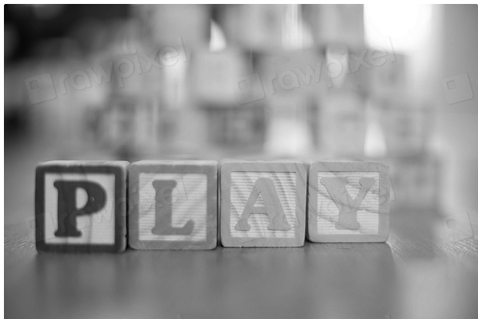
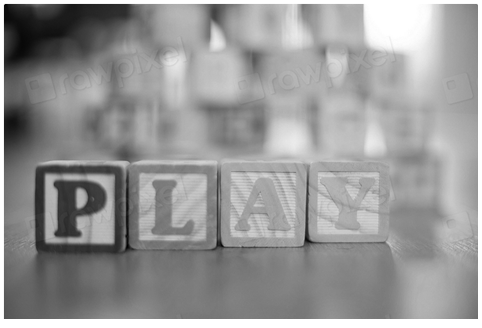
And yet, the linear view permeates everyday thinking about language. It is ingrained in us from early childhood when we play with toy blocks that have letters on them (see Figure 1.1), and later by games like Scrabble and even letter-bead jewelry.
Toy blocks with letters
Our everyday experience in speaking, reading, writing, and understanding the speech of others – like the experience of composing a sentence with which we began this chapter – also makes us think of language in linear terms. The structure of our speech organs requires that we pronounce one sound at a time, in sequence. Similarly, when we write – especially in alphabetic writing systems, like the one that English employs – we represent the linear sequence of sounds that we pronounce with a linear sequence of letters we write.
But as we’ll see in the course of the book, a slightly more careful observation of human language shows that it’s not linear. As with the appearance of ship masts coming up from beneath the water or the barrelman’s location at the top of a mast, you don’t need complex scientific equipment or satellite photography to observe the evidence for language not being “flat,” or linear. You just have to pay attention to phenomena observable with the naked eye.
How We Compose a Sentence
Let’s ponder more closely the 10-word-sentence exercise: What exactly did you do to compose a ten-word sentence? Did you pick some 10 words that first came to mind and then put them in a certain order to make a sentence? Did you think of the first word of your sentence first and then considered what word should come after it, and what word should come third, and so on? Did your first attempt at a 10-word sentence even have exactly ten words at all? The answers to these questions are no, no, and not necessarily.
Let’s use my 10-word sentence to illustrate, but the same points can be made about the sentence you’ve composed. (As I’m writing this book in a café on London’s Baker Street, my examples revolve around Sherlock Holmes, Doctor Watson, etc.) Here’s my sentence:
The world’s greatest detective praised Watson for this astute observation.
But this was not the first sentence I attempted: at first, I wrote down:
The world’s greatest detective praised his friend for this astute observation.
However, when I counted the words, I realized that there was one word too many, so I had to rework the sentence to have exactly ten words, as required by our exercise. I considered dropping out astute or world’s and finally settled on substituting the name Watson for his friend. Evidently, what didn’t happen is me first making a list of ten random words that first came to mind and then composing a sentence out of these words.
In fact, if I had asked you to make a list of the first ten words that come to your mind, you probably would have made a list of words that would not be easy to make a sentence out of. I tried this exercise with a few of my friends and students, without telling them to compose a 10-word sentence first, and all of them created word lists that suffered from the same flaw: they were mostly nouns, with a few adjectives and verbs thrown in for good measure. (Nouns are words like cat, banana, or observation; adjectives are words like big, best, or astute; verbs are words like do, jump, or praise.) But what these lists were all lacking is little grammatical words like the and for. Yet, although such words are necessary to make an adequate sentence we rarely think of them as “words,” or count them as words for purposes of word games like Scrabble. Interestingly, random word generators like the one found at RandomLists.com, produce lists that suffer from the same flaw. Here are some of the lists it generated:
learn
witty
erratic
achiever
fertile
bathe
illegal
sisters
loving
north
alcoholic
gamy
bounce
sweet
bolt
jealous
precious
road
disillusioned
furniture
imminent
snobbish
lucky
unwritten
stuff
thankful
treat
beef
excuse
stiff
If there’s any difference between these computer-generated lists and those produced by humans, it’s that the former have more adjectives and verbs and fewer nouns than the latter. But there is not a single grammatical word in any of these lists. You just can’t make a sentence using all and only words in such a list.
So, if we don’t compose a sentence by first picking all the words that would go into that sentence, perhaps we just pick the first word with which to start the sentence, and then pick each consecutive word? That is hardly the case. I certainly didn’t start composing my sentence above by thinking of the word the first, then pondering what is a good word to put after the. Similarly, if I asked you what is a good word to put right after Watson, I doubt you would come up with the word for. And this is, maybe, not the most likely word to come to mind as the next word after for. Although Google finds 1.83 million hits for the exact sequence Watson for and nearly 5,000 times as many for the sequence for this, when I asked human speakers of English to continue the sentence with one word, not a single one of them offered for after Watson or this after for. Our human mind just doesn’t work like that.
So how do we compose sentences? This is the question to which we turn next.
Intuitive Chunking
If we don’t compose sentences by selecting the words we would need and then ordering them a certain way, how do we build sentences out of words? Let’s take another look at my example sentence, repeated here from above:
Intuitively, we sense that some sequences of words within this sentence “go together” in a way that other sequences of words don’t. For example, the three-word sequence this astute observation forms such an intuitive chunk. But not any three words in a row in this (or any other) sentence do. Thus, three-word sequences Watson for this, the world’s greatest, or praised Watson for do not form a chunk in the same intuitive way. (Linguists call such intuitive chunks “constituents,” but I’ll use the simpler term “chunk,” as well as “chunking” for the way that a given sentence can be broken down into chunks.)
A chunk doesn’t need to consist of exactly three words: It can be two-, three-, four-words long, or even longer. In a banal way, even a one-word sequence is also a chunk, but here we’re mostly interested in chunks that have more than one word in them. In our example sentence, praised Watson is a two-word chunk, and the world’s greatest detective is a four-word one.
While we have a certain gut feeling about chunking a given sentence, in science we don’t want to rely purely on our subjective intuitions and gut feelings. We want to have objective diagnostics for a given phenomenon or measure. Are there any such objective diagnostics that would tell us what is or isn’t a chunk? Yes, there are several. Here, I’ll introduce you to just two such diagnostics, called “substitution” and “cleft.” Let’s consider them one at a time. The first diagnostic consists of replacing a given string of words with a single word, without losing the original meaning. Chunks can be replaced in this way, but random nonchunk strings of words cannot. (One should be careful with this test, because not all chunks are replaceable in this way. That’s why I’ll introduce a second test shortly.) For instance, the four-word sequence the world’s greatest detective in our example sentence can be replaced by he:

Similarly, the three-word sequence this astute observation can be replaced by it:

However, pronouns like he and it can only replace certain types of chunks but not others. For example, if I ask you who praised Watson for his astute observation, you might respond with:

What does the word did mean here? It replaces a six-word sequence: praised Watson for his astute observation, which tells us that this string of words constitutes a chunk too.
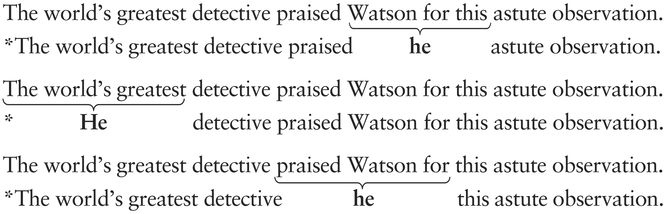
But crucially, if we select a random sequence of six word in a row that doesn’t constitute a chunk and try to replace it with one of those words – he, it, or did – we get gibberish and not a plausible sentence at all. Following a commonly accepted linguistic notation, I’ll use an asterisk before a sentence, phrase, or word that is gibberish in the language in question. For example, the six-word sequence world’s greatest detective praised Watson for in my original sentence can’t be replaced by he, it, or did – because it’s not a chunk.

Figure 1.104 Long description
The sentence The worlds greatest detective praised Watson for this astute observation appears at the top. A curved bracket links the subject and verb phrase The worlds greatest detective praised Watson for to three lines below. The first line shows the substitution The he this astute observation. The second line shows The it this astute observation. The third line shows The did this astute observation. Each line begins with an asterisk.
The same is true no matter how long of a sequence of words we take: the bottom-line is that not any random two, or three, or four words in a row constitute a chunk. As we noted above, Watson for this, the world’s greatest, and praised Watson for intuitively do not seem to form a chunk, and our substitution test shows the same: There’s no substitution word that we could replace those sequences with to get a plausible sentence of English. Here is what we get when attempting substitution with he (you can try the same with it or did):
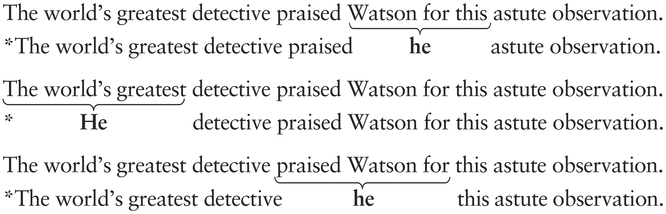
Figure 1.105 Long description
Each pair shows the sentence The worlds greatest detective praised Watson for this astute observation. In the first example, the phrase Watson for this is linked by a curved bracket to the pronoun He in the ungrammatical sentence The worlds greatest detective praised he astute observation. In the second, the phrase The worlds greatest is linked to He in He detective praised Watson for this astute observation. In the third, the phrase praised Watson for is linked to He in The worlds greatest detective he this astute observation.
Let’s recap what we’ve seen so far: Some sequences of words in a sentence intuitively seem to group together, and we can typically replace them by the right kind of pronoun or similar “substituting word.” There are other ways to distinguish chunks from random strings of words: for example, moving some words around in a sentence. One way to do this is with the so-called “cleft construction,” which goes like this: it was __ that…. Chunks can be taken out of their place in the original sentence and put where the underscore is in the sentence above. Nonchunks cannot go into a cleft construction. For example, four-word sequences the world’s greatest detective and for this astute observation can be placed in a cleft:
It was the world’s greatest detective that praised Watson for this astute observation.
It was for this astute observation that the world’s greatest detective praised Watson.
But four-word strings of words that don’t form a chunk, like world’s best detective praised or praised Watson for this, when put into a cleft, result in gibberish. (I use the wavy underlining to mark random sequences of words that don’t form a chunk.)
*It was world’s greatest detective praised that the Watson for this astute observation.
*It was praised Watson for this that the world’s greatest detective astute observation.
A chunk doesn’t have to contain exactly four words in order to be able to go into the cleft. It can have any number of words – for example, three:
It was this astute observation that the world’s greatest detective praised Watson for.
Or even just one:
It was Watson that the world’s greatest detective praised for this astute observation.
Yet, as we’ve seen above with four-word strings that aren’t a chunk, two- or three-word strings that aren’t a chunk can’t go into a cleft either:
*It was Watson for that the world’s greatest detective praised this astute observation.
*It was Watson for this that the world’s greatest detective praised astute observation.
There are other ways to separate chunks from nonchunk strings of words, which similarly align with our intuitions about which words “go together” in a sentence, but we’ve already learned something important: Sentences consist not just of words but of chunks.
Before we proceed further, it is important to note that whether a certain sequence of words forms a chunk or not is relative to a given sentence: the exact same string of words may be a chunk in one sentence but not in another. Let’s take, for example, the string for this astute observation: we’ve already seen that it forms a chunk in my original sentence, and as such it can go into the cleft construction:
It was for this astute observation that the world’s greatest detective praised Watson.
But what if the same string of words occurs in a different sentence:
For this astute observation to be proven wrong is impossible.
Does the string for this astute observation form a chunk here? We can test it in the same way – with the cleft-construction:
*It was for this astute observation that to be proven wrong is impossible.
What we get is gibberish and not a sentence of English, which I marked by an asterisk. This tells us that in this new sentence the string for this astute observation isn’t a chunk.
Let’s pause now and reflect on what we’ve learned so far: We’ve seen that sentences are best analyzed not as sequences of individual words but as consisting of chunks, which we have intuitions about and which can be diagnosed by applying such tests as substitution and the cleft construction. But did that get us away from a linear view of language? Not at first glance: Instead of thinking of sentences as sequences of individual words, we can think of them as sequences of chunks, but it still would be all about linear sequences where one chunk comes after another. For example, our original sentence (repeated below so you don’t have to turn the pages back and forth) is not just a linear sequence of ten words, but a linear sequence of three chunks, marked by brackets:
[The world’s greatest detective] [praised Watson] [for this astute observation].
However, in the following pages, we’ll begin to divorce ourselves from this linear view by taking a closer look at what we’ve learned about sentence chunks.
But before we do that, I would like to pause again for self-reflection: What we’ve just done was look at sentences (and more generally, at language) in an objective, scientific way. We didn’t use them to communicate ideas nor did we think about how we feel about these sentences from an aesthetic point of view. What we did, instead, is look at their structure and how it can be manipulated. This is exactly what linguists as scientists do.
Chunks Aren’t Purely Sequential
Remember our discussion in the prologue about flat-earthers’ views of what the world looks like? English physicist and cosmologist Stephen Hawking opens his book, A Brief History of Time, with a story of a well-known scientist meeting a little old lady who believed in the flat Earth. The same story is told about different scientists in different sources: Hawkings says that the scientist in question was mathematician and philosopher Bertrand Russell, although my colleague, linguist John R. Haj Ross, in his now-classic 1967 dissertation titled Constraints on Variables in Syntax, tells the same story about the Harvard psychologist and philosopher William James. Whoever the scientist in the story was, he tried to gently dissuade his opponent who believed that the world is really a flat circle supported on the back of a giant turtle by asking her what that turtle stands on. To that the little old lady replied that the first turtle stands on the back another, larger turtle. And when questioned what the second turtle stands on, the old lady replied with a triumphant smile: “You’re very clever, young man, very clever, but it’s turtles all the way down!”
The anecdotal little old lady’s belief in the Earth standing on series of turtles is clearly a fallacy, but I like this story as a metaphor for how human language is organized: As we’ll see in the course of this book, when it comes to language, “it’s chunks all the way down,” to the level of individual words and even sounds. In the rest of this chapter and in the next one, we’ll see that sentences are organized into nested chunks, that is, chunks put inside bigger chunks like Russian matryoshka dolls. (We’ll come back to this notion of nesting shortly below.) This nonlinear organization permeates language all the way down to individual words, and, as we’ll discover in the subsequent chapters, words also consist of identifiable chunks, all the way down to individual sounds. And this multilayered chunking means that language doesn’t work in a linear way!
Let’s get back to our sample sentence we’ve been working with. At the end of the previous section, we saw that it consists of three large chunks that follow one after another:
[The world’s greatest detective] [praised Watson] [for this astute observation].
But if we take a closer look, we’ll find more chunks hidden inside those three big chunks, “all the way down” to individual words. It’s easiest to see this with the middle chunk which consists of just two words: As mentioned above, each word is its own chunk as well. Let’s add more brackets to keep track of the chunks we identify:
[The world’s greatest detective] [[praised] [Watson]] [for this astute observation].
Let’s now turn to the third big chunk: for this astute observation. Actually, we’ve already discovered that the string this astute observation forms a chunk: It can be replaced by it or moved into the cleft construction. The word for is, by default, a one-word chunk. More brackets are needed:
[The world’s greatest detective] [[praised] [Watson]] [[for] [this astute observation]].
What about the chunk this astute observation? There is another smaller chunk hiding within it: astute observation. To prove its existence, we need to introduce another substituting word, one. While pronouns like he or it replace phrases like the world’s greatest detective and this astute observation, one replaces a subpart of such phrases that leaves behind the article the or a demonstrative this or that. We do that when we say about someone that he or she is “the one,” or when we compare this one and that one. In a conversation where I say something about an astute observation, you can reply with:

This substitution test tells us that astute observation is a chunk, so let’s add some more brackets, leaving this as its own one-word chunk as well:
[The world’s greatest detective] [[praised] [Watson]] [[for] [[this] [astute observation]]].
Since each word is a chunk, let’s mark astute and observation as chunks as well:
[The world’s greatest detective] [[praised] [Watson]] [[for] [[this] [[astute] [observation]]]].
All that is left to do now is to decompose the first big chunk, the world’s greatest detective. Perhaps less than obvious here is that the string the world forms a chunk, but we can show that by replacing it with it, which together with ’s gives us its. The sequence greatest detective forms a chunk as well, replaceable with one. Each word, as before, is its own chunk as well. We can draw yet more brackets, but as it gets difficult to process visually, I’ll use another notation below, underlining each chunk we’ve identified.

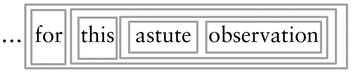
There are other notations we could use to mark chunks, besides brackets or underlining. We could put each chunk in its own little box. I’m doing it here for just a part of our sentence, to save space:
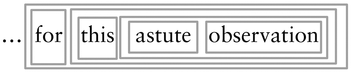
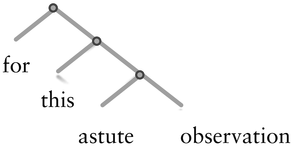
Or we could use a notation where words that form a chunk are connected into a “family tree”-like diagram. Each node where two lines meet represents a chunk. Again, I will do it here just for the same part of our sentence:
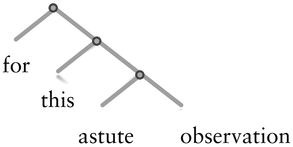
All of these notations say exactly the same thing: They show how our sentence is chunked – which we know to diagnose with tests like substitution and the cleft construction – and these chunks are organized not purely sequentially, but hierarchically. While the first three big chunks follow one another in a linear fashion, each of them also contains smaller chunks inside. The overall inner organization of a sentence is, therefore, not linear. It’s chunks all the way down!
Language versus Genetic Code
Before we continue to explore the idea that human language is organized in this chunks-all-the-way-down way, an important comparison must be drawn between human language and genetic code. When books similar to this one explain how genes work to nonspecialists, they often compare a genetic code to a language: An individual’s genome is like a book, genes are sentences, composed of smaller, word-like elements called codons. But this comparison goes only so far! There’s a major difference between how language works and how genetic code works: The latter is linear whereas the former is not.
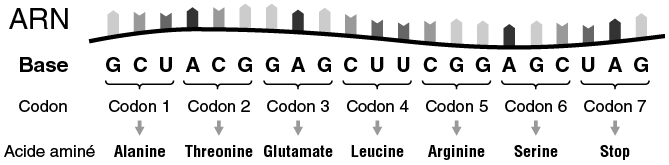
Let’s take a closer look at the workings of a genetic code. There are only four “letters” in the genetic code, which stand for four nitrogen-containing nucleobases: cytosine “C,” guanine “G,” adenine “A,” and thymine “T” (in DNA; in RNA the latter is replaced by uracil or “U”). So, a gene – and we’ll set aside the noncoding DNA for now – is a long sequence of these four letters: for example, TTACGTACGTTTACAGACTAGTGCCA and so on. But what do these sequences “mean”? Genes are sort of recipes for creating protein molecules, and proteins consist of amino acids. But the letters themselves do not code directly for amino acids. Rather, it is sequences of exactly three letters in a row that encode an amino acid. Such sequences of three letters are called “codons” (Figure 1.2).
Codons as sequences of three letters that code for amino acids
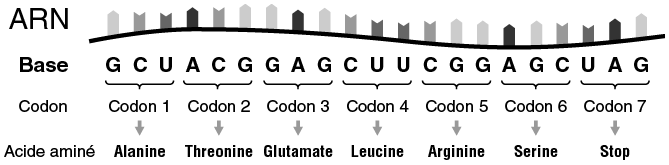
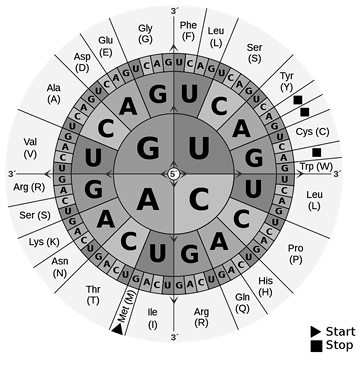
With three positions in a codon and four letters that can occupy each of these positions, there are 64 codons possible (Figure 1.3). But there are only 22 amino acids incorporated into proteins. Most amino acids can be encoded by different yet synonymous codons. For example, glutamic acid, which serves as an excitatory neurotransmitter, is encoded by the codons GAA or GAG. Glycine, an inhibitory neurotransmitter, is encoded by all the codons starting with GG: GGU, GGC, GGA, GGG. Tryptophan, an important chemical that is a precursor to the neurotransmitter serotonin, the hormone melatonin, and vitamin B3, is encoded solely by the codon UGG. Three of the RNA codon sequences – UAG, UGA, and UAA – do not encode an amino acid but rather signal the end of protein creation and are thus known as “stop codons.”
The standard RNA codon table organized in a wheel
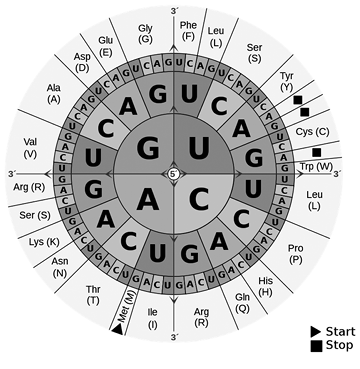
In other words, the “sentences” of the genetic code that are genes consist of “chunks,” the codons, but these chunks are organized in a purely sequential way. What matters is which codon follows which one. There are no codons or other organizational units inside codons. Moreover, there’s no interaction between neighboring codons and no closer interaction between some codons than between others. Nor is there any interplay between codons that are separated from each other by other codons. Yet, as we’ll see in the course of this book, all these things are not only possible but vital to the organization of actual sentences in human languages. Thus, although nature created human language, it’s nothing like the “language” of nature itself – the genetic code. Let’s now go back to human language and see how chunks are organized in language.
Chunks Nest but Don’t Overlap
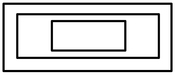
Since the Covid-19 pandemic times, like so many of us, I began shopping almost exclusively online: A couple of days after I make a few clicks on my phone, the necessary goods miraculously arrive at my doorstep, packaged in cardboard boxes. As a result, I now have a lot of empty cardboard boxes that need to be recycled and before that, stored somewhere. To make them take up less room, I can put smaller boxes inside bigger ones. This configuration is called “nesting.” (As I am not good at drawing, I’m going to use a simple rectangle to symbolize each box.)
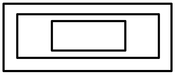
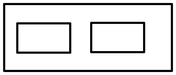
Sometimes two smaller boxes can be placed inside a bigger one, side by side – this is also nesting:
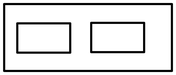
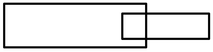
Crucially, what is not physically possible is to place the boxes in a partially overlapping, or intersecting, or intertwined configuration, like so:
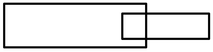
As it so happens, the chunks that form sentences in language are just like cardboard boxes: They can be nested but not partially overlapping, as in the diagram above. This limitation on the organization of chunks is, for instance, the reason why a given sentence might have certain meanings but not certain other conceivable meanings. To illustrate this, let’s consider more closely the relationship between the chunks of which a given sentence consists and its meaning.
To continue with our Sherlockian theme, let’s think about the meaning of the following sentence:
The diamond was reported stolen by the Count.
This sentence has two different meanings; it’s what’s called “ambiguous.” The bold-faced chunk by the Count can describe either the reporting or the stealing. (We can ascertain that by the Count is indeed a chunk by applying, for example, the cleft test: It was by the Count that the diamond was reported stolen.) One interpretation of this sentence is that the Count reported the theft, committed presumably, though not necessarily, by someone else. The other interpretation is that someone reported that the Count stole the diamond; perhaps the Count in question is also an infamous jewel thief. Without further context or clarification, we can’t tell which meaning the author of this sentence intended. In this respect, such ambiguous sentences are like visually ambiguous images of the “young woman or old woman” or “vase or two face profiles” variety.
That the exact same string of words may have two interpretations is another nail in the coffin of the idea that language is organized purely linearly: After all, if linear order is all there is to language, how can the exact same string of words have two meanings? The words are the same, their order is the same – so what gives? The idea that sentences consist of chunks, which are nested like cardboard boxes in my garage, offers an explanation for this kind of ambiguity: The same string of words can be dissected into chunks in more than one way. And the meaning of a sentence goes hand in hand with the chunks of which it consists. The sentence about reporting the theft of the diamond can be chunked in two different ways, represented below by box diagrams. (You can practice different notations if you please.) The first diagram corresponds to the meaning whereby the Count did the reporting, and the second diagram corresponds to the meaning whereby the Count did the stealing.


The exact same thing applies if instead of the chunk by the Count we have a word such as yesterday:
The diamond was reported stolen yesterday.
This sentence can mean that either the report about the theft of the diamond was made yesterday (with theft itself happening some time earlier, maybe last week) or that the theft occurred yesterday (with the report being made some time later, maybe today). Again, without context or clarification, we can’t tell which meaning was intended. Once again, that this sentence can have two different meanings has to do with it being a possible result of two different ways of chunking. (You can test yourself by drawing the diagram corresponding to each of the meanings.)
Now let’s combine those two ambiguous sentences into one:
The diamond was reported stolen by the Count yesterday.
Since we’ve seen that by the Count can describe either the reporting or the stealing, and yesterday similarly can describe either the reporting or the stealing, we might assume that this combined sentence can have four different meanings:
| reported yesterday | stolen yesterday | |
|---|---|---|
| reported by the Count | The Count made a report yesterday about the theft of the diamond (by someone else, earlier) | The Count made the report (say, today) that someone else stole the diamond yesterday. |
| stolen by the Count | The Count stole the diamond (say, last week), but someone else reported it yesterday. | The Count committed the theft yesterday and someone else made the report, possibly today |
It seems that we might need Sherlock Holmes just to deduce what a simple sentence of English means! But actually, we can manage on our own, by asking ourselves which of the four situations depicted above can be described by using exactly the sentence above. It would help to imagine each of the situations in turn and to pronounce the sentence out loud each time. But please make sure you don’t change the sentence in any way!
Hopefully, the conclusion you come to is exactly the conclusion that numerous other speakers of English have come to: The sentence in question has only three out of four conceivable interpretations. It simply cannot have the meaning shown in the shaded cell in the table above: that the Count made the report (say, today), about the theft that occurred yesterday. We are perfectly able to imagine such a situation, but we cannot describe it by the sentence as given. What’s stopping us from understanding this sentence in this way? To get this string of words to mean that, we would need to have two chunks that are overlapping but not nested, which I tried to depict below with the box-style notation:

The problem is that this kind of configuration where sentence chunks interweave rather than nest is not possible. It is a Law of Language, much like the Law of Nature that prevents two cardboard boxes from adopting a similar interweaving configuration.
This no-overlapping principle of sentence organization is a general one, not just something about passive sentences like the one we’ve looked at above. We can see its effects in various sentences but for now let’s just take a quick look at one more:
The detective sent a telegram to the politician from London.
This sentence is also ambiguous, but it can have only two out of three conceivable meanings: It can mean that the politician is from London or that the telegram originated from London. What it can’t mean is that the detective in question is from London. To express that meaning, we have to move the chunk from London so that it is contiguous with the detective:
The detective from London sent a telegram to the politician.
Now that we’ve looked at how meaning and chunking of sentences are connected, let’s think about how we extract meaning from … silence. Or more precisely, how we extract meaning even from what is not said out loud.1
Incomplete Sentences Involve Chunks Too
Thus far we’ve focused on sentences, which we’ve concluded consist of chunks, which in turn consist of chunks, and so on to the level of individual words: “It’s chunks all the way down!” But we don’t always speak in full sentences. In real conversations, we often speak in smaller strings of words that do not form a complete sentence. In fact, the most typical way to answer a question is by using a fragment, a sequence of words that isn’t a complete sentence:
— Who is this movie about? — The world’s greatest detective.
— What will he do? — Praise Watson.
— What is he famous for? — His astute observations.
Are such fragments subject to the same principle of “chunks all the way down” as full sentences? The answer is yes. Each fragment answer is itself a chunk, consisting of smaller chunks, all the way down to individual words. There is no conceivable question in English that anyone could possibly answer with a nonchunk string like Praise Watson for or Watson for this, or any other string that doesn’t form a chunk. Linguists and language teachers alike pay so much attention to complete sentences exactly because even when we speak not in complete sentences, we speak in fragments of complete sentences that are necessarily chunks. If you know how to speak in full sentences, you’ll also know how to make fragments, but not vice versa.
Interestingly, not only can we speak in fragments that are chunks, but our attention and memory are geared to working with chunks rather than nonchunk strings of words. In their article published in 1982, linguists Charles Read and Peter Schreiber describe an experimental study they’d conducted with seven- and eight-year-old children whose task it was to try to mimic the way one experimenter repeated back snippets of another experimenter’s sentences.2 Some of these snippets were chunks, in the sense I use in this book, and others were random, nonchunk strings of words. According to the researchers, none of the children were able to correctly repeat the nonchunk strings as reliably and as many times in a row as they did with chunks. In a later chapter, we’ll see additional evidence that we process the language we hear by reconstructing the chunks the speaker intended. But for now, let’s go back to incomplete sentences.
In addition to fragment answers, which aren’t complete sentences, we sometimes speak in sentences that appear to miss a piece. (Linguists call this phenomenon “ellipsis.”) As listeners (or readers) we reconstruct the meaning of the missing piece (marked in examples below with a square) as “echoing” something that is said explicitly (which is underlined in these examples):
Watson questioned the butler’s account, and Holmes questioned the valet’s ❒.
Holmes would notice every detail, but Watson wouldn’t ❒.
Holmes said he suspected the butler, but he didn’t tell Watson why ❒.
You can see this “echoing” effect by changing the first part of these sentences; the meaning of the second part changes accordingly:
Watson questioned the butler’s wife, and Holmes questioned the valet’s ❒.
Holmes would ignore attractive women, but Watson wouldn’t ❒.
Holmes said he liked Irene Adler, but he didn’t tell Watson why ❒.
Unlike fragment answers, which as we’ve seen above, are themselves chunks, what’s left when part of the sentence is not said explicitly doesn’t necessarily constitute a chunk. In our examples, Holmes questioned the valet’s, Watson wouldn’t, and he didn’t tell Watson why aren’t chunks. (You can verify that by using the tests we’ve established in the previous section: substitution and the cleft construction.) However, it doesn’t mean that sometimes we speak in bits and bobs for which our idea of nonsequential chunks is completely irrelevant. Although what’s left behind in such incomplete sentences isn’t a chunk, what’s left out is. In other words, the little square in my examples above stands where a chunk – and only a chunk – can be inserted.
The take-home message of this brief introduction into complete and incomplete sentences in which we speak is that these are not merely strings of words, one following another, but rather sets of nonlinear, nested chunks. How we build sentences and fragments and how we understand them is based on these chunks, organized crucially in a nonlinear fashion. In the next chapter, we’ll explore this idea further by looking into rules of the mind that are the building blocks of language.