


Inspired by Mitchell et al.’s (Reference Mitchell, Haslam, Burke and Steffens2026) thought-provoking perspective that leader narcissism can be stimulated by hyperpersonalizing HR practices (or suppressed by depersonalizing HR practices), we offer three related comments. Building upon large-scale empirical research on narcissism in the workplace, we first note that narcissism exhibits an inverted U-shaped relationship with leader effectiveness (Grijalva et al., Reference Grijalva, Harms, Newman, Gaddis and Fraley2015). As such, HR practices that enhance narcissism might actually improve leader effectiveness and organizational outcomes, in some cases. Second, narcissism’s facets occupy different positions in the nomological network, with the leadership/authority facet of narcissism exhibiting positive effects on work behavior and the entitlement/exploitativeness facet of narcissism exhibiting negative effects (Grijalva & Newman, Reference Grijalva and Newman2015). Finally, established gender gaps in narcissism (Grijalva et al., Reference Grijalva, Newman, Tay, Donnellan, Harms, Robins and Yan2015) imply that when HR practices stimulate narcissism unequally across gender groups, such practices might be used to either exacerbate or to diminish gender gaps. Overall, what the three issues broached in the current commentary—that is, nonlinearity, narcissism’s facets, and gender—have in common is that all three suggest novel effects in the opposite direction from those proposed by Mitchell et al. For instance, the hyperpersonalizing HR practices proposed to stimulate narcissism, alleged by Mitchell et al. to be harmful, could actually be deemed beneficial if they are targeted at: leaders who are initially very low in narcissism (the nonlinearity implication), the leadership/authority facet of narcissism (the adaptive facet implication), and female leaders (the gender gap-closing implication).
Mitchell et al. provide a timely call to I-O psychologists, HR scholars, and HR practitioners to view leader narcissism as a dynamic output of organizational practices instead of a static individual characteristic forged only by early life experiences (e.g., parenting style). Leveraging self-categorization theory (SCT), they theorize how particular sets of HR practices might inadvertently stimulate or suppress a leader’s narcissistic tendencies. For example, hyperpersonalizing HR practices (e.g., hypercompetitive selection, exorbitant pay) are proposed to cultivate and promote a leader’s identity as special, heroic, and superior, and/or to attract leaders with such identities.
The speculation that HR practices might contribute to leader narcissism has intuitive appeal and theoretical support, and we join Mitchell et al. in their call for empirical research on this topic. If it turns out to be true that hyperpersonalizing HR practices can indeed stimulate leader narcissism, we would like to offer three caveats about when such a process would ultimately be destructive (or not) to the organization. These three important considerations all emerge from empirical evidence that suggests that leader narcissism is not universally detrimental to leadership effectiveness or organizational outcomes.
Nonlinear relationship
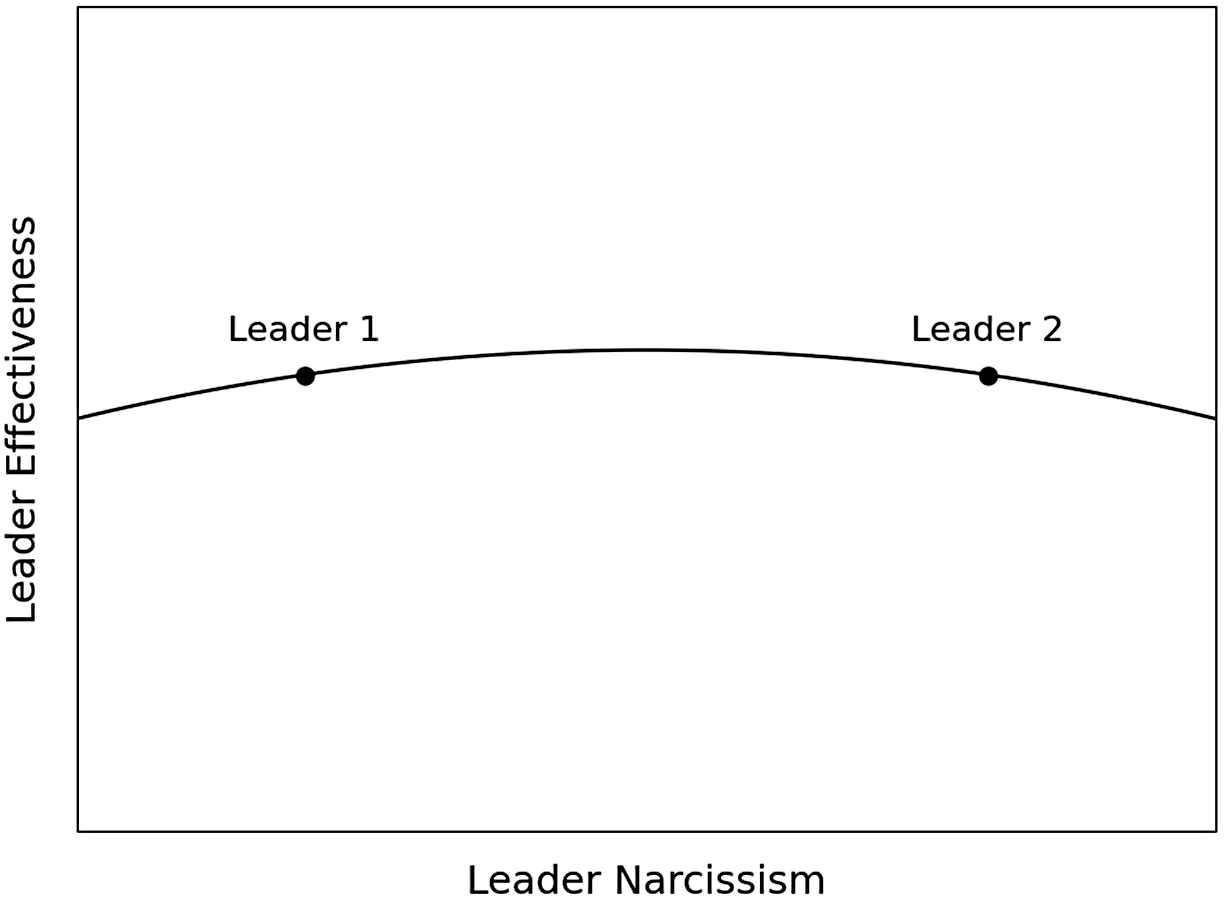
Meta-analytic evidence suggests a complex relationship between leader narcissism and leadership effectiveness (Grijalva et al., Reference Grijalva, Harms, Newman, Gaddis and Fraley2015). Although leader narcissism is related to leader emergence (being chosen as a leader), leader narcissism is not correlated with leader effectiveness (r = 0.02; ns). Instead, narcissism has a nonlinear association with leader effectiveness (inverted U-shape), wherein moderate levels of narcissism coincide with maximal leader effectiveness, and both lower and higher levels of narcissism coincide with less leader effectiveness (Grijalva et al., Reference Grijalva, Harms, Newman, Gaddis and Fraley2015).
Given this nonlinearity in leader narcissism’s effects on leadership effectiveness, we suggest that whether stimulating (or suppressing) leader narcissism is harmful to leadership may depend upon where the leader falls in the trait range of narcissism. For example, in Figure 1, an increase in narcissism can correspond to either an increase or decrease in leader effectiveness for Leader 1, depending on the magnitude of the increase. However, an increase in narcissism could only correspond to a decrease in leader effectiveness for Leader 2. The inverse would be true if an intervention were to suppress narcissism. This example illustrates the importance of considering a leader’s initial level of trait narcissism, because an HR practice that stimulates leader narcissism might actually improve leader effectiveness in some cases (e.g., see Figure 1, Leader 1).
Leader Effectiveness as a Function of Leader Narcissism.

Facets of narcissism
Like Mitchell et al., up to this point we have only discussed leader narcissism at the broad domain level; however, narcissism’s facets warrant consideration as well. For example, Grijalva and Newman (Reference Grijalva and Newman2015) found evidence that two of the facets of narcissism as measured by the Narcissistic Personality Inventory (NPI) exhibit distinct and opposing relationships with counterproductive work behavior (CWB). Specifically, the entitlement/exploitativeness facet of narcissism relates positively to CWB (r = 0.28), whereas the leadership/authority facet of narcissism relates negatively to CWB (r = −0.11). In other words, an increase in the entitlement/exploitativeness facet predicts less desirable work behaviors, whereas an increase in the leadership/authority facet of narcissism predicts more desirable work behaviors. Thus, it is important to consider which narcissism facets are specifically being stimulated by hyperpersonalizing HR practices (or being suppressed by depersonalizing HR practices).
For example, hyperpersonalizing practices that emphasize legitimate achievement (e.g., transparent merit-based selection) may both enhance the leadership/authority facet by reinforcing a leaders’ sense of earned status and simultaneously enhance entitlement/exploitativeness through an inflated sense of superiority. The net organizational loss due to hypercompetitive HR practices would then be unclear, because the increased organizational deviance behavior due to inflated entitlement/exploitativeness (a maladaptive facet of narcissism) would be offset by reduced deviance behavior due to inflated leadership/authority (an adaptive facet of narcissism).
To further complicate matters, Grijalva and Harms (Reference Grijalva and Harms2014) proposed that narcissistic leaders’ effectiveness can depend on their match with followers’ characteristics (see Liu et al., Reference Liu, Zheng, Zhang, Liao, Harms, Qin and Yu2025), which may also be shaped by organizational HR practices. Altogether, narcissism is a complex, multifaceted trait, making it difficult to predict the effects of broad HR practices without considering which specific facets are influenced, and for whom (leaders, followers, or both).
Gender differences
To add to this complexity, there is meta-analytic evidence that gender differences in narcissism exist at both overall trait and facet levels. Specifically, Grijalva, Newman et al., (2015) estimate that men are more narcissistic than women (d = 0.26), with mean subgroup differences on the entitlement/exploitativeness facet (d = 0.29) and the leadership/authority facet (d = 0.20). Given these gender differences, if a hyperpersonalizing (or depersonalizing) HR practice is applied unequally across gender groups, it could in theory increase or mitigate the gender gap in narcissism. For example, if elevated leader pay stimulates narcissism, and this HR practice is afforded to men at a greater rate than to women, then Mitchell et al.’s theorizing carries an additional implication that such HR practices might be one source of the mean gender gap in narcissism. Conversely, if a hyperpersonalizing HR practice were preferentially targeted at women (enhancing women’s narcissism), it would in theory serve to reduce the gender gap. These possibilities highlight the need for future research to consider not only whether HR practices influence narcissism but how these effects might vary across demographic groups.
Conclusion
We share the authors’ excitement about the idea that HR practices might stimulate or suppress leader narcissism and look forward to future research that tests and expands upon their theoretical claims. To aid in this pursuit, we raised three additional points about how stimulating leader narcissism might actually have advantages, if: (a) the leader begins at a very low point in the trait range of narcissism, (b) the HR practice stimulates the leadership/authority facet of narcissism in particular, and/or (c) the HR practice is targeted at women, closing the narcissism gender gap.

 Open access

