

Introduction
The annual bluegrass Poa annua L. (Poaceae) is the only non-indigenous flowering plant species that has established a breeding population in the Antarctic. Other alien plant species recorded in Antarctic terrestrial communities for example Nassauvia magellanica J.F. Gmel., Gamochaeta nivalis Cabrera (Smith and Richardson Reference Smith and Richardson2011) have only reached the status of ephemerophytes. A small patch of Poa pratensis L. has been observed since 1954–1955 austral summer season until today at Cierva Point, Antarctic Peninsula (Smith Reference Smith1996; Pertierra and others Reference Pertierra, Lara, Benayas and Hughes2013). In Antarctica this patch is maintained only by clonal spread, there has been no seed production and only incomplete development of the sexual structures (Pertierra and others Reference Pertierra, Lara, Benayas and Hughes2013). The diaspores of Juncus bufonius L. from soil samples collected on King George Island have been found germinating under laboratory conditions in Chile, however the species has not been physically observed in Antarctica (Cuba-Díaz and others Reference Cuba-Díaz, Troncoso, Cordero, Finot and Rondanelli-Reyes2013), as well as a fern, Elaphoglossum hybridum (Bory) Brack. cultured from mineral sediment in cryoconite holes in the ice cap of Signy Island, South Orkney Islands (Smith Reference Smith2013).
With the increase of tourist traffic from Tierra del Fuego to the Antarctic Peninsula region (IAATO 2001–2014) as well as the rise in research activities connected with many scientific programmes (for example Chwedorzewska and Korczak Reference Chwedorzewska and Korczak2010; Greenslade and others Reference Greenslade, Potapov, Russell and Convey2012; Hughes and others Reference Hughes, Lee, Tsujimoto, Imura, Bergstrom, Ware, Lebouvier, Huiskes, Gremmen, Frenot, Bridge and Chown2011; Hughes and Convey Reference Hughes and Convey2014; Tin and others Reference Tin, Fleming, Hughes, Ainley, Convey, Moreno, Pfeiffer, Scott and Snape2009, Reference Tin, Liggett, Maher and Lamers2013), it may be only a matter of time until more plant species are dispersed into west Antarctica. A similar phenomenon has already been observed on sub-Antarctic islands (for example Frenot and others Reference Frenot, Aubry, Misset, Gloaguen, Gourret and Lebouvier1999, Reference Frenot, Gloaguen, Massé and Lebouvier2001, Reference Frenot, Chown, Whinam, Selkirk, Convey, Skotnicki and Bergstrom2005; Gremmen and Smith Reference Gremmen and Smith1999). Harsh conditions prevailing in Antarctica together with other constrains have protected the region from natural colonisation and from invasions of exotic species in the past (Chwedorzewska and Bednarek Reference Chwedorzewska and Bednarek2008, Reference Chwedorzewska and Bednarek2011). Growing intensity of tourism and governmental activities coupled with climate change can break this isolation. The area has recently been warming up rapidly (Turner and others Reference Turner, Barrand, Bracegirdle, Convey, Hodgson, Jarvis, Jenkins, Marshall, Meredith, Roscoe and Shanklin2013). These newcomers are potentially imported every year by human vectors (Chwedorzewska and Korczak Reference Chwedorzewska and Korczak2010; Chown and others Reference Chown, Huiskes, Gremmen, Lee, Terauds, Crosbie, Frenot, Hughes, Imura, Kiefer, Lebouvierh, Raymond, Tsujimoto, Warec, Van de Vijverk and Bergstrom2012a, Reference Chown, Lee, Hughes, Barnes, Barrett, Bergstrom, Convey, Cowan, Crosbie, Dyer, Frenot, Grant, Herr, Kennicutt, Lamers, Murray, Possingham, Reid, Riddle, Ryan, Sanson, Shaw, Sparrow, Summerhayes, Terauds and Wall2012b; Lityńska-Zając and others Reference Lityńska-Zając, Chwedorzewska, Olech, Korczak-Abshire and Augustyniuk-Kram2012; Augustyniuk-Kram and others Reference Augustyniuk-Kram, Chwedorzewska, Korczak-Abshire, Olech and Lityńska-Zając2013; Chwedorzewska and others Reference Chwedorzewska, Korczak-Abshire, Olech, Lityńska-Zając and Augustyniuk-Kram2013; Huiskes and others Reference Huiskes, Gremmen, Bergstrom, Frenot, Hughes, Imura, Kiefer, Lebouvier, Lee, Tsujimoto, Ware, Van de Vijver and Chown2014) and/or already are deposited in the soil seed bank (Wódkiewicz and others Reference Wódkiewicz, Galera, Giełwanowska, Chwedorzewska and Olech2013, Reference Wódkiewicz, Ziemiański, Kwiecień, Chwedorzewska and Galera2014; Cuba-Díaz and others Reference Cuba-Díaz, Troncoso, Cordero, Finot and Rondanelli-Reyes2013). They may await for favorable conditions and establish in the vegetation when environmental conditions ameliorate.
History of expansions in Antarctica
Poa annua was recorded for the first time in Antarctica in 1953 near the ruined whaling station on Deception Island, South Shetland Islands (Skottsberg Reference Skottsberg1954: Fig. 1). According to Longton's (Reference Longton1966) observations conducted during the austral summer season of 1964–1965 the species flowered and produced scattered seedlings. Collected seeds also germinated successfully. This population was destroyed during a volcanic eruption in November 1967 (Collins Reference Collins1969).
In 1967 P. annua together with 38 other alien species (34 angiosperms and four pteridophytes) was experimentally introduced at Factory Cove 60°43′S, 45°36′W (Signy Island, South Orkney Islands, Fig. 1) from Falkland Islands (Edwards and Greene Reference Edwards and Greene1973). Poa annua was the most successful among them. During successive austral summers every year plants have flowered and developed fertile seeds. After three seasons’ research the experiment was destroyed (Edwards and Greene Reference Edwards and Greene1973; Edwards Reference Edwards1980).
Sites in the maritime Antarctic at which Poa annua was recorded.

In a similar experiment concerning the introduction of Nothofagus pumilio (Poepp. et Endl.) Kasser and N. antarctica (G. Forster) Oerst. in the summer of 1954–1955 Poa pratensis was accidently introduced to Cierva Point, Antarctic Peninsula (Corte 1961 after Pertierra and others Reference Pertierra, Lara, Benayas and Hughes2013). In 1981 a single well-established flowering P. annua clump was observed by Smith (Reference Smith and Laws1984) close to Faraday Station 65°15′S, 64°14′W (at present Vernadsky Station, Fig. 1) on Galindez Island (Argentine Islands, Antarctic Peninsula) and was destroyed before 1985 (Smith Reference Smith1996).
The expansion of P. annua in the vicinity of Polish Antarctic Station H. Arctowski 62°09′S, 58°28′W (King George Island, South Shetland Islands, Fig. 1) is very well documented (Olech Reference Olech1996; Olech and Chwedorzewska Reference Olech and Chwedorzewska2011). This permits the estimation of the rate and range of this process during the last 28 years. In the austral summer of 1985–1986 single individuals of annual bluegrass were observed for the first time next to the station living quarters. During next seasons the population of P. annua increased in density and abundance within the original area and expanded into new areas (Olech Reference Olech1996). In the summer season of 2005–2006 P. annua was observed for the first time in tundra communities. In summer 2006–2007 the number of individuals in tundra communities as well as the total number of localities further increased (Olech and Chwedorzewska Reference Olech and Chwedorzewska2008). In summer 2008–2009 an extensive population of P. annua was recorded in a new locality on the deglaciated moraines of the Ecology Glacier, approximately 1.5 km from Arctowski at the area of ASPA (Antarctic Specially Protected Area) 128. This new population was not very numerous and consisted of about 70 individuals occupying about 100 m2 (Olech and Chwedorzewska Reference Olech and Chwedorzewska2011).
During the two Chilean expeditions in 2007–2008 and 2009–2010 individual specimens of P. annua were found further south in new localities situated on the Antarctic Peninsula near the Chilean and Argentinean bases: General Bernardo O’Higgins (63°19′S, 57°54′W), Gabriel González Videla (64°49′S, 62°51′W) and Almirante Brown (64°52′S, 62°54′W). During the second Chilean expedition in February 2010 a single flowering turf was found approximately half a kilometer from Whaler's Bay (62º58′S, 60º33′W), Deception Island. The individual was eradicated from the area (Molina-Montenegro and others Reference Molina-Montenegro, Carrasco-Urra, Rodrigo, Convey, Valladares and Gianoli2012, Fig. 1). The spreading of P. annua and other alien species (see for example Hughes and Worland Reference Hughes and Worland2010; Hughes and others Reference Hughes, Worland, Thorne and Convey2012) in the Antarctic Peninsula region are examples of the expansion process following anthropogenic introduction, discovery, and operator failure to attempt or achieve rapid eradication, illustrating the dangers to Antarctic terrestrial ecosystems and highlighting the necessity to monitor their spread and gather information on their ecology which might be vital to the control and removal of organisms introduced by human agency.
Origin of Poa annua in the Antarctic
The history of human influence in the Antarctic Peninsula region goes back to the beginning of the 19th century. Excessive commercial exploitation took place during the 19th and early 20th century, initially through hunting for seal and, then, whaling. After this period field bases and scientific stations have begun to be established (for example Chwedorzewska Reference Chwedorzewska2009; Tin and others Reference Tin, Fleming, Hughes, Ainley, Convey, Moreno, Pfeiffer, Scott and Snape2009). There is no accurate data concerning when the population of P. annua was observed at Deception Island for the first time. Annual bluegrass could have been introduced to this locality by whalers working in the on-shore station, built in 1912 and abandoned in 1931 or/and by the British (first observation is dated to 1953) running a permanent base from 1944 (Skottsberg Reference Skottsberg1954) to 1967 when volcanic eruption forced their withdrawal (Collins Reference Collins1969). Again in February 2010 a single flowering turf was found on Deception Island. It is unlikely that seeds of P. annua survived the volcanic eruption in 1967, so the most probable vector of this new introduction is human. Presently, on the South Shetland Islands, especially on King George Island, there are several all-year stations with developed infrastructure and a couple of summer field bases. Similarly to Deception Island those stations are often visited by tourists. According to IAATO (data collected regularly from 1991) Arctowski is one of the most frequently visited research stations in the whole Antarctic Peninsula region (Chwedorzewska and Korczak Reference Chwedorzewska and Korczak2010). The number of tourist visits during the last seven austral summer seasons ranged from 350 to 5700 of landing persons per season according to the Arctowski station logbook. As well as the tourist visits, at the same time the number of expedition members working at Arctowski ranged from 13 to 39 bringing more than 50 tons of cargo per year (Arctowski Station logbook). Despite the high tourist traffic in some Antarctic stations, the main introduction routes seems to be associated with the provisioning of the stations by cargo and personnel (Frenot and others Reference Frenot, Chown, Whinam, Selkirk, Convey, Skotnicki and Bergstrom2005; Chwedorzewska and Korczak Reference Chwedorzewska and Korczak2010; Chown and others Reference Chown, Huiskes, Gremmen, Lee, Terauds, Crosbie, Frenot, Hughes, Imura, Kiefer, Lebouvierh, Raymond, Tsujimoto, Warec, Van de Vijverk and Bergstrom2012a, Reference Chown, Lee, Hughes, Barnes, Barrett, Bergstrom, Convey, Cowan, Crosbie, Dyer, Frenot, Grant, Herr, Kennicutt, Lamers, Murray, Possingham, Reid, Riddle, Ryan, Sanson, Shaw, Sparrow, Summerhayes, Terauds and Wall2012b; Lityńska-Zając and others Reference Lityńska-Zając, Chwedorzewska, Olech, Korczak-Abshire and Augustyniuk-Kram2012; Augustyniuk-Kram and others Reference Augustyniuk-Kram, Chwedorzewska, Korczak-Abshire, Olech and Lityńska-Zając2013; Chwedorzewska and others Reference Chwedorzewska, Korczak-Abshire, Olech, Lityńska-Zając and Augustyniuk-Kram2013; Huiskes and others Reference Huiskes, Gremmen, Bergstrom, Frenot, Hughes, Imura, Kiefer, Lebouvier, Lee, Tsujimoto, Ware, Van de Vijver and Chown2014) and earlier by industrial activity in the sub-Antarctic as well as in the Antarctic (Frenot and others Reference Frenot, Chown, Whinam, Selkirk, Convey, Skotnicki and Bergstrom2005).
According to available historical data one can make the hypothesis that at Arctowski station the diaspores of P. annua probably originated from Poland, most likely from unsterilised soil for the greenhouse transported to the station in 1978. This is supported by observations conducted during 2000–2001 Polish Antarctic Expedition when emergence of P. annua seedlings was observed in the greenhouse building in a box containing soil destined for incineration (Chwedorzewska personal observation). This hypothesis was also supported by investigations conducted during three austral summer seasons (2007–2008, 2008–2009, 2009–2010). In a subsequent study the cargo, clothes and equipment of the Polish Antarctic Expeditions to Arctowski were examined for the presence of alien propagules. This study showed that a substantial number of non-indigenous propagules enters Arctowski every year (Lityńska-Zając and others Reference Lityńska-Zając, Chwedorzewska, Olech, Korczak-Abshire and Augustyniuk-Kram2012; Augustyniuk-Kram and others Reference Augustyniuk-Kram, Chwedorzewska, Korczak-Abshire, Olech and Lityńska-Zając2013; Chwedorzewska and others Reference Chwedorzewska, Korczak-Abshire, Olech, Lityńska-Zając and Augustyniuk-Kram2013). Among them were caryopses and remains of spikelets of P. annua. Diaspores are probably most effectively transported in the crannies of field footwear. The majority of cargo and station personnel came directly from Poland. This seems to point out that annual bluegrass originated from that country and was probably introduced to Antarctica not once but through multiple events (Lityńska-Zając and others Reference Lityńska-Zając, Chwedorzewska, Olech, Korczak-Abshire and Augustyniuk-Kram2012). However, some cargo, mainly fresh products, were brought from Argentina or Chile, therefore the introduction from different sources could not be excluded (Chwedorzewska and others Reference Chwedorzewska, Korczak-Abshire, Olech, Lityńska-Zając and Augustyniuk-Kram2013). This evidence supports the hypothesis of constant flow of fresh genetic material of this species to the vicinity of the station, which is reflected by an astonishingly high genetic variability in the introduced population in comparison with Polish populations (Chwedorzewska Reference Chwedorzewska2008; Chwedorzewska and Bednarek Reference Chwedorzewska and Bednarek2012). Thus new more restrict phytosanitary regulations were introduced to Arctowski in 2013 in order to protect this area from further invasions of species whose potential vector can be the human and/or their activities (Non-native Species Manual 2011).
During the 2009–2010 growing season P. annua was recorded for the first time on the Antarctic Peninsula near Chilean and Argentine bases, and these findings were also attributed to the presence of tourists or national operator staff (Molina-Montenegro and others Reference Molina-Montenegro, Carrasco-Urra, Acuña-Rodríguez, Oses and Chwedorzewska2014). The Argentine base Almirante Brown is one of the most visited stations in the Antarctic with ca. 11,000 landed visits during the season of 2009–2010. Similarly, Chilean base Gabriel González Videla received ca. 2,000 landed visits (IAATO 2001–2014). On the other hand, scientific and logistic activities in these places have increased considerably in the last time. For example, the number of Chilean scientific projects concerning Antarctica and scientists’ visits to the region have increased over two-fold in the last 10 years, with a consequent expansion and construction of the bases. Thus, tourists as well as scientists, and logistic operators could be responsible for the introduction, establishment and spread of P. annua in the Antarctic (Molina-Montenegro and others Reference Molina-Montenegro, Carrasco-Urra, Acuña-Rodríguez, Oses and Chwedorzewska2014).
Supply for the Antarctic stations is loaded mainly from disturbed areas, like farms and holding areas in ports, where both the abundance and diversity of invasive species from elsewhere in the world is huge (Slabber and Chown Reference Slabber and Chown2002; Lee and Chown Reference Lee and Chown2009a, Reference Lee and Chown2009b). Thus the sources of introduction of P. annua to those localities may be very diverse but most likely the main points of origin are Central Europe and South America.
Habitats
Poa annua occurs in the Antarctic Peninsula region, where the climate is the least extreme in the Antarctic (Chwedorzewska Reference Chwedorzewska2009). The species favours mainly areas with the mildest conditions, such as on Deception Island, where it grew on unstable volcanic ash, where substrate temperature was consistently, above air temperature and in some extent sheltered from the wind (Longton Reference Longton1966), or locations which are humid and sheltered from the wind as at the vicinity of Arctowski (Olech Reference Olech1996). At that station P. annua occurred firstly in habitats disturbed by human activities (for example by earthworks or vehicles; or in the cracks of concrete structures filled with soil, Olech Reference Olech1996) and in pioneer zones, for example on the forefield of a retreating glacier, where the species has been observed on the leeward slope in the humid hollows (Olech and Chwedorzewska Reference Olech and Chwedorzewska2011). Annual bluegrass also inhabits anthropogenic sites at the vicinity of the Chilean and Argentine bases. Survival of P. annua was higher in sites with soil disturbed by anthropogenic activities, suggesting that some human activities could be a significant factor related to the abundance and potential spread of P. annua in the Antarctica (Molina-Montenegro and others Reference Molina-Montenegro, Carrasco-Urra, Rodrigo, Convey, Valladares and Gianoli2012, Reference Molina-Montenegro, Carrasco-Urra, Acuña-Rodríguez, Oses and Chwedorzewska2014).
Presently, P. annua also enters tundra communities associated with two native vascular plants, Deschampsia antarctica Desv., Colobanthus quitensis (Kunth) Bartl., and mosses such as Bryum pseudotriquetrum (Hedw.) P. Gaertn., B. Mey. & Scherb. and Ceratodon purpureus (Hedw.) Brid. (Olech and Chwedorzewska Reference Olech and Chwedorzewska2008). Recent laboratory evidence has shown that P. annua begun to compete with the native vascular plants, exerting a negative impact on their physiology and biomass (Molina-Montenegro and others Reference Molina-Montenegro, Carrasco-Urra, Rodrigo, Convey, Valladares and Gianoli2012).
Adaptations to polar conditions
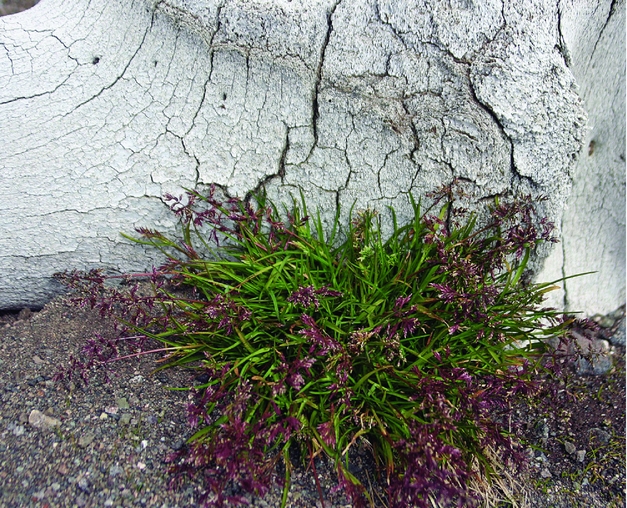
Numerous characteristics make P. annua highly adaptable to environmental stress and unstable habitats: huge phenotypic and genotypic variability, small size, plastic life cycle: life-history types ranging from annual to perennial forms (for example Law Reference Law1981, Grime and others Reference Grime, Hodgson and Hunt1986; Frenot and others Reference Frenot, Aubry, Misset, Gloaguen, Gourret and Lebouvier1999, Reference Frenot, Gloaguen, Massé and Lebouvier2001; Holm and others Reference Holm, Doll, Holm, Panchbo and Herberger1997; Mitich Reference Mitich1998). The functioning of P. annua in the Antarctic could not be possible without specific adaptations, which enable the plants to persist the climatic conditions typical for this zone. Poa annua shows both ‘r’ (rapid development, a high rate of population growth, early reproduction, compact form and a single reproductive cycle, usually annual plant life cycle) and ‘K’ (slower development, a greater competitive ability, delayed reproduction, greater biomass per individual, continued reproduction, usually perennial plant life cycle) life strategies depending on environmental variables (Law and others Reference Law, Bradshaw and Putwain1977). Under stress conditions annual bluegrass shows more likely the ‘K’ strategy (McNeilly Reference McNeilly1981, Chen and others Reference Chen, Li, Shen and Li2003). Under the sub-Antarctic (Walton and Smith Reference Walton and Smith1973; Walton Reference Walton1975) as well as the Antarctic (Chwedorzewska and Bednarek Reference Chwedorzewska and Bednarek2012) polar conditions, where the unstable environment does not guarantee seedling survival, selection seems to favour perennial individuals with greater biomass (Fig. 2).
A perennial tussocks which has been observed in the vicinity of Arctowski during several consecutive years (photo K. J. Chwedorzewska).
The development of substantial freezing tolerance enables the survival of individuals at low temperatures, with LT50 (median lethal temperature) as low as −31,6°C for some ecotypes (Dionne and others Reference Dionne, Castonguay, Nadeau and Desjardins2001). This freezing tolerance is probably connected with high accumulation of water soluble sugars (mainly sucrose) in response to low temperature. In some ecotypes there is even more than 20% of sucrose in dry matter (Dionne and others Reference Dionne, Rochefort, Huff, Desjardins, Bertrand and Castonguay2010).
Annual bluegrass can produce a huge number of seeds in very short time, even thousands per individual (Law Reference Law1981). Seeds can germinate even two days after fertilisation over a wide range of environmental conditions. They may retain viability for several years in the soil seed bank (Hutchinson and Seymour Reference Hutchinson and Seymour1982). As shown by Wódkiewicz and others (Reference Wódkiewicz, Galera, Giełwanowska, Chwedorzewska and Olech2013), P. annua at Arctowski successfully reproduces sexually with more than 50% of fully developed, viable caryopses that can survive the maritime Antarctic winter not only in the soil, but also directly on the previous year's inflorescence. Furthermore, germination tests of freshly collected seeds showed that P. annua did not differ significantly in mean germination success from Colobanthus quitensis, while the germination success of this introduced species was significantly higher than of Deschampsia antarctica (Wódkiewicz and others Reference Wódkiewicz, Galera, Giełwanowska, Chwedorzewska and Olech2013; Molina-Montenegro and others Reference Molina-Montenegro, Carrasco-Urra, Acuña-Rodríguez, Oses and Chwedorzewska2014). However the germination success of native plants might be different after stratification (for example Hennion and others Reference Hennion, Huiskes, Robinson, Convey, Bergstrom, Convey and Huiskes2006). It has also been shown that annual bluegrass maintains a soil seed bank comparable to species typical for the polar tundra (Wódkiewicz and others Reference Wódkiewicz, Galera, Giełwanowska, Chwedorzewska and Olech2013, Reference Wódkiewicz, Ziemiański, Kwiecień, Chwedorzewska and Galera2014). That way seeds are able to survive the Antarctic winter and readily germinate under optimal conditions. This species also often reproduces vegetatively (Vargas and Turgeon Reference Vargas and Turgeon2004).
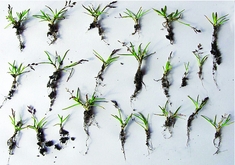
The characteristic spatial structure of the Antarctic population of P. annua is distinct dense clumps or tussoks (Wódkiewicz and others Reference Wódkiewicz, Ziemiański, Kwiecień, Chwedorzewska and Galera2014). At least some of the tussocks consist of many individuals (Fig. 3). In the temperate zone the species is only loosely tufted (Grime and others Reference Grime, Hodgson and Hunt1986). The microspatial structure of P. annua soil seed banks in Antarctica is highly associated with the presence of tussocks. Seeds are deposited underneath the tussock rather than in the vicinity of the clump. High density of plants within the tussock may be of an adaptive value for the persistence of plants in extreme polar conditions (Wódkiewicz and others Reference Wódkiewicz, Ziemiański, Kwiecień, Chwedorzewska and Galera2014). Earlier observations suggest that the tussocks are rather stable in time (Fig. 2). This finding is in agreement with earlier data underlining the capability of P. annua to form perennial ecotypes (Gibeault Reference Gibeault1971). Therefore at least some of the clumps may be capable of surviving at least over several vegetation periods.
Individuals isolated from one clump (photo A. Gasek).

The response of P. annua to polar conditions is also evident in morphometric traits. Work is continuing on this phenomenon. Populations thriving in the Antarctic, which is the latitudinal extreme of the species distribution, differ from populations from the centre of the species distribution (European lowland). Plants from the altitudinal extreme (mountain localities) of the species range exhibit morphological characteristics intermediate between lowland and Antarctic populations. This indicates that environmental factors seem to be the main driving force for morphological differentiation of this species. Populations for the morphometric analysis were chosen after genetic analysis, which pointed out that most likely the population of P. annua from Arctowski originated from Poland. Genetic analyses indicated significant decrease of variability (Chwedorzewska and Bednarek Reference Chwedorzewska and Bednarek2012). Despite the genetic relationship of the Antarctic and Polish populations, some of observed differences in morphological features may have adaptive value. The phenomenon of epigenetic ‘transgeneration memory’ in plants (Molinier and others Reference Molinier, Ries, Zipfel and Hohn2006), may underlie those significant morphological differences. This is a reaction of plants to stress factors resulting in changes of DNA methylation patterns, very often manifested in changes at the phenotype level. Stress conditions not only led to transformation but also played a role in the stabilisation of the ‘new phenotype’. The results obtained with the metAFLP technique also point out a similar mechanism in the P. annua population from the Antarctic as compared to the population from the centre of the species range. Significantly higher methylation variability was observed in the Antarctic population than in the Polish one, despite a contrary trend in genetic variability. This is probably a reaction to stress conditions prevailing in polar environment (subzero temperatures, specific light regime, short vegetation season, salinity, desiccating winds etc.). Such reaction to stress manifested by a significant increase in frequency of epigenetic changes can lead to phenotypic changes accelerating the adaptation processes (Chwedorzewska and Bednarek Reference Chwedorzewska and Bednarek2012). In this way an acquired feature could potentially be fixed, as it is forced by the environment, which was already observed in P. annua by La Mantia (Reference La Mantia2009). The relation between morphological variability and genetic/epigenetic variation and the fixation of morphological traits should be the focus of further studies.
Conclusions
The spreading of P. annua in the Antarctic Peninsula region is an example of expansion process and could serve as a model, on the basis of which the course and consequences of further invasions may be predicted and monitored. This process also highlights the dangers to Antarctic terrestrial ecosystems that are resulting from increasing human traffic in this region. The results on the functioning of this species in Antarctica collected in various study fields may shed light on the alien species spread in this region in association with regional warming; it may also play an important role in the prediction of the course and outcome of subsequent invasions. Understanding the history of P. annua will allow the application of different policies and actions in protection against other invasive species and develop effective methods of their eradication.
Acknowledgements
Part of this research was supported by the Polish Ministry of Scientific Research and Higher Education grant 2013/09/B/NZ8/03293. We would like to thank two anonymous reviewers for constructive advice and fruitful discussion that has improved our paper.