





Impact statement
As mental health conditions and human immunodeficiency virus (HIV) adversely affect each other, interventions that integrate services for these two conditions may improve health outcomes, especially in low- and middle-income countries (LMICs) with high HIV prevalence. However, the evidence for these impacts has not been assessed. This systematic review found 18 studies, mostly from sub-Saharan Africa, that combined mental health interventions with HIV prevention, diagnosis or treatment. Most mental health interventions included in this review, including psychotherapy, drug therapy and community-based care, were provided by nonspecialists. These studies found consistent positive results on the mental health symptoms of participants, including symptoms of depression and post-traumatic stress disorder. The interventions’ effects on HIV-related outcomes, such as antiretroviral therapy adherence and viral load, also seemed positive, but the evidence was limited. Overall, the results of this review support the integration of mental health and HIV services in LMICs while highlighting areas where more research might be beneficial. Understanding the evidence base for integrated interventions can support decision-making by policymakers and program directors.
Introduction
Despite tremendous biomedical progress in prevention and treatment, HIV remains a significant global health burden (World Health Organization, 2024). This burden is disproportionately located in LMICs, especially eastern and southern Africa, which accounts for over one-third of the world’s new HIV cases (Joint United Nations Programme on HIV/AIDS, 2024).
Mental health disorders and HIV are intertwined. People living with HIV are significantly more likely to be affected by mental disorders. For example, a study in rural Kenya reported a prevalence of depressive symptoms among people living with HIV to be 13.8%, much higher than the national prevalence of depression of 4.4% (Nyongesa et al., Reference Nyongesa, Mwangi, Wanjala, Mutua, Newton and Abubakar2019). Further, mental disorders increase the risk of HIV acquisition as a consequence of individual, social and system factors (Hobkirk et al., Reference Hobkirk, Towe, Lion and Meade2015), such as unsafe and coercive sexual encounters (Collins et al., Reference Collins, Holman, Freeman and Patel2006), homelessness (Guimarães et al., Reference Guimarães, McKinnon, Cournos, Machado, Melo, Campos and Wainberg2014) and lower pre-exposure prophylaxis adherence (Velloza et al., Reference Velloza, Baeten, Haberer, Ngure, Irungu, Mugo, Celum and Heffron2018). Mental disorders are also associated with decreased antiretroviral therapy (ART) adherence (Uthman et al., Reference Uthman, Magidson, Safren and Nachega2014) and poor HIV-related health outcomes (Yousuf et al., Reference Yousuf, Mohd Arifin, Musa and Md. Isa2019) among people living with HIV. Given this interaction, it is imperative to provide care for both conditions. However, mental health problems among people living with HIV in LMICs often remain unnoticed and untreated, due to stigma, lack of resources or fragmented service delivery (Remien et al., Reference Remien, Stirratt, Nguyen, Robbins, Pala and Mellins2019).
Service integration is a critical method to address this disparity. Integrated health services can provide accessible, person-centered and cost-effective care (World Health Organization, 2015). The World Health Organization has endorsed integrating mental health into primary health care (World Health Organization and WONCA, 2008) and specifically into HIV services (Joint United Nations Programme on HIV/AIDS and World Health Organization, 2022).
A few review articles have previously examined interventions that integrate mental health and HIV services (Chuah et al., Reference Chuah, Haldane, Cervero-Liceras, Ong, Sigfrid, Murphy, Watt, Balabanova, Hogarth, Maimaris, Otero, Buse, McKee, Piot, Perel and Legido-Quigley2017; Conteh et al., Reference Conteh, Latona and Mahomed2023) using the Rainbow Model of Integrated Care (Valentijn et al., Reference Valentijn, Schepman, Opheij and Bruijnzeels2013), which combines the functions of primary care with the dimensions of integrated care. These reviews primarily focused on integration processes rather than health outcomes and did not include recent studies. While service integration can be valuable across settings, it may be particularly relevant in LMICs where there is often limited availability of mental health services and a disproportionate burden of HIV. To inform future research and policymaking, we conducted a systematic review of the effectiveness of the integration of mental health and HIV services in LMICs.
Methods
This review is part of the Evidence Project, which has conducted a series of systematic reviews of HIV behavioral interventions in LMICs following systematic methods documented in our overall study protocol (Kennedy et al., Reference Kennedy, Yeh, Fonner, Armstrong, Denison, O’Reilly and Sweat2024). We followed the Preferred Reporting Items for Systematic reviews and Meta-Analyses guidelines (Page et al., Reference Page, JE, Bossuyt, Boutron, Hoffmann, Mulrow, Shamseer, Tetzlaff, Akl, Brennan, Chou, Glanville, Grimshaw, Hróbjartsson, Lalu, Li, Loder, Mayo-Wilson, McDonald, McGuinness, Stewart, Thomas, Tricco, Welch, Whiting and Moher2021).
Eligibility criteria
We included studies that meet the following criteria: (1) evaluated the integration of services (including prevention, screening, testing, care, treatment and management) for HIV and mental health conditions; (2) the intervention was conducted in a LMIC as defined by the World Bank (2024); (3) the intervention was evaluated using a study design that compared post-intervention outcomes using either a pre/post or multi-arm study design, including randomized controlled trials (RCTs), observational and before–after studies and post-only exposure analysis and (4) the article was published in a peer-reviewed journal from January 1, 2000 through January 29, 2024. No language restrictions were used.
We followed the World Health Organization’s definition of “integrated health services,” as: “the management and delivery of health services so that clients receive a continuum of preventive and curative services, according to their needs over time and across different levels of the health system” (World Health Organization, 2008). To be included in our review, integration had to occur through the following formats: by session or visit (e.g., services offered by the same provider or different providers but at the same client session/visit), location (e.g., services offered in the same clinic or at the same physical location such as an outreach tent) or referral (e.g., there is a clear referral for a client from one service provider to another). We excluded studies where one type of service was offered to a population that had previously received the other type of service without clear intention or format of integration (e.g., psychotherapy was offered to people living with HIV, but the delivery of psychotherapy was not clearly integrated with the delivery of HIV care). For the mental health component, we included all kinds of mental health and neurocognitive conditions except for substance use disorders, as we felt that this was a related but separate area of service integration and had been reviewed previously (Haldane et al., Reference Haldane, Cervero-Liceras, Chuah, Ong, Murphy, Sigfrid, Watt, Balabanova, Hogarth, Maimaris, Buse, Piot, McKee, Perel and Legido-Quigley2017; Oldfield et al., Reference Oldfield, Muñoz, McGovern, Funaro, Villanueva, Tetrault and Edelman2019; Duffy et al., Reference Duffy, Ghosh, Geltman, Mahaniah, Higgins-Biddle and Clark2022).
Search strategy
We searched five electronic databases (PubMed, CINAHL, Sociological Abstracts, PsycINFO and EMBASE) following the search strategy presented in Supplementary Appendix A. Titles and abstracts were used to screen for inclusion. We also searched the included articles from previously published reviews on relevant topics (Chuah et al., Reference Chuah, Haldane, Cervero-Liceras, Ong, Sigfrid, Murphy, Watt, Balabanova, Hogarth, Maimaris, Otero, Buse, McKee, Piot, Perel and Legido-Quigley2017; Collins et al., Reference Collins, Velloza, Concepcion, Oseso, Chwastiak, Kemp, Simoni and Wagenaar2021; Conteh et al., Reference Conteh, Latona and Mahomed2023). In addition, articles suggested during the journal peer-review process were considered for inclusion. We used Covidence systematic review software (Veritas Health Innovation, 2024) to facilitate study selection and data extraction. Full-text articles were obtained and then reviewed by two independent reviewers to determine eligibility for final inclusion. Any differences were resolved by consensus.
Data extraction
Data extraction was conducted by two staff members. One reviewer independently extracted data from articles and entered them into a coding form. A second reviewer used Paper Interpreter (International), a custom version of ChatGPT, to facilitate data extraction (OpenAI, 2024). He provided the model with prompts that instructed the extraction of each item (e.g., country and outcomes measured) from journal articles, and then manually reviewed the accuracy of each output. The two completed forms were compared, and discrepancies were resolved by discussion and consensus. Extracted items included geographic location, time frame, the type of intervention, study design and HIV-related and mental health-related outcomes. We also extracted data on risk of bias using the Evidence Project tool (Kennedy et al., Reference Kennedy, Yeh, Fonner, Armstrong, Denison, O’Reilly and Sweat2024) that includes the following eight items: (1) prospective cohort; (2) control or comparison group; (3) pre-/post-intervention data; (4) random assignment of participants to the intervention; (5) random selection of subjects for assessment, or assessment of all subjects who participated in the intervention; (6) follow-up rate of 80% or more; (7) comparison groups equivalent on sociodemographic measures; and (8) comparison groups equivalent at baseline on outcome measures.
Analysis
Due to the heterogeneity in study design, population, intervention and outcome measures, a meta-analysis was not feasible. Thus, we present key findings from the included studies in a narrative summary categorized by intervention type. In addition, for commonly reported mental health-related outcomes (depression, post-traumatic stress disorder [PTSD] and functioning) and HIV-related outcomes (ART adherence, viral load and HIV stigma), we present the percentage difference for continuous outcomes and the odds ratio for binary outcomes as common metrics. The percentage difference was calculated as:
 $$ \frac{\mathrm{Intervention}\ \mathrm{group}\ \mathrm{value}-\mathrm{Comparison}\ \mathrm{group}\ \mathrm{value}}{\mid \mathrm{Comparison}\ \mathrm{group}\ \mathrm{value}\mid}\times 100\;\left(\%\right) $$
In multi-arm studies, “Intervention group value” indicates the difference between the endline and baseline values of the intervention group, and “Comparison group value” indicates the difference for the control group. In before–after studies, “Intervention group value” indicates the endline value and “Comparison group value” indicates the baseline value. We extracted the odds or prevalence ratios (including adjusted measures) reported by the original studies, and where they were not available, we calculated them. We also reported p-values associated with these metrics. When only confidence intervals were reported in the original articles, p-values were calculated using the formula provided by Altman and Bland (Reference Altman and Bland2011). When studies reported outcomes at multiple time points, the time point immediately following the completion of the intervention was used for the main table, and long-term data were added in footnotes. Imputed data rather than raw data were used whenever available.
Results
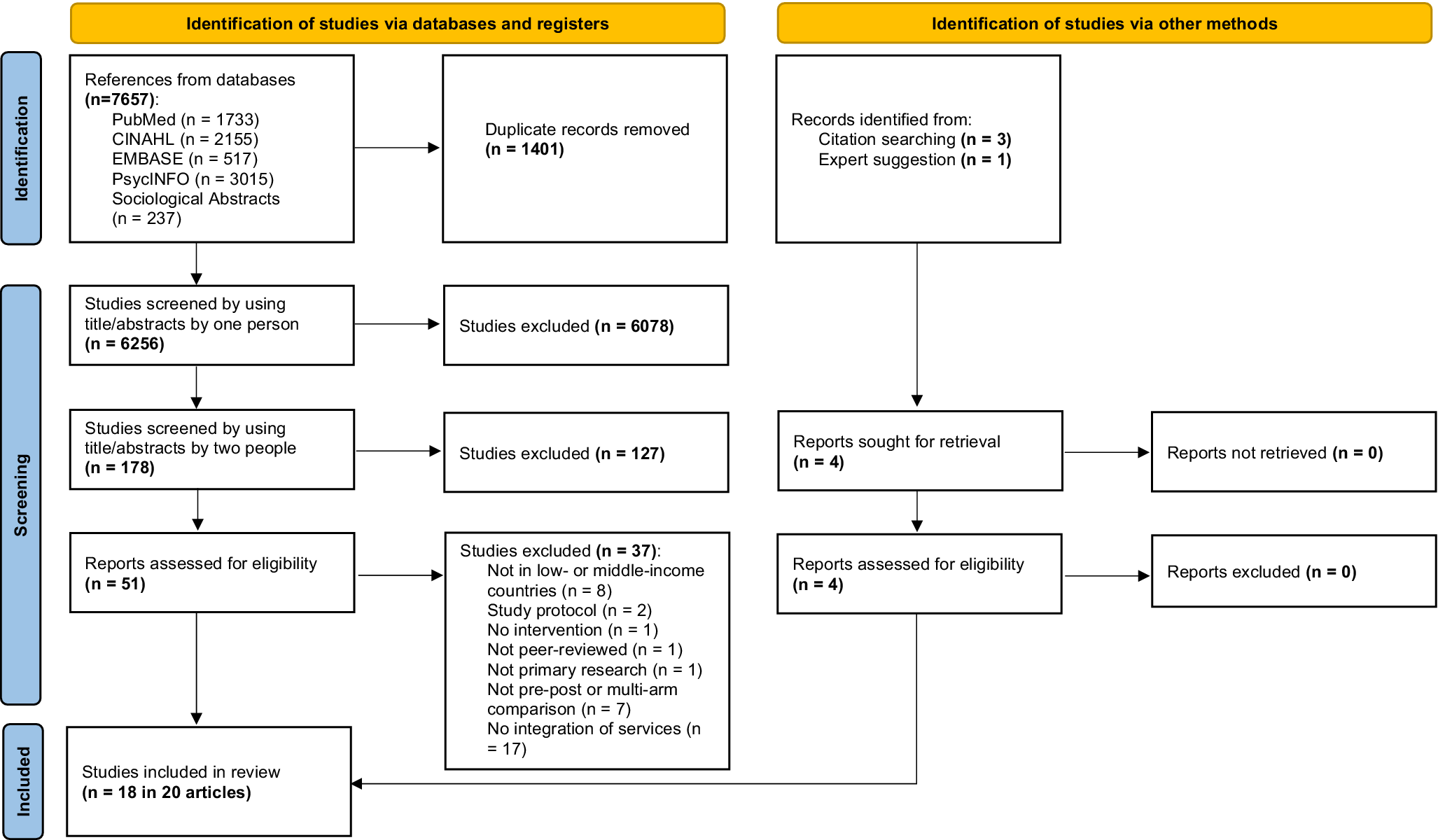
Electronic database searching yielded 7,657 articles (Figure 1). Among the 6,256 unique records, 51 articles were retained for full-text review. After adding four articles identified by secondary citation searching and expert suggestion, 20 articles reporting on 18 studies with a total of 9,729 participants met the inclusion criteria and were included in the qualitative synthesis (excluded studies listed in Supplementary Appendix B).
PRISMA flow diagram of the different phases of a systematic review.

Study characteristics
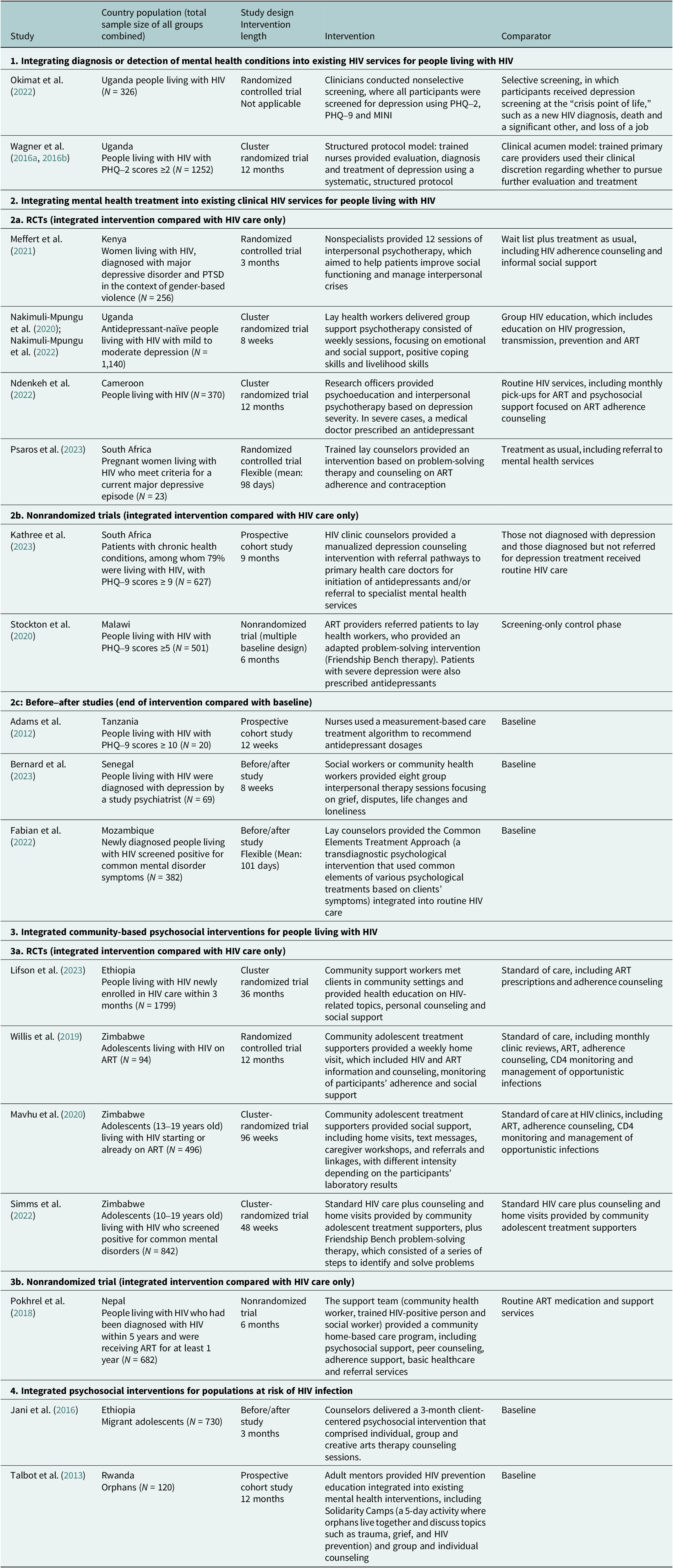
Seventeen out of the 18 included studies were conducted in sub-Saharan Africa: three in Uganda (Wagner et al., Reference Wagner, Ghosh-Dastidar, Ngo, Robinson, Musisi, Glick and Dickens2016a, Reference Wagner, Ngo, Goutam, Glick, Musisi and Akena2016b; Nakimuli-Mpungu et al., Reference Nakimuli-Mpungu, Musisi, Wamala, Okello, Ndyanabangi, Birungi, Nanfuka, Etukoit, Mayora, Ssengooba, Mojtabai, Nachega, Harari and Mills2020; Nakimuli-Mpungu et al., Reference Nakimuli-Mpungu, Smith, Wamala, Okello, Birungi, Etukoit, Mojtabai, Nachega, Harari, Musisi and Mills2022; Okimat et al., Reference Okimat, Akena, Opio, Mutabazi, Sendaula, Semitala, Kalyango and Karamagi2022) and Zimbabwe (Willis et al., Reference Willis, Milanzi, Mawodzeke, Dziwa, Armstrong, Yekeye, Mtshali and James2019; Mavhu et al., Reference Mavhu, Willis, Mufuka, Bernays, Tshuma, Mangenah, Maheswaran, Mangezi, Apollo, Araya, Weiss and Cowan2020; Simms et al., Reference Simms, Weiss, Chinoda, Mutsinze, Bernays, Verhey, Wogrin, Apollo, Mugurungi, Sithole, Chibanda and Willis2022), two in Ethiopia (Jani et al., Reference Jani, Vu, Kay, Habtamu and Kalibala2016; Lifson et al., Reference Lifson, Hailemichael, Workneh, MacLehose, Horvath, Hilk, Sites and Shenie2023) and South Africa (Psaros et al., Reference Psaros, Stanton, Raggio, Mosery, Goodman, Briggs, Williams, Bangsberg, Smit and Safren2023) and one in Mozambique (Fabian et al., Reference Fabian, Muanido, Cumbe, Mukunta, Manaca, Dorsey, Hammett and Wagenaar2022), Tanzania (Adams et al., Reference Adams, Almond, Ringo, Shangali and Sikkema2012), Rwanda (Talbot et al., Reference Talbot, Uwihoreye, Kamen, Grant, McGlynn, Mugabe, Nshimyumukiza, Dongier, Slamowitz, Padilla, Uvamahoro, Musayidire, Mukarubuga and Zolopa2013), Malawi (Stockton et al., Reference Stockton, Udedi, Kulisewa, Hosseinipour, Gaynes, Mphonda, Maselko, Pettifor, Verhey, Chibanda, Lapidos-Salaiz and Pence2020), Cameroon (Ndenkeh et al., Reference Ndenkeh, Nji, Yumo, Rothe and Kroidl2022), Kenya (Meffert et al., Reference Meffert, Neylan, McCulloch, Blum, Cohen, Bukusi, Verdeli, Markowitz, Kahn, Bukusi, Thirumurthy, Rota, Rota, Oketch, Opiyo and Ongeri2021) and Senegal (Bernard et al., Reference Bernard, Font, Ziadeh, Tine, Diaw, Ndiaye, Samba, Bottai, Jacquesy, Verdeli, Ngom, Dabis, Seydi and de Rekeneire2023). One remaining study was conducted in South Asia (Nepal; Pokhrel et al., Reference Pokhrel, Sharma, Pokhrel, Neupane, Mlunde, Poudel and Jimba2018; Table 1). Eleven studies were funded by United States government agencies, including the National Institutes of Health and the United States Agency for International Development (Adams et al., Reference Adams, Almond, Ringo, Shangali and Sikkema2012; Jani et al., Reference Jani, Vu, Kay, Habtamu and Kalibala2016; Wagner et al., Reference Wagner, Ghosh-Dastidar, Ngo, Robinson, Musisi, Glick and Dickens2016a; Stockton et al., Reference Stockton, Udedi, Kulisewa, Hosseinipour, Gaynes, Mphonda, Maselko, Pettifor, Verhey, Chibanda, Lapidos-Salaiz and Pence2020; Meffert et al., Reference Meffert, Neylan, McCulloch, Blum, Cohen, Bukusi, Verdeli, Markowitz, Kahn, Bukusi, Thirumurthy, Rota, Rota, Oketch, Opiyo and Ongeri2021; Fabian et al., Reference Fabian, Muanido, Cumbe, Mukunta, Manaca, Dorsey, Hammett and Wagenaar2022; Okimat et al., Reference Okimat, Akena, Opio, Mutabazi, Sendaula, Semitala, Kalyango and Karamagi2022; Bernard et al., Reference Bernard, Font, Ziadeh, Tine, Diaw, Ndiaye, Samba, Bottai, Jacquesy, Verdeli, Ngom, Dabis, Seydi and de Rekeneire2023; Kathree et al., Reference Kathree, Bachmann, Bhana, Grant, Mntambo, Gigaba, Kemp, Rao and Petersen2023; Lifson et al., Reference Lifson, Hailemichael, Workneh, MacLehose, Horvath, Hilk, Sites and Shenie2023; Psaros et al., Reference Psaros, Stanton, Raggio, Mosery, Goodman, Briggs, Williams, Bangsberg, Smit and Safren2023).
Description of included studies

aOR, adjusted odds ratio; ART, antiretroviral therapy; CI, 95% confidence interval; HIV, human immunodeficiency virus; MINI, Mini International Neuropsychiatric Interview; OR, odds ratio; PHQ, Patient Health Questionnaire; PTSD, post-traumatic stress disorder.
In terms of the direction of integration, 15 studies integrated mental health services into existing HIV services (Adams et al., Reference Adams, Almond, Ringo, Shangali and Sikkema2012; Wagner et al., Reference Wagner, Ghosh-Dastidar, Ngo, Robinson, Musisi, Glick and Dickens2016a; Willis et al., Reference Willis, Milanzi, Mawodzeke, Dziwa, Armstrong, Yekeye, Mtshali and James2019; Mavhu et al., Reference Mavhu, Willis, Mufuka, Bernays, Tshuma, Mangenah, Maheswaran, Mangezi, Apollo, Araya, Weiss and Cowan2020; Nakimuli-Mpungu et al., Reference Nakimuli-Mpungu, Musisi, Wamala, Okello, Ndyanabangi, Birungi, Nanfuka, Etukoit, Mayora, Ssengooba, Mojtabai, Nachega, Harari and Mills2020; Stockton et al., Reference Stockton, Udedi, Kulisewa, Hosseinipour, Gaynes, Mphonda, Maselko, Pettifor, Verhey, Chibanda, Lapidos-Salaiz and Pence2020; Meffert et al., Reference Meffert, Neylan, McCulloch, Blum, Cohen, Bukusi, Verdeli, Markowitz, Kahn, Bukusi, Thirumurthy, Rota, Rota, Oketch, Opiyo and Ongeri2021; Fabian et al., Reference Fabian, Muanido, Cumbe, Mukunta, Manaca, Dorsey, Hammett and Wagenaar2022; Ndenkeh et al., Reference Ndenkeh, Nji, Yumo, Rothe and Kroidl2022; Okimat et al., Reference Okimat, Akena, Opio, Mutabazi, Sendaula, Semitala, Kalyango and Karamagi2022; Simms et al., Reference Simms, Weiss, Chinoda, Mutsinze, Bernays, Verhey, Wogrin, Apollo, Mugurungi, Sithole, Chibanda and Willis2022; Bernard et al., Reference Bernard, Font, Ziadeh, Tine, Diaw, Ndiaye, Samba, Bottai, Jacquesy, Verdeli, Ngom, Dabis, Seydi and de Rekeneire2023; Kathree et al., Reference Kathree, Bachmann, Bhana, Grant, Mntambo, Gigaba, Kemp, Rao and Petersen2023; Lifson et al., Reference Lifson, Hailemichael, Workneh, MacLehose, Horvath, Hilk, Sites and Shenie2023; Psaros et al., Reference Psaros, Stanton, Raggio, Mosery, Goodman, Briggs, Williams, Bangsberg, Smit and Safren2023), two studies established a new service that provided care for both HIV and mental health (Jani et al., Reference Jani, Vu, Kay, Habtamu and Kalibala2016; Pokhrel et al., Reference Pokhrel, Sharma, Pokhrel, Neupane, Mlunde, Poudel and Jimba2018), and only one study integrated HIV services into existing mental health services (Talbot et al., Reference Talbot, Uwihoreye, Kamen, Grant, McGlynn, Mugabe, Nshimyumukiza, Dongier, Slamowitz, Padilla, Uvamahoro, Musayidire, Mukarubuga and Zolopa2013). Except for Okimat et al. (Reference Okimat, Akena, Opio, Mutabazi, Sendaula, Semitala, Kalyango and Karamagi2022), all studies used a task-shifting or task-sharing approach, where nonspecialists in mental health (e.g., community support workers, HIV counselors and primary health nurses) provided interventions.
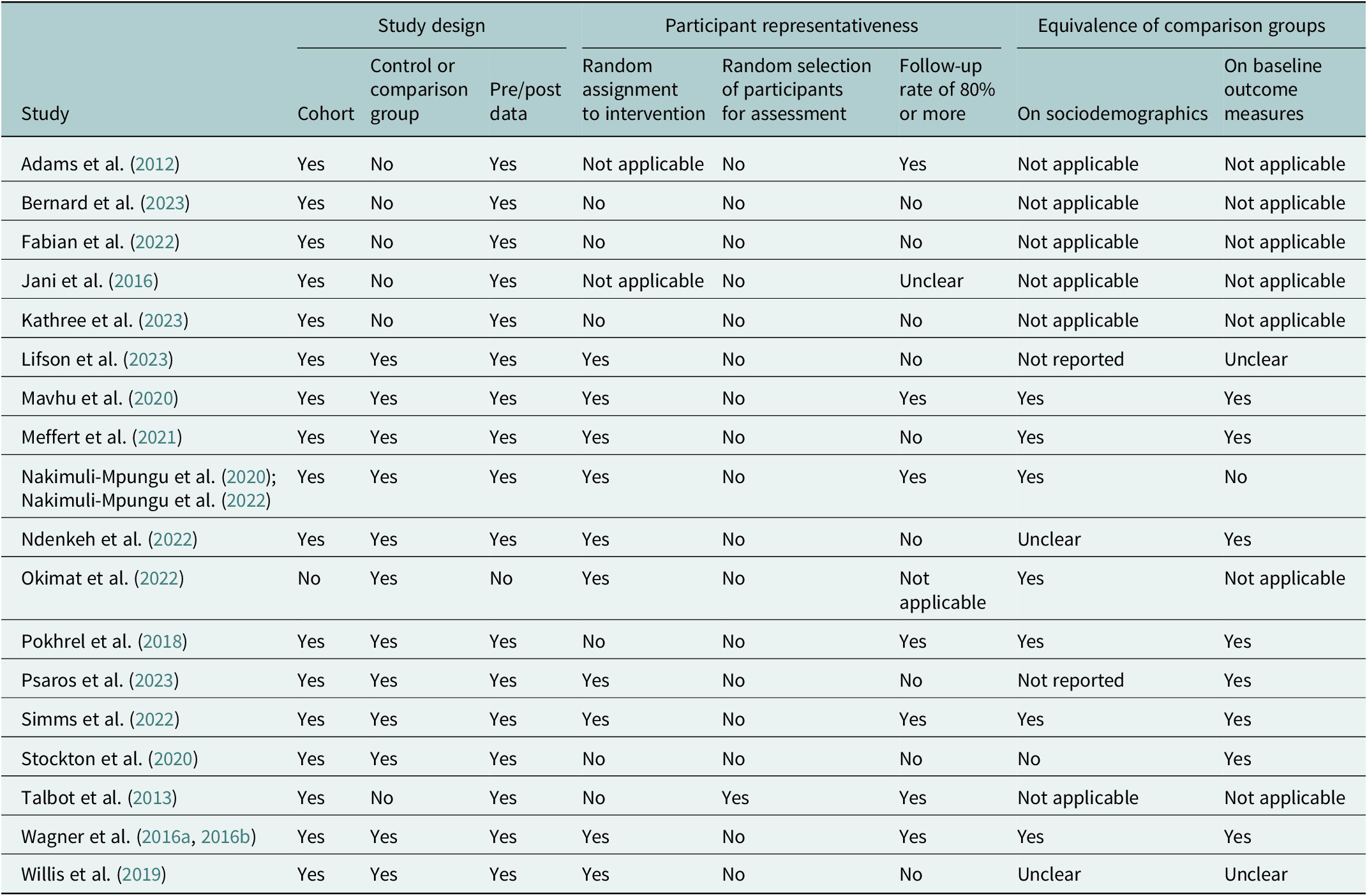
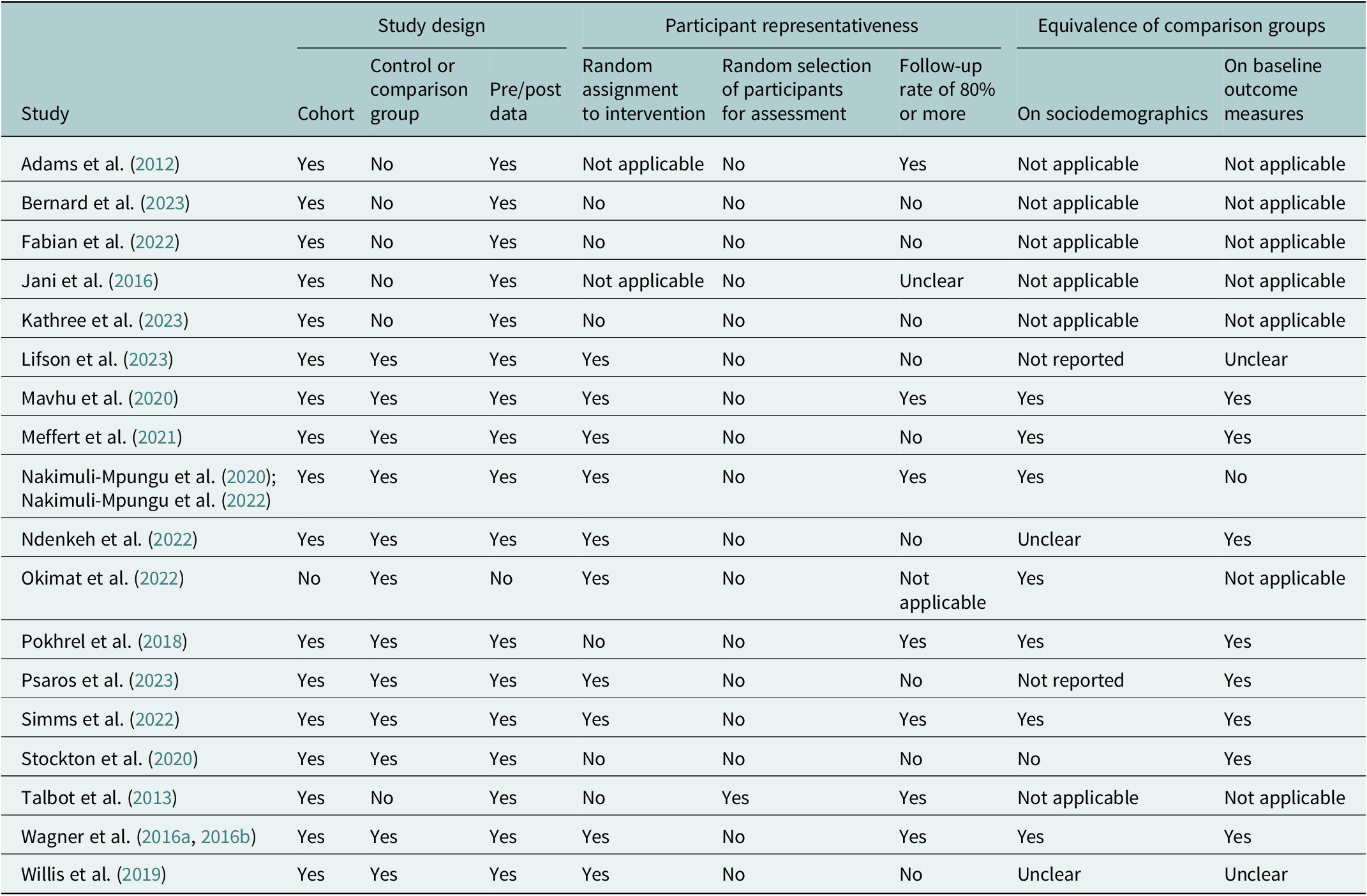
The risk of bias varied across the included studies, and no study met all eight criteria of the Evidence Project risk of bias tool (Table 2). Study designs included 10 RCTs (Wagner et al., Reference Wagner, Ghosh-Dastidar, Ngo, Robinson, Musisi, Glick and Dickens2016a; Willis et al., Reference Willis, Milanzi, Mawodzeke, Dziwa, Armstrong, Yekeye, Mtshali and James2019; Mavhu et al., Reference Mavhu, Willis, Mufuka, Bernays, Tshuma, Mangenah, Maheswaran, Mangezi, Apollo, Araya, Weiss and Cowan2020; Nakimuli-Mpungu et al., Reference Nakimuli-Mpungu, Musisi, Wamala, Okello, Ndyanabangi, Birungi, Nanfuka, Etukoit, Mayora, Ssengooba, Mojtabai, Nachega, Harari and Mills2020; Meffert et al., Reference Meffert, Neylan, McCulloch, Blum, Cohen, Bukusi, Verdeli, Markowitz, Kahn, Bukusi, Thirumurthy, Rota, Rota, Oketch, Opiyo and Ongeri2021; Ndenkeh et al., Reference Ndenkeh, Nji, Yumo, Rothe and Kroidl2022; Okimat et al., Reference Okimat, Akena, Opio, Mutabazi, Sendaula, Semitala, Kalyango and Karamagi2022; Simms et al., Reference Simms, Weiss, Chinoda, Mutsinze, Bernays, Verhey, Wogrin, Apollo, Mugurungi, Sithole, Chibanda and Willis2022; Lifson et al., Reference Lifson, Hailemichael, Workneh, MacLehose, Horvath, Hilk, Sites and Shenie2023; Psaros et al., Reference Psaros, Stanton, Raggio, Mosery, Goodman, Briggs, Williams, Bangsberg, Smit and Safren2023), two nonrandomized trials (Pokhrel et al., Reference Pokhrel, Sharma, Pokhrel, Neupane, Mlunde, Poudel and Jimba2018; Stockton et al., Reference Stockton, Udedi, Kulisewa, Hosseinipour, Gaynes, Mphonda, Maselko, Pettifor, Verhey, Chibanda, Lapidos-Salaiz and Pence2020), three before–after studies (Jani et al., Reference Jani, Vu, Kay, Habtamu and Kalibala2016; Fabian et al., Reference Fabian, Muanido, Cumbe, Mukunta, Manaca, Dorsey, Hammett and Wagenaar2022; Bernard et al., Reference Bernard, Font, Ziadeh, Tine, Diaw, Ndiaye, Samba, Bottai, Jacquesy, Verdeli, Ngom, Dabis, Seydi and de Rekeneire2023) and three prospective cohort studies (Adams et al., Reference Adams, Almond, Ringo, Shangali and Sikkema2012; Talbot et al., Reference Talbot, Uwihoreye, Kamen, Grant, McGlynn, Mugabe, Nshimyumukiza, Dongier, Slamowitz, Padilla, Uvamahoro, Musayidire, Mukarubuga and Zolopa2013; Kathree et al., Reference Kathree, Bachmann, Bhana, Grant, Mntambo, Gigaba, Kemp, Rao and Petersen2023). Random selection of participants was conducted in only one study (Talbot et al., Reference Talbot, Uwihoreye, Kamen, Grant, McGlynn, Mugabe, Nshimyumukiza, Dongier, Slamowitz, Padilla, Uvamahoro, Musayidire, Mukarubuga and Zolopa2013). In addition, the follow-up rate was generally low, with only seven studies achieving more than 80% (Adams et al., Reference Adams, Almond, Ringo, Shangali and Sikkema2012; Talbot et al., Reference Talbot, Uwihoreye, Kamen, Grant, McGlynn, Mugabe, Nshimyumukiza, Dongier, Slamowitz, Padilla, Uvamahoro, Musayidire, Mukarubuga and Zolopa2013; Wagner et al., Reference Wagner, Ghosh-Dastidar, Ngo, Robinson, Musisi, Glick and Dickens2016a; Pokhrel et al., Reference Pokhrel, Sharma, Pokhrel, Neupane, Mlunde, Poudel and Jimba2018; Mavhu et al., Reference Mavhu, Willis, Mufuka, Bernays, Tshuma, Mangenah, Maheswaran, Mangezi, Apollo, Araya, Weiss and Cowan2020; Nakimuli-Mpungu et al., Reference Nakimuli-Mpungu, Musisi, Wamala, Okello, Ndyanabangi, Birungi, Nanfuka, Etukoit, Mayora, Ssengooba, Mojtabai, Nachega, Harari and Mills2020; Simms et al., Reference Simms, Weiss, Chinoda, Mutsinze, Bernays, Verhey, Wogrin, Apollo, Mugurungi, Sithole, Chibanda and Willis2022). In most multi-arm studies, sociodemographics and baseline outcome measures were roughly equivalent between groups.
Risk of bias assessment
Overall, 14 studies reported depression outcomes (Adams et al., Reference Adams, Almond, Ringo, Shangali and Sikkema2012; Wagner et al., Reference Wagner, Ghosh-Dastidar, Ngo, Robinson, Musisi, Glick and Dickens2016a; Pokhrel et al., Reference Pokhrel, Sharma, Pokhrel, Neupane, Mlunde, Poudel and Jimba2018; Mavhu et al., Reference Mavhu, Willis, Mufuka, Bernays, Tshuma, Mangenah, Maheswaran, Mangezi, Apollo, Araya, Weiss and Cowan2020; Nakimuli-Mpungu et al., Reference Nakimuli-Mpungu, Musisi, Wamala, Okello, Ndyanabangi, Birungi, Nanfuka, Etukoit, Mayora, Ssengooba, Mojtabai, Nachega, Harari and Mills2020; Stockton et al., Reference Stockton, Udedi, Kulisewa, Hosseinipour, Gaynes, Mphonda, Maselko, Pettifor, Verhey, Chibanda, Lapidos-Salaiz and Pence2020; Meffert et al., Reference Meffert, Neylan, McCulloch, Blum, Cohen, Bukusi, Verdeli, Markowitz, Kahn, Bukusi, Thirumurthy, Rota, Rota, Oketch, Opiyo and Ongeri2021; Fabian et al., Reference Fabian, Muanido, Cumbe, Mukunta, Manaca, Dorsey, Hammett and Wagenaar2022; Ndenkeh et al., Reference Ndenkeh, Nji, Yumo, Rothe and Kroidl2022; Simms et al., Reference Simms, Weiss, Chinoda, Mutsinze, Bernays, Verhey, Wogrin, Apollo, Mugurungi, Sithole, Chibanda and Willis2022; Bernard et al., Reference Bernard, Font, Ziadeh, Tine, Diaw, Ndiaye, Samba, Bottai, Jacquesy, Verdeli, Ngom, Dabis, Seydi and de Rekeneire2023; Kathree et al., Reference Kathree, Bachmann, Bhana, Grant, Mntambo, Gigaba, Kemp, Rao and Petersen2023; Lifson et al., Reference Lifson, Hailemichael, Workneh, MacLehose, Horvath, Hilk, Sites and Shenie2023; Psaros et al., Reference Psaros, Stanton, Raggio, Mosery, Goodman, Briggs, Williams, Bangsberg, Smit and Safren2023), three reported PTSD outcomes (Talbot et al., Reference Talbot, Uwihoreye, Kamen, Grant, McGlynn, Mugabe, Nshimyumukiza, Dongier, Slamowitz, Padilla, Uvamahoro, Musayidire, Mukarubuga and Zolopa2013; Nakimuli-Mpungu et al., Reference Nakimuli-Mpungu, Musisi, Wamala, Okello, Ndyanabangi, Birungi, Nanfuka, Etukoit, Mayora, Ssengooba, Mojtabai, Nachega, Harari and Mills2020; Meffert et al., Reference Meffert, Neylan, McCulloch, Blum, Cohen, Bukusi, Verdeli, Markowitz, Kahn, Bukusi, Thirumurthy, Rota, Rota, Oketch, Opiyo and Ongeri2021) and five reported functioning/disability outcomes (Talbot et al., Reference Talbot, Uwihoreye, Kamen, Grant, McGlynn, Mugabe, Nshimyumukiza, Dongier, Slamowitz, Padilla, Uvamahoro, Musayidire, Mukarubuga and Zolopa2013; Mavhu et al., Reference Mavhu, Willis, Mufuka, Bernays, Tshuma, Mangenah, Maheswaran, Mangezi, Apollo, Araya, Weiss and Cowan2020; Meffert et al., Reference Meffert, Neylan, McCulloch, Blum, Cohen, Bukusi, Verdeli, Markowitz, Kahn, Bukusi, Thirumurthy, Rota, Rota, Oketch, Opiyo and Ongeri2021; Nakimuli-Mpungu et al., Reference Nakimuli-Mpungu, Musisi, Wamala, Okello, Ndyanabangi, Birungi, Nanfuka, Etukoit, Mayora, Ssengooba, Mojtabai, Nachega, Harari and Mills2020; Bernard et al., Reference Bernard, Font, Ziadeh, Tine, Diaw, Ndiaye, Samba, Bottai, Jacquesy, Verdeli, Ngom, Dabis, Seydi and de Rekeneire2023; Table 3). Additionally, one study reported anxiety and stress (Pokhrel et al., Reference Pokhrel, Sharma, Pokhrel, Neupane, Mlunde, Poudel and Jimba2018), and one reported quality of life and “confidence, self-esteem and self-worth” (Willis et al., Reference Willis, Milanzi, Mawodzeke, Dziwa, Armstrong, Yekeye, Mtshali and James2019). Various measures were used for each outcome; for example, while Patient Health Questionnaire-9 (PHQ-9) was the most common depression scale and was used in eight studies (Adams et al., Reference Adams, Almond, Ringo, Shangali and Sikkema2012; Mavhu et al., Reference Mavhu, Willis, Mufuka, Bernays, Tshuma, Mangenah, Maheswaran, Mangezi, Apollo, Araya, Weiss and Cowan2020; Stockton et al., Reference Stockton, Udedi, Kulisewa, Hosseinipour, Gaynes, Mphonda, Maselko, Pettifor, Verhey, Chibanda, Lapidos-Salaiz and Pence2020; Ndenkeh et al., Reference Ndenkeh, Nji, Yumo, Rothe and Kroidl2022; Okimat et al., Reference Okimat, Akena, Opio, Mutabazi, Sendaula, Semitala, Kalyango and Karamagi2022; Simms et al., Reference Simms, Weiss, Chinoda, Mutsinze, Bernays, Verhey, Wogrin, Apollo, Mugurungi, Sithole, Chibanda and Willis2022; Bernard et al., Reference Bernard, Font, Ziadeh, Tine, Diaw, Ndiaye, Samba, Bottai, Jacquesy, Verdeli, Ngom, Dabis, Seydi and de Rekeneire2023; Kathree et al., Reference Kathree, Bachmann, Bhana, Grant, Mntambo, Gigaba, Kemp, Rao and Petersen2023), other scales, such as the Center for Epidemiologic Studies Depression Scale (Pokhrel et al., Reference Pokhrel, Sharma, Pokhrel, Neupane, Mlunde, Poudel and Jimba2018; Lifson et al., Reference Lifson, Hailemichael, Workneh, MacLehose, Horvath, Hilk, Sites and Shenie2023) and Beck Depression Inventory (Meffert et al., Reference Meffert, Neylan, McCulloch, Blum, Cohen, Bukusi, Verdeli, Markowitz, Kahn, Bukusi, Thirumurthy, Rota, Rota, Oketch, Opiyo and Ongeri2021) were also used. In studies that relied on dichotomous outcomes (diagnosed/not diagnosed), the Mini-International Neuropsychiatric Interview (MINI), a short structured diagnostic interview for various psychiatric disorders, was commonly used. For functioning measurement, Meffert et al. (Reference Meffert, Neylan, McCulloch, Blum, Cohen, Bukusi, Verdeli, Markowitz, Kahn, Bukusi, Thirumurthy, Rota, Rota, Oketch, Opiyo and Ongeri2021) and Bernard et al. (Reference Bernard, Font, Ziadeh, Tine, Diaw, Ndiaye, Samba, Bottai, Jacquesy, Verdeli, Ngom, Dabis, Seydi and de Rekeneire2023) used the WHO Disability Assessment Schedule, which covers six domains (cognition, mobility, self-care, getting along, life activities and participation). Talbot et al. (Reference Talbot, Uwihoreye, Kamen, Grant, McGlynn, Mugabe, Nshimyumukiza, Dongier, Slamowitz, Padilla, Uvamahoro, Musayidire, Mukarubuga and Zolopa2013) used the Children’s Global Assessment Scale, which includes psychological, social and school functioning. Nakimuli-Mpungu et al. (Reference Nakimuli-Mpungu, Musisi, Wamala, Okello, Ndyanabangi, Birungi, Nanfuka, Etukoit, Mayora, Ssengooba, Mojtabai, Nachega, Harari and Mills2020) used a locally developed function score.
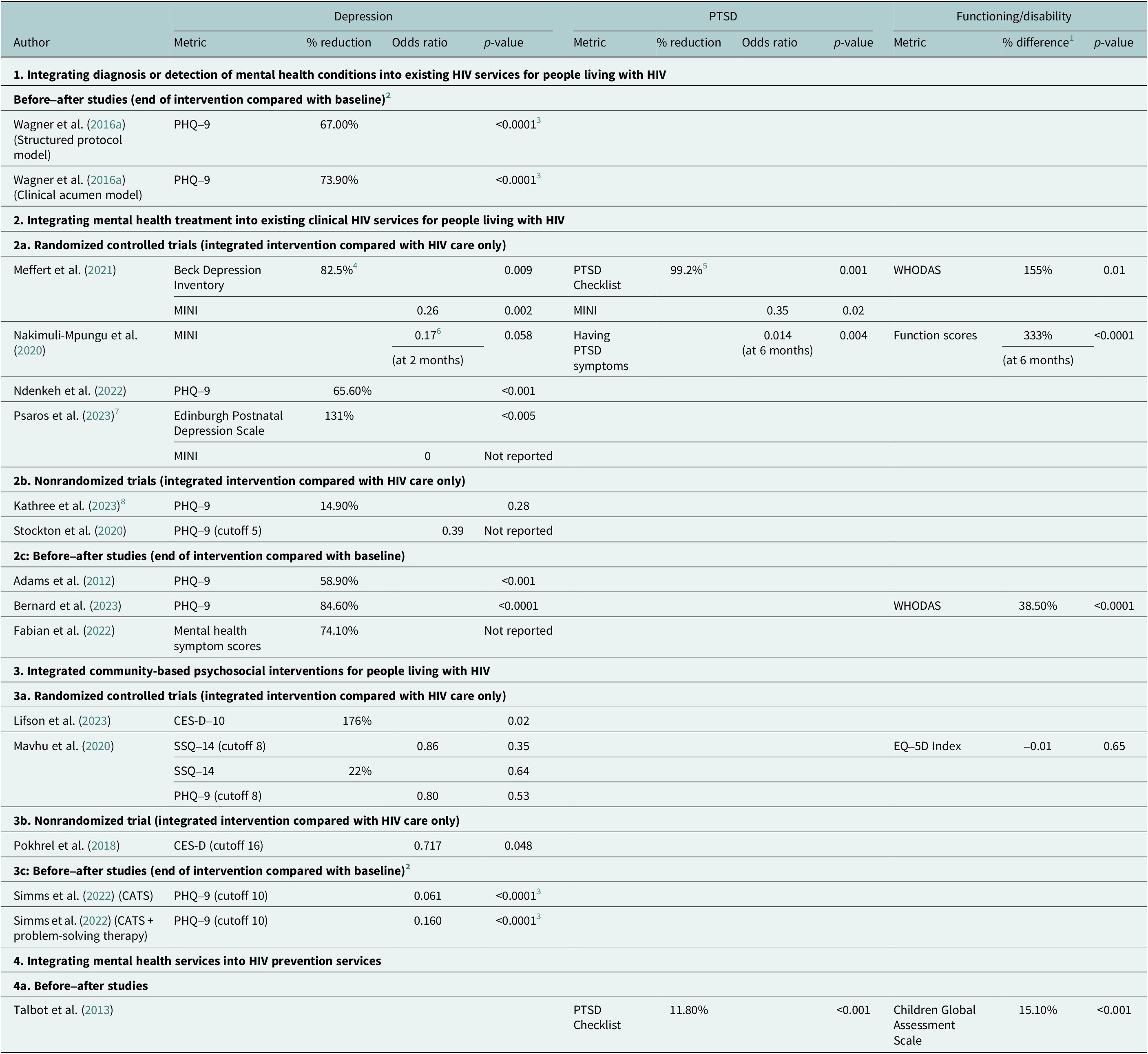
Percentage reduction (for continuous metrics) and odds ratio (for binary metrics) of mental health-related outcomes

1 The differences are reported based on scale direction: the score increase is shown for scales where higher scores mean better function, whereas the score decrease is shown for scales where higher scores indicate worse function.
2 Although originally randomized controlled trials, the before–after change of each group is presented because the studies tested two different integration models rather than interventions with and without integration.
3 Calculated by the review authors using unpaired t-test.
4 Due to the unavailability of exact values, 10.95 and 6 points were used for the decreased amount in the intervention group and the control group, respectively, based on the description in the main text.
5 Similar to 4, decreases of 17.93 and 9 points were used for the intervention group and the control group, respectively.
6 0.038 at 24 months (p = 0.016).
7 The results should be interpreted with caution because only 18 participants in total completed post-intervention assessment.
8 Comparison between “diagnosed and not referred” and “diagnosed and referred” groups.
CATS, Community Adolescent Treatment Supporters; CES-D, Center for Epidemiologic Studies Depression Scale; EQ-5D, European Quality of Life-5 Dimensions; MINI, Mini International Neuropsychiatric Interview; PHQ, Patient Health Questionnaire; PTSD, post-traumatic stress disorder; SSQ, Shona Symptom Questionnaire; WHODAS, World Health Organization Disability Assessment Schedule.
No studies measured outcomes related to psychotic, developmental, personality or neurocognitive disorders. Across the intervention types, the effects of the integrated interventions on mental health-related outcomes were overwhelmingly positive, with all studies showing a reduction in symptom scores or a lower likelihood of diagnosis for depression and PTSD compared with the control group or baseline.
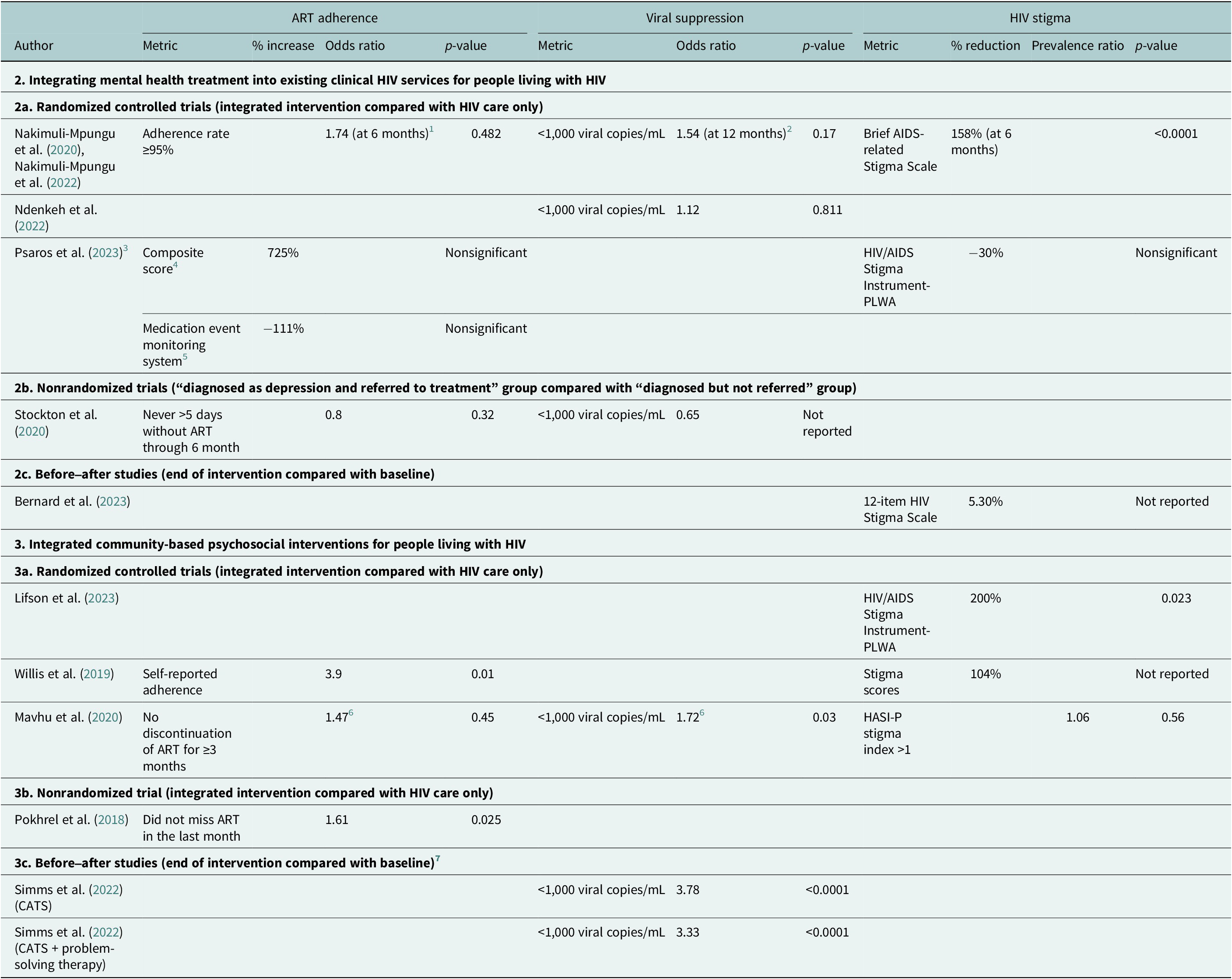
For HIV-related outcomes, five studies (Pokhrel et al., Reference Pokhrel, Sharma, Pokhrel, Neupane, Mlunde, Poudel and Jimba2018; Willis et al., Reference Willis, Milanzi, Mawodzeke, Dziwa, Armstrong, Yekeye, Mtshali and James2019; Nakimuli-Mpungu et al., Reference Nakimuli-Mpungu, Musisi, Wamala, Okello, Ndyanabangi, Birungi, Nanfuka, Etukoit, Mayora, Ssengooba, Mojtabai, Nachega, Harari and Mills2020; Stockton et al., Reference Stockton, Udedi, Kulisewa, Hosseinipour, Gaynes, Mphonda, Maselko, Pettifor, Verhey, Chibanda, Lapidos-Salaiz and Pence2020; Psaros et al., Reference Psaros, Stanton, Raggio, Mosery, Goodman, Briggs, Williams, Bangsberg, Smit and Safren2023) reported ART adherence, three reported viral suppression (all defined as fewer than 1,000 viral copies/mL; Nakimuli-Mpungu et al., Reference Nakimuli-Mpungu, Musisi, Wamala, Okello, Ndyanabangi, Birungi, Nanfuka, Etukoit, Mayora, Ssengooba, Mojtabai, Nachega, Harari and Mills2020; Ndenkeh et al., Reference Ndenkeh, Nji, Yumo, Rothe and Kroidl2022; Stockton et al., Reference Stockton, Udedi, Kulisewa, Hosseinipour, Gaynes, Mphonda, Maselko, Pettifor, Verhey, Chibanda, Lapidos-Salaiz and Pence2020) and five studies reported HIV stigma (Bernard et al., Reference Bernard, Font, Ziadeh, Tine, Diaw, Ndiaye, Samba, Bottai, Jacquesy, Verdeli, Ngom, Dabis, Seydi and de Rekeneire2023; Lifson et al., Reference Lifson, Hailemichael, Workneh, MacLehose, Horvath, Hilk, Sites and Shenie2023; Nakimuli-Mpungu et al., Reference Nakimuli-Mpungu, Musisi, Wamala, Okello, Ndyanabangi, Birungi, Nanfuka, Etukoit, Mayora, Ssengooba, Mojtabai, Nachega, Harari and Mills2020; Psaros et al., Reference Psaros, Stanton, Raggio, Mosery, Goodman, Briggs, Williams, Bangsberg, Smit and Safren2023; Willis et al., Reference Willis, Milanzi, Mawodzeke, Dziwa, Armstrong, Yekeye, Mtshali and James2019; Table 4). Various stigma measures were used, but common elements included negative self-image, social isolation, abuse and fear of contagion. Additionally, two studies reported HIV knowledge (Talbot et al., Reference Talbot, Uwihoreye, Kamen, Grant, McGlynn, Mugabe, Nshimyumukiza, Dongier, Slamowitz, Padilla, Uvamahoro, Musayidire, Mukarubuga and Zolopa2013; Jani et al., Reference Jani, Vu, Kay, Habtamu and Kalibala2016), one reported the proportion of HIV testing (Jani et al., Reference Jani, Vu, Kay, Habtamu and Kalibala2016) and one reported the prevalence of HIV risk-taking behavior among participants (Talbot et al., Reference Talbot, Uwihoreye, Kamen, Grant, McGlynn, Mugabe, Nshimyumukiza, Dongier, Slamowitz, Padilla, Uvamahoro, Musayidire, Mukarubuga and Zolopa2013). Compared with mental health-related outcomes, the reports on HIV-related outcomes were limited, and the results were more mixed. Although some studies showed improvement in ART adherence, viral suppression rate or HIV stigma, many others did not show statistically or clinically meaningful changes. Outcomes not covered in Tables 3 and 4 are summarized in Supplementary Tables A and B.
Percentage difference (for continuous measures) and odds ratio (for binary measures) of HIV-related outcomes

1 3.24 at 24 months (p = 0.040).
2 2.56 at 24 months (p = 0.004).
3 The results should be interpreted with caution because only 18 participants in total completed post-intervention assessment.
4 Combined score of the following three factors: medication use frequency, self-reported percentage of time that the medication was taken as prescribed, and a rating of one’s ability to take prescribed medication.
5 The percentage of time that the medications were taken as prescribed, based on data from a digitized pill bottle cap that measures and records when the bottle was opened each day.
6 Prevalence ratio. Opposite outcomes were reported in the original study, but inversed here for consistency.
7 Though originally randomized-controlled trial, the before-after change of each group is presented because the study tested two different integration models rather than interventions with and without integration.
AIDS: acquired immunodeficiency syndrome, ART: antiretroviral therapy, HIV: human immunodeficiency virus, PLWA: people living with AIDS.
We found that the included studies covered four groups based on the target populations and locations of interventions. Here, we briefly describe the study findings included in each group.
-
1. Integrating diagnosis/detection of mental health conditions into existing HIV services for people living with HIV (n = 2 studies)
Two RCTs, both in Uganda, tested the integration of diagnosis or detection of mental health conditions into existing HIV services for people living with HIV. The first RCT (Okimat et al., Reference Okimat, Akena, Opio, Mutabazi, Sendaula, Semitala, Kalyango and Karamagi2022) compared selective screening for depression (only screened at “crisis points,” such as new HIV diagnosis and death of a significant other) to nonselective screening (screening every client regardless of life events), and found that depression was more likely to be detected in the nonselective screening arm (10.7% difference, p = 0.03). This result could be due to the difference in the number of screening steps of the two groups (two steps in the nonselective screening vs. three in selective screening). The second RCT (Wagner et al., Reference Wagner, Ghosh-Dastidar, Ngo, Robinson, Musisi, Glick and Dickens2016a) compared a structured depression treatment model, which used PHQ-9 and MINI for depression diagnosis and decision on antidepressant prescription, and a clinical acumen model, in which clinicians decided whether to evaluate and treat clients based on their clinical judgment. They found that participants in the structured protocol model were more likely to receive further evaluation, suggesting that clinicians tended to be more cautious about referrals. However, depression alleviation rates were comparable between the two groups, with both showing an ~70% reduction in depression scores at follow-up.
-
2. Integrating mental health treatment into existing clinical HIV services for people living with HIV (n = 9 studies)
Nine studies integrated mental health treatment interventions, including psychotherapies and pharmacotherapy, into existing services at HIV clinics. Four randomized trials (Nakimuli-Mpungu et al., Reference Nakimuli-Mpungu, Musisi, Wamala, Okello, Ndyanabangi, Birungi, Nanfuka, Etukoit, Mayora, Ssengooba, Mojtabai, Nachega, Harari and Mills2020; Meffert et al., Reference Meffert, Neylan, McCulloch, Blum, Cohen, Bukusi, Verdeli, Markowitz, Kahn, Bukusi, Thirumurthy, Rota, Rota, Oketch, Opiyo and Ongeri2021; Ndenkeh et al., Reference Ndenkeh, Nji, Yumo, Rothe and Kroidl2022; Psaros et al., Reference Psaros, Stanton, Raggio, Mosery, Goodman, Briggs, Williams, Bangsberg, Smit and Safren2023) and two nonrandomized trials (Stockton et al., Reference Stockton, Udedi, Kulisewa, Hosseinipour, Gaynes, Mphonda, Maselko, Pettifor, Verhey, Chibanda, Lapidos-Salaiz and Pence2020; Kathree et al., Reference Kathree, Bachmann, Bhana, Grant, Mntambo, Gigaba, Kemp, Rao and Petersen2023) compared the integrated intervention with standard HIV care, while the other three (Adams et al., Reference Adams, Almond, Ringo, Shangali and Sikkema2012; Fabian et al., Reference Fabian, Muanido, Cumbe, Mukunta, Manaca, Dorsey, Hammett and Wagenaar2022; Bernard et al., Reference Bernard, Font, Ziadeh, Tine, Diaw, Ndiaye, Samba, Bottai, Jacquesy, Verdeli, Ngom, Dabis, Seydi and de Rekeneire2023) were before–after studies.
Overall, the six trial studies showed that integrated interventions greatly improved mental health-related outcomes (e.g., depression, PTSD and functioning), often with more than 50% reduction in symptom scores, compared with the control group without integration. However, the results on clinical HIV outcomes (e.g., ART adherence and viral load) were more limited. In a large cluster-randomized trial in Uganda (Nakimuli-Mpungu et al., Reference Nakimuli-Mpungu, Musisi, Wamala, Okello, Ndyanabangi, Birungi, Nanfuka, Etukoit, Mayora, Ssengooba, Mojtabai, Nachega, Harari and Mills2020), participants living with HIV who received group support psychotherapy were much less likely to be diagnosed with depression or have PTSD symptoms and had higher function scores and lower acquired immunodeficiency syndrome (AIDS)-related stigma scores, compared with those who received group HIV education after 6 months. While the proportion of good ART adherence and viral suppression was similar between the two groups 6 and 12 months after the intervention, respectively, both outcomes were better among those who received group support psychotherapy at 24 months (Nakimuli-Mpungu et al., Reference Nakimuli-Mpungu, Smith, Wamala, Okello, Birungi, Etukoit, Mojtabai, Nachega, Harari, Musisi and Mills2022). In an RCT in Kenya (Meffert et al., Reference Meffert, Neylan, McCulloch, Blum, Cohen, Bukusi, Verdeli, Markowitz, Kahn, Bukusi, Thirumurthy, Rota, Rota, Oketch, Opiyo and Ongeri2021), women living with HIV and affected by gender-based violence were randomized into 12-session interpersonal psychotherapy plus usual HIV treatment or waitlist plus usual HIV treatment. After the 3-month intervention period, those who received interpersonal psychotherapy had lower depression and PTSD scores and higher function scores than the waitlist group. A cluster-randomized trial in Cameroon (Ndenkeh et al., Reference Ndenkeh, Nji, Yumo, Rothe and Kroidl2022) showed that 12 months of psychoeducation on depression symptoms, help-seeking and treatment, combined with interpersonal therapy, were effective in reducing depression scores. However, ART adherence and viral suppression rates were similar to the routine HIV service group. In a pilot RCT in South Africa (Psaros et al., Reference Psaros, Stanton, Raggio, Mosery, Goodman, Briggs, Williams, Bangsberg, Smit and Safren2023), problem-solving therapy was effective in reducing depression scores among pregnant women with HIV, but the change in HIV stigma and ART adherence was not statistically significant. In a cohort study in South Africa (Kathree et al., Reference Kathree, Bachmann, Bhana, Grant, Mntambo, Gigaba, Kemp, Rao and Petersen2023), patients with chronic health conditions who were diagnosed with depression and referred to mental health treatment by primary health care nurses had somewhat better depression outcomes than those who were diagnosed but not referred.
Similarly, three before–after studies showed substantial decreases in mental health symptoms after the interventions. In Tanzania (Adams et al., Reference Adams, Almond, Ringo, Shangali and Sikkema2012), after nurses used a treatment algorithm based on evaluation by PHQ-9 and the types of antiretroviral drugs to recommend antidepressant dosages, PHQ-9 scores dropped by 58.9%. In Senegal (Kathree et al., Reference Kathree, Bachmann, Bhana, Grant, Mntambo, Gigaba, Kemp, Rao and Petersen2023), depression and functioning scores greatly improved after social workers or community health workers provided group interpersonal therapy, and the improvement was maintained after 3 months. In Mozambique (Fabian et al., Reference Fabian, Muanido, Cumbe, Mukunta, Manaca, Dorsey, Hammett and Wagenaar2022), lay counselors provided the Common Elements Treatment Approach, a transdiagnostic psychological intervention in which counselors flexibly used common elements of various psychological treatments based on clients’ symptoms, rather than focusing on a single mental disorder, for people newly diagnosed with HIV. They observed a 74.1% drop in mental health symptom scores, which measured various symptoms, including depression, anxiety, substance use and trauma.
-
3. Integrated community-based psychosocial interventions for people living with HIV (n = 5 studies)
Four RCTs (Willis et al., Reference Willis, Milanzi, Mawodzeke, Dziwa, Armstrong, Yekeye, Mtshali and James2019; Mavhu et al., Reference Mavhu, Willis, Mufuka, Bernays, Tshuma, Mangenah, Maheswaran, Mangezi, Apollo, Araya, Weiss and Cowan2020; Simms et al., Reference Simms, Weiss, Chinoda, Mutsinze, Bernays, Verhey, Wogrin, Apollo, Mugurungi, Sithole, Chibanda and Willis2022; Lifson et al., Reference Lifson, Hailemichael, Workneh, MacLehose, Horvath, Hilk, Sites and Shenie2023) and one nonrandomized trial (Pokhrel et al., Reference Pokhrel, Sharma, Pokhrel, Neupane, Mlunde, Poudel and Jimba2018) provided integrated psychosocial interventions in community settings rather than at HIV clinics. In these studies, community health supporters met clients in the community or at clients’ homes and provided comprehensive mental health and HIV care programs that included counseling and social support. Overall, depression outcomes and ART adherence improved more in the integrated intervention group than in the control group, who received standard HIV care, which typically included assessment by a medical provider, laboratory tests, ART medication prescription and adherence counseling. A large cluster-randomized trial in Ethiopia (Lifson et al., Reference Lifson, Hailemichael, Workneh, MacLehose, Horvath, Hilk, Sites and Shenie2023) found that health education, personal counseling and social support, provided by community support workers who were living with HIV and from the same geographic area as the participants, were associated with lower depression and HIV stigma scores compared with standard HIV care. Zvandiri, a community organization in Zimbabwe, conducted multiple studies to examine the effectiveness of a weekly home visit to adolescents living with HIV by community adolescent treatment supporters (CATS) that included provision of HIV and ART information, monitoring of ART adherence and general well-being, and caregiver support. They showed that intervention by CATS improved participants’ ART adherence, quality of life, and “confidence, self-esteem and self-worth” scores compared with those who received standard HIV care (Willis et al., Reference Willis, Milanzi, Mawodzeke, Dziwa, Armstrong, Yekeye, Mtshali and James2019), as well as viral suppression rate (Mavhu et al., Reference Mavhu, Willis, Mufuka, Bernays, Tshuma, Mangenah, Maheswaran, Mangezi, Apollo, Araya, Weiss and Cowan2020). However, the effect on mental health was modest (22% reduction in Shona Symptom Questionnaire; p = 0.64). Zvandiri also conducted a cluster-randomized trial that compared peer counseling by CATS combined with Friendship Bench problem-solving therapy and peer counseling only (Simms et al., Reference Simms, Weiss, Chinoda, Mutsinze, Bernays, Verhey, Wogrin, Apollo, Mugurungi, Sithole, Chibanda and Willis2022). Viral suppression rate was similarly low in the two groups, and both groups showed a substantial improvement in mental health, with better outcomes in the Friendship Bench group. However, qualitative data showed that problem-solving therapy was not appropriate or feasible for the adolescent population due to their limited agency. In a nonrandomized study in Nepal (Pokhrel et al., Reference Pokhrel, Sharma, Pokhrel, Neupane, Mlunde, Poudel and Jimba2018), a team of a community health worker, a person living with HIV and a social worker provided people living with HIV with home-based care, including psychosocial support, peer counseling and referral for further care. Participants in the intervention group had a lower likelihood of depression diagnosis and higher ART adherence compared with those who received routine ART services.
-
4. Integrating mental health services into HIV prevention services (n = 2 studies)
Unlike studies in the previous three groups, the two observational studies in this group targeted adolescents at risk of HIV acquisition, not people already diagnosed with HIV. A study in Ethiopia (Jani et al., Reference Jani, Vu, Kay, Habtamu and Kalibala2016) evaluated a client-centered psychosocial intervention for migrant adolescents, which included individual, group and art therapies to address increased vulnerability to HIV. The researchers found that mental health problems (including anxiety, social and attention problems and aggressive behavior) decreased following the intervention in females but not in males. A study in Rwanda (Talbot et al., Reference Talbot, Uwihoreye, Kamen, Grant, McGlynn, Mugabe, Nshimyumukiza, Dongier, Slamowitz, Padilla, Uvamahoro, Musayidire, Mukarubuga and Zolopa2013) incorporated HIV prevention education into the existing mental health intervention for orphans, which included adult mentorship, Solidarity Camp (a 5-day activity where orphans live together and discuss topics such as trauma, grief and HIV prevention) and counseling. After the intervention, post-traumatic stress symptoms decreased by 11.8%, but the prevalence of HIV risk-taking behavior remained similar. In both studies, HIV knowledge improved after the interventions.
Discussion
Our systematic review provides an overview of the diverse but limited literature on the effectiveness of interventions integrating mental health and HIV services in LMICs. Nearly all studies found a positive impact of integrated interventions on mental health outcomes (e.g., most studies showed 50–90% reduction in depression symptom scores), supporting their broader implementation. However, interventions should be tailored to each population and setting; for example, Simms et al. (Reference Simms, Weiss, Chinoda, Mutsinze, Bernays, Verhey, Wogrin, Apollo, Mugurungi, Sithole, Chibanda and Willis2022) suggests that problem-solving therapy for adolescents should be less structured and with shorter sessions than for adults.
HIV-related outcomes exhibited more mixed results. Potential reasons for this result could include that the follow-up periods may not have been long enough to detect meaningful changes, and that viral load data may not have aligned with the timing of the intervention or data collection of the mental health outcome. When compared by the location of intervention, community-based interventions (Group 3 in our review) seemed to have more positive effects on ART adherence than those conducted at HIV clinics (Group 2; Table 3). Although the number of studies is too small to draw conclusions, community- or home-based care might be more beneficial in this regard.
As to the direction of integration, most studies included in this review incorporated mental health services into existing HIV service delivery for people living with HIV, rather than vice versa. This discrepancy likely reflects the preceding establishment of HIV services and the disparate funding available for HIV and mental health in LMICs.
Mental health interventions were delivered by nonspecialists in most studies. Task-sharing has been shown to be effective and cost-effective in LMICs (Tesema et al., Reference Tesema, Mabunda, Chaudhri, Sunjaya, Thio, Yakubu, Jeyakumar, Godinho, John, Eltigany, Hogendorf and Joshi2025) and endorsed as a strategy to provide mental health care to communities whose needs are unmet (Patel, Reference Patel2022). It also facilitates integrated service delivery by enabling a more collaborative, efficient and accessible health system. The positive effects summarized in this review support its use within the context of integration with HIV services. Although we limited this review to LMICs, the integrated approach may also be beneficial in high-income countries, particularly in rural settings or other areas with limited mental health specialists (Hoeft et al., Reference Hoeft, Fortney, Patel and Unützer2018).
Measuring the effectiveness of integrated intervention presents some challenges. For example, people who experienced severe mental health problems may have disproportionately dropped out of the study due to difficulty returning to study sites. Such survival bias might have made the outcomes among completers look better than those who did not complete the intervention. In addition, the included studies varied in the timing of recruitment of participants in relation to HIV diagnosis: some studies only recruited individuals newly diagnosed with HIV, while others included people with chronic HIV. A new HIV diagnosis constitutes acute stress and a major risk factor for depression (Ciesla and Roberts, Reference Ciesla and Roberts2001; Liu et al., Reference Liu, Chen, Li, Xie, Huang and Luo2023), whereas long-term HIV survivors experience chronic and cumulative psychological burdens, including cognitive challenges (Remien and Mellins, Reference Remien and Mellins2007; Rueda et al., Reference Rueda, Law and Rourke2014). Thus, the heterogeneity in the recruitment timing may have obscured the effects of interventions. Stigma may also have confounded the treatment outcomes: individuals with greater self-stigma may have been less likely to report mental health issues or engage with healthcare providers, thereby limiting intervention effectiveness (Oexle et al., Reference Oexle, Müller, Kawohl, Xu, Viering, Wyss, Vetter and Rüsch2018).
The rigor of the included studies also varied considerably. While a few studies were well-designed large RCTs, most studies had some limitations, such as small sample size, lack of control group or randomization and low follow-up rate. Additionally, the follow-up periods after the interventions were 6 months or shorter, except for Nakimuli-Mpungu et al. (Reference Nakimuli-Mpungu, Smith, Wamala, Okello, Birungi, Etukoit, Mojtabai, Nachega, Harari, Musisi and Mills2022), who followed participants for 2 years. This limitation may have prevented the detection of effects on certain outcomes.
Most studies included in this review used self-reported symptom scores to identify individuals who might benefit from mental health interventions, rather than using a diagnosis made by comprehensive clinical interviews. While often a practical choice, assessment of symptoms is not the same as clinical diagnosis. Furthermore, culture plays a critical role in understanding and intervening in mental health (Bass et al., Reference Bass, Bolton and Murray2007; Gopalkrishnan, Reference Gopalkrishnan2018). Common screening tools, such as PHQ-9, may not work well in populations with low literacy (Ali et al., Reference Ali, Ryan and Silva2016) and are often used without validation (Kaggwa et al., Reference Kaggwa, Najjuka, Ashaba and Mamun2022), limiting utility in diverse cultural settings. Thus, continued efforts to develop and validate culturally appropriate assessment tools are required.
This review reveals three areas where evidence is lacking. First, studies were almost exclusively from sub-Saharan Africa. While the burden of HIV is heaviest in this region, its countries are also rapidly moving toward population targets for viral suppression (World Health Organization, 2025). More studies in other regions with relatively and increasingly high HIV prevalence, such as the Caribbean, Central and Southeast Asia and Eastern Europe, might be beneficial. Second, few studies measured mental health symptoms other than depression and PTSD; research on the effect of integrated interventions for other mental health conditions, such as psychosis and dementia, is lacking. Third, most studies focused on mental health outcomes, and the effect of integrated interventions on HIV-related outcomes (e.g., ART adherence and viral load) was often not reported.
A major strength of our review is that we extracted both mental health-related and HIV-related outcomes, allowing us to present the comprehensive effectiveness of integrated interventions. However, we also note three limitations. First, although we used a predetermined definition of integration, the decision on whether an intervention satisfied our definition often required a judgment call by the study team. Although different reviewers might classify interventions differently, we believe we reasonably captured relevant studies. Second, we focused on peer-reviewed data to ensure a minimal level of detail and rigor and excluded conference abstracts and gray literature. However, this decision may have led us to miss relevant unpublished studies. Third, we used the percent difference as an effect size for continuous outcomes. Although it allows simple comparison across studies when available information is limited, it is heavily influenced by baseline values and ignores variability among participants. Thus, results should be interpreted with caution.
Conclusion
In summary, we found consistent evidence that, in LMICs, interventions that integrate mental health services into HIV services improve the mental health of recipients. Limited evidence suggests these interventions, especially community-based ones, may also improve ART adherence and viral suppression. Given that a range of program delivery models have shown effectiveness, it may be generally recommended for health program planners to develop programs using locally available resources. Future studies may benefit from targeting diverse geographic regions and mental health conditions, and consistently measuring and reporting HIV-related outcomes.
Open peer review
To view the open peer review materials for this article, please visit http://doi.org/10.1017/gmh.2025.10066.
Supplementary material
The supplementary material for this article can be found at http://doi.org/10.1017/gmh.2025.10066.
Data availability statement
All data come from published articles; data extraction conducted for this review is available upon request to the corresponding author.
Acknowledgements
H.A. is currently affiliated with the World Health Organization. The authors would like to thank the Johns Hopkins Bloomberg School of Public Health graduate students who assisted with the search, screening and data abstraction process for this review: Faith Apencha, Maclaine Barre-Quick and Joyce Yehjin Jang.
Author contribution
All authors conceptualized the study. H.A., P.T.Y. and C.E.K. developed the review protocol. H.A. and P.T.Y. oversaw the literature search, screening and data extraction. H.A. analyzed the data and drafted the original manuscript with feedback from the other coauthors. All authors were involved in reviewing and editing the manuscript and approved the submission of the final manuscript.
Financial support
This work was supported by the US National Institute of Mental Health (Grant Number R01MH125798).
Competing interests
The authors declare none.
Ethics
No ethical approval was required as this study is a review of published data.


 Open access

