

1. Introduction
The western margin of the Caledonian orogen is marked by the Moine Thrust Zone (MTZ) in NW Scotland, which runs from Loch Eriboll on the north coast south to the Isle of Skye and further south offshore the Isle of Mull (Fig. 1). The stable foreland to the west comprises Lewisian basement gneisses of Archean (Scourian) and Paleoproterozoic (Laxfordian) age, unconformably overlain by Mesoproterozoic (Stoer Group) and Neoproterozoic fluvial sandstones and conglomerates (Sleat and Torridon Groups), collectively known as the Torridonian (Stewart, Reference Stewart2002; Park et al. Reference Park, Stewart, Wright and Trewin2002). A stable passive continental margin was established in the early Cambrian with quartz arenites (basal quartzites and ‘Pipe rock’), thin silty mudstones (Fucoid beds) and grits (Salterella grit) deposited unconformably above, transgressed by thick Ordovician dolomites and limestones (Durness Group) (Fig. 2). The MTZ includes four or five major thrust sheets comprising imbricated sequences of all the foreland units, described in detail below. The uppermost thrust is the Moine thrust, which places thick non-fossiliferous metamorphosed sandstones, shales and turbidites (Meso- and Neoproterozoic Moine Supergroup), thought to be the lateral equivalents of the Torridon Group, westwards above the major thrust sheets of the MTZ.
Simplified geological map of NW Scotland, showing the Laurentian foreland, Moine Thrust Zone, the Assynt window and the Northern Highlands metamorphic hinterland, after Peach et al. (Reference Peach, Horne, Gunn, Clough and Hinxman1907), Butler (Reference Butler2010), Krabbendam and Leslie (Reference Krabbendam and Leslie2010), Law et al. (Reference Law, Johnson and Law2010) and others.

Simplified stratigraphy of the Moine Thrust Zone, after Peach et al. (Reference Peach, Horne, Gunn, Clough and Hinxman1907), Law et al. (Reference Law, Johnson and Law2010), Butler (Reference Butler2010), Woodcock and Strachan (Reference Woodcock and Strachan2012) and others.

Despite more than 150 years of active research along the Moine Thrust Zone, the Caledonian thrust front in NW Scotland (Nicol, Reference Nicol1861; Lapworth, Reference Lapworth1883, Reference Lapworth1885a, b; Peach et al. Reference Peach, Horne, Gunn, Clough and Hinxman1907; Elliott & Johnson, Reference Elliott and Johnson1980; Butler, Reference Butler1982, Reference Butler1987; Reference Butler2010, Reference Butler2023; Coward, Reference Coward1983, Reference Coward1985; Trewin, Reference Trewin2002; Law et al. Reference Law, Butler, Holdsworth, Krabbendam and Strachan2010; Mendum et al. Reference Mendum, Barber, Butler, Flinn, Goodenough, Krabbendam, Park and Stewart2009; Searle et al. Reference Searle, Law, Dewey and Streule2010, Reference Searle, Cornish, Heard, Charles and Branch2019; Searle, Reference Searle2022), there remain several controversial aspects concerning the geometry of thrust sheets, the timing of motion along major thrusts and the relationship between thrusts and a suite of alkaline igneous rocks exposed in NW Scotland (Fig. 1). Three major alkaline igneous complexes occur in and around the Assynt window, the Loch Ailsh and Loch Borralan syenite complexes within the MTZ, and the Canisp porphyry intruding the foreland sequence (Parsons, Reference Parsons1999; Goodenough et al. Reference Goodenough, Evans and Krabbendam2006, Reference Goodenough, Millar, Strachan, Krabbendam and Evans2011; Searle et al. Reference Searle, Law, Dewey and Streule2010; Fox & Searle, Reference Fox and Searle2021). Numerous minor alkaline dykes and sills intrude all thrust sheets within the MTZ (Goodenough et al. Reference Goodenough, Young and Parsons2004). In particular, one model suggests that most alkaline intrusions in the Assynt window were intruded immediately prior to thrusting, except for the late suite of the Loch Borralan pluton, which was intruded after movement on the Ben More Thrust ceased (Parsons & McKirdy, Reference Parsons and McKirdy1983; Butler, Reference Butler1997; Parsons, Reference Parsons1999; Goodenough et al. Reference Goodenough, Young and Parsons2004, Reference Goodenough, Millar, Strachan, Krabbendam and Evans2011). The opposing model, based on structural mapping, strain analyses and balanced and restored sections, proposes that all the alkaline igneous intrusions were emplaced prior to thrusting and their U-Pb zircon ages (430–429 Ma; Goodenough et al. Reference Goodenough, Millar, Strachan, Krabbendam and Evans2011) provide a maximum age of thrusting (Searle et al. Reference Searle, Law, Dewey and Streule2010; Fox & Searle, Reference Fox and Searle2021)
The Assynt window, where the Moine thrust has been domed around deep-level thrusts and subsequently eroded, is a critical area of the MTZ for interpretation of thrust geometries and thrust evolution (Peach & Horne, Reference Peach and Horne1884; Peach et al. Reference Peach, Horne, Gunn, Clough and Hinxman1907; British Geological Survey, 2007). Readers are referred to Butler (Reference Butler2010, Reference Butler2023) for an excellent and detailed history of mapping of Assynt and the MTZ, and tectonic interpretation of the MTZ. Elliott and Johnson (Reference Elliott and Johnson1980) made four detailed balanced cross-sections across the MTZ including two across the Assynt window; one across Loch Glencoul to the Stack of Glencoul, and the other across the southern Assynt window from Loch Ailsh west to the Sole thrust. These authors first proposed the piggy-back sequence of thrusting (thrusts move sequentially down-structural section from east to west, towards the foreland, with time), which is now widely accepted by most workers. Previous studies presented balanced and restored cross-sections across the Loch Ailsh and Loch Borralan plutons in the southern Assynt window (Elliott & Johnson, Reference Elliott and Johnson1980; Coward, Reference Coward1985; Searle et al. Reference Searle, Law, Dewey and Streule2010; Krabbendam & Leslie, Reference Krabbendam and Leslie2010; Fox & Searle, Reference Fox and Searle2021).
This paper presents three new deformed-state cross-sections across the Assynt window, and one retrodeformed or restored cross-section, with the aim of providing greater constraints on the geometry of thrust slices beneath the Moine thrust. It is concluded that the Assynt window culmination was constructed by deep-level thrusting in the Lewisian basement in the central Assynt window, which domed the Moine thrust sheet over the foreland resulting in greater erosion and exposure of the deep structural levels of the MTZ. All alkaline intrusive igneous rocks were emplaced prior to thrusting, and therefore the Moine thrust initiated after 430–429 Ma. Thrusts mainly propagated in sequence down structural section with time, but the Moine thrust also shows some minor out-of-sequence motion in the southern Assynt window, where earlier mylonite fabrics, folds and imbricate thrusts are abruptly truncated along the footwall of the Moine thrust.
2. Stratigraphy and structure of the Assynt window
The stratigraphy of NW Scotland (Fig. 2) includes four major units, the Archean-Proterozoic Lewisian basement gneisses, the Mesoproterozoic Stoer Group and the Neoproterozoic Sleat and Torridon Groups, the Cambrian-Ordovician shallow marine sedimentary sequence and the Moine Supergroup metamorphic rocks east of the Moine thrust (Sutton & Watson, Reference Sutton and Watson1951; Park & Tarney, Reference Park, Tarney, Park and Tarney1987; Stewart, Reference Stewart2002). The Lewisian gneisses are mainly Archean meta-igneous rocks formed around 2.9 Ga, metamorphosed to granulite facies around 2.7 Ga (Badcallian event) and intruded by pegmatites around 2.5 Ga (Wheeler et al. Reference Wheeler, Park, Rollinson and Beach2010). The Scourian granulites include tonalitic gneisses, composed of plagioclase, quartz and orthopyroxene; mafic gneisses composed of clinopyroxene and garnet with plagioclase, orthopyroxene and minor hornblende; and ultrabasic gneisses consisting of pargasitic hornblende, ortho- and clinopyroxene, olivine and spinel. Rare meta-sedimentary gneisses are intercalated with the tonalite, trondhjemite and granitic felsic gneisses. The Scourian granulites were intruded by a set of WNW-ESE aligned regional basic and ultrabasic dykes (orthopyroxene-bearing picrites, norites, olivine gabbro and quartz dolerite; the Scourie dykes (Sutton & Watson, Reference Sutton and Watson1951; Park & Tarney, Reference Park, Tarney, Park and Tarney1987). New U-Pb baddelyite and zircon ages show that the majority of Scourie dykes were emplaced at 2.42–2.37 Ga; Davies & Heaman, Reference Davies and Heaman2014). A major amphibolite facies metamorphic event (the Laxfordian event) overprinted the early Scourian granulites at 1.85–1.7 Ga, with biotite and hornblende replacing pyroxene (Kinny & Friend, Reference Kinny and Friend1997). A prominent set of K-feldspar pegmatites and granite sheets cuts the Laxfordian gneisses. An unconformity with more than 500 m.y., possibly up to a billion years, time gap occurs between the Lewisian basement below and a thick succession of Mesoproterozoic and Neoproterozoic continental fluvial conglomerates and sandstones, comprising the Stoer, Torridon and Sleat Groups redbeds, above. A major phase of uplift and erosion ended with establishment of a passive continental margin in the Cambrian with deposition of cross-bedded quartz arenites (basal quartzites), some with the trace fossil Skolithus (‘Pipe rock’). The quartzites are overlain by thin dolomitic shales and siltstones (Fucoid beds) and thin cross-bedded sandstones (Salterella grit). Unconformably overlying all these units are the Ordovician shallow marine Durness Group limestones and dolomites. The Cambrian-Ordovician units represent the establishment of an east-facing passive continental margin along the eastern seaboard of Laurentia (Woodcock & Strachan, Reference Woodcock and Strachan2012) prior to the Caledonian orogeny.
The Moine Supergroup to the east of the Moine thrust comprises a thick succession of unfossiliferous psammites and semi-pelites, including the Morar Group (1000–950 Ma), the Loch Eil and Glenfinnan Groups (900–870 Ma) intruded by the West Highland granite gneiss (870 Ma) and the ∼600 Ma Carn Chuinneag granite (Peach et al. Reference Peach, Horne, Gunn, Clough and Hinxman1907; Ramsay, Reference Ramsay1958; Friend et al. Reference Friend, Strachan, Kinny and Watt2003; Strachan et al. Reference Strachan, Holdsworth, Krabbendam and Alsop2010; Cawood et al. Reference Cawood, Strachan, Merle, Miler, Loewy, Dalziel, Kinny, Joudan, Nemchin and Connelly2015; Searle, Reference Searle2021). These metamorphic rocks are time-equivalent units to the Torridon Group sandstones on the Laurentian foreland (Searle et al. Reference Searle, Cornish, Heard, Charles and Branch2019). In places, inliers of Lewisian basement rocks occur beneath the Moine schists. Post-collisional regional Barrovian metamorphism occurred during either a two-phase orogenic event comprising a 480-470 Ma Grampian event, and a 445–425 Ma Scandian event (Dewey, Reference Dewey1969, Reference Dewey1971, Reference Dewey2005; Dewey & Shackleton, Reference Dewey and Shackleton1984; Johnson et al. Reference Johnson, Kelley, Oliver and Winter1985), or a single, protracted orogenic-metamorphic event (Searle, Reference Searle2021). Readers are referred to the recent discussion between Searle (Reference Searle2022) and Dewey and Ryan (Reference Dewey and Ryan2022) for arguments for and against the two short-lived orogenies (Ordovician Grampian and Silurian Scandian), or a single longer-lasting event in the Northern Highland terrane (Searle, Reference Searle2021).
This paper discusses the thrust structures of the MTZ, particularly in the Assynt window region. The Assynt window was first mapped in great detail by Peach and Horne (Reference Peach and Horne1884) and Peach et al. (Reference Peach, Horne, Gunn, Clough, Hinxman and Cadell1888, Reference Peach, Horne, Clough, Hinxman, Cadell and Dinham1892, Reference Peach, Horne, Gunn, Clough and Hinxman1907). Their maps were used by Elliott and Johnson (Reference Elliott and Johnson1980) to construct balanced and restored cross-sections across the entire Assynt window. An updated geological map with balanced cross-sections was published by the British Geological Survey (2007), and thrust geometries within the MTZ were discussed by Krabbendam and Leslie (Reference Krabbendam and Leslie2004, Reference Krabbendam and Leslie2010) and Butler (Reference Butler2010). The southern part of the Assynt window was mapped by Searle et al. (Reference Searle, Law, Dewey and Streule2010) and Fox and Searle (Reference Fox and Searle2021) who also presented detailed balanced and restored cross-sections. A simplified geological map of the Assynt window based on all these studies is shown in Figure 3.
Simplified geological map of the Assynt window, after Peach et al. (Reference Peach, Horne, Gunn, Clough and Hinxman1907), British Geological Survey (2007), showing the lines of the three cross-sections presented in this paper. The green lines in the Lewisian basement are mainly 2.4-2.0 Ga Scourie dykes. Assynt minor intrusions are not shown; the distribution of these intrusive rocks is shown in Goodenough et al. (Reference Goodenough, Young and Parsons2004).

3. Alkaline magmatism in the NW Highlands
Numerous alkaline igneous intrusions are exposed in the stable foreland (Canisp porphyry sills), within the MTZ (Loch Ailsh, Loch Borralan syenites and lamprophyre sills and dykes), and intruding the Moine schists in the hinterland (Loch Loyal syenite in the north; Glen Dessarry syenite in the south). Within the MTZ, two major intrusions sandwiched between the Moine, Ben More and Borralan thrusts are the Loch Ailsh syenite and the Loch Borralan syenites (Parsons, Reference Parsons1965a, b, Reference Parsons1972; Wooley, Reference Wooley1970, Reference Wooley1973; Parsons & McKirdy, Reference Parsons and McKirdy1983; Coward, Reference Coward1985; Searle et al. Reference Searle, Law, Dewey and Streule2010; Fox, Reference Fox2015; Fox & Searle, Reference Fox and Searle2021). Numerous sills of alkaline igneous rocks intrude the Cambrian-Ordovician sedimentary rocks. These sills have clearly been affected by subsequent imbricate thrusting (Sabine, Reference Sabine1953; Goodenough et al. Reference Goodenough, Young and Parsons2004; Wood, Reference Wood2015). They include a suite of hornblende-bearing microdiorites and lamprophyres (vogesites), peralkaline rhyolites and porphyritic quartz microsyenites (nordmarkites).
3.1. Canisp porphyry
The Canisp porphyry is a feldspar + quartz microsyenite with both feldspar and hornblende phenocrysts. These sills intrude the Torridonian sandstones and Cambrian quartzites in the foreland south of Loch Assynt, and on the peaks of Canisp and below Suilven (Fig. 3) (Peach et al. Reference Peach, Horne, Gunn, Clough and Hinxman1907; Sabine, Reference Sabine1953; British Geological Survey, Assynt sheet, 2007). Goodenough et al. (Reference Goodenough, Evans and Krabbendam2006, Reference Goodenough, Millar, Strachan, Krabbendam and Evans2011) dated the Canisp intrusion by U-Pb zircon (TIMS) at 437 ± 4.8 Ma. Most authors agree that these sills were intruded prior to thrust movement in the MTZ (Parsons, Reference Parsons1999; Goodenough et al. Reference Goodenough, Young and Parsons2004, Reference Goodenough, Evans and Krabbendam2006; Searle et al. Reference Searle, Law, Dewey and Streule2010).
3.2. Loch Ailsh syenite
The Loch Ailsh pluton has three intrusive syenite phases based on cross-cutting field relationships, which together form a single igneous complex (Parsons, Reference Parsons1965a, b, Reference Parsons1968; Fox & Searle, Reference Fox and Searle2021). Early riebeckite amphibole- and pyroxene-bearing syenites (S1; pulaskites, shonkinites in older literature; Phemister, Reference Phemister and Read1926) are cut by later alkali feldspar bearing syenites (perthosites) and peralkaline rhyolites, both of which were mylonitised by ductile shearing along the Moine thrust (Fox & Searle, Reference Fox and Searle2021). Minor ultramafic pyroxenites and mafic syenites occur as pods and xenoliths within the pluton and along the margins. The Loch Ailsh syenites intruded across previously folded Lewisian basement, Torridon Group sandstones and conglomerates and Cambrian-Ordovician sedimentary rocks prior to the main Caledonian thrusting. The Loch Ailsh pluton is carried above the Ben More Thrust and is truncated along the upper part by the Moine thrust, and therefore its age (U-Pb zircon age 430.6 ± 0.2 Ma; Goodenough et al. Reference Goodenough, Millar, Strachan, Krabbendam and Evans2011), provides a maximum age of initiation of the Moine thrust (Searle et al. Reference Searle, Law, Dewey and Streule2010; Fox & Searle, Reference Fox and Searle2021).
3.3. Loch Borralan syenite
The Loch Borralan pluton (Fig. 4a) is a silica-understaurated syenite comprising early mafic syenites, borralanites (also spelt borolanite) composed of melanite garnet + clinopyroxene + nepheline and large white feldspathoid leucite crystals pseudomorphed by alkali feldspar + muscovite + nepheline (pseudo-leucite), and later alkali feldspar and quartz syenites (Horne & Teall, Reference Horne and Teall1892; Teall, Reference Teall1900; Parsons, Reference Parsons1999; Fox & Searle, Reference Fox and Searle2021). Small alkaline ultramafic bodies, ‘cromaltites’ of Shand (Reference Shand1910, Reference Shand1939) and Wooley (Reference Wooley1970, Reference Wooley1973), outcrop along the SW margin of the Borralan intrusion and consist of varying proportions of clinopyroxene, melanite garnet, kaersutite amphibole, biotite and magnetite, with no plagioclase feldspar. These cumulate ultramafic rocks represent the parent magmas from which the borralanite was fractionated under high temperature and low-pressure conditions (Fox & Searle, Reference Fox and Searle2021). Pseudoleucite crystals in the borralanites have been flattened and aligned along the shearing direction (WNW–ESE) showing that the original high-temperature igneous fabrics have been affected by subsequent ductile shearing (Searle et al. Reference Searle, Law, Dewey and Streule2010; Fox & Searle, Reference Fox and Searle2021). Small pockets, vugs and veins of undeformed borralanite occur within the main pseudoleucite-bearing borralanites, but do not cross-cut the bounding Borralan or Ben More Thrusts. U-Pb zircon dating gave a mean age of 431.1 ± 1.2 Ma from the main borralanite, and 429.2 ± 0.5 Ma from the later quartz syenite (Goodenough et al. Reference Goodenough, Millar, Strachan, Krabbendam and Evans2011). The late quartz syenites, nordmarkites, contain minor Ti-rich amphibole (kaersutite), Ti-clinopyroxene (aegerine augite) and melanite garnet (titanium andradite), with up to 12% quartz. The Loch Borralan syenites have a high-temperature contact metamorphic aureole, exposed in the Ledbeg quarry along the western margin (Fig. 4b). Ordovician limestones and dolomites have been transformed to phlogopite, brucite, clinopyroxene and talc-bearing marbles (Fox & Searle, Reference Fox and Searle2021). The Loch Borralan syenites are mostly undeformed, except for the internal flattened pseudoleucites, but have been cut by the Ben More Thrust above and are carried along the Borralan thrust below (Searle et al. Reference Searle, Law, Dewey and Streule2010; Fox & Searle, Reference Fox and Searle2021). Although some earlier studies proposed that the Borralan syenites intruded during or after thrusting (Wooley, Reference Wooley1970; Parsons, Reference Parsons1965a, b, Reference Parsons1999; Parsons & McKirdy, Reference Parsons and McKirdy1983; Goodenough et al. Reference Goodenough, Young and Parsons2004, Reference Goodenough, Millar, Strachan, Krabbendam and Evans2011), Searle et al. (Reference Searle, Law, Dewey and Streule2010) and Fox and Searle (Reference Fox and Searle2021) showed, through detailed mapping and strain analyses, that the syenite dykes intruding Cambrian-Ordovician sediments occurred within the Borralan thrust sheet, and did not intrude across any of the bounding thrusts.
(a) Panorama of the southern Assynt window, view towards NE from Knockan Crag, showing the Borralan syenite massif with quartz syenites forming the high ground above the K-feldspar syenites. The Metamorphic aureole rocks are exposed in the Ledbeg quarry. The cross-section of Figure 9 transects this area. (b) Newly quarried cliff faces in the Ledbeg quarry, northwestern margin of the Loch Borralan syenite intrusion, showing the metamorphic aureole rocks. Dykes and sills of borralanite (mafic nepheline syenite) intrude Durness Group dolostones, metamorphosed to brucite and talc-bearing marbles after Fox and Searle (Reference Fox and Searle2021).

3.4. Assynt minor intrusives
Numerous sills and dykes of alkaline igneous rocks intrude rocks of the foreland and MTZ, and include hornblende microdiorites, lamprophyres (vogesites), and peralkaline rhyolites (‘grorudites’ of Sabine, Reference Sabine1953) intrude up to the Ordovician Durness limestones and dolomites, and are all affected by imbricate thrusting within the Glencoul, Ben More and Sole thrust sheets (Goodenough et al. Reference Goodenough, Young and Parsons2004, Reference Goodenough, Millar, Strachan, Krabbendam and Evans2011). Lamprophyres are mainly hornblende- and plagioclase-phyric vogesites with minor phlogopite, olivine, clinopyroxene and biotite. The quartz microsyenites (nordmarkites) are chemically and petrologically related to the Borralan quartz syenites and the Loch Ailsh S3 quartz syenites (Fowler et al. Reference Fowler, Kocks, Darbyshire and Greenwood2008). Nordmarkites are coarse-grained quartz microsyenites that are co-magmatic with the late quartz syenites of the Loch Borralan complex. They occur as dykes and sills intruding rocks within the Ben More Thrust sheet and also intruding across mylonite fabrics related to the Moine thrust. Hornblende microdiorites have phenocrysts of microperthitic alkali feldspar, sodic plagioclase and hornblende (Goodenough et al. Reference Goodenough, Young and Parsons2004). Peralkaline rhyolites are petrographically variable but have alkali feldspar phenocrysts and hornblende with plagioclase and aegirine augite in the groundmass. They are intrusive varieties of normal rhyolites and occur in sills and dykes with the MTZ. Porphyritic trachytes have large plagioclase phenocrysts in a groundmass of K-feldspar and minor quartz (Goodenough et al. Reference Goodenough, Young and Parsons2004). All these rocks are related to a common enriched mantle source and were probably intruded at the same time as the Loch Borralan and Loch Ailsh complexes.
3.5. Loch Loyal syenite
The Loch Loyal syenites in the northern part of the MTZ include three separate, but related, igneous bodies intruding the Moine Supergroup schists approximately 15 km east of, and structurally above, the Moine thrust in the far north of Scotland. Structural relationships show that the syenite intruded after regional folding and ductile thrusting (Holdsworth, Reference Holdsworth1990; Holdsworth et al. Reference Holdsworth, McErlean and Strachan1999, Reference Holdsworth, Alsop, Strachan, Ries, Butler and Graham2007). U-Pb zircon dating showed that most grains analysed were highly discordant, but one single concordant grain gave a poorly constrained age of ca 425 Ma (Goodenough et al. Reference Goodenough, Millar, Strachan, Krabbendam and Evans2011).
3.6. Glen Dessarry syenite
The Glen Dessarry pluton is another syenogranite pluton that intrudes the Loch Eil Group psammites, part of the Moine Supergroup, approximately 100 km south of Assynt and 30 km east of the Moine thrust, east of Knoydart and the Isle of Skye (Fig. 1). The pluton cuts across early deformation fabrics in the Moine rocks but has a penetrative solid-state deformation fabric aligned with tight to isoclinal folding within the Northern Highlands steep belt (Roberts et al. Reference Roberts, Smith and Harris1984). The Glen Dessarry pluton has similar petrology and geochemistry as the Assynt syenites (Fowler et al. Reference Fowler, Kocks, Darbyshire and Greenwood2008) but has an older age, 206Pb/238U zircon age of 445.7 ± 1.9 Ma (Goodenough et al. Reference Goodenough, Millar, Strachan, Krabbendam and Evans2011). Folding, thrusting and metamorphism in the Moine rocks and intrusion of the Glen Dessarry syenite all preceded initial movement along the Moine thrust.
4. Balanced cross-sections
The first balanced and restored cross-sections across the MTZ and Assynt window were published by Elliott and Johnson (Reference Elliott and Johnson1980). These sections revolutionised structural interpretation of the MTZ. They first proposed the ‘piggy-back’ sequence of thrusting from higher to lower (Moine to Ben More to Glencoul to Sole thrust sequence) and also provided the first quantification of minimum amounts of slip along the thrust faults. Elliott and Johnson (Reference Elliott and Johnson1980) proposed minimum slip of ca 77 km along the Moine thrust, 20–25 km along the Glencoul thrust and ca 28 km along the Ben More Thrust, based on reconstructions of their balanced cross-sections. Coward (Reference Coward1983, Reference Coward1984, Reference Coward1985), Butler and Coward (Reference Butler and Coward1984) and Butler (Reference Butler1987, Reference Butler2010) published further cross-sections across the MTZ in and around Assynt constraining the geometry more accurately. Coward (Reference Coward1985) proposed a total shortening across the southern Assynt window of at least 54 km. The British Geological Survey (2007) remapped the Assynt window in great detail and published further cross-sections. Krabbendam and Leslie (Reference Krabbendam and Leslie2004) redefined the Glencoul and Ben More Thrusts in the classic Loch Glencoul area, with the structurally higher Ben More Thrust separated from the structurally lower Glencoul thrust. Wood (Reference Wood2015) remapped the central part of the Assynt window, particularly the area where many of the Assynt minor intrusions crop out. Fox (Reference Fox2015) and Fox and Searle (Reference Fox and Searle2021) remapped the area around the Loch Ailsh and Loch Borralan syenites in detail and constructed balanced and restored sections from the Sole thrust east to the Moine thrust. Three further balanced cross-sections across the Assynt window are presented here with a restored section across the central part of the Assynt window, and a SSW–NNE lateral section.
4.1 Loch Glencoul section
The classic section at Loch Glencoul has been the focus of much research since the original mapping of Callaway (Reference Callaway1883) and Peach et al. (Reference Peach, Horne, Gunn, Clough and Hinxman1907). A balanced cross-section from the stable foreland around Quinag east to the Moine thrust at the Stack of Glencoul is shown in Figure 5. In this section, the Lewisian basement in the foreland is overlain unconformably by the basal Cambrian quartzites. The thick Torridon Group sandstones and conglomerates exposed on Quinag have been tilted and eroded prior to deposition of the Cambrian basal quartzite. The ‘double unconformity’ is exposed along both sides of Loch Glencoul and Loch Assynt (Fig. 6). The Sole thrust places a thin sheet of imbricated Cambrian – Ordovician rocks above the foreland. The Glencoul thrust places a sheet of allochthonous Lewisian gneiss over the Sole thrust imbricates (Fig. 7). The WNW–ESE aligned Scourie dykes intruding the Lewisian basement rocks have similar alignments both on the stable foreland and in the allochthonous thrust sheets of the Assynt window. Both the Sole thrust and the Glencoul thrust are exposed along both sides of Loch Glencoul. Cambrian and Ordovician sedimentary rocks also rest above the allochthonous Lewisian in the Glencoul thrust sheet and are themselves tectonically overlain by mylonites on the Stack of Glencoul and the Moine thrust (Christie, Reference Christie1960; Law, Reference Law, Snoke, Tullis and Todd1998; Law et al. Reference Law, Casey and Knipe1986, Reference Law, Johnson and Law2010). Bailey (Reference Bailey1910) proposed a displacement of ca 21 km westward, and Elliott and Johnson (Reference Elliott and Johnson1980) proposed 20–25 km of overthrusting along the Glencoul thrust. Krabbendam and Leslie (Reference Krabbendam and Leslie2004, Reference Krabbendam and Leslie2010) suggested that the structurally lower Glencoul thrust merged with the higher Ben More Thrust along a branch line at the head of Loch Glencoul; both thrust slices of Lewisian basement over stratigraphically higher units. Mapping by the British Geological Survey (2007) shows several thrust sheets carrying Lewisian basement in the hanging-wall meeting along buried branch lines beneath the Ben More Thrust (Fig. 3). In the new balanced cross-section here (Fig. 5), it can be seen that three such thrust sheets are mapped beneath the Ben More Thrust, and these stacked basement thrusts are responsible for the doming of the central Assynt window.
Balanced cross-section (XS-1 on Fig. 3) across the Loch Glencoul transect. The double unconformity is mapped along the footwall of the Sole thrust, which follows the basal quartzites along the foreland. The Glencoul (or Ben More) thrust places a slice of Lewisian basement gneisses over a thin sheet of imbricated quartzite, Fucoid beds, Salterella grit and Durness limestone in the Sole thrust sheet. Cambrian–Ordovician sedimentary rocks also overlie the allochthonous Lewisian above the Ben More Thrust sheet. Mylonites of the MTZ are exposed at the Stack of Glencoul beneath the brittle Moine thrust at the eastern end of the section. See text for explanation.

View south across Loch Assynt showing foreland features. Flat-lying Torridonian conglomerates and sandstones overlie Lewisian basement gneiss above an unconformity showing a rugged paleo-topography. Basal Cambrian quartzites dipping at ca 20º east cut the bedding in the Torridonian sandstones, conglomerates and the Lewisian basement.

View north across Loch Glencoul showing the Sole thrust above Cambrian quartzites, which unconformably overlie Lewisian basement gneisses. Small imbricate thrust slices of Fucoid beds, Salterella grit and Durness limestones/dolomites are exposed above the Sole thrust at loch level. The Glencoul (or Ben More) thrust places a slice of Lewisian basement over the Sole thrust imbricates.

4.2. Loch Assynt – Moine thrust section
Figure 8 shows a balanced cross-section across the central part of the Assynt window, and Figure 9 is a restored section showing the position of each thrust prior to thrusting. In this area, the classic double unconformity is well exposed along both flanks of Loch Assynt. The thick Torridon Group sandstones and conglomerates that unconformably overlap Lewisian basement gneisses are truncated by the base Cambrian unconformity dipping to the east. Thus, Cambrian basal quartzites lie directly on Lewisian basement beneath the Sole thrust. Torridon Group rocks are also exposed above the Ben More Thrust so they must have been down-faulted by half-graben normal faulting before deposition of the Cambrian quartzites (Soper & England, Reference Soper and England1995; Searle et al. Reference Searle, Cornish, Heard, Charles and Branch2019). The Sole thrust runs through Ardvreck castle and places quartzites over Ordovician Durness limestones (Fig. 10). Lamprophyre (hornblende-bearing vogesite) sills intrude Cambrian-Ordovician sedimentary rocks throughout the Sole thrust sheet and were clearly intruded prior to thrusting, and repeated along imbricate thrust slices. One such hornblende-bearing vogesite sill intrudes the Durness limestone at the top of the foreland sequence and along the trace of the Sole thrust at the eastern end of Loch Assynt.
Balanced cross-section (XS-2 on Fig. 3) across the central part of the Assynt window. The double unconformity (Cambrian over Torridonian over Lewisian) is exposed immediately beneath the Sole thrust. Above the Sole thrust sheet, four thrust slices are mapped, each placing a thin slice of Lewisian basement over Cambrian-Ordovician imbricated rocks beneath the Ben More Thrust. See text for explanation.

Restored cross-section across central Assynt showing the pre-thrusting geometry at the time of initiation of the Moine thrust and formation of mylonites (ca 430-429 Ma). Data is extrapolated along strike onto the line section. Multiple imbricate thrust slices in the Durness limestone immediately above the Sole thrust (Stronchrubie imbricates) are extrapolated onto the line of section from the Inchnadamph area to the south. The vogesite lamprophyre dykes, hornblende microdiorites, peralkaline rhyolites and trachyte dykes and sills are shown in blue. The Ben More and Glencoul thrusts meet at a branch line at the eastern end of Loch Glencoul (Krabbendam & Leslie, Reference Krabbendam and Leslie2004). See text for explanation.

The Sole thrust placing folded Cambrian basal quartzites over Durness limestone exposed above Ardvreck castle; view south from the eastern end of Loch Assynt.

A NW–SE aligned cross-fault structure termed the Traligill Transverse Zone (Krabbendam & Leslie, Reference Krabbendam and Leslie2010) extends across the entire Assynt window, but only shows limited post-thrusting offset. It separates the Glencoul thrust sheet imbricates to the north from the Breabag-Stronchrubie thrust sheets to the south. Between the Sole thrust and the Glencoul thrust, a series of thin imbricate slices repeating the Fucoid beds, Salterella grit and lower part of the Durness limestones mark the westernmost extent of the MTZ, the Achmore imbricates (Coward, Reference Coward1984, Reference Coward1985). Above the Glencoul thrust, as mapped by Krabbendam and Leslie (Reference Krabbendam and Leslie2004, Reference Krabbendam and Leslie2010), three major thrust sheets all carry a thin slice of Lewisian basement along their hanging walls (Fig. 8). It is these deep-level thrusts that have resulted in the doming of the Assynt window culmination. The Ben More Thrust sheet is the structurally highest one of these Lewisian carrying thrusts, and continues northwards along Glen Beag to join the Glencoul thrust along a branch line at the eastern end of Loch Glencoul. Krabbendam and Leslie (Reference Krabbendam and Leslie2004, Reference Krabbendam and Leslie2010) gave a series of local names to each of these thrusts, but each one is a splay with one thrust linking in with the adjoining one. Coward (Reference Coward1982, Reference Coward1984) suggested that the two Lewisian gneiss bodies were separated by an extensional ‘surge zone’. However, new mapping by Krabbendam and Leslie (Reference Krabbendam and Leslie2004, Reference Krabbendam and Leslie2010) has clearly shown that the upper thrust is a continuation of the Ben More Thrust above an oblique lateral ramp, negating the extensional surge zone concept. The upper structural levels of the Ben More Thrust sheet show the full Cambrian-Ordovician sequence imbricated beneath the overlying Moine thrust. The Moine thrust shows the full mylonite sequence including Moine-derived mylonites from the hanging-wall schists, Lewisian-derived mylonites from basement thrust sheets and quartz-mylonites derived from the Cambrian quartzites (Law, Reference Law1987, Reference Law, Snoke, Tullis and Todd1998; Law et al. Reference Law, Johnson and Law2010).
The Ben More Thrust is a large-scale thrust fault that places folded Lewisian basement, Torridon Group sandstones and Cambrian-Ordovician sedimentary rocks over Ordovician Durness limestones and underlying Cambrian sediments. South of the line of section, the Loch Ailsh syenites including both the early amphibole and pyroxene-bearing S1 syenites and the later K-feldspar S2 syenites (Fig. 11a) intrude all these rocks within the Ben More Thrust sheet, but are cut by thrusts both below (Ben More Thrust) and above (Moine thrust). Hornblende microdiorites, vogesites and porphyritic trachytes all intrude the rocks of the Ben More Thrust sheet as narrow dykes and mainly sills. Peralkaline rhyolite dykes intrude both the Loch Ailsh syenites and the country rocks but are not present above the Moine thrust (Goodenough et al. Reference Goodenough, Young and Parsons2004; Fox & Searle, Reference Fox and Searle2021). The rhyolite dykes cut the hornblende microdiorites as well as country rocks and are the youngest of all the Assynt minor intrusions (Parsons, Reference Parsons1999; Goodenough et al. Reference Goodenough, Young and Parsons2004). All these minor intrusions were clearly intruded prior to thrusting (see the restored section in Fig. 9), and none are exposed above the Moine thrust. A few quartz microsyenite (nordmarkite) dykes cut the Moine mylonites right at the Moine thrust, but do not extend up into the un-mylonitised Moine schists above (Fox & Searle, Reference Fox and Searle2021). Restoration of the Central Assynt (Fig. 9) and Southern Assynt balanced cross-sections (Searle et al. Reference Searle, Law, Dewey and Streule2010; Fox & Searle, Reference Fox and Searle2021) shows that the Loch Ailsh complex has been transported at least 3 km westward along the Ben More Thrust.
(a) Loch Ailsh syenite lithologies in the Oykel River section. Coarse-grained mafic syenites (S1) with xenoliths of ultramafic pyroxenites cut by pyroxene syenites (S2). (b) Brucite (yellow) and talc (light green) marbles in the contact metamorphic aureole adjacent to the borralanite, Ledbeg quarry. (c) Sketch map of the Moine thrust region in the Loch Aish region, SE Assynt window, showing location of the new quarry at Ben More Lodge, revealing folded mylonites. (d) Folding in Lewisian-derived mylonites and quartz mylonites (yellow lines) around a fold with axis aligned 120º NW-SE after Fox and Searle (Reference Fox and Searle2021). Note that the folded mylonites and underlying structures (Ben More Thrust) are truncated by the brittle Moine thrust above.

4.3. Loch Borralan section
Figure 12 shows a balanced cross-section across the southern part of the Assynt window and traverses the Loch Borralan syenite intrusion shown in the panorama of Figure 4a. The Moine thrust is marked by a thick zone of mylonites (Law & Johnson, Reference Law, Johnson and Law2010; Fox & Searle, Reference Fox and Searle2021). New outcrops in a recently excavated quarry (Fig. 11c, d) reported by Fox and Searle (Reference Fox and Searle2021) show the mylonite fabrics are folded along a later tight anticline with an axial plane aligned 120o, oblique to the strike of the mylonites elsewhere and at an angle to the strike of the Moine thrust itself. The NW–SE anticline axis is parallel to the Traligill Transverse zone, and also the Loch Glencoul lineament. It is not entirely clear what the causes of this NE–SW compression, post-mylonite fabric, but pre-Moine brittle thrust, were related to. The Moine thrust does show a late brittle thrust truncating earlier ductile mylonites and abruptly cutting imbricate thrusts and folds in the footwall around the southern part of the Assynt window. Restoration of balanced sections across Loch Borralan and Loch Urigill shows that the Borralan complex has been transported at least 7 km westward above the Borralan thrust (Searle et al. Reference Searle, Law, Dewey and Streule2010; Fox & Searle, Reference Fox and Searle2021).
Balanced cross-section (XS-3 on Fig. 3) across the Loch Borralan profile, southern Assynt window, after Searle et al. (Reference Searle, Law, Dewey and Streule2010) and Fox and Searle (Reference Fox and Searle2021). The Borralan syenite is carried above the Borralan thrust and truncated along the top by the Ben More Thrust. The high-temperature contact metamorphic aureole is only exposed at the western end (Ledbeg quarry area). Along the north and south margins, lateral ramps have down-faulted the country rocks along the margins with unmetamorphosed sedimentary rocks juxtaposed directly against the syenite. The Moine thrust is folded and domed over the Assynt window such that the mylonites rest almost directly on the basal quartzites of the foreland at Knockan Crag. See text for explanation.

Parsons (Reference Parsons1999) and Goodenough et al. (Reference Goodenough, Young and Parsons2004, Reference Goodenough, Millar, Strachan, Krabbendam and Evans2011) proposed that the Loch Borralan pluton was emplaced after movement along the Ben More Thrust, and possibly also the Sole thrust. As previously discussed, the later suite of undeformed borralanite outcrops entirely within pockets and pods of the main pseudoleucite nepheline syenite and are never seen cross-cutting the major thrusts below or above (Searle et al. Reference Searle, Law, Dewey and Streule2010; Fox & Searle, Reference Fox and Searle2021). The nordmarkite (quartz microsyenite) dykes are petrologically and geochemically related to the last stage of syenite intrusions in both the Loch Ailsh and Loch Borralan intrusions and are most likely structural offshoots of the late quartz-bearing syenites. The high-temperature contact metamorphic aureole is only seen along the western margin, notably in the Ledbeg quarry (Figs. 4b and 11b; Fox & Searle, Reference Fox and Searle2021). The aureole has been faulted out by lateral ramps along both the north and south sides of the Loch Borralan intrusion. Three small klippen of a higher thrust sheet, including the Cam Loch klippe, overlie the imbricate thrust units of the Sole thrust sheet.
4.4. Lateral section across the Assynt window
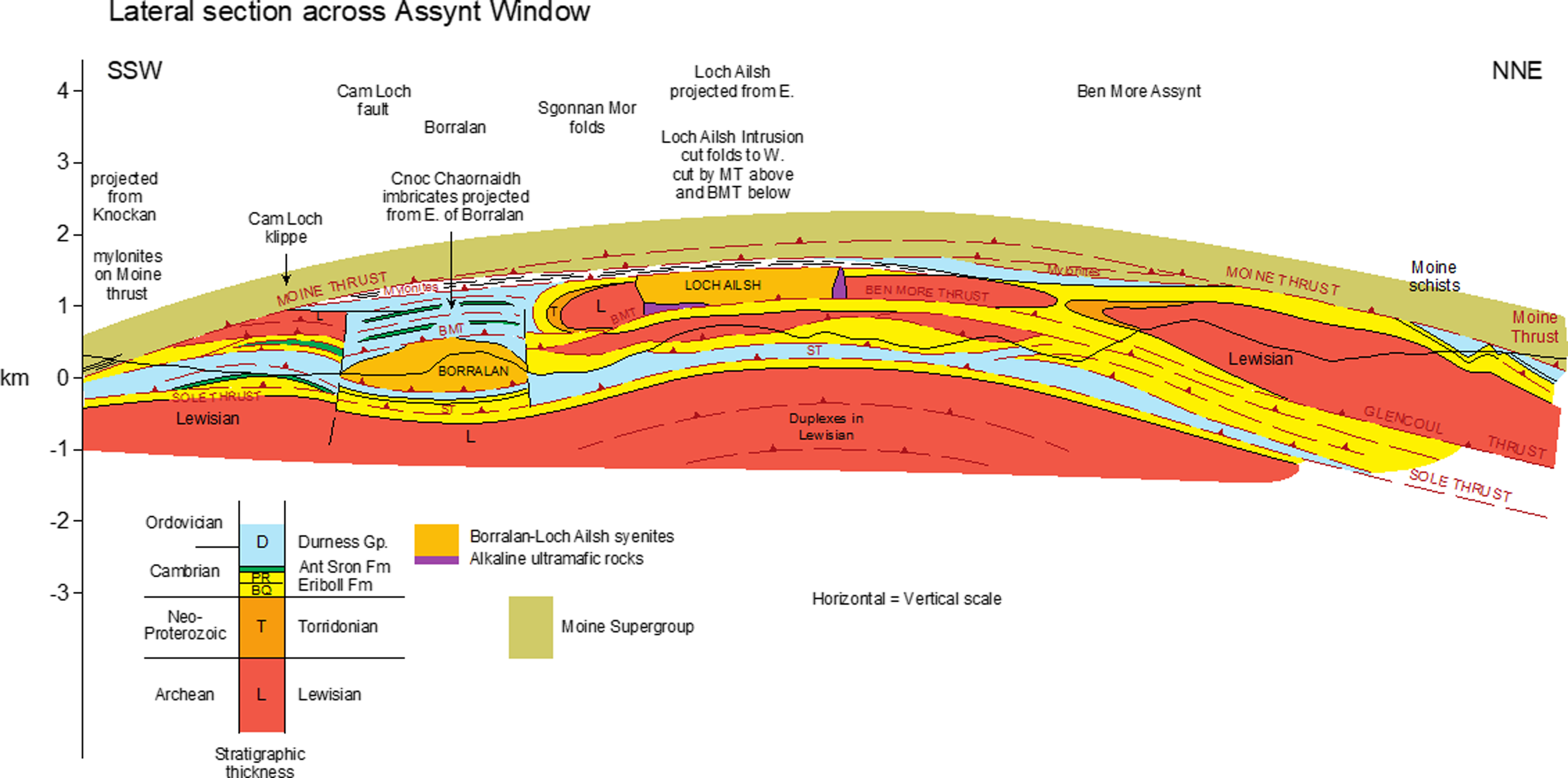
Figure 13 is a lateral section along the strike of the Assynt window. This profile clearly shows the Loch Ailsh syenite sandwiched in between the Moine thrust above and the Ben More Thrust below, and the Borralan syenite sandwiched between the Ben More Thrust above and the Borralan thrust beneath. Allochthonous slices of Lewisian basement gneisses can also be noted in the Cam Loch klippe and above the Glencoul and Ben More Thrusts. In the north, the large thrust sheet of Lewisian includes the rocks above the Glencoul and Ben More Thrusts. This massif could also have an internal thrust (Lewisian over Lewisian) within if the geometry of Krabbendam and Leslie (Reference Krabbendam and Leslie2004) is correct. The Moine thrust is bulged up over the Assynt culmination, mainly as a result of deep thrusting in the Lewisian basement. The deep thrusts marked are inferred, but at least four main thrusts that bring basement rocks up are known from mapping and have been extrapolated onto the line of section by down-plunge projection. In the south, near Knockan Crag, the Moine mylonites rest almost directly on top of the stable foreland, showing that the Moine thrust sheet initially was emplaced across the entire Assynt window region prior to deeper level thrusting along the Glencoul and Ben More Thrusts and bulging up of the Assynt window. The truncation of fold axial planes and minor imbricate thrusts along the footwall of the Moine thrust in the southern Assynt window corroborates some late-stage out-of-sequence motion along the Moine thrust.
Lateral section (NNE-SSW) along the strike of the Moine Thrust Zone and across the Assynt window. The Moine thrust has domed up as a result of deep thrusting in the Lewisian basement. Allochtonous thrust slices of Lewisian basement are present above the Cam Loch klippe, and above the Glencoul and Ben More Thrusts. The Loch Ailsh syenite, with its ultramafic margin, is sandwiched between the Moine thrust above and the Ben More Thrust below. The Loch Borralan syenite is sandwiched between the Ben More Thrust above and the Borralan thrust below. See text for explanation.
5. Discussion on regional tectonics
5.1. Moine Thrust Zone and Caledonian orogeny
The MTZ represents the Caledonian thrust front tapering towards the WNW with the orogenic wedge becoming increasingly thicker towards the SE. The timing of crustal thickening and metamorphism of the orogenic wedge is known from thermobarometric studies (Ashley et al. Reference Ashley, Thigpen and Law2015; Thigpen et al. Reference Thigpen, Law, Lloyd and Brown2010a, b, Reference Thigpen, Law, Loehn, Strachan, Tracy, Lloyd, Roth and Brown2013; Mazza et al. Reference Mazza, Mako, Law, Caddick, Krabbendam and Cottle2018), U-Pb monazite dating (Kinny et al. Reference Kinny, Friend, Strachan, Watt and Burns1999, Reference Kinny, Strachan, Friend, Kocks, Rogers and Paterson2003; Cutts et al. Reference Cutts, Kinney, Strachan, Hand, Kelsey, Emery, Friend and Leslie2010; Mako et al. Reference Mako, Law, Caddick, Thigpen, Ashley, Cottle and Kylander-Clark2019, Reference Mako, Law, Caddick, Kylander-Clark, Thigpen, Ashley, Mazza and Cottle2021) and Sm/Nd and Lu/Hf dating of garnets (Bird et al. Reference Bird, Thirlwall, Strachan and Manning2013) across the Northern Highlands. The ages of peak, or near-peak, metamorphism range from ca 480–425 Ma suggesting that the previously defined Grampian 1 (480–470 Ma), Grampian 2 (450–445 Ma) and Scandian (443–425 Ma) short-lived orogenies (Oliver et al. Reference Oliver, Wilde and Wan2008) are more likely to be one continuous orogeny (Searle, Reference Searle2021). A maximum age of Moine thrusting is given by the pre-thrusting intrusion of the Loch Ailsh and Loch Borralan syenites ranging from 430 to 429 Ma (Goodenough et al. Reference Goodenough, Millar, Strachan, Krabbendam and Evans2011). Mylonites clearly formed during ductile shearing have K-Ar cooling ages of 443–435 Ma (Kelley, Reference Kelley1988). Dallmeyer et al. (Reference Dallmeyer, Strachan, Rogers, Watt and Friend2001) showed that the micas from the mylonites contained excess argon and suggested that 40Ar/39Ar ages were unreliable. Rb/Sr ages as young as 408 Ma from mylonites in the Dundonell area south of Ullapool indicate that shearing could locally have continued up to the Early Devonian (Freeman et al. Reference Freeman, Butler, Cliff and Rex1998). It is not known how long the thrusting from Moine thrust to Sole thrust episode lasted, but the entire Caledonian Moine thrusting episode was complete by 400 Ma when the Devonian Old Red Sandstone was deposited unconformably over all tectonic units across Scotland. Thus, we must assume a maximum of 30 m.y. (430–400 Ma) time span for shortening and thrusting along the MTZ, and an approximate minimum east-west shortening of 54–120 km (Elliott & Johnson, Reference Elliott and Johnson1980; Coward, Reference Coward1985; Searle et al. Reference Searle, Law, Dewey and Streule2010). Accurate estimates depend entirely on where one draws the cut-off branch line along each thrust at depth. Added to this must be the amount of internal shortening and thrusting with the Moine Supergroup rocks above the MTZ, a figure that is unknown and impossible to quantify accurately. With 40–50 m.y. of continuous or semi-continuous crustal shortening, thickening and metamorphism up to kyanite and sillimanite grade across the Northern Highlands terrane alone, the total amount of crustal shortening could be several 100 km, a figure comparable to the Himalayan orogeny (Searle, Reference Searle and Schubert2015).
5.2. Alkaline igneous intrusions and thrusting
A major period of highly alkaline igneous intrusions in and around the Assynt window occurred at ∼430 Ma with the intrusion of the Canisp porphyry, the Loch Ailsh and Loch Borralan nepheline pseudoleucite syenites, K-feldspar-syenites and quartz-bearing syenites, and probably most of the Assynt hornblende-bearing lamprophyres, micro-diorites and peralkaline rhyolites (Goodenough et al. Reference Goodenough, Evans and Krabbendam2006, Reference Goodenough, Millar, Strachan, Krabbendam and Evans2011). Similar silica-undersaturated alkaline intrusions are known from the north as far as Loch Loyal, and south at least as far as Glen Dessarry, a distance of 200 km (Fig. 1), aligned along a NNE–SSW axis. The trend is roughly parallel to the MTZ, suggesting some physical connection between the area of highly alkaline, metasomatised sub-continental mantle and the initiation of the Moine thrust.
Alkaline intrusions including syenites and carbonatites are usually associated with (1) zones of lithospheric rifting such as the East African rift, (2) deep asthenospheric hot spot traces such as the Benui trough – Cameroon intrusions (60–30 Ma) of west Africa or (3) large igneous provinces such as the 25–1 Ma Yemen – Afar – Somaliland rift zone (Black et al. Reference Black, Lameyre and Bonin1985; Wooley, Reference Wooley2001). They are usually undeformed within-plate intrusions, not generally associated with ophiolites or suture zones. Many alkaline provinces, such as the Gardar province in south Greenland (1350–1140 Ma; Upton et al. Reference Upton, Emeleus, Heaman, Goodenough and Finch2003) are associated with deep lithospheric mantle melting and transcurrent faults, although these faults can only affect the final crustal emplacement. In Africa, alkaline igneous rocks do not generally intrude old stable cratonic regions, but do intrude intervening Proterozoic ‘mobile belts’. The Scottish alkaline intrusions are not associated with rift zones, hot spots, ophiolites or suture zones, and are uncommon in that they were definitively intruded during a time of orogenic compression and initiation of the Moine Thrust Zone, not lithospheric extension.
Numerous granites (part of the so-called ‘Newer Granites’) were also intruded across the Northern Highlands during the period 430–420 Ma. They are mostly high-K, calc-alkaline to alkaline in composition with highly enriched lithospheric mantle signatures, and high concentrations of Ba, Sr and LILEs, with Nd-Sr isotopic compositions indicating some crustal contamination (Miles et al. Reference Miles, Woodcock and Hawkesworth2016; Neilson et al. Reference Neilson, Kokelaar and Crowley2009). The ∼430 Ma granites in the Northern Highlands typically have high Sr/Y values and high La/Yb ratios, typical of adakitic magmatism (Archibald et al. Reference Archibald, Murphy, Fowler, Strachan and Hildebrand2022). They are spatially and temporally related to hornblende-bearing appinites and mantle-derived lamprophyres (Halliday Reference Halliday1984; Rock 1984; Shand et al. Reference Shand, Gaskarth, Thirlwall and Rock1994; Murphy, Reference Murphy2020), similar to the lamprophyres exposed in the Assynt window. Most previous models relate the ‘newer granites’ to some sort of slab break-off (Atherton & Ghani, Reference Atherton and Ghani2002) associated with inferred NW dipping subduction (Dewey & Shackleton, Reference Dewey and Shackleton1984; Strachan et al. Reference Strachan, Harris, Fettes, Smith and Trewin2002). In contrast, the Searle (Reference Searle2021) model invokes continuous SE-directed subduction along the Highland Boundary and Midland valley during the Ordovician-Silurian, and that the Grampian and Scandian metamorphic events were all one continuous event lasting ca 40–45 m.y., a time span similar to that along the Himalaya. The appinite – lamprophyre – adakite suite does not require subduction processes, and the geographic distribution of the 430–425 Ma alkaline intrusions in Scotland is aligned at right angles to the proposed subduction zone along the Midland valley. The geographical distribution of alkaline igneous rocks of NW Scotland extends for a distance >200 km to the north of the Highland boundary fault and Midland Valley suture zone. It is suggested here that, similar to the distribution of kimberlites across Africa, the Assynt lamprophyres were intruded above localised mantle anomalies, where alkaline or I-type granite magmas with adakite-shoshonite geochemical imprints formed by fractional crystallisation of sub-continental lithospheric mantle, forming co-magmatic mafic melts (lamprophyres, appinites) and lower crustal syenite melts. Lithospheric mantle heating melted the base of the crust to form the high-K, and high-Ba, Sr granites. Both mantle-derived lamprophyres and lower crust-derived granites intruded at roughly the same time.
6. Conclusions
The Assynt window through the Moine Thrust Zone in NW Scotland has been a classic area for interpretation of thrust tectonic processes over the last 150 years. However, there still remains controversy over the geometric mapping of thrust sheets, the relationship between syenite–lamprophyre intrusions and bounding thrust planes and the timing of thrust motion. Renewed mapping, balanced and restored cross-sections, combined with fabric analysis, cross-cutting field relationships and geochronological data have revealed the following main conclusions:
-
1. The Assynt window through the Moine Thrust Zone has been domed up by four main deep-level thrusts that have brought Lewisian basement rocks high, thrusting the Lewisian gneisses westward over Cambrian-Ordovician sediments.
-
2. The Moine thrust, although mapped as a single line on the map, includes (a) early, deep ductile mylonites derived from hanging-wall Moine schists, and footwall Lewisian gneisses, Cambrian quartzites and Ordovician dolomites and limestones, (b) the brittle roof thrust contact with the underlying Ben More and Glencoul thrust sheets and (c) out-of-sequence thrusting where a brittle thrust fault truncates imbricate thrusts and folds in the footwall (southern Assynt window). Along the MTZ, the Moine thrust was the first thrust to move and was emplaced to the west over the Ben More, Glencoul and Sole thrust sheets across the entire Assynt window to rest almost directly above the foreland, as seen at Knockan crag, then was domed up as a result of deep-level thrusts in the Lewisian basement.
-
3. The Loch Ailsh syenite (206Pb/238U zircon concordant age 430.6 ± 0.2 Ma; Goodenough et al. Reference Goodenough, Millar, Strachan, Krabbendam and Evans2011) was intruded through the Cambrian-Ordovician sedimentary sequence pre-thrusting. The syenite was carried on the Ben More Thrust below and was cut by the Moine thrust above. The Moine thrust must, therefore, have been initiated after 430 Ma.
-
4. The Loch Borralan syenite (206Pb/238U zircon age 431.1 ± 1.2 Ma; Goodenough et al. Reference Goodenough, Millar, Strachan, Krabbendam and Evans2011) intruded through the Cambrian-Ordovician sedimentary sequence, also pre-thrusting. It formed a high-temperature contact metamorphic aureole in the Durness limestones and dolomites, forming diopside-forsterite-phlogopite-brucite marbles, exposed in Ledbeg quarry. Flattened pseudoleucites within the borralanite attest to the sub-solidus high-temperature internal deformation fabrics imposed after intrusion (Searle et al. Reference Searle, Law, Dewey and Streule2010; Fox & Searle, Reference Fox and Searle2021). The Loch Borralan syenite was carried on the Borralan thrust below, is truncated along the top by the Ben More Thrust, and bounded to the north and south by lateral ramps, which effectively cut out the contact aureole along the lateral margins.
-
5. The Loch Borralan ‘late suite’ (206Pb/238U zircon age 429.2 ± 0.5 Ma; Goodenough et al. Reference Goodenough, Millar, Strachan, Krabbendam and Evans2011) is not a separate magmatic suite, but are pockets and vugs of pegmatites enclosed completely by pseudoleucite + melanite garnet + biotite nepheline syenite. Nowhere are any rocks of the Borralan intrusion seen to cross-cut the major duplex thrusts as claimed by Parsons and McKirdy (Reference Parsons and McKirdy1983), Parsons (Reference Parsons1999) and Goodenough et al. (Reference Goodenough, Millar, Strachan, Krabbendam and Evans2011). Syenite dykes cutting country rocks occur within the Borralan thrust sheet, not cutting through the bounding thrust faults. Both the Loch Ailsh and Loch Borralan syenites were intruded immediately prior to thrusting, which therefore is constrained as younger than 430–429 Ma.
-
6. A suite of alkaline sills including peralkaline rhyolites, hornblende bearing micro-diorites and lamprophyres (vogesites) and porphyritic quartz micro-syenites (nordmarkites) intruded up to the Ordovician dolomites and limestones prior to thrusting. They are widely exposed throughout the Assynt window and are clearly deformed by thrusting and folding in the Sole thrust sheet and structurally higher units. They do not appear to intrude the Moine schists above the Moine thrust mylonites (Fox & Searle, Reference Fox and Searle2021).
-
7. The Moine Thrust Zone, dated as starting at 430–429 Ma, marks the western thrust front of the Caledonian orogenic wedge, which thickens to the east and ESE beneath the Northern Highlands and Grampian Highlands. Barrovian facies metamorphic grade reaches kyanite and sillimanite grade in the Northern Highlands along the hanging wall of the Moine thrust. Thus, the entire Northern Highlands and MTZ is the pro-wedge part of the Caledonides (Searle, Reference Searle2021), not a backthrust zone retro-wedge as claimed in earlier models (Dewey & Shackleton, Reference Dewey and Shackleton1984; Strachan et al. Reference Strachan, Harris, Fettes, Smith and Trewin2002; Leslie et al. Reference Leslie, Smith and Soper2008).
-
8. The regional extent of highly alkaline intrusions stretches north-south for at least 200 km from the Loch Loyal syenite in the north, at least to the Glen Dessarry syenites in Knoydart, east of the Isle of Skye in the south, indicating a large area of highly alkaline metasomatised upper mantle underlay western Scotland at ∼430 Ma. These alkaline intrusions are not subduction-related at all; the zone of alkaline igneous rocks in NW Scotland is aligned north-south, whereas the subduction zone along the Highland Boundary fault and Midland valley, >200 km to the south, is aligned SW–NE.
-
9. All the alkaline igneous rocks in the Assynt window were intruded during crustal compression, immediately prior to initiation of the Moine thrust. It is possible that intrusion of these alkali magmas along the Caledonian thrust front may have somehow initiated the Moine thrust movement. The alkaline rocks of NW Scotland are not related to lithospheric rifting, hot spot plumes, ophiolites or suture zones. Instead, they record an anomalous metasomatised upper mantle within the Lewisian basement. Inliers of Lewisian basement occur beneath the Moine metamorphic rocks in the hinterland east of the Moine thrust indicating that the Moine thrust initiated within the Lewisian basement, and not along a plate margin.
Acknowledgements
This paper is the result of >30 years of leading undergraduate student field trips to the Assynt window and Moine Thrust Zone, as well as more detailed geological mapping in specific areas. I would particularly like to thank the following: Robert Fox, Eleni Wood, Sam Cornish, Tobermory MacKay-Champion, Mike Streule, Nick Gardiner, John Dewey, Marc St-Onge, Rob Strachan and Rick Law for many discussions. Thanks to Ryan Thigpen and Rob Strachan for detailed reviews, which greatly improved the paper, and to editor Olivier Lacombe. I acknowledge with gratitude funding from a Leverhulme Emeritus Fellowship.


 Open access

