


Introduction
The United States (U.S.) Centers for Disease Control and Prevention (CDC) reported an annual outpatient antibiotic prescription rate of 752 prescriptions per 1,000 persons in 2024, which was highest in the South. 1 Overall, an estimated 28% of outpatient antibiotic prescriptions are unnecessary, although the rate varies by diagnosis and outpatient care setting. Reference Hersh, King, Shapiro, Hicks and Fleming-Dutra2,Reference Palms, Hicks and Bartoces3
Depending on living conditions (sheltered vs unsheltered) and subsequent exposure to infectious agents, many individuals experiencing homelessness and/or transient housing have a higher infection risk and often face barriers to care. Reference Lanham, White and Gaffney4 The number of people experiencing homelessness in the U.S. increased by 18.1% from 2023 to 2024. 5
Given the epidemiologic and socioeconomic vulnerability of this growing population and the limited literature surrounding the need for antimicrobial stewardship (AMS) efforts in underserved outpatient clinics, the objective of this study was to evaluate the appropriateness of antibiotic prescriptions at a free clinic primarily serving patients experiencing homelessness.
Methods
This retrospective cohort study assessed all oral antibiotic prescriptions written at C.D. Doyle Clinic between 1/1/23–6/30/25. The C.D. Doyle Clinic is an outpatient, interprofessional, student-run, free clinic in Austin, TX that operates for three hours, once weekly. The clinic provides a variety of ambulatory care services including treatment of chronic conditions, infections, and wound care, and serves between 14–17 patients per month. Most patients are either uninsured or access healthcare through a county-funded medical access program (MAP) for low-income residents. While no-cost prescription medications are not available for on-site dispensing, low-cost first-line oral antibiotics are available through the MAP formulary and/or cash-pay coupons at nearby community pharmacies. Healthcare volunteers include students and trainees from medicine, advanced practice nursing, pharmacy, social work, and prehealth undergraduate disciplines. All clinic sessions are supervised by on-site attending physicians. Advanced practice nursing students and pharmacy students additionally receive profession-specific remote supervision from nurse practitioner and pharmacist preceptors, respectively. While the clinic does maintain an electronic health record (EHR) (athenahealth, Inc, Boston, MA) for clinical documentation, all prescriptions are written on a paper prescription pad. The clinic does not have any ongoing AMS initiatives.
Study data was abstracted from the EHR by a single investigator (OL). The primary outcome, antibiotic appropriateness, was independently assessed by two investigators (OL and MS) and arbitrated by a third investigator (TJC) in cases of disagreement. Prescriptions were evaluated for appropriateness against the best available scientific evidence using a predefined hierarchy prioritizing IDSA clinical practice guidelines, disease-specific guidance, FDA prescribing information, and then expert clinical judgment. Appropriateness was assessed across four domains: antibiotic selection, dose, dosing frequency, and duration of therapy. Prescriptions could be inappropriate for one or more reasons. Of note, patients may have received more than one oral antibiotic prescription during the study period; however, all prescriptions were evaluated independently. Data were tabulated with STATA, version 15.1 (StataCorp LLC, College Station, TX). This study was reviewed and deemed exempt from the University of Texas at Austin’s Institutional Review Board.
Results
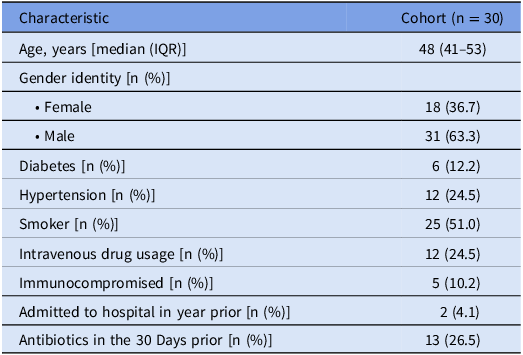
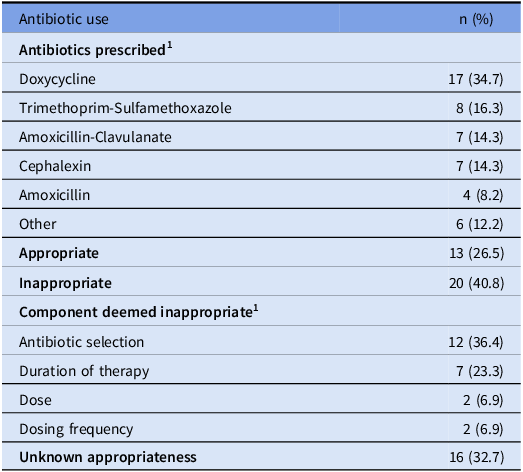
Over the 30-month study period, a total of 470 patient visits were conducted at C.D. Doyle Clinic, and 49 oral antibiotics were prescribed to 30 unique patients. See Table 1 for patient characteristics. Skin and soft tissue infections were the most common (69.4%), followed by oropharyngeal infections (10.2%), urinary tract infections (10.2%), and other infections (10.2%). Of the 49 prescriptions, 20 prescriptions were deemed inappropriate, 13 were deemed appropriate, and 16 could not be evaluated due to lack of necessary documentation in the EHR (see Table 2).
Cohort characteristics (n = 30)

IQR, interquartile range.
Oral antibiotic prescription appropriateness (n = 49)

1 Percentages may exceed 100% because categories are not mutually exclusive.
Discussion
Of the antibiotic prescriptions reviewed at an interprofessional student-run free clinic, 40.8% were deemed inappropriate when evaluated against clinical practice guidelines. This rate of inappropriate prescribing is more alarming when considering 32.7% of antibiotic prescriptions could not be completely assessed for appropriateness as documentation regarding dose, dosing frequency, and/or duration of therapy were lacking.
Unfortunately, the rate of inappropriate prescribing we observed seems to align with previous observations. In a nationally representative sample of visits to non-federally employed, office-based physicians and hospital-based emergency departments, an estimated 28% of prescriptions were unnecessary. Reference Hersh, King, Shapiro, Hicks and Fleming-Dutra2 In a study that compared a random sample of outpatient antibiotic prescriptions to consensus guidelines prescribed at one of seven Veterans Affairs (VA) primary care clinics, 49.7% (149/300) of prescriptions were unnecessary while 76.0% (228/300) were inappropriate. Reference Shively, Buehrle, Clancy and Decker6 Although outpatient clinics that are accredited by The Joint Commission under the Ambulatory Health Care (Standard MM.09.01.03) or (Standard MM.09.01.01) programs must adhere to standards related to AMS, most outpatient care settings, including ours, are commonly without formal AMS programs. Reference Eudy, Pallotta and Neuner7 The absence of formal AMS efforts enables inappropriate prescribing, which in turn can negatively impact patient safety via adverse effects and promote antimicrobial resistance and gut dysbiosis.
This clinic would benefit from the implementation of an AMS initiative to optimize antibiotic use. In its Core Elements of Outpatient Antibiotic Stewardship, the CDC advocates consulting a pharmacist to facilitate optimal antibiotic use if they are accessible, and pharmacist support is associated with improved success when implementing AMS initiatives in outpatient settings. Reference Eudy, Pallotta and Neuner7,Reference Sanchez, Fleming-Dutra, Roberts and Hicks8 Studies describing antibiotic use or AMS initiatives in student-run free clinics are scarce, but there are many examples of AMS program implementation in outpatient settings. Reference Eudy, Pallotta and Neuner7–Reference St. Louis and Okere9 Potential interventions we are considering include pharmacy student prospective audit and feedback of all antibiotic prescriptions, clinical decision support (CDS) in the EHR (eg, best practice advisories [BPAs] for antibiotic orders), standardized “smart phrases” in clinical documentation to ensure that antibiotic dose, frequency, and duration of therapy are consistently recorded, and facility-specific treatment guidelines for commonly encountered infections. Additionally, while all prescriptions are currently written on a paper prescription, transitioning to electronic prescribing could facilitate additional CDS opportunities, such as BPAs, order sets, and documentation templates, supporting ongoing quality improvement efforts to enable reliable tracking of antibiotic use.
To our knowledge, this is the first study to report total oral antibiotic use at a student-run, free clinic, but it has several limitations. First, our limited sample size and relatively short study period may limit the external validity of our findings. Second, the lack of consistency in the careteam from week-to-week led to variability in clinical documentation, which may have resulted in underestimating the number of appropriate and/or inappropriate antibiotic prescriptions. Unfortunately, this frequent turnover is nearly unavoidable in our clinic and may further limit the generalizability of our findings to care settings with more resources and consistent staff. Third, although we attempted to mitigate misclassification bias in our primary outcome by using three investigators, it is possible that some outcomes were misclassified due to a subjective interpretation of the best available scientific evidence or because of incomplete clinical documentation. Despite these limitations, we feel our findings justify an intervention as any amount of inappropriate prescribing warrants systemic change. This is particularly true for patients experiencing homelessness, whereby improving the standard of care can have a massive impact.
In conclusion, oral antibiotic prescribing at this student-run free clinic serving patients experiencing homelessness demonstrated substantial gaps in appropriateness and documentation. These findings highlight the need for targeted AMS interventions to minimize patient harm and optimize patient care outcomes. The implications of this study may apply to other student-run free clinics and/or Federally Qualified Health Centers, but future research should evaluate the clinical impact of AMS interventions in these unique outpatient settings to establish best practices and support broader implementation.
Acknowledgments
The authors would like to thank all clinical volunteers at C.D. Doyle Clinic for providing care each week and supporting the health of patients experiencing homelessness. We also acknowledge the C.D. Doyle student and faculty leadership team for their guidance and support throughout this project.
Author contributions
OL: Methodology, Investigation, Data Curation, Writing—Original Draft, Writing—Review and Editing, Project Administration; MPS: Conceptualization, Methodology, Validation, Writing—Original Draft, Writing—Review and Editing, Project Administration, Supervision; KPL: Supervision, Writing—Original Draft, Writing—Review and Editing; TJC: Validation, Formal Analysis, Resources, Data Curation, Writing—Review and Editing.
Financial support
None.
Competing interests
All authors report no conflicts of interest relevant to this article.
Research transparency and reproducibility
All data generated or analyzed during this study are contained within the manuscript. No external datasets or code were created or used for this work.

 Open access

