





1. INTRODUCTION
In French, a language with a grammatical gender system, the masculine form occupies two functions, one generic and one specific, in contrast to the feminine form which always has a specific interpretation. As an example, chirurgiennes [surgeonsFEM] unambiguously refers to a group of women surgeons, whereas chirurgiens [surgeonsMASC] can designate a group consisting of only men surgeons, of both women and men surgeons, or of surgeons whose gender is unknown. During the last two decades, psycholinguistic studies have investigated the effect of the default use of the masculine grammatical form on mental representations of gender. These studies, conducted in different languages, have shown that this default use results in a male bias in mental representations of gender (French: Brauer and Landry, Reference Brauer and Landry2008; Gygax et al., Reference Gygax, Gabriel, Sarrasin, Oakhill and Garnham2008, Reference Gygax, Gabriel, Lévy, Pool, Grivel and Pedrazzini2012; German: Braun et al., Reference Braun, Sczesny and Stahlberg2005; Hansen et al., Reference Hansen, Littwitz and Sczesny2016; Horvath and Sczesny, Reference Horvath and Sczesny2016; Irmen, Reference Irmen2007; Steiger-Loerbroks and von Stockhausen, Reference Steiger-Loerbroks and von Stockhausen2014; Norwegian: Gabriel, Reference Gabriel2008).
In order to increase women’s visibility through language, some users of grammatical gender languages such as French or German have begun using gender-fair (GF) forms. These forms are becoming more popularly employed, as illustrated by an increased use of GF forms (Abbou, Reference Abbou2011; Burnett and Pozniak, Reference Burnett and Pozniak2021) and by the decision to include the gender-neutral pronoun “iel” (contraction of il [he] and elle [she]) in the online version of the dictionary Le Robert (‘iel’, 2021). This increased use has led to heated discussions (Abbou et al., Reference Abbou, Arnold, Candea and Marignier2018) and a politicisation of GF language in French since it can be considered a political stance to use (or not use) a certain kind of GF language (Burnett and Pozniak, Reference Burnett and Pozniak2021).
In French, GF forms can either include both the feminine and masculine grammatical forms in their complete (chirurgiennes et chirugiens [surgeonsFEM and surgeonsMASC]) or contracted forms (chirurgien·nes [surgeonsMASC·FEM]), or different gender-neutral forms which lack gender-markings (collègues [colleagues]). While GF forms have been found to have a positive effect on representations of women in German (Irmen, Reference Irmen2007; Irmen and Roßberg, Reference Irmen and Roßberg2004; Steiger-Loerbroks and von Stockhausen, Reference Steiger-Loerbroks and von Stockhausen2014), experimental studies on the effect of these forms in French are scarce. Filling this gap is the main objective of the current study.
With the aim of investigating the influence of different GF forms as compared to the masculine form of a role noun on perceived gender proportions, we analysed 1,018 native French speakers’ estimated percentage of women and men in 22 role nouns. By focusing on non-stereotyped role nouns, we aimed to exclude gender stereotypes as a factor potentially influencing the estimated percentages (in contrast to Misersky et al., Reference Misersky, Gygax, Canal, Gabriel, Garnham, Braun, Chiarini, Englund, Hanulikova, Öttl, Valdrova, Von Stockhausen and Sczesny2014). Moreover, the stereotypicality norms for the different GF forms provided in this study will allow for further research on the topic of GF language.
The article is structured as follows: First, a literature review presents a state of the art of the relevant research domains, which includes the characteristics of French GF forms and the influence of GF and masculine forms on mental representations of gender. Second, the research questions and the hypotheses are presented. Third, the participants, materials, research design, and the data preparation procedure are described. Finally, the results are presented and discussed before reaching a conclusion.
2. BACKGROUND
This section is concerned with an overview of two research fields relevant to our study: how GF language in French takes form, and the effects of masculine and GF forms on gender representation.
2.1. Gender-fair language in French
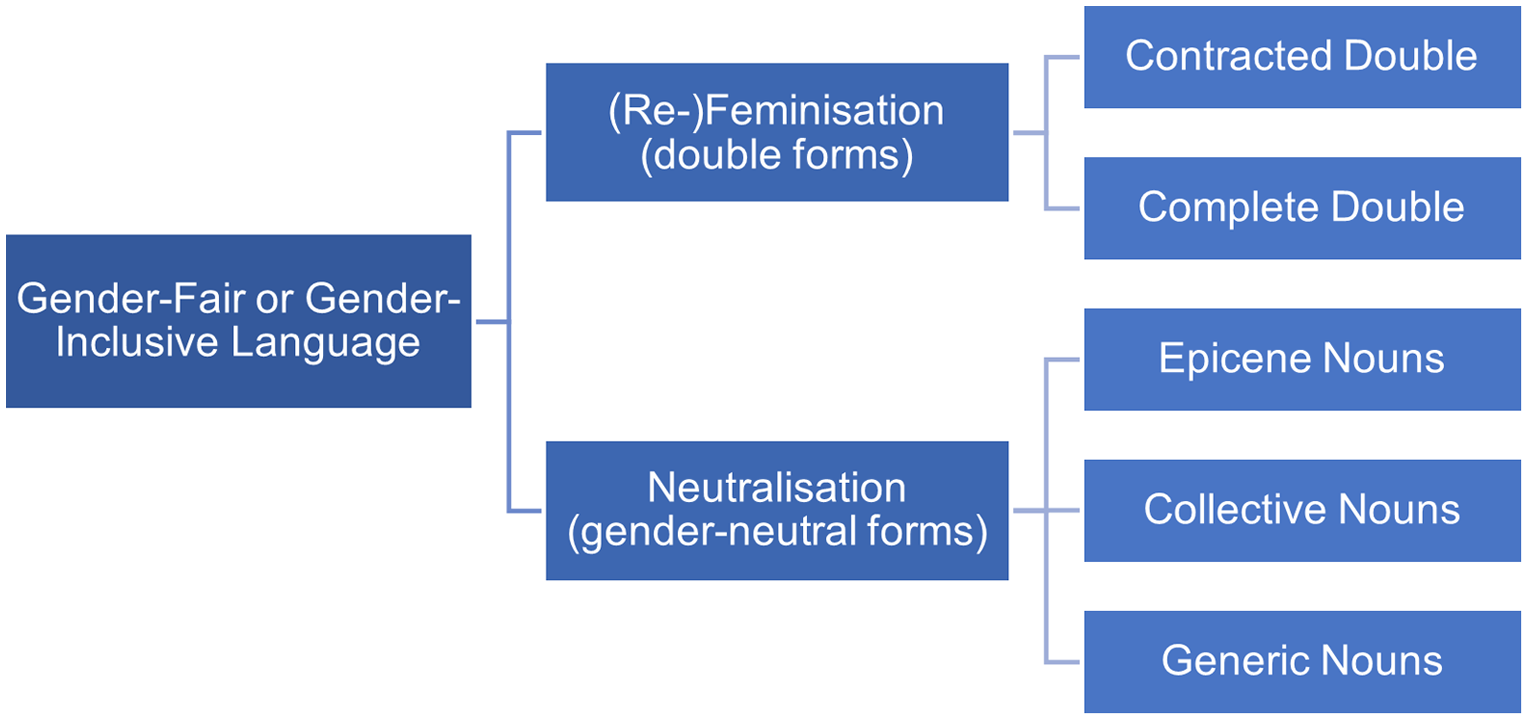
Two main strategies can be distinguished regarding GF language: feminisation and neutralisation (Elmiger, Reference Elmiger2008; Gabriel et al., Reference Gabriel, Gygax and Kuhn2018; Gygax et al., Reference Gygax, Gabriel and Zufferey2019). Although we acknowledge that one should perhaps rather talk of a re-feminisation or de-masculinisation strategy (Gygax et al., Reference Gygax, Gabriel and Zufferey2019; Viennot, Reference Viennot2017), we will continue using feminisation since it is an established term today. The feminisation strategy aims at including both the feminine and the masculine forms in text by means of double forms. These can either be complete (joggeuses et joggeurs [joggersFEM and joggersMASC]) or contracted (joggeur·euses [joggersMASC·FEM]). However, this strategy is not unproblematic since using complete forms requires choosing an order of mention, which is often affected by semantic factors (Hegarty et al., Reference Hegarty, Watson, Fletcher and McQueen2011). For example, older people tend to be mentioned before younger (père et fils [father and son]), and men before women (mari et femme [husband and wife]) (Gygax et al., Reference Gygax, Gabriel and Zufferey2019). Since double forms have often been criticised for their length, as in étudiants et étudiantes [studentsMASC and studentsFEM], contracted forms have been suggested whereby the feminine gender-marking gets added onto the masculine form and separated with a typographical symbol such as an interpunct or a hyphen. These contracted forms have been criticised for impairing aesthetic qualities, comprehension, and the readability of a text. Empirical support for these claims, however, does not exist (French: Gygax and Gesto, Reference Gygax and Gesto2007; German: Blake and Klimmt, Reference Blake and Klimmt2010; Braun et al., Reference Braun, Oelkers, Rogalski, Bosak and Sczesny2007). In addition, double forms strengthen the gender binarity by suggesting that women and men are the two sole gender categories available (Gabriel et al., Reference Gabriel, Gygax and Kuhn2018). These problems can be resolved by employing neutralisation strategies since gender-neutral forms lack explicit gender-markings that correspond to the referred person’s gender. Gender-neutral forms include epicene nouns (collègues [colleagues]), collective nouns (un groupe de jogging [a jogging group]), and generic nouns. Epicene nouns are nouns whose feminine and masculine forms are identical. As opposed to generic nouns, epicene nouns can require both feminine and masculine agreement, while generic nouns are either grammatically feminine (une personne [aFEM person]) or masculine (un individu [anMASC individual]) (Elmiger, Reference Elmiger2008).Footnote 1 The relationship between the different strategies and the forms they use is shown in Figure 1.
Relationship between the different gender-fair strategies and forms. Gender-inclusive language is included as a synonym for gender-fair language since the term ‘langage inclusif’ is the most common term in French.
Finally, we acknowledge that other strategies do exist (cf. Elmiger, Reference Elmiger2008), but we decided to concentrate on the above-mentioned forms as they seem to be the most prevalent in inclusive language guides (e.g., Viennot, Reference Viennot2018). We chose to use the interpunct for the contracted double forms as it is the typographical sign often used at the centre of the public debate in France (Conruyt, Reference Conruyt2021), sometimes to the degree that GF language is reduced to this form.
2.2. Effects of masculine and gender-fair forms on gender representation
Research has unanimously found that the use of the masculine form (whether intended as generic or specific) results in a male bias in readers’ mental representations of gender (cf. reviews in Gabriel and Gygax, Reference Gabriel, Gygax, Giles and Maass2016; Gygax et al., Reference Gygax, Gabriel and Zufferey2019; Sato et al., Reference Sato, Öttl, Gabriel and Gygax2017; Stahlberg et al., Reference Stahlberg, Braun, Irmen, Sczesny and Fiedler2007). This bias is present even with female-stereotyped role nouns (Gygax et al., Reference Gygax, Gabriel, Sarrasin, Oakhill and Garnham2008) and seems hard to overcome (Gygax et al., Reference Gygax, Gabriel, Lévy, Pool, Grivel and Pedrazzini2012). To resolve this bias, GF forms are being increasingly used in grammatical gender languages. Although the effects of complete double forms have also been tested in French (e.g., Chatard et al., Reference Chatard, Guimont and Martinot2005; Vervecken et al., Reference Vervecken, Gygax, Gabriel, Guillod and Hannover2015), the effects of other GF forms on representations of gender have been mainly tested in German (Braun et al., Reference Braun, Sczesny and Stahlberg2005; Irmen and Roßberg, Reference Irmen and Roßberg2004; Sato et al., Reference Sato, Gabriel and Gygax2016; Steiger-Loerbroks and von Stockhausen, Reference Steiger-Loerbroks and von Stockhausen2014). The literature review in the following section is therefore based on studies conducted in German.
While double forms appear to produce more balanced gender representations than masculine forms (exp. 2 in Irmen and Roßberg, Reference Irmen and Roßberg2004), results differ regarding gender-neutral forms as they have been found to both reproduce the male bias (e.g., Irmen, Reference Irmen2007; exp. 2 & 3 in Irmen and Roßberg, Reference Irmen and Roßberg2004), and to result in more equal gender representations (e.g., Sato et al., Reference Sato, Gabriel and Gygax2016; Steiger-Loerbroks and von Stockhausen, Reference Steiger-Loerbroks and von Stockhausen2014). When comparing gender-neutral forms with double forms, the latter have produced stronger effects than the former in some experiments (e.g., exp. 1 & 2 in Braun et al., Reference Braun, Sczesny and Stahlberg2005), but this difference was not constant (e.g., exp. 3 in Braun et al., Reference Braun, Sczesny and Stahlberg2005). As for the different double forms, contracted forms have been found to produce stronger effects than complete forms (exp. 4 & 6 in Braun et al., Reference Braun, Sczesny and Stahlberg2005). In French, research on contracted forms is scarce (with the exception of Chatard et al., Reference Chatard, Guimont and Martinot2005, and Gygax and Gesto, Reference Gygax and Gesto2007).
In addition to grammatical gender, gender stereotypicality — meaning the degree to which we believe or expect a role to be held by a woman or a man — is of great importance when studying mental representations of gender since stereotype information has been shown to be automatically activated and affect mental representations of gender (Carreiras et al., Reference Carreiras, Garnham, Oakhill and Cain1996; Gygax et al., Reference Gygax, Gabriel, Sarrasin, Oakhill and Garnham2008; Irmen and Kurovskaja, Reference Irmen and Kurovskaja2010; Oakhill et al., Reference Oakhill, Garnham and Reynolds2005). Since role nouns — nouns denoting groups of people or roles in general like piano players or political activists — are often used in studies investigating mental representations of gender, we need to know how they are perceived by speakers in terms of gender stereotypes. Otherwise, it would be difficult to separate the effect of the grammatical form of the role noun from that of its gender stereotypicality, especially for male stereotyped role nouns. Previous studies collecting stereotypicality norms have found that the direction of the response scale has an effect on the perceived women/men ratios (Gabriel et al., Reference Gabriel, Gygax, Sarrasin, Garnham and Oakhill2008; Kennison and Trofe, Reference Kennison and Trofe2003; Misersky et al., Reference Misersky, Gygax, Canal, Gabriel, Garnham, Braun, Chiarini, Englund, Hanulikova, Öttl, Valdrova, Von Stockhausen and Sczesny2014). This will be further investigated in the present study since it includes scale direction as a variable having a potential effect on perceived women/men ratios (see Section 4 for details).
Before presenting the current study, we will discuss two other variables which have been found to influence mental representations of gender, namely attitudes towards GF language and participant gender.
2.2.1. Attitudes, participant gender, and gender-fair language
In general, attitudes are thought to be dispositions possessed by a person to evaluate an object with different degrees of favour or disfavour (Perloff, Reference Perloff2003). They are included in the broader concept of values, characterised as important guiding principles in a person’s life (Bernard et al., Reference Bernard, Maio and Olson2003). Consequently, attitudes shape and influence how we interact with and think of other entities in the world. Attitudes are of interest in the present study since some studies have shown that positive attitudes towards GF forms (or sometimes referred to as non-sexist language (Braun et al., Reference Braun, Sczesny and Stahlberg2005; Parks and Roberton, Reference Parks and Roberton2000)) lead to a reduced representation of women with masculine role nouns, indicating that participants with positive attitudes interpret the masculine form more specifically than those with negative attitudes (Braun et al., Reference Braun, Sczesny and Stahlberg2005). To measure attitudes towards GF language, researchers have typically used different questionnaires assessing participants’ agreement on different statements such as We will never rid ourselves of gender prejudice so long as we have that prejudice built into our language (Prentice, Reference Prentice1994). These attitudes have been shown to also influence participants’ evaluation of a text written with GF language (Tibblin, Reference Tibblin2020), and they are closely connected to attitudes towards gender equality (Sarrasin et al., Reference Sarrasin, Gabriel and Gygax2012).
In addition, attitudes towards GF language are linked to participant gender, since previous research has shown that male participants held significantly more negative attitudes towards GF language than female participants (Tibblin, Reference Tibblin2020). Other studies have investigated the influence of participant gender on representations of women and found that female participants showed increased representations of women when compared to male participants (Brauer and Landry, Reference Brauer and Landry2008; Braun et al., Reference Braun, Sczesny and Stahlberg2005). However, this effect is not consistent since other studies have shown no participant gender effects (Steiger-Loerbroks and von Stockhausen, Reference Steiger-Loerbroks and von Stockhausen2014). As these two variables can potentially influence the representation of women, we include them in this study.
3. THE PRESENT STUDY
In short, previous research has found that the masculine form, even if intended as generic, leads to a male bias in mental representations. Studies of different languages (especially German) have shown that this effect may be attenuated by using double and gender-neutral forms, but such experimental studies, with a few exceptions, have not contrasted several different GF forms and have not been carried out on French. In addition, gender stereotypes are closely connected to mental representations of gender, and although stereotypicality is not an experimental factor in our study (we only tested non-stereotyped role nouns), we collect accurate perceived women/men ratios of non-stereotyped role nouns. These norms could further refine statistical models for future research. To our knowledge, the present study is the first to a) investigate the effects of the different GF forms on the representation of women in a norming study in French, and b) provide perceived women/men ratios for 22 non-stereotyped role nouns presented in different GF forms in French (see Appendix A).
In line with Sato et al. (Reference Sato, Gabriel and Gygax2016), who studied German nominalised gender-neutral forms, the focus of the present study is purely on the form of the role noun, and not on the potential effects of stereotypicality. For that reason, only non-stereotyped role nouns were included in the study. With the removal of gender information in terms of stereotypicality, a potential change in the estimated percentage of women between GF forms can only be attributed to the change of the form and thus provide a stronger argument in favour or against GF forms having an effect on gender representation. In addition, it should arguably be more difficult to establish whether GF forms have an effect on non-stereotyped role nouns, at least in comparison to male stereotyped nouns. In other words, if the estimated percentage of women in a role is already low, i.e., because it’s stereotyped, the application of GF forms should more easily result in a significant increase in the representation of women than if the role noun is non-stereotyped to begin with. Moreover, using only non-stereotyped role nouns should allow for a finer measurement of the norms since the role nouns are not contrasted with stereotyped nouns (see Section 4.3 for a further discussion).
To achieve the above-mentioned aims, the following research questions were formulated:
-
i. To what extent do the different GF forms influence participants’ estimated percentage of women represented in a role noun?
-
ii. To what extent does the response scale direction influence participants’ estimated percentage of women?
-
iii. To what extent do attitudes towards GF forms, participant gender, and participant region influence the estimated percentage of women represented in a role noun?
-
iv. Is any role noun particularly affected by the application of particular GF forms?
Based on the review of previous findings, Hypothesis 1a is that the estimated percentage of women will be lower in the masculine form than in the other forms (e.g., Brauer and Landry, Reference Brauer and Landry2008; Sato et al., Reference Sato, Gabriel and Gygax2016; Steiger-Loerbroks and von Stockhausen, Reference Steiger-Loerbroks and von Stockhausen2014). In addition, Hypothesis 1b is that the estimated percentage of the gender-neutral forms will be lower than that of the double forms (as in exp. 1 & 2 in Braun et al., Reference Braun, Sczesny and Stahlberg2005; exp. 2 & 3 in Irmen and Kurovskaja, Reference Irmen and Kurovskaja2010), and that within the double forms, contracted forms will result in a bigger increase compared to the complete forms (exp. 4 & 6 in Braun et al., Reference Braun, Sczesny and Stahlberg2005). Hypothesis 2 concerns the influence of the scale’s direction, where we hypothesise that, according to previous findings (Gabriel et al., Reference Gabriel, Gygax, Sarrasin, Garnham and Oakhill2008; Misersky et al., Reference Misersky, Gygax, Canal, Gabriel, Garnham, Braun, Chiarini, Englund, Hanulikova, Öttl, Valdrova, Von Stockhausen and Sczesny2014), the estimated percentage of women will be higher in the 100% women-left condition. Lastly, we hypothesise that gender (Brauer and Landry, Reference Brauer and Landry2008; Braun et al., Reference Braun, Sczesny and Stahlberg2005) and attitudes towards GF language (exp. 6 in Braun et al., Reference Braun, Sczesny and Stahlberg2005) will influence the participants’ general estimated percentage of women (Hypothesis 3) such that women will estimate higher percentages of women, and participants with positive attitudes will estimate lower percentages when reading the masculine form but higher percentages with the gender-fair forms. As the fourth research question was of a more explorative nature, we did not have any explicit hypothesis concerning that question.
4. METHOD
4.1. Participants
The sample consisted of 1,018 native French speakers (mean age = 30.6 years [sd = 11.6 years] comprising 524 women, 466 men, 21 of another gender, and 7 not wishing to state their gender). Most of the participants lived in France (n = 553), while 290 participants lived in another French-speaking region, and 175 in non-francophone regions. 409 participants were students. 57% expressed having rather or very good prior knowledge of GF language while 36% stated having some prior knowledge, and 7% had only little or no prior knowledge. Regarding the participants’ personal use, 53% declared that they never or very rarely used GF language, while 27% did sometimes. The remaining 19% stated they used GF language most of the time or every day. Furthermore, 38% said that they never or very rarely encountered GF language, while 46% did so sometimes, and 16% encountered it most of the time or every day. The exact wording of these questions is found in Appendix C.
4.2. Materials and research design
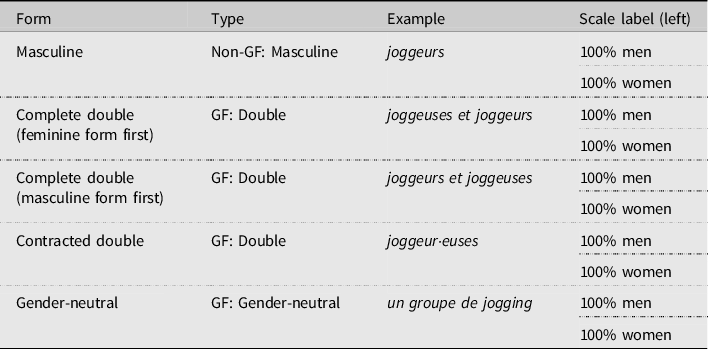
The form of the role nouns was the main between-participants factor. Since previous studies (Gabriel et al., Reference Gabriel, Gygax, Sarrasin, Garnham and Oakhill2008; Kennison and Trofe, Reference Kennison and Trofe2003; Misersky et al., Reference Misersky, Gygax, Canal, Gabriel, Garnham, Braun, Chiarini, Englund, Hanulikova, Öttl, Valdrova, Von Stockhausen and Sczesny2014) found the direction of the response scale influenced the outcome, scale direction was added as a between-participants factor. This resulted in a 5 [form] x 2 [scale direction] between-participants design (see Table 1). In all analyses, the dependent variable was the estimated percentage of women represented in the 22 role nouns, which are presented in Appendix A. Figure 2 presents a screenshot of the condition: form: contracted double forms, scale direction: 100% men-left.
Overview of the research design. GF stands for Gender-Fair, see Fig. 1
Screen shot of the questionnaire, form: contracted double forms, scale direction: 100% men-left.

4.3. Stimuli
The stimuli consisted of 22 role nouns selected from previous research (Misersky et al., Reference Misersky, Gygax, Canal, Gabriel, Garnham, Braun, Chiarini, Englund, Hanulikova, Öttl, Valdrova, Von Stockhausen and Sczesny2014) and through brainstorming sessions on the basis of a set of criteria. The first selection criterion was non-stereotypicality. Presenting only non-stereotyped role nouns enabled a more precise focus on these types of nouns, hopefully allowing for a finer investigation of the influence of form on the perceived proportion of women represented in the selected role nouns. If non-stereotyped role nouns had been presented along with stereotyped nouns, a contrasting effect might have appeared in the sense that the participants would perceive the non-stereotyped role nouns as gender-balanced in relation to the more stereotyped role nouns. This choice hopefully reduced the risk of participants answering 50% women on all non-stereotyped role nouns. The criterion of non-stereotypicality was based on a previous norming study (Misersky et al., Reference Misersky, Gygax, Canal, Gabriel, Garnham, Braun, Chiarini, Englund, Hanulikova, Öttl, Valdrova, Von Stockhausen and Sczesny2014). From their French sample, we initially extracted all role nouns with a proportion of women between 0.45 and 0.55. This interval was later extended to 0.43–0.56 to include role nouns that seemed appropriate for the present study. One role noun, auditeurs [listenersMASC], was added despite not being included in the study by Misersky et al. (Reference Misersky, Gygax, Canal, Gabriel, Garnham, Braun, Chiarini, Englund, Hanulikova, Öttl, Valdrova, Von Stockhausen and Sczesny2014) since it was included in the norming study by Gabriel et al. (Reference Gabriel, Gygax, Sarrasin, Garnham and Oakhill2008) and fulfilled the selection criteria. The estimated percentages of women represented in the chosen role nouns from previous studies are found in Appendix B (M = 49.5%).
The second criterion was that each role noun must have a gender-neutral equivalent, either in the form of an epicene role noun (e.g., des élèves [pupils]), a collective noun (e.g., un public [an audience]), or by using the generic noun personnes [persons]. These alternatives were formulated through brainstorming sessions, discussions with peers, and by searching in dictionaries. We strived towards an equal proportion of epicene and collective nouns, and only used the generic noun personne occasionally. In the final list, nine gender-neutral forms were collective nouns, ten were epicene forms, and three were generic nouns (see Appendix A). It should be noted that some of these gender-neutral forms are not 100% synonymous with the gendered forms and would need an explicit context for them to be understood as completely similar. For example, athlètes [athletes] could be understood as nageurs [swimmersMASC] if it were explicitly stated that they were doing something related to swimming.
The last criterion was that the feminine form must differ phonologically from the oral masculine form in its oral representation. Since seeing a familiar word automatically activates its pronunciation (Ehri, Reference Ehri2014), we wanted to eliminate phonological form as a factor which could potentially influence the estimates despite the task being in written form. Thus, a role noun like employés [employeesMASC] - employées [employeesFEM] was not included despite having a good gender-neutral equivalent (collègues [colleagues]).
4.3.1. Attitudes towards and use of gender-fair language
Attitudes towards GF language were included as a variable since it has been previously shown to influence representation of women (exp. 6 in Braun et al., Reference Braun, Sczesny and Stahlberg2005). Different measurement scales have been used to investigate attitudes towards GF language, targeting different aspects such as beliefs and practices concerning GF language (Prentice, Reference Prentice1994) or beliefs and opinions, recognition, and use regarding GF language (Parks and Roberton, Reference Parks and Roberton2000). In the present study, we focused on the participants’ beliefs and opinions by utilising four items (A, B, C, and D in Appendix C) from Parks and Roberton’s (2000) scale that address this category, and two items (G and H) targeting the same category from Prentice’s (1994) scale. Two items used by Sczesny et al. (Reference Sczesny, Moser and Wood2015) were added since they concerned participants’ beliefs (F) or personal opinions (E).
The participants indicated their agreement with the eight items using a 1-5 Likert scale going from Pas du tout d’accord [strongly disagree] to Tout à fait d’accord [strongly agree]. The answer Aucune alternative ne me convient [no option suits me] was also available for each item and was coded as a missing value. After reversing the scores on the concerned items, Cronbach’s alpha showed a high internal consistency (α = 0.9). Exclusion of any particular item did not lead to a higher value.
In addition to asking participants about their attitudes towards GF language, we asked them three questions regarding their prior knowledge of GF language, their personal use of it, and how often they encounter it in their daily life. These questions, found in Appendix C, were answered on a 1-5 scale ranging from Non, pas du tout [No, not at all] or Non, jamais [No, never] to Oui, très bien [Yes, very well] or Oui, tous les jours [Yes, every day]. As these variables are based on self-evaluations, and since it can be difficult to quantify one’s own use or knowledge of GF language, they will not be included in the analyses. Nevertheless, they provide interesting information on the spread of GF language in French.
4.3.2. Procedure
All items as well as the questionnaire interface were presented in French. Once the participant clicked on the link leading to the experiment, the Qualtrics software randomly assigned participants to one of the ten versions of the questionnaire. The data gathering was conducted in two phases. In the first phase (n = 455), the questionnaire link was distributed through social media and to peers, and in the second, we used the Internet-based participant pool Prolific to enlarge our sample. The Prolific participants (n = 608) were paid £1.88. After giving their consent, the participants were presented with all the role nouns written in the same form, along with an 11-point scale ranging from 0% women and 100% men to 100% women and 0% men, or from 100% women and 0% men to 0% women and 100% men (cf. Figure 2). Each point represented an increase of 10%. In accordance with previous norming studies (Gabriel et al., Reference Gabriel, Gygax, Sarrasin, Garnham and Oakhill2008; Misersky et al., Reference Misersky, Gygax, Canal, Gabriel, Garnham, Braun, Chiarini, Englund, Hanulikova, Öttl, Valdrova, Von Stockhausen and Sczesny2014), participants were instructed to estimate the extent to which the presented social and occupational groups actually consisted of women and men. Thus, the participants were instructed to indicate the actual proportions of women and men, and not their opinion of what the proportions should be. Lastly, they were told to use a computer, and not a tablet or a cell phone, and to answer as quickly as possible without overthinking. The instructions also specified that there were no right or wrong answers.
After estimating the women/men ratios, the participants provided information about their prior knowledge of GF language, and the frequency with which they used and encountered GF language. They then provided answers using the scale measuring attitudes towards GF language. Lastly, they answered a number of socio-biographical questions, which can be found in Appendix D. The participants answering through Prolific were timed. Their median response time was 6 minutes and 40 seconds.
4.4. Data preparation
Participants were removed prior to analysis if they did not have French as (one of their) first language(s) (n = 26), or if their age was under 18 years or not stated (n = 5). Furthermore, the variables region and attitudes towards gender-fair language required some recoding. Since most of the sample lived in France, participants living in another French-speaking region (such as Québec, Switzerland, or Belgium) were recoded into one group. The variable region therefore has three values: France, another French-speaking region, or non-French-speaking region. Regarding the scale measuring attitudes towards GF language, five items (A, B, C, F, and G in Appendix C) were reversed, meaning that a high score on the scale corresponds to positive attitudes. Finally, a mean score for the eight items, missing values excluded, was calculated for each participant.
As for the perceived gender ratios, data from all versions of the questionnaire were coded in a way such that the response was the estimated percentage of women represented. Since estimating women/men ratios for all role nouns was mandatory to complete the questionnaire, there were no missing data for this variable.
The data were analysed through linear mixed effects regressionFootnote 2 conducted with the lmer function of the lme4 package (Bates et al., Reference Bates, Maechler, Bolker, Walker, Haubo Bojesen Christensen, Subgnabb, Dai, Scheipl, Grothendieck, Green, Fox, Bauer and Krivitsky2021) in R (R Core Team, 2021). The dependent variable was the estimated percentage of women represented for each role noun. The initial model contained the following fixed effects: a three-way interaction between the variables form, scale direction, and average attitude towards gender-fair language, and region as a main effect. Participant and role noun were entered as random intercepts. All variables were coded with treatment contrasts. This model was run through the fitLMER.fnc function of the LMERConvenienceFunctions package (Tremblay and Ransijn, Reference Tremblay and Ransijn2020). Starting from the initial model, this function finds an optimal fixed effects structure through backwards elimination, then finds an optimal random effects structure through forward selection, and finally refits the fixed effects structure through further backward elimination. Gender was not included as a fixed effect for two reasons. First, due to the low number of participants from the “another gender” category, not all ten versions of the questionnaire had been answered by this group. Consequently, if gender had been included, we would have been forced to drop a certain number of rows in the analysis, meaning that the model would not have included all observations. Second, the average attitude towards GF language was strongly impacted by participant gender as shown by a one-way ANOVA (F(3, 1014) = 40.25, p < 0.001). Post hoc comparisons using Tukey’s HSD test showed that male participants (M = 2.8) held significantly more negative attitudes compared to female participants (M = 3.5) (p = 0.000, 95% CI = [-0.85, -0.51]) and participants of another gender (M = 4.0) (p < 0.001, 95% CI = [-1.70, -0.53]).Footnote 3
To quantify the variance explained by the model, we used the R2 measures suggested by Nakagawa and Schielzeth (Reference Nakagawa and Schielzeth2013) calculated with the r2 function of the performance package (Lüdecke et al., Reference Lüdecke, Makowski, Ben-Shachar, Patil, Waggoner, Wiernik, Arel-Bundock and Jullum2021). These measures provide one value for only the fixed effects (marginal R2) and one for the entire model, i.e., including both fixed and random effects (conditional R2).
In accordance with Brysbaert and Stevens (Reference Brysbaert and Stevens2018), effect sizes were calculated by dividing the difference in predicted values by the square root of the sum of the variance components.Footnote 4
5. RESULTS
The results section is structured as follows. First, descriptive statistics of the mean estimated percentage of women across all role nouns are presented to give readers an idea of the general outcome. These statistics are grouped by the form of the role noun, the response scale direction of the questionnaire, and by the participant variables relevant to the linear mixed effects model. Second, we present the fixed and random effects of the final linear mixed effects model, which combines the previously discussed variables.
5.1. Descriptive statistics
5.1.1. Inter-participant analyses
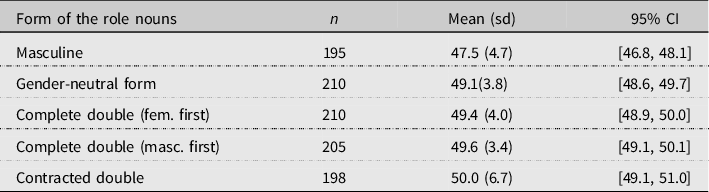
As shown in Table 2, the differences in the mean estimated percentage of women between the different forms are rather small, something that is most likely due to our criterion of non-stereotypicality when selecting the role nouns. However, there are some differences. The participants who read the role nouns in their masculine form estimated the lowest percentage of women on average whereas the participants who read the role nouns in the contracted double form showed the highest estimations on average. A plot illustrating the distribution of these responses is found in Appendix E.
Mean estimated percentage of women across all role nouns grouped by form
As for the response scale direction, the participants estimated a higher percentage of women on average when the label 100% women was presented to the left (n = 505, M = 49.6, sd = 5.1) in comparison to when 100% men was presented to the left (n = 513, M = 48.7, sd = 4.3).
The variables related to the participants that were initially of interest for the analysis were gender, region, and attitudes towards gender-fair language. Before continuing, we remind readers that participant gender was removed as a variable due to its correlation with attitudes regarding GF language (cf. section 4.4 for details). As for participant region, participants living in a non-French-speaking region (n = 175, M = 48.5, sd = 4.6) estimated a slightly lower percentage of women than participants living in France (n = 553, M = 49.1, sd = 5.1), who in turn estimated a slightly lower percentage than the participants living in a French-speaking region outside of France (n = 290, M = 49.6, sd = 4.0).
5.2. Modelling
The model that best fitted the participants’ estimated percentage of women contained the main effects of form, scale direction, average attitudes towards gender-fair language, and region. This model, along with effect sizes for each variable, are shown in Table 3. The random structure of this model contained random intercepts for participant and role noun. No significant interactions were found. As shown by the conditional R2 value, this final model, with fixed and random effects included, explains 21.5% of the variance. The intercept refers to the estimated percentage of women with the independent variables set at the following values: form: masculine, scale direction: 100% men-left, region: another French-speaking region, and attitudes towards gender-fair language, which is centred at its mean, 3.2.
Summary of the optimal linear mixed effects model

5.2.1. Fixed effect variables
As Table 3 shows, all forms of GF language had a positive main effect compared to the masculine form. The GF forms increased the estimated percentage of women from between 1.6 percentage points (gender-neutral) to 2.6 percentage points (contracted double), and the effect sizes were rather small. To compare all the forms against each other, we conducted post hoc contrast analyses which showed that all GF forms differed significantly only from the masculine form, but not from each other, cf. Table 4.
Summary of post hoc contrast analyses of gender-fair forms

The small main effect of the response scale direction indicated that participants who rated the percentage on a scale starting with 100% women estimated 0.9 percentage points more women than the participants answering a questionnaire version whose scale started with 100% men.
Attitudes towards gender-fair language had a small negative main effect on the estimated percentage such that an increase on the attitude scale, i.e., increasingly positive attitudes, led to a reduction in the estimated percentage of women.
Figure 3 shows predicted estimated percentages of women based on the model when accounting for form, scale direction, and attitudes towards gender-fair language.
Predicted values based on form, scale direction, and attitudes towards gender-fair language. Error bars indicate a 95% confidence interval.

The small main effects of region showed that participants living in a non-francophone region differed significantly only from the participants living in a French-speaking region other than France. The former participants estimated 1.1 percentage points fewer women than the latter group.
5.2.2. Random effect variables
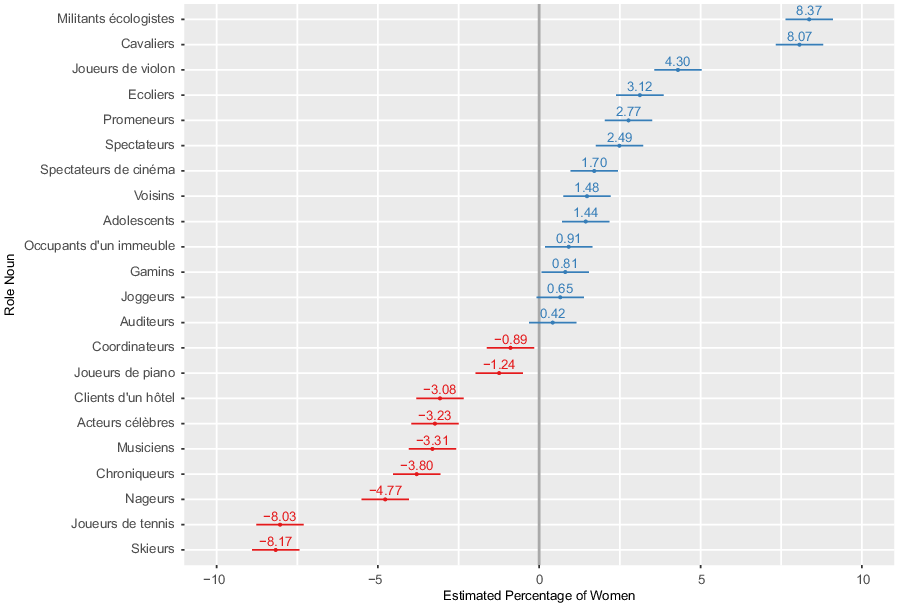
The random effects output of the final model indicates the adjustments the model makes for each specific role noun, therefore showing the role nouns for which it needs to adjust the most. The intercept in Figure 4 represents the intercept of the final model, which is 47.58, and the values indicate the estimations of the model for each role noun independently of the predictors which the model has accounted for. For example, the predicted estimated percentage of women in joueurs de violons [violin playersMASC] across all forms is 51.88. As the error bars in the plot indicate, these estimations are not exact. Therefore, they do not correspond precisely to the values presented in Appendix B, which shows the mean estimated percentage of women for each role noun split by form. Nevertheless, the ranking of the role nouns is to a large extent identical, showing that militants écologistes [environmental activistsMASC] and cavaliers [horseridersMASC] are the two role nouns that raise the estimated percentage of women the most, whereas skieurs [skiersMASC] and joueurs de tennis [tennis playersMASC] lower it the most.
Random effects of the role nouns. Error bars indicate the 95% confidence interval, and the vertical grey line indicates the intercept.
6. DISCUSSION
The present study set out to investigate how the written form of a role noun influences the estimated percentage of women and men in 22 non-stereotyped French role nouns. In a large-scale online experiment, native French speakers were presented with a list of non-stereotyped role nouns, which were written out in one of the five following forms: masculine (gamins), complete double-feminine first (gamines et gamins), complete double-masculine first (gamins et gamines), contracted double (gamin·es), and gender-neutral (enfants). The task consisted of estimating the percentage of women and men for each role noun on a scale from 100% to 0% women or from 100% to 0% men. The role nouns were selected for their non-stereotypicality based on previous studies (Gabriel et al., Reference Gabriel, Gygax, Sarrasin, Garnham and Oakhill2008; Misersky et al., Reference Misersky, Gygax, Canal, Gabriel, Garnham, Braun, Chiarini, Englund, Hanulikova, Öttl, Valdrova, Von Stockhausen and Sczesny2014) in order to focus on the effect form has on the mental representation of gender, irrelevant of stereotypes.
The results showed that three important factors influence the perceived ratios: form, scale direction, and participants’ attitudes towards gender-fair language. More specifically, all GF forms increased the estimated percentage of women represented in comparison to the masculine form. In addition, all four GF forms gave rise to an equal increase in the estimated percentage of women represented compared to the masculine form. In other words, there was no particular version of GF language that was more successful than another in increasing the mental representation of women in the tested role nouns. Furthermore, the scale direction had a significant influence such that the participants presented with the 100% women-left condition estimated higher percentages of women. Lastly, a person’s attitudes towards GF language generally influenced gender ratios such that the more positive the participants’ attitudes were, the lower their overall estimated percentage of women. In the next section, these findings are discussed in relation to our initial hypotheses and to previous research.
6.1. Form of the role nouns
Regarding the influence of the different GF forms, we hypothesised that the estimated percentage of women would be lower in the masculine form than in the other forms (hypothesis 1a). Consistent with the results from previous studies on German (Braun et al., Reference Braun, Sczesny and Stahlberg2005; exp. 2 in Irmen and Roßberg, Reference Irmen and Roßberg2004; Sato et al., Reference Sato, Gabriel and Gygax2016; Steiger-Loerbroks and von Stockhausen, Reference Steiger-Loerbroks and von Stockhausen2014), this hypothesis was confirmed. Therefore, our results provide further support for the hypothesis that GF language increases the mental representation of women in role nouns. Thus, it can be concluded that the use of different GF language forms in French also leads to increased representations of women. Our results support previous findings (e.g., Gabriel et al., Reference Gabriel, Gygax, Sarrasin, Garnham and Oakhill2008; Gygax et al., Reference Gygax, Gabriel, Sarrasin, Oakhill and Garnham2008; Sato et al., Reference Sato, Gabriel and Gygax2016) showing that using the masculine form results in a male bias even with non-stereotyped role nouns. As for the difference between the four GF forms, our hypothesis (1b) was that the gender-neutral forms would increase the estimated percentages to a lesser extent than double forms, and that within the double forms, a contracted form would increase the estimated percentage more than a complete form. However, no significant differences between the respective GF versions were found. In other words, any of the GF language versions increased the perceived percentage of women represented in the role nouns to an equal extent as compared to the masculine form.
Before discussing this slightly surprising result in more detail, it is worth noting that although previous studies in French (Brauer and Landry, Reference Brauer and Landry2008; Kim et al., in press) have mainly compared one GF form to a masculine form, the present study compared different GF forms to each other (similarly to Chatard et al., Reference Chatard, Guimont and Martinot2005 but with a different population and another aim). Due to the scarce number of studies in French comparing different GF forms, these results will have to be discussed primarily in comparison to studies of the German language.
It is interesting to note that while German and French are similar in that both are grammatical gender languages and have different GF forms at their disposal, GF language in German often uses nouns resulting from nominalisation which are gender-neutral in their plural form. For example, instead of die Käufer [the buyersMASC], one can write die Konsumierenden [the consumers, literally those who consume] (examples from Sato et al., Reference Sato, Gabriel and Gygax2016). In French, this is not possible, as one would have to write les personnes qui achètent [the persons who buy] to avoid gender-markings.
Regardless, the main difference in our findings compared to those of previous studies on German is that in our sample, double and gender-neutral forms proved to be equally efficient in increasing the perceived percentage of women represented in the role nouns. Thus, our findings agree with those of certain previous studies (e.g., Sato et al., Reference Sato, Gabriel and Gygax2016; Steiger-Loerbroks and von Stockhausen, Reference Steiger-Loerbroks and von Stockhausen2014), while differing from those of others (Irmen, Reference Irmen2007; exp. 2 & 3 in Irmen and Roßberg, Reference Irmen and Roßberg2004). We currently lack an explanation for this, and further research should investigate differences in representations of gender depending on the neutralisation strategy used, as French and German use rather different strategies.
Concerning the double forms, the findings of Braun et al. (Reference Braun, Sczesny and Stahlberg2005) were not replicated. In our study, both the complete and contracted forms show a similar increase in the perceived percentages of women represented. The lack of difference between the different GF forms could potentially be explained by the fact that the present study controlled for stereotypicality, whereas all previous studies (except Sato et al., Reference Sato, Gabriel and Gygax2016) did not. In the present study, all selected role nouns were non-stereotyped in order to concentrate on the form’s effect on mental representations of women and men. It is therefore possible that the reported similarity in the influence of the GF forms could be attributed to the non-stereotypicality of the role nouns. Since gender representation across all role nouns was quite balanced even with the masculine form (M = 47.5), the range between the lowest (i.e., the masculine condition) and the highest average percentage of women represented (contracted double forms, M = 50) is rather small. If the range had been wider, differences between the GF forms might have been more evident. In light of this, it would be of great interest to compare the influence of different GF forms on female and male stereotyped role nouns in future research. It should also be stressed that the GF forms’ ability to increase the percentage of women represented in the role nouns despite them being stereotypically gender-balanced strengthens the claim that form influences how speakers perceive gender representations for a role noun.
It is also worth noting that we found no differences between the two complete double forms, thus indicating that in our sample, it did not matter whether the feminine form was mentioned first or last. However, contrary to other studies that did find such order effects (e.g., Gabriel et al., Reference Gabriel, Gygax, Sarrasin, Garnham and Oakhill2008), the response scale direction (see below) was not always in line with the mentioning order of the complete double forms.
In sum, our results suggest that it is not important which GF form is used; rather, all forms increase the perceived percentage of women represented when compared to the masculine form. In other words, if the masculine form is avoided in any manner, the male bias will decrease or even disappear altogether.
6.2. Scale direction
The second factor that influenced the estimated percentages was the direction of the response scale. In accordance with Hypothesis 2, the estimated percentage of women represented turned out to be higher in the 100% women-left condition. This is in line with previous research investigating the influence of scale direction (Gabriel et al., Reference Gabriel, Gygax, Sarrasin, Garnham and Oakhill2008) which found stereotypicality ratings to be less male-biased when the label 100% women was presented to the left. However, before continuing this comparison further, we must explain how our study design differed from that of Gabriel et al. (Reference Gabriel, Gygax, Sarrasin, Garnham and Oakhill2008) in terms of how the role nouns were presented. In their study, the role nouns were presented in the grammatical form that matched the scale label. Thus, in the 100% men-left condition, the role nouns were presented in their masculine form to the left and in their feminine form to the right, and vice versa in the 100% women-left condition. In the second version of the study, the role nouns were presented only in their masculine form (to the left in the 100% men-left condition and inversely in the 100% women-left condition). When presenting both the feminine and the masculine forms, the 100% women-left condition led to higher percentages of women represented. In contrast, when only the masculine form was presented, the 100% men-left condition led to higher percentages of women. Because the role nouns were always presented to the left in our study, only the condition form: masculine and scale direction: 100% men-left matches one of the conditions of Gabriel et al. (Reference Gabriel, Gygax, Sarrasin, Garnham and Oakhill2008). When comparing these two conditions, we actually find that scale direction has the opposite effect since that condition led to a lower percentage of women represented in our sample, while it increased in that of Gabriel et al. (Reference Gabriel, Gygax, Sarrasin, Garnham and Oakhill2008).
A potential explanation of this could be that in our design, the label 100% women was presented in text, and not by a female icon as in the study of Gabriel et al. (Reference Gabriel, Gygax, Sarrasin, Garnham and Oakhill2008). Hence, the first word that the participants read (assuming that they read from left to right and from the top to the bottom of the page) after reading the instructions (c.f. Figure 2) was women. It is therefore possible that a priming effect occurred, forcing the participants to reflect upon the fact that women could be part of the role nouns to a higher degree when they read women before reading the role nouns (and before being impacted by the mentioning order of the complete double forms). With this interpretation, our results confirm those of Gabriel et al. (Reference Gabriel, Gygax, Sarrasin, Garnham and Oakhill2008) since the condition in which the feminine form of the role noun was presented to the left and was the first word the participants read led to the highest percentages of women in their study.
The size of the effect of scale direction also deserves a few comments since it was smaller than that of the form of the role noun. These findings are in line with those of Gabriel et al. (Reference Gabriel, Gygax, Sarrasin, Garnham and Oakhill2008), since this influence was present but not statistically significant in their French sample, contrary to the German and English samples. Lastly, the lack of any interaction between form and scale direction may seem rather unexpected, as one could have imagined a stronger influence from scale direction in the masculine condition. In this condition, the estimated percentage of women represented was the lowest. Thus, there was a potentially larger margin of increase for this condition compared to the GF forms. Since no interaction between form and scale direction was found, our interpretation of these findings is that the form of the role noun is a stronger predictor than scale direction. This is also confirmed by the predictions produced by the final model.
In brief, the form of a role noun, be it masculine or GF, has a stronger influence on the representation of women than scale direction. Nevertheless, the influence of scale direction was significant and should be considered in further research.
6.3. Attitudes towards gender-fair language
Our last hypothesis was that gender and attitudes towards GF language would influence participants’ estimated percentage of women and men (Hypothesis 3). Confirming previous studies (Tibblin, Reference Tibblin2020), the participants’ gender was strongly impacted by attitudes towards GF language and was therefore not included as a predictor in the modelling. However, contrary to our hypothesis, results showed that across all forms (masculine, double, and gender-neutral forms), participants with more positive attitudes towards GF language perceived lower percentages of women than participants holding more negative attitudes. To the best of our knowledge, only one previous study (exp. 6 in Braun et al., Reference Braun, Sczesny and Stahlberg2005) has reported a similar effect, yet only when the role nouns were written in their masculine form, suggesting that positive attitudes towards GF language led to an even more specific interpretation of the masculine forms, thus resulting in a stronger male bias.
A tentative explanation for our findings can be found in the study by Begeny et al. (Reference Begeny, Ryan, Moss-Racusin and Ravetz2020) showing that people who believe that gender equality is already achieved within a profession might be those who perpetuate gender inequalities. In Begeny et al. (Reference Begeny, Ryan, Moss-Racusin and Ravetz2020), participants believing that women in the profession no longer faced discrimination evaluated a female candidate as less competent and recommended she receive a salary lower than a male salary. However, among the participants who believed gender discrimination still existed, there were no differences in how the female and male candidates were evaluated. In relation to our study, this would suggest that the participants holding negative attitudes towards GF language may believe that women are already sufficiently well-represented in society. They might therefore think that GF language is unnecessary. Inversely, participants with positive attitudes towards GF language believe that women are under-represented in society (i.e., lower perceived percentages of women). With this interpretation, participants might be in favour of GF language because they believe women are under-represented in society, and not the other way around. It could also mean that they believe that the use of GF language can actually make a difference. The relationship between attitudes towards GF language and the representation of women should be further investigated to shed light on this slightly surprising result.
6.4. Different gender-fair forms
Our final research question asked whether any particular role noun was especially affected by the application of GF forms. As this question is mainly descriptive, the results are provided in Appendix B and will only be briefly discussed here. In general, the GF forms increased the percentage of women represented by a few percentage points in all role nouns, but some observations attract our attention. In musiciens [musiciansMASC], the perceived percentage of women was increased by 4.2-6.4 percentage points by the double forms (compared to the masculine form), and by 8.6 percentage points when using the gender-neutral form un orchestre [an orchestra]. This pattern is repeated in chroniqueurs [columnistsMASC] and cavaliers [horseridersMASC]. Since both musiciens and chroniqueurs are among the most male role nouns, it could seem that GF forms are particularly efficient for male stereotyped role nouns. However, this effect was not found for the most male role nouns (skieurs [skiersMASC] and joueurs de tennis [tennis playersMASC]), possibly suggesting that the activities of skiing and playing tennis activate male stereotypes that are too strong to be resolved by a GF form.
It should also be noted that some gender-neutral forms stand out in comparison to both the masculine and the double forms. In athlètes [athletes] (gender-neutral version of nageurs [swimmersMASC]), the percentage of women is 5 percentage points lower than that of the masculine form and between 5.9-8.4 percentage points lower than those of the double forms. Likewise, fewer women were perceived in pianistes [pianists] (44.8%) than in joueurs de piano [piano playersMASC] (46.1%). There is also an important difference between the gender-neutral formulation personnes qui montent au cheval [persons who go horse-riding] (64.1%) and both the masculine form cavaliers (49.6%) and the double forms (56%-58.4%). This suggests that some gender-neutral forms are not interchangeable with the masculine and double forms but need context information to be interpreted similarly. Thus, it would be useful for future research to study gender-neutral and masculine forms in terms of synonymity, and in clearer contexts.
Finally, it is interesting to note that the endings of the epicene nouns differ from the gender-marked nouns with the exception of enfants [children]. Since a role noun ending with -iste, -aire, or -logue is always epicene, such a role noun may not be as closely connected to a male representation, at least among non-stereotyped role nouns. Future studies comparing phonetically similar double forms (auteures et auteurs [authorsFEM and authorsMASC]) to phonetically different pairs (autrices et auteurs [authorsFEM and authorsMASC]), or comparing collective nouns (une équipe de recherche en biologie [a research group in biology]) to epicene nouns (biologistes [biologists]) would provide more detailed insights into the connection between form and mental representations of gender.
6.5. Reflections on the study’s design
A few words should also be mentioned about potential issues regarding the study’s design. First, we focused only on non-stereotyped role nouns, and it is therefore possible that the results would have been different if the role nouns had been presented along with more stereotyped role nouns. Again, by doing so, we might have zoomed in on an effect that might be smaller if contrasted with more stereotyped role nouns. However, our results do not vary greatly from those of Misersky et al. (Reference Misersky, Gygax, Canal, Gabriel, Garnham, Braun, Chiarini, Englund, Hanulikova, Öttl, Valdrova, Von Stockhausen and Sczesny2014) (see Appendix B) or Gabriel et al. (Reference Gabriel, Gygax, Sarrasin, Garnham and Oakhill2008), suggesting that such a contrasting effect might be rather weak. Second, we used a methodology providing off-line measures, in the sense that they did not necessarily measure spontaneous processes regarding the representations of women and men. A comparison of our results with a research paradigm using on-line measures, such as reading or response times, would therefore be welcomed as it would yield a more exhaustive understanding of how GF language influences mental representations of women in French.
7. CONCLUSION
To conclude, the present study showed that using GF forms significantly increases the perceived percentage of women in non-stereotyped role nouns when compared to the masculine form. Moreover, all tested GF forms proved to be equally efficient in increasing the perceived percentage of women when compared to the masculine form. We conclude that our findings strengthen the support of using GF language in French in cases where the intention is to increase the perceived percentage of women represented.
Our results also entail methodological implications, as we have reproduced an effect linked to the response scale direction. Therefore, scale direction continues to be an important design feature which should be taken into account in future research on the representations of women and men. Furthermore, the stereotypicality norms presented in this study open up opportunities for future studies wanting to make use of French role nouns in different GF forms. Such research would be welcome since gender-fair language in French seems to be here to stay, as is shown by the participants’ self-reported experience with, use, and knowledge of gender-fair language.
Supplementary material
To view supplementary material for this article, please visit https://doi.org/10.1017/S0959269522000217
Competing interests
The authors declare none.
Funding
This work was partially funded by Einar Hansen’s Allhemsstiftelse.


 Open access

