

Introduction
In recent years, numerous studies of animal bones from sites at the lakes of Bienne, Morat, Burgäschi, and Neuchâtel in Switzerland have greatly enriched our knowledge of the Neolithic period (Stampfli, Reference Stampfli and Furger1980; Becker & Johansson, Reference Becker and Johannsson1981; Glass & Schibler, Reference Glass, Schibler, Hafner and Suter2000; Hafner & Suter, Reference Hafner and Suter2000; Stampfli et al., Reference Stampfli, Schibler, Hüster Plogmann, Zwahlen, Affolter, Brombacher, Francuz, Hafner, Hüster Plogmann and Jacomet2003; Chiquet, Reference Chiquet2005; Reynaud Savioz, Reference Reynaud Savioz, Mauvilly and Boisaubert2005; Schibler, Reference Schibler2006; Chiquet, Reference Chiquet2012; Schibler, Reference Schibler, Albarella, Rizzetto, Russ, Vickers and Viner-Daniels2017). By summarizing and synthesizing these data, this article aims to investigate the subsistence practices of hunters and herders between 4000 and 2500 cal. bc.
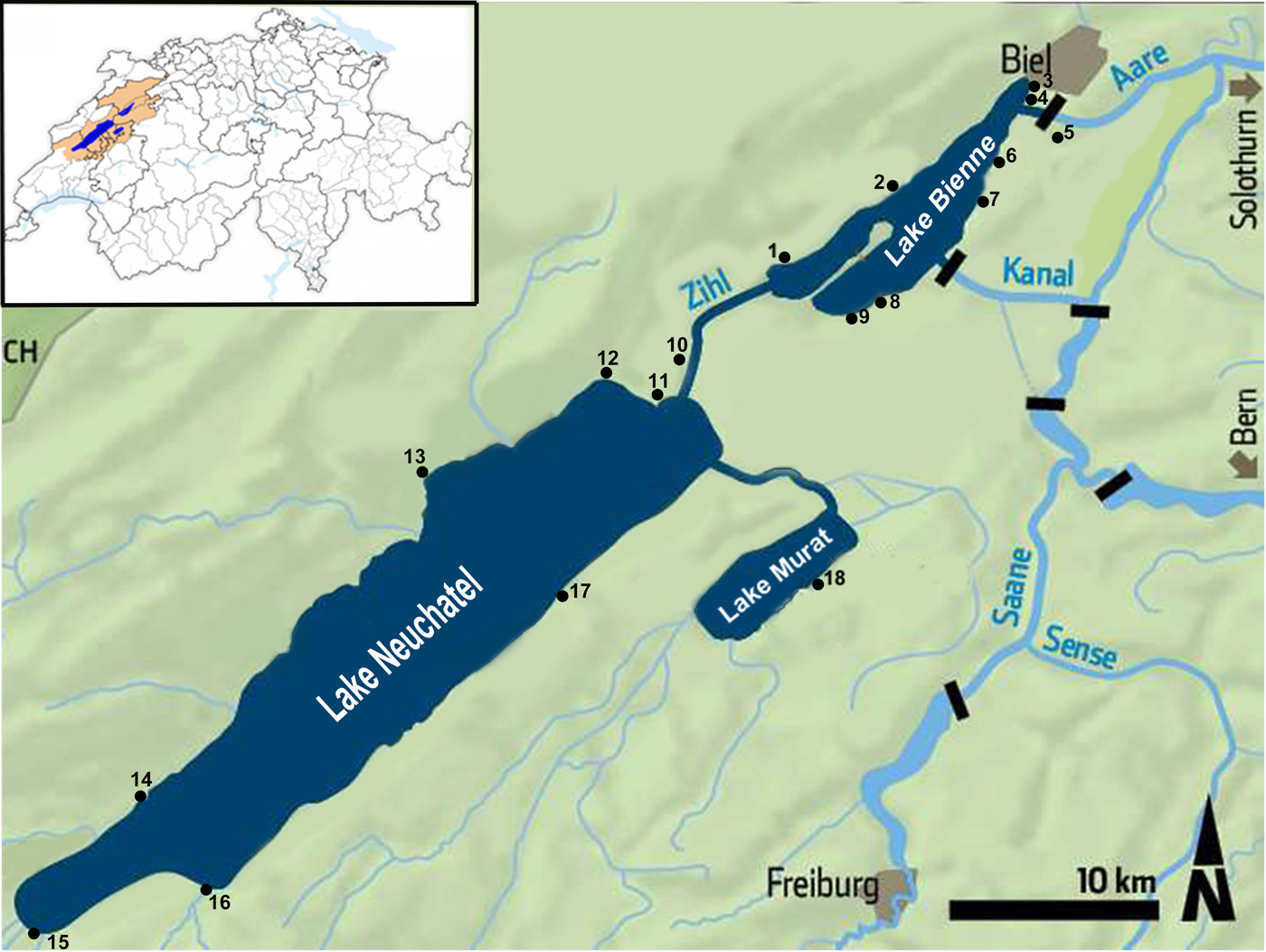
The majority of the assemblages studied were from the lakes of Bienne and Neuchâtel but data from Lake Morat and Lake Burgäschi were also used. The sites, their dating, and dating methods are listed in Figure 1 and Table 1. The zooarchaeological results are based on hand-collected animal bones only, excluding fish, amphibians, reptiles, and the smallest mammals, given the lack of sieved soil samples at most sites. The exceptional quality of the preservation below the water table meant that the large mammal bones were recovered in a perfect state of conservation.
Distribution of Neolithic lakeshore sites in western Switzerland. 1: La Neuville; 2: Twann; 3: Port; 4: Nidau; 5: Port-Südeli; 6: Sutz-Rütte; 7: Sutz-Lattrigen; 8: Lüscherz; 9: Vinelz; 10: Thielle; 11: Marin les Piécettes; 12: Saint-Blaise; 13: Auvernier; 14: Concise; 15: Yverdon; 16: Yvonand; 17: Portalban; 18: Muntelier. Most of these sites comprise several settlement phases. For settlement phases and dating see Table 1.
List of waterlogged site and settlement phases at the lakes of Bienne, Neuchâtel, Morat, and Bürgäschi (sites references in Schibler et al. Reference Schibler, Jacomet, Hüster-Plogmann and Brombacher1997).

As Schibler (Reference Schibler2006) remarks, marked fluctuations in the importance of game animals can be recognized throughout the Neolithic lake dwelling period. These fluctuations coincide with climatically induced economic crises, which, because of the threat of starvation, forced people to intensify hunting and gathering. On the other hand, Arbogast and Jeunesse (Reference Arbogast, Jeunesse, Colledge, Connolly, Dobney, Manning and Shennan2013) point out that the different exploitation strategies of livestock and the integration of hunting into the meat supply coincided with the distributions of cultural groups as categorized by pottery styles and burial practices. It is assumed that cultural identities include both behaviour and food production.
In this study, the zooarchaeological data were compared chronologically, culturally, and geographically in order to find potential reasons for the differences in animal husbandry and hunting practices, or in individual domestic or wild mammal species. The zooarchaeological evidence was also used to explore possible environmental, cultural, or social relations.
Material and Methods
The data discussed here come from 38 settlement layers located on both sides of Lake Bienne and 17 settlements on both sides of Lake Neuchâtel; they are complemented by two settlement layers each from Lake Morat and Lake Burgäschi (Figure 1). Among these 59 settlement layers, 49 have been dated precisely by dendrochronology. The others have been dated by radiocarbon or typological methods (Table 1). The settlements are all fairly evenly distributed between the Middle Neolithic (4000–3400 cal bc. (30 instances) and the Late Neolithic (3400–2500 cal. bc (29 instances), but data from the twenty-seventh century, the twenty-ninth to the thirty-first, or the thirty-third to the thirty-fifth centuries cal bc are rare or even missing (Table 1). In total, 59 settlement layers from 34 sites are included in the database, which contains a total of about 189,000 identifiable animal bones (Figure 1 and Table 1).
The comparison between the assemblages was based on the number of identified specimens (NISP, bone fragments). Although NISP has some disadvantages when comparing quantities of bones between large assemblages, because it can lead to overestimating the number of individuals, especially when the bones are highly fragmented (Marshall & Pilgram, Reference Marshall and Pilgram1993), it was not a concern for this study.
To investigate the economic aspect of food in more detail, factorial correspondence analysis was used to include and compare the importance of the different animal species in one diagram (Vaillé, Reference Vaillé2011). This multivariate statistical approach made it possible to investigate the underlying structure of the dataset and to describe the most significant trends in the animal economy.
In order to describe the diversity of mammals exploited at the different sites, nine variables were retained: cattle (Bos taurus), pigs (Sus domesticus), dogs (Canis familiaris), aurochs (Bos primigenius), red deer (Cervus elaphus), roe deer (Capreolus capreolus), wild boar (Sus scrofa), and the species groups sheep (Ovis aries)/goat (Capra hircus) and ‘various wild species’, the latter primarily containing various carnivores, as well as beaver, hare, or even moose.
Results
Husbandry and domestic animal meat
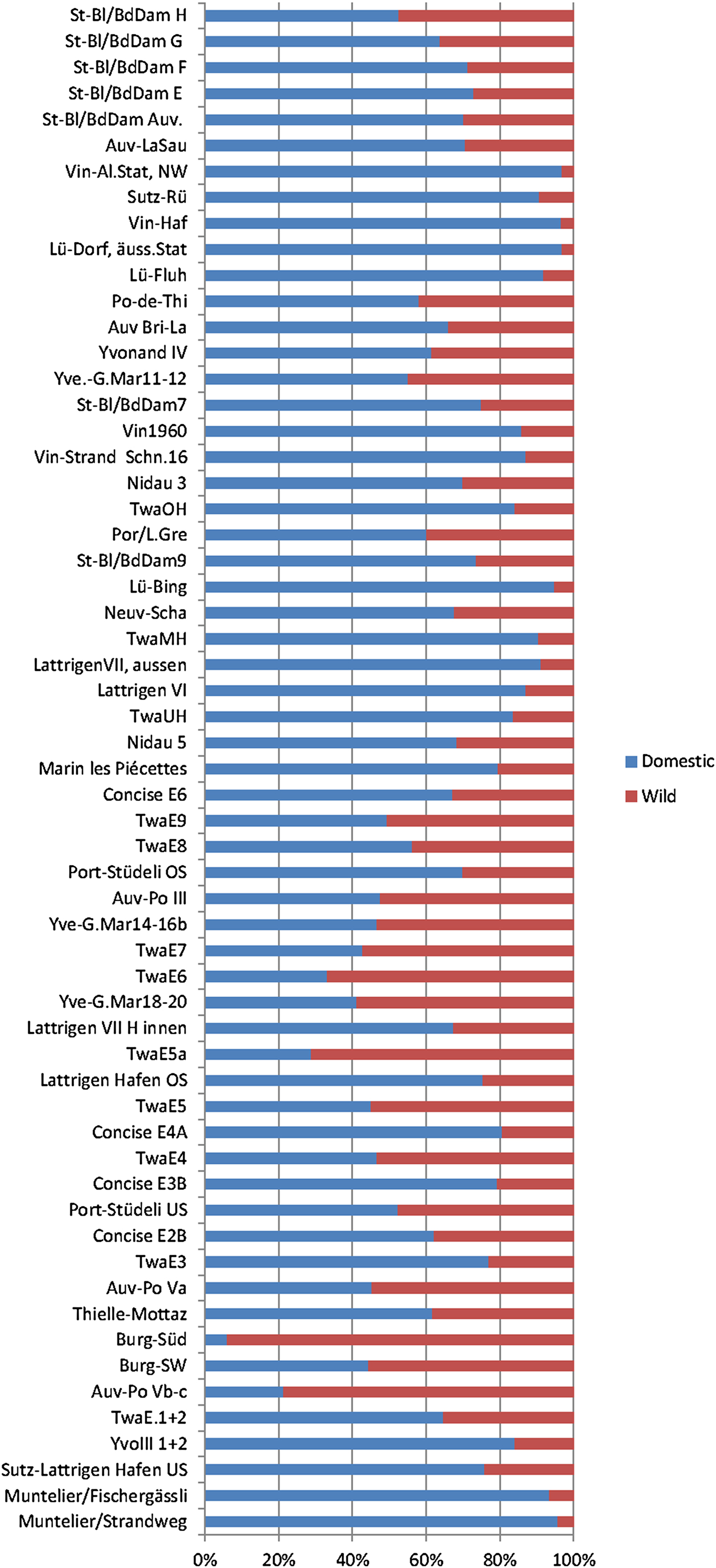
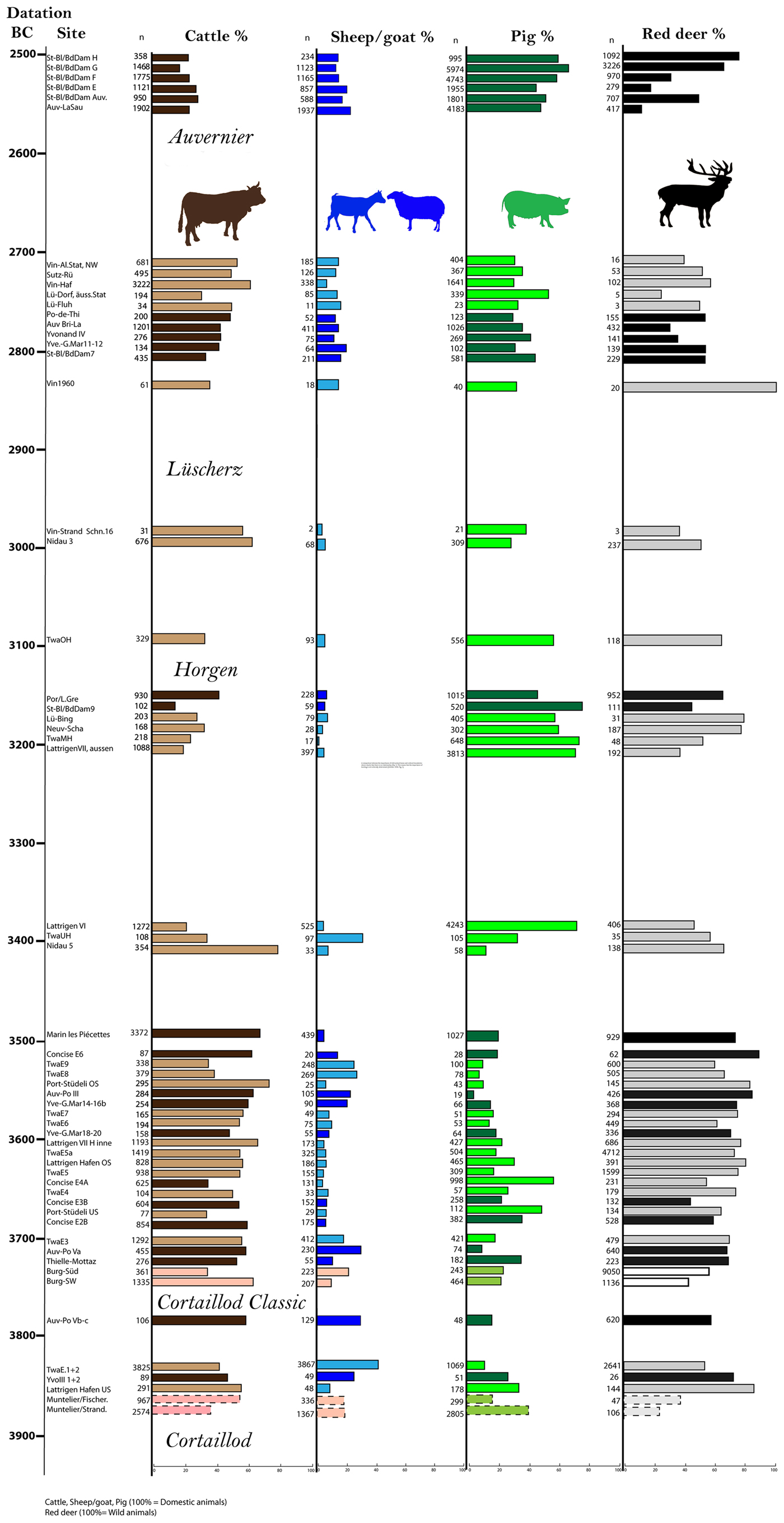
One of the most obvious aspects of the faunal spectra was the high frequency of domestic animal remains (Figure 2). In the Neolithic sites around Lake Bienne, husbandry mostly contributed to the supply of meat: more than two thirds of the settlements contained over 70 per cent of domestic animal remains (Figure 3). This feature especially concerns the husbandry of cattle and pigs, as the meat of these two domestic species was the most frequently consumed (Figure 4). The frequency of bones from domestic animals fluctuates remarkably during the time of the Cortaillod culture (3900–3400 cal. bc), between 28 and 76 per cent. During the period of the Horgen and Lüscherz cultures (3400–2800 cal. bc, the proportion of domestic animals is high, comprising over 75 per cent of the identified bone material. And during the timespan of the Auvernier culture, the importance of domestic animals reached its highest level (e.g. 80 per cent at Vinelz-Alte Station). Compared to the Lake Bienne region, the proportion of domestic animals was slightly lower in the Lake Neuchâtel basin (Figure 5): in most assemblages the percentage varied between 50 and 70 per cent.
Importance of domestic and wild animals according to the number of bone fragments in Neolithic western Switzerland (100% = domestic and wild animals).
Importance of cattle, pigs, sheep/goats, and red deer at Neolithic lakeshore sites in western Switzerland (shown in their cultural sequence), according to percentages based on fragment numbers (100% = domestic and wild animals). Dark shading represents sites on Lake Neuchâtel, light shading represents sites on Lake Bienne; the two sites on Lake Morat and the two sites on Lake Burgäschi are marked by even lighter shading.
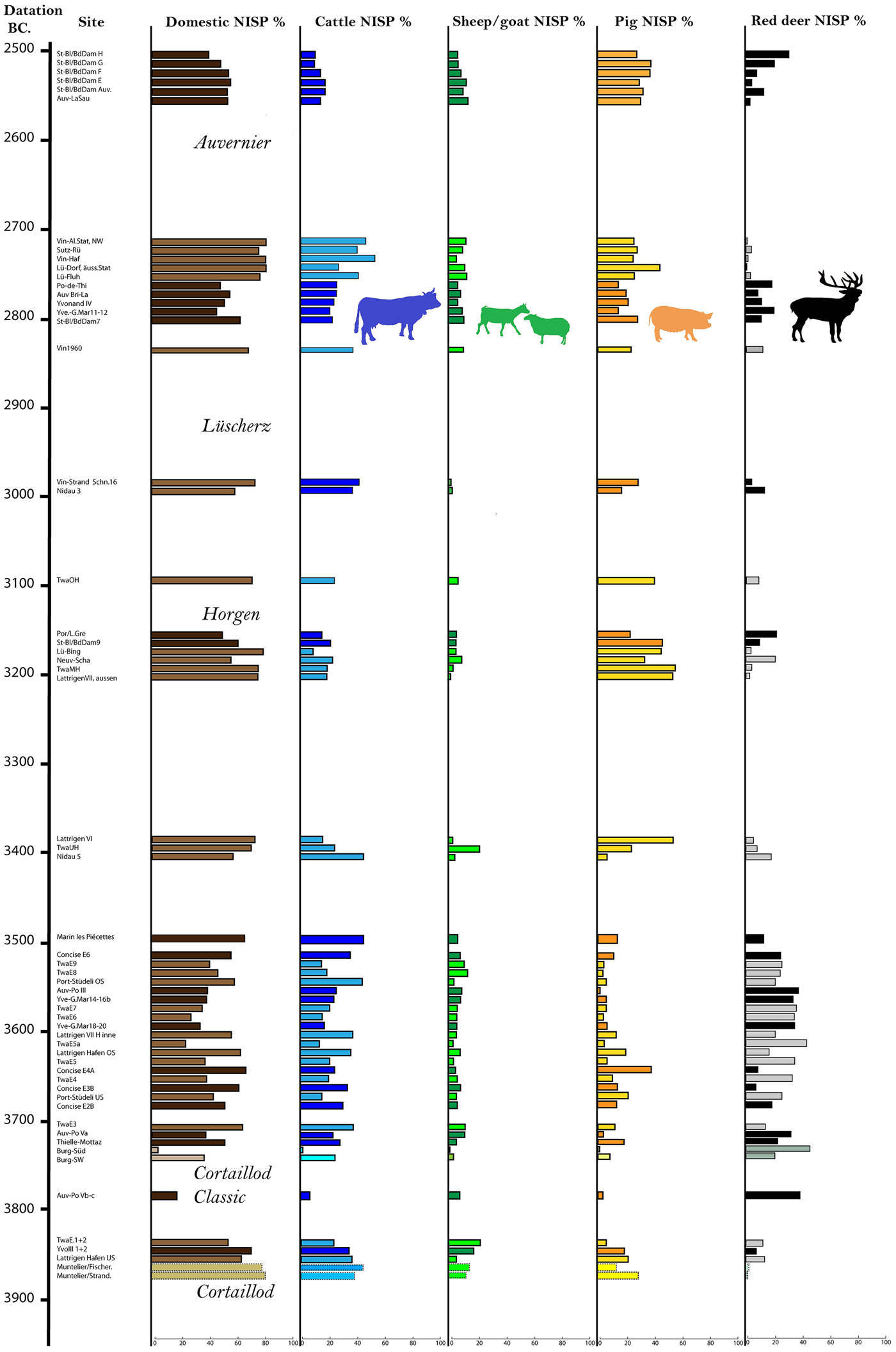
Importance of domestic animals based on the number of bone fragments at Neolithic lakeshore sites in western Switzerland, shown in their cultural sequence: cattle, sheep/goats, and pigs (100% = domestic animals); red deer (100% = wild animals). Dark shading represents sites on Lake Neuchâtel, light shading represents sites on Lake Bienne; the two sites on Lake Morat and the two sites on Lake Burgäschi are marked by even lighter shading.
Mean value of the importance (% of fragment numbers) of domestic animal remains at Lake Bienne and Lake Neuchâtel.

From 4000 cal. bc to 3400 cal. bc, cattle were the dominant domestic species exploited in Neolithic lake dwellings in western Switzerland (Figure 4). The proportion of cattle bones is greater than that of any other domestic species at the beginning of the fourth millennium, with more than half of all the remains being those of cattle at most sites on both lakes. At the beginning of the thirty-fourth century, the proportion of cattle bones decreases in favour of pig bones. Smaller proportions of cattle bones and higher proportions of pig bones are therefore typical in the second half of the fourth millennium and the first half of the third millennium bc. This trend is common to sites on both lakes. The ratio of cattle bones in both lake settlements is also quite similar, confirming that this was a chronological trend and not a reflection of geographical and topographical differences between the two regions (Figure 4). On the other hand, when finds’ densities (number of bones per m2) from sites near Lake Zurich are considered, no decrease in cattle bones during this period can be seen (Schibler, Reference Schibler, Albarella, Rizzetto, Russ, Vickers and Viner-Daniels2017).
Between the thirty-ninth and the thirty-fourth centuries bc, pig bones make up less than one third of all domestic animal bones (Figure 4), except at the settlement of Concise E4A dated to the thirty-seventh century bc. From the beginning of the Horgen culture at Lake Bienne (c. 3400 cal. bc), a significantly higher proportion of pig bones can be recognized (Schibler, Reference Schibler2006; Reference Schibler, Albarella, Rizzetto, Russ, Vickers and Viner-Daniels2017): pig bones account for 80 per cent of the domestic animal remains. In contrast, during the same period at Lake Neuchâtel, the importance of pig bones is much lower, averaging around 40–50 per cent (Figure 6). With the beginning of the third millennium, pigs decrease again in favour of cattle.
Mean value of the importance (% of fragment numbers) of domestic pig remains at Lake Bienne and Lake Neuchâtel.

During the Cortaillod culture (until the thirty-fourth century bc), sheep and goats are represented in stable proportions of up to 20 per cent at most sites. From the beginning of the third millennium, the importance of sheep and goat increased again (Figures 2 and 3).
Hunting and wild animal meat
Wild mammal remains were recovered on all the sites studied, but their importance fluctuates strongly between 2 and 95 per cent (Figure 3). The percentage of wild mammals makes up to one third of the identified bones at the beginning of the thirty-ninth century bc on sites around Lake Bienne (Stampfli, Reference Stampfli and Furger1980; Becker & Johansson, Reference Becker and Johannsson1981; Glass & Schibler, Reference Glass, Schibler, Hafner and Suter2000). Red deer was the dominant species (Figure 4), with aurochs, roe deer, and wild boar being of minor importance. During the thirty-seventh and thirty-sixth centuries bc, the percentage of wild mammal bones increased abruptly by up to two thirds of the assemblage. In the Late and Final Neolithic, the proportion of wild animals decreased again to 5–20 per cent of the identified bones (Kerdy, in prep.; Brombacher & Marti-Grädel, Reference Brombacher and Marti-Grädel1999: Schibler, Reference Schibler2006, Reference Schibler, Albarella, Rizzetto, Russ, Vickers and Viner-Daniels2017).
The sites around Lake Neuchâtel gave different results. Higher percentages of wild animals are present on most sites from the beginning of the thirty-eighth century until the twenty-fifth century cal. bc, with an especially high proportion of red deer bones on these sites in those centuries. Other wild animals, mainly carnivores, i.e. foxes and wolves, but also beavers and hares have been identified, but only in small numbers. Some cut marks found on these carnivore bone remains indicate that their meat was also eaten, even if they were primarily killed for their skins and fur (Chiquet, Reference Chiquet2012).
Food economy: a multiplicity of factors
To concentrate more fully on the meat economy as a whole (rather than just on a single species) and to further explore the economic aspects of food, this study examined the results of correspondence analysis. The information shown by the first two axes on Figure 7 reaches almost 63 per cent, which is a high score indeed.
Correspondence analysis of the faunal composition at lakeshore sites located in western Switzerland (Bienne, Neuchâtel, Morat, and Burgäschi). See text for an explanation of the symbols.
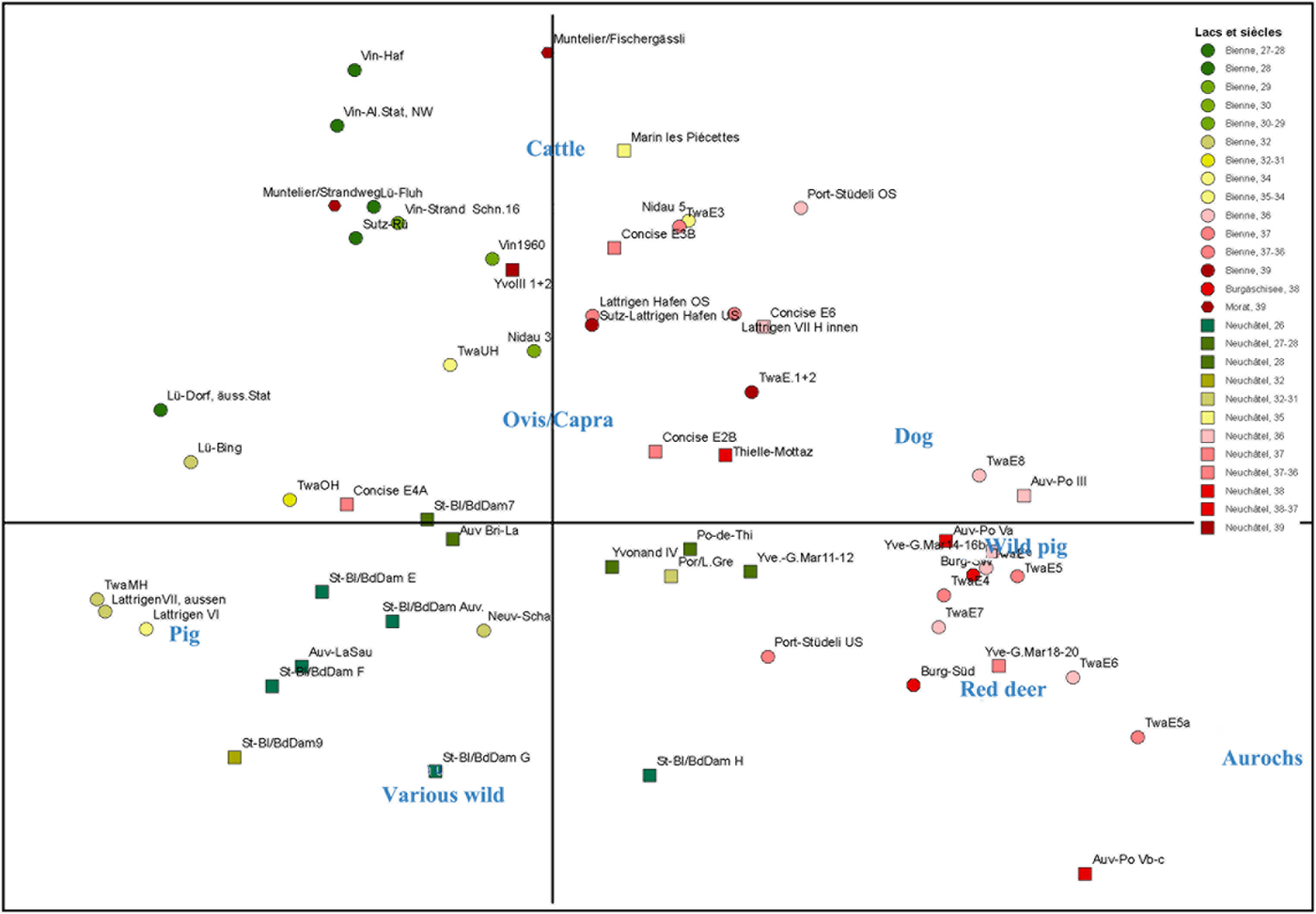
The sites on axis 1 are distributed in chronological order. The Middle Neolithic sites (red to pink symbols) are positioned on the right half of the diagram, while more recent sites (yellow to green symbols) are on the left.
Looking at the animal species, axis 1 is dominated by two variables, i.e. pigs (left side) and red deer (right side); the two animal species account for more than 82 per cent of the contributions. In addition, red deer is associated with two other wild species that also provide high amounts of meat: wild boar and aurochs.
Axis 2 seems to have some geographical significance. A dichotomy between sites located around Lake Bienne (circles: mostly upper part) and sites located on Lake Neuchâtel (squares: mostly bottom part) can be recognized.
Regarding the species, wild animals can be found in the lower part of axis 2, where only one domestic species can be recognized: the domestic pig.
The Lake Bienne sites (circles) show a much stronger correlation with husbandry (axis 2), especially with cattle remains, which alone make up 59 per cent of the contribution.
For wild animals, the correspondence analysis shows two aspects: first, wild animals are more frequently associated with earlier sites that are dated to the first half of the fourth millennium bc; second, more wild animals, especially red deer, are observed on sites on the northern shores of the lakes of Bienne and Neuchâtel. Red deer and wild boar are the most hunted animals across all sites.
Discussion
The ratio between the number of domestic and wild animal bones fluctuates considerably during the fourth and the first half of the third millennium, with a remarkable increase in wild animal proportions during specific phases of intensified hunting (Figure 3). It appears that in some periods farmers had to rely on wild resources to cover their routine demand for meat, specifically during the thirty-seventh and thirty-sixth centuries bc. In these periods, a concentration of large animal species, such as red deer, can be seen, as is the case in the Zurich region (Schibler & Jacomet, Reference Schibler and Jacomet2010). This phenomenon could be a sign of economically driven hunting, whose only goal was to ‘produce’ as much meat as possible during periods when other foodstuffs (e.g. cereals) were rare (Schibler, Reference Schibler, Albarella, Rizzetto, Russ, Vickers and Viner-Daniels2017).
Hunting wild animals was part of the exploitation strategy integrated into the economy of the lake settlements, and it offered people a valuable source of meat during periods of food shortages. This remarkable relationship—between the intensity of hunting and short-term climatic fluctuations—has been demonstrated for the Neolithic lakeshore settlements in the Zurich region (Schibler et al., Reference Schibler, Jacomet, Hüster-Plogmann and Brombacher1997; Hüster-Plogmann et al., Reference Hüster Plogmann, Schibler, Steppan, Dobiat and Leidorf1999). Short-term climatic deterioration may have been responsible for agricultural catastrophes which could have caused crop failures. Strong evidence for the highly specialized, economically stimulated hunting of large-sized mammals has been noticed at several lake sites already. The higher the quantity of wild animal remains found, the lower the diversity of wild animal species is observed in favour of larger species (Schibler & Jacomet, Reference Schibler and Jacomet2010). Furthermore, at the lakes in western Switzerland, hunters focused on species that offered the highest possible meat yield, that is, mainly red deer but also wild boar and aurochs (Figure 3).
Later, during the second half of the fourth millennium, the proportion of wild animal remains decreases significantly. This decline could have two reasons: first, an increase in some plant food species that are more tolerant of bad weather conditions (Brombacher & Jacomet, Reference Brombacher, Jacomet and Zwahlen2003), and second, an increase in pig keeping, from the thirty-fourth century bc onwards, which greatly increased meat production. This chronological replacement of hunting large wild animal species by intensive husbandry of domestic pigs is also convincingly supported by the result of the correspondence analysis. It shows a strong dichotomy between wild animals and domestic pigs on the first axis with a solid chronological correlation between a greater frequency of hunting at older settlements of the first half of the fourth millennium bc and a higher importance of pigs at more recent sites of the second half of the fourth and third millennium bc (Figure 7). A comparison between the importance of wild animal bones and cultural boundaries shows clearly that there was no relationship, which signifies that the importance of hunting is not culturally determined (Schibler, Reference Schibler2006: fig. 2).
From the middle of the fourth millennium bc onwards, an increase in the proportions of domestic animals can be seen. After the fluctuation in the share of wild/domestic animals in the Cortaillod period, the proportion of domestic animals in the Late Neolithic is visibly higher. However, not only does the ratio of wild to domestic animals fluctuate, but so do the proportions of different domestic species. The share of cattle bones is greater than that of other species in the Middle Neolithic (Figure 4: 4000–3400 cal. bc). Cattle proportions are constantly high at the beginning of the fourth millennium at all the lakeshore sites studied. It seems that not only were Neolithic cattle used as producers of meat but also as draught animals and for providing milk. The fatty acids from cow's milk discovered on pottery sherds suggest that cow's milk was being systematically used from at least 3400 cal. bc onwards (Spangenberg, Reference Spangenberg, Jacomet, Leuzinger and Schibler2004; Spangenberg et al., Reference Spangenberg, Jacomet and Schibler2006; Schibler, Reference Schibler2006).
A significant increase in pig bones from 3400 cal. bc onwards was also detected. Pigs, being highly reproductive and having large litters, are perfect animals for the production of meat; therefore, larger quantities of meat can be produced in a relatively shorter time than is needed for cattle (Serjeantson, Reference Serjeantson2011). Moreover, the decision to exploit more pigs among the available domestic resources may also have resulted from the discovery that rearing pigs is the only form of farming that requires little space or additional fodder; pigs can be kept on fallow land and fed with household refuse, or they can be let loose in the forest to browse and then attracted back to the village, using fodder, when their meat is needed (Schibler & Schäfer, Reference Schibler, Schäfer, Bleicher and Harb2017). Additionally, keeping pigs was not only a source of protein, but also a way of tilling the arable farmland, as pigs have an instinct for rooting in the ground (Schibler et al., Reference Schibler, Jacomet, Hüster-Plogmann and Brombacher1997). While pigs were of particular importance for bulk manure, other livestock, mainly cattle, goats, and sheep only made a complementary contribution to intensive cultivation (Bogaard, Reference Bogaard and Jones2012). Cattle, goats, and especially pigs also contributed to the clearance of forest vegetation and weeds on arable land, and they deposited manure through penning on arable land (Bogaard, Reference Bogaard and Jones2012). Therefore, pigs proved tremendously adaptable and enabled households to have a ‘refuse compactor’ which converted domestic waste, forest products, and field remains into meat (Bogucki, Reference Bogucki1993). The importance of pig keeping, therefore, may have been because it was the only practicable solution for producing more meat without greater effort. The existing arable farmland and the marshy/sparsely-wooded floodplain around the settlements could all have been used as pastures for pigs (Schibler et al., Reference Schibler, Jacomet, Hüster-Plogmann and Brombacher1997; Pétrequin et al., Reference Pétrequin, Arbogast, Bourquin-Mignot, Lavier and Viellet1998; Hüster Plogmann et al., Reference Hüster Plogmann, Schibler, Steppan, Dobiat and Leidorf1999; Serjeanston, Reference Schibler, Jacomet, Hüster-Plogmann and Brombacher2011).
Furthermore, intensive pig keeping made it possible to replace the hunting of large wild ungulates (red deer, wild boar, and aurochs). This shift from hunting wild ungulates to pig husbandry was developed in eastern Switzerland during the time of the Pfyn culture between 3800 und 3400 cal. bc and was been adapted in western Switzerland during the Horgen culture in a very short time (in the thirty-fourth century), as the settlements at Lake Bienne and in Concise (Lake Neuchâtel) demonstrate (Chiquet, Reference Chiquet2012; Schibler, Reference Schibler, Albarella, Rizzetto, Russ, Vickers and Viner-Daniels2017). This change obviously allowed better control of available protein resources. This growing interest in pig husbandry has been recorded in other regions, such as the French Jura region, and it reflects a more supra-regional or even cultural tendency (Arbogast et al., Reference Arbogast, Jacomet, Magny and Schibler2006; Arbogast, Reference Arbogast2008; Schibler, Reference Schibler2006; Kerdy in prep.).
Sheep and goat proportions fluctuated less strongly than those of cattle and pig. A high proportion of sheep and goats was typical in the early settlements of the fourth millennium, as at Twann and Auvernier Port and some sites of the Jura lakes (Arbogast, Reference Arbogast2008). Later, smaller proportions of sheep and goats (less than 25 per cent) remain stable until the Late Neolithic. During the final period of the Neolithic, the slightly higher importance of sheep (and goats) was possibly due to the exploitation of wool. This impression is supported by the fact that larger animals and older slaughter ages can be recognized, at least in the Zurich region (Hüster-Plogmann & Schibler, Reference Hüster-Plogmann, Schibler, Schibler, Hüster-Plogmann, Jacomet, Brombacher, Gross-Klee and Rast-Eicher1997), and by the first evidence of bone and antler needles and buttons at Corded Ware and Auvernier sites (Schibler et al., 1997b; Schibler, Reference Schibler, Albarella, Rizzetto, Russ, Vickers and Viner-Daniels2017).
Dog bones were found on all lakeshore sites in Switzerland. Usually the percentage lies between 1 and 10 per cent of the domestic animal remains. Yet, by looking at the proportion of dog remains, significant increases in dog bones were noticed in the western Swiss sites dated to between 3700 and 3500 cal. bc (Figure 8). However, if all Neolithic lakeshore sites in Switzerland are considered, no correlation between the proportion of dog remains and wild animal bones can be observed (Schibler, Reference Schibler2006).
The importance of dogs (Canis familiaris L.) at Neolithic lakeshore sites in western Switzerland according to percentages based on fragment numbers (100% = domestic animals).

Higher frequencies of dog bones with cut marks in the period between 3700 and 3400 cal. bc and the young age of the dogs could indicate that dogs were used as additional meat sources during periods of food crises (e.g. starvation). Based on the tooth-wear classification of Habermehl (Reference Habermehl1975), 43 per cent of the dogs in the upper layer at Sutz-Lattrigen Hafen were killed just after their first year. At the site of Concise, E2B, half of the dogs were killed before they had even reached 6 months (Chiquet, Reference Chiquet2012). These results indicate that dog meat was an additional source of food during periods of economic problems. This scenario is observed at sites around Lake Zurich, e.g. at Opera Parkhouse, layer 13 (Schibler & Schäfer, Reference Schibler, Schäfer, Bleicher and Harb2017). In both regions, i.e. western Switzerland (end of the second half of the fourth millennium bc) and eastern Switzerland (first half of the third millennium bc), the increase in dog bone proportions, as well as pendants made from dog metapodials and canine teeth (Schibler, Reference Schibler1981; Deschler-Erb et al., Reference Deschler-Erb, Marti-Grädel, Schibler, de Capitani, Deschler-Erb, Leuzinger, Marti-Grädel and Schibler2002), indicate that special relations existed between dogs and humans.
As stated above, farmers in western Switzerland faced many challenges to meet their daily food demands. These challenges could be caused by natural factors (e.g. weather conditions); however, topographical situations or cultural tradition could also have been factors that influenced the Neolithic economy. At sites like Twann or Auvernier, located on the steeper northern slopes of the lakes of Bienne and Neuchâtel, hunting was important. On the southern side of the lakes, i.e. the flatter southern shore, different results were obtained, with lower proportions of wild species and higher proportions of domestic animal remains. The steep northern shores of the lakes obviously influenced the strategies of the farmers, restricting the intensity of husbandry and agriculture. Farming, especially cattle and pig husbandry, on steep slopes is much more challenging and would have made this region less favourable for domestic animals. On the other hand, the inhabitants were surrounded by wider areas of forests which offered an increased range of hunting opportunities. Farmers on the steeper northern lakeside were also more influenced by climatic conditions, which could have reduced their already restricted productivity of cultivated plants. Conversely, the undulating southern shore was an ideal place for farming and offered better possibilities for cultivation (Marti-Grädel & Stopp, Reference Marti-Grädel and Stopp1997; Kerdy, in prep.).
Conclusion
This review has brought together zooarchaeological data from Neolithic settlements established on the shores of two large (Neuchâtel, Bienne) and two small (Morat, Burgäschisee) lakes in western Switzerland. The results illustrate profound changes in the subsistence strategies used by the communities that lived in this region between the thirty-ninth and the twenty-sixth centuries cal. bc.
The archaeological data point to a period of economic crisis in the thirty-seventh and thirty-sixth centuries cal. bc, which could have been caused by climatic deterioration. The resulting decrease in available crops forced the farmers to intensify their exploitation of wild resources. However, when hunting did take place, it generally targeted the most abundant and meat-rich animals such as the red deer. Wild plant gathering also intensified markedly.
During periods of favourable conditions, the animal economy of the Neolithic famers was mostly based on keeping domestic animals. Cattle were the most common animals in the first half of the fourth millennium. The economic importance of domestic pig starts to increase from the beginning of the thirty-fourth century cal. bc, replacing the meat supply previously provided by hunted wild ungulates. Neolithic farmers probably intensified pig husbandry because pigs were more easily fed with household refuse, or by browsing the harvested fields or the adjacent forest. In addition, keeping cattle, sheep, goats, and pigs on harvested fields provides manure to fertilize the land. Sheep and goats were kept more frequently during two periods: the beginning of the fourth millennium cal. bc and the beginning of the third millennium cal. bc. In the earlier period, meat and milk are the most plausible reason for this increased frequency; during the later period, the earliest evidence of the use of wool is the most likely explanation. Increased frequencies of dog bones, correlated with cut marks and the preferred slaughter age at one year old, make it probable that dogs were also a source of meat during periods of economic crisis in the first half of the fourth millennium cal. bc.
In conclusion, the economy of the lakeshore sites in western Switzerland was influenced by many sub-regional trends and local factors. Short climatic fluctuations correlate well with the varying importance of hunting. The significant factor influencing the relative importance of domestic animal species is the topographical location of the sites (steep or lower hills). Obviously, environmental, topographic, and material cultural factors were responsible for the complex system that created the faunal composition at each individual settlement. To fully understand this system, further investigations in neighbouring regions are necessary. The evidence of contact and even displacement across the Jura Mountains during the Neolithic period offers the possibility of new research perspectives on these fundamental issues (see Burri, Reference Burri2007; Chiquet, Reference Chiquet2012, Burri-Wyser et al., Reference Burri-Wyser, Chiquet, Winiger, Rey and Dumont2015; Pétrequin et al., Reference Pétrequin, Pétrequin, Sheridan, Affolter, Arbogast, Maigrot, Pétrequin and Pétrequin2015; Schibler, Reference Schibler, Albarella, Rizzetto, Russ, Vickers and Viner-Daniels2017).
Acknowledgements
We are grateful to Jean-François Buard (University of Geneva, Laboratoire d’Archéologie Préhistorique et Anthropologie) for his help in providing the factorial correspondence analysis. We would like to thank Jill Cucchi for the English proofreading.



