

The effect of interstate conflict on domestic politics is a fundamental question in international relations, underpinning concepts such as diversionary war and rally around the flag (see Fravel, Reference Fravel2010, 309–310; Seo and Horiuchi, Reference Seo and Horiuchi2023). That literature derives its micro-foundations from in-group/out-group dynamics in which confrontations with any out-group activates a common in-group identity, uniting the group engaged in external struggle while reducing perceived internal divisions (Gaertner and Dovidio, Reference Gaertner and Dovidio2000; Feinstein, Reference Feinstein2016).
However, it remains uncertain whether interstate conflict activates a common identity when the boundaries of the in-group are contested, especially when domestic minority groups share identities with those in neighboring enemy states, what we call linked out-groups. Early researchers (Williams, Reference Williams1947; Coser, Reference Coser1956) proposed that if pre-conflict internal cohesion was sufficiently low, conflict could cause group disintegration rather than unity.
We examine these dynamics in India, a Hindu-majority country with a large domestic Muslim minority and a long-standing rivalry with Muslim-majority Pakistan. India-Pakistan conflict could either (1) activate a shared Indian identity, promoting Hindu-Muslim tolerance or, (2) exacerbate Hindu-Muslim tension due to the shared Muslim religious identity of India's Muslim minority with Pakistan's religious majority. Perceptions that Muslims have a propensity to be “disloyal to India” because “their religious identity is posed as an anti-thesis to the nation's security” could link external fights with Pakistan to internal identity disputes (Ahmed, Reference Ahmed2019).
We assess how attitudes toward Indian Muslims vary in response to hypothetical crisis vignettes in a nationally representative survey experiment of 7052 Indian respondents in 2022. We compare results of hypothetical crises involving Pakistan and those involving China, a country which has no linkage to Indian Muslims in the popular imagination. Two main results emerge: (1) Hindu respondents express less discriminatory attitudes toward Indian Muslims following an interstate crisis vignette compared to a control condition without a vignette; (2) contrary to our expectations, a Pakistan crisis vignette increases tolerance toward Indian Muslims more than China crisis vignettes. These findings suggest that attitudes toward Indian Muslims need not worsen during crisis; rather such conflicts may improve group cohesion within India, increasing tolerance toward Muslims.
1. Theoretical background
A rich literature building on insights from social psychology has found that prejudice toward an out-group can be decreased by making salient a shared, superordinate identity to which both in-group and out-group members belong (Gaertner and Dovidio, Reference Gaertner and Dovidio2000). Applications of our theory—including in our country case study of India (Charnysh et al., Reference Charnysh, Lucas and Singh2014) as well as in neighboring Pakistan (Kalin and Siddiqui, Reference Kalin and Siddiqui2020)—have found that priming a shared national identity can promote intergroup tolerance as well as decrease intergroup threat (Riek et al., Reference Riek, Mania, Gaertner, McDonald and Lamoreaux2010). This school of thought argues that external conflict—by making national identity salient—can improve cohesion among sub-national groups.Footnote 1 Indeed, researchers have sometimes documented greater Hindu-Muslim unity in India during or following wars with Pakistan (Malik, Reference Malik1969; Zins, Reference Zins2002).
However, it is possible that attitudes toward linked out-groups are affected differently in the wake of interstate conflicts. This possibility has broad relevance: most societies today are multiethnic, with many ethnic groups dispersed transnationally, resulting in situations where a minority ethnic group in one state also has minority or majority status in a neighboring state. Many of these transnational ethnic groups reside in two states with adversarial relations (see Table 1).
Examples of linked out-groups
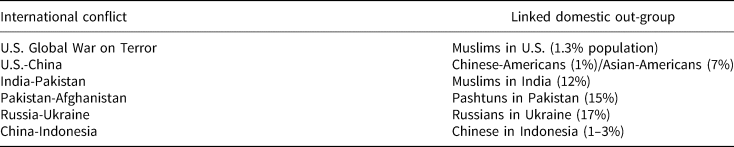
This alternative school of thought emphasizes that interstate conflict may decrease tolerance, particularly for linked out-groups. This school is consistent with prior research that finds intergroup tolerance decreases when territory is threatened by international foes (Gibler et al., Reference Gibler, Hutchison and Miller2012) and that civil wars and other intrastate conflicts decrease inter-ethnic tolerance (Hutchison, Reference Hutchison2014; Tir and Singh, Reference Tir and Singh2015). Contemporary American political debates also posit that fights against external adversaries negatively shift domestic discourse, with the current U.S.-China competition and the earlier U.S. Global War on Terror offering recent examples. On the former, Jeung (quoted in Nakamura, Reference Nakamura2021) has argued, “When America China-bashes, then Chinese get bashed, and so do those who look Chinese.” Ackerman (Reference Ackerman2021, xiii) similarly proposes that the post-9/11 Global War on Terrorism led not just to Islamophobia but a broader xenophobic backlash in the United States.
The idea of linked out-groups is closely related to two other overlapping but distinct concepts. The charge of “dual loyalties” implies that an individual has “emotional commitments” to some entity that “conflict with one's rational and legal requirements as a citizen” (Baron, Reference Baron2009, 1027; Shklar, Reference Shklar1993, 183–184). When alleged dual loyalties involve emotional commitments to external adversaries of a state, then the linked domestic out-group may also face allegations that it is a “fifth column,” defined as “domestic actors who work to undermine the national interest, in cooperation with external rivals of the state” (Radnitz and Mylonas, Reference Radnitz, Mylonas, Mylonas and Radnitz2022, 3). Our definition of linked outgroups sits between these two concepts since the concept of dual loyalties does not require attachments to an adversary state (our definition of linked outgroups does), while the concept of a fifth column implies active undermining (our definition merely posits perceived shared identities).
2. Regional context and expectations
In 1947, British India was partitioned into two successor states, with Pakistan created as a homeland for the Muslims of the subcontinent. While many Muslims migrated to Pakistan during and after Partition, a large population stayed in India—with Muslims constituting roughly 1 in 7 Indians today. In India, there have been two contending visions of nationalism: (1) a secular, multi-ethnic, multi-religious alternative to the Muslim-majority Pakistan, and (2) an alternative Hindu nationalist vision where minorities were welcomed within a fundamentally Hindu rashtra (polity). The secular vision predominated, at least in elite discourse, in India's initial decades, while Hindu nationalism has become more predominant in the contemporary period. Pakistani nationalism remains wedded to the belief that Muslims are second-class citizens in independent India. For example, a recent Pakistan prime minister emphasized in 2018, “The way Muslims are treated today in India has made people realize now why Pakistan was born” (Geo Reference Geo2018).
Partition did not yield peaceful relations between the two newly independent successor states of British India. India and Pakistan have fought four wars since 1947 and relations remain crisis-prone. In this context, Indian Muslims face charges of dual loyalties toward Pakistan. As Devji (Reference Devji1992, 7–8) has argued, they face allegations that they are “saboteur[s] of the nation” who have “sympathies toward Pakistan.” Similarly, Tambiah (Reference Tambiah2005, 924) observes, “the contemporary ideologues of Hindu nationalism have viewed the approximately 120 million Muslims residing in India as the enemy within, and the Muslims living in Pakistan as the enemy without…”
Whatever their role in national identity, it is undeniable that Indian Muslims face discrimination in daily life. India's own government has documented the social, economic, and educational disenfranchisement of its Muslim minority (Prime Minister's High Level Committee, Cabinet Secretariat, Government of India, 2006). Social scientists have documented housing discrimination, in particular (Datta and Pathania, Reference Datta and Pathania2016). Muslims have also been singled out as waging a “love jihad” to lure non-Muslims into marriages as part of a broader demographic expansion. When Muslim internal migrants do create communities in Indian cities, Hindu nationalist politicians accuse them of creating “mini-Pakistans” (Mishra, Reference Mishra2022).
In our study, we seek to assess how interstate conflict affects domestic intergroup cohesion in India. On the one hand, building on literature on superordinate (national) identity we would predict that interstate conflict with any enemy state would improve intergroup cohesion within India, improving tolerance toward Muslims. Accordingly, we hypothesize:
H1: Respondents that receive information about a hypothetical interstate conflict involving India (regardless of the enemy state) should be more likely to express tolerant attitudes toward Indian Muslims than those that receive no interstate conflict vignette.
Alternatively, it is possible this improvement in inter-group cohesion will vary by the nature of the adversary. In particular, given the possible perception of a linked outgroup relationship between Indian Muslims and Pakistan, we might expect that non-Muslim respondents who are exposed to a hypothetical conflict between India and Pakistan will become less tolerant toward Muslim Indians than respondents in other treatment arms.
H2: Respondents that receive information about a hypothetical interstate conflict between India and Pakistan should be less likely to express tolerant attitudes toward Indian Muslims than those that receive information about a hypothetical China-India conflict or those that receive no interstate conflict vignette.
3. Research design
In order to study the identity implications of different international crisis interactions, we fielded a large telephone survey experiment among 7052 respondents across India in 2022. The survey was translated and fielded nationally in 12 languages by the Centre for Voting Opinion & Trends in Election Research (CVoter), a widely used public opinion firm.Footnote 2
Respondents were asked a series of questions about their political views before they were randomly assigned to a crisis vignette condition (n = 6213) or a control condition (n = 839). Those assigned to the crisis condition were asked their “opinion on the following hypothetical scenario.” They were then split further, receiving hypothetical crisis vignettes that differed on three dimensions:
• the external adversary (China or Pakistan),
• India's escalatory choice (counterattack vs. inaction), and
• strategic circumstances (presence of military exercises that improved or worsened the strategic situation).Footnote 3
For the purposes of this article, we examine only the differences between China, Pakistan and control conditions since these treatment arms are most relevant for our theoretical inquiry.Footnote 4
Respondents were then asked a series of questions about their support for Prime Minister Modi's decision in the vignette as well as their attitudes toward Indian Muslims. We focus here on two outcomes which measure tolerance toward Muslims: (1) if the respondent would be willing to have a Muslim as a neighbor—a measure of personal discriminatory preference, which has been widely used to measure intergroup tolerance in social science research for nearly a century (Wark and Galliher, Reference Wark and Galliher2007, 392)—and (2) if the respondent believed that the Muslim population in India was growing too rapidly, a widely-held belief which Hindu nationalists have often emphasized as a long-term threat to Hindu political power in India (DeVotta, Reference DeVotta2002).
4. Results
We find little evidence that interstate crises result in heightened intolerance toward domestic minority groups; instead, we find some evidence that interstate crises may foster group cohesion within India, improving tolerance of Muslims among the non-Muslim population in India, and that this effect is magnified when the conflict is with Pakistan.
First, we find, across all treatment arms, high levels of prejudicial attitudes toward Indian Muslims among non-Muslim respondents (n = 6122; 86.8 percent of our sample). Of non-Muslim respondents, 39.4 percent expressed unwillingness to have a Muslim neighbor with another 4.4 percent of respondents that “can't say.” When asked if India's Muslim population is growing too rapidly, 80.7 percent of non-Muslim respondents agreed, while another 9.4 percent “can't say.”
Second, overall, we find that exposure to interstate crisis vignettes did not worsen, and in some treatment arms actually improved, stated tolerance toward Indian Muslims across one of the two measures of prejudice. Such a finding seems consistent with the common in-group identity model of group cohesion (H1). Of non-Muslim respondents who were exposed to crisis vignettes involving China or Pakistan, 38.8 percent stated they were unwilling to have a Muslim neighbor, 4.7 percentage points (p < 0.05) less than the 43.5 percent of respondents in the control condition that expressed this discriminatory view. In other words, discrimination toward Muslims declined by this measure for those respondents receiving crisis vignettes. (Attitudes toward Muslim population growth were indistinguishable between crisis vignette and control conditions.)
Third, closer examination suggests that differential discrimination is driven largely by those receiving the Pakistan crisis vignettes, not the China vignettes. This finding is contrary to H2's expectations that intolerance would increase toward linked outgroups. This difference was substantively and statistically significant. Figure 1 shows the percentage of respondents (and associated confidence intervals) by vignette type. 36.7 percent of respondents that received a crisis vignette involving Pakistan said they would not be willing to have a Muslim neighbor compared to 41.4 percent of respondents receiving either China vignettes or the control condition, a difference-in-means of 4.7 percentage points (p < 0.001).Footnote 5
Stated intolerance of Muslims.
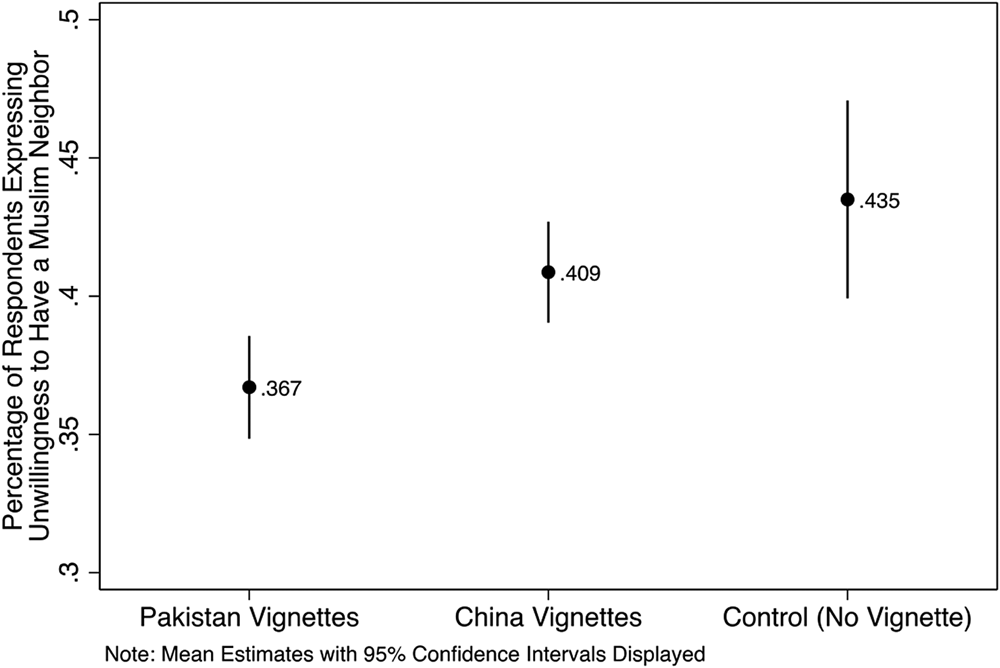
These findings suggest that exposure to a crisis vignette with Pakistan may decrease discrimination toward the Muslim minority. This result does not appear to be driven by further heterogeneous treatment effects among respondents in that treatment arm. We tested for subgroup effects for Modi supporters and non-supporters, BJP supporters and non-supporters, high- and low-income respondents, residents of states with higher-than-average Muslim populations, and residents of northern versus southern states (see Appendix A8). None of these interaction effects reached conventional levels of significance (p < 0.10). Though the sub-sample size is small, we also find that Muslim respondents similarly expressed greater willingness to have a Hindu neighbor if they received information about a crisis with Pakistan.Footnote 6 While it is possible that Muslim respondents, after receiving a vignette about a crisis with Pakistan, felt that the socially desirable answer was to increase their stated tolerance toward Hindus, it is nonetheless striking that it is consistent with the finding among Hindu respondents.
5. Discussion and conclusion
In multiethnic societies, commentators worry that escalating tensions with an external adversary might worsen domestic in-group/out-group relations especially if a domestic out-group might be linked through perceptions of dual loyalties. We tested this concern through a survey experiment in India, a multiethnic society that has a large Muslim minority frequently linked in commentary to Pakistan. Our findings suggest that, while overall intolerance of the Muslim minority in India is high, information about a conflict with Pakistan does not worsen these attitudes and may in fact improve them.
How should we interpret these findings of improved group cohesion in some interstate crisis vignettes but not others? It is possible that when respondents were told of a conflict between India and Pakistan, this reminded them of historic national myths that India would be a home for all its citizens (as well as the opposite Pakistani national myth that Muslims would never be well-treated in India). There may be tacit awareness among the Indian population that social fissures could be activated in the event of a conflict with its Muslim-majority rival, a concern that is not as acute even against the militarily more daunting China threat. Future research should uncover the mechanisms at play here. Given this uncertainty, several caveats merit emphasis.
First, one avenue for research would seek to test the effects of inter-state crisis across a broader array of tolerance measures. We observed little variation across treatment arms on one of our two measures of tolerance, that of beliefs about Muslim population growth. This measure may have encountered ceiling effects given how many non-Muslim respondents expressed their view that it was too high. While it is possible that different measures that asked specifically about attitudes towards Muslims in the military, for example, would have yielded different results, we opted for tolerance measures that were sufficiently removed from our treatment. In Appendix A5, we provide an overview of these measures, including other contexts in which they have been utilized. Nonetheless, it is possible that measures of tolerance across other facets would find intolerance against Muslims increase as a result of inter-state conflict.
Second, any stated changes in expressed tolerance could be the product of perceived social desirability when Pakistan vignettes are raised. However, there is suggestive evidence this is not occurring. Notably, we do not observe heterogenous treatment effects even in populations, such as younger or more educated respondents, who we might expect to be more prone to social desirability concerns.Footnote 7
Third, other mechanisms might also produce more stated tolerance even when underlying attitudes might reflect intolerance. For example, if respondents believe a military crisis with Pakistan will intimidate Indian Muslims into quiescence, they might be more willing to have them as neighbors. Our measure of intergroup cohesion might improve not because of heightened tolerance, but shifting beliefs about the possibility that any Indian Muslim bad actors will be deterred.
Fourth, these findings pertain to one case—India—and further work is needed to generalize to other societal contexts. One specific possibility worth considering is that our Indian respondents were confident that India could prevail in a conflict with Pakistan or China. Some research suggests that uncertainty about the outcome of ongoing fighting may trigger a combination of fear, anger, and intolerance that may differ when outcomes appear more favorable (Maoz and McCauley, Reference Maoz and McCauley2008; Spanovic et al., Reference Spanovic, Lickel, Denson and Petrovic2010).Footnote 8 This again makes further research important. Yet, India is by far the world's most populous electoral democracy and its history of conflicts with Pakistan makes it a most-likely case for linked out-group dynamics giving the study intrinsic value.
As with other survey experimental research, it is difficult to know whether an environment full of media coverage, elite cueing, and other contingency might lead to attitudinal responses that diverge from our results here. Nonetheless, our findings still clarify. They suggest that an attitudinal shift toward intolerance of linked out-groups is not intrinsic to the occurrence of interstate conflict, but rather might emerge out of the broader milieu of crisis politics. While outbursts of Hindu-Muslim violence have occasionally accompanied prior India-Pakistan crises (notably in 2002), most crises have passed without a clear uptick in domestic Hindu-Muslim enmity. Prior experience and our survey suggest that India-Pakistan conflicts need not necessarily presage Hindu-Muslim clashes within India.
Additionally, our findings do not eliminate the possibility that politicians may benefit from external crises, but it does reduce the likelihood that certain hypothesized benefits appear in practice. Our findings are in tension with the allegation that Indian politicians might highlight confrontational stances toward Pakistan “to achieve polarization of Hindu-Muslim votes.” (Desai, Reference Desai2019). The evidence suggests that crises may not secure this aim. We also tested the related proposition of whether respondents change their assessment of Modi as a likely defender against Muslim extremists, depending on the crisis vignettes. We found no meaningful or statistical difference across treatments and discuss this finding in Appendix A9.
Finally, while our research presents encouraging signs when it comes to linked out-group phenomena, overall we find distressingly high levels of anti-Muslim views among our non-Muslim Indian respondents. The vast majority of non-Muslim respondents felt Muslim population growth was too high and a substantial minority stated they would be unwilling to have Muslim neighbors. The fact that external conflict did not worsen these views is an important silver lining in an otherwise dark cloud.
Supplementary material
The supplementary material for this article can be found at https://doi.org/10.1017/psrm.2024.47.
To obtain replication material for this article, https://doi.org/10.7910/DVN/KZRLWC
Acknowledgements
The authors thank the Stimson Center for funding support, CVoter for their assistance with survey administration, participants and discussants from the American Political Science Association 2023 annual meeting, the University at Albany Experiments in Politics and Policy Group, and Leiden University for their feedback, and Julia Lodoen for her research assistance.
Competing interests
The authors declare none.


 Open access

