


Early psychoanalytical writing acknowledged the contribution of homosexuals to society (Reference Freud and StracheyFreud, 1953) but linked homosexuality to paranoia and suggested how homosexuality might be treated by psychoanalysis (Freud, Reference Freud and Strachey1955, Reference Freud and Strachey1958). Such views were influential in wider society. Homosexuality continued to be regarded as a state of arrested development that, through psychoanalysis, could be restored to ‘normality’ (Reference SilversteinSilverstein, 1991; Reference O'Connor and RyanO'Connor & Ryan, 1993), despite the lack of empirical evidence (Reference AcostaAcosta, 1975). The social science critique of the illness model of homosexuality (Reference PlummerPlummer, 1981; Reference KitzingerKitzinger, 1987) and the development of a modern gay and lesbian identity encouraged some psychoanalysts to rethink (Reference McDougallMcDougall, 1995), but the Association of Psychoanalytic Psychotherapists invited Socarides (Reference Socarides1978, Reference Socarides and Rosen1996) — an enthusiast for the psychoanalytic treatment of homosexuality — to talk in the UK. This prompted a debate on the subject.
METHOD
There has been no systematic study in the UK of the views of psychoanalysts and psychotherapists on gay and lesbian identity. We surveyed a random sample of practising psychoanalysts and psychotherapists, focusing on three areas: the individual background of the respondent; the psychoanalysts'/psychotherapists' work with gay and lesbian clientsFootnote 1; and training issues. Only the first and second topics are reported here.
We developed a pilot questionnaire. Two psychotherapists, known to us, advised on the face validity of questions. A penultimate version was sent to 23 therapists, of whom 15 (65%) replied and 13 (57%) completed questionnaires on two occasions, 2 weeks apart. Intraclass correlation and κ coefficients were used to assess test—retest reliability of continuous and categorical variables, respectively. Of 20 questions assessed, one received a κ value of 0.67, ten received κ values of 1.0, seven had perfect agreements and two had intraclass correlations of 0.99. We used the terms ‘gay’ and ‘lesbian’ rather than ‘homosexuality’ in the questionnaire to reflect the language of contemporary society rather than that of psychoanalysis. In all other respects we used language that had face validity within the analytical world.
We selected the sample from the 1996 Register of the British Confederation of Psychotherapists (BCP), which contains the names and addresses of approximately 800 practitioners with adults and information about their training institutes. A random one-in-two sample of 400 was generated using random number tables from the alphabetical list of practitioners working with adults. The questionnaire was anonymous. Respondents were sent a postcard to return under separate cover to indicate that they had replied. Non-responders were posted a second questionnaire in order to improve the response rate.
We used a postal questionnaire to target a large sample of psychotherapists. This comprised both forced-choice and open-ended questions. However, we recognised that the information collected would not do justice to the complexity of therapeutic work itself, therefore respondents were offered follow-up interviews during which they could give more in-depth views. The use of both techniques is preferable to either in isolation. Qualitative data from the interviews are reported separately (Reference Phillips, Bartlett and KingPhillips et al, 2001). The questionnaire covered socio-demographic details of respondents, their experience as training analysts and psychotherapists if applicable, their experience of working with gay and lesbian clients and their attitudes towards the rights of gays and lesbians. Individuals who wished to comment on the questionnaire without completing it in full were invited to respond in this way.
Pre-coded frequency data generated in the study were analysed using SPSS version 9 (for PC). Free text was transcribed, read and analysed by one of the authors (A. B.) to produce descriptive codings relevant to the topic of the research. Categories arose and were assigned on the basis of units of meaning. Data could give rise to more than one coding, and where relevant this is indicated. The richness of the free text data and the controversial nature of the project made it important to include illustrative verbatim observations. The views of respondents who generated no free text remain unelaborated.
RESULTS
Four hundred questionnaires were posted. One person was deceased and four people were not known at their mailing addresses. Two hundred and fourteen psychotherapists responded to the initial mailing and a further 60 to the follow-up mailing. Data are available from 274 (69%) respondents out of a possible total of 395 (100%). A total of 218 (55%) of the 274 were fully completed. Fifty-six individuals (14%) returned the forms but declined to fill in the questionnaire, other than to comment on their reasons for not wishing to answer it in full.
Information on non-responders
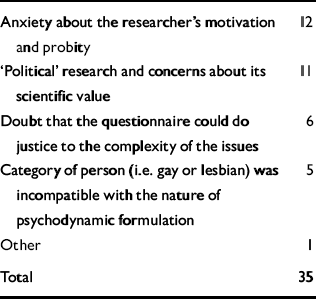
Of the 56 individuals who declined to complete the questionnaire in full, 45 gave reasons. Two-thirds of those who commented expressed concern about the nature of the research (Table 1).
Concerns about research (n=31)1
| Anxiety about the researcher's motivation and probity | 12 |
| ‘Political’ research and concerns about its scientific value | 11 |
| Doubt that the questionnaire could do justice to the complexity of the issues | 6 |
| Category of person (i.e. gay or lesbian) was incompatible with the nature of psychodynamic formulation | 5 |
| Other | 1 |
| Total | 35 |
Many respondents gave thoughtful replies even when declining to complete the remainder of the questionnaire. The verbatim comments below are illustrative of their concerns:
“I prefer not to answer this questionnaire, it purports to investigate a matter of human rights but does so from a very superficial and slanted perspective. Its perspective is fashionably ‘politically correct’, ultimately to enforce the distortion of the language. What W. H. Auden called ‘corruption’ of language; denial of the homosexual's despair about him/herself. It is altogether indifferent to, insensitive of deeper feelings.”
“It is not relevant or appropriate to my work as a psychoanalytic therapist — which is about thoughts, feelings, fantasies, desires not about ‘orientation’. Behaviour outside the consulting room is to be addressed, to be thought about and understood and ‘worked through’ — such categories as you suggest have no place and are irrelevant.”
“I prefer not to answer this question because I do not think it is helpful to view homosexuality as a pathological entity per se. I would regard it rather as a symptom of various forms of narcissistic and borderline disturbance….”
Respondents completing the questionnaire
Of the 218 respondents who replied essentially in full, 136 (62%) were women and 75 (34%) were men (7 did not answer this question), compared with 254 (64%) women and 146 (36%) men in the original sample. Their mean age was 57 years (s.d.=11). A total of 198 out of the 218 gave their ethnicity as White, 2 as Black Caribbean, 12 did not answer and 6 gave other categories. Of the 218 respondents, 193 indicated at least one additional professional background, this was most frequently medicine (62), followed by social work (45), psychology (29) and teaching/academe (29).
Of the 218 respondents, 113 confirmed that they were psychotherapy trainers, 14 were training analysts, 82 were training psychotherapists and 17 were both.
Respondents were asked to describe, in their own terms, their sexual orientation. Of the 218 respondents, 185 (85%) reported that they were heterosexual, one homosexual and five bisexual, whereas nine gave a variety of other definitions. Eighteen of the 218 individuals who responded in full to other parts of the questionnaire declined to answer the question on sexual orientation.
Choice of therapists
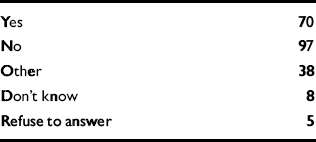
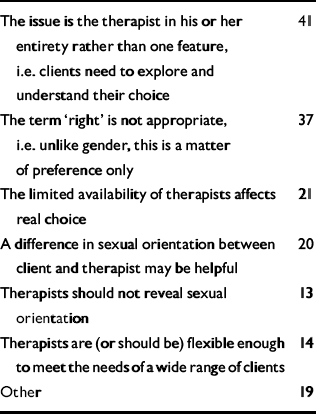
We asked the psychotherapists whether they thought that gay and lesbian clients should have the right to gay and lesbian clients should have the right to gay and lesbian psychotherapists (see Table 2). All free text comments on this question were content analysed, giving rise to the categories in Table 3.
Should gay and lesbian clients have a right to a gay or lesbian psychotherapist (n=218)
| Yes | 70 |
| No | 97 |
| Other | 38 |
| Don't know | 8 |
| Refuse to answer | 5 |
Choice of therapists: comments (n=149)1
| The issue is the therapist in his or her entirety rather than one feature, i.e. clients need to explore and understand their choice | 41 |
| The term ‘right’ is not appropriate, i.e. unlike gender, this is a matter of preference only | 37 |
| The limited availability of therapists affects real choice | 21 |
| A difference in sexual orientation between client and therapist may be helpful | 20 |
| Therapists should not reveal sexual orientation | 13 |
| Therapists are (or should be) flexible enough to meet the needs of a wide range of clients | 14 |
| Other | 19 |
A small number of illustrative free text comments are reported here in full:
“Yes. Ideally, in certain cases — if the patient feels very strongly about it. But I can not imagine how it could be done in practice, considering that therapists are unlikely to have ‘come out’ and therefore to be known as homosexual.”
“No. — ‘right’ is a difficult word in the analytic context. Those who want gay—lesbian therapists will find them through voluntary organisations. Sameness can lead to a fantasia of collusion.”
“I think there is an assumption (that I also shared before my own experience of analysis and of the training) that to consider homosexuality in a psychotherapy meant to ‘do’ something about it; presumably to push it towards some societal norm…. I can understand a wish for an avowedly homosexual therapist. However, I do not think it is necessarily the most helpful course of action…. I think what is important is to find a skilled therapist, who has no particular axe to grind….”
Therapeutic work with gay and lesbian clients
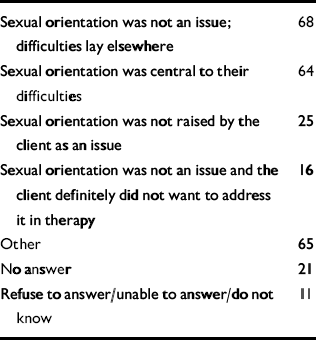
We posed respondents forced-choice questions about their most recent assessment of a gay or lesbian client to ascertain whether the client's sexual orientation was relevant (see Table 4). For at least 186 respondents this was a current issue. Gay and lesbian people were approaching them for psychodynamic work. Because of the large number of respondents answering “other”, this was examined further where it was elaborated. Most of the 65 who clarified their discontent with the options indicated that sexual orientation in such cases was important but not central.
Assessment and the relevance of sexual orientation (n=218)1
| Sexual orientation was not an issue; difficulties lay elsewhere | 68 |
| Sexual orientation was central to their difficulties | 64 |
| Sexual orientation was not raised by the client as an issue | 25 |
| Sexual orientation was not an issue and the client definitely did not want to address it in therapy | 16 |
| Other | 65 |
| No answer | 21 |
| Refuse to answer/unable to answer/do not know | 11 |
We asked respondents a further series of questions about the outcome of their most recent assessment. Almost invariably they took on the client. Fourteen psychotherapists said they took them on but did not explore their sexual orientation. A total of 129 said they took the gay or lesbian clients on and did explore their sexual orientation. In nine instances where sexual orientation was explored, this was against the expressed wishes of the client at assessment. In only two cases were clients not taken on for therapy. Thirty-seven respondents ticked “other” and 36 had no relevant assessment, declined to answer or gave unanalysable answers.
In the nine cases where exploration of sexual orientation was at odds with the expressed view of the client, three therapists explained how this had happened:
“In the early days it was not usual to have homosexual patients in the NHS because of their homosexuality. Most were depressed and suicidal because of having been rejected and abandoned by a partner, or were in disgrace with parents and family. They wanted to claim… that homosexuality was a moral variable, like being left handed or blue eyed and the only thing wrong was society's attitude. They rarely wanted to understand it. Some wanted their sexual attitude to be changed to heterosexual and some wanted to be able to live with something society condemned…. I did not help all but helped some, at most I must have seen about 20 women and 10 men.”
“I saw the client for six years. Initially he denied absolutely that his sexual preference was an issue. This is something I have encountered several times and it seems an understandable defensiveness in the context of the pathologising of gay sex in most analytic literature…. Only after two or three years were we able to look at what it meant to be gay and to counter his absolute and sweeping dismissal that it had ever been a problem. Ultimately we reflected long and often on the way his personality had been influenced both by his culture's hostility to homosexuality and the identity he often felt forced to adopt by his own gay cultural norms.”
“Discussion has increased more understanding of the possible origins of their sexual orientation. As a result they experienced less paranoid feelings and expectations about other people's reaction to their S(exual)O(rientation). But they could face up more and become aware of: (a) the losses and disadvantages due to their SO, e.g. not having and creating a family, having children, etc.; (b) the secrecy they feel is required, e.g. in relation to work, or legal matters like insurance, ‘next of kin’ rules when ill, in hospital, making a will, etc. But the recent reduction of anti-homosexual opinions and attitudes has helped reduce generally in some homosexuals anxiety and tensions and many more can easily and quickly discuss their problems if any re. their SO.”
We asked respondents to describe the progress of the therapy where they had taken on the client. Of 218 respondents, 179 (82%) provided comments. Despite the wording of the questionnaire, which had referred to the most recent assessment of a gay or lesbian client, respondents frequently replied in relation to more than one client, or gave a general response. Rather than lose all the data, responses were coded thematically on the following basis. Where details of a particular client's therapy was given, it was coded separately, and where general comments were given, this too was coded separately. The quantity of text given varied and at times was sufficiently complex to warrant more than one code. Where respondents have written a response, it was always coded. Most respondents described only one client. The maximum number of clients described by any one therapist was seven. The total number of clients described individually was 193. Fifty respondents made general comments.
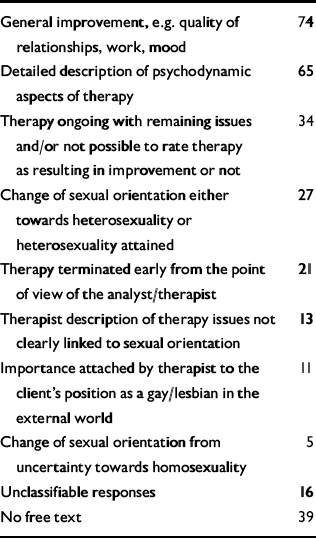
A large number of analysts and therapists said that their clients had improved in some way during therapy. Aspects of change that were of interest in the context of this survey included the observation that on 27 occasions the client or client group was thought either to have become heterosexual or to have moved in that direction (see Table 5). Only five had become definitely gay or lesbian as the therapy progressed. In 21 instances the therapist considered that therapy terminated prematurely. For the most part this was explained as part of the client's situation or as indicative of ongoing psychological problems. In only two instances did the therapist indicate that they had doubts about their own skills in relation to their clients. On only nine occasions did analysts/therapists mention society's view of homosexuality as being relevant to therapy.
Progress of therapy: free text comments1
| General improvement, e.g. quality of relationships, work, mood | 74 |
| Detailed description of psychodynamic aspects of therapy | 65 |
| Therapy ongoing with remaining issues and/or not possible to rate therapy as resulting in improvement or not | 34 |
| Change of sexual orientation either towards heterosexuality or heterosexuality attained | 27 |
| Therapy terminated early from the point of view of the analyst/therapist | 21 |
| Therapist description of therapy issues not clearly linked to sexual orientation | 13 |
| Importance attached by therapist to the client's position as a gay/lesbian in the external world | 11 |
| Change of sexual orientation from uncertainty towards homosexuality | 5 |
| Unclassifiable responses | 16 |
| No free text | 39 |
Further consideration of the responses given indicated that therapists regarded transitions out of homosexuality as self-directive on the client's part, rather than following the implicit or explicit views of the therapist. Occasionally, replies where sexuality had changed in therapy were illuminating:
“Very early in my career, in the 1960s, homosexual patients were occasionally referred by the courts for ‘treatment of their homosexuality’!… I believe I invariably found myself focusing on other problems that did seem resolvable. Now I think I was colluding with the patients in their struggle with an unfair and irrational system. Since practising homosexuality became legal, I think my practice has been the same, except that patients came for things they saw as problems, which was hardly ever their sexual orientation.”
DISCUSSION
The sensitive nature of the subject
Our research focused on a sensitive subject where the issue of possible discrimination on the grounds of sexual orientation was central. Obtaining valid responses in such work can depend on how it is perceived. This is why we were particularly interested in respondents who took issue with the questionnaire and declined to answer it in full. Some responses exemplify the pathologising discourse evident in academic psychodynamic writing. Others suggested that it is inappropriate to ask questions of one world (analysis and psychotherapy) using the preferred vocabulary of another (contemporary gay and lesbian culture). The data indicate a degree of mutual incomprehension. Nevertheless, many analysts and psychotherapists, whatever the researchers' and some respondents' reservations about the style of inquiry, were able to respond fully. Indeed, if the volume of free text generated is a measure, this research touched a chord in the therapy world.
Only one of 218 respondents indicated that he/she was homosexual. In the UK, 5-12% of men and 3-5% of women are homosexual (Reference Wellings, Field and JohnsonWellings et al, 1994). It is possible that potential gay and lesbian analysts do not apply to train or that their application is refused. Eighteen of the 218 who fully completed the questionnaire declined to answer the question about their own sexual orientation. This reticence about self-disclosure suggests that psychodynamic practitioners may find it difficult to be frank about their sexual orientation.
Finding the right therapist
Choice of therapist is already important to lesbians and gays who are wary of self-disclosure (Reference FalcoFalco, 1991; Reference Hitchcock and WilsonHitchcock & Wilson, 1992). One-third of respondents thought that gay and lesbian clients had a right to a gay or lesbian psychotherapist. But if the sexual orientation of our respondents is representative of individuals trained with the most prestigious training institutions, then this would be hard to achieve — and even more so in areas of the country where analysts and psychotherapists are few in number. The view that a mismatch in sexual orientation between therapist and client is desirable and helpful suggests a privileged role for heterosexuality — such an idea has not led, it would appear, to the widespread availability of gay and lesbian therapists to help heterosexuals. It may help to explain why gays and lesbians in contact with therapists can feel poorly understood (Reference BalisBalis, 1984; Reference McFarlaneMcFarlane, 1997).
The view that clients should not know the sexual orientation of their therapists is problematic. The idea that the identity of the therapist should be explored as an important aspect of therapy makes sense in terms of analytical theory, with its emphasis on fantasy and transference. Our results, in keeping with the methodologically compromised work of Friedmann & Lilling (Reference Friedmann and Lilling1996), suggest that without such information a lesbian or gay client will be confronted with a therapist whose views on gay and lesbian identity are completely unknown and potentially negative. But the therapist will usually take them on. Sexual orientation will probably feature in the analysis or therapy. Indeed, given the theoretical origins of the practitioners, it is perhaps surprising that it can ever be ignored; the analytical theory is one of sexual development. That sexual orientation was a focus of work was only rarely at odds with the patient's or client's initial wishes. For most people such a focus was apparently by mutual explicit, or implicit, consent, although this study does not ascertain the views of clients directly.
Ending up straight
We were not attempting to study the out-comes of the therapy or analysis. However, it is striking that so many more individuals who reportedly changed their orientation moved to heterosexuality rather than homo-sexuality. Garnetset al (Reference Garnets, Hancock and Cochran1991) investigated psychologists' practice with lesbians and gay men. They found considerable variation in the way such clients were approached and identified the ways in which biased, inadequate or inappropriate practice occurred, including subtle discouragement from a lesbian or gay orientation. Our data are insufficient to address this issue. This is an important area for future investigation.
Sex and social attitudes
The age and experience of the analysts and psychotherapists in our survey provided an unexpected dimension to the research. Older respondents confirmed that some earlier therapeutic work took place because sexual expression had been deprecated and/or criminalised. However, contemporary work was described for the most part without explicit acknowledgement of the relevance of social attitudes to psychological work with gay and lesbian clients. Were this paper to have been about another cultural category, such as ethnicity, then such tunnel vision might be seen as unfortunate, to say the least. For respondents working in the National Health Service it may be that the usual imperatives of responding to the expressed needs of all elements of the community will encourage further thinking on these issues.
Clinical Implications and Limitations
CLINICAL IMPLICATIONS
• Psychotherapists and psychoanalysts should obtain informed consent from prospective gay and lesbian clients/patients by explaining their theoretical approach to homosexuality prior to the start of psychodynamic work.
• The National Health Service (NHS) has a responsibility, stated by government, to provide a non-discriminatory service meeting the needs of all sections of society. Psychotherapy departments should review practice and establish the extent to which this is true in relation to gay and lesbian clients/patients.
• In line with policy on equal opportunities, NHS psychotherapy departments should scrutinise the training and experience of applicants for posts to ensure that they are equipped to meet the needs of a wide cross-section of the community, including gay and lesbian clients/patients.
LIMITATIONS
• There may have been a semantic gap between our use of the terms gay and lesbian and the psychodynamic use of the term homosexuality. This may have led to misunderstanding of and/or refusal to complete the questionnaire.
• The study was a compromise between the desire to survey a large number of therapists and analysts and yet to allow respondents to describe clinical cases in their own way.
• The findings tell only half of the story, that of the analyst or therapist. A more complete account would incorporate the experiences of those gays and lesbians undertaking psychoanalysis or psychotherapy.




eLetters
No eLetters have been published for this article.