

Introduction
Governments often target illicit crops with forced eradication campaigns, but these efforts carry heavy social and environmental costs.Footnote 1 In Latin America, eradication policies aimed at coca cultivation have fallen hardest on marginalized communities (Dion and Russler Reference Dion and Russler2008; Rincón-Ruiz et al. Reference Rincón-Ruiz, Correa, León and Williams2016), intensifying social inequalities and sparking protests (Herrera and Dessein Reference Herrera and Dessein2023). Social mobilization frequently emerges in response to such state-led eradication efforts, illustrating the potential of collective action to shape public policy. Yet not all mobilizations generate the same political or policy effects. Protests against forced eradication, in particular, may generate a “backlash effect,” whereby public awareness of dissent inadvertently strengthens support for greater state control (Alter and Zürn Reference Alter and Zürn.2020).
This article examines whether the form of community dissent—specifically, whether a community verbally criticizes eradication efforts or mobilizes in protest—shapes public support for these interventions. Using a vignette experiment, we presented Colombian respondents with one of four scenarios that varied both the type of opposition (verbal objection vs. mobilization) and the community’s identity (Afro-Colombian vs. non-specified). Each scenario explicitly described the state’s eradication strategy as forced and emphasized its coercive nature, noting that the government was using pesticides containing glyphosate, a chemical classified as a probable carcinogen. After reading each scenario, participants chose from three policy responses: unconditional eradication, eradication with community consent, or complete opposition to eradication.
Our findings reveal a significant response to social mobilization: awareness of protests encourages support for eradication policies, but only if affected communities agree. This shift to conditional support highlights a moderated public response, where protests foster an inclination toward respecting community voices rather than rejecting the policy outright.Footnote 2 We interpret these findings as evidence that visible, organized community dissent can push public preferences toward more community-centered and conditional approaches, rather than blanket support or opposition. Contrary to our expectations, this result is consistent across both Afro-Colombian and unspecified communities, suggesting that the impact of protest on public attitudes may transcend racial or ethnic considerations.
This article contributes to the literature on social mobilization and public opinion by examining how protest awareness shapes support for state policies in contentious areas such as counternarcotics enforcement. First, we build on the theory of the “backlash effect” (Alter and Zürn Reference Alter and Zürn.2020), showing that protest awareness can lead to a middle point, where respondents favor eradication only if affected communities agree. Second, we extend research on how racial and ethnic identities influence public reactions to protests (e.g., Manekin and Mitts Reference Manekin and Mitts2022), showing that Afro-Colombian and unspecified communities might provoke similar responses, suggesting that protest impact can transcend ethnic boundaries. These insights enrich the literature on collective action’s effects, social mobilization, and the dynamics of public opinion in response to coercive state interventions.
Context: Coca Eradication and Afro-Colombian Resistance
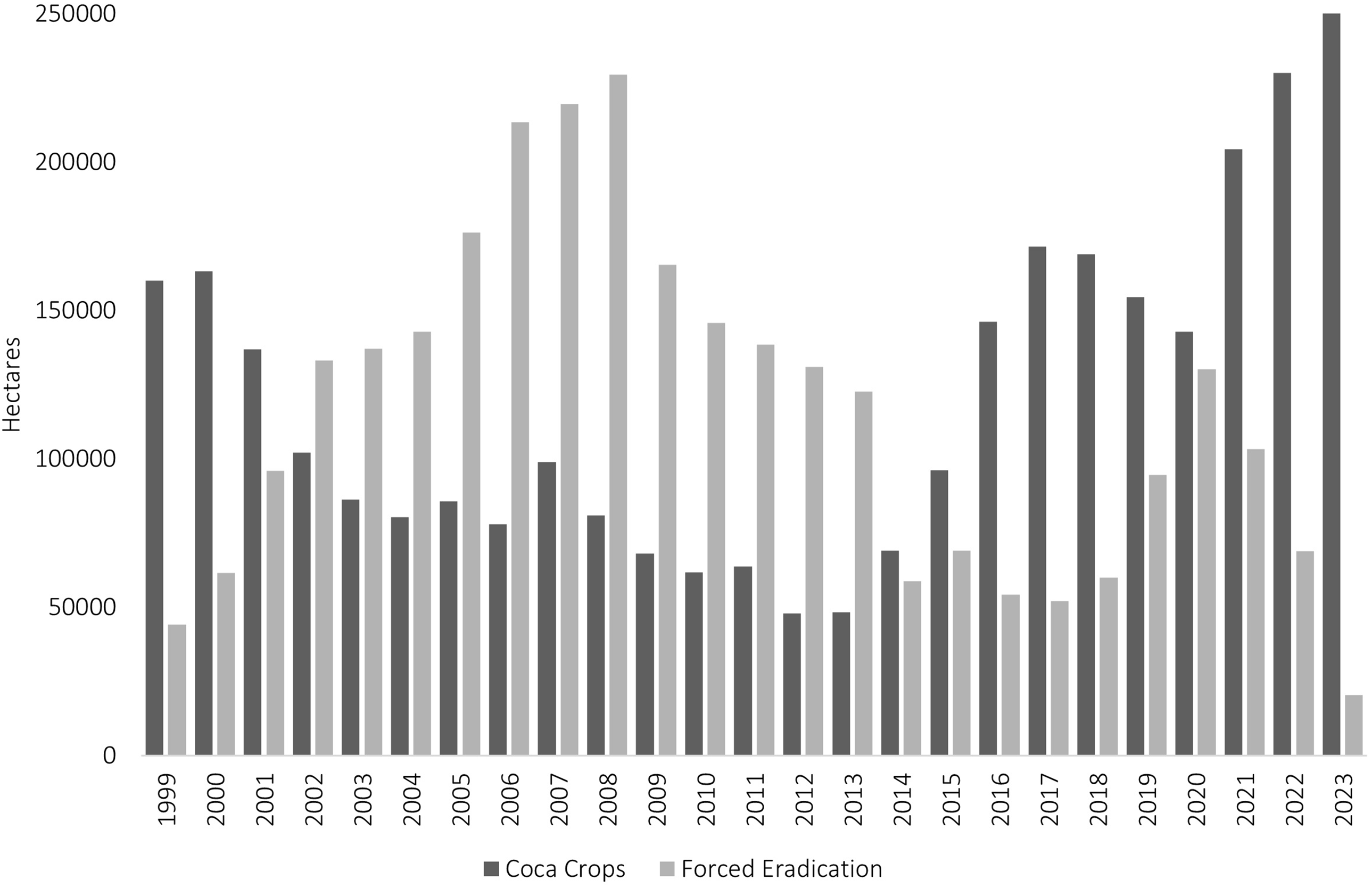
Colombia, responsible for producing around 80 percent of the world’s cocaine (DEA 2023), has long been at the center of global counternarcotics efforts. Over the past decades, the Colombian government has implemented a range of eradication strategies aimed at reducing coca production (see Figure 1), with aerial and manual eradication being the most prominent and controversial (Gelvez Reference Gelvez2024). Both methods involve the use of pesticides, particularly glyphosate—a chemical classified as a probable human carcinogen by the World Health Organization (International Agency for Research on Cancer 2015)—which is sprayed either from an aircraft or applied manually by eradication teams on the ground. These operations, often carried out with military or police support, are not only invasive but have also had severe consequences for rural populations. They disproportionately impact marginalized communities that depend on coca cultivation for their subsistence (Gutiérrez Reference Gutiérrez2020), resulting in widespread social and environmental harm: health problems due to chemical exposure, deforestation, and intensified violence linked to the militarization of eradication efforts (Camacho and Mejia Reference Camacho and Mejia2017; Dávalos et al. Reference Dávalos, Bejarano, Hall, Correa, Corthals and Espejo2011).
Trends in Coca Cultivation and Forced Eradication in Colombia (1999–2023).
Note: Data from the Ministerio de Justicia y del Derecho (2025). “Forced eradication” includes both aerial spraying and manual removal of coca crops. Trends reflect annual estimates in hectares.

One of the unintended consequences of forced eradication efforts has been the displacement of coca cultivation into new territories, particularly Afro-Colombian collective lands. By 2022, approximately 19 percent of Colombia’s coca crops were concentrated in these territories, with over 43 percent located in the Pacific region, where the majority of Afro-Colombians reside (Oslender Reference Oslender2008; UNODC, 2023). While coca cultivation represents only a fraction of the total land area, its expansion into these communities has introduced significant challenges, exposing them to heightened violence, environmental degradation, and instability (Dávalos et al. Reference Dávalos, Bejarano, Hall, Correa, Corthals and Espejo2011; Vélez et al. Reference Vélez, Robalino, Cárdenas, Paz and Pacay2020). The influx of armed groups seeking to control coca-producing areas has deepened insecurity, exacerbating the historic marginalization of Afro-Colombian populations.
In response to both the direct effects of forced eradication and the broader expansion of coca cultivation into their territories, Afro-Colombian and peasant communities have mobilized against state policies that fail to consider their realities (Abril Bonilla et al. Reference Abril Bonilla, Gutiérrez Márquez, Jiménez Nicholls, Ortega Van Arcken and Uribe Larrota2019; Ramírez Reference Ramírez2011). These groups argue that eradication campaigns have not only failed to curb coca production but have also disproportionately harmed vulnerable populations who have limited economic alternatives. Despite facing exclusion from meaningful participation in policy decisions, Afro-Colombian organizations have actively resisted these injustices through legal action, peaceful protests, and grassroots advocacy (Lobo and Vélez Reference Lobo and Vélez2022). A key victory in this struggle was the Constitutional Court of Colombia (2017) ruling, which mandated that the government consult affected communities before carrying out aerial fumigation operations. However, challenges remain, as eradication efforts continue alongside coca expansion, fueling tensions between the government, international actors, and local populations.
Building on this resistance, social movements in these communities are not only opposing eradication policies but are also advocating for alternative development strategies that prioritize their rights and economic well-being (Abril Bonilla et al. Reference Abril Bonilla, Gutiérrez Márquez, Jiménez Nicholls, Ortega Van Arcken and Uribe Larrota2019). The current administration of President Gustavo Petro (2022–) initially signaled a shift toward development-oriented solutions for coca-growing regions, emphasizing economic alternatives over punitive eradication (Loaiza Reference Loaiza2023). However, in a controversial move that has drawn criticism from grassroots organizations and contradicted earlier promises, the government aims to resume forced eradication operations using glyphosate in 2025, citing international pressure and domestic security concerns (El País 2025). As a result, forced eradication remains a politically charged and deeply contested issue, with right-wing opposition and international actors continuing to frame it as an indispensable tool in the fight against drug trafficking (Rodríguez Reference Rodríguez2024).
Theory and Hypotheses
Community dissent has long shown its potential to challenge state authority and influence policy outcomes. From labor movements to civil rights protests, community dissent allows marginalized communities to voice grievances and demand change, often amplifying previously overlooked issues within public and political spheres (Escobar Reference Escobar2020).
Yet not all forms of dissent provoke the same public response. As research on protest dynamics shows, the way dissent is expressed—its form, intensity, and visibility—shapes whether it is perceived as legitimate or threatening (Chenoweth Reference Chenoweth2023; Enos et al. Reference Enos, Kaufman and Sands2019; Gash Reference Gash2015). Building on McAdam and colleagues’ (Reference McAdam, Tarrow and Tilly2003) concept of “mechanisms of contention,” we understand protest as an interactive process, where dissenters’ tactics and state or public responses mutually influence one another. Different forms of protest—whether confrontational or contained—activate different pathways of public evaluation, including certification, suppression, or reframing of the contested policy.
We, therefore, distinguish between two forms of community dissent: verbal objection and mobilization.Footnote 3 Verbal objection involves expressing disagreement through statements, while mobilization implies coordinated collective action such as protests. These forms of community dissent might not be only tactically distinct but are also interpreted differently by the broader public, particularly in how they affect perceptions of legitimacy and threat (Alter and Zürn, Reference Alter and Zürn.2020; Feinberg et al. Reference Feinberg, Willer and Kovacheff2020).
While mobilization can raise awareness about the harms of certain policies, it may also trigger a backlash effect—an increase in support for the criticized policy among third-party observers (Alter and Zürn Reference Alter and Zürn.2020). Recent work finds that more extreme or disruptive protest actions reduce public identification with social movements and their causes (Chenoweth Reference Chenoweth2023), primarily due to perceptions of immorality or threat (Feinberg et al. Reference Feinberg, Willer and Kovacheff2020). This phenomenon captures the tension between gaining visibility and alienating potential supporters.
Although this research focuses only on two types of community dissent—verbal objection and mobilization—work on protest framing and legitimacy suggests that public reactions heavily depend on how dissent is perceived and portrayed. Wasow (Reference Wasow2020), for instance, finds that nonviolent and disciplined protests by the US civil rights movement generated sympathetic media coverage and increased elite responsiveness—especially when protesters were victims of state repression. In contrast, protester-initiated violence shifted the narrative to law and order, reinforcing punitive responses. Similarly, Gash (Reference Gash2015) documents how civil rights advocates in the United States strategically used low-visibility or “below the radar” tactics to protect gains and avoid backlash, particularly when dealing with controversial or polarizing issues.
Furthermore, the racial identity of the community involved in the protest may influence the strength of the backlash effect (Chenoweth Reference Chenoweth2023). Specifically, protests led by marginalized ethnic communities may heighten public support for state-led enforcement by amplifying perceived threats to social order (Manekin and Mitts Reference Manekin and Mitts2022). This dynamic aligns with research suggesting that public reactions to protests can vary depending on the racial or ethnic identities of the protesting groups (Haider-Markel et al. Reference Haider-Markel, Joslyn, Ahmed and Badran2018).
Fording (Reference Fording2001), for example, highlights the racialized dynamics of backlash in his analysis of Black insurgency in the US South, showing that protests by marginalized racial groups often provoked punitive responses—more so than protests from dominant groups. In the Latin American context, Eisenstadt and West (Reference Eisenstadt and West2019) show that indigenous mobilization in Ecuador was often delegitimized by state actors using nationalist or racialized frames, portraying protesters as a threat to development. These studies suggest that dissent is not judged in a vacuum: its perceived legitimacy depends on racial framing, as well as the visibility of the dissent.
In the context of forced eradication, these policies predominantly impact politically marginalized regions where limited institutional presence restricts communities’ ability to directly influence policy change (Acero and Thomson Reference Acero and Thomson2022). Social movements have nonetheless emerged, resisting both coca cultivation and counter-narcotic strategies alike (Gutiérrez Sanín Reference Gutiérrez Sanín2020; Lobo and Vélez Reference Lobo and Vélez2022). Through dissent—whether verbal or mobilized—cocalero movements have challenged state power, calling attention to both the negative impacts of the illegal market and the unintended harms of state interventions (Ramírez Reference Ramírez2011).
Drawing on research on racialized social movements and protest legitimacy (Alter and Zürn Reference Alter and Zürn.2020; Enos et al. Reference Enos, Kaufman and Sands2019; Feinberg et al. Reference Feinberg, Willer and Kovacheff2020; Gash Reference Gash2015), we expect that both the form of community dissent and the ethnic identity of the dissenting community shape public support for coercive drug control policies. Verbal objection, as a less confrontational and more conventional form of dissent, is likely to be perceived as more legitimate and therefore reduces support for forced eradication relative to social mobilization. At the same time, dissent from Afro-Colombian communities—regardless of form—may provoke a stronger backlash due to racialized perceptions of threat and entrenched social biases.
Therefore, we hypothesize:
H1: Social mobilization increases public support for forced eradication compared to verbal objection.
H2: Dissent from Afro-Colombian communities leads to higher support for forced eradication policies compared to dissent from non-Afro-Colombian communities.
Data and Methodology
Data and Experiment
To examine how public awareness of protests against a drug policy influences support for counternarcotics enforcement, we collected data from a survey conducted in Colombia in March 2023, administered online by the polling firm Netquest.Footnote 4 The survey gathered responses from a nationally representative sample of 2,449 Colombians, balanced by gender and age groups. Following the structure of the survey, this section first details the control variables used, describes the vignette experiment and treatment definition, and presents a summary of the final sample composition.
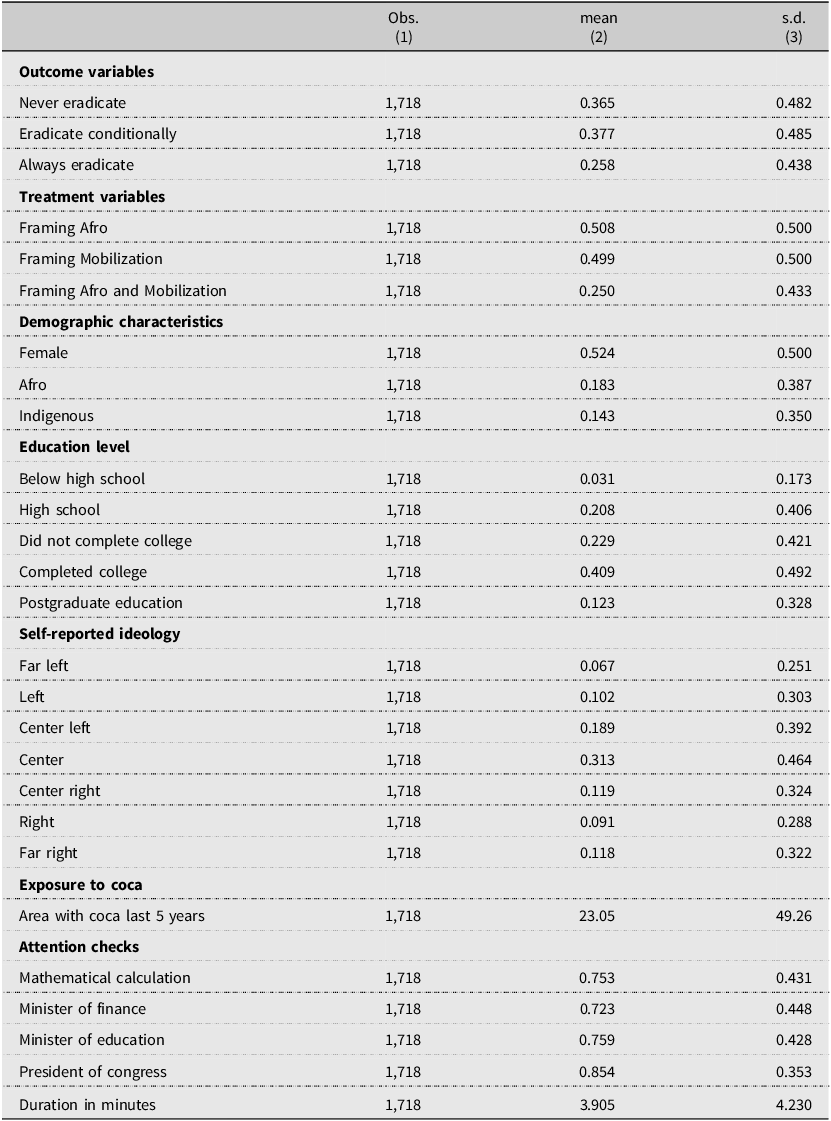
The survey included a series of questions covering respondents’ sex, whether they self-identify as Black or Indigenous, and their highest level of education attained. Additionally, we asked about their political preferences or self-reported ideology, positioning themselves on a scale from 1 (far left) to 7 (far right). Finally, we performed concentration checks related to political knowledge, a mathematical problem, and the time spent reading the vignette. Table 1 presents the summary statistics.
Summary Statistics

Note: All the variables are dichotomous except for the area with coca in the last 5 years and time spent reading the vignette. Demographic characteristics regarding race and ethnicity are self-reported and are not mutually exclusive. Political ideology questions ranged from (1) “Far Left” to (7) “Far Right.” Attention checks involve making a simple mathematical calculation and naming the current ministers of finance and education and the president of congress.
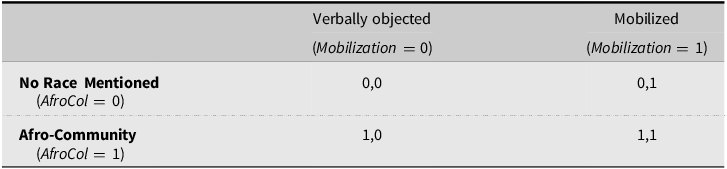
The survey included our vignette experiment, where respondents were presented with a statement regarding forced eradication and the reactions of affected communities to this policy. Respondents were randomly assigned to one of two different treatments, or framings, or to a combination of both. The first question is whether coca growers have protested against (i.e., mobilized against) or criticized (i.e., verbal objection) the forced eradication policy; while the second one, whether the affected community was an Afro-Colombian community or did not mention race.Footnote 5 For more details, see Supplementary Material A1.
We define both treatments as two separate variables. The first treatment variable, Mobilized, is coded as 1 if the question framing states “protested” and 0 if it states “criticized.” Similarly, the second treatment variable, AfroCol, is coded as 1 if the framing specifies an “Afro-Colombian community” and 0 otherwise (see Table 2). We refer to these treatments as the Mobilized and Afro framings, respectively.
Experimental Vignette Design with Treatment Coding

Regardless of the vignette, all respondents were presented with the same set of three options: (i) Eradicate crops independently of criticisms/protests; (ii) Eradicate once the affected communities agree with eradication; (iii) Forced eradication should never be effected. We coded these three options into the dependent variable Eradication. We label these options in the figures as “always eradicate,” “eradicate conditionally,” and “never eradicate,” respectively.
The treatment arms are balanced in terms of the number of respondents, with each arm comprising roughly half of the sample and approximately one-quarter of respondents in each vignette (see Table A1). Respondent characteristics are also balanced, with fewer than 7 percent of differences being statistically significant, further validating the randomization procedure (see Table A2).
Our final sample consisted of 1,718 survey respondents. Among all the survey respondents, about 17 percent did not respond to the self-reported ideology question and 27 individuals did not reply to the framing experiment; while 5 percent of the respondents did not state geographic location. Thus, we exclude from our analysis any observations for which we do not have information on all variables used, including a proxy for location using department-level data.
Of the respondents who have information in all the variables, about 50 percent of them are female respondents, 15 percent self-identify as Indigenous, and about 18 percent of respondents self-identify as Afro. The median respondent has completed college education, which is common in online survey experiments, as the level of education is positively associated with the willingness to participate in research (Mulder and de Bruijne Reference Mulder and de Bruijne2019). In addition, the median respondent is between 36 and 45 years old and self-identifies in the center of the political spectrum (see Table 1).
Analytical Model
We employ a multinomial logit model to examine the relationship between the framing of the statements and public opinion about forced eradication, given that our dependent variable is categorical with no natural order. Specifically, we are interested in the following relationship:
 $$\small{\eqalign{Eradicatio{n_i}\; = \alpha \; + \;{\beta _1}\;Mobilize{d_i}\; + {\beta _2}\;AfroCo{l_i}\; + {\beta _3}\;Mobilize{d_i} \times \;AfroCo{l_i}\; + \delta \;{X_i}\; + {\gamma _d}\;\; + {\varepsilon _i}}}$$
where Eradication is the outcome variable, Mobilized and AfroCol, are the two treatment variables previously defined. Our parameters of interest are the $\beta $
’s, which capture the sign of the effects of using either of the framings, or both through the interaction term.
$\beta $
’s, which capture the sign of the effects of using either of the framings, or both through the interaction term. ${X_i}$
is a vector of characteristics including respondent’s sex, race, ethnicity, education, and self-reported political ideology. In addition, we control for political knowledge, time spent in the interview, and performance on concentration checks.
${X_i}$
is a vector of characteristics including respondent’s sex, race, ethnicity, education, and self-reported political ideology. In addition, we control for political knowledge, time spent in the interview, and performance on concentration checks. ${\gamma _d}$
represents either department fixed effects for location of the respondents or exposure to coca at the department level, based on the intensity of coca presence in the previous five years.Footnote
6
Finally, the error term
${\gamma _d}$
represents either department fixed effects for location of the respondents or exposure to coca at the department level, based on the intensity of coca presence in the previous five years.Footnote
6
Finally, the error term ${\varepsilon _i}$
is calculated using robust standard errors.Footnote
7
${\varepsilon _i}$
is calculated using robust standard errors.Footnote
7
Empirical Findings
Main Results
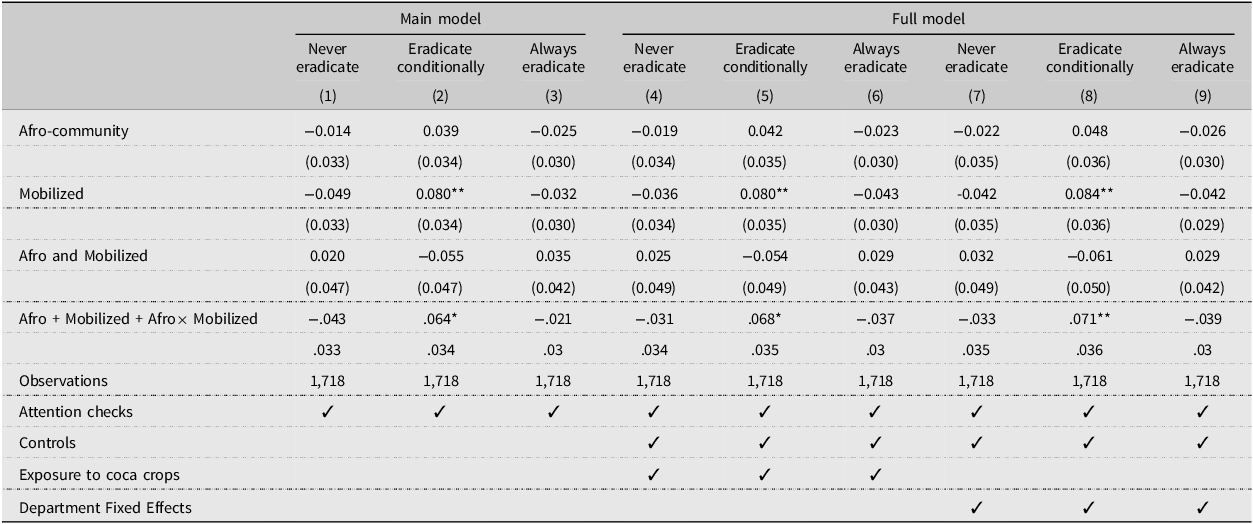
Table 3 presents the marginal effects of the vignette experiment on public opinion regarding forced eradication. To isolate the effects of the experiment, we present the main model or unconditional effects of the treatments in the first three columns, controlling for attention check variables. The next three columns (4 to 6) present the full model or conditional effects, including respondents’ characteristics (i.e., demographic variables, education level, and self-reported political ideology), and our measure of exposure to coca. In the last three columns (7 to 9), we control for location by including department fixed effects. See the complete Table A3 in the Supplementary Material.
Marginal Effects of Treatments on Public Support for Forced Eradication

Note: See the complete Table A3 in the Supplementary Material. The main model includes treatment variables and attention check controls. The full model includes a different set of control variables. Robust standard error reported in parentheses. * is significant at the 10% level, ** is significant at the 5% level, *** is significant at the 1% level.
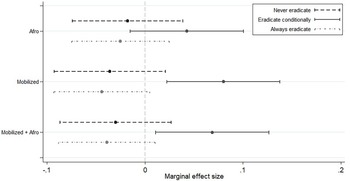
Our empirical findings suggest that awareness of community dissent in the form of protests against forced eradication affects support for this type of policy (column 2), whereas highlighting the race of the communities alone does not influence public opinion on forced eradication. The interaction between the two treatments affects public opinion in a similar way to when the race of the community is not mentioned; that is, it specifically affects support for eradication conditional on community agreement, which is statistically significant (reported in the bottom panel of the table). This result is robust to the inclusion of control variables (columns 4 to 6, and 7 to 9), both in terms of effect size and significance. Figure 2 summarizes the results of columns 4 to 6 for our coefficients of interest, that is, both informational treatments and their interaction. The Mobilized treatment regardless of race presents a positive effect on the probability of supporting eradication conditionally on community agreement; while the Afro treatment is not statistically different from zero.
Marginal Effects of Afro and Mobilized Treatments
Note: Results come from estimating equation 1 including all the control variables. Horizontal lines represent 90% confidence intervals.

Our results suggest a limited support for the “backlash effect” outlined in our first hypothesis (H1). Specifically, we hypothesized that informing respondents about community social mobilization would increase support for forced eradication compared to information about verbal objection (columns 1–3). However, our findings show that this support is not unconditional; rather, it is a community-centered approach that depends on the communities consenting to the eradication policy (column 2). We interpret this as evidence that social mobilization shifts public preferences toward more community-centered and conditional approaches to forced eradication, as we develop further in the next section.
Furthermore, we find that highlighting the race of the community does not significantly alter public opinion, which runs contrary to H2. This is an unexpected result, as we anticipated a stronger effect when the Afro-Colombian communities were identified as protesters (Afro treatment in Figure 2). A potential explanation for this result is that, although Afro-Colombians are a marginalized community living in regions with more coca cultivation than, for example, the indigenous population (another marginalized group in coca-growing areas (UNODC 2023)), they are less closely associated with illicit cultivation. Future research is needed to explore these differences between marginalized groups and support for coercive state responses.
Our results are robust to the inclusion of various control variables, including demographic characteristics, education, political ideology, coca presence, and department fixed effects (see the full Table A3 in the Supplementary Material). Although these results should not be interpreted as causal, we provide a general overview here to show that our main findings are not driven by omitted variable bias.
Female respondents are more likely to reject the forced eradication policy, with indigenous respondents showing similar patterns—possibly due to their closer association with territories where illicit cultivation occurs. By contrast, race is not significantly associated with support for eradication. Afro-Colombian respondents are neither more nor less supportive of eradication, echoing findings from our treatment conditions involving racial cues.
In terms of education, the diverse levels of educational attainment are not associated with differential support for the eradication policy. None of our education categories presents an estimate statistically different from zero when compared to the base level of below high school. It is important to note that our final sample of respondents is highly educated, with more than half holding at least a college degree. This lack of association helps alleviate concerns that our results are merely driven by our sample’s high educational attainment.
The political ideology of the respondents is associated with support for the eradication policy. Specifically, those located to the left of the political spectrum are more likely to show support for the option “never eradicate” and those on the right for the option “always eradicate.” This result is consistent with the literature that ideology influences perceptions of state authority and the legitimacy of protests (Giersch Reference Giersch2019; Manekin and Mitts Reference Manekin and Mitts2022). Moreover, right-wing politicians and voters are more likely to support counternarcotics efforts, which they perceive as critical tools in the fight against criminal activities (Bäck et al. Reference B¨ack, Fredén and Renstr¨om2022).
Finally, exposure to coca cultivation is not significantly associated with support for the eradication policy. While our measure may not fully capture the nuances of individual exposure—given that respondents in our sample are likely to vary widely in their actual exposure, from high to none—we took several steps to address this limitation. Specifically, we constructed a measure to account for potential spillover effects and temporal variation, defining exposure as the total area under coca cultivation in the five years preceding the survey, aggregated at the department level. We also examined alternative measures of coca cultivation, finding that our main results remain robust across these specifications (see Table A6 in the Supplementary Material). Thus, although we cannot rule out the possibility that individual-level exposure may influence attitudes differently, we can be reasonably confident that the absence of a statistically significant association is not simply an artifact of how the exposure measure was constructed. Collecting more precise information on coca presence at the respondent level would likely be problematic, given concerns about safety, confidentiality, and the sensitivity of the topic.
Discussion and Conclusion
This article examined how the form of community dissent shapes public support for forced eradication policies in Colombia. Using a vignette experiment, we found that exposure to community mobilization, compared to verbal objection, does not increase support for eradication outright. Instead, it leads to a conditional stance: people are more likely to support eradication only when the affected communities themselves agree with the intervention.
Our findings speak to broader research in social science. For example, we suggest that organized and visible resistance can shift public preferences toward more community-sensitive approaches, rather than blanket endorsement or rejection. Similar to prior research on protest and public opinion (e.g., Manekin and Mitts Reference Manekin and Mitts2022 and Chenoweth Reference Chenoweth2023), our results show how community dissent can influence attitudes toward state policies, especially when framed as coercive.
Support for forced eradication may also reflect broader political orientations and perceptions of state authority, particularly among respondents with right-leaning views. For these individuals, who are not directly affected by coercive policies, such interventions may symbolize the restoration of order and territorial control (Gelvez Reference Gelvez2024). When dissent occurs, it can be perceived as a challenge to state authority, and support for eradication may become a way to reaffirm the state’s role in maintaining sovereignty and the rule of law.
An unexpected finding was the absence of a racial treatment effect. The racial identity of the dissenting community (Afro-Colombian vs. non-specified) did not significantly influence public opinion in our vignette experiment. This contrasts with scholarship that emphasizes the racialization of drug policy in the Global North (Chavanne et al. Reference Chavanne, Ahluwalia and Goodyear2023) and their impact on marginalized racial groups in Colombia (Lobo and Vélez Reference Lobo and Vélez2022). One possible explanation is that our experimental design may not have sufficiently activated racial cues. Alternatively, the public may be more responsive to other marginalized groups, such as indigenous communities, or to regional and cultural distinctions beyond racial labels. Future research should explore how race intersects with other political identities in shaping support for drug policy.
Although our main focus was on the form of community dissent and racial identity, other covariates in the analysis had a correlation with our outcome of interest. In line with previous work (e.g., Bäck et al. Reference B¨ack, Fredén and Renstr¨om2022), political ideology shaped responses to coercive policies: right-leaning respondents tended to support unconditional eradication, while left-leaning individuals were more likely to oppose it. Similarly, women displayed significantly greater resistance to forced eradication than men. This may reflect heightened concern about the harms of coercive policy and greater empathy toward those directly affected (Christov-Moore et al. Reference Christov-Moore, Simpson, Coude, Grigaityte, Iacoboni and Ferrari2014). Future research should explore the intersectionality of ideology, gender, and race to offer a more nuanced picture of how different political identities shape public opinion.
Finally, future studies should also consider including a baseline condition in which communities express no form of dissent to help isolate the effect of dissent itself, relative to verbal objection or public mobilization. Further research could also examine how different types of protest—nonviolent, disruptive, or symbolic—interact with community characteristics to shape support for coercive state policies, and more specifically, whether violent actions or damage to property produce distinct backlash effects.
Supplementary material
To view supplementary material for this article, please visit https://doi.org/10.1017/lap.2025.10035
Data availability statement
Data for this study can be accessed via the following URL: https://doi.org/10.7910/DVN/TUIHY0.
Competing interests
The authors declare they have no competing interests.


 Open access

