





Introduction
Sunflower ranks third after soybean and rapeseed in oilseed production worldwide, according to 2019/20 production data (USDA, 2020). With respect to sunflower production by country Turkey ranks sixth (FAO, 2018) with sunflower as the main crop for domestic vegetable oil consumption (TURKSTAT, 2020a). However, the production of sunflower is insufficient, even for domestic consumption. According to the Turkey product trade balance reports for 2018/19, the level of self-sufficiency of sunflower is at 66.4%. Thus, increasing the efficiency of sunflower production is essential to reduce its import (TURKSTAT, 2020b).
Although sunflower can be grown under rainfed conditions, significant decreases in productivity depend considerably on the degree of drought conditions (Kadayifci and Yildirim, Reference Kadayifci and Yildirim2000). According to TURKSTAT reports, droughts experienced in 2007 caused a significant negative effect on crop productivity. In 2007, sunflower production decreased by 23.8% compared to the previous year (TURKSTAT, 2020a). An increase in the yield can be achieved under irrigated farming conditions (Erdem, Reference Erdem2000; Kaya, Reference Kaya2006). It is inevitable that sunflower production, which is directly affected by climate conditions, will also be affected by the projected change under future climate conditions (Kaya, Reference Kaya2003; Soylu and Sade, Reference Soylu and Sade2012; Demir, Reference Demir2013).
The global average surface temperature has risen about 1.1°C since the late 19th century, a change driven largely by human-made emissions into the atmosphere. The World Meteorological Organization (WMO) confirms that the past 5 years (i.e. 2015–2019) were the five warmest years on record and that the past decade (2010–2019) is also the warmest on record (WMO, 2020). The Intergovernmental Panel on Climate Change (IPCC) reports that global warming is likely to reach 1.5°C between 2030 and 2052 (IPCC, 2018). Turkey, which is located in the eastern Mediterranean region is among the most vulnerable regions to climate change (Akcakaya et al., Reference Akcakaya, Sumer, Demircan, Demir, Atay, Eskioglu, Gurkan, Yazici, Kocaturk, Sensoy, Boluk, Arabaci, Acar, Ekici, Yagan and Cukurcayir2015). According to the IPCC projections, the temperature in Turkey will increase by 1.5–2.5°C and 2.5–3.6°C based on representative concentration pathways (RCP) 4.5 and RCP8.5 scenarios, respectively, by end of the century (Demircan et al., Reference Demircan, Gurkan, Eskioglu, Arabaci and Coskun2017). According to the World Food and Agriculture Organization (FAO) projections after the first quarter of the century (2030–2100) there will be a decreasing trend in the crop yield in developing countries (including Turkey) due to climate change (FAO, 2016). Previously Dellal et al. (Reference Dellal, McCarl and Butt2011) also predicted that agricultural production in Turkey will be negatively affected by climate change.
Studies on the possible effects of climate factors on plant productivity can be conducted through experimental studies, statistical methods or cropping simulation models. The latter are based on mathematical equations that predict crop development and growth using input data that describe weather and soil conditions, cultivar characteristics and management options and by modelling processes in the soil–plant–atmosphere system (Jones et al., Reference Jones, Hoogenboom, Porter, Boote, Batchelor, Hunt, Wilkens, Singh, Gijsman and Ritchie2003; Hoogenboom et al., Reference Hoogenboom, White and Messina2004). In recent years, crop simulation models have become more robust and increasingly accepted system with high success capabilities (Boote et al., Reference Boote, Jones, Hoogenboom and White2010). Crop simulation models allow obtaining potential outcomes in a short time compared to long years of experimental studies, and offer the possibility of exploring climate conditions under various CO2 concentration levels and temperature not present in today's climate. The models also aim to support decision makers’ prior starting projects by simulating possible outcomes. Crop simulation modelling is one of the most frequent approaches to simulate potential impacts of climate change on future agricultural productivity (White et al., Reference White, Hoogenboom, Kimball and Wall2011). Furthermore, data sets provided from crop simulation models have become an important source for agriculture assessment reports by IPCC (Reilly et al., Reference Reilly, Baethgen, Chege, Van de Geijn, Lin, Iglesias, Kenny, Patterson, Rogasik, Rötter, Rosenzweig, Sombroek, Westbrook, Bachelet, Brklacich, Dämmgen, Howden, Watson, Zinyowera and Moss1996; Gitay et al., Reference Gitay, Brown, Easterling, Jallow, McCarthy, Canziani, Leary, Dokken and White2001; Easterling et al., Reference Easterling, Aggarwal, Batima, Brander, Erda, Howden, Kirilenko, Morton, Soussana, Schmidhuber, Tubiello, Sweeney, Singh and Kajfež-Bogataj2007; White et al., Reference White, Hoogenboom, Kimball and Wall2011).
Although there are many studies conducted using crop simulation models internationally, the number of such studies in Turkey is relatively small. Various studies have been conducted to evaluate the impacts of climate change on agricultural production in different regions of Turkey and for different crops such as cotton (Baydar, Reference Baydar2010), maize (Sen, Reference Sen2007), wheat (Koc, Reference Koc2011; Caylak, Reference Caylak2015; Vanli et al., Reference Vanli, Ustundag, Ahmad, Hernandez-Ochoa and Hoogenboom2019) and sunflower (Deveci et al., Reference Deveci, Konukcu and Altürk2019) using crop simulation models such as Aquacrop, DSSAT or WOFOST. They generally concluded that there would a significant decrease in yield after 2070 if no adaptation was implemented. Deveci et al. (Reference Deveci, Konukcu and Altürk2019) showed a 22% decrease in the yield of sunflower based on the IPCC A2 scenario applied to the Thrace region in Turkey using the Aquacrop model.
The current study aimed to quantify uncertainty in the assessment of impact of climate change on sunflower for the main sunflower production regions of Turkey by using global climate models (GCMs) based on the IPCC Assessment Report (AR) 5 in concert with crop simulation models. The objectives were (a) calibration and evaluation of the CSM-CROPGRO-Sunflower model of DSSAT4.7 and (b) estimation of future sunflower yield changes by using the GCMs climate projections data set. The current research is the first climate change assessment study conducted on sunflower using the CSM-CROPGRO-Sunflower model of DSSAT4.7 with selected latest IPCC scenarios (RCP4.5 and RCP8.5) for climate conditions in Turkey. Also, this is the first evaluation study of the CSM-CROPGRO-Sunflower model of DSSAT4.7 for Turkey.
Materials and methods
Study area
A 2-year sunflower field experiment was conducted in the Konya province of Turkey (Gunduz et al., Reference Gunduz, Gunduz, Dundar, Cagirgan and Cay2018). The Konya province is one of the major sunflower growing areas in Turkey and is located in the semi-arid climatic zone. According to 2019 reports, Konya ranks second in sunflower production in the country (TURKSTAT, 2020a, 2020b). The study site was located at the field of the Konya Soil, Water and Deserting Control Research Institute (37°48′N, 32°30′ E, 1031 m a.s.l.) of Turkey (Fig. 1).
Study area, Konya, Turkey.

The soil at the study area is clayey and water loss due to soil surface runoff is small due to its high infiltration capacity. The soil has a relatively low organic matter content (Table 1).
Soil physical and chemical characteristics at the study site

LL, lower limit; DUL, drained upper limit; SSAT, saturation; SBDM, soil bulk density; SLOC, soil organic carbon; SRGF, soil root growth factor.
Field experimental data
The Ekllor sunflower variety was selected for the experiment that was conducted during 2015 and 2016. The experimental design was a randomized complete block with three replications and 35 m2 per plot. The harvested area was 18.9 m2 for each individual plot. The row spacing was 70 cm and plant spacing was 25 cm. In the first year, the crop was planted on 5 May and was harvested 136 days after planting (DAP), while in the second year the crop, planted on 12 May and harvested 133 DAP.
The field experiment consisted of a rainfed and an irrigated treatment. Drip irrigation technique was used for the irrigated treatment under full irrigation. In order to determine the irrigation amount to be applied, the sunflower effective root depth was accepted as 90 cm and when approximately 0.5 of the available water capacity at this depth was consumed, the current water content was increased back to the field capacity based on the amount of irrigation that was applied. For full irrigation treatment, a total of 428 mm irrigation was applied for ten applications during the first year, and 465 mm for 12 applications during the second year.
The same amount of fertilizer was applied in both years. The types and amounts of applied fertilization were as follows: 200 kg/ha di-ammonium phosphate before planting, 300 kg/ha 20-20-20 compound fertilizer (at planting), 50 kg/ha urea and 50 kg/ha ammonium nitrate (at hoe). The soil water content was measured with a neutron probe (CPN, Model 503DR Hydroprobe). One neutron sensor was placed in the centre of each plot. The total soil available water was measured for 0–90 cm during the crop cycle. Measurements were recorded 18 times in 2015 and 23 times in 2016.
The measured soil water content at planting was defined as the initial condition for the model, while the amounts, dates and type of fertilizer that were applied and the dates and amounts of irrigation that were applied defined crop management. Measurements that were taken included observations for the sunflower phenological growth stages and yield, biomass and unit grain weight at harvest.
Weather and climate projections’ data set
Konya is one of the most arid provinces of Turkey. The annual average temperature is 11.6°C and the average annual total precipitation is 323.3 mm. Daily observed weather parameters (minimum and maximum temperature, total precipitation, average relative humidity, total radiation and average wind speed) were obtained from the Turkish State Meteorological Service (TSMS) automatic weather station. The growth cycle in 2016 was hotter and drier compared to 2015. The total precipitation was 163.8 mm during the 2015 growing season (May–September), while it was 98.1 mm during the 2016 growing season (Fig. 2).
Observed monthly values (total precipitation, maximum and minimum temperatures) at the research site in 2015 and 2016.

For the assessment of impact of climate change, three GCMs and two RCPs, i.e. 4.5 and 8.5 were selected. RCP4.5 represents the more likely scenario to happen, while RCP8.5 is called the most pessimistic scenario due to the expectation of the highest increase in temperatures and radiative forcing values globally (Riahi et al., Reference Riahi, Rao, Krey, Cho, Chirkov, Fischer, Kindermann, Nakicenovic and Rafaj2011; Thomson et al., Reference Thomson, Calvin, Smith, Kyle, Volke, Patel, Delgado-Arias, Bond-Lamberty, Wise, Clarke and Edmonds2011).
The GCMs HadGEM2-ES, MPI-ESM-MR and GFDL-ESM2M were selected for the analysis. The corresponding six data sets were obtained from TSMS and thus, included two scenarios of daily weather parameters generated by each of three GCMs. Projection data sets were downscaled and bias-corrected by TSMS (Akcakaya et al., Reference Akcakaya, Sumer, Demircan, Demir, Atay, Eskioglu, Gurkan, Yazici, Kocaturk, Sensoy, Boluk, Arabaci, Acar, Ekici, Yagan and Cukurcayir2015). GCM data sets were downscaled to 20 km using regional climate model RegCM4.3.4 and with dynamic downscaling method by TSMS. Bias-correction applied considering the comparison results between model reference period (1971–2000) values and TSMS meteorological station values (1971–2000). The bias correction was determined for each day of year, based on each parameter and each GCM data set. The daily average bias correction results of each parameter are presented in Table 2. The baseline period was defined as the 1971–2000 period, while future projections were evaluated for three different periods that included 2019–2040, 2041–2070 and 2071–2098. In order to better reflect daily changes of climatic parameters on crop growth, daily meteorological projection data were used for future projections.
Daily average bias correction (measured-GCM data set) for each parameter

T min, minimum temperature; T max, maximum temperature; Rhum, relative humidity.
Based on the six future climate projections for the study area for the sunflower growing season, the air temperature was projected to increase and while precipitation was projected to decrease (Fig. 3). Specifically, the average maximum temperature during the sunflower growing season will increase between 3.6 and 6.6°C and the average minimum temperatures will increase between 3.8 and 6.5°C. Precipitation is projected to decrease by 18% for the RCP4.5 scenario and by 21% for the RCP8.5 scenario during the sunflower growing season.
Climate projections for the study area for the sunflower growth cycle for three GCMs.

The CO2 concentrations used for RCP4.5 and RCP8.5 were 434 and 448 ppm respectively, for the first period (2019–2040), 497 and 573 ppm, respectively, for the second period (2041–2070) and 532 and 803 ppm, respectively, for the final period (2071–2098). The CO2 concentration level of 347 ppm was used for the baseline (1971–2000) (Meinshausen et al., Reference Meinshausen, Smith, Calvin, Daniel, Kainuma, Lamarque, Matsumoto, Montzka, Raper, Riahi, Thomson, Velders and Vuuren2011).
The CSM-CROPGRO-Sunflower model of DSSAT4.7
The Decision Support System for Agrotechnology Transfer (DSSAT) comprises crop simulation models for over 42 crops (as of Version 4.7) as well as tools to facilitate effective use of the models (Hoogenboom et al., Reference Hoogenboom, Porter, Boote, Shelia, Wilkens, Singh, White, Asseng, Lizaso, Moreno, Pavan, Ogoshi, Hunt, Tsuji, Jones and Boote2019a, Reference Hoogenboom, Porter, Shelia, Boote, Singh, White, Hunt, Ogoshi, Lizaso, Koo, Asseng, Singels, Moreno and Jones2019b). The tools include database management programmes for soil, weather, crop management and experimental data, utilities for preparing the data and various application programmes for seasonal, crop rotation and spatial analysis (Thornton and Hoogenboom, Reference Thornton and Hoogenboom1994; Thornton et al., Reference Thornton, Hoogenboom, Wilkens and Bowen1995). The crop simulation models simulate daily growth, development and yield as a function of the soil–plant–atmosphere dynamics. Furthermore, DSSAT provides the opportunity to choose different calculation methods for evapotranspiration, soil evaporation, photosynthesis, soil layer distribution, infiltration, soil organic matter and hydrology for more appropriate modelling. Ritchie's (Reference Ritchie1972) method was selected as the soil evaporation method and Priestley and Taylor's (Reference Priestley and Taylor1972) method was selected as the evapotranspiration method.
In addition to the capability of making simulation for more than 40 crops, DSSAT comes with additional functionalities such as statistical analysis, crop rotation, multi-run capability, seasonal and economic analysis the CSM-CROPGRO-Sunflower model of DSSAT4.7.5 was used for conducting simulations in this study (Hoogenboom et al., Reference Hoogenboom, Porter, Boote, Shelia, Wilkens, Singh, White, Asseng, Lizaso, Moreno, Pavan, Ogoshi, Hunt, Tsuji, Jones and Boote2019a, Reference Hoogenboom, Porter, Shelia, Boote, Singh, White, Hunt, Ogoshi, Lizaso, Koo, Asseng, Singels, Moreno and Jones2019b).
Results
Crop model calibration and evaluation
When conducting simulations in DSSAT three different sets of genetic coefficients are used for each crop including species, ecotype and cultivar coefficients. Eighteen genetic coefficients are used to define each sunflower cultivar in the CSM-CROPGRO-Sunflower model of DSSAT4.7 (Table 3). Coefficients are classified into three different types, representing phenological durations to stage events, vegetative growth traits and reproductive growth traits. Of the coefficients, right coefficients describe phase durations and photoperiod sensitivity, while four coefficients represent vegetative growth parameters and six represent reproductive parameters. The CSM-CROPGRO-Sunflower model of DSSAT4.7 was calibrated using the data obtained in 2015 and then evaluated using data from 2016.
Calibrated genotype coefficients of sunflower Ekllor cultivar

For the current study, soil water content was calibrated first to improve the rainfed and irrigated treatments. Then the cultivar coefficients were calibrated in a step-wise manner. Firstly, the coefficients of the phenological phase durations (five phases) were calibrated, followed by the vegetative growth coefficients and during the final step the reproductive growth characteristics were calibrated.
The generalized likelihood uncertainty estimation (GLUE) (He et al., Reference He, Dukes, Jones, Graham and Judge2009; Jones et al., Reference Jones, He, Boote, Wilkens, Porter, Hu, Ahuja and Ma2011) tool of DSSATv4.7 was used to estimate genotype-specific coefficients for sunflower crop. The GLUE tool does not request any minimum limitation for input data. Users can determine the number of input parameters depending on the parameters they want to calibrate. The GLUE tool tries to find best optimization scheme for selected coefficients based on likelihood estimation principles.
The results of the calibration and evaluation process for the phenological stages are provided in Table 4.
Model performance for calibration for phenological stages and yield
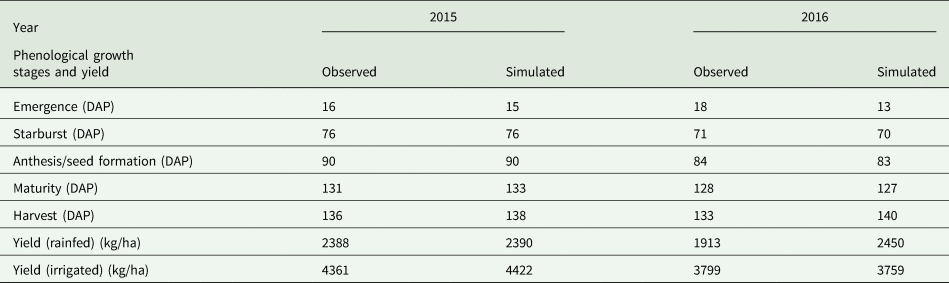
DAP, days after planting.
One of the main objectives of the research was to assess the performance of the model by comparing the simulated data with field measurements. Therefore, several statistical criteria were used including relative error (RE), relative mean absolute error (RMAE), root mean square error (RMSE), normalized root mean square error (NRMSE), index of agreement (d-index), modified index of agreement (d1-index) and modelling efficiency (EF) (Nash and Sutcliffe, Reference Nash and Sutcliffe1970; Willmott, Reference Willmott1982; Willmott et al., Reference Willmott, Ackleson, Davis, Feddema, Klink, Legates, O'Donnell and Rowe1985). RE, RMAE and NRMSE indexes calculate error as percentage. Smaller indicates a better fit, and a perfect fit is equal to 0. RMSE calculates error based on used unit (kg/ha for this research). Smaller indicates a better fit, and a perfect fit is equal to 0. d-, d1- and EF indexes are dimensionless and vary between 0 and 1. The index value of 1 indicates a perfect match, and 0 indicates no match. As a result of the statistical analysis of the simulations, it was determined that the model achieved successful results for phenological stages and yield estimation (Table 5).
Evaluation of the model for phenology and yield

RE, relative error; RMAE, relative mean absolute error; RMSE, root mean square error; NRMSE, normalized root mean square error; d-index, index of agreement; d1-index, modified index of agreement; EF, modelling efficiency.
The amount of water that the plant roots can extract directly affects the yield. Under dry conditions, the sunflower root structure can go deeper. Root development and soil available water content changes were also calibrated and evaluated to improve the simulation of the crop development process (Table 6; Fig. 4). According to the evaluation results of soil water content in profile in 2015, the d-indexes were obtained as 0.90 and 0.86 for rainfed and irrigated treatment, respectively. On the other hand, in 2016, the d-indexes for rainfed and irrigated treatment were 0.79 and 0.85, respectively.
Comparison of simulated and measured total soil water in profile (0–90 cm).

Evaluation of model for total soil water in profile (0–90 cm)

Assessment of impact of climate change on the sunflower life cycle
Daily meteorological projection data were used to better reflect climatic changes on crop growth. The 1971–2000 period was used as a baseline and, years between 2020 and 2098 were selected as future projections period. The simulations of the CSM-CROPGRO-Sunflower model of DSSAT4.7 were conducted on yearly basis for both the reference period and for the future periods. The changes for the future conditions were calculated according to differences from the baseline period. The results of the study revealed that climate change may cause changes in sunflower crop growth duration. Assessment results indicated that temperature increases due to climate change would cause a shortening of plant growth durations.
The crop simulation results predicted that there will a decrease in the time to flowering and maturity. Based on the RCP4.5 projections for the three GCMs there will be a shortening of the development timing by up to 1–4 days for emergence, 3–7 days for flowering, 7–15 days for maturity and 8–18 days for harvest time. Based on the RCP8.5 projections for the GCMs, it is expected that there will be a shortening of the development timing by up to 2–5 days for emergence, 4–8 days for flowering, 7–16 days for maturity and 6–18 days for harvest time (Fig. 5).
Average changes of sunflower growth stages due to climate change (days).

Assessment of impact of climate change on sunflower yield
In order to assess the effects of climate change on sunflower yield, climate projections were analysed for rainfed conditions (Fig. 6) and for irrigated conditions (Fig. 7). Projections for three periods (2019–2040, 2041–2070 and 2071–2098) were evaluated separately for the two scenarios, i.e. RCP4.5 and RCP8.5, and for each GCM.
Impact of climate change on sunflower yield for rainfed conditions based on three GCMs and for two RCPs.

Impact of climate change on sunflower yield for irrigated conditions based on three GCMs and for two RCPs.

For rainfed conditions, it is projected that sunflower yield will decrease based on both RCP4.5 and RCP8.5 scenarios. For the 2019–2040 period, sunflower yield was predicted to decrease by 19–31% for the RCP4.5 scenario and by 3 to 24% for the RCP8.5 scenario. For the 2041–2070 period, sunflower yield was predicted to decrease by 15–31% for RCP4.5 and by 24–33% for RCP8.5. For the 2071–2098 period, sunflower yield was predicted to decrease by 15–34% for RCP4.5 and by 21–40% for RCP8.5 (Fig. 6).
For irrigated conditions, sunflower yield is projected to increase for both the RCP4.5 and RCP8.5 scenarios. For the 2019–2040 period, the sunflower yield is predicted to increase by 11–13% for RCP4.5 and by 7–13% for RCP8.5. For the 2041–2070 period, sunflower yield is projected to increase by 17–24% for RCP4.5 and by 24–28% for RCP8.5. For the 2071–2098, yield is projected to decrease by 19–28% for RCP4.5 and by 32–39% for RCP8.5 (Fig. 7).
The projection results also confirmed that and increase in temperature due to climate change would cause an increase in the water requirements for sunflower in the future (Fig. 8). An increase in the amount of irrigation water that is applied would provide a more positive effect on sunflower water use efficiency. According to the RCP4.5 scenario, an average increase of 10.2% in irrigation water would contribute to an average 18% increase in the sunflower yield. The result for RCP8.5 scenario projection indicated that an average increase of 16% in irrigation water would increase sunflower yield by 23.7% on average.
Changes (%) in total irrigation requirements due to climate change based on three GCMs and for two RCPs.

Discussion
The overall goal of the current study was the evaluation of the CSM-CROPGRO-Sunflower model of DSSAT4.7 and the assessment of impact of climate change on sunflower yield under different GCMs projections. The results of the evaluation of the CSM-CROPGRO-Sunflower model show that the model was able to successfully simulate both the phenological growth stages and yield for the sunflower cultivar Ekllor. The model was able to achieve acceptable simulation results under both rainfed and irrigated conditions. Statistical analysis results confirmed the simulation skill of the model.
The model achieved good results in yield simulation under irrigated conditions. In 2015, the measured yield value was 4361 kg/ha, while the simulated yield was 4422 kg/ha. In 2016, the measured yield was 3799 kg/ha, while the simulated yield was 3759 kg/ha. Moreover, excellent yield prediction ability, i.e. measured yield of 2388 kg/ha and, a simulated yield of 2390 kg/ha, was also obtained under rainfed conditions during the first year of this study. However, the prediction ability under rainfed conditions was slightly less in 2016 when the measured yield was 1913 kg/ha and the simulated yield was 2450 kg/ha. The model performance was in the same range compared to previous research using the CROPGRO-Sunflower for conditions in Spain (Malik and Dechmi, Reference Malik and Dechmi2019) where an NRMSE of 12% was obtained during model evaluation.
The analysis revealed that there is a need to improve the simulation of root development during drier conditions. However, due to the lack of measurements of soil water content it was not possible to evaluate soil and plant water balance properly under drought conditions. There is, therefore, a need for more detailed soil water content observations in the deeper part of the profile for deeper rooting of crops such as sunflower for optimal calibration of model. Sunflower is known to be drought resistant due to its strong root system. Under dry conditions, the sunflower roots will grow deeper (Angadi and Entz, Reference Angadi and Entz2002; Nejad, Reference Nejad2011; Hasan et al., Reference Hasan, Khan, Habib, Sadaqat and Basra2020). In our study, soil available water content was only recorded until a depth of 90 cm. Based on the simulations, we concluded that it is necessary to measure the dynamics of the changes in soil water content down to 200 cm in order to best determine the sunflower root structure and associated water uptake under arid conditions.
The result of the assessment of climate change indicated that sunflower will be adversely affected under rainfed conditions in semi-arid regions. All yield projections predicted a yield decrease ranging from 2.9 to 39.6% based on three GCMs (HadGEM2-ES, MPI-ESM-MR and GFDL-ESM2M) and for both RCP4.5 and RCP8.5 scenarios under rainfed conditions. The highest decrease in yield would occur during the periods when there is a large decrease in total precipitation. The largest decrease in yield decrease under rainfed conditions was 39.6% based on the GCM GFDL and 36.6% based on the GCM MPI for the RCP8.5 scenario and 2071–2098 period. For the same period, average precipitation was projected to decrease by 41.5 and 33.8%, respectively, for these two models. These results also confirmed that water-deficit conditions during the growing period of sunflower have a negative effect on yield. The results of the current study are similar to other studies on the potential impact of climate change on sunflower conducted in Turkey (Dellal, Reference Dellal2012; Demir, Reference Demir2013; Gurkan et al., Reference Gurkan, Ozgen, Bayraktar, Bulut, Yildiz and Amanullah2020). Also, a study conducted across Europe projected a yield decrease of 10–30% decrease for the 2030 period, especially in Southern and Eastern Europe (Donatelli et al., Reference Donatelli, Srivastava, Duveiller, Niemeyer and Fumagalli2015). Another study also showed a significant reduction in yield for the 2071–2100 period for the Mediterranean countries using the CropSyst model (Moriondo et al., Reference Moriondo, Giannakopoulos and Bindi2011). A study conducted in Portugal by Valverde et al. (Reference Valverde, de Carvalho, Serralheiro, Maia, Ramos and Oliveira2015) using the ISAREG model showed a reduction in yield ranging from 6 to 10% for the 2011–2041 period and ranging from 11 to 19% for the 2041–2070 period.
In addition to changes in precipitation, the GCMs also predicted an increase in temperature, which will accelerate the plant development rate and thus shorten the life cycle, also impacting the length of seed filling and thus final yields. The results for the 2019–2098 period on the basis of three GCM scenarios showed that the harvest period would be 9–18 days earlier for the RCP4.5 scenario and 14–17 days earlier for the RCP8.5 scenario.
Various studies have shown that elevated CO2 concentrations will boost C3 plants’ (such as sunflower) productivity due to the enhanced rate of photosynthesis (Long et al., Reference Long, Ainsworth, Leakey, Nösberger and Ort2006; Reddy et al., Reference Reddy, Rasineni and Raghavendra2010; Debaeke et al., Reference Debaeke, Casadebaig, Flenet and Langlade2017). The IPCC scenarios used in this research, i.e. RCP4.5 and RCP8.5, assume an increase in CO2 concentrations for future climate projections. The CO2 concentrations used for RCP4.5 was 434 ppm and for RCP8.5 was 448 ppm for the first period, i.e. 2019–2040; 497 ppm for the RCP4.5 and 573 ppm for RCP8.5 for second period, i.e. 2041–2070 and 532 ppm for RCP4.5 and 803 ppm for RCP8.5 for the final period, i.e. 2071–2098. For the baseline, i.e. 1971–2000, we used a CO2 concentration level of 347 ppm (Meinshausen et al., Reference Meinshausen, Smith, Calvin, Daniel, Kainuma, Lamarque, Matsumoto, Montzka, Raper, Riahi, Thomson, Velders and Vuuren2011).
For irrigation conditions, the projections showed that sunflower yield would increase by 7.4–38.5% for both RCP4.5 and RCP8.5 scenarios. These results reveal that in the case of irrigated conditions, an increase in CO2 concentrations due to climate change can positively affect sunflower productivity and potentially offset the negative impact of an increase in temperature. Under rainfed conditions, although the enhanced CO2 level contributes positively to plant productivity in the future period, a significant decrease in yield was projected due to a significant increase under drought conditions during the growing season. In order to reveal the positive effect of CO2 increase more clearly, it can be controlled using different CO2 levels (current levels and RCP predictions) in future analysis.
The simulations in the current study showed that sunflower yield will increase if sufficient water through supplemental irrigation is provided during growing season. The results from this assessment of climate change illustrate the importance of irrigation as an adaptation strategy for climate change for sunflower production under semi-arid conditions.
Turkey is located in one of the most vulnerable regions to climate change. According to climate change projections for Turkey, an increase in temperatures and a decrease in precipitation are expected in future periods (Sen, Reference Sen2013; Onol et al., Reference Onol, Bozkurt, Turuncoglu, Sen and Dalfes2014). Thus, climate change will have especially negative impact on rainfed agriculture. Changes in the precipitation regime, and a decrease in the amount of precipitation and, heat and cold stress conditions will all have a negative effect on crop productivity. It has been projected that under future climate change conditions, access to water for agricultural irrigation will be more difficult, especially in arid and semi-arid climates. Studies conducted in different locations have reported that sunflower is vulnerable to climate change and will be adversely affected, especially under rainfed farming conditions (El-Marsafawy and El-Samanody, Reference El-Marsafawy and El-Samanody2009; Awais et al., Reference Awais, Wajid, Saleem, Nasim, Ahmad, Raza, Bashir, Mubeen, Hammad, Ragman, Saeed, Arshad and Hussain2018). Other studies have been conducted to evaluate the potential impact for the most important crops in Turkey, including wheat, cotton, maize and rice, and found similar results (Sen, Reference Sen2007; Caldag, Reference Caldag2009; Baydar, Reference Baydar2010; Koc, Reference Koc2011; Caylak, Reference Caylak2015; Deveci et al., Reference Deveci, Konukcu and Altürk2019; Vanli et al., Reference Vanli, Ustundag, Ahmad, Hernandez-Ochoa and Hoogenboom2019).
In general, the projected change in climate for future conditions will have a negative impact on agricultural production in Turkey. Therefore, various adaptation strategies should be developed in order to adapt to changing climate conditions. Plant breeding is one of the most preferred method to adapt to environmental changes (Akinnagbe and Irohibe, Reference Akinnagbe and Irohibe2014; Kaya, Reference Kaya and Kumar Gupta2016). Breeding studies for drought, extreme heat–cold wave stress, cold and heat stress resistant varieties and increased response to higher CO2 levels could contribute to adaptation to climate change. Agricultural production could also become more resilient to climate change with changes such as agricultural management options and cultural practices. Changing to improved varieties and, optimal planting-sowing dates are options for rainfed conditions.
In most of the Mediterranean basin countries, the flowering period for traditional sunflower cultivars coincides with the beginning of the summer season when dry conditions prevail. Sunflower is vulnerable to drought especially during flowering and grain-filling periods (Gunduz et al., Reference Gunduz, Gunduz, Dundar, Cagirgan and Cay2018). These conditions were also found in the climate change projection results. For the climate change conditions, the development periods that were most affected by the drought stress conditions were the beginning of flowering and the grain-filling period. Sunflower reaches its highest canopy cover rate during the flowering stage. This period continues until the grain-filling stage. During full canopy cover, the water requirements are at the highest level resulting in abiotic stresses and ultimately yield losses. These drought conditions, especially during sunflower flowering and grain filling, can be avoided by changing the planting date. Other adaptation measures could include the development of sunflower varieties with fewer leaves to reduce the effect of abiotic stress conditions. In cool temperate regions, sunflower is sown in spring after the last frost. The breeding of cold-resistant varieties, especially for late freeze events, will provide more flexibility to change the planting time earlier in the spring, this could also potentially avoid drought stress conditions during the summer season. One of the most prominent factors in adaptation to climate change is irrigation practice. For irrigated conditions, improved irrigation technique, suitable irrigation dates and optimizing the amount of water that is applied for irrigation could also support adaptation to climate change to ultimately water use efficiency, especially when water will become limiting. In semi-arid climates, the drip irrigation technique is the most adequate method for effective use of water in order to increase efficiency in sunflower production and adapt to climate change (Karam et al., Reference Karam, Lahoud, Masaad, Kabalan, Breidi, Chalita and Rouphael2007; Sezen et al., Reference Sezen, Yazar and Tekin2019). The drip irrigation technique ensures the prevention of runoff and reducing evaporation. With the widespread adaptation of drip irrigation, it is possible to increase yield and reduce water use and thus significantly increasing the water use efficiency. To ensure rapid adaptation to this method, farmers should be encouraged to use the drip irrigation technique by financial support for the installation costs by the policymakers. Sunflower can be grown in many different geographical regions due to its high adaptability under arid conditions. Although sunflower is resistant to arid conditions, significant increases in productivity can be achieved when sufficient irrigation is provided (Kaya, Reference Kaya2006).
Conclusions
The average climate projections for Konya, Turkey based on three GCMs and two RCPs indicated that maximum and minimum temperatures would increase by 3.6–6.6°C, while total precipitation would decrease by 18.1–21.2% on average during the sunflower growing season by end of the century. This will lead to a reduction in sunflower yield and production for rainfed agriculture. Adequate water management strategies are one of the main options for climate change adaptation for sunflower producers. Further studies should focus on the development of climate change adaptation strategies for sunflower production in other regions of Turkey using the CSM-CROPGRO-Sunflower model.
Acknowledgements
The authors thank Mehmet Aksoy, Huseyin Bulut and Osman Eskioglu for their contributions to the study (Turkish State Meteorological Service).
Financial support
The first author was supported by The Scientific and Technological Research Council of Turkey (TUBITAK) with the scholarship (2214-A) to visit the Institute for Sustainable Food Systems, University of Florida, Gainesville, Florida, USA.
Conflict of interest
The authors declare no conflicts of interest.


 Open access

