

Introduction
The life-changing experience of pregnancy and childbirth is both exciting and joyful. However, some level of fear of childbirth (FoB) is a common experience during pregnancy (O’Connell et al., Reference O’Connell, Leahy-Warren, Khashan, Kenny and O’Neill2017; Sydsjö et al., Reference Sydsjö, Bladh, Lilliecreutz, Persson, Vyöni and Josefsson2014). Although estimates from individual studies vary broadly, a recent meta-analysis reported an overall global pooled prevalence of FoB of 14% (O’Connell et al., Reference O’Connell, Leahy-Warren, Khashan, Kenny and O’Neill2017). Among the only two published studies employing diagnostic criteria to assess FoB, rather than questionnaire estimates, the prevalence of FoB was reported at 3.7% (Räisänen et al., Reference Räisänen, Lehto, Nielsen, Gissler, Kramer and Heinonen2014) and 3.3.% (Fairbrother et al., Reference Fairbrother, Albert, Collardeau and Keeney2022a).
For a minority of individuals, FoB can escalate to the point of becoming clinically distressing and impairing (O’Connell et al., Reference O’Connell, Leahy-Warren, Khashan, Kenny and O’Neill2017). When this occurs, it may also be referred to as tokophobia. FoB can impact reproductive decisions, including the desire to become pregnant or continue one’s pregnancy, waiting longer between births, or overall having fewer children. FoB can also impact parent–infant attachment, and increase the desire for a caesarean delivery (O’Connell et al., Reference O’Connell, Leahy-Warren, Khashan, Kenny and O’Neill2017; Sydsjö et al., Reference Sydsjö, Bladh, Lilliecreutz, Persson, Vyöni and Josefsson2014).
Although FoB has received significant research attention, the most appropriate diagnostic classification or category(ies) for clinically significant FoB has yet to be established. Failure to attribute FoB symptomatology to any established diagnosis(es), makes accurate and consistent identification of clinically significant FoB difficult. In a recent FoB workshop consensus statement, ascertaining the most appropriate diagnostic category(ies) applicable to FoB was identified as a high priority (Jomeen et al., Reference Jomeen, Martin, Jones, Marshall, Ayers, Burt, Frodsham, Horsch, Midwinter, O’Connell, Shakespeare, Sheen and Thomson2021). At present, intense FoB (tokophobia) is not listed as a diagnosable condition in the ICD-11 or the DSM-5. FoB is strongly associated with depression (Jomeen et al., Reference Jomeen, Martin, Jones, Marshall, Ayers, Burt, Frodsham, Horsch, Midwinter, O’Connell, Shakespeare, Sheen and Thomson2021). In one study, generalized anxiety disorder emerged as the strongest predictor of FoB (Jomeen et al., Reference Jomeen, Martin, Jones, Marshall, Ayers, Burt, Frodsham, Horsch, Midwinter, O’Connell, Shakespeare, Sheen and Thomson2021), and in another study, authors argue that FoB should be classified as an obsession rather than as a type of phobia (Kitamura et al., Reference Kitamura, Takegata, Usui, Ohashi, Sohda, Takeda, Saito, Kasai, Watanabe, Haruna and Takeda2024).
Some investigators have suggested that specific phobia may be the most appropriate diagnostic category for primary FoB (i.e. FoB among nulliparous people). There is some evidence that post-traumatic stress disorder (PTSD) may be the most appropriate diagnostic category for secondary FoB (i.e. FoB following a traumatic birth experience) (Sharma and Sharma, Reference Sharma and Sharma2023). Some research also indicates that, for a subset of individuals, FoB occurs in the context of other anxiety and/or anxiety-related disorders (Jomeen et al., Reference Jomeen, Martin, Jones, Marshall, Ayers, Burt, Frodsham, Horsch, Midwinter, O’Connell, Shakespeare, Sheen and Thomson2021). In short, there is no empirical evidence regarding how FoB should be diagnosed using DSM-5 criteria, how often specific phobia and PTSD represent the most appropriate diagnoses, and whether other disorder categories may also apply (e.g. obsessions about childbirth in the context of obsessive-compulsive disorder).
Establishing the most appropriate diagnostic category(ies) for FoB could have far-reaching implications. From a clinical perspective, patients who would most benefit from therapeutic interventions could be identified in a timelier manner, which may improve their ability to receive treatment. Treatment for FoB may also vary depending on the diagnostic category(ies) it falls under (e.g. how one intervenes with panic disorder is different from interventions for PTSD). Research could be better streamlined among studies pertaining to FoB. Ultimately, the identification of one or more clear diagnostic categories for FoB removes ambiguity and allows for more focused mental health care and better anticipated outcomes for parent and infant.
The purpose of the current study was to conduct a pilot assessment (n=18) of the diagnostic categories applicable to self-reported clinically severe pre-natal FoB based on DSM-5 criteria for the anxiety and anxiety-related disorders.
Method
Design
The case series design consisted of questionnaires and a diagnostic interview.
Inclusion criteria
Pregnant people were eligible to participate if they spoke English fluently, were over the age of 19, resided in Canada at the time of recruitment, and reported high FoB. High FoB was defined as: (a) a score of 83 or higher on the Childbirth Fear Questionnaire (CFQ; Fairbrother et al., Reference Fairbrother, Collardeau, Albert and Stoll2022b) and/or (b) a score of 2 or greater on one of three additional questions pertaining to FoB intensity and related distress and impairment.
The CFQ (Fairbrother et al., Reference Fairbrother, Thordarson and Stoll2018; Fairbrother et al., Reference Fairbrother, Albert, Collardeau and Keeney2022a) is a 40-item self-report measure with nine subscales. Items are measured on a Likert-type scale from 0 (no fear) to 4 (extreme fear). Internal reliability is good to excellent (i.e. Cronbach’s alpha reliability coefficient of 0.94 for the full scale, and 0.76–0.94 for the nine subscales). Convergent and discriminant validity are adequate. We used a cut-off score of 83 on the CFQ as one of two criteria for inclusion in the current study, as scores of 83 or higher were obtained by 25% of the original sample (the top quartile of scores). Full details about the development and the psychometric properties of the CFQ have been published (Fairbrother et al., Reference Fairbrother, Albert, Collardeau and Keeney2022a; Fairbrother et al., Reference Fairbrother, Collardeau, Albert and Stoll2022b)
An additional three items (developed for the current research) were also used to select participants for the current study. Specifically, they were asked: (a) how intense is your fear of childbirth?; (b) how much distress does your fear of childbirth cause you?; and (c) how much does your fear of childbirth interfere with your day-to-day life? Response options for these questions ranged from 0 to 4, and were labelled: not at all intense, slightly intense, somewhat intense, very intense and extremely intense for FoB intensity; none, no distress, slight distress, some distress, a lot of distress, and extreme distress for FoB-related distress; and not at all, slightly, somewhat, very much, and extremely for interference from FoB.
Recruitment
Participants were recruited via convenience sampling. This included recruitment via a larger study on fear of childbirth, online social media and other websites catering to pregnant people, maternity support workers (e.g. doulas), and primary care providers (e.g. midwives, family physicians).
Procedures
Prospective participants were directed via an internet link or URL address to the online survey registration. Following registration, they provided consent and completed a short questionnaire requesting information about personal demographics, current pregnancy and reproductive history, previous and current mental health concerns, and birth preferences. Participants who met the study eligibility criteria were invited to participate in a semi-structured diagnostic interview. Interviews were conducted by telephone with a clinical psychology doctoral student, or a registered psychologist. Interviews were audio-recorded unless otherwise requested by the participant. Participants were offered a $25 honorarium for their time.
Measures
Demographic and reproductive history information
Demographic information (e.g. age, education, marital status, income, race/ethnicity, and country of residence), pregnancy details (e.g. number of fetuses and method of conception), and reproductive history (e.g. number of previous pregnancies, births, miscarriages, and vaginal or caesarean deliveries) were gathered through self-report.
Diagnostic Assessment Research Tool (DART)
The DART (McCabe et al., Reference McCabe, Milosevic, Rowa, Shnaider, Pawluk, Antony and Working Group2021) is a semi-structured interview designed to assess psychiatric diagnoses, according to their respective criteria in the Diagnostic and Statistical Manual of Mental Disorders (DSM-5) criteria. Although only recently developed, early psychometric evidence supports the DART’s construct (convergent and discriminant) validity and inter-rater reliability as a diagnostic interview tool for DSM-5 disorders. For the current study we assessed all of the anxiety disorders and the following anxiety-related disorders: illness anxiety disorder, somatic symptom disorder, adjustment disorder, PTSD and acute stress disorder, and obsessive-compulsive disorder (OCD).
Data analysis
Descriptive statistics were conducted for participant demographic and questionnaire data. Results from the diagnostic interviews are qualitative (e.g. description of symptoms, diagnostic rating) and presented descriptively.
Results
Participants
A total of 18 pregnant people (26.7–38.1 weeks gestation) participated in this study. Of these, six met criteria for entry based on the three additional FoB items, and 12 scored 83 or above on the CFQ. Participants ranged in age from 23 to 42 years (M=32.7, SD=5.1). All of the 15 of 18 participants who provided information about their gender identified as cis-gendered women. Participants were primarily nulliparous (n=14; 73.3%), European (n=11; 73.3%) or Asian (n=3; 20.0%), and well-educated (all had a college degree or higher).
Diagnostic findings
Overall
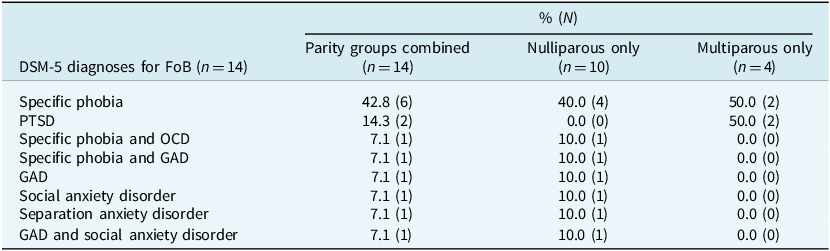
Fourteen of 18 participants reported symptoms meeting criteria for one or more of the disorders assessed. For the four participants who failed to report symptoms meeting criteria for any of the disorders assessed, this included FoB-related and non-FoB-related conditions. See Table 1.
Participant diagnoses assigned for FoB

Symptoms reported by four participants (22%) failed to meet criteria for any of the disorders assessed and are not included in this table.
Specific phobia-related FoB
The most common diagnosis given for clinically significant FoB was specific phobia (8 of 14, 57%). Of these, five (four nulliparous and one multiparous) reported disorder onset during the current pregnancy. Among participants who failed to report FoB-related symptoms meeting criteria for any of the disorders assessed (n=4), reported symptoms primarily fell within specific phobia, FoB. See Table 1. Fears were broad-ranging and included fear of harm to the infant, pain, tearing, inability to cope, and fear of caesarean birth specifically.
Other FoB-related diagnoses
The next most common diagnoses given were PTSD (n=2 of 14, 14.3%) and generalized anxiety disorder (GAD) (n=2 out of 14, 14.3%). Other diagnoses given for FoB-related symptoms included social anxiety disorder (n=1, 7.1%), OCD (n=1, 7.1%), and separation anxiety disorder (n=1, 7.1%). A total of four participants reported symptoms meeting criteria for two FoB-related disorders (i.e. specific phobia and OCD, specific phobia and GAD, and social anxiety disorder and GAD). Among the two participants who reported symptoms meeting criteria for PTSD, these were related to a previous traumatic and complex childbirth experience (e.g. complication during the delivery leading to baby’s distress and multiple unwanted emergency medical procedures). In the context of social anxiety, fears related to a loss of privacy, being touched and nudity. In GAD, worries about the upcoming birth were present alongside other non-FoB related worries. Childbirth-related obsessions were present in OCD, and fears of harm to the infant in the context of separation anxiety disorder.
Extent of FoB-related symptoms across disorders
Specific phobia and PTSD were the only diagnostic categories in which FoB-related symptoms were the exclusive focus. Among participants for whom childbirth-related fears occurred outside of these two disorder categories (i.e. in the context of GAD, separation anxiety, or social anxiety), participants also reported non-FoB-related symptoms commonly associated with those disorders. Specifically, childbirth-related concerns represented only a portion of the disorder-related symptoms endorsed. For the one participant whose symptoms of FoB met criteria for OCD, obsessions were characterized by childbirth-related concerns (e.g. needing to rush to the hospital due to baby’s unexpected health concerns). See Table 1.
Parity
Fourteen of 18 participants were nulliparous. Among nulliparous participants, 12 reported FoB-related symptoms meeting criteria for one or more of the disorders assessed. All four participants who failed to report symptoms meeting criteria for any of the disorders assessed were nulliparous. Among multiparous participants, all four reported symptoms meeting criteria for a diagnosis related to their FoB. The two cases of PTSD in this study were among multiparous participants. The other two multiparous participants reported symptoms meeting criteria for FoB-related specific phobia. For one, their specific phobia developed in response to a very complicated previous pregnancy and birth. For the other, their specific phobia, FoB began in childhood.
Non-FoB related diagnoses
Eight of the 18 study participants also reported symptoms sufficient for one or more additional diagnoses either only marginally related, or wholly unrelated to their FoB. These included specific phobia (n=2), panic disorder (n=2), social anxiety disorder (n=3) and OCD (n=3).
Discussion
The purpose of the current research was to improve our understanding of the range of diagnostic category(ies) applicable to clinically meaningful FoB, and to assess the degree to which specific phobia may be the diagnostic category most relevant to FoB. Although specific phobia, as a diagnostic category, has been used to: (a) identify individuals experiencing diagnosable FoB (i.e. study inclusion criteria required a diagnosis of specific phobia, FoB; Sydsjö et al., Reference Sydsjö, Bladh, Lilliecreutz, Persson, Vyöni and Josefsson2014), and (b) to determine cut-off scores for a measure of FoB (i.e. the cut-off score was based on the mean scores of those who met diagnostic criteria for specific phobia, FoB), to date these decisions have been theoretical, rather than empirical. To our knowledge, no published research to date has sought to determine which diagnostic categories (specific phobia or others) may be most applicable to FoB.
Our study findings suggest that: (a) specific phobia may be the most common diagnostic category relevant to FoB, and (b) it is not the only one. Reinforcing the idea that specific phobia may be the most common diagnostic category relevant to FoB is the fact that for two out of the four people who did not report symptoms sufficient for a diagnosis, the predominant symptoms were nevertheless those of specific phobia.
The only two diagnostic categories in which FoB emerged as the primary focus were specific phobia and PTSD (among multiparous participants only). If future studies echo these findings, it will be important to distinguish between diagnostic categories relevant to diagnosing clinically significant FoB from diagnostic categories in which FoB may feature.
In keeping with much of the research on FoB, in the current study, when PTSD was a focus of childbirth-related fears, it was a product of prior birth trauma (Sharma and Sharma, Reference Sharma and Sharma2023).
Limitations and future directions
As the first study to look at the question of the diagnostic classification of FoB, we employed a small convenience sample, and no formal power analysis was conducted. Although this limits the generalizability of the findings, it provides important preliminary insights that can guide future research. Research employing larger, more diverse samples of both nulliparous and multiparous participants will permit greater generalizability and provide a more accurate view of the proportion of cases of FoB which meet criteria for different anxiety and related disorders.
Additionally, this study primarily reports on FoB among cis-gendered women of European descent in a high-income, Western country. Given known disparities in perinatal care and mental health outcomes, it is essential to explore how FoB manifests across different cultural, socioeconomic, and healthcare contexts. Experiences of discrimination, obstetric violence, and structural inequities may shape both the prevalence and expression of FoB, as well as the appropriateness of existing diagnostic frameworks across diverse populations.
Future directions
Future studies should seek, via larger, representative samples, to determine: (a) in what proportion of cases of clinically significant FoB is specific phobia the appropriate diagnosis, (b) how does the distribution of FoB-related diagnoses differ between nulliparous and multiparous people, and (c) are specific phobia and PTSD in fact the only two anxiety or anxiety related disorders in which diagnosable FoB is the sole focus (i.e. not one of several fears, concerns or worries)? Future research should also account for cultural differences in which FoB is expressed, as well as variations in the actual risk of mistreatment and obstetrical violence faced by pregnant people in different communities.
Conclusion
Early results suggest that specific phobia and PTSD (among multiparous subjects) may be the most common anxiety-related disorders relevant to FoB. It also appears (although larger samples are needed) that when FoB occurs in the context of other anxiety and related disorders (e.g. GAD or OCD), it is unlikely to be the only area of focus.
Data availability statement
The dataset associated with this study will be provided upon reasonable request.
Acknowledgements
We would like to thank all of our participants. We would also like to thank team members Fanie Collardeau for all of her hard work conducting study interviews and contributing to the research design, and Emily Friedrich, for her help.
Author contributions
Nichole Fairbrother: Conceptualization (lead), Data curation (lead), Formal analysis (lead), Funding acquisition (lead), Investigation (lead), Methodology (lead), Project administration (lead), Resources (lead), Software (lead), Supervision (lead), Validation (lead), Visualization (lead), Writing - original draft (equal), Writing - review & editing (equal); Cora Keeney: Conceptualization (supporting), Formal analysis (supporting), Methodology (supporting), Project administration (supporting), Writing - original draft (equal), Writing - review & editing (equal).
Financial support
This research was funded through the Michael Smith Foundation for Health Research’s 2018 Pathway to Patient-Oriented Research (P2P) Award Competition (award no. 17452). Funding was awarded to Dr Nichole Fairbrother.
Competing interests
The authors declare no potential competing interests with respect to the research, authorship, and/or publication of this article.
Ethical standards
This study was approved by the University of British Columbia Ethics Board and the Health Research Ethics Board of Island Health. Written informed consent was obtained from all participants at the start of the online questionnaire, and oral consent was provided at the beginning of each diagnostic interview. This research has conformed to the Declaration of Helsinki.

 Open access


Comments
No Comments have been published for this article.