Skip to main content Accessibility help
×
Hostname: page-component-699b5d5946-pzwhm Total loading time: 0 Render date: 2026-03-04T11:26:42.739Z Has data issue: false hasContentIssue false

Chapter 1 - ‘At a Time When the Temple of Dodonean Zeus Had No Walls until the First Century BCE

from Part I - Site and Senses

Published online by Cambridge University Press:  26 February 2026

Hugh Bowden
Affiliation:
King's College London
Esther Eidinow
Affiliation:
University of Bristol

Summary

Dodona lies in the northwest of Greece, south of Ioannina. It is situated in the midst of a lovely, peaceful green valley, overlooked by the twin peaks of Tomaros. Natural openings disrupt the rugged geomorphological relief and allow bilateral movements to and from Epirus’ hinterland areas and the coast. It is acclaimed by the ancient writers as the oldest oracle in ancient Greece, with researchers placing its origins as far back as the Bronze Age. The whole area is scattered with ruins, including an imposing theatre, the sanctuary and an acropolis enclosed by fortified walls, occupying an area of 164.659,43 m2.The aim of this paper is to contextualize the architectural development of the sanctuary of Dodona from prehistory till the first century BCE within a general overview of the sacred landscape. It aims to provide a synthesis of the architectural development of the temenos based on previous and recent excavation data. It argues that the transformation of the sanctuary of Dodona from a small open-air shrine to a pan-Epirote and pan-Hellenic cult centre seems to be associated with the urbanization of Epirus and the formation of an Epirotic identity.

Information

Type
Chapter
Information
Visiting the Oracle at Dodona
Contexts of Unknowing in Ancient Greek Religion
, pp. 17 - 33
Publisher: Cambridge University Press
Print publication year: 2026
Creative Commons
Creative Common License - CCCreative Common License - BYCreative Common License - NCCreative Common License - ND
This content is Open Access and distributed under the terms of the Creative Commons Attribution licence CC-BY-NC-ND 4.0 https://creativecommons.org/cclicenses/

Chapter 1 ‘At a Time When the Temple of Dodonean Zeus Had No WallsFootnote 1 until the First Century BCE

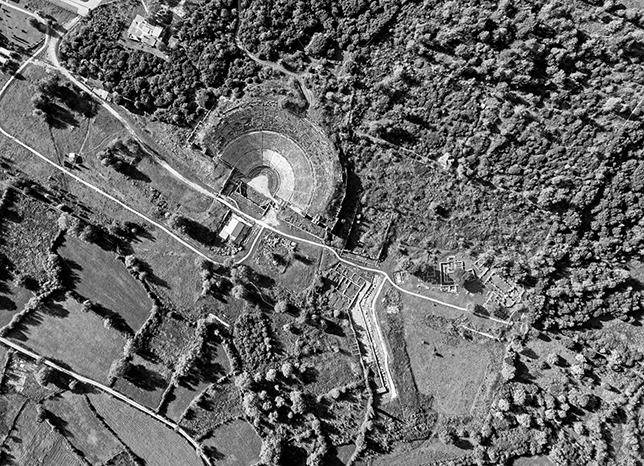
The archaeological site of Dodona was reported by several travellers of the nineteenth century (Figure 1.1).Footnote 2
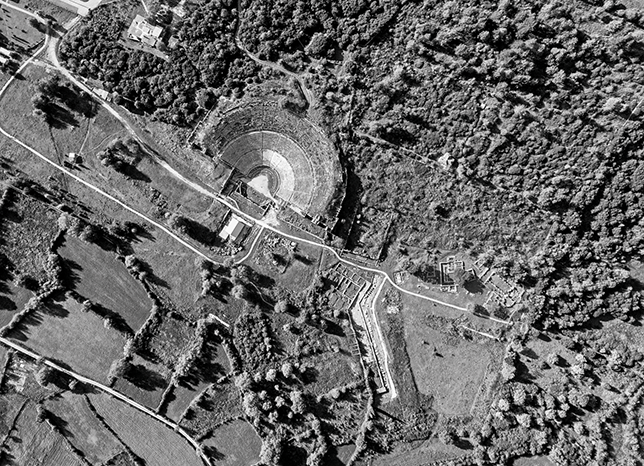
An aerial photograph of ruins surrounded by trees. A road runs across the site. There is a theatre and some buildings. See long description.

Figure 1.1 Aerial view of the archaeological site of Dodona.

(© Ephorate of Antiquities of Ioannina-Hellenic Ministry of Culture and Sports)
Figure 1.1Long description

An aerial view of the ruins of the sanctuary of Zeus at Dodona. The Sacred Way runs across the site from east to west. Above the Sacred Way, stands the remains of the ancient theatre and to the East are the remains of temples and treasuries.

In 1875, Konstantinos Carapanos, a Greek politician and merchant, excavated the sanctuary and two years later published the results of his excavations in a two-volume book in which he included a detailed plan of the site.Footnote 3 Before Carapanos’ excavations, the only visible building in the site was the theatre. From the decade of the 1930s until the beginning of the twenty-first century, Dimitrios Evangelidis as well as Sotiris Dakaris, and his collaborators – namely, Drs Chrysiis Souli, Amalia Vlachopoulou and Konstantina Gravani – conducted excavations on behalf of the Greek Archaeological Service.Footnote 4

‘Harsh-wintered’ Dodona was the main cult place of Zeus in Epirus probably since the Bronze Age.Footnote 5 The oldest reference to the shrine derives from Homer in the eighth century BCE.Footnote 6 There is still no evidence from the excavations, however, attesting to the existence of a special place dedicated to the cult before the eighth century BCE. Initially, it was traditionally believed that Mother Earth was worshipped in the area close to the sacred oak tree.Footnote 7 The travel-writer Pausanias provides us with a part of a hymn chanted by the priestesses of Dodona, which refers to her cult: ‘Zeus was, Zeus is, Zeus will be. Earth gives fruits, so you shall praise Mother Earth!’. Footnote 8 It is difficult to define when the oracular activity started at the site, but following the historian Herodotus, it seems that Dodona was the most ancient place of divination in Greece.Footnote 9 Aristotle notes that the oracle was operating during the time of the great cataclysm – by which he means the great flood sent by Zeus, which only Deucalion and Pyrrha survived.Footnote 10

Based on the passage of the Iliad in which Achilles prays to Zeus Dodonaios Pelasgikos,Footnote 11 the hypothesis that the cult of Earth (Gaia) was replaced by the cult of Zeus in the second millennium was put forward.Footnote 12 Use of the adjective ‘Pelasgian’ is connected with the seniority of the cult, as the Pelasgians, in the memory of the Greeks, are their mythical ancestors. Pelasgus, the first inhabitant of the Earth, personified the new values of the Neolithic era (7000–3200 BCE): wheat cultivation, bread production and improvement of nutrition.Footnote 13 According to the myth, Pelasgus brought to humanity bread from the oak tree.Footnote 14

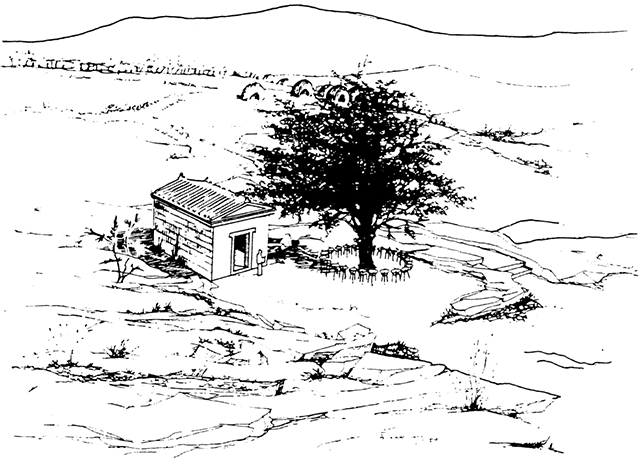
For centuries the shrine remained rather rudimentary. The sanctuary was open-air and various ceremonies were performed around the sacred oak tree. It is believed that, from the eighth to the beginning of the fourth century BCE, the oak tree was surrounded by cauldrons that rested on bronze tripods (Figure 1.2).Footnote 15
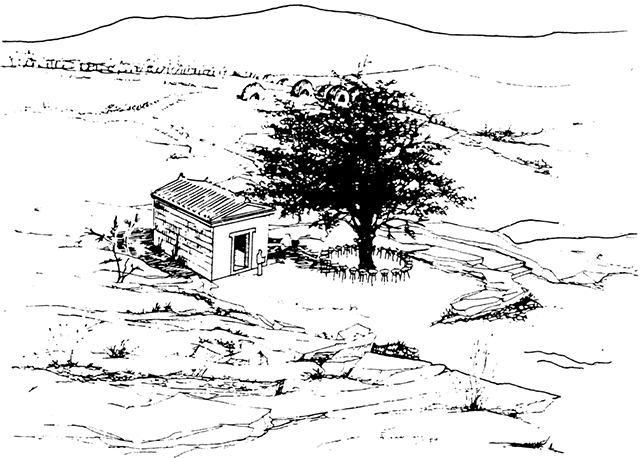
A drawing of a small temple. Standing to the right of the temple is an oak tree surrounded by a ring of tripods on each of which is a cauldron.

Figure 1.2 Representation of the bronze cauldrons around the sacred oak tree (after V. Charissis)

(© Ephorate of Antiquities of Ioannina-Hellenic Ministry of Culture and Sports)

Because all the cauldrons would have touched each other, whenever one of them was struck, the sound would reverberate through the rest. During the eighth century BCE and based on the evidence of the votive offerings found there, which were manufactured in Corinthian workshops, the sanctuary seems to have been involved in the Corinthian expansion.Footnote 16 The late eighth-century BCE bronze warrior statuettes with shield and spear, which were found in the sanctuary of Dodona, are probably the oldest depictions of Zeus at Dodona.Footnote 17 It seems that this type was first formulated in the Peloponnese and arrived in Epirus after the establishment of the Elean colonies (eighth–seventh century BCE).Footnote 18 Bronze cast and concrete warrior statuettes have been used to decorate the handles of big, forged tripod cauldrons.

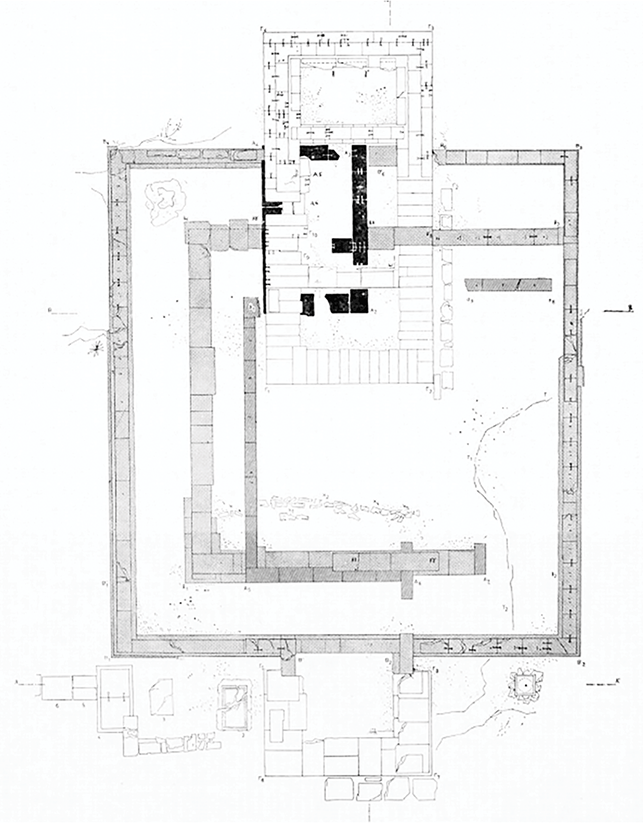
The first architectural remains, which can be related to the so-called prebuilding phase of the sanctuary in Dodona, were unearthed by Evangelidis and Dakaris (1959). They both noted that in the northwestern side of the Sacred HouseFootnote 19 (Temple of Zeus and Dione; E1 on Figure 1.4), a series of flattened limestone slabs had been revealed.Footnote 20 These were positioned vertically in the virgin soil, having an ellipsoidal curve and following an E-W direction (Figure 1.3).
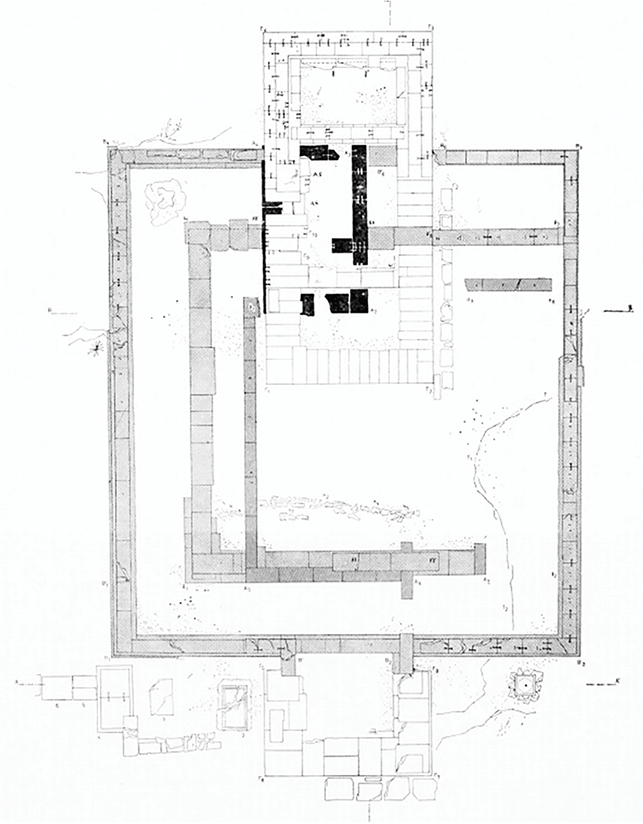
A drawing of the architectural plan of an ancient temple. The oldest part of the building is at the centre of the picture, and around it are the walls that, over time, enlarged the building.

Figure 1.3 Architectural remains related to the prebuilding phase of Dodona inside the Sacred House

(© Ephorate of Antiquities of Ioannina-Hellenic Ministry of Culture and Sports)
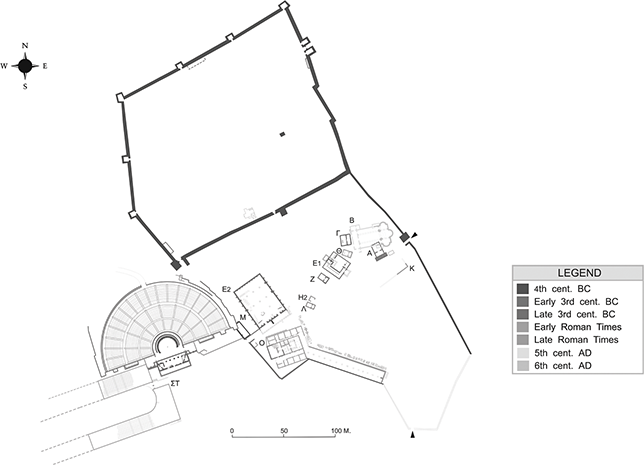
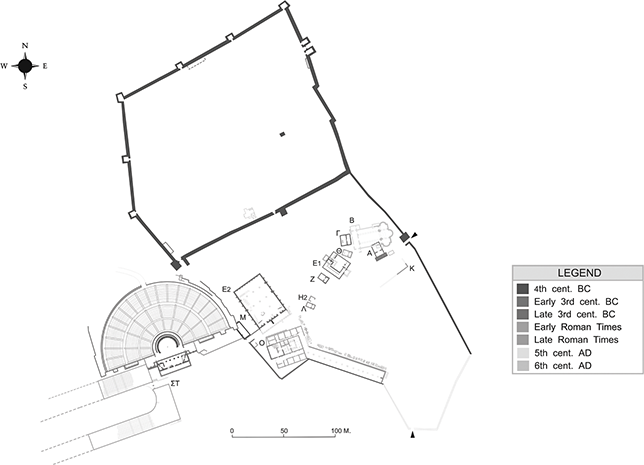
A line drawing of the site plan of the sanctuary of Dodona, as it developed over time. The site lies on a northwest axis; to the north are the walls surrounding the settlement of Dodon, and below that, the buildings of the sanctuary.

Figure 1.4 Dodona site plan

(© Ephorate of Antiquities of Ioannina-Hellenic Ministry of Culture and Sports)

In close proximity, a stone-lined posthole came to light. They identified it as the foundations of a single building that probably acted as a temple during the Geometric period. Later, however, other scholars offered different opinions.Footnote 21

Further excavations brought to light an apsidal edifice at the bouleuterion (E2 on Figure 1.4),Footnote 22 a number of pits and postholes of a rectangular hut in the bouleuterion’s stoa,Footnote 23 a circular building north of the bases of the eastern stoa of the prytaneion (O),Footnote 24 and postholes and relics of a wall also in the prytaneion (O).Footnote 25 These constructions seem to be part of a small settlement of stockbreeders consisting of huts made with perishable materials, dated to the end of Late Helladic–Early Iron Age.Footnote 26 Pastoral activities are closely connected to the development of Zeus’ sanctuary into a supra-regional cult centre, as Dodona is located on important routes used by transhumant shepherds.Footnote 27

The situation differs in the eastern part of the site. A hearth and paving stones at the Sacred House can be associated with a cult activity which would have taken place in the open air.Footnote 28 Miniature pottery vessels and non-utilitarian bronze tools and weapons found in the adjacent area support the idea that this area had a religious function.Footnote 29 The miniature vessels could have been filled with offerings for the worshipped deity. Some of them have been also recognized as ritual vases.Footnote 30 Additionally, a votive character can be attributed to the bulk of the bronze findings (such as knives, axes sometimes bearing incised and impressed decoration and spearheads), dating to the Late Helladic–Early Iron Age period because they were small and sometimes made of sheet bronze.Footnote 31 But it still remains obscure whether or not some sort of cult activity took place in this area.

At the end of the fifth century BCE, Dodona transformed gradually to a place where politics and cult coexisted harmoniously.Footnote 32 During Tharypas’ kingship (423/2–390/85 BCE),Footnote 33 it has been suggested that the Molossians took control of Dodona from the Thesprotians.Footnote 34 A stele with two honorific decrees testifies to this new role of the sanctuary,Footnote 35 which then further developed and became more established with the building of the bouleuterion and the prytaneion.

In the first half of the fourth century BCE the landscape of Dodona started changing.Footnote 36 A small naiskos (E1 in Figure 1.4; 4.20 m × 6.5 m) erected near the sacred oak tree in the eastern area seems to have mainly served as a storage room for the offerings that people from all over Greece brought to the divine couple, namely, Zeus and Dione.Footnote 37 The tripods were then replaced by two columns; the first one was topped by a statue of a boy with a whip in his hand (a present from the people of the island of Korkyra, now modern Corfu) and the second with a bronze cauldron. When the wind blew, the whip would strike against the cauldron, creating the prophetic sounds.Footnote 38

To the same period dates the enclosure of Dodona (the so-called ‘Acropolis’Footnote 39), the ancient townFootnote 40 that stands on the mound above the valley in the form of an irregular square, as well as Building M (17.30 x 10.70 m). The latter was later integrated into the sanctuary’s circuit wall together with the bouleuterion or council chamber (E2) and the prytaneion (O), a development that suggested its use as a public guest house.Footnote 41

In the late fourth/beginning of the third century BCE, the so-called oikoiFootnote 42 (buildings Γ, 9.80 m × 9.40 m and Λ, 4.70 m × 8.70 m) were erected near the Sacred House. These have been assigned to Dione and Aphrodite respectively,Footnote 43 who were also known as ‘Naoi gods’, meaning gods who shared the same house (synoikoi) and temple (synnaioi) as Zeus.Footnote 44 According to recent excavations Building Λ (the so-called temple of Aphrodite) had two phases: during the first one (in the first quarter of the fourth century BCE) it consisted of a cella (the inner part of a temple, that usually housed an image of the god), and in the second phase, two Doric columns were added to its entrance (during the beginning of the third century BCE).Footnote 45

On the western side of the shrine, an area developed consisting of the theatre,Footnote 46 which followed the natural shape of the hillside, the bouleuterion (E2; see Figure 1.4) and the prytaneion (O).Footnote 47 More specifically, the bouleuterion (E2) consists of a large hypostyle hall (43.60 × 32, 35 m; hypostyle means that the inner part of the building rests on columns) with a Doric colonnade (stoa) with fifteen columns in front (32.40 × 5.50 m). Near its south wall a stone altar has been revealed. It was dedicated to Zeus Naios and Bouleus (Counsellor) and to Dione by Charops the Elder, an Epirote General. The surviving outside walls formed the stone base of the building, but the upper part was built of baked and unbaked bricks bonded with mud. Its identification was based on the discovery there of a large number of pieces of clay, used probably for voting.Footnote 48 It is suggested that it hosted the meetings of the Molossian koinon (which ran from 370/368 to 334/331–330 BCE), the Epirote Alliance (which ran from 334 or 331/330 to 233/231 BCE) and later of the Epirote koinon (which ran from 233/231 to 148 BCE). At the same time, it was used as a place where other activities, like musical or theatrical performances, took place. Facing the bouleterion, the prytaneion (O) (31.50 × 13.50 m) consisted of a square room (12 × 12 m) and a rectangular peristyle court (19 × 13.50 m) with 4 × 5 Doric columns on a stylobate (a continuous base) and an altar. The representatives of the Epirotes would gather in the large square room, where the hearth of Hestia with the eternal fire was burning.Footnote 49

Alexander the Great had planned to rebuild six Greek sanctuaries, including Dodona, and allocated the huge sum of 1500 talents (9,000,000 ancient drachmas) to this project.Footnote 50 But his premature death prevented him from carrying them out. Nevertheless, they were put into effect by King Pyrrhus (297–272 BCE), who considered the favour of the oracle as a crucial factor in the success of his political ambitions. In fact, Pyrrhus used Dodona to promote his political and military power, through the practices of dedication and renovation.Footnote 51 For example, he dedicated to Zeus a shield of his own, bearing a relief depiction of the winged thunderbolt (okiptera) and an inscription, now fragmentary, that mentions his name and perhaps his title as general (…] Purrou p [ara … / … ē] gētor [os … iōt … .) in the bouleuterion,Footnote 52 as well as the shields of his enemies, which had been taken in battle.Footnote 53

The motif of the okiptera had a double aim: it was used as symbol of the power of Zeus Dodonaios and as an emblem of the ‘Epirote Alliance’ (334 or 331/330–233/231 BCE) and the ‘Epirote koinon’ (233/231–148 BCE). It has also been found on roof tiles and parts of armour (epaulettes, sword-grips, baldric plaques and shoulder plates). Moreover, he adorned the colonnades and the Sacred House with trophies and treaties – and this was the reason that in 219 BCE the Aetolians destroyed the sanctuary with such wrath.Footnote 54 During his reign, the Molossians acquired a greater sense of regional, Epirote identity, and Dodona was transformed into a pan-Epirote cult-centre. Pyrrhus thus portrayed himself as the leader of the Epirotes, and [portrayed] Epirus, not Molossia, as his home base.Footnote 55

The monumentalization of the sanctuary took concrete form during Pyrrhus’ reign. The most important religious centre that belonged to all the people of Epirus was transformed into a ‘showplace’!Footnote 56 New buildings were erected (see Figure 1.3): the edifices A (9.50 m × 16.50 m, known as the ‘Temple of Hercules’), Θ (6.05 m × 9.40 m, known as the ‘New Temple of Dione’) and Ζ (6.25 m × 9.70 m, known as the ‘Temple of Themis’) were erected. The prytaneion (O) was expanded with the addition of two wings (O1–O2) and a porch with four columns, in order to fulfil the needs of the political organization of the Epirotes. The wings consisted of three rooms with nine couches each and with service areas, where the government officials dined (katagogion).Footnote 57 Moreover, it was used during cult practices and in hosting authorities during the festival of the penteric games, the Naia.Footnote 58

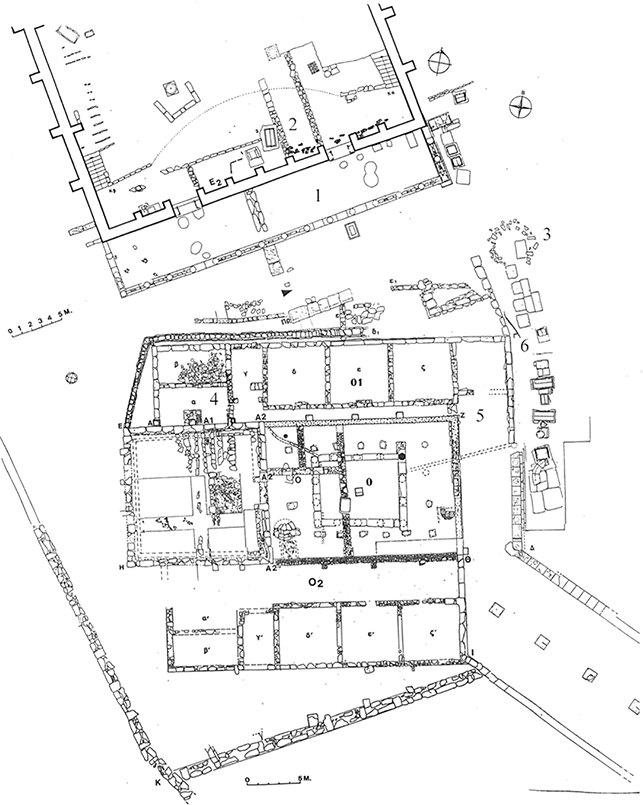
In the area east of the bouleuterion’s stoa, the prytaneion and the western stoa, a large number of honorific statues were erected, underpinning the area’s significance (Figure 1.5).Footnote 59
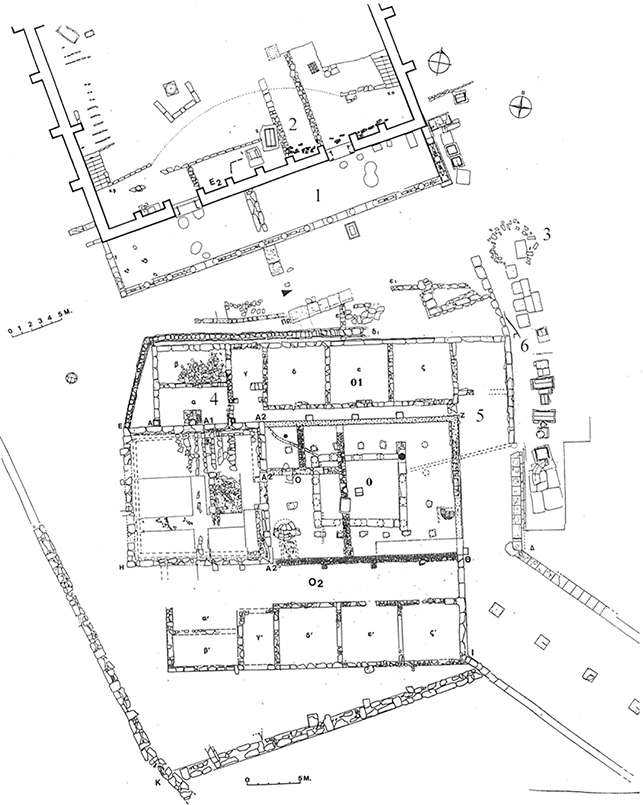
A line drawing of the ground plan of an ancient building, showing the path towards it, and the many rooms inside it. There is another building opposite it.

Figure 1.5 Ground plan of the Prytaneion

(© Ephorate of Antiquities of Ioannina-Hellenic Ministry of Culture and Sports)

At Dodona, sixty-two statue bases and over one hundred fragments from bronze statues have been revealed, a fact that is particularly important, taking into account the rarity of this sculptural genre.Footnote 60 It is worth mentioning the discovery of a group of six bases to the east of the bouleuterion (E2), three of which bear inscriptions, three for statues on foot and one for an equestrian (Milon, an officer of the Epirote Koinon).Footnote 61 The choice to locate the bases there was not random, as it was the point where the two ‘identities’ of Dodona (sacred and civic) joined.Footnote 62

The old isodomic circuit wall was replaced by a larger circuit wall, with three Ionic colonnades along the north, west and south sides. Thus, the open forecourt and the oak tree were surrounded by three stoas with an Eastern orientation, of a type usual in northwestern Greece. This construction meant that there were two enclosed corner spaces formed at the end of the forecourt.Footnote 63 The east side of the forecourt remained free, without a stoa, because the oracular oak stood there. Sanctuaries in the Hellenistic period commonly included at least one stoa; those in the open-air (as here) were probably devoted to rituals.Footnote 64 South of the naoi there was a wall, known as wall K, which had been revealed during the excavations by Carapanos. Based on the result of recent investigations, these seem to have a Γ-shaped plan and to have functioned as a boundary for the north side of the large open-air space and for the expansion of the platform of the building.Footnote 65

After the destruction of the sanctuary by the Aetolians in 219/218 BCE, the existing structures were restored. The Sacred House was renovated. The small temple was replaced by a larger Ionic temple (5.60 m × 12.95 m) with four columns in the front. The colonnades were restored. The old material was used in the foundations of the new, monumental Hellenistic temple, which was built so that it was exactly symmetrical. On the western side opposite the theatre, the stadium (ST, on Figure 1.4) started functioning, while the eastern colonnade of the prytaneion (O) was connected to the western stoa of the sanctuary, which extended towards the south.Footnote 66 Finally, the sanctuary was re-established in the Roman period, although with a different character. During the reign of Augustus, the theatre was transformed into an arena for wild beast fights and gladiatorial shows. In its lower part, a wall was constructed to protect the spectators, which cut off the proscenium and the skene.Footnote 67 The square room (O) of the prytaneion was transformed into a conference room for the officials of the Epirote koinon. It was furnished with seven rows of stone benches and the peristyle was enlarged with 4 × 7 columns in second use.Footnote 68

The aforementioned architectural remains in the area seem to have developed on three levels.Footnote 69 The citadel is at the top of the hill, an extension of the western foothills of the mountain range of Agios Nikolaos-Manoliasas (alt. 800 m–1000 m). At its foot, on terrain sloping downhill, the buildings of the sanctuary were built on both of its sides, having an amphitheatrical arrangement. Looking at the site plan (Figure 1.4) we can see that the dominant building was the Sacred House (E1), located in the eastern area, around which smaller edifices were erected.

The bouleuterion (E2), the prytaneion (O) and the theatre were all erected on the western side of the shrine. In front of these buildings, stoas were constructed. On the southern side, the porticoes with the temenos wall shaped the overall picture and created a unique ensemble, providing an aesthetically pleasing perspective against the landscape. At the lowest level, in the southwest, the main entrance of the sanctuary was formed in the place where an ancient way once existed.Footnote 70 Overall, it seems, and over time, Dodonaean sacred architecture was characterized by rather small and humble edifices, apart from the Sacred House, which fitted the modest physical environment in which the mountain mass of Tomaros dominated.

Regarding the architectural synthesis of the sanctuary, of special interest is the orientation of the buildings.Footnote 71 As the site plan (Figure 1.4) shows, an axis from east to west passes in front of the Sacred House (E1), the bouleuterion (E2) and the theatre, forming the Sacred Way; it traverses the stadium (ST), and, if we imagine its extension, we can see that it continues to meet mount Tomaros. A second axis, running from south to north, leads to the main gate across the Sacred House, which overlooks the whole sanctuary. The site was thus divided into two zones, a western one that would hold an assembly and cultural activities and an eastern one devoted to cult.Footnote 72 The western zone was accessible from the south, while the eastern one was accessible via the east and south gates which were reinforced by towers. All in all, it can be inferred that the architectural development at Dodona was late in relation to the significant number of pilgrims that visited the shrine during the Archaic and classical periods.

Until the end of the third century BCE, the main building material was the local flysch of light green colour, extracted from the quarries of the region. Due to its sensitivity to weather conditions, it was replaced by calcareous rocks (thin bedded, micro-breccia and breccia, Eocene period).Footnote 73 No stone-based, monumental architecture from before the fourth century BCE has been found at Dodona. This is a phenomenon widespread in Epirus, and it can be assumed that, in general, the architecture of this area was not stone-based before the Hellenistic period. Indeed, as Chiara Lasagni has noted:

the fourth century represents a turning point in the history of Epirus with reference to urbanization. In this phase, the gradual organization of the Epirote tribes into urban nucleated settlements went hand in hand with their entrance into the ‘great history’ of Greece, as well as with their population’s increase and socio-economic development.Footnote 74

The fourth century was the period when the first poleis appeared in Epirus. The Epirotes under the leadership of the Aeakid dynasty organized into states (koina) or kingdoms and started to establish a regional identity.Footnote 75 Dodona, as the main religious and political centre of the region, inevitably played a significant role in the development of Epirus’ political history.Footnote 76
Footnotes

1 Steph. Byz. 4.146.111–18.

2 Soueref and Vasileiou Reference Soueref, Vasileiou and Soueref2017: 181–182.

6 Hom. Il. 2.748–750, 16.233–235, Od. 14.327–330, 19.296–299.

7 Based on the excavation data concerning the cult in Dodona, Georgoudi (Reference Georgoudi, Georgoudi, Koch and Schmidt2012) noted that the worship of the Mother Goddess must be excluded.

8 Paus. 10.12.10.

9 Hdt. 2.52.2.

10 Arist. Mete. 1.14 (352a-b).

11 Hom. Il. 16.233–235.

12 Dakaris Reference Dakaris1998: 86–92, Georgoudi Reference Georgoudi, Colombo and Seppilli1998: 317–320, 335–340, Eidinow Reference Eidinow2007: 60.

13 Soueref Reference Soueref2010: 123–129.

14 Paus. 8.1.5–2 and 3.

15 FGrH IIIB, 201–202, Steph. Byz. s.v. Δωδώνη (FGrH 327, F20), Dakaris Reference Dakaris1998: 37–39, Dieterle Reference Dieterle2007: 265, 363–382, Emmerling Reference Emmerling2012: 71–74, 263, Vasileiou Reference Vasileiou, Eleutheratou and Soueref2016: 42.

16 Piccinini Reference Piccinini2017: 63–65. In the seventh century BCE the Corinthians under the rule of Kypselos (657–627 BCE) and his son Periander (627–587 BCE) began to found a significant number of colonies across the Mediterranean coasts [Epidamnus (Durrës, Albania), Apollonia (Fier, Albania), Syracuse (Italy), Ambracia-Korkyra-Anactorion-Potidea (Greece) and Naukratis (ancient Egypt)]. The result of this was the widespread expansion of Greek trade.

18 For the Elean colonies: Dakaris 1971, Dominguez Monedero 2005. For the type of the figurine: Tzouvara-Souli Reference Tzouvara-Souli2008: 113.

19 Polyb. 4.67.3.

20 Evangelidis and Dakaris Reference Evangelidis and Dakaris1959: 65.

21 Andronikos Reference Andronikos1966: 272, Dieterle Reference Dieterle2007: 238–241, Charissis Reference Charissis2010: 143, Emmerling Reference Emmerling2012: 230.

24 Dakaris Reference Dakaris1971b: 127.

25 Dakaris Reference Dakaris1981, Souli, Vlachopoulou and Gravani Reference Souli, Vlachopoulou and Gravani2000: 149, Gravani Reference Gravani2007: 103, Georgoulas Reference Georgoulas2015: 783.

26 Vasileiou Reference Vasileiou2020: 407.

27 Piccinini Reference Piccinini2017: 35–40.

28 Velenis and Georgoulas Reference 33Velenis and Georgoulas2008: 783, Georgoulas Reference Georgoulas, Eleutheratou and Soueref2016: 46, Georgoulas and Skalisti Reference Georgoulas and Skalisti2017: 307–309.

30 Zolotnikova Reference Zolotnikova2019: 47.

31 Zolotnikova Reference Zolotnikova2019: 98.

33 Plut. Vit. Pyrrh. 1.3.

34 Scholars debate whether or not there was a federal state of the Epirotes before the murder of Pyrrhus’ granddaughter, Deidameia and the fall of the Aeakid dynasty (234/232 BCE); see Meyer Reference Meyer2013, Liampi Reference Liampi2017: 285–291, Raynor Reference Raynor2017.

36 For the architectural development of the sanctuary, see Moustakis Reference Moustakis and Bumke2020: 193–200, Vlachopoulou–Oikonomou Reference Vlachopoulou-Oikonomou, Eleutheratou and Soueref2016.

37 For a detailed report on its building phases: Dakaris Reference Dakaris1998: 37–49, Georgoulas Reference Georgoulas, Eleutheratou and Soueref2016: 46–47, Georgoulas and Skalisti Reference Georgoulas, Skalisti and Soueref2014: 97–98.

38 Steph. Byz. 4.146.111–18; see Cook Reference Cook1902, Intrieri Reference Intrieri and Domínguez2018.

39 Gerogiannis Reference Gerogiannis2021: 307–313, Suha Reference Suha2021: 148–150.

40 The inhabitants of the city, the Dodonaeans, are mentioned in the question tablets, DVC 295B, 1089B, 2425A, 2519B, 2952B.

41 Lyrou Reference Lyrou2009: 126.

42 Some scholars argue that these structures had different functions: see Dieterle Reference Dieterle2007: 130 (she refers to them as temples on p. 168), Emmerling Reference Emmerling2012, Mancini Reference Mancini2013: 84–88, Georgoulas Reference Georgoulas, Eleutheratou and Soueref2016: 47, Piccinini 2016: 164.

43 Dakaris Reference Dakaris1998: 50, 55–56.

44 Dione and Aphrodite are referred to with these adjectives in the corpus of the lead tablets; see DVC 95A, 799B, 1559B, 2546A.

45 Skalisti and Georgoulas Reference Skalisti, Georgoulas and Soueref2014: 98–99.

46 On the latest data about the construction and preservation of the theatre: Katsoudas Reference Katsoudas and Soueref2014, Skalisti and Georgoulas Reference Skalisti, Georgoulas and Soueref2014, Katsikoudis 2016.

47 On the latest data, see Rinaldi Reference Rinaldi2021: 381–393.

48 Rinaldi Reference Rinaldi2021: 385.

49 Gravani, Souli and Vlachopoulou Reference Gravani, Souli, Vlachopoulou and Soueref2014: 30.

50 Diod. Sic. 18.4.5.

52 Vasileiou 2014: 61–62.

53 After his victory in Heracleum, Pyrrhus hung among the columns of the Sacred House the Roman shields that he took, with the inscription ‘King Pyrrhus and the Epeirotes and the Tarantines from the Romans and their allies, with Zeus Naios’ ([Βασιλεύ]ς Πύρρο[ς καί]/῾Ήπειρ[ῶ]ταί καί Τ[αραντίνοι] / ἀπό ʾΡωμαίων καί [τῶν]/συμμάχων Διί Να[ίωι]): Katsikoudis Reference Katsikoudis1997: 270. In addition, a Macedonian shield has been found at Dodona bearing the inscription ‘King’ (ΒΑΣΙΛΕΥΣ). It has been suggested that Pyrrhus dedicated it in the sanctuary after his victory against Antigonus Gonatas in the straits of the river Aous (274 BCE): Dakaris Reference Dakaris1968: 58–59, Liampi Reference Liampi1998: 52.

54 Polyb. 4.67.3, Diod. Sic. 26.4.7.

55 Raynor Reference Raynor2017: 261.

57 Gravani, Souli and Vlachopoulou Reference Gravani, Souli, Vlachopoulou and Soueref2014: 31.

58 The period of the foundation of Naia remains unknown. The first written report is given by Athenaeus (second century BCE), Skalisti 2016: 117, Katsikoudis Reference Katsikoudis, Partida and Schmidt-Dounas2019: 34.

59 Katsikoudis 2016b: 133, Gerogiannis Reference Gerogiannis2021: 141.

64 Gravani, Souli and Vlachopoulou Reference Gravani, Souli, Vlachopoulou and Soueref2014:39–40.

65 Skalisti and Georgoulas Reference Skalisti, Georgoulas and Soueref2014: 98.

66 Gravani, Souli and Vlachopoulou Reference Gravani, Souli, Vlachopoulou and Soueref2014: 32.

68 Gravani, Souli and Vlachopoulou Reference Gravani, Souli, Vlachopoulou and Soueref2014: 33.

69 Lyrou Reference Lyrou2009: 96–97, 122.

73 Oikonomou and Smiris Reference Oikonomou, Smiris and Koui2018: 280.

74 Lasagni Reference Lasagni2018: 172.

75 On the organization of the Epirotes in koina and alliances, see Meyer Reference Meyer2013, Raynor Reference Raynor2017.

76 For an overview of the experience of the site during the Hellenstic period, see Chapinal-Heras, this volume.

References

Andronikos, M. 1966. ‘Review of Δ. Ευαγγελίδης- Σ. Δάκαρης, Το Ιερόν της Δωδώνης, Α. Ιερά Οικίa Aρχαιολογική Εφημερίς’, Gnomon 38: 270274.Google Scholar
Carapanos, C. 1878. Dodone et ses ruines. Vol.1–2. Paris.Google Scholar
Charissis, V. 2010. Δωδώνη. Αρχιτεκτονικά Μελετήματα. Ioannina.Google Scholar
Cook, A. B. 1902. ‘The Gong at Dodona’, Journal of Hellenic Studies 22: 528.CrossRefGoogle Scholar
Dakaris, S. I. 1967. ‘Ανασκαφή του ιερού της Δωδώνης’, Πρακτικά της εν Αθήναις Αρχαιολογικής Εταιρείας: 3354.Google Scholar
Dakaris, S. I. 1968. ‘Ανασκαφή του Ιερού της Δωδώνης’, Πρακτικά της εν Αθήναις Αρχαιολογικής Εταιρείας: 4549.Google Scholar
Dakaris, S. I. 1969. ‘Ανασκαφή του Ιερού της Δωδώνης’, Πρακτικά της εν Αθήναις Αρχαιολογικής Εταιρείας: 4259.Google Scholar
Dakaris, S. I. 1971a. Cassopaia and the Elean Colonies. Athens.Google Scholar
Dakaris, S. I. 1971b. ‘Ανασκαφή του Ιερού της Δωδώνης’, Πρακτικά της εν Αθήναις Αρχαιολογικής Εταιρείας: 124129.Google Scholar
Dakaris, S. I. 1981. ‘Ανασκαφή στο Ιερό της Δωδώνης’, Πρακτικά της εν Αθήναις Αρχαιολογικής Εταιρείας: 6771.Google Scholar
Dakaris, S. I. 1998. Δωδώνη. Αρχαιολογικός Οδηγός. Ioannina.Google Scholar
Dieterle, M. 2007. Dodona. Religionsgeschichtliche und historische Untersuchungen zur Entstenhung und Entwicklung des Zeus-Heiligtums. Hildesheim.Google Scholar
Domínguez Monedero, A.J. 2015. ‘Phantom Eleans in Southern Epirus’, Ancient West & East 14: 111143.Google Scholar
Eidinow, E. 2007. Oracles, Curses, and Risk among the Ancient Greeks. Oxford.CrossRefGoogle Scholar
Emmerling, T. E. 2012. Studien zu Datierung Gestalt und Funktion der Kultbauten im Zeus Heligtum von Dodona. Antiquitates, Archäologische Forschungsesrgebnisse 58. Hamburg.Google Scholar
Evangelidis, D. and Dakaris, S. I. 1959. ‘Το Ιερόν της Δωδώνης, Α. Ιερά Οικία’, Αρχαιολογική Εφημερίς: 1176.Google Scholar
Georgoudi, S. 1998. ‘Les portes-paroles des dieux. Réflexions sur le personnel des oracles grecs’, in Colombo, I. Chirassi and Seppilli, T., eds. Sibille e linguaggi oracolari, 315365. Pisa-Roma.Google Scholar
Georgoudi, S. 2012. ‘Des sons, de signes et des paroles: La divination à l’oevre dans l’oracle de Dodone’, in Georgoudi, S., Koch, R. and Schmidt, Fr. Piettre, eds. La raison des signes. Présages, rites, destin dans les sociétés de la Méditerranée ancienne, 5590. Leiden.CrossRefGoogle Scholar
Georgoulas, G. 2015. ‘Εφορεία Αρχαιοτήτων Ιωαννίνων. Παρακολούθηση Έργων. ΕΣΠΑ-Συγχρηματοδοτούμενα έργα. 3. Αποκατάσταση του Θεάτρου και της Δυτικής Στοάς του Ιερού της Δωδώνης. Α.1. Ανασκαφικές εργασίες’, Αρχαιολογικόν Δελτίον 70 Χρονικά Β’1: 779784.Google Scholar
Georgoulas, G. 2016. ‘Η Δωδώνη και τα λατρευτικά οικοδομήματα’, in Eleutheratou, St and Soueref, K. I., eds. Δωδώνη. Το μαντείο των ήχων, 4647. Athens.Google Scholar
Georgoulas, G. and Skalisti, E. 2014. ‘Ιερό Δωδώνης. Διαμορφώνοντας τη σύγχρονη εικόνα’, in Soueref, K. I., ed. Δωδώνη Διαχρονική. Παρελθόν, παρόν και μέλλον του αρχαίου Θεάτρου και του αρχαιολογικού χώρου, 1η Επιστημονική Ημερίδα, Ιωάννινα 8 Μαρτίου 2014, 93102. Ioannina.Google Scholar
Georgoulas, G. and Skalisti, E. 2017. ‘Ιερό Δωδώνης. Παρουσίαση νεότερων στοιχείων από τις εργασίες ανάδειξης του αρχαιολογικού χώρου’, in ΣΠΕΙΡΑ, Επιστημονική συνάντηση προς τιμήν της Αγγέλικας Ντούζουγλη και του Κωνσταντίνου Ζάχου, Πρακτικά, Αθήνα, 307318. Athens. https://www.academia.edu/33607576/Herakles_A_Model_of_Virtuous_Life_in_Σπείρα_Επιστημονική_συνάντηση_προς_τιμήν_της_Α_Ντούζουγλη_και_του_Κ_Ζάχου_Αθήνα_2017_full_textGoogle Scholar
Gerogiannis, G. M. 2021. L’Epiro dei Molossi. Difesa e gestione del territorio. Cronache Monografie. Catania.Google Scholar
Gravani, K. 2007. ‘Η ανασκαφική έρευνα στο ιερό της Δωδώνης’, Ηπειρωτικά Γράμματα 11: 175224.Google Scholar
Gravani, K. 2016. ‘Η πολιτική Δωδώνη. Ο πολιτικός μετασχηματισμός, το Πρυτανείο και το Βουλευτήριο’, in Eleutheratou, St and Soueref, K. I, eds. Δωδώνη. Το μαντείο των ήχων, 173177. Athens.Google Scholar
Gravani, K., Souli, C. and Vlachopoulou, A. 2014. ‘H ανασκαφική έρευνα στο ιερό της Δωδώνης’, in Soueref, K. I., ed. Δωδώνη διαχρονική. Παρελθόν, παρόν και μέλλον του αρχαίου θεάτρου και του αρχαιολογικού χώρου, 2142. Ioannina.Google Scholar
Intrieri, M. 2018. ‘L’Isola, l’Epeiros e il santuario: una riflessione sull’ anathema corcirese a Dodona’, in Domínguez, A. J., ed. Politics, Territory and Identity in Ancient Epirus, 135170. Pisa.Google Scholar
Katsikoudis, N. 1997. ‘Μαρτυρίες για την ηγεμονική προβολή του Πύρρου στη Δωδώνη’, Δωδώνη 26: 255286.Google Scholar
Katsikoudis, N. 2005. Δωδώνη. Οι τιμητικοί ανδριάντες. Ioannina.Google Scholar
Katsikoudis, N. 2014. ‘Αρχαιότητες από το Ιερό της Δωδώνης των ιστορικών χρόνων στο Μουσείο’, in Soueref, K. I., ed. Δωδώνη Διαχρονική. Παρελθόν, παρόν και μέλλον του αρχαίου Θεάτρου και του αρχαιολογικού χώρου, 1η Επιστημονική Ημερίδα, Ιωάννινα 8 Μαρτίου 2014, 4360. Ioannina.Google Scholar
Katsikoudis, N. 2016. ‘Το Θέατρο και το Στάδιο’, in Eleutheratou, St and Soueref, K. I., eds. Δωδώνη. Το μαντείο των ήχων, 119122. Athens.Google Scholar
Katsikoudis, N. 2019. ‘The Stoas of the Sanctuary at Dodona’, in Partida, E. C. and Schmidt-Dounas, B., eds. Listening to the Stones: Essays on Architecture and Function in Ancient Greek Sanctuaries in Honor of Richard Alan Tomlinson, 2937. Oxford.Google Scholar
Katsoudas, P. 2014. ‘Τεκμηρίωση αρχιτεκτονικών και γεωμετρικών στοιχείων του θεάτρου της Δωδώνης με τη χρήση νέων τεχνολογιών’, in Soueref, K. I., ed. Δωδώνη Διαχρονική. Παρελθόν, παρόν και μέλλον του αρχαίου Θεάτρου και του αρχαιολογικού χώρου, 1η Επιστημονική Ημερίδα, Ιωάννινα 8 Μαρτίου, 8791. Ioannina.Google Scholar
Lang, F. 2019. ‘Architectural Practice and the Distinctiveness of Sacred Sites’, in Partida, E. C. and Schmidt-Dounas, B., eds. Listening to the Stones: Essays on Architecture and Function in Ancient Greek Sanctuaries in Honor of Richard Alan Tomlinson, 3853. Oxford.Google Scholar
Lasagni, C. 2018. ‘Tribal-poleis in Northwestern Greece’, in S. Montel and A. Pollini, eds. La question de l’espace au IVe siècle avant J.- C. dans les mondes grec et étrusco-italique: continuités, ruptures, reprises, 159188. Besançon.Google Scholar
Liampi, K. 1998. Der makedonische Schild. Bonne.Google Scholar
Liampi, K. 2017. ‘Ἄπειρος’, in ΣΠΕΙΡΑ. Πρακτικά Επιστημονικής Συνάντησης προς τιμήν της Αγγέλικας Ντούζουγλη και του Κωνσταντίνου Ζάχου, Ιωάννινα 1–3 Νοεμβρίου, 279294. Ioannina.Google Scholar
Luce, J.-M. 2010. ‘Homère, les sanctuaires et les temps’, Gaia 13: 955.CrossRefGoogle Scholar
Lyrou, F. 2009. Οικοδομήματα πολιτικού χαρακτήρα στη βορειοδυτική Ελλάδα κατά την αρχαιότητα: Πρυτανεία – Βουλευτήρια – Αρχεία. Dissertation, University of Ioannina.Google Scholar
Ma, J. 2008. ‘Review of N. Katsikoudis, Dodone: Oi Timetikoi Andriantes (Dodona: The Honorary Statues)’, Bryn Mawr Classical Review 2008.02.27. (https://bmcr.brynmawr.edu/2008/2008.02.27/ consulted 19 July 2025)Google Scholar
Mancini, L. 2013. ‘Templi, thesauroi, “temples-trésors”. Note sull’edilizia templare on periptera nei santuari dell’Epiro ellenistico’, Ocnus 21: 7599.Google Scholar
Meyer, E. A. 2013. The Inscriptions of Dodona and a New History of Molossia. Heidelberger althistorische Beiträge und epigraphische Studien (HABES), 54. Stuttgart.Google Scholar
Meyer, E. A. 2015. ‘Molossia and Epeiros’, in Beck, H. and Funke, P., eds. Federalism in Greek Antiquity, 297318. Cambridge.CrossRefGoogle Scholar
Moustakis, N. 2020. ‘Zeus Dodonaios und seine Synnaoi zwischen staatlichen Gemeinschaften und Privatpersonen’, in Bumke, H., ed. Kulte im Kult. Sakrale Strukturen extraurbaner Heiligtümer. Internationale Tagung an der Martin-Luther-Universität Halle-Wittenberg vom 12. bis 13, 181206. Rahden/Westfalia.Google Scholar
Oikonomou, A. and Smiris, G. 2018. ‘Reassessment of Conservation Materials of Ancient Stone: The Example of Dodona Theater, Epirus, Greece’, in Koui, M., F. Zezza and D. Kouis, eds. 10th International Symposium on the Conservation of Monuments in the Mediterranean Basin, 279295. Cham.CrossRefGoogle Scholar
Piccinini, J. 2015. ‘Past and Present Scholarship on The Politeia of the Epirotes and a New Book on the History of Molossia’, L’ Antiquité Classique 84: 227235.CrossRefGoogle Scholar
Piccinini, J. 2016. ‘Renaissance or Decline? The Shrine of Dodona in the Hellenistic Period’, in Melfi, M. and Bobou, A., eds. Hellenistic Sanctuaries, between Greece and Rome, 152169. Oxford.CrossRefGoogle Scholar
Piccinini, J. 2017. The Shrine of Dodona in the Archaic and Classical Ages: A History. Macerata.Google Scholar
Raynor, B. 2017. ‘Alexander I of Molossia and the Creation of Apeiros’, Chiron 47: 243270.Google Scholar
Rinaldi, E. 2021. ‘The Meeting Halls of the Hellenistic Epirus’, Thiasos 10.1: 371400.Google Scholar
Skalisti, E. and Georgoulas, G. 2014. ‘Ιερό Δωδώνης. Διαμορφώνοντας τη σύγχρονη εικόνα’, in Soueref, K. I., ed. Δωδώνη Διαχρονική. Παρελθόν, παρόν και μέλλον του αρχαίου θεάτρου και του αρχαιολογικού χώρου, 1η Ενημερωτική ημερίδα, 93102. Ioannina.Google Scholar
Soueref, K. I. 2010. Μύθοι των τόπων, του λόγου και της ιστορίας. Thessaloniki.Google Scholar
Soueref, K. I. and Vasileiou, E. 2017. ‘Η διασπορά των αρχαίων της Δωδώνης’, in Soueref, K. I., ed. Dodona. The Omen’s Questions: New Approaches in the Oracular Tablets, 181208. Ioannina.Google Scholar
Souli, C., Vlachopoulou, A. and Gravani, K. 2000. ‘Ανασκαφή Δωδώνης’. Πρακτικά της εν Αθήναις Αρχαιολογικής Εταιρείας: 145150.Google Scholar
Suha, M. 2021. Late Classical – Hellenistic Fortifications in Epirus Fourth to Second Century BC. Dissertation, University of Helsinki.Google Scholar
Tzouvara-Souli, C. 2008. Η λατρεία του Δία στην αρχαία Ήπειρο. Ioannina.Google Scholar
Vasileiou, E. 2008. ‘Η Εποχή του Χαλκού’, in Zachos, K. L., ed. Το Αρχαιολογικό Μουσείο Ιωαννίνων, 4348. Ioannina.Google Scholar
Vasileiou, E. 2015. Η χειροποίητη κεραμική της εποχής του Χαλκού και της πρώιμης εποχής του σιδήρου από την περιοχή της κεντρικής Ηπείρου: ζητήματα χρονολόγησης, παραγωγής και κατανάλωσης. Dissertation, University of Thessaloniki.Google Scholar
Vasileiou, E. 2016. ‘O Δίας και η μαντική βελανιδιά. Η λατρευτική παράδοση’, in Eleutheratou, St and Soueref, K. I., eds. Δωδώνη. Το μαντείο των ήχων, 4142. Athens.Google Scholar
Vasileiou, E. 2020. ‘Revisiting Prebuilding Dodona’, Documenta Praehistorica XLVII: 404410.CrossRefGoogle Scholar
Velenis, G. and Georgoulas, G. 2008. ‘Αρχαιολογικός χώρος Δωδώνης. Ανασκαφικές εργασίες. Ιερά Οικία’, Αρχαιολογικόν Δελτίον 2008 B1 Χρονικά: 783.Google Scholar
Vlachopoulou-Oikonomou, A. 2016. ‘Η αρχιτεκτονική σύνθεση του Ιερού της Δωδώνης’, in Eleutheratou, St and Soueref, K. I., eds. Δωδώνη. Το μαντείο των ήχων, 2729. Athens.Google Scholar
Zachos, K. 2016. ‘Η Δωδώνη στους ρωμαϊκούς χρόνους’, in Eleutheratou, St and Soueref, K. I., eds. Δωδώνη. Το μαντείο των ήχων, 3033. Athens.Google Scholar
Zolotnikova, O. 2019. ‘The Sanctuary of Zeus in Dodona: Evolution of the Religious Concept’, Journal of Hellenic Religion 12: 85132.Google Scholar
Figure 0

Figure 1.1 Aerial view of the archaeological site of Dodona.Figure 1.1 long description.

(© Ephorate of Antiquities of Ioannina-Hellenic Ministry of Culture and Sports)
Figure 1

Figure 1.2 Representation of the bronze cauldrons around the sacred oak tree (after V. Charissis)

(© Ephorate of Antiquities of Ioannina-Hellenic Ministry of Culture and Sports)
Figure 2

Figure 1.3 Architectural remains related to the prebuilding phase of Dodona inside the Sacred House

(© Ephorate of Antiquities of Ioannina-Hellenic Ministry of Culture and Sports)
Figure 3

Figure 1.4 Dodona site plan

(© Ephorate of Antiquities of Ioannina-Hellenic Ministry of Culture and Sports)
Figure 4

Figure 1.5 Ground plan of the Prytaneion

(© Ephorate of Antiquities of Ioannina-Hellenic Ministry of Culture and Sports)

Accessibility standard: Inaccessible, or known limited accessibility

Why this information is here

This section outlines the accessibility features of this content - including support for screen readers, full keyboard navigation and high-contrast display options. This may not be relevant for you.

Accessibility Information

The HTML of this book is known to have missing or limited accessibility features. We may be reviewing its accessibility for future improvement, but final compliance is not yet assured and may be subject to legal exceptions. If you have any questions, please contact accessibility@cambridge.org.

Content Navigation

Table of contents navigation
Allows you to navigate directly to chapters, sections, or non‐text items through a linked table of contents, reducing the need for extensive scrolling.
Index navigation
Provides an interactive index, letting you go straight to where a term or subject appears in the text without manual searching.

Reading Order & Textual Equivalents

Single logical reading order
You will encounter all content (including footnotes, captions, etc.) in a clear, sequential flow, making it easier to follow with assistive tools like screen readers.
Short alternative textual descriptions
You get concise descriptions (for images, charts, or media clips), ensuring you do not miss crucial information when visual or audio elements are not accessible.

Visual Accessibility

Use of colour is not sole means of conveying information
You will still understand key ideas or prompts without relying solely on colour, which is especially helpful if you have colour vision deficiencies.

Structural and Technical Features

ARIA roles provided
You gain clarity from ARIA (Accessible Rich Internet Applications) roles and attributes, as they help assistive technologies interpret how each part of the content functions.

Save book to Kindle

To save this book to your Kindle, first ensure no-reply@cambridge.org is added to your Approved Personal Document E-mail List under your Personal Document Settings on the Manage Your Content and Devices page of your Amazon account. Then enter the ‘name’ part of your Kindle email address below. Find out more about saving to your Kindle.

Note you can select to save to either the @free.kindle.com or @kindle.com variations. ‘@free.kindle.com’ emails are free but can only be saved to your device when it is connected to wi-fi. ‘@kindle.com’ emails can be delivered even when you are not connected to wi-fi, but note that service fees apply.

Find out more about the Kindle Personal Document Service.

Available formats
×

Save book to Dropbox

To save content items to your account, please confirm that you agree to abide by our usage policies. If this is the first time you use this feature, you will be asked to authorise Cambridge Core to connect with your account. Find out more about saving content to Dropbox.

Available formats
×

Save book to Google Drive

To save content items to your account, please confirm that you agree to abide by our usage policies. If this is the first time you use this feature, you will be asked to authorise Cambridge Core to connect with your account. Find out more about saving content to Google Drive.

Available formats
×