




Introduction
The ability to process sentences, especially when sentences require extensive cognitive demands, has been shown to decline in gracefully aging adults (Hasher & Zacks, Reference Hasher, Zacks and Bower1988; Obler et al., Reference Obler, Fein, Nicholas and Albert1991; Payne et al., Reference Payne, Grison, Gao, Christianson, Morrow and Stine-Morrow2014; Stine-Morrow et al., Reference Stine-Morrow, Shake, Miles and Noh2006; Waters & Caplan, Reference Waters and Caplan2001; Wingfield et al., 2003, among many others). Aging effects in sentence processing have been shown to arise from limitations in processing resources, with older adults exhibiting slower processing and increased difficulty for sentences with long-distance dependencies (Caplan et al., Reference Caplan, DeDe, Waters, Michaud and Tripodis2011; Waters & Caplan, Reference Waters and Caplan2001, Reference Waters and Caplan2005). These age-related sentence processing difficulties may also be attributed to increased susceptibility to interference during retrieval (e.g., Lewis et al., Reference Lewis, Vasishth and Van Dyke2006), a pattern that aligns with increased reliance on “good-enough” syntactic interpretation under processing limitations in older adults (Ferreira et al., Reference Ferreira, Bailey and Ferraro2002; Ferreira & Patson, Reference Ferreira and Patson2007). We cluster these explanations for age-related patterns of decline in sentence processing under the syntactic complexity account, which holds that complex structures are likely to be affected in older age. A cluster of studies, however, found that sentence processing is resilient to aging effects, suggesting that despite certain neurobiological changes leading to variability in cognitive resources, morphosyntactic processing is preserved (see Beese et al., Reference Beese, Meyer, Vassileiou and Friederici2017; Peelle et al., Reference Peelle, Troiani, Wingfield and Grossman2009; Tyler et al., Reference Tyler, Shafto, Randall, Wright, Marslen-Wilson and Stamatakis2009; Wingfield & Grossman, Reference Wingfield and Grossman2006). The syntactic resilience account challenges traditional views of cognitive decline by demonstrating that sentence processing can reorganize adaptively in later adulthood. In the current study, we explored a grammatical phenomenon that refers to information sources, evidentiality, across younger and older speakers of Korean and Turkish. Evidentiality processing in grammar requires understanding and monitoring information sources (see Papafragou et al., Reference Papafragou, Li, Choi and Han2007), and we are yet to inform our understanding of whether this process is compromised by aging.
Evidentiality in Korean and Turkish
Evidentiality refers to the linguistic coding of information source—that is, how a speaker indicates the source of the information in a statement they utter. In other words, evidentiality expresses how speakers know what they are saying, whether through direct witnessing, report from another, or inference/deduction (see Aikhenvald, Reference Aikhenvald2004; Chafe & Nichols, Reference Chafe and Nichols1986; Givón, Reference Givón1982; Johanson & Utas, Reference Johanson and Utas2000; Plungian, Reference Plungian2001; Willett, Reference Willett1988). In about a quarter of world languages, evidentiality is expressed in a grammatically obligatory manner through specific verbal inflections or particles (Aikhenvald, Reference Aikhenvald2004).Footnote 1 In this paper, we deal with two such “evidential languages,” Korean and Turkish, where evidentiality is grammatically encoded. Both Korean and Turkish obligatorily distinguish between two types of evidential meanings: direct information, involving firsthand knowledge through witnessing, and indirect information through either non-firsthand inferences or verbal reports received from others. When describing a past event, Korean and Turkish speakers are required to choose between the direct and indirect evidential forms; evidential marking is therefore not an optional grammatical category. Evidentiality distinctions in both Korean and Turkish grammars are marked via inflectional forms that are suffixed to predicates; see (1–2) for Korean and (3–4) for Turkish.
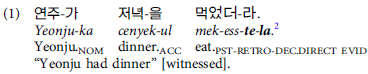
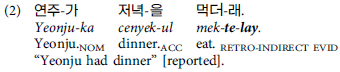
Korean evidential paradigm harbors a binary distinction between firsthand and non-firsthand information sources across four different forms: (1) the direct evidential -te- form that makes reference to events in the past, (2) the direct evidential -ney form that makes reference to events in the present, (3) the indirect evidential -keyss- form the use of which is appropriate for inference, and (4) the indirect evidential -lay form is used for reported sources (see accounts in Sohn, Reference Sohn2001, Reference Sohn and Aikhenvald2018; Song, Reference Song, Lee and Park2020). Korean has a complex interaction with temporal reference and information sources, as the direct evidential meaning can be distinguished between past and present events (see Chung, Reference Chung2010; Lee, Reference Lee2011, Reference Lee2013). For the purpose of this study, we only focus on the direct past/sensory evidential -te- and the indirect reported evidential form -lay , and for simplicity, we will henceforth refer to them as direct and indirect evidentials, respectively.Footnote 3
The suffix -te- signifies that the speaker has direct sensory evidence regarding the statement s/he utters (Song, Reference Song1998, Reference Song, Lee and Park2020). That is, the evidential meaning is consolidated based on the information obtained through the speaker’s (visual) senses that the event occurred in the past. In (1), the verb form mek-ess-te-la “(she) ate” indicates that the speaker witnessed while Yeonju was having her dinner. Note that -te- can also be affixed on past predicates to express the speaker’s new knowledge or awareness of the end result of an action that s/he has not directly witnessed (e.g., ttena-ss-te-la leave.DEC.PAST-DIRECT EVID “left”). Here, we specifically turn our attention to contexts where -te- marks visual sensory evidence. The indirect evidential suffix -te-lay encodes that the information in a given statement is acquired through hearsay or verbal reports from other speakers (see Chung, Reference Chung2010; Kim, Reference Kim2000). The -te-lay form derives from the verb “say” (Song, Reference Song, Lee and Park2020). In (2) above, the verb form mek -te-lay “(she) is said to have eaten” indicates that the speaker was told that Yeonju was having her dinner.
Similarly, Turkish encodes grammatical evidentiality distinctions through its tense, aspect, and mood inflections suffixed on predicates (see Aksu-Koç & Slobin, Reference Aksu-Koç, Slobin, Wallace and Nichols1986; Arslan, Reference Arslan2015; Johanson, Reference Johanson, Johanson and Utas2000; Sezer, Reference Sezer and Erguvanlı-Taylan2001; Slobin & Aksu, Reference Slobin, Aksu and Hopper1982).


Here, we align with the well-grounded view that Turkish makes a binary distinction between direct/firsthand and indirect/non-firsthand information sources (Aksu-Koç, Reference Aksu-Koç, Johanson and Utas2000; Aksu-Koç & Slobin, Reference Aksu-Koç, Slobin, Wallace and Nichols1986; Kornfilt, Reference Kornfilt1997; Lewis, Reference Lewis1967; Sezer, Reference Sezer and Erguvanlı-Taylan2001). In Turkish, the direct evidential inflectional suffix –(y)DI is used to indicate past events that the speaker has directly witnessed or participated in. For example, in (3), the verb form yedi “(she) ate” signals that the speaker has firsthand knowledge of the event, having directly witnessed Berna eating her dinner. By contrast, the indirect evidential suffix –(I)mIş is used to codify that the speaker has indirect access to the information, either by being told about it (i.e., reportative) or by making an inference based on observable end-states of an action (i.e., inferential). That is, in (4), the verb form yemiş “(she) ate” indicates that the speaker did not directly witness Berna eating her dinner but inferred it from resultant evidence, such as seeing her empty plate, or was reported about it by another speaker. Within both Korean and Turkish evidential paradigms, the indirect evidential is assumed to be marked due to its semantic complexity and is often shown to be acquired later in development (see below).
Psycholinguistic studies on evidentiality in Korean and Turkish
Pioneering psycholinguistic studies on evidential forms in both languages have stemmed from research on children’s first language acquisition, indicating that Korean children begin to produce the direct and indirect evidential markers -te- and -tay around the ages of two and three (Choi, Reference Choi, Bybee and Fleischman1995), whereas Turkish children first acquire the direct evidential morpheme -DI around 1.6 years of age, followed by the indirect morpheme -mIş several months later (Aksu-Koç, Reference Aksu-Koç1988). However, research on both languages points out that young children are not yet fully able to distinguish between direct and indirect sources of information. The ability to monitor inferred or reported information was shown to improve until around the age of seven, suggesting a gradual relationship between evidential use and the development of source monitoring abilities (see, e.g., Aksu-Koç, Reference Aksu-Koç1988; Öztürk & Papafragou, Reference Öztürk and Papafragou2016; Papafragou et al., Reference Papafragou, Li, Choi and Han2007).
The available studies on adult speakers’ processing of evidentiality in Turkish are scant, and there are none in Korean. Available studies on Turkish adult speakers suggest processing asymmetries in evidentiality, as Arslan et al. (Reference Arslan, de Kok and Bastiaanse2017) using an auditory sentence-source verification task, showed that Turkish listeners respond faster to evidentiality infelicities where a firsthand source is followed by an indirect evidential than to those where a non-firsthand source is followed by a direct evidential. Arslan (Reference Arslan2020) further showed that for Turkish, such mismatches in information source context and evidential form tend to evoke rather moderate acceptance rates (around 72% of the time) as compared to evidential forms matching to their appropriate information source (around 91%), suggesting that those mismatching conditions fulfil certain pragmatic function, and hence, they might be interpretable. However, in Turkish evidentials, acceptability is strongly modulated by the epistemic load of the context, as in a highly certain epistemic stance, indirect evidential is rather not compatible. This observation is compatible with previous findings that direct evidential -DI is often perceived as more reliable in Turkish than indirect information conveyed using -mIş indirect evidential (see Aydin & Ceci, Reference Aydin and Ceci2009; Tosun & Vaid, Reference Tosun and Vaid2018), and mismatches of such forms may even be perceived as deceitful (Arslan et al., Reference Arslan, Tunalı, Çetin and Aydın2024). See also Aksu-Koç and Arslan (Reference Aksu-Koç, Arslan and Johanson2024) for a recent overview of Turkish studies.
In summary, the available empirical studies on evidential forms in both Korean and Turkish indicate that children acquire evidential forms quite early, around the ages of two or three; however, their ability to monitor different information sources develops around the age of seven or perhaps even later. Psycholinguistic studies investigating evidentiality processing in adult Korean and Turkish speakers are scarce, and the available studies indicate that there may be a processing asymmetry, indicating that Turkish direct evidential is taken rather to be a default option and that indirect evidential has more complex semantics and is more strongly affiliated with cognitive mechanisms such as monitoring sources that belong to other speakers. Drawing on previously available studies, processing evidential meanings, which is closely tied to the cognitive capacity to monitor information sources, takes considerable time to develop in children, possibly due to its complexity. Moreover, indirect evidential forms may place greater demands on cognitive resources during processing in adult speakers. The existing literature nonetheless leaves an important gap concerning how evidentiality is processed in adult and older participants.
The current study
The overarching aim of this paper is to investigate whether evidentiality, a structure in language that has been attested to be challenging to acquire, is affected in older age across the adult lifespan. However, available research on the effects of aging on evidentiality processing in older adults is virtually nonexistent. To our knowledge, only one study, Söderqvist (Reference Söderqvist2017), has investigated non-grammatical optional evidential structures in English across age groups. The author reports that the frequency of evidential structures did not differ across age groups. Besides this study, however, our understanding of how grammatical evidentiality in sentence comprehension differs across the adult lifespan is yet to be informed.
To this end, we administered a self-paced reading experiment to investigate how grammatical evidentials are interpreted involving adult samples of young (N = 44, ages 19–27) and older (N = 37, ages 48–70) speakers of Korean, as well as young (N = 31, ages 18–31) and older (N = 45, ages 50–85) speakers of Turkish. Including both Korean and Turkish has allowed us to explore whether aging affects the interpretation of evidential markers across Korean and Turkish, two grammatically evidential languages that, however, differ typologically in how evidential meanings are marked. As mentioned above, Turkish encodes evidentiality within its tense/aspect/modality paradigm, whereas Korean evidentials are marked using dedicated verbal affixes. This typological contrast allows us to examine whether age-related changes in evidentiality processing are influenced by differences in how evidentiality is grammatically and pragmatically expressed. Moreover, studying two unrelated evidential systems provides a cross-linguistic perspective on whether observed processing patterns reflect universal or language-specific mechanisms.
We hypothesize that the cognitive capacity to monitor information sources, which underpin evidential meaning in language, may decline with age, thereby leading to reduced efficiency as measured by reading disruptions during processing evidential meanings. This assumption is built upon the well-grounded body of research showing that in comparison to younger adults, recognition memory and source monitoring often become poorer in older adults, as they often accept suggested information as witnessed, make and retrieve false memories, and are less confident in monitoring information (see Cansino et al., Reference Cansino, Estrada-Manilla, Hernández-Ramos, Martínez-Galindo, Torres-Trejo, Gómez-Fernández, Ayala-Hernández, Osorio, Cedillo-Tinoco, Garcés-Flores, Gómez-Melgarejo, Beltrán-Palacios, Guadalupe García-Lázaro, García-Gutiérrez, Cadena-Arenas, Fernández-Apan, Bärtschi, Resendiz-Vera and Rodríguez-Ortiz2013; Mitchell et al., Reference Mitchell, Johnson and Mather2003; Mueller-Johnson & Ceci, 2007; Multhaup et al., Reference Multhaup, De Leonardis and Johnson1999; Reifegerste et al., Reference Reifegerste, Veríssimo, Rugg, Pullman, Babcock, Glei, Weinstein, Goldman and Ullman2021), and this pattern seems less likely to be affected by cultural differences (Chua et al., Reference Chua, Chen and Park2006). Therefore, it is possible to assume that both older Korean and Turkish adults’ interpretation of evidential meanings might be compromised. This line of reasoning is also supported by the syntactic complexity account, which posits that cognitively demanding language structures often pose comprehension difficulty in older adults (see, e.g., Hasher & Zacks, Reference Hasher, Zacks and Bower1988; Waters & Caplan, Reference Waters and Caplan2001). If our assumption holds true, following the syntactic complexity account, we may expect both older Korean and Turkish adults to show similar signs of compromised evidentiality processing, as measured by reading disruptions and longer responses. The rationale here is that potentially declining memory resources would render normal processing of evidentiality not possible. If our assumption does not hold true, however, and neither older Korean nor Turkish adults show signs of compromised evidentiality processing, then this suggests that despite the cognitive decline in healthy aging, sentence processing is compensated or maintained in older age. This would then be accounted for under the syntactic resilience account (see, e.g., Peelle, Reference Peelle, de Zubicaray and Schiller2019; Tyler et al., Reference Tyler, Shafto, Randall, Wright, Marslen-Wilson and Stamatakis2009; Wingfield & Grossman, Reference Wingfield and Grossman2006).
Experiment 1. Evidentiality processing in Korean speakers
Participants
Eighty-one Korean speakers participated in this experiment. This cohort was divided into two distinct age groups: 44 young adults with an average age of 22.70 years (SD = 2.04, age range = 19–27, including 32 females) and 37 older adults with an average age of 57.13 years (SD = 4.68, age range = 48–70, including 20 females). Within the senior adult group, we recruited two individuals in their late 40s, 25 individuals in their 50s, and 10 individuals over 60. All the participants acquired Korean from birth in a naturalistic setting; the majority of the participants did not speak a second language well and/or learned English as a second language later in adulthood. None of the participants reported any psychiatric, mental, or learning disorders. The participants were recruited from the greater Seoul metropolitan area. Their educational levels ranged from those with at least a tertiary education or currently enrolled in a bachelor’s program (33.7%) to those who had completed a bachelor’s degree or higher (30.5%) and those enrolled in higher research programs, including master’s and doctoral degrees (35.8%). The senior participants underwent screening using the Korean Mini-Mental State Examination (Han et al., Reference Han, Jo, Jo, Kim, Park and Kang2008). The participants achieved an average score of 27.1 (SD = 1.8) out of 30, with each individual’s score exceeding the sensitive cut-off score of 23 for the presence of mild cognitive impairment or dementia (see Baek et al., Reference Baek, Park and Kim2025). To detail out their cognitive profiles, each participant in the study was further evaluated for visuospatial span scores using the Corsi block-tapping task (Corsi, Reference Corsi1972). The participants achieved an average score of 5.96 out of 9. On average, the younger adult group achieved a score of 6.36, whereas the older adult group recorded an average score of 5.45. This difference was statistically significant, confirming that the older adults exhibited a reduced capacity for visuospatial working memory compared to the younger adults (t(6334.7) = 22.92, p < .001, CIs [0.80, 0.95]).
Materials
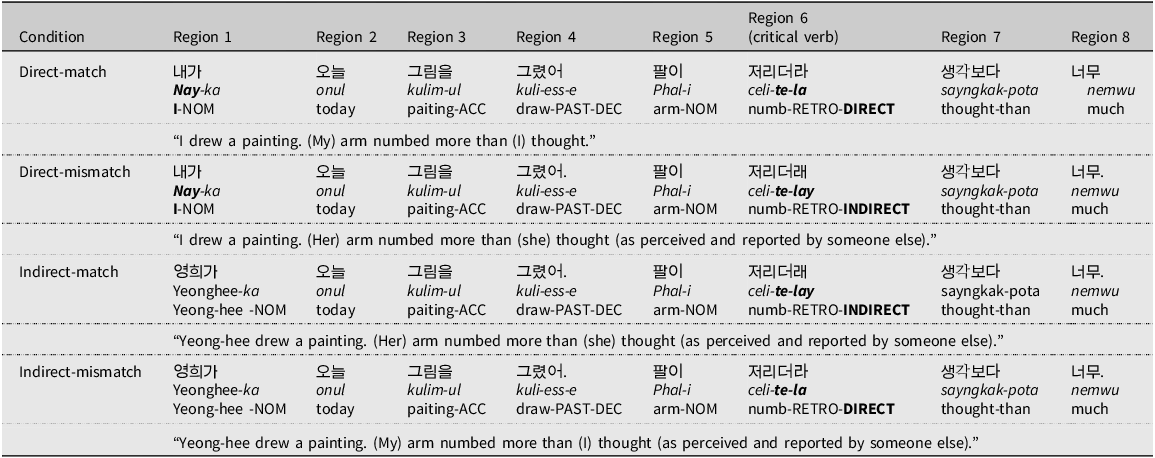
Table 1 demonstrates the total of 80 sentence quadruplets constructed in a 2 (Evidentiality: Direct vs. Indirect) × 2 (Congruency: Match vs. Mismatch) design, distributed across four conditions: (i) direct-match, (ii) direct-mismatch, (iii) indirect-match, (iv) indirect-mismatch. To create these conditions, we created sentence contexts with two clauses. The first clause acted as the information source context (Regions 1–4 in Table 1), and the second one acted as the critical clause where the critical evidential verb form was presented. The first manipulation, Evidentiality, determines whether the main verb carries a direct (- te -) or indirect (- lay ) evidentiality marker. As shown in Table 1, when a critical verb (e.g., “to numb” in region 6) contains the evidential marker - te -, it indicates that the speaker directly witnessed or experienced the event in the proposition (Direct). In contrast, when the verb contains – lay (realized in this context as - telay ), it suggests that the sensory experience belongs to a report from someone else (Indirect). In the direct-match condition, the critical verb celi-te-la “become numb.RETRO.DIRECT” is appropriate for use following the information context clause Nayka onul kulimul kulyesse “I draw a painting” as the -te- direct evidential form indicates that the speaker personally experienced this event. In the indirect-match condition, by contrast, the information source context mentions Yeong-hee.ka onul kulim-ul kulye-ss-e “Yeong-hee drew a painting” and makes the use of celi-te-lay “become numb.RETRO.INDIRECT” appropriate for the critical verb. The - telay here indicates that the speaker is reporting someone else’s experience, hence making it appropriate for the use of an indirect evidential form.
A sample quadruplet of stimulus sentences used in the Korean self-paced reading experiment
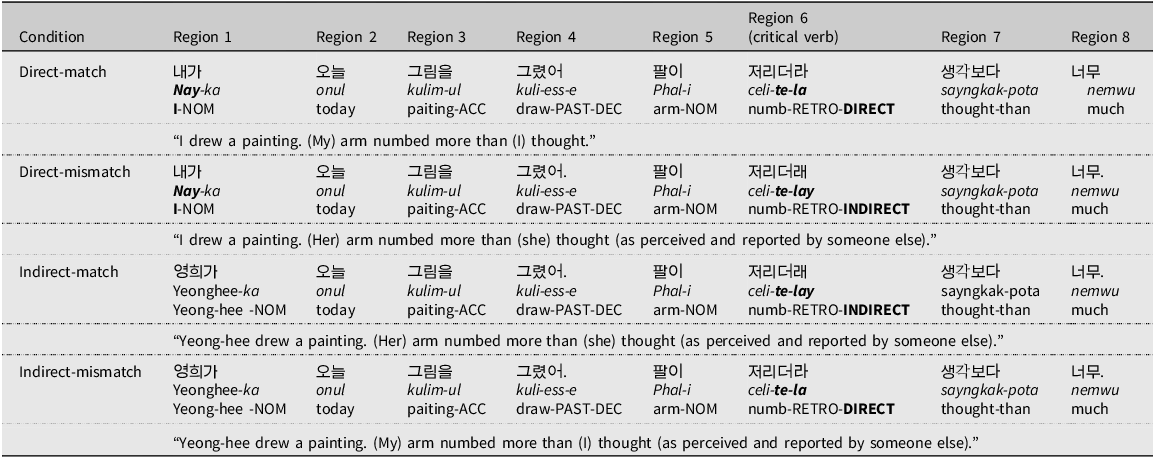
The second experimental manipulation, Congruency, examines whether the sentence context aligns with or contradicts the information source indicated by the verb’s evidentiality. Two conditions—direct-match and indirect-match—are acceptable because the information source in the first clause is congruent with the type of evidential marker in the evidential form expressed at the critical verb. In the direct-mismatch condition, the information source context signifies an event that was participated in by the speaker Nayka onul kulimul kulyesse “I drew a painting,” and thus, at the critical clause following this information source context, the use of the indirect evidential marker on the verb -lay suffix is inappropriate in Korean. In the indirect-mismatch condition, in contrast, the information source context states that the information regarding an event in the proposition belongs to the speaker (Yeong-hee, who drew a painting). However, at the critical clause that follows the context, a verb that is marked with a direct evidential -te-la suffix appears, which goes against intuition as it suggests that the speaker reports on an action as if s/he directly experienced it. Therefore, the use of direct evidential in this situation would not be appropriate.
Procedure
The experimental sentence stimuli were programmed within a non-cumulative self-paced reading design with an end-of-sentence acceptability judgment task (see Jegerski, Reference Jegerski, Jegerski and VanPatten2014; Just et al., Reference Just, Carpenter and Woolley1982). The task was coded using the IbexFarm platform (Drummond, Reference Drummond2013). In each trial, the participants were presented with a sentence, centered in the middle of their computer screen, which was represented by a sequence of dashes. These dashes truncated each word and made the location and length of each word apparent. The participants were instructed to read sentences segment by segment at their own pace by pressing the spacebar, which sequentially unveiled each segment while keeping the others truncated. With each press, a sequence of dashes was transformed into a segment in a linear progression of words across the screen in a left-to-right orientation. We utilized four practice trials, during which participants received immediate feedback on the accuracy of their responses, ensuring that the participants fully understood the task.
The sentence materials were distributed across four lists, with each list containing an equal number of experimental sentences from every condition in a counterbalanced manner and filler sentences. A participant responded to one list, a total of 120 sentences consisting of 80 experimental sentences and 40 fillers. Following each sentence, the participants were given an acceptability task, which required them to respond whether the sentence they had read was acceptable or not. The participants were instructed to respond by pressing on the keyboard “F” for acceptable or “J” for not acceptable. The experiments were conducted by two research assistants using either desktop or laptop computers. The experiment lasted approximately 45 minutes, and each participant received a monetary compensation of ₩10,000 for their participation. The procedures reported here adhered to the Declaration of Helsinki and its affiliated legislation regarding research on human subjects.
The experimental sentences were intermixed with 40 filler trials containing 10 semantically and 10 grammatically incongruent sentences and 20 congruent sentences to prevent the participants from developing strategies (e.g., anomaly with a wrong case marker: 내가 최근에 자동차를 팔-았-는데 값-* ‘INOM recently carACC sellPST price-*NOM… and congruent context: 민수가 오늘 봤던 영화는 굉장히 유명한 감독의 작품이다 “MinsuNOM today sawREL movieTOP very famous directorGEN work-is; Natural translation: The movie that Minsu watched today is the work of a very famous director.”). Please note that there is no consensually agreed ratio of filler to experimental sentences, and this ratio varies across researchers who administered self-paced reading experiments (see Arslan, Reference Arslan, Nesi, Milin and Filipović Đurđević2026; Keating & Jegerski, Reference Keating and Jegerski2015 for recent methodological reviews). While some authors have used more filler items than experimental items, others have used fewer or none. Marsden et al. (Reference Marsden, Thompson and Plonsky2018) also reported that the majority of the studies they reviewed included 50% or more noncritical items, a threshold that our study seems to meet.
Data analysis
Using the self-paced reading design, three kinds of data were recorded: (i) accuracy of responses, (ii) latency of responses in milliseconds, and (iii) and per-segment reading times (RTs) in milliseconds. Prior to the statistical analysis, the RT data points shorter than 200 ms or longer than 10000 ms were excluded. These thresholds resulted in the exclusion of 2.1% of the data in Region 5 (prior to the critical verb region) and 2.3% in Region 6 (critical verb region). For all other regions, the data removed did not exceed 3.8%. The data were analyzed in R version 4.2.3 (R-Core-Team, 2012) with linear mixed-effects regression models for end-of-trial response times and RTs and generalized linear mixed-effects regression models for response accuracy data using the lme4 package (Bates et al., Reference Bates, Mächler, Bolker and Walker2015). These models included binary categorical independent variable fixed effects for Evidentiality (Direct vs. Indirect) and Congruency (Match vs. Mismatch), which were sum-to-zero contrast coded. We added region length as a fixed effect to each model for each region to be able to control for varying region lengths, instead of using z-score transformed residual RTs. The RT data were log-transformed to ensure a homoscedastic distribution. Participants and items were incorporated as random intercepts and/or random slopes (Baayen et al., Reference Baayen, Davidson and Bates2008). The p-values were obtained using the Satterthwaite approximation. Bonferroni-corrected Tukey post hoc tests were computed using the emmeans package (Lenth & Lenth, Reference Lenth and Lenth2018).
Results
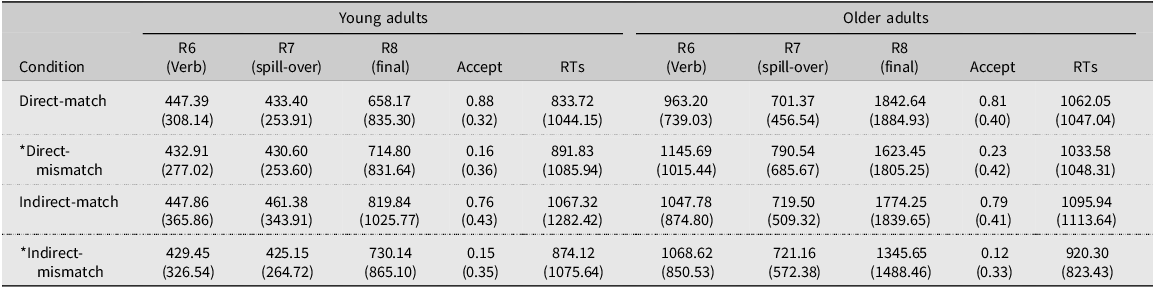
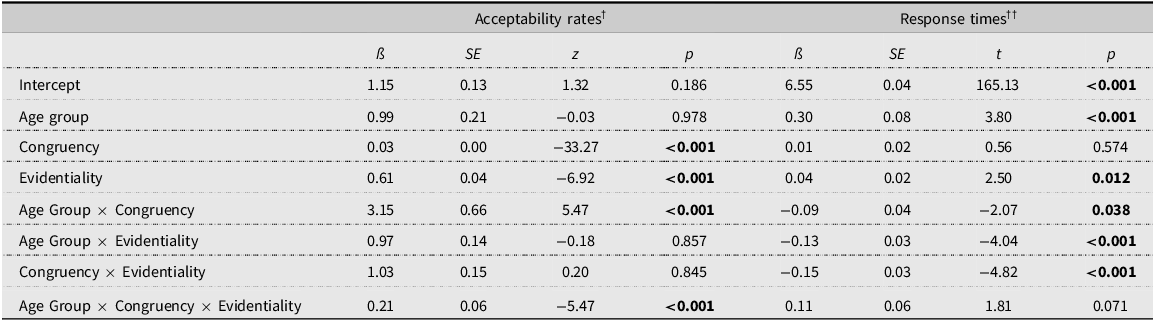
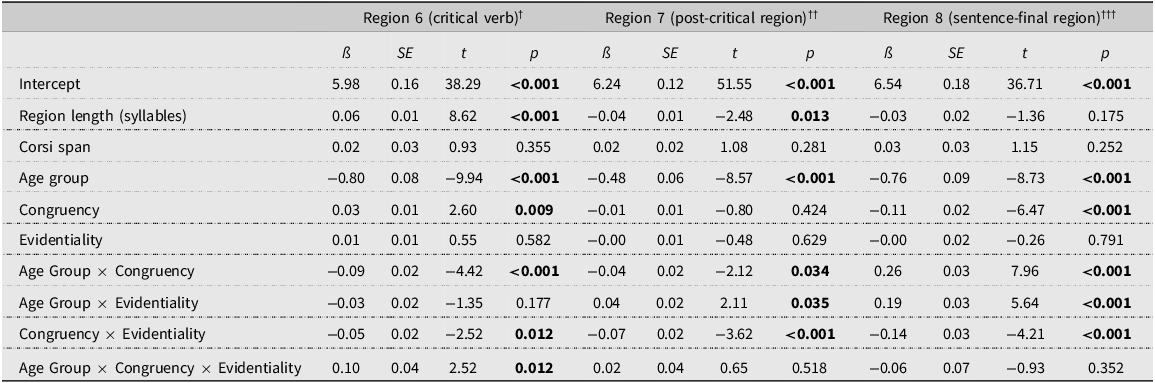
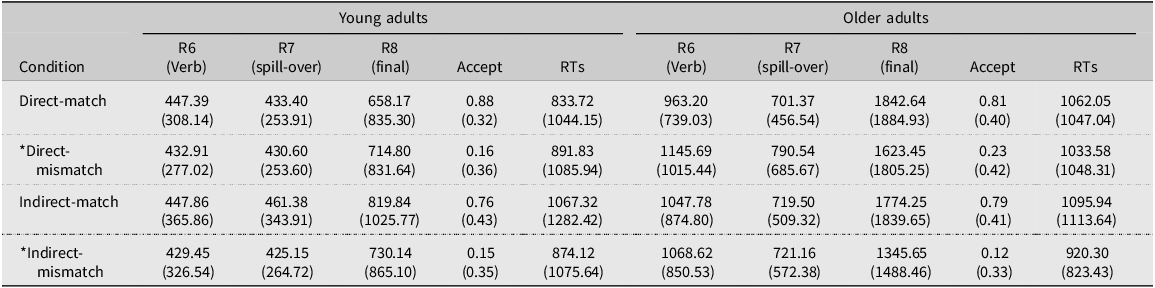
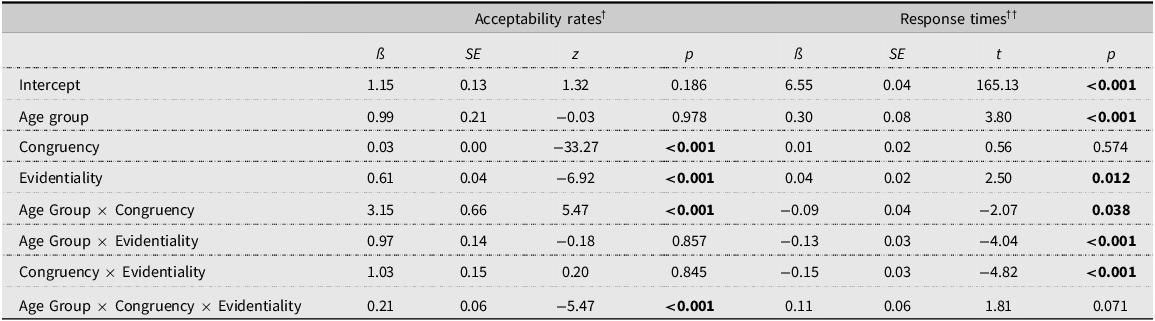
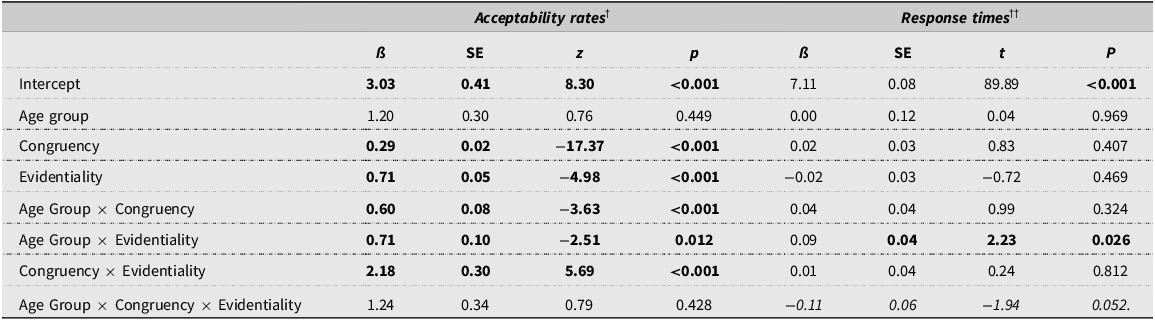
Results from per-segment RTs, response accuracy, and latencies are given in Table 2, and outputs from (generalized) mixed-effects regression models computed with end-of-trial responses are provided in Table 3, and those with per-segment RTs are given in Table 4.
Raw RTs and standard deviations per region, end-of-sentence acceptance rates, and end-of-trial response times. Notes: Accept. = acceptance rate in proportions, SDs in parentheses
Outputs from mixed-effects regression models that include acceptability rates and end-of-trial response times data (ß = estimate, SE = standard error). Significant effects are bolded
† Random effects for the accuracy model: σ2 = 3.29, τ00 subject = 0.70, τ00 stimulus = 0.04, ICC = 0.18, marginal/conditional R 2 = 0.446/0.548.
†† Random effects for the RTs model σ2=0.38, τ00subject = 0.11, τ00stimulus = 0.00, ICC = 0.23, marginal/conditional R 2 = 0.034/0.259.
Sample code in R: model1 = glmer (Acceptability ∼ Group × Congruency × Evidential + (1|subject_id) + (1|stimulus_event), family = binomial, data = data, control = glmerControl (optimizer = “bobyqa”)).
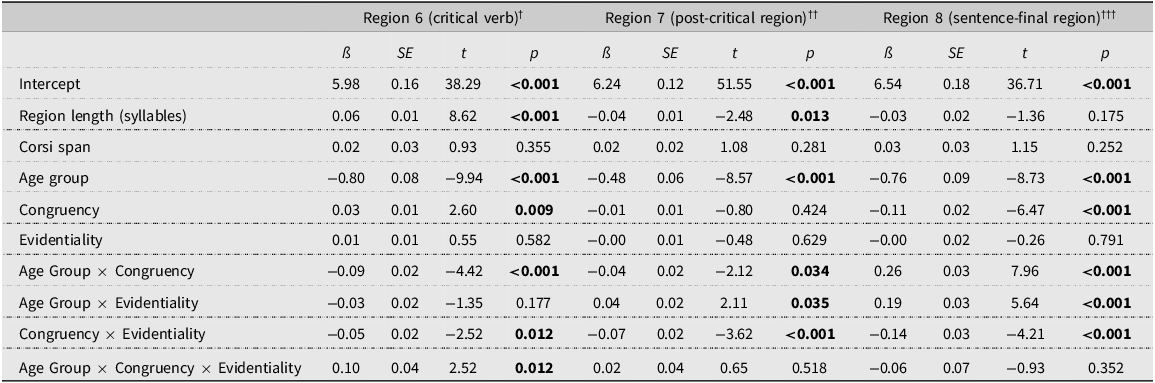
Outputs from mixed-effects regression models per-region RT data (ß = estimate in log-transformed units, SE = standard error)
† Random effects for R6 model σ2 = 0.16, τ00 subject_id = 0.12, ICC = 0.43, marginal/conditional R 2 = 0.358/0.632.
†† Random effects for R7 model σ2 = 0.14, τ00subject_id = 0.06, ICC = 0.30, marginal/conditional R 2 = 0.223/0.454.
††† Random effects for R8 model σ2 = 0.42, τ00 subject_id = 0.14, ICC = 0.24, marginal/conditional R 2 = 0.207/0.399.
Sample code in R: roi = “R8”; R8.glm <− lmer(log(rt) ∼ RegionLength + corsi_span + age_group × match × Evidential + (1|subject_id), data = subset(SPR.data, region == roi), control = lmerControl (optimizer = “bobyqa”)).
End-of-sentence responses
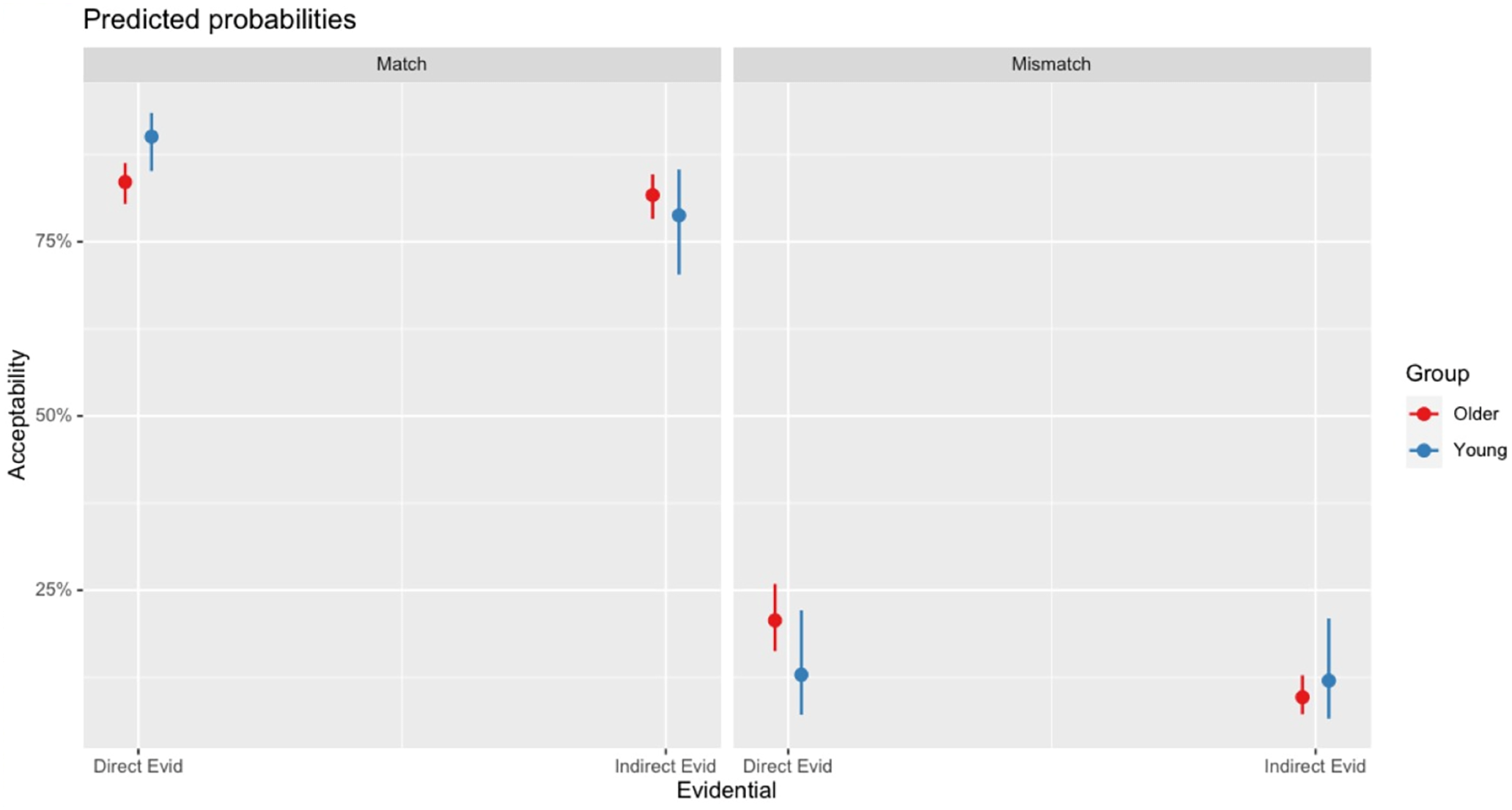
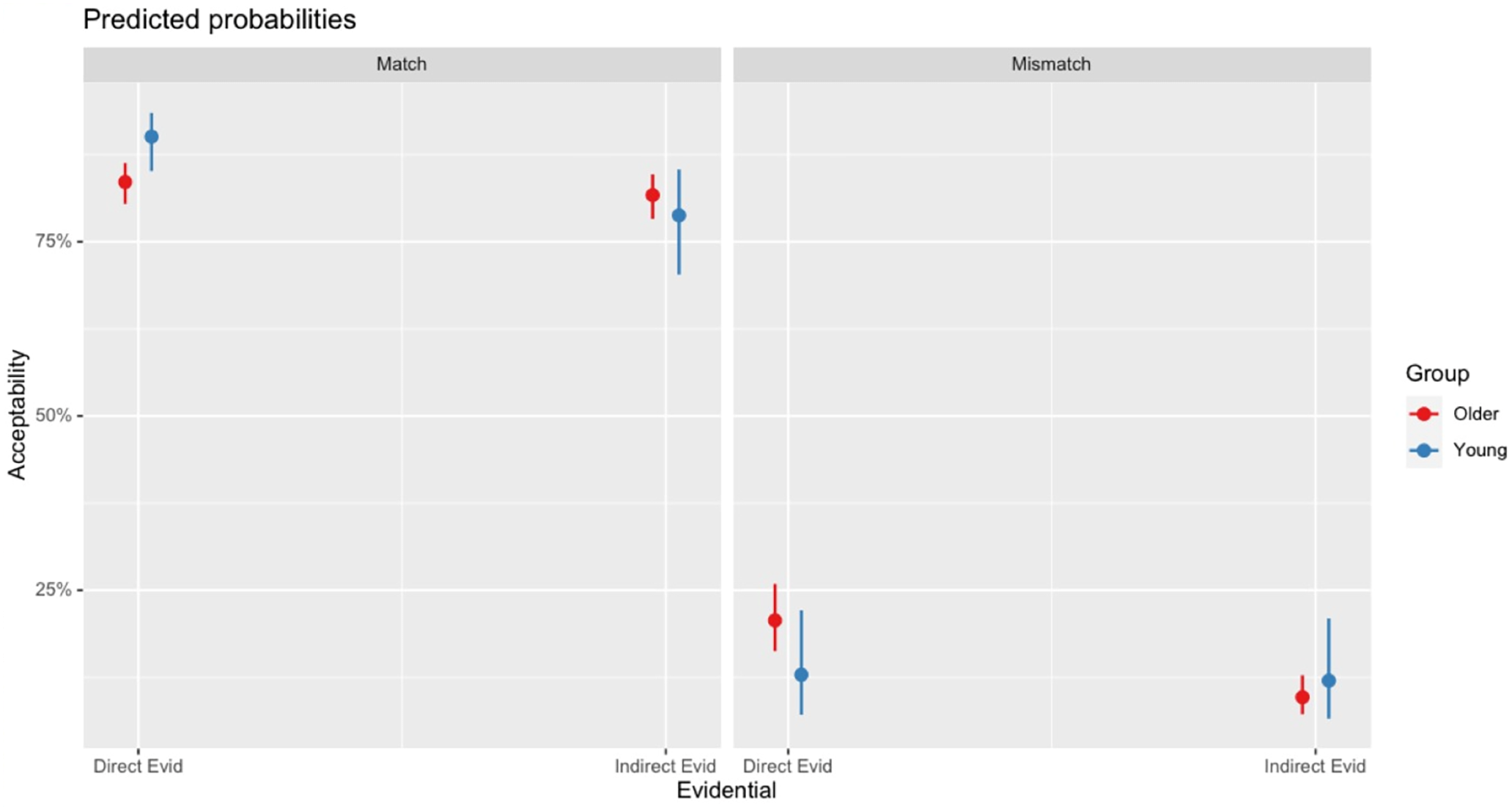
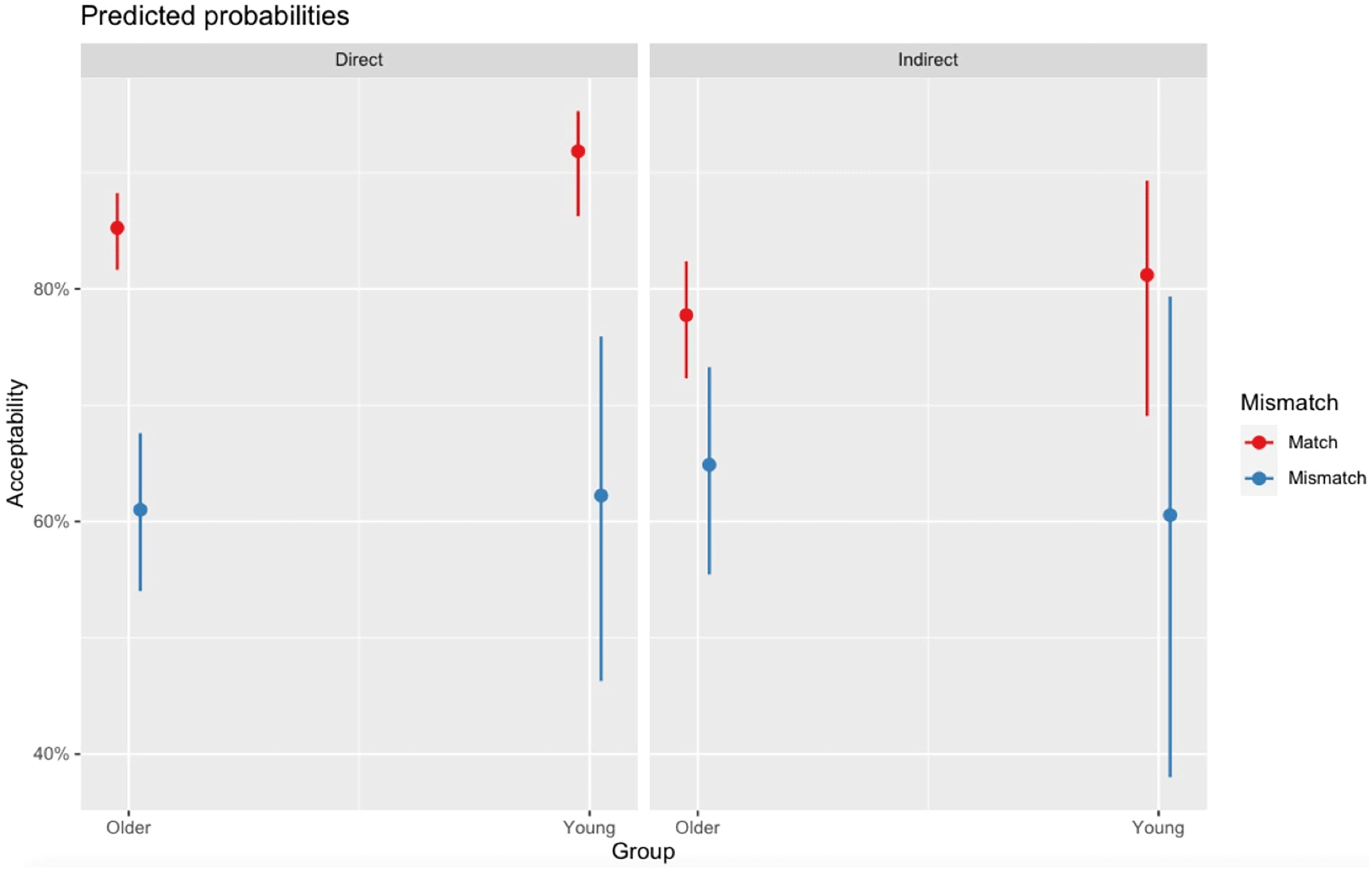
Regarding the end-of-sentence acceptance rates, the model outputs have shown significant fixed effects of Congruency and Evidentiality, respectively, and significant interactions for Age Group × Evidentiality, and a three-way interaction between Age Group × Congruency × Evidentiality (see Table 3). This interaction is largely driven by Congruency, where matching items were rated as more acceptable than mismatching ones, and there seems to be interesting Age Group differences across evidential conditions, however (see the interaction in Appendix 1). For match items, acceptance rates were above 76% in any condition or group, while the older adults’ acceptance rates for mismatching items were 23%, and those of the younger adults were around 15%. Given these differences across conditions, to better understand the Age Group × Congruency × Evidentiality interactions, we further analyzed acceptance rates in post hoc comparisons.
For matching items, there was no fixed effect of Age Group (Intercept ß = 1.83, SE = 0.14, z = 12.61, p < .001; Age Group ß = −0.23, SE = 0.25, z = −0.91, p = .36). However, there was a significant fixed effect of Evidentiality (ß = −0.55, SE = 0.10, z = −5.53, p <.001) and an interaction effect between Evidentiality and Group (ß = 0.87, SE = 0.20, z = 4.37, p < .001). This interaction signifies the fact that the younger group achieved higher acceptance rates in direct than in the indirect evidential condition (ß = 0.99, SE = 0.14, z = 6.96, p < .001), while this condition difference was not significant in the older group (ß = 0.11, SE = 0.14, z = 0.82, p = .84) in the match condition. For mismatching items, the model outputs showed a nonsignificant fixed effect of Group (Intercept ß = −2.20, SE = 0.17, z = -12.61, p < .001; Age Group ß = 0.12, SE = 0.33, z = 0.37, p = .71). However, the fixed effect for Evidentiality (ß = −0.57, SE = 0.11, z = −5.06, p < .001) and the interaction between Evidentiality and Age Group returned significant (ß = −0.99, SE = 0.22, z = −4.35, p < .001). In the mismatching items, the older group had elevated acceptance rates for the direct condition in comparison to the indirect condition (23% vs. 12%; ß = 1.07, SE = 0.17, z = 6.32, p < .0001), while this difference did not hold for the younger group (16% vs. 15%; ß = 0.07, SE = 0.15, z = 0.50, p = .95).
With respect to the end-of-sentence response times, model outputs have shown fixed effects for each factor of Age Group and Evidentiality (Table 3). A fixed effect of Age Group indicates that the older adults were slower on average in their response than the younger adults, and a fixed effect of Evidentiality signals that the participants were slower in responding to the indirect than the direct evidential condition overall. Given significant interactions for Age Group × Evidentiality, Age Group × Congruency, and Congruency × Evidentiality, we further analyzed matching and mismatching items in two separate models to better understand group differences. For matching items, the model outputs have demonstrated a significant fixed effect for the Age Group (Intercept ß = 6.60, SE = 0.04, t = 147.70, p < .001; Age Group ß = 0.24, SE = 0.08, t = 2.82, p = .005), for Evidentiality (ß = 0.11, SE = 0.02, t = 5.14, p < .001), and for an interaction between the two factors (ß = −0.18, SE = 0.04, t = −4.19, p < .001). A set of post hoc comparisons revealed that the young adults responded with faster RTs to the matching direct than indirect evidential condition (ß = −0.20, SE = 0.02, z = −6.87, p < .001), while this difference did not hold in the older adults (ß = −0.02, SE = 0.03, z = −0.65, p = .91), who were longer on average in responses than the younger adults. For mismatching items, however, the model outputs showed a significant fixed effect of Age Group (Intercept ß = 6.53, SE = 0.03, t = 166.38, p < .001; Age Group ß = 0.25, SE = 0.07, t = 3.24, p = .001), while the fixed effect for Evidentiality (ß= 0.03, SE 0.02, t = 1.73, p = .08) or the interaction between Age Group and Evidentiality did not reveal significant outputs (p > .11). The result indicates that, for mismatching items, the older adults responded with slower RTs than the younger adults without any further critical condition differences.
Per-region reading times
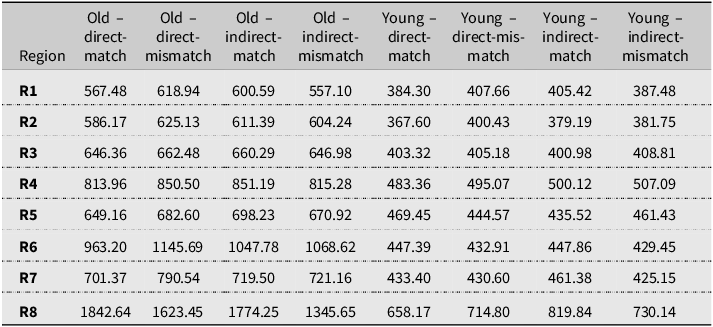
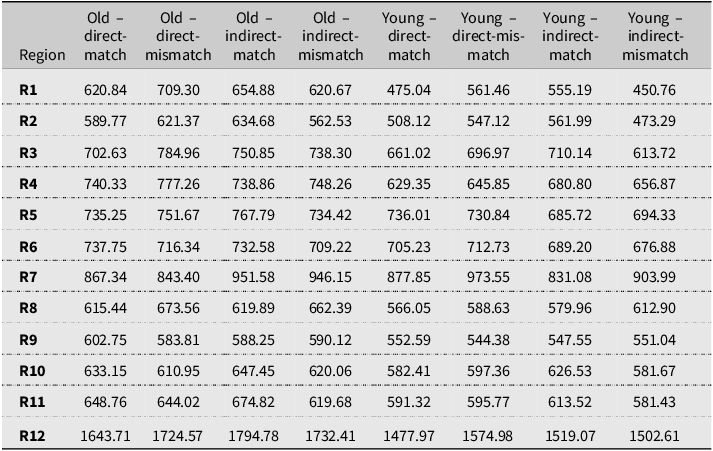
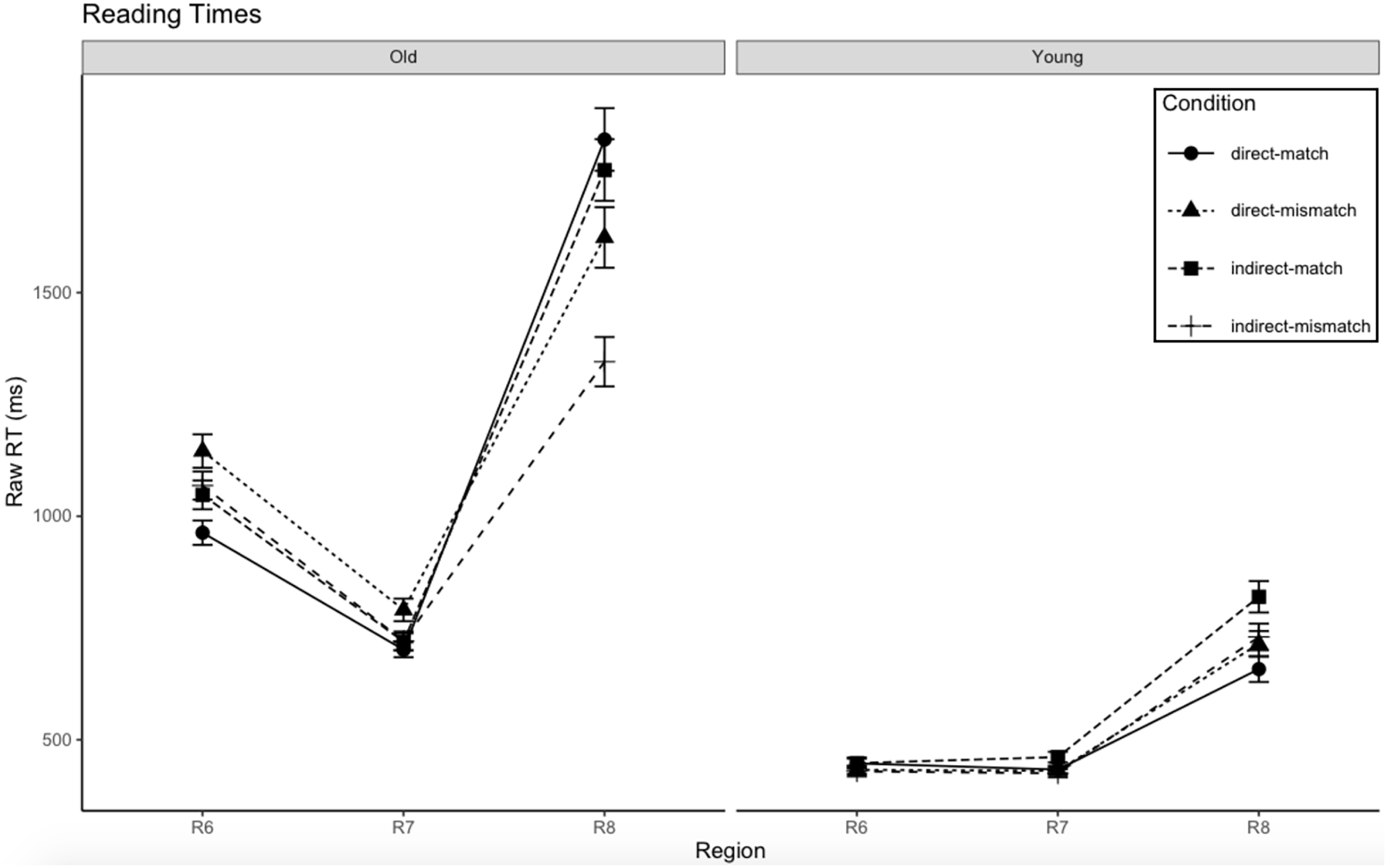
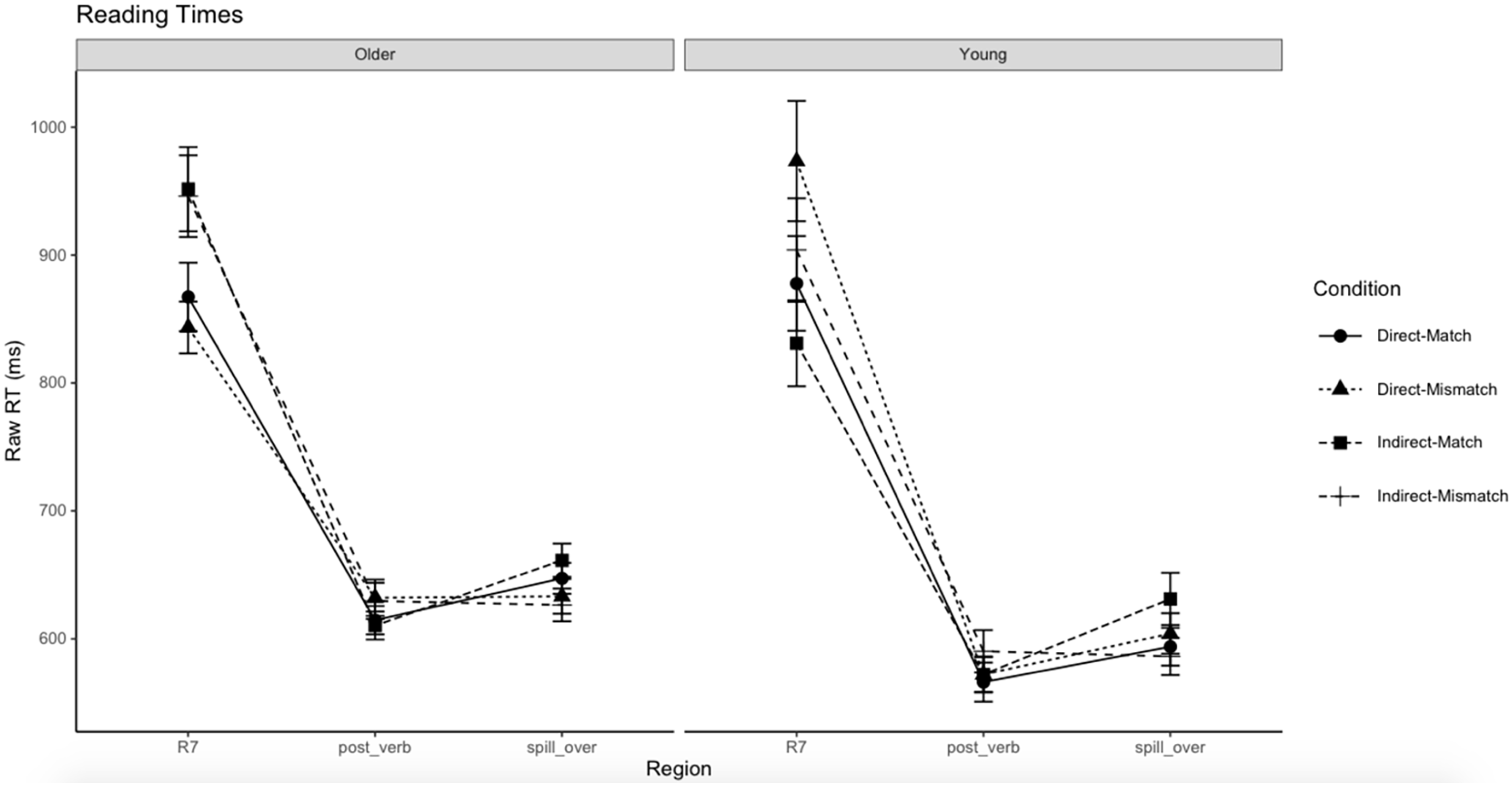
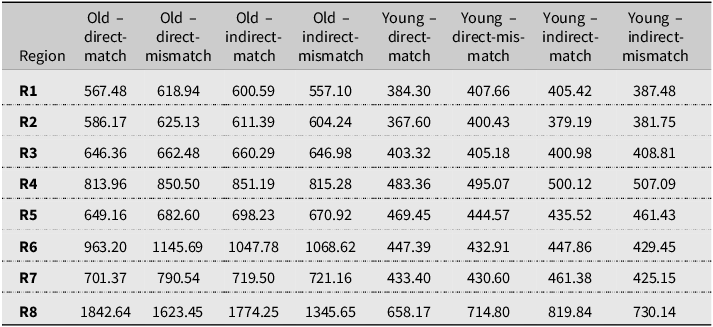
Per-region RT data were analyzed for three critical regions: R6, where the critical verb appeared; R7, the post-critical region; and R8, which contained the final word of the sentence. The mean RTs and their standard deviations are given in Table 2, and these RTs across the three critical regions are visually depicted in Figure 1. The full data table covering all regions is given in Appendix 2. A set of linear mixed-effects regression models was conducted with the data from each region separately (Table 4).
Raw RTs across regions of interest (critical verb is at R6) per age group.
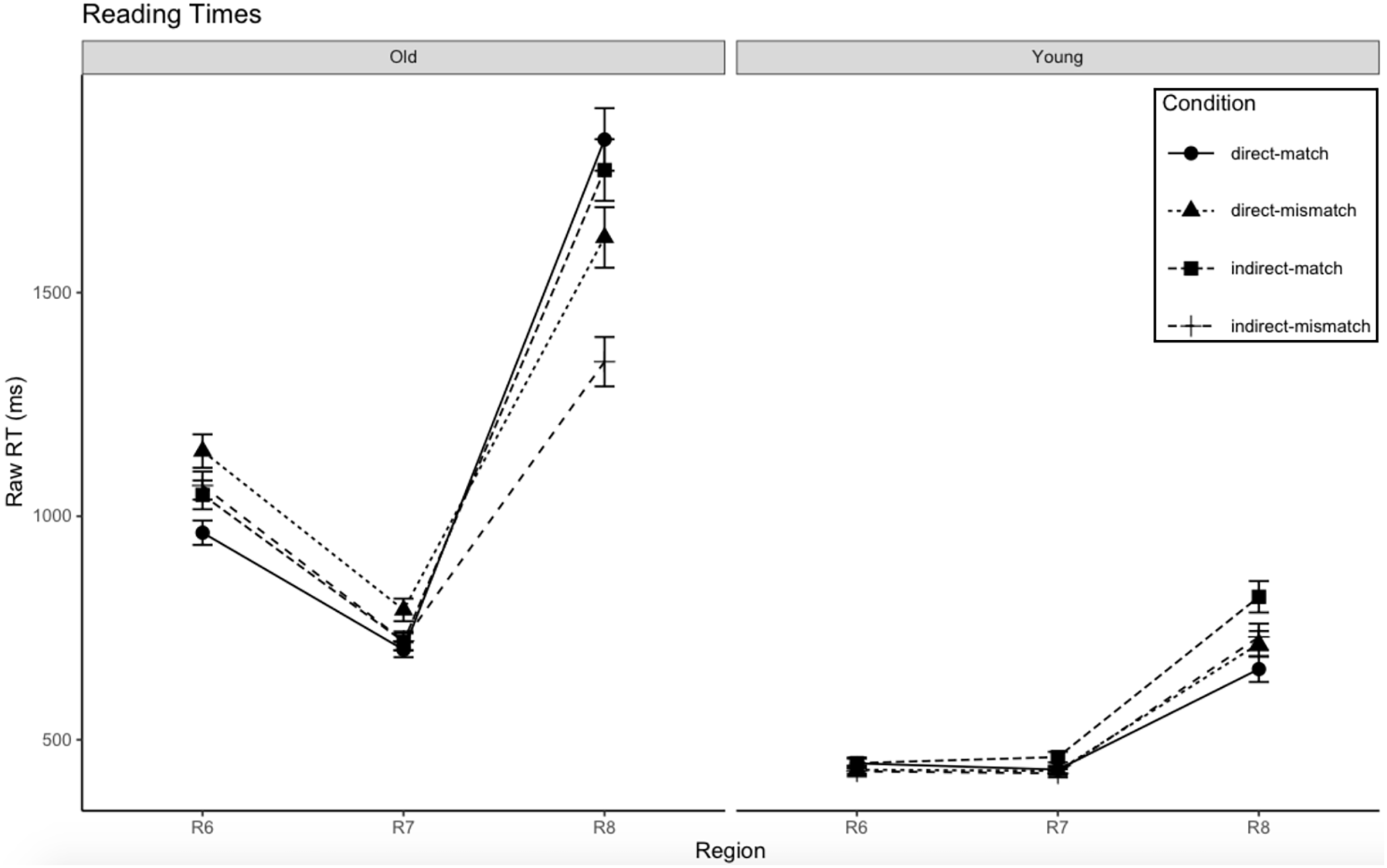
Region 6 (critical verb): The model outputs for RTs recorded in R6 (see Table 4) revealed significant fixed effects of Age Group, indicating faster RTs for younger adults, and of Congruency, evidencing the participants’ early sensitivity to mismatch at the verb. Region length is often significant in reading experiments and hence will not be further discussed. Further, the model outputs have shown significant two-way interactions for Age Group × Congruency and Congruency × Evidentiality and a three-way interaction for Age Group × Congruency × Evidentiality. Region 6 shows immediate sensitivity to evidential and congruency information, with age-related differences. Two pieces of findings are important here. First, the older adults read this region more slowly across all conditions compared to the younger individuals. Second, the older adults read direct evidential verbs in this region with longer RTs in the direct-mismatch condition as compared to its acceptable baseline direct-match condition (ß = −0.12, SE = 0.02, z = −5.83, p < 0.001), while the younger adults did not show such a difference (ß =0.01, SE = 0.01, z = 0.98). Moreover, no condition difference was observed for indirect evidential verbs in either group.
Region 7 (post-critical region): Model outputs for R7 have shown that the fixed effect of Age Group remained highly significant, indicating that the older adults were slower in reading overall as compared to the younger adults. There were no significant fixed effects for Congruency or Evidentiality. These model outputs have also shown significant two-way interactions for Age Group × Congruency, Age Group × Evidentiality, and Congruency × Evidentiality. The overall reading profiles in older adults slightly sped up at R7, but they were still slower compared to younger adults (see Figure 1), and no critical differences were found between the match and mismatch counterparts for both direct and indirect evidential verbs in either group (all ps > 0.12).
Region 8 (sentence-final region): Finally, for R8, again similar to the previous regions, the older adults’ overall slow-reading patterns remained, who showed interesting condition differences, however. The model outputs have indicated significant fixed effects for Age Group and Congruency, as well as significant two-way interactions of Age Group × Congruency, Age Group × Evidentiality, and Congruency × Evidentiality. A set of post hoc tests have indicated that the older adults took longer to recover from evidential mismatch effect as compared to younger adults; nonetheless, they read mismatch conditions with quicker RTs for both direct evidential (ß = 0.18, SE = 0.03, z = 5.36, p < .001) and indirect evidential verb forms (ß = 0.29, SE = 0.03, z = 8.51, p < .001). This recovery appears to be slightly more effortful in the direct-mismatch condition compared to the indirect-mismatch condition, as older adults exhibited longer RTs in the former (ß = 0.15, SE = 0.03, z = 4.41, p < .001). Any such condition differences were not observed in the younger adults.
Summary of results from Experiment 1 and discussion
Experiment 1 aimed to understand whether and how evidentiality processing differs in healthy-aging individuals who speak Korean (aged 48–70) compared to a group of younger adults (aged 19–27). Results indicated that evidential verbs that mismatch information source contexts in all conditions are largely not acceptable. However, older adults showed a slightly higher, though minimal, tendency to judge the direct-mismatch condition as acceptable (around 23%). At the critical verb region (R6), older adults exhibited longer RTs in the direct-mismatch condition compared to the baseline direct-match condition, but no such effect was observed for indirect evidentials. This suggests that older adults experienced greater reading disruptions when encountering a direct evidential verb in a non-firsthand information context, as opposed to an indirect evidential form in a firsthand context. The reading profiles in R7 and R8 indicated a relatively immediate recovery from mismatch effects in older adults, as there were no critical condition differences in the immediate post-verbal region, suggesting that the older adults seemed to have already worked out the mismatch. However, at the sentence end, critical effects emerged: (i) the older adults read mismatching direct and indirect evidentials quicker as compared to their matching counterparts; (ii) they read the direct-mismatch condition with longer RTs than the indirect-mismatch condition. Accelerated RTs at post-critical regions often signify processing ease, as individuals may have already made a decision regarding the final task. That is, upon detecting a mismatch, they may accelerate through the post-critical regions to reach the final task more swiftly (see Stowe et al., Reference Stowe, Kaan, Sabourin and Taylor2018).
One very clear finding observed in the older Korean speakers’ processing of evidentiality was that their interpretation was rather disrupted by the presence of a direct evidential verb within an inappropriate information context. They tended to find this type of mismatch minimally but significantly acceptable, taking longer to read direct evidential verbs when they appeared inappropriately. Additionally, they took more time to recover from the direct-mismatch effect at the sentence end compared to indirect evidential mismatches. It is well established in source memory literature that older adults have reduced accuracy and a greater tendency to make “false alarms” while recollecting source information of a given item in eyewitness memory (see, e.g., Cansino et al., Reference Cansino, Estrada-Manilla, Hernández-Ramos, Martínez-Galindo, Torres-Trejo, Gómez-Fernández, Ayala-Hernández, Osorio, Cedillo-Tinoco, Garcés-Flores, Gómez-Melgarejo, Beltrán-Palacios, Guadalupe García-Lázaro, García-Gutiérrez, Cadena-Arenas, Fernández-Apan, Bärtschi, Resendiz-Vera and Rodríguez-Ortiz2013; Mitchell et al., Reference Mitchell, Johnson and Mather2003; Mueller-Johnson & Ceci, Reference Mueller-Johnson, Ceci, Toglia, Read, Ross and Lindsay2007; Multhaup et al., Reference Multhaup, De Leonardis and Johnson1999). It seems that there is a parallel between such widely observed source monitoring errors in gracefully aging adults reported in the previous literature and the Korean older adults’ judgments in our sentence contexts, requiring monitoring and mapping certain information source onto evidential verb forms. More precisely, our Korean sentence stimuli in the direct-mismatch condition signaled that the author of the sentence did not personally experience this event. However, older Korean speakers exhibited higher rates of misattributing the direct information source to a reportative form (23% of the time), suggesting that the speakers conveyed their own experiences as if they were reporting information told by others. Under normal circumstances, this is counterintuitive in Korean and not observed in the younger adult group. However, we should caution the reader not to interpret such misattributions as grammatically erroneous, but rather these mismatches are pragmatically not intuitive, but in many evidential languages, misuses of evidentials are occasionally used to obtain certain pragmatic effects (i.e., to indicate that the speaker is lying, see Aikhenvald, Reference Aikhenvald2004, p. 98; Arslan et al., Reference Arslan, Tunalı, Çetin and Aydın2024).
Experiment 2: Evidentiality processing in Turkish speakers
Methods
We recruited 73 Turkish native speakers, who were divided into two age groups. The group of young adults included 31 individuals with an average age of 27.32 years (SD = 3.5, age range = 18–31, including 21 females). The group of senior adults contained 42 individuals with an average age of 62.91 years (SD = 8.66, age range = 50–85, including 24 females). The participants involved 3 individuals younger than 20, 19 individuals in their 20s, 9 individuals in their 30s, 18 individuals in their 50s, 15 individuals in their 60s, 7 individuals in their 70s, and only two over 80. The participants acquired Turkish from birth in naturalistic settings and had been residing at the time of testing in the following cities: Eskişehir (51.8%), İzmir (8.2%), İstanbul (8.2%), and other nearby cities (31.8%). Their level of education ranged from primary school (5 years, 26.2%), middle school (8 years, 9.5%), and high school (12 years, 20.2%) to associate degrees (+2 years, 7.1%) and bachelor’s degrees (+4 years, 22.6%), with a smaller proportion holding graduate-level qualifications (14.3%). None of the participants had a history of psychiatric, mental, or learning disorders. The participants were screened with the Turkish adaptation of the Addenbrooke’s Cognitive Examination, and those who achieved a score above 73 were admitted (ACE-III, Mihci et al., Reference Mihci, Gurvit, Bilgic, Alpaslan, Tumac, Yildiz, Unsalan, Akca Kalem and Tanor2011). The maximum score in ACE-III is 100, and a cut-off value of 73 was used following Mihci et al.’s (Reference Mihci, Gurvit, Bilgic, Alpaslan, Tumac, Yildiz, Unsalan, Akca Kalem and Tanor2011) sensitive diagnostic norm for mild cognitive impairment or for dementia. The younger participants obtained an average of 90.92 (SD = 6.21) from the ACE-III, while the senior adults achieved an average score of 84.46 (SD = 10.14). The younger adults performed significantly better on the ACE-III than their senior fellows (t(5805.5) = −30.29, p < .001, CIs: −6.87, −6.04). Each participant was also assessed for visuospatial span scores using the Corsi block-tapping task (Corsi, Reference Corsi1972). The younger adult group achieved an average score of 4.38 (SD = 1.10), while the senior adult group scored an average of 4.11 (SD = 0.71) on the Corsi block-tapping task. The younger adults slightly outperformed the senior adults, as indicated by a Bonferroni-corrected Welch t-test (t(3853.9) = −10.58, p < .0001, CIs: −0.32, −0.21).
Materials and procedures
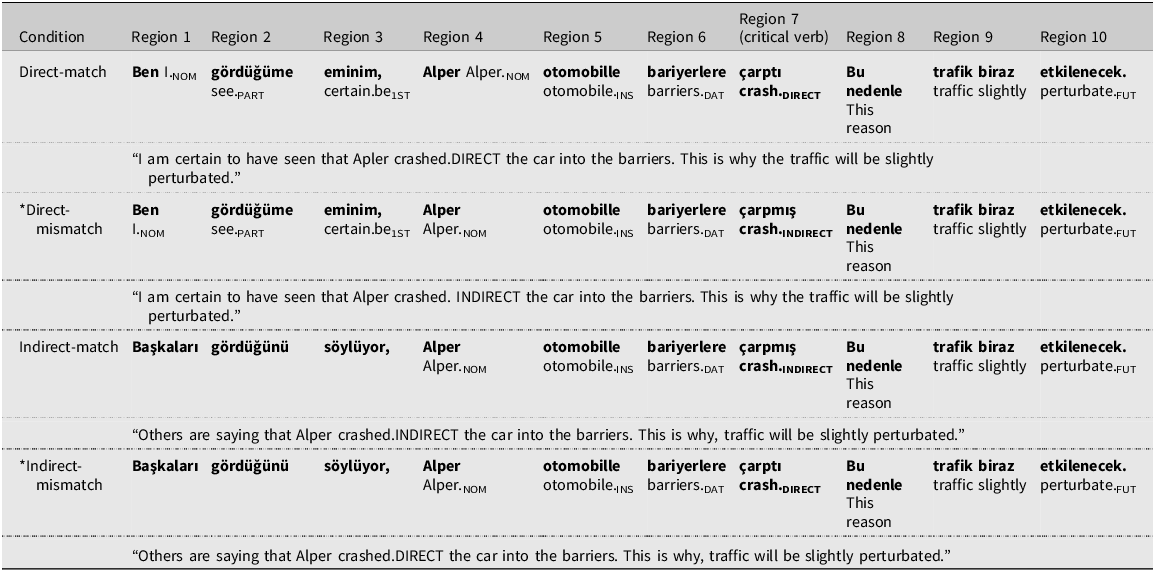
We created a total of 80 sentences distributed among four different conditions: direct-match, direct-mismatch, indirect-match, and indirect-mismatch. In direct-match and indirect-match conditions, the sentences were acceptable, featuring a match between the information source context and the evidentiality form appended at the verb.Footnote 4 The remaining two conditions were unacceptable, comprising sentences where the verb evidentiality did not align with the information source context, creating a contextual mismatch. The information source contexts were introduced with short clauses at the beginning of each sentence (i.e., Ben gördüğüme eminim “I am certain to have seen” in firsthand witnessed contexts and Başkaları gördüğünü söylüyor “Others say they have seen” in non-firsthand information sources). The sentences contained a post-critical spill-over region to avoid sentences from finishing at the critical verb. See (5) and Table 5.Footnote 5



A sample set of sentence materials presented in Experiment 2 (Turkish participants)
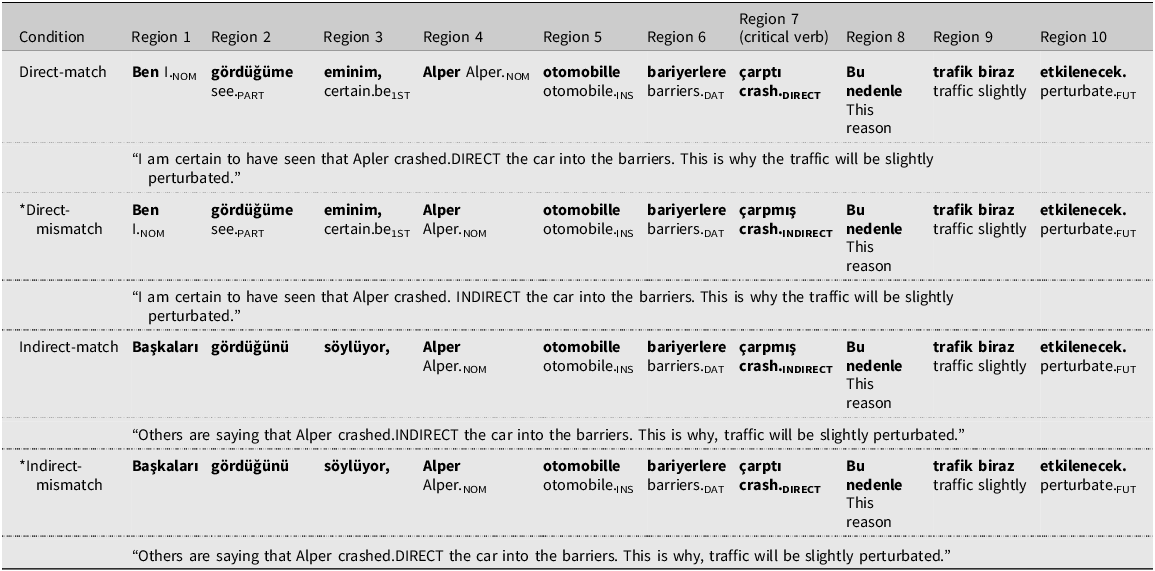
The same procedures for the non-cumulative self-paced reading task that were used in Experiment 1 were applied to this experiment. Similar to the Korean experiment, the stimulus materials were interspersed with 40 filler items, half of which were acceptable and half were unacceptable. The unacceptable fillers contained semantic anomalies involving verb usages (e.g., Nurdan hasta olmuş. Erkan Nurdan’ın iyileştiğini boşayacak… “Nurdan was sick. Erkan will divorce* Nurdan’s recovery.”). The critical regions included Region 7, where the evidential verb appeared, and Regions 8 and 9, which hosted two post-critical regions. We recorded and analyzed (i) end-of-trial accuracy of responses, (ii) end-of-trial response times in milliseconds, and (iii) per-segment RTs in milliseconds. We removed the RT data shorter than 200 ms or longer than 10000 ms, which resulted in the exclusion of 9.2% of the data in Region 7 and about 8% in Regions 8 and 9. The participants signed a consent form and received a remuneration of 7€ for their participation.
Results
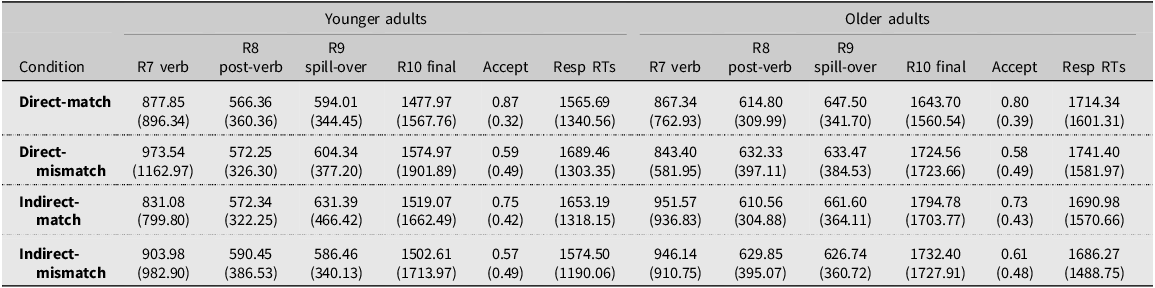
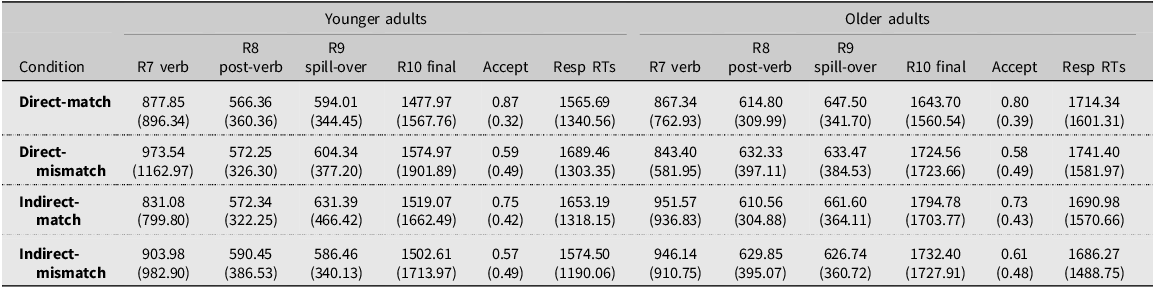
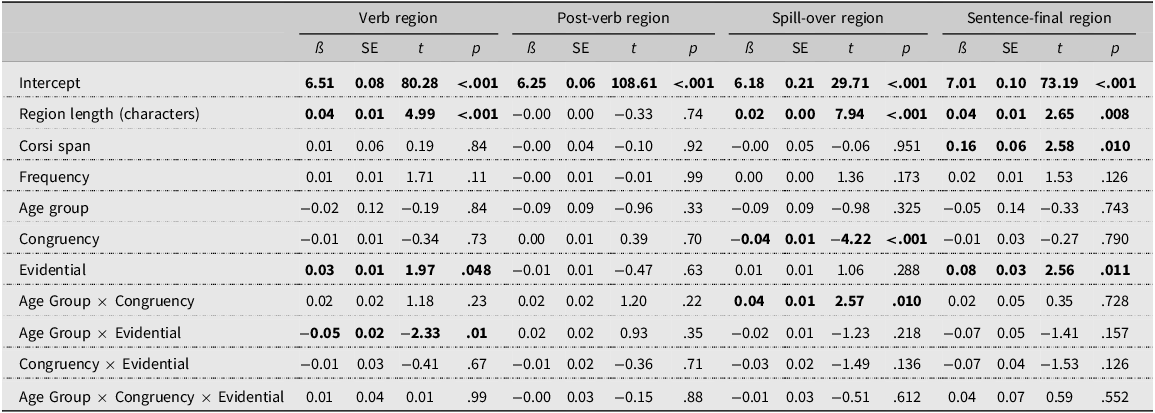
The RT data from the Turkish self-paced reading experiment and its response accuracy and latencies are given in Table 6. The outputs from a set of (generalized) mixed-effects regression models programmed with end-of-trial responses are provided in Table 7, and those with per-region RTs are given in Table 8.
Raw RTs and standard deviation per-region RTs, end-of-sentence acceptance rates, and end-of-trial response times
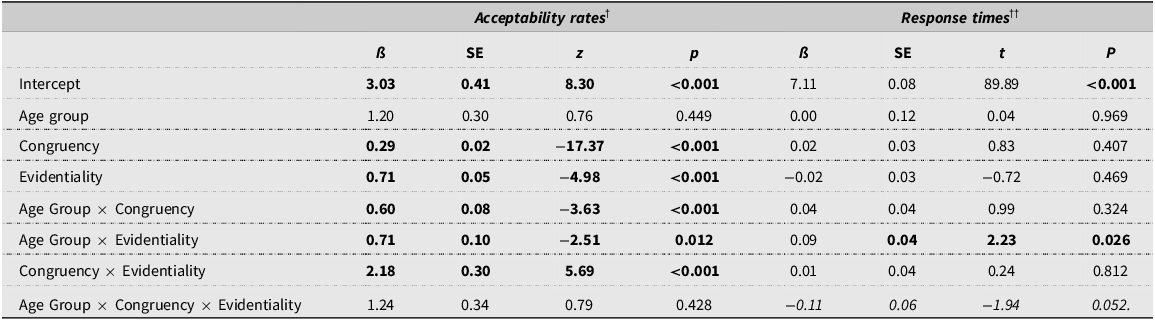
Outputs from mixed-effects regression models including acceptability rates and end-of-trial response times data (ß = estimate, SE = standard error). Significant effects are bolded. Estimates for acceptability rates are based on the logit odds ratio
† Random effects for acceptability model: σ2 = 3.29, τ00 Item = 0.21, τ00 Participant = 1.00, ICC = 0.27, marginal/conditional R 2 = 0.090/0.335.
†† Random effects for RTs model: σ2 = 0.30, τ00 Item = 0.00, τ00 Participant = 0.26, ICC = 0.45, marginal/conditional R 2 = 0.002/0.454.
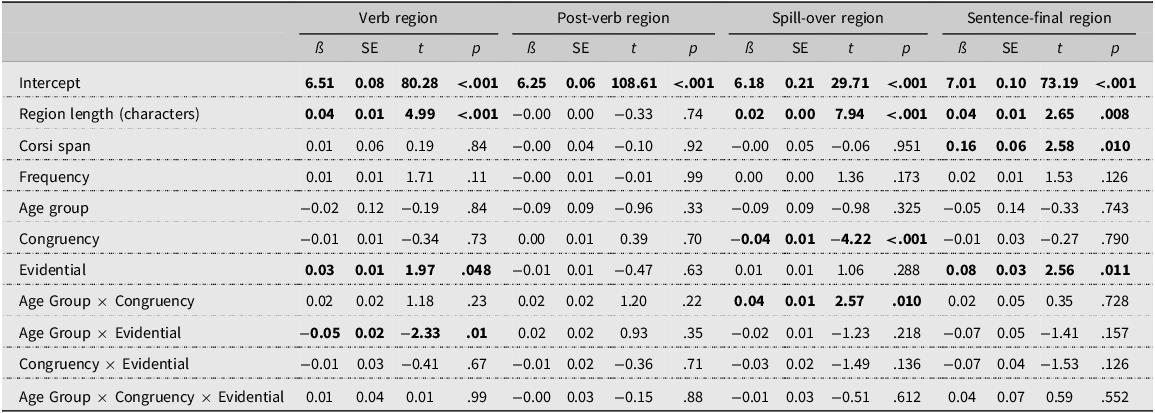
Outputs from mixed-effects regression models per-region RT data (ß = estimate, SE = standard error)
End-of-sentence responses
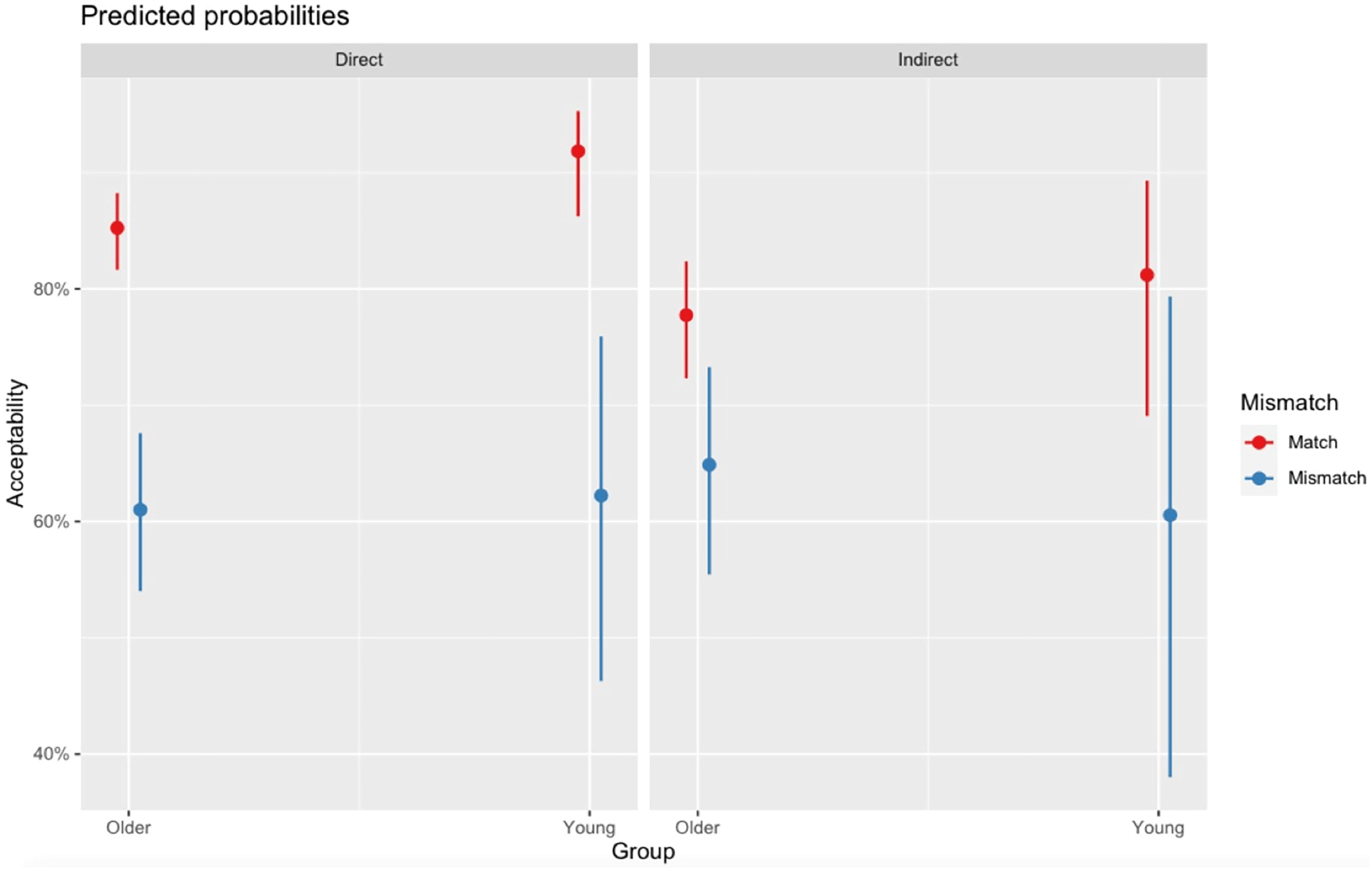
The older Turkish participants’ acceptance rate was 80% for the direct-match and 73% for the indirect-match conditions, while their acceptance rate was 58% for the direct-mismatch and 61% for the indirect-mismatch conditions. In contrast, the younger Turkish participants showed acceptance rates of 87% for the direct-match and 75% for the indirect-match conditions, while their rates were 59% for the direct-mismatch and 57% for the indirect-mismatch conditions. The model outputs have demonstrated significant fixed effects of Congruency and Evidentiality and a set of significant interactions for Age Group × Congruency, Age Group × Evidentiality, and Congruency × Evidentiality, as detailed in Table 7. An interaction plot for this model is given in Appendix 3. The presence of a fixed effect for Congruency suggests that sentence contexts where the evidential verb form matched with the information sources received significantly higher acceptability ratings compared to those with mismatches. A significant fixed effect of Evidentiality indicates that, on the whole, the direct evidential conditions elicited higher acceptability responses, surpassing those of the indirect evidential conditions. Following interactions Age Group × Congruency and Age Group × Evidentiality, we analyzed match and mismatch items using separate sub-models.
For matching items, we found no fixed effects of Age Group (Intercept ß = 1.70, SE = 0.14, z = 12.02, p < .001; Age Group ß = 0.39, SE = 0.24, z = 1.61, p = .11). Nonetheless, a significant fixed effect of Evidentiality was observed (ß = −0.72, SE = 0.11, z = −6.74, p < .001), along with an interaction effect between Evidentiality and Age Group (ß = −0.45, SE = 0.21, z = −2.12, p = .03). A set of post hoc tests has revealed that lower acceptance rates were achieved for the indirect-match than direct-match condition in both younger adults (ß = 0.95, SE = 0.17, z = 5.57, p < .001) and in older adults (ß = 0.49, E = 0.13, z = 3.80, p = .001). For mismatching items, by contrast, we found no critical group or condition differences (all ps > 0.43).
With respect to the end-of-sentence response times, the only significant model outputs were an interaction effect of Age Group × Evidentiality (Table 7). This interaction effect was due to younger adults’ slower RTs in the indirect-match than direct-match condition (ß = −0.07, SE = 0.03, z = −2.25, p = .012). However, this difference between evidential conditions was not significant in the older adults (ß = 0.01, SE = 0.0, z = 0.67, p = .90). No group or condition differences were found for mismatch items (all ps > .58).
Per-region reading times
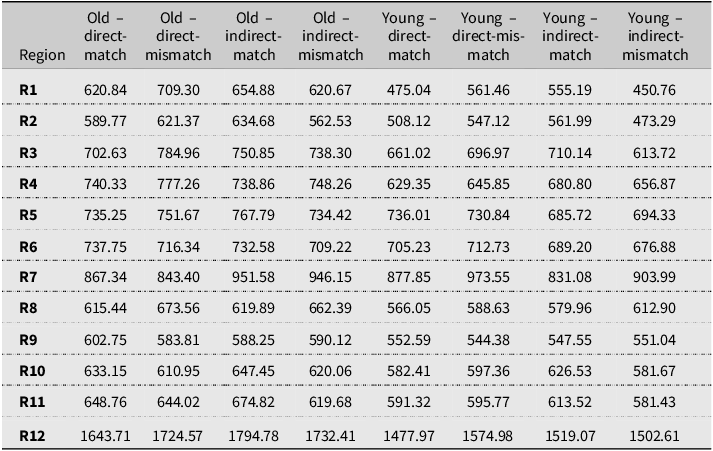
We analyzed each of the four critical regions separately: the critical verb region (R7), the post-verb region (R8), the spill-over region (R9), and the sentence-final region (R10). The mean RTs are presented in Table 5, and a visual representation of these RTs across the critical regions is shown in Figure 2. The full data table covering all regions is given in Appendix 4. A series of linear mixed-effects regression models was performed on the data from each individual region, with the resulting outputs displayed in Table 8.
Raw RTs across regions of interest (critical verb is at R7). The final word is not shown in this figure.
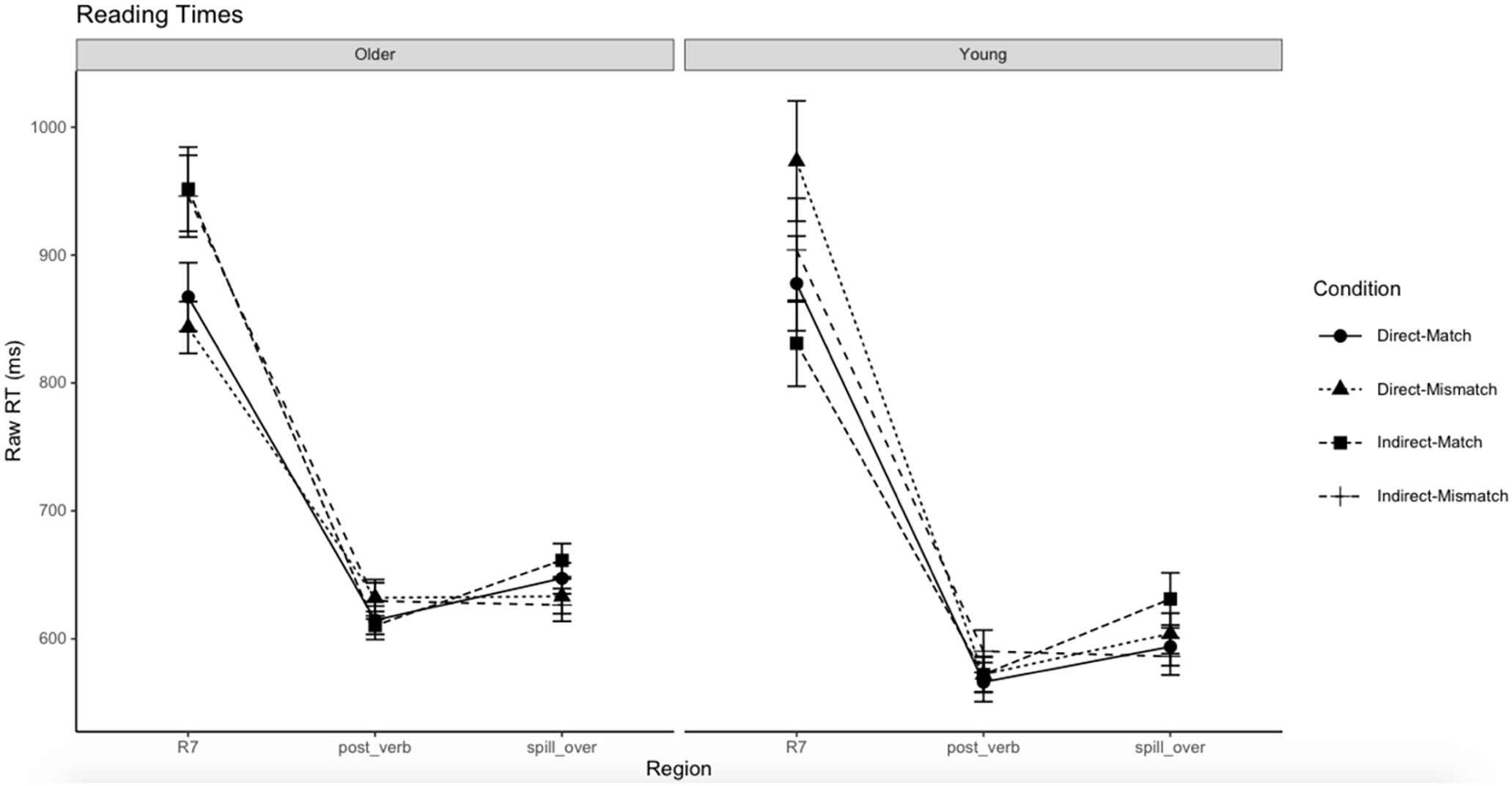
Region 7 (critical verb region): For the critical verb region (R7), featuring verbs marked for evidentiality, the models indicated significant fixed effects of Evidentiality and an interaction effect of Age Group × Evidentiality (see Table 8). The Turkish older adults’ RTs were slower in the indirect evidentiality condition than in the direct evidential condition (ß = −0.03, 0.01, z = −2.075, p = .03). However, the younger adults exhibited no significant difference in RTs between direct and indirect evidential verbs (ß = 0.02, SE = 0.01, z = 1.26, p = .58).
Region 8 and Region 9 (post-verbal spill-over regions): Concerning R8, the model outputs did not reveal any significant effects. However, in the subsequent spill-over region (R9), significant fixed effects for Congruency were observed, along with an interaction effect of Age Group × Congruency, as detailed in Table 8. The interaction suggests that older Turkish readers exhibited quicker RTs in mismatching sentences compared to matching ones (ß = 0.03, SE = 0.008, z = 4.22, p = .0001). In contrast, younger adults did not exhibit this difference (ß = 0.01, SE = 0.01, z = 0.18, p = .99).
Region 8 (sentence-final region): Regarding R10, our model demonstrated significant fixed effects of the Corsi span scores and Evidentiality, and no other interaction effects were observed. The fixed effect of Evidentiality indicates that, in the sentence-final region, Turkish readers took longer to read sentences with indirect evidential markers compared to those with direct evidentials (t = 2.56, p = .01, see Table 8). An interesting finding here was the significant effects of the Corsi span scores, demonstrating that individuals with higher span scores tended to have shorter RTs at the sentence-final region.
Summary of results from Experiment 2 and discussion
The aim of Experiment 2 was to investigate how evidentiality processing differs between healthy-aging older Turkish speakers (aged 50–85) and a group of younger adults (aged 18–31). The end-of-sentence acceptability judgment data revealed that both younger and older Turkish participants tended to judge indirect evidentiality to be less acceptable than direct evidentiality. Further, both groups judged sentences where the evidential verb mismatched the information source context as less acceptable than the matching ones, indicating that mismatches were detected. However, subtle age-related differences emerged in both judgment patterns and reading profiles. At the critical verb region (R7), older adults exhibited longer RTs for the indirect evidential compared to the direct evidential condition, suggesting greater processing difficulty when the source of information was indirect and/or non-firsthand, a pattern not observed in younger adults. Corpus frequency of these evidential forms, however, does not seem to modulate these results (see Table 8). In the spill-over region (specifically R9), a strong mismatch effect was observed, where older adults showed faster RTs in the mismatch condition compared to the match condition. This reflects an early decision strategy, similar to what was observed in the Korean experiment, as older Turkish adults read mismatching sentences faster than matching ones, indicating that once a mismatch was detected, they accelerated through the subsequent region. At the sentence-final region (R10), sentences containing indirect evidentials elicited longer reading times overall, and individuals with higher visuospatial working memory (Corsi span) showed faster reading, implying that working memory capacity facilitated sentence wrap-up processes. These findings are consistent with previous research on Turkish young adult speakers, which shows sensitivity to mismatches between information sources and evidential verbs (Arslan, Reference Arslan2020; Arslan et al., Reference Arslan, de Kok and Bastiaanse2017). The findings suggest that older Turkish adults, like the older Korean group, were sensitive to evidential mismatches but showed distinct processing dynamics. In Turkish, these effects appeared mainly at the critical verb region, where older adults demonstrated reading disruptions for the indirect evidential condition. This aligns with our hypothesis that potential age-related reductions in source-monitoring capacity would lead to processing disruptions during the processing of evidential forms. This is based on the syntactic complexity accounts, which hold that cognitively demanding language structures pose processing difficulty in older age. Therefore, the older adults’ processing disruptions during comprehending indirect evidential in Turkish seem compatible with the account that predicts a more complex form within the evidential paradigm to pose greater challenges.
General discussion
The overarching aim of this paper was to investigate whether and how grammatical evidentiality, a linguistic category that encodes the source of information, is affected by aging across the adult lifespan. Specifically, we investigated whether age-related changes occur in groups of young and senior Korean and Turkish adults’ comprehension of evidential markers during self-paced sentence reading. We employed a self-paced reading experiment to measure per-word RTs and end-of-sentence acceptability ratings during the interpretation of grammatical evidentials. The study included adult participants comprising younger (N = 44, ages 19–27) and older (N = 37, ages 48–70) speakers of Korean, as well as younger (N = 31, ages 18–31) and older (N = 45, ages 50–85) speakers of Turkish.
We formulated a hypothesis based on syntactic complexity accounts, which hold that cognitively demanding syntactic structures often pose comprehension challenges for older adults. We hypothesized that age-related declines in cognitive resources, such as working memory and the ability to monitor information sources, may lead to reading disruptions during the processing of evidential meanings. Under this hypothesis, we predicted that aging effects would be more pronounced during older adults’ processing of indirect evidentiality, as this form is semantically and morphosyntactically more marked across languages and requires monitoring information sources attributed to other speakers’ reports or inference, a cognitively demanding process also observed in children’s acquisition studies. Conversely, if aging adults speaking Korean and Turkish do not demonstrate reading disruptions during evidentiality processing, this would then be accounted for under the syntactic resilience account. An alternative was that aging impacts Korean and Turkish evidentiality processing differentially.
Blending in the summary of findings across both experiments, younger and older adults in Korean and Turkish were sensitive to mismatches between evidential verbs and information source contexts, but their behavioral judgments and reading profiles revealed language-specific and age-related asymmetries. In Korean, both age groups rated mismatching evidential sentences as less acceptable, though older adults showed a slightly higher acceptance rate and longer RTs at the verb region for the direct-mismatch condition, in which direct evidentials appeared in non-firsthand contexts. In Turkish, both groups also judged mismatching conditions with lower acceptability rates than matching ones; however, the Turkish participants showed a notably higher acceptance of such mismatches compared to Korean speakers. This pattern may indicate that Turkish speakers are more inclined to interpret evidential mismatches as pragmatically acceptable than Korean speakers. Further, the Turkish older adults rated sentence contexts with indirect evidentiality overall less acceptable and read them more slowly than those with direct evidentiality. At the sentence-final region, Turkish indirect evidentials elicited longer reading times overall, moderated by working memory capacity. Comparing the groups of older adults, Korean and Turkish older adults showed differential age-related reading disruptions: while the older Korean adults exhibited longer RTs for the direct-mismatch condition at the critical verb region, the older Turkish adults had longer RTs for indirect evidential verbs.
These findings are partially consistent with our hypothesis, which predicted that age-related effects would emerge more prominently in the indirect evidential conditions, as this form is morphosyntactically more complex and places greater demands on processing resources than the direct evidential form. While this prediction was confirmed in Turkish, where older adults showed increased processing difficulty for indirect evidentials, the Korean data revealed a different pattern, with age-related disruptions appearing primarily for direct evidential mismatching to non-firsthand source contexts. We discuss these implications below.
Are there age-related evidentiality processing differences?
So far, we can confirm that older groups of participants speaking both languages are slower in responding to the end-of-sentence judgment task as compared to younger adults. However, this does not automatically translate to their evidentiality processing being affected by age differences, since general processing speed slows down with age (Salthouse, Reference Salthouse1996). Hence, the older adults’ overall slower response times cannot be taken as an indicator of a specific evidentiality interpretation difficulty. However, there were interesting age-related condition differences in their per-word reading profiles, especially at the critical region where the evidential verb form appeared. The older Korean adults exhibited longer RTs for the direct-mismatch than indirect-mismatch condition both at the critical verb and the sentence-final regions, a pattern not observed in the younger Korean adults. This confirms the presence of greater processing disruptions in the older Korean adults’ interpretation when they encountered a direct evidential verb form within a non-firsthand information context. The older Korean speakers were also more likely to misattribute non-firsthand information sources to a direct evidential verb form, by rating this kind of mismatching information to be acceptable. We believe this minimal but significantly elevated acceptance of mismatching sentence contexts with direct evidentiality reflects a difficulty in information source misattribution. Higher tendency in older adults to assume imagined/suggested information to be witnessed is, in fact, not entirely unheard of in eye-witnessing and source memory research (see, e.g., Cansino et al., Reference Cansino, Estrada-Manilla, Hernández-Ramos, Martínez-Galindo, Torres-Trejo, Gómez-Fernández, Ayala-Hernández, Osorio, Cedillo-Tinoco, Garcés-Flores, Gómez-Melgarejo, Beltrán-Palacios, Guadalupe García-Lázaro, García-Gutiérrez, Cadena-Arenas, Fernández-Apan, Bärtschi, Resendiz-Vera and Rodríguez-Ortiz2013; Mitchell et al., Reference Mitchell, Johnson and Mather2003; Mueller-Johnson & Ceci, Reference Mueller-Johnson, Ceci, Toglia, Read, Ross and Lindsay2007; Multhaup et al., Reference Multhaup, De Leonardis and Johnson1999). Therefore, it is conceivable that the older Korean adults might have misattributed a reported event to be witnessed by the author of a given sentence. However, we did not observe a similar pattern of processing disruptions in the Turkish adults. In contrast, compared to older Korean adults, the Turkish older adults exhibited a reversed processing profile: they had longer RTs for indirect evidential verbs than for direct evidential verbs at the critical verb regions. This finding suggests that Turkish older readers were most disrupted by the presence of an indirect evidential within any sort of information context, and they rated sentence contexts with indirect evidential to be less acceptable than those with direct evidential. A clear tendency to accept sentences with direct evidential to be more acceptable than any other sentence types with an indirect evidential seems consistent with the primacy of direct evidential form in first language acquisition of Turkish (see Aksu-Koç, Reference Aksu-Koç1988; Öztürk & Papafragou, Reference Öztürk and Papafragou2016) and with direct evidentials being perceived as epistemically more reliable than indirect evidential (Arslan, Reference Arslan2020; Aydin & Ceci, Reference Aydin and Ceci2009). However, it is important to note that we did not find an interaction effect of mismatch for Turkish adults at the critical verb region. This may suggest that, at this point, they have not yet fully integrated the source information with the evidential form as sentence structure unfolds, which only seems to have happened at the spill-over region for the Turkish readers. Also importantly, evidential verb forms that do not match the appropriate information source contexts were ranked quite at bottom (around 23%–12%) in Korean, but it seems as though Turkish participants still made some sense of those mismatches as they rated them around 57%–61% without any critical differences among conditions or groups. Using a similar design, Arslan (Reference Arslan2020) also observed relatively high acceptance rates in a group of Turkish speakers’ responses to evidential forms mismatching to appropriate information sources. He argues that evidentiality mismatches, especially a direct evidential form in a non-firsthand context, may be interpreted as “expected news” and hence acceptable (Arslan, Reference Arslan2020, p. 13). Such loose constraints on licensing and the multifunctional nature of evidential markers in Turkish compared to Korean seem to have caused such differences in acceptance of mismatching items between the two languages.
Returning to the question of whether or not age differences affected evidentiality processing, we cannot confirm a strong age-related decline in evidentiality processing. However, we found different patterns of differences across Korean and Turkish: while the older Korean adults showed reading disruptions at the direct evidential verb within a firsthand information context, the older Turkish adults did so at the indirect evidential verbs in any context. Therefore, we have only partial support for the syntactic complexity accounts, under which we hypothesized that morphosyntactically more complex terms in the evidentiality paradigm would be more vulnerable to age-related changes in sentence processing. This is based on the reasoning that indirect evidential forms in both Korean and Turkish take longer to acquire during first language development. Although research on Korean is relatively limited, existing studies on Turkish indicate that indirect evidentials place greater processing demands than direct evidentials. Therefore, the presence of older adults’ processing disruptions in Turkish indirect evidential supports this hypothesis, whereas Korean older adults’ processing disruption for direct evidential form goes against the hypothesis. Our results do not seem to support the syntactic resilience accounts either; albeit not strong, we have found certain age-related differences in older adults’ behavioral responses and reading profiles during evidentiality processing in both Korean and Turkish. How can the opposite direction of effects across Korean and Turkish older adults’ processing of evidentiality be accounted for then?
Recall that both Korean and Turkish are evidential languages; they bear differences in how they encode evidentiality. Turkish indirect evidential - mIş encodes both inferential and reportative meanings. In contrast, the Korean indirect evidential form –tay is specifically used for reported information, and hence, the information context is clearer for the Korean readers in this sense. These cross-linguistic differences may have contributed to the results from older groups. An anonymous reviewer however raises cautions at this point. The contextual clauses signaling the source information are rather more elaborated in Turkish (i.e., Ben gördüğüme eminim. “I am certain to have seen…” vs. Başkaları gördüğünü söylüyor. “Others say that they have seen…”), compared to Korean context clauses (Nay-ka onul kulim-ul kuli-ess-e. “Today I drew a painting” vs. Yeonghee-ka onul kulim-ul kuli-ess-e. “Today Yeonghee drew a painting.”). These differences in contextual clauses might have influenced the participants’ responses. We maintained the information source for a firsthand source through participation of the author/speaker, and stimuli in both languages encompassed a first-person statement matching with direct evidential. However, the difference between the two languages is that in Turkish contextual clauses, there is contrast between a high and neutral level of certainty. We already know that Turkish indirect evidential in an epistemically high-certain perspective of the first-person is not so intuitive (see Arslan, Reference Arslan2020). However, in Korean, such an epistemic contrast is apparent without stressing, as –tay reportative form has epistemic extensions (see Choi et al., Reference Choi, Goller, Ansorge, Hong and Yun2022). Therefore, while we have no clear implications that those contextual clauses might have a major effect on the Korean and Turkish older adults’ different patterns of evidentiality processing, one clear limitation is that we know so little about how these semantic extensions in both Korean and Turkish influence evidentiality processing. That is, both Korean and Turkish indirect evidential forms expose epistemic extensions, meaning that indirect evidential coming from a non-firsthand source is not as reliable as that from a firsthand source. Furthermore, in both languages, indirect evidentials have mirative readings, making reference to unexpected and surprising information. Therefore, one might argue that an indirect evidential may, in fact, be acceptable under a firsthand information source context (I self-witnessed that… an event happened – INDIRECT) as the speaker might have found this event unexpected and surprising. Therefore, we have yet to explore how those modal semantic extensions of indirect evidentials influence processing.
This study is the first of its kind in exploring processing grammatical evidential forms across the adult lifespan. However, while pioneering a line study here, we have not been able to address several questions, which future studies may undertake. First, group differences in involvement of visuospatial short-term memory, measured by simple block-tapping tasks, in evidentiality processing pose a disparity. We chose a visuospatial task specifically to minimize the involvement of language-related differences; however, it appears that this attempt was not entirely successful. Several factors might explain this, such as orthographic differences between the languages. For instance, the Hangul writing system may rely more heavily on visual memorization, leading Korean speakers to employ greater visuospatial strategies. However, in the presence of no evidence, this argumentation remains a speculation. Second, we know from the children’s acquisition literature that there is a conceptual complexity issue with different functions of indirect evidentials, which often present variability in their frequency of use across different situations; see Uzundağ et al. (Reference Uzundağ, Taşçi, Küntay and Aksu-Koc2018) for Turkish and Choi (Reference Choi, Bybee and Fleischman1995) for Korean. However, the state of the art in adult language processing needs to advance for us to make insightful contemplations here, as we know so little about the extent to which such psycholinguistic factors in conceptual complexity and frequency of use affect information source processing.
In conclusion, there are two key age-related processing differences for Korean and Turkish evidentials: (i) direct evidential mismatches present challenges for older Korean adults, and (ii) indirect evidentials lead to immediate processing disruptions in older Turkish adults, though this effect is limited to the critical verb region. We found moderate age-related differences in evidentiality processing, pointing to distinct processing patterns observed across the two languages. Older Korean adults showed processing disruptions while interpreting direct evidential forms in non-firsthand contexts, whereas older Turkish adults exhibited slower reading profiles with indirect evidential forms. The selective differences observed between Turkish and Korean underscore the role of linguistic structure in shaping how older adults interpret evidentiality.
Replication package
Any data, code, and stimulus materials from the experiments reported in this paper are publicly accessible on the OSF platform https://osf.io/6xmbw.
Funding statement
This study was supported by a research grant from the Academy of Korean Studies (grant no. AKS-2019R2).
Plotted interactions depicting the three-way interaction for the Korean Experiment 1 acceptance rate data.
Mean raw reading times in milliseconds covering all regions, obtained from Experiment 1: Korean
Plotted interactions depicting interactions for Turkish Experiment 2 acceptance rate data.
Mean raw reading times in milliseconds covering all regions, obtained from Experiment 2: Turkish

 Open access

