

Overview
Scenarios are among the most visible and widely used products of the Intergovernmental Panel on Climate Change (IPCC). Many kinds of scenarios are used in climate research, but emissions scenarios and the socio-economic assumptions that underpin them have a distinct status because the IPCC orchestrated their development. They have evolved from assessment cycle to assessment cycle and serve as ‘boundary objects’ across Working Groups (WGs) and as instruments of policy-relevance. The field of Integrated Assessment Model(ling) (IAM) has emerged to produce these scenarios, thereby taking centre stage within the IPCC assessment process. Because these scenarios harmonise assumptions about the future across disciplines, they are essential tools for the IPCC’s production of a shared assessment of climate research and for ensuring the policy-relevance of this assessment. Yet, the reliance on a relatively small set of complex models to generate scenarios spurs concerns about transparency, black-boxed assumptions, and the power of IAMs to define the ‘possibility space’.
15.1 Introduction
Scenarios are everywhere in IPCC reports, from the climate change projections of WGI (Chapter 14) to the mitigation pathways of WGIII. Often encountered as graphs displaying arrays of roads-yet-to-be-taken, scenarios are in fact complex sets of interrelated numerical variables. Among them, the scenarios projecting long-term evolutions of greenhouse gases (GHG) stand out because the IPCC has orchestrated their development. They are a cornerstone of the IPCC’s outlook on the future. Through them, the IPCC has contributed to the elaboration of a new approach to scenarios, distinct from scenario planning or futurology. This chapter focuses on these scenarios and on the IAMs that produce them.
The IPCC initially produced projections of GHG emissions as input for Global Climate Models (GCMs), but the function of emissions scenarios has greatly increased in scope and ambition. In 2006, the IPCC moved from scenario producer to ‘catalyst’, entrusting the elaboration of new scenarios to the ‘scientific community’ (IPCC, 2006b). Rather than a catalogue of projections, the resulting scenario framework became a toolbox used for various purposes across WGs. This reflects an ambition to integrate the increasingly diverse domains of climate research. As explained in the WGIII contribution to the Fifth Assessment Report (AR5), ‘scenarios can be used to integrate knowledge about the drivers of GHG emissions, mitigation options, climate change, and climate impacts’ (IPCC, Reference Edenhofer, Pichs-Madrugada and Sokona2014a: 48). Their development has harmonised the futures considered by climate research, ensuring some compatibility and comparability across disciplines. It has also accompanied and shaped the emergence and evolution of IAMs, now the main providers of scenarios.
Scenarios are not just outputs of IPCC reports. They are, first, a cornerstone of IPCC assessments and of the broader ambition to construct a consistent and policy-relevant body of knowledge on climate change. They are also a research infrastructure, enabling the organisation, harmonisation and circulation of data across disciplines. Last, they are now a field of research whose emergence was fostered by the IPCC. Considering these three dimensions of scenarios, this chapter first retraces the evolution of IPCC scenarios since the First Assessment Report (AR1). It then clarifies the role of IAMs, and reviews ongoing debates on IAM-produced scenarios.
15.2 The IPCC as Scenarios Producer
To project future climate change, climate modellers need estimates of the future evolution of GHG and other emissions. Providing ‘scenarios of possible future greenhouse gas emissions for the use of the three IPCC Working Groups’ was one of the first tasks undertaken by WGIII in the preparation of the IPCC’s AR1 (IPCC, 1990b: xxxi). Since then, scenario development has gone hand-in-hand with the IPCC assessment cycles. Emissions scenarios have been regularly updated to take into account real-time evolutions in GHG emissions and to meet the evolving needs of climate research and policy.
To date, there have been four generations of scenarios (Table 15.1). They differ in their scope, characteristics and development process (Girod et al., Reference Girod, Wiek, Mieg and Hulme2009). The first set of scenarios, labelled ‘SA90’, was developed in 1989 by an expert group formed by the ‘Response Strategies Working Group’ (IPCC, 1990b: 17). Its four scenarios were intended as inputs for GCMs (van Beek et al., Reference van Beek, Hajer, Pelzer, van Vuuren and Cassen2020a).
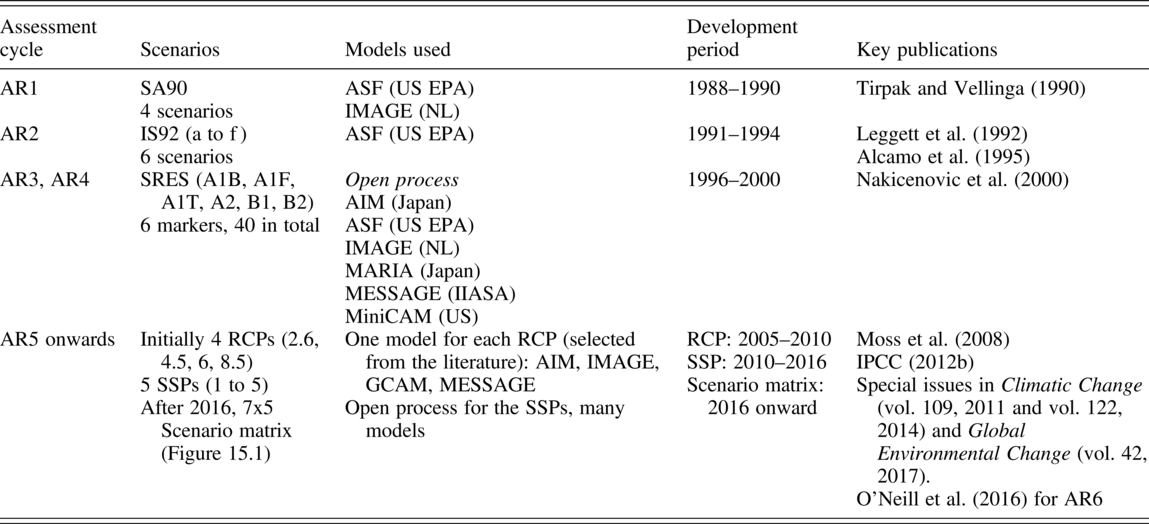
The IPCC requested an update in 1991 (IPCC, 1991) and the resulting ‘IS92’ scenarios – standing for ‘IPCC Scenarios 1992’ – were published in a supplement to AR1 (Leggett et al., Reference Leggett, Pepper, Wart, Houghton, Callander and Varney1992). As noted in the foreword to the Special Report on Emissions Scenarios (SRES), these IS92 scenarios were ‘pathbreaking’ as ‘they were the first global scenarios to provide estimates for the full suite of greenhouse gases’ (Nakicenovic et al., Reference Nakicenovic, Alcamo and Davis2000). The IPCC-requested evaluation of the IS92 scenarios (Alcamo et al., Reference Alcamo, Bouwman, Edmonds and Houghton1995) was possibly even more influential. At the time, there were few emissions scenarios in the literature and no established criteria for their evaluation (Alcamo et al., Reference Alcamo, Bouwman, Edmonds and Houghton1995: 242). The 1995 evaluation set an evaluation framework, recommended good practice, and categorised the potential uses for scenarios. Its guidelines have remained benchmarks for the development and assessment of scenarios.
The ‘SRES scenarios’ were developed between 1996 and 2000 and published in a 600-page Special Report (Nakicenovic et al., Reference Nakicenovic, Alcamo and Davis2000). They marked an increase in ambition and scope. Based on an extensive literature review, they were designed for a broader range of purposes and users. The process of constructing the scenarios was also more open, with a 50-author writing team and a call for participation issued to researchers. It produced a set of 6 marker scenarios picked among a total of 40 scenarios, all published in an internet database. One of the main innovations was the development of four storylines to map scenarios along two axes – regional vs. global, economic vs. environmental. With this structuring compass, the SRES scenarios offered a framework for organising and communicating uncertainties surrounding climate change.
The SRES scenarios were used as reference points by all three WGs in the AR3 (2001) and AR4 (2007) reports. By 2003, the scenarios literature had considerably expanded and so the IPCC raised ‘the question of new scenarios for the AR5’ (IPCC, 2003). This initiated a major overhaul of the scenario framework and a redefinition of the IPCC’s role in it.
15.3 The IPCC as Catalyst: Towards a New Scenario Framework
During the revision of the scenario framework, initiated in 2005, the IPCC shifted from being the producer of scenarios to being the catalyst of their production. At its 25th Panel session in 2006, the IPCC delegated the development of new scenarios to the scientific community at large, whilst retaining a facilitating role. The Integrated Assessment Modeling Consortium (IAMC) was founded to coordinate scenario work.1 The delegation of this work was possible because the emerging IAM community convinced the IPCC chair of its ability to coordinate the process (Cointe et al., Reference Cointe, Cassen and Nadaï2019). In fact, this community comprised many of the same people involved in previous scenario developments – the three founders of the IAMC included two SRES authors. The process involved IPCC-sponsored meetings (where the main features of scenarios were agreed upon), annual IAMC meetings and a string of research workshops. Reflecting the change of process, there was now not one document presenting the scenarios, but a collection of multi-authored workshop reports, journal articles and special issues (Table 15.1).
The process was bottom-up and had to accommodate the technical specifications of climate models, the requirements of diverse scientific and policy users, the IPCC timeline, and the capacities of existing models. It was guided by two aims: first, to make scenarios suitable for more purposes, especially policy analysis and impact assessments; and, second, to decouple climate change projections from socio-economic assumptions, so as to enable climate modelling, impact studies, and the elaboration of socio-economic scenarios to progress independently in a ‘parallel process’ (Moss et al., Reference Moss, Edmonds and Hibbard2010).2 The resulting framework is quite intricate, and cannot be understood independent of its development process.
Between 2005 and 2017, two types of scenarios were elaborated: Representative Concentration Pathways (RCPs) and Shared Socioeconomic Pathways (SSPs). The RCPs are emissions scenarios leading to specified levels of radiative forcing and designed as inputs for climate models. The radiative forcing profiles serve as a common currency to connect mitigation pathways with climate scenarios. Within the AR5 timeline, four RCPs were selected among published IAM scenarios. They were adapted to the data requirements of climate models (Moss et al., Reference Moss, Babiker and Brinkman2008: xv) without harmonising the underpinning socio-economic assumptions. They had to satisfy scientific soundness, requirements from WGI researchers, and expectations for policy-relevance. The choice of the low-emissions pathways illustrates this latter demand. The compatibility of RCP2.6 with the ‘2°C policy objective’ made it a favourite scenario in policy negotiations, but it was only approved after a scientific check (Weyant et al., Reference Weyant, Azar and Kainuma2009; Moss et al., Reference Moss, Edmonds and Hibbard2010; Beck & Mahony, Reference Beck and Mahony2018b).
The SSPs, which took longer to develop, provide both narrative (storylines) and quantitative sets of socio-economic assumptions – for example, population and economic growth – that form coherent pictures of how the world might develop without climate change and climate policy (O’Neill et al., Reference O’Neill, Kriegler and Riahi2014). IAMs use these assumptions to project future emissions, combining them with policy assumptions to reach lower emissions levels. In the lead-up to AR6, eight new reference scenarios – combining one SSP storyline with one radiative forcing level – were selected for WGI (O’Neill et al., Reference O’Neill, Tebaldi and van Vuuren2016). This updated the RCPs by expanding their scope and harmonising their socio-economic assumptions.
Rather than a fixed library of scenarios, the new (and current) IPCC scenario framework is a method for organising assumptions in order to harmonise and coordinate different types of climate-relevant projections. This method is encapsulated in the ‘scenario matrix’ (Figure 15.1) designed as a common reference to map the range of assumptions about the future. Thus, contrary to previous versions used by the IPCC, the current scenario framework is an infrastructure to organise model inputs and outputs across research communities, which can be rediscussed, refined and adapted.

15.4 The ‘Mapmakers’: Integrated Assessment Models
The elaboration of the scenario framework established the models used to produce emissions scenarios as a cornerstone of climate research. The emergence of IAMs as a category of models and a tightly bound research community is inseparable from the development of scenarios for the IPCC. The original website of the IAMC emphasised this co-evolution, stating that ‘scenarios to underpin the 1st Assessment Report of the IPCC were elaborated with 1st generation IAMs’ (IAMC, 2017).
IAMs are complex numerical models that represent the interactions between environmental, human and technological systems. They do not build upon a shared theoretical basis, but combine disciplines and intellectual traditions including environmental sciences, systems analysis, macroeconomics and engineering. About 30 IAMs are referenced in the AR5 (Clarke et al., Reference Clarke, Jiang, Akimoto, Edenhofer, Pichs-Madrugada and Sokona2014), most of them developed in Europe, the United States and Japan. As tools to assess mitigation trajectories and policy options on a global scale, they constitute an important part of the research assessed by WGIII, especially in AR5 where they were the basis for ‘the exploration of the solution space’ (IPCC, Reference Edenhofer, Pichs-Madrugada and Sokona2014a: ix).
Although IAMs are widely used outside the IPCC scenario process, their emergence is closely tied to the IPCC and its WGIII (see Chapter 12). Corbera et al. (Reference Corbera, Calvet-Mir, Hughes and Paterson2016) note that a number of WGIII authors have organised their careers around the IPCC, which is the case for several prominent figures of IAM research. Most IAM group leaders have been IPCC authors and have participated in scenario development – some, such as Jae Edmonds, Priyadarshi Shukla, John Weyant or Nebosja Nakicenovic, since the 1990s. The IMAGE model – developed originally by the Netherlands Environmental Assessment Agency (PBL) – has also been a consistent feature of scenario development, except for the IS92.
These links intensified after 2005. The delegation of scenario development to the scientific community, and the central position of IAM-produced mitigation scenarios in the WGIII AR5, drove the organisation and professionalisation of IAM research (Cointe et al., Reference Cointe, Cassen and Nadaï2019). The combination of an intense schedule of IPCC-sponsored ‘expert meetings’ to work on scenarios, together with several large EU-funded IAM research projects, meant that involved researchers met almost every other month for a few years. This effectively fostered a small and close-knit community. The IAMC, initially created to prepare the RCPs, turned into a disciplinary organisation, and its annual meeting became a fully fledged conference. This emerging community also set up an infrastructure for collaboration and data exchange – partly to be able to work together, partly because it was a requirement for IPCC scenarios. The database created at the International Institute for Applied Systems Analysis (IIASA) to host RCP data now serves as a repository of scenarios for IPCC-related work and for research projects; model documentation and codes are increasingly available; and the IAMC curates a Wiki documenting existing IAMs.
This considerably improves the transparency of IAMs, but it also exposes them to scrutiny and criticism (Robertson, Reference Robertson2021). The prominence of IAM-produced scenarios indeed gives the models’ underlying assumptions, worldviews and solving mechanisms considerable influence in defining the scope of action presented by the IPCC.
15.5 The Contested Influence of IAMs
The position of IAMs-generated scenarios at the interfaces between different domains of climate science and between science and policy puts them at the heart of lively – if mostly academic – debates. These debates highlight the difficulty of disentangling the process of scenario production from the substance of scenarios.
One core issue is the lack of transparency of models. IAMs are complex, interdisciplinary models that are hard to communicate even among experts. They are thus often perceived as ‘black-boxes’ (Haikola et al., Reference Haikola, Hansson and Fridahl2019). In fact, much of the work undertaken in the IAMC and in modelling projects aims to enable modellers from different groups to understand each other’s models. Transparency about model structure, assumptions and data is necessary to assess the soundness and reliability of IAM projections. This is not only an epistemic concern. Because IAMs-generated scenarios are used to explore the ‘possibility space’, their structure, inputs and underlying assumptions constrain the range of futures brought to the attention of policy-makers (Beck & Mahony, Reference Beck and Mahony2018b; Beck & Oomen, Reference Beck and Oomen2021; also Chapter 21). According to Robertson (Reference Robertson2021), failure to answer calls for transparency risks undermining trust in the IPCC. To some degree, the IPCC has heeded such critiques in expert meetings and publications attempting to tackle the challenge (IPCC, 2017b; Skea et al., Reference Skea, Shukla, Al Khourdajie and McCollum2021).
Criticism of the reliance of IAMs on negative emission technologies (NETs) – and in particular on bioenergy with carbon capture and storage (BECCS) – to achieve scenarios compatible with the 2 °C and 1.5 °C policy objectives of the UN Framework Convention on Climate Change (UNFCCC) has spurred examination of the inner workings of IAMs. This has brought social sciences and science and technology studies (STS) scholars into the discussion (Beck & Mahony Reference Beck and Mahony2018b; Haikola et al., Reference Haikola, Hansson and Fridahl2019; Carton et al., Reference Carton, Asiyanbi, Beck, Buck and Lund2020; Low & Schäfer, Reference Low and Schäfer2020). These analyses suggest that the tendency of IAMs to favour NETs comes from their representation of technological progress, their focus on least-cost options, and their discounting assumptions. Many limitations of IAMs have been highlighted: they are better at representing technological change than lifestyle changes; they use economics as a basis for decision-making; they tend to consider a limited range of market-based policies; many (not all) are cost-optimisation models; and they hardly consider no-growth or degrowth futures. For critics like Kevin Anderson, this makes them ‘the wrong tool for the job’ (Anderson & Jewell, Reference Anderson and Jewell2019). However, not all of these limitations are hard-wired into the models, and modellers are reflecting on how to address them (O’Neill et al., Reference O’Neill, Carter and Ebi2020; Keppo et al., Reference Keppo, Butnar and Bauer2021).
Another issue of concern is the interpretation and use of IPCC-sanctioned scenarios. Scenarios have a life of their own, and their assumptions and limitations often do not travel with them, even when they are acknowledged in the original publications (see also Box 15.1). The performativity of scenarios often escapes their creators. The reason NETs are controversial is that their ubiquity in IAM scenarios makes them seem inescapable – even though these technologies do not exist at scale – to the expense of alternative options, perhaps more realistic but not as frequently modelled by IAMs. NETs-heavy scenarios have thus been criticised for sustaining the discrepancy between policy ambitions and real-world policy action, and for maintaining the chimera that gradual emission reductions can ever be enough (Anderson & Peters, Reference Anderson and Peters2016; Beck & Mahony, Reference Beck and Mahony2018b; Carton et al., Reference Carton, Asiyanbi, Beck, Buck and Lund2020).3
An important choice when making climate scenarios is whether to consider increased climate policy action. Scenarios without additional climate policies, often referred to as ‘business as usual’, serve as baselines against which to assess the effects, costs and benefits of climate action. The SA90 scenarios included policy and no-policy scenarios. As requested by the IPCC, the IS92 and SRES scenarios were all ‘business as usual’. The later scenario matrix is more flexible, but retains the idea of a no-policy baseline: while the SSP storylines do not include climate policies, modellers add policies (usually a carbon price) to reach lower concentrations from the same socio-economic assumptions. The term ‘business as usual’ can be misleading when used to refer to a single scenario. There is not one, but many possible, scenarios without additional policies (Figure 15.1). Scenario experts insist that all can serve as baselines and none should be considered more likely than any other. In practice, however, all are not used equally. Reviewing the use of IS92 scenarios, the SRES report noted that the high-emission IS92a scenario was often used as a baseline, despite explicit recommendations to use the full range of IS92 scenarios for climate assessment (Nakicenovic et al., Reference Nakicenovic, Alcamo and Davis2000: 32). More recently, Pielke and Ritchie (Reference Pielke and Ritchie2021) and Hausfather and Peters (Reference Hausfather and Peters2020) warned against considering RCP8.5 as a ‘business as usual’ scenario, arguing that its assumptions – especially for future coal consumption – were implausible and outdated. This reignited a longstanding debate about the assignment of probabilities to scenarios to aid interpretation – something that modellers have so far resisted so as not to liken scenarios to predictions (This issue is discussed in AR6; Chen et al., Reference Chen, Rojas, Samset, Masson-Delmotte, Zhai and Pirani2021: 109–111.) Rather than ‘mis-uses’, these debates reflect different understandings of the status of baseline scenarios. They highlight the challenges that arise from the use of scenarios as boundary objects and from their appropriation by increasingly diverse users.
15.6 Achievements and Challenges
Since its first report, the IPCC has driven the establishment of scenarios as boundary objects (see Chapter 24) among climate research communities. In orchestrating the development of emissions scenarios, the IPCC has defined an approach to scenarios that puts IAMs centre stage. It has also ‘charted out’ the future. Scenarios work as boundary objects that harmonise assumptions about the future across disciplines, thereby enabling the circulation and comparison of projections.
The development of scenarios has encouraged integration across WGs (see Chapter 18) and supported the emergence of a shared scientific understanding of climate change. Thanks to debates around the new scenario framework, both IAMs and the IPCC scenario infrastructure have become more transparent and open to alternative perspectives. Although there is still much room for improvement, the IPCC is at the forefront of these efforts. Because IAMs are now essential tools for navigating the climate challenge, they are (rightly) held to higher standards of accountability than other models. They need to be subjected to both scientific and political scrutiny.
The opaqueness of IAMs is to an extent irreducible given their complexity and diversity. The intricacy of the scenario framework and the proliferation of scenarios add to the challenge of transparency. However, this opaqueness also stems from the ambition for scenarios to meet the requirements of increasingly diverse users. These users can have different understandings of the usefulness, validity and plausibility of scenarios, a challenge likely to be amplified as scenarios are taken up in political discourses or juridical trials.
Indeed, despite its ambition for comprehensiveness, the scenario framework used by the IPCC offers an incomplete map of the future. Its success has enshrined a quantified, model-based approach largely framed by the requirements of GCMs, at the expense of alternative scenario methods. The next major challenge for the IPCC is to incorporate more diverse and more radical versions of possible world futures into their assessment process.


 Open access