





1. Introduction
The World Heritage Site of Takht-e Solaymān in Iran's West Azerbaijan province was home to the “Fire of the warriors and military chieftains,” or Ādur Gušnasp, one of the three most sacred Zoroastrian fire temples of Sasanian Iran.Footnote 1 From 2002–2008, Yousef Moradi, in collaboration with the Iranian Centre for Archaeological Research (ICAR) and the Takht-e Solaymān World Heritage Base, excavated the site and discovered a remarkable collection of 824 bullae from both the Sasanian and Ilkhanid strata.
Four of the bullae within this new collection bear the impressions of a seal showing a nude female accompanied by a nude adolescent male, likely representing Aphrodite and Eros, the Graeco-Roman divinities, but no inscription. Together with the rest of the bullae Moradi and his team excavated at Takht-e Solaymān, these four are currently housed in the archive of the Urmia Museum in West Azerbaijan, Iran. The museum assigned the inventory numbers 7772, 7933, 10841, and 10921 to the bullae and the sealings showing Aphrodite and Eros are items 7772.1, 7933.1, 10841.1, and 10921.1. These four bullae were among several discovered in the Ilkhanid bathhouse, which is situated adjacent to the eastern room of the Northern Gate of the Takht-e Solaymān complex. Like the rest of the collection, these four bullae originally belonged to the archive (Room Z) of the fire temple of Ādur Gušnasp, but were accidentally transported to the bathhouse when building materials were taken from the Sasanian religious complex during the Ilkhanid period.
The iconography of a nude female accompanied by a nude adolescent male was already known from four bullae excavated in Room Z in 1963 and 1964 by the team of the German Archaeological Institute. These bullae show impressions of the same sealstone as the four new bullae discovered by Moradi. Göbl published images of the four bullae bearing impressions of this seal under the excavation numbers 63/134-2 (Tafel 15), 63/158-3 (Tafel 19), 64/15-1 (Tafel 23), and the partially preserved sealing 63/155-4 (Tafel 19), which Göbl omits to mention in his list on p.112 no. 59.Footnote 2 While the images on plates 15, 19, and 23 show the position of the sealing on their respective bulla, Göbl provides three images of the cast of a sealing on Plate 32, no. 59, but the image quality is too poor to reveal details. Although Göbl does not mention the excavation number of the bulla whose cast he reproduces on Plate 32, no. 59, the impressions of two knobs at 6 and 12 o'clock on the sealing unmistakably indicate that these three images show sealing 64/15-1, the only one featuring such impressions of the knobs. Providing three images of a single cast must have been done to ensure that all details were captured, but the photographer faced challenges due to the use of an unsuitable light source. In his brief description of the sealing's iconography, Göbl suggests that the figures in the image represent Aphrodite and Eros.Footnote 3 Additionally, the German team found a bulla with a seal impression showing a single nude figure, interpreted as representing either a male figure or Aphrodite Anadyomene.Footnote 4
After the German team completed the 1963 and 1964 excavations at Takht-e Solaymān, the bullae were divided into two categories: those with an even inventory number and those with an odd inventory number. The ones with an even inventory number went to the National Museum of Iran in Tehran, where they remain, and those with an odd number were sent to Germany. As a result, bullae 63/134 and 63/158 are now in Tehran while bullae 64/15, 63/109, and 63/155 are stored at the Archäologische Staatssammlung (Bavarian State Archaeological Collection), München, under the inventory numbers Göbl T.63/109 = ASM Inv. no. 1978,1156; Göbl T.63/155 = ASM Inv. no. 1978,1179; and Göbl T.64/15 = ASM Inv. no. 1978,1191.
The following sections provide both a comprehensive description of the four new bullae and an in-depth analysis of their seal impressions. Particular attention is paid to the stylistic characteristics of the main seal impression, featuring a full-sized female figure accompanied by an adolescent boy standing on a column. We discuss the identity of these figures and propose a timeframe for the creation of the original sealstone that produced these impressions. Furthermore, we - discuss the methods employed to affix these bullae to objects and contextualize the seals and seal impressions within both Graeco-Roman and Iranian cultural contexts.
2. The bullae and sealing methods
The bullae are made of finely refined clay with a soft, granular texture, and are tempered with grit, lime, and mineral particles such as mica and quartz. Bullae 7772, 7933, and 10921 bear four, nine, and twenty-two seal impressions, respectively, while bulla 10841 bears a single sealing (see the catalogue in section 6 for details). Notably, none of these bullae display the impression of an administrative or official seal.Footnote 5 Instead, the bullae are impressed with the personal seals of individuals who may or may not have been state officials and likely hailed from a broad social spectrum. These personal seals are iconic and some also bear an inscription, usually the frequently repeated expression abestān ō yazdān (trust in the sacred beings), but one provides a personal name and the title mgw (priest) (sealing no. 7772.7).
The backside of these bullae exhibits the concave impression of a cylindrically curved object with cross imprints of the twisted strings. A double string hole runs into the bulla immediately above and below the concave channel. These bullae were presumably affixed to rolled documents or scroll bundles as a means of attesting or authenticating the documents’ contents and to certify the document's ownership. As reconstructed by Huff, based on a group of similar bullae from Takht-e Solaymān, the process by which these bullae were attached to documents involved the following steps.Footnote 6 Initially, a sheet of leather, parchment, or cloth was either rolled or both rolled and folded at least twice to form a short bundle of three layers of flattened scroll sections. A rolled or folded scroll would fit perfectly with the concave impressions on our bullae, resembling a somewhat levelled semi-cylinder on the bulla. A twisted string was then used to bind the folded bundle transversely. Subsequently, the string was tied around the rolled/folded document once again in one direction, and the knot was fastened above the first crossing point. While holding the knot at a certain distance above the document, clay was applied to envelope the crossing point and knot, imprinting the characteristic crosswise pattern on the bottom of the bulla and producing the lateral string holes. The depth of the concavity of the new bullae indicates that the lateral exits of the string holes were directed downwards, suggesting that the sealed document had a narrow cross-section.
In addition to material evidence that bullae were appended to documents by a string or cord, a similar practice of sealing documents in Late Antiquity is also attested by a document from the “Pahlavi Archive,” which dates from the second half of the 7th century CE.Footnote 7 Most of these Pahlavi documents are housed at the Bancroft Library of the University of California at Berkeley, and a smaller part is kept at the Freie Universität Berlin. Weber's transcription and translation of the four closing lines of one of these documents are as follow:
6 …band
7 ī ēn āyādgār pad
8 muhr ī ōstāndār
9 āwišt
He sealed the tie of this reminder with the seal of the ōstāndār. Footnote 8
This passage constitutes valuable textual evidence that the bullae were affixed to documents by means of a band, the Middle (and Modern) Persian word denoting a “tie” or “string”. The bullae were used to identify the different parties involved in a legal or economic transaction, and simultaneously served as closure and protection to restrict access and secure the contents of the rolled-up document. Opening and displaying the contents of a document sealed in this way inevitably broke the bulla, and this was clearly and immediately visible. The sealed content was thus kept private until it was opened by a suitably authorized person.
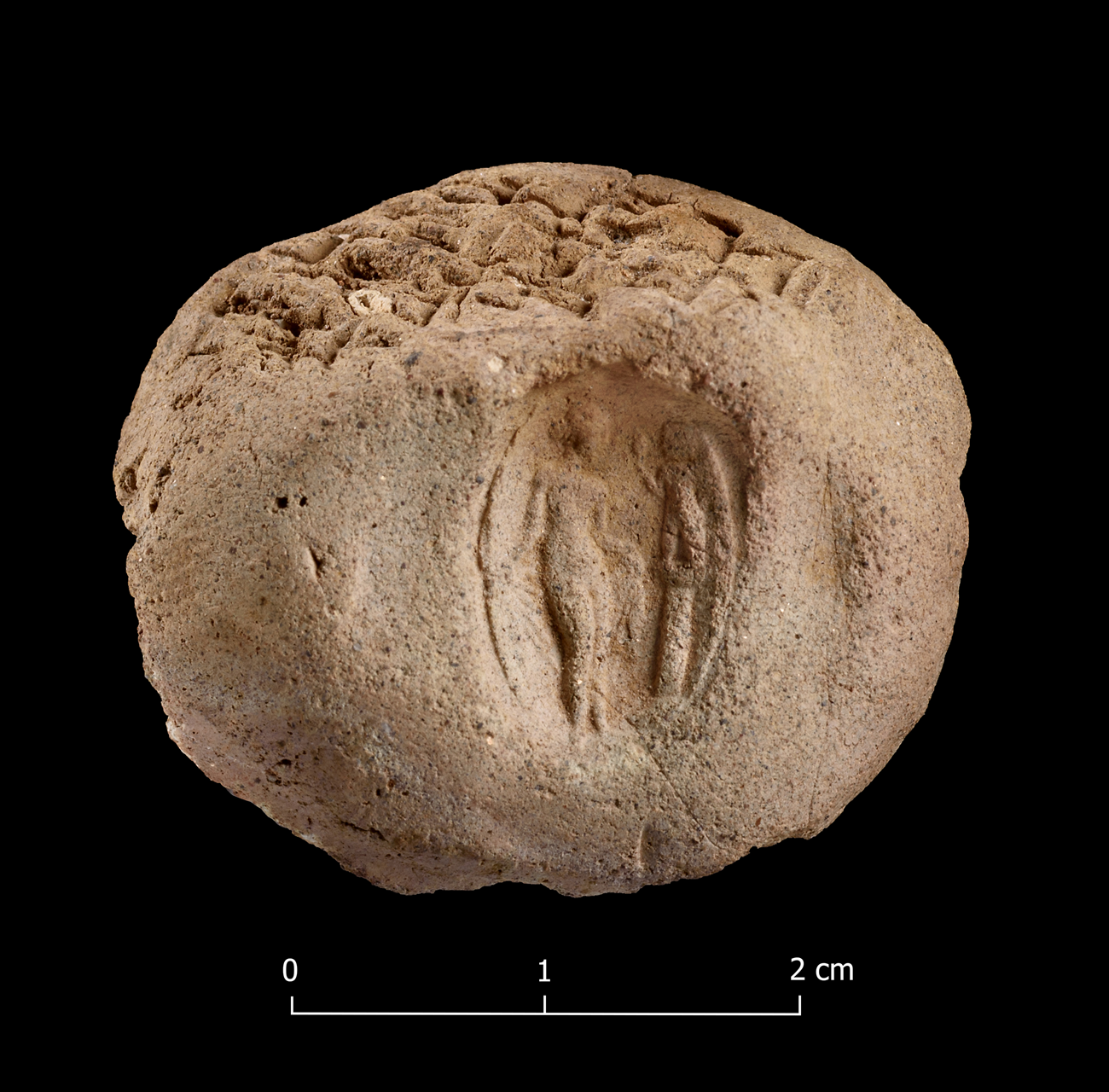
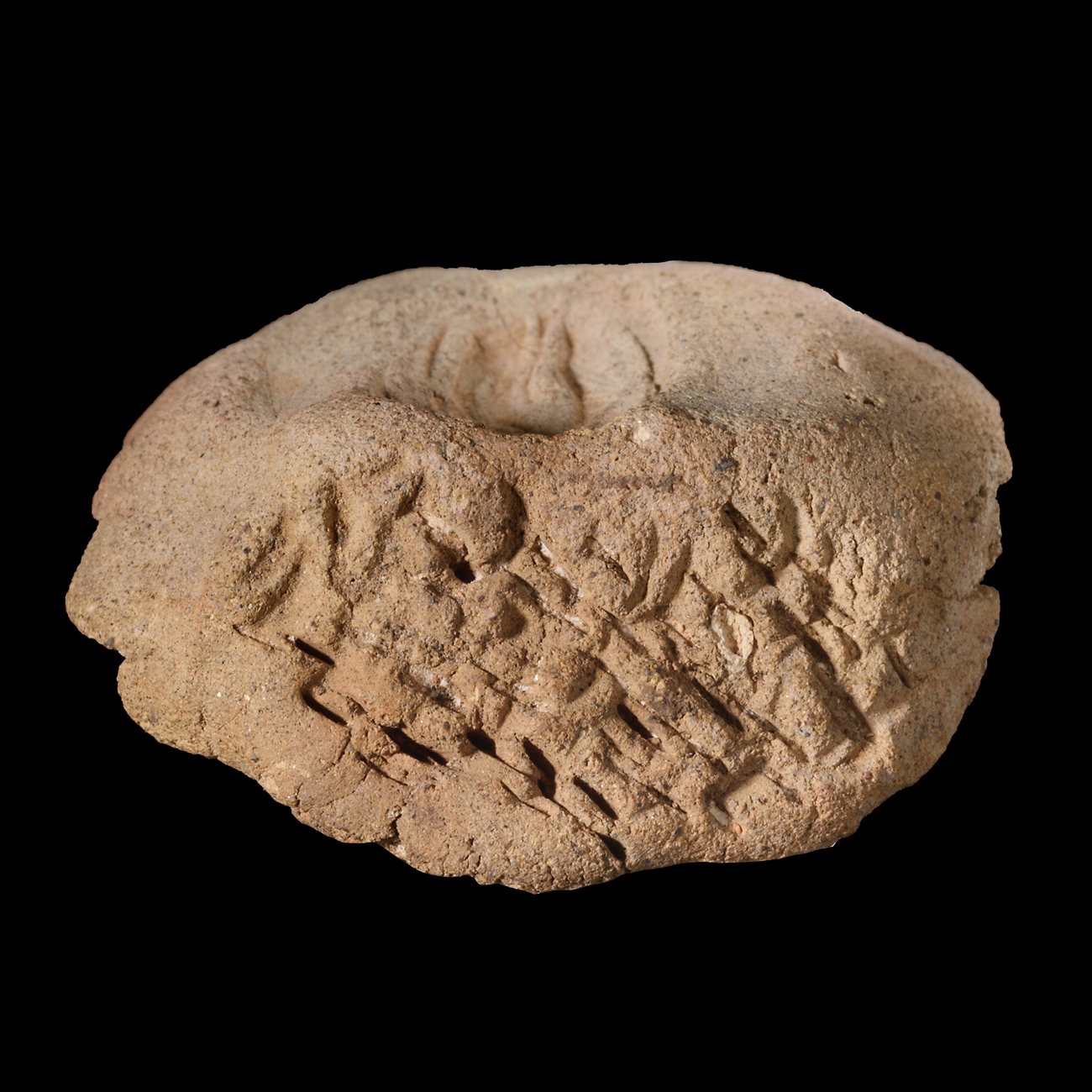
Of the four new bullae under discussion here, the anepigraphic bulla with inv. no. 10841 bears a single seal impression of Aphrodite and Eros (Figure 1). One side of this bulla displays the marks of multiple incisions made with a pointed tool (Figure 2). Wedges of this type are also found on bulla inv. no. 11008 of the new Moradi collection from Takht-e Solaymān, on two Sasanian bullae held at the Khoy Museum in West Azerbaijan, on a bulla in the Bibliothèque Nationale de France, and on one in the Ahmad Saeedi collection.Footnote 9 While there is no evidence to suggest the purpose(s) these wedges may have served, one possibility is that they are signs for calculations. The reverse side of bulla 10841 is notably flat, displaying a longwise slit through which a strip of leather or parchment must have passed to secure the object the bulla once sealed. In certain areas, the edge of the bulla is raised, most likely caused by the object to which it was attached. However, it is difficult, if not impossible, to ascertain whether the bulla was attached to a document, a package, or a bundle of merchandise.
Bulla inv. no. 10841 showing Aphrodite and Eros (Photo by R. Maleki).
Bulla inv. no. 10841 displaying marks of multiple incisions on the side (Photo by R. Maleki).
It has been widely assumed that small bullae with a single seal impression were likely applied to documents, while larger bullae were predominantly affixed to commodities.Footnote 10 Thus, Gyselen advanced the hypothesis that “small sealings,” under 3 cm in diameter, were likely attached to documents and “large sealings,” over 4 cm in diameter, were usually affixed to goods.Footnote 11 Although an examination of the post-Sasanian economic documents of the “Pahlavi Archive” housed at the University of California's Bancroft Library and the Freie Universität BerlinFootnote 12 suggests that small bullae were indeed primarily attached to documents, it remains uncertain whether small bullae were exclusively used for sealing documents, as there is no conclusive evidence ruling out their use in securing packages.
Upon examining the bullae discovered at Takht-e Solaymān by the German Archaeological Institute, Huff concludes that all clay bullae were primarily used to seal documents, rather than packages or consignments of commodities, as the bullae would have easily been damaged or destroyed during transportation.Footnote 13 However, Huff's intriguing proposition is at odds with a Sasanian bulla attached to a fragmentary glass vessel. Displaying a single impression featuring a bird standing to the right, this bulla was found at Sayf Abād, approximately 10 km southeast of Kazerun in Fars province.Footnote 14 Moreover, at Dvin in Armenia, bullae and remnants of sacks were discovered, indicating that bullae were affixed to merchandise and commodities. Describing the Dvin archive, Lukonin states: “more than one hundred bullae were found in a store-room together with the remains of many sacks for wares on which some of them were applied.”Footnote 15
The imprint of the mount (2 mm in width) around the impression suggests that the intaglio that made the impression was set in the metal bezel of a signet ring. Sealing no. 64/15-1 exhibits two globular indentations at 6 and 12 o'clock,Footnote 16 suggesting the bezel had two prominent knobs on its edge. The knobs, though decorative, served the practical purpose of preventing the sealstone from slipping while being pressed into the moist clay, thus facilitating the equal application of pressure across the surface of the clay to create a clear impression of the seal. The knobs were also used to orient the seal correctlyFootnote 17 and acted as a lever to remove the seal from the clay bulla after application.Footnote 18 The imprint of the knobs on bulla 64/15-1 (Tafel 23) published by Göbl and their absence in the impressions of the same seal on bullae 63/134-2 (Tafel 15), 63/158-3 (Tafel 19), and the four new bullae (inv. nos. 7772, 7933, 10841, and 10921) strongly suggest that the seal's owner replaced the ring and its bezel at a certain point in time. However, determining the chronological precedence of one bezel over the other remains elusive.
The depressions on either side of the sealing on bulla inv. no 10841 may be finger impressions of the seal's owner, who would have steadied the ring in the clay during the sealing process. The intaglio was an oval stone, noticeably convex in profile. The elongated oval form, favored by Hellenistic and Roman gem-cutters and their patrons, is effective at portraying standing figures in relaxed or leaning positions. Its large size (10×14 mm including the bezel mount) and placement in the upper part or at the center suggest it was the main sealing on the three bullae that bear multiple seal impressions (7772, 7933, and 10921). Typically, in Sasanian archives, the foremost place on a bulla was reserved for the seal impression of significant individuals, such as the main party in the transaction or the authority overseeing it. The seals of co-signatories were considered secondary and appear as smaller seals, impressed around the impression of the main seal and on the margins of the bulla. These so-called “witness seals” belonged to individuals who were required to authenticate the validity of the contents of the document or the object to which the bulla was once affixed.Footnote 19 The reconstruction of this scenario gains support from evidence found in the post-Sasanian “Tabarestān Archive,” which provides additional insights into the procedures for sealing and authenticating documents. The textual content of numerous documents from that archive explicitly identifies the official, witness(es), scribe, claimant, defendant, representative, and others who sealed the documents. The sealings that appear on the bullae correspond precisely to those described in the document they sealed, featuring the same number of seal impressions as the individuals listed in the document.Footnote 20
3. Style and iconography
3.1. Aphrodite and Eros
Of the four new bullae featuring Aphrodite and Eros, bulla 10841 is the best preserved and bears only this one sealing. The other three bullae with this impression display several other impressions alongside it, surveyed in the catalogue in section 6. The sealing portrays a female figure (Figure 3) in three-quarter profile with her head turned to the right towards a small male figure on a column. Due to the deep carving of the figures on the sealstone, the resulting impression is high and of great plasticity. Göbl refers to a tree behind the female figure that provides her with shade.Footnote 21 In 2024, Yousef Moradi was able to closely examine the original four bullae in the Museum of Urmia, and Harald Schulze and his team at the Bavarian State Archaeological Collection sent several high-resolution images of bulla 64/15-1, but we were unable to identify the tree to which Göbl refers.
Aphrodite and Eros on bulla 10841 (Photo by R. Maleki).
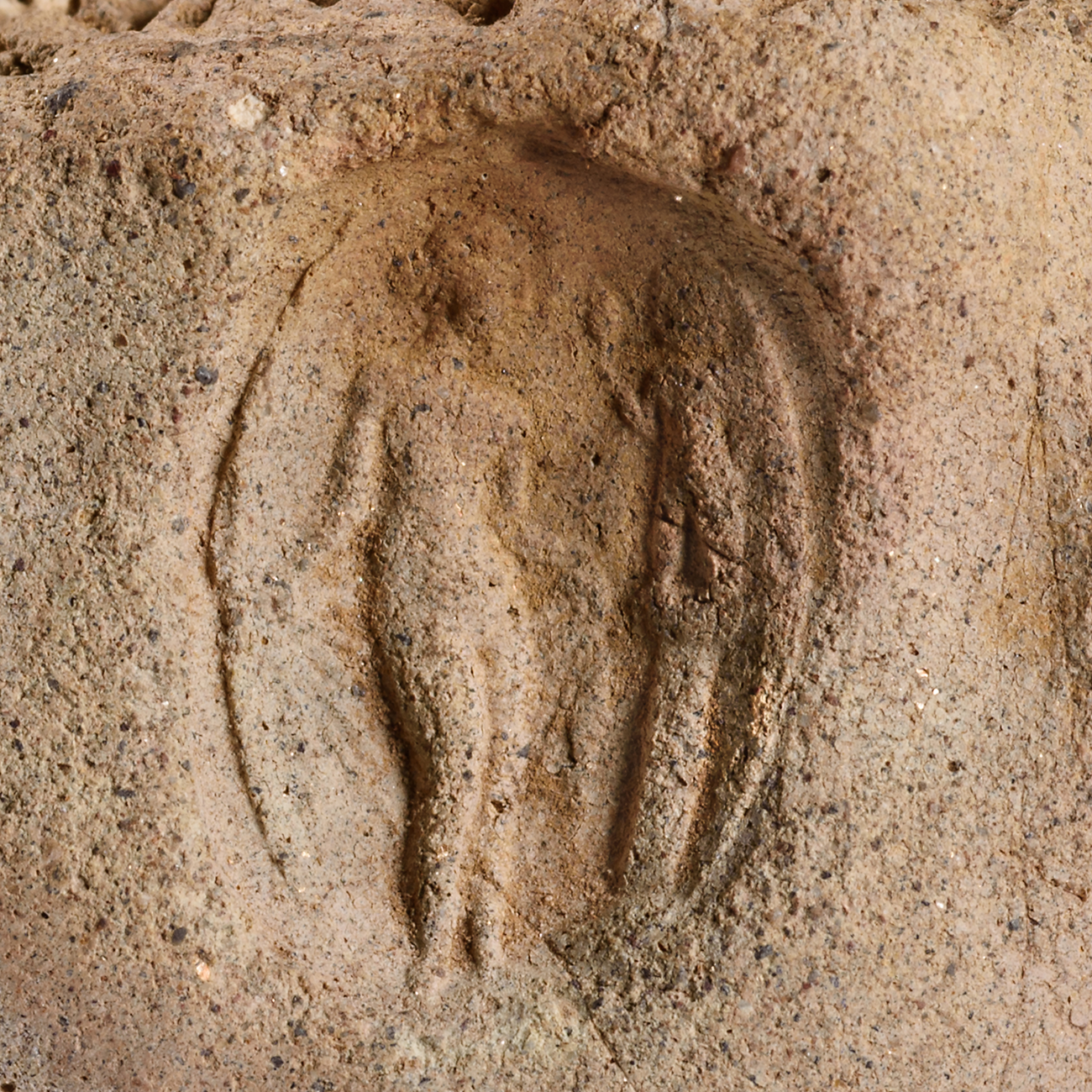
The female figure stands naked and gracefully holds the corners of an outspread himation behind the lower part of her body. The himation is fringed, and its folds are skillfully crafted, conveying the lightness of the fabric and a sense of motion and realism. The figure exhibits a particular finesse of execution, notable for the delicate rendering of her rounded and soft body, as well as her elegant S-shaped posture. She has a rounded head proportionately small in relation to her body. Her hair is rendered by obliquely dense lines and styled in a distinctive chignon at the back of her head. Her face is slightly lowered. Although the clay showing her face in profile is worn, it still retains faint traces of a large, fully opened eye, a mouth, fleshy lips, and round chin. The ears are not visible. Her nose is prominent and straight. Her fingers are clearly visible. With arms turned up at the elbow, the right arm is lowered with a subtle bend, held slightly away from the body, while the left arm is sharply bent and close to the body. Leaning slightly forward, the left shoulder is higher than the right, and the right shoulder is broader.
She is long-legged and voluptuous, with large hips and thighs. Her left hip thrusts out to create an S-curve that rises through her body. Her weight-bearing right leg is counterbalanced by her weight-bearing left arm and hand, and a sense of movement across and through the body is fully realized. The figure is designed in a contrapposto pose, a technique where the weight of the body is predominantly borne by one leg while the other leg remains relaxed. This deliberate positioning results in the creation of an aesthetically pleasing female figure. In this instance, the weight of the figure is unevenly distributed so that she supports herself with her right leg, allowing her left leg to assume a more relaxed and graceful stance. The left leg is slightly bent. The figure is barefooted. Unlike the legs, the feet are noticeably apart, with the left foot shown in frontal view and the heel off the ground, while the right foot is depicted in profile. The seal impression of bulla inv. no. 7772 shows her legs resting on a baseline. The toes are rendered with delicate precision. The trailing left leg slightly moved across her right leg in an attempt to cover her crotch, a gesture that may be understood as drawing attention to her sexual power. Bulla inv. no. 7933 reveals the figure's navel. Her breasts are particularly pronounced so that the cleavage between her breasts is visible. The left breast is slightly higher, round, and almost frontal. Despite her nudity, she is shown as “modest” and essentially “passive” by present-day standards. The figure is also blithely non-explicit in genital detail. Accurate female genitalia on this figure might have been deemed too immodest or unconsciously felt to be too sexually aggressive.
The figure's nudity accords with the Graeco-Roman concept of nakedness as denoting divinity. Nudity, a characteristic often linked to Aphrodite (known as Venus to the Romans), is not exclusively confined to the iconography of this goddess. Figures such as Leda and Dionysus are occasionally portrayed in a similar stance and posture.Footnote 22 However, in the case of our sealing, Aphrodite can be securely identified not only by her nudity but also by the presence of Eros in the scene. Although Greek sources mention that gods and goddesses should not be portrayed on rings, keeping their “notions” and “reckonings” from public view (Porphyry Vit. Pyth. 42),Footnote 23 a plethora of seals, including the one with the imagery of Aphrodite and Eros under discussion here, show representations of divine beings and suggest a contrary practice.
Aphrodite was the goddess of sexual love, but she is much more than the irresistibly beautiful and seductive character she is painted to be by Homer. Aphrodite also oversees marriage, political harmony, military success, and the sea and seafaring.Footnote 24 The engraver of the Takht-e Solaymān Aphrodite seal produced a work that effectively portrays the goddess as embodying the concept of ideal beauty and body. Presumably, she is presented after ritual bathing, as the nakedness of every Aphrodite is founded on either her bath or her unusual birth from the sea. That the seal shows Aphrodite after her bath is indicated by her having already done her hair, holding the himation behind her body and gazing with admiration into the mirror held by Eros. These observations imply that she is about to attire herself after her ablutions.
To the right of Aphrodite is a freestanding column with a smooth shaft and plain capital. As sealing 7772.1 demonstrates, the column's plinth is two-stepped, although part of the lower step does not show in the impression. Judging by the available space, this seems intentional, although this part of the plinth may have been obscured by the ring's bezel. As in Hellenistic glyptic representations, the column is not a mere pedestal, but is more monumental. As an architectural element designed to support loads, a column inherently symbolizes strength and stability; and it is likely that representations of columns carry further symbolic significance.Footnote 25
Although, in Graeco-Roman art, the column was typically a support for Aphrodite to lean against, or, more rarely, stand upon,Footnote 26 in the case of our bullae, the son of Aphrodite – Eros (the Roman Cupid), the god of love – stands atop the column. He is characteristically portrayed, in three-quarter view, as a chubby adolescent, glancing towards Aphrodite. The details of his body are minimal: only his left wing can be seen and neither his facial features nor hair are visible; though naked, his genitalia are not visible. With his right hand he raises what is presumably a hand mirror, one of his usual attributes, so that Aphrodite may gaze admiringly at herself.
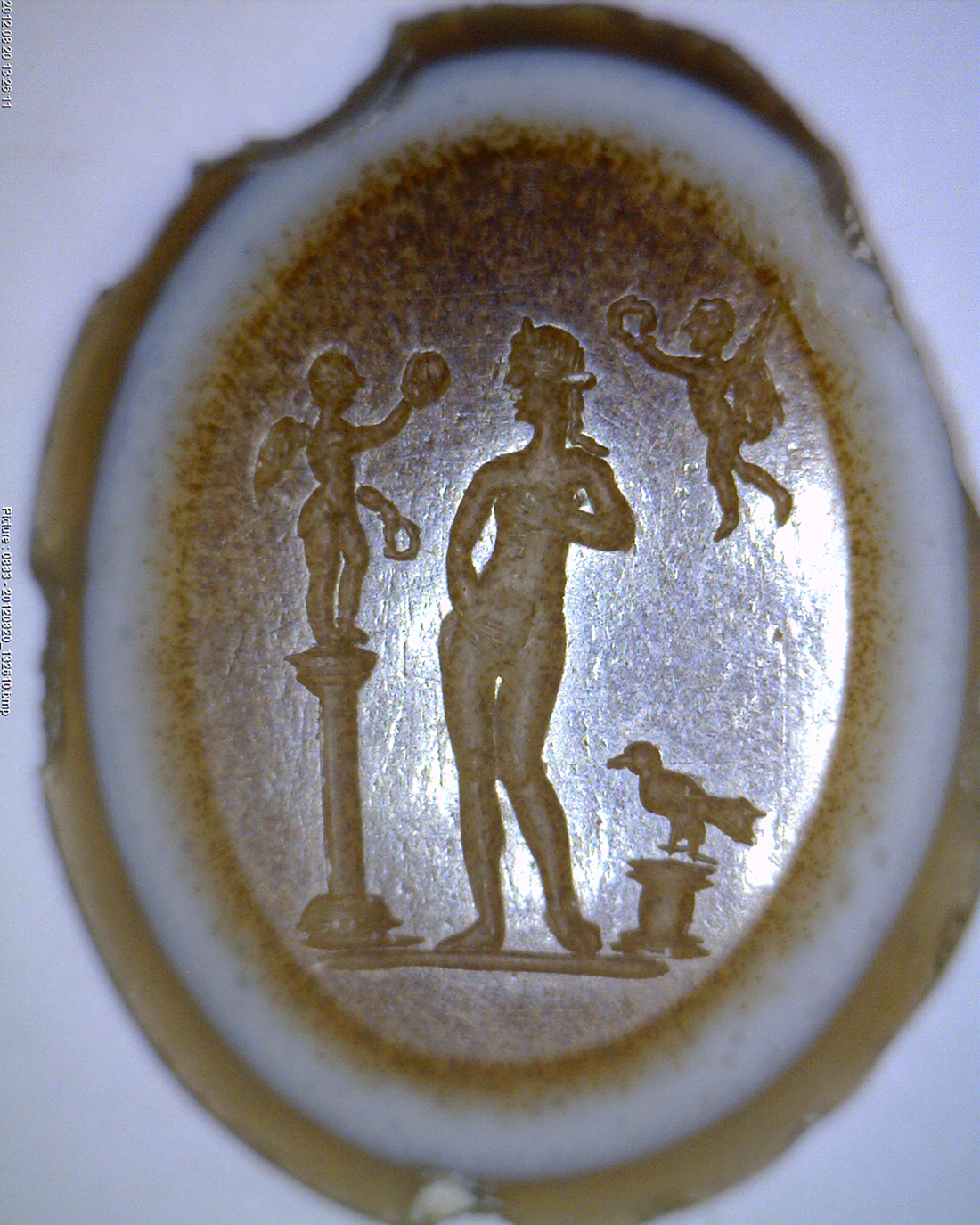
The pairing of these deities on Graeco-Roman seals and bullae is not unusual. However, Eros is not typically depicted upon a column. Instead, he is shown seated, standing, or kneeling before Aphrodite, or sometimes even standing on top of her head. If not depicted holding a mirror towards her, Eros can be seen crowning her, fastening her sandal, or engaged in other activities. As far as we know, the image of Eros upon a column, facing Aphrodite, is only found on the Takht-e Solaymān bullae and a sardonyx gem in the Archaeological Museum of Zagreb, Croatia (inv. no A-9221) (Figure 4). The Zagreb gem depicts Aphrodite standing with her weight on her right leg, while her left leg is slightly bent. With her right hand she covers her pubis, and with her left clutches her left breast. Eros stands upon a column holding a mirror in front of Aphrodite with his right hand and a wreath with his left hand. A second Eros hovers above, also holding a wreath. This seal can be dated to the 2nd century CE.Footnote 27 A further example is an undated gemstone kept in the Museo Archeologico Nazionale di Napoli. Despite its notable divergence in composition, portraying Aphrodite seated in front of a basin, with Eros behind the goddess rather than before her, this seal features Eros atop the column.Footnote 28 Two bullae discovered in Delos, Greece, also display Eros on a column, either caressing or crowning Aphrodite. However, in contrast to our bullae, on which the deities face each other, those from Delos show Eros on the column, with Aphrodite standing with her back to him.Footnote 29
Aphrodite and Eros on a sardonyx gem in the Archaeological Museum in Zagreb, Croatia (Photo courtesy of M. Henig).
We find no precise parallels for the Takht-e Solaymān sealings elsewhere, not even on coins of the Hellenistic or Imperial Roman periods. For the most part, however, the depiction of Aphrodite on the Takht-e Solaymān sealings faithfully follows Aphrodite's generic posture as seen in Hellenistic sculpture. Her entire figure is characterized by sinuous and oblique rhythms, emphasizing the curvature of her hip and flexed left leg. This represents a restatement of the Hellenistic concept of the female nude in contrast with drapery. The figure's relaxed pose and dynamic balance are also inspired by the Hellenistic tradition. Although in different poses, several Hellenistic gems with depictions of Aphrodite and ErosFootnote 30 bear notable similarities to our sealings in terms of style, execution, body proportions and form, position of the feet, sway of the hips, and the concave shape (convex for the seal, classicizing in style) and elongated oval shape of the seal impression. The posture of the female figure on our bullae is consistent with the Hellenistic statuary type of Aphrodite, which emphasizes the display of feminine beauty with a focus on bare breasts. The image corresponds to the “Hellenistic ideal of beauty” prevalent in artistic styles of Greece. The emphasis on the Aphrodisian sphere is reinforced by the outspread himation held behind the lower part of the figure like a towel. The pose is open and places the goddess's entire body on display.
Several gemstones featuring the image of a nude female figure exhibit notable similarities with the representation of Aphrodite on our bullae. While these figures are commonly identified as Aphrodite, it is plausible that they might alternatively represent an erotic woman or courtesan. Nevertheless, without a definitive representation of a deity, one cannot rule out the possibility that the intention behind these gemstones was to invoke a sense of Aphrodite for the owners, enabling the mortals to identify with the deity. These gemstones can be categorized into three groups based on the manner in which Aphrodite holds the himation behind her body.
1) Holding the himation behind the lower part of her body with both hands lowered
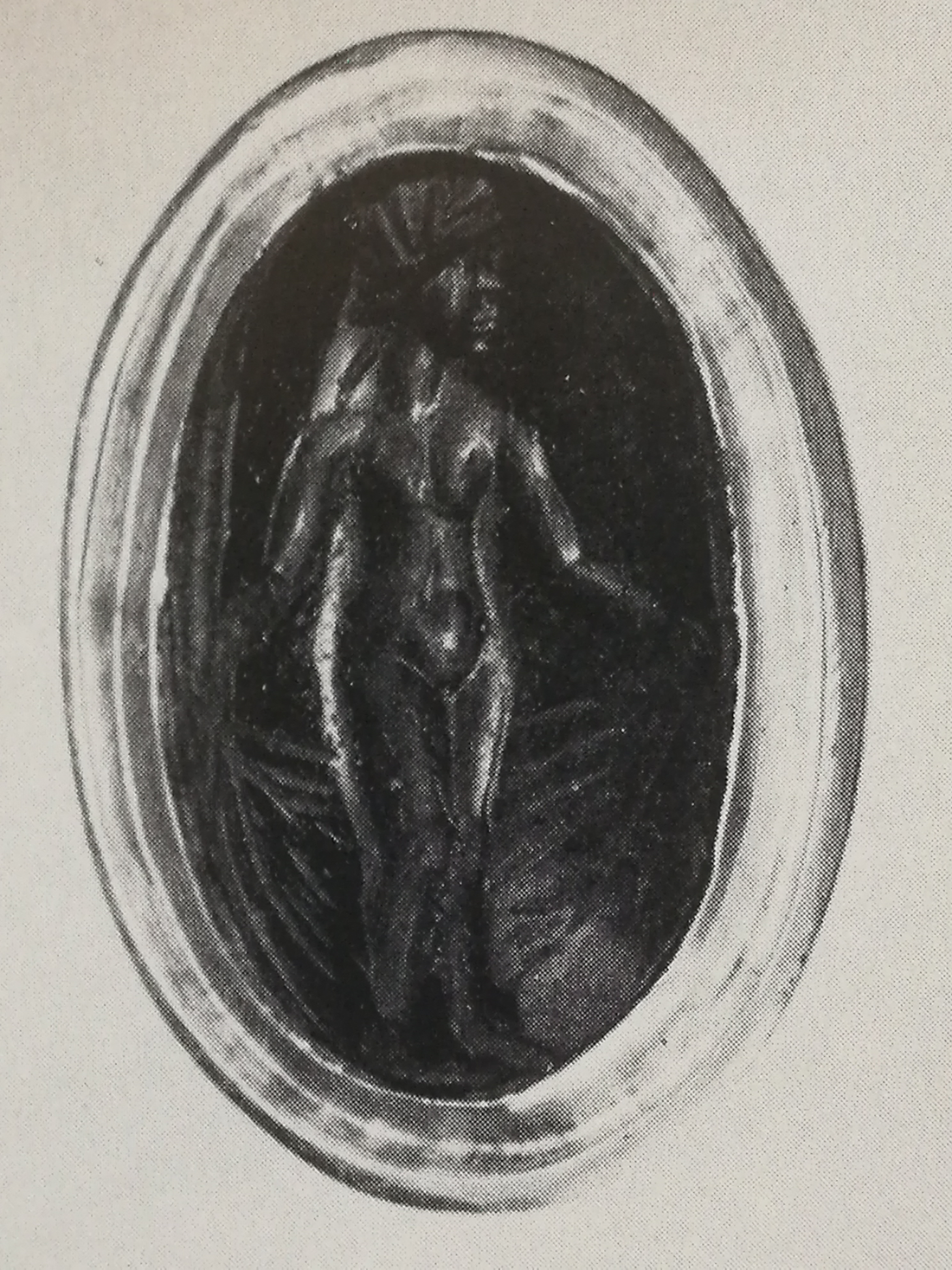
The closest parallel for Aphrodite in a relaxed pose unfolding a himation behind her lower body can be found on a gemstone from the Roman Imperial period, specifically from the 2nd or 3rd century CE.Footnote 31 However, the dating of this gemstone is uncertain, as it was not discovered in an archaeological context. This gemstone, currently housed in the Staatliche Münzsammlung München, shows Aphrodite standing in contrapposto. Her body is rather stocky and thick through the waist (Figure 5). Although the rendering of the body and drapery is slightly harder than that of Aphrodite on our bullae, the work, characterized by great finesse and elegance, seems to belong to the same style.
Aphrodite on a gemstone in the Staatliche Münzsammlung München (from Brandt, Antike Gemmen in deutschen Sammlungen, Tafel 228, no. 2498).
2) Holding the himation behind the lower part of her body with one hand raised and the other lowered
While the Aphrodite on our bullae holds her himation rather lower, other similar depictions have her holding the drapery behind her back, with one hand raised and the other lowered. In almost all these instances, her pose, somewhat voluptuous body shape, and hairstyle bear a striking resemblance to the image of Aphrodite on our bullae. One such example is a Graeco-Roman sard gemstone, likely from late 1st century BCE or 1st century CE, in the British Museum. This gemstone portrays a nude Aphrodite standing in a contrapposto pose to the right, with both hands holding the drapery behind her back.Footnote 32
A similar pattern to that of the image on the British Museum gemstone can be seen on a partially preserved sardonyx gemstone from ca. 40–20 BCE held in Dressel collection. This gem shows naked Aphrodite standing in three-quarter view facing left. She gazes at her raised right hand, holding up a corner of her drapery behind her lower body.Footnote 33 Given the lost part of the gem, it is unknown whether Aphrodite's left hand was originally lowered or raised.
Another instance is a ring stone from the 1st century BCE that portrays nude Aphrodite holding the drapery behind her lower body.Footnote 34 However, the image on this ring stone diverges from the depiction on our bulla in terms of the drapery style. In her half-raised left hand, the goddess holds a folding mirror in which she observes herself; the right hand, lowered backwards, grasps a drapery that is drawn behind her back and hangs down over her left arm.
A nicolo from the Roman Imperial period, now a stud on an 11th-century book cover of Evangelistarium of St. Ansfridus, the Bishop of Utrecht from 995–1009, portrays a nude Venus/Aphrodite in a three-quarter pose facing to the left.Footnote 35 Her right hand is raised while her left hand is lowered, grasping the corner of the drapery behind the lower part of her back.Footnote 36 A similar iconography can be seen on the gemstones reproduced by Gravelle, without any indication of the stones or their owners.Footnote 37
Furthermore, a carnelian gemstone from the late 1st century BCE, now held at the Museo Nazionale di Aquleia, Italy, depicts a nude Aphrodite in three-quarter view facing left, raising one arm to hold the outspread drapery that covers her back from the neck down to the calf.Footnote 38
3) Holding the himation behind the lower part of her body with both hands raised
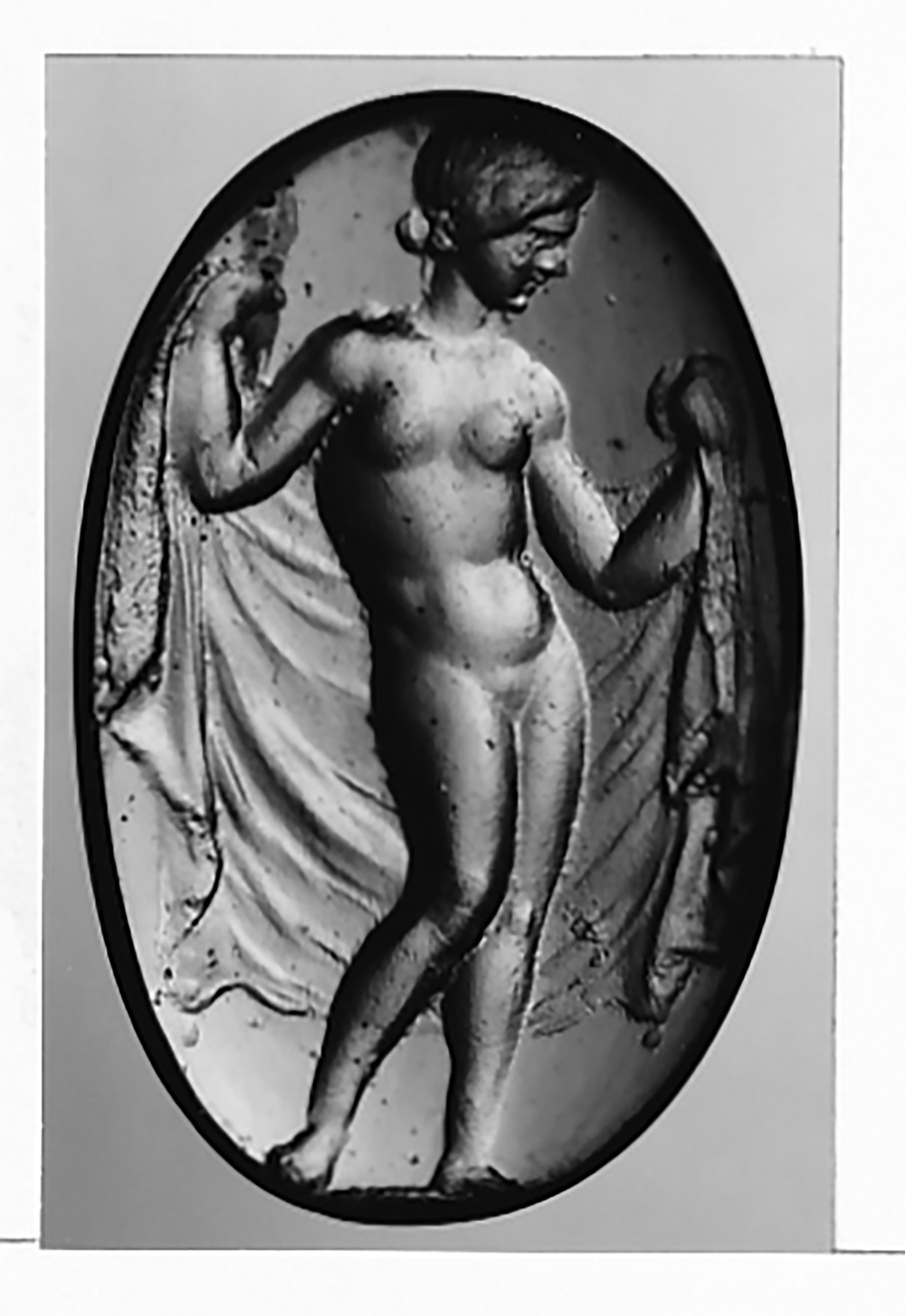
A carnelian gemstone from the late 1st century BCE, now held at the Museo Nazionale di Aquleia, shows Aphrodite standing naked in three-quarter view facing right, with her left leg bent backward. Her left arm is raised above her head to hold a corner of the drapery behind her, while her right arm holds the other corner at the level of her chest.Footnote 39 Similarly, a Graeco-Roman carnelian gemstone in Berlin (no. 6820. Rep. Gravelle, rec. I, 97) shows Aphrodite in a contrapposto pose, standing completely naked while grasping the edge of a draped himation behind her body.Footnote 40 The motif of Aphrodite holding a drapery behind her back while exposing her naked body is also found on an 18th-century glass paste seal that imitates a gemstone from the 1st century BCE to 1st century CE. This seal currently resides in the Martin von Wagner Museum at the University of Würzburg, Germany.Footnote 41 The seal features Aphrodite in a relaxed pose and a curvaceous body, with both of her hands raised, unfolding a himation behind her back and lower body (Figure 6).
Aphrodite on a glass paste in the Martin von Wagner Museum (from Zwierlein-Diehl, Glaspasten im Martin-von-Wagner-Museum, Tafel 61, no. 335).
3.2. Aphrodite Anadyomene
As mentioned in the introduction, the German Archaeological Institute excavations at Takht-e Solaymān found a bulla (no. 63/109), one of whose twenty-three seal impressions represents another type of Aphrodite. Sealing nine is on the side of that bulla and measures 10×10 mm.Footnote 42 The images in Göbl's edition, however, are too small to decipher details, and we are grateful to Dr. Harald Schulze and his team at the Archäologische Staatssammlung in München, where this bulla is now housed, for providing us with images and the permission to reproduce them here (Figure 7). No further example of this seal impression has been found in Moradi's excavations of 2002–2008. The imprint of a mount around the impression indicates that the sealstone was mounted in the metal bezel of a ring.
Aphrodite Anadyomene on bulla 63/109-9 (Photo courtesy of Archäologische Staatssammlung in München).
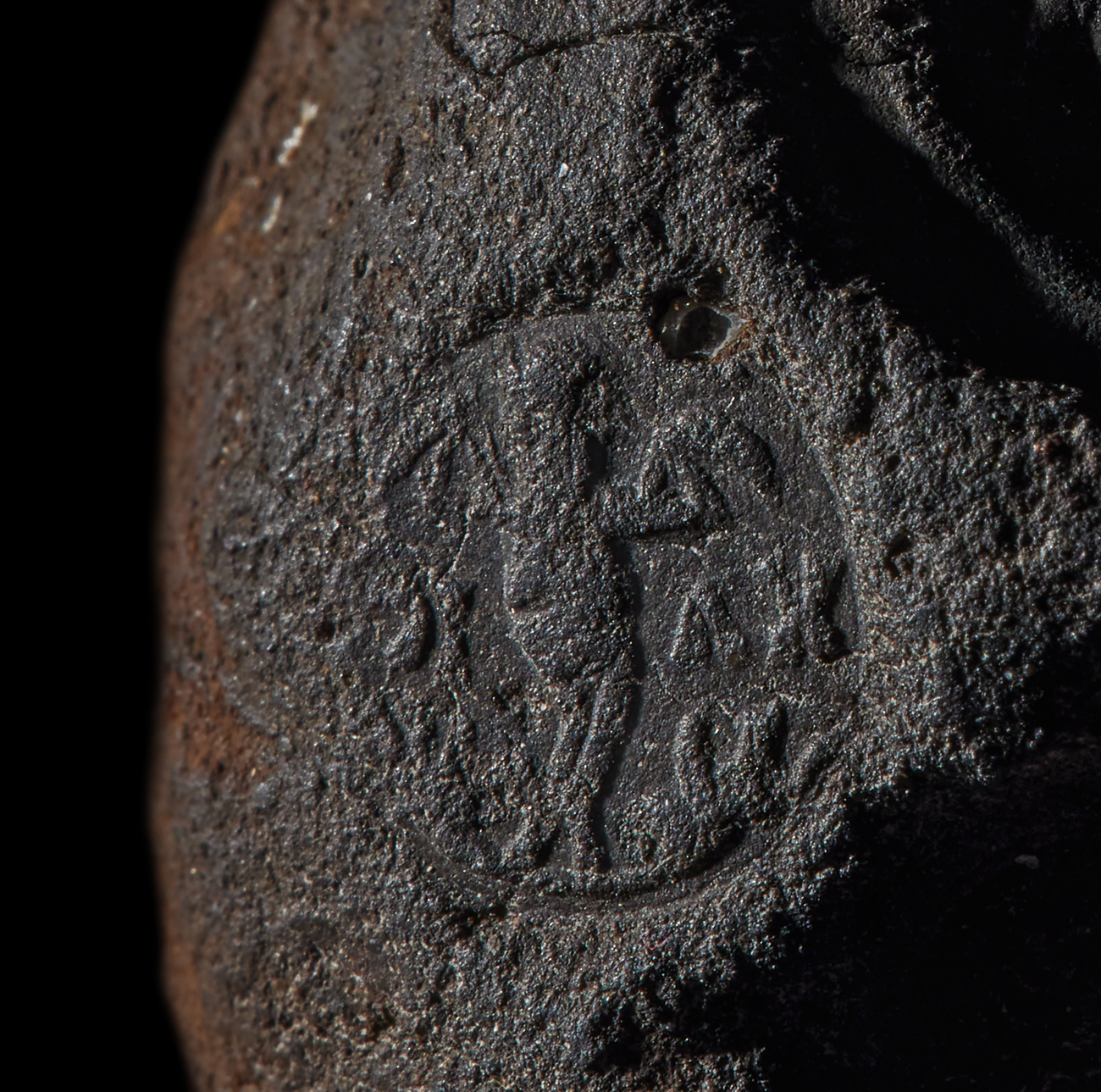
This sealing depicts a female figure with a line of inscription on either side. A.A. Barb apud Göbl interprets the characters as representing the Greek letters XAIC.Footnote 43 Assuming a lost letter indicated by a blank space between the alpha and iota, Barb restores the word as XA[P]IC (Charis), “grace,” with reference other legends. Additionally, Barb interprets traces in the lower right of the seal impression as the letter omega (Ω). This leads him to consider the possibility that this omega might be part of what he writes in Latin (rather than Greek) letters as “ArOriphrasi.” The name intended by Barb is apparently AΡΩΡΙΦΡΑΣΙ(Σ), a common designation for Aphrodite Anadyomene, especially on magical amulets. Noting that, depending on the shape of the amulet, this name is often split in two, Waegeman suggests that the spelling ΦΡΑΣΙ(Σ) is an anagram for ΣΑΦΙΡ, the name of the precious stone, while ΑΡΩΡΙ recalls the Greek word ἄρουρα (arable land). According to him, the name AΡΩΡΙΦΡΑΣΙ(Σ) expresses “the goddess's duality by calling her goddess of fertility and goddess of heaven in one name.”Footnote 44 Although the presence of this magical name of Aphrodite agrees with the iconography of the object, there does not seem to be sufficient space for all these letters on the sealing of bulla Göbl no. 63/109-9. The edges of the bezel are distinctly impressed. Moreover, what Barb identifies as the letter omega is more likely to be a part of the body of an enigmatic creature. Thus, two creatures are depicted to either side of the figure's lower legs.
Returning to the word XA[P]IC, although the rho is not explicitly depicted in sealing Göbl 63/109-9, it is implied. We are uncertain whether the inscription identifies the female figure as a Grace, embodying charm, grace, and beauty, in a pose similar to Aphrodite, or whether it simply conveys the concept of “grace” – a common wish found on amulets associated with the goddess, who is invoked to produce charm and beauty in the wearer of the gem. In Greek, χάρις also carries the meaning “grace and beauty,” of which the Graces are the embodied personification. However, one typically would use the word καλή (beautiful) in Greek to denote that a woman is beautiful or attractive. The use of the nominative form of the noun “grace” (rather than the adjective “gracious”) indicates that a personification is intended.
The figure on sealing Göbl 63/109-9 is nude, standing on a baseline in three-quarter view towards the right (Figure 7). The buttocks are not clearly depicted, making it uncertain whether the figure is being shown from the back. Nevertheless, the elevated right heel and contours of the shin and thigh might indicate that the figure is intended to be viewed from the back. However, this observation is inconclusive, especially considering that Aphrodite Anadyomene is typically depicted from a frontal view rather than from the rear. Her facial details and hairstyle cannot be discerned. Her legs are noticeably thin and exhibit an awkward lack of proportionality with the rest of her body. Her weight is on the left leg while the right leg is slightly bent at the knee. Her right heel is raised. On the sealing, an enigmatic, winged creature crouches to either side of the figure. Unfortunately, the images currently at our disposal allow for no credible identification and interpretation of these creatures. The presence of a creature, in particular a bird, accompanying Aphrodite Anadyomene is a common motif in her depictions. For instance, a carnelian seal from the 2nd or 3rd century CE, in the Kunsthistorisches Museum, Vienna, portrays Aphrodite Anadyomene standing upon waves as dolphins dive from both sides. Other seals, such as a chalcedony from the 3rd century CE in the same museum, depict a dove perched on a pedestal next to the goddess.Footnote 45
While Göbl describes the sealing as “»Abraxas«-Gemme: stehender Mann mit erhobenen Armen auf Doppelzweig (?),” he also shares a personal communication, dated January 18, 1974, of A.A. Barb from London, who identifies the figure as Aphrodite Anadyomene.Footnote 46 Barb's identification of the figure is plausible if one assumes that she raises both hands to bind her hair.Footnote 47 This specific gesture is a distinctive characteristic associated with Aphrodite Anadyomene, a motif replicated in numerous terracotta figurines, bronze and marble statuettes, monumental marble statues, vase-paintings, gemstones, seals, and sealings. In the Archäologische Staatssammlung photograph (Figure 7), the figure appears to raise her hands to grasp two unidentifiable curved objects. Nevertheless, it is conceivable that two locks of hair fall on either side of the head and then curve upwards, although the fallen locks cannot be seen in the photograph. An alternative interpretation is that the impression has not taken up the linking strands. Another hypothesis is that the gem-cutter may have misunderstood the figure's act of lifting two tresses as her holding detached objects. Moreover, the slight fletching of one leg fits with the pose of Aphrodite on numerous other Graeco-Roman seals.
Hesiod (Theogony 188–199) recounts that Aphrodite was born in the sea from the foam that collected around the severed genitals of Ouranos, the primordial Greek god of the sky. After reaching the island of Kythera, she undertook a very long swim to the shores of her sacred home on the island of Cyprus.Footnote 48 Due to her marine birth, the ritual bathing of Aphrodite has held significant importance in her cult.Footnote 49 The main source of inspiration for the portrayal of Aphrodite Anadyomene is thought to have been a 4th-century BCE painting of the goddess “rising from the sea,” attributed to Apelles, the court painter of Alexander the Great, and described by Pliny the Elder (Naturalis Historia 35. 87).Footnote 50 Thus, Athenaeus Naucratita (Athenaeus 13. 590), a Greek rhetorician and grammarian from the late 2nd and early 3rd century CE, recounts of Aphrodite:
At the great assembly of the Eleusinia and at the festival of Poseidon, in full sight of the whole Greek world, she removed only her cloak and let down her long hair before stepping into the water; she was the model for Apelles when he painted his Aphrodite [Anadyomene] Rising from the Sea. So, too, the sculptor Praxiteles, being in love with her, modelled his Cnidian Aphrodite from her.Footnote 51
The pose of Aphrodite Anadyomene is open, exposing her complete nudity in a manner that Havelock suggests conveys the fearlessness of Aphrodite, who “now realizes how attractive she is, and the observer is no longer threatening but admiring.”Footnote 52 While Havelock's observation concerning the directness of the pose might be valid, her interpretation of the viewer's intentions may be excessive, considering that perception, acceptance, and norms around nudity are shaped by cultural values, traditions, and societal beliefs. Hence, it might be an unreasonable exercise to judge ancient nudity through the lens of modern perspective and morality.
4. The date of the bullae and original sealstones
It is difficult to establish the precise date of the bullae under consideration, as they were not found within their respective, primary archaeological contexts and none of their seal impressions provide a chronological marker. Nonetheless, one can tentatively attribute these bullae to sometime between the 5th–7th centuries, the timeframe in which all bullae were stored in the archive of the fire temple of Ādur Gušnasp.Footnote 53 Nevertheless, it is crucial to exercise caution, as the potential discovery of new bullae in future excavations might provide further insight into the chronology of the Takht-e Solaymān bullae.
Establishing the exact date of the engraved gemstones that produced the bullae's seal impressions proves equally challenging. This challenge stems from the lack of parallel gemstones discovered in controlled excavations, as the gemstones known from the art-trade are neither securely dated nor exhibit precisely identical iconography to that depicted on our bullae. Even when a gemstone is discovered in an archaeological context, pinpointing its exact date is impossible, as archaeological context only provides a terminus ante quem for when the object – such as a seal, which may have remained within a family or office for generations – might have been deposited, whether intentionally or accidentally. Consequently, establishing an approximate date for a particular seal requires a comprehensive examination of the type of stone, its stylistic characteristics, and the technology employed in its carving. Unfortunately, the seals that produced the impressions on the Takht-e Solaymān bullae have either not survived or, at the very least, not yet come to light. Göbl posits a late Hellenistic date, specifically the end of the 2nd or beginning of the 1st century BCE, for the original seal that produced the impressions of Aphrodite and Eros on the Takht-e Solaymān bullae.Footnote 54 However, he provides no justifications for his proposed dating of the sealstone.
The representation of Aphrodite on our bullae shares notable similarities with the nude Aphrodite depicted on the gemstones described above. These parallels point to a similar degree of artistic finesse in the sinuous contrapposto, volume of the body, folds of the drapery, position of the feet, and sway of the hips, as well as the concave shape (convex for the seal, classicizing in style) and elongated oval shape of the seal impression. While these artistic and stylistic features are subjective indicators and do not necessarily provide concrete chronological evidence, it is reasonable, in the absence of such evidence, to propose a dating of the seal that produced impressions on the Takht-e Solaymān bullae to the late Hellenistic or the Early Roman Imperial period, specifically the late 1st century BCE into the early 1st century CE.
Regarding the dating of the sealstone that left the impression of Aphrodite Anadyomene on the bulla discussed in section 3.2 above, Barb apud Göbl proposes a date in the 3rd or 4th century BCE.Footnote 55 However, one cannot rule out the possibility that the sealstone is a Roman Imperial seal, potentially from the 2nd century CE. Aphrodite Anadyomene was a prevalent theme on Roman Imperial gems of the 2nd to early 3rd centuries CE, especially on the magical amulets in fashion at the time. These gems often had inscriptions engraved alongside the image, not in reverse as usual on seals but designed to be read in positive on the original gems.
5. The Takht-e Solaymān seals and sealings in a Graeco-Roman and Iranian cultural context
It is difficult, if not impossible, to specify whether the original sealstones were carved in workshops in the Mediterranean region and imported into Iran in the Parthian or Sasanian period by way of exchange, trade, or other means, or whether they were produced locally, either by highly skilled local seal-engravers in the strongly Hellenized communities of Parthian Iran or by Western artisans who settled in Iran due to the mass deportations of victorious Parthian and Sasanian rulers.Footnote 56 However, the bullae under discussion demonstrate that the seals bearing the image of Aphrodite were used alongside other seals with inscriptions and imagery belonging to Zoroastrian priests or laypersons of Eranshahr (see the catalogue in section 6). This strongly suggests that the Aphrodite seals were indeed used within Sasanian territory.
Irrespective of when, where, and who produced the original sealstones, one needs to understand whether each of these seals was used by a Zoroastrian or whether they belonged to individuals from one of the religious and ethnic minorities living in Parthian and Sasanian Iran. If indeed the seals were used by Zoroastrians, it would be fascinating to explore whether the iconography was reinterpreted in the Iranian cultural context or was simply appreciated for its aesthetic value, with the seal owners possibly lacking a deeper understanding of the religious and symbolic connotations of their visual content. It is conceivable that those who reused the seals may not have been well-versed in their symbolic significance, perceiving them as exquisite depictions of Anahita or other female deities within the Zoroastrian pantheon. This hypothesis becomes more interesting when considering instances in which male priests reused seals featuring the image of a woman. One example of such reuse is a sardonyx intaglio in the Bibliothèque Nationale de France bearing the figure of the goddess Artemis, as shown by the bow she holds in her left hand. Probably carved in the 2nd century BCE, it bears a Parthian inscription that must have been added much later.Footnote 57 Another seal featuring a goddess, from a different cultural sphere, in the same museum is an inscribed garnet showing a female figure seen from behind, in three-quarter back view, holding a spear in her left hand and an enigmatic object, presumably a helmet, in her right; the Middle Persian inscription reads “Burz-Mihr Mārēy.”Footnote 58 Gyselen argues that although the motif is inspired by the Venus Victrix, subtle iconographic differences with its Roman prototype may indicate the reinterpretation of the goddess in an Iranian context. Gyselen further posits that while some syncretism influenced the original Roman motif, it remains uncertain whether the seal's owner perceived it as the Roman Venus Victrix or as some Iranian concept or divinity to which she had been assimilated.Footnote 59
The other scenario is that these seals were originally carved in the West and subsequently reused by non-Zoroastrian owners. Hence, it is necessary to explore the significance of these figures within non-Zoroastrian contexts. There is compelling evidence, albeit scanty, that the depictions of Aphrodite and Eros, as well as the cult associated with these deities, were familiar concepts among certain communities in Sasanian Iran. Thus, these depictions serve as a testament to the cultural and religious plurality of Sasanian Iran and its openness to external ideas, despite the dominant Zoroastrian religious framework. A fragment of an unprovenanced Sasanian silver bowl (measuring 60×53 mm), held in a private collection in Tehran in 1980, shows the legs of a female figure and a child. Seidl interprets the iconography as a representation of a nude Aphrodite standing in frontal view, holding Eros in her left hand.Footnote 60 Seidl's interpretation draws on several Sasanian vessels and relies heavily on the iconography on a bulbous bottle from the Perm region, held in the Hermitage St. Petersburg (inv. no. S-256). This bottle depicts six nude women in arched postures, one of whom holds an Eros in her left hand and a pomegranate in her right.Footnote 61 Another example is a silver plate with a Middle Persian inscription of the 5th–6th century CE, housed in the Toledo [Ohio] Museum of Art, on which a nude Aphrodite stands on a small platform. She holds a cape over her shoulders and grasps a flower in her right hand, while securing the corner of the drapery with her left hand. Overhead, two winged Erotes extend a billowing veil, while two others touch her feet in an act of reverence. Two female figures, identically attired and symmetrically posed, flank Aphrodite.Footnote 62 Further, several stucco statues of Aphrodite and reliefs of cupids/Erotes have been discovered in the Sasanian manor house at Hājiābād (Fars province, Iran). Statues of Aphrodite occupied the wall niches of Room 114, considered a temple to the goddess Anahita, while the cupids/Erotes were found in the debris of the same room.Footnote 63
Another possible scenario is that these seals originated and were used in the West before reaching Iran. Consequently, it is conceivable that they held some “official” status, potentially indicating an association with a religious institution linked to the cult of the goddess Aphrodite/Venus. Conversely, it remains a viable scenario that individual women, possibly queens, used their personal seals featuring Aphrodite's image. During the late imperial era, the depiction of this goddess appears on coinage, often inscribed with the names of influential and powerful women. Motivated by both political and religious aims, these women sought identification with Aphrodite/Venus as a means of expressing their authority.Footnote 64 Nevertheless, it is also conceivable that certain women would choose Aphrodite as a symbol of their admiration, worship, or homage, without necessarily aspiring to emulate her.
Not only did powerful women associate themselves with this goddess, but male political figures also embraced her to convey potent propaganda messages or lay the groundwork for the acceptance of more significant issues. Thus, Dio Cassius (Historia Romana, 43.43.3) mentions Julius Caesar's signet ring with a representation of Venus in full armor, thus Venus Victrix.Footnote 65 The ring held symbolic political value, as Caesar chose Venus as his divine patroness and family ancestor. This choice of motif was distinctly political, underscoring Caesar's profound connection and special veneration of Venus.Footnote 66
A further question that arises is why these Western gemstones would still be in use in Iran centuries after their manufacture. It is not surprising to see a Graeco-Roman intaglio reused in the 5th–7th century CE in a region quite far from the Hellenistic and Roman East centers.Footnote 67 Gems were perceived as highly prestigious and valuable objects, circulating throughout the ancient world for many generations, even centuries. It was not an uncommon practice in the eastern Mediterranean regions, e.g., Jordan and in Byzantine contexts, to reuse Byzantine rings with much older Roman or Sasanian gemstones.Footnote 68 Engraved Sasanian gems have even been found as far west as in Anglo-Saxon graves.Footnote 69 The Sasanians not only reused older as well as non-Sasanian seals, but they also seem to have appreciated foreign seals of any quality.Footnote 70 A well-known example of such reuse is a Roman gem, found in Iran, bearing the portrait of Tiberius Caesar (r. 11–37 CE), on which was engraved a 3rd-century Pahlavi inscription:
⟨mtrky ZY plʾhʾtʾn wyn whyšty ZY lwšny⟩
/Mihrag ī Frahādān wēn wahišt ī rōšn/
O Mihrag, son of Frahād, behold the luminous paradise.Footnote 71
The gem was given to a Parthian nobleman as an official gift in the 1st century or traded to Iran and subsequently acquired by Mihrag, who then had it inscribed. Alternatively, it could have been seized as booty. The gem was kept for hundreds of years, most likely in the family, thus confirming the practice of reusing seals from bygone times in the Sasanian period. The reuse of seals is also documented in the textual sources. Thus, the 7th-century CE Sasanian Law-Book Mādayān ī Hazār Dādestān (MHD 32.4–10)Footnote 72 discusses a legal dispute over a document sealed with an older seal.Footnote 73 Hence, it is reasonable to postulate that the sealstones once used to impress on the Takht-e Solaymān and other bullae were prized as family heirlooms or, at least, exotic objects. Such seals were used in legal contexts and were legally valid to seal documents even many centuries after their production.
6. Catalogue of the sealingsFootnote 74 on bullae 7772, 7933, 10841, and 10921
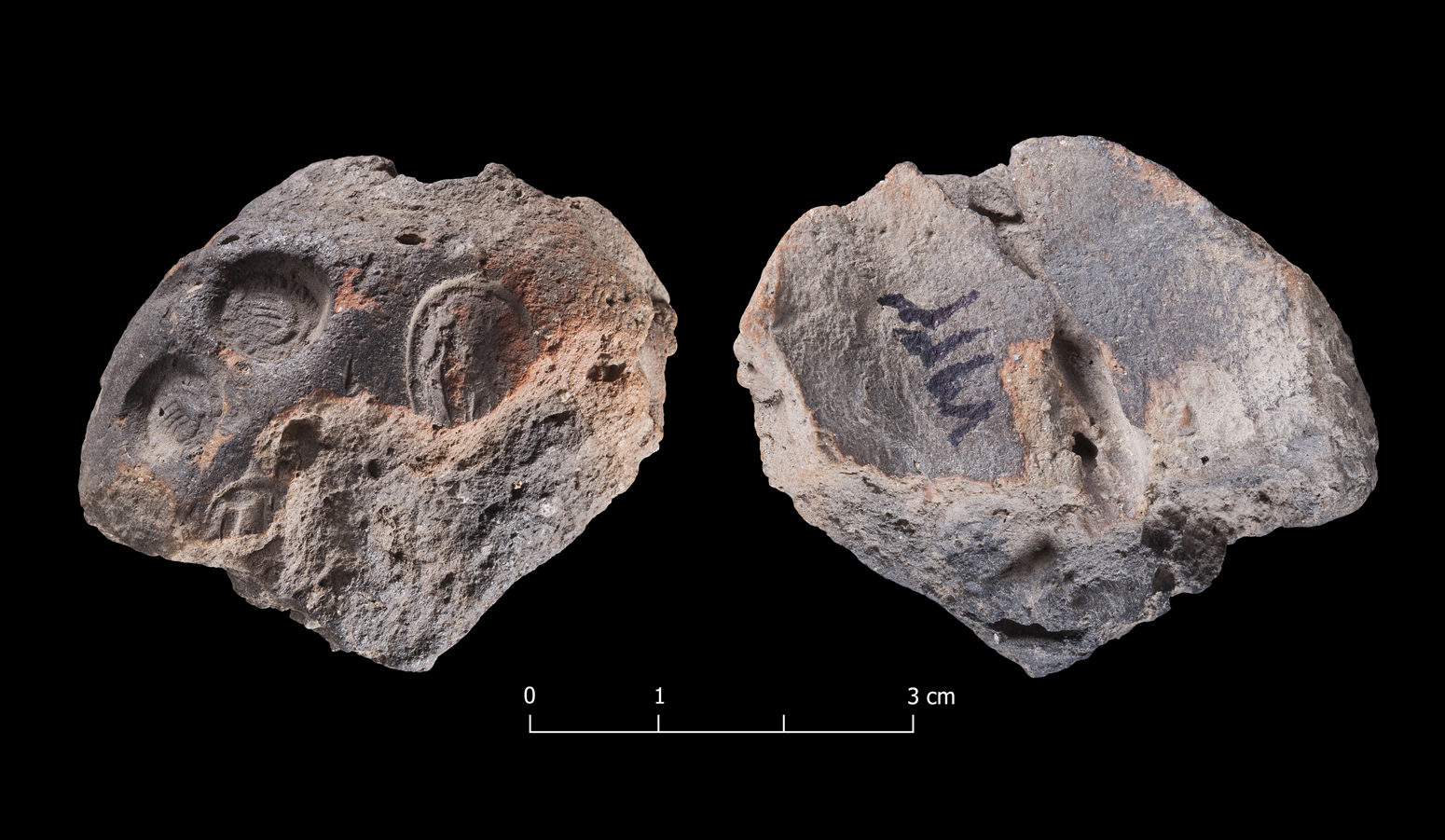
6.1. Bulla inv. no. 7772 (Figure 8) measuring 52×40×21 mm. Weight: 38.88 gr. Obv. Reddish brown (2.5YR5/3) and dark grey (10YR4/1). Rev. Light reddish brown (5YR6/3) and pinkish grey (5YR6/2). On the back, concave impression of a curved object with cross imprints of twisted strings. A single string hole runs into the bulla immediately above and below the concave channel. Bulla bears nine seal impressions (Figure 9).
Bulla inv. no. 7772 (Photo by R. Maleki).
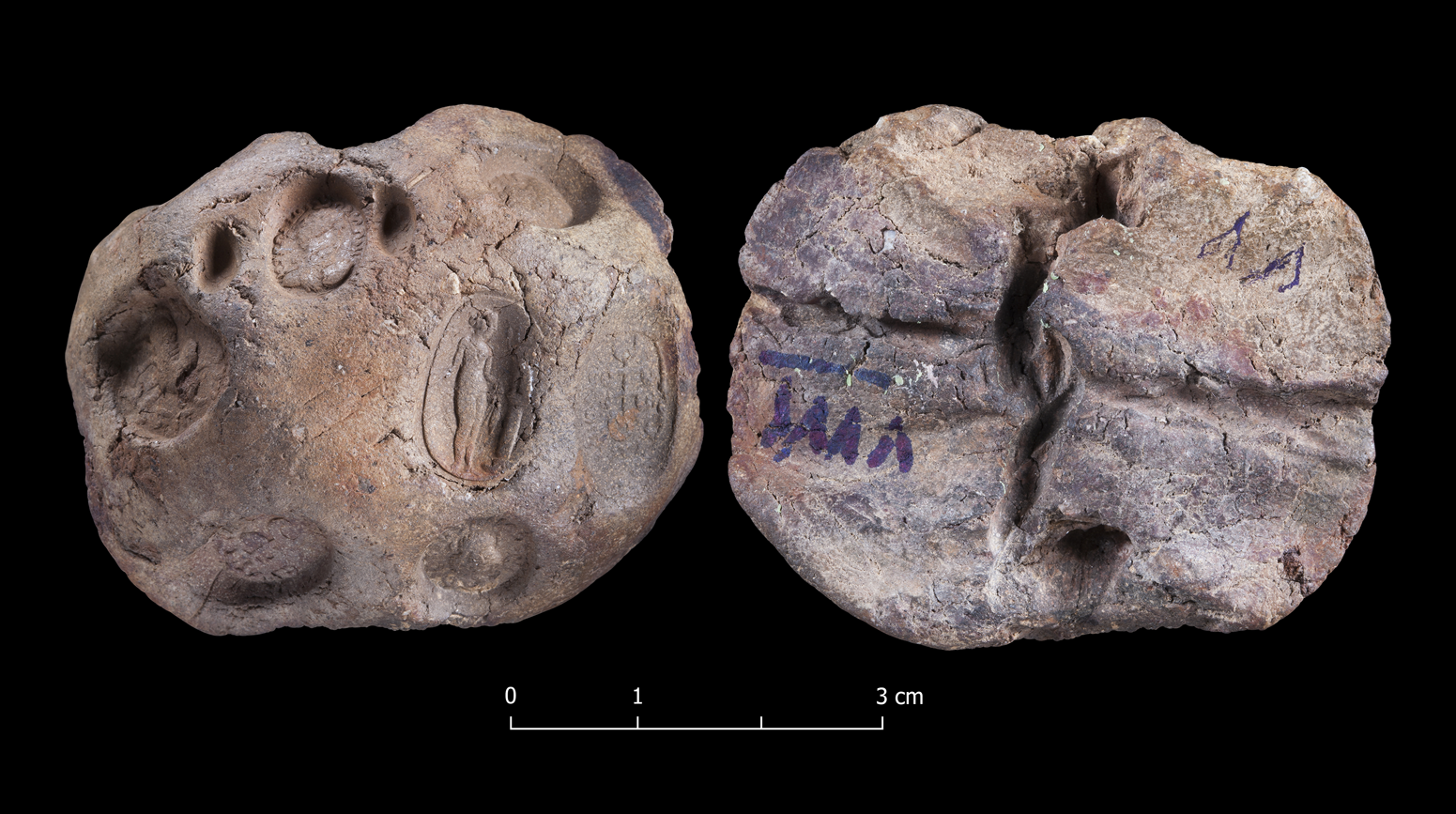
Seal impressions on Bulla inv. no. 7772 (Photo by R. Maleki).
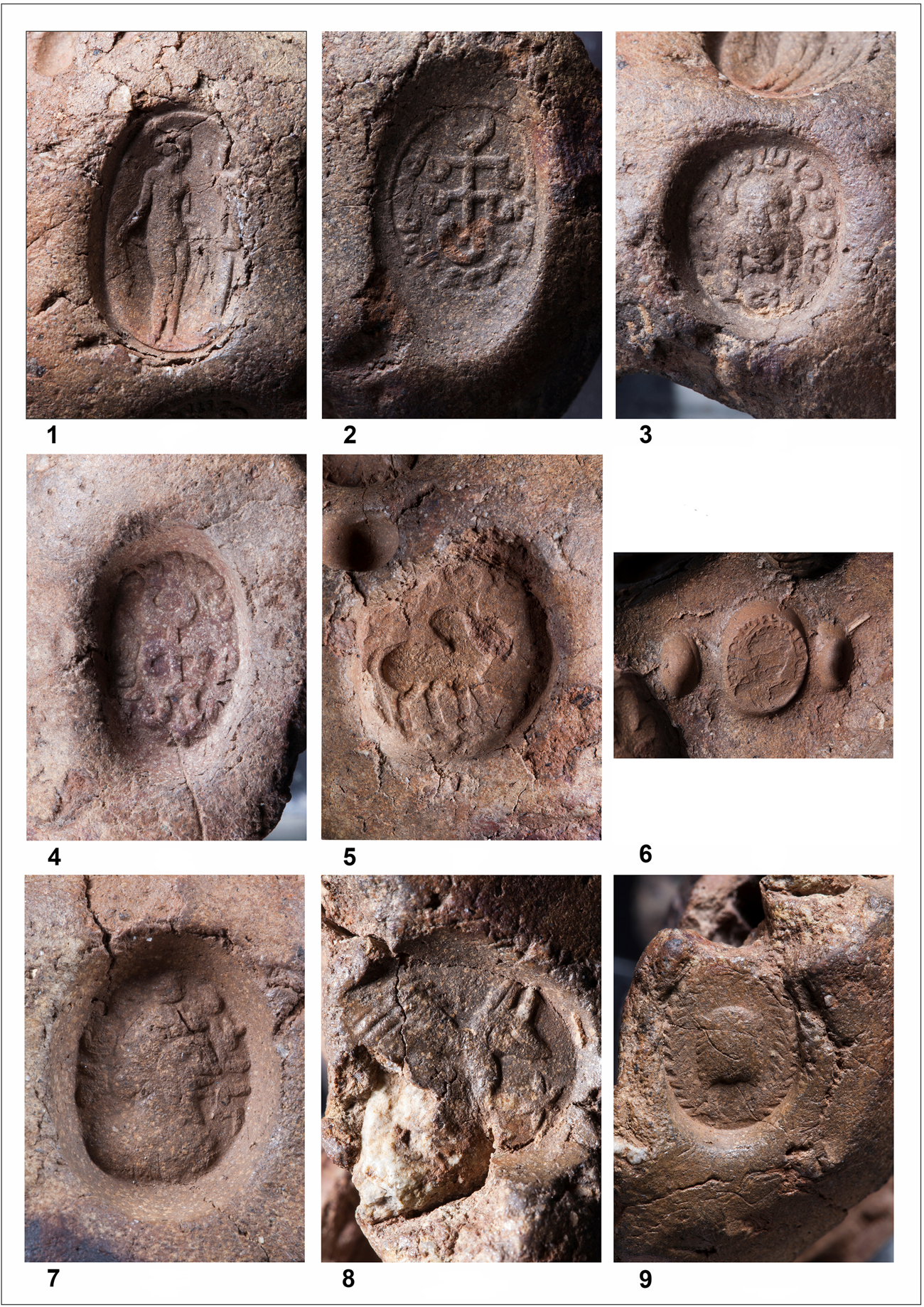
7772.1) At the center, impression, 10×14 mm, of an elongated convex seal. No inscription. Aphrodite standing in contrapposto holding a himation around the lower part of her body. She is turned towards Eros, who is standing on a column and holding a mirror towards the goddess. The imprint of the bezel appears in the impression, indicating the actual sealstone was mounted in a ring (Figure 9.1).
7772.2) At 3 o'clock, impression, 9×16 mm, of an ellipsoid seal with a flat engraved face. Device, possibly a personal or clan emblem (nišān), composed of a crescent linked to a lope by a vertical line that bisects two yokes (Figure 9.2). The imprint of a mount surrounds the impression, indicating the actual sealstone was mounted in the metal bezel of a ring. In the margin, from ca. 11 to ca. 3 o'clock, the Pahlavi inscription in lapidary script reads:
⟨ʾpstʾn cL yzd[ʾ]n⟩
/abestān ō yazdān/
Trust in the sacred beings.
7772.3) At 5 o'clock, impression, 9×9 mm, of a circular seal with a flat engraved face. A lion's head with upward-curving horns shown in frontal view. Long mane encircles the two sides as well as the top of the head. Mouth is open. Nose and eyes are elaborately executed (Figure 9.3). In the margin, from ca. 11 to ca. 3 o'clock, the Pahlavi inscription in lapidary script reads:
⟨ʾpstʾn lʾsty mtl⟩
/abestān rāst mihr/
Trust in Mithra (is) right.
7772.4) At 7 o'clock, impression, 9×13 mm, of an ellipsoid seal with a flat engraved face. Device, possibly a personal or clan emblem (nišān), composed of a crescent moon linked to opposed yokes. There is a six-pointed star below the lower yoke (Figure 9.4). In the margin, from ca. 5 to ca. 8 o'clock, the Pahlavi inscription in lapidary script reads:
⟨ʾpstʾn cL yzdʾn⟩
/abestān ō yazdān/
Trust in the sacred beings.
7772.5) At 9 o'clock, impression, 11×11 mm, of a circular seal with a flat engraved face. A humped bull, with a long tail and upward-curving horns, standing to the right (Figure 9.5). In the margin, from ca. 4 to ca. 10 o'clock, Pahlavi inscription in lapidary script. The left knob of sealing no. 4 pushed the clay onto this sealing, covering the upper parts of the last characters of the inscription on sealing no. 5. The inscription reads as follows:
⟨lʾstyh⟩
/rāstīh/
righteousness.
7772.6) At 12 o'clock, impression, 8×10 mm, of an ellipsoid seal with a flat engraved face. A male portrait bust shown in profile to the right with shoulders and chest to the front. He wears curly hair. Facial details cannot be discerned due to the severe deterioration. Details of the dress have been lost, but the fold on the shoulders indicates that he wears a round collar cloak with folds running obliquely around the upper torso (Figure 9.6). On either side of the sealing is a deep indentation (3×5 mm) with the imprint of a ring, indicating that a gemstone was mounted in a metal bezel placed on eider side of the sealstone. In the margin, from ca. 4 to ca. 8 o'clock, the Pahlavi inscription in lapidary script reads:
⟨ᵓḥtry lwbᵓk ḤZYTN⟩
/axtar rawāg dīd/
The constellation was seen as the current one.
The association between the portrait bust and the content of the inscription cannot be definitively established. Nonetheless, it is not unreasonable to consider the possibility that the seal's owner may have been an astrologer. This raises questions around the contents of the document or object to which the seal was attached, which warranted the verification of an astrologer. This subject merits further investigation in future publications.
7772.7) At 1 o'clock, impression, 7×9 mm, of an ellipsoid seal with a flat engraved face. The image shows a male portrait bust shown in profile facing to the right with shoulders and chest to the front. He wears a crown with a single three-stepped crenelation. The hair is gathered in a bun at the back of his neck. He has a staring eye, long straight nose, and thick lips. The beard is long, and spade shaped at its lower end. He wears a round collar cloak with folds running obliquely around the upper torso and terminating in vertical folds on the front (Figure 9.7). In the margin, from ca. 4 to ca. 8 o'clock, the Pahlavi inscription in lapidary script reads:
⟨zr-glydy mgw⟩
/Zar-garē magu/
Zar-garē the priest.
The name, here read as ⟨zr-glydy⟩ /zar-garē/ is not listed by Gignoux, but names with zar (yellow, golden) and gar (mountain) are attested.Footnote 75 The second term of the compound /garē/ could be based on an adjective *gar-i̯a- (belonging to the mountain), and the name would then mean “the one belonging to the golden mountain.”
7772.8) At 12 o'clock, impression, 8×10? mm, of an ellipsoid seal with a flat engraved face and no inscription. The sealing is partially broken off and what survives has no inscription. The image shows the forepart of an indistinguishable quadruped animal with upright ears and flowing ribbons at the neck. The animal looks towards the right. A six-pointed star appears in front of the animal (Figure 9.8).
7772.9) At 11 o'clock, impression, 6×9 mm, of an ellipsoid seal with a flat engraved face and no inscription. A lion's head with upward-curving horns shown in frontal view. A mane encircles the two sides of the head. Facial details are not discernible. The head is surrounded by a wreath (Figure 9.9).
6.2. Bulla inv. no. 7933 (Figure 10) measuring 41×37×17 mm. Weight: 25.78 gr. Reddish brown (5YR5/4) and pinkish grey (7.5YR6/2). Rev. Reddish brown (5YR5/4) and pinkish grey (7.5YR6/2). On the back, concave impression of a cylindrically curved object (31 mm in width) and the impression of a twisted string running longwise. The bulla is fragmentary, the lower part of it being lost. The surviving fragment bears four seal impressions (Figure 11).
Bulla inv. no. 7933 (Photo by R. Maleki).
Seal impressions on Bulla inv. no. 7933 (Photo by R. Maleki).
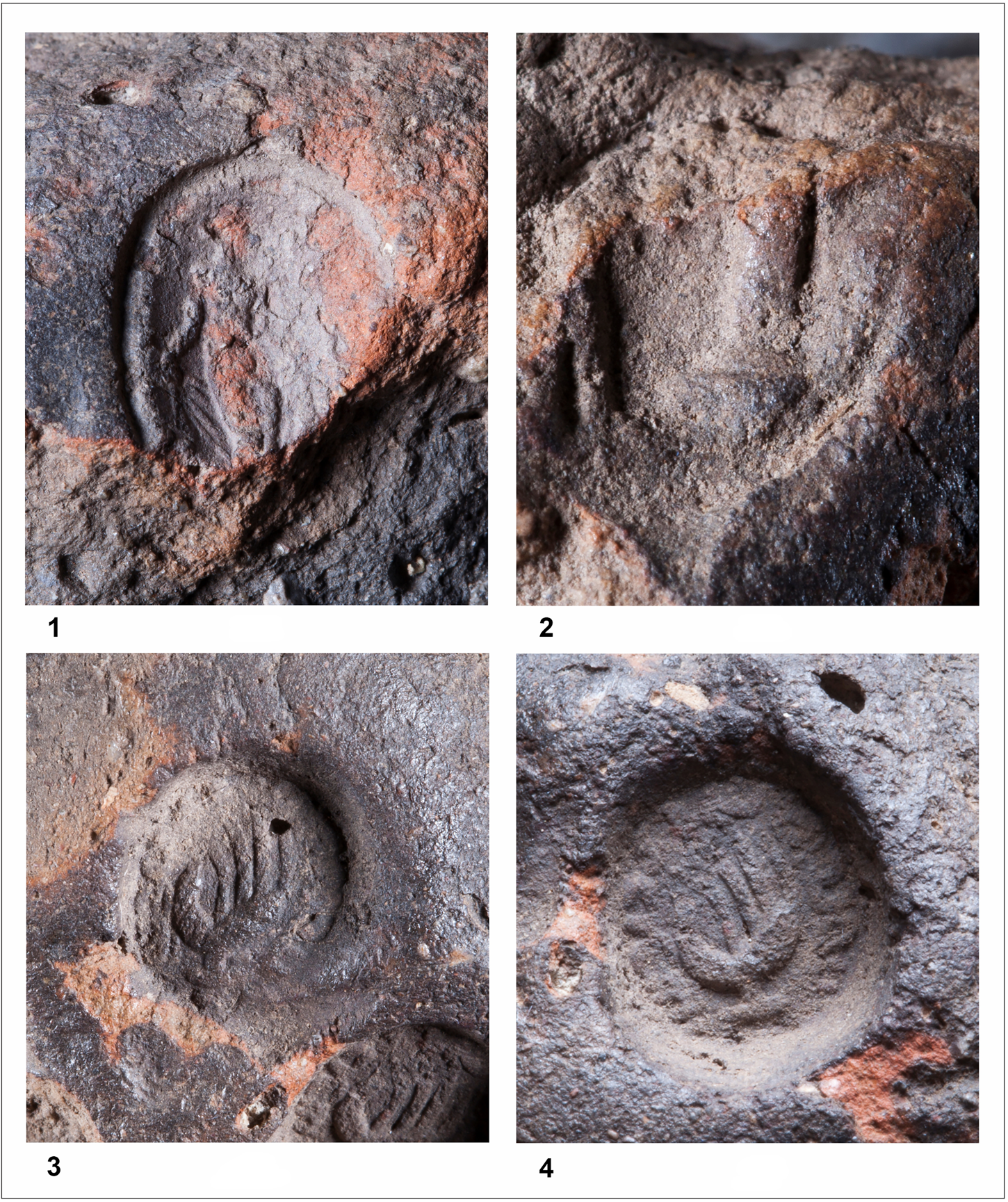
7933.1) At the center, impression, 10×12? mm, of an elongated convex seal. No inscription. Aphrodite standing in contrapposto holding a himation around the lower part of her body. She is turned towards Eros, who is standing on a column and holding a mirror towards the goddess. The imprint of the bezel appears in the impression, indicating the actual sealstone was mounted in a ring (Figure 11.1).
7933.2) At 8 o'clock, impression, 5×? mm, of an elongated convex seal. No inscription. While partially missing, the remaining portion displays a two-stepped column with a shaft. Parts of a full-sized figure from the knees downward are discernible, suggesting that a full-sized figure once stood before the column (Figure 11.2). The positioning of the figure's feet and the column closely resembles that of the image of Aphrodite and Eros on sealing no. 1 of this bulla, suggesting that sealing no. 2 is the impression of a sealstone displaying the same iconography. The imprint of a mount surrounds the impression, indicating that the actual sealstone was mounted in the metal bezel of a ring.
7933.3) At 9 o'clock, impression, 7×9 mm, of an almost circular seal with a flat engraved face. A human left hand in the impression is placed upon a vertical stand. The thumb and forefinger bend towards each other while the other three fingers are extended upward (Figure 11.3). In the margin, from ca. 5 to ca. 7 o'clock, the Pahlavi inscription in lapidary script reads:
⟨ʾpstʾn cL yzdʾn⟩
/abestān ō yazdān/
Trust in the sacred beings.
7933.4) At 10 o'clock, identical image and inscription to seal impression 7933.3 (Figure 11.4).
6.3. Bulla inv. no. 10841 (Figure 12) measuring 34×29×13 mm. Weight: 9.29 gr. Obv. Pale brown (10YR6/3). Rev. Pale brown (10YR6/3). On the back, a longwise hole through which a string passed to bind the object sealed. The impression of the edge of the sealed object is recognizable. One side of the bulla bears the marks of multiple incisions made with a pointed object. The bulla bears one single seal impression and no inscription (Figure 1).
Bulla inv. no. 10841 (Photo by R. Maleki).
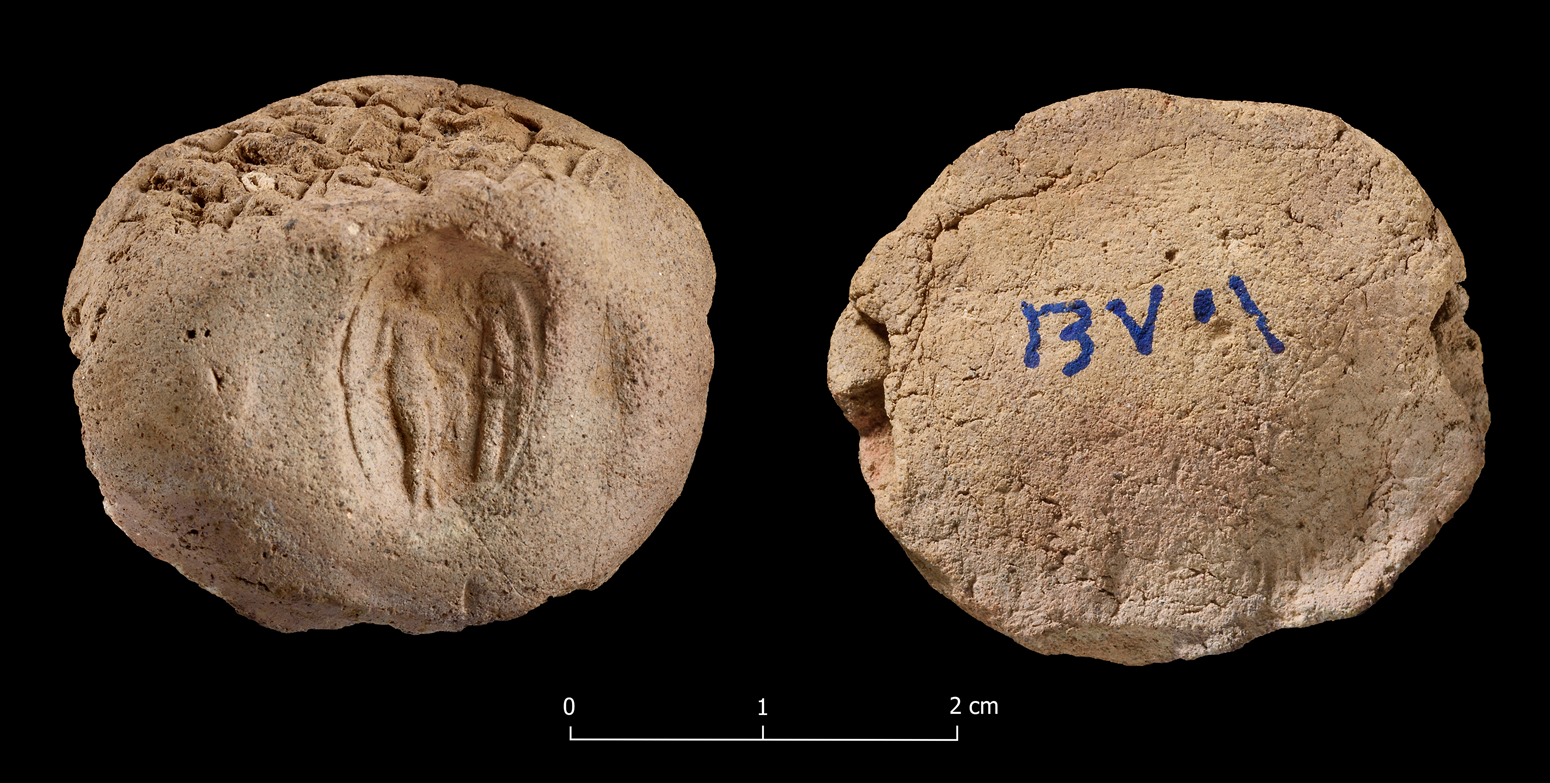
10841.1) At the center, impression, 10×14 mm, of an elongated convex seal. No inscription. Aphrodite standing in contrapposto holding a himation around the lower part of her body. She is turned towards Eros, who is standing on a column and holding a mirror towards the goddess. The imprint of the bezel appears in the impression, indicating the actual sealstone was mounted in a ring (Figures 1 and 3).
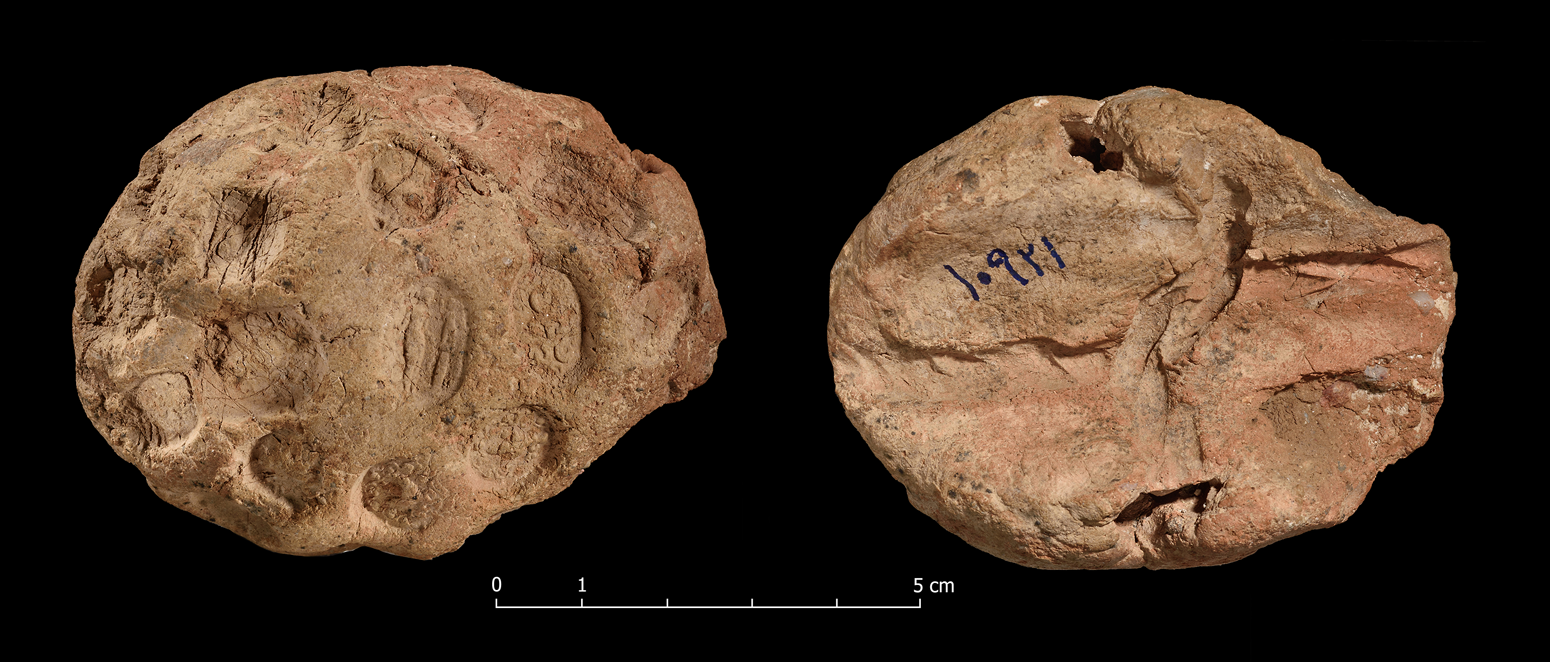
6.4. Bulla inv. no. 10921 (Figure 13) measuring 75×57×26 mm. Weight: 122.39 gr. Obv. Light brown (7.5YR6/3) and reddish brown (5YR5/4). Rev. Light brown (7.5YR6/3) and reddish brown (5YR5/4). On the back, a concave impression of a cylindrically curved object (35 mm in width) with cross imprints of the twisted strings. A double string hole runs into the bulla immediately above and below the concave channel. Bulla bears twenty-two seal impressions (Figure 14).
Bulla inv. no. 10921 (Photo by R. Maleki).
Seal impressions on Bulla inv. no. 10921 (Photo by R. Maleki).
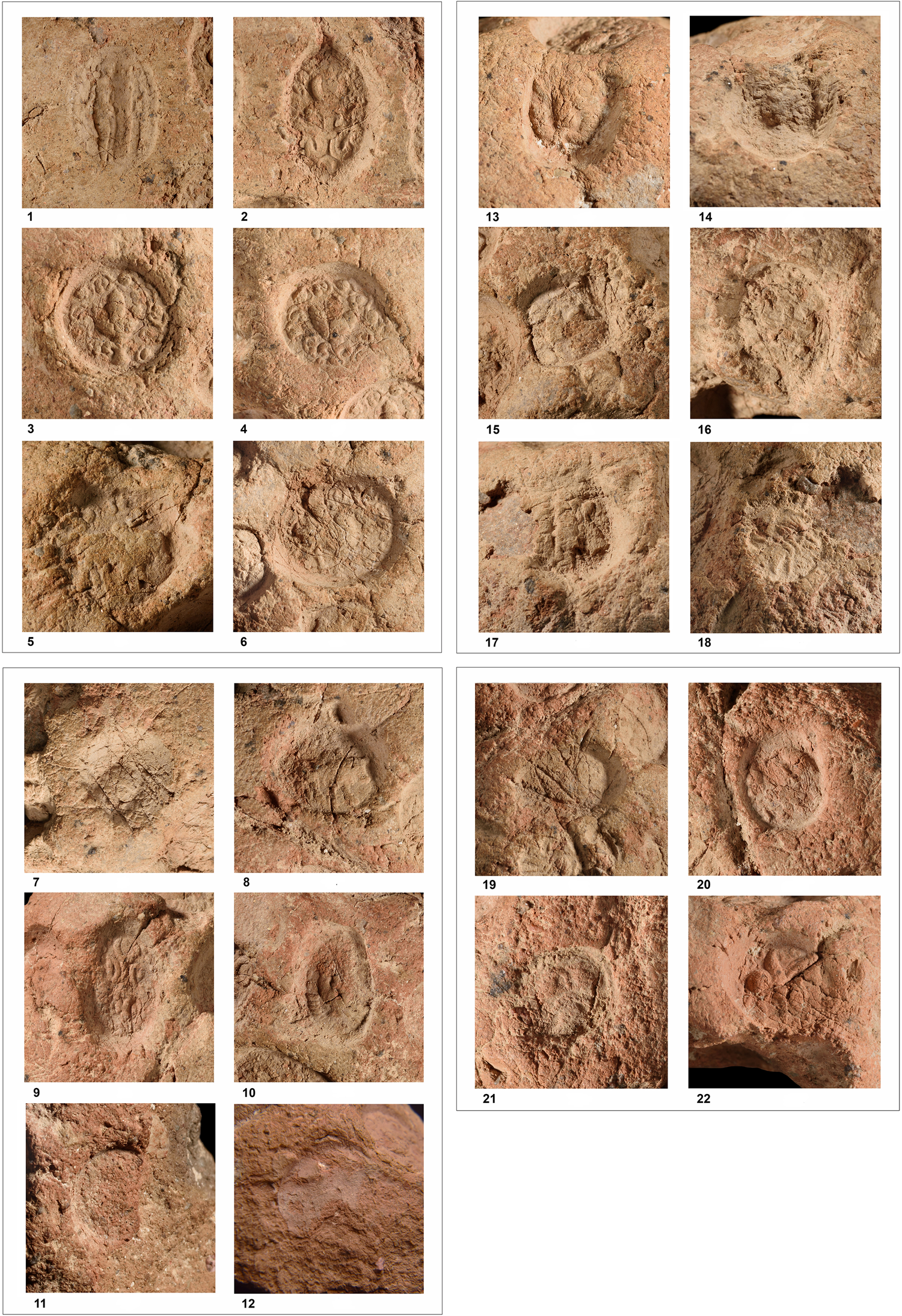
10921.1) At the center, impression, 10×14 mm, of an elongated convex seal. No inscription. Aphrodite standing in contrapposto holding a himation around the lower part of her body. She is turned towards Eros, who is standing on a column and holding a mirror towards the goddess. The imprint of the bezel appears in the impression, indicating the actual sealstone was mounted in a ring (Figure 14.1).
10921.2) At 3 o'clock, impression, 9×13 mm, of an ellipsoid seal with a flat engraved face. Device, possibly a personal or clan emblem (nišān), composed of a crescent moon linked to opposed yokes. There is a six-pointed star above the crescent. A second crescent is depicted beneath the lower yoke (Figure 14.2). This seal impression is identical to those on two bullae in the German collection published by Göbl.Footnote 76 It is duplicated twice on bulla no. 63/102. In the margin, from ca. 5 to ca. 8 o'clock, there are traces of a Pahlavi inscription in lapidary script. Although the inscription on the sealing in the Moradi collection is severely deteriorated and challenging to read, those on the sealings uncovered by the German team are relatively well-preserved. Hence, by using multiple images of the new instance of this sealing, reading the inscription from different angles, and comparing it with the seal impressions on the bullae excavated by the German team, we can confidently read the inscription as follows:
⟨hwdʾty [lʾ]ty lʾst⟩
/hudād rād rāst/
well-created, generous, just.
Göbl interprets ⟨hwdʾty⟩ as a personal name and transcribes it as “Xudāt,” while Gignoux transcribes it as “Hudād” and supports the reading with reference to a seal (inv. no. 119 718/AE 4) in the British Museum with the inscription that Gignoux reads as follows:
⟨ʾtwlyhwdʾt ZY mgwhwdʾt⟩
Ādur-Hudād, fils de Mog-Hudād.Footnote 77
Gignoux further proposes that the name is a compound of hu- (good) and the participle dād (< Old Iranian data-, created) thus translating to “well-created.”Footnote 78
10921.3) At 5 o'clock, impression, 10×10 mm, of a circular seal with a flat engraved face. A flower with three buds on a single stem. From the lower part of the stem emerge two gently twisted tendrils curving downwards. The tree is encircled by a vine scroll (Figure 14.3).
10921.4) At 6 o'clock, identical to sealing no. 3 (Figure 14.4).
10921.5) At 8 o'clock, impression, 9×9 mm, of a circular seal with a flat engraved face. A humped bull, with a long tail and upward-curving horns, standing to the right (Figure 14.5). In the margin, from ca. 1 to ca. 10 o'clock, Pahlavi inscription in lapidary script. The text is too badly damaged to be legible.
10921.6) At 9 o'clock, impression, 11×13 mm, of a circular seal with a flat engraved face. A winged horse standing to the right (Figure 14.6). In the margin, from ca. 5 to ca. 12 o'clock, faint traces of the Pahlavi inscription in lapidary script read:
⟨ʾpst[ʾn]⟩
/abest[ān]/
trust.
10921.7) At 10 o'clock, impression, 9×9 mm, of a circular seal with a flat engraved face. A male portrait bust shown in profile to the right with shoulders and chest to the front. His hair is dressed in curls. Facial features cannot easily be discerned. The head of the bust is surrounded with a garland (Figure 14.7).
10921.8) At 12 o'clock, impression, 8×10 mm, of an almost circular seal with a flat engraved face. A humped bull standing to the right, with upward-curving horns and a long tail continuing between the hind legs, ending with a tassel (Figure 14.8). A fairly deep indentation at 12 o'clock above the impression indicates that the actual seal was mounted in a metal bezel of a ring with a globular knob. In the margin, from ca. 12 to ca. 10 o'clock, faint traces of a Pahlavi inscription in lapidary script, which is illegible.
10921.9) At 2 o'clock, impression, 9×15 mm, of an ellipsoid seal with a flat engraved face. Device, possibly a personal or clan emblem (nišān), composed of a crescent moon linked to opposed yokes. The device is placed between two upward ribbons, and the upper part of the device is encircled by raised beads (Figure 14.9).
10921.10) At 3 o'clock, impression, 8×13 mm, of an ellipsoid seal with a flat engraved face. An unidentified object, presumably a human left hand placed between two upward ribbons. Two raised dots can be observed to the left (Figure 14.10).
10921.11) At 4 o'clock, impression, 7×7? mm, of a circular seal with a flat engraved face. A sealing with no imagery left (Figure 14.11).
10921.12) At 5 o'clock, impression, 8×8? mm, of a circular seal with a flat engraved face. A sealing with no imagery left (Figure 14.12).
10921.13) At 6 o'clock, impression, 8×11 mm, of an ellipsoid seal with a flat engraved face. The head of a horse in right profile rested over a pair of upward ribbons. The upper part of the sealing has disappeared (Figure 14.13).
10921.14) At 7 o'clock, impression, 11×11 mm, of a circular seal with a flat engraved face. A male portrait bust shown in profile to the right with shoulders and chest to the front. He has curly hair, a staring eye, a thick eyebrow, and a long straight nose. Details of his clothes are lost, but the round collar of his cloak is elaborate. The head of the bust is surrounded with a garland (Figure 14.14).
10921.15) At 8 o'clock, impression, 8×8 mm, of a circular seal with a flat engraved face. The head of a bore in right profile (Figure 14.15).
10921.16) At 9 o'clock, impression, 8×11 mm, of an ellipsoid seal with a flat engraved face. Device, possibly a personal or clan emblem (nišān), composed of a crescent moon linked to a line bisecting two yokes. There is a partially preserved star above the crescent (Figure 14.16).
10921.17) At 11 o'clock, impression, 9×10 mm, of a circular seal with a flat engraved face. Two full-sized human figures facing one another. Each person wears an ankle-length dress (Figure 14.17).
10921.18) At 11 o'clock, impression, 8×9 mm, of a circular seal with a flat engraved face. An unrecognizable animal standing to the right (Figure 14.18).
10921.19) At 10 o'clock, impression, 7×11 mm, of an ellipsoid seal with a flat engraved face. Image cannot be identified due to its severe deterioration (Figure 14.19).
10921.20) At 1 o'clock, impression, 8×10 mm, of an ellipsoid seal with a flat engraved face. Traces of a human-headed bull facing to the right, usually identified as a personification of Gōpadšāh (Figure 14.20).
Dādestān ī Mēnōg ī xrad (Judgment of the Spirit of Wisdom) (Chap. LXI, 32), a Pahlavi text probably compiled in the 6th century CE, yields a precise description of a creature closely compatible with this depiction on the seals and bullae: “From foot to mid-body he is an ox, and from mid-body to the top he is a man.”Footnote 79 According to Pahlavi texts, Gōpadšāh, the spiritual master of a land, has as his main task to purify the seas and destroy the noxious creatures.Footnote 80 For example, as Mēnōg ī xrad (Chap. LXI, 33–35) states:
At all times he sits on the sea-shore, and always performs the ceremonial of sacred beings, and pours holy-water into the sea. On account of which, through the pouring of that holy-water, innumerable noxious creatures in the sea will die.Footnote 81
10921.21) At 9 o'clock, impression, 7×7 mm, of a circular seal with a flat engraved face. An unrecognizable animal standing to the right. The imprint of a mount around the impression indicates that the sealstone was mounted in the metal bezel of a ring (Figure 14.21).
10921.22) At 2 o'clock, impression, 9×11 mm, of an almost circular seal with a flat engraved face. A winged horse, with a long downward tail, walking towards right (Figure 14.22). In the margin, from ca. 1 to ca. 10 o'clock, Pahlavi inscription in lapidary script. Only individual letters can be discerned, in particular the letter hē/ḥēth at 10 o'clock and a final yōd at 12 o'clock. If the identification of the yōd is correct, the inscription would have consisted of at least two words.
Acknowledgements
The research for this publication was carried out as part of the “Beyond Discovery: Religion, economics and administration in Sasanian Iran through new clay bullae from Taxt-e Solayman” project, funded by the Arts and Humanities Research Council (AHRC), to which we are very grateful for their generous support. We are also indebted to the Iranian Centre for Archaeological Research (ICAR) for generously granting the excavation permit. Our sincere gratitude also goes to Takht-e Solaymān World Heritage Base for its financial support, unfailing administrative cooperation, and logistical assistance. We are also grateful to Ruzbeh Maleki for producing the photographs and to Dr. Harald Schulze and his team at the Archäologische Staatssammlung (Bavarian State Archaeological Collection), München, for sending us images of bullae Göbl T.63/109 and T.64/15. We would also like to extend our gratitude to Judith Lerner, Martin Henig, Christopher Faraone, Jeffrey Spier, Vito Messina, and Graça Cravinho for reading earlier drafts of this article and offering invaluable comments and insight.
Financial support
This work was financially supported by the Arts and Humanities Research Council (AHRC) in the UK.
Competing interests
The authors declare none.


 Open access

