


Introduction
Positivism has been one of the most important heuristics in the social sciences. Although there are many varieties of positivism, two positions are common to all: empiricism (the equation of scientific knowledge with knowledge of fact) and scientism (the purported similarity of the natural to the social sciences) (Alexander Reference Alexander1982: 5–15; Halfpenny Reference Halfpenny, George and Barry2001: 372; Riley et al. Reference Riley, Ahmed and Emigh2021: 318–23; Steinmetz Reference Steinmetz and George2005c: 280–87; Turner Reference Turner1993: 1–2). Under what conditions do intellectuals adopt this particular heuristic (Abbott Reference Abbott2001: 5–9, 122–36; Baert Reference Baert2015: 1–22)? Two basic accounts of positivism exist.
Positivists (Comte Reference Comte1908 [1844]: 37; Spencer Reference Spencer1884: 38–39; see also the discussion of Comte in Haller Reference Haller1993: 21–22) and their many critics (Giddens Reference Giddens1971: xii, 1978 [1974]: 4–5; Gouldner Reference Gouldner1970: 113–14; Horkheimer and Adorno Reference Horkheimer and Adorno1994 [1944]: 3–42; Lukács Reference Lukács1971 [1923]: 83–222; Marcuse Reference Marcuse1964: 172; Marx Reference Marx1977 [1867]: 163–77; Weber Reference Weber, Roth and Wittich1978: 86–90) are externalists, defined by Steinmetz as focusing on “influences on science that do not relate to the intellectual question of the fit between theory and object” (2005a: 125; see also Reference Steinmetz and George2005c: 288). They hold that empiricist-scientism (positivism) is associated with industrialization or “Fordism” (Steinmetz 2005c: 287–309, Reference Steinmetz, Clemens and Ann Shola2005a: 125–26).
A second view is internalist (see the descriptions in Steinmetz Reference Steinmetz2005b: 110; Reference Steinmetz and George2005c: 288). It suggests that positivism is a strategy of distinction (Bourdieu Reference Bourdieu1984 [1979]: 56–57) in which scholars accumulate symbolic capital by asserting their methodological skills (Bourdieu Reference Bourdieu1976: 98; Swartz Reference Swartz2013: 192). Positivists claim the existence of an ontologically distinct “social level” of reality that can form the object of an autonomous science (defined either as moral science or sociology), and they posit a general scientific method drawn from the natural sciences and applicable to the study of this new social domain (Bourdieu 1976: 98, Reference Bourdieu2004 [2001]: 51).
Our article uses evidence from a branch of positivism that developed in Italy in the late nineteenth century to challenge the generality of both externalism and internalism and to build a new theoretical synthesis drawn from Gramsci. It is not our intention to “falsify” either the externalist or the internalist position, but rather to specify their conditions of validity by carefully examining a case that these established accounts cannot explain (Emigh Reference Emigh1997: 649–50). Indeed, many of the externalist and internalist theories of positivism were developed for cases other than Italy (and for periods after the development of this movement there), so it is not surprising that they do not hold here. We show that positivism in Italy arose before industrial capitalism and that its main exponents had little experience with it. Furthermore, we show that positivists in Italy claimed ontological continuity between nature and society rather than methodological analogy between the natural and social sciences. Consequently, Italian positivists neither identified a distinct “social level” of reality nor a methodology modeled on the natural sciences. Instead, Italian positivism’s scientism was based on the claim that the social was part of the natural world, rather than analogous to it.
We then reconstruct theories about the connection between positivism and society focusing on the internal structure of the intelligentsia. Italian intellectuals formed a stratum that emerged in the medieval city states and reached its apogee in the Renaissance, hundreds of years before the development of industrial capitalism (Gramsci Reference Gramsci, Hoare and Nowell Smith1971: 6–8). These “traditional intellectuals,” as Gramsci termed them, were still present in the late nineteenth century. They were generalists. As the positivist vogue swept across Europe, in Italy it was refracted through this preexisting structure creating a mixed-genre literature blending natural science, philosophy, the humanities, medicine, and law. In this context, positivism was a strategy for reasserting the power of this stratum of traditional intellectuals.
Positivism and Capitalism
Our article assesses these three accounts of positivism: (1) the externalist theory, (2) the internalist theory, and (3) our expanded Gramscian theory of intellectuals, which to some extent synthesizes the strengths of the two preceding accounts.
The Externalist Theory
Comte distinguished three stages in human intellectual development: the theological, characterized by “spontaneous fictions”; the metaphysical, characterized by the personification of abstractions; and the positive stage “based upon an exact view of the real facts of the case” (Reference Comte1908 [1844]: 35–36). Comte (ibid.: 37) linked these stages of thought to stages of social development: the periods of “offensive war,” “defensive war,” and “industry.” He also asserted a connection between the “positive spirit” and “industry” (ibid.).
Spencer claimed that industrialization made scientific knowledge increasingly necessary for “every man above the laborer” (Reference Spencer1884: 38–39). As Spencer (ibid.) summarized his point: “Just as fast as productive processes become more scientific, which competition will inevitably make them do; and just as fast as joint-stock undertakings spread, which they certainly will; so fast will scientific knowledge grow necessary to every one.” Both Comte and Spencer, in sum, saw an intimate connection between positivism and industrialization.
The notion that modern capitalist society generates positivism also has roots in Marx’s (Reference Marx1977 [1867]: 149, 165–66, 168–69) theory of commodity fetishism, Weber’s (1978: 91–93, Reference Weber1992 [1927]: 275–77) account of rationalization, and Simmel’s (1930 [1900]: 482–83, 488, 495, 498) theory of money. Lukács (Reference Lukács1971 [1923]: 83) synthesized these arguments, claiming that capitalist social relations take on a “thingish” appearance. He combined this with the claim that capitalism also produced a calculating and rationalized worldview. This combination of naturalization and quantification was “reification”: a high degree of individual calculation proceeding within a social context treated as a quasinatural reality. Positivism reflects this situation (ibid.: 84, 119–20).
Adorno (1976a: 11, 1976b: 113, Reference Adorno, Hans, Ralf, Jürgen, Harald and Popper1976c: 74) argued that capitalist society created a social world appearing as a set of disconnected “facts” that anchored positivism. Steinmetz (Reference Steinmetz and George2005c: 278, 296, 300, 305, 311) and Sewell (Reference Sewell and George2005: 173–74) claimed that positivism “resonates” with the experience of organized or “Fordist” capitalism characterized by “Keynesian management of aggregate demand, full employment strategies, welfare state institutions, and highly bureaucratized forms of both public and private management” (Sewell Reference Sewell and George2005: 180). This stabilized form of capitalism makes the application of natural scientific models to the social world plausible (Sewell Reference Sewell and George2005: 180–81; Steinmetz Reference Steinmetz and George2005c: 299).
Positivism’s accounts of itself thus converge with positivism’s critics. Both offer a “social epochal” (Steinmetz Reference Steinmetz and George2005c: 290) explanation linking industrial capitalism (whether Fordist or not) to a form of social experience, rendering empiricist-scientism possible. Although positivists are not entirely clear about the mechanism that links these things, critical theories of positivism claim that capitalism makes the analogical transfer of natural scientific methods to the social world plausible.
The Internalist Approach
A second approach to the sociology of knowledge tends to focus on the dynamics of intellectual fields. Accordingly, we term this, again following Steinmetz (Reference Steinmetz and George2005c: 289), an “internalist” theory. Its most developed form is Pierre Bourdieu’s field theory, which accords “methodological primacy to objective relations” (Reference Bourdieu1968: 703). In general, fields are social spaces, and actors’ positions in them determine their behaviors or objectifications (Bourdieu Reference Bourdieu1996 [1989]: 1; Heilbron Reference Heilbron2015: 5) in politics (Bourdieu Reference Bourdieu1981: 6) and intellectual life (Bourdieu 1988 [Reference Bourdieu1984]: xvii; Lachmann Reference Lachmann2013: 65–67). In field analysis, researchers explain intellectual positions, including positivism, as consequences of the position of other intellectual stances in social space (Swartz 1997: 40, Reference Swartz2013: 58–59). Bourdieu used this field argument to explain positivism in two slightly different ways. In one sense, positivism was a slogan useful for the construction of an autonomous field of sociology. By providing a “positivist reinterpretation of the scientific practice of the sciences of nature,” rules could be developed for use in sociology as well (Bourdieu Reference Bourdieu1976: 102; see also Heilbron Reference Heilbron2015: 74–75). Positivism was thus an ideological tool for creating the new field of sociology.
Positivism was not, however, just a tool for establishing the autonomy of the intellectual field of sociology. It was also a position within sociology after its consolidation. Thus, Bourdieu argued with reference to American sociology that positivism constituted the dominant pole of an already established field. Its basic characteristics were a claim to political neutrality, a gradualist view of scientific development, and a preference for formalization. These epistemological positions were in fact misrecognized political positions linked to the interests of scholars working in prestigious American universities (Bourdieu Reference Bourdieu1976: 90, 98, 101).
Positivism, for the internalists, is a resource in a symbolic struggle allowing scholars deploying it to make two claims: first, that the “social” is a distinctive level of reality, and second, that it is like enough to the natural world that the logic of inquiry developed for the study of nature applies to it as well. In both cases, positivism stakes a claim to the distinctive character of social science: to emphasize both the difference with natural science in terms of its object and its similarity to natural science in terms of its method. Bourdieu (Reference Bourdieu1976: 92) saw the attempt to borrow the legitimacy of the natural sciences to bolster social scientific claims as common to all the social sciences.
The Gramscian Sociology of Intellectuals
Before introducing our approach, we note one similarity between the externalist and internalist accounts. For both, positivism is a consequence of the rise of capitalism. The tradition of critical theory growing out of Lukács explicitly makes this argument; Bourdieu’s sociology implies the claim as the differentiation of fields is a consequence of capitalist development. This suggests a synthesis: the internalist account provides a mechanism (stance taking in fields) linking the macro-factor identified in the externalist account (capitalism) to the outcome of positivism. There is, however, one problem with these accounts: it is difficult to link positivism directly to the development of industrial capitalism.
Positivism emerged in European thought during the 1850s first with the work of August Comte and Herbert Spencer (Kolakowski Reference Kolakowski1972 [1966]: 60–67; Plé Reference Plé1996: 61; Winkler Reference Winkler2009: 687). Later, in the 1860s and 1870s, a partially autonomous positivism emerged in Italy under the influence of Roberto Ardigò (Plé Reference Plé1996: 151).Footnote 1 Accordingly, there were three major cultural areas in which the movement was important during this period: France, the Anglo-Saxon area including Great Britain and the United States, and Italy. In the later nineteenth century, positivism spread beyond these European countries to Argentina, Brazil, Chile, Colombia, India, Mexico, Poland, Russia, and Turkey (Clark Reference Clark, Ofelia and Otávio2010: 59–64; Cruz Costa Reference Cruz Costa1964 [1956]: 82–108; Forbes Reference Forbes, Fillafer and Jan2018: 32; Nemeth 2018: 273–74; Özervarli Reference Nemeth, Fillafer and Jan2018: 81–84; Palti Reference Palti, Fillafer and Jan2018: 59–65; Skidmore Reference Skidmore1999: 66; Surman Reference Surman, Fillafer and Jan2018: 239). In all these areas, positivism provided a guide for ethical behavior as a substitute for the weakened position of the church and established a unified framework for a thought world fragmented by the progress of science (Plé Reference Plé1996: 114–15).
This pattern of development seems to correspond to the view that positivism was a reaction to industrial capitalism. The first half of the 1850s was a period of rapid economic growth in Europe (Winkler Reference Winkler2009: 687–88). Yet the leading areas of positivism do not fully correspond to industrial capitalism. The most industrialized countries in Europe in the late nineteenth century were the United Kingdom and Germany. France, Italy, and the southern and eastern European peripheries were much less industrialized (Mayer Reference Mayer1981: 23; Winkler Reference Winkler2009: 1029, 1069). But Germany remained relatively immune to positivism (Ringer Reference Ringer1992: 242), while France and Italy were awash in it. Accordingly, the relationship between positivism and capitalism seems not nearly so direct as the prevailing accounts would suggest. Manuel (Reference Manuel1965 [1962]: 274) stated that “positivism, like many of the other great dogmatic structures of modern times, exerted its greatest influence in those countries which were comparatively backward in their cultural and economic development.” Indeed, these peripheral positivisms, such as the Italian one discussed here, represent negative cases with respect to the established accounts (Emigh Reference Emigh1997: 649). In light of this, what is a more satisfactory account?
A third approach explains positivism by the characteristics of intellectuals (e.g., Emigh et al. Reference Emigh, Riley and Ahmed2016b: 15–16). This theory states that political economy affects social thought through its impact on the structure of the intelligentsia. “Information intellectuals” draw on social experience, but they also play an active role by developing and clarifying that experience. Thus, intellectuals create “elaborate worldviews and ideologies” out of “everyday forms of consciousness” (Emigh et al. Reference Emigh, Riley and Ahmed2016a: 25). The social structure of the intelligentsia shapes how this process of conversion of everyday forms of consciousness to ideologies and worldviews occurs.
The sociology of intellectuals is useful here. Alvin Gouldner, Antonio Gramsci, György Konrád, Iván Szelényi, and Talcott Parsons see positivism as an ideology of preindustrial intellectuals fascinated and threatened by the rise of industrial capitalism. As Gouldner (Reference Gouldner1979: 35) put the point, “Positivism was a premature bid by the emerging New Class to portray itself as the essential source of legitimacy and productivity in modern society” (see also Gouldner Reference Gouldner1976: 36). This was a secular religion that emerged prior to the consolidation of sociology proper and would disappear with the rise of the ideology of professionalism exemplified by Parsonian sociology. Parsons (Reference Parsons1949 [1937]: 3–6), although he did not explain positivism sociologically, also saw it as a prescientific worldview that emerged prior to the rise of the theory of social action. However, it was Gramsci’s and Konrád and Szelényi’s work in particular that linked positivism specifically to the structure of the intelligentsia. Gramsci suggested that the relationship between knowledge and production affected the position of intellectuals. Under capitalist conditions, knowledge and production link because entrepreneurs incorporate knowledge into production. As Gramsci put it, “In the modern world, technical education, closely bound to industrial labour even at the most primitive and unqualified level, must form the basis of the new type of intellectual” (1971: 9 see also Asor Rosa Reference Asor Rosa and Romano1979: 813–14). In precapitalist societies, the relationship between knowledge and production differs. Here knowledge production is separated from economic life.
These different relationships between knowledge and production in capitalist and precapitalist societies are at the base of two different types of intellectuals: organic intellectuals under capitalism and traditional intellectuals under precapitalism. Organic intellectuals are “‘specializations’ of the partial aspects of the primitive activity of the new social type” (Gramsci Reference Gramsci, Hoare and Nowell Smith1971: 6). They participate in production. Traditional intellectuals in contrast develop an esprit du corps, insulating them from production and the dominant class. As Gramsci wrote, “They put themselves forward as autonomous and independent of the dominant social group” (1971: 7).
There is a connection between capitalism and organic intellectuals, on the one hand, and precapitalism and traditional intellectuals, on the other. However, the transition from one configuration to another is not a reflex of the economy. Traditional intellectuals can be reproduced within capitalism partly because this economic system generates class positions that are indeterminate in relation to the main classes of capitalist society. Furthermore, traditional intellectuals play a role in reproducing capitalism because they are positioned to develop justificatory ideologies, whereas more specialized organic intellectuals are less able to do this (Gramsci Reference Gramsci, Hoare and Nowell Smith1971: 18–19).
Konrád and Szelényi’s (Reference Konrád and Iván1979: 19) account of positivism as a new philosophy of history reconciling dynamic social change with an overarching purpose to human society resembles Gramsci’s. The bearers of positivism are “teleocrats” similar to Gramsci’s traditional intelligentsia. “Technocrats” in contrast are agnostic about ends; they place their knowledge at the service of market actors, similar to Gramsci’s organic intellectuals (ibid.: 64, 69–70). Konrád and Szelényi’s analysis usefully complements Gramsci’s because it suggests that a particular style of thought (teleocracy and technocracy, respectively) is associated with a particular structure of the intelligentsia (traditional, organic).
Gramsci and Konràd and Szelènyi, like Parsons and Gouldner, interpret positivism as an ideology of “traditional intellectuals” associated with precapitalist society. All four thinkers suggest that positivism was a secularized form of scholasticism that attempted to reassert traditional authority in a period of social transformation (Gramsci Reference Gramsci, Hoare and Nowell Smith1971: 445). However, Gramsci and Konràd and Szelènyi specified a mechanism linking the social structure of the intelligentsia to positivism. We draw on, and reformulate, this theory to account for different forms of positivism.
Gramsci and Konràd and Szelènyi employ the same logic as the externalist position to arrive at an opposite empirical implication: that positivism is associated with backwardness, not with capitalist development. Nevertheless, like the positivists and the critical theory of positivism, theories of intellectuals seek to link the emergence of positivism to a specific period of economic development.
The sociology of intellectuals, however, can be generalized by specifying more closely what positivism means. There are, on closer examination, two sorts of positivism associated with the predominance of two different types of intelligentsias: ontological positivism associated with traditional intellectuals and methodological positivism associated with organic intellectuals. This allows a more general theory of the social foundations of positivism that can account for both its methodological and ontological forms.
The social structure of the intelligentsia mediates macro-structural factors, in this case the rise of industrial capitalism, and the predominant type of knowledge, in this case the type of positivism likely to exist in a given society. This provides a more general explanation of positivism than those currently on offer. Figure 1 situates our theoretical approach in relation to the two prevailing ones.
Theories of positivism.
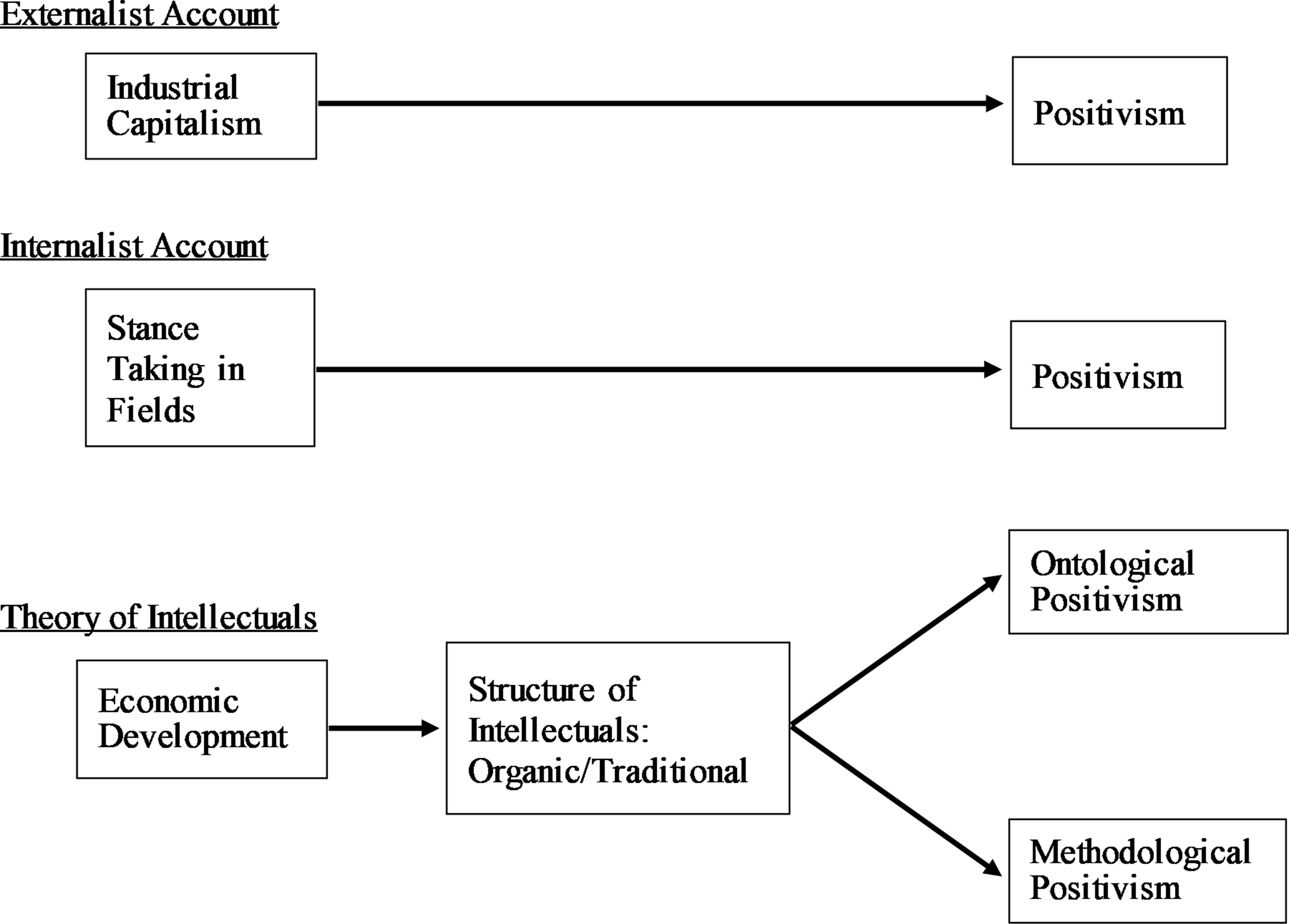
Both the externalist and the internalist accounts establish an immediate connection between a given context and positivist social science, and both assume the existence of a highly specialized group of intellectuals. The analogical extension of natural scientific methods to the social sciences implies that “natural scientists” and “social scientists” are clearly differentiated social groups. But intellectuals need not be organized this way. Where intellectuals are generalists, positivism can also arise. Capitalism is an important determinant of positivism in these cases but not in the way that the critical theory and the Bourdieusian accounts suggest. For in these cases, it is not the experience of advanced capitalism that produces positivist social thought but rather awareness of capitalism’s uneven development: the emergence of backwardness as a problem. Positivism in this context is based on a claim to ontological continuity, not methodological similarity, and it promises to address questions of value through the study of questions of fact. Yet this is still positivism in the sense that it embraces empiricist-scientism. Thus, our theory draws attention to the importance of the social structure of the intelligentsia as a relatively autonomous factor in the determination of the type of positivism likely to emerge in a given social context.
Positivism, to summarize our view, arose in two quite different forms. In industrial capitalist societies with organic intelligentsias, methodological positivism emerged based on an analogical extension of natural scientific methods to the realm of society. In backward or semiperipheral societies with traditional intelligentsias, ontological positivism emerged based on the claim that society was in fact part of the natural world.
Empirical Implications
We organize our following analysis into three sections, each assessing some empirical implications from the three schools.
Implications 1 (Externalist)
Following the positivist self-account, critical theory, and Steinmetz’s and Sewell’s work, we might expect that positivist social science should be associated with capitalist development. Therefore, positivism should have been weak in late-nineteenth-century Italy because industrial capitalism was not highly developed. To the extent that positivism did develop, it should have been regionally concentrated in the more economically developed northwestern part of the peninsula. The first part of our empirical analysis assesses these implications.
Implications 2 (Internalist)
Following Bourdieu, to establish the legitimacy of social science, positivists should have distinguished “society” as a level of reality, and they should have claimed that this level could be studied with formalized methods analogous to those in the natural sciences. In short, positivists should have used positivism as a justification for establishing a new “field” of sociology. The second section of the article draws on the writings of some exemplary positivists to assess this claim.
Implications 3 (The Expanded Gramscian Theory)
Positivism can arise on the basis either of an “organic intelligentsia,” in which case it should take a methodological form, or it can arise on the basis of a “traditional intelligentsia,” in which case it should take an ontological form. In Italy, given the predominance of traditional intellectuals, positivism should have taken an ontological form. This leads to three expectations. First, positivists should have come from intellectual family backgrounds rather than from industrial ones: as an “estate group,” intellectuals should have been somewhat separated from the dominant economic classes on the peninsula. Second, positivists should have been trained in the established faculties of medicine and law and not in the new fields associated with industrial capitalism like political economy and engineering. This would indicate that they were traditional intellectuals. Finally, they should have used positivism to reassert their traditional role as a goal-setting “teleocratic” estate. To assess this claim, we draw on some prosopographical evidence (described in the following text) and some key writings. The point of this presentation of the material is not to falsify existing theories of positivism, or even to amass evidence disconfirming them, but instead to use the empirical anomalies generated by the Italian case to expand the range and specificity of theories of positivism (Emigh Reference Emigh1997: 649). The externalist and internalist explanations, in many instances, were developed to illuminate the rise of positivism in places other than Italy and after the time when Italian positivism developed, so it is quite plausible that we would need to expand these explanations to take the Italian case into account.
Data and Methods
We use various evidence in this article. One source of information is a prosopography (e.g., see Stone Reference Stone1971) of Italian positivism compiled by combining several sources. The first is a list of names from the Consiglio generale di statistica (CGS), a collegial body responsible for overseeing the collection of statistics in Italy. The CGS gave scientific experts power to deliberate over how to collect information. Stefano Castagnola, the minister of agriculture, industry, and commerce at the time of unification, provided a summary of its general purpose. As he stated in a letter to Victor Emmanuel II (Ministero d’agricoltura, industria e commercio 1872: 1–2):
If it is reasonable, when dealing with material of an administrative character, that decisions should be taken exclusively by those who have government responsibility and requires only that the persons who are most able in every branch of business assist them with their counsel, [the matter is different] when treating instead of research aimed at collecting facts and figures, according to scientific norms, and with no other thought but that of knowing the truth[. In this case] it is manifestly opportune that these should be undertaken by competent persons, and persons distinct from the administration, and that this last should limit itself to executing the decisions made by these [competent persons].
In sum, the CGS had the purpose of subordinating administrators to “eminent persons in the statistical and economic disciplines” (ibid.: 3). Given its mission of “collecting facts and figures according to scientific norms,” the CGS drew the cream of the crop of Italian positivists prior to the end of World War II.
The statistical agency ISTAT (Istituto Nazionale di Statistica [National Institute of Statistics]) published a membership list of this organization in 1936, although the names refer to the late nineteenth century, not to the 1930s. We supplemented this list of names with a list of contributors to the Rivista di filosofia scientifica, founded in 1881 by the Turinese psychiatry professor Enrico Morselli and described in Giovanni Gentile’s comprehensive history of Italian positivism as the “Organ of Positivism” (Gentile Reference Gentile1921: 317). Indeed, this review is widely considered to have been the principal outlet of positivism in late-nineteenth-century Italy, and all its contributors, with the exception of one,Footnote 2 were self-identified positivists who thought of themselves as struggling against the established tradition of Italian scholasticism (ibid.: 318–19).
These two sources produced 330 “positivists.” We then cross-checked these names with entries in the Dizionario biografico Italiano (Italian Biographical Dictionary) and other scattered sources. We found information on 167 positivists, giving us a “response rate” of about 51 percent. This allowed us in most cases to figure out the positivist’s place of birth and, in some cases, his father’s occupation. Much of the empirical analysis in the following text is based on this evidence. This evidence is not a random sample because it was much easier to find information about prominent intellectuals than less prominent ones. But this bias probably helps us because it ensures that we have information about the most important positivists; these were precisely those who were likely to have the most influence on Italian culture in the period we study. (Please refer to the appendix for a more detailed explanation of the prosopography.)
The second piece of evidence we use is the writings of several key Italian positivists. The main intellectual figures we discuss (Roberto Ardigò, Corrado Gini, Cesare Lombroso, Alfredo Niceforo, and Pasquale Villari) are widely recognized as among the key figures in Italian positivism. The analyses that follow are then of two sorts: brief presentations of quantitative evidence and analytical discussion of the arguments of some of the main Italian positivists.
We organize our article according to the expectations discussed in the preceding text. Accordingly, section 1 assesses the externalist explanation linking positivism to capitalism. We assess the timing of the emergence of positivism in Italy in relation to industrialization, and the distribution of positivists in more or less industrialized areas of the peninsula. Section 2 assesses the internalist explanation. It analyzes the key ontological and methodological writings from the most important Italian positivists: Ardigò, Gini, Lombroso, Niceforo, and Villari. This evidence assesses whether Italian positivists used positivism to establish a new field of “moral science” or “sociology.” Finally, section 3 uses the prosopography to establish the social origins and educational background of Italian positivists; it then analyzes a set of writings to assess how positivists thought about the relationship between facts and values to consider whether they were a “teleocratic” estate.
Positivism and Capitalism in Italy: Assessing the Externalist Explanation
The beginning of Italian positivism is conventionally dated from 1865 with Villari’s pamphlet entitled La filosofia positiva e il metodo storico (Positivist Philosophy and Historical Method) (Espinas Reference Espinas1880: 77; Gentile Reference Gentile1921: 1; Restaino Reference Restaino1985a: 66). Later, during the 1870s and 1880s, a particularly radical form of positivism swept Italian intellectual life (Bellamy Reference Bellamy1987: 8–10; Burgalassi Reference Burgalassi1996: 48–56, 145–46; Espinas Reference Espinas1880: 157–72; Gentile Reference Gentile1921: 318–19; Restaino 1985b: 265, 270, Reference Restaino1985c: 506). Italian positivism was in crisis by 1910. The “season” of Italian positivism thus covers a 45-year period from 1865 to 1910.
The basic macroeconomic evidence on Italy shows that this period did not correspond to the triumph of industrial capitalism. Despite scattered growth toward the later nineteenth century, factory production on a large scale was little in evidence (Fenoaltea Reference Fenoaltea2011 [2006]: 10–14, 19–21; Gershenkron Reference Gershenkron1968: 98–124; Milward and Saul Reference Milward and Saul1977: 253–64). Even where it did develop, industry maintained a close relationship to agriculture; the earliest factories processed agricultural products, and workers maintained connections to the countryside (Mayer Reference Mayer1981: 30–31; Zamagni Reference Zamagni1993: 83–88, 122). The social elite also remained agrarian and depended on low wages for its profits (Corner Reference Corner2002: 289). Thus, Italy seems paradoxical with respect to the externalist position. Here an agrarian country produced a highly positivistic form of social thought.
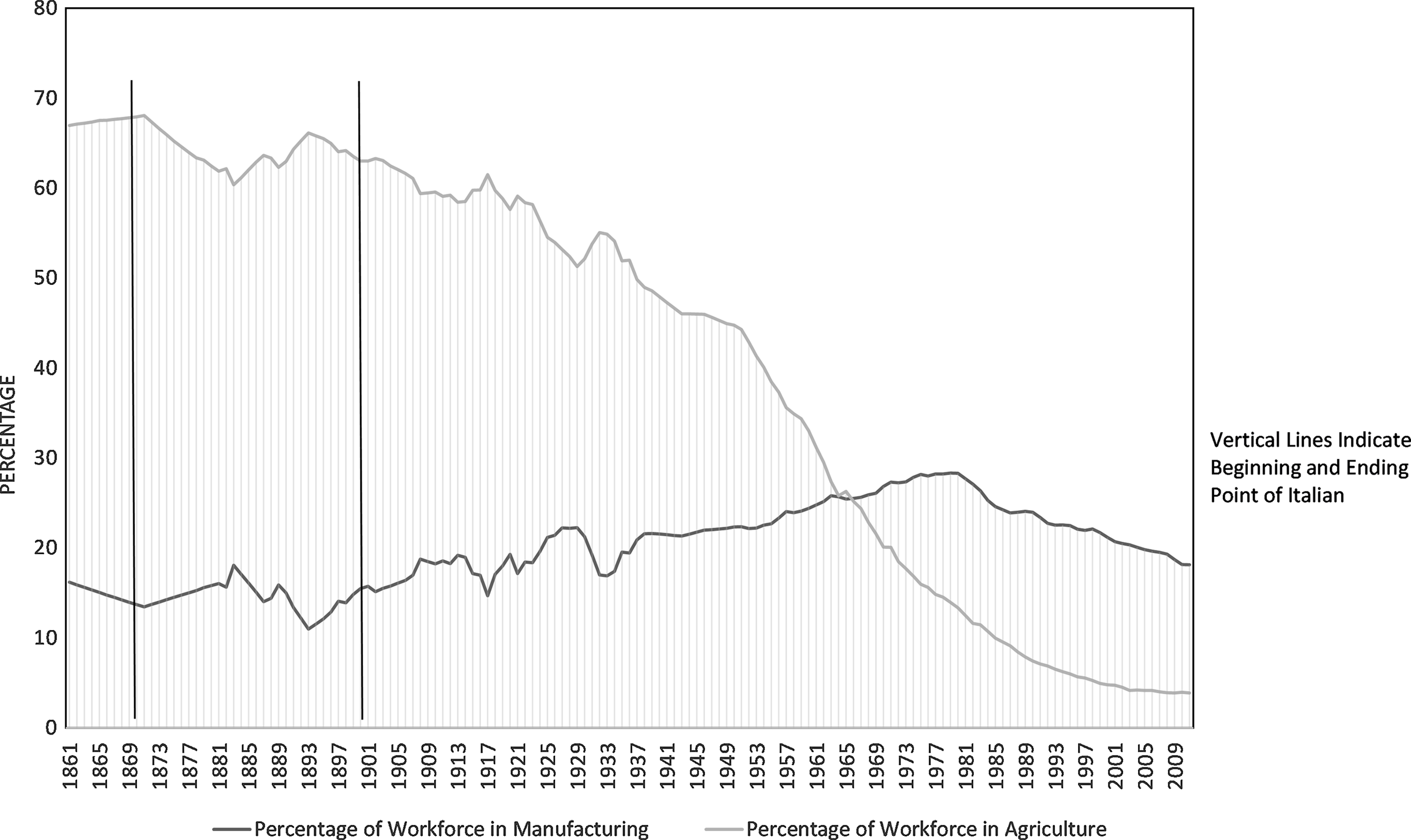
Figure 2 summarizes the point. It shows the percentage of the population in manufacturing and agriculture from 1861 to 2011. The period of positivist dominance is shown in the chart with two lines: one at 1865 and the other at 1910. At no point in this period did the workforce in manufacturing exceed a fifth of the total. In contrast, during the entire period, the percentage of the workforce in agriculture never dropped much below 60 percent. Italy was an agrarian society throughout the entire season of positivist predominance.
Percentage of the population in manufacturing and agriculture, 1861–2011. Source: Stephen Broadberry, Claire Giordano, and Francesco Zollino. 2011. “A Sectoral Analysis of Italy’s Development, 1861–2011.” Economic History Working Papers, Banca d’Italia, Number 20.
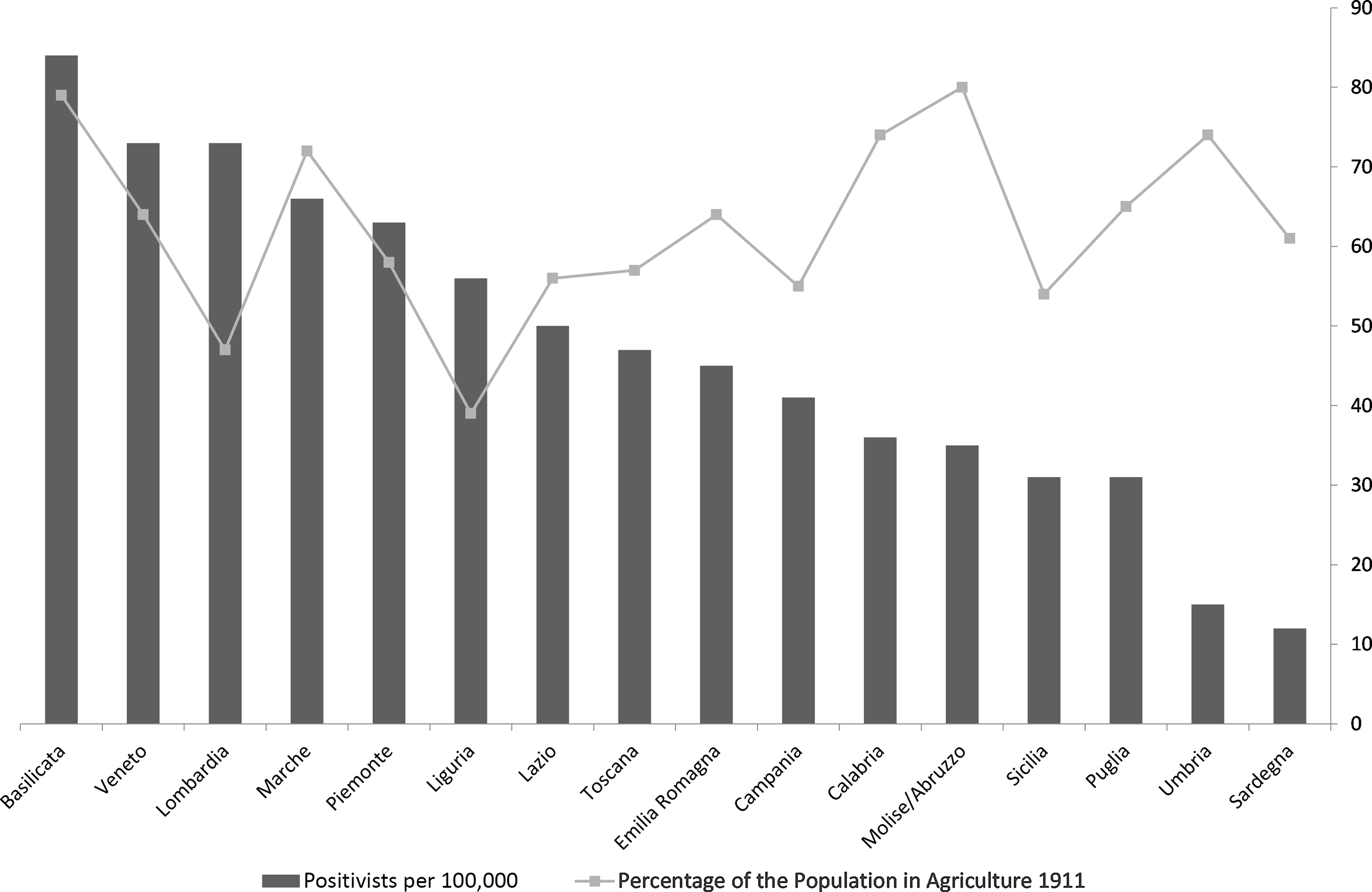
The regional distribution of positivists is also interesting. Figure 3, drawing on the prosopography, plots positivists per 100,000 people and the percentage of the population in agriculture by region for 1911. If there were a connection between capitalism and positivism, the regions with the lowest percentage of the population in agriculture should be the ones with the highest concentration of positivists. But the figure shows that some regions with an extremely high percentage of the population in agriculture had relatively large concentrations of positivists (Basilicata and the Marche). Other regions (Liguria) had a relatively low percentage of the population in agriculture but also a relatively low concentration of positivists. There is thus little discernible regional connection between indicators of capitalist development and positivism.
Positivists per 100,000 versus percentage of population in agriculture in 1911. Sources: Our prosopography and Stephen Broadberry, Claire Giordano, and Francesco Zollino. 2011. “A Sectoral Analysis of Italy’s Development, 1861–2011.” Economic History Working Papers, Banca d’Italia, Number 20.
What does this evidence imply for externalism? These theories suggest that positivism should develop in conjunction with industrialization. But there is no evidence of this either temporally or regionally. Italy as a whole was not industrialized during the period of positivist preeminence, nor were the most industrialized regions of the peninsula particularly likely to produce positivists (Barbano Reference Barbano1985: 173). Why, then, did positivism sweep Italy in the late nineteenth century?
Social Theory without Society: Assessing the Internalist Explanation
Was Italian positivism a strategy for establishing the field of sociology or, more broadly, a field of “social science” or “moral science?” At first glance the answer would seem to be yes. Most scholars who called themselves sociologists in Italy in the late nineteenth century identified as positivists (Burgalassi Reference Burgalassi1996: 49). But the claim to be a “sociologist” in the late nineteenth century did not amount to an attempt to establish a specific disciplinary field. Relatedly, Italian intellectuals’ use of positivism contrasts with Bourdieusian theory. For these aspiring sociologists or moral scientists did not use positivism to identify a distinct layer of reality called “society,” and they did not develop a methodology to study it (cf. Bobbio Reference Bobbio1969: 54–55; Mangoni Reference Mangoni1985: 110–11). These failures were, moreover, linked—it was the ontology of Italian positivism that blocked the development of its methodology.
The Ontology of Italian Positivism
Ardigò, a Mantuan priest, developed positivism’s ontology. His positivist debut was a laudatory piece on the heterodox Renaissance Mantuan priest Pietro Pompanazzi, published in 1869, rejecting metaphysics and insisting that all knowledge is based on observation and experiment (Ardigò Reference Ardigò1908b: 49). Ardigò held in particular that there was no difference between “collective units” such as states, regions, and social groups, and “absolute units” or natural kinds such as physically individual organisms (Ardigò Reference Ardigò1881–82: 12). Both could be dissolved into a series of further relationships among the parts, “indistinct matter,” the reality comprising all things (ibid.: 9). Thus, natural, social, and psychological phenomena existed on the same level. Because Ardigò denied ontological distinctions in general, he necessarily failed to develop a strong conception of the social. Individual minds, collectives such as nations, and physical objects all interacted in an undifferentiated soup.
Society, then, appeared to Ardigò as ontologically mixed. As he put the point (Ardigò Reference Ardigò1908a: 64–65):
Material persistences in the individual are development and cerebral morphology and dependent organs. In society, [the persistences are] all the external and common products of human work (operosità). Man is called to an idea, and thus to an act, not only by the erythrism of a cell of his brain, but also by what he touches, hates, and sees outside. Therefore, the house, the city, the country, with the infinite things that they present and that man has done to them, continually attract him, and with a surprising constancy and order. These artificial persistences of society correspond to so many ideas that belong to them; and they are an immense number.
The social world for Ardigò was, in other words, no different from that of plants or rocks (Salvadori Reference Salvadori1960: 185).
Each of these partly natural and partly social settings produced different character types. These were often national such as the French, the Italians, and the English; this made possible a comparative “psychology of peoples” (Ardigò Reference Ardigò1908a: 106), something halfway between medicine and political theory. This was the common ontological framework of all Italian positivists.
Positivists developed this framework in different ways depending on how they conceptualized the “group” whose psychology they tried to explain. We now turn to discussing some important exemplars of this conceptualization of the group, the concepts of “national character,” “regional types,” “social class,” and “north/south.”
Villari and National Character
Villari (Reference Villari1868: 22, 27) identified the object of the new “moral sciences” as lo spirito umano (the human spirit or human nature). The new sciences studied human nature by examining the ideas and institutions that manifested it (ibid.: 21–22). For example, it was possible to know the idea of the beautiful by examining the history of art because art was nothing “but the sensible manifestation precisely of this idea of the beautiful” (ibid.: 21). Similarly, “laws, statutes, institutions, codes, norms, and rules” were manifestations of the idea of the just (ibid.: 23). The same procedure was suitable for the idea of the best government: “The laws of the world of nations are the laws of the human spirit itself” (ibid.: 29). Positivism for Villari (ibid.: 20–24) meant following Giambattista Vico’s (1668–1744) notion that human nature (lo spirito umano) could only be understood through an examination of the social and historical world that expressed it.
Human nature differentiated into national types rooted in the natural and social environment (e.g., Villari Reference Villari1895: xxiii). In his pedagogical writings, Villari continued the theme of national spirit, emphasizing the importance of a total education, physical as well as mental, for forming a national character (Villari Reference Villari1885: 159). Villari’s work translated Ardigò’s ontological conceptions into a series of empirical studies of “national character.” The starting assumption for this work was the interconnectedness of physical, social, and psychological reality.
Lombroso and Regional Type
The Italian criminal anthropologist Lombroso expressed skepticism that the relevant groups were national character types, instead focusing on different regional types. His views were first laid out in L’uomo delinquente (Criminal Man), a treatise on criminal anthropology that tried to link cranial measurements to criminal types. Lombroso’s tabulations implied different ethnic stocks in different parts of the peninsula, suggesting profound ethnic differences within Italy.
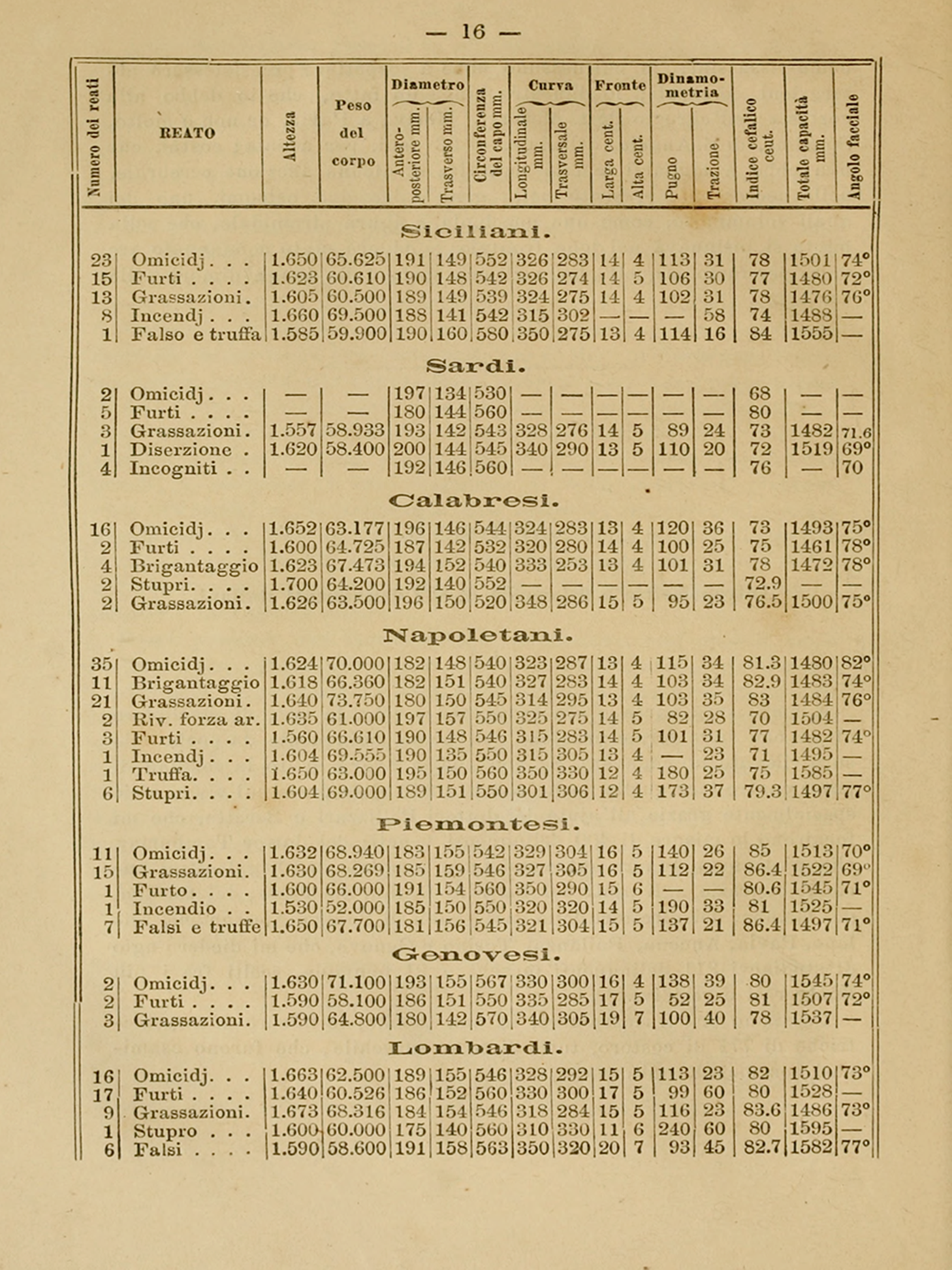
Figure 4 is a table from the treatise that tabulates types of criminals: “murderers,” “thieves,” “robbers,” “arsonists,” and “swindlers” (omicidj, furti, grassazioni, incendj, and falso e truffa) by region. It purports to show, for example, that Piedmontese murderers had a higher skull capacity (totale capacità mm) (1,513 millimeters squared) than either Calabrian or Neapolitan murderers (with figures of 1,493 and 1,480, respectively). In general, wrote Lombroso (Reference Lombroso1876: 17, see also 24), the “stature of delinquents almost always reproduces the regional type.” Lombroso’s version of positivism thus put regional unevenness on a new racial foundation. Lombroso’s regional types, in analogy to Ardigò and Villari’s national types, formed the main object of his social science.
Image from Cesare Lombroso’s L’uomo delinquent.
Gini and Social Class
Gini also considered group psychology the basic object of social science. But he focused on social classes, conceived as quasinatural groupings. Gini argued that nations were combinations of these (Lanaro Reference Lanaro1979: 45). The condition of each nation depended on the differential fertility of its classes. Wealthier nations had a large proportion of the population in high social classes with low fertility rates. Poorer nations had a large proportion of the population in low social classes with high fertility. The optimum for Gini occurred when the demographic excess of the lower classes replaced the demographic “vacuum” of the upper ones (De Grazia Reference De Grazia1992: 53; Ipsen Reference Ipsen1996: 222; Lanaro Reference Lanaro1979: 47). Thus, lower, more fertile social classes were the reservoir from which new elites formed (Cassata Reference Cassata2006: 21). Gini (Reference Gini1912: 34) made an analogy to biology, stating: “Now, just as the parabola of the life of organisms finds its explanation in the diverse activities of their exchange, thus—I think—the curve of the evolution of peoples can be put into relation with the diverse stages of the demographic exchange among the various social classes.” Gini presented a biological version of a cyclical and evolutionary view of historical development in which nations were born, aged, and then declined (but could reemerge in the future).
Gini’s classes each had characters that together shaped national character. Thus, countries lacking large, fertile lower classes suffered from a “change in the temperament of the nation” (Gini Reference Gini1912: 38). The “carefree solidarity of the poor majority” was then replaced by the “calculated egoism of the well-off many” (ibid.).
Gini’s argument about fertility also engaged the emigration debate, arguing in Reference Gini1912 that the upper classes were still fertile enough to replace themselves, which forced members of the lower classes to emigrate (Bertaux Reference Bertaux1999: 575; Lanaro Reference Lanaro1979: 47). In the future, as the fertility of the upper classes declined, Italy would face the problem of an aging population (Bertaux Reference Bertaux1999: 575). Furthermore, as the most vigorous Italians emigrated, those who remained to replenish the infertile elites would be demographically weaker than before (Cassata Reference Cassata2006: 21). The threat of “egoism” now loomed in Gini’s imagination. Closing off emigration so as retain the reservoir of poor, but fertile, Italians was key.
Gini’s social thought, like Lombroso’s, reduced society to biology. Thus, society was a cultivable living being. Individuals within it were cells linked to the social whole (Gini Reference Gini1912: 9, 45). As Gini (1927: 102) stated in Reference Gini1927, distinguishing the liberal from the nationalist theory:
The liberal theory assumes that society consists of an aggregate of individuals who must look after their own interests and it regards the state as an emanation of the individual wills intended to eliminate the conflicts between the interests of individuals. The nationalistic theory, on the contrary, views society as a true and distinct organism of a rank superior to that of the individuals who compose it, an organism endowed with a life of its own and with interests of its own.
Society was thus more important than the individuals who made it up, the purpose and value of which could be determined only by their place in this whole. Ontologically, Gini’s thought resembles that of Villari, Ardigò, and Lombroso. Like these thinkers, the object of social science was group psychology, although for Gini, the relevant groups were classes, each possessing a distinctive temperament that shaped the temperament of the nation as a whole.
Niceforo and the North and South
Niceforo (Reference Niceforo1901: 19–91) offered a different specification, arguing that Italy contained two races: Mediterranean in the south and Aryan in the north, distinguished by a series of features such as cranial capacity, hair thickness, arm span, and the incidence of baldness. On this basis, Niceforo (ibid.: 116) claimed there had emerged two “collective psychologies.” Southerners possessed a highly developed sense of the “I,” making them fickle and excitable. Northerners instead had a weakly developed sense of the “I,” making them slower but more patient and willing to tolerate organization (ibid.: 116–22). Niceforo (ibid.: 126) saw the two races as a product of natural and historical conditions. Collective psychology and climate formed for Niceforo an interlocked causal network, much as in Ardigò’s view.
Ardigò’s, Villari’s, Lombroso’s, Gini’s, and Niceforo’s social ontologies might seem different (e.g., Burgalassi Reference Burgalassi1996: 144–45). In fact, they were similar. The object of social science for all was collective psychology, a product of natural, historical, and biological circumstances. Collective psychology was a mixed reality existing in an indeterminate intellectual space between history, geography, anthropology, and medicine. In sum, Italian positivists lacked any clear understanding of society as an emergent reality that could be analytically disengaged from its natural and geographical bases.
The Methodology of Italian Positivism
What rules of procedure (Merton Reference Merton1968 [1957]: 100–4) did this definition of the object of the moral sciences imply? Italian positivists lacked a firm conception of rules of inquiry in this sense. Indeed, although highly sophisticated in some respects, they seem to have been either unaware of, or unconcerned about, the problem of inference (Stinchombe Reference Stinchcombe1968: 15–17).
Villari’s Historical Method
Villari’s widely read “La filosofia positiva e il metodo storico” attempted to develop a method of social science based on Galileo’s experiment. In Galileo’s experiment, “your idea [does] not remain in your mind, rather you [confront] it with the external world and [obligate] nature to confirm it” (Villari Reference Villari1868: 12). Villari supported the use of a method analogous to Galileo’s for the historical sciences by claiming that history can be understood as a set of experiments providing evidence about human nature. Just as the natural world comes to be known through active intervention that constrains nature to speak, so human nature comes to know itself through institutions (ibid.: 29). As he put the point: “We have on the one side man with his faculties, with his ideas, and with his passions; and on the other side society and its history, which are nothing other than the impersonal and independent reflex of this individual will, of this same man” (ibid.).
To what method did this conception of “society and its history” lead? While Galileo’s scientist conducts experiments, and therefore proceeds with a method, in Villari’s conception, history performs the experiments that produce the evidence for the moral sciences. The resulting evidence, Villari treats as immediately interpretable. Strictly speaking, therefore, there is no problem of inference in the context of the historical sciences for Villari because historical actors have already performed the experiments prior to their study by the scholar who has simply to observe the results. The student of the “sciences of morality” is therefore passive, not active, as in Galileo’s experiment. The student of history has simply to interpret the object.
Villari denied the applicability of mathematics to history because “method depends absolutely on the nature of the science” and “to believe that it is possible to apply numbers and formulae to the passions of the human heart, or to the ideas and aspirations of our intellect, would demonstrate an absolute ignorance of human nature and the nature of thought” (Villari Reference Villari1868: 6–7). Villari’s positivism, then, although seeming to rest on an analogy between the natural sciences and social sciences, rejected application of natural science procedures to society. Positivism meant that human nature was observable in human institutions and history, but Villari offered no method for producing knowledge about these institutions and this history. As an expression of underlying collective mind or psychology they were immediately interpretable. As a consequence, despite his positivism, Villari developed no “logic of procedure” (Merton Reference Merton1968 [1957]: 102).
Villari failed to identify society as a layer of reality to which scientific methods could be applied on analogy to natural science; instead, the national character types or group psychologies that emerged from it resulted from a blending of natural and social causes. As a result, he did not develop a method of inference. Positivism justified traditional interpretive techniques without ever dealing with the problem of inference.
Lombroso’s Tables
Lombroso’s work, focused on the biological causes of social phenomena (cf. Gould Reference Gould1981: 125), demonstrated the same mixing of factors as Villari’s. Lombroso (Reference Lombroso1876: 120–55) established an etiology of crime asserting a bewildering variety of causes at different ontological levels: “weather,” “race,” “civilization,” “food,” “heredity,” “age,” “sex,” “profession,” “up-bringing,” “rickets,” “cranium,” “conception,” “sensations,” and “imitation.” He made no attempt, however, to establish the specific weight of any of these, contenting himself with the claim:
For crime as well one can establish an etiology, as for a sickness (morbo), and perhaps more than in these [others]. There is no crime that does not have its roots in multiple causes: even if these in many cases intertwine and blend with one another, that does not relieve us from the duty of considering them one by one, in obeisance to linguistic and scholastic necessity, as is the practice for all human phenomena, to which one can ever never assign a single cause separated from concomitants (Lombroso Reference Lombroso1876: 120).
Lombroso described processes but did not isolate factors. This flowed from the same ontology Ardigò articulated in which natural, social, and geographical factors worked together to explain all social phenomena.
Gini’s Crusade against Sampling
Gini conducted groundbreaking work in methodology, creating an index for the measurement of inequality that is still widely used (Prévost Reference Prévost2009: 22–57). However, he embraced the same ontology as all Italian positivists, and this influenced his procedures. Gini, despite being the most important Italian statistician of his generation, rejected the use of sampling techniques and statistical inference. He saw these techniques as doing violence to the reality of the nation. Although Gini’s technical arguments against sampling are somewhat complicated and controversial, most historians of his work suggest that part of his motivation for rejecting sampling was his attachment to the Italian tradition of descriptive monographs, exemplified by Villari and written under the influence of Ardigò’s ontology, which assumed that all aspects of a territory linked to one another, so that individuals could not be treated as fungible units (Baffigi Reference Baffigi2007: 54–57; Cassata Reference Cassata2006: 144; Prévost Reference Prévost2009: 167–68). Gini’s ontological positivism negatively affected his statistical practice.
Niceforo’s Eclecticism
Niceforo (Reference Niceforo1901: 60–61) claimed that two races existed on the Italian peninsula: Aryans, who had large, short, and voluminous skulls with spheroid or flat shapes, long noses, large chests, rosy complexions, blond or red hair, and early baldness in the north, and Mediterraneans, who had light, elegant, and slim skulls with ellipsoid or ovoid forms, and were shorter, darker, and more hirsute in the south.
Following this demonstration of the different physical types that supposedly predominated on the Italian peninsula, Niceforo presented evidence on differences in diet, literacy, crime, and the production and circulation of goods in the two parts of Italy. His presentation implied that the differences in cranial types, hair, and eye color in the first part of his book connected to the indicators of modernization in the second part. But this claim was convincing only within the ontology of Italian positivism, which presumed an interconnection of all layers of reality. Like Lombroso, Niceforo never attempted to establish through comparative analysis or statistical techniques the specific effect of the supposed racial differences on any of his indicators of “civilization.” As with other Italian positivists we have discussed in this section, there is no discernible logical procedure that could guide empirical analysis.
Internalism
We are now in a position to conclude our evaluation of the internalist argument. Internalists treat positivism as a strategy of distinction aimed at establishing a new field of sociology. They suggest that positivists extend a scientific method to social reality. This is possible, according to positivists, because the domains of nature and society are ontologically distinct, but analogous (Steinmetz Reference Steinmetz and George2005c: 283). Italian positivists, however, did not identify society as a distinct ontological layer, nor did they try to establish any particular disciplinary field. Rather, they treated empirical materials (history, demographic trends, or crime statistics) as the expression of group (either national, regional, or racial) psychology. They also did not develop a method to distinguish themselves from their rivals. Paradoxically, it was the very ambition of the Italian positivist agenda that undermined any methodological reflection. Given the ontological continuity between nature and society, the question of exactly how the social could form the object of a specific science could not arise; sociology, or the “moral sciences,” was a branch of biology or geography (Santoro Reference Santoro and George2013: 114–15). Positivism, therefore, was not a strategy of distinction allowing for an analogical extension of method in Italy. Instead, positivism claimed ontological sameness between natural and social reality, which undermined methodological development (Burgalassi Reference Burgalassi1996: 97–110).
The Bearers of Italian Positivism, the Traditional Intellectuals: Assessing the Expanded Gramscian Explanation
We now turn to the sociology of intellectuals, using our prosopography. Understanding the Italian case requires analysis of the social character of the intellectuals who espoused it.
A Traditional Intelligentsia
How did Italian positivists relate to the dominant disciplines? The university as an institutional form was established in Bologna in the thirteenth century and had two levels. The lower focused on arithmetic, geometry, dialectics, music, grammar, rhetoric, and astronomy. The upper was broken into three specialized faculties: theology, jurisprudence, and medicine (Winkler Reference Winkler2009: 60). Even after unification, this system remained in place. Classically educated lawyers, doctors, and theologians dominated the intelligentsia at the expense of technicians (Barbagli Reference Barbagli1982: 19–21). Italian intellectuals educated in this system were generalists; they possessed a common classical education but relatively little specialist training (Charle Reference Charle1996: 295). This generalist background was also characteristic of Italian positivists and, as we show in the text that follows, their fathers.
Consider the five men we discussed already. Roberto Ardigò (1828–1920) was born to a downwardly mobile Cremonese family. He attended elementary and high school in Mantua, where he studied with a Mazzinian priest named Enrico Tazzoli, who was defrocked and executed in 1852 for his political ideas. Tazzoli introduced Ardigò to the writings of many important nationalist intellectuals. Following his high school education, Ardigò studied theology at Milan in 1848 and became a priest in 1851. In 1853, he began teaching and in 1863 became a canon of the cathedral of Mantova. Ardigò was, then, a Catholic priest. This is perhaps the clearest possible case of a positivist traditional intellectual because, as Gramsci (Reference Gramsci, Hoare and Nowell Smith1971: 7) put the point, ecclesiastics, with their specific esprit de corps and relative separation from economic life, were typical of the traditional type.
Villari (1820–1918), the son of a lawyer, was born in Naples and began to study law himself until his move to Florence (Moretti Reference Moretti2012: n.p.). Villari was initially drawn to Hegel’s philosophy because he saw it as a source for renewing Italian national culture (Gentile Reference Gentile1921: 55–56). He became a positivist in his adopted city, where he published a number of important historical works, engaged with the social problems of Italian unification, and edited an important positivist review called La Rassegna Settimanale (The Weekly Review) together with Sidney Sonnino (1847–1922) and Leopoldo Franchetti (1847–1917) (Donzelli Reference Donzelli1999: 82; Espinas Reference Espinas1880: 125; Gentile Reference Gentile1921: 61; Restaino Reference Restaino1985a: 73–74, 86). The review published a number of groundbreaking studies of Italian society, including Villari’s (Reference Villari1885: xxiv) own Lettere meridionali (Southern Letters). These Florentine currents developed Comtean positivism, as well as elaborating Galileo’s science as a general model of knowledge (Restaino Reference Restaino1985a: 73–74). However, Villari’s background of Neapolitan idealism, going back to Giambattista Vico as well as his family origins as a lawyer (Abbate Reference Abbate1966: 33; Restaino Reference Restaino1985a: 86), mark him clearly as a traditional intellectual because, like Ardigò, he was part of the stratum of generalist scholars sharply separated from economic activity.
Lombroso (1835–1909) was born to a previously wealthy but economically declining Jewish family in Verona in 1835. After age 15, he was privately schooled at home before attending university, where he studied medicine at the University of Pavia beginning in 1853 (Armocida Reference Armocida2005: n.p.). He had been a medical official in Calabria in 1862 during the struggles against brigantaggio (brigandage) that followed Italian unification (Pick Reference Pick1986: 61–63). Initially believing in a political solution to the problem of regionally uneven development that plagued the newly unified state, he later shifted his thinking toward a biologically reductionist view interpreting regional differences in crime as the expression of racial differences (Petraccone Reference Petraccone2005: 79–80). Lombroso too was part of the traditional intelligentsia. He had a wide humanistic education, and medicine was one of the traditional disciplines of the Italian university.
Gini (1884–1965) was born in Treviso, a town in the eastern Veneto, in 1884 to a “privileged family of the high agrarian bourgeoisie” (Federici Reference Federici and Mario2000: 18). He studied jurisprudence at Bologna, but also statistics, economics, mathematics, and biology. Gini’s first job was at the university of Cagliari, where he taught statistics before moving to Padova and finally to Rome (ibid.). Given his mathematical background, it might be tempting to think of Gini as a technician. But he was in fact a classically educated polymath.
Niceforo (1876–1960) was born in Castiglione, Sicily. His father, Nicolò, was a jurist at the Palermo appellate court and a historian of Italian literature who held various ministerial appointments. Niceforo’s classical education included the study of authors such as Horace, Quintillian, Cicero, and nineteenth-century Russian and French novelists. He studied in Florence, Perugia, and Rome, and received a degree in Naples, probably in law. Niceforo’s literary interests remained even after his turn toward criminal anthropology as exemplified by his 1898 study, Criminali e degenerate dell’Inferno dantesco (Criminals and Degenerates in Dante’s Inferno) (Guarnieri Reference Guarnieri2013: n.p.). Like our other exemplars of Italian positivism, Niceforo was a traditional intellectual. He came from a background of lawyers and had received a classical literary education before attending university.
The Prosopography
The biographical sketches mentioned previously suggest that many Italian positivists came from traditional intellectual social backgrounds. They were mostly the sons of lawyers, professors, doctors, or landowners. None of the positivists discussed already were sons of industrialists. Was this true of Italian positivists as a whole? To answer this question, we collected information on father’s occupation for 69 positivists. We divided the occupations into six categories: “intellectual,” “petty-bourgeois/peasant,” “merchant/banker/financier,” “landowner,” “industrialist,” and “military.” As figure 5 shows, more than half all positivists came from “intellectual” backgrounds. None of the other social backgrounds was more than 10 percent, and industrial class backgrounds were rare, comprising less than 5 percent of the cases.
Distribution of positivists by father’s occupation.
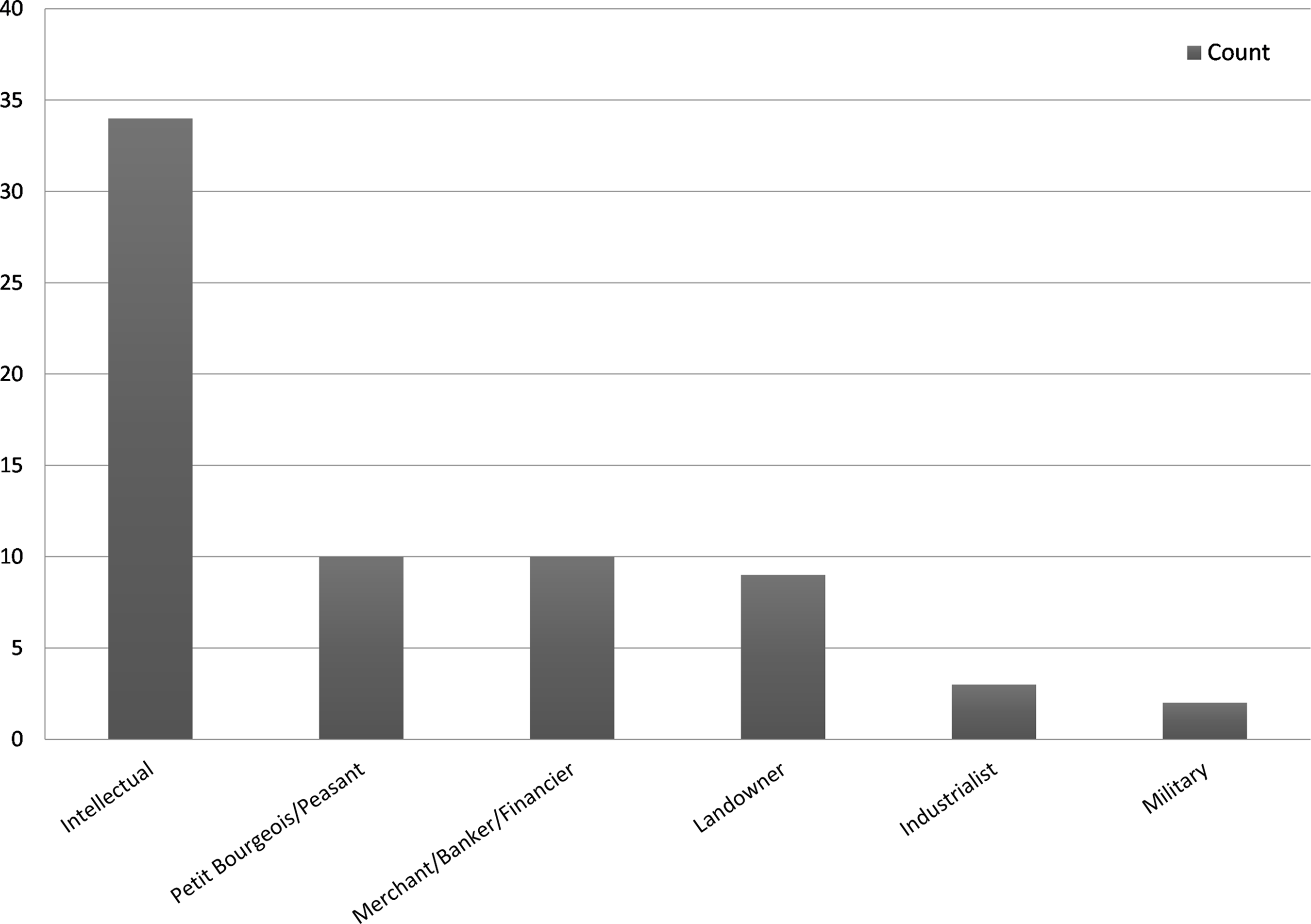
This evidence implies that Italian positivists were not a new group of intellectuals linked to a developing capitalist class. Rather they were largely the scions of an already established strata.
A further implication of the biographical sketches is that Italian positivists tended to be trained in traditional university disciplines: theology, law, and medicine. Does this pattern hold more broadly? Figure 6 shows that a plurality of the positivists (40 percent) studied law, and well more than half (58 percent) concentrated in the two traditional disciplines of law and medicine. Only small percentages (4 percent and 2 percent, respectively) studied engineering or political economy.
Type of degree.
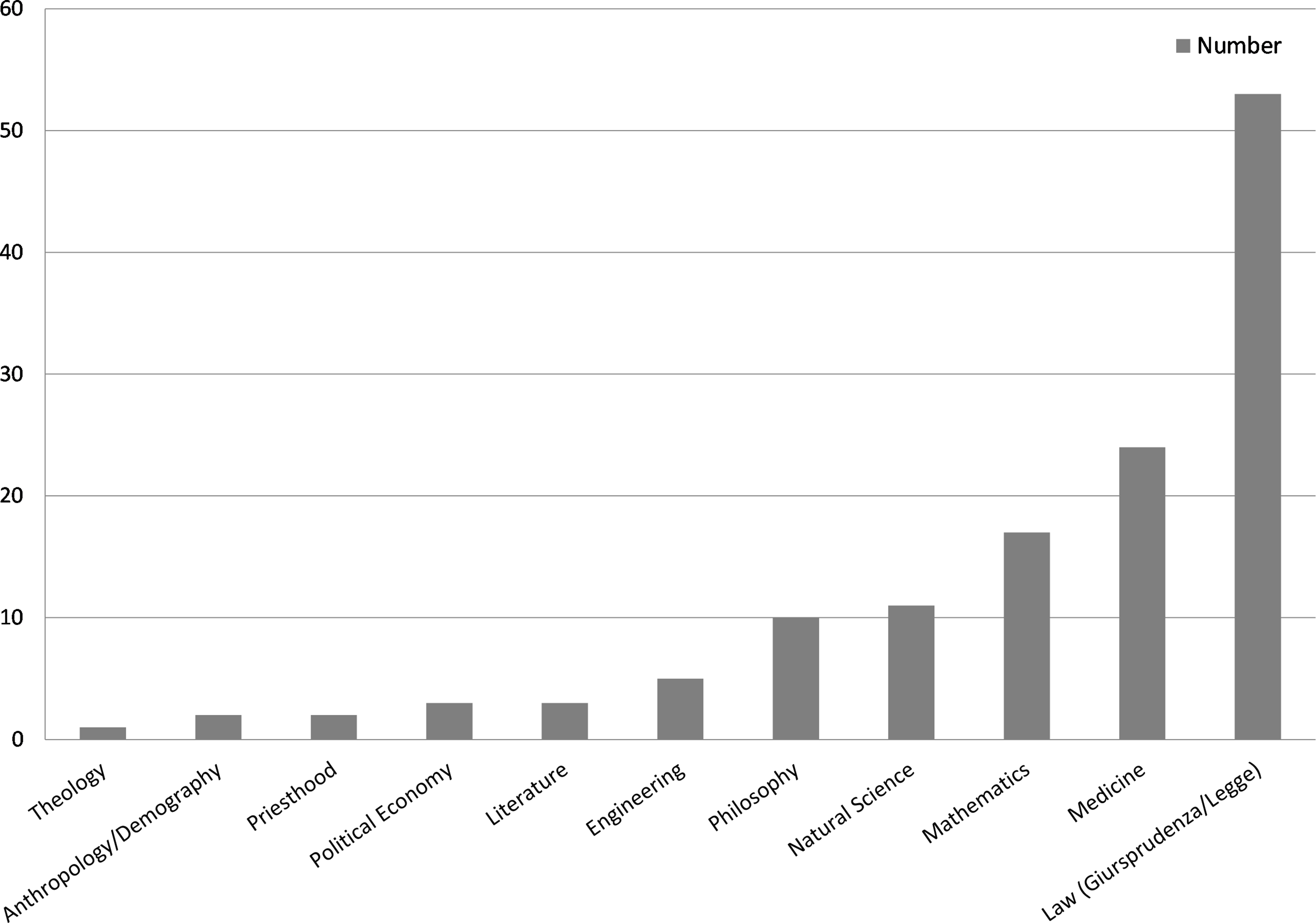
The social bearers of Italian positivism were thus traditional intellectuals. They came from an already established intellectual stratum and had been educated in the ancient disciplines of law and medicine.
Positivism as Teleological Knowledge: Ardigò’s Theory of Morality
A final characteristic further indicates the traditional character of this group. Italian positivists concerned themselves with goal setting. As Konrád and Szelényi (Reference Konrád and Iván1979: 64–65) and Gramsci (Reference Gramsci, Hoare and Nowell Smith1971: 6–7) argued, there is a crucial difference between the technical knowledge produced by organic intellectuals and the teleocratic or value-relevant knowledge characteristic of traditional intellectuals. Italian positivists were not content with providing descriptions or causal models. Rather, most were eager to provide an answer to Weber’s (Reference Weber1946: 152–53) query: “What shall we do, and, how shall we arrange our lives?” Indeed, positivism was a strategy for reasserting the special qualifications of the traditional intellectuals to speak on political matters in an age of secularization (Konrád and Szelényi Reference Konrád and Iván1979: 64; Plé Reference Plé1996: 417). This characteristic can be best shown by examining how, for Italian positivists, values grew out of the study of facts. We return to a discussion of Ardigò’s psychological theories to demonstrate this.
Ardigò, before his break with the church, claimed that the results of positive science could bolster Catholic moral teachings; indeed, his first major work, La psicologia come scienza positive (Psychology as a Positive Science), was published while he was still a canon of Mantova (Gentile Reference Gentile1921: 242–46; Pironi Reference Pironi2000: 24–25). In this work, Ardigò (Reference Ardigò1908a: 145–46; Pironi Reference Pironi2000: 32, 128, 137) sought to establish a set of scientifically justified ethical maxims.
Ardigò conceived of the development of morality as a transition from egoism to antiegoism. Although biologically human beings are self-interested, they are also naturally social. Through historical development, egoism was gradually transformed into antiegoism, an attitude aimed at safeguarding society rather than the individual (Pironi Reference Pironi2000: 143). With this scheme, Ardigò was able to reestablish much of the content of Catholic morality on a supposedly empirical foundation (ibid.: 145). Thus Ardigò (Reference Ardigò1908a: 238) wrote: “Virtue properly so-called, or rather the truly moral disposition, is a species of holy furor that transports man to the sacrifice of himself; and before he has been able to reflect on his own advantage; and even not expect it.”
Strikingly, therefore, Ardigò's positivism provided a way of anchoring morality in social science. Self-sacrifice in the name of the community was not a premodern attitude but the product of social evolution. Ardigò also insisted on the importance of education as a way of forming Italian national character (Pironi Reference Pironi2000: 9–10, 148; Plé Reference Plé1996: 391; Spirito Reference Spirito and Ugo1956: 19).
Ardigò’s psychological theories exemplify the value stance of a traditional intelligentsia. Rather than considering science a value-free activity, Ardigò claimed to establish values scientifically. He thereby scientifically authorized the demand that Italian citizens consider the good of the nation rather than their own narrow self-interest. Italian positivism was, then, an ideology of ends, not techniques. It served the interests of a teleocratic estate (a traditional intelligentsia), not a rising technical intelligentsia (organic intelligentsia).
Italian positivism was thus rooted in a group of traditional intellectuals. This evidence is compatible with our expanded Gramscian theory of positivism. To be clear, our theory does not suggest that positivism is always associated with traditional intellectuals, but what our argument does suggest is that traditional intellectuals can produce a distinctive form of positivism, as they did in Italy in the late nineteenth century.
Conclusion
What is the connection between capitalist development and positivism? Externalists suggest that industrial capitalism produces positivism. Internalists suggest that positivism is a strategy of distinction aimed at establishing a new social science based on a set of scientistic “rules of procedure” (Merton Reference Merton1968 [1957]: 102).
We first showed that the period of positivism’s preeminence in Italy did not correspond to the development of industrial capitalism. Throughout the decades from 1865 to 1910, Italy remained an overwhelmingly agrarian country. Our prosopography revealed no relationship between capitalist development at a regional level and the incidence of positivists. Instead, positivists were found across all levels of economic development within Italy.
For the “internalist” account, positivism is a strategy aimed at establishing an autonomous field of sociology. Positivists first identify a distinctive ontological layer, “society,” and then apply natural scientific methods to it. Italian positivists failed either to identify such a layer or to develop a scientific method through analogy because there was no clear domain in which to apply such methods. Positivism in Italy was not a path to the development of natural science methods in social science; it was a major obstacle to it.
Why, then, did positivism rise to dominance in the years between 1865 and 1910? Italian positivists were mostly “traditional intellectuals.” They came largely from intellectual social backgrounds and were trained in the established fields of medicine and law. They used positivism as a way of reasserting control over social-goal setting. In this sense, they were a “teleological estate” in the words of Konrád and Szelènyi (Reference Konrád and Iván1979: 64). Positivists claimed values derived from empirical study (Plé Reference Plé1996: 401).
The argument of this article has three broader implications. Positivism very often came to relatively backward societies such as Italy not as the ideology of a dynamic industrial bourgeoisie and its associated organic intellectuals but rather as a substitute for traditional religion. Important positivist movements occurred in the late nineteenth century in Brazil, Argentina, Mexico, Chile, and Colombia (Clark Reference Clark, Ofelia and Otávio2010: 59–64; Cruz Costa Reference Cruz Costa1964 [1956]: 82–108; Palti Reference Palti, Fillafer and Jan2018: 59–65; Skidmore Reference Skidmore1999: 66). In India, intellectuals promoted positivism as an alternative to Hinduism and Christianity (Forbes Reference Forbes, Fillafer and Jan2018: 35). In Turkey, positivism was an important current in the reform movement within the Ottoman elite in the late nineteenth century (Özervarli Reference Özervarli, Fillafer and Jan2018: 81–84). In Poland, positivism was a political and intellectual movement between the 1860s and 1880s (Surman Reference Surman, Fillafer and Jan2018: 239). By the 1870s, positivism was an established tradition in Russian thought (Nemeth Reference Nemeth, Fillafer and Jan2018: 273–74). The importance of positivism in all these relatively underdeveloped societies in the late nineteenth century calls out for an explanation that goes beyond the externalist and internalist accounts assessed here. Our article offers a theory of intellectuals as a way of explaining these developments.
Second, our analysis has consequences for theories of positivism and the “sociology of sociology” more broadly. Both the externalist and internalist accounts assume that positivism is primarily a methodology. Indeed, we think that these existing theories probably account well for the “methodological positivism” familiar to most Anglo-American sociologists. However, our article shows that positivism does not follow this form everywhere.
Positivism (empiricism-scientism) in our view should be considered generally as the attempt to claim scientific credentials. But this can occur on either the methodological or the ontological dimension. Our theory of intellectuals can account for both forms. Externalist theory correctly suggests that methodological positivism is associated with the rise of industrial capitalism. But because these theories lack an account of intellectuals, they offer no plausible mechanism linking positivism to industrial capitalism, and they cannot explain the Italian case. Internalist accounts, following Bourdieu, do offer a mechanism (distinction) that explains how methodological positivism could emerge. But internalist theory assumes that methodological positivists and humanists already exist as different types of agents in an intellectual field. Thus, somewhat like the externalist account, the internalist account does not specify the scope conditions of its theory, nor does it explain the Italian evidence. The sociology of intellectuals allows us to recast existing theories of positivism in more general terms. This is because our theory allows us to specify the connection between different types of positivism and different types of intellectual formation. Our argument is thus synthetic. It is not our purpose to disprove, or even to provide evidence refuting, existing accounts of methodological positivism, but rather to specify the historical conditions under which such theories work.
Our key theoretical point, then, is that different social ontologies are linked to differently structured intelligentsias. The lack of specialization among Italian intellectuals in general led to an indeterminant ontology in nineteenth-century Italy. As biology, sociology, anthropology, law, and medicine all formed part of intellectuals’ cultural background, few Italian intellectuals were spurred to isolate social reality. The blended genre of Italian positivism expressed the blended social roles of Italian intellectuals. The mechanism linking the social structure of the intelligentsia to social ontology is general and can account for the findings of both the externalist and internalist schools. With respect to the first school, to the extent that intellectual specialization follows capitalist development, there should be a connection between methodological positivism and capitalism. With respect to the second school, intellectual specialization explains the conditions under which a field might emerge in which methodological positivism could arise as a strategy of symbolic domination. Our sociology of intellectuals thus offers a more general theoretical account of positivism than those currently on offer; it furthermore resolves the empirical anomalies from which the other theories suffer.
Our article, finally, makes a contribution to methodology. Scholars influenced by critical realism, such as Collier (1994: 110; Reference Collier and George2005: 334), Elder-Vass (Reference Elder-Vass2010: 44–45), and Porpora (Reference Porpora2015: 32–35), asserted the importance of ontological models to empirical work without showing the impact of different such models on knowledge production. Our article offers a way of empirically investigating this connection, and we hope others will use it as a model. We have shown in section 2 how Italian positivism’s underdeveloped social ontology blocked the development of social science methodology. We would encourage future scholarship concerned with the important methodological questions raised by the turn toward ontology to pursue a comparative and historical strategy in seeking to make their points. We hope to have shown that the actual study of historical positivism in its various forms contains many important lessons for contemporary social science practice.
Appendix: The Prosopography
This article identifies names of Italian positivists from two sources. The first is the Decennale 1926–IV–1936–XIV, published by the Istituto centrale di statistica in 1936. Pages 63 and 64 list all the members of the variously named high councils on statistics (e.g., Consiglio superiore di statistica), forming an initial group of names. The contributors to the Rivista di filosofia scientifica (Journal of Scientific Philosophy), a journal that appeared from 1881 to 1891 and that is in the public domain in the HathiTrust database, formed the other group. We then searched for biographical information on the positivists from the Treccani website (www.treccani.it) that hosts the Dizionario biografico degli Italiani and a number of other encyclopedias containing information. On this basis, we produced a prosopography containing information about 167 positivists.


 Open access

