





Introduction
Although much is known about the distress patients experience at the end-of-life (EOL; Bovero et al. Reference Bovero, Sedghi and Opezzo2018; Breitbart et al. Reference Breitbart, Rosenfeld and Pessin2000; Chochinov et al. Reference Chochinov, Hassard and McClement2009, Reference Chochinov, Wilson and Enns1998; Soto-Rubio et al. Reference Soto-Rubio, Valero-Moreno and Díaz2020; Wilson et al. Reference Wilson, Chochinov and Graham Skirko2007a, Reference Wilson, Chochinov and McPherson2007b), little is known about who is most likely to experience such distress. Personality influences coping with life-threatening illness (Carver Reference Carver2005; Carver and Connor-Smith Reference Carver and Connor-Smith2010) and neuroticism (propensity or tendency toward high arousal/emotional distress) is the personality trait with the strongest relationship to psychopathology (Barlow et al. Reference Barlow, Sauer-Zavala and Carl2014; Brandes and Tackett Reference Brandes and Tackett2019; Kendler and Myers Reference Kendler and Myers2010; Watson Reference Watson, Smelser and Baltes2001; Widiger and Seidlitz Reference Widiger and Seidlitz2002). Neuroticism is a significant predictor of depression, hopelessness, anxiety, worry, loss of dignity, concentration, and quality of life in patients with cancer at the EOL (Chochinov Reference Chochinov2006). It is unknown how this relationship manifests in those with noncancer illness at the EOL.
There is an increasing awareness of the need to expand research in EOL care to noncancer populations (Addington-Hall and Higginson Reference Addington-Hall and Higginson2001; Moens et al. Reference Moens, Higginson and Harding2014). Illnesses such as chronic obstructive pulmonary disease (COPD) and end-stage renal disease (ESRD) are among the top causes of death worldwide (World Health Organization 2020). Additionally, as the world’s population rapidly ages (United Nations Department of Economic and Social Affairs 2019), an increasing number of individuals are considered the frail elderly (frailty), with multiple care needs at the EOL (Clegg et al. Reference Clegg, Young and Iliffe2013). Finally, albeit less common, amyotrophic lateral sclerosis (ALS) has a rapid deteriorating course associated with significant symptom distress and impaired quality of life (Aoun et al. Reference Aoun, Bentley and Funk2013). COPD, ESRD, frailty, and ALS have less predictable courses than cancer and relatedly, suboptimal EOL care, though the need for such care in these groups has been highlighted (Aoun et al. Reference Aoun, Bentley and Funk2013; Gardiner et al. Reference Gardiner, Gott and Payne2010; Hobson et al. Reference Hobson, Gomm and Murtagh2011; Kristjanson et al. Reference Kristjanson, Aoun and Oldham2006; Lastrucci et al. Reference Lastrucci, D’Arienzo and Collini2018). The physical and psychological issues faced by those at the EOL with noncancer illnesses are similar to those with cancer (Stiel et al. Reference Stiel, Matthies and Seuß2014). Since neuroticism’s link with aspects of psychological distress in cancer populations and its significant public health implications are well established (Aarstad et al. Reference Aarstad, Beisland and Aarstad2011a, Reference Aarstad, Beisland and Osthus2011b; Beisland et al. Reference Beisland, Aarstad and Osthus2013; Cardenal et al. Reference Cardenal, Cerezo and Martínez2012; Carter and Acton Reference Carter and Acton2006; Chochinov et al. Reference Chochinov, Kristjanson and Hack2006; Lahey Reference Lahey2009; Macía et al. Reference Macía, Gorbeña and Gómez2020; Rutskij et al. Reference Rutskij, Gaarden and Bremnes2010; Wang et al. Reference Wang, Sun and Yue2022), gaining additional information about neuroticism at the EOL in ALS, COPD, ESRD, and frailty may have important implications.
In particular, furthering what is known about neuroticism’s link with psychological issues faced at the EOL in patients with ALS, COPD, ESRD, and frailty may aid identifying and supporting individuals who are likely to become depressed. The bidirectional nature of depression and chronic illness (Evans et al. Reference Evans, Charney and Lewis2005) and the overlapping symptoms shared by depression, chronic illness, and aspects of aging complicates clear delineation of directionality (Wilson-Genderson et al. Reference Wilson-Genderson, Heid and Pruchno2017). The presence of chronic illness is a known risk factor for depression onset (Lahey Reference Lahey2009), duration (Ohayon and Schatzberg Reference Ohayon and Schatzberg2003), resulting psychiatric hospitalization (Šimunović Filipčić et al. Reference Šimunović Filipčić, Filipčić and Glamuzina2019), and comorbid chronic illness and depression result in more somatic symptoms (Katon et al. Reference Katon, Lin and Kroenke2007). As such, the cyclical nature of depression and physical illness has significant implications for quality of life related to physical and mental health (Evans et al. Reference Evans, Charney and Lewis2005). Understanding this relationship between physical symptoms and depression is particularly salient at EOL, where depression that is not properly treated may interfere with the “work” of a “good death” (Chochinov Reference Chochinov, Portenoy and Bruera2003).
The objective of this study was to examine the role of neuroticism as a moderator of the impact of physical symptoms at Time 1 on depression at Time 2 in 4 noncancer illnesses (ALS, COPD, ESRD, and frailty) in the last 6 months of life. We hypothesized that physical symptoms at baseline would be associated with increased depression approximately 3 months later, more so for those higher in neuroticism.
Methods
Participants
We analyzed data collected in the Dignity and Distress across EOL Populations study, which contains additional information concerning the data collection protocol and inclusion criteria (Chochinov et al. Reference Chochinov, Johnston and McClement2016). This project involved a prospective, longitudinal, multi-site approach to examine EOL issues of patients with ALS, COPD, ESRD, and frailty.
A total of 663 eligible patient participants were approached for the study, with 249 declining participation and 10 ineligible due to cognitive impairment, resulting in a sample of 404 patients. Participants were assessed at baseline (∼6 months before expected death) and then 3 months later. Date of death was tracked until September 2013, by which time 45% of participants had died (among the groups, time of participation to death ranged from 1.1 to 1.6 years).
Measures
Demographic data
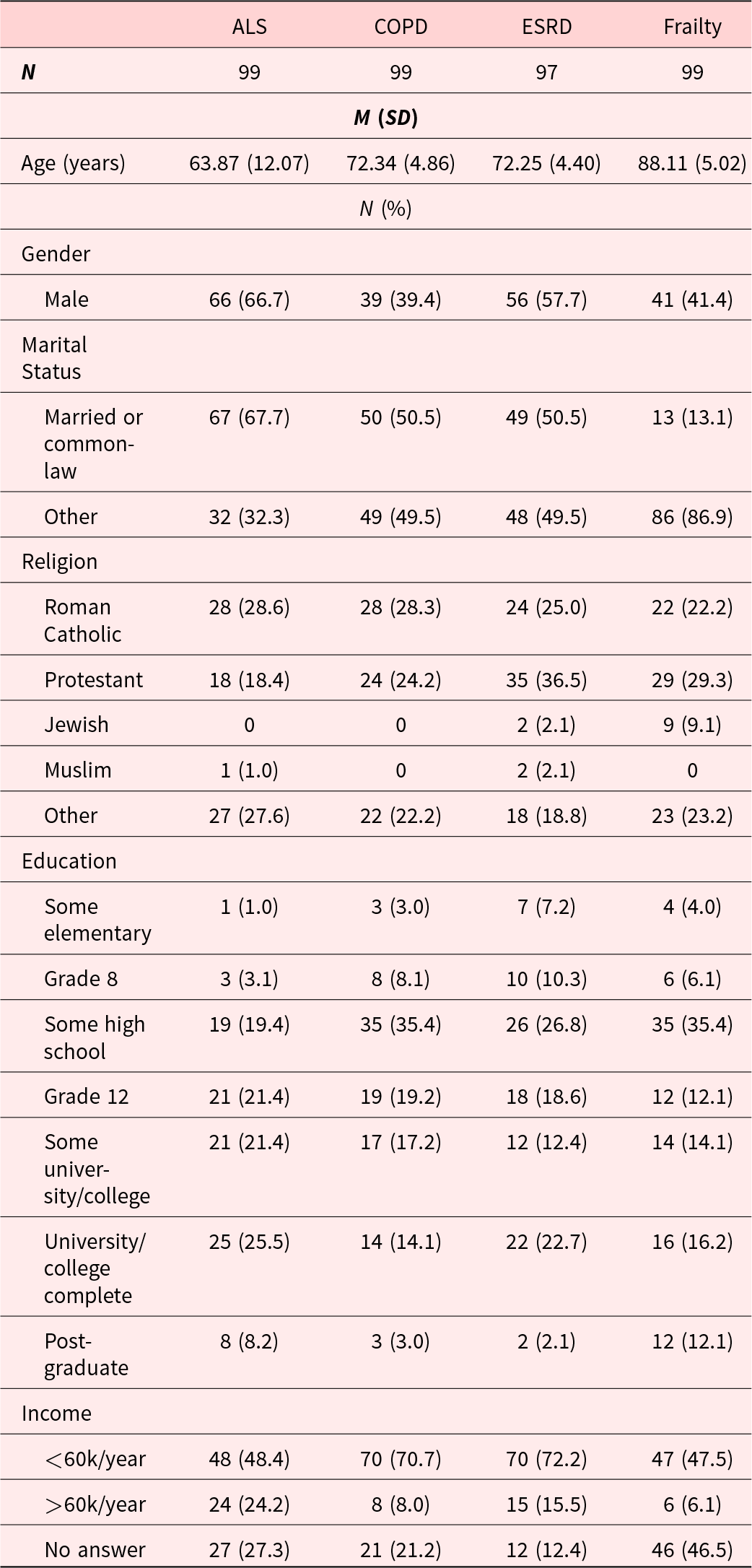
Participants provided information regarding their age, gender, marital status, religion, education, and income (see Table 1).
Demographics by illness group

Neuroticism
Participants completed the 12-item neuroticism subscale from the NEO-FFI (Costa and McCrae Reference Costa and McCrae1992; McCrae and Costa Reference McCrae and Costa2004). Internal consistency in the current sample was α = 0.83. Higher scores indicate greater neuroticism (scored 0 [strongly disagree] to 4 [strongly agree], with a possible range of 0–48).
Depression
Depression was measured using the 7 depression items from the Hospital Anxiety and Depression Scale (HADS; Zigmond and Snaith Reference Zigmond and Snaith1983). Internal consistency for the current sample was α = 0.76.
Physical symptoms
Physical symptoms (pain, nausea, drowsiness, shortness of breath, anxiety fatigue, trouble sleeping, constipation, diarrhea, weakness, dizziness, difficulty thinking, appetite) and non-physical experiences (will to live, wellbeing, activity level) were assessed using the Revised Edmonton Symptom Assessment Scale (ESAS-R; Bruera et al. Reference Bruera, Kuehn and Miller1991).
Statistical analysis
We conducted descriptive and correlational analyses using SPSS 25, and moderation analyses using the PROCESS v.3 macro (Model 1) for SPSS 25, which facilitates estimating and probing interactions using ordinary least squares (OLS) regression (Hayes Reference Hayes2018). We ran Model 1 for each illness group with each Time 1 ESAS-R item as predictor, neuroticism as the moderator, and Time 2 HADS depression symptoms as the outcome. All regression coefficients are unstandardized as recommended by Hayes. Neuroticism and ESAS-R symptom were mean-centered for ease of interpretation. ESAS-R symptom and neuroticism, together with their interaction term, were entered into the linear regression model to predict depression. Age, gender, Time 1 depression, and Time 2 ESAS-R symptom were included as covariates. All assumptions of OLS regression were met.
The difficulty of low power in moderation analyses is well known (Shieh Reference Shieh2009), with small effect sizes for interactions being common (Aguinis et al. Reference Aguinis, Edwards and Bradley2017). Given the sample sizes of approximately 100 for each illness group, the above analyses were underpowered (Cohen’s d for range of interaction affects = 0.14–0.38). Hence, we relied on the R 2-change effect sizes for moderated multiple regression (Green Reference Green1991). R 2-change after adding the interaction term of 0.008, 0.07, and 0.194, are considered small, medium, and large effects, respectively (Bodner Reference Bodner2017).
Results
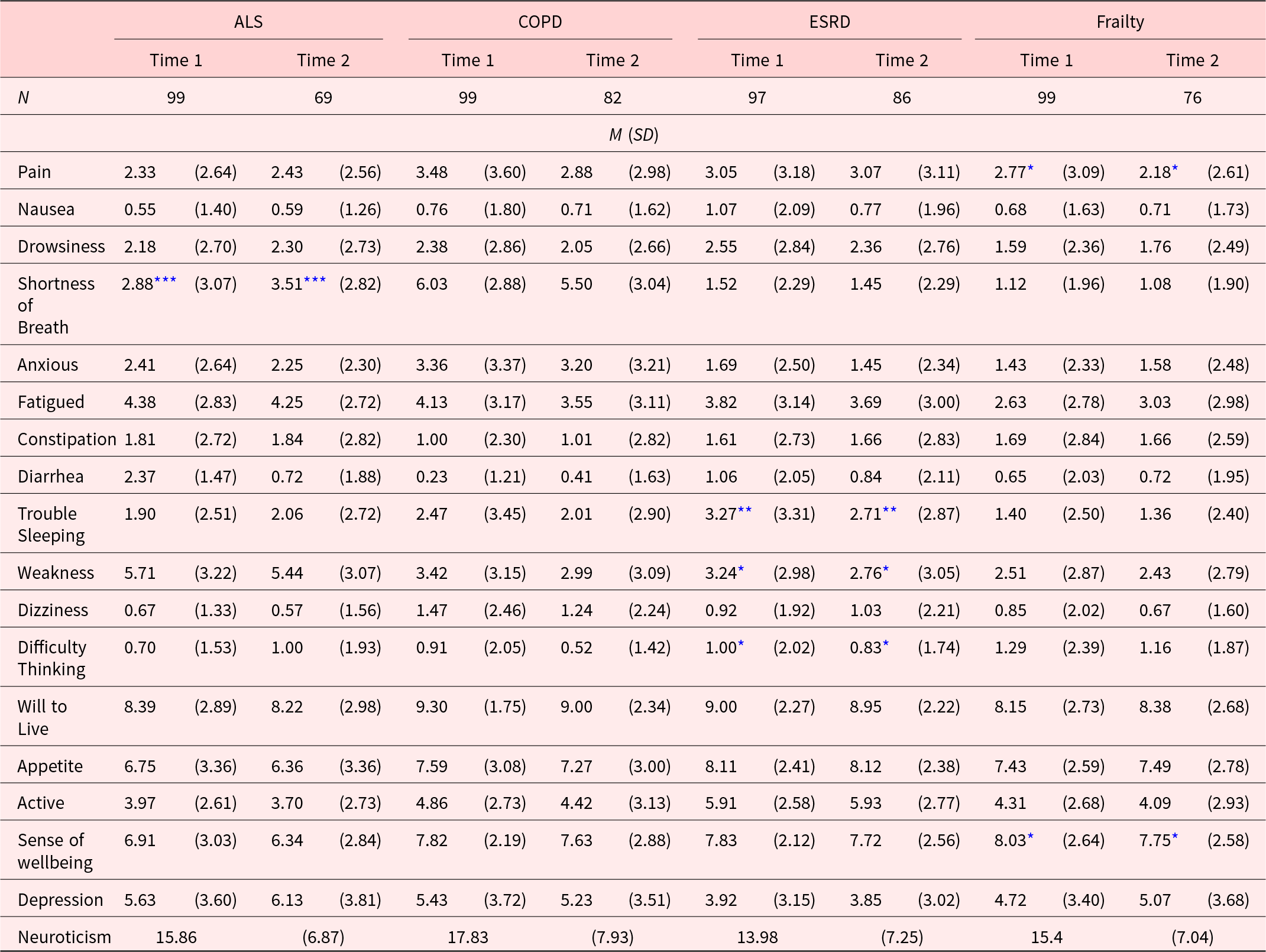
Descriptive statistics for the ESAS-R symptoms, neuroticism, and depression are presented by illness group in Table 2. Zero-order correlations of the predictors, covariates, and outcome are presented by group in supplemental materials.
Descriptive statistics of Time 1 and Time 2 ESAS symptoms, depression, and neuroticism by illness group

* p<.05
** p<.01
*** p<.001.
Moderation
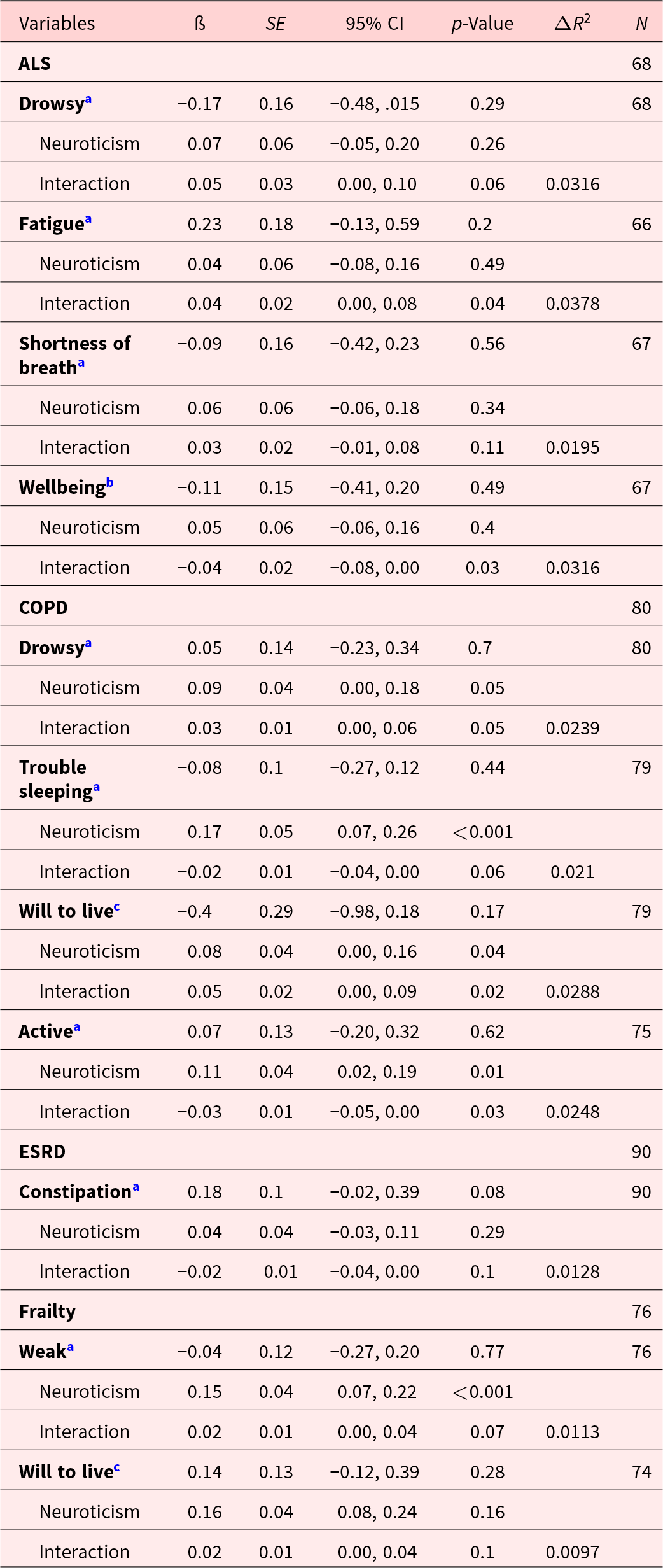
We hypothesized that physical symptoms at baseline (Time 1) would predict increased depression approximately 3 months later (Time 2) for those high in neuroticism. The results of the moderation analyses are presented by group and summarized in Table 3. Conditional effects associated with the symptom by neuroticism interactions presented in Table 3 reflect values of the Time 1 symptom on Time 2 depression for individuals who are average, 1 standard deviation (SD) below, and 1 SD above the mean on neuroticism (Figs. 1–4). In cases where the interaction was significant, but these conditional effects were not, the interaction of neuroticism and different levels of the symptom (−1 SD, M, 1 SD) on depression was further probed. Due to the large number of variables assessed within and across illness groups, we only present the significant interactions in Table 3. Given the aforementioned issues with low power, and the increasing awareness of not relying on p-values alone in interpreting data (Cumming Reference Cumming2014), we report full results for interactions with a p-value ≤0.1 with a corresponding confidence interval that did not include zero (±0.01; Table 3). We did not find that neuroticism moderated the effect of pain, nausea, anxiety, diarrhea, dizziness, difficulty thinking, or appetite on Time 2 depression for any of the illness groups.
Interaction effects of time 1 symptom and neuroticism on time 2 depression

Note. The interaction term is the product of mean-centered values of ESAS-R symptom and neuroticism. Age, gender, Time 1 depression, and Time 2 symptom were covariates. Coefficients for symptom and neuroticism are simple effects and represent the effect of X on Y when W = 0.
a Scored 0 (no/not) to 10 (very).
b Scored 0 (poor sense of wellbeing) to 10 (very good sense of wellbeing).
c Scored 0 (no will to live) to 10 (strong will to live).
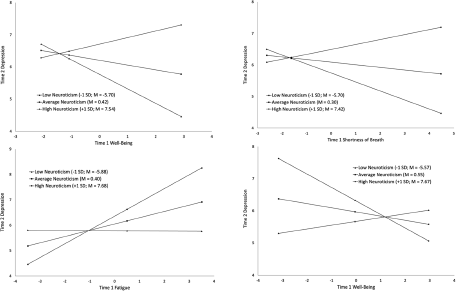
ALS – significant interactions of neuroticism and ESAS-R symptom on subsequent depression.

ALS
Neuroticism moderated the relationship between Time 1 drowsiness, fatigue, shortness of breath, and wellbeing on Time 2 depression (Table 3; Fig. 1). The interaction between Time 1 drowsiness and neuroticism was significantly related to Time 2 depression (Table 3). Greater drowsiness was associated with greater depressive symptoms for those high in neuroticism, and less depression at Time 2 for those low in neuroticism. The slope of the relationship between Time 1 drowsiness and Time 2 depression was positive but non-significant for those high in neuroticism. A similar pattern emerged in the interaction between Time 1 fatigue and neuroticism in its relation to Time 2 depression (Table 3). Higher levels of fatigue at Time 1 were associated with greater levels of depression at Time 2. Whereas fatigue was not significantly associated with subsequent depression for those lower in neuroticism, for those higher in neuroticism, Time 1 fatigue was associated with depression in the clinical range (>8). Neuroticism also moderated the relationship between Time 1 shortness of breath and Time 2 depression (Table 3). Neuroticism exacerbated the likelihood of depression at Time 2 among those with greater shortness of breath at Time 1 (ß = 0.21, p = .10, 95% CI [−0.04, 0.46]). The interaction between Time 1 wellbeing and neuroticism was significantly related to Time 2 depression (Table 3), such that for those high on neuroticism, low wellbeing at Time 1 was associated with greater depression at Time 2. There was no significant relationship between Time 1 wellbeing and Time 2 depression at lower levels of neuroticism.
COPD
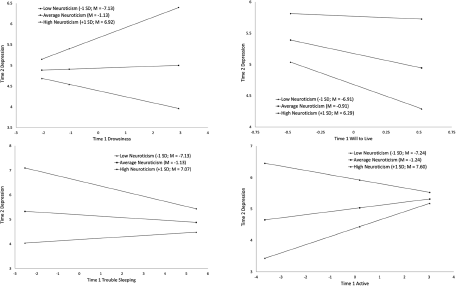
In participants with COPD, neuroticism moderated the relationship between Time 1 drowsiness, trouble sleeping, will to live, and activity on Time 2 depression (Table 3). These interactions are demonstrated in Fig. 2. The interaction between Time 1 drowsy and neuroticism was significantly related to Time 2 depression (Table 3), with the effect of neuroticism on depression being stronger and positive for those who have higher drowsiness at time 1 (ß = 0.17, p < .01, 95% CI [0.07, 0.27], ∆R 2 = 0.02). Further, the relationship between Time 1 trouble sleeping and Time 2 depression was significantly moderated by neuroticism (Table 3), such that increased trouble sleeping at Time 1 was associated with less depression at Time 2 among those high in neuroticism, whereas for those who had less trouble sleeping, those high in neuroticism had greater depression symptoms than those low in neuroticism. The relationship between Time 1 will to live and Time 2 depression was significantly moderated by neuroticism (Table 3), such that in those low in neuroticism, low will to live at time 1 was associated with greater depression at time 2. Interestingly, for those high in neuroticism, depression scores at time 2 were relatively invariant as a function of will to live at Time 1. Similarly, the interaction between Time 1 active and neuroticism and was significantly related to Time 2 depression (Table 3). The effect of neuroticism on subsequent depression was strongest and positive at lower levels of activity (ß = 0.20, p = 0.001, 95% CI [0.08, 0.32]), weaker though still significant at moderate activity (ß = 0.10, p = 0.02, 95% CI [0.02, 0.18]), and not significant at high levels of activity.
COPD – significant interactions of neuroticism and ESAS-R symptom on subsequent depression.

ESRD
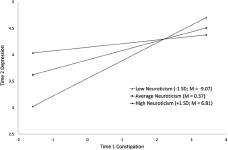
The relationship between Time 1 constipation and Time 2 depression was moderated by neuroticism (Table 3). For those low in neuroticism, higher levels of constipation at Time 1 was associated with greater of depression at Time 2 (Fig. 3). A similar, though weaker pattern emerged for those with average levels of neuroticism.
ESRD – significant interactions of neuroticism and ESAS-R symptom on subsequent depression.

Frailty
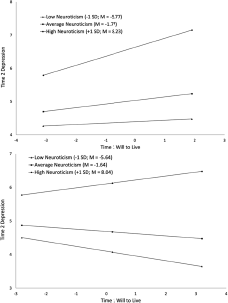
The relationship between Time 1 weakness and Time 2 depression was moderated by neuroticism (Table 3). At high levels of Time 1 weakness, those highest in neuroticism had Time 2 depression scores that were almost 3-points higher than those lowest in neuroticism (Fig. 4). Probing the interaction revealed that the positive relationship between neuroticism and weakness on subsequent depression was strongest at high levels of weakness (ß = 0.20, p = < 0.001, 95% CI [0.12, 0.29]), and weakest at low levels of weakness (ß = 0.09, p = < 0.001, 95% CI [−0.02, 0.20]). The interaction between Time 1 will to live and neuroticism and its relationship to Time 2 depression (Table 3) shows a strong positive slope for those with high neuroticism demonstrating that for highly neurotic individuals, greater will to live at Time 1 was associated with greater depression at Time 2 (Fig. 4).
Frailty – significant interactions of neuroticism and ESAS-R symptom on subsequent depression.

Discussion
To the best of our knowledge, this study is the first to examine neuroticism as a moderator between common illness symptoms and later depression in noncancer populations at the EOL. We found partial support for our hypothesis that the relationship between physical symptoms and depressive symptoms 3 months later is dependent on neuroticism in patients with ALS, COPD, ESRD, and frailty. Among these illness groups, there were both shared and unique ESAS-R symptoms that interacted with neuroticism to predict depression. Moreover, neuroticism tended to increase the likelihood of depressive symptoms for individuals reporting those physical symptoms most common or problematic to the specific illnesses and may be important in the development of psychopathology and poor coping in the context of illness-related symptom distress. Thus, these findings may be vital in understanding which patients at EOL are at risk for comorbid depression and the challenges it brings. This is made evident through examining the interaction of neuroticism with pervasive symptoms of each illness.
In patients with ALS, fatigue interacted with neuroticism to predict later depression. Fatigue was associated with clinically significant levels of depression only for those with above-average neuroticism. Given that fatigue is such a pervasive symptom in ALS (Jackson et al. Reference Jackson, McVey and Rudnicki2015), the ability to identify patients who may be at risk for later depression, as a function of neuroticism, is promising. The potential clinical significance of this finding is accentuated by the fact that lack of energy is one of the most impairing symptoms of depression (Fried et al. Reference Fried, Epskamp and Nesse2016; Fried and Nesse Reference Fried and Nesse2014). It is concerning that patients with ALS higher in neuroticism and fatigue are more likely to develop depression, which can further increase fatigue and limit energy. This fatigue alongside EOL depression may get in the way of a “good death” (e.g., limiting engagement in meaningful activities/life completion, important conversations; Chochinov Reference Chochinov, Portenoy and Bruera2003). Thus, screening patients with ALS at EOL who experience fatigue for high neuroticism may lead to early detection of those at risk for later depression and the subsequent, potentially exacerbated consequences of fatigue. This early detection may provide the opportunity for preventative care, allowing for these individuals to engage in activities that contribute to a “good death.” This finding is also consistent with research highlighting the overlap between symptoms of depression and chronic illness (Wilson-Genderson et al. Reference Wilson-Genderson, Heid and Pruchno2017), but is unique in that the longitudinal nature of the analysis elucidates directionality – that the fatigue is not simply a function of increased depression, but rather, in the context of high neuroticism, predicts it. A similar pattern is seen in those at EOL with COPD.
Excessive daytime sleepiness (drowsiness) is common in COPD (Enz et al. Reference Enz, Brighenti-Zogg and Steveling-Klein2016) and is one of the symptoms that interacted with neuroticism to predict later depression. There was a positive association between drowsiness and later depression in those high in neuroticism. Given that energy loss leads to severe impairment in those with depression (Fried et al. Reference Fried, Epskamp and Nesse2016; Fried and Nesse Reference Fried and Nesse2014) and that drowsiness and high neuroticism interacted to predict later depression in patients with COPD, this is clinically significant. This drowsiness, like fatigue in those with ALS, may lead to accentuated impairment if depression develops. Again, this finding points to the importance of screening those with this common symptom of COPD for high neuroticism in hopes of providing better EOL care.
Functional gastrointestinal symptoms are common in ESRD (Cano et al. Reference Cano, Neil and Kang2007; Gök et al. Reference Gök, Ýnci and Çoban2017). Constipation affects approximately one third of patients with ESRD and is highly associated with depression in some samples (So Yeon et al. Reference So Yeon, Min-Ok and Hyun-Ju2009). Gastrointestinal problems have been found to be one of the most central physical symptoms associated with depression in the general population (Fried et al. Reference Fried, Epskamp and Nesse2016). Our results suggest that while those high in neuroticism maintain relatively stable levels of depression, regardless of constipation severity, for those with moderate to low neuroticism, higher levels of constipation are associated with a significant increase in depression symptoms. Though this finding may seem counterintuitive, given the high occurrence of gastrointestinal issues in ESRD, individuals with this disease who are higher in neuroticism may have “adapted” to gastrointestinal symptoms so that their level of constipation is not a primary driver of their depressive symptoms. However, for those who are lower in neuroticism, the “insult” of a challenging symptom such as constipation may contribute to mood symptoms. It is also possible this finding reflects a Type 1 error. These types of nuances would be important to explore in future research and this outlier finding would benefit from replication. Research in other illnesses has demonstrated that in those with Parkinson’s disease, there was a bidirectional relationship between gastrointestinal symptoms and depressive symptoms (Jones et al. Reference Jones, Dominguez and Bunch2021). That is, for those with Parkinson’s disease, more severe gastrointestinal symptoms predicted more severe depressive symptoms, which in turn predicted more severe gastrointestinal symptoms in the following year. If this pattern were to emerge in those with ESRD, it may be important to screen those with gastrointestinal symptoms for depression to identify those who may be at risk for this negative symptom cycle that is so common with depression and chronic illness (Evans et al. Reference Evans, Charney and Lewis2005).
There has been a call for an understanding of moderators in the relationship between frailty and depression (Vaughan et al. Reference Vaughan, Corbin and Goveas2015), and our analysis revealed neuroticism is one such moderator. In our sample, there is preliminary evidence that weakness – a hallmark symptom of frailty – is associated differentially with later depression dependent on levels of neuroticism. At high levels of weakness, those higher in neuroticism had greater symptoms of depression than those lower in neuroticism. This suggests that neuroticism may play a key role in mood outcomes within the same symptom presentation, consistent with prior research (Enns and Cox Reference Enns and Cox1997; van Eeden et al. Reference van Eeden, van Hemert and Carlier2019). Additionally, an increased will to live at baseline was associated with increased depression symptoms at follow-up only for those higher in neuroticism. Individuals in the frail sample were the oldest of our 4 illness groups which may have provided them more prognostic awareness of their impending death (Carstensen Reference Carstensen2006). As such, a strong will to live in this group may be incompatible with reality, death acceptance, and making peace (Cicirelli Reference Cicirelli2003). Again, these findings provide insight into EOL care and highlight the importance of identifying those at risk for later depression. Patients higher in neuroticism with a strong will to live may benefit from interventions related to meaning making and acceptance to reduce existential distress and depression. Thus, for all 4 illness groups, neuroticism may interact with common symptoms of the respective illnesses in ways that highlight the importance of identifying those at risk for developing depression in providing effective EOL care.
The findings of this study must be viewed in the context of its strengths and limitations. In terms of strengths, the ability to examine the impact of symptom distress on depression longitudinally, as a function of neuroticism, in a diverse sample of participants at the EOL with noncancer illnesses, is an important contribution to the literature and allowed us to control for the effects of prior depression and medical symptoms on future development of depressive symptoms. Although the sample is relatively large, the power to detect moderation effects was nonetheless low, an extensively discussed challenge of moderated multiple regression (Aguinis Reference Aguinis1995). Despite being underpowered, we still found effect sizes related to the interaction terms that were small to medium, which suggests neuroticism meaningfully impacts the effect specific symptoms have on later depressive symptoms. This low power introduced further limitations as we ran multiple tests with a more liberal p-value, which inflates the possibility of Type I error. Future research with larger samples and more conservative p-values would help reinforce these findings and add further support to the suggestion that the relationship between specific illness-related symptom and depression could vary between individuals who are low versus high in neuroticism.
As this was secondary analysis, we were limited to use of single item predictors in the ESAS-R, which is not ideal in terms of thoroughly assessing symptom impact. However, given the common use of the ESAS-R across illnesses, both within our research sample and in clinical practice, it was appropriate for this preliminary investigation. Similarly, the HADS is not a diagnostic tool, though its strength is that it primarily avoids somatic symptoms of depression, which can confound accurate assessment in the medically ill (Olver and Hopwood Reference Olver and Hopwood2013; Zigmond and Snaith Reference Zigmond and Snaith1983). Future research might consider the use of comprehensive measures of 1 symptom, within 1 illness, with illness-specific mental health measures. Relatedly, use of the full NEO-PI-R (Costa Reference Costa1992) which includes sub-facets of neuroticism, may be particularly relevant to our research question and study populations. Finally, inclusion of a measure that specifically assesses coping (Carver Reference Carver1997) would have allowed for direct assessment of coping in itself and as a mediator of the relationship between neuroticism and depression.
Clinically, the present research adds to the small body of literature examining the importance of neuroticism in EOL experience (Bovero et al. Reference Bovero, Sedghi and Opezzo2018; Chochinov et al. Reference Chochinov, Kristjanson and Hack2006; Ghiggia et al. Reference Ghiggia, Pierotti and Tesio2021; Lattie et al. Reference Lattie, Asvat and Shivpuri2016). Our findings point to specific symptoms within illness groups, for which neuroticism may be a particularly important variable to consider in terms of monitoring risk of depressive symptoms. With respect to treatment implications, our findings provide preliminary evidence for specific groups of patients, unique to each illness, who may be targeted for early intervention both in terms of physical and psychological symptoms. As such, it may be useful to screen patients for neuroticism early in the illness trajectory.
Supplementary material
The supplementary material for this article can be found at https://doi.org/10.1017/S147895152300127X.
Funding
This work was supported by the CIHR Doctoral Research Award, Sir Gordon Wu Scholarship, and Centre on Aging. This research received no specific grant from any funding agency, commercial, or not-for profit sectors.
Competing interests
All authors declare none.


 Open access

