





Impact statement
The rise in mental health issues throughout India is concerning and despite availability of mental health services across the districts in the country; accessibility, stigma and lack of resources act as a constraint in availing these services. Barriers to traditional methods of counselling include privacy issues, higher costs and transport issues (Doss et al., Reference Doss, Feinberg, Rothman, Roddy and Comer2017; Ollerton, Reference Ollerton1995). In India, stigma and discrimination related to mental health issues prevent individuals from seeking help (Shetty, Reference Shetty2023). The number of rising cases, especially among young individuals, suggests a requirement for early intervention to be carried out across India to help reach people despite the constraints. Since the young population display an increased usage of the internet, making use of such activity to promote well-being of the individuals may help in bridging the gap between the receivers of mental health services and the individuals who seek it. Since the medium of the service deviates from the traditional face-to-face counselling provided, determining the well-being scores pre- and post-chat-based sessions across various problem areas, helps to determine whether the chat-based therapy has a positive effect on the well-being of the individuals. The lack of research carried out in such a context in India calls for a study to be carried out to determine the impact levels of the synchronous online chat-based counselling offered. It was found that the chat-based counselling increased the well-being of clients who availed the service and further, duration and gender influenced the impact on well-being levels regardless of the problem area faced by the clients. Such a service can be offered to a larger population across several problem areas faced by the individuals.
Internet chat-based intervention as a mode for therapy and counselling
Background
India is a diverse and culturally rich country with strong religious, linguistic and traditional roots. As a developing country with substantial contributions to research, technology, infrastructure and healthcare, the country faces a challenge in the area of mental health.
The accessibility of mental health services in India, especially in terms of reachability, is an area needing significant improvement. Despite India being one of the first countries to adopt a standard health system for mental healthcare, individuals have to travel for about 10 km to avail services from the District Mental Health Program (NMHS, 2016). This programme was established to decentralize mental health services by offering them at a community level. By integrating both mental health and the general healthcare delivery system (Singh, Reference Singh2018), it aimed to improve accessibility and promote self-help in the community. While it has been successful in offering mental healthcare at a district level, providing the same beyond the district level has been a challenge (Singh, Reference Singh2018).
Further, there also exists a shortage of mental health professionals, with the professionals-to-population ratio being low. The number of mental healthcare workers ranges from 0.05 in Madhya Pradesh to 1.2 in Kerala for a population of hundred thousand (Reference Gururaj, Varghese, Benegal, Rao, Pathak and SinghGururaj et al., 2016, as cited in Singh, Reference Singh2018). There are only 0.75 psychiatrists available for 100,000 people in India (Sandhu, Reference Sandhu2020), and the number of registered practicing clinical psychologists in India is staggeringly low (Chakrapani and Bharat, Reference Chakrapani and Bharat2023). Around 10% of the population in India requires mental health treatment; however, many of those who need mental health support in India remain untreated. The recent reports indicate a treatment gap of 83% for any mental health disorder prior to the COVID-19 pandemic. The number of people and areas to be covered demands an alternate approach that complements the existing system to effectively treat individuals in need of therapy and counselling (Singh & Sagar, Reference Singh and Sagar2022).
India consists of 1.4 billion people, making it the highest populated country. Mental health problems are said to be one of the most common problems faced by young adults (Jurewicz, Reference Jurewicz2015), and around 65% of the population falls below 35 years of age in India (Deo, Reference Deo2023). Depression and anxiety are the most common mental health issues faced by the population (WHO, 2022), and a recent report states that more than 50% of the youth in India have poor mental health (Pradeep, Reference Pradeep2023). Out of a large number of populations requiring help, only 7.8% of youth report mental illness (Gaiha et al., Reference Gaiha, Taylor Salisbury, Koschorke, Raman and Petticrew2020).
India is a vast country, with around 65% of the population residing in rural regions (PIB, 2023). This makes accessibility and reachability a challenge for implementation from the systems perspective and the availability of mental health services to the public. Further opportunities, lifestyle, social structures, health belief systems and help-seeking behaviour differ between urban and rural areas, indicating a divide (Gupta, Reference Gupta2024). Reduced education, awareness and infrastructure in rural areas are a few areas that make it challenging to provide mental health services (Iyer et al., Reference Iyer, Gupta, Sapre, Pawar, Gala, Kapoor, Kalahasthi, Ticku, Kulkarni and Iyer2023). Stigma towards mental health issues in rural areas is more visible in comparison to urban areas (Gupta, Reference Gupta2024), and the reasons for stigma range from diverse cultural beliefs, socioeconomic status, access to healthcare and awareness (CHP 2 Depression Group et al., Reference Guttikonda, Shajan, Hephzibah, Jones, Susanna, Neethu, Poornima, Jala, Arputharaj, John, Natta, Fernandes, Jeyapaul, Jamkhandi, Prashanth and Oommen2019; Trani et al., Reference Trani, Bakhshi, Kuhlberg, Narayanan, Venkataraman, Mishra, Groce, Jadhav and Deshpande2014; Zeiger et al., Reference Zieger, Mungee, Schomerus, Ta, Dettling and Angermeyer2016). Mental health literacy can significantly improve awareness and aid in facilitating an improved attitude towards therapy. Recognition of symptoms helps the individual and the ones around them to approach help. A study carried out in South India found that less than one-third of the participants in their adolescent ages could recognize depression, while only 1.31% could recognize schizophrenia, while around 30.68% of the participants would not prefer to seek help for mental health issues (Ogorchukwu et al., Reference Ogorchukwu, Sekaran, Nair and Ashok2016) suggesting that awareness acts as a significant barrier.
Arahanthabailu (Reference Arahanthabailu, Praharaj, Purohith, Yesodharan, Rege and Appaji2024) highlights that affordability, geographical disparity, accessibility and lack of insurance coverage act as a barrier to seeking help. Larger families consist of individuals belonging to different generations, and mental illnesses such as depression are more likely to be stigmatized among the older generation (Baral et al., Reference Baral, Prasad and Raghuvamshi2022). Further, a large number of working populations in metropolitan cities prefer to stay in paying guest (PG’s) rooms. People who stay in these PGs often share rooms, making privacy or self-isolation a problematic task (The Hindu, 2020). Discreet counselling helps maintain anonymity while seeking help, especially when privacy is challenged in shared spaces. Stressors at the workplace seem to be a relevant contributing factor to well-being and mental health issues among the working population, and mental health problems increase dropout and sick leaves (Rajgopal, Reference Rajgopal2010). Moreover, mental health problems among employees cause ill health and increased sick leaves (NICE, 2009, as cited in Hitt et al., Reference Hitt, Tahir, Davies, Delahay and Kelson2018).
Limited resources, financial and time constraints and fear of disclosure due to the present stigma (Clement et al., Reference Clement, Schauman, Graham, Maggioni, Evans-Lacko, Bezborodovs, Morgan, Rüsch, Brown and Thornicroft2015; Salaheddin and Mason, Reference Salaheddin and Mason2016) act as barriers. The Indian culture encourages children or youth to stay with their parents until they get married (Bhowmick, Reference Bhowmick2010), which means that most of the youth in India share spaces with one or more family members. Negative attitudes of parents towards mental health affect the children (Ferrie et al., Reference Ferrie, Miller and Hunter2020, as cited in Ramiro et al., Reference Ramiro, Dominguez and Sanguino2024). The prevalence of mental health issues among college students may be attributed to issues such as failing to recognize or accept (denial) mental health symptoms and/or receiving insufficient care.
Online or web-based counselling has been gaining popularity all over the world for its ease of use, access and reachability. Counselling through an online mode has several advantages that are exclusive of what is found in offline counselling. It prioritizes the comfort of the clients and provides autonomy experienced from remaining anonymous over the Internet (Chan, Reference Chan2020). Further costs relating to transportation, such as parking hassles, can be avoided while going through using technology for treatment (Doss et al., Reference Doss, Feinberg, Rothman, Roddy and Comer2017). When it comes to working professionals or corporate employees who work for a fixed number of hours a day, catering to their well-being during their day-to-day life during work hours would not be possible. In such cases, online counselling is convenient, and the same applies to college students, where the majority of Indian college students are occupied at the institute for the whole day throughout the week. The young population of India has been active with the usage of the internet and smartphones, and around 759 million Indians access the internet at least once a month, out of which 399 million reside in rural areas (Majumdar, Reference Majumdar2023). The increased internet usage across the country has developed the potential to reach individuals in need of mental healthcare. Miller and Sonderland’s (Reference Miller and Sønderlund2010) research states that web-based interventions are easily accessible and provide a favourable cost–benefit outcome to individuals (Curry, Reference Curry2007).
Online synchronous chat session is defined as real-time, text-based, one-to-one chat with a mental health professional and/or a trained volunteer (Tibbs et al., Reference Tibbs, O’Reilly, Dwan O’Reilly and Fitzgerald2022). Synchronous sessions bridge the gap by meeting clients halfway and providing therapy with ease of use on a modern platform. Young individuals are often hesitant to seek help due to availability or access to services appropriate to the areas or issues faced (Eckert et al., Reference Eckert, Efe, Guenthner, Baldofski, Kuehne, Wundrack, Thomas, Saee, Kohls and Rummel-Kluge2022), along with the barriers present in an Indian context. Leveraging the access of technology to utilize these services would make a positive difference. Research states that there is no significant difference found between online chat and face-to-face counselling and that young people gain from a single session of chat counselling (Dowling and Rickwood, Reference Dowling and Rickwood2013). Text-based mental health services have been proven to be effective in treating mental health conditions, and a single session is said to reduce anxiety to a similar degree as traditional face-to-face counselling (Dwyer et al., Reference Dwyer, de Almeida Neto, Estival, Li, Lam-Cassettari and Antoniou2021). The anonymity of the clients is highly prioritized. In an age where technology is advancing rapidly and numerous digital therapy platforms have emerged, sessions with experts in a synchronous domain, following a mixture of technology and traditional therapy, help individuals seeking help (Balasinorwala et al., Reference Balasinorwala, Shah, Chatterjee, Kale and Matcheswalla2014).
Cognitive behavioural therapy (CBT) is known to help with negative self-talk and helps in developing problem-solving and coping skills, thereby improving their overall academic performance (Kumar and Sebastian, Reference Kumar and Sebastian2011). CBT treatment among the working population has helped in achieving significant positive results on their mental health (Ojala et al., Reference Ojala, Nygård, Huhtala, Bohle and Nikkari2018). An internet-based CBT self-guided program in the US showed lower work absence compared to in-person or telephone counselling; however, productivity levels were similar in nature (Attridge, Reference Attridge2020). Most of the studies on online counselling highlight the role of CBT in counselling, while very few interventions utilize therapies, such as motivation theory or problem-solving therapy. CBT has been used to help individuals deal and cope with problems ranging from self-improvement to problems that are psychiatric in nature. Studies state that there has been sufficient evidence to prove that the CBT approach is as powerful or more effective compared to other forms of psychological therapy and psychiatric medicines, and its usefulness extends to psychological and physical conditions and behavioural problems among individuals (APA, 2017; Nakao et al., Reference Nakao, Shirotsuki and Sugaya2021). In this form of therapy, the therapist enables the client to identify, evaluate and change one’s perception and cognition, which helps improve the mood and the behaviour (Gaudino, Reference Gaudiano2008). Internet-based CBT research highlights that the concerns faced by individuals are mostly psychological (Eckert et al., Reference Eckert, Efe, Guenthner, Baldofski, Kuehne, Wundrack, Thomas, Saee, Kohls and Rummel-Kluge2022) in nature, and most of the research in this domain focuses on psychological and psychiatric disorders (Johansson and Andersoson, Reference Johansson and Andersson2012; Kiropoulos et al., Reference Kiropoulos, Klein, Austin, Gilson, Pier, Mitchell and Ciechomski2008; Klein et al., Reference Klein, Mitchell, Gilson, Shandley, Austin, Kiropoulos, Abbott and Cannard2009; Kumar et al., Reference Kumar, Sattar, Bseiso, Khan and Rutkofsky2017; Webb et al., Reference Webb, Rosso and Rauch2017; Zerwas et al., Reference Zerwas, Watson, Hofmeier, Levine, Hamer, Crosby, Runfola, Peat, Shapiro, Zimmer, Moessner, Kordy, Marcus and Bulik2016).
In an Indian context, studies have not been carried out to determine the impact of chat-based online therapy. Further, a comparative study has not been conducted based on the intervention’s outcome among college students and corporate employees. Western research highlights that individuals who reach out for therapy primarily seek services for psychiatric symptoms and that there exist no conclusive results between gender and the well-being of the individuals (Hasan, Reference Hasan2019; Matud et al., Reference Matud, Bethencourt, Ibáñez, Fortes and Díaz2021). A study comparing the outcomes of online synchronous chat-based counselling and telephonic counselling among young individuals found the former to be more effective (Fukknik and Hermanns, Reference Fukkink and Hermanns2009, as cited in Tibbs et al., Reference Tibbs, O’Reilly, Dwan O’Reilly and Fitzgerald2022). The present study uncovers the impact of chat-based therapy by analysing the clients’ well-being before and after the sessions synchronously. The program was carried out with the aim to improve access to therapy. The data collected from the intervention program was used to carry out a retrospective analysis. The intervention involves CBT as a mode of treatment. CBT has been the primary mode of therapy followed as clients well receive it and can be modified along with other therapies based on the session’s needs. Our study takes diverse genders into consideration, along with males and females, to determine the variation in the impact of the treatment.
Further, most research papers focus on video conferencing or blended treatment. Our study focuses on the intervention’s satisfaction and effect on well-being after a complete synchronous chat-based session. This helps to understand whether the current intervention program is feasible for individuals across seven problem categories. Most of the studies focus on psychological disorders or issues that are psychiatric in nature; our study takes self-improvement and specific issues, such as relationships, into consideration. The approach used is tailored according to the goals of the individual which is bounded by CBT.
The study aims to determine whether the type of organization, duration and gender have an association with subjective unit of well-being (SUW) and satisfaction scores, along with determining the impact on change in well-being post-intervention. College students and corporate employees were targeted as a part of the intervention programme as joint efforts with institutions would help reach a large number of individuals who want to seek therapy.
Hypotheses
H1: The SUW scores will be higher among the total sample post intervention.
H2: Gender of the participants will influence the SUW and satisfaction levels among the population.
H3: The impact on SUW and satisfaction levels has a relation with duration of session.
Materials and method
Intervention
The intervention involved sessions on a single session basis which were synchronous in nature with an average duration of 41.60 min. The sessions mainly followed CBT along with other therapies depending on individual cases. Problem areas, such as Relationships, Career/Academics, Abuse and Discrimination, Self-improvement, Psychological Disorders, LGBTQAI+ and Sexual Well-being, were reported to the counsellors by the participants prior to the sessions. The option to chat instantly with an available therapist or schedule an appointment based on problem area and availability was provided to the individuals. The therapists and counsellors, termed as experts, had a minimum qualification of master’s degree in Psychology or Counselling. These counsellors were assigned based on availability and problem areas of the clients. As a part of their induction program, the counsellors were trained to provide counselling through chat-based mode. Further, to make sure that the counsellors stay up to date on the treatment procedures and counselling techniques, periodic training was offered across all problem areas. Every new counsellor was supervised by an individual mentor on a weekly basis. The assigned mentor was tasked with going through the chats and providing feedback. The satisfaction levels of the clients post session were also taken into consideration. Upon completing 3 months with the platform, supervision was carried out fortnightly. Training was provided to all psychologists every week in a group setting and these trained group of counsellors provided therapy for 1 year.
Two therapy options were made available to the participants – chatting instantly and scheduling an appointment mainly followed the CBT framework. Prior to the session the SUW, and satisfaction levels were self-reported by the clients through a Likert scale, and data, such as age, organization type (college or workplace) and gender, were recorded from registration portal.
Design
The study used a retrospective cohort evaluation of chat-based counselling intervention where pre and post results were analysed. The data were collected routinely for a period of 1 year, from 10 October 2022 to 10 October 2023.
Data collection
Organizations carried out programmes for mental health and well-being, including orientations and several other programmes. YourDost reference was provided to college students and employees. The posters printed out by organizations were put up in cafeterias and halls to enhance reachability. The therapy sessions were conducted over YourDost platform where the individuals wanting to avail counselling register under an anonymous name. Consent was obtained during the registration of the clients on the platform.
Measures
One item, 11-point Likert scale ranging from 0 to 10, was used to record the SUW prior to the intervention and post intervention to ascertain the well-being levels. A single question pre and post session – “Rate your Wellness levels on a scale of 0 to 10” was asked to the participants.
Problem area was collected through a drop-down list prior to booking the session. Ratings or satisfaction with the session was collected post session on a 5-point Likert scale. The question consisted of a single item “On a Scale of 1 to 5 rate how well you are satisfied with the session.”
Data analysis and criteria
Data was analysed with the usage of Jamovi and Microsoft excel. The inclusion criteria for the study involved population from two organization types: college students who were above 17 years of age and working individuals who were above 18 years of age. The exclusion criteria involved individuals who did not rate their SUW before and after sessions, satisfaction levels and who did not report a problem area. Tests were carried out to determine the relation as well as associations. Since the data were not normally distributed, non-parametric equivalents were used.
Results
The study was conducted for a period of 1 year between 10 October 2022 and 10 October 2023. The sample is a subset of 50,127 college students and corporate employees who had completed data on all parameters measured; 3429 clients were selected after excluding the clients who had provided incomplete data. Out of 50,127 individuals, 4752 provided the SUW scores; 781 individuals did not mention the problem area, 547 individuals did not mention the age and gender wasn’t mentioned for 21 individuals. Some of the missing parameters overlapped and individuals did not answer more than one area. Eight individuals were excluded for providing inconsistent data based on age and organization type.
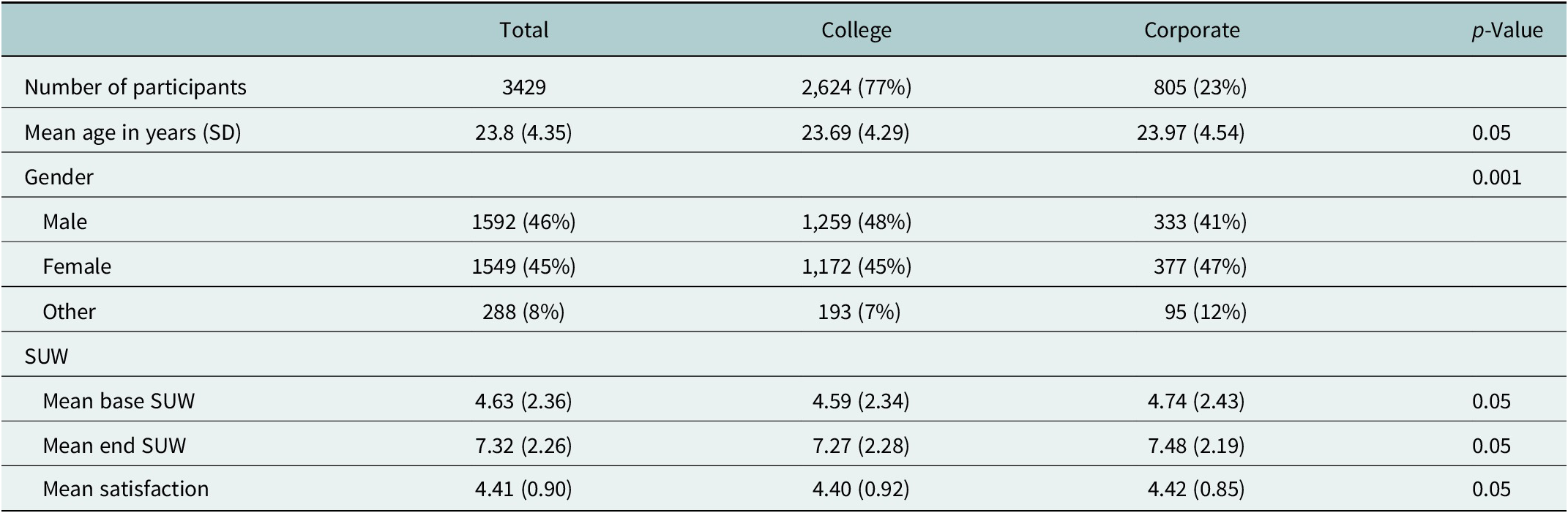
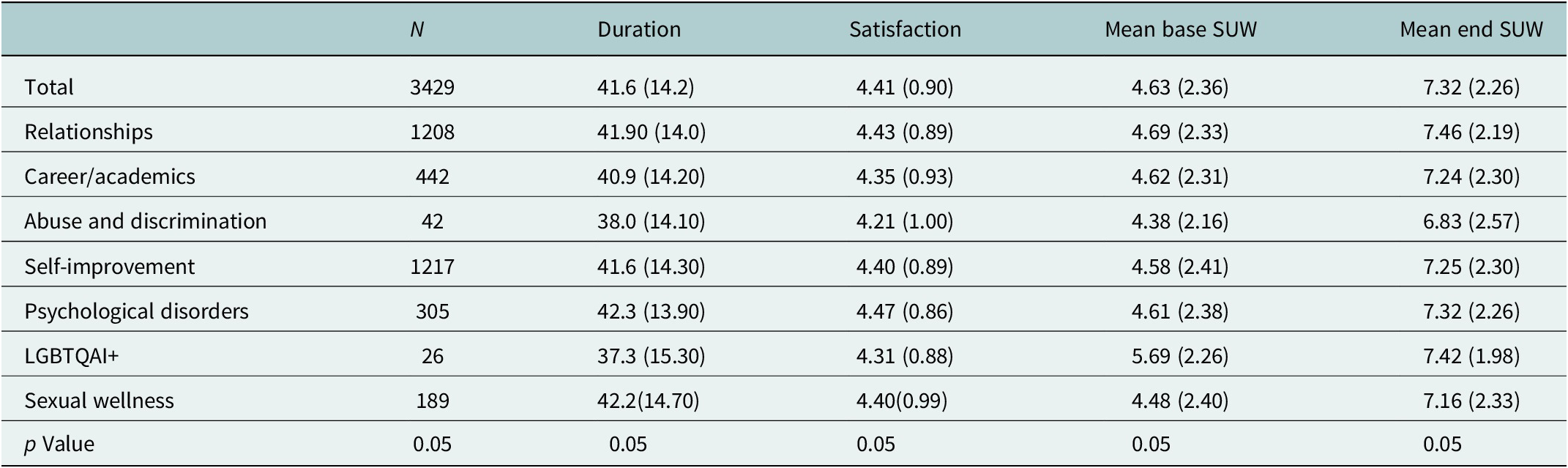
From the sample, 2624 (77%) of the clients were college students and 805 (23%) of the clients were corporate employees as displayed in Table 1. The mean (SD) age of all the clients, including the college and corporate employees, was M = 23.76 (SD = 4.35). The clients reported problems, which were broadly categorised into seven areas, mentioned in Table 5. The majority of the clients received counselling for relationships (35%, N = 1,208) and Self-improvement (35%, N = 1,217). The demographic characteristics of the clients are provided in the tables.
Sociodemographic characteristics based on organization type and other variables

H1: The SUW scores will be higher among the total sample post intervention
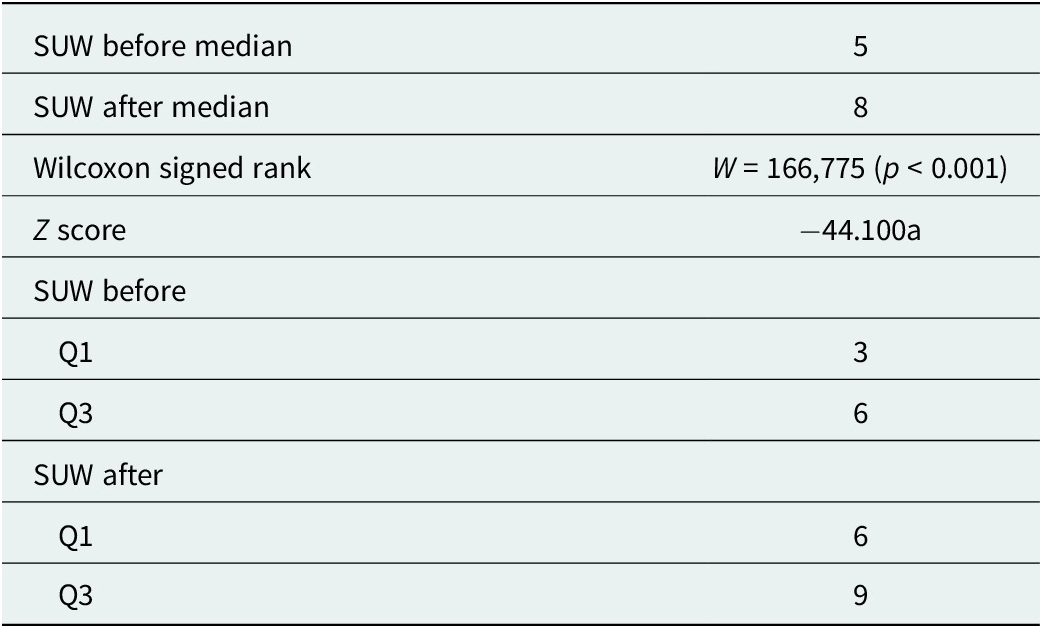
The mean and median of SUW displayed in Table 2 and 4 is 4.63 and 5 before the intervention while post intervention mean and median is 7.32 and 8. Wilcoxon signed rank test indicates significant results with the W = 166,775 (p < 0.001) and an effect size of −0.926, suggesting significant difference in SUW scores post intervention. The organization type did not exhibit association with the base scores however, significant association (p < 0.05, η2 = 0.00125, χ2 = 4.287) was observed with the SUW end scores through a Kruskal–Wallis test. The end mean SUW was higher for corporate employees M = 7.48(2.19) compared to college students M = 7.27(2.28) as seen in table 2. The SUW post intervention was higher across all problem areas.
Sociodemographic characteristics based on gender and other variables

H2: Gender of the participants will influence the SUW and satisfaction levels among the population
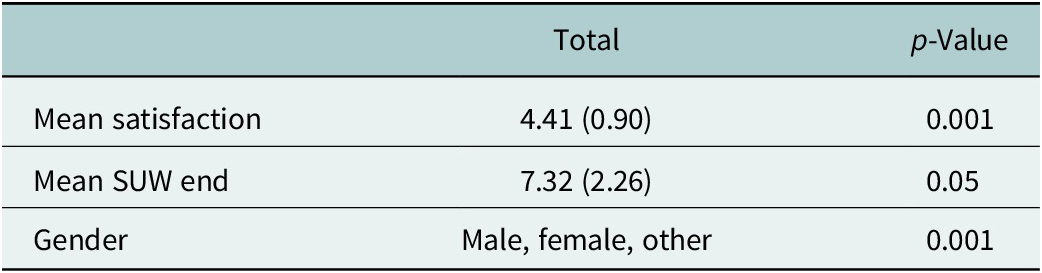
The satisfaction levels had a significant association with gender of the population (p < 0.001, η2 = 0.00505, χ2 = 17.32) (supplementary material: Gender and associations). The Kruskal–Wallis test revealed that gender was associated with both baseline SUW (p < 0.001, η2 = 0.00931, χ2 = 31.92) and endline SUW scores (p < 0.05, 0.00273, χ2 = 9.36) (supplementary material: Gender and associations). The mean SUW post-intervention displayed higher mean for male group M = 7.41(2.31), lower for female group M = 7.26(2.19) and the least for diverse gender group 7.19(2.33). The satisfaction levels remained similar for male and female population M = 4.42(0.90) and 4.42(0.88) while diverse population had lower mean satisfaction 4.23(0.96).
H3: The impact on SUW and satisfaction levels have a relation with duration of session
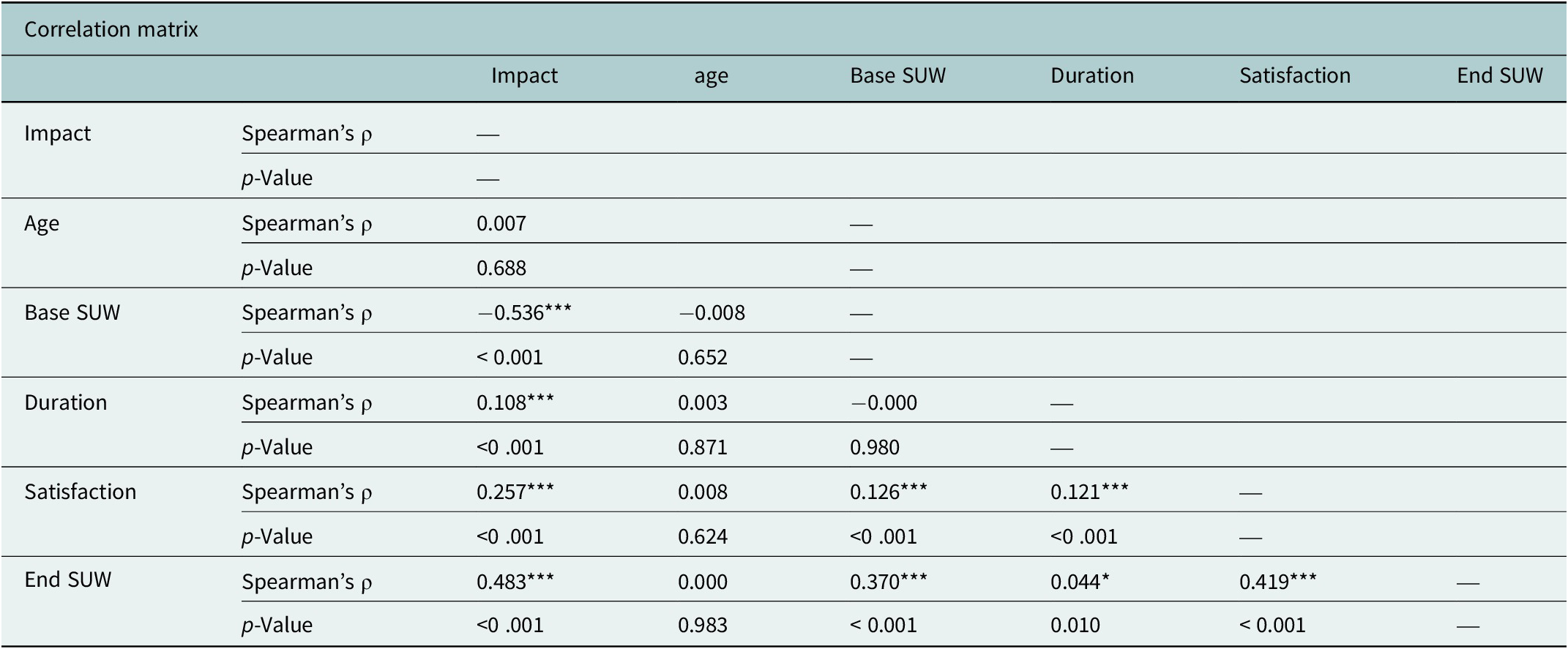
The mean satisfaction level is 4.41 while the end line mean SUW is 7.32, as displayed in Table 3. The ratings (satisfaction levels) provided by the participants displayed positive correlation between impact (p < 0.001, r = 0.257) and duration of the sessions (p < 0.001, r = 0.121) as shown in Table 6. These satisfaction levels were determined on the basis of clients’ ratings provided to the sessions. Impact scores displayed in Table 4 were calculated as the difference between base SUW and end SUW. The duration and impact had a positive correlation of (p < 0.001, r = 0.108).
Sociodemographic characteristics based on duration and other variables

Table displaying SUW

Sociodemographic characteristics based on problem category and other variables

Table displaying correlation between Impact and other variables

Note: *p < 0.05, **p < 0.01, ***p < 0.001.
Other results
The mean (SD) of base SUW for males was M = 4.87 (SD = 2.45), females was M = 4.42 (SD = 2.24) and M = 4.38 (SD = 2.38) for diverse population. The chi-squared test between organization (college and corporate) and gender suggests that there is strong association (p < 0.001, χ2 = 20.9) ( supplementary material: Chi-Square Test) between the two variables however the population identifying as “other” under the gender category is observed to be higher (3.33) under corporate, while the observed value for college category (−1.84) seems to be less than expected. Despite the strong association between gender and organization, the Cramer’s V test suggests a weak association between these two variables (0.0782). Further, the observed male population for corporate seem to be significantly lower than expected (−2.11).
Discussion
The higher SUW scores post intervention demonstrates that the chat-based intervention had a positive effect on well-being of the participants. The gender of the participants influences SUW and satisfaction levels. It was found that the mean satisfaction levels between males and females remained similar between these two groups, while the diverse population displayed lower satisfaction levels. The mean SUW was recorded to be lower for women and diverse populations overall. This goes in line with the study carried out stating that women tend to display reduced subjective well-being when compared to men (Tesch-Römer et al., Reference Tesch-Römer, Motel-Klingebiel and Tomasik2008), and the diverse population experiences reduced subjective well-being due to discrimination (Conlin et al., Reference Conlin, Douglass and Ouch2019).
The impact levels (difference between the SUW pre and post) showed significant associations with gender. The male population displayed lower impact compared to the diverse population. The male population in comparison to the female population displayed a significant association. The female population had higher impact levels compared to males, and the comparison between females and diverse populations displayed no significant difference. As the results are promising in terms of impact on SUW, the counselling sessions provided seems impactful and can be helpful if carried out on broader areas. Regardless of the type of problem faced, the well-being was noted to be higher post intervention suggesting that online chat mode of counselling using CBT can be made applicable throughout all problem areas. Past research has proven CBT to be effective in case of chat-based and video-based counselling. This result also goes in line with the study carried out by Bani et al. (2020) and Cooper (Reference Cooper2009) which speaks about the improvement in wellness among students post counselling. The students experience significant reduction in distress among the individuals who completed the interventions (Bani et al., Reference Bani, Zorzi, Corrias and Strepparava2022). In this study, we see that duration and impact levels had a positive relation suggesting that higher the duration higher the impact on subjective well-being experienced by the population. The study conducted by Dowling and Rickwood (Reference Dowling and Rickwood2014) suggests that chat-based counselling was more impactful among individuals who took a higher number of sessions, and Freedman et al. (Reference Freedman, Hoffenberg, Vorus and Frosch1999) states that duration has a significant relationship with the patient’s satisfaction levels. Our study goes in line with the narrative that longer the time spent with the therapist higher the level of impact in well-being of the clients.
It is possible that younger individuals are more predisposed towards availing online resources to support emotional and mental well-being, which is in line with the research carried out by Pretorius et al. (Reference Pretorius, Chambers, Cowan and Coyle2019) stating that accessibility of internet is helpful and made use of by young individuals (Power et al., Reference Power, Hughes, Cotter and Cannon2020; Pretorius et al. (Reference Pretorius, Chambers, Cowan and Coyle2019). Further, mental health is categorized as one of the common problems faced by young adults (Jurewicz, Reference Jurewicz2015).
Research shows that help-seeking behaviour is less common among adults within the age group of 18–24. However, this age group happens to be active with internet usage (Mitchell et al., Reference Mitchell, McMillan and Hagan2017). Stigma and anonymity may be an issue while seeking help therefore online tools such as chat may influence help-seeking behaviour. In the current study, the sessions were offered free. However, it is observed that chat sessions are provided at a reduced rate in comparison to video calls, therefore increasing the cost-effectiveness while seeking treatment. Further, the anonymity present through chat-based therapy sounds encouraging to individuals who worry about the stigma associated with seeking mental healthcare.
The experts carrying out the intervention were trained psychologists and counsellors who could either be selected by the individual or be assigned based on availability and problem areas faced. The mean satisfaction level suggests that the individuals were content with the sessions. It was also noticed that base SUW levels had significant negative correlation with the impact levels suggesting a possibility that individuals who had a higher well-being score prior to the intervention might have found the session to be ineffective. Majority of the clients availed counselling for relationship issues and self-improvement regardless of college and corporate employees, suggesting that organization type may not play a prominent role in narrowing down the type of problems faced. Further, the gender of the clients had an association with the impact levels, and it was found that comparisons between males and females were significant.
This mode of therapy helps the clients come up with goals and work through faulty perceptions, which ultimately uplifts their mood and adds to their well-being. Improving well-being for both college students and corporate employees is highly helpful, given that both fields involve specific goals that have to be achieved in the institute or organizations. Improving well-being increases the ability of the individuals to better deal with emotions and reduces the susceptibility towards mental health disorders (Cloninger, Reference Cloninger2007). Further, the educational experience of the psychologists and the training they receive help to facilitate smoother and more effective sessions among clients from various backgrounds. The flexibility and the accessibility of the platform enhance help-seeking behaviour, thus improving the mental health of individuals in need. The client has the autonomy and flexibility to proceed with the therapist of their choice, and if not, the assigning of the therapist takes place after the client approves it. This helps in making sure that the client is comfortable throughout the therapy process.
Since the study used limited items and non-standardized scales to determine the well-being pre and post intervention, one may not be able to generalize the results. Given that individuals voluntarily sought counselling, the study was primarily focused on a natural and realistic setting. Furthermore, because the purpose was to help the participants, having shorter questions to provide an understanding of weather they were helped while preventing response burden was the intention. The team of experts being diverse and qualified in the problem categories mentioned adds to the comfort and satisfaction of the individuals seeking help. In cases where the individual was found to engage in self-harm or carrying out extreme steps, references of psychiatrists were provided.
The study predominantly highlights that the online chat-based intervention has been successful in improving the well-being post session regardless of the problem area faced by the individuals. Improving accessibility while ascertaining confidentiality helps in promoting mental healthcare while tackling stigma toward mental health. In an Indian context, mental health must be given the priority that it requires. Therefore, making use of technology along with models of therapy can help in bringing out necessary changes to better understand and address mental health issues in the country.
Future directions and limitations
In the future, it would be helpful to make use of standardised tools to facilitate broader usage of chat-based counselling. As the study did not have a comparison group, its impact levels may be questioned. The nature of the study and its retrospective methodology limit improvisation of the study in its present form. Future studies may take control groups into account in order to measure effectiveness of the interventions. Further, following up to determine the SUW after a few weeks would help in strengthening the study. The use of CBT from an online counselling lens has been gaining momentum; however, it is understood the college students and corporate employees have access to gadgets and devices. If the study is expanded to cover a bigger population, it would be helpful to understand its accessibility among populations who are not very well versed with technology. Carrying out comparative studies between different modes of counselling including chat-based counselling in India will help towards contributing to the field.
Open peer review
To view the open peer review materials for this article, please visit http://doi.org/10.1017/gmh.2024.151.
Supplementary material
The supplementary material for this article can be found at http://doi.org/10.1017/gmh.2024.151.
Availability of data and materials
Data will be available on request. J.K.G. and P.M. designed the study and supervised data collection. J.K.G. and M.R. conducted the data analysis. The manuscript was prepared by J.K.G. and M.R. All authors have read the manuscript and revised drafts and approved the final submission. All authors are accountable for all aspects of the work in ensuring that questions related to accuracy or integrity of any part of the work are appropriately investigated and resolved.
Funding statement
No funding was received for the study.
Competing interest
The study does not report any conflict of interest.
Ethics statement
The study has been approved by the Internal Ethics Committee of YourDost. Consent was obtained from the participants prior to carrying out the study. Anonymity was maintained throughout and no identifying information was used for the analysis.
Appendix
Questions relating to the SUW and satisfaction:
-
(1) Rate your Wellness levels on a scale of 0 to 10
-
(2) (After Intervention) Rate your wellness levels on a scale of 0 to 10.
-
(3) On a Scale of 1–5 rate how well you are satisfied with the session



 Open access


Comments
No accompanying comment.