




Introduction
Childbirth has been described as a significant life event involving interconnected psychological and physiological processes, influenced by various social, environmental, and policy factors Reference Leinweber, Fontein-Kuipers and Karlsdottir1 . Positive childbirth experiences were linked to improved maternal adjustment and reduced postnatal depression, boosting a woman’s self-confidence later in life Reference Leinweber, Fontein-Kuipers and Karlsdottir1 .
While there has been extensive research on the epigenetic effects of the prenatal and early postnatal periods Reference Dieckmann and Czamara2 on health, the impact of the intrapartum period (labour and birth) has remained largely unexplored.
This brief but crucial time is believed to be a formative phase for the human epigenome Reference Szyf3 . The Epigenetic Impact of Childbirth (EPIIC) hypothesis suggests that labour and birth induced positive stress, or eustress, on the foetus, affecting DNA methylation (DNAm) of specific genes related to immune responses, weight regulation, and tumour suppression Reference Dahlen, Kennedy and Anderson4 . On the other hand, hormonal abnormalities during labour could lead to foetal epigenetic anomalies, influencing gene expression and potentially causing health issues later in life Reference Dahlen, Kennedy and Anderson4 . Additionally, a mother’s psychological state during childbirth might affect this epigenome. Remodelling due to hormonal and neurotransmitter changes are linked to subjective experiences. While this is a hypothesis, research indicated that a mother’s subjective childbirth experience mediates the relationship between prepartum fear and postpartum bonding, emphasising the importance of a positive birth experience Reference Seefeld, Weise, Kopp, Knappe and Garthus-Niegel5 .
Childbirth experiences may influence long-term epigenetic changes in both mother and child, but the relationship is complex and requires further research to be fully understood. Therefore, this study aimed to explore the possible association between maternal birth experience (MBE) and infant DNA methylation after childbirth. Additionally, the study investigated the associations between MBE and breastfeeding, and MBE and mother-infant bonding since these aspects that are capable of influencing the health and development of infants Reference Kramer and Kakuma6 were found to be related to MBE in previous research Reference Bell, Andersson, Goding and Vonderheid7 .
Method
Description of avon longitudinal of parents and children cohort
The Avon Longitudinal Study of Parents and Children (ALSPAC) cohort regrouped 14,541 pregnancies (14,203 unique mothers) from Avon, UK with expected due dates between 1st April 1991 and 31st December 1992 Reference Boyd, Golding and Macleod8 . In total, 13,988 children were still alive at 1 year of age. Data about psychobiological factors, social, and environmental exposures were collected during pregnancy and follow-up assessments took place up to 18 years. The ALSPAC subcohort called ARIES (Accessible Resource for Integrated Epigenomic Studies) which regrouped 1022 mother-children dyads provided blood sample collection that allowed genome-wide DNAm profiling. Ethical approval was obtained from the ALSPAC Ethics and Law Committee and the Local Research Ethics Committees and included appropriate permissions from the Human Development Biology Resource, Newcastle Brain Tissue Resource and Leiden University Medical Centre Reference Fraser, Macdonald-Wallis and Tilling9,Reference Relton, Gaunt, McArdle and Ho10 . After quality control and data cleaning, the number of participants who were included were as follows: newborn = (813), at 7 years (n = 876), and at 15 years (n = 874).
Measures
DNAm: Genome wide methylation profiles of children were assessed using the Illumina Infinium HumanMethylation450K BeadChip. Offsprings’ genomic DNA was extracted from cord blood collected immediately after birth and from peripheral blood collected at age 7 and 15 years Reference Fraser, Macdonald-Wallis and Tilling9,Reference Relton, Gaunt, McArdle and Ho10 . Methylation data pre-processing such as post hoc Houseman correction for cellular heterogeneity Reference Richmond, Simpkin and Woodward11 was performed by the ARIES project team at the University of Bristol Reference Touleimat and Tost12 . In addition, a cell-type corrected post-normalisation data was conducted, as well as the removal of “failing” samples Reference Richmond, Simpkin and Woodward11 . Betas values measuring the ratio of methylated probes intensity to total intensity were used for further investigation.
Mother-infant bonding: Mother-infant bonding was measured at eight months postpartum from the “Looking after a baby” questionnaire 13 . The questionnaire included two subscales regarding maternal enjoyment of the baby and maternal confidence respectively defined as “I really enjoy my baby” and “I feel confident with my baby.” Eleven items about maternal feelings were assessed as “This is exactly how I feel,” “This is often how I feel,” “This is how I sometimes feel,” or “I never feel this way.” In total, a maximum score of 44 was generated where higher scores represented higher mother-infant bonding Reference Thomson, Allely and Purves14 .
Maternal birth experience (MBE): MBE was measured at eight weeks postpartum from the “Me and my baby” questionnaire 15 , based on a series of questions related to mothers’ experience of labour and delivery. In particular, eight binary indicators were derived based on the following variables: Labour score (e009), Feelings during delivery (e011), Control over doctor and midwives in labour (e012), Feelings about asking for help in labour (e013), Alone during labour (e060, e062, e064), Alone during delivery (e061, e063, e065), Feelings about many staff during labour (e071), and Found birth a wonderful experience (e080). Details about each variable were described in supplementary materials. Based on the binary indicators of poor maternal experiences around delivery described above, an MBE score was then defined based on the experience of at least one of the events above. For robustness, alternative cut-offs were additionally used to define poor MBE (i.e. at least two or at least three negative events).
Breastfeeding: In order to measure the duration of breastfeeding, the question kc404 “Duration of breastfeeding,” administered to mothers at child age 15 months, was used. The variable is categorical, coded as follows: “Never = 0”, “Less than 3 months = 1,” “3 to 5 months = 2,” “6 or more months = 3.”
Maternal alcohol consumption: A new variable was created by dichotomising the event of maternal drinking during pregnancy, based on their self-reported consumption at different stages of the pregnancy (variables b721, b722 and e220). The new binary variable was built to be equal to one if the mother reported drinking at least one glass per week at any point during the pregnancy and zero otherwise.
Statistical analysis
All analyses were performed in R (version 4.1.1 R Core Team, 2020) on R studio (version 4.3.0 R Core Team 2022). “Dplyr” (version 1.0.7) and “smjics” (version 2.8.7) were used for data cleaning. Associations between MBE and indicators of the mother-child closeness (namely, breastfeeding and mother-infant bonding score) were tested in a linear regression framework. Ordinary Least Squares regression (OLS) estimates of the relationship were derived using the “regress” command on Stata 17.
To investigate the epigenetic implication of MBE on children’s genome, a case-control epigenome-wide association study (EWAS) approach was used, highlighting CpGs associated with exposure. Differences in methylation across regions/sites were examined as described below. Normalised and corrected beta values were used with a detection p value <0.01. R “Minfi” (Version 1.46) and “DMRcate” (Version 2.14.0) packages were used to extract significantly associated CpGs and information from differential methylated regions with gene positions Reference Peters, Buckley and Statham16 . “Dplyr” (version 1.1.2), was used to extract probes statistics. For each time point, EWAS models tested associations between differentially methylated regions and maternal birth experience (i.e., feelings during delivery (e011 variable) and MBE score). Statistical models were adjusted for several covariates: maternal smoking Reference Richmond, Simpkin and Woodward11 during the last two months of pregnancy, declared gestational week at birth Reference Merid, Novoloaca and Sharp17 , maternal age at childbirth (calculated from entries at eight weeks postpartum) Reference Sharami, Kabodmehri and Hosseinzadeh18 , maternal alcohol consumption and batch effect. Maternal ethnicity and body mass index (BMI) were not included as covariates because of the lack of information on ethnicity (98.7% white) and missing values (n = 168) for BMI. To control for the rate of false positives in multiple testing, False Discovery Rate threshold was set to 0.05.
Results
Results showed that around half of the mothers in the sample experienced at least one negative event surrounding childbirth, while only 7% reported at least three negative events out of 8. Table 1 demonstrated the association between negative MBE (using 1, 2, or 3 negative experiences as alternative cut-offs) and measures of breastfeeding (Panel A) and mother-infant bonding (Panel B). Results were presented both for the ARIES subsample and for the entire ALSPAC sample with available information on the variables of interest and the controls. In both cohorts, negative MBE was associated with a reduction in the period of breastfeeding, with the effect size for at least one negative MBE being around 14% of a standard deviation in breastfeeding. A similar pattern was seen in the case of mother- infant bonding: experiencing at least one negative MBE was associated with a 32 to 39% standard- deviation reduction in the mother-infant bonding score. Previous studies had highlighted that families in ARIES tend to come from a higher socio-economic background compared to the full ALSPAC cohort, which were reflected in certain characteristics such as maternal smoking and drinking behaviours, maternal age, and breastfeeding prevalence. These differences in sample selection had been previously documented in the literature Reference Relton, Gaunt, McArdle and Ho10 .
Maternal birth experience, breastfeeding, and mother-infant bonding: ordinary least squares results
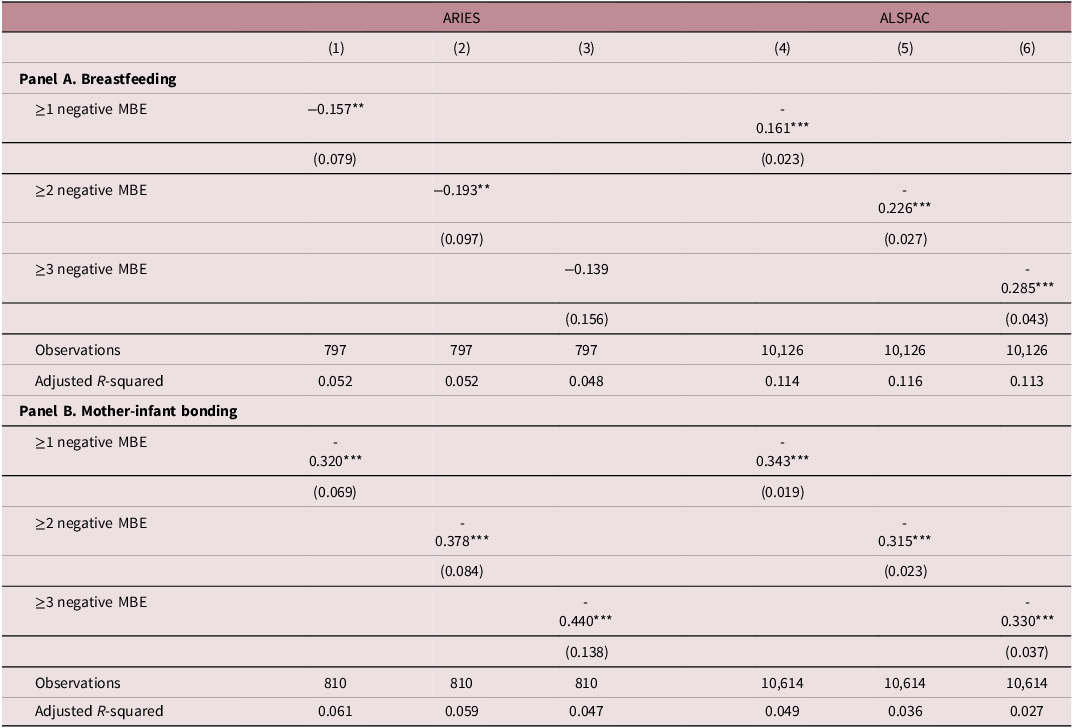
Notes: the table displays OLS estimates of coefficients from linear regression models. Standard errors in parentheses. All regressions include the following controls: child’s gender and gestational age, mother’s age at birth, maternal smoking, and maternal alcohol consumption during the last two months of pregnancy (informed by mothers eight weeks postpartum). The mother-infant bonding score in Panel B is standardised to have mean zero and standard deviation one. * p <0.1, ** p <0.05, *** p <0.01.
To investigate the epigenetic implication of MBE on children’s genome, a case-control approach (EWAS) was used to highlight CpGs associated with exposures. Associations were tested for DNA methylation measured at 3 time points of life: birth (N = 596), age 7 (N = 658) and age 15–17 (N = 653), adjusting the analysis for covariates (sex, gestational week, age of mother at childbirth, smoking and alcohol consumption during pregnancy, and batch effect). The EWAS models using the dichotomised MBE variable (using either 1, 2, or 3 as the cut-off) did not return any CpGs significantly associated with MBE at any time points. In addition, there were no differentially methylated regions in association to feelings during delivery (e011 variable) at any of the time points detected.
Discussion
This study aimed to explore the possible association between maternal birth experience and infant DNA methylation after childbirth. In particular, we investigated whether the DNA methylation of children measured at birth and at 7 and 15 years of age can be associated with MBE. In addition, we evaluated whether MBE influences other important mechanisms such as breastfeeding and mother-infant bonding Reference Bell, Andersson, Goding and Vonderheid7 , which may play a role in the development of infant behaviour and long-term health Reference de Waal, Boekhorst, Nyklíček and Pop19 . In particular, this study examined differentially methylated regions across the offspring’s genome at 3 time points of life (birth, age 7 and age 15-17) to identify associations with maternal birth experience (i.e., feelings during delivery and MBE score).
Considering that a previous study had reported limitations due to ALSPAC’s limited operational measures of women’s perception of birth Reference Bell, Rubin and Davis20,Reference Bell and Andersson21 , we decided to use more questions present in ALSPAC Reference Boyd, Golding and Macleod8 . To capture the various dimensions influencing MBE, such as feeling supported, in control, safe, and respected, we decided to apply the MBE composite score Reference Leinweber, Fontein-Kuipers and Karlsdottir1 to our cohort.
Our research indicated that women who receive support during labour and had a positive birth experience showed better mother-infant bonding at eight months postnatally. Poor bonding could result in insecure attachment, diminished empathy, increased irritability, cognitive difficulties, and mental health issues Reference Cassidy and Shaver22 . Our findings were consistent with a recent systematic review that found a correlation between women’s birth experiences and their attitudes and behaviours towards postnatal caregiving Reference Bell, Andersson, Goding and Vonderheid7 .
Additionally, our study revealed that mothers with positive birth experiences were more likely to breastfeed their infants. This concurred with what has been shown in another study Reference Davis and Sclafani23 . Increasing breastfeeding rates globally have been a vital public health objective, especially as Western countries have seen persistently low rates for over a decade Reference Prentice24 . Breastfeeding has consistently shown positive effects on BMI growth the first 6 years of life Reference Briollais, Rustand and Allard25 and cognitive function later in life Reference Krol and Grossmann26 . It also protects against immune-related diseases like type 1 diabetes, coeliac disease, inflammatory bowel diseases, allergies, and possibly cancer Reference Kramer and Kakuma6 . Furthermore, breastfeeding seemed to be linked to lower blood pressure and cholesterol levels. In addition, there was evidence that breastfeeding enhances psychological benefits both to the mother and child Reference Krol and Grossmann26 . Given these benefits, healthcare practitioners should prioritise breastfeeding support, especially for women with negative birth experiences, to improve global breastfeeding rates.
In this study, children’s genome-wide methylation profiles did not show any changes associated with MBE at any of the analysed timepoints (birth, 7 years old, 15–17 years old). This result is partially surprising, considering previous studies on the same cohort Reference Alfano, Guida and Galobardes27–Reference Reed, Suderman, Relton, Davis and Hemani28 . Prior research has demonstrated that DNA methylation changes in early life can be shaped by a range of perinatal and social factors. For instance, maternal education during pregnancy has been associated with differential DNA methylation signatures at birth and adolescence Reference Alfano, Guida and Galobardes27 . Similarly, maternal body mass index (BMI) has been identified as a factor influencing offspring DNA methylation patterns Reference Reed, Suderman, Relton, Davis and Hemani28 . Additionally, maternal adverse childhood experiences (ACEs) have been linked to epigenetic modifications in offspring Reference Vidal, Sosnowski and Marchesoni29 . Besides, breastfeeding reduced overweight and obesity in the first 6 years of life and was associated with changes in DNA methylation in both genders Reference Krol and Grossmann26 . These findings collectively suggest that prenatal and early postnatal environments play a crucial role in shaping the epigenome. However, DNA methylation changes require time and appropriate exposure to stressors to occur. In addition, DNA methylation, being reversible, can also be corrected during life. Here it may be hypothesised that the entity and the frequency of the MBE considered in this study were not of a large enough magnitude to affect children’s DNA methylation.
Further studies are needed to better characterise MBE and its impact on children’s health. Future research should also consider maternal ethnicity and body mass index, which were not included in this study but may offer valuable insights. The predominantly Caucasian population in our study is a limitation, as ethnic disparities in maternal care and birth experiences have been well documented Reference MacLellan, Collins, Myatt, Pope, Knighton and Rai30 . Additionally, future studies should explore the possible impact of mode of birth (vaginal vs. C-section) and the number of pregnancies on MBE, as their exclusion represents a potential limitation of the current research.
In conclusion, our study has shown that there is no measurable association between the maternal birth experience and maternal and infant DNA methylation up to 15 years after childbirth. However, a clear theoretical link between birth experience, maternal mental state, and the eventual mother-infant bond, could play a pivotal role in the subsequent behavioural development of the infant. This further confirmed previous research, and helps to empower health care professions, especially those involved in maternity care, in order to continue working towards giving a positive birth experience to all mothers.
Supplementary material
The supplementary material for this article can be found at https://doi.org/10.1017/S2040174425000133.
Data availability statement
All data are available commercially from the ALSPAC consortium.
Link : Access data and samples | Avon Longitudinal Study of Parents and Children | University of Bristol.
Please note that the study website contains details of all the data that is available through a fully searchable data dictionary and variable search tool: http://www.bristol.ac.uk/alspac/researchers/our-data/.
Acknowledgments
The authors acknowledge Sophie Mériaux and Pauline Guébels for the technical help in the research group and members of working group four from COST Action CA18211 for fruitful discussion. We are extremely grateful to all the families who took part in this study, the midwives for their help in recruiting them, and the whole ALSPAC team, which includes interviewers, computer and laboratory technicians, clerical workers, research scientists, volunteers, managers, receptionists, and nurses.
Funding statement
The UK Medical Research Council and Wellcome (Grant ref: 217065/Z/19/Z) and the University of Bristol provide core support for ALSPAC. This publication is the work of the authors and all authors will serve as guarantors for the contents of this paper. A comprehensive list of grants funding is available on the ALSPAC website (http://www.bristol.ac.uk/alspac/external/documents/grant- acknowledgements.pdf). JDT together with CD’A and CH are funded by the Fonds National de la Recherche Luxembourg: ALAC (C19/SC/13650569 ‘ALAC’).
Competing interests
The authors declare no conflict of interest.
Ethical standard
Ethical approval for the study was obtained from the ALSPAC Ethics and Law Committee and the Local Research Ethics Committees. Consent for biological samples has been collected in accordance with the Human Tissue Act (2004). Informed consent for the use of data collected via questionnaires and clinics was obtained from participants following the recommendations of the ALSPAC Ethics and Law Committee at the time.
Consent for publication
Approval from the ALSPAC executive team.


 Open access

