


“A state,” Weber (Reference Weber, Gerth and Mills1946, 78) tells us, “is a human community that (successfully) claims the monopoly of the legitimate use of physical force within a given territory.” Yet for millions of Latin Americans, local order and governance is provided, at least in part, by armed criminal organizations (COs).Footnote 1 While governing criminal groups range from street and prison gangs (e.g., Barnes Reference Barnes2022; Moncada Reference Moncada2021) to international drug cartels (e.g., Duncan Reference Duncan2015; Trejo and Ley Reference Trejo and Ley2020), these groups do not seek to topple or secede from overarching states, and rarely pose serious military challenges. State forces can usually enter areas of criminal governance at will, if not always without violence. Nonetheless, states typically neither eliminate governing COs nor incorporate them into formal coercive apparatuses. Rather, state and criminal governance usually overlap, in an antagonistic but ultimately stable “duopoly of violence” (Lessing Reference Lessing2021; Skaperdas and Syropoulos Reference Skaperdas, Syropoulos, Fiorentini and Peltzman1997).
Criminal governance has enormous consequences. For those governed, it can be simultaneously effective and terrifying, securing everyday order and property rights at the cost of due process, freedom of movement, and other rights. It shapes, by design, everything from community norms to elections, policing, and access to public services (e.g., Leeds Reference Leeds1996; Magaloni, Franco-Vivanco, and Melo Reference Magaloni, Franco-Vivanco and Melo2020). These microdynamics are so widespread that they can aggregate up. Governing COs can get involved in politics not only as vote brokers (e.g., Arias Reference Arias2017; Trudeau Reference Trudeau2022), but also as armed actors with the power to sharply reduce (or exacerbate) macrolevel violence. COs including El Salvador’s maras and Medellín’s combos have struck both overt and covert truces with governments to curb homicides (Cruz and Durán-Martínez Reference Cruz and Durán-Martínez2016), while the Primeiro Comando da Capital (PCC) helped to transform São Paulo from Brazil’s murder capital to one of its safest cities (e.g., Biderman et al. Reference Biderman, João, De Lima and Schneider2019; Denyer Willis Reference Denyer Willis2015).
Scholarship on criminal governance (CG) has blossomed in recent years (e.g., Blattman et al. Reference Blattman, Duncan, Lessing and Tobón2025; Córdova Reference Córdova2019; Feltran Reference Feltran2010; Flom Reference Flom2019; Magaloni, Franco-Vivanco, and Melo Reference Magaloni, Franco-Vivanco and Melo2020; Skarbek Reference Skarbek2024), building on foundational work by Leeds (Reference Leeds1996), Arias (Reference Arias2006; Reference Arias2017), and Auyero (Reference Auyero2007), among others. Yet most of this work focuses on well-known or easily observable cases, usually—though not always (Blume Reference Blume2021; Ley, Mattiace, and Trejo Reference Ley, Mattiace and Trejo2019)—in low-income urban peripheries. While shedding invaluable light on the internal dynamics, causes, and effects of CG, such work reveals little about its overall prevalence—the extensive margin, as it were—and raises questions about the external validity and generalizability of research findings (Feldmann and Luna Reference Feldmann and Luna2022).
We begin to address these lacunae by conceptualizing and attempting to measure CG’s extensive margin. Through a two-pronged empirical approach, we leverage novel data to characterize patterns in CG across Latin America. We first systematically collected and analyzed extant scholarly and journalistic accounts of criminal governance throughout the region. Then, when the 2020 Latinobarómetro (LB) wave produced the first nationally representative survey data for 18 countries on criminal-group presence and governance, we adopted LB as our principal source and redeployed our qualitative data analysis to contextualize and probe the reliability of our quantitative findings.
The LB survey instrument and resulting data have significant limitations. We address these through a battery of validation, robustness, and error-bounding exercises, drawing on novel quantitative techniques (contributions in their own right), data from national censuses, other public opinion surveys, and our original qualitative estimates. Overall, we find the LB data to be informative, if imprecise, and—critically—more likely to under- than overestimate the true prevalence of criminal governance.
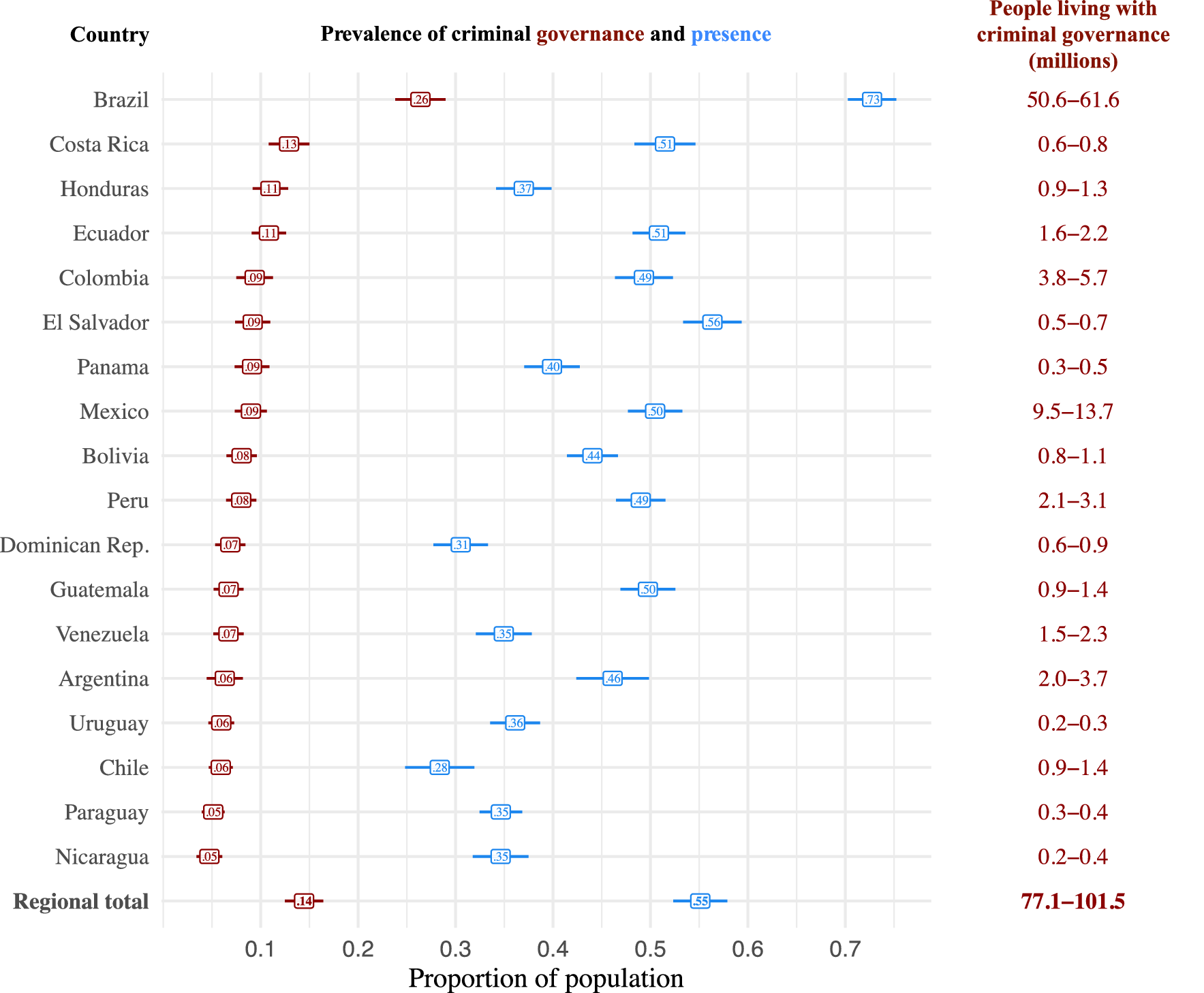
Across the 18 countries surveyed, 14% of all respondents reported criminal governance activities (providing order, improving security, or reducing crime) where they live, with national figures ranging from 5% to 26%. Based on LB’s claim of nationally representative sampling, we estimate country-level confidence intervals totaling 77–101 million people living with some form of criminal governance.Footnote 2 For robustness, we adapt techniques for reweighting survey data known to be unrepresentative, yielding potentially more representative confidence intervals totaling 67–90 million. These estimates are eye-opening: even the lowest bound corresponds to an astonishing one in nine people across Latin America.
Of primary concern, then, is whether these results are inflated by measurement error. The likeliest driver of overestimation is if respondents answered with respect to their entire cities rather than neighborhoods; while we cannot definitively rule this out, we present evidence that it did not occur systematically. Meanwhile, a host of factors point in the opposite direction, toward underreporting. These include asking only about a few core governance activities, and only to respondents who first indicated criminal presence; difficulty of gaining enumerator access to areas of strong gang control; and a potential enumeration error in Central America. More broadly, while general perceptions of crime frequently outstrip reality, perceiving and reporting order provision by gangs where none exists seems far less likely; indeed, social desirability bias likely runs counter to “admitting” that gangs reduce crime. In short, false negatives are probably more common than false positives.
Investigating the extensive margin of CG requires data on places both with and without it, and this same data allows us to systematically explore the correlates of criminal governance. Our main finding is that, compared to places with COs that do not govern, CG is positively associated with both subjective assessments and objective measures of state presence. This suggests that similar, causally identified findings in specific settings (e.g., Blattman et al. Reference Blattman, Duncan, Lessing and Tobón2025) may generalize. Our data also offer a potential corrective to the conventional wisdom that CG is predominantly urban. Across the region, the estimated rate of CG was the same (11%) among both large (1 million or more inhabitants) and medium (250,000–1 million) metro areas, and 7% in sparsely populated and smaller districts ( $ < $
250,000). Finally, respondents reporting criminal governance are also less likely to report “extortion” and “violence” by their local CO. Since many governing COs tax, and all wield coercive force, we conjecture that governance provision may legitimize taxation and coercion in residents’ eyes, and could be a strategic response by COs to state repression or incursion (e.g., Blattman et al. Reference Blattman, Duncan, Lessing and Tobón2025; Magaloni, Franco-Vivanco, and Melo Reference Magaloni, Franco-Vivanco and Melo2020).
$ < $
250,000). Finally, respondents reporting criminal governance are also less likely to report “extortion” and “violence” by their local CO. Since many governing COs tax, and all wield coercive force, we conjecture that governance provision may legitimize taxation and coercion in residents’ eyes, and could be a strategic response by COs to state repression or incursion (e.g., Blattman et al. Reference Blattman, Duncan, Lessing and Tobón2025; Magaloni, Franco-Vivanco, and Melo Reference Magaloni, Franco-Vivanco and Melo2020).
We then explore potential causal mechanisms that could explain the positive association between state presence and criminal governance, classifying them into three groups and offering empirical illustrations consistent with each. A common cause, like economic development, could encourage both state and criminal governance. Alternatively, states may respond to criminal governance by increasing local governance capacity—though one might wonder why this does not undermine the correlation. Finally, state presence itself may cause criminal groups to govern in response.
While our data cannot arbitrate among these, they do yield two important descriptive takeaways: the sheer extent of criminal governance and its concentration in places where states are relatively strong. The first shows that duopolies of violence, particularly in urban cores, are far from exceptional. The second generalizes extant findings from specific settings, demonstrating that the outdated conventional wisdom—that COs govern to fill vacuums left by state absence—is not just wrong in some cases, but on average misleading. In light of these findings, we conclude with suggestions for both more precise data collection on criminal governance itself and its inclusion in broader research on economic development, demography, and politics.
Concepts, Data, and Research Design
Conceptualizing the Extensive Margin of Criminal Governance
We follow Lessing’s (Reference Lessing2021, 3) broad definition of criminal governance as “the imposition of rules or restrictions on behavior by a criminal organization.” He distinguishes internal CO governance, governance over illicit markets and criminal actors, and governance over noncriminal civilians or “gang rule.” We are concerned primarily with the latter.Footnote 3
Criminal governance thus defined is distinct from criminal activity writ large. Many if not most COs do not govern civilians or regulate property crime and interpersonal violence, as our results attest (Uribe Reference Uribe2025). One strength of the survey data we rely on is that they distinguish the presence of COs (CP) from their activities, including governance (CG).
Criminal governance varies along many dimensions: what aspects of life are governed, how intensely, and by what means (Lessing Reference Lessing2021). Resulting criminal governance “regimes” (Arias Reference Arias2017) also vary in terms of COs’ relationship with one another (e.g., peacefully dividing versus competing for turf) and especially with the state (e.g., Arias Reference Arias2017; Barnes Reference Barnes2017). While CG can be part of larger, collusive, and even corrupt crime–state arrangements (the so-called gray zone [Auyero Reference Auyero2007; Trejo and Ley Reference Trejo and Ley2020]), it can also be an aggressive state-distancing tactic (e.g., Magaloni, Franco-Vivanco, and Melo Reference Magaloni, Franco-Vivanco and Melo2020) or reflect an emergent but unintentional symbiosis (e.g., Adorno and Dias Reference Adorno and Dias2016; Denyer Willis Reference Denyer Willis2015).
We treat all of this as variation on the intensive margin, and say little about it.Footnote 4 We operationalize CG as any one of the core set of governance activities explicitly asked about by LB: order provision, safety, and regulation of property crime. This maps nicely onto an intuitive, minimalist definition of CG. Though it does not explicitly include common CG activities like dispute resolution and policing sexual violence, nor less common ones like regulating drug consumption, domestic violence, and land use (Lessing Reference Lessing2021), respondents experiencing these forms of CG may well consider them part of “imposing order.” Thus defined, our focus is on the extensive margin of CG: where do gangs govern—with whatever intensity, efficacy, motives, and resulting crime–state relations—and where do they not?
Conceptually, the edge of the extensive margin is blurry: for example, some gangs prohibit theft and robbery not only within their communities but also—to avoid drawing police attention—in adjacent, often wealthier areas, whose residents might be said to live with, but not under, criminal governance. “Lives with” leaves room for interpretation: ideally, it means “interacts directly and regularly with criminal governance” rather than “lives in a city (or country) where CG exists somewhere.” Yet even a narrower definition—only those subject to gang rule—raises questions: for example, should city and nongovernmental organization (NGO) staff who obey rules (like identifying oneself upon entry) during visits to gang-governed areas count? Our operationalization reflects these blurred edges, resting on survey questions about criminal presence and activities where respondents live but not whether they consider themselves subject to gang rule. We discuss the geographic range of “lives with” below.
Operationalization: The 2020 Latinobarómetro Survey Instrument
Our primary measures of CP and CG come from the 2020 Latinobarómetro (LB) survey (Latinobarómetro 2020), which compiles nationally representative samples of 1,000–1,200 respondents in each of 18 Latin American countries. The survey covers political opinions and behavior, economic experiences, and social issues. We were not involved with the survey’s design or implementation. LB data is widely used in scholarly research on topics ranging from political attitudes (e.g., Saravia and Marroquín Reference Saravia and Marroquín2022; Wiesehomeier and Doyle Reference Wiesehomeier and Doyle2012) to sensitive issues like crime and violence (e.g., Arjona Reference Arjona2021; Blume Reference Blume2021). Its broad scope helps to fill informational gaps around phenomena for which little comparative data exist, as we aim to do here. As with most large, cross-national surveys—particularly those asking about criminal activity—measurement error and sample representativeness are concerns. To mitigate these, we report three additional analyses: reweighting the national estimates to address representativeness, validating survey measurement first against correlates and other surveys, and then against our prior qualitative data collection. The appendices report supplemental robustness and validation exercises.
The 2020 LB survey included, for the first time, questions about the presence and activities of local COs, including ones related to governance. First, in what we label Q1, respondents were asked, “Are there organized crime, armed groups, narco groups, or gangs where you live (in your municipality or neighborhood)?”Footnote 5 We coded all affirmative answers as “criminal presence” (CP).Footnote 6 Respondents answering “yes” were then asked a follow-up question, “Q2”:
Which of the following roles do these groups play in your municipality or neighborhood: A) control robberies, improve security; B) impose order in the area; C) extort people or businesses; D) use violence against people; E) other.
Respondents could report all, some, of none of these activities. We coded respondents whose answers included A, B, or both (regardless of other selections) as “living with criminal governance” (or just CG). This is a broader estimand than “living under CG,” and its meaning depends on how Q2 was interpreted, as we discuss below. We suggest future surveys add a direct question, “Are you personally subject to rules or duties imposed by criminal groups?” though this could undercount CG if, say, respondents who do not see themselves as likely to commit robbery or violence do not feel the rules are an imposition on them.Footnote 7 Ideally, surveyors should ask both questions, and measure the differential response between them; a Colombian survey (which we use for validation in the next section) did just that and found lower rates for “living under” than “living with” CG.
We further coded all respondents indicating C as “extortion” and D as “violence,” independently of our coding of CG. This follows Lessing’s (Reference Lessing2021, 3) definition of CG, which excludes “pure extortion, where the only rule is ‘pay.’” While this coding decision preceded our analysis, our results support it: many respondents seem to see “extortion” as distinct from taxation by governing COs (see the discussion below), even where qualitative evidence suggests that governing groups charge taxes.
The survey questions appear ambiguous as written, referring to “where you live” as “your neighborhood or municipality,” and we cannot know with certainty how enumerators in different countries parsed and presented them.Footnote
8 Did respondents report criminal presence, governance, extortion, and violence in their immediate neighborhoods, or anywhere throughout cities and rural municipalities? Call these two interpretations $ \gamma $
and
$ \gamma $
and $ \delta $
, respectively. Which predominated has important implications for both our descriptive estimates and our correlational analysis.
$ \delta $
, respectively. Which predominated has important implications for both our descriptive estimates and our correlational analysis.
Our results provide evidence that $ \gamma $
predominated, as we discuss throughout. Moreover,
$ \gamma $
predominated, as we discuss throughout. Moreover, $ \gamma $
was the intended interpretation,Footnote
9 and in Spanish it would be strange to ask residents of large cities about their “municipality,” but not strange for those of rural areas or small villages. Q2’s option B, “Impose order in the area [zona],” further suggests a local interpretation. Our best guess is that enumerators typically asked about neighborhoods in bigger cities and about municipalities in smaller towns and rural areas, or—if they read the questions verbatim—further clarified the relevant geographical areas based on locale.Footnote
10 Nonetheless, we consider the implications for our results under
$ \gamma $
was the intended interpretation,Footnote
9 and in Spanish it would be strange to ask residents of large cities about their “municipality,” but not strange for those of rural areas or small villages. Q2’s option B, “Impose order in the area [zona],” further suggests a local interpretation. Our best guess is that enumerators typically asked about neighborhoods in bigger cities and about municipalities in smaller towns and rural areas, or—if they read the questions verbatim—further clarified the relevant geographical areas based on locale.Footnote
10 Nonetheless, we consider the implications for our results under $ \delta $
as a bounding and robustness exercise, conducting additional analyses where appropriate. The possibility that
$ \delta $
as a bounding and robustness exercise, conducting additional analyses where appropriate. The possibility that $ \delta $
predominated also influenced our definition of subnational units of analysis, discussed below.
$ \delta $
predominated also influenced our definition of subnational units of analysis, discussed below.
Defining Subnational Units of Analysis, and Additional Data for Reliability Probes
The data required to estimate the extensive margin of CG also help us to explore the kinds of places where it is more likely to occur, this paper’s second contribution. There is no “natural” unit of analysis here: we can meaningfully ask how CG varies across individuals in a neighborhood, across neighborhoods in a city, across cities in a country, or among countries. Since our data are representative at the national level, we first present country-level rates and population estimates, and then explore correlations between national estimates of CG and country-level measures of poverty, corruption, and urbanization.
Yet since CG varies considerably within countries, we then examine the correlates of individual survey responses, grouped by purpose-built “metro-rural districts” discussed below. Following the survey structure, we compare respondents who reported criminal governance on Q2 to the universe of those who could have done so (namely, those who indicated criminal presence on Q1).Footnote 11 This approach, by including only places with criminal groups, sheds light on their choice to govern or not.
Our correlational analyses required defining an appropriate subnational unit of analysis—what we call metro-rural (MR) districts—and collecting data on them. Including district-level fixed effects ensures we are comparing respondents from the same relevant geographic unit—important both substantively and as a check on the question of how Q1 and Q2 were interpreted. MR districts also proved useful for validation and robustness checks, as we describe below. To build them, we began with the LB data, which list 1,374 “locales” (usually but not always municipalities) where surveys took place. We geocoded these place names and matched them to individual-level census data for the 18 surveyed countries from the Integrated Public Use Microdata Series International (IPUMS) project (Minnesota Population Center 2022).Footnote 12 IPUMS’s least-aggregated level roughly corresponds to municipalities, but is inconsistent internationally and frequently cuts across large metro areas, a common problem for studies involving urban areas (Schouela Reference Schouela2025).
Luckily, one of this article’s authors has pioneered a technique for aggregating those IPUMS districts that belong to a single metropolitan area (Schouela Reference Schouela2025).Footnote
13 We call the resulting districts “metro-rural” since they include both the novel, aggregated metro-area districts and the original rural districts from IPUMS. In our view, these best match our survey data, for two reasons. First, CP and CG often occur in peripheries of metro regions that splay across official municipal boundaries (and hence across IPUMS “districts”). Second, under the $ \delta $
interpretation of Q1 and Q2, people might think of “their municipality” as their entire metropolitan area; our MR districts capture this “broadest possible interpretation,” bounding its potential effects on our results. For robustness, we replicate all our results with the raw IPUMS districts in tables A.33 and A.34 in the online appendix; they are broadly similar.
$ \delta $
interpretation of Q1 and Q2, people might think of “their municipality” as their entire metropolitan area; our MR districts capture this “broadest possible interpretation,” bounding its potential effects on our results. For robustness, we replicate all our results with the raw IPUMS districts in tables A.33 and A.34 in the online appendix; they are broadly similar.
We then collected additional data at the MR district level. We take census data on residents’ gender, age, educational attainment, and employment status from IPUMS, and record the population and population density of each MR district sampled by LB. We proxy for district-level economic output using satellite-measured luminosity from the National Oceanic and Atmospheric Administration/Visible Infrared Imaging Radiometer Suite (NOAA/VIIRS) nighttime-lights dataset (Elvidge et al. Reference Elvidge, Baugh, Zhizhin and Hsu2013), which we normalize by population. We also draw a range of variables from the OpenStreetMap (OSM) platform (OpenStreetMap 2022), which crowdsources data from contributors around the world to record the locations of streets, businesses, government institutions, and other features.Footnote 14 We use OSM data to measure district-level road density, a common measure of economic integration. We also use OSM to create two “objective” district-level measures of the degree of state presence based on per capita counts of government institutions for coercion, administration, and public service provision: police stations, military bases, hospitals, post offices, and schools. Appendix table A.17 presents summary statistics for all variables.
Finally, we draw on our prior estimation effort carried out before the 2020 LB survey, for which we conducted large-scale, qualitative data collection. After systematically collecting scholarly articles, books, theses, and dissertations; government sources; journalistic accounts; and NGO reports, we coded for the presence of governing criminal groups in subnational units. In six countries—Colombia, El Salvador, Guatemala, Honduras, Nicaragua, and Venezuela—we were able to code for CG at the MR district level; we use these to conduct a validation exercise of our primary, survey-based results.Footnote 15
Estimating the Prevalence of Criminal Governance
Our first set of results are country-level estimates of the prevalence of criminal governance and presence. Given data limitations, these results must be carefully interpreted and qualified. We present them and discuss their interpretation, then address reliability and measurement error. Overall, we believe the estimates are imprecise but informative, and more likely to undercount than overcount CP and CG.
National Estimates and Their Interpretation
Figure 1 plots reported rates of CP and CG among respondents; we estimate confidence intervals around these values that account for the distinct survey design employed in each country.Footnote 16 Weighting by country population yields regionwide estimates: 52% to 58% of Latin Americans are living with the presence of criminal groups (CP), and 12%–16% with some form of criminal governance (CG). This corresponds, if LB data is indeed nationally representative (an issue we probe below), to some 77–101 million Latin Americans living with CG. While national prevalence rates vary widely, at least 5% of respondents reported governance activities in every country surveyed.
Estimated National Prevalence of Criminal Governance and Presence
Notes: Boxes show each country’s share of respondents reporting criminal governance and presence. Populational confidence intervals were calculated based on each country’s sampling design; Argentina’s are unreliable.

Interpreting the estimands—“living with” CP and CG—depends on how respondents understood the survey questions. If they answered with respect to their immediate surroundings (the intended $ \gamma $
interpretation), our estimates represent people who have direct experience of—but are not necessarily subject to—gang presence and rule. Evidence from the correlational analysis, discussed below, suggests that
$ \gamma $
interpretation), our estimates represent people who have direct experience of—but are not necessarily subject to—gang presence and rule. Evidence from the correlational analysis, discussed below, suggests that $ \gamma $
predominated. If instead
$ \gamma $
predominated. If instead $ \delta $
predominated, our estimates would represent people living with CP and CG somewhere in their city or municipality. Under this interpretation, the estimates seem implausibly low, even for Brazil (the country where, as we discuss,
$ \delta $
predominated, our estimates would represent people living with CP and CG somewhere in their city or municipality. Under this interpretation, the estimates seem implausibly low, even for Brazil (the country where, as we discuss, $ \delta $
is most likely to have predominated). Across the 18 LB-surveyed countries, 81.9% of residents live in cities (appendix table A.14), almost all of which have criminal-group presence somewhere, so CP rates should be far higher if
$ \delta $
is most likely to have predominated). Across the 18 LB-surveyed countries, 81.9% of residents live in cities (appendix table A.14), almost all of which have criminal-group presence somewhere, so CP rates should be far higher if $ \delta $
predominated.Footnote
17 This is further evidence that
$ \delta $
predominated.Footnote
17 This is further evidence that $ \gamma $
predominated.
$ \gamma $
predominated.
Another critical caveat applies for interpretation and cross-national comparisons. Our data provide essentially no measure of the intensive margin—the varied dimensions, degrees, and styles of CG, and the crime–state relations it is embedded within (e.g., Arias Reference Arias2017). For example, say one respondent is from a formal working-class neighborhood and not personally subject to gang rule, but truthfully reports that a small local gang prohibits robbery around its single drug corner to ward off police attention. A second respondent lives under heavily armed and thoroughgoing gang rule in a state-abandoned shantytown. A third lives in a rural area where cartels and the mayor collude in governing civilians and sacking public coffers. These three reports of criminal governance count equally. Aggregating up, countries might have equal reported national prevalences, accurately reflecting true national prevalence, while experiencing strikingly different forms and intensities of gang rule under varied crime–state relations.
In the remainder of this section, we address country-specific concerns, then present general validation and robustness checks, as well as survey-wide measurement-error concerns. Overall, we find that our estimates are more likely to under- than overcount criminal governance.
Country-Level Concerns
Experts may find some of the results in figure 1 hard to believe. Generally speaking, it is important to balance skepticism and legitimate data concerns against our own ignorance about criminal governance and criminal activity more generally. Ecuador’s results looked dubious in 2020, but now seem prophetic given the explosion of gang violence there in intervening years (e.g., Turkewitz Reference Turkewitz2023). Costa Rica suffered a similar ramp-up of homicidal violence in 2023 that attenuates our surprise at its high reported prevalence. Our qualitative assessment found evidence of substantial criminal governance in all 18 sampled countries, including high state-capacity states like Costa Rica (e.g., Blume Reference Blume2021), Chile (e.g., Luna Reference Luna2018), Argentina (e.g., Flom Reference Flom2019), and Uruguay (e.g., Díaz et al. Reference Díaz, Ines Fynn and Tiscornia2022).
A few cases call for specific attention. In Central America and the Dominican Republic, a survey implementation issue may have reduced reported CG: no respondents indicated more than one criminal activity, suggesting they erroneously believed they could only select one. If anyone experiencing governance activities alongside violence and/or extortion chose to report the latter over governance, they went uncounted. In appendix section A2.4, we attempt to bound any resulting downward bias on our estimates by comparing all remaining countries, where respondents did indicate multiple activities. Since the affected countries are relatively small, the potential increase to our regionwide estimate is modest: no more than 4 million at most. Yet national CG rates may be significantly underestimated, by as much as a factor of two in El Salvador, Guatemala, and Nicaragua. That said, the raw results are in line with some national surveys: Cruz (Reference Cruz2009), for example, finds that just 2% of residents report CG in El Salvador, and finds low rates for Guatemala and Honduras. Across LB and national surveys, lack of easy enumerator access to gang-governed areas—a general concern discussed below but one specifically noted by LB’s survey team in El SalvadorFootnote 18—may have played a role.
Venezuela is another case of surprisingly low prevalence. The culprit here may be a combination of measurement error and response bias: most major criminal groups in Venezuela have extensive and well-known ties to the authoritarian Maduro government (e.g., Corrales Reference Corrales2020). Respondents may fear state repression if they report criminal activity, or may not know where state governance ends and criminal governance begins.
Brazil merits particular scrutiny: its outlier status and sheer size raise concerns that measurement issues unique to it might bias regional totals, as well as the correlation results to come. Prima facie, the reported prevalence and governance rates are high but not implausible: its powerful prison-based facções or “factions,” led by the PCC, have spread to the urban peripheries of every state, where they are known to rule over residents (e.g., Feltran Reference Feltran2012; Leeds Reference Leeds1996), control infracommunity property crime, and in some cases induce violence-reducing “pacifications” (e.g., Pereira Barros et al. Reference Barros, Paulo, Paiva, Rodrigues, da Silva and Santos Leonardo2018) similar to São Paulo’s. The survey itself—carried out by the Brazilian Institute of Public Opinion and Statistics (Instituto Brasileiro de Opinião Pública e Estatística, IBOPE), Brazil’s premier national polling firm—does not seem prone to generalized sampling or measurement-error biases: as we show in appendix figure A.1, Brazil is not an outlier on any of 23 other survey questions about politics, democracy, corruption, and related issues.
That said, two slight differences in the Portuguese survey instrument may have raised reported CO presence and possibly governance relative to other countries. One—the inclusion of “factions,” a term widely recognized and associated with governance (e.g., Paiva Reference Paiva2019)—may have increased reporting rates compared to generic terms like pandillas (gangs) in Spanish-speaking countries. If so, this represents a relative reduction in measurement error in Brazil, a good thing. However, the Portuguese wording of Q1 could have led to relatively more responses at the citywide level (the $ \delta $
interpretation), at least with respect to criminal presence. We discuss details and present sensitivity analyses in appendix section A2.5; the correlational analysis below provides additional evidence.Footnote
19 Overall, we find that
$ \delta $
interpretation), at least with respect to criminal presence. We discuss details and present sensitivity analyses in appendix section A2.5; the correlational analysis below provides additional evidence.Footnote
19 Overall, we find that $ \gamma $
is still likely to have predominated, and that Brazil’s outlier status is most likely the result of objective conditions and relatively lower underreporting.
$ \gamma $
is still likely to have predominated, and that Brazil’s outlier status is most likely the result of objective conditions and relatively lower underreporting.
General Concerns: Validation, Representativeness, and Measurement Error
Stepping back, systematic validation of the LB results as a whole would require alternative measures of CP and CG for every country or—better—every “locale” surveyed by LB. Lacking such data, we conduct a second-best general validation test, presented in appendix A4. We leverage our prior data collection effort, which drew on journalistic, academic, governmental, and NGO sources to produce dichotomous mappings of CP and CG. In six countries (Colombia, El Salvador, Guatemala, Honduras, Nicaragua, and Venezuela), these mappings were at the municipal/district level. Since the LB data is not representative at this level, we use multilevel regression and poststratification (MRP) (Lax and Phillips Reference Lax and Phillips2009; Park, Gelman, and Bafumi Reference Park, Gelman and Bafumi2004) to produce more representative MR district-level estimates of the proportion of residents living with CG.Footnote
20 While these prevalence rates cannot be directly compared to our dichotomous qualitative coding of CG, the corpus of accounts of criminal governance across the region that we collected aligns well with the LB survey results, strongly predicting them ( $ p<0.01 $
) both with and without country fixed effects (appendix table A.16).
$ p<0.01 $
) both with and without country fixed effects (appendix table A.16).
We can validate our results against reliable estimates of CG for one country, thanks to a 2023 nationally representative survey by the Colombian firm Invamer (described in appendix section A2.6). Invamer’s survey instrument is similar to LB’s, but has three advantages. First, it asks about criminal-group activities “in your neighborhood,” inducing the $ \gamma $
interpretation. Second, its list of activities is longer and more specific: 13 items (as opposed to LB’s four), with seven corresponding to governance (as opposed to LB’s two). Finally, Invamer includes a distinct, direct question: “Do you have to submit to the rules or controls of any organized crime group?”
$ \gamma $
interpretation. Second, its list of activities is longer and more specific: 13 items (as opposed to LB’s four), with seven corresponding to governance (as opposed to LB’s two). Finally, Invamer includes a distinct, direct question: “Do you have to submit to the rules or controls of any organized crime group?”
While not perfectly comparable—Invamer’s survey was fielded three years later and via cell phone rather than in person—the results are illuminating. Taking a subset of CG activities that most closely match our LB-derived “minimalist definition” (order provision, security, and reducing property crime), we find a national estimate of 15% from Invamer, compared to 9% from LB.Footnote
21 This suggests that LB underestimates the prevalence of criminal governance, at least in Colombia. It also provides further evidence that the $ \gamma $
interpretation of LB’s questions predominated, since Invamer’s questions specifically asked about respondents’ neighborhoods and yielded a higher estimate. Finally, only 14% of Invamer’s respondents reported submitting to “rules and controls,” a smaller share than those who reported even a small subset of governance activities, highlighting the need to measure both “living under” and “with” CG.
$ \gamma $
interpretation of LB’s questions predominated, since Invamer’s questions specifically asked about respondents’ neighborhoods and yielded a higher estimate. Finally, only 14% of Invamer’s respondents reported submitting to “rules and controls,” a smaller share than those who reported even a small subset of governance activities, highlighting the need to measure both “living under” and “with” CG.
Turning to our country-level rate and population estimates, these rest on LB’s claim that its samples are nationally representative.Footnote 22 To evaluate this, we benchmark each of LB’s national samples against census data drawn from IPUMS. As appendix figures A.2–A.5 show, the LB samples consistently hew closely to the characteristics of their target populations on gender, age, employment status, and educational attainment.Footnote 23 For robustness, we again employed MRP, which is commonly used to produce population-level estimates from samples known to be nonrepresentative (e.g., Wang et al. Reference Wang, Rothschild, Goel and Gelman2015). We extend this approach to hedge against potential sampling error in the LB national samples. Rather than rely on LB’s sample selection and weighting, MRP poststratification allows us to independently weight each country’s sample to match its population distributions, producing potentially more representative national population estimates (appendix table A.12).Footnote 24 The MRP estimates are on average slightly smaller than those in figure 1, but remain remarkably high, yielding a regional estimate of 67–90 million people experiencing criminal governance.
Systematic measurement error in the survey data is another concern, especially for sensitive questions about crime and violence. To check internal consistency, we compare the 2020 LB results for reported criminal violence to the 2016, 2017, and 2018 survey waves.Footnote 25 We see no sharp increase in reported rates in 2020. The proportion of respondents reporting criminal violence in 2020 was largely in line with previous years, and almost every country saw a decrease in violence from 2018 (appendix figure A.6). To check for systematic bias, we compare data from LB and the 2018 Latin American Public Opinion Project (LAPOP),Footnote 26 another well-regarded cross-national survey (LAPOP Lab 2019). The most relevant common variable is crime victimization rates. As appendix figure A.7 shows, national rates are strongly correlated, though LAPOP’s are consistently higher, suggesting that, if anything, LB may be underestimating rates of criminal activity.
With respect to CG specifically, several possible sources of measurement error point toward under- rather than overreporting—a troubling possibility given the size of our estimates. First, stronger CO governance may deter respondent reporting or the entry of survey teams, as apparently happened in El Salvador. Second, respondents were only asked about criminal activities (including governance) if they first reported CO presence on Q1. It is possible, if not terribly likely, that some share of respondents would have truthfully reported governance if they were asked, but for some reason did not report presence. Finally, among the four activities respondents could attribute to criminal groups, “reduce crime” and “provide local order” (either or both of which we coded as CG), have a more positive normative valence, and are less typically associated with criminal activity, than “violence” and “extortion,” and thus were possibly underreported due to sensitivity bias. As noted, this is particularly important for Central America and the Dominican Republic, where respondents may have believed they could only select one criminal activity.Footnote 27 By the same token, false positives, common in crime perception surveys where respondents may respond positively based solely on news reports or rumor, seem less likely for atypical or “unexpected” activities like governance.
Correlates of Criminal Governance
In what sort of places are gangs more likely to govern? Descriptive analysis of the correlates of CG offers a first glimpse of how it systematically varies across different geographic units. While our data cannot explain such variation, they help to gauge the external validity of causally identified studies of CG at more local levels (e.g., Blattman et al. Reference Blattman, Duncan, Lessing and Tobón2025; Córdova Reference Córdova2019; Oliveira Reference Oliveira2024). The LB data are individual and representative at national levels, making these units of analysis relevant; applying novel quantitative and geospatial techniques, we also explore correlates at the level of MR districts.Footnote 28
High-Level Correlates
The cross-national variation in figure 1 is striking, and raises questions about the relationship between state capacity and criminal governance. The highest rates are in Brazil, a middle-income country with relatively strong institutions; Mexico, Colombia, and Costa Rica also pair high criminal governance with relatively strong states and developed economies. Simple cross-national correlations reveal that criminal governance is not predicted by broad measures of income or corruption (see appendix figures A.9 and A.10). Poorer countries are not, apparently, more susceptible to criminal governance. Neither does corruption appear to be a precondition for criminal rule: if anything, the countries reporting higher levels of criminal governance struggle less with corruption.Footnote 29
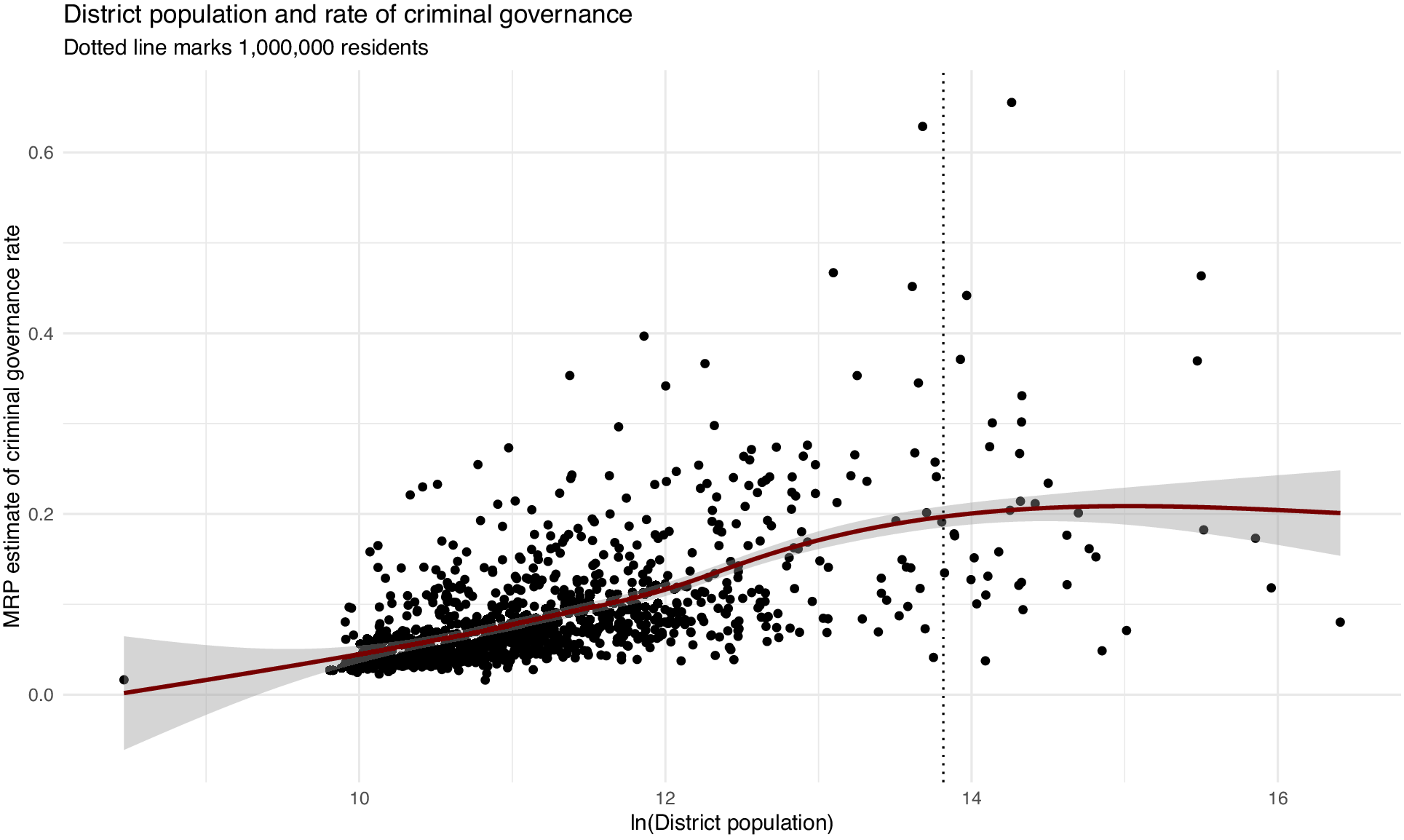
Criminal governance is widely thought to concentrate in urban peripheries, though a few studies have found CG in rural areas as well (Blume Reference Blume2021; Duncan Reference Duncan2015; Ley, Mattiace, and Trejo Reference Ley, Mattiace and Trejo2019). Our data permit what to our knowledge is the first systematic assessment of the question, adding important nuance. At the national level, the correlation between urbanization and CG is quite weak (appendix figure A.11). Subnationally, using MRP to estimate criminal governance rates at the MR district level, we find nearly equal rates (11%) across both large and midsized metro areas (1 million or more, and 250,000–1 million residents, respectively), and an only slightly lower rate (7%) in smaller and sparsely populated districts (under 250,000 residents). Figure 2 plots MR district-level population against MRP-estimated CG rates. While big cities report somewhat higher rates, criminal governance appears to be common in communities of all sizes across Latin America.Footnote 30
MR District Population (Logged) and MRP Estimates of MR District Criminal Governance Rate
Notes: The dotted vertical line marks MR districts with 1 million residents. The red curve represents best fit estimated via locally estimated scatterplot smoothing (LOESS).

District-Level Correlates: Criminal Governance and State Presence
Survey Respondents’ Assessment of State Presence
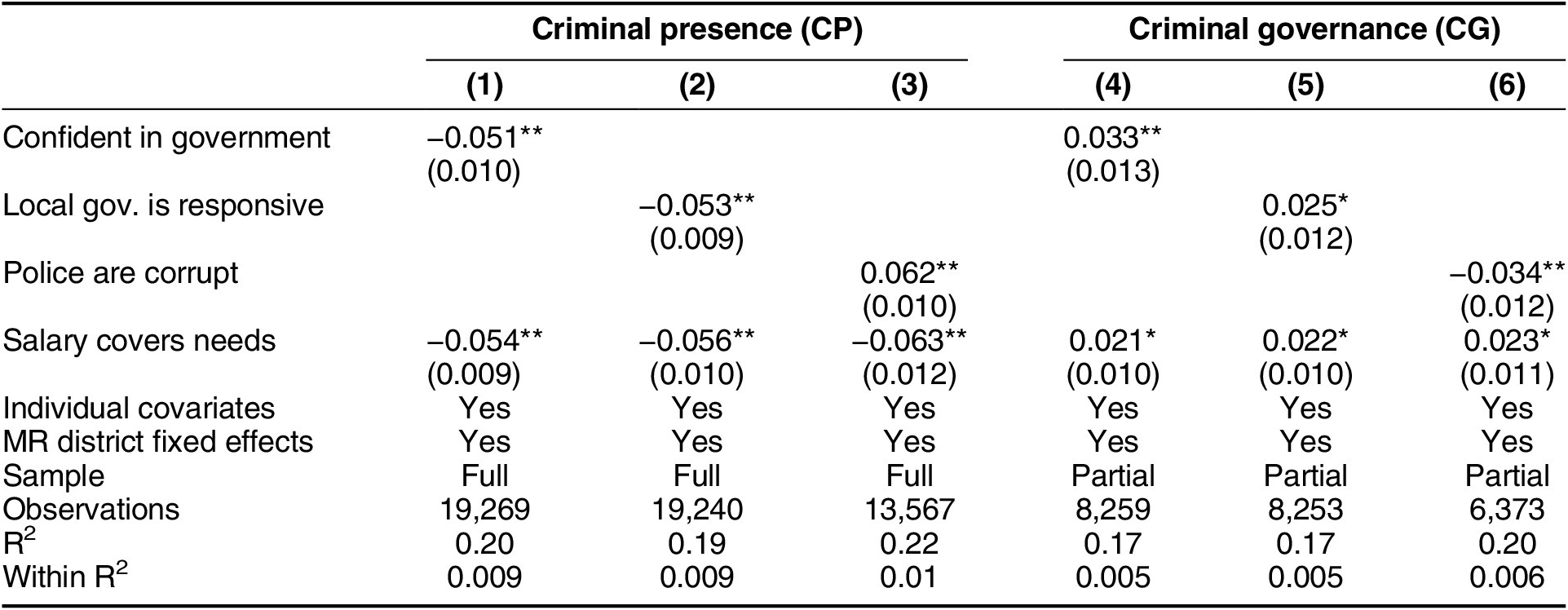
Starker counterintuitive results appear at more disaggregated levels of analysis. Table 1 probes the association between respondents’ reports of criminal presence and governance and their perceptions of the state, as captured by separate survey questions about confidence in government, responsiveness of local authorities, and perceptions that police are corrupt.Footnote 31 We include MR district-level fixed effects to ensure we are comparing respondents from the same metro or rural area, and add individual economic and demographic covariates to account for some likely confounders. Columns 1–3 model the association between criminal presence and these three measures. Unsurprisingly, respondents reporting criminal presence in their communities also reported less confidence in the state across all three measures.
Individual Correlates of Reporting Criminal Presence and Criminal Governance

Notes: Standard errors clustered within MR districts. Universe is all respondents for models 1–3, respondents who report criminal presence for models 4–6. Individual covariates are gender, age, employment status, and educational attainment. ** p < 0.01; * p < 0.05; . p < 0.1.
Columns 4–6 extend this analysis to the correlates of reported criminal governance. Here, we subset the sample to respondents who reported criminal presence, and hence who were asked about governance and other CO activities. This compares places where COs govern to places where they are present but do not, potentially illuminating the causes and effects of their choice to govern. Strikingly, criminal governance predicts greater satisfaction with the state across all three measures—as well as greater reported income—than nongoverning CO presence.Footnote 32 This result could be an artifact of reporting bias—if respondents more satisfied with the state were differentially more willing to report CG—but this is implausible since the correlation is among only those respondents who already willingly reported criminal presence.
These results also provide critical evidence that respondents typically answered Q1 and Q2 with respect to their neighborhoods, not entire cities (i.e., the $ \gamma $
interpretation predominated over
$ \gamma $
interpretation predominated over $ \delta $
). Because we include MR-district fixed effects, all variation in responses is within-city (or within rural district). Yet under
$ \delta $
). Because we include MR-district fixed effects, all variation in responses is within-city (or within rural district). Yet under $ \delta $
, there is only a single fact of the matter for each MR district. Within-district variation in reporting CG thus points toward
$ \delta $
, there is only a single fact of the matter for each MR district. Within-district variation in reporting CG thus points toward $ \gamma $
. To see the general point, imagine asking the ambiguously worded question, “What is the name of the place you live in (your neighborhood or municipality)?” The more that responses vary within a municipality, the more likely it is that respondents answered with respect to their neighborhood.
$ \gamma $
. To see the general point, imagine asking the ambiguously worded question, “What is the name of the place you live in (your neighborhood or municipality)?” The more that responses vary within a municipality, the more likely it is that respondents answered with respect to their neighborhood.
In our case, if $ \delta $
predominated, then all variation must be due to differences in either respondents’ willingness to report CG or their awareness of it somewhere in their city. The former is implausible since, as noted above, they had already reported CP. The latter is also implausible since, given our results, residents with lower reported income and trust in institutions (and who are thus likely to live in poorer neighborhoods) would have to be systematically less aware of CG. Moreover, as we show in appendix figure A.8, within-district variation in reported CG is significant and roughly the same across metro and rural districts of all sizes.Footnote
33 While we cannot rule out these possibilities, it seems far more plausible that within-district variation is due to respondents answering about their immediate surroundings (i.e.,
$ \delta $
predominated, then all variation must be due to differences in either respondents’ willingness to report CG or their awareness of it somewhere in their city. The former is implausible since, as noted above, they had already reported CP. The latter is also implausible since, given our results, residents with lower reported income and trust in institutions (and who are thus likely to live in poorer neighborhoods) would have to be systematically less aware of CG. Moreover, as we show in appendix figure A.8, within-district variation in reported CG is significant and roughly the same across metro and rural districts of all sizes.Footnote
33 While we cannot rule out these possibilities, it seems far more plausible that within-district variation is due to respondents answering about their immediate surroundings (i.e., $ \gamma $
predominated).
$ \gamma $
predominated).
Substantively, the negative correlation between reported CG and police corruption is particularly striking, suggesting that CG is not typically understood as part of a collusive “gray zone” arrangement between the state and criminal groups. Cruz (Reference Cruz2022) finds similar positive correlations between CO governance and perceptions of police legitimacy in Central America, hypothesizing that citizens whose experience of criminal governance is positive may also tend to feel positively about state governance, independent of its objective quality. This is consistent with assessments of crime–state cogovernance as symbiotic but not corrupt per se (Adorno and Dias Reference Adorno and Dias2016; Denyer Willis Reference Denyer Willis2015; Lessing Reference Lessing2021).
Objective Measures of State Presence
Two factors threaten the validity of these individual-level results. First, they rely on respondents’ perceptions of state presence and capacity, which could diverge from objective measures in ways potentially correlated with CG. In particular, citizens whose experience of CG is positive may also tend to feel positively about local state governance, regardless of its objective quality, as Cruz (Reference Cruz2009) argues. Second, we might worry that respondents reported CG with respect to larger metro areas (under the $ \delta $
interpretation) but answered trust-in-government questions with respect to their neighborhoods. Residents in objectively better-served areas might be more willing to report metro-level CG, driving a spurious correlation.
$ \delta $
interpretation) but answered trust-in-government questions with respect to their neighborhoods. Residents in objectively better-served areas might be more willing to report metro-level CG, driving a spurious correlation.
To address these threats, we reestimate these regressions, replacing subjective assessments with objective measures of state presence at the MR district level, capturing the largest areas respondents could have had in mind under $ \delta $
. We use data from OSM to generate two measures of physical state presence for each MR district. The first captures the local strength of the coercive state—the function most directly relevant to criminal groups. We record per capita counts of police stations and military bases in each district, and take the first principal component of the two variables. Our second, broader measure adds service provision and administration, taking the first principal component of per capita counts of police stations, military bases, hospitals, schools, and post offices. We incorporate these measures into the model specifications introduced in models 4–6 of table 1. We also add the district-level covariates detailed in the “Concepts, Data, and Research Design” section: road density, logged population, population density, and per capita luminosity, as well as country fixed effects.
$ \delta $
. We use data from OSM to generate two measures of physical state presence for each MR district. The first captures the local strength of the coercive state—the function most directly relevant to criminal groups. We record per capita counts of police stations and military bases in each district, and take the first principal component of the two variables. Our second, broader measure adds service provision and administration, taking the first principal component of per capita counts of police stations, military bases, hospitals, schools, and post offices. We incorporate these measures into the model specifications introduced in models 4–6 of table 1. We also add the district-level covariates detailed in the “Concepts, Data, and Research Design” section: road density, logged population, population density, and per capita luminosity, as well as country fixed effects.
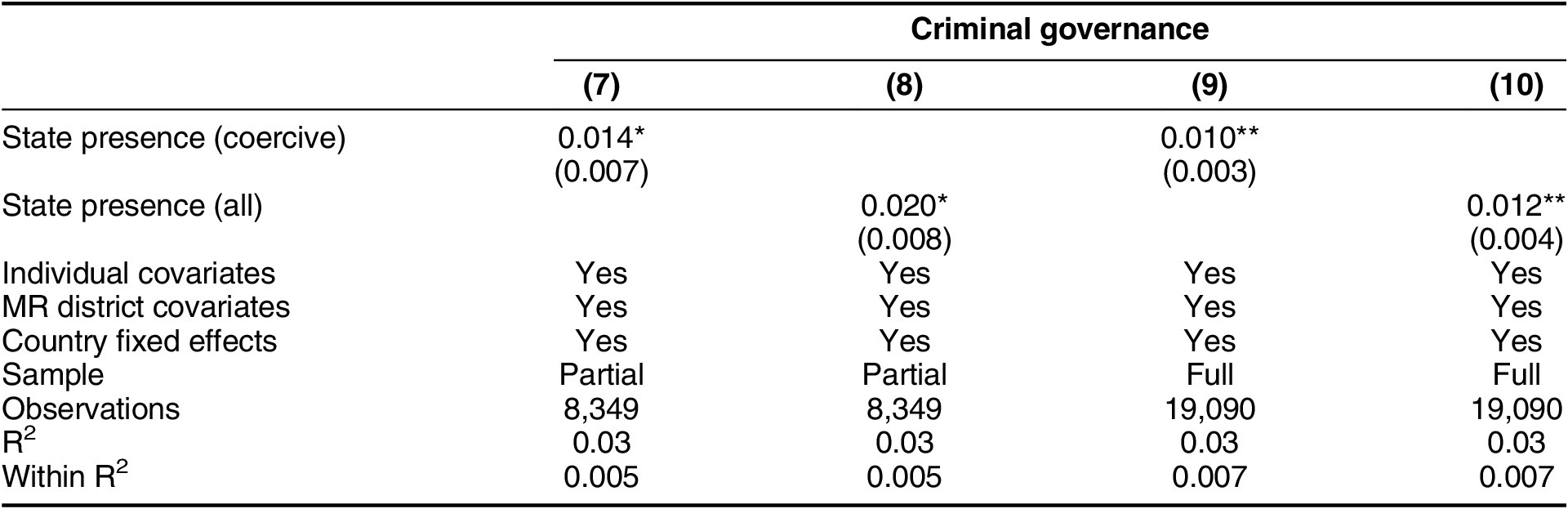
The results (table 2) suggest that the correlations in table 1 are not merely perceptual, nor driven by mismatch between local state capacity and citywide CG. Rather, COs seem more likely to govern in metro areas and rural districts where the state is objectively stronger or more present.Footnote 34 Models 7–8 mirror models 4–6 from table 1, examining the subset of respondents who reported CP (and hence were asked about CG). These respondents were more likely to report CG if they lived in a metro area or rural district where security forces (model 7) and the broader set of state institutions (model 8) were more present. In models 9–10 we show that this relationship holds for the full sample: among all respondents, a greater degree of physical state presence predicts criminal governance.
Reported Criminal Governance and Objective Measures of State Presence

Notes: Standard errors clustered within MR districts. Universe is respondents who report criminal presence for models 7 and 8, all respondents for models 9 and 10. State presence (coercive) is the first principal component of per capita counts of police stations and military bases; state presence (all) is the first principal component of per capita counts of police stations, military bases, schools, hospitals, and post offices. Individual covariates are gender, age, employment status, if salary covers needs, and educational attainment. MR district covariates are road density, (log) population, population density, and per capita luminosity. ** p < 0.01; * p < 0.05; . p < 0.1.
We conduct a series of tests to evaluate the robustness of these correlational results. First, the inclusion of the phrase “armed groups” (along with “gangs,” “narco groups,” etc.) in Q1 could overcount CG in countries with rebel governance (Arjona, Kasfir, and Mampilly Reference Arjona, Kasfir and Mampilly2015) by insurgencies and other noncriminal armed actors. It could also threaten the validity of the correlations reported if such groups concentrate in areas with strong state presence. Appendix tables A.21 and A.22 replicate the analysis without the two countries where large-scale noncriminal armed actors still operate (Colombia and Venezuela). The correlations change little, though the objective state presence measures sometimes lose statistical significance.
Besides measurement error, our results could be driven by our choices of model specification. To assess their sensitivity, we estimate each of the perceptual and objective models without covariates (appendix tables A.23 and A.24) and without fixed effects (appendix tables A.25 and A.26). The results are mostly unchanged. Another potential source of bias is that, in Central America and the Dominican Republic, zero respondents indicated more than one activity by criminal groups, suggesting they believed they could indicate at most one. To check, we reestimate the main models excluding those eight countries; the results change little (appendix tables A.27 and A.28).
Finally, we subset the sample to respondents living in small/rural MR districts: those with fewer than 250,000 inhabitants. There, the difference between $ \gamma $
and
$ \gamma $
and $ \delta $
shrinks: even respondents answering with respect to their whole district are likely to have direct knowledge of whether CG is occurring. Appendix tables A.31 and A.32 reestimate the models in tables 1 and 2 for these small-population districts: the correlations between criminal governance, income, and perceptions of state governance remain directionally consistent, though statistical significance declines for this smaller sample.
$ \delta $
shrinks: even respondents answering with respect to their whole district are likely to have direct knowledge of whether CG is occurring. Appendix tables A.31 and A.32 reestimate the models in tables 1 and 2 for these small-population districts: the correlations between criminal governance, income, and perceptions of state governance remain directionally consistent, though statistical significance declines for this smaller sample.
Correlations with Extortion and Violence
Returning to the individual level, we find surprisingly weak correlations between reports of criminal governance and of either extortion or violence by gangs. Overall, these criminal activities were reported with similar frequency (0.32, 0.40, and 0.46, respectively),Footnote 35 but governance was combined with extortion (0.07) or violence (0.09) at only about half the rate extortion was paired with violence (0.17). These figures are low because many respondents reported just one activity, and some may have believed they could only report one, but the pattern persists among the subset who reported two or all three activities: 30% paired governance with extortion, and 39% with violence, while 74% paired extortion and violence. As appendix section A2.8 shows, similar patterns hold within each country.
The result is surprising, since many governing COs—from Rio’s milícias to Medellín’s combos—are known to coercively tax residents (e.g., Arias and Barnes Reference Arias and Barnes2017; Blattman et al. Reference Blattman, Duncan, Lessing and Tobón2025). These groups, however, explicitly frame themselves as protectors, and employ euphemisms that aim to distinguish “extortion” from legitimate forms of criminal taxation. Thus for Salvadorans taxed by the MS-13, “extortion is a single, occasional act, while ‘the rent’ (la renta) is regular. So, in their words, many pay ‘rent,’ but not extortion” (Amaya and Martínez d’Aubuisson Reference Amaya and d’Aubuisson2021, iii). Elsewhere, residents pay “dues” (derecho de piso), “vaccines” (vacuna), and “security fees” (taxas de segurança). The weak correlation of reported governance with “extortion” suggests that such framing may be effective, and is consistent with findings that COs seek and sometimes attain local legitimacy (e.g., Reference Blattman, Duncan, Lessing and TobonBlattman et al., forthcoming; Magaloni, Franco-Vivanco, and Melo Reference Magaloni, Franco-Vivanco and Melo2020). Future surveys could fruitfully incorporate ethnographic work to formulate more precise questions about CO taxation, coercion, and other activities.
Possible Explanations
A consistent pattern emerges from our analysis at both individual and district levels: criminal organizations appear more likely to govern where the state is more present and more effective. This is not an artifact of sophisticated COs proliferating to wealthier countries with supposedly stronger state institutions, like Chile, Argentina, and Uruguay. While intriguing in its own right, this spread cannot be driving our correlations, which include country-level fixed effects. Similarly, our correlations control for population, density, and economic development: even within similar districts, criminal governance predicts stronger state presence.
What causal relationship(s) might underpin this correlation? While the descriptive nature of our data does not allow us to adjudicate between potential causal mechanisms, we outline and discuss three broad sets of mechanisms that may be at work. First, common causes or omitted variables could drive both criminal governance and relatively high local state capacity. Second and third, criminal governance could directly cause increased state presence and vice versa. These mechanisms need not be mutually exclusive, but are worth specifying and considering in isolation. In particular, since our correlations compare the universe of places with CO presence to the subset where COs govern—thus capturing COs’ choice to channel resources into governance—potential mechanisms must explicitly account for CO incentives to govern.
Could a Common Cause Drive Both State Presence and Criminal Governance?
An obvious candidate for a common driver of both state presence and criminal governance is local economic development and growth, itself possibly shaped by geography. One causally identified study (Blattman et al. Reference Blattman, Duncan, Lessing and Tobón2025) finds little evidence of economic growth as a driver of increased gang rule in response to exogenous state expansion in Medellín. That said, a broader logic could drive our correlational results: if states act as “stationary bandits” (McGuire and Olson Reference McGuire and Olson1996; Olson Reference Olson1993), they would increase investment and presence in more economically dynamic areas since there is both more to tax and greater incentives to invest in public goods. Since these investments grow the economy (hence states’ incentives to make them), the relationship is endogenous. Geography might be an anterior and exogenous common cause, making some regions (ports, border crossings, mountain passes, etc.) both more economically dynamic and differentially attractive or important for the state to control, while rendering other places costly or unprofitable sites for state investment (Herbst Reference Herbst2000).
Why would such differential economic growth or geographic advantage incentivize criminal groups to govern? One possibility is that analogous or overlapping stationary-banditry motives exist: a robust local economy—perhaps a local market or important thoroughfare—might offer a criminal group incentives to provide governance (over and above what the state provides) in exchange for protection fees. Ports and border crossings, with their opportunities for corruption of various types, are places where mafias have traditionally established governance over informal and illicit practices, if not always over civilians. Given their costliness, a CO might only provide order, contract enforcement (Gambetta Reference Gambetta1993), dispute resolution, and other public goods where it anticipates a sufficiently large rate of return.
Alternatively, rising economic prosperity in a community might increase its consumer demand for illicit drugs, making local retail markets more valuable. As we discuss below, COs may find that governing areas around such markets helps to protect and maximize their profits. Of course, such incentives depend on state repression of the drug trade, one reason to suspect that state presence causes criminal governance. Yet holding policing constant across communities, wealthier local drug retail markets could generate greater incentives and resources for CO governance. Competition among COs for such valuable turf could also be a powerful intervening variable, providing COs with a secondary motive to govern—as a defensive tactic against invasion—and states with public security incentives to intervene more robustly. In this way, increased intergang rivalry—itself plausibly driven by economic development—could cause both criminal governance and increased state presence.
Could Criminal Governance Drive State Presence?
Criminal governance could directly cause increased state presence through a host of distinct mechanisms. Some governing COs engage directly in electoral politics (e.g., Arias Reference Arias2017; Trudeau Reference Trudeau2022), or otherwise try to wield political power over local governments (e.g., Trejo and Ley Reference Trejo and Ley2020); COs might use any such political power to channel public investment toward their neighborhoods, some of which could manifest as increased state presence. While possibly important in some cases (e.g., Smith Reference Smith2022), this degree of successful state penetration by local COs—and its use not for immediate material gain but for beefing up state presence—seems unlikely to be driving regionwide correlations.
Alternatively, criminal and state governance may complement one another: some COs, for example, deliberately facilitate entry of nonpolice agencies, including health and education (e.g., Córdova Reference Córdova2019; Lessing Reference Lessing2021), to legitimate their rule. States might not be penetrated or captured by COs, but might simply see a higher return on investment in CO-governed spaces than those with nongoverning COs. A third possibility, suggested by Moncada (Reference Moncada2025) and echoing classic findings (e.g., Arias Reference Arias2006), is that consolidated CO governance over civilians can be complementary to citizen collective action and engagement in politics, while criminal disorder or fighting among COs discourages it. On average, places with stable criminal governance as opposed to simple criminal presence might, via more effective citizen mobilization, see higher state investment.
None of these mechanisms, however, offer a compelling explanation of the correlation between CO governance and our measure of strictly coercive state presence, which captures the very police and military installations that COs are presumably interested in keeping out. If, by choosing to govern, COs were systematically causing states to respond (through whatever mechanism) by building more police stations, why govern in the first place?
Corruption may seem like an obvious answer. Indeed, an important strand of literature sees “state-sponsored protection” (e.g., Snyder and Durán Martínez Reference Snyder and Martínez2009) and “gray zones” of crime–state collusion (Auyero Reference Auyero2007; Barnes Reference Barnes2017; Trejo and Ley Reference Trejo and Ley2020), from local commanders to high-ranking officials and public security ministers (Ahmed and Feuer Reference Ahmed and Feuer2020; Morris Reference Morris2020), as central to the growth and dynamics of organized crime in Latin America. Such collusion could produce the positive correlation we observe if CG is typically the result of crime–state agreements that involve deploying more police resources to areas governed by their criminal allies, as Pellegrino and Uribe (Reference Pellegrino and Uribe2025) report in the case of Rio de Janeiro. Yet our results suggest this is not typical, since CG (compared to CP without governance) is associated with lower perceptions of police corruption. More broadly, from COs’ perspective, paying bribes is not so different from paying fines (Shleifer and Vishny Reference Shleifer and Vishny1993). Corrupt police presence should be roughly as bad for COs’ bottom line as noncorrupt police presence, unless corruption itself creates profits that would otherwise not exist (perhaps by eliminating rival COs). While such productive complementarity may obtain in specific areas, markets, or historical periods, it seems unlikely to be common enough to explain the regionwide correlation we find.
Could State Presence Drive Criminal Governance?
The third, and in our view most compelling, possibility is that increases in state presence, coercive capacity, and repression drive criminal groups to govern. Blattman and colleagues (Reference Blattman, Duncan, Lessing and Tobón2025) identify precisely such a causal effect in Medellín. There, a redrawing of administrative boundaries provoked as-if-random shocks to “effective distance to the state” in sectors on either side. In sectors exogenously brought closer to state institutions, COs ended up governing more intensely. Our results suggest that case-specific findings like these may travel to the wider region.
What mechanisms could underlie such a casual relationship? Broadly speaking, state repression might generate incentives for COs to govern, resources to do so, or both. Increased state presence could incentivize CG if—as seems plausible—governance offers COs a degree of protection against policing’s effects on their illicit profits. By providing local governance, COs can both reduce residents’ calls to the police (either because there are fewer crimes to report or because the CO can respond more quickly) and, more broadly, win residents’ loyalty so that they protect COs when police raids do occur. Such a “hearts and minds” approach was explicitly adopted, for example, by the Comando Vermelho prison gang when it took over Rio de Janeiro’s favelas in the 1980s (Zaluar Reference Zaluar1985) and is still observed today (e.g., Barnes Reference Barnes2022; Magaloni, Franco-Vivanco, and Melo Reference Magaloni, Franco-Vivanco and Melo2020). Blattman and colleagues (Reference Blattman, Duncan, Lessing and Tobón2025) point to this profit-protecting mechanism as a potential driver of their results in Medellín, finding a stronger causal effect of state presence in neighborhoods with larger retail drug markets.
At the same time, state repression might increase COs’ resources for criminal governance. For example, mass incarceration and anti-gang crackdowns have not only fostered the growth of prison gangs (e.g., Cruz Reference Cruz, Bruneau, Dammert and Skinner2011; Skarbek Reference Skarbek2011) but helped them to project power onto the street (Lessing Reference Lessing2017), facilitating their governance over criminal markets and civilians alike. Meanwhile, drug prohibition and enforcement, by raising the price of consumption goods with highly inelastic demand, can actually increase the profitability of trafficking (Becker, Murphy, and Grossman Reference Becker, Murphy and Grossman2006; Castillo and Kronick Reference Castillo and Kronick2020). This increases both COs’ incentives for defending retail turf from competitors and police, and their resources for doing so. While “defense” may consist mostly in fielding soldiers, once in place such coercive apparatuses can easily serve double duty by providing basic order to residents. More ambitious COs have channeled drug profits into elaborate dispute-resolution services, welfare for poor residents, and even infrastructure projects (e.g., Arias Reference Arias2017; Feltran Reference Feltran2010). Needless to say, such profits would not exist if the state stopped repressing the retail drug trade.
Of course, just as we wondered why COs would govern if it brought on increased state presence, we might ask why states would systematically repress crime in ways that foster criminal governance—particularly if such governance makes policing harder. One family of answers is that states “know not what they do”; operate under short, election-driven time horizons; or suffer debilitating principal–agent problems (including corruption). Such inefficiencies may be more bearable for states than for presumably profit-maximizing criminal firms facing competition from rivals, at least in the short run. A different explanation—perhaps more plausible in the long run—is that states benefit on net from the order that COs provide, particularly in areas states find hard to govern themselves (Lessing Reference Lessing2025). Order is, after all, the primordial public good, producing benefits for all including the state. The scale of our results suggest that such benefits could be substantial.
Conclusion: Implications for Future Research
Our results establish an empirical benchmark and yield several substantive takeaways. First, they demonstrate the hemispheric reach of criminal governance and its concentration—though not exclusive presence—in urban peripheries, suggesting it may grow more prevalent as cities continue to expand. They also support a nascent scholarly consensus that organized crime is associated as much with state presence as with absence. Methodologically, the 2020 LB survey instrument demonstrates that respondents can and do report governance activities by local COs, and distinguish governance from more “typical” criminal activities. Finally, these results cast doubt on the assumption, and onetime conventional wisdom, that simply expanding state capacity and presence will naturally crowd out criminal governance; in fact, such tactics appear likely to backfire.
Our analyses also raise questions that only future research can answer. Adjudicating among the causal hypotheses discussed above requires future studies with adequate research designs. Another set of questions are purely descriptive: Are these estimates biased? Is prevalence increasing over time? How does intensity of criminal governance vary? Are the observed correlations between CG and state presence robust to more detailed and carefully executed survey work? What about other world regions? Answering such questions requires significant additional data collection in multiple contexts.
We encourage all researchers launching surveys, from the sub- to the cross-national level, to incorporate questions on criminal governance. Specifically, addressing shortcomings in the LB 2020 questionnaire, we recommend (1) clarifying that questions concern respondents’ immediate neighborhood, not municipality; (2) directly asking if respondents themselves are subject to CO rules; (3) providing multiple, fine-grained options for CO activities, including drug retailing, dispute resolution, and public goods provision (e.g., food, medicine, leisure options); and (4) using ethnographic evidence and pretesting to clarify and validate questions on CO taxation, coercion, and violence.
Finally, the scale of our initial estimate suggests a broader set of questions that go beyond the causes of criminal governance, beyond even its direct impacts on those governed, to consider its deeper macrolevel effects on economics and politics. For tens if not hundreds of millions of people, local order depends on both the state and the armed criminal groups it nominally fights. Often, it has been that way for generations. This vast, understudied “continent” of non-Weberian governance (Lessing Reference Lessing2021) surely impacts longue durée processes of economic development, demographic change, and democratic consolidation or erosion in ways that we are only beginning to systematically study. Research on these and related topics, whether focused on crime or not, should include criminal governance as a central concern.
Supplementary material
To view supplementary material for this article, please visit http://doi.org/10.1017/S1537592725101849.
Data Replication
Data replication sets are available in Harvard Dataverse at: https://doi.org/10.7910/DVN/TK5OXJ.
Acknowledgments
The authors would like to thank Douglas Block, who coordinated our original qualitative estimation effort and coauthored a prior version of this article; Mariana Carvalho, Bruno Oliveira, and Lucas Lelis Graciliano, who also provided invaluable research assistance; and John Henry Murdy, who alerted us to the Latinobarómetro data. We gratefully acknowledge financial support from the University of Chicago Office of the Provost. Benjamin Lessing received additional support from Award W911-NF-1710044 from the United States Department of Defense and US Army Research Office/Army Research Laboratory under the Minerva Research Initiative. The views expressed are those of the authors and should not be attributed to any of these agencies or foundations. The authors declare they have no competing interests.




 Open access

