


1. Introduction
Recent geopolitical crises have caused substantial price volatility in agricultural commodities and farm inputs markets, which puts price risks back on the policy agenda (Vigani et al., Reference Vigani, Fellmann, Porcella Capkovicova and Ferrari2024). Farmers are concerned about price volatility, and risk-averse farmers are assumed to be willing to sacrifice part of their expected profits to mitigate this risk (Boyd and Bellemare, Reference Boyd and Bellemare2020). Market-based risk management tools (or financial tools) such as forward contracts, futures, or options (i.e., price insurance) can be used by farmers to reduce price risk for outputs not yet produced and inputs planned to be used in the future (Hardaker et al., Reference Hardaker, Lien, Anderson and Huirne2004). Hedging benefits agricultural producers by offsetting their price risk (Garcia, Reference Garcia2004), however, the uptake of these financial tools is low (Assefa et al., Reference Assefa, Meuwissen and Oude Lansink2017; Michels et al., Reference Michels, Möllmann and Musshoff2019). Farmers’ decisions are, in general, influenced by behavioral factors (Dessart et al., Reference Dessart, Barreiro-Hurlé and van Bavel2019; Palm-Forster et al., Reference Palm-Forster, Ferraro, Janusch, Vossler and Messer2019; Wuepper et al., Reference Wuepper, Bukchin-Peles, Just and Zilberman2023a), which can explain deviations from what standard economic theory suggests, particularly for decisions made under risk (Bellemare and Lee, Reference Bellemare and Lee2016). Yet, an overview on how these factors affect price risk management in general, and how behavioral economic preferences that can be incorporated mathematically in economic models affect such adoption decisions, is lacking.
In this paper, we conduct a systematic literature review using the PRISMA guidelines (Page et al., Reference Page, McKenzie, Bossuyt, Boutron, Hoffmann, Mulrow and Shamseer2021) to identify behavioral factors that influence the adoption of financial tools for price risk management in agriculture. We thereby contribute to a better understanding of price risk management decisions of farmers and identify knowledge gaps to be addressed in future research.
This review contributes by organizing the literature on farmers’ price risk management decisions around a conceptual distinction between behavioral preferences that modify decision-theoretic models and psychological factors that shape decisions through social and cognitive channels, with explicit implications for modeling and policy design. Behavioral preferences can be incorporated in formal (mathematical) economic models (e.g., risk, uncertainty, time preferences and hyperbolic discounting, loss aversion, or probability weighting), while psychological factors are traits that influence behavior but that are often estimated in reduced form and cannot be formally incorporated in economic models without strong auxiliary assumptions (e.g., social interaction, culture, and personality traits). To define search terms, we first build a conceptual framework of farmers’ decision-making under price risk and introduce economic theories and psychological factors that qualify as driving forces in this decision process.
We limit our analysis geographically to countries with highly intensive farming systems. In total, we identified 101 studies, yielding 232 distinct observations. The higher number of observations results from the fact that some studies examine multiple financial tools, consider more than one preference or factor, and may also focus on different farm types.
Most papers on behavioral preferences use an expected utility representation of farmers’ risk preferences to find optimal hedging decisions on commodity futures contracts. Moreover, multiple empirical papers correlate farmers’ psychological preferences with the adoption of price risk management tools (see also Wever et al. (Reference Wever, Michels and Musshoff2024) for a literature review on how psychological factors affect futures adoption). Surprisingly, only one paper focuses on cumulative prospect theory’s (CPT) loss aversion and probability weighting in a simulation study on futures adoption. Overall, our results indicate a substantial literature gap on empirical work that correlates elicited behavioral preferences with actual adoption of price risk management instruments, and a strong focus on futures contracts. We thus conclude that we currently have a limited understanding of farmers’ price risk management decision-making processes. Additional experimental research on the relation between behavioral preferences and price risk management decisions can improve this understanding and enable a more targeted design of instruments and policies. Finally, our conceptualization of behavioral factors into behavioral preferences and psychological factors is novel in the agricultural economics literature. While this differentiation marks the difference between the disciplines behavioral economics and social psychology, agricultural economists so far use these concepts interchangeably. We therefore suggest that future research should better conceptualize the differences between behavioral preferences and psychological factors and better motivate which to use when. Particularly, due to the very monetary (economic) nature of the decision to purchase financial tools to hedge price risks, we are surprised by the large overweight of current literature on how psychological factors drive this decision compared to the diminished focus on behavioral preferences incorporated in economic models of price hedging decisions.
The remainder of the paper is structured as follows. In the subsequent section 2, we build a theoretical foundation on decision-making under price risk to motivate how different behavioral preferences of farmers (such as risk or loss aversion) might drive the decision to adopt financial tools. In section 3, we introduce our methodology to systematically collect peer-reviewed studies on behavioral preferences driving the adoption decision. We present our results in section 4 and discuss these in section 5. In the discussion, we put a particular emphasis on research gaps . That is, we identify preferences that conceptually drive the price risk management decision (as motivated in section 2) but that have not yet been tested empirically. We end our paper with a general conclusion on future research and policy implications.
2. Conceptual framework
Including individual behavioral preferences in theoretical choice models on farmer decision-making (e.g., by including risk attitudes in an Expected Utility framework) has a long history in agricultural economics. Since actual behavior of economic agents in general and farmers in particular often deviates from what Expected Utility maximization would suggest, behavioral economists developed extensions of Expected Utility Theory and relaxed some of its assumption by incorporating new behavioral preferences (e.g., Kahneman and Tversky, Reference Kahneman and Tversky1979; Tversky and Kahneman, Reference Tversky and Kahneman1992). This led to further preferences being formally considered in theoretical specifications. Additionally, behavioral factors from the social–psychological side of the literature also play an increasing role in applied agricultural economics research (e.g., Dessart et al., Reference Dessart, Barreiro-Hurlé and van Bavel2019; Palm-Forster et al., Reference Palm-Forster, Ferraro, Janusch, Vossler and Messer2019; Schaub et al., Reference Schaub, Ghazoul, Huber, Zhang, Sander, Rees, Banerjee and Finger2023; Wever et al., Reference Wever, Michels and Musshoff2024; Wuepper et al., Reference Wuepper, Bukchin-Peles, Just and Zilberman2023a). These “psychological” factors might offer greater flexibility in explaining decisions but are often not incorporated in formal economic decision models in the context of price risk management. Historically, Daniel Kahneman, as one of the founders of behavioral economics, won the Nobel prize in economics “for having integrated insights from psychological research into economic science, especially concerning human judgment and decision-making under uncertainty.” Thus, it is this integration into mathematical economic models that marks the difference between a behavioral economic preference and a psychological factor. Moreover, such behavioral preferences are particularly suited for economic decisions under risk. At the same time, psychological factors allow to more flexibly capture decision-making without the formal restriction of a mathematical function to be optimized. Concluding, behavioural preferences can be expressed as parameters in a mathematical equation that models farmers’ choices, while psychological factors are not restricted in that way.
While this distinction marks a difference between behavioral economic and social psychological research, the agricultural economic literature does not always make this distinction but uses these concepts interchangeably to correlate behavioral factors with decisions (Knapp et al., Reference Knapp, Wuepper and Finger2021). We therefore classify farmer preferences in i) behavioral preferences, which we consider to be formally recognized in economic models (such as loss aversion or probability weighting), and ii) psychological factors, which describe farmer preferences but are not mathematically implemented into a theoretical economic model.
2.1. Behavioral preferences
Decisions about the adoption of financial tools can be framed as decision-making under risk. These types of decisions in agriculture have been conceptualized based on different theoretical grounds. As a more normative model, Expected Utility Theory (EUT) can help to find optimal decisions given an expected return and riskiness of a production activity and the decision maker’s preference for taking risks (Meyer, Reference Meyer2002). For positive modelling, that is predicting actual behavior, different theories from behavioral economics have been proven useful in an agricultural setting. Cumulative prospect theory (CPT) (Tversky and Kahneman, Reference Tversky and Kahneman1992) for instance, allows to include (biased) perceptions of probabilities and a particular aversion to losses with respect to a reference point (Finger et al., Reference Finger, Garcia, McCallum and Rommel2024). Additionally, in decision contexts where objective probabilities are simply not available, farmers make choices under uncertainty and ambiguity (Knight, Reference Knight1921). Building on these theories,Footnote 1 Subjective EUT (Savage, Reference Savage1954), the Smooth ambiguity model (Klibanoff et al., Reference Klibanoff, Marinacci and Mukerji2005), and Alpha EUT (Ghirardato et al., Reference Ghirardato, Maccheroni and Marinacci2004) are adaptations that have been applied in the agricultural economics literature (see for example Bougherara et al., Reference Bougherara, Gassmann, Piet and Reynaud2017; Cerroni, Reference Cerroni2020; Cerroni et al., Reference Cerroni, Bozzola and Rippo2023; Couture et al., Reference Couture, Lemarié, Teyssier and Toquebeuf2024).
Concluding from the above decision-making theories, the following preferences qualify to correlate with farmers’ price risk management decisions: i) risk preferences as represented in the standard expected utility model (Garcia et al., Reference Garcia, McCallum and Finger2024), i.e., how much risk a person is willing to take determining the expected utility of the outcome, ii) loss aversion (Sproul and Michaud, Reference Sproul and Michaud2017), when losses, i.e., outcomes below a certain reference point, have a greater impact on decisions than gains of the same size; iii) time preferences, these are assumed fixed and stable in the standard expected utility model but decision makers often over proportionally prefer “present goods” to those that will be available in the future (O’Donoghue and Rabin, Reference O’Donoghue and Rabin2015); iv) probability weighting (Prelec, Reference Prelec1998), when individuals overweight low probability events and/or underweight high probability outcomes; v) uncertainty (or ambiguity) aversion, i.e., preference for known-probability over uncertain (or ambiguous) bets (Ellsberg, Reference Ellsberg1961); and vi) subjective probabilities, i.e., the personal degree of beliefs that an uncertain event will occur (e.g., de Finetti, Reference de Finetti1931; Ramsey, Reference Ramsey1931).
2.2. Psychological factors
In addition to the behavioral preferences integrated into economic models, psychological factors such as biases, social interaction, cultural, and personality aspects have been frequently used to explain farmers’ decision-making under risk (see Wuepper et al., Reference Wuepper, Bukchin-Peles, Just and Zilberman2023a for an overview of the current state of behavioral agricultural economics). We conceptually categorize these factors following the approach proposed by Dessart et al. (Reference Dessart, Barreiro-Hurlé and van Bavel2019), which is commonly used in agricultural economics (Schaub et al., Reference Schaub, Ghazoul, Huber, Zhang, Sander, Rees, Banerjee and Finger2023; Wever et al., Reference Wever, Michels and Musshoff2024). This classification is organized into i) dispositional, ii) social, and iii) cognitive factors. Dispositional factors are rather stable internal factors of a given individual, such as personality, attitudes, general preferences, and objectives. Social factors relate to the social environment (information, peers, networks, and interactions with other individuals). Cognitive factors are related to learning and reasoning and are more closely dependent on the specific decision-making process. In the context of risk management, they include personal knowledge about risk management in general, the knowledge and the perceptions of costs and benefits associated with a specific financial tool and its alternatives. Finally, some studies considering psychological factors include some measures of risk attitudes (such as self-reported risk aversion), which might conceptually overlap with risk preferences in economics models. Therefore, we indicate such cases in our literature review and classify those papers into either of the two categories.
3. Methods
We developed a pre-registration plan for our methodological approach based on the PRISMA-P guidelines (Moher et al., Reference Moher, Shamseer, Clarke, Ghersi, Liberati, Petticrew, Shekelle and Stewart2015; Shamseer et al., Reference Shamseer, Moher, Clarke, Ghersi, Liberati, Petticrew, Shekelle and Stewart2015) and uploaded it to Open Science Framework before starting the formal search process of the literature review (Spada et al., Reference Spada, Moritz, Rommel, Cerroni, Meuwissen and Dalhaus2024). Deviations from the pre-registration plan, along with explanation are reported in supplementary material (Table S1).
3.1. Literature search
The keywords used in the search process were developed based on the terms summarized in Table 1, which revolve around three key concepts: i) farmers: we are interested in studies that focus on farmers’ decisions at the farm level; ii) financial tools: we are interested in a broad range of financial tools for price risk management;Footnote 2 and iii) behavioral factors: search terms in here should describe either behavioral preferences or psychological factors that potentially correlate with price risk management decisions. The literature search was conducted on Scopus and Web of Science, filtering for English language and peer-reviewed literature, an additional search was conducted on AgEcon Search. (see supplementary Table S2 for full search strings).
Key concepts and search terms

Table 1 Long description
A table with three columns and four rows, including a header row. The columns are labeled Key concepts, Search terms, and Behavioral factors. The rows list key concepts and their corresponding search terms. Row 1: Key concepts, Farmers, Search terms, Agricultural entrepreneur, farmers, growers, producers. Row 2: Key concepts, Financial tools, Search terms, Financial tools, forwards, futures, hedging, options, price insurance, risk management, swap. Row 3: Key concepts, Behavioral factors, Behavioral preferences, Search terms, Alpha expected utility, ambiguity attitudes, ambiguity aversion, ambiguity preferences, attitudes consideration, discount, expected utility theory, loss aversion, probability weighting, prospect theory, rank-dependent utility, risk attitudes, risk aversion, risk considerations, risk preferences, smooth ambiguity model, subjective probability, subjective utility, temporal preferences, time preferences, uncertainty attitudes, uncertainty aversion, uncertainty consideration, uncertainty preferences. Row 4: Key concepts, Behavioral factors, Psychological factors, Search terms, Attitudes, attributes, behavioral, cognitive, factors, norms, perception, preferences, social.
Notes: see supplementary Table S2 for full search strings.
3.2. Eligibility
Studies were included according to the criteria summarized in Table 2. Only papers that target farmers as subjects were analyzed, while other actors in the food chain, integration, and collectives were not considered. Although farmer collectives, like producer-owned cooperatives, are likely to hedge using futures contracts (Nienhaus et al., Reference Nienhaus, Franken and Pennings2023), their decision-making process might be different from a single farmer, and studies focusing on organizations rather than individuals are thus excluded from the analysis. Only articles that study the impact of behavioral preferences and psychological factors on the adoption of instruments targeting the mitigation of price risk were analyzed. Non-price focused risk management tools like revenue or yield insurance were excluded. We restrict our review geographically to only consider advanced economies (IMF, 2024) since we expect price risk management adoption decision to be substantially different in low-income countries.Footnote 3 Finally, only published peer-reviewed papers written in English were considered for the analysis, without applying any time restrictions.
Eligibility criteria

Table 2 Long description
A table comparing study and report characteristics for inclusion and exclusion criteria. The table has two main columns: Included and Excluded. Under the Study characteristic section, the Subject row includes Farmers and excludes Other actors in the food chain, Integration, and Agricultural students. The Decision making row includes Adoption of financial price risk management tools such as Forwards, Futures, Options, Price insurances, and Other price tools, and the Impact of behavioral preferences and psychological factors on adoption, while it excludes Adoption of nonprice risk management tools like Collective risk management, Contract farming, Yield insurance, and Revenue insurance, and studies focusing exclusively on farm- and farmer characteristics. The Geography row includes Agricultural systems in countries classified as advanced economies and excludes those outside this classification. Under the Report characteristics section, the Type of report row includes Peer-review literature and excludes Unpublished Gray literature. The Year of publication row includes No limit, and the Language row includes English and excludes Other languages.
Notes: *Following the International Monetary Fund “advanced economies” classification. See (IMF, 2024) Statistical Appendix for more details.
3.3. Screening
The 1,469 entries obtained through the search process were scanned for duplicates on Zotero (https://www.zotero.org/), leading to the exclusion of 435 duplicate records. Titles and abstracts were then screened against the inclusion criteria by two of the authors on Rayyan (https://www.rayyan.ai/). Each of the two authors independently evaluated the studies without knowledge of the other’s decisions and any conflicting decision between the two individual screening processes was discussed individually and resolved. The title and abstract screening resulted in the exclusion of 816 records. For the remaining 218 entries, the full text was sought. During the retrieval process, 7 records could not be accessed (see supplementary Table S3). The number of included studies after full-text screening was 41. At this stage, the snowballing method (Wohlin et al., Reference Wohlin, Kalinowski, Romero Felizardo and Mendes2022) was used to ensure literature saturation: the reference list of included studies (backward snowballing) and the list of papers citing the included studies (forward snowballing) were scanned to identify additional relevant papers. The backward and forward snowballing process yielded 49 and 24 additional references respectively (Figure 1). Most relevant papers emerged from the snowballing procedure rather than the initial identification round, as the search strategy relied on queries that scanned only the title, abstract, and keywords. This is because many relevant studies discuss specific behavioral factors only in the main text rather than explicitly mentioning them in the searchable fields. As a result, these studies remained undetected in the initial database search. Data were recorded in an Excel spreadsheet and analyzed using R (R Core Team, 2021) (see supplementary files: “Data_SLR_BehavPriceRisk.xlsx” for the data and “Script_SLR_BehavPriceRisk.R” for the analysis and figure replication).
Flow diagram of article selection.
Notes: Based on PRISMA guidelines (Page et al., Reference Page, McKenzie, Bossuyt, Boutron, Hoffmann, Mulrow and Shamseer2021).

4. Results
4.1. Categorization and data description
In total, we identified 101 studies, yielding 232 distinct observations. Based on a critical appraisal, no studies were excluded from the review (see supplementary Table S4 for the criteria and Figure S1 for a summary of the critical appraisal). The higher number of observations stem from the fact that some studies examine multiple financial tools, consider more than one preference or factor, and may also focus on different farm types. Based on the categorization defined in the conceptual framework, Table 3 provides a general overview of the behavioral preferences and psychological factors that relate to the adoption of financial tools. In overlapping cases, where a factor that can be modeled both within a decision model or simply treated empirically as a psychological variable, we assign it based on how it has been operationalized in the study. Psychological factors are conceptually categorized into i) dispositional, ii) social, and iii) cognitive factors according to Dessart et al. (Reference Dessart, Barreiro-Hurlé and van Bavel2019) (see supplementary Table S5 for a description of each behavioral preference and psychological factor).
Overview of behavioral preferences and psychological factors

Table 3 Long description
A table categorizing behavioral preferences and psychological factors related to the adoption of financial tools. The table has two columns: Behavioral preferences and Psychological factors. The Behavioral preferences column includes six rows: Risk preferences, Time preferences, Uncertainty and Variation aversion, Probability weighting, Loss aversion, Reference dependence, and Price expectations. The Psychological factors column is divided into three subcategories: Dispositional factors, Social factors, and Cognitive factors. Dispositional factors include Risk attitudes, Innovativeness, and Management attitudes. Social factors include Network influence and Social norms. Cognitive factors include Tool knowledge and perceived ease of use, Alternative perceptions, Perceived usefulness, Risk perceptions, and Price and yield expectations.
Note: A distinction exists for price expectations, where in behavioral preferences they are mathematically incorporated in economic models, while in the psychological factors category, they are simply elicited or derived in experiments. See supplementary Table S5 for a description of each individual preference and factors.
Table 4 presents a methodological categorization of the studies based on their approach of dealing with either behavioral preferences or psychological factors. Of the 101 papers, 58 implement behavioral preferences in mathematical notations. Of these, 15 are purely theoretical. They propose a theoretical model that includes a behavioral preference in mathematical terms, without a numerical application. Studies that implement optimizations (43 papers) apply numerical applications to a theoretical framework to optimize an objective function (typically a utility function). The studies that investigate psychological factors are in total 43, of which 39 analyze farmers’ behavior by conducting experiments to collect primary data, while 3 papers employ econometric techniques to explore secondary data.
Methodological categorization of the studies

Table 4 Long description
The table categorizes studies based on their approach to behavioral preferences or psychological factors. It has two main columns: Behavioral preferences and Psychological factors, each with subcategories and corresponding numbers of papers. The Behavioral preferences column has two subcategories: Theoretical models with 15 papers and Optimizations with 43 papers. The Psychological factors column also has two subcategories: Experiments with 40 papers and Econometric methods with 3 papers. The total number of papers for Behavioral preferences is 58, and for Psychological factors, it is 43.
Geographically, the countries most represented are the United States, followed by the Netherlands and Australia (see supplementary Table S6). Most studies focus on tools for managing output price risk (92 papers). Approximately half of the observations relate to farms engaged in crop production (see supplementary Table S7) and, among the total 232 observations, 74 pertain to behavioral preferences and 158 to psychological factors (Figure 2). Within the domain of behavioral preferences, risk preferences is the most extensively studied concept while in the domain of psychological factors, risk attitudes, categorized under “dispositional factors,” received significant attention in the literature. The difference between the two domains is that in behavioral economics, risk preferences refer to a property/parameter of a utility function, while this mathematical implementation is not necessary in a psychological setting. Risk attitudes are different from how farmers might perceive risk; thus risk perceptions are classified as different factors.
Overview of behavioral preferences and psychological factors.
Notes: See supplementary Table S5 for a description of each behavioral preference and psychological factor.

The distribution of included publications over time is displayed in Figure 3. The number of studies increased over time to reach a peak in the early 2000s. Since then, research interest in behavioral factors affecting price risk management decisions seems to have decreased. There has been a stark decline in studies that include behavioral preferences in economic models for price risk management decision-making, while studies on the impact of psychological factors remain constant over time since the late 80s.
Distribution of publications over time.

4.2. Behavioral preferences
Since the adoption of financial price risk management tools is a decision under risk, it is not surprising that most papers focus on risk preferences, amounting to 77% of the total observations relating to behavioral preferences. In general, risk and other preferences are mainly incorporated mathematically in Expected Utility maximization and Mean-Variance (M-V) methodologies and mostly used to investigate adoption decisions regarding futures contracts, while other risk management tools receive less attention (see supplementary Table S8 for a comprehensive overview).
Figure 4 provides a summary of how various behavioral preferences affect the optimal adoption decision for price risk management tools in theoretical models. The evidence on the impact of farmers’ risk preferences, mainly risk aversion, is mixed. Out of 57 studies that investigate risk preferences, 39 studies include an effect on adoption decisions. Of these, 31 show that for an increase in risk aversion, the optimal hedging position increases, and 8 that it decreases. Although other behavioral preferences appear to have a consistent directional effect, the limited number of studies on these factors weakens the support for this claim. Moreover, based on the reviewed studies no conclusion can be derived on uncertainty and loss aversion.
Relationship direction between each behavioral preference and adoption decision.
Notes: The top bar shows that out of 57 total observation relating to risk preferences, 18 report no relationship while 39 find a significant relationship between risk preferences and the adoption of risk management tools, with 8 showing a negative relationship and 31 showing a positive one. See supplementary Table S5 for a description of each behavioral preference.

Risk preferences are the most studied concept relating to behavioral preferences and refer to the way farmers behave when making decisions under risk. Decision-makers can be risk-averse, risk-neutral, or risk-seeking. Risk aversion is extensively covered in the traditional decision-making models based on M-V and EUT approaches. These types of investigations derive the optimal hedge ratio, i.e., the proportion of a cash position that should be hedged to minimize risk.Footnote 4 Following the insight that farmers are risk-averse on average (Iyer et al., Reference Iyer, Bozzola, Hirsch, Meraner and Finger2020), most studies on risk management tools assume farmers to be risk-averse. This concept is extended to include the degree of risk aversion, introduced mathematically by one or more coefficients. Nonetheless, studies that consider risk neutrality are also present (Brorsen, Reference Brorsen1995; Loy and Pieniadz, Reference Loy and Pieniadz2009).
Early investigations incorporated risk preferences mathematically in the standard M-V hedging model (e.g., Heifner, Reference Heifner1972; Rutledge, Reference Rutledge1972). This approach, based on modern portfolio theory (Markowitz, Reference Markowitz1959), derives the optimal level of the hedging position and has been the preferred theoretical model of normative hedging behavior due to its intuitive trade-off of expected return and risk, and ease of implementation. It has the general form: ${\max W=E\left(R\right)+\lambda Var\left(R\right)}$
where the final wealth (W) depends on expected return (R) and its variance. In this framework, the optimal hedging position was assumed to be independent of the risk aversion coefficient (λ), thus being the same for all risk-averse decision-makers. Kahl (Reference Kahl1983) demonstrated that this happens when cash and futures positions are treated as endogenous, making the optimal hedge ratio independent of the risk parameter.Footnote 5 Later Bond and Thompson (Reference Bond and Thompson1985) showed that λ is a relevant determinant. The M-V approach was extended by maximizing its EU (e.g., Alexander et al., Reference Alexander, Musser and Mason1986; Bielza et al., Reference Bielza, Garrido and Sumpsi2007; Frechette, Reference Frechette2000; Liu and Pietola, Reference Liu and Pietola2005; Simmons and Rambaldi, Reference Simmons and Rambaldi1997; Wolf, Reference Wolf1987), thus mathematically incorporating risk preferences through the curvature of the utility function. Models that employ an EU maximization framework without considering the variance (i.e., differently from the M-V approach, do not consider the variance in the objective function) have also been explored (e.g., Arshanapalli and Gupta, Reference Arshanapalli and Gupta1996; Benninga et al., Reference Benninga, Eldor and Zilcha1983; Grant, Reference Grant1985; Ke and Wang, Reference Ke and Wang2002; Lapan and Moschini, Reference Lapan and Moschini1994; Lei et al., Reference Lei, Liu and Hallam1995; Moschini and Lapan, Reference Moschini and Lapan1995). In particular, Lence (Reference Lence1996) found that when production is stochastic, there is a negative correlation between risk aversion and the optimal hedge position, while most of the remaining papers assume that as risk aversion increases, the optimal hedge position increases.
Time preferences, i.e., standard (nonbehavioral) time preferences, are typically incorporated in models that consider multi-period risk management and often involve the discounting of future benefits or costs, captured mathematically through a discount function (Wuepper et al., Reference Wuepper, Henzmann and Finger2023b). Given that most studies focus on single-period decisions (e.g., a decision made at planting time t 0 to mitigate the price risk at the selling time t 1 ), time preferences were found in only 6 papers. These papers incorporate discounting alongside risk preferences. Ho (Reference Ho1984) found that each farmer’s hedge ratio, ceteris paribus, would increase as harvest time approaches (i.e., the optimal position falls with the longer the time to harvest). On a similar note, Myers and Hanson (Reference Myers and Hanson1996) found that the optimal hedge increases at the inverse of time to maturity (and interest rate). Basically, the greater the time between the decision and the selling time, the lower the optimal hedging position.
Uncertainty aversion and Variation aversion are investigated only by Frechette (Reference Frechette2005) who uses a Recursive Utility approach (Epstein and Zin, Reference Epstein and Zin1989, Reference Epstein and Zin1991) in a multi-period decision model. Uncertainty aversion is the tendency to prefer a guaranteed value over one that is unknown,Footnote 6 while variation aversion is the tendency to prefer a steady stream over a lump sum. The author found that uncertainty aversion explains little observed behavior. On the other hand, as aversion to intertemporal variation increases, the optimal hedge position declines to zero, concluding that moderately risk-averse and even highly risk-averse hedgers may not hedge at all if they are averse to intertemporal variation. The argument is that a farmer paying transaction costs to manage risk incurs a utility loss to secure that in the future, a utility loss will be minimized. To smoothen the utility stream, the farmer can reduce the larger loss (transaction costs) by hedging less, resulting in a more balanced utility stream.
Probability weighting refers to the cognitive bias where individuals use perceived instead of actual probabilities. The literature generally shows that people tend to overweight small probabilities and underweight large probabilities. This distortion is captured by a probability weighting function and is usually incorporated in Rank-dependent Utility (Quiggin, Reference Quiggin1982, Reference Quiggin2012) or Prospect Theory frameworks. Only one paper was found that studied this concept in relation to price risk management tool adoption decisions (Mattos et al., Reference Mattos, Garcia and Pennings2008b). The authors of the simulation paper concluded that changes in probability weighting affect optimal hedge ratios relatively more than changes in loss and risk aversion.
Loss aversion refers to the phenomenon that losses are perceived as disproportionately worse than gains of equal size, and loss aversion is usually incorporated into a CPT framework (Tversky and Kahneman, Reference Tversky and Kahneman1992). This behavioral preference has received relatively little attention regarding price risk management decisions, with only 2 simulation papers considering it. Lien (Reference Lien2001) and Mattos et al. (Reference Mattos, Garcia and Pennings2008b) introduce loss aversion for futures contracts hedging decisions and arrive at the same conclusion that loss aversion has relatively small or no impact on hedging decisions. The functional form of loss aversion is strongly dependent on another fundamental behavioral concept of prospect theory: reference dependence.
Reference dependence occurs when people evaluate outcomes and express preferences relative to an existing reference point, which often is the status quo. It has been applied not only to CPT but also to other frameworks (Kőszegi and Rabin, Reference Kőszegi and Rabin2006). This is confirmed by studies found in the literature. Turvey and Nayak (Reference Turvey and Nayak2003) extended the traditional M-V model by considering only the (downside) semi-variance. This is done by applying the Mean-semi-variance model of portfolio selection (Hogan and Warren, Reference Hogan and Warren1972) to the hedging problem, where the semi-variance is measured in relation to a reference point that can be either the expected value or a fixed target value. Turvey and Nayak (Reference Turvey and Nayak2003) conclude that the choice of the reference point influences the optimal hedge position, with the higher the target value, the higher the hedge ratio.
Reference dependence is also implemented by Mattos et al. (Reference Mattos, Garcia and Pennings2008b) in a prospect theory framework by considering the status quo as the reference point, this allows risk-averse behavior in the domain of gains, and risk-seeking behavior in the domain of losses. Nonetheless, their investigation focuses on the impact of loss aversion, so no conclusion can be derived regarding the effect of reference dependence on the hedging decision other than the mediated effect through the horizontal translation of the loss aversion function. Lastly, Jacobs et al. (Reference Jacobs, Li and Hayes2018) develop a model of optimal hedging by integrating static and dynamic reference dependence into an EU framework. They find that the optimal hedge ratio appears to respond positively to futures price changes above the static reference prices but is not statistically different when futures prices are below the reference price. Similar results are found by using a dynamic reference price (the thirty-day moving average) of the futures contract. Jacobs et al. (Reference Jacobs, Li and Hayes2018) find an increase in hedging activity when the futures price increases and is above the moving average. On the other hand, when the futures price is below the moving average price, producers do not increase their hedge position in response to price changes. Nonetheless, they find no significant difference in hedging activity between a standard EU producer and a reference-dependent producer.
Price expectations reflect farmers’ subjective views on the spot price outcome distribution. Expectations have been shown to influence decisions (Manski, Reference Manski2004) and the role of expectations has been applied in agricultural economics settings (Cerroni and Rippo, Reference Cerroni and Rippo2023; Hardaker and Lien, Reference Hardaker and Lien2010). Price expectations can affect the farmers’ behavior if the risk management tool provides a higher price (in the case of output prices) or a lower price (in the case of inputs) than the expected spot outcome. Results show that Shi and Irwin (Reference Shi and Irwin2005) apply a Bayesian approach to incorporate subjective price expectations in a M-V framework. They present an investigation of farmers’ expected futures contract price movement and found that if a farmer has a bullish (bearish) view regarding the futures market direction, the hedger should decrease (increase) his/her short position in futures. The authors show that the optimal M-V position could be substantially modified based on this subjective view and that the magnitude of the adjustment depends on the relative confidence in it. For example if a farmer is confident that the market information (i.e., futures price) is correct, the model ignores the subjective view and the speculative component of the optimal hedging position shrinks to the standard M-V result. On the contrary, when the hedger feels more and more confident about the subjective view, the speculative component of the optimal hedging position becomes more prominent, pulling away from the M-V baseline.
4.3. Psychological factors
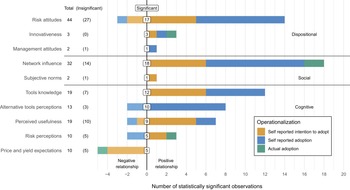
Following the overall trend observed for behavioral preferences, risk attitudes are again the most investigated psychological factor (44 observations). Network influence is also highly studied (32 observations) and has more statistically significant observations compared to risk attitudes (Figure 5). To assess the statistical significance of psychological factors observations, we collected data on effect sizes, standard errors, and p-values (if available) from the underlying studies. We consider observations statistically significant when the reported p-value was less than 0.1. Figure 5 summarizes the direction of statistically significant observation for each psychological factor, highlighting the operationalization of the outcome variable: self-reported intention to adopt, self-reported adoption, and actual adoption. For instance, risk attitudes demonstrate a statistically significant relationship with adoption across 17 studies, of which 3 identify a negative association, while 14 report a positive association. Among these studies, 7 operationalize adoption through self-reported intention to adopt, whereas 10 measure self-reported adoption. Network influence, tools knowledge, and innovativeness have a clear positive correlation with adoption decisions, while higher price expectations are negatively correlated with adoption. Other factors present mixed results, such as risk attitudes, risk perceptions, and perceived usefulness, while social norms and management attitudes have not been investigated enough to derive ultimate conclusions.
Relationship direction between each psychological factor and adoption decision.
Notes: The top bar shows that out of 44 observations, 27 find a statistically insignificant relationship and 17 a statistically significant one between risk attitudes and the adoption of risk management tools, with 3 showing a negative relationship and 14 showing a positive one. Statistically significant results are divided by the operationalization of the outcome variable, the top bar shows that 7 observations use self reported intention to adopt while the rest use self reported adoption. See supplementary Table S5 for a description of each psychological factor.

Figure 5 Long description
A horizontal bar graph compares the number of statistically significant observations of various psychological factors influencing the adoption of risk management tools. The horizontal axis represents the number of statistically significant observations, ranging from -4 to 20. The vertical axis lists different psychological factors categorized into Dispositional, Social, and Cognitive. Each bar is divided into sections representing different operationalizations: self-reported intention to adopt, self-reported adoption, and actual adoption, color-coded in orange, blue, and green respectively. The graph shows both negative and positive relationships. For example, Risk attitudes have 27 insignificant observations, 3 negative, and 14 positive significant observations. Network influence shows 14 insignificant, 18 significant observations with a mix of operationalizations. Tools knowledge has 7 insignificant, 12 significant observations. The legend explains the color coding for operationalizations. The graph provides a detailed view of how different psychological factors relate to the adoption of risk management tools.
4.3.1. Dispositional factors
Dispositional factors include farmers’ general internal beliefs that drive behavior in a certain way. They include risk attitudes, management attitudes, and innovativeness (see supplementary Table S9 for an overview).
Risk attitudes are the most studied factor; however, most observations indicate that risk aversion has no statistically significant effect on risk management tools adoption. When the results are statistically significant, there is a general trend (14 observations) that the more producers are risk-averse, the more they adopt price risk management tools, but some papers provide the opposite evidence (3 observations). In particular, Goodwin and Schroeder (Reference Goodwin and Schroeder1994) found that risk-seeking producers are more likely to adopt forward pricing than risk-averse ones, van Winsen et al. (Reference van Winsen, de Mey, Lauwers, Van Passel, Vancauteren and Wauters2016) conclude that farmers who are more willing to accept risk are more likely to use risk management tools (i.e., forwards, futures, and insurances), and Boyer et al. (Reference Boyer, DeLong, Griffith and Martinez2024) find that farmers with higher risk tolerance (i.e., lower risk aversion) for their beef cattle operation are more likely to buy price insurance. The fact that many papers derive nonsignificant results and some even counter the general trend may be because risk attitudes are a concept which is difficult to measure. The studies found in the literature display a lot of heterogeneity in their elicitation methods.Footnote 7 This may explain the mixed results. Some derive elaborated risk constructs, where multiple questions are used to obtain a global risk measure (e.g., Franken et al., Reference Franken, Pennings and Garcia2014; Pennings and Garcia, Reference Pennings and Garcia2001; Pennings and Leuthold, Reference Pennings and Leuthold2000; Pennings and Smidts, Reference Pennings and Smidts2000). Other studies focus on diverse self-assessment scales: Likert-type (Anastassiadis et al., Reference Anastassiadis, Feil, Musshoff and Schilling2014; Isengildina and Hudson, Reference Isengildina and Hudson2001), simple dummy variables (Goodwin and Kastens, Reference Goodwin and Kastens1996; Vergara et al., Reference Vergara, Coble, Knight, Patrick and Baquet2004), or use a different risk attitude definition (Fields and Gillespie, Reference Fields and Gillespie2008; Musser, Patrick and Eckman, Reference Musser, Patrick and Eckman1996).
Innovativeness is the farmer’s attitude toward innovation, such as the adoption of new technologies or practices. This was found to have a positive statistically significant effect in all the studies in the review: for forward pricing tools, i.e., forwards, futures, and options (Coffey and Schroeder, Reference Coffey and Schroeder2019), for forwards contracts (Ricome and Reynaud, Reference Ricome and Reynaud2022), and for digital risk management tools in general (Block et al., Reference Block, Michels and Mußhoff2023).
Management attitudes reflect the preferences of farmers toward free entrepreneurship, but limited evidence was found in the literature. Farmers who state a preference for more freedom of action regarding their operationFootnote 8 are more likely to adopt futures contracts (Pennings and Leuthold, Reference Pennings and Leuthold2000). Ricome and Reynaud (Reference Ricome and Reynaud2022) found that farmers who prefer free market prices (as opposed to administrated minimum prices) are more likely to adopt forward pricing, but the results were not statistically significant.
4.3.2. Social factors
The social environment and the interpersonal relationship affect farmers’ decisions to adopt price risk management tools. Social factors include social norms and network influence (see supplementary Table S10 for an overview). Given the relevance of peers and other actors in the social sphere in the context of decision-making, network influence was found to be highly investigated and the factor with the highest number of positive and significant effects on adoption decisions.
Network influence refers to the direct impact exerted by peers, institutions, and other actors in the chain on the adoption of financial tools. It includes recommendations and encouragement, typically provided by lenders, buyers, or extension services, and information exchange among peers who can share (positive or negative) experiences with these tools. Although 14 observations reported no significant impact of network influence on adoption (Figure 5), a significant number indicate a positive relationship between the influence of different actors and adoption decisions (18 observations). For example, producer organizations play a role in the decision: farmers that view producer organizations as an important source of marketing information (Fu et al., Reference Fu, Epperson, Terza and Fletcher1988), attend organizations meeting (Asplund et al., Reference Asplund, Forster and Stout1989), or are simply organization member (Makus et al., Reference Makus, Lin, Carlson and Krebill-Prather1990), are more likely to adopt forward contracting. Another example relates to market advisory and extension services that have been found to have a positive effect on the adoption of forwards, futures, and options (Coffey and Schroeder, Reference Coffey and Schroeder2019; Davis et al., Reference Davis, Patrick, Coble, Knight and Baquet2005; Isengildina et al., Reference Isengildina, Pennings, Irwin and Good2006; Katchova and Miranda, Reference Katchova and Miranda2004; Perry and Mishra, Reference Perry and Mishra1999). Moreover, upstream and downstream actors also play a role in the decision process. Penone et al. (Reference Penone, Giampietri and Trestini2024) demonstrated that when buyers recommend forward contracts, farmers state that they will adopt them more frequently. Finally, a positive effect on the frequency of forwards contract usage was found for farmers who participated in education programs or seek information in general from magazines or digital sources (Goodwin and Schroeder, Reference Goodwin and Schroeder1994; Vergara et al., Reference Vergara, Coble, Knight, Patrick and Baquet2004).
Social norms reflect the producer’s perception of how other people think he/she should behave, also called subjective norms in the Theory of Planned Behavior (Ajzen, Reference Ajzen1991). Unlike network influence, which is more specific, social norms dictate what people ought to do. A positive effect of social norms was found in futures adoption (Michels et al., Reference Michels, Möllmann and Musshoff2019). Along the same lines, Penone et al. (Reference Penone, Giampietri and Trestini2024) found a positive effect on forwards, but the results are not statistically significant. Given the low number of observations, no clear conclusion can be drawn regarding the effect of social norms on the adoption of price risk management tools.
4.3.3. Cognitive factors
Cognitive factors are more specific and closely related to risk management and financial tools adoption decisions. They include risk perceptions, price and yield expectations, perceived usefulness, tools knowledge, and perception of alternative tools (see supplementary Table S11 for an overview). Among these, the tools knowledge is the one with the most significant positive effects on adoption decisions (Figure 5).
Tools knowledge refers to the level of understanding and the perceived ease of use of financial tools. As expected, farmers with a high (low) level of understanding are more (less) likely to adopt financial tools (Ennew et al., Reference Ennew, Morgan and Rayner1992; Patrick et al., Reference Patrick, Musser and Eckman1998; Pennings and Leuthold, Reference Pennings and Leuthold2000; Vergara et al., Reference Vergara, Coble, Knight, Patrick and Baquet2004). The perceived ease of use (or the perceived complexity) also impacts adoption decisions: a higher perceived ease of use, or lower perceived complexity, leads to higher adoption levels (Davis et al., Reference Davis, Patrick, Coble, Knight and Baquet2005; Michels et al., Reference Michels, Möllmann and Musshoff2019). Further, farmers who put higher effort into seeking information specifically about markets (market orientation), such as prices or volume traded, are more likely to hedge using futures (Meulenberg and Pennings, Reference Meulenberg and Pennings2002; Pennings and Leuthold, Reference Pennings and Leuthold2000).
Alternatives perceptions relate to how other financial tools are perceived. Most of the positive observations derive from the study by Edelman et al. (Reference Edelman, Schmiesing and Olsen1990), where investigating different farm-type use of forwards, futures, and options, found that the use of one tool is correlated with the use of other financial tools. Similarly, Makus et al. (Reference Makus, Lin, Carlson and Krebill-Prather1990) found that farms that use forward contracting are more likely to use futures and options. In contrast, Ennew et al. (Reference Ennew, Morgan and Rayner1992) and Isengildina and Hudson (Reference Isengildina and Hudson2001) found that the more other means of risk management are preferred, the less the adoption of futures.
Perceived usefulness is the perception of farmers regarding the perceived benefits and drawbacks of financial tools adoption. Most of the studies focus on the price enhancement capacity of financial tools, which is closely related to price expectations. Farmers who believe risk management tools will provide a higher price than the spot price (Meulenberg and Pennings, Reference Meulenberg and Pennings2002; Michels et al., Reference Michels, Möllmann and Musshoff2019; Pennings, Reference Pennings2002) have higher adoption levels. Another capacity is the risk reduction that these tools provide. A positive relationship was found in the literature between the perceived risk reduction performance of the tool and adoption levels (Meulenberg and Pennings, Reference Meulenberg and Pennings2002; Pennings and Leuthold, Reference Pennings and Leuthold2000; Penone et al., Reference Penone, Giampietri and Trestini2024). On the other hand, several perceptions about the drawbacks of using these tools hinder adoption. For example, the more the belief that futures markets are risky, the less the adoption of futures contracts (Ennew et al., Reference Ennew, Morgan and Rayner1992), or the more farmers are concerned about the other party not complying with the contract, the less the adoption of forwards (Penone et al., Reference Penone, Giampietri and Trestini2024).
Risk perceptions relate to the subjective assessment of price risk. The intuition would be that farmers who perceive higher price risk would adopt more risk management tools, but the evidence is mixed, and there is no clear direction on the effect that higher perceived risk has on adoption decisions. For instance, farmers who perceive high price risk were found to have higher adoption levels for futures and options (Davis et al., Reference Davis, Patrick, Coble, Knight and Baquet2005; Pennings and Garcia, Reference Pennings and Garcia2004) and forwards (Davis et al., Reference Davis, Patrick, Coble, Knight and Baquet2005). On the other end, the effect was found to be negative for futures, options, and forwards (Vergara et al., Reference Vergara, Coble, Knight, Patrick and Baquet2004). This might be due to the fact that risk perception might affect actual behavior through risk attitudes (Pennings and Garcia, Reference Pennings and Garcia2004). Producers who perceive high price risk but are risk-neutral will not use financial tools, and when no risk is perceived, a manager’s risk attitude does not influence their behavior.
Price and yield expectations reflect farmer beliefs about future prices and output levels. A clear trend was found in the literature: if farmers believe that prices at harvest would be higher (lower) than current prices, they state that they are less (more) willing to adopt risk management tools (Anastassiadis et al., Reference Anastassiadis, Feil, Musshoff and Schilling2014; Davis et al., Reference Davis, Patrick, Coble, Knight and Baquet2005; Ricome and Reynaud, Reference Ricome and Reynaud2022). Nonetheless, almost all observations relate to a self-reported intention to adopt financial tools (Figure 5) providing less validity to support the claim. Interestingly, these expectations are often based on the current spot price being the reference point. Yield expectation can influence the adoption of forward contracts because they directly affect farmers’ ability to meet contractual obligations. Producers determine whether the benefits of hedging price risk outweigh the potential costs and risks associated with committing to fixed production volume. This was studied in only one paper (Roussy et al., Reference Roussy, Ridier, Chaib and Boyet2018), but no significant effect was found.
5. Discussion
This literature review systematically summarizes the role of behavioral preferences and psychological factors in the adoption of price risk management tools. Unlike existing reviews, this synthesis emphasizes how different behavioral and psychological mechanisms imply distinct modeling approaches and policy levers, rather than treating them as interchangeable determinants of adoption. Several behavioral preferences and psychological factors are currently represented by very few studies. Additionally, although we conducted a quality assessment of the included studies (Table S4) our synthesis does not weight reports by their methodological rigor. Conclusions should therefore be interpreted as indicative of research patterns rather than definitive.
We find a shift that started in 2002, from economic models that incorporate behavioral preferences to studies that use psychological factors to explain adoption. Behavioral preference studies mostly include models that derive optimal hedging decisions under different levels of risk aversion, while the role of more advanced behavioral economic concepts, such as loss aversion or probability weighting in price hedging decisions, is underexplored. Psychological factors provide more flexibility in explaining decision-making beyond purely economic preferences, but price hedging decisions are economic decisions under risk. We are therefore surprised by the recent overweight of psychological studies compared to the deficiency of experimental behavioral economic research and suggest that future research should explore this further. Notably, the post 2010 decline pertains specifically to studies that formally embed behavioral preferences within structural decision models, while survey-based approaches capturing psychological factors without explicit parameterization have continued to appear. Two nonexclusive explanations may account for this shift. First, assessments of psychological traits are typically easier to implement: they do not require time-intensive experimental elicitation tasks or the specification and estimation of an underlying decision-theoretic framework. Second, psychological measures often provide greater flexibility, given that the universe of potentially relevant psychological constructs is wider than the set of formally parameterized behavioral preferences. Consequently, researchers can more readily investigate correlations between elicited traits and observed farmer behavior without committing to a fully specified structural model.
A large share of the literature is theoretical and focuses on optimal hedging decisions, which are driven by producers’ risk preferences (i.e., risk-averse, risk-neutral, and risk-seeking attitudes). However, findings regarding risk attitudes in the psychological factors’ side of the literature have been mixed (Figure 5), with many studies that elicit risk attitudes finding no correlation with adoption decisions. Therefore, further research is needed to identify preferences that drive price hedging decisions.
The neoclassical models for risk management decisions have been extended by considering factors beyond risk preferences. Working (Reference Working1953) recognized early that hedging couldn’t be explained solely in terms of risk reduction but also as a source of potential profits, giving rise to speculative behavior. Anderson and Danthine (Reference Anderson and Danthine1980), included this possibility in their hedging model, viewing the optimal hedge as a sum of a risk-minimizing and a speculative position. Several other papers extended these traditional models by investigating different nonbehavioral factors that have a negative impact on the optimal hedging position, among which: production uncertainty (e.g., Ho, Reference Ho1984; Karp, Reference Karp1987; Lence, Reference Lence1996; McKinnon, Reference McKinnon1967), diversification (e.g., Berck, Reference Berck1981), financial leverage (e.g., Turvey and Baker, Reference Turvey and Baker1989), transaction costs (e.g., Pannell et al., Reference Pannell, Hailu, Weersink and Burt2008), and the use of subsidized nonprice insurance (e.g., Coble et al., Reference Coble, Zuniga and Heifner2003; Makus et al., Reference Makus, Wang and Chen2007). These models have also been expanded by considering different definitions of risk: while the traditional M-V model assumes that farmers are willing to renounce upside potential opportunities to reduce variance, a downside risk approach has been considered (Mattos et al., Reference Mattos, Garcia and Nelson2008a; Turvey and Nayak, Reference Turvey and Nayak2003), or considering skewness in the price distribution (Gilbert et al., Reference Gilbert, Jones and Morris2006; Vercammen, Reference Vercammen1995). Other decision rules that consider behavioral preferences have also been employed, such as stochastic dominance (Gloy and Baker, Reference Gloy and Baker2002; Parcel and Langemeijer, Reference Parcel and Langemeijer1997) and Value at Risk (Schütz and Westgaard, Reference Schütz and Westgaard2018). Besides Shapiro and Brorsen (Reference Shapiro and Brorsen1988), that elicited an Arrow-Pratt risk aversion and related to futures adoption, no other behavioral economic studies exist that empirically relate elicited behavioral economic preferences (e.g., based on the approach suggested by Tanaka et al., Reference Tanaka, Camerer and Nguyen2010) to the adoption of price risk management tools.
Moving away from the normative approach of EU and M-V frameworks toward behavioral economics insights seems to be a promising path for future research to better explain and predict farmers’ price risk management decisions, which has been little explored so far. Only a handful of studies explore behavioral preferences that shed light on the relation between price risk management and reference dependence, loss aversion, uncertainty preferences, and time preferences. Regarding this matter, reference dependence has been applied both to the traditional M-V model (Turvey and Nayak, Reference Turvey and Nayak2003) and to the prospect theory model (Mattos et al., Reference Mattos, Garcia and Pennings2008b), which are, however, both simulational in nature and lack an experimental confirmation. Those simulational findings are confirmed in studies on psychological factors (e.g., Anastassiadis et al., Reference Anastassiadis, Feil, Musshoff and Schilling2014; Davis et al., Reference Davis, Patrick, Coble, Knight and Baquet2005; Ricome and Reynaud, Reference Ricome and Reynaud2022), where price expectations depend on a reference level (often the status quo).
A related concept to reference dependence is loss aversion, but conceptually it seems to have little explanatory power regarding farmers’ price risk management decisions, at least in a classical risk management framing of the decision (Figure 4). Insights from psychological factors investigations suggest that some papers elicit risk attitudes framing the question as loss aversion, for example, Musser et al. (Reference Musser, Patrick and Eckman1996) ask farmers if they are more concerned about a large loss in their farm operation than missing a substantial gain. Nonetheless, no experimental studies exist that implement tasks to reveal farmers’ sensitivity to losses relative to gains and relate them to actual price risk management decisions.
CPT incorporates not only reference dependence and loss aversion, but also a biased perception of probability distributions. Mattos et al. (Reference Mattos, Garcia and Pennings2008b) concluded that changes in probability weighting affect hedge ratios relatively more than changes in loss and risk aversion, but again, the shape of the weighting function or any other form of probability distortion has not been related to price risk management decisions in any experimental work.
From a policy perspective, insight on loss aversion, reference dependence, and probability weighting suggest that risk management adoption may be improved by reframing outreach around income stabilization and downside protection. Moreover, extension programs that explicitly acknowledge reference prices may therefore be more effective than purely informational approaches when promoting the use of price risk management tools. However, these policy implications should be interpreted with caution, as the found evidence is limited, highlighting the need for further experimental and field-based validation.
Another promising avenue from behavioral economics that received little attention in the context of price risk management is decision making under uncertainty and ambiguity. Only one study investigated uncertainty aversion (Frechette, Reference Frechette2005) but this has no impact on the decision (Figure 4). Uncertainty preferences have been investigated in relation to farmers’ decisions to enter contract farming to mitigate uncertainty related to future market prices of agricultural commodities (e.g., Cerroni, Reference Cerroni2020, Reference Cerroni, Bozzola and Rippo2023). Other theories might offer better behavior explanations, such as Subjective EUT (Savage, Reference Savage1954), Smooth ambiguity model (Klibanoff et al., Reference Klibanoff, Marinacci and Mukerji2005), Alpha EUT (Ghirardato et al., Reference Ghirardato, Maccheroni and Marinacci2004), or multi-reference theories (Wang and Johnson, Reference Wang and Johnson2012). These theories were developed to find better explanations of behavior than EUT models, given the fact that people often do not behave in accordance with EUT predictions. It also remains an open question as to how far behaviors, with growing experience, converge toward a rational benchmark (List, Reference List2003). Given that price risk management tools are designed to hedge against future price risk, price risk management decisions are an intertemporal choice. In this context, few studies have considered time preferences and price risk management tools in simulations (Frechette, Reference Frechette2005; Ho, Reference Ho1984; Karp, Reference Karp1987; Kuwornu et al., Reference Kuwornu, Kuiper, Pennings and Meulenberg2005; Lence et al., Reference Lence, Kimle and Hayenga1993; Myers and Hanson, Reference Myers and Hanson1996). Recent evidence shows that farmers elicited time preferences in the US and Europe seem to be unrealistically high (Wuepper et al., Reference Wuepper, Henzmann and Finger2023b). Therefore, behavioral discounting models (such as quasi-hyperbolic discounting) might allow for a more flexible representation of farmers’ time preferences, including a present bias (Liebenehm and Waibel, Reference Liebenehm and Waibel2014). Present-biased preferences may contribute to the underutilization of tools whose benefits accrue in the future while costs are immediate. Policies targeted to reduce upfront costs, simplify commitment decisions, or introduce default or automated risk management options may help mitigate present bias.
We did not find a single study that formally models a heuristic, for instance, through a decision tree, rather than utility maximization. The vast literature in psychology on heuristics (Gigerenzer and Gaissmaier, Reference Gigerenzer and Gaissmaier2011) has yet to find its way into the general Agricultural Economics literature and the literature on adoption and use of financial tools.
Hedging decisions are shaped not only by risk consideration and behavioral preference but also by psychological factors that have not yet been considered in theoretical specifications regarding financial tools for price risk management. Based on the insights derived from the psychological factor investigation, incorporating network influences in decision models is a particularly promising avenue (Figure 5). Much empirical work on technology adoption in agriculture uses simple measures of network influence, such as the number of peers adopting a tool, or behaviorally informed interventions that state average adoption numbers of a relevant peer group. A new approach is to open this black box of social norms by investigating mechanisms in farmer samples (Raineau et al., Reference Raineau, Giraud-Héraud and Lecocq2025) and to consider the distribution rather than averages in relevant peer networks (Dimant et al., Reference Dimant, Gelfand, Hochleitner and Sonderegger2024). Nonetheless, insights from network influences suggest that extension services, financial tools providers, and policy makers can have a role in providing training and education to improve farmers’ decision-making ability regarding price risk. For example by engaging influential or central actors within farmer networks rather than relying on generic promotion. Moreover, the importance of tool knowledge in adoption decisions underscores the need of reducing informational barriers trough targeted training peer-based learning, practical demonstrations, and decision-support tools.
Finally, several of the latest developments in the behavioral economics literature in Agricultural Economics could also be relevant for a better understanding of the adoption of financial risk management tools. For instance, culturally shaped experiences and beliefs play an important role in financial decisions in general (Malmendier, Reference Malmendier2021). Likewise, farmers’ cultural differences can lead to differences in conservation practices (Wang et al., Reference Wang, Schaub, Wuepper and Finger2023). A small literature is also concerned with the role of identity in the adoption of environmentally friendly practices (Faccioli et al., Reference Faccioli, Czajkowski, Glenk and Martin-Ortega2020; Zemo and Termansen, Reference Zemo and Termansen2022), and this literature could be relevant for the adoption of financial tools as well.
A notable shortcoming of the existing literature is the unbalance toward futures-based hedging compared to other instruments available to farmers. Unlike forwards and futures contracts, that generate linear payoffs, options and insurances generate asymmetric, truncated payoff distributions that can fundamentally alter optimal hedging positions. This may interact differently with behavioral preferences and psychological factors, implying that results derived from a majority of studies on future and forwards, may not fully generalize to other price risk management tools.
Option prices also embed market-implied probability distributions for future prices. One can assume that most producers do not directly observe or interpret implied volatility. This arguably turns the hedging decision from a decision under risk (based on probabilities taken from implied volatility) into a decision under uncertainty (based on farmers individual expectations on future price developments. This nonuse of implied volatility has received little attention in the behavioral risk management literature, highlighting a gap between available market information and farm-level risk assessment. If it is uncertainty rather than risk that is the driving force behind the price hedging decision of farmers, it is rather farmers’ ambiguity aversion rather than risk aversion that should be used to model this decision.
Although we thoroughly designed this systematic review and followed our pre-registered procedure, some limitations remain. First, during the review process, it became evident that the intended combination of keywords and search strategy (in title, abstract, and keywords of the reviewed papers) did not identify all relevant studies. While we planned for this by suggesting a backward and forward snowballing in our pre-registered methodological procedure, we were surprised by the number of studies that was identified in the snowballing compared to the initial search. Around half of the relevant papers did not include the selected search terms in searchable fields such as the title, abstract, or keywords, but rather within the main body of the text. A second common limitation applies to our review. Because of publication bias and underpowered study designs in published papers, we may overestimate the number of statistically significant findings and their effect sizes (Ferraro and Shukla, Reference Ferraro and Shukla2023). We may also miss out on important effects due to small sample sizes in studies with farmers (type II error).
Lastly, while the focus on advanced economies is appropriate given markets availability, it is important to note that this setting may not transfer to developing countries. In environments with thinner markets and higher price uncertainty, behavioral preferences may play a larger role in decision-making (Mishra et al., Reference Mishra, Kumbhakar and Lien2023), as producers face fewer opportunities to transfer risk through market instruments. Moreover, limited access to formal risk management tools may constrain choice sets and amplify the impact of behavioral biases on decision-making. As a result, the behavioral mechanisms identified in this review may operate differently in such settings, limiting the external validity of our results.
6. Conclusion
This study systematically reviewed the literature on how behavioral factors impact financial tools adoption for price risk management. These behavioral factors were divided into behavioral preferences and psychological factors based on their incorporation into economic choice models. Our results show that the neoclassical models, based on the notion that optimal hedging decisions, primarily driven by producers’ risk preferences, are still the central frameworks of price risk management. Empirical findings on risk attitudes remain mixed, with many studies finding little correlation between elicited risk measures and hedging adoption. This suggests that factors such as reference dependence, loss aversion, probability weighting, and decision making under uncertainty may better explain farmers’ financial tools adoption decisions. Some instances were identified that tried to shift the focus from normative models toward a behavioral economics approach, but more effort in this direction is required.
Regarding psychological factors, the literature indicates that non-risk variables, such as network influence or tools knowledge, in the domain of social and cognitive factors, also play a role in farmers’ hedging decisions. These insights underscore the importance of incorporating more psychological factors in economic choice models. Despite promising but timid theoretical advances, the lack of empirical studies that employ experimental tasks to elicit farmers’ behavioral preferences (e.g., loss aversion, reference dependence, and probability weighting) highlights an important avenue for future research.
Supplementary material
The supplementary material for this article can be found at https://doi.org/10.1017/aae.2026.10044.
Data availability statement
Data was collected from peer reviewed studies available on Scopus, WebOfScience, and AgEcon Search. Both data and .R script file for tables and figures replications are provided in supplementary material.
Author contributions
Conceptualization, R.S., L.M., J.R., S.C., and T.D.; Methodology, R.S. and T.D.; Formal Analysis, R.S.; Data Curation, R.S. and L.M.; Writing – Original Draft, R.S.; Writing – Review and Editing, R.S., L.M., J.R., S.C., M.P.M.M., and T.D.; Validation, R.S.; Visualization, R.S.; Software, R.S. and L.M.; Investigation, R.S.; Funding Acquisition, J.R., S.C., and T.D.
Financial support
This work has received funding from the European Commission (grant agreement 101136474 – AgEnRes project). Open access funding provided by Wageningen University & Research.
Competing interests
All the authors declare no conflict of interests.
AI contributions to research
Claude (Sonnet 3.7-4) was used to improve grammar and readability of the text, and for debugging code.




 Open access

