


Introduction
Scholars and practitioners variously describe non-state actors such as Greenpeace as ‘civil society organisations’ (CSO), ‘interest groups’, ‘non-governmental organisations’ (NGO), ‘not-for-profit organisations’, or ‘third sector organisations’, to name but a few of the plethora of terms that has emerged over time (see Enjolras et al. Reference Enjolras, Salamon, Henrik Sivesind and Zimmer2018, Chapter 1). Those new to the field will likely find this state of affairs confusing; practitioners may either perceive such proliferation of terminology as useless academic squabbles or—to the extent that they have tuned into the finer lines of debate—may use the terms strategically. More than ten years ago, Beyers et al. (Reference Beyers, Eising and Maloney2008) drew attention to this problem by arguing that ‘it is quite remarkable how such a relatively modest field is so heavily Balkanised’. They argued that different conceptual approaches have resulted from historical use of terminology, but crucially also point to linked normative assumptions, particularly in the case of ‘civil society’ (Beyers et al. Reference Beyers, Eising and Maloney2008). In the intervening decade, limited progress has been made to advance these conceptual debates, let alone track them over time. This paper addresses this gap by asking what terms have been used to describe and analyse non-state actors over time, and what normative visions are attached to them insofar as they relate to the EU’s evolving democracy. Doing so is relevant not only for research endeavours on the role of non-state actors in the EU, but also for practitioners seeking to work with non-state actors.
Analytically, this paper draws on the tool of a ‘frame’. Frames are ‘underlying structures or organizing principles that hold together and give coherence to a diverse array of symbols, idea elements, metaphors and other cognitive elements’ (Creed et al. Reference Creed, Langstraat and Scully2002, p. 36; see also Shore and Wright Reference Shore and Wright1997). They are thus ‘schemata of interpretation’, or mental structures, which order what would otherwise appear disjointed (Goffman Reference Goffman1974, p. 21; see also Creed et al. Reference Creed, Langstraat and Scully2002). Framing implies organising cognitive elements such as ideas, practices, or beliefs into coherent networks (Benford and Snow Reference Benford and Snow2000). Analysing frames has gained popularity in social sciences as a way of expanding our understanding of how people make meaning in networked ways, including framing endeavours by non-state actors (Boräng et al. Reference Boräng, Eising, Klüver, Mahoney, Naurin, Rasch and Rozbicka2014). This paper in turn argues that terminological choices in describing non-state actors matter, because each term signifies underlying ideational networks or frames about the roles and functions of these organisations in democratic systems (see Kutay Reference Kutay2017). While the paper adopts ‘non-state actor’ for narrative purposes—in line with the Oxford Dictionary of English (3rd ed.) understanding a non-state actor broadly as ‘an individual or organization that has significant political influence but is not allied to any particular country or state’, it seeks to disentangle the terminology used in scholarship in order to shine a spotlight on academia’s key role in framing non-state actors. While non-state actors may include armed or terrorist groups (see Clapham Reference Clapham and Chetail2009, p. 200), the focus of this paper is on actors that are generally considered legitimate elements of EU governance.
Developing a better understanding of the framing of non-state actors by researchers matters for two reasons: first, it contributes to the conceptual clarity of the field, which is undermined if terminology is used uncritically or randomly, and especially if underlying normative implications remain unclear (Beyers et al. Reference Beyers, Eising and Maloney2008). Clear concepts are also a precondition for fruitful empirical explorations (see Baroni et al. Reference Baroni, Carroll, Chalmers, Marquez and Rasmussen2014; Sartori Reference Sartori1970). Second, this paper argues that more than mere conceptual and definitional issues are at stake, because each frame captures a normative vision about the role of non-state actors in the delivery of social values and public goods such as democracy, environmental protection, citizen engagement, and others. Frames may influence other academics, policy-makers, and citizens regarding (1) what we can expect from non-state actors and (2) the normative role that non-state actors should play in the European polity. Scholars have already noted the power of framing that non-state actors conduct themselves (Boräng et al. Reference Boräng, Eising, Klüver, Mahoney, Naurin, Rasch and Rozbicka2014; Boräng and Naurin Reference Boräng and Naurin2015; Klüver and Mahoney Reference Klüver and Mahoney2015). It is thus high time to consider how scholars frame non-state actors in their own work and with what (explicit or implicit) normative connotations.
Empirically, this paper contributes a fresh bibliometric analysis of a novel literature database containing 780 academic publications on non-state actors in the European Union (EU) that have appeared between 1992 and 2020. The EU has been identified as a particularly dynamic site of non-state actor interest and involvement—often described as various forms of lobbying. The growth of these activities has attracted the attention of an international community of scholars (Bunea and Baumgartner Reference Bunea and Baumgartner2014). Prominent existing studies have addressed the number of EU non-state actors (Berkhout et al. Reference Berkhout, Carroll, Braun, Chalmers, Destrooper, Lowery and Rasmussen2015; Wonka et al. Reference Wonka, Baumgartner, Mahoney and Berkhout2010), their funding and regulation (see Greenwood Reference Greenwood2017), their access to the European institutions (e.g. Albareda and Braun Reference Albareda and Braun2019; Arras and Beyers Reference Arras and Beyers2020; Coen and Katsaitis Reference Coen and Katsaitis2019), their influence (Dür, Reference Dür2007; Klüver Reference Klüver2013), their strategies as well as their professionalisation (Klüver and Saurugger Reference Klüver and Saurugger2013; Maloney et al. Reference Maloney, Hafner-Fink and Fink-Hafner2018). A second reason why the EU is a particularly useful site of empirical study for the current paper is that has always been an evolving political system with vibrant debates on its democratic nature and quality (e.g. Warleigh Reference Warleigh2003), which has stimulated research on the role of non-state actors’ contribution to democratic governance (Kohler-Koch and Quittkat Reference Kohler-Koch and Quittkat2013; Saurugger Reference Saurugger2008).
The paper proceeds as follows: It starts with an overview of framing approaches and then describes the empirical methods, namely combining bibliometric and keyword analyses with a literature review in order to expose the prevalence and emergence of prevalent frames of non-state actor research in the EU. The fourth section disentangles prominent conceptual frames and demonstrates how they contain democratic ideals of the EU polity. The paper concludes by highlighting the growing importance of academic framing in EU non-state actor politics.
Framing Approaches
Framing approaches have been especially popular among social movement scholars, who ask how social movement leaders frame strategically to mobilise people (Snow et al. Reference Snow, Rochford, Worden and Benford1986). For instance, ‘collective action frames’ combine events and information that may otherwise seem disconnected, in order to define problems and, after linking them to solutions, provide rationales for action (Benford and Snow Reference Benford and Snow2000; Rein and Schön Reference Rein, Schön, Wagner, Hirschon Weiss, Wittrock and Wollmann1991). In political terms, frames can be powerful—for example, ‘old’ issues can be turned into ‘new’ ones by reframing them (Chong and Druckman Reference Chong and Druckman2007) and one can bridge, connect, and extend, but also manipulate frames and use them strategically (Mazey and Richardson Reference Mazey, Richardson, Edwards and Spence1997). In Lakoff’s (Reference Lakoff2004) terms,
In politics our frames shape our social policies and the institutions we form to carry out policies. To change our frames is to change all of this. Reframing is social change. (p. XV; emphasis in original).
For example, Ruzza (Reference Ruzza2004, p. 58) explains how governments and non-state actors reframed ‘environmentalism’ as ‘sustainable development’ and how this new frame enabled business actors to collaborate on environmental issues. This paper argues that social scientists create and manipulate frames by describing and researching social or political phenomena, including non-state actors. Precisely because terms such as CSO or NGO remain diffuse and variable, their use implies constant re-framing and linking with normative ideas about the their (political) context (here the European polity), even if this happens in an academic environment.
Not all frames are equally effective. Benford and Snow (Reference Benford and Snow2000) identify a few ‘master frames’ that have been used to rally large constituencies behind certain causes, such as the ‘environmental justice frame’. Some frames resonate more than others, depending on their fit with social movements, the wider life-world and whether people articulating them are perceived as credible (Benford and Snow Reference Benford and Snow2000). Frame efficacy also depends on institutional environments (Ruzza Reference Ruzza2004). Those studying framing should therefore identify whether certain master frames exist and consider their interactions with outside factors.
Finally, framing is a dynamic process because people intentionally or unintentionally change, adjust and sometimes manipulate frames (Chong and Druckman Reference Chong and Druckman2007; see also Benford and Snow Reference Benford and Snow2000; Tarrow Reference Tarrow, Morris and Mueller1992). Callon (Reference Callon and Callon1998) argues that frames are inherently dynamic because the elements they comprise remain connected with the world by virtue of their origin. This creates constant frame ‘overflow’, meaning that frame contents contribute to ongoing frame emergence and re-framing (Callon Reference Callon and Callon1998). In light of these properties, there is to date very limited knowledge on the origin of frames, how they move through political space, and how long they remain more or less stable (Chong and Druckman Reference Chong and Druckman2007; but see Entman Reference Entman2009; Gamson Reference Gamson and Entman2005).
This paper focuses on the framing of non-state actors by academia in the EU, while fully recognising that other actors such as politicians and bureaucrats may also contribute to this process (see Smismans Reference Smismans2003). It also remains cognizant of frame dynamism, which includes horizontal interactions, levels of frame overlap, and frame differentiation. Importantly, framing processes are often highly political because their outcomes may have implications for access to reputational, monetary, and other resources. For example, certain CSOs receive financial support from the EU institutions (Bouwen Reference Bouwen, Coen and Richardson2009). The following section describes the methods used in order to identify prevalent frames and their dynamic emergence in research on non-state actors over time.
Methods
This section describes the methods applied to create the new database and to analyse it with bibliometric tools.
Assembling the New Database
The first step involved searching the prevalent academic databases Scopus,® Web of Knowledge,SM and Proquest International Bibliography of the Social Sciences (IBSS) for relevant academic publications. These databases provide a broad, multidisciplinary coverage of multiple academic fields including political science, sociology, and geography. The approach applied in this research is thus more comprehensive than earlier efforts, which had exclusively focused on political science and public policy studies (Bunea and Baumgartner Reference Bunea and Baumgartner2014). The sample from these databases thus provides a good estimation of the nature of publications on non-state actors (Andrés Reference Andrés2009). The search was based on an extensive collection of terms or keywordsFootnote 1 drawn from the literature review by Beyers and colleagues (Reference Beyers, Eising and Maloney2008) and turned into search text with Boolean indicators. The raw data were imported into the reference management software program Citavi and duplicates removed. The search includes all journal articles, book chapters, and other relevant publications, while books on the subject were excluded.Footnote 2 In addition, all articles whose titles and/or abstracts did not clearly indicate that they were about non-state actors in the EU were removed.
Bibliometric Analysis
The second step involved analysing the full database with bibliometric approaches (Andrés Reference Andrés2009; Donohue Reference Donohue1973) in order to evaluate the prevalence of frames in literatures on non-state actors in the EU. First, the publication year was recorded for each item in the qualitative analysis software NVIVO. Second, depending on the emergence of keywords in the titles and abstracts, publications were coded into corresponding categories signifying descriptive framesFootnote 3; four frame signifiers emerged as strongest, namely interest group; NGO; civil society organisation; and multiple frames. Keywords that did not feature in at least 10 articles in any one year between 1992 and 2020Footnote 4 are not reported.Footnote 5 Third, each publication was subjected to a keyword query using NVIVO. To this end, each publication was stripped of its bibliography and the software then identified the most commonly used keywords in all publications that had been assigned to one of the four main frame signifiers. Only words with three or more characters were included in the analysis, and word clouds were generated in order to support interpretation. In parallel, a literature review was conducted in order to identify linkages between the terms identified, drawing on the author’s knowledge of the field, as well as on the contents of the database.
Results
Bibliometric Analysis
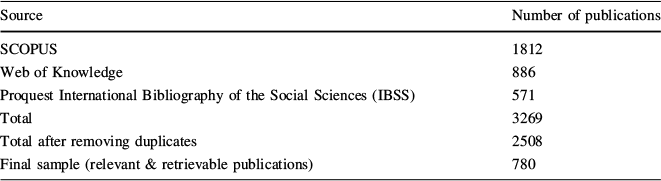
The initial combined database search returned more than 3000 hits (see Table 1).Footnote 6 The search involved all publications that the author was able to retrieve from as early as possible (1992) until June 2020.
Identifying frames in research on non-state actors in the EU

Source |
Number of publications |
|---|---|
SCOPUS |
1812 |
Web of Knowledge |
886 |
Proquest International Bibliography of the Social Sciences (IBSS) |
571 |
Total |
3269 |
Total after removing duplicates |
2508 |
Final sample (relevant & retrievable publications) |
780 |
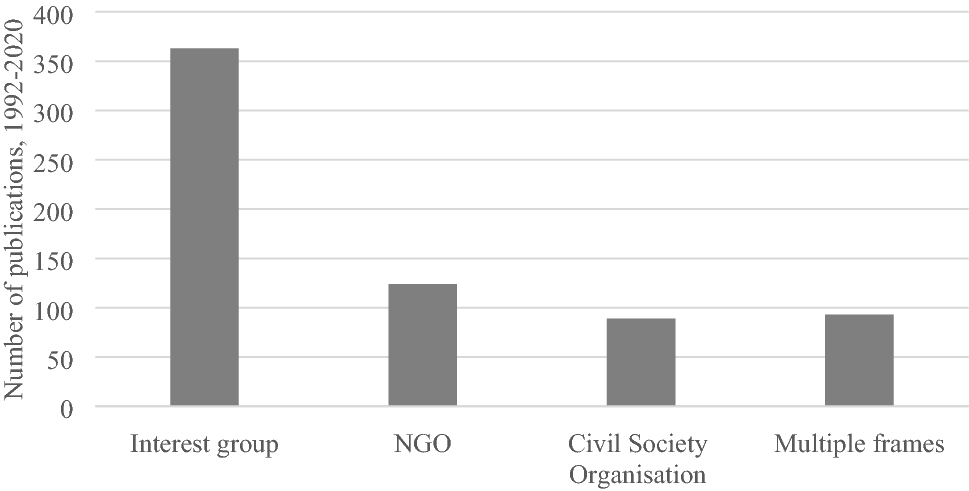
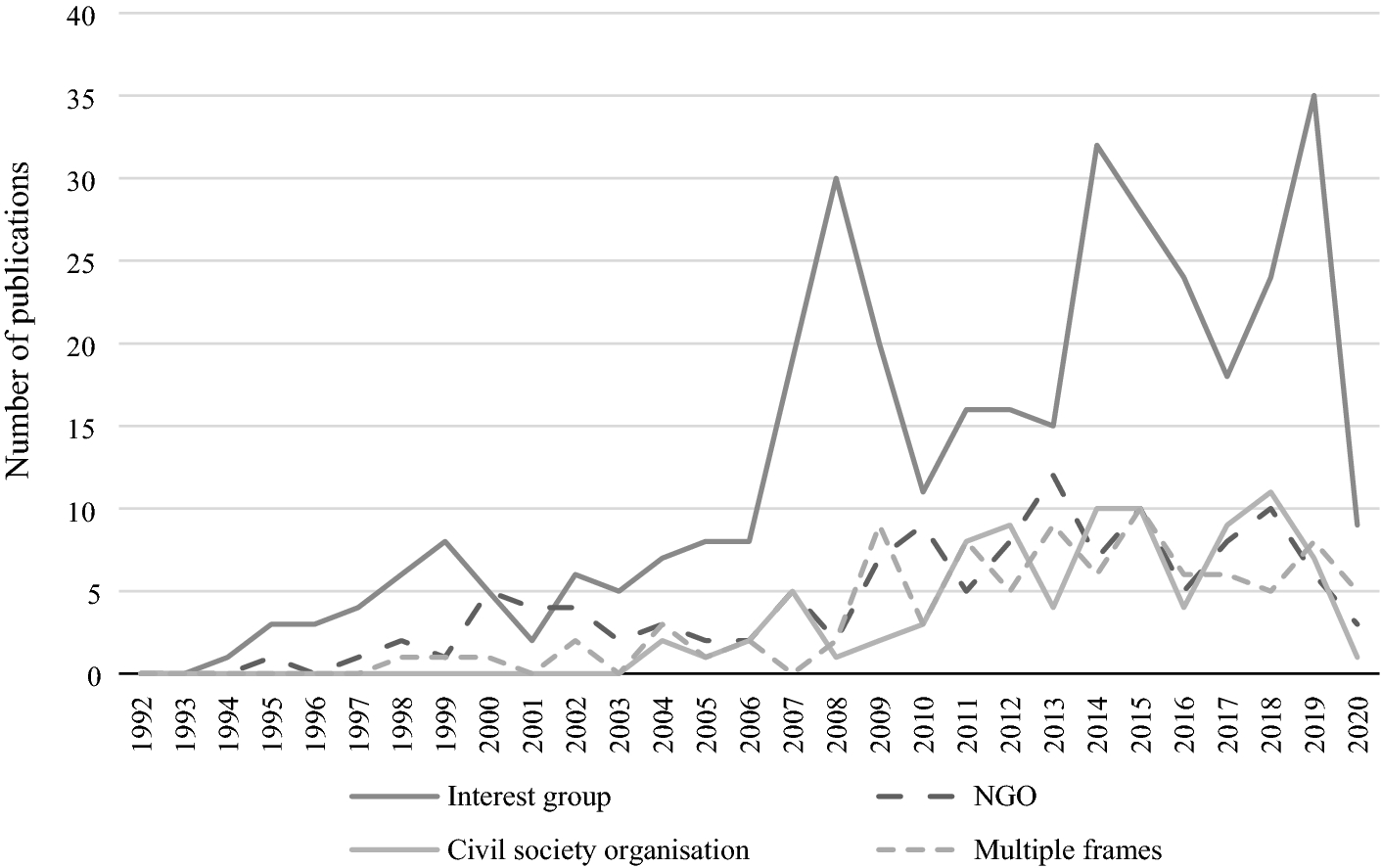
After the initial data screening (see above), including removing duplicates and sifting through the studies that resulted from this process, 780 publications remained. In total, the publications from the three major frames and those using multiple fames sum up to 669 publications or 85.9% of the database. The analysis demonstrates that nearly half of the publications fell into the ‘interest group’ frame, followed by ‘NGOs’, ‘multiple frames’, and ‘civil society organisation’. See Fig. 1. Figure 2 reveals the remarkable general growth of publications on non-state actors, beginning in the early 2000s. Furthermore, this figure reveals the rise of ‘civil society’ as a keyword in article titles from the early 2000s onwards, remaining roughly on par with ‘NGO’. The ‘interest group’ frame began dominating in the early 2000s; note that the numbers for 2020 only include the first half of the year.
Key frames in academic publications on non-state actors in the EU

A second step involved tracing the emergence of the four major frames in academic publications over time (see Fig. 2).
Frame usage of academic publications on non-state actors in the EU

Prevalent Frames in Research on Non-state Actors in the EU
This section unpacks the contents of each main frame in greater detail, drawing on the keyword-based insights as well as on a corresponding literature review.
The ‘Interest Group’ Frame
The ‘interest group’ frame has by and large been the most popular in the study of non-state actors in the EU. But it is also a contentious concept in political science. As Jordan et al. (Reference Jordan, Halpin and Maloney2004) explain, interest groups were originally constituted and sustained by individual members (see also Dalziel Reference Dalziel, Anheier, Toepler and List2010). As such, they have an ‘underlying rationale’ that is based on the attitudes or interests of their members (Eising and Lehringer Reference Eising, Lehringer, Cini and Pérez-Solórzano Borragán2013). In practice, scholars often deviate from this membership-based idea by categorising all groups that seek to influence political processes as ‘interest groups’ (Jordan et al. Reference Jordan, Halpin and Maloney2004). As a response, some have sought to clarify the concept by refocusing it on the original membership-inspired idea while engaging with functional approaches: Jordan and colleagues (Reference Jordan, Halpin and Maloney2004) suggest labelling all entities which seek to influence public policy as ‘pressure participants’, but distinguishing between ‘policy participants’, which would be individual companies, and interest/pressure groups, which are typically groups of individuals or other organisations/companies that seek to influence the policy process. However, some staff-based groups may also be classified as interest groups (Jordan et al. Reference Jordan, Halpin and Maloney2004).
Others, such as Beyers and colleagues (Reference Beyers, Eising and Maloney2008) seek to define an interest group based on the key organisational features of ‘organisation’, ‘political interests’, and ‘informality’. The ‘organisation’ component distinguishes the interest groups from other influences on public policy, such as social movements or public opinion. ‘Political interest’ means that these groups seek to influence public policy, and ‘informality’ refers to the fact that these groups do not seek formal political positions (Beyers et al. Reference Beyers, Eising and Maloney2008). Beyers and colleagues (Reference Beyers, Eising and Maloney2008) highlight that this fairly broad definition encompasses a diverse spectrum of actors.
The aforementioned attempts to clarify the concept are mostly done by researchers seeking to operationalise the concept for data collection. There are, however, normative notions included in the ‘interest group’ frame. The basic idea is that there are multiple groups in a polity pushing for the interests that they represent—and therefore the frame implies pluralist notions of democratic governance (Truman Reference Truman1951). This idea assumes that interest groups have more or less fixed preferences which are brought to the fore and worked through the relevant institutional context, such as the EU (Mansbridge Reference Mansbridge and Petracca1992). Policy-makers appear to have had different perceptions—Doliwa-Klepacka (Reference Doliwa-Klepacka2011) argues that the European Commission introduced the frame, because it felt that it was politically anodyne, especially compared to the term lobbyist/lobbying, which was thought to contain negative connotations. The fact that the keyword ‘lobby’ ranks in the top ten words used in publications with ‘interest group’ in the abstract/title shows that this is one of the key contents of the ‘interest group’ frame. However, the word ‘member’ also emerges in 12th place, indicating that some elements remain from its original formulation (see Fig. 3). In this line of thinking, the ‘interest group’ label insinuates a ‘Europe of interests’. The latter argument sits well with liberal democratic ideas about political processes (Held Reference Held2006). These normative notions are easily forgotten when the term interest group is used.
Interest group frame

The ‘Non-Governmental Organisation’ (NGO) Frame
The non-governmental organisation (NGO) frame, which the United Nations (UN) created in 1945 in order to formalise how non-state actors participate in UN processes, has become increasingly prevalent in politics and academia, particularly in the 1980s and 1990s when neoliberal agendas sought to push back the state and allocate tasks to markets and other actors, including NGOs (Lewis Reference Lewis, Anheier, Toepler and List2010). However, ‘while the term “NGO” is widely used, there are also many other overlapping terms such as “non-profit”, “voluntary”, and “civil society organisations”’ (Lewis Reference Lewis, Anheier, Toepler and List2010, p. 1057), which may be related to historical path dependencies in term usage in different parts of the world, but also to the fact that NGOs tend to be very diverse organisations (Lewis Reference Lewis, Anheier, Toepler and List2010). Lewis (Reference Lewis, Anheier, Toepler and List2010) argues that NGO activities may be understood in two broad categories: service provision and political advocacy. Many of the NGOs active in the EU are indeed ‘umbrella organisations’ performing political advocacy for a range of NGOs in their membership (Melville Reference Melville, Anheier, Toepler and List2010), or they represent globally active organisations such as Greenpeace or the WWF.
On a fairly basic level, the term NGO signifies an organisation that is neither governmental nor part of the market (therefore sometimes also described as belonging to the ‘third sector’). This framing becomes a source of legitimacy derived from a perceived sense of independence. Given that some environmental groups such as Greenpeace have great capacity to attract public attention, and tend to self-identify as NGOs, the expression has stuck in the public and academic mind. The concept NGO became popular in order to describe organisations that are perceived to be ‘defenders of the public interest, presenting neutral, value-free accounts of issues and problems’, driven by positive media images and public stunts (Grant Reference Grant2001, p. 338). Although this frame has been criticised for a number of reasons, it enjoys considerable use and appreciation (see Giddens Reference Giddens2011). This is especially true in the environmental sector and with a view to a few other campaigning causes (Grant Reference Grant2001). The keyword analysis of publications with the term ‘NGO’ in the title/abstract corroborates these arguments from the literature. The words ‘environment’ and ‘social’ are among the top ten words used in these publications, and ‘stakeholders’ in 54th place. ‘Governs’ appears in 15th place, while the word ‘members’ appears in (20th) place (see Fig. 4).
NGO frame

Many have argued that NGOs are the basic element or constitutive part of civil society (Kohler-Koch and Rittberger Reference Kohler-Koch and Rittberger2006). These claims notwithstanding, in contrast to the orientation towards democratic theory in the CSO frame (see below), the NGO frame contains notions of governance—as supported by the keywords above—an organisational form that envisions networks, rather than hierarchies of government, at the root of societal steering (Fukuyama Reference Fukuyama2016; Rhodes Reference Rhodes2007). The underlying rationale here is different from approaches to civil society that rely on participatory or deliberative notions, mainly with a strong connection to state structures.
The ‘Civil Society [Organisation]’ Frame
While relatively well developed in political theory (e.g. Cohen and Arato Reference Cohen and Arato1992), civil society remains a contested concept in the social sciences (Paturyan Reference Paturyan2011). According to Edwards (Reference Edwards and Edwards2011), this is in part because it first emerged as a broad concept of a ‘sphere of uncoerced human association between the individual and the state […] relatively independent of government and the market’ (p. 3). Origins of ideas on civil society can be traced to scholars running from Aristotle to Jean-Jacques Rousseau, Georg W.F. Hegel, John Dewey, Antonio Gramsci, Jürgen Habermas and others (Anheier et al. Reference Anheier, Toepler and List2010; Ehrenberg Reference Ehrenberg and Edwards2011). While their arguments cannot be reviewed in depth here, it is important to highlight that civil society has typically been understood to be a sphere that is complementary to politics and markets (Cohen and Arato Reference Cohen and Arato1992). Today, there are three broad ways to conceptualise society: as a sphere of voluntary action; as a ‘kind of society’ with a specific set of norms; and as ‘a space for citizen action and engagement’ in the public sphere (Edwards Reference Edwards and Edwards2011, p. 7).
Correspondingly, researchers use civil society ideas in three broad ways (Keane Reference Keane, Anheier, Toepler and List2010): as an ‘idealtyp’ in empirical investigations of its origins and nature; in pragmatic ways, where ‘strategic usages of the term have an eye for defining what must or must not be done’ (p. 463); or normatively, where civil society stands for an expression of ‘good society’, often filling gaps left by markets and states. In contrast to NGOs (see above), civil society is often conceptualised as working ‘with the state’ (Cohen and Arato Reference Cohen and Arato1992) and contains positive connotations, because it is thought to connect citizens with their governing institutions. Scholars consequently often link civil society with participatory and deliberative approaches to democracy, particularly in the EU context (e.g. Kohler-Koch Reference Kohler-Koch2010c; Smismans Reference Smismans2003; see also Habermas Reference Habermas1996), a notion that appears to bear out in terms of representation and transmission in a more recent empirical analysis (Rodekamp Reference Rodekamp2013, p. 258–259).
The results from the keyword analysis of academic publications with ‘civil society’ in the abstract/title corroborate the latter point. The word ‘members’ appears in the top twenty words used in these publications, followed by ‘participative’ (21st place), ‘represents’ (22nd) and ‘associative’ (35th). In sum, the keywords also suggest that the concept of civil society in the EU context links with academic discussions about EU democracy and citizen engagement (see Fig. 5).
Civil society organisation frame

The origins of this linkage may be traced to the late 1990s, when civil society was framed as a democratising force in order to remedy the EU’s democratic and legitimacy crisis after the fall of the Santer Commission (Smismans Reference Smismans2003). A small number of individuals, including academic Stijn Smismans and a handful of Commission officials around Jerome Vignon, were instrumental in framing civil society as a solution to the EU’s crisis (Michel Reference Michel, Jobert and Kohler-Koch2008; Smismans Reference Smismans2006). In what finally became the White Paper on European governance (European Commission Reference Commission2001), they left notions of civil society, participation, and dialogue sufficiently vague in order to unite actors with different ideas on civil society and democracy to address the democratic deficit (Michel Reference Michel, Jobert and Kohler-Koch2008). The civil society concept proved broad enough to address both philosophical concerns about democratic legitimacy and the practical needs of consultation (Michel Reference Michel, Jobert and Kohler-Koch2008; Freise Reference Freise and Freise2008; Smismans Reference Smismans2006). It follows that the fuzziness of the frame enabled its efficacy at the European level (Michel Reference Michel, Jobert and Kohler-Koch2008), but people continued to pursue their own visions of European governance within it.
This state of affairs continues to generate disagreement among academics ‘[…] not just because the concept of civil society is ambiguous but also because civil society is linked to different images of the nature of the European polity’ (Kohler-Koch Reference Kohler-Koch2009, p. 47; see also Kohler-Koch Reference Kohler-Koch, Anheier, Toepler and List2010a). Finke (Reference Finke2007, p. 1) explains that ‘[…] two scholars who refer to “civil society” do not necessarily mean the same thing and this is even less obvious if journalists, politicians or public officials allude to civil society’. For example, Kohler-Koch and Quittkat (Reference Kohler-Koch and Quittkat2009) found in a survey that whether or not scholars classify an organisation as civil society depends on their underlying democratic ideals. People who adhere to pluralist or governance visions classify trade unions or firms as civil society organisations as long as they add to the number of voices represented in EU political discourse (Kohler-Koch and Quittkat Reference Kohler-Koch and Quittkat2009). By contrast, scholars with deliberative or participatory perspectives may only classify general interest organisations as civil society (Kohler-Koch and Quittkat Reference Kohler-Koch and Quittkat2009).
Particularly for those emphasising participatory and deliberative notions, evidence showing that CSOs in the EU struggle to engage citizens in EU policy-making processes challenges this positive framing (Kohler-Koch Reference Kohler-Koch2010b; Kohler-Koch and Quittkat Reference Kohler-Koch and Quittkat2013; Warleigh Reference Warleigh2001). The positive normative overtones of this frame may thus obscure empirical realities. As Apthorpe (Reference Apthorpe, Shore and Wright1997, p. 43f) explains,
[…] we should also be suspicious of a term which is agreed among so many people, which everybody likes, and which everybody is in favour of. One crucial characteristic of these sorts of keywords is that they do not require an opposite word to give or enhance their meaning. They acquire much of their winning warmth from their popular meanings in everyday usage. A further characteristic is that, as a rule, they are not ever put to serious empirical test—or if they are, and they fail, they continue to circulate in good currency nevertheless.
Indeed, discussions of CSOs' less favourable features are slow to emerge (e.g. Chambers and Kopstein Reference Chambers and Kopstein2001) and much empirical and theoretical work remains in order to understand how positively viewed normative notions of participatory and deliberative democracy embedded in the civil society frame play out in practice.
Multiple Frames
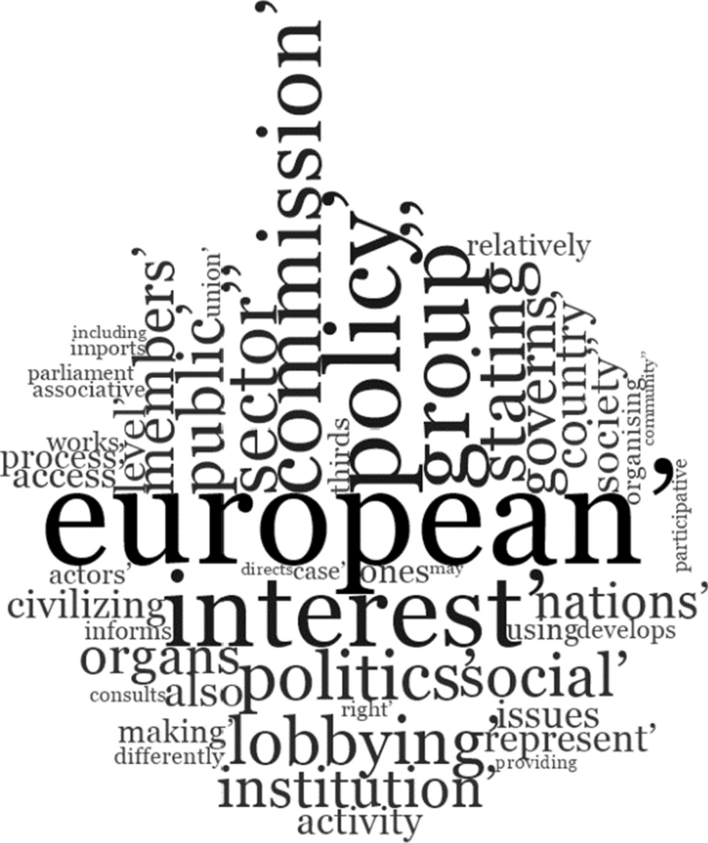
This analysis reveals a smaller, but growing number of articles that include multiple frames (see Fig. 2). There are in principle two types of publications that use multiple frames: first, there are publications that use the frames carelessly and interchangeably without paying attention to their underlying normative dimensions. Such use is unfortunate, because it convolutes concepts and frames and thus potentially leads to confusion. By contrast, there are those who deliberately engage with and explore different frames and concepts with a view to understanding their differences (e.g. Enjolras et al. Reference Enjolras, Salamon, Henrik Sivesind and Zimmer2018, chapters 1 and 2; Salamon and Sokolowski Reference Salamon and Sokolowski2016)—a welcome endeavour to which the current paper also seeks to contribute in a systematic fashion. The keyword analysis represents a melange of different approaches, including words such as ‘interest’, ‘group’, but also ‘members’ and ‘participative’. See Fig. 6.
Multiple frames
Summary
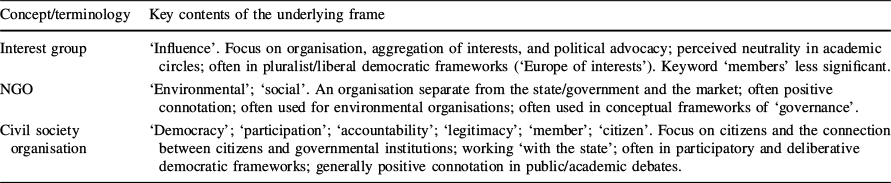
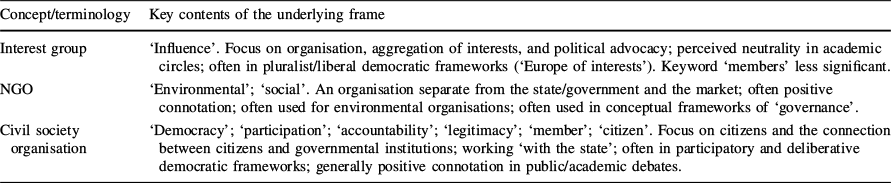
The three most popular frames on non-state actors in the EU emerging from the bibliographic analysis are ‘interest group’, ‘NGO’, ‘civil society organisation’, and the publications using multiple frames. Frame contents indicate that these connect with liberal democracy and pluralism (interest groups), governance (NGO), and deliberative/participatory democracy (CSO) ideals of the European polity. See Table 2.
Key frames in publications on non-state actors in the EU
Concept/terminology |
Key contents of the underlying frame |
|---|---|
Interest group |
‘Influence’. Focus on organisation, aggregation of interests, and political advocacy; perceived neutrality in academic circles; often in pluralist/liberal democratic frameworks (‘Europe of interests’). Keyword ‘members’ less significant. |
NGO |
‘Environmental’; ‘social’. An organisation separate from the state/government and the market; often positive connotation; often used for environmental organisations; often used in conceptual frameworks of ‘governance’. |
Civil society organisation |
‘Democracy’; ‘participation’; ‘accountability’; ‘legitimacy’; ‘member’; ‘citizen’. Focus on citizens and the connection between citizens and governmental institutions; working ‘with the state’; often in participatory and deliberative democratic frameworks; generally positive connotation in public/academic debates. |
Source: Own keyword analysis and literature review
Discussion and Conclusion
This paper set out to identify and describe prevalent frames used to describe non-state actors in the EU in academic publications. Framing non-state actors is relevant for academic study and for ongoing debates about the European democratic deficit, which have often admonished a perceived distance between the EU and its citizens (Saurugger Reference Saurugger2008). The bibliometric analysis of a novel literature database containing 780 publications that appeared between 1992 and 2020 presented in this paper suggests three main frames used to describe non-state actors in research in the EU, namely ‘interest group’, ‘nongovernmental organisation (NGO)’, and ‘civil society organisation’ (CSO). The use of these frames is not (and should not be) random or interchangeable. Rather, this paper demonstrates that each frame contains specific normative visions about the role of non-state actors in the EU’s evolving democracy, which the previous sections have unpacked (see also Kutay Reference Kutay2017). For example, in relevant literatures, non-state actors—then usually re-framed as ‘civil society organisations’—are thought to potentially plug the democratic deficit, though caveats apply (e.g. Saurugger Reference Saurugger2008).
These findings chime with how EU policy-makers have used ‘civil society’ terminology (Freise Reference Freise and Freise2008). For example, in the important White Paper on European Governance,Footnote 7 the European Commission uses a very broad definition of civil society to claim that
Civil society plays an important role in giving voice to the concerns of citizens and delivering services that meet people’s needs. […] Nongovernmental organisations play an important role at global level in development policy. (European Commission Reference Commission2001, p. 14)
What is striking in this document is that the term ‘lobbying’ is not used at all, the term ‘interest groups’ is cited once (p. 34), but ‘civil society’ seventeen times; ‘non-governmental organisations’ is only used once (see quote above). More generally, Kohler-Koch and Finke (Reference Kohler-Koch and Finke2007) show that the European Commission has moved from talking about ‘special interest groups’ to ‘NGOs’ and finally ‘CSOs’ across a range of policy documents. This has resulted from a shift in the Commission from consulting interests towards notions of participatory democracy (Kohler-Koch and Finke Reference Kohler-Koch and Finke2007)—though this paper suggests that across academic literatures, this focus may be waning. European policy-makers evidently use frames about non-state actors strategically in order to make claims about their role in the European polity (Smismans Reference Smismans2003). The findings from this paper may help practitioners to use the concepts in a way that furthers their aims, while remaining cognizant of the alternatives. It is therefore important to pay attention to the frames that EU policy-makers evoke, because ‘policy language […] is itself a form and source of policy power’ (Apthorpe Reference Apthorpe, Shore and Wright1997, p. 42). This analysis shows that in corresponding academic work, the interest group frame has gained force at the expense of civil society organisations and the other frames over the last two decades.
Dynamic framing of non-state actors in the EU furthermore has the potential to reveal developments in EU governance, which has been described as a polity-in-the-making. As new states join the EU (e.g. Croatia in 2013) and others leave (UK in 2020) and the policy-making activities of the EU change, the role of non-state actors is constantly being evaluated and contested. This is particularly relevant in light of continuous efforts to adjust non-state actor regulation in the EU (Greenwood and Dreger Reference Greenwood and Dreger2013). In addition, potential roles of non-state actors matter for addressing the EU’s perceived democratic deficit. Kohler-Koch and Rittberger (Reference Kohler-Koch, Rittberger, Kohler-Koch and Rittberger2007, p. 11) write:
The political discourse supporting institutional reforms in the EU is quite evidently inspired by the mainstream debate in academia that the present institutions of liberal democracy are not operating satisfactorily, that a key problem is the lack of civic engagement and, therefore, a main concern how to promote effective citizenship.
Given that academics can become involved in EU policy-making in multiple ways (e.g. Gornitzka and Sverdrup Reference Gornitzka and Sverdrup2008), developing a clearer understanding of their framing of non-state actors may open up possibilities to understand how academic and policy-maker frames interact and how academia influences the development of the European polity. But this also means that academic framing may influence the success of responses to issues such as the European democratic deficit (see Peters and Hoornbeek Reference Peters, Hoornbeek, Eliadis, Hill and Howlett2005).
Academic framing may be a slower process than in the world of public policy-making, and it tends to be less action-oriented than in social movements/among policy-makers. However, similar general principles apply—academic leaders frame or re-frame phenomena, frames interact with political and social realities and serve to attract followers, who could be other academics, students, or policy-makers. Future research should shed more light on the role of academics in political framing processes. If the EU institutions are receptive to academic voices, then their lobbying regulation and funding schemes for non-state actors may change in response to the way in which these groups are understood. Research on non-state actors as such—and the dominant frames developed and used within that field—may have a collective impact that works over time to shape important aspects of the European polity.
One may argue that academic conceptual development on non-state actors should be separated from political framing processes. It is questionable whether such a separation is possible in principle or practice. Attempting to do so certainly risks creating an increasing distance between political realities and corresponding academic study, thereby overlooking academia’s role in political framing processes and vice versa. In practical terms, the ongoing, networked cross-fertilisation between academia and EU politics makes strict separation all but impossible. A better approach is to study how dynamic framing processes unfold in different arenas, how they overlap and interact, and what political and conceptual consequences emerge from related developments. Of course, not all scholars who use a certain set of terminology may consciously argue for a particular democratic vision for Europe, or necessarily make a conscious choice to this effect. There may still be a significant degree of randomness in academic use.
Finally, if we accept Callon’s (Reference Callon and Callon1998)’s rationale that frames are intrinsically dynamic, attempts to provide ‘clear definitions’ of terms (e.g. Jordan et al. Reference Jordan, Halpin and Maloney2004) may fail as the result of a continual process of re-framing and frame interaction. The current contribution may be understood as an analysis of a particular time, spanning nearly three decades. However, important insights could emerge from future studies seeking to shed light on why certain frames emerge in particular times, how academic and political frames interact, and how this relates to EU polity building.
Acknowledgements
An earlier version of this paper was written as the second chapter of a Master of Philosophy (MPhil) thesis submitted to the Department of Geography and the Environment at the University of Oxford in 2013. The author thanks his thesis supervisor, Dr Paul Jepson, for support and advice during this period. In updating and re-working the paper prior to publication, the Technical University of Darmstadt and especially Prof. Kai Schulze's research group provided for an excellent research environment. Finally, the author is grateful to the anonymous peer reviewers, whose constructive comments considerably strengthened the paper.
Funding
Open Access funding enabled and organized by Projekt DEAL. Funding was provided by St. Cross College, University of Oxford (Student Travel and Research Grant), and the Technical University of Darmstadt (Ingenium Support Package Grant).
Compliance with Ethical Standard
Conflict of interest
On behalf of all authors, the corresponding author states that there is no conflict of interest.



 Open access

