




Introduction
Skin-to-skin care, also known as kangaroo care or skin-to-skin contact, is a developmentally supportive intervention in which a diapered infant is held to the bare chest of the parent. This practice has well-established benefits for newborns and parents. Across preterm, neonatal ICU, and healthy term populations, skin-to-skin care has been shown to promote physiologic stability, improve thermoregulation, reduce pain responses, enhance breastfeeding success and infant growth, strengthen mother–infant bonding, and reduce stress reactivity in both infants and parents. Reference Cleveland, Hill and Pulse1–Reference Ionio, Ciuffo and Landoni3 Skin-to-skin care has favourable effects on infant vital signs, including improved temperature regulation, lower heart rate, and increased oxygen saturation. Reference Durmaz, Sezici and Akkaya4
Although skin-to-skin care has been extensively studied and widely adopted in neonatal ICU settings, its implementation has lagged in paediatric cardiac ICUs. Infants with CHD represent a particularly vulnerable population for whom developmentally supportive care is critical. Reference Sood, Newburger and Anixt5 Skin-to-skin care is an underutilised, neuroprotective strategy despite evidence demonstrating its safety and feasibility before and after neonatal cardiac surgery. Reference Lisanti, Buoni and Steigerwalt6,Reference Lisanti, Demianczyk and Costarino7 Data suggest that only a small minority of parents of infants requiring cardiopulmonary bypass engage in skin-to-skin care during hospitalisation, highlighting a substantial gap between evidence and practice. Reference Lisanti, Min and Golfenshtein8 Barriers to skin-to-skin care in the paediatric cardiac ICU include medical complexity, perceived instability, unit culture, lack of role clarity, lack of communication, lack of resources, lack of standardised education and implementation strategies, and concern for patient safety. Reference Lisanti, Buoni and Steigerwalt6,Reference Lisanti, Demianczyk and Whittaker9,Reference Lisanti, Bettencourt, Kneeland, Vittner and Baxelbaum10
One strategy that has been used successfully in neonatal ICU settings to promote skin-to-skin care uptake is the skin-to-skin-a-thon (also referred to as a kangaroo-a-thon). These events are typically time-limited, unit-based initiatives designed to increase awareness, education, and implementation of skin-to-skin care through coordinated staff engagement and family-centred encouragement. 11 Skin-to-skin-a-thons are commonly held around International Kangaroo Care Day on May 15th and have been used globally to normalise and increase skin-to-skin practice. Despite their widespread use in neonatal ICUs, skin-to-skin-a-thons have not been systematically applied or evaluated in paediatric cardiac ICU settings, and a coordinated, multicentre skin-to-skin-a-thon focused specifically on infants with CHD has not previously been reported to our knowledge.
To address this gap, the aim of this initiative was to leverage the collaborative infrastructure of the Cardiac Neurodevelopmental Outcomes Collaborative to develop and implement the first nationwide, multisite CHD-focused skin-to-skin-a-thon. Through coordinated timing, shared goals, and site-specific implementation strategies, our fundamental goal was to increase awareness and uptake of the practice of skin-to-skin care in paediatric cardiac ICUs and promote developmentally supportive, family-centred care for infants with CHD and their caregivers.
Materials and methods
Study design and setting
This project was a multisite, grass-roots initiative organising the first nationwide CHD-focused skin-to-skin-a-thon. This undertaking was a multicentre quality improvement initiative using a pre–post observational design to evaluate implementation outcomes.
Site recruitment and organisation
Participating sites were paediatric cardiac ICUs and step-down units across the United States. Sites were recruited through the Cardiac Neurodevelopmental Outcomes Collaborative via the Cardiac Newborn Neuroprotective Network Special Interest Group listserv and an interest session held at the 2024 Cardiac Neurodevelopmental Outcome Collaborative Scientific Sessions meeting in St Louis, MO, USA. Sites utilised their own existing holding and skin-to-skin care policies and procedures approved by their respective institutions. Each participating site identified both a site champion and a nurse champion. Site champions served as local leads and primary points of contact with the event co-leads (SO and SS). Sites who did not have their own policies and procedures for skin-to-skin care prior to registering for the event were encouraged to advocate within their institutions to develop and implement evidence-based policies and procedures prior to participating in this skin-to-skin-a-thon or promoting the practice in other ways.
Planning and collaborative development
Event co-leads facilitated monthly virtual planning meetings for seven months prior to the skin-to-skin-a-thon. These meetings provided structured guidance and peer support for event planning, logistics, and staff and family education. Feedback was actively solicited from participating sites to promote collaborative design. Through this process, a unified event theme (“Camp Cuddles”) was developed along with a coordinating logo and promotional materials. All meetings were recorded and made available to site champions if they were unable to attend live sessions.
Development of the site implementation bundle
The event co-leads developed a comprehensive “site bundle” to support adaptable implementation across institutions. The bundle included editable educational materials, promotional posters, email templates for unit leadership, staff, and family organisations, social media posts, a site champion checklist with a suggested timeline, and printable items customisable by each site. Bundle components were reviewed iteratively during monthly meetings and distributed to site leaders via shared Google Drive documents and Canva (canva.com). Site leaders were encouraged to begin staff education and event promotion in March 2025. The mode, frequency, and format of education and promotion were determined by each site and tailored to each site in accordance with local institutional policies. After the conclusion of the event, SO developed a website that stores these materials: https://www.chdskintoskin.com/.
Skin-to-skin-a-thon implementation
The CHD-focused skin-to-skin-a-thon (“Camp Cuddles”) was held concurrently across participating sites from May 12 to 16, 2025, in recognition of International Kangaroo Care Day (May 15). Each site conducted the event within its existing holding and skin-to-skin care policies and procedures and adapted activities to fit unit-specific workflows and patient populations. Participating sites had the autonomy to adapt or develop their own educational or engagement activities in support of the skin-to-skin-a-thon. The skin-to-skin-a-thon co-leads did not provide oversight for any site-specific activities or for the implementation of the site bundle.
Pre- and post-skin-to-skin-a-thon staff survey
The instrument, “Implementation Readiness of Skin-to-skin care for Neonates with CHD in Acute or Intensive Care,” was recently validated using internal consistency, convergent validity, and exploratory factor analyses. Reference Lisanti, Baxelbaum, Kneeland, Bettencourt and Vittner12 Interdisciplinary staff—including physicians, nurses, and therapists—were invited to complete the validated survey Reference Lisanti, Baxelbaum, Kneeland, Bettencourt and Vittner12 before and after the skin-to-skin-a-thon to assess staff experiences, attitudes, and practices related to skin-to-skin care. The survey was built within a secure REDCap database hosted at the University of Pennsylvania and distributed by event co-leads to site champions, who disseminated the survey link to staff at their respective institutions via email, word of mouth, and/or QR codes. Participation was voluntary, and all participants reviewed a consent statement at the beginning of the survey. Completion of the survey denoted their consent to participate. No identifiable information was gathered. Participants created a personalised but de-identified code to link their pre and post surveys. The IRB at the University of Pennsylvania provided review and exempt status for this portion of this project (IRB #857681).
Post-event debrief and quality improvement survey
Following the event, site champions participated in a structured debrief meeting to share experiences, perceived successes, and challenges. Site leaders were then asked to complete a brief quality improvement survey (Supplementary Material) to (1) confirm site participation and (2) capture information regarding event promotion strategies, staff education approaches, utilisation of the site bundle, and perceived barriers or difficulties in organising the event.
Statistical analysis
Data for participants that completed both a pre- and post-test survey were analysed to determine changes in attitudes and knowledge. Paired data were available for 90 participants. Factor scores for domains of attitude and knowledge were computed using the seven-factor model identified in prior work, Reference Lisanti, Baxelbaum, Kneeland, Bettencourt and Vittner12 providing scores for education and training; unit culture and behaviours; self-efficacy; communication; decision-making; general knowledge; and beliefs. Each score consisted of the mean response to all items that loaded on that factor in the prior validation study, providing a score between 1 and 5. Likert-scale responses were treated as continuous variables for analysis. Separate paired t-tests were used to assess changes in factor scores for each factor from pre to post, with a Bonferroni-corrected significance level of p < 0.007.
Results
Participating sites and event implementation
Of 52 Cardiac Neurodevelopmental Outcome Collaborative-affiliated centres, 31 registered to participate in the inaugural CHD-focused skin-to-skin-a-thon, which was conducted under the unified theme “Camp Cuddles.” Twenty-two of the 31 registered sites (71%) reported active participation in the event held from May 12 to 16, 2025. Participating sites adapted skin-to-skin-a-thon site bundle materials to align with institutional policies, implemented staff education initiatives, and hosted unit-based activities designed to increase awareness of and engagement in skin-to-skin care within the cardiac ICU and step-down units.
All participating sites (100%) reported having an existing guideline that included holding or skin-to-skin care at the time of the skin-to-skin-a-thon (Figure 1( a )). Nine sites (41%) reported that they developed new or updated existing skin-to-skin care or holding guidelines in the lead-up to the skin-to-skin-a-thon as a direct result of participation in the event.
Guidelines, education, and promotion strategies for the skin-to-skin-a-thon. ( a ) Types of guidelines utilised by participating sites. ( b ) Staff education strategies utilised by participating sites. Sites often used multiple strategies. ( c ) Strategies for promoting the skin-to-skin-a-thon employed by participating sites. Sites often used multiple strategies.

Figure 1. Long description
Panel A: A pie chart shows the distribution of guideline types utilized by participating sites. The chart is divided into four segments: Holding at 27 percent, Skin-to-skin at 14 percent, Both at 50 percent, and Other at 9 percent. Panel B: A vertical bar graph illustrates various staff education strategies used by participating sites. The strategies include Emails, Social Media, Unit Newsletter, Staff Education Day, Handouts, Posting material in unit, Staff Meetings, In-person Education, Recorded Video Education, Unit In-Service, Hands-On Education, Learning Modules, and Other. The bars represent the frequency of each strategy, with Emails, Handouts, and Posting material in unit being the most commonly used. Panel C: Another vertical bar graph displays strategies for promoting the skin-to-skin-a-thon event. The strategies include Emails, Handouts, Social Media, Posters in the Unit, Unit Newsletter, Staff Meetings, and Other. The bars indicate the frequency of each promotion strategy, with Emails, Handouts, and Social Media being the most frequently used.
Event promotion and staff education strategies
Approaches to staff education were more variable across sites. The most frequently used educational strategies included emails (n = 18, 82%), posted educational materials within the unit (n = 17, 77%), and staff meetings (n = 17, 77%). Additional educational methods were also reported, reflecting site-specific needs and workflows (Figure 1( b )). Most sites incorporated multiple educational strategies in the weeks leading up to the event.
Sites employed multiple strategies to promote the skin-to-skin-a-thon. Internal email communication was used by all participating sites (n = 22, 100%), followed by staff meetings (n = 21, 95%). Handouts and posters displayed within the unit were also commonly utilised (n = 18, 82%) (Figure 1( c )). Most sites reported using more than one promotional strategy.
Feasibility and implementation challenges
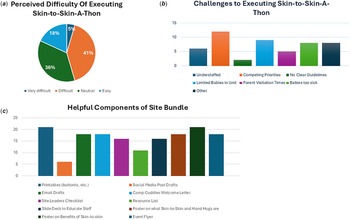
There was variability across institutions in the perceived difficulty of organising the skin-to-skin-a-thon (Figure 2( a,b )). Ten sites (46%) reported that organising the event was difficult or very difficult, eight sites (36%) reported a neutral level of difficulty, and four sites (18%) reported that organising the skin-to-skin-a-thon was easy. Competing clinical and operational priorities were the most frequently reported challenge to implementing skin-to-skin care during the event (n = 12, 55%). Nine sites reported that a limited census of eligible infants during the skin-to-skin-a-thon week affected participation. At a post-skin-to-skin-a-thon debriefing meeting, site leaders anecdotally reported that staff had overwhelmingly positive experiences and perceived improvements in staff morale during the skin-to-skin-a-thon. We did not collect data on adverse events; however, no site leaders disclosed any adverse events during the debriefing meeting.
Perceived difficulty, challenges, and helpful site bundle components. ( a ) Perceived difficulty of executing the skin-to-skin-a-thon as reported by site leaders. ( b ) Challenges to executing the skin-to-skin-a-thon. Many sites reported more than one challenge. ( c ) Most helpful components of the site bundle. Site leaders were able to choose more than one option.

Utilisation and perceived helpfulness of the site bundle
Site leaders reported broad utilisation of the site bundle components, with most sites adapting multiple elements for their local events. All sites (100%) reported that the printable materials (e.g., templates for buttons and unit decorations) were helpful. A poster describing the benefits of skin-to-skin care was reported as helpful by most sites (n = 21, 95%). Email templates, a family welcome letter, a poster describing skin-to-skin care and hand hugs, and the skin-to-skin-a-thon event flyer template were each reported as helpful by most sites (n = 18, 82%) (Figure 2( c )). Social media post templates were perceived as helpful by fewer sites (n = 6, 27%).
Staff survey outcomes
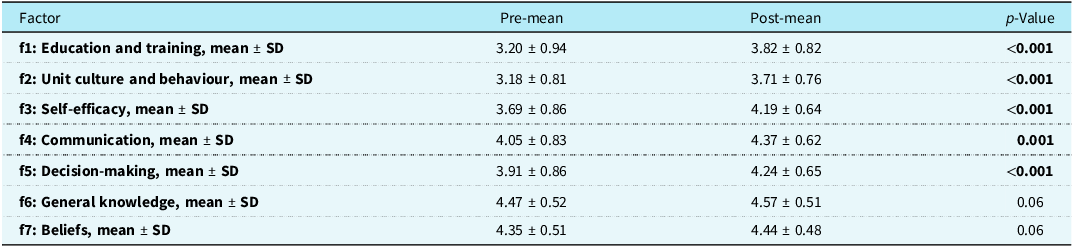
Ninety respondents from 20 sites completed matched pre- and post-skin-to-skin-a-thon surveys assessing staff experiences, attitudes, and practices related to skin-to-skin care (Table 1). Following the skin-to-skin-a-thon, there was a statistically significant change in staff-reported perceptions of education and training, unit culture and behaviours, self-efficacy, decision-making (p < 0.005 for all factors), and communication (p = 0.001) related to skin-to-skin care on their units. No significant differences between pre- and post-skin-to-skin-a-thon were observed in general knowledge (p = 0.06) or baseline beliefs (p = 0.06) regarding skin-to-skin care amongst surveyed staff.
Results of the implementation readiness survey

Table 1. Long description
The table presents data on pre- and post-mean values for seven factors related to skin-to-skin care, along with their standard deviations and p-values. The factors include education and training, unit culture and behaviour, self-efficacy, communication, decision-making, general knowledge, and beliefs. The table has seven rows for the factors and four columns for pre-mean, post-mean, and p-value. Each row provides the mean and standard deviation for pre- and post-values, along with the p-value indicating statistical significance. Notable trends include significant changes in education and training, unit culture and behaviour, self-efficacy, decision-making, and communication, with p-values less than 0.001. No significant differences are observed in general knowledge and beliefs, with p-values of 0.06.
N = 90. Pre-Mean = mean ± SD of scores for each factor for survey distributed prior to the skin-to-skin-a-thon; Post-Mean = mean ± SD of scores for each factor for survey distributed after the Skin-to-skin-a-thon; SD = standard deviation. p ≤ 0.05 is considered statistically significant. Statistically significant values are in bold
Discussion
Skin-to-skin care remains one of the least utilised, yet well-studied, developmental care practices in cardiac ICUs Reference Lisanti, Min and Golfenshtein8,Reference Miller and Alexander13,Reference LaRonde, Connor, Cerrato, Chiloyan and Lisanti14 and step-down units, highlighting the need for targeted improvement efforts. The inaugural skin-to-skin-a-thon successfully united 22 hospital sites across the United States to promote skin-to-skin care for infants with CHD. Participation from 42% of Cardiac Neurodevelopmental Outcome Collaborative-affiliated institutions highlights the feasibility of leveraging a national collaborative to support grassroots, evidence-based practice implementation through virtual connection and shared resources. This coordinated effort demonstrates a proof-of-concept model for unifying geographically diverse cardiac units around a common developmental care goal. Additionally, participation of 22 sites demonstrates the interest and engagement in efforts to support skin-to-skin care in cardiac ICUs and cardiac step-down settings. We are only aware of one previous report of a single cardiac centre, including both a cardiac ICU and cardiac step-down unit, engaged in a skin-to-skin-a-thon, Reference Lisanti, Buoni and Steigerwalt6 and we were unable to find any literature documenting coordinated skin-to-skin care efforts across institutions.
Despite a limited number of matched pre- and post-event implementation surveys (n = 90), exploratory data suggest that participation in the skin-to-skin-a-thon was associated with significant improvements in staff perceptions of education and training, unit culture and behaviours, self-efficacy, communication, and decision-making related to skin-to-skin care. We recognise survey-response bias may exist, limiting the generalisability of these findings, and results should be interpreted with caution. However, we demonstrate the utility and feasibility of using the instrument, “Implementation Readiness of skin-to-skin care for Neonates with Congenital Heart Disease in Acute or Intensive Care,” as a pre/post measure. Additionally, site champions recounted in the debrief that participating staff overall reported positive experiences and perceived improvements in staff morale during the skin-to-skin-a-thon. Site champions also reported that the skin-to-skin-a-thon bundle components were useful tools for local implementation. Together, these findings suggest that time-limited, focused implementation events may positively influence staff readiness to engage in skin-to-skin care practices in the cardiac ICU environment.
Notably, nearly half of site leaders reported that skin-to-skin-a-thon implementation was difficult or very difficult at their institution. These challenges likely reflect both site-specific resource and financial constraints and implementing novel skin-to-skin care-focused initiatives within the cardiac intensive care setting. They may also reflect the distinct complexities of supporting skin-to-skin care for neonates with CHD, particularly in the postoperative period after cardiopulmonary bypass surgery. Reference Lisanti, Vittner and Medoff-Cooper15 Unique barriers exist in cardiac ICUs, including clinicians’ lack of knowledge about skin-to-skin care and the unit-based skin-to-skin care policies and procedures. Reference Lisanti, Demianczyk and Whittaker9,Reference Lisanti, Bettencourt, Kneeland, Vittner and Baxelbaum10 This initiative may have helped address some of these barriers, as exemplified by sites creating policies and procedures for skin-to-skin care. Additional barriers include unclear roles and responsibilities regarding skin-to-skin care and decision-making, limited communication among healthcare providers and with parents, insufficient resources to support skin-to-skin care, and ongoing concerns for patient safety. Reference Lisanti, Demianczyk and Whittaker9 The most frequently cited barrier to skin-to-skin care by site champions was competing clinical priorities, including diagnostic testing and subspecialty consultations, which may limit the ability to protect dedicated time for facilitating parental holding and skin-to-skin care in medically complex infants with CHD.
This report of the first national skin-to-skin-a-thon should be interpreted considering several limitations. We did not directly measure clinical outcomes; therefore, we were unable to reliably quantify changes in the number of infants held or total duration of holding or skin-to-skin care during the event. Because adverse events were not prospectively collected, conclusions regarding safety cannot be drawn from this initiative. Parent or caregiver surveys were also not uniformly collected across sites, limiting assessment of family-centred outcomes. Our use of survey data has inherent survey-response bias and should be interpreted with caution. Additionally, analyses did not account for clustering of responses within sites, which may have influenced variance estimates. In the absence of any multisite trials of skin-to-skin care in the CHD population, this report demonstrates the feasibility of engaging sites to focus on skin-to-skin care practice through education and targeted implementation efforts.
Several implementation strategies appeared useful across participating sites, including identification of local site champions, multidisciplinary staff education, use of standardised promotional materials, leadership engagement, and integration of skin-to-skin care messaging into existing unit workflows. These components may serve as foundational elements for future implementation guidance in cardiac intensive care settings.
Future studies are needed to evaluate the impact of skin-to-skin care on infant outcomes, parental mental health, parent–infant bonding, and medical provider well-being in both the cardiac ICU and cardiac step-down unit settings. Continued research should identify implementation strategies that support sustainable adoption of skin-to-skin care practice for newborns and other young infants with CHD. Data on site-specific skin-to-skin care and holding protocols were not collected. Development of evidence-informed implementation guidance represents an important next step toward broader adoption of skin-to-skin care in cardiac intensive care settings, as well as integrating standardised implementation and patient outcome metrics to evaluate subsequent skin-to-skin-a-thons. Collectively, these findings highlight the opportunity for national collaboratives such as the Cardiac Neurodevelopmental Outcome Collaborative to facilitate scalable, low-cost interventions such as skin-to-skin care that promote developmentally supportive care in infants with CHD.
Supplementary material
The supplementary material for this article can be found at https://doi.org/10.1017/S104795112612349X.
Acknowledgements
The authors would like to thank the Cardiac Neurodevelopmental Outcome Collaborative and the Cardiac Newborn Neuroprotective Network Special Interest Group of the Cardiac Neurodevelopmental Outcome Collaborative for their support of this project. Joeybands® donated 10 Joeybands to each participating site that wished to utilise them for the skin-to-skin-a-thon. AI was used to check grammar and improve flow/readability of the manuscript. The authors would like to thank the CHD Academy for organising a lecture series on developmental care in the lead-up to the skin-to-skin-a-thon and for promoting the event.
Financial support
Sarah Schlatterer was supported by the Van Metre Foundation.
Competing interests
The authors have no conflicts of interest to declare.



 Open access

