

1. Introduction
Research has extensively documented how proportional representation (PR) and gender quotas affect women’s representation. However, institutional variations within majoritarian electoral systems and their implications for representational diversity remain largely understudied.Footnote 1 Although commonly linked to single-member districts and single-vote ballots, many majoritarian elections employ multimember districts that allow voters to cast multiple votes. Prior research suggests that majoritarian rules permitting multiple candidate preferences—such as ranked-choice, cumulative, or limited voting—may correlate with more diverse candidate slates and outcomes. Nonetheless, findings remain mixed and context-dependent (Brockington et al., Reference Brockington, Donovan, Bowler and Brischetto1998; John et al., Reference John, Smith and Zack2018; Santucci and Scott, Reference Santucci and Scott2021; Casella et al., Reference Casella, Guo and Jiang2023; Crowder-Meyer et al., Reference Crowder-Meyer, Gadarian and Trounstine2024), and empirical evidence linking these institutional features to more diverse outcomes remains limited. This gap motivates our central question: how does ballot structure shape voting behavior and ultimately affect the diversity of elected officials?
We compare two electoral systems: the Block Vote (BV), where voters can cast as many votes as there are seats and distribute them across candidates, and the Single Non-Transferable Vote (SNTV), where each voter casts only one vote.Footnote 2 While both systems are multimember plurality rules that allocate seats to the top n vote-getters in multimember districts, they differ in ballot structure. This institutional variation allows us to assess how ballot structure affects voters’ propensity to support underrepresented candidates. To evaluate this question, we conducted a preregistered conjoint experiment with 5,400 Japanese voters, simulating candidate selection in local elections—a context characterized by weak partisan cues and limited nomination control. Respondents were randomly assigned to cast either one vote (SNTV) or three votes (BV) from a hypothetical set of candidates differing in gender, age, and education, with BV votes cast sequentially and counted according to BV rules.
The results indicate that under the BV system, voters are more likely to alternate candidate genders in their second- and third-ranked choices, suggesting that multi-vote ballots may promote more gender-balanced voting. However, this pattern did not extend to other attributes, such as age or education. While support for female candidates increased in later rounds, women were overall less likely to be elected under BV due to the predominance of male candidates in first-ranked choices. By examining institutional variation within majoritarian systems, this study demonstrates that ballot structure—specifically, the number of votes allotted per voter—significantly influences voter behavior and support for underrepresented candidates. These findings reveal the trade-offs associated with modest reforms and suggest that ballot design, alongside PR reforms, can meaningfully influence representational outcomes.
2. Voting for gender balancing
While voters often base their choices on policy preferences, policy outcomes are also shaped by institutional bargaining among governing actors. Anticipating these dynamics, voters may engage in policy balancing by splitting their tickets across parties or institutions to influence the composition of governing bodies (Alesina and Rosenthal, Reference Alesina and Rosenthal1995; Fiorina, Reference Fiorina1996; Lacy and Paolino, Reference Lacy and Paolino1998; Mebane, Reference Mebane2000; Mebane and Sekhon, Reference Mebane and Sekhon2002; Kedar, Reference Kedar2006). We extend this logic to representational balancing, wherein voters aim to diversify elected bodies along gender lines, reflecting a concern for descriptive representation beyond mere policy outcomes. This behavior is particularly relevant in multimember plurality systems, such as BV and SNTV, where party labels are relatively weak, and candidates must compete both across and within parties.Footnote 3 These systems encourage candidate-centered campaigns, elevating the salience of personal attributes such as gender. This tendency is rooted in institutional incentives to cultivate a personal vote (Carey and Shugart, Reference Carey and Shugart1995) and is further reinforced by gender heuristics and equality norms. Although voters may differentiate candidates based on various characteristics, such as age, education, or occupation, we focus on gender as a salient and widely recognized heuristic.Footnote 4
We identify three theoretical mechanisms that drive gender balancing among voters. First, from the perspective of substantive representation, male and female politicians often prioritize different policy areas (Schaffner, Reference Schaffner2005; Atkinson and Windett Reference Atkinson and Windett2019; Ono and Miwa, Reference Ono and Miwa2023); research indicates that women are more likely to advocate for issues such as welfare, education, and gender equality. Second, in low-information contexts, gender serves as a salient cue that voters use to infer candidates’ values and priorities (McDermott, Reference McDermott1997; Badas and Stauffer, Reference Badas and Stauffer2019; Ono and Burden, Reference Ono and Burden2019). Third, beyond instrumental policy considerations, normative concerns such as fairness, equity, and democratic inclusion may motivate voters to favor gender-balanced outcomes to enhance democratic legitimacy and representativeness.
These motivations yield distinct implications across electoral systems. In the SNTV system, where voters cast only one vote in multimember districts, vote balancing is limited. Voters with gender biases may disproportionately favor male candidates, especially in the absence of party labels, resulting in male-dominated outcomes. In contrast, the BV system allows voters to cast multiple votes, enabling them to balance their preferences by alternating between genders—an observable and politically significant behavior.
H1: Under the BV system, voters are more likely to alternate between male and female candidates as they make their choices than consistently choosing candidates of the same gender.
Our second hypothesis examines how the number of votes allotted to each voter influences outcomes in multimember electoral systems. In the SNTV system, voters cast a single vote, whereas in the BV system, voters can cast multiple votes. If voters act sincerely, their first choice under BV should correspond to their choice under SNTV. If H1 holds true, the two systems are expected to yield different outcomes, particularly regarding the gender composition of elected candidates, due to the balancing effect under BV. Specifically, we expect that the gender gap in voter support will be smaller under BV, where gender balancing is more achievable.
H2: The difference in voter support between male and female candidates is smaller under the BV system than under the SNTV system.
3. Research design
We conducted a preregistered survey incorporating a conjoint experiment to test our hypotheses.Footnote 5 Conjoint designs enable the simultaneous manipulation of multiple candidate attributes, allowing us to estimate each attribute’s effect on vote choice. The survey was administered from 19 to 23 February 2022, targeting Japanese residents aged 18–69 years enrolled in panels affiliated with Lucid Marketplace. To approximate the national population, we recruited respondents using quotas based on gender, age, education, and region of residence. The final sample comprised 5,400 respondents who passed attention checks.Footnote 6 The survey began by collecting demographic data and measuring levels of sexism, followed by a candidate-choice conjoint experiment. In this module, respondents completed five tasks; in each task, they viewed six profiles of hypothetical municipal assembly candidates and, depending on the assigned condition, selected either one or three candidates they would vote for (see Supplementary Appendix A for question wording).Footnote 7
Candidate profiles were defined by attributes typically available to voters during elections, including gender (man or woman), age, education, occupation, hometown, and legislative experience. Party affiliation was omitted to reflect the candidate-centered nature of Japanese local elections, where partisan labels are often muted, and many candidates run as independents.Footnote 8 Each profile also featured a pictogram depicting either a male or female face (see Figure 1).Footnote 9 Attribute levels were selected to approximate the marginal distributions observed among actual local assembly members in Japan, thereby enhancing external validity (de la Cuesta et al., Reference de la Cuesta, Egami and Imai2022). The sole exception was gender, which was assigned uniformly at random. Full details on the attribute wording, level definitions, and data sources for the real-world profile distribution are available in Supplementary Appendix B.
Screenshot of candidate profiles in the conjoint experiment.

Figure 1 Long description
The image shows six candidate profiles arranged in three rows. Each profile includes a pictogram representing either a man or woman. The profiles provide details such as age, education, occupation, legislative experience, and hometown. The first profile shows a man with a private university education, experience as a legislative secretary, eight years of legislative experience, from Sapporo, aged 70s. The second profile shows a man with a private university education, experience as a self-employed worker, twelve years of legislative experience, from outside Sapporo, aged 30s. The third profile shows a woman with high school education, experience as a legislative secretary, no legislative experience, from outside Sapporo, aged 30s. The fourth profile shows a man with a private university education, experience as a self-employed worker, twelve years of legislative experience, from Sapporo, aged 40s. The fifth profile shows a man with a private university education, experience as a legislative secretary, four years of legislative experience, from Sapporo, aged 60s. The sixth profile shows a woman with a high school education, experience as a company employee, no legislative experience, from Sapporo, aged 60s.
The core feature of our experiment is the random assignment of respondents to one of the two conditions. In the SNTV condition, respondents selected a single candidate from a list of six; in the BV condition, they selected three candidates in ranked order.Footnote 10 All respondents were informed that the district magnitude was three, simulating an SNTV election for one group and a BV election for the other. Respondents were randomly assigned in a 1:3 ratio, resulting in 1,456 individuals in the SNTV group and 3,944 in the BV group.Footnote 11 As in other candidate-choice conjoint studies, the unit of analysis is each candidate per task.Footnote 12 Each respondent completed five tasks, each featuring six candidates, yielding a total of 162,000 observations. To test H1, we restricted the data to the BV group, regressing indicators for whether a candidate was ranked second or third on the candidate’s gender, the respondents’ choice for the previous rank, and their interaction, while excluding higher-ranked candidates.Footnote 13 For H2, we pooled the two groups to assess how the effect of being female on vote choice varies between electoral systems. Standard errors were clustered by respondent, and statistical significance was evaluated at the 5% level. Details of the models and variables are provided in Supplementary Appendix C.
In accordance with our preregistered plan, we examined not only the full sample but also the two key subgroups: male respondents and individuals with high levels of hostile sexism. We included the latter group because previous research indicates that hostile sexism predicts attitudes toward female candidates (Bauer, Reference Bauer2015). Hostile sexism was measured using a five-item scale from Schaffner (Reference Schaffner2022), with responses summed and scores above the median classified as high. These analyses aim to examine whether individuals who are less supportive of gender equality still engage in gender balancing under the BV system. We anticipate that both groups will demonstrate lower support for female candidates. For example, male respondents may prefer male candidates due to gender affinity (Badas and Stauffer, Reference Badas and Stauffer2019).
4. Results
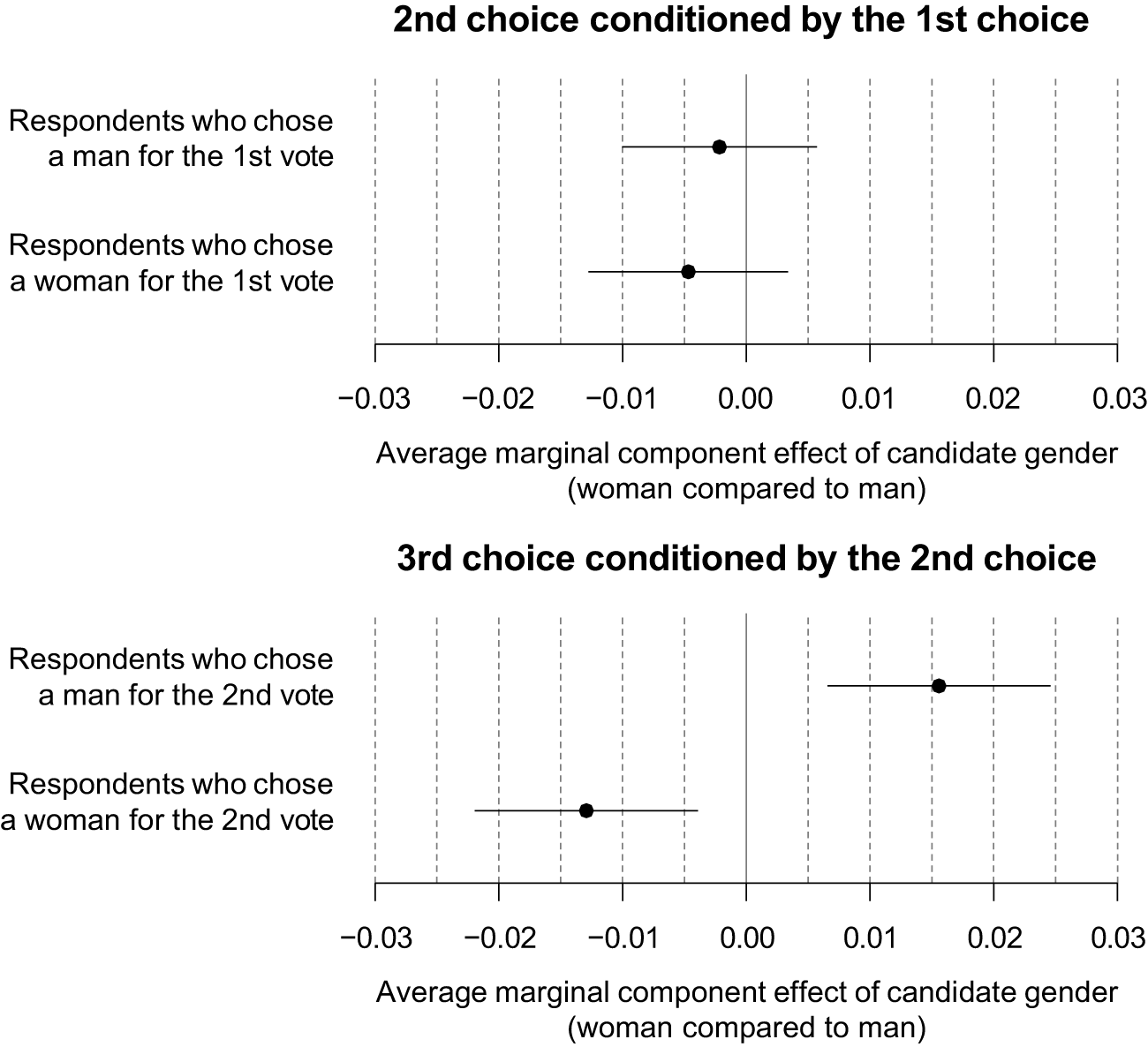
We begin with the results for H1. The top panel of Figure 2 presents the average marginal component effects (AMCEs) of being a female candidate on the likelihood of selection as the second-ranked choice in the BV group, conditional on the gender of the first-ranked candidate. The bottom panel shows the AMCEs for third-ranked choices, conditional on the second-ranked selection. Positive values indicate a greater likelihood of selection for female candidates.
AMCE of candidate gender in second- and third-rank choices in the BV group, based on the gender of the candidate selected in the previous rank.

Figure 2 Long description
The top graph is titled ‘2nd choice conditioned by the 1st choice’ and shows the average marginal component effect of candidate gender (comparing women to men) on the x-axis, ranging from negative 0.03 to positive 0.03. It includes two data points: one for respondents who chose a man for the first vote, with an estimated effect of negative 0.002 that is not statistically significant, and another for respondents who chose a woman for the first vote, with an estimated effect of negative 0.005 that is also not statistically significant. The bottom graph is titled ‘3rd choice conditioned by the 2nd choice’ and uses the same x-axis range. It also has two data points: one for respondents who chose a man for the second vote, with an estimated effect of positive 0.016 that is statistically significant, and another for respondents who chose a woman for the second vote, with an estimated effect of negative 0.013 that is statistically significant.
The figure reveals that the AMCE for second-ranked choices remains consistent regardless of the prior selection. However, gender balancing becomes apparent for third-ranked choices: respondents who selected a male candidate second were 1.6 percentage points more likely to choose a female third, whereas those who selected a female candidate second were 1.3 percentage points less likely to choose another woman. These results provide partial support for H1, particularly concerning the third-choice level.
Table 1 contextualizes these findings by reporting the full-gender sequences chosen in the BV group. Across all combinations of first and second choices, mixed-gender combinations at the second and third ranks occurred more frequently than same-gender sequences. For instance, man–man–woman appeared 2.3 percentage points more often than man–man–man; similarly, woman–man–woman was 1.1 percentage points more frequent than woman–man–man. These patterns indicate a behavioral tendency toward gender diversification in later selections.
Pattern in the gender order of candidates chosen by the BV respondents

Table 1 Long description
The table reports the observed probabilities of the eight possible gender-order patterns across respondents’ first, second, and third choices. The probabilities are 11.6% for man-man-man, 13.9% for man-man-woman, 13.9% for man-woman-man, 12.8% for man-woman-woman, 11.6% for woman-man-man, 12.7% for woman-man-woman, 12.1% for woman-woman-man, and 11.5% for woman-woman-woman. Patterns in which the second and third choices differ by gender occur more frequently than patterns in which they share the same gender.
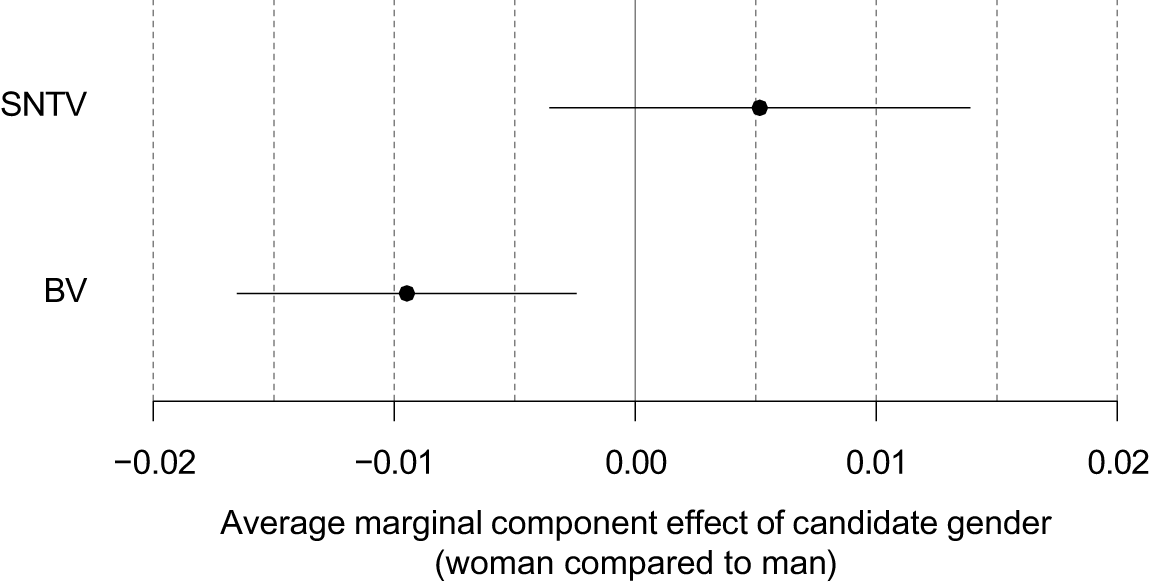
Figure 3 presents the AMCEs of candidate gender across the SNTV and BV groups.Footnote 14 In the SNTV system, female candidates had a marginal, statistically insignificant advantage of 0.5 percentage points. In contrast, under the BV system, they were significantly less likely to be selected, facing a disadvantage of 0.9 percentage points. Contrary to H2, the overall gender gap widened under BV.
AMCE for candidate gender depending on electoral systems.

Figure 3 Long description
The graph shows the average marginal component effect of candidate gender, comparing women to men, under two electoral systems: SNTV and BV. The x-axis is labeled ‘Average marginal component effect of candidate gender (woman compared to man)’ nd ranges from negative 0.02 to positive 0.02. The y-axis lists the two electoral systems: SNTV and BV. For SNTV, the estimated effect is positive 0.005 and is not statistically significant. For BV, the estimated effect is negative 0.009 and is statistically significant.
The pattern of gender balancing persisted in subgroup analyses (see Supplementary Appendices D.4 and D.5). Male respondents and individuals scoring above the median on hostile sexism generally favored male candidates, particularly in the BV condition. Nevertheless, consistent with H1, these groups demonstrated a greater willingness to select a candidate of the opposite gender as their third-ranked choice than as their second-ranked choice. Even among voters with strong anti-female attitudes, the probability of including a woman increased when their second-ranked choice was a man.
Some may question whether the differences in the effect of candidate gender across the SNTV and BV conditions—or among ranked choices in BV—partly reflect variations in candidate selectability. In the SNTV condition, a respondent who prefers men can typically select a male candidate unless all six candidates are women (a scenario with a probability of 0.016). In contrast, in the BV condition, if fewer than three of the six candidates are male (a scenario occurring with a probability of 0.344), respondents may be compelled to select at least one woman. Similarly, while respondents in the BV condition can freely rank a male candidate first, limited male availability may compel them to select women in lower ranks. To address these concerns, we conducted several robustness checks: for H1, we controlled for the number of remaining female candidates; for H2, we restricted observations in the BV group to tasks with equal numbers of male and female profiles. The results of these checks and additional analyses (see Supplementary Appendix E.1) indicate that our findings are not artifacts of these structural constraints.
In summary, the conjoint experiment reveals that, under the BV system, respondents were more likely to alternate genders in their second- and third-ranked choices, thereby supporting H1. However, because first-ranked choices strongly favored male candidates, women were ultimately less likely to be selected under BV than under SNTV, contradicting H2. These findings suggest that while multi-vote ballots can promote gender balancing at lower ranks, the dynamics of first-choice selections still tend to favor male candidates.
5. Conclusion
While extensive research has examined the effects of PR and gender quotas on women’s legislative representation, less attention has been paid to how majoritarian systems—particularly those permitting multiple votes—influence gendered voting behavior. Although previous studies suggest that multi-vote settings may encourage voters to diversify their choices, robust empirical evidence remains limited. To address this gap, we conducted a preregistered survey experiment comparing two majoritarian systems used in multimember districts: BV (multiple votes) and SNTV (single vote). We hypothesized that BV would promote “gender balancing” behavior, especially in candidate-centered local elections. In the conjoint experiment, respondents were randomly assigned to either the SNTV or BV condition. As expected, those in the BV condition were more likely to alternate genders in their second- and third-ranked choices, although our design does not identify the underlying mechanism. This pattern persisted even among male respondents and individuals with high levels of hostile sexism, who generally exhibit lower support for female candidates. Robustness checks eliminated mechanical constraints as a cause of this behavior. In contrast, no corresponding gender balancing was observed between the first- and second-ranked selections. Future research should investigate why balancing emerges later in the selection sequence rather than during the initial step.
Contrary to our hypothesis, female candidates were less likely to be selected under the BV system than under SNTV overall. The predominance of men in first-choice votes under BV offset the gender balancing observed in lower rankings, despite neither system weighting selections by rank. This finding suggests that multi-vote structures may encourage diversification in subsequent selections while amplifying gender bias in the initial choice, potentially reflecting a tendency for the first choice to favor male candidates. This result contrasts with the meta-analysis by Schwarz and Coppock (Reference Schwarz and Coppock2022) showing broad support for female candidates, which may partly reflect assumptions based on single-vote contexts. The balancing effect appears specific to gender, as no comparable patterns were observed for age, education, hometown, or legislative experience (see Supplementary Appendix F). This raises important questions regarding how sequence position interacts with the perceived importance of each vote.
Finally, our study highlights the understudied influence of electoral design on women’s representation within majoritarian systems. Although our conjoint design excluded party labels and did not account for strategic voting (see Cox, Reference Cox1997), the findings provide compelling evidence that ballot structure affects gendered voting behavior. Future research should investigate how candidate gender interacts with party cues, party nominations, and strategic behavior under majoritarian rules. It is important to recognize that, in partisan environments, BV can result in de facto winner-take-all outcomes within districts; in such scenarios, party nominations may have a greater impact on electoral outcomes than voters’ gender preferences (see Matland, Reference Matland1993). Hence, the insights from our candidate-centered setting should not be overgeneralized to partisan elections. Nevertheless, some implications may extend to the limited vote system—another multimember rule that often yields more proportional outcomes than BV—even in partisan contexts, as the same gender-balancing mechanism could operate when party coordination is weak. Further research is needed to examine these dynamics under partisan conditions. Overall, these findings underscore the inherent trade-offs in majoritarian systems and demonstrate how ballot structure shapes gendered voting behavior beyond what has been documented under PR.
Supplementary material
The supplementary material for this article can be found at https://doi.org/10.1017/psrm.2026.10108.
Acknowledgements
We would like to extend our thanks to Charles T. McClean, Marwa Shalaby, Paul J. Schuler, Hidenori Tsutsumi, Nick C. N. Lin, Chung-Min Tsai, and participants from the 2023 annual meetings of the Japanese Association of Electoral Studies and the American Political Science Association, as well as from the Political Methodology Conference held at National Chengchi University in Taiwan, for their valuable feedback on earlier drafts. We also thank Hitoshi Komiya and Yuichiro Shimizu for sharing historical insights and providing helpful comments. In preparing this manuscript, the authors used Grammarly and ChatGPT for copyediting purposes. After employing these services, the authors have reviewed and edited the content as necessary and take full responsibility for the final manuscript.
Data availability statement
Replication files are available on the PSRM Dataverse at: https://dataverse.harvard.edu/dataverse/PSRM.
Funding information
The authors received financial support from the Research Institute of Economy, Trade and Industry (RIETI), Waseda University Grants for Special Research Projects (2025C-288, 2024C-005, 2023C-003), and the Japan Society for the Promotion of Science Grants-in-Aid for Scientific Research KAKENHI (25K00603, 25K00604, 24K00217, 20H00059, 19H00584). Yoshikuni Ono also received financial support from Waseda University's Global Research Center Support Program (GRC-kojin-2502). This research was conducted as part of the project “Challenges to Achieving a Sustainable Society: Exploring Solutions Through a Social Science Approach Utilizing Experiments and Data” at RIETI.
Competing interests
The authors declare no competing interests.




 Open access

