

1. Introduction
Prototyping is a fundamental activity within the design process, enabling the exploration, evaluation, and communication of design concepts (Reference Camburn, Viswanathan, Linsey, Anderson, Jensen, Crawford, Otto and WoodCamburn et al., 2017). Tools that guide designers to focus on how (and why) they specify their prototype, increase prototype quality and the likelihood of deeper design insight (Reference Lauff, Menold and WoodLauff et al., 2019). High-fidelity physical prototypes are generally viewed as the most valuable in terms of the depth and richness of understanding they can generate, but they require a significant time and cost commitment.
Mixed Reality (MR) offers opportunities to enhance low-fidelity prototype value, enabling them to provide value closer to that of a high-fidelity prototype. By blending physical and virtual elements, MR affords prototypes perceived to be of high fidelity with greater flexibility and at a lower cost than traditional physical models (Reference Snider, Cox, Kukreja and WallerSnider et al., 2026). However, this introduces a new layer of complexity as designers must consider the physical and virtual prototype characteristics and their interplay (Reference Cox, Gopsill, Snider and HicksCox et al., 2024), as well as how each feature should be blended across the virtual/physical spectrum, deciding what should be tangible and what should be digital (Reference Snider, Kukreja, Cox, Gopsill and KentSnider et al., 2024).
A growing body of research has investigated how MR prototypes can be implemented (Reference Ferrise, Graziosi and BordegoniFerrise et al., 2017; Reference KentKent, 2022). Further work has sought to holistically describe MR prototype implementation options, investigating why a prototype should be made in a specific way, looking at how characteristics, like size and mass, affect user perception in an MR prototyping context (Reference CoxCox, 2025; Reference Cox, Gopsill, Snider and HicksCox et al., 2024).
With this new knowledge, the field can move to the next stage in prescribing tools that support designers in designing their MR prototypes, bridging the gap between goal and implementation. This paper proposes, evaluates and demonstrates the value of one such tool. Section 2 provides a summary of the influential research for the creation of this tool. Sections 3 and 4 describe how the tool was developed and evaluated and Sections 5, 6, and 7 present the results of this evaluation, with a discussion of these results and recommended future work.
2. A summary of MR prototype implementation research
Prototypes are critical for reducing uncertainty in product development, enabling ideas to be tested, feedback to be gathered, and design iteration before significant investment is made in production (Reference Camburn, Viswanathan, Linsey, Anderson, Jensen, Crawford, Otto and WoodCamburn et al., 2017). However, specifying a prototype to efficiently meet its goals is a complex task. Designers must balance fidelity, scope, cost, and time to create a representation that seeks to elicit and answer the right design questions without wasting resources.
Examples of MR prototypes in academic literature; left to right: OurLab (Reference KentKent, 2022), MR prototype drill (Reference Cox, Gopsill, Snider and HicksCox et al., 2024), MR prototype handheld printer (Reference Wang, Tian, Liu, Zhou and ZhangWang et al., 2024)

Mixed Reality (MR) has emerged as a valuable addition to the prototyping toolkit. It offers the ability to combine the tangibility of physical models with the flexibility, low cost, and speed of virtualisations (Reference Kent, Snider, Gopsill and HicksKent, Snider, Gopsill, et al., 2021). Successful MR prototypes can be found in academia (Figure 1), and are starting to be adopted by industry (Reference SamuelsonSamuelson, 2018; Reference SquiresSquires, 2017; YORD, 2024).
Despite the purported benefits of MR in prototyping, the increased design freedom gives rise to a more complex decision-making process for prototype specification that is insufficiently addressed in literature. Designers must now consider not only what to represent, but how to represent it across a blended physical/virtual spectrum. They must determine what aspects should be physical, what should be virtual, how should they be implemented, at what fidelity, and how aspects of the two domains should be blended whilst minimising development time and cost (Reference Cox, Gopsill, Snider and HicksCox et al., 2024; Reference Kent, Snider, Gopsill and HicksKent et al., 2021). This added complexity is not supported by any existing implementation guidance, and thus a new supportive tool or method is needed.
While work in the field of MR for design processes is still in its infancy, three notable research studies into the specification of MR prototypes have been conducted but have not been consolidated into a single useable format. Summarised here, these three distinct studies provide the basis for the tool presented in this paper:
1. A Taxonomy for MR Prototype Fidelity: A barrier to specifying MR prototypes is the lack of a consistent lexicon. The simple 1-D scale of low-high fidelity is insufficient to describe a prototype with physical and virtual components of varying quality (Reference McCurdy, Connors, Pyrzak, Kanefsky and VeraMcCurdy et al., 2006). To address this, a taxonomy of MR prototype fidelity was developed, breaking fidelity down into three distinct dimensions: Form, Functional, and Psychological fidelity, with a range of sub-dimensions. This framework (Figure 2) allows for a more precise “fidelity profile”, providing a richer description of a prototype’s characteristics and implementation (Reference Cox, Hicks and GopsillCox et al., 2022).
Taxonomy of MR prototype fidelity dimensions (Reference Cox, Hicks and GopsillCox et al., 2022)

2. The Role of Physical/Virtual Size and Mass Fidelity: A study was conducted to understand the interplay between physical and virtual traits on user perception, revealing that the visual representation (the virtual component) dominates the user’s overall perception of size. However, it also found that a baseline of physicality is essential; for instance, prototypes with unrepresentatively low mass were perceived as significantly less realistic, negatively impacting the user’s experience. This suggest that while vision is dominant, haptic feedback must meet a minimum threshold to maintain the illusion (Reference Cox, Gopsill, Snider and HicksCox et al., 2024).
3. Industry Validation of Broader Fidelity Dimensions: A third study further evaluated the role of the other dimensions within the taxonomy shown in Figure 2, such as environmental and operational fidelity. Industry designers provided input on the value and suitability of different prototype characteristics for specific use-cases. This study, detailed in Reference CoxCox (2025), confirmed the value of representing interactions, tasks, and environments within an MR prototype and began to link specific characteristics to different prototyping scenarios.
3. Creating a design tool to guide MR prototype development
A variety of design support tools have been created that provide structure and guidance to aid designers in their prototyping design decision making (Reference Lauff, Menold and WoodLauff et al., 2019; Reference Menold, Jablokow and SimpsonMenold et al., 2017; Reference Roy and WarrenRoy & Warren, 2019). Similarly, many tools have been created to support other complex decision-making processes, such as business strategy planning (Reference OsterwalderOsterwalder, 2004), or developing inclusive practice (Reference Craigon, Fearnshaw, Fisher and Hadfield-HudsonCraigon et al., 2023). The frequency of these types of decision support tools both within and outside of the engineering domain highlight their value, and the specific value of design support tools for prototypes have been shown by Reference Lauff, Menold and WoodLauff et al. (2019), Reference Menold, Jablokow and SimpsonMenold et al. (2017) and Reference Roy and WarrenRoy and Warren (2019). Common themes among these tools include the use of targeted questions, the provision of background information, and recommendations for specific scenarios/example case studies.
However these design support tools, such as the Prototyping Canvas by Reference Lauff, Menold and WoodLauff et al. (2019) and the Prototyping for X framework by Reference Menold, Jablokow and SimpsonMenold et al. (2017) primarily focus on the process of prototyping, and not on what the specific implementation of the prototype should be. As the task of specifying an MR prototype’s implementation has been shown to be non-trivial, this is the research gap that is addressed by the tool proposed in this paper.
To select an appropriate format for this design tool, a comparative analysis of existing design tool formats (card decks such as in (Reference Craigon, Fearnshaw, Fisher and Hadfield-HudsonCraigon et al., 2023; Reference Roy and WarrenRoy & Warren, 2019), canvases such as in (Reference Lauff, Menold and WoodLauff et al., 2019) and prescriptive frameworks such as in (Reference Menold, Jablokow and SimpsonMenold et al., 2017)) was conducted. The tool needed to be flexible enough to accommodate the wide variety of scenarios in which a prototype may be needed, yet structured and comprehensive enough to provide clear guidance across a range of considerations. Furthermore, given the rapid evolution of MR technology and as this is a first iteration of the tool, it needed to be easily updatable.
A card-based, discussion-led framework was selected as the most appropriate format, based on these metrics of application flexibility, depth of guidance and ease of modification. Inspired by tools like the EDI Cards (Reference Craigon, Fearnshaw, Fisher and Hadfield-HudsonCraigon et al., 2023) and other card based design tools (Reference Roy and WarrenRoy & Warren, 2019), this format encourages informed discourse by presenting key information, targeted questions, and case studies across a range of topics. The modularity of a card deck also simplifies any required modification of the tool.
To structure the card deck, the taxonomy shown in Figure 2 was used to establish topics for each card, in addition to the key contextual factors that influence prototype design (Reference Houde and HillHoude & Hill, 1997; Reference Ulrich and EppingerUlrich & Eppinger, 2016). This choice was made as it had been identified that the tool should focus on the actual implementation of the prototype, rather than the process of prototype creation. This resulted in 25 cards across 6 themes: Psychological Fidelity, Visual Fidelity, Haptic Fidelity, Operational Fidelity, Environmental Fidelity, and Prototyping Context. Each theme contains one “theme card” that explains the main points of that theme, and several “topic cards” that explain the topics within each theme. Each topic card focuses on a specific dimension of prototype fidelity (e.g., “Mass Fidelity”) from the taxonomy in Figure 2, or a contextual factor (e.g., “Prototyping Goals”).
Other support tools that help navigate complex problem solving tasks (see Section 2) are commonly formatted with three key ingredients – key information about each topic, key questions that should be addressed by the designer/practitioner, and potential implementations or case studies. This approach is adopted for the proposed tool. Each card is double-sided. The front of each card presents key information, summarising the value proposition and core concepts related to that topic or theme. The back of the cards have key questions, to prompt the designer to consider relevant factors, and recommendations that offer practical examples and guidance, many of which are drawn from Reference CoxCox (2025).
A theme card and a topic card, showing key information, questions and recommendations

The main rationales that inform the content on the cards are derived directly from the foundational research discussed in Section 2 (Reference CoxCox, 2025; Reference Cox, Gopsill, Snider and HicksCox et al., 2024), and the author’s experience creating MR prototypes (Reference CoxCox, 2025; Reference Cox, Gopsill, Snider and HicksCox et al., 2024; Reference Dybvik, Cox, Ormerod, Aalto and SniderDybvik et al., 2025).
Due to space limitations, the entire card deck cannot be displayed hereFootnote 1 . However, some example cards are shown in Figure 3, and the overall structure is shown in Figure 4.
The structure of the full card deck, showing the distribution of cards across six themes

It is highlighted by Reference Roy and WarrenRoy and Warren (2019) that any design support tool requires a process to use it effectively. It was proposed that an effective method to utilise the card deck is for a designer to first familiarise themselves with the contents of the card deck, and then to identify the priority cards based on their prototyping scenario. With this prioritisation the designer should then consider the questions and recommendations proposed for these priority cards, to identify how these characteristics should be implemented. However, this method will require validation and iteration, as well as the contents and formatting of the card deck, based upon the results of the subsequent testing and evaluation.
4. Evaluation of design support tool utility
A qualitative evaluative study was conducted to validate the contents and proposed implementation method of the card deck. A team of three design researchers at PhD level who were aware of MR but had no experience using MR for prototyping were recruited. Although this sample size was small, the participant’s expertise in engineering design enabled them to provide rich feedback on the utility and application of the tool.
The participants were given the following task which involved creating a specification list for an MR prototype with rationale for each of their implementation decisions:
You are designers at a car company that is looking to explore the use of MR in their design process and have decided to conduct an initial case study.
They want to create an MR prototype of a new car cockpit design, to verify and iterate the layout of the different components to maximise ergonomics and intuitiveness, before committing to a physical prototype.
You have been tasked with specifying this prototype, so that the specification can be sent to the modelling team for fabrication/creation.
The study was split into four stages to compare between an MR prototype specification task with and without the design support tool, and to capture the participant’s opinions of the tool:
-
1. Initial specification of an MR prototype, without the use of the proposed design tool.
-
2. Familiarisation with the proposed design tool.
-
3. Revisiting the MR prototype specification with the design tool, allowing the participants to update and expand the specification if desired.
-
4. Evaluation and discussion of the design tool.
Additionally, all audio was recorded to provide additional data from any dialogue as needed.
4.1. Stage 1: initial specification without the design support tool
The participants were asked as a group to create an initial specification of how the prototype should be made and implemented, with justifications for each decision. Twenty minutes was assigned for the activity, but the participants were told they could take longer if needed, until they were happy that they had produced a sufficiently complete specification for the brief.
From this, the number of specification points and the depth of justification was captured.
4.2. Stage 2: familiarisation with the design support tool
The participants were given a copy of the card deck and asked to familiarise themselves with the contents. The proposed method of how the card deck should be used to support the designing process was also explained. Participants were told they could ask any clarification questions, to mitigate misunderstandings and highlight potential improvements to the tool.
Once the participants were happy with the contents of the card deck (this took around 15 minutes), they continued to the next stage of the study.
4.3. Stage 3: revisiting the MR specification task with the design support tool
The participants were asked to revisit the initial specification task and were told that they could update, iterate and/or redo their MR prototype specification in line with their new knowledge and following prompting from the cards, if they wanted to.
It should be noted that participants were presented with the same brief used in Stage 1. As the participants were happy their initial specification was sufficient to meet this brief, any addition or modification to their output specification in this stage would be due to the consideration of the design tool, not due to the extra allocated time or brief variation.
As with stage 1, the output specification was recorded. This section was also nominally allocated 20 minutes but, as with stage 1, the participants were encouraged to take any extra time required to reach a state they were satisfied with (5 extra minutes were needed).
4.4. Stage 4: evaluation and discussion of the design support tool
The final stage focused on capturing data from the participants to acquire insight into the performance of the design support tool, and to identify any points for improvement in future iterations. To achieve this, a questionnaire was given to each of the participants, and discussion on each of the questions was encouraged within the group to gain deeper insight.
The questionnaire contained a range of Likert-style ranking questions and open-ended questions that explored whether the participants felt that the card deck helped them to specify a “better” prototype (i.e. better suited to the prototype goals), that was “cheaper” (in terms of both cost and development time), and with better rationale. The questions also explored whether or not the tool encouraged the participant to consider a wider variety of prototype implementation options/factors (and what these were), or changed their approach to the specification process. Lastly, the participants’ opinions on the strengths, weaknesses and potential improvements to the card deck were captured. Further details of these questions can be found in Section 5.
5. Results
This section is divided into two. Firstly, characterisations of the prototype specifications after study stages 1 and 3 are provided, and then the results from the stage 4 questionnaire are shown.
5.1. Prototype specification characterisation
Table 1 summarises the number of specification points, and the average text length of the justification entry for each specification point. These results show that the number of specification points generated by the participants more than doubled after introducing the card deck (18 to 51 points), and the length of the justification for each point followed a similar trend (23 to 42 characters). This shows that a greater number of design considerations were made by the participants after being exposed to the design support tool, and these considerations were made with greater rationale (due to increased length of justification).
Summary of MR prototype specification after stages 1 & 2

Most of the new specification points focused on task representation and enabling specific user interactions, and the specific physical and virtual features required to enable this with suitable fidelity levels (29/33 new points). The justifications provided for the new specification points were reinforced by the necessity of these tasks and interaction modes, and their perceived realism. Based on the associated audio recordings, these points and their rationale were largely inspired by the topics and contents of the cards.
5.2. Questionnaire results
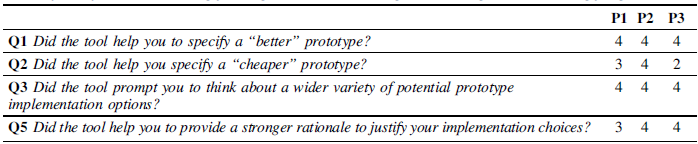
The results of the Likert-style ranking questions (Q1,2,3,5) are summarised in Table 2. This table shows that the participants agreed that the card deck helped to produce cheaper (less funds/time needed) and better (more suited to the task) prototypes. It also encouraged them to explore more options and provide a stronger rationale for their choices (modal score of 4 – agree). One participant disagreed with the statement that the card deck produced a cheaper prototype, but during the discussion elaborated to say that this was because the prototype specification they generated had more features due to a more rigorous specification process.
Likert question results from the stage 4 questionnaire, showing ratings from the three participants. 1 = Strongly Disagree, 3 = Neither Agree or Disagree, 5 = Strongly Agree

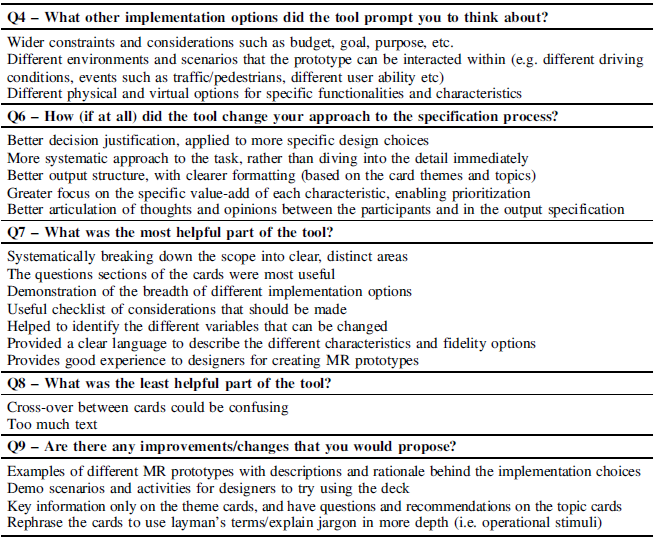
The participant answers to the open questions are summarised in Table 3. As the participants were encouraged to discuss with each other while filling in the questionnaire, some answers were duplicated, and some (despite verbal agreement from each of the participants) were only written down by one participant. Additionally, as the participants were aware that they were being recorded, some of the points were written down as a single word or pair of words, and explained in more depth verbally. Because of these factors, the comments shown in Table 3 have been interpreted and clarified, and duplicates have been combined. Each of the comments in this table were agreed upon by each of the participants, with no disagreement during the discussion stage.
Comments made by the participants in the open-text questions of the questionnaire

6. Discussion
The positive feedback shown above demonstrates the tool’s value in supporting MR prototype specification, providing a structured approach to a complex task. Largely due to the prompts to consider a wider range of implementation options and rationales that might otherwise be overlooked. This is evidenced by participant comments and the stark increase in the number of output design specification points, and rationale depth, after introducing the card deck.
By breaking the multifaceted nature of MR implementation into distinct themes, the tool facilitated prioritisation of key elements through the use of question prompts. Also, the clear lexicon helped improve communication clarity between team members and in written output.
Beyond the deck’s immediate utility, participants stated that the experience itself was valuable in developing their skill to create future MR prototypes. This highlights a potential high-value use case for the tool in facilitating CPD (Continuing Professional Development) activities.
However, feedback revealed areas for improvement. A primary concern was the volume of text and technical jargon, which requires streamlining to improve access, an issue emphasised by clarification questions raised during the experiment. Potentially confusing overlaps between card topics were also noted, suggesting a need for clearer distinction.
Furthermore, the divided opinion on whether the tool created a “cheaper” prototype is noteworthy. Verbal elaboration suggested that the tool led to a feature-rich and costlier prototype. However, as the resulting prototype would likely be higher quality, this would likely result in long-term cost savings by reducing the need for more less effective prototypes.
Finally, participants proposed some formatting improvements that are discussed in Section 7.
7. Next steps
The insights gained from this initial evaluation provide a clear direction for the future development of the design support tool and for further research in MR prototyping. This work can be divided into two main streams: improvements to the design tool itself and a broader scope of future testing and research.
Based on the constructive feedback from the participants, the card deck would benefit from several refinements to improve information accessibility and overall tool value:
-
• Rephrasing of the card contents to reduce and improve explanation of technical terms.
-
• Refining the deck structure to reduce information density and overlap between cards.
-
• Develop supporting materials to include examples and demo activities.
-
• After making these improvements, to further validate and enhance the tool, the card deck should be tested more rigorously with a larger sample size, ideally with designers from industry. This will provide valuable insights into the tool’s applicability and effectiveness in a real-world design context, validating that the tool promotes “better” prototyping practice, and characterising this improvement in greater depth. Additionally, other areas for iteration and improvement in the tool should be identified, leading to further refinement.
-
• As this design support tool is focused on the specific implementation of the prototype and not the mapping of the prototype to the wider design process, compatibility of this tool alongside the more process driven tools such as (Reference Lauff, Menold and WoodLauff et al., 2019; Reference Menold, Jablokow and SimpsonMenold et al., 2017) should also be tested.
-
• Lastly, further research into the specific effects of different MR prototype implementation options on user experience could be framed within the structure of the card deck. This will help researchers to pinpoint independent and control variables and can then in turn be used to further expand the card deck with any resultant results from these new studies.
8. Conclusion
This paper has presented the development and initial validation of a card deck-based design support tool that addresses the complexities of specifying MR prototypes. An evaluation study conducted with three PhD level design researchers demonstrated the tool’s potential to improve the rigour, structure, and collaborative nature of the MR prototyping specification process. This is evidenced by a significant increase in the number of specified prototype implementation points after introducing the design support tool (18 to 51), with improved rationale to support these points (avg. justification length increased from 23 to 42 characters). Furthermore, the participants unanimously agreed that the tool enabled them to create a better prototype, based on a wider variety of options and supported by stronger rationale.
By providing a structured framework and a common vocabulary, the tool empowers designers to make more informed decisions based on feature prioritisation, leading to higher-quality and more effective prototypes. The constructive feedback received has provided a clear path for future refinements and broader validation. The continued development of this tool, alongside further research into the complex mapping between MR prototype implementation and value, will further improve the utility of MR for prototyping. Also, further exploration of the support tool alongside more process-focused tools will help to expose the utility of MR prototypes to designers in industry, so that they can capitalise on it within their design processes.
Acknowledgements
This work was conducted as part of the Digital Design Network+ project (ID UKRI394) and the 21st Century Prototyping project (ID EP/W024152/1).




 Open access

