


1. Introduction
Products are designed for their customers. Customers are people who are willing to buy a product in fulfilling their own subjective requirements or needs. How customers perceive a product, understand the product functions or quality and what motivates them to buy the product is highly complicated and relies on multiple factors. (Reference Retief and De KlerkRetief and De Klerk, 2010) According to McKean the reason why customers buy products depend on the three primary factors, acknowledgement, respect and trust. Acknowledgement of the customers’ needs through product characteristics and building trust and respect for the customer is the key motivation point for a “purchase decision”. (Reference McKeanMcKean, 2003)
Stylidis et al. state that “making a product with excellent perceived quality is not an extremely difficult task for a product development project. […] The truly challenging task is to reach optimal perceived quality level based on given boundaries regarding technologies, development time, production systems capabilities, and financial limitations.” (Reference Stylidis, Wickman and SöderbergStylidis et al., 2018). Perceived quality refers to a customer’s subjective evaluation of product excellence, influenced by expectations, purpose, aesthetics, brand reputation, and prior experiences (Reference Lieb, Quattelbaum and SchmittLieb et al., 2008). Consumers increasingly base their judgments on product rather than measurable quality, often choosing products that align with their aesthetic, emotional, or functional ideals. Consequently, perceived quality may diverge from objective performance, meaning the most technically advanced or durable product is not always viewed as the highest quality. (Reference Kassemeier, Haumann and GüntürkünKassemeier et al., 2022)
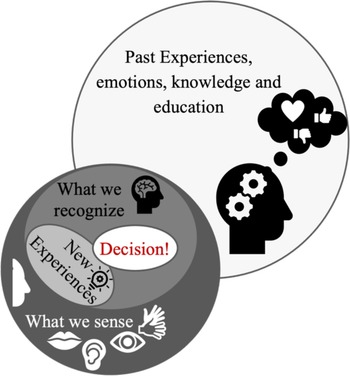
Accordingly, humans perceive products through their senses. The senses of sight, touch, smell, hearing and taste received from experiencing the product are converted into neuron excitation signals by sensory receptor cells located in each sensory organ. These signals can be received and processed by the brain as data to create a perception of that product. (Reference Stylidis, Wickman and SöderbergStylidis et al., 2018) The brain processes sensory data alongside internally stored information, including intuition, past experiences, emotions, knowledge, and education. Consequently, judgments of product quality are inherently subjective, shaped by individual sensory and cognitive filters (see Figure 1). This complexity makes predicting customer perceptions during purchasing challenging. The issue is amplified in online shopping environments, where sensory inputs such as touch and smell are absent, further complicating accurate assessment of perceived product quality. (Reference Retief and De KlerkRetief & De Klerk, 2010) The research question that arises from this is how such “lost” sensory perceptions can be communicated or how customer perceptions can be gathered?
An interpretation of sensory and intuition influence on decision-making

2. Background
The subsequent sub-chapters will give the background information required to answer the aforementioned research question. In consideration of the fact that the customer perception process is highly product context dependent, the product category of textile fashion is selected with a view to offering more tangible results.
2.1. Textile touch - general
According to most studies done on textile experience with sensory organs, customers naturally tend to try the product with their own hand, with using fingers and palm and observe or experience it with touch and sight (Reference BishopBishop, 1996; Reference Gussen, Ellerich and SchmittGussen et al., 2019). Gussen et al. and T. Smith state, multisensory perception relies on the integration of visual, auditory, and tactile stimuli. This suggests that the perception of textile surfaces with properties such as roughness, softness, and gloss can only be replicated with engaging multiple senses. (Reference Gussen, Ellerich and SchmittGussen et al., 2019; Reference SmithSmith, 2014)
Physical interaction with a product creates a sense of belonging and ownership, as handling materials provides sensory confirmation of their quality, texture, and value. In the context of modern consumer behaviour, this is described within the concept of Need for Touch (NFT). (Reference Pino, Amatulli, Nataraajan, De Angelis, Peluso and GuidoPino et al., 2020) NFT differentiate between high-NFT and low-NFT individuals, where high-NFT individuals actively seeking for tactile experiences relying heavily on touch to evaluate product quality. Low-NFT individuals place less importance on tactile interaction, relying more on visual or digital cues when assessing products. (Reference Peck and ChildersPeck & Childers, 2003; Reference Pino, Amatulli, Nataraajan, De Angelis, Peluso and GuidoPino et al., 2020)
Touch can be further categorized into the two types, “instrumental touch” and “non-instrumental touch”. Instrumental touch is purposeful and functional, such as handling a fabric to assess its durability, texture, or flexibility. This type of touch is goal-oriented and directly linked to product evaluation. Non-instrumental touch, is hedonic or emotional, such as stroking a soft textile for comfort or aesthetic pleasure, which enhances the feeling of personal connection and satisfaction with the product. (Reference Frankel, Vasut, Houle, McCauley, Bamber, King, Hipolito, Wasiak and ClarkFrankel et al., 2023; Reference Pino, Amatulli, Nataraajan, De Angelis, Peluso and GuidoPino et al., 2020) The increase of fashion eCommerce applications leads to the absence of a physical touch opportunity and therefore presents a challenge in the purchase process. Without touch interaction, the sense of belonging, trust, and emotional attachment may be reduced, highlighting the need to develop multisensory or haptic solutions that can bridge the gap between digital representation and physical experience. (Reference Peck and ChildersPeck & Childers, 2003)
2.2. Textile touch characteristics
The “surface aspect” of a textile can be defined by “the sensorily perceptible result (the effect) of working process as shown by any given treatment of material (smoothness, for instance), surface aspects maybe due to elemental causes, such as influence of nature, or mechanical causes, such as machine treatment” (Reference SmithSmith, 2014). The analysis of textile fabric touch requires consideration of two primary components: the human perceptual response and the material attributes of the fabric (Reference Basdogan, Giraud, Levesque and ChoiBasdogan et al., 2020; Reference Neves, Brigatto, Samaan, Rodrigues and PaschoarelliNeves et al., 2020). Different fabrics generate distinct sensory stimuli during handling due to variations in their textile components and structural characteristics. These stimuli arise from several key factors, including fibre and yarn composition; the type of fibre or filament (natural, synthetic, or blended), its polymer structure, fabric structure and design; the weave or knit pattern and intrinsic properties such as flexibility, surface texture, or moisture behaviour. (Reference Cui and WangCui & Wang, 2025) Surface and finishing treatments; processes such as dyeing, coating or laminating may modify surface attributes such as smoothness, gloss, stiffness or softness (Reference Skrzetuska, Puszkarz and NosalSkrzetuska et al., 2022; Reference Thundathil, Emerson, Nazmi, Shahri, Müssig and HuberThundathil et al., 2024). Together, these elements determine the haptic and visual sensations perceived when handling a fabric, contributing to its overall tactile and aesthetic experience (Reference Philippe, Schacher, Adolphe and DacremontPhilippe et al., 2004).
While vision enables a perception of global characteristics such as colour, orientation, and overall form, touch provides direct sensory input on mass, surface friction, hardness, and temperature (Reference Woods and NewellWoods & Newell, 2004; Reference Zeng, Wang, Qiao, Wang, Wu, Zeng and HongZeng et al., 2024). Together, these modalities allow humans to detect both macro-geometric features (e.g., shape and size) and micro-geometric features (e.g., texture and material differences). The interaction between these sensory systems also affects how material qualities are interpreted. (Reference Woods and NewellWoods & Newell, 2004)
Concluding, different sensory modalities capture distinct textile attributes that together shape our perception of materials. Haptic perception conveys temperature, pressure, vibration, and pain, informing judgments of softness, roughness, greasiness, and dryness. Handling adds cues about thickness, drape, weight, and stretch. Vision captures colour, pattern, and surface structure, while audition reflects sounds like rustling silk or crinkling synthetics. Accurate assessment typically combines modalities. Numerous attributes describe textile sensations, yet no common set exists, so studies propose varying terms for subjective touch. In general a lot of touch attributes can be referred back to the work of Sueo Kawabata (Reference KawabataKawabata, 1980), but at the end all these attributes are dependent of the specific product and social context (Reference Jang and HaJang & Ha, 2024; Reference Schacher, Adolphe, Bensaid, Jeguirim and VassiliadisSchacher et al., 2011).
2.3. Existing methods for touch perception modelling/measurements
Ciesielska and Van Langenhove reviewed the historical development and methodological diversity of fabric touch research from 1930 to 2010. Their four-part classification distinguishes between objective physical measurement systems (e.g., KES, FAST), subjective psychophysical evaluations, and emerging biomechanical and digital modelling approaches. Objective techniques are physical or mechanical testing methods that aim to translate the tactile and visual sensations perceived by humans into quantified measurements of fabric properties. Subjective techniques rely on human sensory evaluation and descriptive judgments of fabric qualities such as softness, smoothness, or warmth, with questionnaires, blind tests, gesture analysis, etc. Combined techniques integrate instrumental data with human perception to improve prediction accuracy of fabric hand. Mathematical or biomechanical modelling methods simulate the interaction between human skin and fabric, supporting digital and virtual haptic evaluation. (Reference Ciesielska-Wróbel and Van LangenhoveCiesielska-Wróbel & Van Langenhove, 2012)
Basdogan et al. reviewed textile-like sensations through digital touch surfaces technologies, which use vibrotactile, electrostatic, and ultrasonic actuation to generate tactile effects that simulate real material textures on screens. Such systems allow consumers to perceive haptic impressions of fabrics before purchase, representing a new dimension of textile haptics in online shopping experiences. (Reference Basdogan, Giraud, Levesque and ChoiBasdogan et al., 2020)
Development presented at Eurohaptics 2024 underscore the potential of textile-based haptic technologies in creating immersive digital experiences. By integrating tactile feedback into wearable textiles, these innovations enable users to experience virtual environments with a heightened sense of realism. The combination of pressure, vibration, and thermal stimuli through textile interfaces offers a more comprehensive approach to digital haptics, moving beyond traditional visual and auditory feedback. (Reference Kajimoto, Lopes, Pacchierotti, Basdogan, Gori, Lemaire-Semail and MarchalKajimoto et al., 2025)
Retief and de Klerk underscore the pivotal role of visual assessment in the consumer evaluation of clothing textile products, particularly in contexts where tactile interaction is limited, such as online shopping. Their study highlights that consumers rely on both concrete and abstract criteria and emphasizes the necessity of developing comprehensive guides that assist consumers in visually assessing the quality of clothing textiles. (Reference Retief and De KlerkRetief & De Klerk, 2010)
A study by Rakhin and Onkar investigated how visual images of textiles can predict haptic sensations, focusing specifically on smooth-rough perception. Using 13 fabric samples, the study compared participants’ responses to high-resolution and full images with actual touch-based sensations. Results show a strong positive correlation between high-resolution images and real haptic perception, while full images correlated weakly. The findings suggest that detailed, close-up visuals more accurately convey tactile qualities, which has implications for textile design, manufacturing, and online retail applications. (Reference Rakhin and OnkarRakhin & Onkar, 2018)
Quattelbaum et al. demonstrate that, although digital visual cues can provide partial information regarding textile surface properties, they are insufficient to fully replicate the tactile experience of handling materials. Therefore, not only smooth-rough perception was investigated, but eight different attributes to describe textile surfaces. This limitation indicates that relying solely on visual representation by high-resolution images in digital platforms may not meet customer expectations or provide a satisfactory product evaluation. (Reference Quattelbaum, Wolter and StylidisQuattelbaum et al., 2022)
In order to enhance the touch information, Atkinson et al. investigate the means by which the tactile qualities of textiles, including weight, drape, and texture, can be communicated through interactive video media in the absence of physical contact. The present study combines observational research on how people naturally handle fabrics with experimental design techniques. The aim was to capture realistic textile deformations through controlled filming and lighting. (Reference Atkinson, Orzechowski, Petreca, Bianchi-Berthouze, Watkins, Baurley, Padilla and ChantlerAtkinson et al., 2013)
Böttcher et al. have developed a virtual reality (VR) system that simulates realistic two-finger haptic interactions with virtual textiles. This system is fully digital and immersive, and is combined with an external device. This system facilitates the manipulation of digital fabrics through actions such as squeezing, stretching, and rubbing, enabled by a dual-finger force-feedback device integrated with tactile actuators. The system also integrates tactile rendering, generating vibrotactile feedback corresponding to fabric texture. (Reference Böttcher, Allerkamp, Glöckner and WolterBöttcher et al., 2008)
The issue of economic scalability of external devices, previously mentioned, is once again raised in this context (Reference Ornati and KalbaskaOrnati & Kalbaska, 2022). Ultimately, advancing digital textile touch requires a multidisciplinary integration of material science, human perception research, and computational modelling, ensuring that both the physical characteristics of textiles and the nuanced human responses to them are accurately represented in virtual environments.
2.4. Evaluation of touch perception in physical and digital worlds
In ‘From Material to Architecture’, Moholy-Nagy expresses that people first become aware of space and the positional relationships of bodies through their sense of sight. The movement of the viewer (i.e. the change in their position) and the sense of touch define the experience of space, or ‘spatial experience’. In this context, light generates visual volumes, and volume has two meanings: mass size and visual size. Space is the reality of our sensory perception and the positional relationship of bodies. Therefore, spatial experience related to sight and touch is connected to light, space, and the volume and position of the object. (Reference Moholy-NagyMoholy-Nagy, 1929)
The texture or surface of an object can be understood as an aggregation of micro-objects, which the eye interprets as different textures based on their composition (Reference Moholy-NagyMoholy-Nagy, 1929). In textiles, which are composed of very fine fibre structures, a spatial experience of surfaces and textures is also present. Therefore, in visual-haptic evaluation models, the relationship among light, space, and volume must be considered to accurately convey surface qualities. However, when translating textiles to digital platforms necessity given by increasing eCommerce the information source of space and volume is limited. Furthermore, the perception is reduced to the visual sight. (Reference Jang and HaJang & Ha, 2024)
Wilfling et al highlight consumers with a high Need for Touch were found to struggle more with online apparel shopping, as visual information alone, such as photos or videos cannot fully replace the missing haptic experience. As a result, decision quality and purchase intention decline when tactile cues are absent. (Reference Wilfling, Havenith, Raccuglia and HodderWilfling et al., 2023)
Given that textile components and human sensory responses are inherently complex and distinct systems, replicating the full touch experience digitally presents significant challenges. One promising approach to address this complexity is the enhancement of digital textile representations across multiple dimensions, including visual realism, surface texture simulation, mechanical behaviour, and haptic feedback. (Reference Retief and De KlerkRetief & De Klerk, 2010) Online retailers should improve the communication of fabric touch through enhanced visuals, videos, descriptive language, or emerging technologies like augmented reality to help bridge the sensory gap and support better consumer decision making (Reference Wilfling, Havenith, Raccuglia and HodderWilfling et al., 2023).
Development of comprehensive guides that assist consumers in visually assessing the quality of clothing textiles, are essential for enhancing consumer confidence and satisfaction, by providing clear visual indicators of quality, these guides can bridge the gap between physical and digital product experiences, fostering more informed and satisfying purchasing decisions (Reference Retief and De KlerkRetief & De Klerk, 2010). A robust “touch experience” framework is required, one that systematically transports touch experience information and communicates texture, softness, and other touch attributes to the customer. Such a framework should integrate broader perceptual studies to bridge the gap between visual representation and the physical experience of textiles, enabling consumers to perceive digital products more reliably.
3. Textile touch experience framework
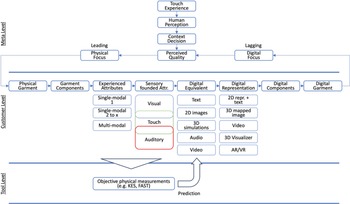
As stated in the preceding chapters, the convergence of the physical, digital and human domains poses significant challenges to designers and retailers in terms of the representation of their products in digital channels. The physical interaction with textile products is a determining factor in the acquisition of essential experiences regarding material composition, durability, appearance, and tactile quality. These experiences are built up through the processes of seeing, touching, and interacting with the fabric. In the context of digital textile representation, it is imperative that all pertinent information is conveyed virtually. In contemporary approaches, this encompasses high-quality or macroscopic images and videos, meticulous written descriptions, and material care instructions. The objective of a digital textile is to replicate the physical experience as closely as possible, thereby providing both visual and touch impressions, even in the absence of physical contact with the material. Customers can thereby receive a reliable and realistic impression of the textile product, even without physically touching it. Within the following sections a framework gets described how attributes defined by the physical product experience (top-down) can be transferred to digital environment covering “lost” senses like the touch and be perceptible by the customers (bottom-up). Figure 2 outlines the framework of a comprehensive textile touch experience.
The leading driver of the framework is always the physical experience of a product. Even if a product is ordered online, the final decision to keep it is made after handling the product for the first time. Therefore, companies must understand how the customer perception process works using a top-down approach, how product context influences customers (e.g. a different set of attributes) and how a final perceived quality judgement is formed. Next, specific products or product groups need to be broken down into their main components and physically analysed. This should be done using objective physical measurements (e.g. KES, FAST) and customer studies to derive a product-specific set of attributes for assessment. These studies should be designed as a combination of multi-modal and single-modal subsets. Companies need to build an understanding of which sensory category is fundamental to each attribute so they can address or communicate these attributes in the best possible sensory way. (see Figure 2, left part “top-down”)
At this juncture, the interface to the digital representation context is initiated, with the sensory perception modelling for customers being constructed in a bottom-up manner. As previously stated, sensory attributes that have been identified and defined in the physical world must be allocated to their digital equivalents. Following this allocation, said sensory attributes must then be modelled in digital product representatives. These representatives serve as the digital cues that customers use to construct their sensory perceptions in digital channels. This digital focus is compared to the leading physical the lagging focus, but not of less importance. In this chapter, the elements, digital equivalents and digital representatives of the bottom-up side of the framework (see Figure 2, left part, ‘bottom-up’) are described in greater detail.
Our visual system is able to survey an entire scene of objects at once and encode the spatial relationships and orientations of those objects, whereas the haptic (touch) modality is necessarily sequential and limited by the “one thing at a time” nature of manual exploration. Vision takes in holistic spatial information (“the scene”), enabling one glance to capture many elements and their layout, where the efficiency of the recognition is higher than the haptic system. (Reference Woods and NewellWoods & Newell, 2004) So, the representation or conversion of touch and haptic attributes in textile product experience process, is the key to make “digital representation” of a textile product.
Touch experience framework

In the process of digital conversion, visual and auditory attributes can be effectively represented through digital visual and auditory formats. However, translating tactile or haptic qualities into digital form remains a challenge. The primary limitation arises from the variability in individual “haptic sensitivity,” which makes it difficult to establish standardized digital representations (Reference Mehta, Holásková and WalkerMehta et al., 2024). As demonstrated by Griffiths and Kulke, the digital replication of fabric haptic and touch–movement data is technically complex and demands substantial computational resources (Reference Griffiths and KulkeGriffiths & Kulke, 2002). Consequently, haptics replicating devices are inevitably expensive and not scalable in an end consumer market (Reference Ornati and KalbaskaOrnati & Kalbaska, 2022). This situation presents an opportunity for companies to employ digital-visual and digital-auditory technologies as alternative means of conveying the tactile, movement, and haptic characteristics of textiles.
In order to convey information in this regard, it is necessary to utilise various forms of media, including text, graphics, photographs, audio, video and three-dimensional objects (Reference Retief and De KlerkRetief & De Klerk, 2010; Reference Wilfling, Havenith, Raccuglia and HodderWilfling et al., 2023). Conventional 2D images of textile surfaces offer a restricted visual information, frequently failing to adequately represent depth, structure, or the tactile qualities of the material. (Reference Quattelbaum, Wolter and StylidisQuattelbaum et al., 2022). In contrast, 3D representations enhance spatial perception, allowing users to better understand surface structures and forms (Reference Rodriguez-Pardo, Pascual-Hernandez, Rodriguez-Vazquez, Lopez-Moreno and GarcesRodriguez-Pardo et al., 2025). However, producing realistic 3D textures requires extensive data processing and computational capacity, and carries the risk of exaggerating surface features beyond their physical reality. Accurate digital replication therefore necessitates faithful representation of texture, colour, light interactions, transparency, fine surface details, and depth. The employment of generative models and intrinsic image decomposition in this approach serves to eliminate shadows and glare, thereby enabling the creation of true-to-life digital textiles. (Reference Rodriguez-Pardo, Pascual-Hernandez, Rodriguez-Vazquez, Lopez-Moreno and GarcesRodriguez-Pardo et al., 2025)
An additional sensory dimension in textile perception is the sound generated during fabric handling, which contributes to the unconscious assessment of tactile qualities (Reference Gussen, Ellerich and SchmittGussen et al., 2019). For instance, the sound produced while handling a certain material can be correlated with the attribute of roughness (Reference Xue, Murillo, Dawes, Frier, Cornelio and ObristXue et al., 2024). Such audio-tactile information can be integrated with still textile images or presented in video format to provide a more comprehensive sensory experience.
Furthermore, the dynamic interaction with digital textiles, such as rotating, zooming, or simulating touch through animations or videos, provides a more realistic spatial experience. This can replicate with a 3D object and visualize in 3D visualizer, as video or using AR or VR technology. It replicates the perception of handling textiles by visually suggesting how fabrics respond to movement, pressure, or drape. Nevertheless, such approaches still face limitations in fully replicating the haptic feedback that physical interaction provides. (Reference BhowmikBhowmik, 2024)
In the final analysis, the addition of text information or metaphorical visual/written language may be considered as a possible representation of haptic cues. As posited by Leng et al., the utilisation of a metaphorical information approach serves to enhance consumers’ awareness of haptic attributes. This approach also explores implementation strategies for conveying online product haptic attributes and experiences to consumers. (Reference Leng, Zhou, Wang and XiangLeng et al., 2022) The use of everyday language by consumers, designers and textile experts to describe materials fosters an emotional connection between the consumer and the product. The terms frequently employed, such as ‘flutter’, ‘crunch’ and ‘soapy’, serve to phonetically describe a material, closely aligning with their original denotation. This approach suggests a method of translating sensory experiences in a synesthetic manner (Reference Meiklejohn, Devlin, Silverman and KoMeiklejohn et al., 2023).
The touch experience framework can be operationalised by designers following these steps:
-
1. The product category and usage context are specified, clarifying which touch qualities are relevant for purchase decisions.
-
2. The product is decomposed into technical elements and if possible objective measurements related to touch behaviour are obtained.
-
3. Customer perception is investigated. Multi-modal and single-modal studies identify perceptual attributes that drive quality judgements and determine the predominant sensory channel for each attribute. The result is an attribute matrix linking: (1) relevant perceptual qualities, (2) dominant and secondary senses, (3) correlated physical parameters, and (4) vocabularies.
-
4. Digital representation strategies are derived for each attribute, specifying appropriate combinations of digital equivalents required to evoke the intended sensory impression.
-
5. The adequacy of the digital representation is validated by comparing user evaluations based on digital stimuli alone with evaluations after direct physical interaction. Discrepancies support the formulation of transferable design guidelines for the product category.
4. Discussion
The proposed theoretical framework structures how customer perceptions of fashion textiles can be gathered and communicated when physical interaction is limited but purchasing decisions occur online. The framework aims to reduce perceptual uncertainty and bridge the sensory gap between tactile evaluation and digital representation. Its implications extend across strategic, design, and theoretical dimensions.
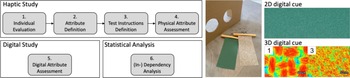
Initial applications of parts of the framework, illustrated by textiles, have generated encouraging results, along with some challenges. The application of a single-modal focus, achieved by means touch, in combination with a reduced set of digital representations (2D pictures and/or 3D microscope pictures), has demonstrated the ability of customers to assess certain touch attributes via digital visual cues, with a level of accuracy comparable to physical cues. Eight attributes, strength, wool, softness, felt, structure, ease, elasticity, smoothness were elaborated by participants during a physical study. (Reference Quattelbaum, Wolter and StylidisQuattelbaum et al., 2022). However, it should be noted that not all defined sensory-based attribute assessments can be replicated using a digital representation. The combination of 2D pictures and 3D microscope pictures to enhance digital representation could strengthen the validity of the physical-digital representation, but further investigation is needed. (Reference Quattelbaum, Steinem and NeumannQuattelbaum et al., 2023) Figure 3 shows the applied methodology and digital representations. The methodology can be used as a blueprint for specific future design cases.
Based on these preliminary results and the literature review the integration of textile photographs, audio cues, video simulations, 3D visualisations, and descriptive text or graphics must be further explored and refined to more accurately convey tactile sensations on digital platforms. The interactive, video-based approach for textile samples proposed by Atkinson et al. offers considerable potential for realistic fabric perception (Reference Atkinson, Orzechowski, Petreca, Bianchi-Berthouze, Watkins, Baurley, Padilla and ChantlerAtkinson et al., 2013). In order to enhance the digital experience of haptic perceptual richness and realism, future developments should incorporate auditory and linguistic elements. In the context of a paradigm shift towards digital product experiences, which are increasingly replacing physical interaction, it is imperative to preserve the sensory understanding of textiles from the outset.
For fashion and textile companies, the framework offers a pathway to address a central weakness of online eCommerce: the absence of touch and its consequences for consumer confidence and return rates. Integrating perceptual data and touch equivalents into digital interfaces allows companies to communicate material qualities more accurately, enhancing trust and purchase intention (Reference Petit, Velasco and SpencePetit et al., 2019).
Operationalization of touch experience framework (sub-set)

Beyond risk reduction, structured perceptual data create opportunities for differentiation. Standardized touch descriptors and multimodal representations enable digital material passports or enriched B2B fabric libraries (Reference Jang and HaJang & Ha, 2021). Treating material experience as quantifiable information also aligns with current movements toward transparency, sustainability, and circular design (European Union, 2024). However, such initiatives require investment in sensory studies, data management, and cross-functional collaboration.
For designers, the framework redefines material literacy. Translating subjective sensory qualities into standardized digital descriptors demands new skills at the intersection of design, psychophysics, and data visualization. (Reference Overmars and PoelsOvermars & Poels, 2015) Designers must express tactile nuances through visual cues, metadata, or simplified representations integrated into digital prototypes. Designers face trade-offs between expressive creativity and perceptual accuracy. Moreover, device and lighting variability alter visual impressions of materials, necessitating consistency guidelines and perceptual calibration across platforms (Reference Zhang, de Ridder and PontFan Zhang et al., 2015). These challenges highlight the need for interdisciplinary collaboration among designers, engineers, and data scientists to preserve perceptual integrity throughout digital workflows. But consequently, the proposed framework offers designer a comprehensive understanding of the customers’ touch experience and there supports a data-informed decision making.
Although the framework provides systematic guidance, touch perception is inherently subjective and shaped by cultural and personal factors (Reference Rahman, Fung, Chen and GaoRahman et al., 2017). Models based on narrow samples may overlook population variability; hence, future studies should use diverse panels and adaptive modelling approaches. Technological limitations also constrain the fidelity of visual-haptic renderings. While high-resolution imaging and physics-based drape simulations improve realism, they cannot yet replicate the complex spatiotemporal cues of real touch (Reference Qiu, Porterfield, Mathur and HanQiu et al., 2025). Additionally, collecting detailed perceptual and behavioural data introduces privacy concerns, requiring transparent consent and anonymization practices
Future research should empirically validate each layer of the model. Controlled experiments comparing perceptual communication bundles, such as images alone versus images plus semantic descriptors, can quantify their effects on purchase confidence and return behaviour.
5. Conclusion
Ultimately, the digitization of textile perception is both a technological and conceptual challenge. The proposed framework demonstrates that touch experience can be structured, measured, and partially translated into digital communication without erasing its sensory richness. Successful implementation will depend on balancing standardization with creativity and objectivity with emotion. By making the invisible qualities of touch perceptible online, the fashion industry can move toward more transparent, multisensory, and trustworthy digital experiences.

 Open access

