


1. Introduction
In 1988, the contracting parties to the General Agreement on Tariffs and Trade (GATT) were debating reforms to the GATT’s dispute settlement system when the European Economic Community (EEC) pointed to a fundamental tension in that system. It might seem ‘illogical’, the EEC admitted, that a party to a dispute could veto the adoption of a panel report, since this made the party ‘both judge and jury in its own case’. However, it was ‘equally illogical’ to deny a party the right to block the adoption of legal interpretations developed by a panel, since this ‘might result in GATT obligations which [the party] felt that it had not accepted in the past and was unwilling to accept in the future’. There was thus a conflict, in the EEC’s view, between ‘two activities involved in dispute settlement’: ‘resolution of the conflict on the one hand and authoritative interpretations of GATT provisions on the other’.Footnote 1
The GATT contracting parties ultimately tried to resolve this conflict by institutionally separating the parties’ role as litigants from their role as interpreters of the law. The Marrakesh Agreement Establishing the World Trade Organization (WTO Agreement), which entered into force in 1995, effectively prevents WTO Members, when sitting as the Dispute Settlement Body that oversees the dispute settlement system, from blocking the adoption of reports issued by the dispute settlement organs. At the same time, the WTO Agreement gives WTO Members, when sitting as the General Council or the Ministerial Conference, the ‘exclusive authority’ to adopt interpretations of WTO provisions.
It is safe to say that this attempt to accommodate the ‘dual role of states’Footnote 2 in WTO dispute settlement was unsuccessfulFootnote 3 : while WTO Members became enthusiastic litigants, they largely failed to fulfil their role as treaty interpreters and norm developers.Footnote 4 WTO Members have not adopted a single authoritative interpretation in the WTO’s 30-year history and have only rarely and haphazardly offered interpretive guidance to the dispute settlement organs by other means. The result of this failure should not be surprising: the dispute settlement organs have filled the vacuum that the Membership created – they became drivers of norm development in the WTO at least in part because WTO Members collectivelyFootnote 5 reduced themselves to bystander status.Footnote 6 It was this division of labour that ultimately precipitated the current backlash, culminating in the decision by the United States to veto the initiation of the selection procedure for new Appellate Body Members and thereby causing the Appellate Body to lose its quorum for deciding appeals.Footnote 7
Why did the WTO Membership fail to play its assigned role in norm development as the dispute settlement organs were busily interpreting the law? Two explanations are currently on offer. The first is that WTO Members’ inability to offer guidance on the interpretation of WTO law reflects the broader crisis of the WTO’s negotiating function.Footnote 8 WTO Members have famously been unable to conclude the Doha Round and have only managed to adopt two major multilateral agreements – on trade facilitation and fisheries subsidies – in the WTO’s three decades of existence. The second explanation, which has been most prominently advanced by the United States Trade Representative (USTR) under the first Trump administration, Robert Lighthizer, is that certain WTO Members have refused to negotiate changes to WTO law because they have strategically chosen to litigate rather than legislate. Thus, Lighthizer has argued that ‘[t]oo often members seem to believe they can gain concessions through lawsuits that they could never get at the negotiating table’.Footnote 9
Both of these explanations provide an important part of the picture, but they do not offer a full explanation of why WTO Members have not made more use of the specific avenues for guiding norm development that the WTO regime provides. The first explanation does not take account of the difference between the negotiation of new obligations and the clarification of existing obligations: it is by no means clear that the negotiating dynamics that prevented WTO Members from agreeing on the major cuts in tariffs and agricultural subsidies contemplated by the Doha Round are the same that prevented them from clarifying the meaning of an existing obligation. And Lighthizer’s theory does not explain why WTO Members have not used the WTO’s mechanisms for clarifying obligations to safeguard against or reverse the results of the type of strategic litigation that he is concerned about.
My argument in this article is that we need to be attentive to the specific dynamics that have made it so difficult for WTO Members to use the avenues for shaping norm development that the WTO regime provides. There are two such avenues: WTO Members can either offer guidance to the dispute settlement organs ex ante or overrule them ex post. As I will argue, dynamics that are specific to these avenues – namely, the diverging conceptions of the judicial function in the WTO that have shaped the approaches of key players to legislative overruling; the WTO’s negotiating principles, which legitimize the expectation that a demandeur ‘pay’ for interpretations even where those interpretations would simply restore the originally negotiated bargain; and the desire to preserve the pragmatic and legally innocuous character of the work done by the WTO’s councils and committees – are part of the explanation for why WTO Members have failed to do their part in shaping norm development in the WTO.
Understanding that failure is especially important at a time when WTO Members have identified a revival of legislative-judicial dialogue as one of the key planks of the reform of the WTO dispute settlement system.Footnote 10 Since February 2023, WTO Members have engaged in informal discussions facilitated by the Guatemalan diplomat Marco Molina; the outcome of those discussions, which was reached by using a novel ‘interest-based’ approach, is contained in a more than 50-page text that was first leaked and then published by the WTO on 16 February 2024, in advance of the WTO 13th Ministerial Conference in Abu Dhabi.Footnote 11
The draft text envisages two new avenues for legislative-judicial dialogue: the first establishes procedures for a more systematic discussion of adjudicative reports in the WTO’s councils and committees.Footnote 12 The goal of these discussions is to provide an ‘opportunity for Members at the expert level to discuss the technical and policy implications of the provisions interpreted in adopted DSB reports’.Footnote 13 The second avenue proposed by the text is the establishment of an ‘Advisory Working Group’ that would provide a mechanism for WTO Members ‘to discuss, build consensus and provide guidance on legal interpretations developed by adjudicators’. Specifically, the Advisory Working Group can suggest that the General Council adopt an authoritative interpretation regarding the matter, can recommend that the DSB agree ‘that the interpretation at issue shall not be considered persuasive’, or can simply record the diverging views of Members regarding the interpretation.Footnote 14 The inclusion of these proposals in the Molina text shows that WTO Members regard the failure of the dialogue between the WTO’s legislative bodies and its judicial organs as a key element of the WTO’s dispute settlement crisis. The recent proposal by the United States for the adoption of an authoritative interpretation of the security exceptions in the WTO Agreement is another illustration of the central role that a revival of legislative control over norm development in the WTO will have to play in attempts to revive the WTO dispute settlement system.Footnote 15
The article proceeds as follows. I will first recall the stakes of my analysis by showing how the failure of WTO Members to guide norm development in the WTO has contributed to the current backlash against WTO dispute settlement. As I will suggest, the crisis of WTO dispute settlement is as much a story of WTO Members’ underreach as it is a story of panels’ and the Appellate Body’s overreach.Footnote 16 I will then introduce the two key mechanisms for shaping norm development in the WTO that WTO Members have at their disposal, namely, the adoption of authoritative ‘interpretations’ within the meaning of Article IX.2 of the WTO Agreement and of a ‘subsequent agreement … regarding the interpretation of the treaty or the application of its provisions’ within the meaning of Article 31.3(a) of the Vienna Convention on the Law of Treaties. Next, I will explore the reasons why WTO Members have largely failed to make use of these mechanisms. Finally, I will provide a conceptual framework for thinking about the institutional design challenges that are at the heart of the crisis of WTO dispute settlement and situate various reform proposals, including those advanced by the Molina text, within that framework.
While the imbalance between the legislative and judicial organs of the WTO is a truism among trade law scholars, surprisingly little attention has been devoted to the reasons why WTO Members have been so reluctant to use authoritative interpretations for the purpose of legislative overruling or to employ subsequent agreements to offer guidance to the dispute settlement organs ex ante. It is notoriously difficult to explain ‘non-decisions’Footnote 17 , and I do not believe that there is a single explanation for the WTO Memberships’ failure to guide norm development in the WTO. In fact, it is more likely that the non-use of these mechanisms is overdetermined: one could think of more than one cause that would be sufficient on its own to explain that failure.Footnote 18 However, if WTO Members are to succeed in reviving legislative-judicial dialogue in the WTO or if we want to learn from the WTO’s experience in designing other international dispute settlement mechanisms, we need a full picture of why that dialogue has not been successful to date. Instead of employing Ockham’s razor to identify the most parsimonious explanation, I hope to add a few more pieces to ‘Ockham’s quilt’: the ‘causal patchwork’ that can explain why WTO Members have failed to guide norm development in the multilateral trade regime.Footnote 19
2. How the failure of the Uruguay Round accommodation of the dual role of states contributed to the backlash against WTO dispute settlement
During the era of the GATT, which lasted from 1947 to 1994, any contracting party could decide to block the adoption of a report by a dispute settlement panel. The contracting parties made regular use of this power, either because they did not like the manner in which the panel had resolved the dispute or because they took issue with an interpretation of GATT provisions adopted by the panel, or both.Footnote 20 In the 1980s, the veto power over panel reports made GATT dispute settlement increasingly dysfunctional, and the contracting parties were considering options that would prevent the blocking of panel reports while preserving the contracting parties’ control over the interpretation of GATT provisions. A key element in solving this tension was to institutionally separate the role of contracting parties (who would later become WTO Members) as litigants and treaty interpreters. The Dispute Settlement Understanding (DSU), which has governed the settlement of disputes in the WTO since 1995, introduced the so-called negative consensus rule for the adoption of reports issued by the dispute settlement organs: under that rule, instead of being able to unilaterally block the adoption of a report, a WTO Member can only prevent the adoption of reports if it can convince all other WTO Members to join it in a consensus to reject the report – a virtually impossible proposition, which rendered the adoption of reports quasi automatic. At the same time, the WTO Agreement reserved for WTO Members collectively the ‘exclusive authority’ to adopt an ‘authoritative interpretation’ of WTO provisions.Footnote 21
It may have looked like a clear division of labour – the dispute settlement organs solve disputes, while WTO Members interpret the law – but WTO Members must have known that the reality would be messier: while the DSU describes the ‘aim’ of the dispute settlement system as achieving a ‘positive solution’ to the dispute, it also tasks the dispute settlement organs with ‘clarify[ing]’ WTO provisions ‘in accordance with customary rules of interpretation of public international law’ – a clear acknowledgement that WTO Members would not be the only ones interpreting WTO law.Footnote 22 Even during the Uruguay Round, some delegations noted the ‘law-creating element in any interpretative choice of one among other possible interpretations of GATT rules by a competent GATT dispute settlement body’; other delegations highlighted that the consensus principle for the adoption of panel reports had a ‘protective function … for the integrity of multilaterally agreed rules’.Footnote 23 In other words, at least some Uruguay Round negotiators were acutely aware that the dispute settlement organs would be engaged in interpreting WTO law along with WTO Members – and they must have known that the dispute settlement organs’ role in interpreting WTO law would grow to the extent that WTO Members failed to undertake that task themselves.
Nonetheless, the negotiators made it extraordinarily challenging for WTO Members to play their role in interpreting WTO law. By institutionally separating the role of states as litigants from their role as treaty interpreters, the negotiators created at least three hurdles to states fulfilling their role as treaty interpreters that had not existed in the GATT. The first hurdle was procedural: in the GATT, the contracting parties had the opportunity to endorse or reject the panel’s interpretation of a GATT provision at the moment when the panel report was put up for adoption. In the WTO, by contrast, a Member may well protest against a dispute settlement organ’s interpretation of a WTO provision when the report comes up for adoption, but that protest has no legal effect (unless the Member can convince all other WTO Members to join it in rejecting the report). If the WTO Member wants to overrule the dispute settlement organ’s interpretation, it must initiate the process laid out in Article IX.2 and bring the issue to the attention of a WTO Council and ultimately the General Council – a considerable investment of time, resources, and political capital. The second hurdle is substantive: in the GATT, the contracting parties could exercise their power as treaty interpreters in a purely negative form by rejecting the interpretation adopted by a panel. In the WTO, by contrast, Members need to replace the dispute settlement organ’s interpretation with an interpretation of their own – they thus have to exercise their interpretive power in a positive form, by telling the dispute settlement organ how it should have interpreted the provision instead.Footnote 24 The third and final hurdle is political: WTO Members can no longer exercise their interpretive power unilaterally by rejecting the panel’s interpretation, as they could in the GATT; instead, they have to build political support for their alternative interpretation among at least three quarters of the WTO Membership and, as a practical matter, among all WTO Members.Footnote 25
At least some negotiators wanted the bar for an authoritative interpretation to be so high that it could never be met. According to Andrew Stoler, a senior negotiator for USTR during the Uruguay Round and later a Deputy Director-General of the WTO, Article IX of the WTO Agreement was ‘one of the most critically negotiated pieces at the end of the Uruguay Round’. On Stoler’s account, the United States and ‘some of [its] allies’ wanted to be ‘absolutely certain that developing countries in general were not able to use decision-making as a way to unwind the contents of the agreements we were in the process of finalising’. This meant that, from the US perspective, ‘all of the provisions of Article IX were drafted in a way to ensure they would not be usable’.Footnote 26 Documentary evidence supports Stoler’s recollections. In the Dunkel Draft of December 1991, which provided the starting point for the final phase of the Uruguay Round negotiations, Article IX:2 of what would become the WTO Agreement simply provided: ‘The Ministerial Conference or the General Council shall have the authority to interpret the provisions of the Agreements annexed hereto.’Footnote 27 Article IX:1 explicitly provided for majority votes as the default mode of decision-making. As Stoler points out, the final version of the WTO Agreement adds multiple hurdles to these provisionsFootnote 28 , with the result of making ‘interpretations all but unusable’. These changes lend plausibility to Stoler’s claim that the United States, at least, ‘never wanted this provision to be live and practically useful’.Footnote 29
However, the United States’ intentions notwithstanding, the fact is that the instrument of authoritative interpretations is available, and the mere existence of procedural, substantive, and political obstacles to WTO Members’ exercise of their role as treaty interpreters does not explain why the WTO Membership has failed to exercise that role, especially as the problematic consequences of that failure – not least from the United States’ perspective – were becoming ever more apparent. Starting in the early 2000s, the jurisprudence of the Appellate Body, especially in the trade remedy sphere, created steadily increasing discontent in the United States.Footnote 30 In reaction, the United States gradually ramped up its pressure on the dispute settlement system – by complying in the narrowest possible way, thereby forcing other WTO Members to relitigate issues over and over,Footnote 31 by refusing to re-nominate its own Appellate Body Members, blocking the reappointment of other countries’ Appellate Body Members, and ultimately by blocking the appointment process for any new Appellate Body Members. Why did the United States not channel the time, resources, and political capital that it invested in litigation and ultimately in sabotaging the dispute settlement system into changing the interpretations adopted by panels and the Appellate Body?Footnote 32
The US-driven backlash against WTO dispute settlement has put intense focus on the process of norm development by the WTO Appellate Body and in particular on the question of whether the Appellate Body has exceeded its authority. These questions are definitely worthy of investigation.Footnote 33 However, it is equally worth investigating why the WTO Membership has not fulfilled its role as treaty interpreter, because the WTO Membership’s failure to fulfil that role was a necessary, if not sufficient, condition for the current backlash to develop. To mention just two thought experiments: if the WTO Membership had clarified the interpretation of the Anti-Dumping Agreement after the first ‘zeroing’ case, decades of litigation could have been avoided. And if the WTO Membership had instructed the Appellate Body how it should deal with situations in which it could not meet its 90-day deadline, it could have spared itself many acrimonious debates in the Dispute Settlement Body and prevented the frustration with the Appellate Body from mounting.
The bottom line is the following: if WTO Members had gotten their act together and overruled interpretations of the Appellate Body that departed from their understanding of the bargain negotiated in the Uruguay Round, all the real or perceived failings of the Appellate Body would have mattered much less, since they could have been corrected by the Membership. While the controversial decisions made by the Appellate Body are worth discussing, they should not have become make-or-break issues for the WTO dispute settlement system. Could the Appellate Body have developed interpretations of the Anti-Dumping Agreement that hit the legal sweet spot between the interests of different members? Perhaps.Footnote 34 Could it have been sufficiently politically astute to find just the right balance in addressing the contradictory demands that the DSU placed on it? Maybe.Footnote 35 But a system that depends for its survival on the institutional instincts and political foresight of seven individuals is inherently unstable. And the WTO Membership only ended up with such a system because it failed to make use of the institutional safeguards that the WTO Agreement provides to ensure that WTO law evolves in line with the preferences of the Membership. At the root of the current backlash thus lies the failure of the Uruguay Round accommodation of the dual role of WTO members – as litigants and treaty interpreters – in dispute settlement: while WTO Members became enthusiastic litigants, they largely failed to fulfil their role as treaty interpreters and norm developers. To understand the reasons for that failure, I first need to sketch the forms in which, and the institutional avenues through which, WTO Members could have shaped norm development in the WTO.
3. How WTO Members can shape norm development in the WTO
Many WTO Members are not shy to express their views on how WTO law should be interpreted. The Members who are parties to the hundreds of disputes that have been litigated in the WTO dispute settlement system regularly do so at length in their submissions to panels and (until recently) the Appellate Body, as well as in their statements to the Dispute Settlement Body once the reports of the dispute settlement organs come up for adoption.Footnote 36 However, while these views are carefully considered by the dispute settlement organs, they have no authoritative status and only contribute to the development of WTO law to the extent that they are reflected in the jurisprudence of the dispute settlement organs.Footnote 37 WTO Members can only shape the development of WTO law decisively if they express their views on its interpretation collectively Footnote 38 – either in the form of an authoritative interpretation adopted under Article IX:2 of the WTO Agreement, or in the form of a subsequent agreement within the meaning of Article 31.3(a) of the Vienna Convention on the Law of Treaties.Footnote 39
Authoritative interpretations and subsequent agreements differ both in their legal effect and in the procedures for their adoption. According to the Appellate Body, the former have ‘pervasive’ and ‘broad’ legal effect;Footnote 40 it stands to reason that the existence of an authoritative interpretation of a provision would dispose of the interpretation of the provision in question, leaving only questions of application for the dispute settlement organs (unless the interpretation itself raises interpretive questions). Subsequent agreements, by contrast, are merely to be ‘taken into account, together with the context’,Footnote 41 in the interpretation of the treaty; they become (an important) part of, but do not replace, the interpretative exercise. Since WTO Members have never adopted an authoritative interpretation, we cannot know for sure whether these distinctions would make a difference to the interpretive weight that would be accorded to the two types of agreements in practice.Footnote 42
What allows us to draw a definite distinction between the two types of agreements is the procedure that must be followed for their adoption. An authoritative interpretation can only be adopted by the Ministerial Conference or the General Council of the WTO; moreover, where the interpretation concerns an obligation under one of the agreements in Annex I of the WTO Agreement (i.e., the multilateral agreements governing trade in goods, trade in services, and trade-related intellectual property rights), the interpretation has to be adopted ‘on the basis of a recommendation by the Council overseeing the functioning of that Agreement’.Footnote 43 Subsequent agreements within the meaning of Art. 31.3(a) of the Vienna Convention, by contrast, merely have to be adopted by ‘the parties’ to the treaty; no particular procedure has to be followed, and no particular WTO body has to be involved, as long as all WTO Members are ‘parties’ to the WTO body that has adopted the agreement, which they are by definition.Footnote 44 The procedural hurdles for the adoption of ‘subsequent agreements’ are thus much lower than for the adoption of an authoritative interpretation; WTO Members might even adopt such agreements without intending to do so – a point that has created some controversy and to which I will return below.
WTO Members have suggested the use of authoritative interpretations repeatedly, most frequently in relation to the functioning of the dispute settlement system itself and in discussions about the effectiveness of special and differential treatment for developing countries.Footnote 45 It was also in these two contexts that the only formal proposals for authoritative interpretations were tabled, by the European Union and Korea, respectively.Footnote 46 What is remarkable for the purposes of the present article is that none of these proposals for authoritative interpretations were made in reaction to rulings of the WTO dispute settlement organs. Neither rulings that were rejected by a large majority of WTO MembersFootnote 47 nor rulings that caused profound discontent among the most powerful WTO members have prompted proposals for authoritative interpretations.
Given that there are no specific procedures for the adoption of ‘subsequent agreements’ within the meaning of the Vienna Convention, we cannot say for sure how many of such agreements the WTO Membership has adopted. So far, panels and the Appellate Body have explicitly classified three decisions as ‘subsequent agreements’: the Decision on ‘Implementation-Related Issues and Concerns’ adopted at the Doha Ministerial Conference in November 2001, the ‘Declaration on the TRIPS Agreement and Public Health’ adopted at the same Ministerial, and the decision on ‘Principles for the Development of International Standards, Guides and Recommendations with relation to Articles 2, 5 and Annex 3 of the Agreement’ that was adopted by the Committee on Technical Barriers to Trade (TBT) in September 2008. The contexts in which the first two and the latter decision were adopted could not have been more dissimilar: the Doha Ministerial took place in an atmosphere of high tension between developed and developing countries and in the political spotlight. The two decisions were designed to address the developing countries’ discontent with the outcome of the Uruguay Round and to buy their acquiescence to the start of a new round of negotiations. The TBT Committee Decision, by contrast, was the outgrowth of the regular work of one of the WTO’s committees, which often takes place under the political radar.Footnote 48 The TBT Committee Decision was thus much more representative of the output that WTO Members produce on a regular basis. Importantly in the context of the present article, its use as an interpretative tool by the Appellate Body produced a backlash that casts doubt on the feasibility of WTO Members offering interpretive guidance to the dispute settlement organs via this avenue in the future.
4. Why WTO Members have failed to shape norm development in the WTO
Authoritative interpretations and subsequent agreements provide WTO Members with the tools to shape norm development in the WTO in two ways: they can either clarify the law ex ante or overrule the dispute settlement organs ex post. In the following, I will explore why WTO Members have largely failed to do so, even as the cost of that failure has become evident in striking fashion.
The two existing explanations, which see the failure either as a reflection of the broader crisis of the negotiating function in the WTO or as an opportunistic choice on the part of WTO Members who are engaging in strategic litigation, have much to commend them. The deadlock in the Doha Round has sapped momentum from WTO negotiations more generally and has also meant that there has been no broad package of negotiating results of which interpretations of WTO provisions could have formed a part.Footnote 49 As I will discuss below, an attempt to reverse the effects of the Appellate Body’s jurisprudence on one of the most controversial issues – the ‘zeroing’ of negative dumping margins – through an amendment of the Anti-Dumping Agreement collapsed in acrimony even before the entire Round hit a road block in July 2008. This episode also shows that some of the WTO Members which derived material benefits from the jurisprudence of the WTO Appellate Body were unwilling to give up those benefits in negotiations, which lends credence to Lighthizer’s charge that some WTO Members have been willing to use strategic litigation to obtain benefits that they might otherwise have struggled to achieve in negotiations. However, I want to suggest that there is more to the story of why WTO Members have been unable to play their role as norm developers. And that story differs with respect to ex ante clarification and ex post overruling.
4.1. The refusal to pursue ex post overruling
Overruling the Appellate Body ex post would have been the most straightforward way for WTO Members to address the United States’ growing discontent with the Appellate Body’s jurisprudence over the past two decades. Why have WTO Members not used this opportunity? Apart from the obvious answer that some WTO Members benefited from the Appellate Body’s jurisprudence, I suggest that we need to look at two further elements to get the full picture, namely, the views of the key players regarding the scope of the judicial function in the WTO, and the particular way in which these views play out in the context of the WTO’s negotiating principles, which require WTO Members to ‘pay’ for concessions in negotiations with concessions of their own.
4.1.1. The role of different conceptions of the judicial function
One of the most controversial elements of the Appellate Body’s jurisprudence, at least for the United States, is the Appellate Body’s finding that the practice of zeroing of negative dumping margins (i.e., where the export price is higher than the normal value) is not permitted by the WTO’s Anti-Dumping Agreement in any context. The Appellate Body first made a finding that zeroing was prohibited by the agreement in a specific context in a case that was brought by India against the European Communities, rather than the United States. When the Appellate Body circulated its report in EC – Bed Linen in March 2001, the European Communities and the United States, along with other major users of anti-dumping duties, such as Canada, found themselves on the same side of the legal question: they all agreed that the Uruguay Round Anti-Dumping Agreement did not prohibit zeroing.Footnote 50 Given that the major users of anti-dumping procedures all used zeroing and that these users also happened to be the largest traders (China had not been admitted to the WTO yet) and thus had considerable leverage in the WTO, one may ask why these users did not team up to attempt to overturn the Appellate Body’s finding through an authoritative interpretation? The instrument should have been on their minds, given that the European Communities had spearheaded an aggressive effort to adopt an authoritative interpretation, if necessary through voting, just two years earlier (only to be blocked by the United States, which argued that the EC was in effect requesting an amendment).Footnote 51
The reactions to the Appellate Body report at the meeting of the DSB at which it was adopted offer a clue. While the EC was ‘surprised and concerned’ by the Appellate Body report, it assured India that it would ‘promptly comply with the DSB’s recommendations and rulings’. Significantly, the EC also expressed a willingness to review other determinations in which it had employed zeroing and noted that it expected other WTO Members who also applied the methodology ‘to bring their practices in line with the Anti-Dumping Agreement as soon as possible’.Footnote 52 In other words, the EC was willing to abandon a practice that it had believed was consistent with the Anti-Dumping Agreement once the Appellate Body found that not to be the case.
The United States, for its part, expressed ‘grave concerns’ about the ruling and declared that it was ‘monitoring the situation carefully, in particular since the standard of review was at the centre of the dispute settlement system’Footnote 53 – a standard that, in the United States’ view, the Appellate Body had not properly applied in reaching the conclusion that zeroing was not permitted by the Anti-Dumping Agreement. Canada similarly expressed concerns about the Appellate Body’s finding regarding the zeroing methodology.Footnote 54
Given that all other WTO Members who spoke, including India, Brazil, and Japan, applauded the Appellate Body’s conclusion, overturning the Appellate Body’s findings through an authoritative interpretation would have been extremely difficult even if the United States, the European Communities, and Canada had stood shoulder to shoulder. However, even though the three were in agreement about the correct interpretation of the Anti-Dumping Agreement and expressed concerns about the Appellate Body’s findings, their approaches to the Appellate Body’s decision differed fundamentally. As early as the DSB meeting at which the report was adopted, the European Communities showed a striking willingness to not only defer to the Appellate Body, but effectively to treat its ruling as an authoritative interpretation of the Anti-Dumping Agreement: even though the rulings and recommendations of the DSB are only binding on the parties to the specific dispute, the European Communities not only announced that it would review other determinations of its own authorities in light of the ruling in EC – Bed Linen, but also expressed the expectation that other WTO Members do so as well – something that neither the European Communities nor other WTO Members were under any legal obligation to do.Footnote 55 Some have speculated that the European Communities’ experience with the role of the European Court of Justice in the process of European integration made the European Communities particularly comfortable with the idea that an adjudicatory body may develop the law beyond what the states that established it originally imagined.Footnote 56
Canada ultimately adopted a similar approach, though in Canada’s case the decision came down to a weighing of economic interests: reportedly, the Appellate Body’s ruling tipped the internal balance of power between export-oriented interests (the softwood lumber industry) and import-competing interests (the steel industry) in favour of the former.Footnote 57 The end result was the same: even though the Appellate Body had taken away a right that they thought they possessed, both the European Union and Canada were willing to accept this loss, either as the price they had to pay for the benefit of having binding third-party adjudication in the WTO or because, on balance, the change promised greater economic benefits than losses. As a result, neither Canada nor the European Union were willing to expend negotiating capital trying to overturn the Appellate Body’s interpretation.
And neither was the United States, if for very different reasons. Starting with the United States’ somewhat ominous statement at the DSB meeting, at which the Appellate Body Report in EC – Bed Linen was adopted, it quickly became clear that the United States was never going to be comfortable with what the Appellate Body had done. From the United States’ perspective, the Appellate Body had taken away a right for which it had ‘paid’ in the Uruguay Round negotiations and had given the corresponding benefit to the other WTO Members for free; in other words, the Appellate Body had engaged in a ‘redistribution’Footnote 58 of the rights and obligations embodied in the WTO agreements. This perception made the United States no more willing to expend negotiating capital on obtaining an authoritative interpretation than the European Union and Canada: the United States was not going to ‘pay twice’ for the right to use zeroing. As a negotiator for the European Communities remembers the US position, the Americans would protest: ‘look, we had a compromise in the Uruguay Round, and now the Appellate Body took that away from us, and now you want us to pay for it again’.Footnote 59 Instead of channelling its outrage about the decision into an attempt to overrule the Appellate Body legislatively,Footnote 60 the United States proceeded to invest tremendous time and resources into getting the dispute settlement organs to self-correct.
The European Union and the United States thus approached (what they perceived as) norm development by the dispute settlement organs with very different attitudes: whereas the former was willing to defer to the judiciary, the latter rigidly insisted on its negotiated rights. Paradoxically, these different attitudes to international dispute settlement cashed out in the same way when it came to legislative overruling: they are both equally hostile. The former does not see the need to expend negotiating capital on obtaining an authoritative interpretation, because it is comfortable with norm development by the judiciary.Footnote 61 And the second is not willing to expend negotiating capital, because it thinks that it has already paid for its rights and is entitled to see them vindicated without expending any further bargaining coin. As a result, neither the European Union nor the United States were willing to do what it would have taken (at a minimum) to obtain an authoritative interpretation on one of the key issues that has led to the current backlash against WTO dispute settlement.
4.1.2. The role of the principle of reciprocity
Highlighting the role that different conceptions of the judicial function – and the resulting unwillingness of either one of the large WTO Members to ‘pay’ for an authoritative interpretation – play in blocking the path to legislative overruling in the WTO does not mean that one has to discount the other explanations for the failure of the WTO Membership to avail itself of this avenue. The practice of taking decisions by consensus certainly presented a formidable obstacle to obtaining an authoritative interpretation that would have reversed the Appellate Body’s finding on zeroing: as noted above, governments representing major economies, including Japan, India, and Brazil, welcomed the Appellate Body’s ruling, and by the time the United States realized that it would not be able to convince the Appellate Body to change course on its own accord, its erstwhile allies – the European Union and Canada – had not only accepted the Appellate Body’s interpretation, but embraced it so completely that they were willing to challenge the United States’ use of the practice themselves.Footnote 62 As a result, the United States found itself virtually without allies, and building a consensus from that position would have seemed like an impossible challenge.
At the same time, the principle of reciprocity in WTO negotiations is designed precisely to allow negotiators to ‘get to yes’ in situations in which they do not agree on substantive matters, by allowing them to trade off issues of interest to one Member against issues of interest to another Member. In the context of negotiations governed by the principle of reciprocity, the fact that the United States ended up as the only Member that insisted on using the practice of zeroing thus did not mean that a consensus on an authoritative interpretation to that effect would have been impossible to achieve – it just meant that the United States would have had to ‘pay dearly’Footnote 63 for that interpretation; in the words of a former Canadian official, the cost to the United States ‘would likely have been horrendous’.Footnote 64
How did the United States end up in a situation in which it faced the prospect of having to make painful concessions just to restore (what it perceived as) the legal status quo ante? The answer points to a second feature of the principle of reciprocity as it has developed in the trade regime: while the principle can facilitate agreement by encouraging negotiators to come up with ‘exchanges of concessions’, it also allows negotiators opportunistically to ‘bank’ concessions that they have not paid for whenever the opportunity presents itself.Footnote 65 It is this opportunism that appears to be at the heart of former United States Trade Representative Robert Lighthizer’s complaint – which has also been adopted by his successor, Katherine Tai – that WTO Members have no incentive to negotiate if they believe that they can achieve their objectives through litigation. This explanation for the failure of a negotiated resolution of the zeroing controversy redirects attention from the general difficulties of achieving consensus among a large and heterogeneous Membership to (what it portrays as) the opportunistic behaviour of those WTO Members who benefit from ‘activist’ rulings by the WTO’s dispute settlement organs.
It is not exactly right to say that other WTO Members were unwilling to negotiate a legislative settlement of the zeroing question – they just envisaged that settlement very differently than the United States. In the early stages of the Doha Round, which was launched in 2001, members of a group that called itself ‘Friends of AD Negotiations’ submitted a range of proposals for clarifying the Anti-Dumping Agreement, including a proposal to ‘clarif[y]’ the agreement ‘so as to explicitly rule out the practice of zeroing’.Footnote 66 Significantly, the group submitted this proposal after the Appellate Body had already ruled that zeroing was impermissible under one of the calculation methodologies contemplated by the Anti-Dumping Agreement; in other words, the prospect of being able to get rid of zeroing through litigation did not sap the ‘Friends’’ enthusiasm for settling the issue legislatively, at least not initially.Footnote 67 However, the Appellate Body’s jurisprudence did modify the legal default position and thereby also changed who would have to make concessions to change that position: before EC – Bed Linen, it was the Friends who would have had to ‘pay’ to amend the Anti-Dumping Agreement to prohibit zeroing.Footnote 68 As a result of the Appellate Body’s jurisprudence, the Friends and their allies could ‘bank’ the prohibition without having had to pay anything for it. As a Canadian negotiator explained Canada’s disinterest in amending the Anti-Dumping Agreement to prohibit zeroing during the Doha Round, ‘we didn’t see the need to go there. … the US [was] going to want something for that, and as far as we were concerned, we already had it. Zeroing was prohibited. … Why would we give up negotiating coin for something we already had in our pocket? … [It would have been] fine if we could get it at no cost – a clarification on zeroing would be nice. But we’re not paying.’Footnote 69 Instead it was now the United States that would have to come up with new concessions to buy a reversal of the jurisprudence.
In 2007–08, the United States decided to test the waters: it countered the Friends’ proposal to outlaw zeroing with a draft amendment to the Anti-Dumping Agreement that would have allowed zeroing in all circumstances.Footnote 70 The proposal was received with some sympathy by the chair of the negotiations, who suggested a compromise that would have prohibited zeroing in some circumstances while allowing it in others.Footnote 71 However, the chair’s draft prompted a backlash from a large group of WTO Members who were opposed to zeroing under any circumstances and who relied on the Appellate Body’s jurisprudence to bolster their position.Footnote 72 The Doha Round negotiations collapsed in July 2008 over disagreements on agriculture, and as a result we will never know whether the United States and other WTO Members might have been able to reach a compromise that would have allowed zeroing in some circumstances. It seems unlikely, and not just because of the diametrically opposed views of WTO Members on the substance of the issue: from the United States’ perspective, the other WTO Members were negotiating with ill-gotten chips, which significantly dented its willingness to engage in the typical back-and-forth of trade negotiations. As a result of this impasse, WTO Members found themselves in the position of bystanders as the WTO dispute settlement organs continued to develop the jurisprudence on zeroing for another decade, until the United States finally decided to pull the plug on the Appellate Body – and with it the entire system of binding dispute settlement in the WTO.Footnote 73
In sum, whether we focus on the general difficulty of achieving consensus among the WTO Membership (due to the substantive divergence of views on the merits of zeroing among WTO Members) or the ability of some WTO Members to use strategic litigation to achieve their objectives (leaving them indifferent to a negotiated outcome),Footnote 74 the different views among the most powerful WTO Members about the scope of the judicial function in the WTO, as well as the specific way in which the principle of reciprocity operates in the WTO, must be part of the explanation for why the opportunity to overrule the dispute settlement organs ex post has not been successfully pursued. While the zeroing saga is only one instance in which legislative overruling was an option, it is a particularly telling episode, both because the stakes were so high (it is doubtful that the United States would have developed such a deep aversion towards the Appellate Body without that jurisprudence, though the jurisprudence on the Agreement on Safeguards and the interpretation of the term ‘public body’ in the Agreement on Subsidies and Countervailing Measures have added to the frustration) and because there is a clear-cut legal solution to the problem (an explicit permission of zeroing, at least in some circumstances).
Ironically, the United States’ decision to block the selection process for new Appellate Body members may have furnished it with the negotiating leverage that it would need to reinstate zeroing at least in some form. While the United States has never indicated that it would agree to restart the appointment of Appellate Body members in exchange for specific concessions, observers suspect that zeroing would be in the mix if the United States ever started asking for concessions. When John O’Neill, an official at the Canadian Mission to the WTO at the time, informally speculated with other delegations about a hypothetical US demand to reinstate zeroing, the reactions ranged from ‘we could never give that’ to ‘well, that’s not realistic’ – to which O’Neill’s response was: ‘well, realistically you’re not gonna have an Appellate Body’.Footnote 75 This new realism about the need to revisit some elements of the Appellate Body’s jurisprudence through authoritative interpretation as part of a deal to restore a binding two-tier dispute settlement system has also been evident in comments by Sabine Weyand, the Director-General for Trade at the European CommissionFootnote 76 – a development that would be hard to imagine if the United States had not raised the stakes so spectacularly. And while the United States has not explicitly linked its demand for an authoritative interpretation of the security exceptions to progress in the dispute settlement reform discussions, it is very hard to imagine that those discussions could successfully conclude as long as the United States’ concerns regarding the interpretation of the security exceptions remain unaddressed.Footnote 77
4.2. The missed opportunities for ex ante clarification
While WTO Members have not been willing to overrule interpretations by the dispute settlement organs ex post, they have adopted several decisions or declarations that were taken into account as ‘subsequent agreements’ by the dispute settlement organs. These statements clarified interpretative matters ex ante, i.e., before the matter had become the subject of a dispute. Do such ex ante clarifications provide a more promising avenue for WTO Members to offer interpretive guidance to the dispute settlement organs? In theory, it should be easier to reach consensus, as there is uncertainty about the interpretation that the dispute settlement organs will adopt, and all Members thus have an incentive to shape the interpretation in a way that is favourable to them. However, the uncertainty also cuts the other way: if a WTO Member is asked to ‘pay’ for its preferred interpretation, it might be tempted to get that interpretation ‘for free’ through the dispute settlement process. A review of the experience to date suggests that WTO Members are extremely wary of offering interpretative guidance to the WTO dispute settlement organs ex ante.
At the outset, we need to distinguish the two documents adopted at the Doha Ministerial Meeting from the decision by the TBT Committee. The Doha Declaration on the TRIPS Agreement and Public Health and the Doha Decision on Implementation-Related Issues and Concerns are the documents that come closest to being authoritative interpretations in the WTO’s history. Both documents were adopted by the Ministerial Conference – the WTO’s highest organ, which has the power to adopt authoritative interpretations. Both explicitly state that they interpret WTO provisions.Footnote 78 The only reason they do not formally qualify as authoritative interpretations is that neither document was adopted on the basis of a recommendation by the responsible Council, as required by Article IX:2 of the WTO Agreement.
However, these two documents are also the product of highly unusual circumstances. The Doha Declaration on the TRIPS Agreement and Public Health was preceded by an unprecedented campaign by developing countries and civil society organizations that drew attention to the dangers that the TRIPS Agreement posed for access to medicines. The campaign created political pressure to address the matter, and the interpretation, which simply reaffirmed existing rights, was a relatively costless way to do so.Footnote 79 The Doha Decision on Implementation-Related Issues and Concerns was meant to address lingering discontent among developing countries about the results of the Uruguay Round and was a bargaining chip that the developed countries used to buy developing countries’ acquiescence to the launch of a new round. Situations in which the political stakes are so high and agreement on interpretative matters can nevertheless be reached are exceedingly rare in the WTO. It therefore does not appear that the dispute settlement organs can count on receiving regular interpretative guidance from Ministerial meetings – in hindsight, the circumstances that led to the adoption of the two documents at the Doha Ministerial appear to have been unique.
The TBT Committee Decision, by contrast, originated from a process that, on its face, provides a more promising source of such guidance: the regular work of the WTO’s councils and committees. Even as the broader Doha Round negotiations have stalled, WTO Members have been actively debating emerging issues in the WTO’s many councils and committees and have in some cases adopted decisions on how to address those issues.Footnote 80 However, when the Appellate Body in the US – Tuna II (Mexico) case classified a TBT Committee Decision as a ‘subsequent agreement’ that could shed light on the interpretation of WTO law, the reaction of the WTO Membership was resistant – indeed, some WTO Members accused the Appellate Body of stymieing the committees’ work by ascribing legal weight to it.
In the US – Tuna II (Mexico) case, several of the parties, as well as the panel, had relied on the TBT Committee Decision in support of their arguments and analysis, without however ascribing it any particular interpretative weight. The Appellate Body went further and ruled that the Decision could qualify as a ‘subsequent agreement’ within the meaning of Article 31.3(a) of the Vienna Convention, since it had been adopted by the TBT Committee (of which all WTO Members are members) by consensus and ‘bore specifically’ on the interpretation of certain terms in the TBT Agreement. The Appellate Body accordingly took the Decision into account in developing its interpretation of those terms of the TBT Agreement.
The reaction from the WTO Membership was largely negative, particularly from the United States, which professed to be ‘disturbed’ by the finding. The United States stated that it did ‘not believe that Members have considered or given their approval to decisions taken by WTO committees to be subsequent agreements with interpretive effect’. The United States also warned that ‘at a time when Members have reemphasized the value of the WTO committees, this finding risks making the approval and adoption of committee decisions significantly more difficult’.Footnote 81
It appears that the United States’ fears have been borne out. Following the US – Tuna II (Mexico) case, the adoption of documents in both the TBT Committee and the Committee on Sanitary and Phytosanitary Measures (SPS Committee) has been delayed even after they had been agreed in substance because the Membership could not agree on the need for a disclaimer regarding the legal effect of the document. For example, in a 2018 meeting of the SPS Committee, the chairperson reported that Members had agreed on the content of a ‘Catalogue of Instruments available to manage SPS issues’ and that ‘everybody thought it was an extremely useful document’, but that the Committee had ‘not been able to adopt it due to a divergence of views on the need to add a disclaimer to clarify its legal status’.Footnote 82 In order to resolve these disagreements, the chairperson had held informal meetings and consultations with Members and had organized an exchange with legal experts from the WTO Secretariat ‘to help Members understand the legal implications of disclaimers’.Footnote 83 One WTO Member (probably the EU) urged that the ‘Committee should not be scared by the possibility that panels and the Appellate Body would look at Committee decisions’, since ‘they would use them as context’. The Member warned that discussions about disclaimers ‘risked slowing down future work of this and other committees’.Footnote 84 Other Members agreed that the discussions about disclaimers were unhelpful; Brazil argued that they ‘added an unnecessary level of complexity to the Committee’s work, resulting in the loss of time due to repeated negotiations on the text of the disclaimer, instead of the substance of the document, creating an overall negative systemic impact and undermining the work of the SPS Committee, among others’.Footnote 85
Similarly, in the TBT Committee’s discussions about a list of good regulatory practices, the disclaimer became ‘one of the core issues that divided Members’.Footnote 86 China explicitly referenced the Appellate Body’s decision in the US – Tuna II (Mexico) case as the cause that ‘justified China’s concern and that of other Members’.Footnote 87 Brazil, which had grown exasperated by the discussion, asked the Committee ‘to ponder the implications of … the insertion of all kinds of disclaimers in the work of all Committees in which we Members participate …: what room would be left for the work of Committees … to further the objectives of the Agreements and to facilitate their operation and administration?’Footnote 88 Brazil stressed that ‘the Committee could find an acceptable path that would not haunt or hobble its future work’.Footnote 89 In a similar vein, the chairperson asked the delegation ‘if the issue of the disclaimer (having it or not having it) was so important as to block the adoption of the document’.Footnote 90
The Appellate Body’s rulings in US – Clove Cigarettes Footnote 91 and US – Tuna II (Mexico) had an even more far-reaching impact on the work of informal groupings in an area that was completely unrelated to the subject matter of the cases: anti-dumping practices. Under the auspices of the Committee on Anti-Dumping Practices, the so-called ‘Working Group on Implementation’ had provided a setting where capital-based officials working on trade remedies could discuss their practices informally and develop recommendations on the administration of anti-dumping procedures. The Working Group was trying to build on the very successful work of a similar group that had been formed in the 1980s to discuss the implementation of the Tokyo Round Anti-Dumping Code; several of the recommendations generated by the earlier group were ultimately included in the Uruguay Round Anti-Dumping Agreement as annexes.Footnote 92 The WTO-era incarnation of the group resumed its work in 1996. The discussion of topics referred to the group by the Committee on Anti-Dumping Practices proceeded on the basis of papers submitted by interested delegations; in areas in which the views of the participants appeared to converge around best practices, the WTO Secretariat was then asked to prepare draft recommendations. Two such recommendations were developed and discussed in various versions in 2001–04Footnote 93 and 2006–08Footnote 94 , respectively; while neither achieved the required consensus to be adopted by the Committee, the papers submitted by the delegations and the draft recommendations developed by the WTO Secretariat represented a tangible and publicly available output of the Working Group.
The impact of the Appellate Body’s ‘subsequent agreement’ jurisprudence on the work of the group was immediate and ultimately fatal.Footnote 95 The summary report of the first meeting of the group following the circulation of the Appellate Body reports in US – Clove Cigarettes and US – Tuna II (Mexico) records that ‘There were no papers in the agenda and no discussions took place during the meeting.’Footnote 96 Several delegations made it clear that they would henceforth require disclaimers that would state ‘unambiguously’ that any outputs generated by the Working Group could ‘not even be referred to in the dispute settlement process’; when the group proved unable to agree on language to ensure this outcome, some delegations announced informally that they would never agree to a recommendation again. As a result, ‘the process of developing recommendations died completely’ – an outcome that was ‘directly associated with the weight that was being given to these recommendations’ in the dispute settlement process.Footnote 97 In subsequent meetings, Jamaica and Brazil were the only WTO Members who submitted formal papers, whereas other delegations limited themselves to describing their practices in oral interventions or to providing ‘informal room documents’. Some delegations wondered aloud ‘how the work of this group could be reinvigorated’Footnote 98 , prompting the chair to try out ‘new working methods’ for the October 2015 meeting, but to no avail.Footnote 99 It was to be the last meeting of the group; a subsequent meeting, originally scheduled for April 2016, never took place. An attempt to recreate the informal exchanges among capital-based officials in the format of a ‘Technical Group of the Negotiating Group on Rules’ soon became subject to the same dynamics; though the group was intended as an informal setting where anti-dumping administrators could build trust, it ‘immediately ran into a wall’ when the discussions turned to a concrete output, such as a model questionnaire. The only way to keep the discussion going was on the basis of an understanding that there would be ‘no product’: the group would never ‘generate any written work product of any kind’, it would be ‘purely informal’, there would be ‘no minutes, no formal record of any kind of the discussion’.Footnote 100 Productive dialogue was possible only if it was physically impossible for a record – not to mention output – of the discussions to find its way into the dispute settlement process.
Even from this brief review of discussions in the WTO committees and their subgroups, it becomes clear that, far from opening up a new avenue for legislative-judicial dialogue in the WTO, the classification of a committee decision as a ‘subsequent agreement’ within the meaning of the Vienna Convention has, if anything, slowed down the work of the committees and thus resulted in WTO Members providing less guidance to the dispute settlement organs than they otherwise might (even inadvertently) have given. The reason appears straightforward: discussions in the WTO’s councils and committees have been able to proceed productively even while negotiations stalled because they were not seen as carrying legal implications. As soon as these discussions came to be perceived as potentially having interpretative import in the dispute settlement process, they became indistinguishable from a negotiation and thus fell prey to the same dynamics. As a result, there is little prospect that the WTO committees will be the place where WTO Members play the role of norm developers in the WTO: either WTO Members are able to erect (or resurrect) a firewall between committee work and dispute settlement, or committee work will go the way of negotiations, i.e., nowhere.
5. Towards a conceptual framework: The WTO dispute settlement crisis and the search for ‘interior solutions’
The key upshot of this article is that the crisis in WTO dispute settlement is not simply the result of the ‘activism’ of the WTO Appellate Body or the United States’ turn away from binding third-party adjudication but rather reflects deeper flaws in the institutional design of the WTO. A good starting point to illuminate these flaws is the distinction with which I began this article, namely, the distinction drawn by the EEC in the 1980s between the ‘two activities involved in dispute settlement’: ‘resolution of the conflict on the one hand and authoritative interpretations of GATT provisions on the other’.Footnote 101 The two activities are in tension because they require different actors to exercise control over the process of dispute settlement. Ideally, WTO Members would have a system that combines Member control over interpretation with judicial control over dispute settlement outcomes (Figure 1).
An ideal system would combine Member control over interpretations with judicial control over dispute settlement outcomes.

In practice, however, it is difficult to give WTO Members control over interpretation without also giving them influence over dispute settlement outcomes, just as it is difficult to give judicial organs control over dispute settlement outcomes without also ceding influence over interpretations. We can understand the history of dispute settlement in the GATT and the WTO as an attempt to manage this ‘polarity’ between member control and judicial control.Footnote 102
In the GATT, the contracting parties had virtually complete control over the interpretation of GATT provisions, since any contracting party could prevent a panel report that contained interpretations with which it did not agree from attaining legal force. However, since this control was exercised through a veto of panel reports with undesired interpretations, it also came with control over dispute settlement outcomes (Figure 2).
The GATT gave the contracting parties control over interpretations – but also control over dispute settlement outcomes.

In designing the WTO system, the Uruguay Round negotiators overcorrected: in granting the WTO’s dispute settlement organs control over dispute settlement outcomes (through the quasi-automatic adoption of panel and Appellate Body reports), the negotiators also effectively handed them control over legal interpretations – either intentionally (as in the case of the United States, which wanted to make it difficult for developing countries to water down the new agreements through interpretation) or inadvertently (Figure 3).
The WTO Agreement gave the dispute settlement organs control over judicial outcomes – but effectively also handed them control over interpretations.

In sum, neither the GATT dispute settlement system nor the WTO dispute settlement system successfully managed the polarity between Member control and judicial control. Perhaps this should not be surprising, since both systems take extreme approaches to decision-making: as Michael Trebilcock has put it, the trade regime went ‘from a system where the losing party could veto adoption of a Panel report to a system where the winning party could veto consensus in favour of rejection’. Trebilcock notes that these are ‘corner solutions’.Footnote 103 Trade negotiators have yet to find a way to design ‘interior solutions’ that successfully manage the polarity between Member control and judicial control. What could such interior solutions look like?
5.1. The GATT-era ‘consensus minus two’ debate
In the history of the multilateral trading system, two proposals for such interior solutions have received extended discussion. The first proposal stems from the 1980s and would have reformed the procedure for the adoption of panel reports under the GATT. The proposal, which was referred to as ‘modified consensus’ or ‘consensus minus two’, would have lowered the hurdles for the adoption of panel reports by excluding the disputing parties from the decision whether to adopt a panel report; in other words, panel reports could have been adopted by the GATT Council without the consent of the disputing parties.Footnote 104 This reform would have increased judicial control over dispute settlement outcomes – by removing the veto threat by the parties most likely to block the adoption of the panel report – while largely retaining the Contracting Parties’ – minus the litigants’ – control over legal interpretations by leaving them free to adopt or reject the panel report (Figure 4).
An Interior Solution? The ‘Consensus minus two’ proposal gave the contracting parties minus the disputing parties control over interpretations and dispute settlement outcomes. Its drawback is that the disputing parties are excluded from control over interpretations and that the non-disputing parties may be subject to undue influence from the disputing parties in exercising control over dispute settlement outcomes.

The proposal reportedly came close to being adopted in the early 1980s and was revived during the negotiations on dispute settlement during the Uruguay Round.Footnote 105 The main objection to the proposal was practical: some negotiators feared that parties to a dispute would find ‘surrogates’ among the other contracting parties who would block the adoption of the panel report on their behalf.Footnote 106 However, there were also more substantive concerns, which illustrate the difficulty of managing the polarity between Member control over interpretation and judicial control over dispute settlement outcomes.
A first such concern was that, in excluding the litigants from the adoption decision, the procedure would exclude the parties that had the best understanding of the legal issues that were before the panel and were thus in the best position to assess the interpretative quality of the panel report. As the Australian delegate noted, if the all the ‘materially interested parties’ – i.e., all parties that had ‘made presentations to the panel’ – were excluded from the adoption decision, there was a ‘risk that the other contracting parties were not sufficiently well informed of a panel report’.Footnote 107
A second concern was that legal findings that were adopted over the objections of a party would not enjoy much legitimacy in the eyes of that party, which would have to implement them.Footnote 108 Some delegations argued that ‘the practice of adoption by consensus should be continued because it was important at the implementation stage to have the contracting party against whom the complaint was brought associated with the decision to adopt’.Footnote 109
5.2. The WTO-era proposals on ‘member control’
The Uruguay Round negotiations ended with a different solution: the introduction of an appeal stage, combined with a reversal of the consensus rule for the adoption of panel and Appellate Body reports. It did not take long for some WTO Members, first and foremost the United States, to start seeing this reform as an overcorrection: whereas the disputing parties had previously had too much control over dispute settlement outcomes, they now had too little control over legal interpretations. The United States, along with Chile, began searching for new interior solutions to restore ‘Member control’ over the dispute settlement process. Starting in 2002, the United States and Chile presented a series of proposals that were designed to increase WTO Members’ ability to provide early feedback to the adjudicatory organs (by introducing an interim review at the appeal level) and to control the pace of the dispute settlement process (by allowing for the suspension of appeal proceedings). Most radically, the proposals would have allowed the disputing parties to agree among themselves to delete parts of a panel or Appellate Body report that they deemed not to be conducive to a resolution of the dispute, or to request the ‘partial adoption’ of panel and Appellate Body reports by the DSB.Footnote 110
The proposal to allow the parties to delete parts of a panel or Appellate Body report or to allow the DSB to partially adopt panel and Appellate Body reports would have gone some way towards restoring the control of WTO Members over legal interpretations which they had had as contracting parties to the GATT. In particular, the proposal would partly have removed the procedural, substantive, and political hurdles to WTO Members’ fulfilling their role as treaty interpreters that the WTO Agreement had created. Procedurally, and similarly to the GATT era, WTO Members would not have had to initiate an entirely separate procedure to endorse or reject the panel’s interpretation of a WTO provision; instead, they would have been able to do so as part of the interim review or at the moment when the panel report was put up for adoption. The proposal also removed the substantive hurdle created by the WTO Agreement: as in the GATT era, WTO Members would have been able to exercise their power as treaty interpreters in a purely negative form by rejecting the interpretation adopted by a panel or the Appellate Body. And while the proposal would not have entirely eliminated the political cost of exercising interpretative power, it would certainly have reduced it: a WTO Member would only have had to convince the other disputing party or parties, and not the entire WTO Membership, to delete a particular passage. While a positive consensus of the DSB would have been required for the ‘partial’ adoption of panel and Appellate Body reports, achieving such a consensus in special cases would still have been slightly more realistic than achieving a consensus in favour of rejecting the entire report or in support of an authoritative interpretation – the two options for pushing back against interpretations developed by the dispute settlement organs that are available under the WTO Agreement (Figure 5).
Another Interior Solution? The ‘deletion by the parties’ proposal would have given the disputing parties a level of control over interpretations. Its main drawback was that it excluded non-disputing WTO Members from any say in the process.

The proposals on ‘Member control’ submitted by the United States and Chile were from the outset met with scepticism by other WTO Members,Footnote 111 who raised questions about the practical feasibility of implementing the US proposals. Some Members feared that the proposal would allow powerful WTO Members to pressure weaker WTO Members who had brought successful WTO challenges against them to delete parts of the panel and Appellate Body’s legal reasoning, which would have hindered the development of a consistent jurisprudence and potentially paved the way for a reversal of previous rulingsFootnote 112 – and it would indeed not have been surprising in the least if the United States had tried to use the procedure to excise the Appellate Body’s reasoning on issues such as zeroing from as many reports as possible. Despite their understandable scepticism of the US proposal, other WTO Members failed to get the message that the proposal sent, namely, that the United States was becoming increasingly concerned about the – from the US perspective – outsize influence that the WTO’s dispute settlement organs were attaining on the interpretation of WTO law. At the time, the WTO Membership felt confident enough to dismiss the US concerns with the diplomatic equivalent of a shrug. As a former US official put it, the prevailing sentiment was: ‘What are we [i.e., the United States] going to do about it?’ According to the official, the ‘notion that the United States would walk was never taken seriously’.Footnote 113 As it turned out, however, the United States did eventually walk, leaving WTO dispute settlement in a deep crisis.
5.3. A radical (and unrealistic) solution: A procedure to ‘remand’ interpretations to the Membership
Are there any ‘interior’ solutions to the WTO dispute settlement crisis that strike a balance between Member control over interpretations and judicial control over dispute settlement outcomes while avoiding the drawbacks of the US/Chilean proposal, which would have worked in a primarily subtractive fashion (by deleting panel/Appellate Body interpretations)? It would be unrealistic to expect a revival of norm development by the WTO Membership to emerge without a reform that fundamentally changes the incentives that WTO Members face in deciding whether to provide interpretative guidance to the dispute settlement organs. To say that the prospects for such a reform are remote is an understatement; but thinking about what a system that facilitates true legislative-judicial dialogue would look like – even if it brings us squarely into the realm of fantasy – can at least sharpen our understanding of the shortcomings of the current system and can serve as a blueprint to evaluate less ambitious proposals, such as the ones contained in the Molina text.
In starting to think about how to increase the incentives for WTO Members to provide interpretative guidance to the dispute settlement organs, trade officials today could take a page out of the Uruguay Round negotiators’ playbook by increasing the automaticity of the process of interpretation. One option would be to give the dispute settlement organs the power to ‘remand’ a question of interpretation to the Membership, either on their own motion or at the request of one of the parties to the dispute. If a single member of a panel/Appellate Body division or a party to the dispute could trigger this process, there is virtual certainty that the most contentious questions of legal interpretation would end up in front of the Membership.
Once the process of interpretation has been triggered, the difficult question is how the WTO Membership can resolve the interpretive question with automaticity and within a set time frame, so that the process of interpretation does not become an opportunity to block or unduly delay the dispute settlement proceedings. This will not be possible without some form of voting (which is one element that renders this proposal unrealistic). A possibility would be for the Membership to be presented with several interpretative options, which could be developed by the dispute settlement organ in question and/or by WTO Members themselves. The interpretation that obtains the most votes would be binding for the dispute in question. Where more than two alternative interpretations have been submitted to the Membership, a system of ranked voting could be used to identify the interpretation that enjoys the most support. Only if an interpretation obtains the ¾ majority required under Article IX:2 of the WTO Agreement would it count as an ‘authoritative interpretation’ and thus govern the interpretation of the provision generally.
Implementing such a proposal would go some way towards shifting the responsibility for norm development in the WTO from the dispute settlement system to the Membership. It is not a perfect remedy for the obstacles identified above: some WTO Members would still feel that they have to pay for an interpretation (in order to ensure that it achieves majority support) that was correct in the first place. However, the proposal does at least ensure that WTO Members that benefit from a particular interpretation developed by the dispute settlement organs cannot simply ‘bank’ those gains, since other Members can easily have the interpretation reviewed by the Membership in a subsequent dispute. The key advantage of a system that provides the opportunity to remand interpretative questions to the Membership is that it would restore the Membership’s control over interpretation without removing automaticity from the dispute settlement process. It thus presents an interior solution that reconciles Member control over interpretations with judicial control over dispute settlement outcomes.
5.4. The proposals in the Molina text
To recap, the Molina text circulated in February 2024 envisages two new avenues for legislative-judicial dialogue: first, procedures for a more systematic discussion of adjudicative reports in the WTO’s councils and committees, for expert-level consideration of the technical and policy implications of a ruling,Footnote 114 and second, the establishment of an ‘Advisory Working Group’ that can suggests an authoritative interpretation, that can recommend that a ruling should not be regarded as ‘persuasive’, or that can record diverging views of Members regarding an interpretation.Footnote 115
These proposals in the Molina text do not go quite as far as the ‘remand’ idea; for one, they do not envisage an enhanced role for the Membership during ongoing dispute settlement proceedings; instead, the role of the Membership remains reactive. Nor do the proposals foresee a departure from consensus decision-making when it comes to interpretive questions; on the contrary, the text stipulates that the Advisory Working Group ‘shall make any recommendations [regarding the adoption of an authoritative interpretation or the persuasiveness of an interpretation] by consensus’, thus going beyond the requirement of a ¾ majority in Article IX:2 of the WTO Agreement.
At the same time, the proposals reflect the lessons from this article in at least three ways. First, the bifurcation of the WTO Membership’s engagement with dispute settlement reports into a technical and policy stream (discussion in relevant WTO bodies) and a more legal stream (the Advisory Working Group) reflects WTO Members’ desire to preserve the expert-driven and legally innocuous character of the discussions in the WTO’s committees; discussions of authoritative or persuasive interpretations are reserved for the Advisory Working Group, to which Members will presumably send their DSB delegates or other representatives with legal training and instructions.
A second lesson that the text reflects is that it can be easier for Members to agree that a particular interpretation developed by the dispute settlement organs is not correct than to agree on what the correct interpretation is; thus, the Advisory Working Group can recommend that the DSB agree that an interpretation shall not be considered as persuasive without providing an alternative interpretation.
Third, the text reflects the importance that the adjudicators receive feedback from WTO Members collectively. Even where WTO Members cannot reach consensus either on an authoritative interpretation or on branding a particular interpretation as not ‘persuasive’, the text proposes that Members’ ‘diverging views’ be recorded and that ‘the number of Members that expressed’ a particular view, as well as their reasoning, be part of that record. These records would then become part of the WTO acquis: they would be circulated as unrestricted WTO documents and referenced in the WTO Analytical Index.Footnote 116 Any future adjudicator would thus have ready access to a full picture on where Members stand on a particular interpretation.
The Molina text thus goes some way towards rebalancing the role of the adjudicatory bodies and the WTO Membership when it comes to norm development in the WTO; indeed, it probably goes as far as is realistically possible, given WTO Members’ aversion to voting, which would be required to implement a procedure to ‘remand’ interpretative questions to the Membership.
6. Conclusion
Observers of the WTO have long known that the imbalance between the legislative and judicial organs represented a fundamental problem; few expected it to be as destructive of the WTO’s dispute settlement system as it ultimately proved to be. In this article, I have tried to add to our understanding of the causal patchwork that explains why WTO Members have not been able to guide norm development in the WTO. Substantive disagreement among a large and diverse Membership and the opportunity for WTO Members to opportunistically ‘bank’ interpretative developments that accord with their interests are an important part of the story. I have highlighted additional factors, including the reasons why WTO Members may have been unwilling to ‘pay’ for legislative overruling and the reluctance of many WTO Members to make questions of legal interpretations part of the work of the WTO’s committees.
The good news is that, for the first time in the WTO’s history, WTO Members seem to be willing to adopt reform proposals that would go some way towards invigorating legislative-judicial dialogue in the WTO. While the Molina text does not go as far as would arguably be necessary to force WTO Members to provide interpretive input, its proposals should focus Members’ minds on their role as norm developers. Given that the demise of the Appellate Body will likely make the chastened dispute settlement organs more cautious in developing their own interpretations and more circumspect of their own precedents, we might be getting closer to a healthy balance between the legislative and judicial organs of the WTO than we have ever been.
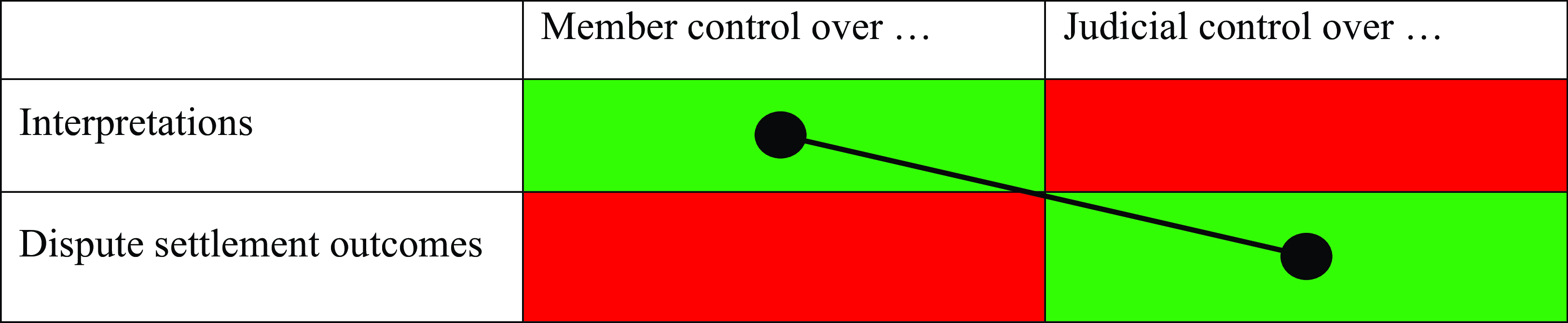
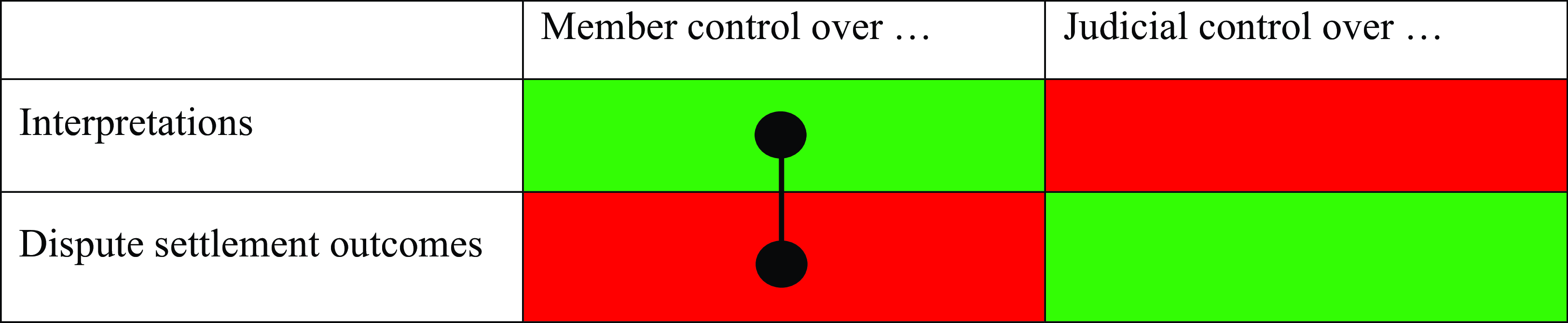
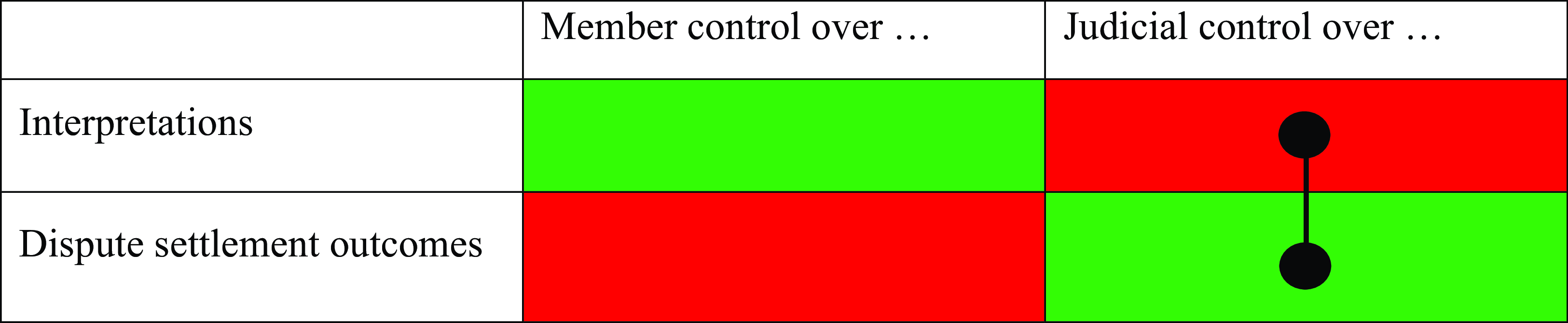
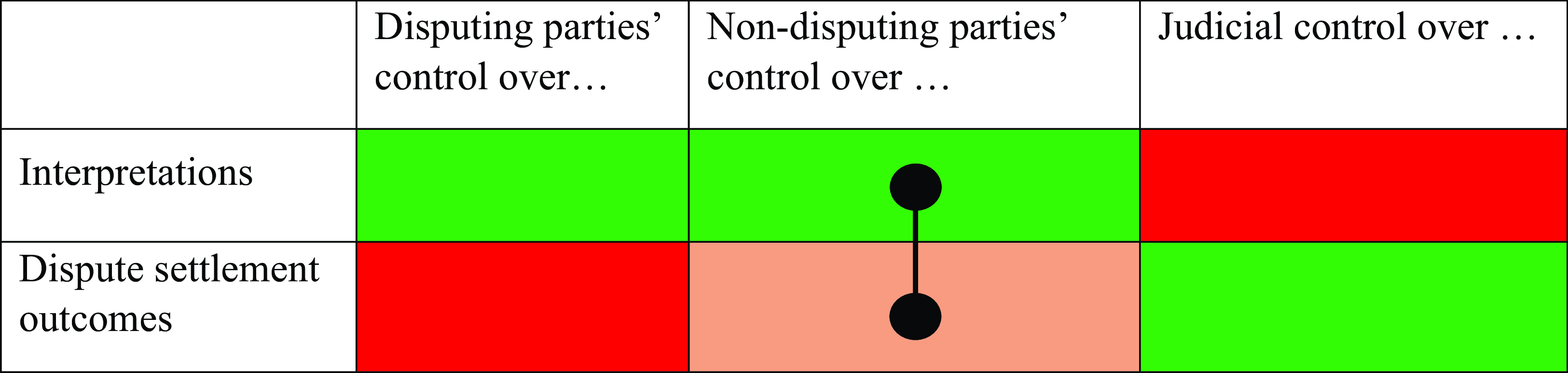
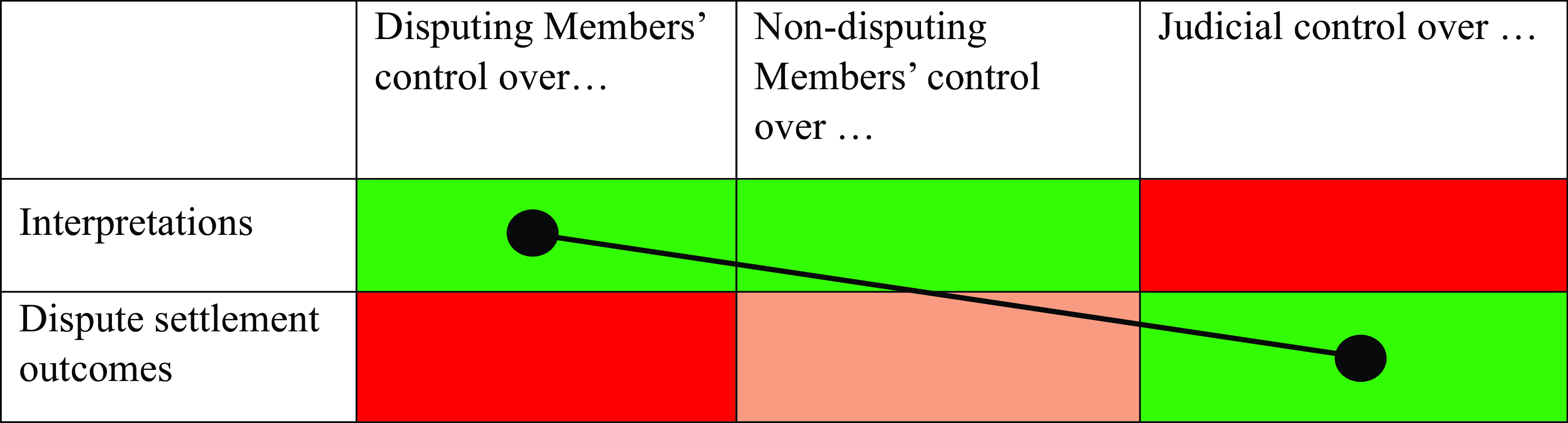

 Open access

