


Introduction
The comparative literature has associated conservative parties with a traditionalist vision of the family and conservative positions regarding family policy (van Kersbergen Reference Van Kersbergen1995; Nyby et al. Reference Nyby, Nygård, Autto and Kuisma2017). During the Golden Age of the Welfare State, the conservatives encouraged the expansion of familiarizing measures – that is, measures that strengthen the family in its caring function – while opposing those aimed at de‐familiarizing family members – namely, facilitating care taking place outside the family (Leitner Reference Leitner2003; Keck & Saraceno Reference Keck and Saraceno2013). In other words, in the Fordist era, conservative parties generally supported the male‐breadwinner family model, which implies a strict gender division of family roles, with the men at work and the women as full‐time mothers acting as the primary caregiver. In countries with a long tradition of conservative‐oriented governments – that is, the continental and southern European countries – family policies thus disincentivised female participation in the labour market and promoted a gendered vision of caring (Langan & Ostner Reference Langan, Ostner and Room1991). Conversely, following the ‘power resources’ hypothesis (Esping‐Andersen Reference Esping‐Andersen1990), countries with strong Social Democratic parties (i.e., those in Scandinavia) invested substantial resources to expand measures to unburden families – and women – from their caring functions, thus fostering a dual‐earner family model.
The political conflict around the family policy thus appears to be structured around the classic left‐right dimension, with conservatives defending the interests of their traditionalist constituency and promoting familialism, and social democrats struggling for de‐familialism (von Wahl Reference Wahl2008).
While such a scenario could be valid during the Golden Age, in the post‐Fordist era, the political contestation concerning the family has become more complex (Leitner Reference Leitner2013). Pressured by new social risks and needs (Taylor‐Gooby Reference Taylor‐Gooby2004), the family has initiated a slow but constant, though still incomplete, revolution (Esping‐Andersen Reference Esping‐Andersen2009). The male‐breadwinner family model no longer seems to be suitable for covering such new risks.
From a politics perspective, this changing context has created new pressures for political parties, including conservatives. Their traditional support to cash transfer‐oriented measures and their gendered vision of the family fit the post‐Fordist environment poorly. Familialism risks being no longer attractive to a changing constituency.
By comparing four different European countries – Denmark, Germany, Italy and the United Kingdom – this paper will investigate the conservative parties’ evolving family policy positions in the post‐Fordist era (1990s–2010s). The work addresses the following research questions: Has conservative support for familiarizing policies remained unchanged, or have they reconfigured their positions? How can we explain these political dynamics?
The article has a more detailed, twofold goal. First, relying on a content analysis of party manifestos, it longitudinally maps the conservatives’ family policy positions in a multidimensional space of political contestation. This allows identifying ideological shifts over time and cross‐country similarities and differences. Second, it explains politics dynamics looking at the configuration of a package of variables over time.
The theoretical and empirical contribution of the article is threefold. First, it focuses on a quite unexplored topic. The literature in the field has paid more attention to the social democrats’ family policy agenda and their general support for de‐familialism. In contrast, we still know relatively little about the evolution of the conservative parties’ preferences in this realm Second, it offers a systemic, longitudinal mapping and comparison of the conservatives’ positions on family policy, bridging party politics with social investment (SI) and feminist literature. The former has systemically scrutinised the parties’ positions regarding the welfare state, but it has not investigated specifically family policy (Budge et al. Reference Budge, Klingemann, Volkens, Bara and Tannenbaum2001). SI and feminist literature have provided a highly elaborated theorisation of the family policy reforms and the resulting political conflict. However, both have mostly focused on governments, while political parties have been neglected. Nevertheless, focusing only on the governments’ reforms does not allow investigating the parties’ positions when they are not in office, nor does it systematically account for ideological shifts. This work combines insights provided by these different literature streams and offers a comprehensive tool for mapping the conservatives’ family policy positions.Third, it questions mono‐causal theoretical frameworks for explaining party preferences in the family realm. By considering a package of variables and their interaction, the work demonstrates that the political dynamics of family policy are more complex in the post‐Fordist era than those that occurred during the Golden Age of the Welfare State.
The article is structured as follows. First, I illustrate the multidimensional space of political conflict concerning family policy. Second, I discuss my explanatory theoretical framework. Third, I briefly elaborate on the case selection and the method. Fourth, I show the findings of the party manifestos content analysis. Next, I explain the conservatives’ party positions concerning the family issue. The final part is devoted to conclusions.
The multidimensional space of political conflict concerning the family policy
Party politics literature has theorised the political conflict concerning welfare state policies essentially as a dichotomy: against versus in favour (Budge et al. Reference Budge, Klingemann, Volkens, Bara and Tannenbaum2001). It has also been applied to family policy: political parties can support its expansion or opt for its retrenchment. However, this approach tends to over‐simplify reality.
The literature on varieties of familialism has pointed out that diverse configurations of family policies can be identified across countries (e.g., Daly & Ferragina Reference Daly and Ferragina2018). Similarly, but with another approach, SI literature has shown that it is possible to distinguish between two different, main categories of policy instruments within the family policy realm (Beramendi et al. Reference Beramendi, Häusermann, Kitschelt and Kriesi2015; Garritzmann et al. Reference Garritzmann, Häusermann, Palier and Zollinger2017; Giuliani Reference Giuliani2019). Social consumption (SC) instruments aim at softening the economic risks of income loss through social transfer measures. In this way, they foster familialisation, that is, strengthening the caring function of the family. Child allowances and family benefits belong to this category In contrast, SI creates ex‐ante protection by boosting human capital development (Hemerijck Reference Hemerijck2012). Their goal is de‐familialisation, that is, facilitating care taking place outside of the family. Childcare can be included in this category. More ambiguous is parental leave. Literature has pointed out that a short leave positively influences a mother's chances of re‐entering the labour market. However, a longer leave has a negative impact (Boeckmann et al. Reference Boeckmann, Misra and Budig2015). Simultaneously, when periods reserved for fathers are present and associated with high replacement rates, they positively affect women's employment outcomes. Therefore, only short parental leave and paternity leave/daddy quotas can be considered SI measures.
The political contestation around family policy can thus be conceived as structuring in a multidimensional space (Figure 1). One dimension is related to SC instruments, with the other one to SI instruments. Political parties are expected to take positions on both (Häusermann Reference Häusermann, Bonoli and Natali2012; Reference Häusermann2018; Giuliani Reference Giuliani2020). Therefore, parties locate themselves within one of the quadrants of Figure 1. Following Häusermann's (Reference Häusermann2018) reconceptualisation of Leitner's work (Reference Leitner2003), it is possible to identify four combined positions.
The multidimensional space of political conflict on family policy.

Implicit familialism implies that parties are against both SC and SI policies. There are no financial aids for the family, nor are its members relieved from caring tasks. In essence, women remain the primary caretakers, and gender equality is not discussed. Political actors thus implicitly support the male‐breadwinner family model.
Explicit familialism combines the support to SC and the opposition to SI policies. Policy actors explicitly back the expansion of cash transfers to strengthen the family's caring function. Women are portrayed primarily as caregivers, and caring is clearly gendered. Parties thus openly support the male breadwinner family model.
With de‐familialism, actors favour SI instruments and are against SC ones. In other words, political parties support the activation of the family components – that is, women's activation and work‐family reconciliation measures. They thus advocate for a dual‐earner family model (Esping‐Andersen Reference Esping‐Andersen2009).
Finally, optional familialism means that the parties are in favour of both SC and SI instruments. Families – and particularly women – can choose between caring and work. Parties thus provide families with the choice of being familiarised or de‐familiarised. Optional familialism leads to a halfway between the male‐breadwinner and the dual‐earner family models.
As for de‐familialism and optional familialism, it must be said that the parties’ support for SI instruments is not automatically associated with a goal of gender equality (Daly Reference Daly2011). They can indeed favour SI measures to bring as many adults as possible into the labour market by outsourcing unpaid family care (Saraceno Reference Saraceno2015; Hieda 2013). In these circumstances, they are not interested in addressing the issue of the gendered nature of care. Parties can also openly advocate for a redistribution of caring tasks within the household, framing SI measures as an instrument to achieve better gender equality In other words, de‐familialism can be backed by political parties with an economic/market‐oriented or a gender equality‐oriented frame.
Explaining conservative parties’ positions in the post‐Fordist era
Based on the broad comparative literature on the welfare state, it is possible to identify a package of variables that help account for the stability or the shift of the conservatives’ family policy positions and cross‐country variations. The first group of variables is related to the constituency structure in terms of cultural values regarding motherhood and gender composition. The second group is more contextual and looks at the family policy legacies and the economic–demographic background. Finally, the last set of variables is politically oriented: they consider the gender representation within the parties as well as the intra‐ and inter‐party competition dynamics.
Reconfiguring constituency's social norms
Public opinion surveys have displayed that citizens’ norms and values with respect to family and gender roles have become more libertarian‐oriented (Inglehart Reference Inglehart1997). From a politics perspective, such a reconfiguration is clearly visible when considering the Social Democratic constituency. However, it is likely that even the conservative's electors – or, at least, a part of them – may have toned down their traditional positions, re‐aligned themselves to a more progressive vision of the family (e.g., Emmenegger & Manow Reference Emmenegger and Manow2014). Consequently, if conservative parties want to preserve or attract the electoral support of this constituency, they could re‐align their positions, moving toward de‐familialism.
Gender composition of the electorate
The literature on the gender vote gap has highlighted that, for many years, women tended to vote for conservative parties more than men (see, Naumann Reference Naumann, Bonoli and Natali2012). However, since their massive entrance into the labour market in the 1980s, women are now more likely to support Social Democratic parties as they tend to promote SI, thus protecting women's new roles as workers and mothers (Shorrocks Reference Shorrocks2018). However, it is possible that even within the conservative's female constituency, the number of working women has increased, outnumbering housewives. Since familistic policy positions are not appealing to working women, conservatives would be pushed to promote SI measures.
National family policy legacies
As historical institutionalism has pointed out, the specific family policy institutions a nation has inherited create path dependencies that will strongly affect the parties’ positions (Pierson Reference Pierson2001). Welfare institutions generate a coalition of early winners that oppose any reform perceived as a threat to their acquired rights. Therefore, in those countries where the male‐breadwinner model is firmly rooted, conservatives have more chances for their support of familialism to be maintained. Conversely, in the Scandinavian countries where de‐familialism occurred already during the Fordist phase, conservatives are more likely to re‐align on SI support.
Finally, structural reforms implemented by other political parties create a new path dependency that is hard to reverse. If these reforms expanded SI measures ‐ as usually happened under centre‐left governments ‐ it is more difficult for conservatives to oppose them. Put differently, a long period in opposition to SI‐oriented governments (mostly, centre‐left ones) could convince conservatives to change their family positions to return to office.
The economic, demographic and political context
Context matters: A low fertility rate coupled with low economic growth can push conservatives, in agreement with the employers, to support measures facilitating women's access to the labour market. However, during harsh economic crises, parties could decide to adopt a cost‐containment strategy, upholding SC and SI cuts. Finally, political crises make the whole system more unstable, and thus indirectly impact party positions.
Gender representation within the conservative parties
Literature has shown that female representation in political parties and parliaments has a positive impact on issues of interest to women, such as childcare (e.g., Bonoli & Reber Reference Bonoli and Reber2010). Therefore, it is likely that an increase in female representation and female leadership within conservative parties can push the parties to back SI.
Party competition
When taking a policy position, the actors’ room for political manoeuvring is expected to be constrained by intra‐ and inter‐party competition (Schwander Reference Schwander, Manow, Schwander and Palier2018). First, intra‐party disputes between a traditionalist and a more progressive fringe can limit or foster de‐familialism support, depending on which of the two forces prevails. Second, conservative parties are likely to be affected by strategic considerations concerning the positioning of their rivals on this policy. If their main competitors are social‐democratic or New Left (e.g., the Greens) parties, they will be more likely to champion SI to keep (especially middle‐class) working mothers’ support or even attract new voters from this social group.
Case selection, data and method1
To map family policy positions, I focused on four Western European parties from the Conservative party family. The notion of the party family is one of the most common approaches to identifying links and equivalences among parties in different polities (Mair & Mudde Reference Mair and Mudde1998). However, there is no common agreement regarding party classification in the literature depending on the different criteria employed to identify party families (Mair & Mudde Reference Mair and Mudde1998).
When considering conservative forces, works that rely on policy and ideological criteria do not distinguish between Christian Democratic and conservative parties (Kriesi et al. Reference Kriesi, Grande, Lachat, Dolezal, Bornschier and Frey2008; Schwander & Häusermann Reference Schwander and Häusermann2013; Häusermann Reference Häusermann, Bonoli and Natali2012; CCS 2018), grouping them together in one single, broad ‘conservative’ group. In this work, I followed this approach. Indeed, as empirically demonstrated by Camia and Caramani (Reference Camia and Caramani2012, p. 57), ‘there is a high degree of ideological similarity between [Christian Democratic] and conservative families supporting the case for treating them together’.
The parties selected are thus the following: the Danish Conservative Party (DKF), the German Christian Democratic Union/Christian Social Union (CDU‐CSU), the Italian Go Italy (FI) and the British Conservative Party (Tories). The classification of the DKF, FI and the Tories within the conservative‐party family is widely shared in the comparative politics literature, including the stream that distinguishes conservative and Christian Democratic parties. The CDU‐CSU has two different souls, a Christian Democratic one (the CDU) and a more conservative one (the CSU). However, when looking at the broader definition of the conservative party family, the CDU‐CSU falls squarely into that designation.
While belonging to the same party family, these parties have inherited very different family policy legacies. Considering the family policy expenditures at the beginning of the 1990s, services in Denmark were already strongly financed (1.8 per cent of the GDP). Over time, expenditures for services continued to increase without a substantial retrenchment of passive measures. In Germany and the United Kingdom, the expenditures for cash transfers were in line with Denmark's (1.4 per cent), but services were underfunded (0.5 and 0.4 per cent, respectively). Between the 2000s and the 2010s, expenditures for these latter were scaled up, though not reaching Denmark's level. Finally, in Italy both services and cash transfers were poorly financed (respectively, 0.1 and 0.6 per cent). While the latter ones increased in the last two decades, the amount of economic resources to services has remained modest (0.7 per cent). Conservative parties, therefore, compete from different starting points. In Denmark, SI policy instruments were a matter of fact already in the 1990s. On the contrary, there was a need to improve the provision of these measures in Germany and the United Kingdom. Finally, both SC and SI policy instruments in Italy were underdeveloped and required interventions.
To map the parties’ positions, following the approach developed by Budge et al. (Reference Budge, Klingemann, Volkens, Bara and Tannenbaum2001), I assumed that they are expressed in their manifestos during national elections. I therefore made a content analysis of party manifestos between the early 1990s until the last election available. Following the methodology developed by the Comparative Manifesto Project, I used the quasi‐sentence as unit of measurement. In the coding scheme, I created two different domains, one for SC policies, one for SI policies. Within the SC domain, I included all the quasi‐sentences concerning: (a) ‘child benefits and family allowances,’ (b) ‘tax deduction’ (c) ‘long maternity and parental leave’ and (d) ‘other passive measures’. On the other hand, within the SI domain, I included all the quasi‐sentences about: (e) ‘childcare’, (f) ‘short parental leaves’, (g) ‘paternity leave and daddy quota’, and (h) ‘other SI measures’. I assigned a score to each quasi‐sentence coded. If a party expresses that it is in favour of SC/SI it gets a positive score (+1). If it against SC/SI, it gets a negative score (−1). If the support/opposition is implicit, it gets a half score (+/‐ 0.5). When positions are neutral, it gets a zero score (0). Parties position themselves on a scale ranging from −1 (full opposition) to +1 (full support). The final position in the two dimensions was then estimated as the relative balance of conservative and liberal quasi‐sentences, signified as a proportion of all quasi‐sentences devoted to family policy issues. I then combined the final scores and plotted them in a Cartesian Graph. For the sake of clarity, I have shown parties’ average positions in each of the three decades analysed.
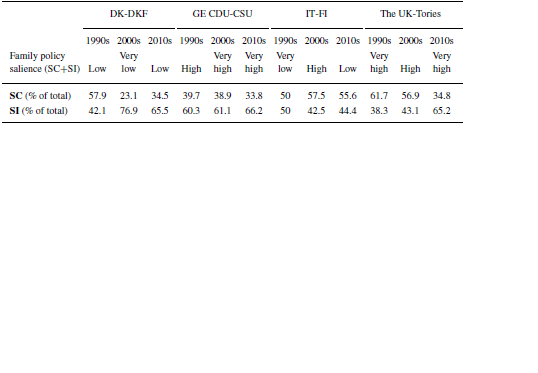
To complement the analysis, I also provided an indication of the perceived salience (from very low to very high, based on the number of sentences) of the family issue. Furthermore, I showed the percentage of quasi‐sentences dedicated to SC and SI policy instruments in order to assess whether the party is more biased toward the former or the latter.
The economic/market versus gender equality frames through which SI instruments can be supported cannot be captured by this semi‐quantitative content analysis. Therefore, I integrated the data by discussing such frames in a more qualitative‐oriented fashion. More specifically, following the feminist literature, a gender equality frame implies direct support to measures aimed at re‐distributing caring tasks, such as, father leave and daddy quotas but also higher replacement rate for (short) parental leave.
Finally, in order to test the explanatory theoretical framework, I employed a comparative historical (CHA) analysis – based on secondary sources – enriched with data from international surveys.
Conservative parties’ family policy positions: Content analysis results
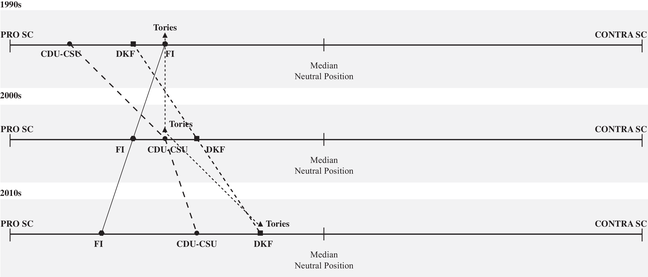
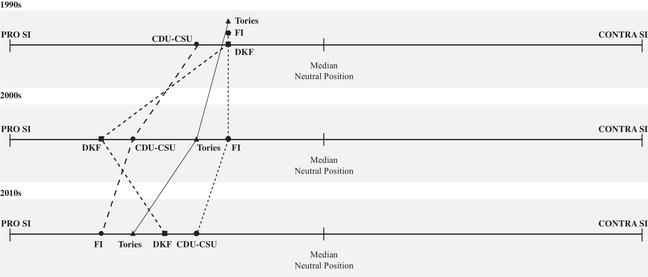
Figures 2 and 3 show the results of the content analysis of the electoral manifestos. Furthermore, Table 1 displays the family policy salience in the conservative parties’ programs.
Conservative party positions within the SC dimension.

Conservative party positions within the SI dimension.

Family policy salience in electoral manifestos

Source: Author's elaboration
Let us start by discussing the positions concerning SC family policy instruments.
The first thing to note is that support for SC policy instruments decreased over time for all the conservative parties analysed, except for FI.
Until the 2005 elections, the DKF backed freedom of choice through cash‐for‐care as an alternative to childcare. Leave in the 1990s were framed more as a right to time for caring than an instrument fostering work‐family reconciliation. However, since the end of the 2000s, SC started to receive increasing lower support, and, in parallel, their salience was scaled back. In general terms, family policy did not represent a salient issue for the DKF.
The CDU‐CSU's support for familiarizing measures (e.g., child allowances and other financial transfers) were very high in the 1990s when the party displayed a traditionalist view of the family. Since the early 2000s, this support was considerably scaled back, though it did not disappear. In the 2009 elections, the party indeed backed the introduction of new home‐care allowances for those parents who decided not to use childcare services (Betreuungsgeld) – a clear, explicit endorsement of familialism. While family policy remains a very relevant issue over the years, the salience of SC policy instruments decreased but more moderately compared to the DKF and the Tories.
In Italy, the dynamics are different. FI's support of familialism was increased over time, as did the salience dedicated to SC policy instruments. The party's SC agenda consisted of increasing support for a mix of on‐time cash‐transfer measures, for example, the bonus bebè, and introducing a family quotient and tax‐oriented measures for families, for example, taxable income deductions (deduzioni) and tax deduction (detrazioni). Simultaneously, the party continued to employ a conservative narrative regarding the family and marriage, flirting with the male‐breadwinner family model – though, in the 2018 elections, this flirt was less explicit. However, while FI endorsed familialism, the family policy did not represent a crucial issue for the party, except in the 2000s, where its salience showed higher results.
In the UK, the Tories maintained their pro‐SC position in the 1990s and the 2000s. Nevertheless, compared to the CDU/CSU and the DKF, their support was more moderate. Indeed the party always promoted a limited State role in the family realm. Accordingly, the only measure backed directly was the universal child benefit, while the bulk of the proposals concerned the detaxation of families. Furthermore, the Tory narrative concerning gender roles remained quite traditionalist until the end of the 2000s. In the 2010s, there was quite a sharp policy shift, with explicit support for the retrenchment of child benefits, which was turned into a means‐tested measure. As happened with the CDU‐CSU in the 2010s, the Tories did not completely oppose familiarizing measures. However, support for SC policies remained rather low. The sharp decline in the salience of SC policy instruments also demonstrated this shift, as they were almost halved between the 1990s and the 2010s. Interestingly, in the last 2019 elections, there was a renewed (moderate) interest in cash‐transfer measures, especially cash‐for‐care.
Let us now turn to the SI dimension.
As shown in Figure 3, already in the 1990s, conservatives began to back some de‐familiarizing measures, though such support remained modest. Nevertheless, SI began to increase in the 2000s and more visibly in the 2010s. However, cross‐country variations are still evident.
In Denmark, childcare and work‐family reconciliation measures had been discussed by the DKF already in the 1990s. However, as previously stated, the focus was more on the right to care than on the right to work. In this decade, SC measures continued to be more salient than SI ones. The shift occurred in the 2000s, when childcare support scaled up and the party claimed for more flexible hours during the weekdays and for a better quality of service. Such support was reconfirmed in the 2010s, though the issue received less emphasis. However, since the 2000s, SI gained more attention than SC in the party manifestos. In general, the DKF recognised the new needs of working families and modified its policy proposals accordingly. However, SI support was not framed through a gender‐equality lens. While equal opportunities between men and women were endorsed in general terms, SI measures are essentially boosted from an economic perspective, that is, as an instrument to allow families – and mothers – to reconcile work and family. There were no references regarding the equal redistribution of care tasks in the household or to paternity leave.
The CDU/CSU's conversion to SI is the most evident one. In the 1990s, the party was already championing every child's legal right to a place in kindergarten from the age of three and other work‐family reconciliation measures, such as a legal right to part‐time work. Such measures were further strengthened in the 2000s electoral manifestos, where the activation of the family components – first of all, women – was strongly promoted. In this regard, the party's 2009 manifesto backed a more flexible use of the parental allowance, including part‐time work and sharing of parental leave, to facilitate a parent's (especially a mother's) re‐entry into the labour market after an extended period of absence. Such measures continued to be supported in the 2010s, with the ‘activation’ goal further emphasised. For example, part‐time work was explicitly seen as a temporary instrument for easing the transition to full‐time work. It is interesting to note that the CDU/CSU always put great emphasis on SI, but that did not lead to radical positions, especially in the 1990s. Concerning the framework, gender equality was increasingly upheld by the party, together with a more libertarian view of the family. Nevertheless, gender equality seems to have been a secondary framework since the lion's share of SI measures in the manifestos were mainly promoted as a key instrument for boosting economic growth.
Concerning Italy, FI is the party that shows lower support for de‐familiarizing measures, with a slight increase only in the last 2018 elections. Broadly speaking, SI measures received less attention than SC. In the 1990s, there were some vague proposals to facilitate female work, but the only solution proposed was to expand part‐time work. In the early 2000s, childcare began to be debated, but its expansion was offloaded to the local authorities, with strong involvement of the third and private sectors. There was explicit support for universal childcare only in the 2018 elections, though the State's role as the provider was not clarified. Other instruments, such as leave or other activation measures, were not discussed by the party. Finally, gender equality never represented the party's goal, except in its 2018 manifesto, where there was a vague reference to equal opportunity.
In the United Kingdom, the Tories can be considered a late‐runner concerning the new childcare consensus. In the 1990s, the party employed the terminology ‘family‐friendly’ to indicate those measures that combined employment and family‐care responsibilities. However, they left the responsibility of setting up a ‘family‐friendly’ environment to employers. In this decade, there were also some statements in favour of activation measures, especially for single parents. However, SI measures remained poorly discussed. A slight position shift occurred during the 2000s, where working families’ needs began to enter the party's agenda. However, the Tories did not advocate for a comprehensive, national childcare strategy, but just an expansion of market‐provided childcare, coupled with informal arrangements (i.e., childminders). The real shift happened in the 2010s when SI outweighed SC in terms of salience. Though the parties upheld some retrenchment measures, they promised an increase of up to 30 free childcare hours for three‐ and four‐year‐olds. Multiple providers remained, however, including the private sector. Nevertheless, in this decade, childcare started to be significantly championed, also focusing on its quality. Simultaneously, the party backed childcare subsidies for low‐income families and activation measures targeting single parents. Finally, the Tories proposed sharing parental leave between men and women to speed up the re‐entrance of the latter into the labour market. Even here, SI measures were mostly promoted through a market/economic perspective, namely, to increase labour market participation and expand the market in the childcare sector.
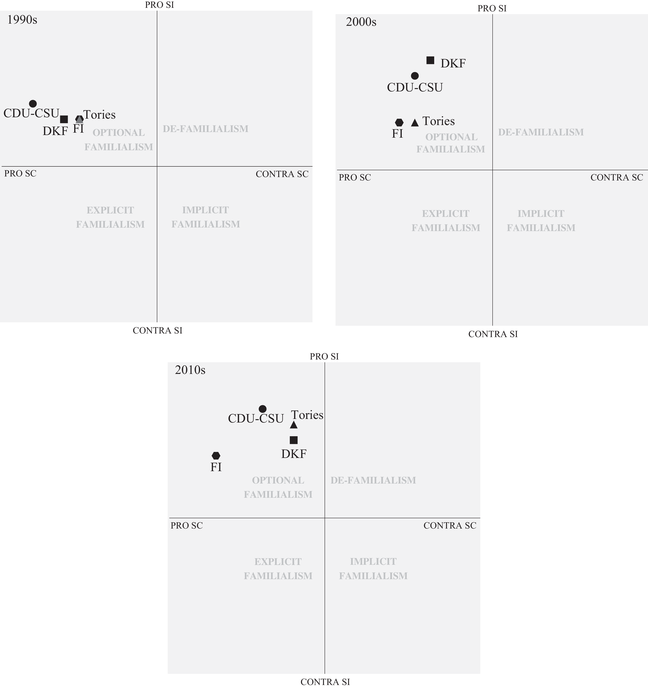
Figure 4 shows the average conservative positions in the 1990s, 2000s and 2010s in the multidimensional political space of conflict.
Family policy positions of the conservative parties in the multidimensional space of political conflict.

The figure shows that, in the post‐Fordist era, conservatives were located within the ‘optional familialism’ quadrant. However, in the 1990s, the parties were positioned in the bottom left, close to ‘explicit familialism’. In the 2000s, a shift toward the upper right and ‘de‐familialism’ began. While the shift is evident for all the parties except FI, differences remain, even in terms of timing.
The DKF constantly and sharply scaled back its support of SC, while its pro‐SI reached a peak in the 2000s and then slightly declined in the 2010s. However, support for de‐familialism remained high. In this case, we can talk about a ‘dual earner‐biased’ optional familialism.
The CDU‐CSU's support for CS decreased over time but less radically than the DKF's, while its support of SI followed a constant increase. The party‐specific position can be re‐labeled as a ‘balanced’ optional familialism.
FI shows a countertrend as it increased its support for SC while only slightly scaling up for SI. We can define such a position as a ‘male breadwinner‐biased’ optional familialism.
Finally, the Tory positions remained, by and large, unchanged in the 1990s and the 2000s but experienced a radical shift in the 2000s when SC's support dropped and SI was prioritised. As for the DKF, we can talk about a ‘dual earner‐biased’ optional familialism. However, the Tories have taken this position only more recently ‐ in the 2010s. For this reason, they can be seen as ‘late‐runners’.
Interestingly, for all the parties, SI is promoted mainly through a market/economic frame, while gender equality is not a goal or only a secondary one.
Explaining conservative parties’ family policy positions
Let us now illustrate how the previously discussed package of explanatory variables was configured in each of the case studies analysed and how they affected conservative family policy positions2.
Denmark – DKF
The Danish welfare state has always been based on a very high degree of employment in the formal labour market for both sexes (Esping‐Andersen Reference Esping‐Andersen1990, Reference Esping‐Andersen2009). Since the Golden Age, governments and policy advisors had always been obsessed with work incentives and high employment rates – including those for females – and fertility (Abrahamson Reference Abrahamson2010). The latter indeed were, and still are, among the highest in Europe, even after the Great Recession. Furthermore, the household structure had already drastically started to change in the mid‐1960s. Consequently, Denmark was a forerunner in re‐orienting its policy priorities in this realm (Christiansen & Markkola Reference Christiansen, Markkola, Christiansen, Petersen, Edling and Haave2006). In other words, family policy was already structured around the dual‐earner family model in the Fordist era, with childcare being made universal after the 1964 reform (Haavet Reference Haavet, Christiansen, Petersen, Edling and Haave2006). Such a pro‐SI trend was strengthened between the 1970s and the 1980s, when work‐family reconciliation measures were further improved, including parental leave (Borchorst Reference Borchorst, Ellingsæter and Arnlaug2006). The Danish family‐policy legacy created a series of early winners – working families, and more specifically, working mothers – for which familialism is far from convenient. Positions questioning the dual‐earner family model are expected to be electorally risky. In this regard, the DKF's flirt with the male‐breadwinner model in the 1990s, especially its support for the CFC scheme and ‘free choice’ for the families, ended up as a losing strategy. Cash‐for‐care schemes have had a long tradition in Denmark. However, with their introduction in 1992 and again in 2002, they were rarely used and had no impact on the parents’ childcare choices (Duvander & Ellingsaeter Reference Duvander and Ellingsæter2016).
Furthermore, the DKF's constituency was reconfigured towards SI. Between the 1990s and the 2010s, there was a drastic drop in traditionalist attitudes regarding motherhood (in 2017, only 7 per cent of DKF's voters agreed that a working mother harms a child's development, against 19 per cent in 1990). Second, housewives have always been underrepresented, even in the 1990s. Meanwhile, the number of working women constantly increased, moving from 57 per cent in the early 1990s to 71 per cent in the late 2010s. Electorally speaking, if the DKF did not want to alienate this growing libertarian, working (female) constituency, it could only shift its positions toward SI.
Two additional factors also facilitated this shift. First, a feminisation process within the party, starting from the late 1990s. Women elected in the DKF parliament group moved from 29 per cent in the 1990s to 44 per cent in the 2010s. Second, a consensual political environment. Both in the Fordist and post‐Fordist eras, pro‐childcare reforms were supported by all the parties and passed by broad parliamentary majorities (Christianesen & Åmark Reference Christiansen, Åmark, Christiansen, Petersen, Edling and Haave2006). The only line of conflict is the daddy quota, abrogated by the centre‐right government (including the DKF) in the 2000s and framed as coercion by the coalition. In this regard, the literature has shown that quotas in Denmark have been by far the most controversial gender‐equality instruments (Borchorst Reference Borchorst, Ellingsæter and Arnlaug2006). Therefore, it is not surprising that the DKF never discussed this issue in its manifestos and favoured an economic‐oriented frame rather than one of gender equality.
Germany – CDU‐CSU
The German welfare state is considered the archetypical conservative welfare model, coinciding with a strong male‐breadwinner family model. The CDU‐CSU's strong support of familistic measures in the 1990s was, therefore, in line with the policy legacies created in and contributing to the Golden Age (Clasen Reference Clasen2005). Since these generous cash‐transfer‐oriented family policies created early winners, especially housewives, it is clear that strong opposition to SC would have been risky for the party. The constituency's structure also reinforced this pro‐SC position. In the 1990s, the majority of CDU/CSU voters displayed traditionalist preferences regarding motherhood. Simultaneously, housewives represented a critical electoral group (31 per cent of the female constituency), while the share of working women was relatively small (33.82 per cent). During this decade, the modest endorsement of SI was essentially motivated by intra‐party politics. Indeed, childcare support was the outcome of the ‘abortion compromise’ between the more traditionalist West German politicians and the more progressive East German ones (Blome Reference Blome2017). The right to a place in a kindergarten was a precondition of voting for a more liberal abortion law since childcare was designed to be a preventive policy measure – that is, convincing women not to abort (Naumann Reference Naumann, Bonoli and Natali2012).
The party's shift toward SI occurred at the beginning of the new century. At the end of the 1990s, under the Red‐Green Coalition, the whole German welfare state started a quite radical change (Lewis et al. Reference Lewis, Knijn, Martin and Ostner2008). The family realm was also affected, with childcare services greatly expanded and parental leave strengthened (Nygård et al. Reference Nygård, Campbell‐Barr and Krüger2013). The institutional reforms implemented in those years began to hijack the German family policy away from the male‐breadwinner track (Seeleib‐Kaiser Reference Seeleib‐Kaiser2016). In this way, they created new winners, that is, working mothers, who were likely to punish any retrenchment of SI measures.
At the same time, the CDU‐CSU constituency began to change. Electors re‐aligned their values concerning motherhood with more progressive positions (in 2017, 34.7 per cent of the CDU/CSU's voters agreed that a working mother harms a child's development, against 66.2 per cent in 1990). Furthermore, while the number of housewives within the female constituency dropped to 7 per cent in the 2010s, the number of working women increased (53 per cent of the female electorate). The libertarian, working women's vote started to be crucial for the CDU‐CSU to secure its position, competing directly against the SPD, which, in the late 2010s, experienced a drastic drop in electoral consensus. Simultaneously, while the percentage of the CDU‐CSU female members of Parliament remained modest even in the 2010s, the party leadership went into Angela Merkel's hands, and, for several years, the Family Ministry was led by another woman, Ursula von der Leyen (Naumann Reference Naumann, Bonoli and Natali2012). Lastly, the demographic and economic issues of the 1990s (Häusermann Reference Häusermann2018) convinced business organisations to support SI measures to improve female labour‐market participation. All these factors thus pressured the CDU‐CSU to endorse SI.
However, such support was quite balanced. Familialism, indeed, did not vanish, for four reasons. First, in contrast to Denmark, the CDU‐CSU still has a relatively strong minority (33 per cent in 2017) with traditionalist attitudes. Also, many women are not in the labour market (40.7 per cent), especially retired women. Therefore, open opposition to or low support of SC would have been too risky. Second, the clash between the CDU and its more traditionalist, Bavarian ‘sister’, the CSU, prevented a radical departure from the male‐breadwinner family model, together with the fact that SI was primarily always supported through a less divisive economic framework, compared to that of gender equality (Langguth Reference Langguth2007). A clear example of this intra‐party clash is the home‐care allowance. This measure was proposed in a ‘package deal’ to satisfy the CSU's ‘pro‐familistic’ demands and made the expansion of de‐familistic measures acceptable (Gülzau Reference Gülzau2020). Third, the Grosse Koalition’s success and the resulting retention of office in the last 15 years seemed to be a deterrent for a more radical shift toward SI. On the one hand, the balanced family policy position demonstrated that it worked electorally, suggesting that no further change was required. On the other, the inclusion of the SPD within the governments had the effect of de‐powering party competition. Put differently, the lack of solid competition from the mainstream centre‐left party contributed to decreasing the incentive to support hardline de‐familialism. Finally, the CDU‐CSU has been increasingly pressured by new challengers. Over time, the (New) Left, and the Greens, have supported expanding the SI measures, thus gaining consensus from the highly‐educated middle classes (Röth & Schwander Reference Röth and Schwander2021). On the (Radical) Right, Alternative für Deutschland (AfD) has promoted traditionalist family policy positions and successfully appealed to those electors discontented by the CDU‐CSI's libertarian shift (Dilling Reference Dilling2016). A balanced family policy position can be seen as a way to limit vote erosion both from the more traditionalist constituency, benefiting the AfD, and from those more progressive, benefiting the Greens.
Italy – FI
Italy is known for being a familistic welfare state centered around the male‐breadwinner family model (Saraceno Reference Saraceno1994). Under the Christian Democratic governments during the Fordist era, family allowances were the family policy's main instrument. However, after first expanding in the early 1950s, they were re‐sized, and the resources were re‐allocated to the pension sector (Fargion et al. Reference Fargion, Ferrera and Jessoula2012). The benefits remained meagre and very fragmented. Despite miserly family allowances, robust expansion of SI instruments did not follow. Childcare started to develop only in the 1970s, namely, in an adverse timing of economic stagflation (Fargion Reference Fargion2000), and was devolved to the local authorities, particularly to the regions, thus creating vast differences between the north and the south (Fargion Reference Fargion and Gal e M. Ajzenstadt2010).
Furthermore, the Catholic Church's strong influence prevented a strengthening of the state's role in the childcare sector (Olk Reference Olk and Gal e M. Ajzenstadt2010). Thus, the family policies implemented in the Fordist era produced a (limited) number of winners, particularly male employees. Simultaneously, the pension sector's hypertrophic development (Ferrera Reference Ferrera1996) created a large winning group that would strongly oppose any attempt to re‐allocate resources away from pensions to SI policy instruments in the family realm (Bonoli & Reber Reference Bonoli and Reber2010). In the 1990s, FI's position was, therefore, in line with the family policy legacy. This position met its constituency's demands, which displayed a rather traditionalist vision of motherhood (though this view was not majoritarian) and where housewives represented a key electoral group.
During the first two decades of the post‐Fordist era, the centre‐left governments tried to emphasise family policy, taking an expansionary position concerning both SC and, especially, SI. However, the reforms were not radical (Da Roit & Sabatinelli Reference Da Roit and Sabatinelli2013), and the governments fell before having time to produce any real policy changes and create a new group of institutional winners. In other terms, on the grounds of family policy, FI did not have strong opposition from the main centre‐left parties. This lack of pressure from its main rivals contributed to disincentivise FI from embracing SI.
Furthermore, the low fertility rates and low economic growth in Italy since the 1990s had not pushed FI to prioritise SI. On the contrary, the economic recession during the Great Crisis further prevented a huge expansion of SI policies (León & Pavolini Reference León and Pavolini2014). In other words, neither the centre‐left reforms nor the demographic and economic context pressured FI to re‐align its positions on SI, as happened to the CDU‐CSU.
The female constituency structure's evolution further pushed to increase support for cash transfers. First of all, housewives remained a powerful group. Second, in the 2010s, the percentage of working women went substantially down (only 27.12 per cent), while retired women were overrepresented (35 per cent). Third, the traditionalist vision of motherhood did not decrease: in the 2010s, more than 60 per cent of the electors displayed conservative positions.
Even the politics‐oriented variables can explain the party's support for a ‘male breadwinner‐biased’ optional familialism. Gender representation within the party remained very low, except for the 2018 elections. The party leadership was typically male‐oriented, with sexist behaviour commonly displayed by its leader, Silvio Berlusconi (Pacilli et al. Reference Pacilli, Mucchi Faina and Berti2012). Gender equality in this regard was never the goal of the party. However, after the 2013 elections, the party's consensus declined, and most of its voters were stolen by the radical right parties of the League and Italian Brothers, which have very traditionalist positions on the family. Increasing support for SC appears to be part of the FI's (so far, losing) strategy to halt vote erosion.
A final remark must be made concerning the 2018 elections where, for the first time, the party increased its meagre support for SI. This increase can be explained considering two factors, the first being a (late) feminisation of the party. Indeed, women represent 35 per cent of the elected MPs, and some of them hold important offices. Second, a new, more libertarian fringe, Free Voice, emerged, guided by the former Minister of Equal Opportunity, Mara Carfagna. This fringe opposes the party's more conservative sectors and champions SI measures, especially childcare and leave, through a gender equality framework (La Repubblica 2019; Domani 2021).
The UK – Tories
According to Lewis (Reference Lewis1992), the United Kingdom's family policy is historically structured around the strong male‐breadwinner model. However, the State's role in supporting families in their caring function remained low. In the 1980s, during Thatcher's government, the neo‐liberal paradigm affected British family policy (Clasen Reference Clasen2005). Thatcher flirted with the male breadwinner model by positively valuing full‐time motherhood (Kremer Reference Kremer2007). On the other hand, several cash‐transfer programs, such as the child benefit plus the maternity allowance and leave, were more or less retrenched successfully (Lister Reference Lister, Dilnot and Walker1989). At the same time, there was an ideological opposition to promote free, public childcare, leaving the private sector responsible for its provision (Kremer Reference Kremer2007). In the 1990s and 2000s, the Tories showed moderate support for SC, while low promotion of SI was in line with the policy legacy of the 1980s. This position also mirrored the traditionalist attitudes regarding motherhood (42 per cent of the Tory constituency in the 1990s and 34 per cent in the 2010s). Furthermore, in the 1990s, housewives represented a key constituency for the party. More interestingly, before the 2010s, working women were outnumbered by those not in the labour market, particularly retired women.
The party's re‐alignment on a pro‐SI agenda occurred in the 2010s. At the end of the 1990s, the Labour governments under Tony Blair gave new priority to the new social risks and expanded SI measures, particularly childcare (Clasen Reference Clasen2005). Though such reforms had several limits and the goal was to activate more parents rather than gender equality (Lewis et al. Reference Lewis, Knijn, Martin and Ostner2008), they marked a break with the past, creating a new group of winners, primarily upper‐middle‐class, working mothers (Daly Reference Daly2011). In this new context, the previous Tory family policy strategy, more biased toward the male‐breadwinner model, appeared to be a losing one, primarily if they wanted to gain consensus from this new, growing electoral group. In other words, the 12‐year opposition to an SI‐oriented government convinced the new leader, David Cameron, that a change within a party was needed if the Tories wanted to return to office. Under his leadership, the party undertook‐ at least apparently‐ a long internal process of emancipation from the Thatcher legacy that was to be presented with a new, ‘de‐toxifying’ image (Williams Reference Williams2015). SI in the family realm became a central ingredient of the new party brand of compassionate conservatism. The shift to SI went in parallel with a change in the party's constituency. In the 2010s, traditionalist attitudes toward motherhood were halved compared to the early 1990s. At the same time, the number of working women dramatically increased. Even the percentage of female conservative MPs had risen in the last decade, though it did not go above 20 per cent.
The Brexit referendum results marked the second part of the 2010s. The victory of Leave created new tension within the party between hard Brexiteers, who support a small state and a free trade ‘hyperglobalist’ model, and the soft Brexiteers, who are more inclined to protect workers’ rights and have a more interventionist industrial strategy (Lynch & Whitaker Reference Lynch and Whitaker2018). The impact on the conservative family‐policy positions has not been wholly manifested yet. Under the relatively weak leadership of Theresa May, who replaced Cameron in 2016, childcare continued to be strongly backed, though still with an economic‐oriented framework as support for SC increasingly diminished. However, in the last 2019 elections, while SI has continued to be promoted under Boris Johnson's leadership, the party has shown a renewed (moderate) interest in cash‐transfer measures. This new, semi‐flirt with the male‐breadwinner model can be explained by considering Boris Johnson's desire to attract (particularly male) blue‐collar voters who tend to favour SC measures over SI ones (Beramendi et al. Reference Beramendi, Häusermann, Kitschelt and Kriesi2015) in northern England (Flinders Reference Flinders2020).
Conclusions
This article has looked into the evolution of the conservative parties’ family‐policy positions in the post‐Fordist era in four European countries: Denmark, Germany, Italy and the UK The content analysis of the party manifestos shows that the conservatives are located within the ’optional familialism’ quadrant, therefore upholding both familiarizing and de‐familiarizing measures. However, these positions are not static. In the 1990s, support for familialism was more evident. Since the 2000s, de‐familialism has been increasingly backed. While the shift is clear for all the parties, except in the Italian case, cross‐country differences remain. In Denmark and the United Kingdom, optional familialism is now more biased toward the dual‐earner model. However, while the shift for the DKF had already occurred in the mid‐2000s, the Tories in the United Kingdom changed their positions only in the 2010s. In Germany, optional familialism is more balanced since the CDU‐CSU's support for familialism has not vanished. Finally, in Italy, Go Italy continues to flirt with the male‐breadwinner family model, with SI being poorly promoted. In all cases, de‐familialism is fostered primarily through an economic/market‐oriented frame, while gender equality is only a secondary goal.
The comparative historical analysis shows how the interaction of constituency‐oriented, institutional, contextual and political factors contributes to explaining the shift toward optional familialism and cross‐country differences.
A shift toward libertarian values regarding motherhood and an increase in working women seem to be associated with the conservatives’ re‐alignment on de‐familialism. In contrast, a traditionalist constituency with an elevated representation of housewives tends to push toward familialism, as suggested by the FI case study.
Policy legacies appear to have an important role as well. The Danish family‐policy legacy characterised by de‐familialism was encouraged the DKF to re‐align itself and support childcare. In contrast, the strong male‐breadwinner legacy in Germany, Italy, and the United Kingdom slowed down this re‐alignment. However, even the paradigmatic reforms of centre‐left governments contributed to re‐shaping the conservative positions in Germany and the United Kingdom. In other words, being in the opposition to SI‐oriented governments seems to foster a re‐alignment on SI – if one wishes to return to office.
The comparative analysis suggests that even the context affects party positions. The Danish obsession with high fertility and employment rates constrained the DKF's dalliance with familialism. Conversely, Germany's low fertility and growth rates in the 1990s convinced the CDU‐CSU to use SI in the family realm as a tool to stimulate the economy. In Italy, the Great Recession limited the FI's room for manoeuvre to expand SI. In the United Kingdom, the Brexit effect is still unclear but could open a new line of conflict.
Finally, politics counts. The comparative analysis shows that an increase in gender representation in the conservative parties can facilitate SI support. Furthermore, female leadership, especially in Germany, seems to have contributed to moving away from the male‐breadwinner model. Moreover, intra‐ and inter‐party competition dynamics constrain or foster the parties’ room for manoeuvring. The CDU‐CSU case shows that conflicts between opposing fringes incentivise compromise and a more balanced optional familialism. At the same time, the analysis indicates that strategic considerations regarding family positions change according to whether the main competitor is a Social Democratic party or a challenger from the New Left or the Radical Right.
Although given the small number of cases, these results cannot be generalised, and the comparative analysis prompts two concluding considerations First, conservative parties are undertaking a re‐alignment process. Family policy is a sector where this process emerges very clearly. The conservatives’ re‐alignment is politically relevant since it may represent a further challenge to the already weakened Social Democracy Second, this re‐alignment cannot be explained through a mono‐causal theoretical framework. It requires a longitudinal analysis of multiple variables and their specific configuration over time. Future works could increase the number of conservative parties selected and test causal mechanisms from a quantitative perspective. That would allow us to identify and explain the different re‐alignment patterns undertaken by conservative parties. At the same time, future research could narrow the analysis and the focus to a qualitative comparison of a small number of key case studies (e.g., Italy and Denmark), leading to a more in‐depth investigation of the explanatory variables and a better understanding of why re‐alignment proceeds at different speeds and why some conservative parties are more reluctant to change.
Acknowledgements
I am grateful to the editors of this collection and two anonymous reviewers for helpful comments. I also would like to warmly thank Sorina Soare for her remarks and suggestions.
Open Access Funding provided by Universita degli Studi di Firenze within the CRUI‐CARE Agreement.
Online Appendix
Additional supporting information may be found in the Online Appendix section at the end of the article:
Appendix A. Party Family Classification
Appendix B. Issue Salience in the Party Manifestos.
Table A: List of National Elections
Table B: Party scores in the social consumption and social investment dimensions (1990s, 2000s and 2010s)
Table C: Conservative party‐elector preferences regarding motherhood. Percentage of agree/disagree to the statement ‘a working mother harms a child's development’
Table D: Conservative party's female constituency. Percentages of women in the labour market and of housewives
Table E: Conservative‐party gender representation. Percentage of elected women within the conservative party group in the Parliament
Table F: Family Policy Expenditure. Cash Benefits and Benefits in Kind
Table G. Variables explaining the conservatives’ varieties of Optional Familialism (1990s–2010s)



 Open access

