





Introduction
Instructed second language acquisition (ISLA) research explores the mechanisms underlying second language (L2) learning in educational contexts, focusing on cognitive, social, and instructional factors. Depth of processing (DoP) has emerged as a key construct for understanding variations in language learning outcomes. DoP originates from Craik and Lockhart’s (Reference Craik and Lockhart1972) levels of first language (L1) processing framework, which distinguishes between deep (conceptual or semantic) and shallow (perceptual) processing of lexical items.
In ISLA, DoP is defined as the amount of cognitive effort, level of analysis, and elaboration of intake, alongside the use of prior knowledge, hypothesis testing, and rule formation during the encoding and decoding of grammatical or lexical items (Leow, Reference Leow2015). This aligns with key psycholinguistically oriented frameworks in ISLA, including Robinson’s (Reference Robinson1995). Model of attention and memory, Schmidt’s (Reference Schmidt1990) Noticing Hypothesis, Gass’s (Reference Gass1997) model of SLA, Leow’s (Reference Leow2015) model of the L2 learning process, and VanPatten’s (Reference VanPatten, VanPatten and Williams2007) model of input processing. While these theoretical underpinnings vary in emphasis on attention and cognitive effort, they underscore DoP’s role in shaping L2 learning. Therefore, L2 tasks promoting deeper processing, such as elaborative questioning and summarization, improve vocabulary retention, grammatical accuracy, and overall proficiency (Abdi Tabari et al., Reference Abdi Tabari, Sato and Wang2023).
However, inconsistencies in DoP’s conceptualization and operationalization complicate cross-study comparisons. Few studies link variations in DoP to specific target items in diverse instructional contexts (e.g., Roca de Larios & Coyle, Reference Roca de Larios, Coyle, Manchón and Polio2021). Interactions among learner variables (e.g., age, gender, proficiency level, and L1 background) and contextual variables (e.g., setting, linguistic context, and instructional context) and DoP remain underexplored, and longitudinal studies are scarce, limiting insights into the sustained impact of DoP on linguistic performance.
The current study addresses these gaps through a synthesis and meta-analysis of DoP research in ISLA. It examines how DoP has been defined and operationalized, clarifying its conceptual and methodological foundations. Further, it investigates the impact of DoP on L2 performance and development, emphasizing definitional and operational variability. Additionally, it identifies methodological and empirical limitations in the existing literature and discusses their implications. By proposing directions for future research, this study aims to foster a more coherent research agenda on DoP in ISLA.
Literature review
Definitions and operationalization of DoP in ISLA
DoP is a central construct in understanding cognitive mechanisms underlying L2 learning in instructed contexts. Conceptually, it refers to the degree of mental engagement, cognitive effort, and elaborative processing that learners allocate when interacting with L2 input. Psycholinguistic models provide the theoretical foundation for DoP. Robinson’s (Reference Robinson1995) Model of attention and memory and Schmidt’s (Reference Schmidt1990) Noticing Hypothesis highlight the importance of focused attention for effective language learning, whereas Gass’s (Reference Gass1997) model emphasizes the distinction between surface-level attention and deeper cognitive processing during the input-intake process. Leow (Reference Leow2015) further operationalizes DoP across three stages: input processing, intake processing, and knowledge processing. Input processing involves shallow engagement, which may enable temporary transfer of linguistic information into working memory, but without additional elaboration, long-term retention is limited. Intake processing requires higher cognitive effort, allowing learners to notice, analyze, and integrate linguistic forms, while knowledge processing is characterized by sustained engagement that supports the production of novel L2 output and the transition toward automaticity with repeated practice.
Empirical operationalizations of DoP have varied considerably, reflecting both methodological creativity and inconsistency in the field. Measures that capture internal cognitive processes, such as think-aloud (TA) protocols (Abdi Tabari et al., Reference Abdi Tabari, Sato and Wang2023), eye-tracking (ET) (Godfroid et al., Reference Godfroid, Boers and Housen2013), and pupillometry (Ryan et al., Reference Ryan, Hamrick, Miller, Was, Gass, Spinner and Behney2017), provide insight into learners’ attention, cognitive load, and engagement in real time. However, many studies have conflated DoP with external task manipulations, such as textual enhancement or elaboration conditions, which primarily affect the nature of input rather than directly capturing the learner’s cognitive activity. This distinction is crucial because only internal, online indicators reveal what learners attend to, notice, and process cognitively during L2 input.
Impact of DoP on L2 learning outcomes
A substantial body of research has demonstrated that higher levels of DoP are positively associated with improved L2 learning outcomes across multiple domains, including grammar, vocabulary, and phonology. Calderón (Reference Calderón, Bergsleithner, Frota and Yoshioka2014b) found that tasks requiring deeper cognitive engagement led to higher proficiency gains, highlighting the importance of elaborative processing. Thinglum et al. (Reference Thinglum, Serafini, Leow and Leow2019) showed that prior knowledge facilitates deeper engagement, supporting the robust integration of new linguistic forms. Hsieh et al. (Reference Hsieh, Moreno, Leow, Leow, Cerezo and Baralt2016) demonstrated that deeper processing enhances learner awareness, suggesting that cognitive elaboration directly contributes to improved learning outcomes. Morgan-Short et al. (Reference Morgan-Short, Heil, Botero-Moriarty and Ebert2012) reported that tasks encouraging attention to both form and meaning foster better acquisition of grammatical and semantic features, further emphasizing that DoP supports not only retention but also the flexible application of L2 knowledge.
Studies examining domain-specific effects underscore DoP’s significance in early and advanced L2 development. Meritan (Reference Meritan2021) found that deeper processing improves phonological accuracy, while Medina (Reference Medina and Leow2019) confirmed that elaborative rehearsal promotes durable vocabulary retention. Rogers (Reference Rogers and Leow2019) highlighted that incidental learning is optimized when deeper processing is combined with enhanced input conditions. Additionally, feedback-focused frameworks, such as Leow (Reference Leow and Manchón2020), demonstrate that DoP mediates the effectiveness of written corrective feedback, with item-level learning supporting short-term gains and system-level restructuring facilitating longer-term knowledge application. Overall, these findings suggest that DoP mediates learning outcomes through mechanisms of attention allocation, hypothesis testing, and cognitive elaboration, offering clear implications for instructional design.
Conceptual, methodological, and empirical limitations
Despite its theoretical and empirical importance, DoP research in ISLA faces several conceptual, methodological, and empirical limitations. Conceptually, definitions of DoP remain heterogeneous, with some studies emphasizing cognitive engagement and mental effort, while others treat it as a proxy for task-based manipulations. This variability complicates synthesis and limits cumulative understanding. Methodologically, studies differ in measurement approaches, analytic techniques, and task types, with many relying on retrospective verbal reports rather than concurrent indicators of processing. The absence of online measures in several investigations makes it difficult to determine whether observed learning outcomes genuinely reflect DoP or are confounded by post hoc rationalization. Empirically, most studies focus on short-term effects or specific linguistic features and often neglect individual differences, task demands, and contextual variability. Moreover, evidence regarding the durability and transfer of DoP effects is limited, as few studies employ longitudinal designs or delayed assessments. These limitations underscore the need for methodological precision and careful operationalization to clarify when, how, and for whom deeper processing facilitates L2 learning.
Pedagogical and methodological implications and future directions
Research on DoP carries significant pedagogical and methodological implications. Instructional designs that foster deeper cognitive engagement, such as structured elaboration, textual enhancement, and computer-mediated feedback, have been shown to enhance L2 learning outcomes (Adrada-Rafael, Reference Adrada-Rafael2017; Baralt, Reference Baralt2013; Lee & Lee, Reference Lee and Lee2024b; Moreno, Reference Moreno and Leow2019). Frameworks like Leow’s (Reference Leow and Manchón2020) feedback processing model illustrate how incremental cognitive engagement, from minimal attention to full elaboration, can scaffold learning and improve retention. Future research should focus on standardizing definitions and operationalizations of DoP to enable systematic synthesis, employing multi-method approaches that combine concurrent online indicators with post-task assessments, and implementing longitudinal designs to evaluate the durability and transfer of learning. Additionally, studies should explore learner-internal factors and task- or context-specific moderators to elucidate the boundary conditions of DoP effects. Addressing these priorities will strengthen both the theoretical articulation of DoP and its practical application in instructional settings, directly responding to the gaps identified in the current study and the research questions that guide this study.
The current study
Building on the review above, four issues limit cumulative insight into DoP in ISLA. First, definitions of DoP and their operationalizations remain insufficiently aligned, making it difficult to determine whether studies are examining a shared construct (RQ1). In some cases, DoP is linked to external task features, such as textual enhancement or elaboration, which shape the input but do not directly capture learners’ cognitive engagement. In other cases, DoP is examined through internal, online indicators of processing, including TA protocols, ET, and pupillometry, which aim to provide more direct evidence of learners’ attention, noticing, and mental effort during L2 input.
Second, the ways in which DoP is examined across studies vary in terms of data sources, analytic procedures, and task designs, complicating efforts to interpret findings in a cumulative manner (RQ1–RQ2). In the present study, “estimating the impact of DoP on L2 learning outcomes” refers to systematically examining how DoP—as it is defined and operationalized in the literature—is investigated in relation to measurable L2 outcomes. Rather than assuming consistent effects, this study reviews how such relationships have been approached and reported across studies.
Third, factors that may shape DoP, including learner characteristics, task demands, and contextual conditions, are not consistently accounted for, leaving open questions about how DoP is treated in relation to different learning contexts (RQ2–RQ3). Given the variability inherent in ISLA research settings, greater clarity is needed regarding how such factors are incorporated into existing research. Finally, relatively limited attention has been given to the durability and transfer of learning, as few studies include delayed measures or longitudinal designs (RQ3).
Against this backdrop, the field would benefit from a systematic account of how DoP has been conceptualized, examined, and interpreted, as well as from a clearer identification of gaps in the literature. Accordingly, this study aims to (1) examine how DoP has been defined and operationalized within ISLA; (2) review how DoP has been investigated in relation to L2 learning outcomes; (3) identify conceptual, methodological, and empirical limitations in existing research; and (4) draw on these findings to inform methodological and pedagogical practices and to outline directions for future research.
To achieve these aims, the study addresses the following research questions (RQs):
-
(1) How has DoP been defined and operationalized within the ISLA domain?
-
(2) How has DoP been examined in relation to L2 learning outcomes in the ISLA literature?
-
(3) What are the current limitations in DoP research within the ISLA domain?
-
(4) What methodological and pedagogical implications can be drawn from existing DoP research, and what directions should future research take?
Method
Research synthesis
Literature search
A thorough and systematic literature search, following the guidelines of Preferred Reporting Items for Systematic Review and Meta-Analysis (PRISMA) 2020 checklist (Page et al., Reference Page, Moher, Bossuyt, Boutron, Hoffmann, Mulrow and McKenzie2021), was conducted to identify studies published up to September 2024, aimed at providing a comprehensive understanding of the strand. The initial search was focused on leading academic databases in applied linguistics and educational psychology, expanding later to include supplementary databases, online repositories, publisher platforms, and relevant social media outlets. To ensure exhaustive coverage, the review also incorporated an analysis of the Tables of Contents of the top 50 applied linguistics journals, as ranked by Scimago Journal & Country Rank [accessible at https://www.scimagojr.com/journalrank.php?category=3310&area=3300&type=j] (see Appendix 1 for the full list of databases, online resources, publisher platforms, and journals). This phase involved conducting keyword searches on each journal’s website and reviewing the Tables of Contents for relevant studies. In addition to database searches, the first author conducted targeted keyword searches within the WorldCat database, utilizing the specific search terms outlined in Appendix 2. To further enhance the search, references from all identified studies were reviewed. No meta-analyses on DoP in ISLA were found in the existing literature.
Forward searches were conducted by exploring Listserv archives, ResearchGate, and Google Scholar. Recognizing the importance of dissertations and theses due to their rigorous research methodologies, these were also included in the review (Vuogan & Li, Reference Vuogan and Li2023). Despite these efforts, no additional studies were identified through forward searches. Additionally, the first and third authors employed social media platforms to access unpublished or restricted-access theses, dissertations, and articles, ensuring a broad selection of studies for the research synthesis and meta-analysis (Abdi Tabari et al., Reference Abdi Tabari, Johnson and Farahanynia2024, Reference Abdi Tabari, Zhuang and Farahanynia2025). As part of the search strategy, the initial WorldCat search highlighted 14 prominent scholars in ISLA. The first author then conducted a detailed examination of each scholar’s faculty web page, while the third author investigated their personal and professional web pages. Despite these efforts, no further studies were identified.
Inclusion criteria
Our initial database searches, using key search terms, identified a total of 4,798 potential studies (3,131 from Scopus, 544 from Linguistics and Language Behavior Abstracts [LLBA], 383 from Web of Science, 335 from ProQuest Linguistics, 247 from ProQuest Dissertations and Theses Global, and 158 from the Educational Resources Information Center [ERIC]). To ensure a rigorous and methodologically sound synthesis of the literature, we employed a systematic screening process, reviewing the titles and abstracts of these studies based on a predefined set of eligibility criteria. Studies were included in the present review if they met all of the following criteria:
-
1. The study must examine the impact of or the relationship between DoP and L2 performance or development.
-
2. The study must operationalize DoP with clear, measurable indicators used within ISLA settings.
-
3. The study must be conducted in a formal educational context. Specifically, the report must clearly describe the research setting (e.g., university, college, school, or language institute) or participant population (e.g., students enrolled in a course or program), allowing the study to be unambiguously identified as taking place within an instructional environment. Studies conducted in non-instructional contexts (e.g., informal learning, self-study, or immersion without pedagogical intervention) were excluded.
-
4. The study must be a peer-reviewed journal article, book chapter, or dissertation.
-
5. The study must provide sufficient methodological detail to support replication and analysis.
-
6. The study must be written in English.
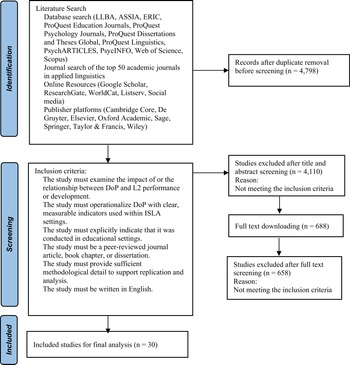
After the initial screening based on titles and abstracts, 688 studies (37 book chapters, 443 journal articles, and 208 theses/dissertations) remained for full-text review. Subsequently, a rigorous process further refined the selection to 30 studies eligible for full analysis. The first and third authors independently coded all studies. Interrater reliability was high (α = 0.95), and any inconsistencies were resolved through discussion. The full list of included studies is provided in Appendix 3. Figure 1 illustrates the PRISMA procedure adopted in this study.
The PRISMA flow chart for the search and screening process.

Figure 1. Long description
The flowchart details the process of identifying, screening, and including studies for final analysis in instructed second language acquisition research. The process begins with a literature search involving various databases, journals, online resources, and publisher platforms, resulting in 4,798 records after duplicate removal. The next step involves applying inclusion criteria to exclude 4,110 studies based on title and abstract screening. The inclusion criteria specify that the study must examine the impact of or the relationship between depth of processing and L2 performance or development, operationalize depth of processing with clear indicators, be conducted in educational settings, be peer-reviewed, provide sufficient methodological detail, and be written in English. After title and abstract screening, 688 studies undergo full text downloading. Following full text screening, 658 studies are excluded for not meeting the inclusion criteria, leaving 30 studies for final analysis.
Dataset building and qualitative coding
Dataset Building. A thorough literature review led to the creation of a structured dataset to organize the selected studies based on key aspects such as publication type, study design, and findings. The first step involved systematically extracting detailed information from each study. For every study, the following elements were recorded: title, authors, publication year, source (names of journals, books, and institutions for articles, chapters, and dissertations, respectively), study design (e.g., experimental, quasi-experimental, observational, pretests, posttests, and treatment intervals), sample characteristics (e.g., size, age, gender, proficiency, linguistic setting, and country), proficiency assessments, treatment details (e.g., language and duration), statistical methods (e.g., regression models and t-tests), and statistical results (e.g., means, standard deviations, and effect sizes), and outcome measures.
Qualitative Coding. Following the final selection of studies (N = 30), a systematic qualitative coding procedure was conducted to categorize studies according to emergent themes and key variables related to DoP in ISLA. The coding framework was developed inductively and refined iteratively through multiple rounds of analysis to ensure conceptual clarity, internal consistency, and analytical robustness. A detailed overview of this coding scheme, outlining the specific definitions, constructs, and the breadth of operationalization used to examine DoP, is provided in Table 1.
Coding scheme and categories for depth of processing in ISLA

To establish the reliability of the coding scheme, the first and third authors independently coded a subset of the studies (n = 10; 33% of the dataset) during an initial calibration phase. Inter-rater reliability (IRR) for this double-coded subset was high (an overall agreement of 95% / TEMP) Cohen’s κ = .95), indicating strong consistency across the coding scheme. Aligning with established perspectives on meta-analytic research (Norouzian, Reference Norouzian2021), this initial IRR assessment served not only to quantify agreement but also fulfilled a diagnostic function. Specifically, initial coding discrepancies were examined in detail and completely resolved through systematic discussions to reach full consensus. This consensus-building process led to the refinement and consolidation of coding categories and operational definitions.
Once the coding framework was finalized through consensus, it was systematically applied to the remaining dataset. Each study was coded for (a) definitions and conceptualizations of DoP, (b) operationalization and measurement of DoP, and (c) key methodological characteristics. In addition, methodological limitations, such as small sample sizes, short treatment durations, and reliance on self-reported measures, were explicitly documented to inform the interpretive synthesis and to contextualize the strength of the evidence base. The subsequent thematic analysis enabled the identification of recurring patterns and cross-study trends, which formed the basis for the qualitative synthesis and directly informed the structure and interpretation of the meta-analytic component of the study.
Meta-analysis
Inclusion and exclusion criteria
From the 30 identified studies, an additional screening process was conducted to determine eligibility for the meta-analysis. Beyond the inclusion criteria used in the research synthesis, studies were required to provide descriptive statistics necessary for effect size (ES) calculation (Hedges’ g), such as means, standard deviations, and sample sizes. These statistics were needed for either within-group ES calculations (e.g., pre-test and post-test for the treatment group) or between-group ESs (e.g., post-test comparisons between treatment and control groups), or both. As a result of this additional screening, 18 studies were excluded due to insufficient quantitative data, leaving 12 studies eligible for the meta-analysis.
Dataset building, effect size calculation, and quantitative coding
Dataset Building. During the review of the 12 selected studies for meta-analysis dataset construction, we examined whether they included more than one independent sample or comparison. For instance, Peng (Reference Peng2024) included two experimental conditions for DoP, resulting in two independent within-group samples. Similarly, Shao and Liu (Reference Shao and Liu2022) featured three experimental groups and a control group, creating three independent comparisons for between-group analysis. Through this process, we identified a total of 47 independent samples (including independent comparisons) across the 12 studies. An overview of the dataset along with the title and details of the included 12 studies is provided in Appendix 4.
Effect Size Calculation. Once the dataset structure was finalized, we computed effect sizes as standardized mean differences (Hedges’ g, small-sample corrected) from the outcome measures reported in each study. This allowed us to address RQ2—What impact does DoP have on L2 learning outcomes?—by quantifying (a) within-group pre–post change under a given DoP condition and (b) between-group differences between DoP and comparison conditions (at posttest or in gains). Because the included studies used different dependent variables, effect-size estimation placed outcomes on a common metric; Appendix 4 provides study-level details of the learning outcomes, including the target domain and outcome construct. Given that 12 samples had fewer than 50 participants, and the average sample size across the 47 samples was approximately 67, we used Hedges’ g as the ES metric due to its reduced bias for small sample sizes. Hedges’ g, an adjusted version of Cohen’s d, applies a correction for small sample size bias $\left(J = 1 - \left( {\frac{3}{{4\left( {{n_1} + {n_2} - 2} \right) - 1}}} \right)\right)$
, and is interpreted using the same standard benchmarks as Cohen’s d: 0.2 represents a small ES, 0.5 indicates a medium ES, and 0.8 signifies a large ES.
$\left(J = 1 - \left( {\frac{3}{{4\left( {{n_1} + {n_2} - 2} \right) - 1}}} \right)\right)$
, and is interpreted using the same standard benchmarks as Cohen’s d: 0.2 represents a small ES, 0.5 indicates a medium ES, and 0.8 signifies a large ES.
While computing effect sizes, we noted three key characteristics of the dataset: (a) two study designs—within-group (pre–post) and between-group (treatment–comparison)—for which we estimated standardized mean differences (Hedges’ g; within-group ES indices pre–post change, between-group ES indices post-test or gain differences); (b) two timings—short-term (immediate post-test) and long-term (delayed/retention); and (c) multiple outcome measures in many samples. For studies with multiple measures, we first computed an ES for each eligible measure and then averaged the effect sizes within each sample to obtain a single ES per sample for the main analyses. Accordingly, effect sizes were organized in a 2 × 2 structure by design and timing, with cell counts reported below. Consequently, a total of 228 ESs were computed across the dataset:
-
(1) 133 short-term ESs for 47 within-group samples.
-
(2) 31 short-term ESs for 27 between-group samples.
-
(3) 33 long-term ESs for 17 within-group samples.
-
(4) 17 long-term ESs for 11 between-group samples.
Quantitative Coding. After calculating ESs, studies were coded for moderator variables, including variations in the definition and operationalization of DoP. It is important to note that most features of variation across studies described in the research synthesis could not be included in the meta-analysis due to missing data. Because meta-analytic moderator analyses require complete data for the variables being examined, only the following four variables were selected as moderators:
-
(1) Publication year: 2008∼2024
-
(2) Publication type: journal article, book chapter, or dissertation
-
(3) Definition of DoP: explicitly defined or not clearly defined
-
(4) Operationalization of DoP: single-type, dual-type, or multi-type operationalization
Publication information, such as publication year and type, was treated as control variables to improve the accuracy of data analysis, as these were not central to the research focus.
Regarding the definition and operationalization of DoP, we emphasize that these variables function as study-level descriptors of conceptual clarity and implementation fidelity rather than experimental manipulations intended to affect learner performance. Accordingly, we treated them as moderators. It is also imperative to clarify that L2 learning gains in this synthesis were operationalized based on the outcome measures reported in the primary studies, as presented in Appendix 4. These outcomes span four target domains (i.e., grammar, writing, reading, and vocabulary) and encompass constructs such as grammatical knowledge, grammatical accuracy, syntactic knowledge, complexity/accuracy/fluency (CAF), reading comprehension, and vocabulary knowledge. Each study’s ES reflected gains in one of these specific constructs. Our moderator analyses, therefore, examined whether the explicitness with which studies defined or operationalized DoP was associated with differences in the magnitude of these distinct types of learning gains and whether DoP showed differential short-term or long-term effects depending on the domain or construct assessed.
For the definition moderator, some studies explicitly defined DoP with reference to prior literature—most commonly Leow’s (Reference Leow2015) formulation of DoP as “the relative amount of cognitive effort, level of analysis, and elaboration of intake, together with the usage of prior knowledge, hypothesis testing, and rule formation employed in decoding and encoding some grammatical or lexical item in the input” (p. 204)—whereas others used the construct without providing a formal definition.
For the operationalization of DoP, we initially prepared four distinct values for coding based on qualitative findings: (1) cognitive effort and elaboration, (2) hypothesis testing and rule formation, (3) error detection and correction, and (4) attention and time spent on task. However, we found that studies did not restrict themselves to a single operationalization category; instead, they often combined multiple categories, reflecting the complexity of their approaches. To account for this, we coded studies based on the number of operationalization types present in each sample (e.g., single-type, dual-type, or multi-type). For instance, Cerezo et al. (Reference Cerezo, Caras and Leow2016), Leow et al. (Reference Leow, Hsieh and Moreno2008), and Peng (Reference Peng2024) employed “(4) Attention and time spent on task,” while Bergsleithner (Reference Bergsleithner and Leow2019) used “(3) Error detection and correction.” As each study utilized only one category, we coded them as ‘single-type.’ In contrast, Morgan-Short et al. (Reference Morgan-Short, Heil, Botero-Moriarty and Ebert2012) incorporated both “(1) Cognitive effort and elaboration” and “(4) Attention and time spent on task,” leading us to classify it as ‘dual-type.’ Furthermore, Shao and Liu (Reference Shao and Liu2022) employed three distinct operationalization types—“(1) Cognitive effort and elaboration,” “(3) Error detection and correction,” and “(4) Attention and time spent on task”—resulting in a ‘multi-type’ classification. This coding system maintains the conceptual integrity of the original categories while enabling a more structured and quantifiable analysis of whether the breadth of operationalization types influences study outcomes. Details on the number of samples corresponding to each moderator variable are provided in Table 2, and the complete dataset for the quantitative analysis is available at https://osf.io/atgdv/.
Number of categorical values for the three moderator variables

Note: “Publication Year” was coded as a continuous variable (Mean = 2016.04, SD = 4.88).
When available, we coded treatment duration (total minutes/hours or sessions) and the retention interval (days between treatment and assessment) and retained these variables in the dataset. Coverage was limited and uneven (duration: 9/47 short-term within-group, 3/17 short-term between-group; interval: 8/17 within-group, 8/11 between-group, with 7 of the 8 delayed tests at 14 days and 1 at 7 days), so these variables were not entered as moderators.
Statistical analyses
We estimated overall and subgroup average effect sizes using a random-effects meta-analytic model with inverse-variance weighting (see Lee & Lee, Reference Lee and Lee2024a; Lee et al., Reference Lee, Warschauer and Lee2019). Observed effect sizes ${g_i}$
(Hedges’ g, small-sample corrected) served as the dependent variable, and their sampling variances (
${g_i}$
(Hedges’ g, small-sample corrected) served as the dependent variable, and their sampling variances ( ${v_i} = SE_i^2$
) provided the inverse-variance weights
${v_i} = SE_i^2$
) provided the inverse-variance weights $\left( {{w_i} = 1/\left( {{v_i} + {\tau ^2}} \right)} \right)$
, where
$\left( {{w_i} = 1/\left( {{v_i} + {\tau ^2}} \right)} \right)$
, where ${\tau ^2}$
denotes between-study heterogeneity. The model intercept yields the pooled mean effect; we report estimates overall and for the four Design × Timing cells (within- vs. between-group; short- vs. long-term). To examine moderators, we fit weighted meta-regressions using the same inverse-variance weights to test study-level coding of DoP definition (explicit vs. not explicit) and DoP operationalization (single-, dual-, and multi-type). Given the modest and uneven evidence base (i.e., 12 studies), we did not add further controls to avoid overfitting. All analyses were conducted in Stata 16 with random-effects estimation (pooled effects) and weighted least squares (meta-regression).
${\tau ^2}$
denotes between-study heterogeneity. The model intercept yields the pooled mean effect; we report estimates overall and for the four Design × Timing cells (within- vs. between-group; short- vs. long-term). To examine moderators, we fit weighted meta-regressions using the same inverse-variance weights to test study-level coding of DoP definition (explicit vs. not explicit) and DoP operationalization (single-, dual-, and multi-type). Given the modest and uneven evidence base (i.e., 12 studies), we did not add further controls to avoid overfitting. All analyses were conducted in Stata 16 with random-effects estimation (pooled effects) and weighted least squares (meta-regression).
Results and discussion
RQ1: How has DoP been defined and operationalized within the ISLA domain?
Definitions of DoP in ISLA
Across the 30 studies reviewed, researchers differed in how explicitly they adopted or articulated this definition. Studies were coded as a direct application of Leow’s definition when they (a) explicitly cited Leow as the definitional source and (b) reproduced or closely paraphrased his characterization of DoP in the theoretical framing or operationalization (e.g., Abdi Tabari et al., Reference Abdi Tabari, Sato and Wang2023; Cerezo et al., Reference Cerezo, Manchon, Nicolás-Conesa and Leow2019; Kim & Bowles, Reference Kim and Bowles2019; Leow et al., Reference Leow, Thinglum and Leow2022; López-Serrano et al., Reference López-Serrano, de Larios, Manchón and Manchón2020; McBride, Reference McBride2023; Park & Kim, Reference Park, Kim and Leow2019; Sachs et al., Reference Sachs, Akiyama and Nakatsukasa2019).
Studies were coded as an indirect application of Leow’s definition when they did not explicitly cite Leow but defined DoP in ways that were conceptually aligned with his framework. These definitions typically invoked constructs such as cognitive effort, attentional allocation, elaboration, or levels of analysis—elements that map onto Leow’s multidimensional characterization (e.g., Adrada-Rafael, Reference Adrada-Rafael2017; Hsieh, Reference Hsieh and Leow2019; Hsieh et al., Reference Hsieh, Moreno, Leow, Leow, Cerezo and Baralt2016; Leow et al., Reference Leow, Hsieh and Moreno2008; Li, Reference Li and Leow2019; Moreno, Reference Moreno and Leow2019; Pan et al., Reference Pan, Chen and Yuan2023; Rogers, Reference Rogers and Leow2019; Shao & Liu, Reference Shao and Liu2022; Thinglum et al., Reference Thinglum, Serafini, Leow and Leow2019).
Finally, a third group of studies did not explicitly define DoP. These studies employed the term or discussed related instructional conditions but did not provide an operational or theoretical definition consistent with Leow or other sources (e.g., Bergsleithner, Reference Bergsleithner and Leow2019; Bowles & Gastañaga, Reference Bowles and Gastañaga2022; Calderón, Reference Calderon2014a; Caras, Reference Caras2017; Cerezo et al., Reference Cerezo, Caras and Leow2016; Issa & Morgan-Short, Reference Issa and Morgan-Short2019; Leow et al., Reference Leow, Donate Velasco, Gutiérrez and Leow2019; Medina, Reference Medina and Leow2019; Morgan-Short et al., Reference Morgan-Short, Heil, Botero-Moriarty and Ebert2012; Peng, Reference Peng2024; Yang & Zhang, Reference Yang and Zhang2023). Table 3 presents a summary of how DoP was defined across all 30 studies, organized into these three categories: direct application, indirect application, and no explicit definition.
Definition of DoP across studies

Operationalization of DoP in ISLA research
As reported above, the major source of the operationalization of DoP is Leow’s (Reference Leow2015) hierarchical coding scheme for DoP, which classifies processing into three levels (low, medium, and high) that capture the cognitive processes underlying the construct. These levels may correspond to degrees of awareness (low, medium, high). Leow cautioned, however, that high DoP should not be equated with awareness at the level of understanding, dividing high DoP into two sublevels: high DoP and high DoP + awareness at the level of understanding. Several studies have adapted this coding scheme (e.g., Cerezo et al., Reference Cerezo, Caras and Leow2016; Park & Kim, Reference Park, Kim and Leow2019) or operationalized specific elements of the construct, such as hypothesis testing associated with metalinguistic comments (e.g., Shao & Liu, Reference Shao and Liu2022).
Methodologically, operationalizing DoP has been approached from two primary sources. The first involves indirect or nonconcurrent data elicitation such as tasks or experimental conditions assumed to promote deeper processing (e.g., Bird, Reference Bird2012; Laufer & Hulstijn, Reference Laufer and Hulstijn2001) and post-exposure retrospective questionnaires (e.g., Meritan, Reference Meritan2021; Sachs & Nakatsukasa, Reference Sachs, Nakatsukasa and Leow2019). The second includes direct or concurrent procedures, such as concurrent non-metacognitive verbal reports during task performance (e.g., Caras, Reference Caras2017; Hsieh et al., Reference Hsieh, Moreno, Leow, Leow, Cerezo and Baralt2016), written languaging tasks (e.g., Cerezo et al., Reference Cerezo, Manchon, Nicolás-Conesa and Leow2019), online reaction times (e.g., Rogers, Reference Rogers and Leow2019), eye-tracking (e.g., Godfroid & Schmidtke, Reference Godfroid, Schmidtke, Bergsleithner, Frota and Yoshioka2013), and pupillometry (e.g., Ryan et al., Reference Ryan, Hamrick, Miller, Was, Gass, Spinner and Behney2017). Below, we summarize how DoP has been operationalized in ISLA research, highlighting representative studies to illustrate the main dimensions and methodological diversity of the construct.
Cognitive effort and elaboration
A consistent theme in the operationalization of DoP is the emphasis on cognitive effort and elaboration. For example, Leow et al. (Reference Leow, Thinglum and Leow2022) and Kim and Bowles (Reference Kim and Bowles2019) examined how learners engage cognitively with L2 input, showing that deeper engagement—such as hypothesis testing and rule formation—leads to more effective learning outcomes. Similarly, López-Serrano et al. (Reference López-Serrano, de Larios, Manchón and Manchón2020) emphasized elaboration in encoding new linguistic forms, arguing that learners who integrate new information with existing knowledge demonstrate greater DoP. Shao and Liu (Reference Shao and Liu2022) also reported that deeper processing involves metalinguistic thinking and higher-level cognitive functions, such as error analysis and self-correction, indicating greater elaboration. In many studies, cognitive effort was inferred from verbalizations, pauses, or the time spent processing linguistic forms (e.g., Hsieh et al., Reference Hsieh, Moreno, Leow, Leow, Cerezo and Baralt2016; Moreno, Reference Moreno and Leow2019; Sachs et al., Reference Sachs, Akiyama and Nakatsukasa2019; Shao & Liu, Reference Shao and Liu2022).
Hypothesis testing and rule formation
Two central components of DoP operationalization are hypothesis testing and rule formation. Sachs et al. (Reference Sachs, Akiyama and Nakatsukasa2019) observed that learners who engage deeply with linguistic input test hypotheses about language structures and modify their understanding based on feedback. Similarly, other scholars (e.g., Abdi Tabari et al., Reference Abdi Tabari, Sato and Wang2023; Hsieh et al., Reference Hsieh, Moreno, Leow, Leow, Cerezo and Baralt2016; McBride, Reference McBride2023; Rogers, Reference Rogers and Leow2019) found that deeper processing—characterized by hypothesis testing and rule formation—leads to more accurate and durable language performance.
Error detection and correction
Some studies (e.g., Pan et al., Reference Pan, Chen and Yuan2023; Shao & Liu, Reference Shao and Liu2022) operationalized DoP in relation to error detection and correction, particularly in the context of written corrective feedback (WCF). Deeper processing and subsequent L2 development were linked to learners’ ability to (1) notice and correct errors in their writing (Pan et al., Reference Pan, Chen and Yuan2023) and (2) engage in metalinguistic reflection and hypothesis testing (Shao & Liu, Reference Shao and Liu2022).
Attention and time spent on tasks
Another frequent approach to operationalizing DoP involves attention and time on task. Several scholars (e.g., Calderón, Reference Calderon2014a; Li, Reference Li and Leow2019; Leow et al., Reference Leow, Hsieh and Moreno2008; McBride, Reference McBride2023) conceptualized DoP as the degree of attention, cognitive effort, or time devoted to processing L2 input. These studies suggest that learners who allocate more time and attention to cognitively demanding tasks—whether reading, writing, or engaging in communicative activities—tend to process language more deeply, leading to stronger learning outcomes.
Overall, the operationalization of DoP in ISLA research is multifaceted and context-dependent. Although most studies draw on shared theoretical assumptions, they differ in the specific indicators and data-collection methods used to represent cognitive engagement. Common operational markers include verbalizations, pauses, time spent on tasks, and error detection and correction. Studies that operationalize DoP typically emphasize its role in enhancing language retention, error correction, and overall learning outcomes, underscoring the central importance of deep cognitive engagement in L2 processing. Table 4 summarizes how DoP has been operationalized across the reviewed studies.
Operationalizations of DoP

Variations across studies investigating DoP in ISLA.
Reviewed studies reveal clear variability across multiple dimensions, including participant demographics, linguistic backgrounds, proficiency levels, task modalities, and research settings. These factors shape how DoP is operationalized and studied, influencing interpretation and generalizability. Across the 30 studies reviewed, these characteristics were systematically coded, revealing distinct distributional patterns that clarify how research on DoP varies in scope and focus.
Participant demographics
Participants in DoP studies span a wide age range, from adolescents to adults. Four of 30 studies (13%) involved younger learners aged 13–17 years, while the majority (≈80%; n = 24) focused on adult learners. Gender distribution varied: about half of the studies (≈50%; n = 15) reported a roughly balanced gender ratio (e.g., Kim & Bowles, Reference Kim and Bowles2019; Leow et al., Reference Leow, Thinglum and Leow2022), 25 (n = 8) included only female participants, and the remaining 25% (n = 7) did not report gender data.
Linguistic backgrounds
Participants came from diverse linguistic backgrounds, representing over 15 different L1s. Studies conducted in China accounted for 40% (n = 12) of all studies, while U.S.-based research comprised 30% (n = 9). Cross-linguistic or multilingual samples appeared in approximately 20% (n = 6) of studies, highlighting the potential influence of L1 and cultural background on DoP.
Proficiency levels
Proficiency levels were unevenly represented. Of the 30 studies, 60% (n = 18) focused on lower-proficiency learners (A1–A2), 23% (n = 7) examined intermediate learners (B1–B2), and 17% (n = 5) targeted advanced learners (C1–C2). Several studies (n = 8; 27%) included mixed-proficiency participants, providing broader insights into how proficiency variation shapes task performance and cognitive engagement.
Distribution of countries
The U.S. (33%; n = 10) and China (27%; n = 8) were the most represented contexts, followed by Spain (13%; n = 4), the U.K. (10%; n = 3), South Korea (7%; n = 2), and Brazil (7%; n = 2). This pattern highlights both the international spread and the concentration of DoP research in English-dominant and EFL contexts, with growing representation in East Asian settings.
Linguistic settings
Most studies (≈70%; n = 21) were conducted in foreign language (FL) contexts, 20% (n = 6) in second language (SL) environments, and 10% (n = 3) did not specify the setting (e.g., Leow et al., Reference Leow, Hsieh and Moreno2008). This suggests a stronger research focus on classroom-based and instructed learning rather than on naturalistic acquisition.
Educational settings
The majority of studies (≈75%; n = 23) were conducted in higher education contexts (e.g., Adrada-Rafael, Reference Adrada-Rafael2017; Cerezo et al., Reference Cerezo, Caras and Leow2016), 20% (n = 6) in K–12 classrooms, and fewer than 5% (n = 1) did not specify educational level.
Class/lab settings
Approximately 60% of studies (n = 18) were classroom-based, 30% (n = 9) lab-based, and 10% (n = 3) used both settings. About 5–10% did not report the setting. Laboratory studies emphasize experimental control, whereas classroom-based designs explore DoP in authentic learning contexts.
Modality of delivery in DoP research
Face-to-face delivery dominated (≈60%; n = 18), online/computer-mediated designs accounted for 30% (n = 9), and 10% (n = 3) used blended or hybrid formats. Several studies did not report modality details.
Overall, the results show that research on DoP in ISLA is heavily adult- and university-centered, primarily situated in FL contexts, and dominated by face-to-face, classroom-based designs. Reporting the frequencies of key characteristics across the 30 studies allows readers to identify both the concentration of research and gaps, particularly regarding younger learners, naturalistic L2 contexts, online or hybrid task environments, and higher-proficiency participants.
RQ2: How has DoP been examined in relation to L2 learning outcomes in the ISLA literature?
In this section, we present the results of the meta-analysis on the impact of DoP on L2 learning outcomes by synthesizing effect sizes across different timeframes (short-term vs. long-term) and comparison types (within-group vs. between-group). Because the primary studies measured L2 learning in different ways, we emphasize that the outcomes synthesized here encompass four target domains—grammar, writing, reading, and vocabulary—and constructs such as grammatical knowledge, grammatical accuracy, syntactic knowledge, CAF, reading comprehension, and vocabulary knowledge (Appendix 4). We also report moderator analyses examining how variation in DoP definition and operationalization is associated with differences in outcomes. As noted in the Method section, only two DoP-related variables (definition and operationalization) and two publication-related variables were included as moderators due to the availability of data.
Short-term effects
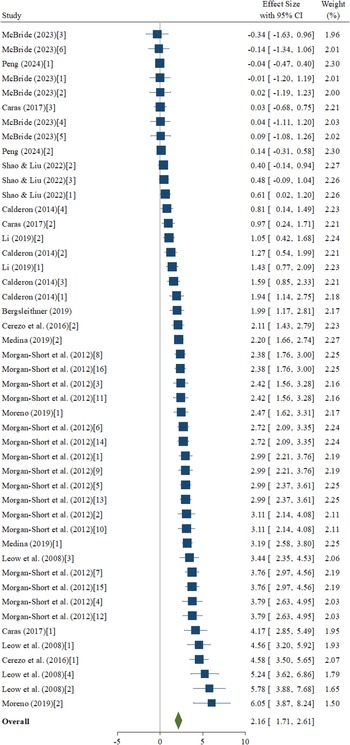
Within-Group Comparisons ( n = 133, k = 47, N = 3,167). On average, studies examining short-term effects (pre- to post-test) showed that deeper processing produced significant immediate gains across grammar, writing, reading, and vocabulary outcomes. As shown in Figure 2, while two samples reported negative ESs and 11 samples yielded nonsignificant ESs (i.e., their 95% confidence intervals included zero), the majority (36 of 47 ESs; 76.6%) were statistically positive. The average ES for within-group comparisons was 2.16 (p < .001; 95% CI [1.71, 2.61]), indicating substantial short-term improvement. These gains were observed across outcome constructs, including grammatical knowledge/accuracy, CAF, reading comprehension, and vocabulary knowledge.
Forest plot of short-term effects of DoP from within-group comparisons.

Figure 2. Long description
The table presents a forest plot of short-term effects of depth of processing (DoP) from within-group comparisons. It includes columns for study references, effect sizes with 95% confidence intervals, and weights in percent. The table has 50 rows and 3 columns. Each row lists a study with its corresponding effect size and weight. The studies are ordered by their effect sizes, ranging from negative to positive values. Notable studies include McBride (2023) with multiple entries, Peng (2024) with multiple entries, and Morgan-Short et al. (2012) with the highest effect sizes. The overall effect size is 2.16 with a 95% confidence interval of 1.71 to 2.61.
For the short-term within-group effects (Table 5), studies that did not explicitly define DoP in their theoretical framework demonstrated gains comparable in magnitude to studies that provided an explicit definition. The small observed difference between the two groups was not statistically significant. Similarly, when comparing studies that elicited DoP using one, two, or multiple indicators of processing (e.g., concurrent verbalization, eye-tracking, or pupillometry), the resulting learning gains were broadly similar, and the differences across these operationalizations were small and not statistically significant.
Results of moderator analysis—short-term effects of DoP from within-group comparisons

Note: In this multiple regression model, two control variables were included.
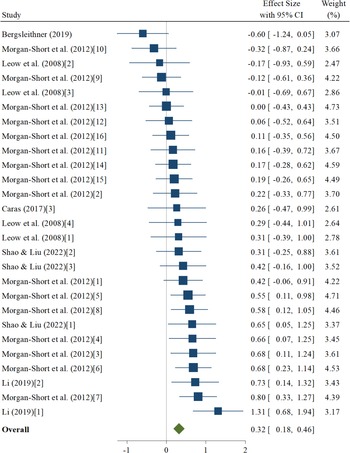
Between-Group Comparisons (n = 31, k = 27, N = 1,714). Between-group comparisons indicated that learners engaging in DoP-based tasks outperformed control groups employing relatively shallow processing strategies. As shown in the forest plot in Figure 3, the average ES was 0.32 (p < .001, 95% CI [0.18, 0.46]), reflecting a small but meaningful educational impact. This effect was consistently observed across grammatical knowledge, writing complexity–accuracy–fluency (CAF), reading comprehension, and vocabulary outcomes.
Adjusted forest plot of short-term effects of DoP from between-group comparisons.

Figure 3. Long description
A table with 31 rows and 4 columns. The columns are labeled Study, Effect Size with 95% CI, and Weight (%). The table lists various studies and their respective effect sizes with 95% confidence intervals and weights. Row 1: Bergsleithner (2019), Effect Size with 95% CI: -0.60 [-1.24, 0.05], Weight (%): 3.07. Row 2: Morgan-Short et al. (2012)[10], Effect Size with 95% CI: -0.32 [-0.87, 0.24], Weight (%): 3.66. Row 3: Leow et al. (2008)[2], Effect Size with 95% CI: -0.17 [-0.93, 0.59], Weight (%): 2.47. Row 4: Morgan-Short et al. (2012)[9], Effect Size with 95% CI: -0.12 [-0.61, 0.36], Weight (%): 4.22. Row 5: Leow et al. (2008)[3], Effect Size with 95% CI: -0.01 [-0.69, 0.67], Weight (%): 2.86. Row 6: Morgan-Short et al. (2012)[13], Effect Size with 95% CI: 0.00 [-0.43, 0.43], Weight (%): 4.73. Row 7: Morgan-Short et al. (2012)[12], Effect Size with 95% CI: 0.06 [-0.52, 0.64], Weight (%): 3.51. Row 8: Morgan-Short et al. (2012)[16], Effect Size with 95% CI: 0.11 [-0.35, 0.56], Weight (%): 4.50. Row 9: Morgan-Short et al. (2012)[11], Effect Size with 95% CI: 0.16 [-0.39, 0.72], Weight (%): 3.67. Row 10: Morgan-Short et al. (2012)[14], Effect Size with 95% CI: 0.17 [-0.28, 0.62], Weight (%): 4.59. Row 11: Morgan-Short et al. (2012)[15], Effect Size with 95% CI: 0.19 [-0.26, 0.65], Weight (%): 4.49. Row 12: Morgan-Short et al. (2012)[2], Effect Size with 95% CI: 0.22 [-0.33, 0.77], Weight (%): 3.70. Row 13: Caras (2017)[3], Effect Size with 95% CI: 0.26 [-0.47, 0.99], Weight (%): 2.61. Row 14: Leow et al. (2008)[4], Effect Size with 95% CI: 0.29 [-0.44, 1.01], Weight (%): 2.64. Row 15: Leow et al. (2008)[1], Effect Size with 95% CI: 0.31 [-0.39, 1.00], Weight (%): 2.78. Row 16: Shao & Liu (2022)[2], Effect Size with 95% CI: 0.31 [-0.25, 0.88], Weight (%): 3.61. Row 17: Shao & Liu (2022)[3], Effect Size with 95% CI: 0.42 [-0.16, 1.00], Weight (%): 3.52. Row 18: Morgan-Short et al. (2012)[1], Effect Size with 95% CI: 0.42 [-0.06, 0.91], Weight (%): 4.22. Row 19: Morgan-Short et al. (2012)[5], Effect Size with 95% CI: 0.55 [0.11, 0.98], Weight (%): 4.71. Row 20: Morgan-Short et al. (2012)[8], Effect Size with 95% CI: 0.58 [0.12, 1.05], Weight (%): 4.46. Row 21: Shao & Liu (2022)[1], Effect Size with 95% CI: 0.65 [0.05, 1.25], Weight (%): 3.37. Row 22: Morgan-Short et al. (2012)[4], Effect Size with 95% CI: 0.66 [0.07, 1.25], Weight (%): 3.45. Row 23: Morgan-Short et al. (2012)[3], Effect Size with 95% CI: 0.68 [0.11, 1.24], Weight (%): 3.61. Row 24: Morgan-Short et al. (2012)[6], Effect Size with 95% CI: 0.68 [0.23, 1.14], Weight (%): 4.53. Row 25: Li (2019)[2], Effect Size with 95% CI: 0.73 [0.14, 1.32], Weight (%): 3.43. Row 26: Morgan-Short et al. (2012)[7], Effect Size with 95% CI: 0.80 [0.33, 1.27], Weight (%): 4.39. Row 27: Li (2019)[1], Effect Size with 95% CI: 1.31 [0.68, 1.94], Weight (%): 3.17. Row 28: Overall, Effect Size with 95% CI: 0.32 [0.18, 0.46], Weight (%): N/A.
The moderator analysis for the short-term effects of DoP from between-group comparisons, presented in Table 6, revealed that studies in which DoP was not explicitly defined showed a small average ES (g = 0.25, SE = 0.11, p < .05), whereas studies with an explicit definition of DoP demonstrated a medium-sized effect (g = 0.57, SE = 0.23, p < .05). Despite these numerical differences, the contrast between explicitly and non-explicitly defined DoP was not statistically significant, suggesting that explicit definition may promote larger short-term effects but without reliable evidence. Regarding operationalization, studies using a single-type indicator of DoP showed a marginal effect (g = 0.10, SE = 0.24, p > .05), while studies employing dual- or multi-type operationalizations displayed small effect sizes (g = 0.40). Learners in studies that operationalized DoP with multiple indicators exhibited only numerically larger short-term gains, and these differences were likewise nonsignificant. Taken together, the results suggest that DoP leads to immediate benefits across outcome types—including grammar and writing—while effects appear generally consistent across different definitions and operationalizations of DoP.
Results of moderator analysis—Short-term effects of DoP from between-group comparisons

Note: In this multiple regression model, control variables were excluded due to the small sample size.
Long-term effects
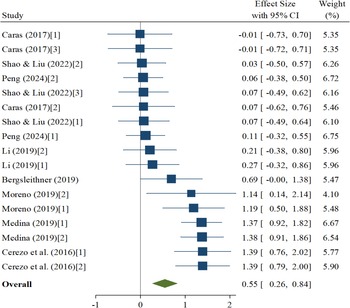
Within-Group Comparisons (n = 33, k = 17, N = 1,192). Delayed posttest analyses showed that learners exposed to deeper processing not only retained information but also demonstrated knowledge transfer. The average ES for long-term within-group comparisons was 0.55 (p < .001, 95% CI [0.26, 0.84]), reflecting medium-sized retention over time. These long-term gains were observed across grammatical knowledge, CAF, reading comprehension, and vocabulary knowledge outcomes. However, as shown in Figure 4, more than half of the ESs (11 of 17; 64.7%) were nonsignificant, with six positives.
Forest plot of long-term effects of DoP from within-group comparisons.

Table 7 presents the moderator analysis results for the long-term effects of DoP from within-group comparisons. Both studies where DoP was explicitly defined and those where it was not showed medium-sized average ESs, with the marginal difference being nonsignificant. However, studies using a single-type operationalization of DoP had a larger average ES (g = 0.79, SE = 0.13, p < .001) and produced significantly larger long-term gains, particularly for grammar-related outcomes compared to those using a multi-type operationalization (g = 0.05, SE = 0.19, p > .05), which showed a marginal effect. The superiority of single-type operationalization in producing larger long-term effects was statistically significant (B = −0.74, SE = 0.23, p < .01). This suggests that more narrowly focused DoP measures may capture processing that predicts longer-term consolidation more effectively than more diffuse multi-indicator approaches.
Results of moderator analysis—long-term effects of DoP from within-group comparisons

Note: In this multiple regression model, only one control variable (publication year) was included due to the small sample size.
Between-Group Comparisons (n = 17, k = 11, N = 695). Delayed posttest comparisons also favored studies that incorporated measures of DoP, with learners demonstrating sustained L2 competence gains, although these gains were not statistically significant. The average ES was 0.41 (p = .09, 95% CI [−0.07, 0.89]), as shown in Figure 5. These long-term effects were again distributed across grammar, writing, reading, and vocabulary outcomes.
Forest plot of long-term effects of DoP from between-group comparisons.

Table 8 presents the results of the moderator analysis for the long-term effects of DoP based on between-group comparisons. Studies in which DoP was not explicitly defined showed a small average ES (g = 0.32, SE = 0.36, p > .05), whereas studies with an explicit definition of DoP demonstrated a medium-sized effect (g = 0.51, SE = 0.39, p > .05). Despite these numerical differences, the contrast between explicit and non-explicit definitions was not statistically significant. Regarding operationalization, studies using a single-type indicator of DoP yielded a medium-sized effect (g = 0.61, SE = 0.40, p > .05), larger than the smaller effect observed in studies employing multi-type operationalizations (g = 0.24, SE = 0.36, p > .05). The single-type operationalization showed numerically larger effects, particularly for grammar outcomes. Overall, long-term gains under single-type operationalizations were similar in magnitude to those observed for dual- and multi-type approaches, with no significant differences emerging across definitions or operationalizations.
Results of moderator analysis—long-term effects of DoP from between-group comparisons

Note: In this multiple regression model, control variables were excluded due to the small sample size.
Summary of quantitative findings
The meta-analysis examined the effects of DoP on L2 learning outcomes across both short-term and long-term timeframes. Overall, tasks designed to elicit DoP were consistently associated with meaningful gains in grammar, writing, reading, and vocabulary outcomes. Short-term effects were particularly strong, while long-term retention was moderate, indicating that DoP promotes both immediate learning and sustained performance. Importantly, positive effects emerged across multiple constructs, including grammatical knowledge and accuracy, syntactic knowledge, CAF, reading comprehension, and vocabulary, suggesting that the impact of DoP is broad rather than domain-specific.
Moderator analyses revealed that the explicitness of DoP definitions and the specificity of operationalization did not systematically alter the magnitude of learning gains. Studies that operationalized DoP with single-type measures showed relatively larger long-term effects, particularly for grammar outcomes, whereas dual- or multi-type operationalizations produced somewhat smaller gains. For short-term effects, differences across operationalization types were minimal. Similarly, whether DoP was explicitly defined or not had little influence on observed gains. These patterns indicate that, although conceptual clarity and operational choices may shape numerical effect sizes, they should not be interpreted as causal levers, and effects appear generally consistent across outcome domains, construct types, and operational definitions.
Taken together, the meta-analysis demonstrates that tasks designed to elicit deeper processing reliably promote both immediate learning and longer-term retention across a range of L2 learning outcomes, with minimal systematic variation in effect magnitude by outcome domain, construct type, or definitional and operational choices made by primary studies.
RQ3: What are the current limitations in DoP research within the ISLA domain?
Research on DoP in ISLA has yielded valuable insights into learners’ cognitive engagement, yet a synthesis of 30 studies reveals recurring limitations that constrain theoretical coherence and comparability across studies. These limitations cluster around several interconnected themes, each informed by quantitative patterns and qualitative interpretations. First, the lack of a standardized operationalization remains a core concern. Only about 20% of studies referenced a shared or established DoP definition or coding scheme, while most relied on locally developed or implicit operationalizations. This conceptual variability weakens construct validity and complicates interpretation: studies may be capturing different facets of cognitive engagement, making synthesis difficult. Although some studies distinguished single-, dual-, and multi-type processing, evidence for the relative effectiveness of these approaches is inconsistent, reflecting broader theoretical ambiguity.
Participant and reporting variability further limit comparability. Only 12 of 30 studies (40%) consistently reported proficiency and demographic information, and just 14 of 30 (47%) included explicit measures of metacognitive or strategic engagement. Because most samples consisted of adult university learners and key variables such as prior knowledge or motivation were often omitted, generalizability remains restricted. Without systematic reporting, it is difficult to assess how DoP effects may differ across learner profiles.
Research settings also varied in ways that affect ecological validity. Half of the studies (15 of 30; 50%) were conducted in laboratories, and 13 of 30 (43%) in classrooms. While laboratory settings enhance experimental control, they may not approximate authentic learning environments, which raises concerns about the applicability of DoP findings to real-world, technology-mediated, or interaction-rich instructional contexts.
Long-term learning outcomes remain underexplored as well. Only 15 of 30 studies (50%) included delayed or retention measures, and those that did used widely differing intervals and reporting practices. This inconsistency makes it difficult to determine whether high DoP reliably contributes to durable learning gains. Moreover, most studies focused on grammar and vocabulary, with far less attention to areas such as fluency, pronunciation, discourse competence, or pragmatics—domains essential to broader communicative competence.
In sum, current DoP research in ISLA is marked by heterogeneous operationalizations, variable reporting practices, mixed research settings, and limited attention to long-term outcomes. These patterns—alongside challenges that mirror broader issues across ISLA, including construct clarity, ecological validity, and narrow topical focus—underscore the need for clearer conceptual definitions, more transparent reporting, classroom-based replication, and pragmatically designed longitudinal work. Addressing these shared limitations will strengthen theoretical accounts of cognitive engagement and enhance the practical relevance of DoP-oriented research for L2 learning.
RQ4: What methodological and pedagogical implications can be drawn from existing DoP research, and what directions should future research take?
Methodological implications
The synthesis of 30 studies reveals several methodological issues that directly affect the interpretability and cumulative value of DoP research. A primary concern is heterogeneous operationalization. Only 20% of studies referenced an existing DoP definition or coding framework, while most relied on locally developed or implicit approaches. Although diversity in operationalization is not inherently problematic, definitions and coding schemes in SLA research are often refined; the challenge arises when reporting lacks clarity. Without explicit definitions or coding rationales, it is difficult to determine how a study’s conceptualization of DoP aligns with or departs from prior work (e.g., Leow’s, Reference Leow2015 coding scheme), making it unclear whether studies are examining comparable dimensions of cognitive engagement. Greater transparency, rather than uniformity, is essential. Researchers should clearly articulate their adopted definition, explain its relation to previous formulations, and justify how their operational choices capture specific processing dimensions. This approach enhances interpretability, enables meaningful cross-study synthesis, and supports theory development without stifling innovation.
Construct validity is another concern. DoP has been measured through various data sources, including verbal reports, online measures (e.g., TA, ET, or pupillometry), and indirect task-based proxies. These approaches differ in how directly they capture cognitive processing. Studies relying solely on task features risk conflating instructional design with learner processing, whereas process-based measures provide more immediate insight into attention and engagement. Furthermore, the limited use of multi-method designs indicates that opportunities for triangulating evidence remain underexploited, constraining confidence in how DoP is inferred.
Reporting of learner characteristics is also inconsistent. As highlighted in RQ3, only 12 of 30 studies (40%) provided proficiency and demographic information in a comparable format, and only 14 studies (47%) included measures of metacognitive or strategic engagement. This variability limits the ability to examine DoP across different learner populations and to explore interactions with individual differences.
Finally, research settings and temporal designs impose additional constraints. Laboratory studies accounted for 50% of the research sample, while 43% took place in classrooms. Although laboratory environments allow experimental control, they may not replicate the interactional, affective, or technological conditions of authentic instructional settings. Combined with the limited use of delayed or retention measures (reported in only 15 studies, 50%), these factors restrict insight into how DoP operates over time and across contexts. Consequently, current research offers only a partial understanding of the durability and contextual sensitivity of DoP-related effects.
Pedagogical implications
Pedagogical implications must be interpreted in light of these methodological constraints. While RQ2 indicates that DoP is frequently examined in relation to L2 learning outcomes, variability in definitions, operationalizations, and measurement approaches limits the extent to which specific instructional recommendations can be drawn directly.
A key insight is that task design does not uniformly translate into learner processing. Evidence from studies using process-based measures shows that learners may engage with the same task in qualitatively different ways, indicating that cognitive engagement depends on how learners allocate attention rather than on task features alone. This challenges the assumption that task complexity, textual enhancement, or elaboration automatically induces deeper processing and underscores the need to examine actual cognitive activity during task performance.
The partial and uneven inclusion of metacognitive and strategic variables—present in only 47% of studies—suggests a possible, yet underexplored, relationship between learner regulation and DoP. Pedagogical applications should therefore be grounded in evidence that directly captures cognitive processing, rather than inferred from task design alone.
Instructional approaches can foster DoP by designing tasks that promote elaboration, problem-solving, and self-reflection and by integrating metacognitive strategies such as noticing, monitoring, and self-regulation. Digital tools offer additional potential for multimodal input and adaptive processing, though technology alone does not guarantee deeper engagement. Taken together, standardized operationalization, systematic reporting, classroom-based replication, and intentional integration of metacognitive strategies provide the foundation for advancing both the theoretical and pedagogical value of DoP in ISLA.
Future research directions
Several priorities emerge for future research. First, there is a need for clearer alignment between conceptual definitions and operationalizations of DoP, enabling systematic comparison across studies. Empirically informed coding schemes that distinguish between single-, dual-, and multi-type processing will facilitate robust theoretical synthesis. Related to this, while our qualitative coding procedure ensured high overall IRR and full consensus, we did not separately report category-specific reliability indices. Therefore, future meta-analytic research in ISLA should retain and report detailed IRR metrics (e.g., Cohen’s κ) for individual coding categories to further enhance the transparency and replicability of the coding frameworks. Second, multi-method approaches should be used more consistently to capture complementary dimensions of cognitive engagement, strengthening construct validity and increasing confidence in how DoP is measured.
Third, systematic reporting of participant characteristics is essential. Researchers should document proficiency, linguistic background, age, and metacognitive or strategic engagement. Expanding participant diversity, including younger learners and individuals from varied educational and linguistic backgrounds, would clarify how DoP interacts with individual differences such as motivation, cognitive style, and proficiency. Fourth, research in classroom-based and technology-mediated contexts (online, hybrid, and blended) should be prioritized to enhance ecological validity and reflect contemporary learning environments more accurately.
Finally, delayed and longitudinal designs are needed to assess the durability of DoP-related learning. Even with practical constraints, manageable follow-up intervals (e.g., several weeks post-instruction) could provide insight into retention across domains such as grammar, vocabulary, discourse, pragmatics, and pronunciation. Additionally, examining how task design, metacognitive training, learner strategies, and digital tools interact to enhance DoP will inform instructional models that promote sustained and meaningful cognitive engagement.
Replication package
Public and free access to the complete analysis code and data is provided via our OSF repository: https://osf.io/atgdv/.
Acknowledgments
We would like to thank Ronald P. Leow for his insightful comments and constructive feedback on multiple drafts of this manuscript. His help and guidance substantially improved the quality and clarity of this study. Any remaining errors are, of course, our own. This work was supported by 2026 research fund of Korea Military Academy (Hwarangdae Research Institute).
Competing interests
The authors declare none.






 Open access

