


Introduction
Interest group lobbying in financial regulation is an increasingly studied area within interest group research. One of the reasons scholarly work focuses on this specific policy area is because financial regulators face allegations of being captured by financial interests (Mügge Reference Mügge2006; Baker Reference Baker2010; Tsingou Reference Tsingou2010, Reference Tsingou2015; Baxter Reference Baxter2011; Young Reference Young2013). Before the financial crisis of 2007–2008, the financial sector influenced policymakers extensively and lobbied successfully for self-regulation (Mügge Reference Mügge2006; Baxter Reference Baxter2011). The sector’s self-regulation and the lack of sufficient microprudential oversight from national and European Union (EU) financial authorities are two of the many reasons the financial crisis of 2007–2008 could have had such dramatic and extensive effects (Baker Reference Baker2010). Precrisis literature argues that financial sector interests lobby in a unified and cohesive manner, and as such form a close policy community. However, recent postcrisis literature shows a more nuanced image of actors involved in financial lobbying. Indeed, financial sector actors (banks, banking associations, brokers, insurance companies, etc.) are still prevalent in the lobbying community after the financial crisis (Quaglia Reference Quaglia2008; Lall Reference Lall2012; Woll Reference Woll2013; Pagliari and Young Reference Pagliari and Young2015). Furthermore, macrolevel longitudinal studies show that there is a surprising stability in financial lobbying after the crisis (Chalmers Reference Chalmers2015; Redert Reference Redert2020). However, recent postcrisis studies have shown that financial industry lobbying involves a greater plurality of actors than previously expected, including nongovernmental organisations (NGOs) and consumer protection groups (Kastner Reference Kastner2014), labour unions and civil society groups (Kirsch and Mayer Reference Kirsch and Mayer2013), nonregulated business actors (Pagliari and Young Reference Pagliari and Young2014), and a wide variety of financial industry actors (Chalmers Reference Chalmers2015, Reference Chalmers2017).
Instead of a uniform community, these studies paint a picture of a policy field consisting of a wide array of interest groups with different policy preferences. The question that arises is whether and how financial lobbying has changed in these times of shocks. To this end, previous studies investigated interest groups’ participation in public consultations by analysing the size and the diversity of the set of participating interest groups (see e.g. Chalmers Reference Chalmers2015; Pagliari and Young Reference Pagliari and Young2015; Redert Reference Redert2020). However, when analysing interest groups’ participation in public consultations, such interest group ecology studies aggregate individual participation by taking the mean or computing a score at the consultation level (for similar studies in different policy fields, see e.g. Berkhout et al. Reference Berkhout, Carroll, Braun, Chalmers, Destrooper, Lowery, Otjes and Rasmussen2015; Fraussen et al. Reference Fraussen, Albareda and Braun2020). The aggregation of data on the consultation level means that these studies lose crucial data about individual groups’ lobbying efforts. Yet, the financial crisis is expected to affect the lobbying behaviour of specific (sets of) interest groups. Thus, instead of aggregating participation data of interest groups, this research takes the individual participation of interest groups in public consultations and constructs networks using these data. Next, building on existing studies on change and stability in networks, this research assesses the changes in the network structures of the EU financial lobbying networks after two consecutive exogenous shocks: the financial crisis and institutional reforms. Hence, this research answers the question: “How are policy networks surrounding the European Supervisory Authorities transformed after exogenous shocks?” To answer this question, this article uses the global financial crisis and subsequent institutional reforms as cases of shocks that are likely to disrupt the policy network concerning financial regulation.
The analysis is based on interest groups’ lobbying activities in one specific venue, namely the public consultations organised by the European Supervisory Authorities (ESAs) and their institutional predecessors. Using interest groups’ responses (n = 11,370) on consultations (n = 432) spanning from 2004 to 2014, I constructed lobbying networks, mapping the coattendance of interest groups in the public consultations of the ESAs and their predecessors. Next, using key measures within social network analysis, the article compares the structure of three lobbying networks of the ESAs before the crisis, after the crisis, and after the reforms. Comparing these network structures over three time periods, I find that as the networks increase in size, they become less interconnected and more balkanised. This implies that the once stable and tight networks are disrupted and become less club-like after the crisis.
Stability and change in policy networks
The role of policy networks in policymaking is prevalent. Policy networks can be defined as subsystems of the political system, and concern all constellations of interdependent actors with different capabilities and policy positions that provide solutions to policy problems (Laumann and Knoke Reference Laumann and Knoke1987; Knoke Reference Knoke1990; Heinz et al. Reference Heinz, Laumann, Nelson and Salisbury1993; Scharpf Reference Scharpf1997; see also Carpenter et al. Reference Carpenter, Esterling and Lazer1998). Generally, policy networks have varying structures of both public and private actors. These structures vary in terms of stability and membership, and mediate the halt or accommodation of policy change (Baumgartner and Jones Reference Baumgartner and Jones1991; Peterson Reference Peterson1995). Policy networks can be “policy communities”: networks with stable relationships between actors, a restrictive membership, interdependences between actors and insulation from the general public (Judge Reference Judge1993; in Richardson Reference Richardson2000). These policy communities are imperative in policymaking as they decide which issues to include and exclude from the policy agenda (Rhodes Reference Rhodes1997; Marsh and Smith Reference Marsh and Smith2000). As a result, policy communities consisting of a few powerful (economic) interests – insulated from the influence of the general public or citizen interests – dictate and sustain existing policy agendas, thus largely ruling out drastic policy change (Baumgartner and Jones Reference Baumgartner and Jones1991).
However, stable network structures, such as policy communities, can be disrupted by shocks (Baumgartner and Jones Reference Baumgartner and Jones1993; Baumgartner et al. Reference Baumgartner, Berry, Hojnacki, Leech and Kimball2009). Long-standing policy networks of well-established groups lose out to other groups who were previously not mobilised in relation to the policy community. For example, studying networks of airline companies, Corbo et al. (Reference Corbo, Corrado and Ferriani2015) finds that the exogenous shock of the September 11 terrorist attacks increases the mobilisation of actors previously not active within the policy network. Such newcomers may manage to construct a new “image” of existing policy problems (Heclo, Reference Heclo and King1978; Baumgartner and Jones Reference Baumgartner and Jones1991; for an overview: Richardson Reference Richardson2000). As such, shocks can change the image of a certain policy field and may induce participation of interests not generally supportive of the already involved industry (Baumgartner and Jones Reference Baumgartner and Jones1991:1051). As a result, the policymaking arena becomes less cohesive, or “club-like” (Heclo Reference Heclo and King1978), as policy communities’ structures open up and transform to “issue networks” that exhibit a lower level of stability and cohesiveness (Heclo Reference Heclo and King1978; Baumgartner and Jones Reference Baumgartner and Jones1991; Peterson Reference Peterson1995). Consequently, policymaking in issue networks is less stable and more subject to rapid change as new interests bring different values, policy frames, demands, and modes of behaviour to the negotiating table (Richardson Reference Richardson2000). In other words, shocks can transform tight networks (i.e. clubs) into unstable networks characterised with alternating memberships of and relationships between interest groups (i.e. hubs).
These theories about stability and shocks in policy networks directly apply to the specific case of financial regulation: one clearly sees that a cohesive policy community experienced a major shock. Both USA and European precrisis literature argue that the networks surrounding financial regulation were close policy communities of financial sector interests, which lobbied in a unified and cohesive manner (Mügge Reference Mügge2006; Baker Reference Baker2010; Tsingou Reference Tsingou2010, Baxter Reference Baxter2011; Young Reference Young2013; Tsingou Reference Tsingou2015). This cosiness between regulators and private interests is the result of regulators’ struggles to keep up with financial instruments and methods. As a consequence, regulators turned to private actors for advice on financial regulation. In turn, the financial sector used their expertise in managing complex financial regulation as a means to command authority over public regulators (Tsingou Reference Tsingou2015). Consequently, private actors gained substantial leverage in their dealings with regulators which led to interdependencies between the two (Newman and Posner Reference Newman and Posner2011; Tsingou Reference Tsingou2015). Due to these interdependencies, closely cooperating networks of interest groups and policymakers were formed (Mügge Reference Mügge2006; Quaglia Reference Quaglia2008; Christopoulos and Quaglia Reference Christopoulos and Quaglia2009; Young Reference Young2013; Tsingou Reference Tsingou2015).
Recent postcrisis literature shows a more nuanced image of actors involved in financial lobbying. Although the financial sector is still dominant in the lobbying community after the financial crisis (Quaglia Reference Quaglia2008; Lall Reference Lall2012; Woll Reference Woll2013; Pagliari and Young Reference Pagliari and Young2015), postcrisis literature has shown that financial industry lobbying involves a greater plurality of actors than previously expected (see Kirsch and Mayer Reference Kirsch and Mayer2013; Kastner Reference Kastner2014; Chalmers Reference Chalmers2015; Pagliari and Young Reference Pagliari and Young2015; Chalmers Reference Chalmers2017). Instead of a cohesive community, this literature paints a picture of a lobbying network consisting of a wide array of interest groups with different policy preferences. Comparing these studies, the financial crisis is indeed a disruptive event which has transformed a club-like network structure into a more pluralized, diversified policy network – or as argued by LaPira, Thomas, and Baumgartner:
“Policy fields that are relatively obscure can be radically transformed by such things as the Enron scandal and the subsequent congressional activity on the Sarbanes-Oxley Act, and we might expect continued expansion in this area after the 2008 and 2009 events surrounding financial bailouts and the practices of the banking industry” (2009, pp. 13–14).
The effect of the global financial crisis on policy networks is also clearly reflected by empirical evidence showing an increase of volatility in the participation of interest groups in public consultations concerning financial regulation (Redert Reference Redert2020). Whereas before the crisis, a few interest groups continuously participate in public consultations, after the crisis and subsequent reforms new interest groups participate in consultations. This clearly reflects that once stable lobbying networks become increasingly volatile after the financial crisis. It makes financial regulation a fitting policy field to explore how networks change after exogenous shocks.
But why is the crisis likely to transform these networks? I make a distinction between short- and long-term effects of the financial crisis on the policy network of financial regulation. In the short term, the global financial crisis highlighted the failure of microprudential oversight by financial regulators. Consequently, the crisis changed the image of how economic governance actually functions and put policy networks in financial regulation closer to the forefront (Young Reference Young2013). In this regard, Chalmers (Reference Chalmers2015) argues that the crisis highlighted the extensive role and influence of the financial sector in policymaking. The crisis showed that the interdependencies between industry and policymakers might have resulted in policy outputs that systematically favour business interests at the disadvantage of the general interest (Mügge Reference Mügge2006; Baker Reference Baker2010; Tsingou Reference Tsingou2010, Baxter Reference Baxter2011; Young Reference Young2013; Tsingou Reference Tsingou2015). After all, it was the industry that created high-risk financial products and proposed self-regulation during the years before the crisis (Quaglia Reference Quaglia2008; Baxter Reference Baxter2011; Tsingou Reference Tsingou2010). Consequently, also the notion that the making of financial regulation should be a joint effort between regulatee and regulator changes drastically.
Besides the changing image, I also expect that institutional and regulatory reforms affect lobbying networks in the long term. In the wake of the financial crisis, it became painfully clear that European regulators lacked the instruments for strict microprudential oversight deemed necessary to control and supervise the financial sector. Hence, the Commission decided to reform the European framework concerning financial regulation. These reforms were aimed to increase EU integration in this policy field and to remove any differences in enforcement and practices concerning financial regulation (for a discussion see Hennessy Reference Hennessy2014). Specifically, three committees with nonbinding powers (the Lamfalussy Committees) were transformed into EU agencies (changing their names to the European Supervisory Authorities, or ESAs – also see Table 1) with legally binding decisionmaking and supervisory powers (Busuioc Reference Busuioc2013; Hennessy Reference Hennessy2014; Scholten and Van Rijsbergen Reference Scholten and Van Rijsbergen2014). The delegation of these extensive powers made that the advisory Lamfalussy Committees transformed into powerful regulatory EU agencies. The delegation of these powers made the ESAs the most powerful regulatory agencies in the EU (for a discussion see Busuioc Reference Busuioc2013).
Overview of Lamfalussy Committees and European Supervisory authorities. *

* To avoid any confusion, the remainder of the article will address the institutions by their new name: EBA, EIOPA, and ESMA.
This increase of powers is likely to disrupt the policy networks in two ways. First, whereas the Lamfalussy committees first had a mere advisory role, their transformation into EU agencies meant that they gained rulemaking competencies, making them an imperative cog in the policymaking process. This makes the agencies crucial venues for interest groups to make their voice heard, trying to influence financial regulation. Second, not only did the agencies get more competences, but they were also tasked with redesigning the financial regulatory framework in the EU in the wake of the crisis. The ESAs are tasked with drafting new and extensive European regulation and strict financial oversight. To this end, they are mandated to implement extensive regulatory packages (i.e. Solvency II, MiFID II, and Single Rulebook for banking). As such, it is expected that these reforms also induce participation of new interest groups formerly absent or less active in this policy field. Therefore, the analysis presented below will assess the change in the network structures on the short term (i.e. after the financial crisis in 2007) and on the long term (i.e. after the institutional reforms in 2010).
Assessing change in lobbying networks
As discussed, the financial crisis is likely to disrupt and transform the policy network of EU financial regulation. However, how can one assess stability and change in policy networks? This research empirically focuses on one specific form of network, namely a lobbying network surrounding the public consultations of the ESAs. With lobbying network, I refer to the networks based on actors (i.e. interest groups, firms, business associations, research institutes, etc.) that partake in a certain political activity, such as cosigning policy briefs (LaPira et al. Reference LaPira, Thomas and Baumgartner2009; Box-Steffensmeier and Christenson Reference Box-Steffensmeier and Christenson2014; LaPira et al. Reference LaPira, Thomas and Baumgartner2014; Box-Steffensmeier and Christenson Reference Box-Steffensmeier and Christenson2015) or participation in public consultations (Ackland and Halpin Reference Ackland and Halpin2019; Chalmers and Young Reference Chalmers and Young2020). Such a network can be used as a proxy to visualise and measure to what extent the underlying lobbying network structures change over time. For example, Ackland and Halpin (Reference Ackland and Halpin2019) construct networks based on interest group participation in consultations to assess stability and change in the Scottish policy map. Following their work, this research uses lobbying networks to assess stability and change in the policy field of financial regulation. More specifically, it compares three lobbying networks’ size, interconnectedness, balkanisation, centralisation, and its core-periphery structure over three time periods.
First, the transformation from cohesive and club-like policy communities to less cohesive issue networks implies the participation of new additional interest groups that are generally not supportive of the status-quo (Richardson Reference Richardson2000). In the field of financial regulation, this is also clearly illustrated. The global crash of financial markets highlighted the importance of sound financial regulation in order to protect consumers, pensioners, business in the real economy, etc. As case-studies by Kastner (Reference Kastner2014, Reference Kastner2017), and Kirsch and Mayer (Reference Kirsch and Mayer2013) illustrate, the financial crisis induced the participation of groups that represented the interests of the “victims” of the financial crisis. These newly participating groups are thus expected to increase the size of the network. This effect is further exacerbated due to the reforms. As rulemaking powers are delegated to the ESAs, the agencies also become a more relevant venue for a wider range of interest groups in the long term. This is expected to induce participation of additional groups that have an interest in financial regulation. In other words, more groups will lobby the agencies, for example through participating in consultations. Additionally, as the agencies are expected to draft regulation after the reforms, they also have an inherent need for expert-knowledge provided by interest groups (also see Arras and Braun Reference Arras and Braun2018). To fulfil this informational need, the agencies are expected to organise more consultations on policy issues. Logically, the more consultations are organised the more opportunities there are for interest groups to participate. Thus:
Expectation 1: The lobbying network increases in size after the financial crisis.
Second, as new interest groups enter the arena, the once tight network becomes more instable. More specifically, I expect that the interconnectedness of the networks will decrease. Before the crisis, public consultations were dominated by a small network of interest groups (Mügge Reference Mügge2006; Tsingou Reference Tsingou2015). As shown by Tsingou (Reference Tsingou2015), the actors that are active in financial regulation form a tightly knit network. A selective club of interest groups participate in public consultations and do so on a regular basis. The crisis and subsequent reforms are expected to disintegrate this tightly knit club as new interest groups enter the arena. In this regard, recent research (Redert Reference Redert2020) has shown that volatility increases after the crisis and reforms due to participation of new interest groups, and repeat players becoming less active over time. This shows that the once highly interconnected club of a few selective groups disintegrates into a more loosely connected network of different (sets of) groups. Additionally, as there is an increase in organised consultations (also see Expectation 1), I expect that interest groups have to be more selective in their participation. As participating in a consultation requires organisational, informational, and financial resources, the more consultations are organised the more interest groups have to “pick their battles”. This means that interest groups are less capable of being continuously present at all organised consultations, which implies that, on average, there will be less ties between interest groups. Hence, I expect that:
Expectation 2: The interconnectedness of lobbying networks decreases after the financial crisis.
A third concept used to determine the stability of lobbying networks is the level of balkanisation of the network. Balkanisation can be conceptualised as the extent to which subsystems of a network are more or less partitioned off from one another (Ackland and Halpin Reference Ackland and Halpin2019). As the lobbying network expands, groups seek out discrete and well-partitioned policy niches (Laumann and Knoke Reference Laumann and Knoke1987; Browne Reference Browne1990). Consequently, a balkanised policy map is composed of well-partitioned subsystems that are loosely connected with each other. Studying a wide range of Scottish policy fields, Ackland and Halpin (Reference Ackland and Halpin2019) find that as networks expand, they do not become more balkanised. Instead, expanding policy networks are characterised by overlap and linkages between subsystems, where most interest groups are involved in a wide range of policy areas and a diverse set of issues (also see Baumgartner and Leech Reference Baumgartner and Leech1998; Ackland and Halpin Reference Ackland and Halpin2019). However, the Scottish policy networks did not experience shocks: the networks expanded, but there was no increased participation of interest groups with alternative views, preferences, and policy positions to those of the well-established groups. The crisis, on the contrary, did change the perception of financial regulation and is thus expected to induce such participation. For example, Pagliari and Young (Reference Pagliari and Young2014) showed that the financial crisis increased mobilisation of nonfinancial business groups active in the real economy, such as agricultural businesses. These nonfinancial business groups were the victim of the excessive risk-taking conduct of the financial sector as they suffered from the economic recession that followed the crisis. As such, these groups are likely to participate in consultations regulating the financial sector or specific markets such as commodities (for a discussion, see Pagliari and Young Reference Pagliari and Young2014). This finding is supported by empirical evidence that those groups active in financial regulation largely cluster together based on their policy preferences on certain issues (Chalmers and Young Reference Chalmers and Young2020). In other words, interest groups cluster together around certain issues. If interest groups do this for multiple (types of) consultations, a clear community is formed. In such a community, interest groups are mainly attending the consultations that the other members within the same community also attend. Community-forming is thus a clear indicator of balkanisation of the policy network. The increase in balkanisation is exacerbated in the long term. As the ESAs become a more important venue due to their new institutional position, they attract more interest group activity. As the network transforms from a small, club-like structure to a broader, more pluralised network, balkanisation is expected to increase – clustering those groups that have an interest in the same consultations. Hence, I expect that:
Expectation 3: The lobbying network becomes more balkanised after the financial crisis.
A fourth concept that helps determining change in network is the core-periphery structure of the lobbying network. Generally, lobbying networks are characterised by some core-periphery structure in which many nodes (whether interest groups, individuals, countries etc.) revolve more or less closely around a single core (also see: Grote et al. Reference Grote, Lang and Schneider2008). In this research, the core consists of actors that continuously and repeatedly lobby regulators by participating in public consultations. These are mainly financial sector actors with extensive expertise and knowledge, which used to “assist” regulators in their rulemaking efforts. After the crisis, however, the credibility of these actors as trustworthy partners deteriorates (Baker Reference Baker2010; Baxter Reference Baxter2011). Hence, it is expected that the position of these core groups is affected. Indeed, it would be illogical to suppose that the network’s core disappears after the crisis and reforms. Groups that are in the core (i.e. international associations, large private enterprises) simply have too much at stake at the EU regulators for them to be less active in regulatory policymaking. A more credible hypothesis, however, would be that the core still exists but that the networks become less centralised.
Centrality is key in network analysis as it shows how important actors are in a network (see Freeman Reference Freeman1978; Knoke and Burt Reference Knoke, Burt, Burt and Minor1983; Friedkin Reference Friedkin1991; Faust and Wasserman Reference Faust and Wasserman1992; Faust Reference Faust1994; Wasserman and Faust Reference Wasserman and Faust1994). Central actors in a lobbying network repeatedly target and share their views on different issues with the agency. Peripheral actors, on the contrary, are those actors that participate less often or in a limited number of issues. Central groups link together subdomains within a policy domain and in doing so presumably ensure that policy conversations are shared and linked across the domain (Ackland and Halpin Reference Ackland and Halpin2019). Indeed, as the network increases in size and more interest groups participate in consultations, one might expect that the centralisation of the network decreases, indicating a declining importance of central players in the policy network (also see Ackland and Halpin Reference Ackland and Halpin2019). In other words, the lower the networks’ centralisation the less distinct the core-periphery structure in the network is. Moreover, following the empirical findings of Kastner (Reference Kastner2014, Reference Kastner2017), Kirsch and Mayer (Reference Kirsch and Mayer2013), and Pagliari and Young (Reference Pagliari and Young2015), I expect that as the system expands the network obtains a less pronounced core-periphery structure. Hence:
Expectation 4: On average, individual interest groups become less central in the lobbying network after the financial crisis.
Data and methods
A lobbying network based on participation in public consultations is a specific kind of network: namely a network of groups affiliated with the same “event”. Such a network is not a social network as participating in a public consultation does not necessarily mean that the actors share information, debate policies, or interact otherwise. As such, this affiliation network differs from networks based on amicus curiae briefs (Box-Steffensmeier and Christenson Reference Box-Steffensmeier and Christenson2014, Reference Box-Steffensmeier and Christenson2015) or Lobby Disclosure Act reports (LaPira et al. Reference LaPira, Thomas and Baumgartner2014) where the networks are mostly based on actual information-sharing between interest groups. Instead, the networks presented here are based on cooccurrences, where two interest groups are linked if they participate in the same consultation (also see Chalmers and Young Reference Chalmers and Young2020; Ackland and Halpin Reference Ackland and Halpin2019). If groups participate in the same consultation, it could be that they cooperated or colluded via a joint response or even a coalition; however, this is not directly observable using the collected consultation data (for research where such an empirical approach is possible, see Box-Steffensmeier and Christenson Reference Box-Steffensmeier and Christenson2014; Chalmers and Young Reference Chalmers and Young2020; James et al. Reference James, Pagliari and Young2020). However, if some interest groups continuously participate in the same consultations, one could say that these groups are affiliated through the sharing of an interest in a similar topic. Moreover, groups that are strongly affiliated via a common interest may form a core within the network. For example, a group with broad interests such as the European Banking Federation is more likely to repeatedly participate in all or most consultations on banking regulation, while an individual bank is likely to be more selective in its participation. This results in a clear core-periphery structure with a small cohesive set of groups which participate in many events and more diffuse set that specialises in a small set of events. In short, I use networks constructed from consultation data in order to map the “cloud” of interest groups surrounding EU agencies. In turn, I compare the networks across three time periods to assess the changes within this “cloud”.
To this end, this article uses a dataset of all responses of interest groups to public consultations organised by the Lamfalussy Committees and the ESAs from 2004 to 2014 (also see Redert Reference Redert2020). During this period, the agencies and their predecessors organised 445 consultations. In total, 11,241 responses from 1,746 unique interest groups have been collected. An overview of these consultations and interest group attendance can be found in Appendix A. The dataset includes each and every response of interest groups to the consultations; it is thus as comprehensive as it can be. Based on this evidence, two networks were constructed: a group-consultation network and a group network.Footnote 1
Measuring size, interconnectedness, balkanisation, and centrality
Appendix C shows graphs of the constructed lobbying networks for the European Banking Authority (EBA), the European Insurance and Occupational Pensions Authority (EIOPA), and the European Securities and Markets Authority (ESMA) for each period. These graphs provide a first insight in how the lobbying networks change after the two shocks. First, the networks become bigger and more complex over time. This is especially visible for the lobbying networks of EIOPA: whereas before the financial crisis, a relatively small network of interest groups is active in EIOPAs consultations, the network becomes visibly bigger with more connections between nodes after the crisis. Second, one can also observe subsystems within the networks. As seen in the example above, small node sets are partially separated from the main network. Likewise, a core-periphery structure can be identified in the lobbying networks: each network has a small set of nodes that is well-connected, while other nodes are visible in the network’s periphery. Although these visualisations are helpful in understanding how the networks visibly transform, they do not measure how size (E1), interconnectedness (E2), balkanisation (E3), and core-periphery structure (E4) change over time. Hence, I turn to the operationalisation of these concepts.
First, size (E1) refers to the number of groups in the network and the number of ties between interest groups. Second, to measure interconnectedness (E2) of the network, I use network density. Density is a relatively simple measurement that divides the number of edges (i.e. two groups participate in the same consultation) by the number of possible edges in the graph. In substantive terms, one could consider density as the connectedness of the entire network of interest groups (Box-Steffensmeier and Christenson Reference Box-Steffensmeier and Christenson2014). In the case of consultation data, density measures to what extent the total set of actors repeatedly participated in the same consultations over time. In other words, when high density reflects the situation where a lot of interest groups participate in the same consultations, whereas low density means that interest groups participated to a lower extent. Third, to measure balkanisation (E3), I use modularity, which assesses the division and strength of clusters of actors and indicates the proportion of edges within clusters (Newman Reference Newman2006). A common way to identify clusters in networks is the Walktrap algorithm of Pons and Lataby (Reference Pons and Latapy2005). The Walktrap algorithm outperforms other algorithms on a number of key metrics (identifying both large and small networks, sensitivity to the total number of elements, or nodes, under consideration, etc.), and is thus a robust way of detecting communities in the networks (Gates et al. Reference Gates, Henry, Steinley and Fair2016). The algorithm performs random walks in the network and measures the probability whether the walk stays within the same cluster or leads outside a given cluster. The closer the modularity value is to 0, the more the linking occurs between clusters than within clusters, whereas a modularity score of 1 means that there is a perfect divide between clusters, and thus that there are no inter-cluster linkages. Clusters do not refer to interaction between actors, as the networks are based on coattendance. Instead, one should see clusters as sets of interest groups that participated in a particular set of consultations. For example, the set of interest groups participating in the consultation on commodity trading in Figure A2.2. (see Appendix B), form a clear cluster: a group of stakeholders that participate in similar consultation(s). This commodity cluster is separated from the other stakeholders, and as such forms its own subsystem within the network. As we expect more of these subsystems and increased balkanisation (E3), one would expect modularity to increase after the crisis and reforms.
To assess the fourth expectation, I turn to centrality and centralisation measures. Centrality is a central concept in social network analysis, and determines to what extent an individual actor is interconnected with its peers. Centralisation, on the other hand, measures the distribution of betweenness centrality among actors on a network level. As such, it describes the extent to which nodes in a network are connected to one or a group of individuals. Centrality and centralisation can be computed using different metrics (Freeman Reference Freeman1978; Wasserman and Faust Reference Wasserman and Faust1994). Recent research by Ackland and Halpin (Reference Ackland and Halpin2019) applies betweenness centrality which assesses how important a node is by measuring the extent to which a node plays a “bridging” or brokerage role. Groups with high betweenness centrality link together sets of groups that otherwise would be separated from one another (i.e. not engage in consultations together).
However, I argue that eigenvector centrality (or eigencentrality) is more helpful in the case of public consultations. As networks presented here are based on coattendances it is empirically impossible to determine whether actors effectively shared information or other resources. If a certain actor connects sets of groups that might otherwise be disconnected from one another, that just means that this one actor participated in a particular consultation together with other actors. This would be different in, let say, friendship networks or board membership. Hence, the brokerage role as described by Ackland and Halpin (Reference Ackland and Halpin2019) might exist, but networks constructed from consultation data limits us to assess whether interest groups indeed broker information to one another. Instead, in the case of public consultations, it is more important who your neighbours are and how well those are connected. In other words, it matters which interest groups mobilised on similar consultations. Eigenvector gets at this property by showing the importance of each interest group relative to the connectedness of its neighbours (Faust and Wasserman Reference Faust and Wasserman1992; Box-Steffensmeier and Christenson Reference Box-Steffensmeier and Christenson2015).
Eigencentrality ranges from 1 (most central actor in the network) to 0 (interest group that participated on one consultation where no other interest groups participated). In the case of consultation data, this means that those groups with a high eigencentrality participate in consultations that also attracted other well-connected interest groups. Taking the distribution of the eigen centrality scores, I compute eigen centralisation per constructed network. The centralisation scores for each network have been normalised by dividing by the theoretical maximum for a network of that size. I suggest that decreasing centralisation points to declining importance of central players in the policy network (also see Ackland and Halpin Reference Ackland and Halpin2019). Thus, following H4, one would expect a decrease in networks’ normalised centralisation scores after the crisis and the reforms.
Besides network centralisation, I also report the Gini-coefficient for eigencentrality as suggested by Badham (Reference Badham2013). The Gini coefficient provides an insight in the differences between interest groups and determines whether central interest groups become more centralised over time. The Gini-coefficient for eigen centrality ranges from 0 (perfect equality in distribution) to 1 (perfect inequality). Equality refers to the situation where all interest groups participated in all consultations, and thus are all equally connected with one another: there is no core or periphery. Inequality refers to the situation where some interest groups are more well-connected than others, meaning that those well-connected groups participate more frequently in consultation where also other well-connected groups participated in (thus forming a core). Consequently, the higher the Gini coefficient, the more variation there is in the centrality of individual groups and the more distinct the core-periphery structure is.Footnote 2 Following H4, we would thus expect that the Gini coefficient would decrease after the crisis and reforms, creating a more level-playing field for more interest groups.
Findings
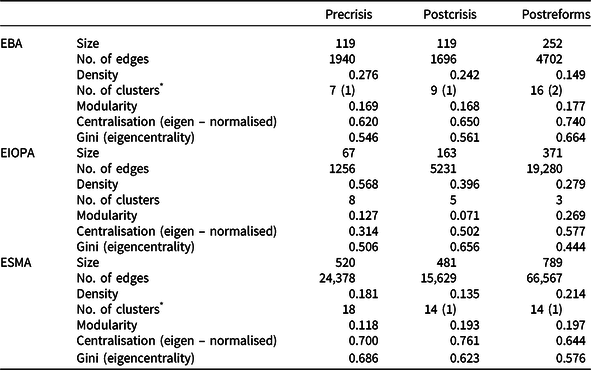
Table 2 provides an overview of the measurements as discussed above and lists them per agency per time period. For every measurement, I compare the precrisis networks with those of the postcrisis and postreforms. Consequently, one can assess how and to what extent the policy network of financial regulation transforms in the short- and long-term.
Network-level properties per agency per period
* Clusters consisting of a single actor in parentheses.
To assess the change in size of the network (E1), I consider the total number of actors in the network and the number of edges between actors before and after the crisis. In general, all three lobbying networks increase in size, either in the short- or long-term. This increase is also clearly visualised in Appendix C. One sees that most networks expand: more interest groups participate in the ESA’s consultations, and do so more frequently (thus increasing the connections between the different nodes). The expanding networks reflect the notion that shocks disrupt networks and induce a wider participation of interested stakeholders (Baumgartner and Jones Reference Baumgartner and Jones1991; Richardson Reference Richardson2000).
Following the literature, I expect that as the networks expand, the interconnectedness of actors within the network decreases (E2). Measuring network density for each of the agencies and time periods, I find that density decreases for both EBA and EIOPA.Footnote 3 These findings reflect the reasoning that the precrisis network consisting of a limited number of stakeholders can be disrupted by the growing participation of new interest groups (Heclo Reference Heclo and King1978). These results show that although more interest groups participate in the consultations, they do so on a more selective basis. Instead of participating in every single consultation, groups strategically choose which consultation is worth their time and resources. As a result, groups become less interconnected with one another. The interconnections in ESMA’s lobbying network remain more or less the same (a slight increase of the density with 0.03). Although this contradicts Expectation 2, it should be seen in the light of an already low interconnectedness of ESMA’s precrisis network. Logically, networks have a minimal interconnectedness – if none of the nodes were connected there would be no network; there are always groups that participate in at least one consultation. The lower the interconnection of a network, the lower the potential to further decrease network density. As a result, the potential for EBA’s and EIOPA’s networks to become less interconnected is, because of their higher density in the precrisis era, greater than for ESMA’s networks.
Next, we turn to balkanisation of the lobbying networks measured by modularity (E3). First, one sees variation in the number of clusters that the Walktrap-algorithm identified in the lobbying networks. For both EIOPA and ESMA, the number of clusters decrease after the crisis (also see Appendix C). For EBAs network, on the contrary, the number of communities increases. Besides the number of clusters present in the networks, Table 2 also reports the networks’ modularity. In all three networks, modularity increases over time. Particularly interesting is the increase in modularity in the long term: it seems that not the crisis, but rather the reforms increase modularity of the network. This can be explained by the introduction of new regulation. The newly introduced regulatory packages (e.g. Solvency II, MiFID II, and Single Rulebook for banking) consist of smaller subissues which are being discussed in separate consultations. Hence, these results show that interest groups cluster around a set of consultations concerned with one of the subissues, rather than participating in every organised consultation. This clustering also reflects the networks’ transformation from one tightly knit “club” to a more pluralised set of subnetworks revolving around different subissues (Heclo Reference Heclo and King1978; Richardson Reference Richardson2000).
Turning to Expectation 4, I focus on the changes in centralisation. Table 2 reports the normalised eigen centralisation scores and the Gini-coefficient for each of the constructed networks. Looking at the centralisation scores, one notices that EBA’s and EIOPA’s network become more centralised over time. In both cases, the findings show that as the network increases in size, the centralisation of the network also increases. ESMA’s networks also become more centralised after the financial crisis but become less centralised after the reforms. Turning to the Gini coefficients, one sees that the distribution of the centrality scores becomes more equal over time in the case of ESMA.Footnote 4 This implies that the core-periphery structure in ESMA’s network becomes less distinct. This is also the case EIOPA after the reforms: the Gini coefficient decreases over time thus signalling that the core-periphery structure becomes less distinct. The core-periphery structure of EBA’s network, on the contrary, becomes more distinct in the short and long term.
Although these results show that the core-periphery structure is disrupted after the crisis, there is profound variation between the agencies. This variation suggests that the impact of the crisis affects interest group participation in public consultations in different ways. A reason for this variation lies within the policy subfields the respective agencies are operating in. For example, EIOPAs consultations are concerned with issues (pensions) that are essential for both business groups (e.g. pension funds, pension investors) and for nonbusiness groups (e.g. pensioners). Contrarily, ESMAs consultations are mainly concerned with regulating financial markets, and hence are likely to mainly attract business actors (e.g. private investors, financial markets, hedge funds, and quoted companies). Consequently, ESMAs network is less likely to be disrupted by new interest groups with alternative views on policy as consultations will largely remain focused on issues important for business actors. Hence, ESMAs network may be more resilient to shocks, such as the financial crisis. This shows that varying policies in different fields might moderate the impact of shocks on networks.
Table 3 summarises the findings and indicates whether the expected increase or decrease occurred in the short- or long-term. Comparing the precrisis networks’ size, interconnectedness, balkanisation, and centrality with that of the networks after the crisis and reforms, one sees that as the networks increase in size (E1) they all become more balkanized (E3). For EBA’s and ESMA’s networks, the increased balkanisation occurs after the crisis, for EIOPA’s networks, the increase only happens on the long term, after the institutional reforms. This shows that both the crisis and subsequent regulatory reforms indeed disrupt once stable networks by attracting (repeated) participation of new interest groups. The growing balkanisation reflects that interest groups are more selective in participating in consultations. Rather than participating in every consultation an agency organises, interest groups participate in a set of consultations concerning a subissue. Furthermore, the once highly connected networks of EBA and EIOPA become less interconnected on the short term. In other words, whereas before the crisis a select number of groups continuously participate in consultations, after the crisis, new groups enter the arena and repeat players are more selective in which consultations to participate. This does not apply for ESMA’s network, which interconnectedness was already weak in the precrisis period. Logically, a more cohesive network is more likely to be affected by shocks than already loosely connected issue networks. This shows that a shock in a network at t1 is likely to be moderated by the characteristics of the network at t0.
Overview of results

* Increase or decrease occurs only in the long term after the institutional and regulatory reforms.
Also the findings concerning centralisation (H4) point into different directions. On the one hand, the networks become more centralised both in the short- and long-term, as shown by EBA and EIOPA. On the other hand, ESMA’s networks become less centralised over time. Although ESMA’s network becomes more centralised on the short term, they become less centralised after the reforms on the long term. These findings are even further complicated by the variation in the (in)equality between interest groups. EIOPA’s and ESMA’s networks become more equal, meaning that the networks have a less distinctive core-periphery structure over time. This does not apply to EBA’s network, however, which becomes more unequal, and thus has a more distinctive core. One can therefore conclude that although the financial crisis affects the actors’ centrality, the effects differ for the different networks. These mixed results largely resemble results reported by Ackland and Halpin (Reference Ackland and Halpin2019) who found that an increase of absolute numbers could correspond with a decreasing relative percentage of central players over time. As centrality concerns the position of individual interest groups, an explanation for these mixed results could be that different types of interest groups become more or less central over time. In fact, it could be that shocks affect different types of groups in different ways, explaining why both analyses resulted in ambiguous findings.
Conclusion
There is a general consensus within current scholarship that policy networks are characterised by stability in membership and organisation, only to be disrupted by shocks (Baumgartner and Jones Reference Baumgartner and Jones1993; Baumgartner et al. Reference Baumgartner, Berry, Hojnacki, Leech and Kimball2009). Although we know that shocks can transform policy networks, it remains largely unknown how and to what extent these networks change. This research provides a systematic analysis of how a shock, namely the global financial crisis and subsequent policy reforms, affects policy networks. It does so by constructing networks using data on interest group participation in public consultations organised by three EU regulatory agencies in three time periods. More specifically, the analysis compares the networks’ size, interconnectedness, balkanisation, and centrality over time.
First, the findings show that although the crisis might not have drastically changed diversity of participating interest groups (see Chalmers Reference Chalmers2015; Redert Reference Redert2020), it did shape the structure of underlying lobbying networks. As such, it poses an important nuance to existing ecology studies (Chalmers Reference Chalmers2015; Pagliari and Young Reference Pagliari and Young2015; Redert Reference Redert2020). The findings confirm theoretical notions of how shocks can change the image of a certain policy field and induce participation of new interest groups. Consequently, the once stable and club-like networks are disrupted and transform into networks with alternating membership (Heclo Reference Heclo and King1978; Baumgartner and Jones Reference Baumgartner and Jones1991, Reference Baumgartner and Jones1993; Baumgartner et al. Reference Baumgartner, Berry, Hojnacki, Leech and Kimball2009). More specifically, the findings suggest that the networks surrounding EU financial regulation become less club-like over time. They demonstrate that the networks not only become bigger but also more balkanised and, in the case of EBA and EIOPA, less interconnected. This demonstrates that shocks – such as crisis or institutional reforms – stimulate the entrance of new interest groups and made repeat players more selective in their lobbying efforts. This has important implications for the policy field of financial regulation as disrupted networks may result in with policy changes. As discussed, tight policy communities consisting of a few powerful (economic) interests can dictate and sustain existing policy agendas (Baumgartner and Jones Reference Baumgartner and Jones1991). This was the case for financial regulation before the crisis, where the financial sector successfully lobbied for self-regulation and loose oversight (Mügge Reference Mügge2006). The new interest groups entering the arena are likely to bring different values, policy frames, and demands to the negotiating table, which may result in drastic policy change (Richardson Reference Richardson2000). Thus, the mobilisation of new interest groups could counter the financial sector’s lobby for self-regulation by supplying different policy demands to the ESAs. Ultimately, this could constrain or even prevent regulatory capture of EU agencies by the financial sector.
Second, the findings suggest that even though networks are disrupted, there is variation in how the networks transform. The results suggest that both network characteristics and policy field characteristics are likely to moderate the effect of shocks on networks. This raises an important implication for our current understanding of stability and change in networks. Now that we know how and to what extent networks are disrupted after the financial crisis, future analyses would benefit from more advanced network-analytical analyses, which statistically explain and compare the observed changes in policy networks. The descriptive comparison of the three networks fitted the aim of this research, which was to empirically compare networks before and after exogenous shocks. To be able to compare these networks in greater detail (and to determine what factors explain changes in policy networks) one needs to seek out more sophisticated network-methods, such as exponential random graph modelling (ERGM). ERGM allows to analyse in greater detail which changes in the networks’ structures are the product of random processes, and which changes are the result of changing participation of interest groups.
Of course, the networks studied in this research focus on a mere portion of interest group activity, namely participation in consultations concerning one specific policy field. The lobbying networks based on consultation data provide an observable estimation of how the bigger policy networks transform. However, these data are also limited as interest group activity could easily have shifted from public consultations to less visible lobbying efforts, such as informal contacts with regulators. Evidence stemming from interviews with interest group representatives substantiates that regulators and financial sector groups are still collaborating and regularly sharing ideas via informal ways. Of course, these informal networks might paint a different picture than a network constructed on the basis of consultation data.
Moreover, the analysis conducted for this article did not identify which actors become more or less central. Although the observations suggest that the networks become less club-like, the analysis presented here did not find unambiguous evidence that core players became less central after the two shocks. However, it is highly likely that the shock of the financial crisis affects (types of) groups differently, thus affecting their centrality in the network. One might expect, for example, that NGOs such as BetterFinance or FinanceWatch will become more central actors over time, while financial sector groups, such as national banking associations, will occupy a less central position in the future network. Hence, follow-up research should examine to what extent and why the positions of individual interest groups in the network change after shocks.
Supplementary material
To view supplementary material for this article, please visit https://doi.org/10.1017/S0143814X21000283.
Acknowledgements
The author would like to thank Peter Bursens, Jan Beyers, and the three anonymous reviewers for their valuable comments and constructive suggestions.
Data availability statement
Replication materials are available at https://doi.org/10.7910/DVN/8OU1JI.
Funding information
This project has received funding from the European Union’s Framework Programme for Research and Innovation Horizon 2020 under the Marie Skłodowska-Curie Grant Agreement No. 722581.


 Open access

