


Context
Gender in Society
In 2020, the United States (US) population was estimated to be 331 million people, of which 51.1% were women. (1) Although most Americans (72%) are white, the race and ethnicity of the US population is diversifying. The 2010 Census revealed the following racial demographics: 12.8% reported being Black; 5.7% Asian; 0.9% American Indian; 0.2% Native Hawaiian; 3.4% multiracial; and 18.4% Hispanic. (2) The modern role of women in the workforce first dramatically changed in the 1920s with two major events: new employment during World War I and the ratification of the Nineteenth Amendment to the US Constitution granting women the right to vote. (Reference Jones3; Reference Carnes, Morrissey and Geller4) Subsequently, social and cultural changes in the 1960s and 1970s prompted legal protections for women in education and the workplace, (Reference Carnes, Morrissey and Geller4) with women increasingly allowed to obtain post-secondary education. By 2018, women comprised 57% of college students and students, 49.5% of medical students, and 46.8% of the workforce. (5)
Cultural stereotypes continue to characterize women as ‘communal’ (e.g. kind, dependent, nurturing) while men are characterized as ‘agentic’ (e.g. logical, independent, strong). (Reference Heilman and Okimoto6) These stereotypes disadvantage women (and men) in domains such as science, medicine, and leadership, as competence can be viewed as a violation of a gender role. (Reference Carnes, Morrissey and Geller4; Reference Ashton-James, Tybur, Grießer and Costa7) Despite increased representation, women continue to be underrepresented in traditionally male-dominated professions, comprising 21.3% of protective service employees, 15.1% of architects and engineers, and 5% of CEO positions in S&P500 companies. Conversely, women remain clustered into ‘pink collar’ jobs, constituting 87.6% of health care support occupations, 94.5% of secretary and administrative assistant positions, and 95% of teaching assistants, kindergarten and elementary school teachers. (Reference Berdahl, Cooper, Glick, Livingston and Williams5) Occupational segregation, largely stemming from a continued cultural devaluation of work performed by women, contributes to a persistent gender wage gap. To enumerate, on average, women in the US earn 81.6% of what men earn, with the gap widening to 75% with increasing levels of education. (Reference Leisenring8) More concerning, gender-based discrimination, including sexual harassment, is reported by 50% of women in the US workforce, with few reporting the abuse to an authority. (Reference Das9) In 2017, the #MeToo movement brought awareness to sexual violence against women by advocating for survivors and encouraging them to speak out about their experiences. TIME’s UP Now, which had several industry-focused initiatives including TIME’s UP Healthcare, followed by bringing awareness of sexual harassment and discrimination in the workplace. TIME’s UP Foundation has expanded their mission to advocate for safe, fair, and dignified work for all women of all kinds, creating a society free of gender-based discrimination in the workplace and beyond. (Reference Kearl10; Reference O’Neil, Sojo, Fileborn, Scovelle and Milner11)
Infographic United States of America. Infographics were provided by CartoGIS Services, The Australian National University. Population: from World Bank https://databank.worldbank.org/source/population-estimates-and-projections. Sustainable Development Progress, global ranking and statistics on women in the workplace, women in management and intimate partner violence: from United Nations SDGs Data Portal https://unstats.un.org/sdgs/dataportal. Female doctor percentage: from Global health workforce statistics www.who.int/data/gho/data/themes/topics/health-workforce. Legislation and law statements: from the World Bank gender data portal 2023 https://genderdata.worldbank.org/en/indicators. Maternal mortality statistics: from the Global Health Observatory 2020 https://mmr2020.srhr.org. Infant mortality statistics: from United Nations International Children’s Fund (UNICEF) https://data.unicef.org/topic/child-survival/under-five-mortality.
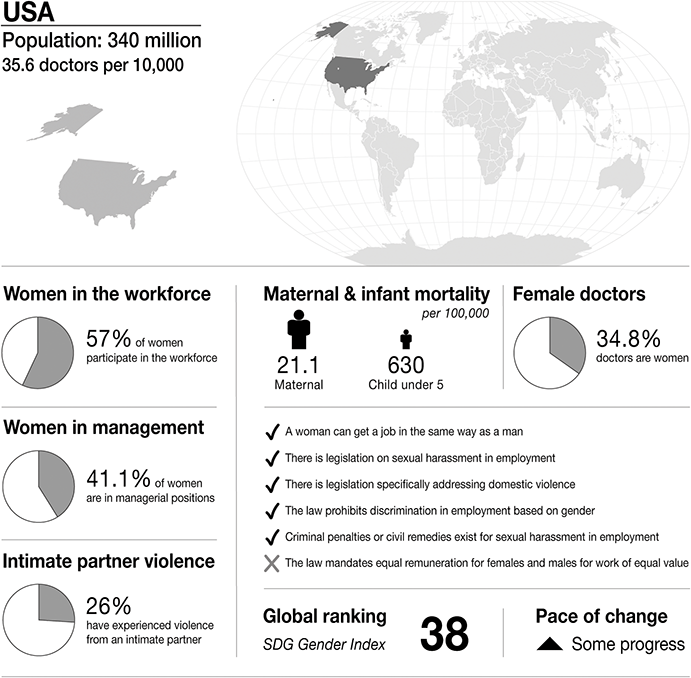
Figure 29.1 Long description
The infographic provides information about the United States, with a population of 340 million and 35.6 doctors per 10,000 people. It highlights several gender-related statistics. 57 per cent of women participate in the workforce. 41.1 per cent of women are in managerial positions. 26 per cent of women have experienced intimate partner violence. Maternal mortality is 21.1 per 100,000. Infant mortality under 5 is 630 per 100,000. 34.8 per cent of doctors are women.
The infographic lists the presence or absence of law and policy on gender equality. In the United States:
– a woman can get a job in the same way as a man.
– there is legislation on sexual harassment in employment.
– there is legislation specifically addressing domestic violence.
– the law prohibits discrimination in employment based on gender.
– criminal penalties or civil remedies exist for sexual harassment in employment.
– there is no law mandating equal remuneration for females and males for work of equal value.
The S D G Gender Index global ranking is 38, and there has been some progress
Gender in Medicine
The Women’s Health and Feminist Movements of the 1960s and 1970s served as an inflection point for US women to embark on careers in medicine. (Reference Carnes, Morrissey and Geller4) With admissions restrictions removed by laws enacted at the end of this cultural movement, a surge of women graduating from medical school was observed, with 20,000 women matriculating from 1970 to 1980, compared to 14,000 from 1930 to 1970. (Reference Braslow and Heins12) By 2003, women in the US applied to, entered and graduated from medical school at similar rates as men. However, the percentage of full-time women faculty that identify as underrepresented by race or ethnicity (URiM) has been essentially unchanged from 12% in 2009 to 13% in 2018. (Reference Lautenberger and Dandar13) This is particularly true for most surgical specialties in the US, which remain predominantly occupied by men. In 2017, 20.6% of general surgeons in the US were women, (Reference Aziz, DuCoin, Welsh, Paramo, Andreone, Butsch, Smith, Pories and Baxter14) with Black women surgeons representing just 1% of the academic surgical workforce. (Reference Berry, Khabele, Johnson-Mann, Henry-Tillman, Joseph and Turner15; Reference Aggarwal, Rosen, Nehemiah, Maina, Kelz, Aarons and Roberts16)
Increased representation of women physicians has not correlated with workplace equity. Although the overall percentage of full-time women faculty in US medical schools continues to rise, the majority of women faculty held the rank of instructor. (Reference Lautenberger and Dandar13) Moreover, there has been no narrowing of the gender gap over time. Women physicians employed by academic centers are less likely than men to be promoted or appointed department chair. (Reference Richter, Clark, Wick, Cruvinel, Durham and Shaw17) Women physicians face a persistent wage gap that cannot be explained by hours worked, skill or experience. (Reference Jena, Khullar, Ho, Olenski and Blumenthal18) Furthermore, women physicians perceive gender-based discrimination 2.5 times more frequently than men, with reported rates of sexual harassment as high as 80%. (Reference Stephens, Heisler, Temkin and Miller19–Reference Heisler, Stephens, Temkin and Miller21) The structural acceptance of these abusive behaviors adversely impacts physicians, surgeons, and patients and contributes to burnout and voluntary and involuntary departure from the medical profession. (Reference Aggarwal, Rosen, Nehemiah, Maina, Kelz, Aarons and Roberts16; Reference Nunez-Smith, Pilgrim, Wynia, Desai, Bright, Krumholz and Bradley22; Reference Linzer and Harwood23) Tragically, 40% of women reduce their hours to part-time or leave medicine entirely within six years of finishing training. (Reference Paturel24) With this percentage of attrition and reduction in the workforce (see figure 29.2), Government and Academic Medical Centers, and the health care system as a whole must start viewing attrition as a sentinel event that has the potential to threaten public health and safety. (Reference Lautenberger and Dandar13)
Seven-year promotion outcomes for US full-time academic faculty, 2008–2009.
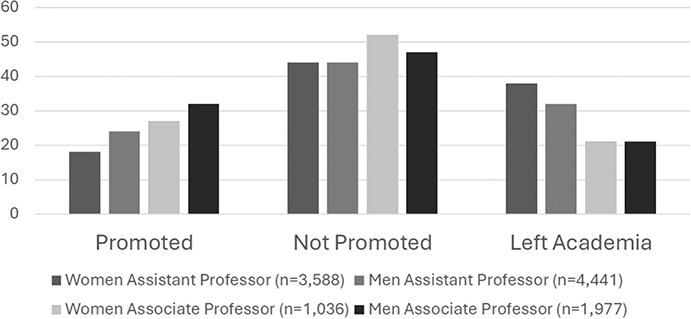
Figure 29.2 Long description
The horizontal axis represents promoted, not promoted, and left academic. The vertical axis ranges from 0 to 60 in increments of 10. The graph shows the following approximate data for: women assistant professor, n equals 3,588; men assistant professor, n equals 4,441; women associate professor, n equals 1,036; and men associate professor, n equals 1,977; respectively. 1. Promoted: 19, 24, 27, 32. 2. Not promoted: 44, 44, 52, 47. 3. Left academia: 39, 31.5, 21, 21.
Medical Education
To become a physician in the US, an undergraduate degree is obtained (usually four years), followed by a medical degree (four years). The cost of attending medical school has risen substantially, with the average debt incurred by medical school graduates reaching $200,000. The financial barrier to becoming a physician disproportionately impacts women, URiM and students from low socioeconomic backgrounds. (Reference Millo, Ho and Ubel25)
Training following medical school varies by specialty, ranging from three years to well over ten years. A ‘match’ system is employed to fill available training programs, in which a medical student interviews at various training programs and then ranks programs in order of preference. Lists from all medical students are compiled with corresponding lists from each training program, and a computerized algorithm determines where each medical student will complete post-graduate training. This legally binding process commits trainees to attending their assigned program. Once a residency has been completed in a specialty, some will pursue one or more fellowships, depending on the specific subspecialty or niche desired. The body that regulates all clinical residencies and fellowships in the US is the ACGME (Accreditation Council for Graduate Medical Education). A Residency Review Committee oversees the evaluation and accreditation of training programs within each specialty. Once accepted to residency or fellowship, physicians are employed and supported by federal funds designated to support physician education. (Reference DeZee, Artino, Elnicki, Hemmer and Durning26)
Historically, medicine and medical education have been very hierarchical, making those lower in hierarchy vulnerable to various types of mistreatment. Not only is this a hierarchy of authority, but while in training the trainee is reliant on those above them for professional opportunities, whether those be clinical, research, or leadership, as well as certification of competency and future employment opportunities.
Law
Two primary laws govern health care workplace sexual harassment in the US: Title VII of the Civil Rights Act, (27) originally passed in 1964, protects employees from discrimination based on race, color, religion, sex, and national origin; and Title IX of the Education Amendments Act, (28) passed in 1972, makes it illegal to discriminate on the basis of sex within educational programs or activities. Title IX applies to health care workers employed by entities that receive federal funding, like medical schools. In contrast, Title VII covers employment in any sector, including health care, and would cover health care workers employed by hospitals or other health care facilities. (Reference Silver and Sinha29)
This distinction is important, as medical students and physicians (interns, residents, fellows, and attendings) may fit both descriptors. Depending on the setting, their employer may be a medical school, a medical school teaching hospital, a hospital, or a combination of these. In the US, federal appellate courts have reached different decisions regarding whether Title VII or Title IX applies in these situations (known as a ‘circuit split’), meaning that the law is interpreted differently depending on locale. (Reference Diekman and Sinha30) A variety of state laws have emerged as a consequence of the #MeToo movement, (Reference Christiansen31) but these laws are limited in both scope and consequence as compared to the federal statutes. For instance, Title VII requires that harassing activity be ‘severe and pervasive’; some new state laws have lowered this high bar to include even a single instance of harassment, but the impact of these state laws remains unknown. That said, the uncertainty as to which federal law (Title VII or Title IX) protects health care workers who have experienced workplace sexual harassment is an issue only the US Supreme Court or the US Congress can resolve. Until that happens, clearer guidance is needed from the US Department of Labor’s Equal Employment Opportunity Commission (Title VII) and the US Department of Education’s Office of Civil Rights (Title IX), respectively.
Medical Regulation
Sexual misconduct in academic medicine is prevalent. A 2018 report of the National Academies of Sciences, Engineering, and Medicine (NASEM), entitled ‘Sexual harassment of women: climate, culture, and consequences in academic sciences, engineering, and medicine’, found that 45% of women in medicine experienced gender harassment before completing medical school and more than 50% of women faculty and staff have experienced gender harassment during employment. This rate for medical students is higher than for science or engineering students. (32)
In a study of early-investigator awardees, approximately 30% of women academic medical faculty in the US reported sexual harassment; among those reporting sexual harassment, 59% reported that it negatively impacted their professional confidence and 47% reported that it negatively impacted opportunities for career advancement. (Reference Jagsi, Griffith, Jones, Perumalswami, Ubel and Stewart33) Rates are even higher in some sub-specialties, as 67% of women vascular surgeons reported sexual harassment; only 7% of these incidents were reported to supervisors. (Reference Smeds and Aulivola34) Barriers to reporting, including fear of reprisal and retaliation, have been well-documented. (Reference Smeds and Aulivola34; Reference Binder, Garcia, Johnson and Fuentes-Afflick35)
Despite a high prevalence of sexual misconduct and significant negative outcomes for physicians and surgeons, most research on physician sexual misconduct focuses on acts against patients rather than between colleagues. (Reference AbuDagga, Carome and Wolfe36–Reference Gulrajani39) US state medical licensure boards and the Federation of State Medical Boards (FSMB) have the authority to investigate and discipline physicians who commit sexual misconduct by restricting, suspending, or revoking licensure to practice; (40) however, physician-on-physician sexual harassment is often investigated as a workplace misconduct issue. Furthermore, health care organizations have flexibility in reporting physicians accused of sexual misconduct to medical boards. (Reference AbuDagga, Carome and Wolfe36) Consequently, few academic medical faculty or physicians who are accused of sexual misconduct are sanctioned by medical boards. (Reference Espinoza and Hsiehchen41; Reference Liu and Hyman42) For example, an analysis of sexual misconduct-related reports indexed in the National Practitioner Data Bank from 2003 to 2013 revealed that a small number of physicians (N=1,039) were reported during that time period, and 70% of those reported were not disciplined by a medical board. (Reference AbuDagga, Wolfe, Carome and Oshel43) In the US, peers may be involved in reporting sexual misconduct but are rarely involved in disciplinary processes for physicians accused of sexual misconduct. Some US professional societies (e.g. American Association for the Advancement of Science) have created new policies and procedures for addressing sexual misconduct among their members, with those who violate these policies subject to removal from annual meetings and bans from attending future meetings. (Reference Bates, Jagsi, Gordon, Travis, Chatterjee and Gillis44) However, few professional societies provide publicly available statements or policies pertaining specifically to gender. (Reference Heisler, Miller, Stephens, Ton and Temkin45) Actions of individual organizations are unlikely to prompt significant, widespread change. To this end, recent publications emphasize a need for large-scale organizational and institutional change, (Reference Heisler, Miller, Stephens, Ton and Temkin45; Reference Fairchild, Holyfield and Byington46) as well as grass roots efforts to enforce codes of conduct, education, and training within academic institutions, health systems, professional societies, and private practices. (Reference von Gruenigen and Karlan47)
Case Study
This case is a first-person account by Dr Christine Heisler. ‘Dr Jarma’ is a pseudonym.
Prelude
As an intern covering minor surgical cases under direct supervision of my attending physician, I was fairly insulated from the egotistical behavior of this anesthesiologist. The stories and warnings from senior residents, nurses, scrub technologists and those same attendings were that he was difficult and could be hard on people. In truth, he was arrogant, condescending and rude. My encounters with him became more frequent and more inappropriate as I became more independent through residency and received a more substantial surgical caseload. He leaned into the power differential without overtly crossing a line into harassment. These interactions were not rare, nor specific to me. Rather, they were illustrative of an oppressor allowed to bully and intimidate anyone to maintain perception of power and an ineffectual organization that permitted it, unfettered.
After completing fellowship, I returned to my former residency program – now as an attending surgeon employed by a health care system. I would have the opportunity to train the residents in my surgical sub-specialty and to build the division which I now led. I was excited to work among the very talented attending surgeons who had trained me years ago. The only concern was that he was still there. As a member of the contracted group of anesthesiologists, this narcissist continued to reign the operating room (OR) suites, infecting the space with his arrogance and derision. His menacing presence continued without a specific direct incident. He was allowed to embed negativity throughout the surgical space without reprimand or consequence.
Assault
I had a major surgical case scheduled to start at 0730. I went to meet the patient in the pre-operative area, and he was behind a curtain talking with her and her family. He peered in my direction, informing me that he was talking with her and needed more time. I acknowledged his request, shut the curtain and stood by, waiting for my turn to talk with our patient. As his conversation turned from relevant medical history to social conversation and laughter, I again opened the curtain to signal I was ready to talk with the patient. He snapped at me, saying that he wasn’t done talking. I explained that I still needed time to talk with the patient before we proceeded to the OR, and he sharply and condescendingly replied that he would be done soon. I closed the curtain and stepped back a few feet. He finally emerged from the room and walked past me, indifferent. I met with the patient and her family to review our plan for surgery, the process of recovery and when she would see her family again.
I knew I needed to address the interaction in order to resolve the conflict. I approached him and asked to speak with him. I acknowledged the importance of his time to meet the patient and review the anesthesia plan for surgery, and noted that I did not appreciate his aggressive response nor his dismissive attitude about my time with the patient. He replied with a sharp tone that he was meeting the patient and developing a rapport with her and her family; my entering the space was disruptive to his time with her. I noted that his socializing with the patient continued, even after I specifically expressed my need to speak with her. I did not appreciate his blatant disregard of my time, nor his behavior in front of my patient, which was hostile and unprofessional. He rolled his eyes and told me to ‘Just calm down’. He reached behind me, patted me on the buttock and squeezed as he walked past me.
My instinct was to yell out or physically fight back at him for what he did to me. Instantaneously, I was reminded of my environment and my need to maintain professionalism, to control my emotions and my response. I was humiliated and embarrassed, left wondering if anyone saw this interaction or his action; yet I maintained integrity and continued on with the responsibilities that lay ahead.
In those subsequent few minutes as the patient was being wheeled from the pre-operative holding area to the OR, my mind was racing with the prior events. Eventually, I was in the OR with the team attempting to regain my focus on the case, but as my patient was prepped and draped, the harassment persisted. This anesthesiologist stood up behind the drapes, watching the surgical steps, and proceeded to comment on the case with nit-picking, criticism, condemnation, ridicule, and biting sarcasm. It was a totally inappropriate barrage of unnecessary negativity that did nothing but distract. My attempts to politely redirect him were futile. Finally, I sternly looked at him and requested that he stop his unprofessional behavior in front of the OR team. He then recoiled to his chair.
Limbo
I had no intention of reporting him. He was a prominent anesthesiologist in the institution and his reputation, though extremely despicable and reprehensible, was ingrained in the fabric of the OR and accepted by the institutional leadership.
I spoke with a male colleague later that day: ‘You won’t believe what happened to me …’ I blurted out the entire story. This colleague, a trusted confidant, was horrified to hear how I had been treated and unsurprisingly, immediately guessed the identity of the perpetrator. My colleague was unrelenting and said, ‘You have to report this. Dr Jarma crossed a line. He assaulted you!’ I explained that it wouldn’t matter. Nobody would believe me. It would be his word against mine. He offered to report on my behalf, to be my voice. I reluctantly agreed to allow him to report the event.
Shortly thereafter, I was called to a meeting with Human Resources, my department chair and two members of the Medical Staff Office. They requested details of the allegation, which I provided. Two profoundly imperative themes emerged from that meeting.
First, I was told that I had handled the situation incorrectly. I created a safety concern for my patient and my team by proceeding to the OR. I should have requested another anesthesiologist so I could focus on my job without additional distraction. Though there was no process available to guide me in this circumstance and the means of requesting another anesthesiologist would have resulted in questions and delay, my experience of being sexually harassed was distorted to imply that I was in the wrong by continuing with the case. In essence, I was potentially endangering my patient, my team, and my organization by doing the job: performing the scheduled operation. It was irrelevant that I had been sexually assaulted by a key member of the team.
More importantly, Dr Jarma was protected under the guise of ‘due process’. He would be allowed to work while they met with him and additional staff. As a physician, he shouldn’t suffer financial penalty just because I alleged inappropriate behavior. He would be treated fairly. In order to protect me, however, I was provided the option of paid leave. This would ensure I would not experience further interactions with him.
Exposure
I was bullied through the ongoing investigation process after the sexual harassment, which caused additional distress. Once, I was confronted by the Human Resources representative, who openly discussed my case in a busy cafeteria. She desired to update me as to the status of the investigation – Dr Jarma is aware, of course, and cooperating fully. Her attempt at timeliness was usurped by the lack of confidentiality. Worse, the rationale for this impromptu meeting was a request that I provide my story in writing.
While the investigation only took a few weeks, time seemed to stand still for me, as I was continually reminded of Dr Jarma’s presence. He was instructed to avoid direct contact or conversations with me, with which he complied. However, he was everywhere – the recovery room, the surgeon’s lounge, the hallways, and outside other operating rooms. He demonstrated complete lack of regard for my discomfort, and in fact seemed to revel in the awareness that he was abiding by the rules without being constrained by them.
At the final meeting with the investigation team, I was informed that, despite this assault occurring in a populated place during the busiest time of day, nobody could corroborate my claim. However, they learned through staff interviews that Dr Jarma had a pattern of unprofessional behavior including sexual harassment that violated organizational standards and was unlawful. As a result, the anesthesia group and hospital leadership agreed to reassign Dr Jarma to another hospital where he already worked, but now on a full-time basis. The final decision did not include any sort of serious punishment: revocation of hospital privileges, termination, suspension of medical licensure, or legal action.
Removing him from the OR environment resulted in excessive gossip occurring around me. ‘Did you hear what happened to Dr Jarma?’ ‘Yeah, I heard he was just being himself and it upset a sensitive surgeon.’ Occasionally, I was confronted with direct questions like ‘Did something happen between Dr Jarma and you?’ ‘Are you really the reason Dr Jarma was reassigned?’ ‘Are you doing okay? I heard about Dr Jarma and you.’ I maintained a professional demeanor and politely played dumb, or deflected the questions, acknowledging that these conversations were inappropriate, regardless of whomever they involved. Though the outcome removed this perpetrator from my hospital, he was allowed to work in another environment, thereby subjecting others to his abusive behavior. I didn’t feel like the outcome was satisfactory. I wanted to disclose everything – the indignities, the hostility, the abuse. This anesthesiologist sexually assaulted me in public in the presence of witnesses but was protected by this institution and allowed to maintain his professional standing and financial security. On the other hand, I suffered from threats, ridicule, disbelief, exposure, antagonizing behavior and revictimization.
Aftermath
Ideally, this sexual assault would have ended with vindication and institutional support; however, that was not the case. Eventually, I resigned from that health care institution; this incident and the institutional culture were the basis of my resignation. The resentment I carried from that situation, and how it was handled by hospital administration, still lingers, though it does lessen with the passage of time.
This experience is unfortunately not unique to attending surgeons, nor is it situationally rooted in one health care system. Through my educational and other leadership roles, I continue to help others navigate these emotional, professionally challenging, and unlawful situations. I have the great fortune to have developed a network of strong women colleagues that are similarly focused on creating an equitable, safe and dignified workplace environment for everyone in health care. Through our collaboration and collective passion for this cause, we strive to make this the new culture in medicine and surgery for future clinicians.
Discussion
For nearly twenty years, men and women have entered and graduated from US medical schools at equal rates. (Reference Lautenberger and Dandar13) In 2015, more than one-third of the physician workforce and nearly half of all physicians-in-training were women. (Reference Butkus, Serchen, Moyer, Bornstein and Hingle48) Although progress has been made towards gender diversity in the physician workforce, disparities related to gender remain widespread.
‘Gender roles’ that define traditionally male-typed traits and behaviors are termed ‘agentic’ because they involve human agency, while traditionally female-typed traits and behaviors are termed ‘communal’. (Reference Eagly49) A workplace environment that permits bias based upon presumed ‘gender roles’ is one where gender-based discrimination and sexual harassment is tolerated. (32) Many agentic actions, such as making decisions quickly and leading a team, are necessary for the effective practice of medicine. These practices and behaviors are acquired by women during medical training, particularly in surgical specialties. Yet the exhibition of ‘masculine’ behaviors and personality traits by women, including competence, can be perceived as a violation of gender roles, resulting in negative feedback and retaliation towards women physicians in the workplace. (Reference Heilman and Okimoto6; Reference Gabriel, Butts, Yuan, Rosen and Sliter50) Retaliation in the workplace is a form of unlawful discrimination. (51) As a result, women in medical school are more often directed towards communal specialties, such as family medicine, while men are directed towards more technical or procedural specialties, such as surgery. (Reference Salles, Awad, Goldin, Krus, Lee, Schwabe and Lai52; Reference Carnes, Bartels, Kaatz and Kolehmainen53) The surgical specialty of obstetrics and gynecology is one notable exception to this career-steering gender bias, yet in this specialty where 58% of the physicians are women, gender inequities persist. (Reference Heisler, Mark, Ton, Miller and Temkin54) Evidence supports the concept that feminization of a specialty is associated with declining status and wages. (Reference Heisler, Mark, Ton, Miller and Temkin54; Reference Pelley and Carnes55) Even when women enter higher status, higher paying specialties, they tend to be assigned lower status communal roles such as educators and providers of clinical care to women, relegating them to the lower end of the status and wage spectrum within the field. (Reference Carnes, Bartels, Kaatz and Kolehmainen53; Reference Pelley and Carnes55; 56)
Despite these well-described barriers to success for women in medicine, studies suggest that women may provide better clinical care in some settings, particularly for women patients. A large US database study demonstrated that hospitalized patients treated by women physicians had a relative risk reduction of 4% in mortality compared to patients cared for by men physicians. (Reference Tsugawa, Jena, Figueroa, Orav, Blumenthal and Jha57) Additionally, higher mortality was noted among women patients who are treated by men physicians following a heart attack. In the same study, however, this finding dissipated for men physicians with more exposure to women patients and women physicians. (Reference Greenwood, Carnahan and Huang58) In another study, patients operated on by women surgeons were found to have a 12% lower risk of death in the thirty-day postoperative period. (Reference Wallis, Ravi, Coburn, Nam, Detsky and Satkunasivam59) Unfortunately, these outcomes are often overlooked by both colleagues and patients. For example, women gynecologists have been shown to receive top patient satisfaction scores only half as often as men colleagues, owing to their gender alone. (Reference Rogo-Gupta, Haunschild, Altamirano, Maldonado and Fassiotto60)
While altruistic impulses lead individuals to pursue medicine, the workplace environment remains discriminatory towards women physicians. Multiple organizational factors lead to the tolerance of gender bias, discrimination and harassment in medicine, including minimal leadership training, power imbalances, a strict hierarchy, and a culture of silence. (Reference Pattani, Marquez, Dinyarian, Sharma, Bain, Moore and Straus61) A traditional, ‘masculine’ and hierarchical structure remains omnipresent. In hospital environments, fatigue and emotions are often at extremes and inhibitions can be lowered. Call rooms, empty spaces and late-night hours provide opportunity for sexual transgressions unlike that of any other profession.
Consistently high rates of discrimination and harassment of women physicians and trainees in medicine are reported. (32) An implacable misconception – that sexual harassment must involve sexual coercion or assault – allows the inequities faced by women in medicine to continue (32) because the burden of proof is too high. While egregious instances of forced attacks do occur, gender harassment represents a wider set of more common behaviors rooted in unconscious gender biases and assumptions that underpin the two-tiered work environment for doctors practicing medicine. Sexual harassment is better defined as a range of behaviors that devalue, demean or humiliate due to gender. (32)
Enforcement of gender discrimination and sexual harassment infringements within the medical profession and legal system is poor in the US. The number of years and financial burden required for training as a physician renders many women vulnerable to retaliation during their careers. Many health care institutions have opaque and outdated mechanisms for investigating claims of harassment. As result, reporting remains uncommon and satisfaction with the outcome of the process is low when incidents are disclosed. (Reference Nunez-Smith, Pilgrim, Wynia, Desai, Bright, Krumholz and Bradley22; Reference Smeds and Aulivola34; Reference Binder, Garcia, Johnson and Fuentes-Afflick35). In the US, legal claims of discrimination or harassment require the plaintiff to provide the burden of proof – the alleged perpetrator is ‘innocent until proven guilty’. This poses significant time and monetary barriers to filing a legal claim.
While women have achieved equity in medical school admissions, members of the profession must work together to create a workplace in which women physicians can thrive. Institutional entities must allocate a commensurate amount of financial and human resources to study and correct gender inequities, in order to mitigate the forecasted physician and surgeon US workforce shortages. Interventions to improve the workplace environment for women physicians must be structural and address the root causes of gender inequity. This is not only an ethical imperative, but critical to improving the delivery of care as diverse teams in health care provide more person-centered, high-quality care. (Reference Gomez and Bernet62)
The Harvard Business Review (Reference Myers and Sutcliffe66) summarized the impact of discrimination and harassment on the field of medicine, highlighting the impact on patient outcomes.
Allowing things to continue as they have for women in medicine is accepting a system where potentially higher quality care is denied to patients due to sexism and bad practices. In fact, the difference in patient mortality observed in male and female physicians is approximately the same magnitude as the difference in mortality that can be attributed to the last decade of scientific improvement in patient care. This means that excluding female physicians in the healthcare system sets our society back not only in gender equality but also in terms of the progress we should be making in medical care.
Widespread organizational transformation can be achieved. As a critical mass of women has been insufficient to change the culture, ‘critical actors’ – individuals who catalyse change in existing cultural systems – must be supported. (Reference Helitzer, Newbill, Cardinali, Morahan, Chang and Magrane63) The creation of a Gender Equity Task Force in a single institution recently provided proof of concept that a multifaceted approach to reducing gender-based discrimination is feasible. (Reference McKinley, Wang, Gartland, Westfal, Costantino and Schwartz64) Interventions included implicit bias testing for faculty and staff, professional messaging through clearly labelled badges, engagement with nursing leadership, improved reporting processes, transparency of policies, and training regarding discrimination. Equitable parental leave policies, applied to both parents, also help to shift norms overall to allow fathers and partners to take on truly equal participation in parenting while decreasing the stigma that women experience while taking leave. (Reference Stephens, Heisler, Temkin and Miller19) Additionally, term limits for the upper echelons of leadership can provide women opportunities in leadership, while inspiring a culture of supporting succession planning and mentorship. Evidence suggests that when such interventions are appropriately deployed, they are able to improve representation of women in leadership. (Reference Gharzai and Jagsi65)
Finally, the 2018 NASEM report on Sexual Harassment (32) made fifteen recommendations:
1. Create diverse, inclusive, and respectful environments
2. Address the most common form of sexual harassment: gender harassment
3. Move beyond legal compliance to address culture and climate
4. Improve transparency and accountability
5. Diffuse the hierarchical and dependent relationship between trainees and faculty
6. Provide support for the target
7. Strive for strong and diverse leadership
8. Measure progress
9. Incentivize change
10. Encourage involvement of professional societies and other organizations
11. Initiate legislative action
12. Address the failures to meaningfully enforce Title VII’s prohibition on sex discrimination
13. Increase federal agency action and collaboration
14. Conduct necessary research
15. Make the entire academic community responsible for reducing and preventing sexual harassment.
The US has been a leader for decades in providing cutting edge medical care and exporting health technology to the rest of the world. The #MeToo and TIME’s UP Health care movements have brought the prevalence and significance of sexual violence and assault against women to the forefront in society and within health care. The time is now for the American medical system to embrace gender equity for the benefit of its diverse workforce and to provide optimal patient care.

 Open access