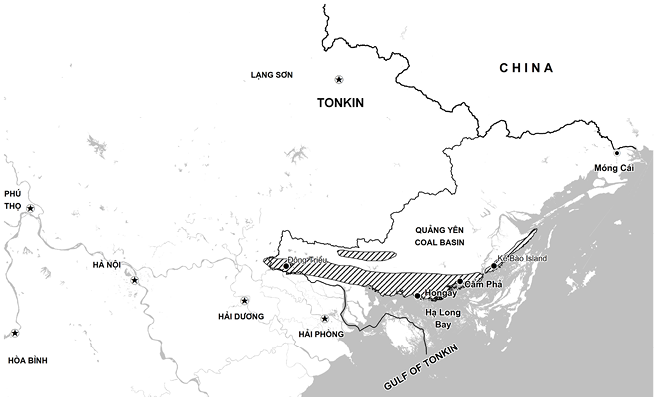


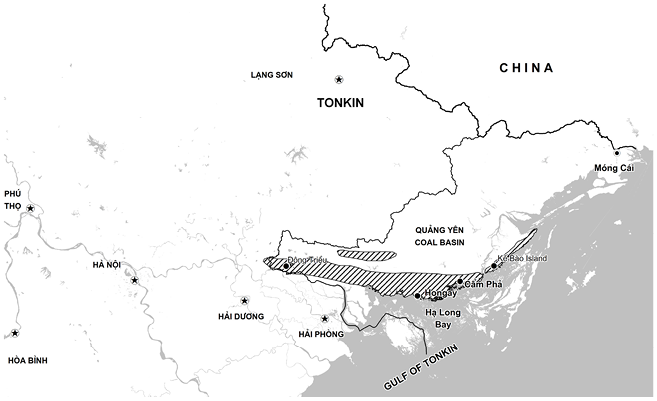
No other industry has had a more profound impact on the environment and the communities of northern Vietnam than coal mining. Before the twentieth century, coal had been excavated and consumed locally in Vietnam, but it did not exert much influence beyond its sites of extraction. In the 1880s, the French discovery of the voluminous and largely untapped Quảng Yên coal basin (Figure I.1) near the Sino-Vietnamese borderland set in motion subsequent developments that had far-reaching consequences for both the landscape and the surrounding communities. By the 1930s, Tonkin,Footnote 1 a small protectorate of the French empire in northern Vietnam, put its name on the global economic map by becoming the tenth largest exporter of coal in the world and the second largest in East Asia, with Manchuria holding the top ranking.Footnote 2 The mining frontier of northern Tonkin now became dotted with vast open pits, underground tunnels, and other industrial infrastructures such as railroads, electricity plants, and deep-water ports. The demography of this sparsely populated frontier also rapidly changed. In addition to European personnel, large-scale coal mining enterprises attracted tens of thousands of Chinese and Vietnamese migrant workers. Like the mining frontiers in many other parts of the world, the coal towns of Vàng Danh, Cẩm Phả, and Hongay also became refuges for vagabonds, opium dealers, petty criminals, prostitutes, bandits, rebels, and radicals.Footnote 3 Coal mining also denuded forests, left behind massive open-pit wastelands, polluted the air and water, and created some of Vietnam’s most troubling and enduring environmental problems.
Quảng Yên coal basin with the major coal mines of Hongay, Cẩm Phả, Đông Triều, and Kế Bào
This book explores how coal mining came to dominate the environmental, ethnic, and economic landscape of northern Vietnam, restructuring the region’s environment, creating conflicts, and upending communities. The book offers a regional, transnational, and environmental history of the coal frontier of northern Vietnam rather than an in-depth economic or labor study of the colonial mining industry and its enterprises. Starting with a precolonial history of how coal and other mining resources had been excavated and administered in Vietnam, the book then examines the expansion of large-scale coal mining through the formation of the colonial mining regime, the establishment of French-owned coal mining companies, and how the coal boom of the 1920s and 1930s transformed the environment of northern Vietnam and eventually led to intense conflicts over the use of natural resources such as land, water, and hard timber forests. Although the rise of coal mining in Vietnam has often been associated with the French economic presence, there had been a thriving mining economy across the Chinese-Vietnamese borderland, one that operated on kinship relations, trading networks, ethnic affinity, and shifting political allegiances.Footnote 4 Although the French were able to turn the vast Quảng Yên coal basin into massive open pits and underground tunnels, the establishment of the new coal mines did not entirely erase preexisting structures, nor were the French able to control the new mining-driven trading networks, informal economy, and illicit activities. Like the rice trade and opium farming business in colonial Southeast Asia, the coal mining industry in colonial Vietnam was built on the precolonial structures of labor, networks, and mining expertise, of which the Chinese played a crucial role.Footnote 5 This book argues that the coal mining industry in colonial Vietnam was only French or European in the narrow sense of its business organization and technological capitalist investment. In fact, the industry was built on the coexistence or competition between different forces, both state and non-state, local and transnational, that extended well beyond the framework of the French empire and the confines of French-owned coal mining enterprises. To depict this multilayered history, this book pays special attention to the role of environmental forces as well as various non-state actors whose voices were often underrepresented in the grand narratives of modern Vietnam, such as Vietnamese and Chinese migrant workers, timber traders, Dao loggers,Footnote 6 local ethnic minorities, outlaws, rebels, and other itinerant populations. Breaking away from the metropole–colony paradigm in colonial historiography, this book offers a new lens through which to explore the dynamics of colonial rule and the interplay of the local and global, as well as the creation of new and important inter-Asian networks.
I.1 Coal Mining in the Economic History of Modern Vietnam
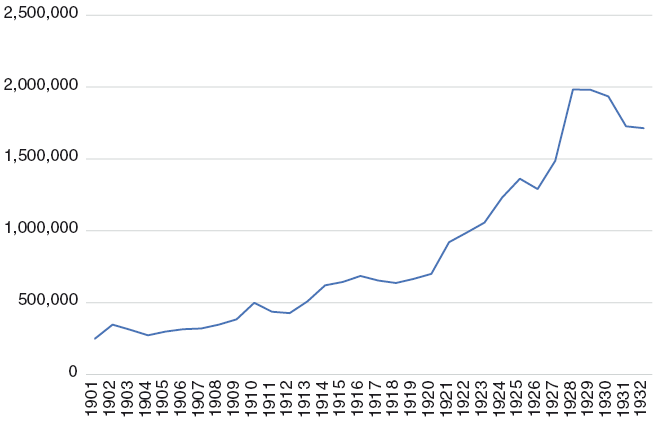
Before the arrival of the French, coal and mineral resources such as tin, zinc, and copper had been mined in northern Tonkin in small operations. Coal was mostly consumed locally and, therefore, did not exert much influence beyond its extraction sites. The Nguyễn dynasty licensed extractive rights to local businesses that were mostly owned by the Chinese. Chinese bandits, such as the Yellow and Black Flags, also competed to control these mines. After the conclusion of their military conquests of Vietnam, which lasted until the late 1880s, the French wrestled mining rights away from the Nguyễn court and granted new licenses to French capitalists, prospectors, and Vietnamese investors. A new colonial mining regime for Tonkin and Annam, another French protectorate in what is now central Vietnam, was created in 1897, allowing the new French colonial government to grant permits and mining perimeters to investors and prospectors. The first French coal mining company in Tonkin was founded in April 1888 on the coal island of Kế Bào on the coast of Quảng Yên after the colonial government ceded the entire island to Francis Dupuis, a French explorer. After Kế Bào Coal Company, other coal mining companies were founded, with the largest one being the French Coal Company of Tonkin (Société française des charbonnages du Tonkin, SFCT) which occupied close to 20,000 hectares of the Hongay and Cẩm phả areas which were the richest and most exposed parts of the Quảng Yên coal basin. After a decade of prospecting, clearing the land, digging up massive open mining pits, and investing in infrastructures such as power plants, railways, and deep-water ports, the coal mining industry of French colonial Vietnam took off in the 1920s, triggering a coal rush when investors and prospectors jumped into a frantic race to lay their claim to the remaining mining perimeters in Tonkin. By the early 1930s, a dozen coal mining companies had operated regularly in the Quảng Yên province of Tonkin. The industry’s annual production reached 1 million tons for the first time in 1923 and 2 million tons in the 1930s, making French Indochina one of the largest coal producers in Pacific Asia (Figure I.2).
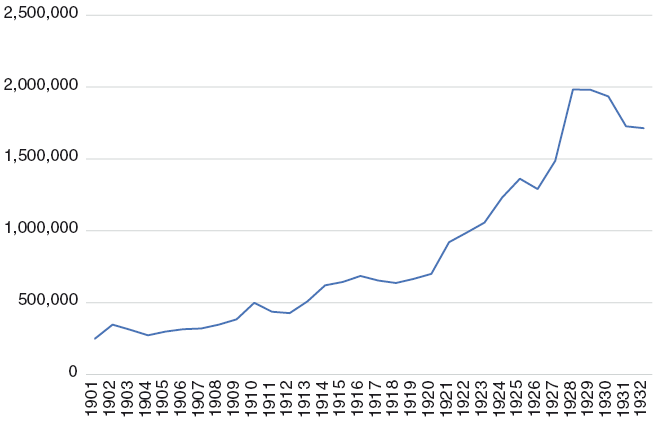
Economic models focusing on the relationship between the metropole and colony profoundly shaped the economic history of colonial Vietnam and other parts of the former colonial world. According to these models, the rise of Vietnam as a major worldwide coal exporter in the 1920s and 1930s was closely tied to the process of industrialization and commercialization that took place in Vietnam under French rule.Footnote 7 In other words, it has become a convention that French capital and technology helped propel the coal mining industry in Vietnam into an economic engine of the French empire in Asia. Amid the many failures of French economic investments in Indochina, coal mining stood as one of their most profitable businesses.Footnote 8
The emphasis on the interplay between the metropole and colony could overlook the important economic connections that had existed between Vietnam and other parts of the Asia, particularly China. When I studied the records of the SFCT and the Đông Triều Coal Company (Société des charbonnages du Đông Triều, SCDT), which were the two largest French coal mining companies in Indochina, I found that these two companies shipped very little by volume and in value to France. Instead, they exported more than 90 percent of their coal production to China, Japan, and Southeast Asia. Moreover, like the rice trade and opium farming business in colonial Southeast Asia, the coal industry in Vietnam was built on the structures of labor, networks, and mining expertise of which the Chinese played a crucial role. Therefore, in order to incorporate a much broader range of linkages than the metropole–colony economic models have suggested, this book stresses the various ways French colonialism both was grafted on and transformed preexisting Asian relationships while also giving rise to other inter-Asian networks beyond the French empire.
I.2 The Emergence of a Colonial Coal Regime and Its Limits
As coal was hailed as the new source of energy that fueled the industrial revolution in the West and at the same time deepened the “economic divergence” between the industrial West and the rest of the world including China,Footnote 9 contemporary scholarship has often portrayed the carbon fuel as a driver of not only economic changes but also technological innovations. Recent studies on East Asia drew attention to the concept of “energy regime” in which coal was central to both the Chinese and Japanese experiences of modernization and the emergence of trans-war technocratic regimes in East Asia. As Victor Seow has argued, coal laid the foundation for an industrial modern East Asia where “governance and control of society or industry were done by experts who were the bearers of technical knowledge, skills, and expertise.”Footnote 10 For scholars of East Asia, Manchuria and its vast coal resources served as a laboratory of modernity,Footnote 11 where businessmen, engineers, scientists, and technocrats experimented with new extractive technologies and advanced techniques of labor control that could solve the energy crisis of their times.
The rise of the colonial coal regime in Tonkin and other parts of the colonial world, however, deviated from the patterns of the industrial and technocratic energy regimes in East Asia and the West. Unlike the coal mines of Manchuria, 70 percent of coal mined in French colonial Vietnam was exported rather than used for domestic consumption.Footnote 12 As a French report highlights, with an annual production of 2 million tons of coal in the late 1920s, which amounted to a little more than 2 percent of the total annual coal production of East Asia in 1929, Indochina was, however, the territory that exported the highest proportion, that is, two-thirds, of its annual coal extraction in absolute value. The Dutch East Indies came second with a net export of 400,000 tons.Footnote 13
Coal was thus perceived by the French colonial administration and its enterprises as a valuable export commodity rather than an agent of technocratic, labor, and governance changes in the colony. In fact, the colonial coal regime in Tonkin was built with the goal of turning the Quảng Yên coal basin into a premier commodity frontier of the French colonial empire in Asia, bringing profits to its enterprises and investors.Footnote 14 And like the many commodity frontiers in other parts of the world, this colonial coal regime operated on a landscape where abundant resources and weak state control have, generally, attracted a transient, diverse population of pioneers and speculators, migrant workers, traders, and itinerants who were able to take advantage of the deficiencies in the colonial coal regime. Along this highly volatile coal frontier of northern Vietnam, local Chinese, Vietnamese, and ethnic groups adapted to the new economic opportunities brought by the new coal wealth, fluid borders, the shifting demography of new mining towns, and the political fragility of the colonial state. Despite the French surveillance, these actors were able to carve out their discreet space and self-sustaining systems that rivaled those of the formal mining economy. Mine workers plundered coal, dynamite, and other assets from their companies and then sold them to Chinese syndicates for cash and opium. Chinese dealers then moved these commodities across borders, using local ethnic minorities like the Tày and Dao as informants and smugglers. Unable to overcome local obstruction, the French had to rely on Vietnamese and Chinese labor recruiters known as the cai as power brokers. The cai crossed the Chinese-Vietnamese border frequently, built their own network of labor supply, and created a self-contained economy within formal mining enterprises by selling food and other necessities to their mine workers. This history of coal mining will therefore reveal as much about the workings of empire as it does about how the diverse local practices contested and reinvented imperial visions and the colonial coal regime.Footnote 15
I.3 Coal Mining and the Environmental History of Modern Vietnam and the French Colonial Empire
The history of energy has recently emerged as a distinct field of study that has been largely defined by scholarship on North America, Europe, and, to a lesser degree, East Asia. This book emphasizes the significance of coal in the making of modern Vietnam as it tracks the discovery and extraction of the fossil fuel and connects them to broader social, economic, and environmental processes in modern Vietnam.
Despite the complex ripple effects that coal mining had on forests, rivers, and land use, coal mining has remained an understudied subject in the environmental literature of Vietnam and Southeast Asia compared with tropical forests, lush river deltas, and rice frontiers.Footnote 16 Scholarship on the environmental history of Vietnam and the larger French colonial empire has focused predominantly on the French techniques of forest intervention in the colonies and their use of the “environmental degradation” narratives to shift blame on indigenous overgrazing and swidden agriculture for the loss of forested terrains.Footnote 17 In her book on forests and environmental rules in Vietnam, the historian Pamela McElwee argues that the French forest regime in colonial Vietnam was built on “the problematization of forests as depleted due to native practices.”Footnote 18 McElwee and other scholars have detailed French efforts to manage and protect the forests in colonial Vietnam against ethnic highlanders’ swidden agriculture, known as the rẫy, and other local forest practices.Footnote 19 These policies included the mapping of forests, the classification of species, the delimitation of forest reserves, and the creation of forest institutions such as botanical gardens and forest agencies. According to the historian Mark Cleary, the French forest regime turned Indochinese forests into “geographically bounded territories” and “cultural spaces” where the colonial state could control both their physical space and those ethnic groups inhabiting them.Footnote 20 The institutionalization of the forest in colonial Vietnam, according to Cleary, mirrored what Peluso and Vandergeest have called the “political forest,” where forest identification and management became a critical part of colonial-era state-making.Footnote 21 Scholars have long argued that the colonial state’s imposition of forest regulations through permits, tax, restricted access, and, in many cases, outright land appropriation played an important role in sparking rural unrest and protests that were directly tied to the emergence of the Indochinese Communist Party in the 1930s.Footnote 22
Regarding the motives behind French colonial forest intervention, the French historian Frédéric Thomas, however, attributed the French environmental ideology in Indochina to the imperative of preserving natural resources for “rational” commercial exploitation. In his opinion, the designation of forest reserves in Indochina was hardly rooted in Richard Grove’s concept of “green imperialism,” nor was it underpinned by cultural prejudices against indigenous methods of forest use.Footnote 23 The French narratives about “destructive” forest practices among ethnic populations in Vietnam instead acted more as smokescreens to justify the colonial state’s attempts to manage and limit indigenous use of their local forests.Footnote 24 This was not unique to the region because, according to the historical geographer Diana Davis, French forest policies in North Africa were based on a similar pattern. The colonists often accused indigenous peoples of causing environmental decline to appropriate the land and transform subsistence production into commodity production.Footnote 25
This book underscores the enormous impact of capitalist developments like coal mining rather than indigenous forest practices in shaping the environment of French colonial Vietnam. Although the French colonial authorities blamed swidden agriculture carried out by ethnic Dao along the coal frontier for the disappearance of forests, indigenous swidden agriculture widely varied and its impact ought to be accessed in a regional and local context.Footnote 26 In reality, capitalist developments like coal mining were the biggest driver of deforestation along this coal frontier not only because of the industry’s soaring timber consumption but also because mining expansion and the mining-driven timber search pushed indigenous people like the Dao to rely more on logging and swidden farming to maintain their livelihood. Furthermore, the impact of the rẫy or swidden agriculture on forests was in no way comparable to the destructive impact of large-scale coal mining. Specifically, to maintain 2 million tons of coal production a year, large-scale coal mining companies had to cut down at least 1 million hard timber trees or flatten tens of thousands of hectares of hard timber forests to procure enough mine timber props to shore up their underground tunnels.
Similarly, in terms of water protection, the French concern about water pollution and public health during the coal age placed disproportional blame on indigenous settlements along watershed rivers like those of the Dao and mine workers on the coal hills of Đông Triều, accusing their lack of hygiene for the spread of cholera and other epidemic diseases through polluted water. At the same time, the colonial government often ignored how unprocessed mining waste and mining-driven deforestation of forests along watershed rivers could also contaminate water resources and increase the chance of flooding and landslides in the coal region. This book argues that this biased environmental ideology in French colonial Vietnam stemmed from the colonial government’s reluctance and difficulties in regulating the powerful extractive industry and its big coal companies.
I.4 Big Coal Companies and Environmental Protection during the Coal Age
In studies of empires, the colonial state often acted as the close ally of capitalist industries, enabling them to exploit indigenous natural resources and labor. However, as the coal mining industry absorbed a massive amount of natural resources, its drive toward expansion, greater production, and profit also led to frequent violations of mining and forest regimes, thus building up to intense conflicts between the colonial state, its regulatory agencies, and coal mining companies. As the political and economic power of big coal companies like SCDT and SFCT rose accordingly with their production numbers, tax contributions, and jobs creation, it became increasingly more difficult for the French colonial state to rein in their actions. Capitalizing on their economic and political influence on the colonial government while exploiting legal loopholes in mining and forest regimes, as well as the weaknesses in colonial surveillance, these big coal companies resorted to illegal clandestine acts such as illicit logging of hard timber in designated forest reserves and unauthorized expansion into public land or maritime zones at the expense of the local communities, small Vietnamese mine owners, and the colonial government. Ultimately, it was these big coal companies, rather than the Dao farmers, that caused the depletion of highland forests and water pollution on the coal frontier. Unlike its suppression of the Dao farmers’ swidden farming practices, the colonial state in Tonkin was faced with an uphill legal battle against these deep-pocketed big coal companies over their environmental and mining violations. This story of the French colonial state’s struggle to regulate the activities of powerful coal companies thus provides a useful lens for examining not only the intense ecological consequences of unchecked capitalist developments but also the internal conflicts and limits of colonial rule.
I.5 From Tonkin to Annam and Africa: A Transnational Environmental History of Coal Mining
The environmental impact of coal mining in colonial Vietnam extended well beyond the industry’s extensive consumption of local natural resources. This book links the introduction of fast-growing exotic hard timber species to Vietnam during the colonial period to the French intensive search for mine timber to satisfy the growing timber demand of their coal mining companies. After decades of depleting and turning Vietnamese hard timber forests into mine props to shore up underground tunnels in subterranean coal mining, French coal mining companies were faced with a large challenge: How could they find enough local hard timber for their soaring mining needs? Known as Casuarina equisetifolia, a type of fast-growing Australian timber species, the filao tree,Footnote 27 and another Australia hard timber species, the eucalyptus, were introduced by the French to Vietnam in 1896 in order to grow and turn them into mine props for French coal mining enterprises and to reforest the hot and shifting sand dunes along the coast of Annam, where few other hard timber species could survive the region’s monsoon tropical climate marked by hot and violent winds blowing from Laos in the summer and typhoon-level rain from the ocean in the fall.
As a fast-growing hard timber species, the filao could reach the height and diameter required for mine props only after seven or eight years, whereas local Vietnamese hard timber species would need at least twenty years to reach the same size. Through a long and complex process of acclimating the filao to the coastal sand dunes of Annam, French foresters successfully found methods of growing this hard timber species in industrial-style plantations using highly regimented tree-planting techniques to ensure their survival and growth. Their success helped establish the filao as a favorite exotic hard timber species that French foresters chose to reforest coastal sand dunes not just in Vietnam but also in other French colonies such as Senegal, Reunion, and Madagascar, where filao strands have become permanent additions to the moving sand dunes along the African coast. The stories of the filao shed light on interesting and unexpected transnational connections between coal mining and the environment during the age of empire and imperialism, when the mining-driven search for hard timber commodities transformed the coastal landscape of both Vietnam and Africa.
I.6 Humans along the Coal Frontier
I.6.1 Coal Mining Labor: Mobility, Volatility, and Illicit Acts
Tonkin’s coal mining industry attracted a large workforce. At its peak in the 1930s, it employed more than 60,000 workers, both full-time and seasonal. Migrant Chinese and Vietnamese workers accounted for more than 95 percent of the workforce, and their population ebbed and flowed according to the fluctuations in the global demand for coal and changing economic circumstances of the miners. The mine laborers, steeped in traditions of mobility and transience, often abandoned the mines after a short period to seek work in agriculture, burgeoning urban industries, railways, and ports, or simply to go back home to China or the lower Red River delta of Tonkin, where most of them came from.
In Vietnamese literature, Vietnamese coal miners are often treated as victims of the drastic French economic exploitation and at the same time as vanguards of the Vietnamese working class. Little has been written about mine workers’ autonomy, their diversity and subculture, and how the workers themselves were also involved in shadow trading networks, illicit pleasure activities, fraud, and theft crimes outside the confines of their coal mining enterprises. These actions contrast with the often idealist, heroic, and exemplary images of the coal miners in Vietnamese literature.Footnote 28 With its focus on miners’ subculture, their mobility, and varied tactics to circumvent French surveillance, this book seeks to bring about a more complex, nuanced labor history of both Chinese and Vietnamese mine workers and their imprints on Vietnamese history.
I.6.2 Dao Farmers, Loggers, Rebels, and Outlaws on the Coal Frontier
Large-scale coal mining expansion changed not only the lives of tens of thousands of mine workers but also the livelihood and way of life of the diverse local populations of ethnic Dao, Vietnamese, and Chinese who had inhabited the coal frontier and its neighboring Sino-Vietnamese borderland well before the French arrived. With its focus on the regional and local history of the coal frontier of Quảng Yên, this book emphasizes how the new coal regime created both opportunities and challenges for these local communities. On the one hand, the arrival of tens of thousands of migrant mine workers led to the displacement of the local Dao, who relied on small farming and logging on the coal hills of Quảng Yên. Coal mining companies’ acquisition of the coastal sand dunes in Annam for their filao timber plantations and nursery complexes also deprived local people of the right to use the dunes. On the other hand, large-scale coal mining in Quảng Yên revitalized the precolonial trading networks of timber, opium, and other highland commodities that had been under the control of highly mobile, small groups of Chinese, Vietnamese, and ethnic Dao loggers and traders. These trading networks now flourished to meet the high demand for timber and commodities of not only the coal mining enterprises but also their large migrant workforce. Furthermore, new mining infrastructures such as roads, bridges, and railways stimulated regional economic exchanges between the coal frontier and lower delta provinces of Tonkin. The Dao were now able to travel to the lowlands to sell their forested goods, while Chinese and Vietnamese merchants and traders could sell contraband opium, alcohol, and other manufactured goods in new local and regional marketplaces that served tens of thousands of mine workers. Similarly, along the coast of Annam, local rice farmers could find work on filao plantations, transplanting filao seedlings and raising filao trees to become mine props for the coal mining companies. At the same time, local villagers could come to these plantations to collect the discarded branches of filao trees to use as firewood. In exploring the complex and diverse impact of large-scale coal mining, this book pays special attention to the multiethnic populations of the Dao, Vietnamese, and Chinese along the coal frontier who were able to adapt their preexisting trading networks to meet the new mining-driven demand for their timber and other commodities. They were also adept at taking advantage of the limits of French colonial power in this remote, poorly policed, and porous Sino-Vietnamese commodity frontier. Thus, this localized, environmental, and social history of coal mining stresses the many ways in which inter-Asian networks continued to play out at the same time and sometimes in conjunction with a colonial economy.
I.6.3 Structure of the Book
The book is organized in a blended chronological and thematic structure to reflect how the introduction of large-scale coal mining to northern Vietnam transformed the environment and local communities along the coal frontier. Part I of the book – Chapters 1 to 3 – provides a geographical, economic, and ethnic overview of the coal frontier of Quảng Yên under the Nguyễn dynasty, along with French early efforts to pacify the coal frontier to pave the way for the establishment of new mining settlements and infrastructures. Chapter 1 documents the precolonial mining regime of the Nguyễn dynasty, examining several political, technological, and environmental factors leading to the decline of the mining economy of Vietnam before the arrival of the French. Chapter 2 follows the footsteps of two French geologists, Edmond Fuchs and Émile Sarran, during their mining expeditions in Tonkin in the 1880s, highlighting their discovery of the Quảng Yên coal basin and the limits and discrepancies in their geological findings of the coal resources of Tonkin. Chapter 3 tracks the rise and fall of Kế Bào coal company, the first large-scale coal mining company in Vietnam, to illustrate the many challenges of extracting coal in Quảng Yên, where labor shortage in combination with unexpected environmental and geological factors led to the closure of the company after just a few years of operation.
Part II of the book, Chapters 4 to 9, explores the coal boom of the 1920s and 1930s, when coal production in French Indochina continued to break records, while bringing major social and environmental upheaval in its wake. Chapter 4 documents the formation of a liberal colonial mining regime and the coal rush it triggered in the 1920s, and how the frantic race for mining concessions in Tonkin led to many disputes between the colonial government, small coal investors, and big coal companies over the use of land and maritime zones. Chapter 5 examines mining-driven timber exploitation, deforestation, and forest management during the coal boom of the 1920s. Chapter 6 explores the French introduction of the filao, an exotic fast-growing hard timber species that was later planted on the coastal sand dunes of Annam to stabilize these shifting sand dunes and to turn them into mine timber for French coal mining enterprises. Chapter 7 addresses the impact of rapid mining expansion on watershed rivers and the intense conflicts between the French colonial government, the city of Hải Phòng, and SCDT regarding the control and protection of the Hương River, which was the source of potable water for the city of Hải Phòng. Chapter 8 documents the rise and expansion of coal mining towns along the coal frontier and how they transformed the urban landscape in the coal region. Chapter 9 describes the miners’ autonomous and defiant subculture as well as the internal working regime of coal mining enterprises. The book’s Epilogue documents the decolonization of the colonial coal regime amid the political turbulences of the 1945–1954 period and also discusses the legacy of coal mining in post-colonial Vietnam.
I.6.4 Sources
This book is based on extensive archival research carried out at different archives in Vietnam and France. In Vietnam, the National Archives Center I in Hanoi provided me with plenty of materials from its Archives of the French Resident Superior of Tonkin (Fonds de la Residence Supérieure au Tonkin, or Fonds RST), Archives of the French Coal Company of Tonkin (Fonds de la Société française des charbonnages du Tonkin, or Fonds SFCT), and its many other collections. The National Archives Center III also in Hanoi offers a wealth of information from its national coal company’s archives known as Phông tổng công ty than Việt Nam. In France, the Archives nationales du monde du travail (ANMT) in Roubaix, France, and its private collections offer a great deal of materials on SFCT. I also consulted a large number of primary sources at the French colonial archives, the Archives nationales d’outre-mer (ANOM) in Aix-en-Provence, and its numerous collections, including its private archives on the Indochinese Mine Timber Company (Société indochinoise des bois de mine, SIBM) and SCDT. The book also takes advantage of the vibrant Vietnamese print press and literature, particularly the ca dao vùng mỏ, a collection of folk poems written by mine workers themselves about their lives as coal miners in French colonial Vietnam. I also consulted the Bibliothèque nationale de France (BNF), its digitized resource Gallica, and the digitized archives of French colonial enterprises for French-language newspapers and other printed documents written during the colonial period. All of the translations in this book are mine.