


INTRODUCTION
Nutrition has captured the international spotlight in an unprecedented way, as persistent global hunger and undernutrition have underscored the need for urgent action. One in eight people around the world still suffer from hunger, and more than double that number are victims of hidden hunger (IFPRI, 2014). Traditional African vegetables can make an important contribution to food and nutritional security and can enhance the livelihoods of marginal and smallholder farmers. In comparison with globally important vegetables such as cabbage (Brassica oleracea) and tomato (Solanum lycopersicum), traditional vegetables including amaranth (Amaranthus spp.), African eggplant (S. aethiopicum, S. anguivi and S. macrocarpon) and jute mallow (Corchorus spp.) have been shown to be rich in micronutrients such as iron, zinc, pro-vitamin A (Weinberger and Msuya, Reference Weinberger and Msuya2004) and phytochemicals that help protect people against non-communicable diseases (Uusiku et al., Reference Uusiku, Oelofse, Duodu, Bester and Faber2010; Yang and Keding, Reference Yang, Keding, Shackleton, Pasquini and Drescher2009). Traditional vegetables complement staple-based diets, and their consumption is crucial for the attainment of several Millennium Development Goals, such as improving maternal health and reducing child mortality (Afari-Sefa et al., Reference Afari-Sefa, Tenkouano, Ojiewo, Keatinge and Hughes2012). For example, African eggplant, an easily cultivated vegetable, recently has been found to possess protective properties against ulcers induced experimentally, making it a cheap source of natural anti-ulcer remedy (Chioma et al., Reference Chioma, Obiora and Chukwuemeka2011). In addition to their nutritional and medicinal importance, traditional vegetables are considered valuable because of their ability to fit into year-round production systems (Weinberger and Msuya, Reference Weinberger and Msuya2004). Most traditional vegetables are easy to grow in home and market gardens of less than 0.25 ha, or under non-mechanized commercial production systems of up to 2 ha. They typically require little space, and can thus maximize scarce water supplies and soil nutrients better than crops such as maize, which need a lot of water and fertilizer (Tenkouano, Reference Tenkouano2011). Many traditional vegetables have high yields within a short period of growth, are easy to harvest with minimum labour, and have widely acceptable taste.
Despite the wealth of agronomic, economic and nutritional benefits traditional vegetables provide, the production and marketing of these crops from Tanzania and other countries in sub-Saharan Africa are constrained by factors such as poor quality and availability of quality seeds and other production-related risks, lack of appropriate market information and support systems (e.g., cold storage), and high postharvest losses – all of which prevent farmers from better exploiting the opportunities traditional vegetable crops present. This partly stems from the fact that most past and some on-going efforts to address food security have concentrated on the provision of calories by enhancing the availability of staples, particularly cereals, and root and tuber crops, rather than placing emphasis on appropriate nutritional elements that can be attained from a balanced diet. A study on the patterns and determinants of dietary micronutrient deficiencies in rural areas of east Africa showed that staples provide somewhat more than 70% of the calorie intake of farmers in Rwanda, Uganda and Tanzania (Ecker et al., Reference Ecker, Weinberger and Qaim2010). Yet, awareness of the importance of nutrition has recently increased in many countries, which should create new opportunities for traditional vegetables. Research is needed to better understand the potential opportunities and perceived critical bottlenecks faced by smallholder farmers in their decisions to produce and consume traditional vegetables to devise effective dissemination and adoption strategies.
The underlying factors on the supply side of vegetable consumption outcomes seem to be quite well understood, but the socioeconomic behavioural constructs of producers and their perceptions of the nutritional benefits of traditional vegetables from the demand side require further evidence. This paper is possibly the first to empirically investigate the factors that motivate smallholder households to integrate traditional vegetables into their farming systems, and to identify pathways and entry points to increase their cultivation of traditional vegetables by linking their perception of the nutritional benefits gained from traditional vegetables with potential high value markets in Tanzania. It is hypothesized that (i) farmer's perception about the importance of nutrition will have a significant and positive effect on the share of traditional vegetables to total cultivated crop area; (ii) farmer's education and age positively and significantly influence share of traditional vegetables; and (iii) there is a positive and significant effect of regional impact on area under traditional vegetable crops; (iv) female-headed households’ participation is significantly and positively related to the share of traditional vegetable cultivated area to total crop cultivated area. These hypotheses are tested through econometric estimations described in subsequent sections of the paper.
MATERIALS AND METHODS
Study sites
Our analysis is based on a primary survey of 181 farm households that cultivate traditional vegetables in five administrative regions of Tanzania known for vegetable production and marketing: Arusha, Tanga, Morogoro, Dodoma and Dar es Salaam (Figure 1). The Arusha site falls under the Northern Highlands agro-climatic zone and experiences bimodal rainfall of 760–1200 mm per annum (usually from October–December and March–May). The Tanga region (Lushoto district) is located within the Western Usambaras, with an altitude ranging from 610 to 2300 masl, characterized by steep slopes and narrow valleys (Vainio-Mattila, Reference Vainio-Mattila2000) with a relatively high population density of 210 persons/km of agricultural land. Land use is a combination of traditional subsistence farming and modern cash crop production. Subsistence crops such as maize, field beans, bananas, cassava and sweet potatoes are grown on hillsides, while vegetables are mostly grown in valley bottoms (Vainio-Mattila, Reference Vainio-Mattila2000). Compared to most other agro-climatic zones of the country, the Lushoto study site enjoys a relatively cool climate with temperatures ranging from 18–23 °C with the maximum occurring in March and minimum in July, and high rainfall of 600–2000 mm per annum. The area is characterized by high rainfall variability. The Morogoro region has a coastal climate with temperatures ranging from a minimum of 19 °C to a maximum of 30 °C, mean annual precipitation of 854 mm, and an altitude of 366–549 masl. The Dodoma region study site in central Tanzania has a semi-arid (savanna) type of climate with a unimodal rainfall regime of 500–700 mm per annum, usually starting as early as mid-November in some places and ending around mid-May, followed by a long dry season (Stigter et al., Reference Stigter, Zheng, Xurong and Onyewoto2005). The rainfall is relatively low in amount and rather unpredictable in frequency.
Map of Tanzania showing study regions.

The unreliability of rainfall in these regions imposes a pattern of risk aversion in traditional farming. During the long dry season, persistent desiccating winds and low humidity contribute to high evapotranspiration and soil erosion.
Dar es Salaam, the commercial capital of Tanzania, has a coastal savanna agro-climate. Because it is close to the Equator and the warm Indian Ocean, the city and surrounding towns experience generally tropical climatic conditions, typified by hot and humid weather throughout much of the year. Annual rainfall is approximately 750–1100 mm, and in a normal year there are two rainy seasons: the major rainy season is in April and May, while the minor season is usually from October to November. This region is characterized by infertile sands on gently rolling uplands and fertile clays on uplands and river floodplains.
Study approach and data
The study employed a combination of key informant interviews, focus group discussions with farmers and detailed one-on-one sampled household survey. This was augmented with secondary data from various sources including published reports. A purposive sampling was employed to sample 181 traditional vegetable producers from the five regions based on the perceived relative importance of traditional vegetables in the various regions (i.e., cultivated area and market access) to farmers. In all, 57 respondents each were selected from the Arusha and Dodoma regions, while 25, 22 and 20 respondents were selected from Morogoro, Dar es Salaam and Tanga regions respectively between March and May 2013. The 12-month cropping year reference period for survey data was from March 2012 to February 2013. Purposive sampling was also used to select key informants from relevant organizations and service providers at district and national levels. Information collected from the respondents included: household socioeconomic and demographic characteristics, land use, cropping patterns, access and use of agro-inputs and services, practices in marketing of traditional vegetables, self-perceptions about new technology and traditional vegetable production, marketing and nutritional awareness of perceived health benefits from consumption of traditional vegetables.
Empirical model
The underlying empirical model examines the effect of farmers’ perceived nutritional and health benefits obtained from consumption of traditional African vegetables towards their decision to grow them (otherwise, known as traditional African vegetable crop concentration) in terms of the ratio of the total area under their cultivation to total crop cultivated area using a log-linear regression model. According to (Bhatia, Reference Bhatia1965), the measurement of crop concentration is normally used by geographers to understand the agricultural distributions using a ratio between two units of measurement in the same area – for example, the ratio of cropped area to total area or the ratio of vegetable area to cropped area in hectares. The measurement approach provides an idea of the variations in the density of crop distribution being investigated as well as the importance of the focus crop in comparison with other competing crops. The study also examines other determinants of household engagement in traditional vegetable crop production such as crop specific factors, socioeconomic characteristics of surveyed respondents and regional effects.
Since the dependent variable used in the estimation is the share of traditional vegetable cultivated area to total area under cultivation of all crops, a variable which is typically constrained between 0 and 1, the study used a logit transformation of dependent variable for the regression estimates. The specification for log-linear model can be stated as follows:
 $$\begin{equation}
\ln Y_i = \beta _0 + \sum\nolimits_{k = 1}^N {\beta _n \ln Z_{ki} + u_i },\end{equation}
$$
$$\begin{equation}
\ln Y_i = \beta _0 + \sum\nolimits_{k = 1}^N {\beta _n \ln Z_{ki} + u_i },\end{equation}
$$
where: Y is a dependent variable that represents a logit transformation of the share of traditional vegetable cultivated area to total area under cultivation for all crops.
Zki = socioeconomic characteristics of the farm householdsFootnote 1 ; k = 1. . .. j (number of explanatory variables) and i = 1,.. N (number of farm households); Ln is the natural logarithm with base e. The parameters of the multiplicative regression model are estimated by the log-linear model proposed in equation (1), using STATA version 12.0 econometric software.
Gender is a dummy variable representing male and female respondents during the field survey. The reason for including gender as a dummy variable was to understand the role of female respondents on traditional vegetable production decisions. Women have traditionally been active in African agricultural production in addition to their responsibility for preparing food for the entire household and thus responses from female farmers with respect to their cropping preferences and related farm production decision is critical (Boserup, 1970; Gotor and Irungu, Reference Gotor and Irungu2010; Lastarria-Cornhiel, Reference Lastarria-Cornhiel2008; Voster et al., Reference Voster, Jansen-ven, Zijl and Venter2007). Enete and Amusa (Reference Enete and Amusa2010) argued that women's contribution to farm decision making is dependent on varied socioeconomic characteristics of the farm households. Thus, this study explored an interaction effect between gender with other socioeconomic variables such as level of education, age of farmers. The results did not however show any significant causal relationships and were thus dropped in the final model results reported for this study.
In recent years, the demand for traditional African vegetables has increased but lack of availability and accessibility of quality seeds of preferred varieties has not resulted in a corresponding increase in production, thereby reducing the ability of farmers to deliver improved produce to consumers (Afari-Sefa et al., Reference Afari-Sefa, Chagomoka, Karanja, Njeru, Samali, Katunzi, Mtwaenzi and Kimenye2013; Gotor and Irungu, Reference Gotor and Irungu2010). This study therefore, included selected explanatory variables in the log-linear model, namely: farmers’ experiencing bottlenecks in access to traditional vegetable seeds in terms of timely availability, price and quality of seeds, cost of inputs and market demand trends through revenue from crop sales. In Tanzania, a large number of farmers are smallholders, with less than 2 ha, most of who grow traditional vegetables (Weinberger and Msuya, Reference Weinberger and Msuya2004). Thus, the net operated area (NOA) was included as a proxy variable for farm size to ascertain the contribution of traditional vegetable cultivation within the cropping mix of the farm household. In the context of developing countries, the sign of the coefficient of NOA is expected to be negative, as smallholders are known to be more efficient in land management particularly in the context of vegetable cultivation (Coelli and Battese, Reference Coelli and Battese1996; Rajendran, Reference Rajendran2014).
Awareness of the nutritional importance of vegetables in human nutrition influences their dietary pattern (Oniang’o et al., Reference Oniang’o, Mutuku and Malaba2003). Several other authors (see for example, Herforth, Reference Herforth2010; Jones et al., Reference Jones, Shrinivas and Bezner-Kerr2014; Pellegrini and Tasciotti, Reference Pellegrini and Luca2013; Smale et al., Reference Smale, Moursi and Birol2013; Thompson and Meerman, Reference Thompson and Meerman2010) conclude that crop diversity and dietary diversity are associated with each other. However, very limited studies have linking farmers’ perceived awareness of the nutritional importance of vegetables to their crop cultivation patterns and hence it is important to understand this causality linkage. Therefore, this study included a variable on farmers’ perceived awareness of the nutritional importance of vegetables, measured on a Likert scale between 1 to 5 scale, (i.e., 1 stands for strongly disagree and 5 stands strongly agreed) connoting the level of farmers awareness about the importance of vegetables in human nutrition. Consistent with the sample design, district dummies are included to control for possible location-specific factors such as infrastructural endowment and agro-ecological conditions.
RESULTS
Results from the key informants’ qualitative surveys indicate that traditional African vegetables are well known by majority of Tanzanians. This dates several decades back when they were mostly collected from the wild, especially during the rainy season before their subsequent domestication. The preference differs from one community to another depending on their socio-cultural background as well their food and eating habits. Respondents confirmed that in the past the popularity of a certain vegetable used to be attributed by taste, medicinal properties, availability and access. Recent years has seen a resurgence in an increased awareness of the nutritional value of traditional African vegetables, partly due to increased promotional efforts by public health and policy experts and to some extent the mass media. This was further confirmed during the focus group discussions, where farmers confirmed that efforts in promoting nutritional awareness especially for pregnant women and children by development agencies have substantially contributed to increasing the consumption of traditional vegetables by several households. It is always common to hear from medical doctors and public health specialist referring their clients to increase their consumption of traditional vegetables as an option for ensuring balanced diets and improved nutritional as they are easily affordable, easy to prepare and very rich in micronutrients that are mostly deficient in most diets. In schools, teachers will also make reference to traditional vegetables especially when they are trying to cite simple measures to prevent some health conditions during classes. Currently, traditional vegetables can be grown easily and harvested within a short time without investing a lot of resources. Farmers can now access seeds from their own saving or buy from seed stockiest and grow for sale and earn income. In recent times, traditional vegetables occupy higher proportions in local markets thereby substantiating their increased demand triggered by increased awareness in nutritional value from the consumer side. In the past, the tendency was to prepare vegetables for certain meals only but nowadays people prefer to have most of their meals served with vegetables.
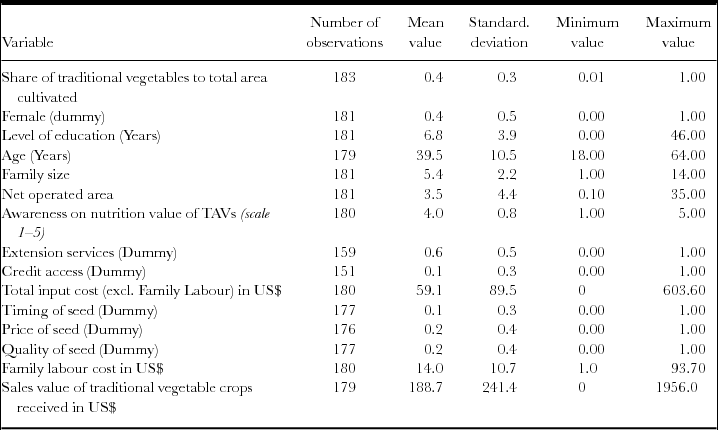
Prior to specifying the model, the zero-order correlation matrix among the independent variables was computed to detect possible multicollinearity problems. The results (not reported) show there is no multicollinearity among the independent variable and hence the multiplicative regression analysis approach can be applied for the purpose of the study. The descriptive statistics of the regression variables are specified in Appendix 1. Table 1 presents results of land ownership patterns disaggregated by farm size. The percentage of NOA weighted by the number of households indicates that marginal and smallholders with total land of 0–2 ha and average NOA of 0.4 ha constitute the majority (44%) of the sample that cultivated traditional vegetables. This is critical knowledge for promoting traditional vegetable production to smallholders, such as through home gardens and urban and peri-urban market-oriented gardening for income.
Land ownership and cultivated area by farm size category.
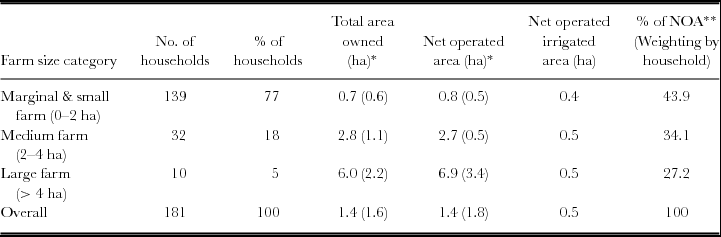
*Numbers in parenthesis denote standard deviations.
**Net operated area.
Results from basic descriptive analysis show that overall, amaranth is the most preferred traditional vegetable cultivated followed by African eggplant, Ethiopian mustard, African nightshade and sweet potato leaves in that order (Figure 2).
Household cultivation of various traditional vegetables by region.
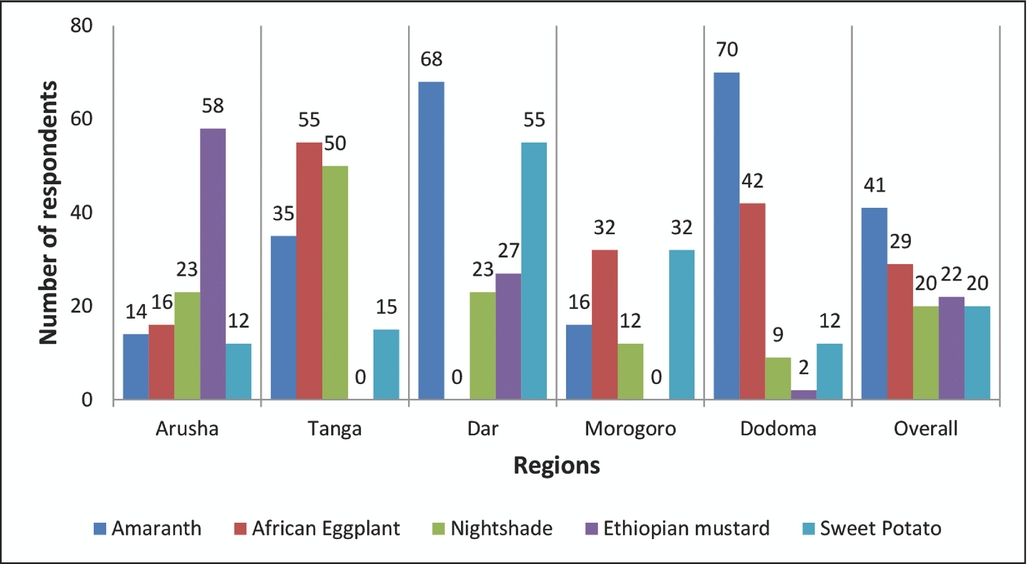
The estimated parameters of log-linear models on determinants of crop concentration towards traditional vegetables show mixed results. The first task involved ascertaining if a farmer's awareness of the importance of nutrition will have significant and positive effect on the share of traditional vegetables to total cultivated crop area was estimated. There are observed differences in the choice of traditional vegetables that are preferred in the various regions (Figure 2). Overall, the model had a good fit with an R 2 of around 68% variation in the endogenous variables due to variation in explanatory variables.
The results show that when farmers are more aware of the nutritional benefit from traditional vegetables compared with other crops, the intensity of cultivation of traditional vegetable crops is significantly higher than other crops at the 10% probability level (Table 2). The result is consistent with earlier qualitative studies carried out selected African countries that conclude that, African traditional vegetables contain substantial amounts of micronutrients and are thus highly recommended for smallholder inclusion in their cropping mix for diversifying household cropping income while meeting household nutritional needs (Odhav et al., Reference Odhav, Beekrum, Akula and Baijnath2007; Voster et al., Reference Voster, Jansen-ven, Zijl and Venter2007). In addition, female respondents were found to be on the average more intensively engaged in traditional vegetable cultivation compared to their male counterparts (see for example, Ecker et al., Reference Ecker, Weinberger and Qaim2010; Weinberger and Msuya, Reference Weinberger and Msuya2004). Interestingly, participation in traditional vegetable cultivation is largely dependent on smallholders whose NOA show negative relationships with crop concentration towards traditional vegetables in comparison with other crops produced by the same farm household.
Determinants of African traditional vegetable crop concentration within existing farming systems.
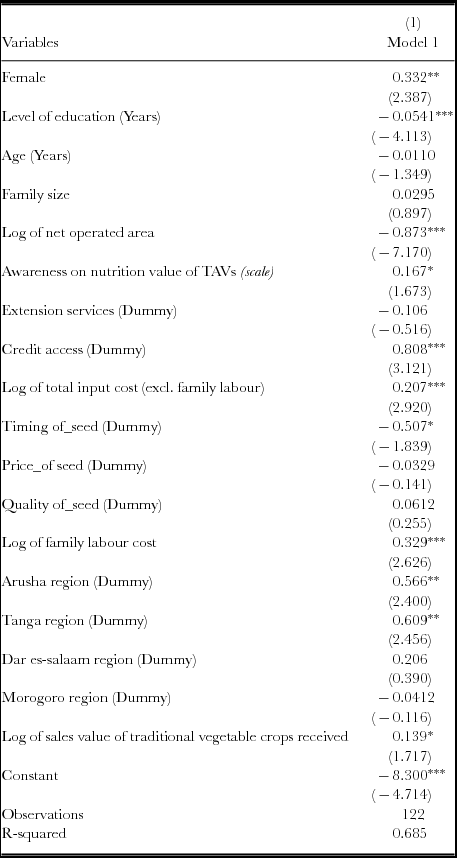
Robust t-statistics in parentheses; Significant Level: ***p < 0.01; **p < 0.05; *p < 0.10.
Our results further show that a farmer's education level is negatively and significantly related to the share of traditional vegetables to total area under cultivation. This might be attributed to the fact that with increased education, farmers tend to generally increase their investment in non-traditional vegetable crop production. Alternatively, the divergent results might be attributed to possible opportunities for an investment transition from farm to non-farm income-earning activities. This is not surprising given their smaller volumes of per unit transaction, high perishability and shorter value chains compared to non-horticultural produce. Access to extension services does not provide much value to farmers, hence the need for a more dynamic approach to encourage farmers to diversify into vegetable cultivation. In addition, access to credit is also positively and significantly related to the share of traditional vegetable cultivated area to total crop area under cultivation. Farmers’ tendency to spend more on inputs (i.e., seeds, fertilizers and chemicals) most likely leads to an increase in their share of traditional vegetable cultivated area to total crop cultivated area. Family labour capacity was found to be positive and significantly related with traditional vegetable cultivation. Since vegetables in general are mostly grown by smallholders, there is a possibility that family labour is the main labour source for traditional vegetable cultivation. There were also statistically significant regional effects of household participation in traditional vegetable cultivation for Arusha and Tanga regions, likely due to marked agro-climatic variations, particularly, relatively much higher precipitation than the three other study regions. Finally, farmers tend to expand their share of traditional vegetable cultivated area to total crop cultivated area when they perceive they can accrue relatively better market value and income for their sales; hence the need for strong market linkages for producers of traditional vegetables.
DISCUSSION
There are observed marked regional differences in preference among the types of traditional vegetables cultivated in the survey sites for this study. In addition to likely differences in food eating habits as noted from the qualitative study and agro-climatic adaptations, the observed differences could be attributed to that fact that fruit-type traditional vegetables such as African eggplant have high farm gate values and can contribute significantly to household income in predominantly commercial vegetable producing centres such as Lushoto district (Tanga region) and other vegetable production baskets in the Morogoro region, while leafy types such as amaranth and African nightshade contribute mainly to household nutritional needs through their inclusion in home gardens in Arusha and Dodoma.
Several reasons may also account for the observed increasing trend in traditional vegetable crop concentration within the study locale. These could be due to one or more of factors such as: monetary benefits, awareness about nutritional benefits, better access to agricultural inputs and services, risk aversion mechanism/diversification (i.e., climate, income, food etc.). Results from the log-linear regression analysis specifically show that gender, level of education, farm size, awareness of the nutritional benefits of traditional vegetables, access to credit, total input costs, regional differentiation, timing of seed supply, family labour endowment and expected revenues accrued from sale of traditional vegetables are significantly related to concentration of traditional vegetable crops within the farming system.
Consistent with the results of an earlier study by Weinberger and Msuya (Reference Weinberger and Msuya2004), the generally observed increased trend towards increasing traditional vegetable crop concentration within the farming system could partly be attributed to the tendency of shifting consumption baskets towards increased proportions of traditional vegetables resulting from increased awareness of their human nutritional and health benefits. Most importantly, farmers tend to reduce the share of their traditional vegetable cultivated area within the overall cropping mix when they perceive that traditional vegetables seeds will not be available in time for the next cropping season.
With regards to seed systems, the results underscore the fact that access to quality seeds alone (for example; Afari-Sefa et al., Reference Afari-Sefa, Chagomoka, Karanja, Njeru, Samali, Katunzi, Mtwaenzi and Kimenye2013; Rohrbach et al., Reference Rohrbach, Minde and Howard2003), is not sufficient to address the critical bottlenecks in the seed supply and distribution system of traditional vegetables. Principally, traditional vegetable seeds must be made available for smallholders in a timely manner and well ahead of the commencement of the season to facilitate production of these nutrient-dense crops. This outlined factor could also be the reason why most farmers are still dependent on own farmer-saved seeds, possibly a guarantee for timely availability for the next growing season.
In addition, there is the need to link smallholders to high value traditional vegetable markets as income from sale of produce increases with increasing crop concentration. This is consistent with earlier studies conducted by other authors (for example; Chagomoka et al., Reference Chagomoka, Afari-Sefa and Pitoro2014; Weinberger and Lumpkin, Reference Weinberger and Lumpkin2007). The results call for the need for policy makers to target intervention programs emphasizing the nutritional importance of vegetables towards smallholders and home gardeners since the former contributed 44% of the weighted sample (Table 1) as the highest volume of traditional vegetable crops for both market and home consumption. Given the significance of female respondent households with crop concentration, there is also the need to encourage female participation in the traditional vegetable sector through provision of adequate farm management training and knowledge for value chain upgrading. Further studies could consequently look into gender time surveys to ascertain the gender division of labour and asset transfer relationships and dynamics along the traditional vegetable value chain and their associated impacts on nutritional perceptions of farmers.
CONCLUSION AND POLICY CONSIDERATIONS
Our study highlighted the often ignored demand-side factors guiding smallholders’ decision to cultivate nutrition-sensitive crops such as traditional vegetables and their contributions in addressing the nutritional aspects of food security within the household.
There are several challenges in the traditional vegetable value chain (mainly due to high perishability of produce, particularly of leafy types) that are important to all actors in the sub-sector, yet interactions among them are hampered by information asymmetry that results in farmers neglecting or evading recommended practices. The following recommendations are offered:
-
• Householders seem to be aware of the higher farm gate values for traditional vegetables per unit area. They also understand the importance of traditional vegetables for nutrition – a main driver of their production decisions. Detailed measurements of vegetables, staples and other food items consumed by households are required to understand other psychological constructs.
-
• Family labour size is positively and significantly related to crop concentration on traditional vegetable cultivation. This is an indication of the preference allocation of more labour resources for the cultivation of traditional vegetables as compared to other crops, perhaps because of their relatively higher farm gate values and household nutrition needs.
-
• There are marked regional differences in traditional vegetable preferences that need to be noted for targeting future interventions.
-
• Since female-headed households involved in traditional vegetable production are more intensively engaged in it than male-headed households, it is necessary to provide adequate farm management training and knowledge for female farmers to upgrade the value chain. However, a study of decision making on vegetable production by females within male-headed households would be an interesting area for future research, to better understand gender roles and division of labour in the supply chain, and to explore options to empower women via traditional vegetable value chains.
-
• It is also important for government to implement enabling policies to enhance timely availability for traditional vegetable seeds and to avoid spatial gaps, as farmers tend to grow less traditional vegetables when they perceive that seed is not available in time for cultivation. As a complement, advocacy for enabling collaborative policies that will encourage public–private partnerships can enhance timely availability of seeds to smallholders to bridge the spatial and time gaps in seed systems.
Acknowledgements
The authors wish to express their appreciation to Dr. Pepijn Schreinemachers and Dr. Jackie Hughes for their valuable comments and suggestions on the initial draft of this paper. We are also grateful to Ms. Maureen Mecozzi for her excellent editing of the paper. Finally, the authors wish to acknowledge the funding support from the Good Seed Initiative project funded by Irish Aid for this study.
Descriptive statistics of Log-linear regression variables.