

Cacao, or chocolate, is arguably one of the most prized foods in the world. In the eighteenth century, Linnaeus, the Swedish naturalist, named the cacao tree Theobroma cacao, which means ‘food of the gods’. Today, the beans of the cacao tree have acquired immense importance socially, economically, and gastronomically. There can be no doubt that the same could be said about them in the past. We know that at the time of the Spanish Conquest, there were a number of written records describing the importance of cacao by the Aztec and Maya (Reference MillonMillon 1955; Reference GascoGasco 1987; Reference CoeCoe & Coe 2004). But, very little data exist, chemical or otherwise, for the origins of cacao use in Mesoamerica. In 2002, researchers revealed that the Maya Lowlands may have been one of the first areas in which cacao cultivation and the custom of chocolate drinking occurred. Powis and colleagues identified traces of chocolate in spouted ceramic jars from the site of Colha, Belize, dating to 600 BC (Reference HurstHurst et al. 2002; Reference PowisPowis et al. 2002). Recently, research at the site of Puerto Escondido in northern Honduras has shown that by 1200-1100 BC inhabitants were consuming both liquid and solid chocolate foods (Reference HendersonHenderson & Joyce 2006). However, evidence of cacao use by the earliest Mesoamerican groups like the Gulf Coast Olmec and Pacific Coast Mokaya of Mexico has thus far been lacking.
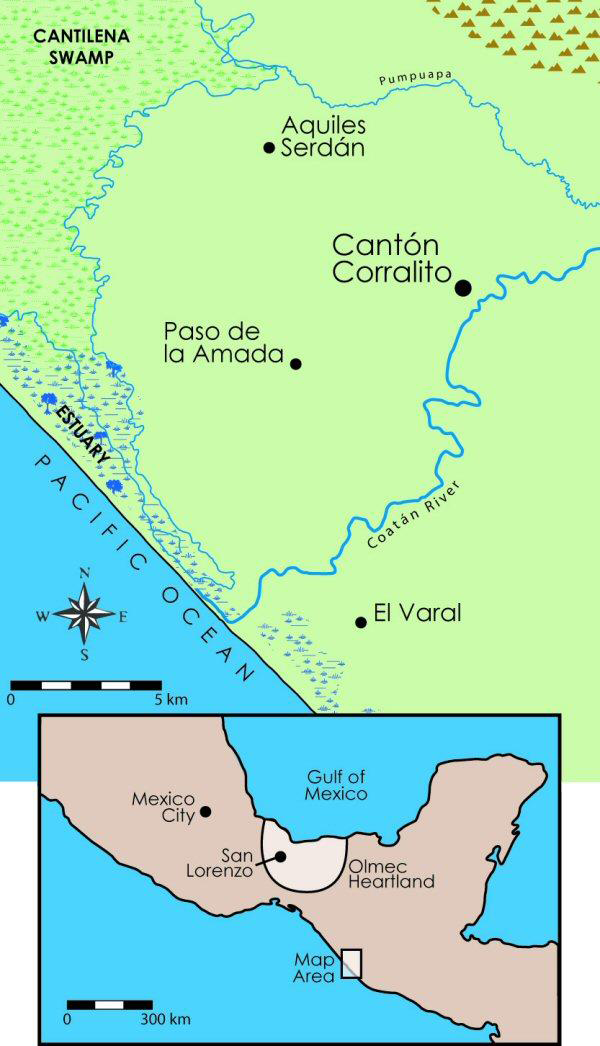
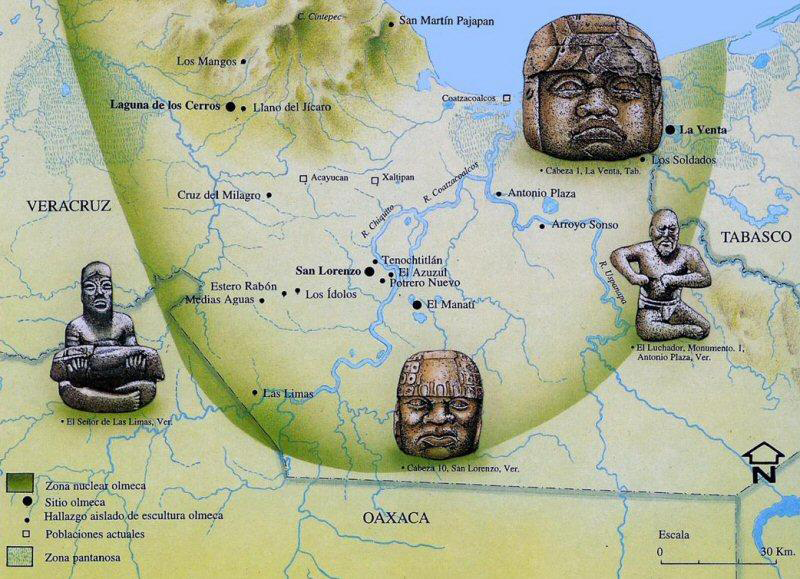
The Mokaya archaeological site of Paso de la Amada on the Pacific Coast of Chiapas, Mexico (Figure 1), and the Olmec archaeological site of El Manatí on the Gulf Coast of Veracruz, Mexico (Figure 2), have each yielded one ceramic vessel that contain residues from the preparation of cacao beverages during the Early Formative (1900-900 BC) period. Our analysis shows that chocolate (Theobroma cacao) was consumed by the Mokaya as early as 1900 BC and by pre-Olmec peoples as early as 1750 BC, pushing back the chemical evidence of cacao use by some 700 years.
Map of Paso de la Amada, located on the southern coast of Chiapas, Mexico.

Map of El Manatí, located on the Gulf Coast of Veracruz, Mexico.

The Mokaya represent one of Mesoamerica’s earliest sedentary villagers. Their initial occupation began during the Barra ceramic phase (1900-1700 BC), a period when both agriculture and ceramics were introduced. Barra ceramic technology copied the styles of fancy gourd vessels and was adopted for competitive social display - perhaps linked to feasting (Clark & Blake 1994). Most Barra phase pottery consists of flat-bottomed tecomates (neckless jars) or deep, incurved bowls. Both are thin-walled, finely finished and elaborately decorated. These ceramics were not designed for cooking, but for holding liquids, presumably beverages such as chicha (corn beer), chocolate, or atole (a drink of ground corn and chocolate) consumed in social settings and conferring prestige on the giver. Until this current study, there has been no direct scientific evidence to support their hypothesis.
We used a Shimadzu QP-8000 LC/MS system to analyse each of the samples collected from the 22 vessel fragments (16 from Paso de la Amada; 6 from El Manatí) recovered from several contexts at both Paso de la Amada and El Manatí. All of the vessels tested for dry residue from Paso de la Amada date between 1900-1500 BC and the ones from El Manatí date between 1750-1500 BC. Samples were extracted in warm water and filtered prior to analysis using HPLC/MS with the API Interface.
Cacao has a unique chemical composition of over 500 different compounds, including members of the methylxanthine class (primarily theobromine, with a lower concentration of caffeine). The Shimadzu QP-8000 LC/MS system was then used to detect peaks of theobromine. As T. cacao is the only Mesoamerican plant that contains theobromine as the primary methylxanthine, this compound is a unique marker for the presence of cacao. For the LC/MS system, the probe was operated in positive-ion mode to monitor for peaks at m/z=181 (theobromine) and m/z=195 (caffeine), with the ultraviolet detector set at 270nm.
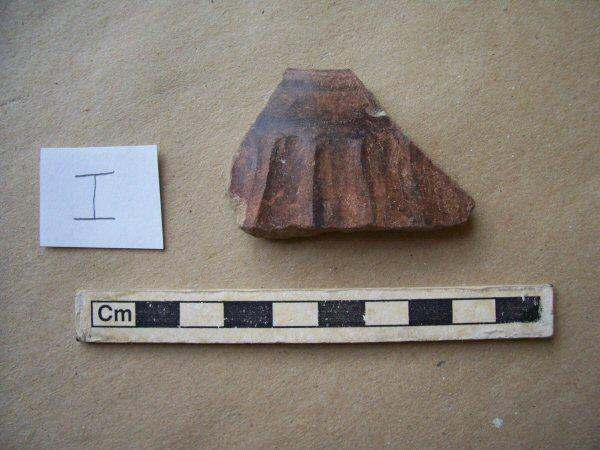
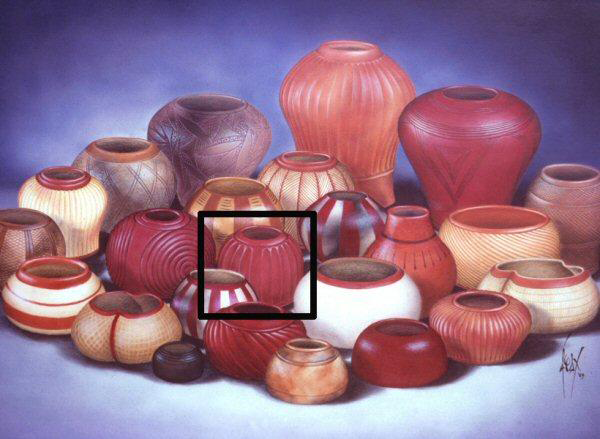
The results of the LC/MS system confirmed the existence of theobromine in two of the 22 analysed. One positive sample comes from a brown slipped tecomate found above Structure 4 in Mound 6 at Paso de la Amada. The Barra Phase vessel is a Bayo Brown ceramic type with vertical fluting on its exterior surface (Figures 3 and 4). It was one of several Barra Phase (1900-1700 BC) and Locona Phase (1700-1500 BC) ceramic types recovered in the construction fill deposit. Bayo Brown is most common in the Barra Phase but may be a firing variant of some of the red wares present in both Barra and Locona. The sherd that tested positive for theobromine was likely dug up from a Barra Phase refuse deposit by the ancient builders who brought in thousands of basket loads of earth to raise the mound surface in preparation for the construction of Structure 3. Therefore, it may represent an heirloom Barra pot in a Locona context. To be conservative, we have dated the vessel to between 1900-1500 BC, to span both Barra and Locona Phases.
Photograph of Bayo Brown ceramic sherd from Paso de la Amada, which exhibited traces of cacao on its interior surface. Photograph by Terry G. Powis.

Early Mokaya use of cacao (Theobroma cacao): Bayo Brown tecomate vessel (inset) which was found to contain cacao residue. This is one of 16 excavated from site of Paso de la Amada in southern Chiapas, Mexico, dating to between 1900-1500 BC. Drawing by Ajax Moreno.

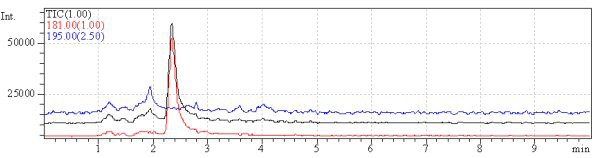
Peaks from the extract of the residue from the Paso de la Amada vessel were evident in the total-ion and ultraviolet chromatograms and the selected-ion-monitoring trace at m/z=181 (Figure 5). It was confirmed by the fact that the mass spectrum and ultraviolet chromatogram of this peak show the same retention time as theobromine.
Mass-spectrometry chromatogram of dry extract from Paso de la Amada vessel: red, total-ion chromatogram; black, selected-ion monitoring (SIM) at m/z=181 for theobromine; blue, SIM at m/z=195 for caffeine.

The vessel that tested positive for cacao from El Manati is a Chaya Punctate ceramic type. It is a deep bowl with cylindrical walls and a flat base. This sherd, along with several other objects, was recovered in Strata IX and X in a test pit designated B4D3 at the site. More specifically, the Chaya Punctate vessel was found associated with a large quantity of sumptuous objects, including fine ceramics, stone mortars, green stone and jadeite axes, sculptures of wood and rubber balls. According to Reference Ortiz CeballosPonciano Ortiz and Carmen Rodriguez (1999), this deposit represents a ritual activity space dating to the Ojochi Phase, calibrated to be 1650-1500 BC.
Very little archaeological research has been conducted on the origins of cacao use by the Olmec and Mokaya in the Early Formative period. The presence of liquid cacao in vessels from both the Gulf Coast and Pacific Coast of Mexico indicates that its usage predates evidence from Belize and Honduras, specifically from the sites of Colha and Puerto Escondido. The results of the present study provide direct evidence that the Mokaya people of the Pacific coast were processing and consuming liquid chocolate as early as 1900-1500 BC. In the Gulf Coast area, pre-Olmec people were consuming liquid chocolate by 1750 BC, suggesting that the later Olmec civilisation centered at the nearby site of San Lorenzo (1200-900 BC) did the same. These findings demonstrate that Mesoamerica had a very long, continuous history of chocolate preparation and consumption beginning with the first sedentary villages and continuing through historic and modern times.
Acknowledgements
This research project was supported by a grant to the senior author from the Foundation for the Advancement of Mesoamerican Studies, Inc. (FAMSI). We would also like to thank John E. Clark and Roger Colten for access to the Paso de la Amada and San Lorenzo ceramic material, respectively.