





Historians and political communication scholars have documented and discussed how authoritarian regimes have used different types of propaganda to influence citizens’ behavior (eg Chapman Reference Chapman2000; Jowett and O’Donnell Reference Jowett and O’Donnell2018). More recently, an emerging literature in comparative politics has also analyzed this phenomenon (Bush et al. Reference Bush, Erlich, Prather and Zeira2016; Carter and Carter Reference Carter and Carter2023; Hintz and Draege Reference Hintz and Draege2025; Huang Reference Huang2015, Reference Huang2018; Lutscher and Donnay Reference Lutscher and Donnay2025a; Mattingly and Yao Reference Mattingly and Yao2022; Rosenfeld and Wallace Reference Rosenfeld and Wallace2024; Shirikov Reference Shirikov2024; Wedeen Reference Wedeen2015; Yang and Zhu Reference Yang and Zhu2025), and some of these studies suggest that propaganda effectively deters citizens from engaging in anti-government behavior (Carter and Carter Reference Carter and Carter2023; Huang Reference Huang2015, Reference Huang2018). Yet we still know little about the mechanisms through which propaganda shapes political behavior, including protest participation. Does propaganda primarily persuade? Does it signal regime strength and thereby discourage dissent? Or does it work by triggering emotions and feelings (eg Mattingly and Yao Reference Mattingly and Yao2022) that, in turn, shape action or inaction (eg Frijda, Kuipers and Ter Schure Reference Frijda, Kuipers and Ter Schure1989)?
Focusing on this latter mechanism, we examine whether and how propaganda affects pro- and anti-government behavior by influencing two emotions – anger and anxiety – and the sense of societal belonging. We also broaden the empirical scope of existing work, which largely focuses on dominant-party regimes such as China, by testing propaganda effects in an electoral authoritarian regime with opposition parties and a more pluralistic media environment (Turkey). This context of study allows us to investigate heterogeneous effects across regime supporters and opponents, an issue seldom addressed in earlier studies.
We focus on power-projecting government propaganda, which contains little explicit informational content but conveys implicit cues about regime strength, capability, or legitimacy. We ask: Does such power-projecting propaganda ‘work’ by triggering psychological or behavioral reactions? And are the effects heterogeneous or uniform across the population?
We consider the effects of government-produced, power-projecting propaganda videos in electoral authoritarian regimes – authoritarian regimes that (formally) hold multiparty elections, which are not conducted in a free and fair manner (Schedler Reference Schedler2006).Footnote 1 Incumbents in these regimes use a wide range of manipulative tools to ensure victory (Gandhi and Lust-Okar Reference Gandhi and Lust-Okar2009; Knutsen, Nygård and Wig Reference Knutsen, Nygård and Wig2017; Schedler Reference Schedler2002). Examples include jailing opposition leaders, vote-count manipulations, and capturing the national media. The opposition still has a chance of electoral success, manipulation notwithstanding, and anti-government protests remain important tools for the opposition in such contexts (Tomini, Gibril and Bochev Reference Tomini, Gibril and Bochev2023).
We argue that power-projecting government propaganda in electoral authoritarian settings produces different emotions and feelings among regime supporters and opponents, especially in politicized and polarized contexts where the two groups diverge sharply in preferences and orientations toward the government (cf. Iyengar et al. Reference Iyengar, Lelkes, Levendusky, Malhotra and Westwood2019). We focus on two emotions, anger and anxiety, and the feeling of societal belonging, all of which are likely shaped by government propaganda and known to influence contentious political behavior. Anger and anxiety have previously been linked to contentious political behavior in ways suggesting they are especially relevant for explaining mobilization or pacification among government opponents (eg Aytaç, Schiumerini and Stokes Reference Aytaç, Schiumerini and Stokes2018; Gurr Reference Gurr2015; Young Reference Young2019). A sense of belonging reflects core needs for social connectedness (Lee and Robbins Reference Lee and Robbins1995) and is linked to collective action (Bäck, Bäck and Knapton Reference Bäck, Bäck and Knapton2015). We expect propaganda to, for instance, increase belonging among supporters, heighten anxiety among opponents, and thus also shape downstream behaviors such as protest participation. Specifically, we anticipate that propaganda will pacify opponents by increasing anxiety while mobilizing supporters by strengthening belonging.
To test this argument, we ran two preregistered survey experiments in Turkey, exposing respondents to two prototypical power-projecting propaganda videos produced by the Turkish government. These surveys were conducted several months before (2312 respondents) and during (3974 respondents) the hotly contested 2023 electoral campaign.
Turkey is a strong test-case: it is an electoral authoritarian regime where political contention persists between distinct pro- and anti-government factions, despite political manipulation and control by government actors. It is also among the world’s most affectively and ideologically polarized countries (Laebens and Öztürk Reference Laebens and Öztürk2021; McCoy et al. Reference McCoy, Press, Somer and Tuncel2022; Wagner Reference Wagner2021), with deep divisions rooted in the secular–religious cleavage and the Kurdish question (Selçuk and Hekimci Reference Selçuk and Hekimci2020). Under AKP rule, the government has expanded its influence over media (Esen and Gumuscu Reference Esen and Gumuscu2018) and deployed propaganda to amplify some of the country’s most polarizing divisions (Hintz Reference Hintz2018; Hintz and Draege Reference Hintz and Draege2025; Yabanci Reference Yabanci2023). Turkey thus presents a pertinent case for evaluating heterogeneous propaganda effects.
The experiments corroborate most of our expectations. Government opponents report feeling angrier and more anxious after watching the propaganda videos, whereas supporters report an increased sense of belonging. Mediation analyses show these emotional responses partly shape downstream political behavior. Overall, propaganda deterred opponents from anti-government protests while encouraging pro-government action among supporters. However, these behavioral effects seem context-dependent; the protest-deterring effect on opponents diminished during the 2023 Turkish electoral campaign. This might point to time-sensitive effects of such propaganda in electoral authoritarian regimes, especially during periods and events with more contestation, political mobilization, and available alternative narratives (cf. Rosenfeld and Wallace Reference Rosenfeld and Wallace2024; Yang and Zhu Reference Yang and Zhu2025).
The next section reviews the literature on propaganda effects in authoritarian regimes. We then present our argument and introduce the Turkish case, before outlining our research design, ethical considerations, and methodological challenges. Thereafter, we present the results, robustness checks, and limitations. We conclude by reflecting on the broader implications of our results and suggesting directions for future research.
The effects of propaganda in autocracies
Studies of propaganda in authoritarian regimes show that it is used to indoctrinate (Friedrich and Brzezinski Reference Friedrich and Brzezinski1965), persuade (Carter and Carter Reference Carter and Carter2023; Guriev and Treisman, Reference Guriev and Treisman2019; Liu and Shao Reference Liu and Shao2023; Mattingly and Yao Reference Mattingly and Yao2022; Yu Reference Yu2021), and signal regime power and resolve (Carter and Carter Reference Carter and Carter2023; Huang Reference Huang2015, Reference Huang2018; Lutscher and Donnay Reference Lutscher and Donnay2025a). Propaganda comes in different forms – news articles overly praising the governing party (Huang Reference Huang2018), ‘mawkish movies with patriotic themes’ (Huang Reference Huang2015: 1034), images highlighting military support (Lutscher and Donnay Reference Lutscher and Donnay2025a), or leader statues scattered across the country (Wedeen Reference Wedeen2015). These are examples of ‘hard propaganda’ (Huang Reference Huang2015) or propaganda to dominate (Rosenfeld and Wallace Reference Rosenfeld and Wallace2024). More subtle variants include government-produced videos that promote nationalist or anti-foreign narratives (Mattingly and Yao Reference Mattingly and Yao2022), biased narratives in textbooks (Northmore-Ball et al. Reference Northmore-Ball, Neundorf, Nazrullaeva, Tertytchnaya and Kim2024), historical TV shows praising the country’s history (Çevik Reference Çevik2019), or costly blockbuster movies (Yao Reference Yao2024). In practice, propaganda often serves multiple purposes at once, simultaneously signaling strength, promoting nationalism, and seeking to persuade citizens (Rosenfeld and Wallace Reference Rosenfeld and Wallace2024).
Most empirical work examines closed authoritarian regimes without multiparty elections, such as Nazi Germany (Adena et al. Reference Adena, Enikolopov, Petrova, Santarosa and Zhuravskaya2015), China (Huang Reference Huang2015, Reference Huang2018; Mattingly and Yao Reference Mattingly and Yao2022), or the UAE (Bush et al. Reference Bush, Erlich, Prather and Zeira2016). Results highlight that in contexts where the information space is (almost) completely dominated by regime messages – thus also making it difficult to measure true government support (Robinson and Tannenberg Reference Robinson and Tannenberg2019; Shen and Truex Reference Shen and Truex2021) – propaganda can shift attitudes toward foreign countries (Mattingly and Yao Reference Mattingly and Yao2022), decrease citizens’ propensity for anti-government action (Carter and Carter Reference Carter and Carter2023; Huang Reference Huang2015, Reference Huang2018), and encourage regime-favorable behavior (Adena et al. Reference Adena, Enikolopov, Petrova, Santarosa and Zhuravskaya2015).
Comparative politics scholarship only recently began to engage with authoritarian propaganda in a more systematic manner (Rosenfeld and Wallace Reference Rosenfeld and Wallace2024). Carter and Carter (Reference Carter and Carter2023) show that regime type – ‘unconstrained’ versus ‘constrained’ – shapes both the degree and form of propaganda use. Yet studies of propaganda effects in electoral authoritarian regimes, where distinct pro- and anti-government factions often exist in the open, remain scarce. This gap matters because government propaganda may have weaker effects when opposition actors, independent media, and civil society provide citizens with competing narratives. One exception is Lutscher and Donnay (Reference Lutscher and Donnay2025a), who assessed the deterring effect of hard propaganda in Venezuela (in 2020). They find that propaganda images are perceived as signaling regime strength and that particularly images highlighting military support deter protest.
Moreover, the question of how propaganda influences behavior in electoral autocracies is under-explored. One promising avenue involves emotions. Recent work highlights the role of emotions in political behavior under authoritarianism (Greene and Robertson Reference Greene and Robertson2022; Przeworski Reference Przeworski2022; Young Reference Young2019, Reference Young2023), but few studies connect propaganda to emotional reactions. Two exceptions are Mattingly and Yao (Reference Mattingly and Yao2022), who find that anti-Japanese and anti-US propaganda video clips increased anger among Chinese citizens, and Öztürk (Reference Öztürk2023), who shows that pro-government economic propaganda in Turkey increased enthusiasm and hope among supporters.
Propaganda, emotions, feelings, and behavior in electoral authoritarian regimes
While some forms of propaganda aim to persuade recipients, for example, by presenting biased or selectively truthful information about government policy proposals, we focus on power-projecting government propaganda. This type of propaganda can come in ‘harder’ and ‘softer’ forms but typically carries limited explicit and specific informational content aimed at persuasion. Instead, it conveys cues intended to signal or remind recipients of underlying regime characteristics such as strength, capability, or legitimacy. Power-projecting propaganda may elicit different psychological reactions. For example, imagery that emphasizes military might or invokes nationalistic themes could simultaneously trigger emotions such as anger and fear or even pride, and the mix of responses may depend on the viewer’s alignment and relationship to the regime. For government opponents, displays of coercive power may primarily induce fear or anger. For government supporters, the same video may yield very different effects.
We zoom in on two emotions and one psychological core need that are extensively studied and measured by widely used indicator batteries in psychology (Lee and Robbins Reference Lee and Robbins1995; Spielberger et al. Reference Spielberger, Jacobs, Russell and Crane1983; Spielberger Reference Spielberger1983; Watson and Clark Reference Watson and Clark1994). These are anger, an emotional state that varies in intensity from mild irritation to intense fury and rage (Spielberger et al. Reference Spielberger, Jacobs, Russell and Crane1983); anxiety, pertaining to sensing tension, worried thoughts, etc. (Spielberger Reference Spielberger1983); and the feeling of belonging, which relates to social connectedness and social assurance (Lee and Robbins Reference Lee and Robbins1995) and involves the subjective feeling of (deep) connections with some social group (Allen et al. Reference Allen, Kern, Rozek, McInerney and Slavich2021). In this study, society at large is the group of interest. Government propaganda videos may also influence other emotional states such as pride, hope, or disgust (Öztürk Reference Öztürk2023). Yet, previous studies on contentious politics indicate that anger, anxiety, and a sense of belonging exert particular influence on the likelihood of joining (politically relevant) collective action, such as participation in street protests (eg Aytaç, Schiumerini and Stokes Reference Aytaç, Schiumerini and Stokes2018; Bäck, Bäck and Knapton Reference Bäck, Bäck and Knapton2015; Gurr Reference Gurr2015; Young Reference Young2019, Reference Young2023), so we focused on them.
Psychologists have studied various correlates of these psychological states and found several systematic patterns. For instance, negative emotions such as anger and anxiety are often correlated (Aldama et al. Reference Aldama, Sambrano, Vásquez-Cortés and Young2023; Carver and Harmon-Jones Reference Carver and Harmon-Jones2009). A strong sense of belonging is related to feeling valued and recognized (Baumeister and Leary Reference Baumeister and Leary1995). Studies in political psychology and political science have also shown how these concepts may be influenced by various political phenomena and policies and how they can, in turn, influence individual behavior.
For instance, (memories or prospects of) government repression and regime power may cause anxiety in opposition actors, which, in turn, generates lower willingness to participate in anti-government collective action and general inaction (eg Young Reference Young2019); the theory of affective intelligence suggests that – when experiencing fear – people tend to switch from the dispositional system, which leads to habit-based decisions, to the surveillance system, in which people evaluate risks and benefits (Marcus, Neuman and MacKuen Reference Marcus, Neuman and MacKuen2000).Footnote 2 Other studies highlight that reminders of government repression increase grievances with the government, presumably inducing anger in many citizens (eg Gurr Reference Gurr2015). This could enhance retaliation motives, thereby spurring some to partake in ‘backlash’ anti-government collective action (eg Aytaç, Schiumerini and Stokes Reference Aytaç, Schiumerini and Stokes2018; Gurr Reference Gurr2015; Lichbach Reference Lichbach1998; Martin Reference Martin2007; Opp and Roehl Reference Opp and Roehl1990). These divergent effects of anger and fear on action/inaction are also widely documented in classic social psychology studies (eg Frijda, Kuipers and Ter Schure Reference Frijda, Kuipers and Ter Schure1989; Van Kleef and Côté Reference Van Kleef and Côté2022). Indeed, recent research shows that anger-based opposition appeals are particularly effective tools for increasing (online) political participation in repressive contexts (Young Reference Young2023) and that backlash effects are particularly likely under high uncertainty (LeBas and Young Reference LeBas and Young2024). Finally, various policies and political appeals, including nationalistic propaganda videos (Mattingly and Yao Reference Mattingly and Yao2022), could enhance feelings of societal belonging. This can, in turn, increase willingness to participate in protests, as people feel more valued and recognized (cf. Bäck, Bäck and Knapton Reference Bäck, Bäck and Knapton2015; McClendon Reference McClendon2014).
Building on the above-reviewed literature, we develop expectations about how government propaganda influences emotional responses and, ultimately, contentious political behavior. We focus on the context of (polarized) electoral autocracies, where vocal pro- and anti-government factions both exist. We thus separate between government supporters and opponents, which in this context typically overlap with regime supporters and opponents. This differs from closed autocracies, such as China, where clear camps and lines of division are often not (openly) present.Footnote 3
Supporters and opponents may be differentially targeted by government propaganda messages (eg one courted, the other attacked), invoking different cognitive and emotional responses. Furthermore, the differential relationship with the sender means that even similar pieces of information can be perceived differently. This notion follows standard receiver–sender models of political communication, which predict that ‘communication effects are the greatest when the message is in line with relevance, existing opinions, beliefs and dispositions of the receivers’ (Jowett and O’Donnell Reference Jowett and O’Donnell2018: 209).
We focus on three psychological states that are expectedly influenced by propaganda exposure and may influence contentious political behavior: anxiety, anger, and the feeling of belonging.Footnote 4 Regarding behavior, we focus on participation in collective action of potential consequence for the regime, and that can come in both pro- and anti-government forms, notably demonstrations or other forms of protest (Hellmeier and Weidmann Reference Hellmeier and Weidmann2020; Svolik Reference Svolik2012). All expectations were preregistered, though – as we indicate below – some of our expectations were stronger than others.
First, we anticipate that power-projecting government propaganda increases levels of anxiety among government opponents. Such propaganda may inform or remind opponents of the regime’s strength not only through its contents, including the display of recognizable political symbols, but also by highlighting that the government is capable of producing and distributing propaganda content on a massive scale (cf. Huang Reference Huang2015; Lutscher and Donnay Reference Lutscher and Donnay2025a). These signals likely heighten perceptions of (corporal or non-corporal) threats against oneself or other in-group members, thereby inducing anxiety. Among government supporters, who are less likely to perceive such displays as threatening, we do not expect a clear effect on anxiety. One might speculate that, if anything, such propaganda might reduce anxiety by increasing supporters’ confidence that ‘their’ government will retain its hold on power.
Second, we expect that propaganda will increase anger among both government supporters and opponents. The expectation is especially clear for government opponents: propaganda images may trigger latent grievances with the regime, as they are reminded of their antagonist and its behavior and features (eg dominance over politics, much-derided symbols). Suggestively, while Huang (Reference Huang2018) finds that heavy-handed propaganda messages deter anti-government action in China, they do lead to reduced government satisfaction (see also Lutscher and Donnay Reference Lutscher and Donnay2025a, for Venezuela). Among supporters, we expect that power-projecting propaganda spur anger by accentuating conflict, highlighting contentious issues, and prime thinking about political enemies at home or abroad – often featured themes in such propaganda. Thus, (certain pieces of) propaganda can agitate government supporters by reminding them of political causes they care about or opponents threatening ‘their’ government. Yet, we acknowledge that the theoretical rationale is less clear-cut for government supporters and that any such effect on anger is likely contingent on the propaganda material’s particular contents.
Third, we expect power-projecting propaganda videos to strengthen the feeling of societal belonging among government supporters in electoral authoritarian regimes. Intentionally designed messages of government and national strength or the use of powerful, recognizable symbols, including memories of historical achievements and markers of ethnicity, may enhance societal identity and sense of unity. We do not expect a similar effect of government propaganda among government opponents, who may not similarly identify with notions of ‘mainstream society’, especially in polarized electoral authoritarian contexts. Yet, as we detail in the results section, there may be important exceptions for broadly accepted identity markers pertaining, for example, to the wider nation.
Finally, we hypothesize that the three psychological responses act as mediators on the pathway from propaganda to the political-behavioral outcomes of interest:
Propaganda (T) $ \to $
psychological state (M)
$ \to $
psychological state (M) $ \to $
collective action (Y).
$ \to $
collective action (Y).
Expectations on mediation effects stem from combining the expected effect of propaganda on a particular psychological state with expectations on how this state tends to mobilize for participation in collective action or pacify and deter such participation. Building on the reviewed psychological theories and studies on behavioral effects, we expect that anger (eg Young Reference Young2023) and sense of belonging (eg Bäck, Bäck and Knapton Reference Bäck, Bäck and Knapton2015; McClendon Reference McClendon2014) have mobilizing effects, but that anxiety pacifies (eg Young Reference Young2019).
Hence, the mediation effect of propaganda via anxiety on participation in (anti-government) collective action for government opponents should be negative. For this group, propaganda should increase anxiety, which in turn reduces the propensity to act. The expected mediation effect via anger should, however, be positive; propaganda is expected to increase anger among government opponents, which, in turn, spurs action. For the feeling of belonging, the mediation effect is indeterminable, since we did not have clear expectations on propaganda affecting this psychological state among government opponents. Since these expected indirect effects point in different directions – and we have no clear expectations on any one of them dominating the others – the net effect of propaganda on anti-government collective action is unclear for government opponents.
For government supporters, we did not have a clear expectation of propaganda affecting anxiety. Therefore, we have no clear expectation on the indirect effect running from propaganda via anxiety to pro-government behavior either. However, we did expect propaganda to increase both anger and sense of belonging among government supporters. Since both anger and sense of belonging are expected to activate behavior, we also expect positive indirect effects on participation in (pro-government) collective action via these psychological states. When combining expectations for these three mechanisms, we thus predict a positive net effect of propaganda on pro-government collective action among government supporters.
We summarize our expectations on group-specific responses to consuming propaganda videos within polarized electoral authoritarian settings in Table 1, with + signifying an expected positive relationship, – a negative relationship, and ? meaning no clear a priori expectation.Footnote 5
Theoretical expectations on the direction of the relationship with consuming government propaganda for government supporters and opponents

Note: ? denotes ‘no clear expectation’.
Case
Over the past decade, Turkey has become a paradigmatic electoral authoritarian regime (Esen and Gumuscu Reference Esen and Gumuscu2016; Hellmeier et al. Reference Hellmeier, Cole, Grahn, Kolvani, Lachapelle, Lührmann, Maerz, Pillai and Lindberg2021). Although multiparty elections persist, they coexist with serious incumbent abuse, resulting in real but unfair competition. Under the Justice and Development Party (AKP) and President Recep Tayyip Erdoğan, media freedoms have been curtailed, opponents prosecuted in politicized trials, judicial autonomy weakened, and control over state resources consolidated (Esen and Gumuscu Reference Esen and Gumuscu2016; Özbudun Reference Özbudun2015). Democratic decline has been gradual but accelerated sharply after the 2016 coup attempt, which prompted the government to declare emergency rule and initiate mass detentions, arrests, and dismissals (Freedom House 2017). Most cross-country indices now classify Turkey as non-democratic.
Yet, Turkey has a highly politicized public. Political interest is widespread, and electoral turnout is high. Erdoğan and the AKP have maintained significant electoral support. The AKP has received over 35% of the vote in every election since 2007, and Erdoğan has approached or surpassed 50% in the first rounds of the 2014, 2018, and 2023 presidential elections.
Turkey also has several active and fairly popular opposition parties. Historically, the party system has been marked by a center-periphery divide (Mardin Reference Mardin1973) – partly reflected today in the division between Erdoğan’s AKP and the largest opposition party, the Republican People’s Party (CHP). The party system has also been characterized by strong policy divisions – also within the opposition – most prominently over the role of religion in the state and nationalism (Ciddi and Esen Reference Ciddi and Esen2014; Draege, Chironi and della Porta Reference Draege, Chironi and della Porta2017; Gumuscu Reference Gumuscu2013). However, as the AKP’s authoritarian turn has deepened, the opposition has increasingly formed a united front (Draege and Jiménez Reference Draege and Jiménez2025; Selçuk and Hekimci Reference Selçuk and Hekimci2020). Public anti-government sentiment has grown, most visibly during the 2013 Gezi Park protests (Aytaç, Schiumerini and Stokes Reference Aytaç, Schiumerini and Stokes2018; Draege Reference Draege2023; Laebens and Öztürk Reference Laebens and Öztürk2021; Somer Reference Somer2019). These developments have contributed to political polarization. The Comparative Study of Electoral Systems ranks Turkey third in affective polarization among 55 countries worldwide (Wagner Reference Wagner2021). V-Dem (Coppedge et al. Reference Coppedge, Gerring, Knutsen, Lindberg, Teorell, Altman, Bernhard, Cornell, Fish, Gastaldi, Gjerløw, Glynn, God, Grahn, Hicken, Kinzelbach, Marquardt, McMann, Mechkova, Neundorf, Paxton, Pemstein, von Römer, Seim, Sigman, Skaaning, Staton, Sundström, Tannenberg, Tzelgov, Wang, Wiebrecht, Wig and Ziblatt2025) assigns maximum scores on both ‘political polarization’ (since 2016) and ‘polarization of society’ (since 2015).
The Erdoğan government has also reshaped the country’s media landscape. Most national outlets have come under government control (Kizilkaya Reference Kizilkaya2023), and the Directorate of Communications has expanded its capacity, engaging directly with government critics online (Bildircin Reference Bildircin2023) and producing propaganda videos for Erdoğan. Many of these videos have received widespread attention in Turkish media (Gündoğan Reference Gündoğan2014; Hürriyet 2018), and the Directorate has been accused of being a government propaganda tool (Cumhürriyet 2023). The production and dissemination of propaganda have thus become integral to the government’s political communication strategy. Yet, some media pluralism remains, and government control is less complete than in many closed autocracies.
Research design
We ran two online survey experiments in Turkey, randomly exposing respondents to two prototypical power-projecting government propaganda videos or neutral control videos. The studies were run from 29 November – 21 December 2022 (2312 respondents), a period with no significant political events occurring, and from 17 April – 9 May 2023 (3974 respondents), during a heated electoral campaign. Below, we summarize the recruitment procedure, samples, experimental design, video selection, ethical considerations, and outcome measurements. We highlight deviations from our pre-analysis plan in the main text.
Samples and experimental design
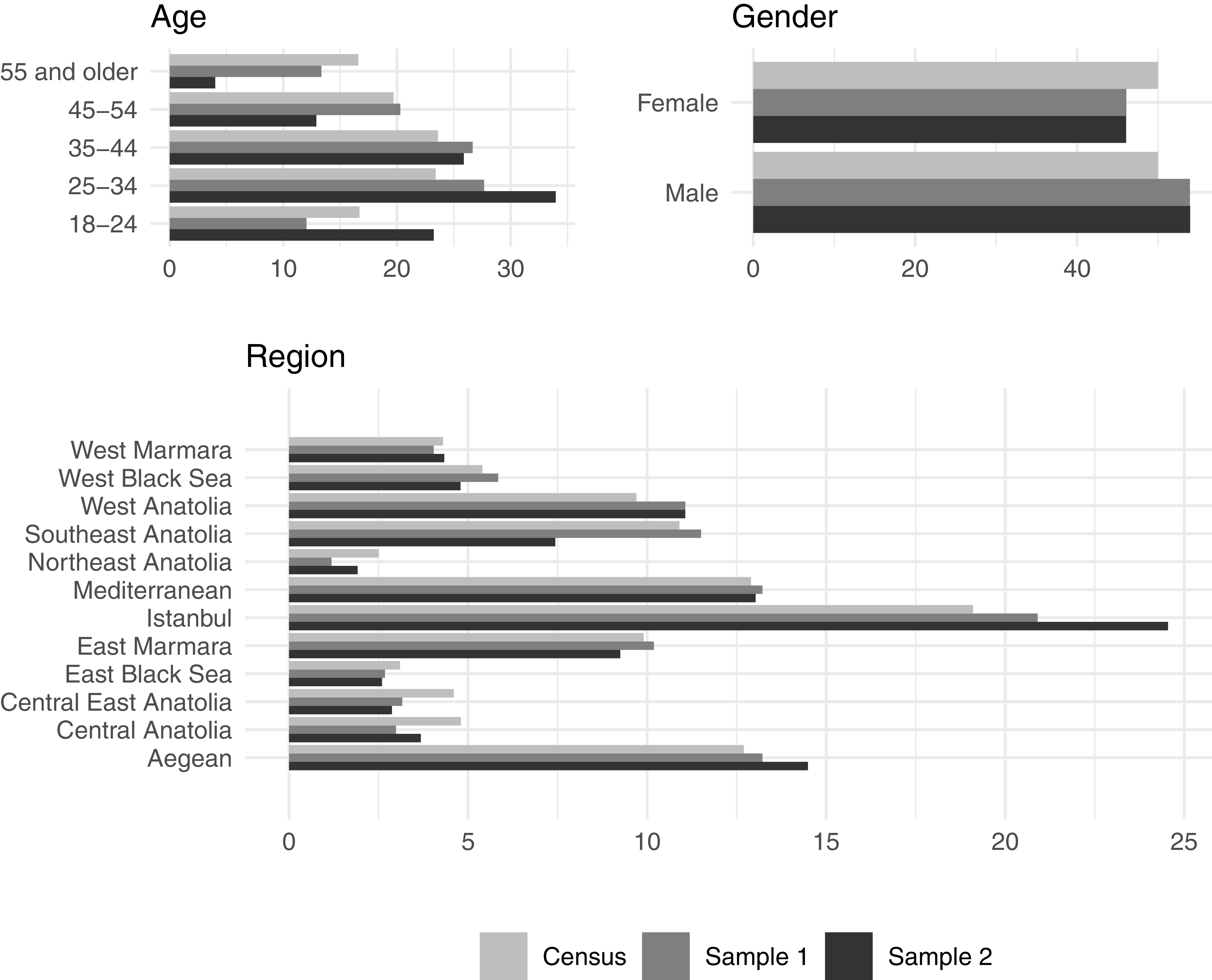
We used Qualtrics and Cint Marketplace to recruit respondents. Both online platforms rely on commercial panel providers, which recruit participants and verify their names, addresses, and dates of birth before inviting them to join their sampling panels. Respondents are compensated with money or equivalents, such as gift cards, and the panel providers regularly perform validity checks of respondents. Evaluation studies generally verify good data quality (Boas, Christenson and Glick Reference Boas, Christenson and Glick2020). 2312 and 3974 respondents completed the interviews in studies 1 and 2, respectively. Randomly drawn representative samples of the population are unfortunately hard to come by in authoritarian countries. To improve the representativeness of different groups (according to observable characteristics), both samples included target quotas for age, sex, and region. As reported in Figure 1, older respondents are underrepresented in study 2 and, as often in online surveys, highly educated and politically interested respondents are overrepresented in both studies (see online Appendix C). In robustness tests, we therefore run analyses applying census weights to ensure comparability between the studies and improve representativeness.
Main demographic variables, comparing our samples to the 2021 Turkish census. X-axes depict percentage shares.

Before random assignment to a propaganda or control video, respondents were asked about the likelihood of voting for Erdoğan.Footnote 6 53% (study 1) and 57% (study 2) of respondents report they are unlikely or very unlikely to vote for Erdoğan. We define these respondents as government opponents. The 47% (study 1) and 43% (study 2) who say they are likely or very likely to vote for Erdoğan are defined as government supporters.Footnote 7
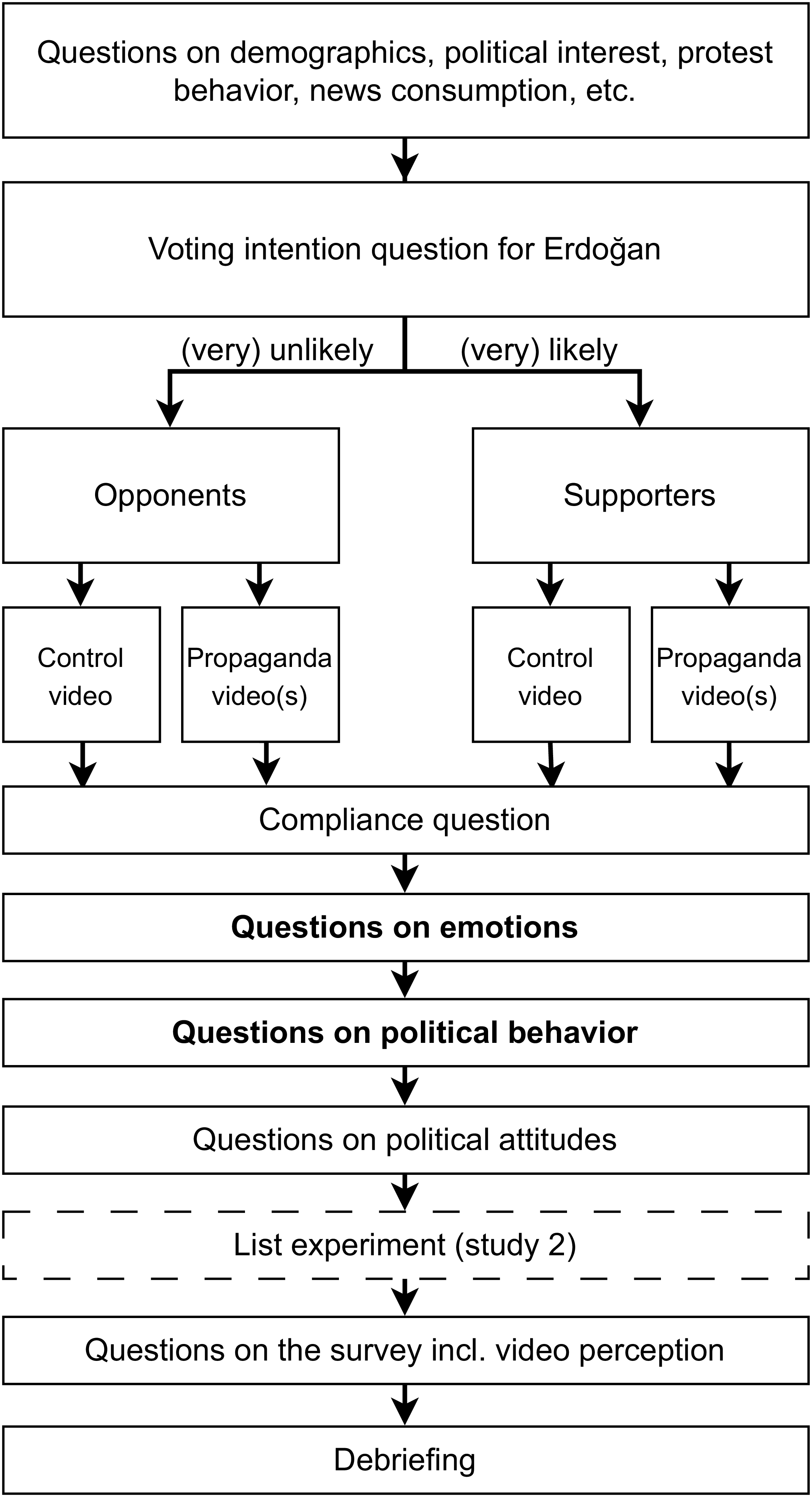
To ensure valid responses, we required that respondents have their audio turned on and screened out participants who could not play videos. Consistent with our preregistration, we also removed duplicates and likely bots, as flagged by the surveying platform. Figure 2 sketches the survey’s components and the sequence in which they were introduced to respondents.
Survey flow. Note: Outcomes that are theoretically relevant are highlighted in bold.
Propaganda videos
To identify suitable government-produced propaganda videos, we first reviewed the Turkish social media channels of Erdoğan, Turkey’s communication department, and other pro-government channels. After these searches, we pre-selected sixteen theoretically relevant three-minute videos, which we deemed to reflect overt power-projecting government propaganda (while still complying with the ethical considerations laid out below) and carry limited explicit informational content aimed at persuasion. The three authors, in consultation with several scholars of Turkish politics, independently assessed and ranked the videos based on their perceived capacity to convey strength, threat, and patriotism – core attributes of power-projecting propaganda. This process narrowed our selection to the three top videos. We then conducted a pre-study with 820 Turkish respondents, recruited via Qualtrics, who rated these top three propaganda videos along relevant dimensions. Based on these evaluations, we selected two videos as treatments for the main experiments.
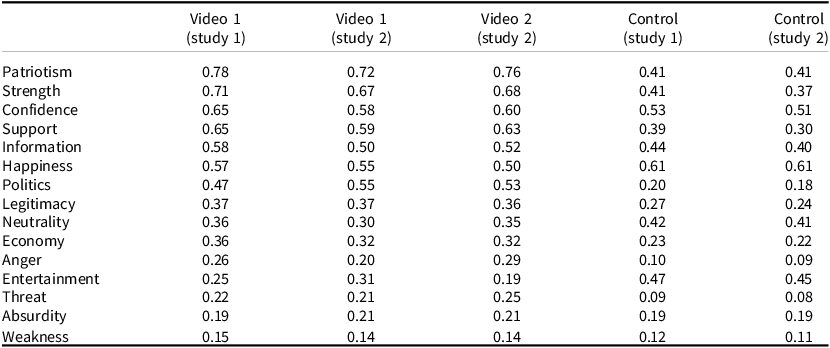
Respondents, toward the end of our main studies, rated the chosen video(s) as very high in displaying patriotism, strength, confidence, and support (Table 2). In study 1, only the highest-ranked video was used. In study 2, we introduced a second video to assess whether effects found in study 1 are generalizable across similar types of propaganda videos (or whether specific content drives effects). That is, we wanted to test for concept validity (Gerber and Green Reference Gerber and Green2012), in addition to assessing stability over time, that is, test for temporal validity (Munger Reference Munger2019).Footnote 8 To further assess concept validity, we asked respondents at the end of our main studies whether they agreed that the video was a form of government propaganda. While the majority of government opponents either agreed or fully agreed with this statement, supporters, on average, tended to disagree, perhaps due to the negative connotations the term carries. Moreover, many treatment respondents, again predominantly opponents, not only attributed the video to the government but also thought the survey was government-run (see online Appendix J).
Respondents’ average perception of videos, by study
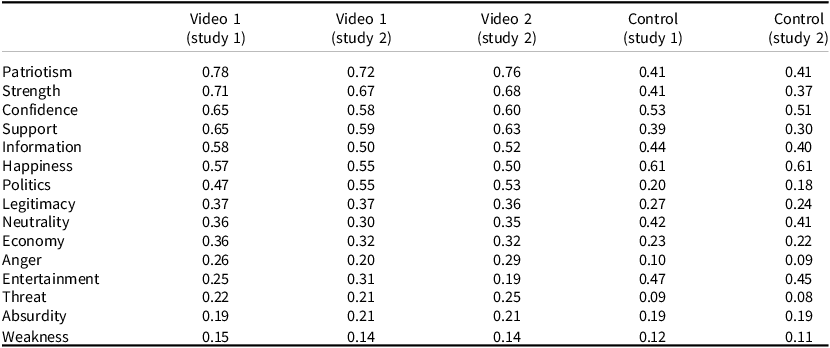
Note: The perception question was asked at the end of the study. Outcome variables were rescaled: 0 = concept not present at all, 0.33 = a little, 0.66 = a lot, and 1 = completely. The results are sorted along video 1 in descending order. As we show in Appendix B, the perceptions strongly vary between supporters and opponents, with the largest differences in confidence, happiness, support, and information.
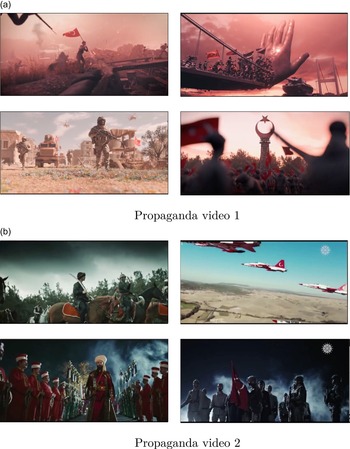
The videos selected for our experiments align with patterns identified by Hintz and Draege (Reference Hintz and Draege2025), who shows that AKP propaganda frequently uses Ottoman history and national struggle to project legitimacy and resolve. Video 1, entitled ‘From Gallipoli to July 15th, Turkey is impassable’, emphasizes the strength and unity of the Turkish nation in facing internal and external threats throughout history, especially against the 2016 coup attempt. The voice-over declares: ‘Your courage knows no bounds. A nation unyielding in unity, striding at the crossroads of two continents, confronting the traitors of July 15 with unwavering resolve, shall remain indivisible’. Video 2, included in study 2, differs by not explicitly referencing contemporary government enemies, but it heavily invokes historical sources of national pride often used by the AKP government. The video is entitled the ‘Kzl Elma’ march, referring to a nationalist myth of a lost homeland to which descendants of Oğuz Turks will eventually return. The lyrics and video depiction refer to the battle of Manzikert in 1071, Osman Gazi (the Ottoman Empire’s founder), and WWI and the subsequent independence war.Footnote 9 Figure 3 presents Snapshots from both videos.Footnote 10
Screenshots of the propaganda videos.

To prevent systematic differences in attrition and ensure the same survey duration between treatment and control groups, the latter group watched one of five randomly selected three-minute nature slideshows designed to minimize political associations and psychological reactions (Porter and Velez Reference Porter and Velez2022).Footnote 11 One potential concern is that the control videos could still influence psychological responses. While Table 2 shows that respondents rated the control videos highest in ‘happiness’, the median answers of our respondents in the control- and treatment groups to the statement ‘the watched video got me emotionally attached’ in the final survey section were, respectively, ‘disagree’ and ‘agree’ (see Figure J.3 in Appendix J). Evidence from other experimental work on propaganda videos also suggests limited differences between respondents who saw a nature control video vs. no video on different emotional, attitudinal, and behavioral outcomes (cf. Mattingly and Yao Reference Mattingly and Yao2022). Yet, we discuss potential concerns with the control videos in the limitations section.
Ethical considerations
We took several measures to ensure that our respondents would not be exposed to any harmful consequences or risks, and we received approval from an ethics review committee at the University of Oslo. First, we do not deceive respondents in our consent form but inform them that the study is on Turkish politics and includes videos. We further highlight that respondents can quit the survey at any point in time.Footnote 12
Second, our online setting ensured complete anonymity of participants, with the added advantage that anonymity should make it more likely that respondents answer truthfully. The online setting also mitigates potential interviewer effects. While we cannot rule out preference falsification on politically charged topics, prior research suggests it is less prevalent in Turkey (Shen and Truex Reference Shen and Truex2021). Indicatively, numerous respondents openly reported opposition to Erdoğan. To further probe for preference falsification, we included a list experiment on protest behavior at the end of study 2. The results suggest that questions on contentious political behavior are not too sensitive for many respondents to answer openly (see Appendix I.7).
Third, we made sure to select videos that do not show any form of explicit violence or threats to avoid inducing too strong negative emotional responses. Note that there is a clear trade-off between selecting explicitly threatening and powerful video messages that would presumably give more easily identifiable emotional effects and selecting less explicit messages to avoid negatively affecting the well-being of some respondents. All videos reflected the type of material many Turkish citizens routinely encounter, given that over 90% of mainstream media is controlled by government-aligned groups (Coşkun Reference Coşkun2020).
Outcome variables and method
To measure our three non-behavioral outcomes of interest (anxiety, anger, and sense of belonging), we relied on reduced four-item versions of established batteries (from Lee and Robbins Reference Lee and Robbins1995; Spielberger et al. Reference Spielberger, Jacobs, Russell and Crane1983; Spielberger Reference Spielberger1983) commonly used by psychologists. For example, items include questions such as ‘do you feel relaxed?’ to measure anxiety, ‘do you feel irritated?’ to measure anger, and ‘do you feel that you belong to the society you live in?’ to measure sense of belonging. In study 2, we additionally used items from the PANAS-X survey (Watson and Clark Reference Watson and Clark1994) to measure anxiety; an example question is: ‘Do you feel anxious?’Footnote 13 Appendix D provides further details on each battery.
Across the batteries, items were standardized so that respondents could answer each item on a four-point scale: never, a little, a lot, and completely. We created indices by mean-aggregating all items within a battery. To ensure internally consistent measures, and as specified in our pre-analysis plan, we aimed for Cronbach’s $\alpha \geqslant 0.7$
and wanted to leave out less well-fitting items. Table 3 shows that all the final indices receive sufficiently high
$\alpha \geqslant 0.7$
and wanted to leave out less well-fitting items. Table 3 shows that all the final indices receive sufficiently high $\alpha $
values. To achieve these values, we had to leave out one poorly fitting item from the anxiety battery and one from the group-belonging battery in study 1. Results from exploratory factor analyses support the creation of these indices and give fairly similar results (Appendix D).
$\alpha $
values. To achieve these values, we had to leave out one poorly fitting item from the anxiety battery and one from the group-belonging battery in study 1. Results from exploratory factor analyses support the creation of these indices and give fairly similar results (Appendix D).
Cronbach’s $\alpha $
for the emotional outcomes
$\alpha $
for the emotional outcomes

Our other outcomes pertain to politically contentious behavior. We measure the potential for such behavior, which we further classify as anti- or pro-government, with several variables. More specifically, we ask respondents about their willingness to join anti- or pro-government protests and write anti- or pro-government social media posts. Additional relevant outcome questions, discussed in Appendix G, concern respondents’ beliefs about the likelihood of others to openly challenge or support the government, willingness to partake in a special form of (mild) anti-government protest, and respondents’ willingness to donate to different non-governmental organizations.
We run our analysis within the pro- and anti-government sub-samples separately, using ordinary least squares (OLS) models with robust (HC3) standard errors.Footnote 14 We run two sets of specifications (results are very similar): one is the OLS models without pre-treatment variables, and the other includes the pre-treatment variables to increase precision. As stated in our pre-analysis plan (PAP), we consider the latter specifications with controls as our main ones and report results after normalizing outcomes to range from 0 to 1. In Appendix E, we provide tabular results for our main specifications, and in Appendix F, we visualize results for the original scales using difference-in-means tests.Footnote 15
Results
Emotions
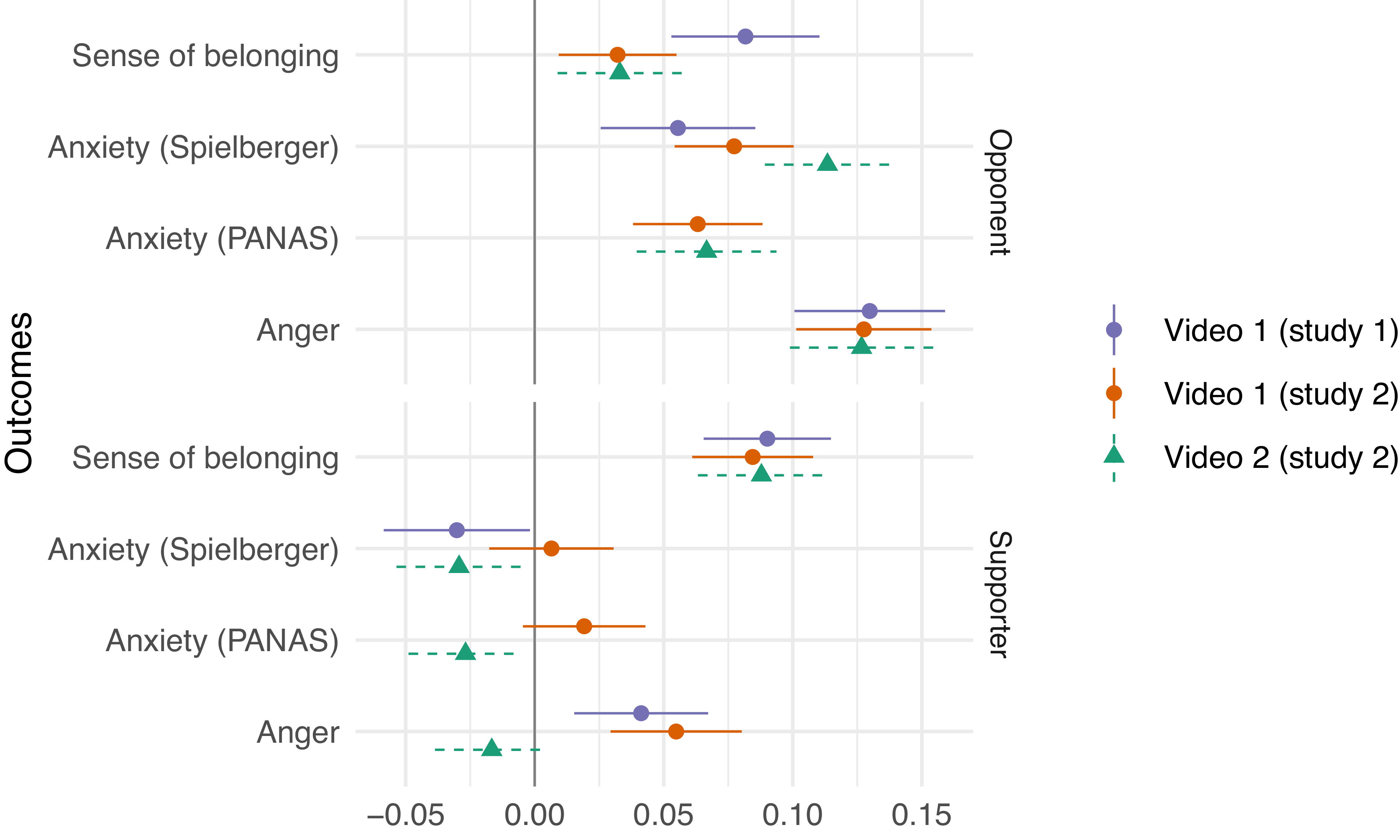
Figure 4 shows the effect sizes (with 95% confidence intervals) on the various emotions/feelings reported after being exposed to the propaganda videos. It does so for both studies and also distinguishes between the two treatment videos. Moreover, we distinguish between government opponents and supporters, following the theorized heterogeneity in emotional responses to power-projecting government propaganda. Despite the differences between the treatment videos and the different contexts in which the two experiments took place, most results are fairly stable. However, there are some exceptions, which we comment on below.
Estimated effects of watching propaganda videos on normalized self-reported emotions, ranging from 0 (not at all) to 1 (completely), surrounded by 95% confidence intervals.
Note: Answer distributions and diff-in-means tests are displayed in Appendix F, and substantial effect sizes are discussed in the main text. When adjusting for multiple comparisons (see Appendix I.5), both anxiety results for government supporters seeing video 2 in study 2 become non-significant.

We start by considering the emotional responses of government opponents. The results suggest systematic reactions for different emotions or feelings, mostly following our theoretical expectations. First, as expected, watching the propaganda videos systematically increases anxiety among opposition members. While effect sizes vary somewhat across studies (lower in study 1), videos (lower for video 1), and operationalization (lower for PANAS battery), they are consistently positive and fairly substantial in size (standardized change in SD between 0.21 and 0.47).Footnote 16
Second, also consistent with our expectations, the propaganda videos enhanced anger among government opponents. The effect is considerable in size – even more so than for anxiety – and remarkably consistent across studies and treatment videos (change in SD between 0.45 and 0.50).
Finally, we did not have a clear expectation on how propaganda videos would influence the sense of belonging among government opponents. Empirically, however, we find a clear positive result across videos and studies, although the estimated effect is largest in study 1 (change in SD of 0.31). Our results thus suggest that watching government-produced propaganda videos enhances feelings of societal belonging among opposition supporters, at least in the electoral authoritarian Turkish context. One plausible interpretation is that, given the amount of patriotic, nationalist content in these propaganda videos, the government is able to reach at least some opponents with these videos. That is, the videos resonated with nationalist sentiments even among some opposition supporters, contributing to an increased sense of societal belonging. Supporting this interpretation, and as reported in Appendix K, measures for patriotism slightly increased for government opponents watching propaganda video 1, especially in study 1 (change in SD 0.18).Footnote 17 This further highlights that the effects of propaganda can be multifaceted, potentially reinforcing broader identity frames even across political divides.
For government supporters, watching either of the two propaganda videos substantially increases the sense of belonging, as theoretically expected. The effect is sizeable, highly significant, and very consistent across studies and video treatments (changes in SD between 0.39 and 0.41). The effects on anger and anxiety appear smaller and inconsistent, depending on the video or study context. Hence, our theoretical expectation of a positive effect on anger (also) among government supporters is not fully supported. As noted, the theoretical rationale behind this expectation was weaker than the expectation on anger for government opponents, and we highlighted how it is likely conditional on propaganda contents. In this regard, we note that the estimated increase in anger is highly significant for video 1 in both studies (changes in SD between 0.19 and 0.25), possibly reflecting that the stronger focus on internal and external enemies in this video fostered more anger among supporters. For anxiety among government supporters, we did not have any clear theoretical expectations, and our results show no clear patterns that are robust across videos and studies.
In sum, we find clear support for three out of four theoretical expectations on emotions or feelings, observing that government supporters watching propaganda videos obtain a stronger sense of belonging and that government opponents react with increased anger as well as increased anxiety.
(Reported) political behavior outcomes
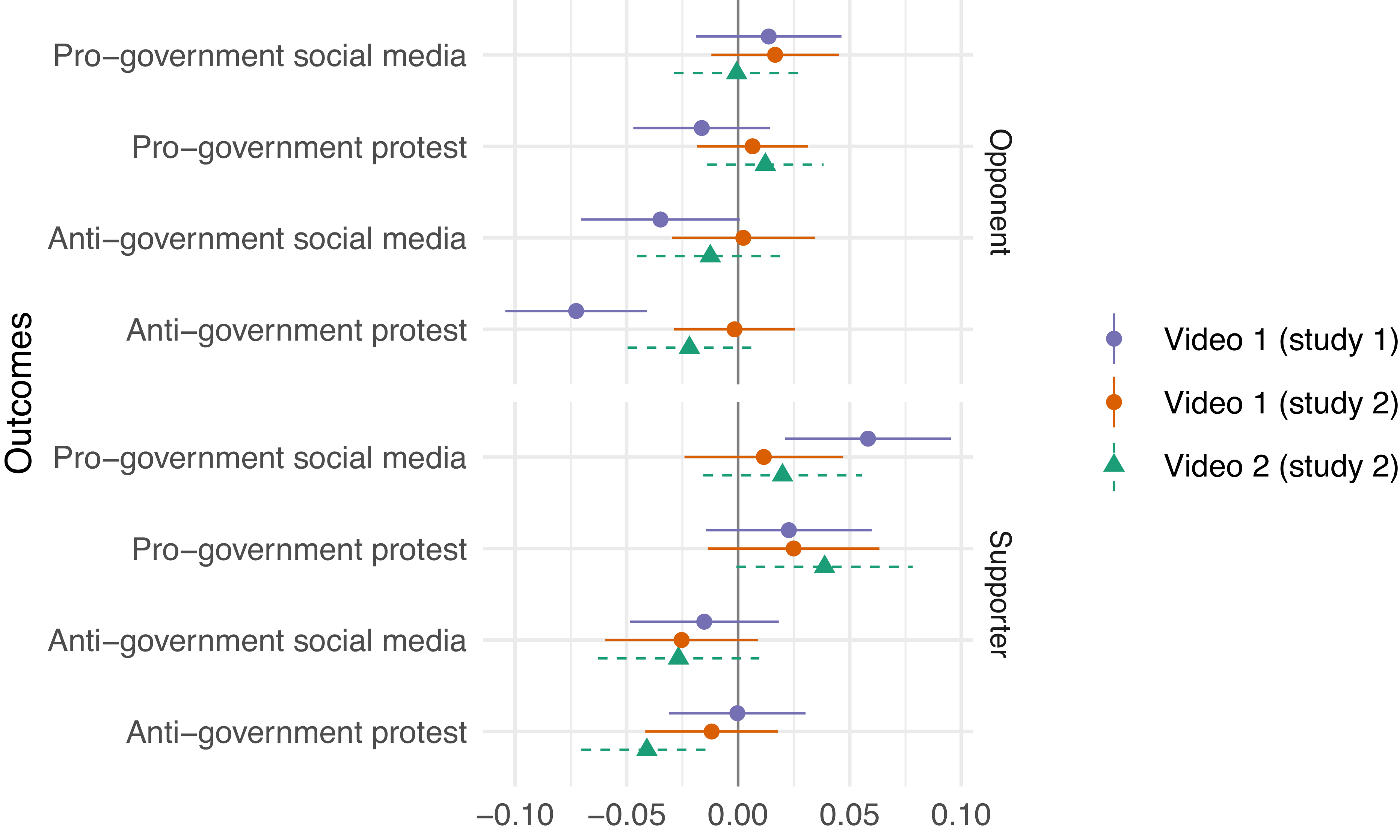
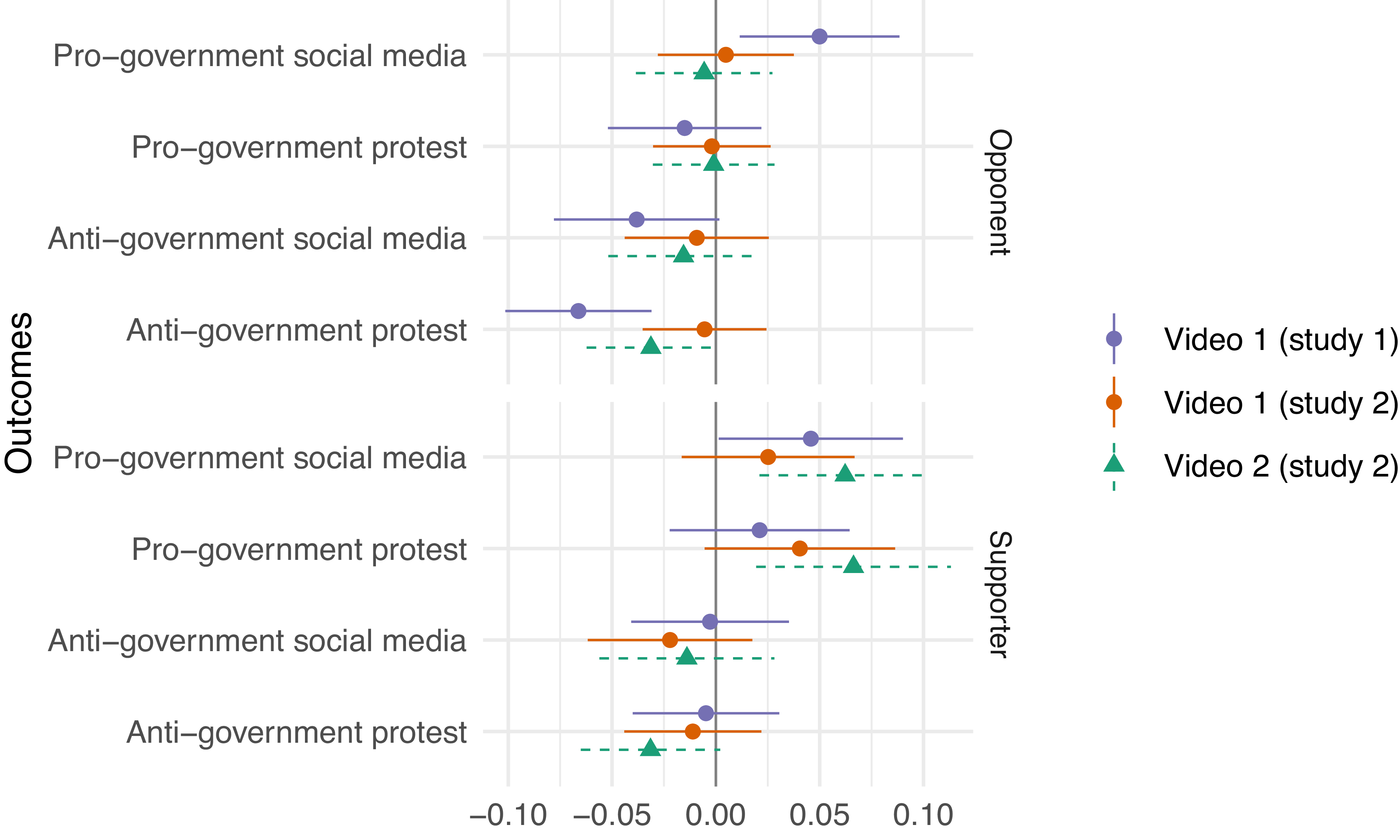
Let us now consider reported behavioral responses. Starting with government opponents, and as shown in Figure 5, watching the propaganda video in study 1 seemingly has a deterring effect. Government opponents are significantly less likely to report that they would participate in anti-government protests (change in SD −0.22). Interestingly, this effect is comparable in size with previous findings from not only electoral authoritarian Venezuela, where respondents looked at propaganda images (Lutscher and Donnay Reference Lutscher and Donnay2025a, change in SD −0.13), but also China, a closed autocracy (Huang Reference Huang2018, change in SD −0.25). Watching the video also decreases – albeit to a lesser degree – the (reported) likelihood of posting anti-government social media posts (change in SD −0.11).Footnote 18 In study 1, conducted during a period without any significant political events happening, power-projecting government propaganda thus seems to achieve one of its main purported effects – deterring anti-government behavior – in the Turkish context. This is a type of chilling effect that authoritarian leaders, who are eager to avoid challenges to their rule and retain power, would most certainly welcome.
Results of watching the propaganda videos on self-reported political behavior questions, normalized to range from 0 (very unlikely) to 1 (very likely).
Note: Answer distributions to each question are displayed in Appendix F, and substantial effect sizes are discussed in the main text. The results hold when adjusting for multiple comparisons (Appendix I.5) and when operationalizing anti- and pro-government protest relying on the pre-treatment question on political action (Figure I.5).

Our results from study 2, however, suggest that such chilling effects may be context-sensitive.Footnote 19 The effects of video 1, both on reported willingness to participate in anti-government protests and write social media posts, are strongly attenuated, and the treatment effects of this video turn non-significant at conventional levels. Moreover, while we do estimate negative effects on anti-government social media posting and protest for video 2 (in study 2), the effects are non-significant. This is despite video 2 clearly enhancing anxiety for government opponents.Footnote 20 While we cannot exclude the possibility that other factors, as well as time-specific contextual ones, explain the cross-study difference, we surmise that the high degree of mobilization, greater discontent, and increased access to alternative information during the election campaign are plausible candidates. One speculation is that once government opponents observe mass mobilization for opposition parties, government propaganda is less effective in deterring people from joining in on protests or posting online (despite the propaganda having similar effects on respondents’ emotions). If so, our results might suggest a mechanism through which ‘cascading effects’ (Kuran Reference Kuran1989; Lohmann Reference Lohmann2000) happen in anti-regime collective action.
However, the above-discussed chilling effect is not the only possible favorable outcome, from the perspective of the regime, that propaganda might achieve. Propaganda could also spur pro-government action among supporters. Indeed, there are some indications that this is occurring, especially from study 1, where watching the propaganda video increases government supporters’ likelihood to write pro-government social media posts (change in SD 0.16). Furthermore, although we do not find significant patterns for pro-government protests, point estimates are consistently positive and just miss the 95% confidence interval threshold for video 2 in study 2. Additional models reported in the robustness section show significant and stronger effects on pro-government actions if we operationalize government supporters by using party choice or only consider definitive Erdoğan voters.
To summarize, we find mixed evidence of behavioral effects for certain outcomes and no evidence for others. There are plausible explanations for these result-patterns. First, we highlighted that, especially during study 2 with high political activity during the election campaign, our intervention might be less potent in influencing behavior, as many participants were effectively ‘pre-treated’. Second, regardless of study context, our theoretical argument suggests that relatively weak or mixed results may partly reflect that different psychological effects of viewing propaganda videos pull protest behavior in opposite directions. For example, such videos might increase both anxiety and anger among government opponents, but whereas anxiety, in turn, has a pacifying effect on protest behavior, anger has an activating effect. We now turn to unpacking such more specific mechanisms.
Unpacking the mechanisms
Finally, we run multiple mediation models to account for the videos influencing different psychological states simultaneously. That is, we include the two other emotions/feelings in the model when exploring the mediation effect of every single mediator. Briefly, our results support two (of four) theorized mechanisms across both studies. First, they suggest a positive mediation effect via sense of belonging on pro-government behavior for supporters, reporting an increase of 2–3% in the propensity to join protests. Second, the mediation effect via increased anger increases the willingness to join anti-government protests for opponents by 2.1–3.4%. While these figures might seem low, they make up as much as 57% of the explained variation (with specific numbers depending on outcome, video, and study). One important caveat, however, is that the results seem sensitive to the strong assumptions necessary for identification (Imai, Tingley and Yamamoto Reference Imai, Tingley and Yamamoto2013; Imai et al. Reference Imai, Keele, Tingley and Yamamoto2011). We discuss these assumptions and models in greater detail in Appendix H.
Robustness tests and limitations
One concern is that our definition of government opponents and supporters might be too broad. Addressing this concern, we ran models where we operationalized government support vs. opposition by using (a) only extreme answers on presidential voting (very unlikely vs. very likely to vote for Erdoğan) and (b) parliamentary party voting.Footnote 21 Results are reported in Appendix I.3 and show quite similar patterns, overall. Yet, two notable differences emerge for our political behavior outcomes. As displayed in Figure 6, the effects of propaganda on government party supporters posting pro-government social media posts and joining pro-government protests are more pronounced and significant for both outcomes in study 2 (especially video 2: changes in SD of 0.18 and 0.19, respectively).Footnote 22 Second, beyond being deterred from anti-government protests, opposition party supporters reported being slightly more prone to publish pro-government social media posts after seeing video 1 in study 1 (change in SD 0.16). Yet, closer scrutiny suggests that this largely reflects fewer respondents choosing the ‘very unlikely’ option relative to the control group.Footnote 23
Results of watching the propaganda video 1 on 0 (very unlikely) to 1 (very likely) normalized self-reported political behavior questions, using party choice to operationalize government support.

Next, we explored whether our study suffers from systematic attrition. In study 1, we record no systematic attrition; that is, respondents in the control and treatment groups were equally likely to drop out. Nevertheless, we record a higher drop-out for the video part of the survey (for both groups); this seems due to some respondents encountering technical problems when playing the videos, particularly in study 1. Some respondents also seemingly encountered technical problems in study 2, despite our best efforts to mitigate this issue before launching the survey. Study 2 has a slightly higher attrition rate for the control video than for the propaganda video 1. In Appendix I.4, we therefore present evidence from trimmed bound analyses, showing that attrition patterns are unlikely to alter results.
Another concern is that preference falsification drives our results. We included several questions and ran two tests to explore whether our results may suffer significantly from such bias. First, we included a list experiment in study 2 on propensity to join anti-government protests, which we believed was the most sensitive question for government opponents. The results, in Appendix I.7, suggest that respondents are actually more likely to state they would join an anti-government protest in the direct question, indicating that this answer is not particularly sensitive. Second, we included a final survey question asking who respondents think conducted the survey. Interestingly, 50% (study 1) and 61% (study 2) of government opponents in the propaganda video groups believed the government was behind the survey; this share was only 16% (study 1) and 19% (study 2) in the control groups.Footnote 24 The different results may reflect selective self-censorship, particularly among opponents, who might, for example, have avoided participating during the more politically charged period of our second study. Since we did not pre-screen participants nor rely on panel data, we cannot rule this out. Yet, since anti-government sentiment was openly and widely expressed during this period and our surveys guaranteed full anonymity, we consider this explanation less likely (cf. Dal and Nisbet Reference Dal and Nisbet2022).
Taken together, our results are consistent with those of Robinson and Tannenberg (Reference Robinson and Tannenberg2019); there is no clear relationship between individuals’ thinking that the government is behind a survey and indications of self-censorship. This suggests that our results have high external validity, particularly since many respondents attributed the propaganda videos to the Turkish government. Nevertheless, it is plausible that respondents who believed the government was behind the study reacted differently to the propaganda videos, both emotionally and behaviorally. To explore this, we ran (not preregistered) analyses comparing responses between those who did and did not believe the government was behind the study. As shown in Appendix I.6, the overall results remain comparable.
Finally, since our two samples differed, particularly on age distribution, we reran our main analyses using census-derived weights on age, gender, and region.Footnote 25 The results are quite similar, although confidence intervals increase for the behavioral outcomes of study 2 (Appendix I.1). While this procedure improves representativeness, our samples are still non-probabilistic, and respondents may differ on other (non-)observable characteristics. Absent representative samples in our study context, this is a limitation that we cannot fully mitigate.
Concerning other limitations, we first rely on self-reported information to measure psychological states. Although this approach is still considered standard Reference Robinson and Tannenberg(Delton et al. Reference Delton, Bang Petersen, DeScioli and Robertson2018; Mattingly and Yao Reference Mattingly and Yao2022; Öztürk Reference Öztürk2023); it is an indirect measurement strategy. Yet, other strategies, such as relying on eye-tracking methods (Skaramagkas et al. Reference Skaramagkas, Giannakakis, Ktistakis, Manousos, Karatzanis, Tachos, Tripoliti, Marias, Fotiadis and Tsiknakis2023) or directly measuring arousal (Bakker, Schumacher and Rooduijn Reference Bakker, Schumacher and Rooduijn2021), are more difficult to use in authoritarian regimes due to ethical concerns.
Second, propaganda videos – as our results suggest – generate various psychological responses, and it remains difficult to perfectly isolate the effect of one emotion/feeling on political outcomes (Aldama et al. Reference Aldama, Sambrano, Vásquez-Cortés and Young2023; Searles and Mattes Reference Searles and Mattes2015). This caveat is even more important if there are unmeasured emotions that correlate with the emotions/feelings that we measure, and which drive political behavior. Future research may theorize, measure, and assess other relevant emotions, also in multiple mediation models. Moreover, to test whether measures of various emotions, more generally, are nudged by propaganda videos in this type of research setting, future studies could measure emotions that are theoretically expected to be unaffected and include them in placebo tests.Footnote 26
Third, concerning political-behavioral outcomes, we follow established work and ask respondents to self-report their likelihood of engaging in protest and other behavior (Carter and Carter Reference Carter and Carter2023; Huang Reference Huang2015; Huang and Cruz Reference Huang and Cruz2022; Kwak Reference Kwak2022; Lutscher and Donnay Reference Lutscher and Donnay2025a; Mattingly and Yao Reference Mattingly and Yao2022). While we try to assess and account for strategic reporting – for example, by including a list experiment on protest participation, which we anticipated would be the most sensitive question – we cannot guarantee that our results are unaffected by it. Importantly, though, by following this conventional practice, we ensure that we do not enhance personal risks of any respondent by encouraging or discouraging them to actually engage in collective action (American Political Science Association 2020).
Fourth, differences in results between our two studies may stem from differential desirability biases potentially influencing reported government support or even self-selection into the survey sample. If government opponents are less likely to honestly report voting intentions (which could be assessed, eg by list experiments in future work) or partake in surveys during contentious periods, this could attenuate results in study 2. Moreover, the behavioral results might be less pronounced in study 2, not because of higher levels of contention, but because the treatments are less informative during election times, since citizens were highly exposed to similar contents. Since the results on emotions/feelings were equally strong in study 2, we find this alternative interpretation less likely (cf. Yang and Zhu Reference Yang and Zhu2025). Yet, future experiments could isolate and further assess different mechanisms that might contribute to differential effects of propaganda across contexts with high and low political contention.
Finally, we measure our outcomes immediately after the treatment, thus capturing (very) short-term effects. Watching one propaganda video is unlikely to have sizeable long-term effects on psychological states or behavioral patterns. The treatment is simply too weak, as it also must be, due to ethical considerations. Concerning the real-world relevance (ie external validity) of our findings, we do note, however, that citizens of authoritarian regimes are ‘treated’ to power-projecting propaganda regularly in their everyday lives. The accumulated effect of such (higher-dosage) treatment, we speculate, may have more lasting and notable effects on emotional states and behavioral patterns. Yet, we cannot say anything with certainty about effect-persistence or cumulated effects from consistent exposure to power-projecting propaganda based on our study.
Conclusions
We examined how power-projecting propaganda shapes emotions, feelings, and political behavior in electoral autocracies, using two large survey experiments in Turkey. Our argument and empirical studies help shed light on the heterogeneous effects of power-projecting propaganda videos in (polarized and politicized) electoral authoritarian settings where many citizens are clearly situated within either a pro- or an anti-government camp. For example, in such societies, we expect government propaganda to enhance anxiety among opponents but not among supporters. Regarding non-behavioral responses, we find robust support for three of four preregistered hypotheses: Watching propaganda videos enhances not only the sense of societal belonging for government supporters but also the feelings of anxiety and anger among government opponents.
Yet, effects are heterogeneous and differ in strength; government supporters and opponents have different emotional and behavioral reactions to consuming propaganda, and some effects seem to depend on contextual factors. In particular, our results suggest that the deterrence effect of propaganda on anti-government protest participation was weakened during the 2023 Turkish election campaign; we speculate that this is because opposition was already mobilized and counternarratives were more easily accessible to voters. Despite these nuances, our study illustrates that propaganda can have various effects on both government supporters and opponents, even in electoral authoritarian settings where the information space is more contested than in closed autocracies. This makes the use of power-projecting propaganda a potentially effective tool also for those leaders who allow for some freedoms and multiparty elections, albeit with unfree or unfair competition (cf. Lutscher and Donnay Reference Lutscher and Donnay2025b).
Beyond contributing to the wider literature on contentious politics and protest behavior (eg Gurr Reference Gurr2015; Lichbach Reference Lichbach1998; Opp and Roehl Reference Opp and Roehl1990) as well as the one on politics and survival strategies of electoral authoritarian regimes (eg Hellmeier et al. Reference Hellmeier, Cole, Grahn, Kolvani, Lachapelle, Lührmann, Maerz, Pillai and Lindberg2021; Lührmann, Tannenberg and Lindberg Reference Lührmann, Tannenberg and Lindberg2018; Schedler Reference Schedler2006), our argument and results primarily contribute to the study of propaganda in autocracies. This rapidly growing literature, mainly studying closed autocracies, has documented several notable patterns (Carter and Carter Reference Carter and Carter2023; Huang Reference Huang2015, Reference Huang2018; Lutscher and Donnay Reference Lutscher and Donnay2025a; Mattingly and Yao Reference Mattingly and Yao2022; Rosenfeld and Wallace Reference Rosenfeld and Wallace2024; Wedeen Reference Wedeen2015). Our findings contribute to this literature by highlighting how behavioral responses to power-projecting propaganda may be transmitted through such propaganda, influencing different (activating or pacifying) emotions and feelings, specifically anger, fear, and the sense of societal belonging.
We also contribute to the literature by theorizing and analyzing the effects of power-projecting propaganda videos in the understudied setting of electoral autocracies, while distinguishing between responses by government supporters and opponents. Our results show how power-projecting government propaganda can yield several responses for one group of individuals (eg enhancing not only anger but also anxiety among government opponents) as well as varying emotional and behavioral reactions across different groups. Such differential reactions are also reflected in other recent work. Shirikov (Reference Shirikov2024), for instance, shows that government supporters are much more likely to believe propaganda messages when they speak to the core beliefs and identities of the viewer. Yet, our study illustrates that even some opponents could be reached by power-projecting nationalist propaganda. Finally, our results indicate how responses to propaganda may vary depending on contextual factors, specifically highlighting how an ongoing election campaign moderates mobilizing or deterring behavioral effects (cf. Rosenfeld and Wallace Reference Rosenfeld and Wallace2024; Yang and Zhu Reference Yang and Zhu2025).
In sum, we contribute to the propaganda literature by showing that power-projecting government propaganda ‘works’ in electoral authoritarian regimes. Our findings further highlight how the effects of such propaganda are multifaceted, nuanced, and interlinked, shaping protest behavior through the elicitation of various emotions and feelings among government supporters or opponents.
Our study opens up several avenues for future research. Future studies may, for example, continue to investigate the heterogeneous nature of the effects of propaganda. First, our results indicate differing effects based on existing levels of support among citizens. Turkey has a highly politicized and polarized citizenry, making the opponent/supporter divide more clean-cut than in many other cases. Future studies might explore how this approval-based heterogeneity plays out in other contexts, including less polarized authoritarian regimes. One might also suspect that similar patterns could appear for some emotional responses in highly polarized but more democratic regime contexts (see Lutscher and Donnay Reference Lutscher and Donnay2025b, for tentative evidence). Whether power-projecting government messages would invoke similar feelings of, for example, a sense of belonging or anger among opposition or government supporters in polarized democracies – where, for example, the media and information environment is more pluralistic and government repression is a less imminent threat – would, however, require further theorizing and creative thinking about adaptations of the research design.
Furthermore, our study indicates that (deterring) effects of propaganda on protest behavior may be weakened in times of already high mobilization, when other ongoing events and dynamics may be so prominent that they dominate whatever impact propaganda might have on citizens. Future studies may further explore such conditionalities and – as discussed in the limitations section – account for alternative methodological and substantial explanations. Future work could also study the potential relevance of ‘mobilizing events’ other than ongoing elections, such as economic crises, political scandals, or military victories, which might ‘mobilize’ government supporters and opponents in different ways and potentially influence how propaganda is perceived and translates into emotional reactions (cf. Baturo and Tolstrup Reference Baturo and Tolstrup2024; Greene and Robertson Reference Greene and Robertson2022). We hope that future research will shed light on these and other questions that are left unanswered by our study.
Supplementary material
The supplementary material for this article can be found at https://doi.org/10.1017/S1475676526100942.
Data availability statement
All replication code, data, and the pre-analysis plan are available at https://osf.io/bv8sm/files/.
Acknowledgements
We thank the following for their helpful input and feedback at various stages of the research process: Lisel Hintz, Aytuğ Şaşmaz, Gözde Çörekçioğlu, Turkay Nefes, Hanne Fjelde, Anita Gohdes, Liu Dongshu, and Noah Buckley, as well as participants at the 2022 Experimental Approaches to Authoritarian and Political Violence workshop at the University of Oslo, 2022 Mobilization and Democratization workshop at PRIO, 2023 Social Media and Contentious workshop at PRIO, the 2023 and 2024 Annual EPSA Conferences in Glasgow and Cologne, and seminar presentations at the University of Oslo, Özyeğin University, Sabanci University, and Diyarbakir University.
Funding statement
The authors gratefully acknowledge funding for this project through Småforsk grants from the Department of Political Science at the University of Oslo and Oslo New University College, as well as the Research Council of Norway FRIPRO Project Policies in Dictatorships (pnr 300777).
Competing interests
There are no competing interests.
Ethical standards
This study received an IRB ethics approval in 2022 at the Department of Political Science, University of Oslo.







 Open access

