


Introduction
Inference to the best explanation (IBE) has been the theme of a lively debate among philosophers who have often found themselves divided about the validity of this pattern of reasoning (van Fraassen, Reference van Fraassen1989; Kapitan, Reference Kapitan1992; McMullin, Reference McMullin1992; Lipton, Reference Lipton2004; Paavola, Reference Paavola2005). Despite a certain dependence on philosophy-led accounts, especially during the 1970s and 1980s, much ink has been spilled in archaeology on methods of investigation while few studies have addressed the specific topic of how archaeologists come to their conclusions (Gardin, Reference Gardin1980; Hodder, Reference Hodder1999). In the last few decades, however, a growing number of scholars has addressed more deeply how archaeological reasoning has structured itself (Salmon, Reference Salmon1982; Hanen & Kelley, Reference Hanen, Kelley, Pinsky and Wylie1989; Gardin, Reference Gardin and Franck2002, Reference Gardin, Višnjackij and Klejn2004; Wylie, Reference Wylie2002; Fogelin, Reference Fogelin2007; Smith, Reference Smith2015; Chapman & Wylie, Reference Chapman and Wylie2016; Lucas, Reference Lucas2018). Among them, Hanen and Kelley (Reference Hanen, Kelley, Pinsky and Wylie1989) and Fogelin (Reference Fogelin2007) have identified IBE as an effective pattern for hypothesis selection in archaeology. Importantly, this connects with the most recent advances in bottom-up theorizing in archaeology (Reichertz, Reference Reichertz, Bryant and Charmaz2007; Lucas, Reference Lucas2015) and contemporary debate about the management of archaeological information in digital form (Dallas, Reference Dallas2016).
In this article, I examine how this particular type of inference has manifestly or more subtly found an application in the recent history of archaeological reasoning. In addition, a specific IBE-based ‘pipeline’ for recording archaeological reasoning will be defined in the light of the arguments discussed.
An account of IBE against two other major types of inference, deduction and induction, is given here, followed by an examination of the pervasiveness of the inference to the best explanation in archaeological reasoning. Finally, an IBE-based methodology is defined, building on an assessment of recent studies and on some findings from a case study in Pompeii (in Campanaro, in prep.), to suggest how the IBE-based procedure outlined here may be used in practice.
Inference to the Best Explanation
Inference to the best explanation, or abductive reasoning, has often been identified as one of the three major types of inference, together with deduction and induction. Despite being still a matter of controversy, with opinions ranging from ‘no inference at all’ (van Fraassen, Reference van Fraassen1989: 161) to ‘the inference that makes science’ (McMullin, Reference McMullin1992), many philosophers agree on defining IBE as commonly used both in everyday life and scientific reasoning. It can be useful, before analysing the connection between archaeology and IBE, to explain in greater detail what IBE is, compared to deductive and inductive patterns. First, a distinction should be made between necessary and non-necessary inferences, namely between deduction on the one hand, and induction and abductive reasoning on the other.
A textbook example of deductive reasoning is: All men are mortal / Socrates is a man / Therefore, Socrates is mortal.
The essence of deduction lies in an appropriate relation between the premises and the conclusion, namely that the last proposition, inferred from the first two premises, is necessarily true if the premises are true.
Yet, not all inferences are of this kind. Consider, for instance, the following: A lives in B / Most people living in B are poor / A is poor.
In this example, the truth of the conclusion is likely to be inferred from the premises, i.e. even if the premises are true, the conclusion could be different. A second group of non-necessary inferences can thus be introduced, comprising inductive and abductive reasoning. The main trait of this class of reasoning seems to be an inference based on statistical data.
Consider now the following example suggested by Okasha (Reference Okasha2002: 29): The cheese in the larder has disappeared, apart from a few crumbs / Scratching noises were heard coming from the larder last night / Therefore, the cheese was eaten by a mouse. The premises do not entail the conclusion as in a deductive pattern. Here the conclusion can be inferred as the one that best explains the given set of data.
A further distinction between abductive and inductive reasoning can be suggested: although both are ampliative (their conclusions go beyond what is included in their premises), the first invokes explanation whereas the second only refers to frequencies or statistics. To clarify, ‘[…] in abduction there is an implicit or explicit appeal to explanatory considerations, whereas in induction there is not; in induction, there is only an appeal to observed frequencies or statistics’ (Douven, Reference Douven2017).
Why, then, prefer abduction or IBE over other forms of inference? It is useful here to anticipate some of the issues developed later. Given the limitations shown by the hypothetico-deductive method in archaeological research (see below), one might assume that ‘induction must be involved in a great deal of good archaeological reasoning’ (Fogelin, Reference Fogelin2007: 606). Yet, statistical inductions, being highly dependent on previous observations (both in terms of quantity and diversity), would not adequately address particularities in the past. For example, ‘when archaeologists evaluate inferences concerning the Pyramids of Giza, how many other massive, awe-inspiring pyramid complexes along the Nile can they observe?’ (Fogelin, Reference Fogelin2007: 608). In this sense, the inference to the best explanation would be an advance over statistical induction since it can account for multiple lines of evidence for infrequent phenomena in archaeology. Additionally, as claimed by Weintraub (Reference Weintraub2013: 203), IBE would be an ‘autonomous (indispensable) form of inference’ and induction a special case of it, so that when we infer a generalization from a uniform sample, we are applying IBE standards (Weintraub, Reference Weintraub2013: 210).
Before proceeding further, some clarification concerning the use of the terms IBE and abduction is needed. In the historical sense, Peirce (Reference Peirce, Hartshorne, Weiss and Burks1931–1958) first coined the term ‘abduction’ and proposed a specific dynamic involving deduction and induction. According to Peirce ‘Abduction merely suggests that something may be. Its only justification is that from its suggestion deduction can draw a prediction which can be tested by induction’ (Peirce, Reference Peirce, Hartshorne, Weiss and Burks1931–1958, vol. 5: 171). In this formulation, the aim of abduction is to lead to a new concept or theory that explains surprising facts (t0 in Figure 1). In the 1960s, Harman proposed his own interpretation of abductive reasoning, identified by him as IBE, so that when adopting it ‘one infers, from the premise that a given hypothesis would provide a “better” explanation for the evidence than would any other hypothesis, to the conclusion that the given hypothesis is true’ (Harman, Reference Harman1965: 89). In sum, the best explanation is also the most likely to be true, a truth relative to evidence and the current state of knowledge (Minnameier, Reference Minnameier, Bergman, Paavola, Pietarinen and Rydenfelt2010).
The dynamic interaction of abduction, deduction, and induction (after Minnameier, Reference Minnameier, Bergman, Paavola, Pietarinen and Rydenfelt2010: 241, fig.1). Copyright © 2010 Minnameier and the Nordic Pragmatism Network. Attribution-NonCommercial 3.0 Unported (CC BY-NC 3.0)

Interestingly, especially for archaeology, a relevant distinction between the two formulations is that Harman advocates using IBE not just in the first of the two stages of scientific enquiry (the logic of discovery and the logic of justification). Channelling Amaya (Reference Amaya, Kaptein, Prakken and Verheji2009) and Niiniluoto (Reference Niiniluoto1999), it is possible to identify two forms of abductive reasoning, labelled weak and strong. In its weak form, abduction exhausts its role within the sole logic of discovery. In its strong form, abduction, identifiable with IBE, operates both in the context of discovery and in that of explanation, thus challenging the separation originally identified by Reichenbach (Reference Reichenbach1983). The latter saw discovery as a mere domain of psychology and explanation as the realm of real science (Reichertz, Reference Reichertz, Bryant and Charmaz2007: 216). Here, I specifically refer to IBE in its strong form.
IBE and Archaeological Reasoning
In the last few decades, a renewed interest in the structure of logical reasoning has been the subject of several contributions in archaeological research (Gardin, Reference Gardin1980, Reference Gardin and Franck2002, Reference Gardin, Višnjackij and Klejn2004; Salmon, Reference Salmon1982; Hanen & Kelley, Reference Hanen, Kelley, Pinsky and Wylie1989; Wylie, Reference Wylie2002; Fogelin, Reference Fogelin2007; Smith, Reference Smith2015; Chapman & Wylie, Reference Chapman and Wylie2016; Lucas, Reference Lucas2018). Many issues concerning archaeological argumentation and explanation have been addressed, along with the question of whether archaeology can be considered a science or not. For the latter, and for our purpose here, it will be sufficient to point out that, for archaeology and science alike, knowledge is responsive to evidence and claims are continuously exposed to challenge (Smith, Reference Smith2015). Furthermore, as noted by Chapman and Wylie, although material traces may give rise to epistemic pessimism, they have a ‘remarkable capacity to bear witness to the cultural past in ways that do often subvert our presentist convictions and expand our interpretive horizons’ (Chapman & Wylie, Reference Chapman and Wylie2016: 33).
Some of the studies mentioned above have stressed the importance of IBE as an effective pattern in archaeological reasoning (Hanen & Kelley, Reference Hanen, Kelley, Pinsky and Wylie1989; Fogelin, Reference Fogelin2007). Among them, Fogelin has emphasized the role of IBE in archaeology as an underlying companion to the standard disciplinary practices for over a century. In order to investigate the enmeshment between IBE and archaeological reasoning, some traits of the recent history of the archaeological theorization and its connection with the philosophy of science will be retraced here (see Lucas, Reference Lucas2018 and Chapman & Wylie, Reference Chapman and Wylie2016 for an historical review of epistemological debates in archaeology).
Initially, with the popularization of ‘new’ or processual archaeology in the 1960s by Lewis Binford (Reference Binford, Binford and Binford1968), attention was drawn on epistemology and the problem of structuring effective archaeological arguments. Consequently, ‘new archaeologists’ agreed on adopting, as a specific formal model, a method commonly used in science to challenge universal statements and laws: the deductive-nomological pattern as defined by Hempel (Reference Hempel1966), also known as the ‘covering law’. Along with this desire for a theory that could produce generalizations about cultural process, came an interest in a more rigorous method of archaeological interpretation to justify such generalizations, the hypothetico-deductive model (Lucas, Reference Lucas2018). In this light, researchers were asked to look for universal laws of human behaviour, following the principle that ‘in a deductively valid argument, the conclusion is related to the premises in such a way that if the premises are true then the conclusion cannot fail to be true as well’ (Hempel, Reference Hempel1966: 10). This model, then already considered inappropriate by the social sciences, soon proved to be inadequate for archaeological inquiry too (Smith, Reference Smith2015: 18). As Fogelin (Reference Fogelin2007: 605) notes, while it is possible for a scientist to determine the validity of deduction (if the premises are true then the conclusion is also true), no mechanism to assess the objective of the truth of the premises is available.
Once the limitations of the covering law model in archaeology were recognized, archaeologists started to find new references in the philosophy of science. While some scholars looked at the statistical nature of archaeology as an alternative method of scientific explanation (Salmon, Reference Salmon1982), others, building on Karl Popper's falsification theory (Peebles, Reference Peebles, Gardin and Peebles1992), maintained that hypotheses could only be rejected. Some borrowed scientific methods from biology or geology (Dunnell, Reference Dunnell1982), while others, like Hodder, have stressed the need for an anti-positivist view that ‘(…) hypotheses are not tested on archaeological data and that theory and data do not confront each other within an objective science of archaeology’ (Hodder, Reference Hodder1984: 26). Jean-Claude Gardin (Reference Gardin1980) proposed a distinctive approach in the 1980s, termed logicism. This consists of a meta-theoretical programme aiming to scrutinize the arguments used by archaeologists in their interpretations, irrespective of the paradigm they may be associated with. Despite promising and promoting the field of archaeological databases, expert systems, and knowledge bases, this approach eventually appealed solely to logico-deductive and empirical-inductive argumentation, leaving aside archaeological arguments based on abduction and not recognizing the latter's centrality to archaeological research (Dallas, Reference Dallas2016: 323).
At the end of the 1990s, a tacit agreement on pluralism prevailed, leading to a sort of ‘epistemic silence’ (Hegmon, Reference Hegmon2003: 230) and an enfeebled debate on epistemological issues in the new millennium. Lucas (Reference Lucas2018) identifies three main streams in this period: indigenous archaeology, neo-empiricism, and evidential reasoning. The latter would include Alison Wylie's approach and proponents of IBE (Hanen & Kelley, Reference Hanen, Kelley, Pinsky and Wylie1989; Fogelin, Reference Fogelin2007). In this framework, Wylie's emphasis on ‘argument’ and ‘logic in use’ advocates ‘robustness’ in reasoning (Lucas, Reference Lucas2018: 61). This mobilizes multiple lines of evidence warranting knowledge claims ‘as credible given available resources’ (Chapman & Wylie, Reference Chapman and Wylie2016: 11). Lucas (Reference Lucas2018), in turn—while accepting IBE (as illustrated by Fogelin, Reference Fogelin2007 and Hanen & Kelley, Reference Hanen, Kelley, Pinsky and Wylie1989) and Chapman and Wylie's ‘argument’ as a means to adjudicate between different knowledge claims—is ‘less ready to see it as the only way to do this’ (Lucas, Reference Lucas2018: 63). In order to connect traditional epistemological issues to the more recent work on knowledge production, Lucas uses the function of writing and textual composition, broadly connecting with Gardin's distinction between field records, archives, and databases on the one hand, and interpretive texts on the other. Other authors propose Peirce's semiotics as an alternative to Saussurean and post-Saussurean approaches (language models applied to the study of meaning by social scientists) for understanding material culture (Preucel & Bauer, Reference Preucel and Bauer2001) or to engage with the non-representational (Crossland & Bauer, Reference Crossland and Bauer2017). Preucel and Bauer relate the logical Interpretant—i.e. the ‘meaning of the Sign that is conjured by the interpreter’ (Harris & Cipolla, Reference Harris and Cipolla2017: 116), one of three elements, the other two being the Sign itself and the Object representing the structure of a sign according to Peirce (Reference Peirce1998: 409)—to ‘abductive’ reasoning and ‘the way we build an argument’ (Preucel & Bauer, Reference Preucel and Bauer2001: 91), opening their model to the logic of the multiple lines of evidence envisaged by Wylie.
Fogelin (Reference Fogelin2007) notes that, to date, IBE has been practically excluded from the archaeological discourse about epistemology. Few authors have stressed how IBE patterns are commonly found in both the ‘new archaeology’ and earlier archaeological studies. In their seminal work, Hanen and Kelley (Reference Hanen, Kelley, Pinsky and Wylie1989) demonstrate how the strategy at the root of two very different examples of archaeological reasoning boils down to inferring the best explanation from competing alternatives. Fogelin, building on Hanen and Kelley, proposes IBE as the underlying standard in archaeological reasoning for almost a century and bridging processual and post-processual theories. In particular, he develops a thorough analysis of different cases from the 1920s to processualism and beyond. Here, I present his interpretation of Ian Hodder's post-processual ‘hermeneutics’.
In ‘Interpretive Archaeology and its Role’, Hodder (Reference Hodder1991) explains how the starting point of his theory is the ‘hermeneutic circle’, a dialectical relation between the parts and the whole. The hermeneutic process, as Hodder defines it, aims to identify different contexts and bring them into a more coherent explanation: a circle where different contexts—e.g. the archaeologists’ context, including their preconceptions and social values, and the context of the people who created the archaeological material—overlap in order to create explanations dynamically. Nevertheless, hermeneutics would implicitly rely on IBE to evaluate hypotheses, in that, as Hodder himself explains, successful hermeneutics work ‘in terms of how much of the data is accounted for by our hypothesis in comparison to other hypotheses’ (Hodder, Reference Hodder1991: 8). In addition, Hodder maintains a certain ‘guarded’ objectivity towards the material remains, to counter the sense of disabling relativism derived from early post-processual claims of equivalence between different readings of the past (Halsall, Reference Halsall and Bentley1997). Hodder (Reference Hodder1992: 175) consequently dismisses the hermeneutic circle as vicious, in favour of a spiral where the interpretative process is always moving forward, a point previously made by Shanks and Tilley (Reference Shanks and Tilley1987; Lucas, Reference Lucas2018: 48). In this perspective, the sole difference between processualism and post-processualism would apparently lie in the adoption of hermeneutics and critical theory. In turn, as noted by Fogelin (Reference Fogelin2007: 614), a common reasoning pattern, embedded in hermeneutics, as well as in the archaeological cases examined by Fogelin, can be pinpointed: the inference to the best explanation.
Better Explanations in Archaeology
Before presenting the proposed IBE-based ‘pipeline’ in light of the arguments set out above, the specific question of explanation or ‘the fundamental question of all serious fields of scholarly enquiry: how would you know when you are wrong?’ (Haber, Reference Haber1999: 312) will be addressed.
Fogelin (Reference Fogelin2007: 615) remarks that explanation in archaeology has often been identified in terms of causation. In this respect, Smith (Reference Smith2015: 22) notes that this model started flourishing after the demise of the ‘covering law’ in order to ‘exhibit the mechanism(s) that make the system tick’ (Bunge, Reference Bunge2004: 182). The main shortcoming in explaining an archaeological phenomenon in terms of causation is the problem of infinite regress (why-regress), i.e. that every causal explanation demands further explanations, ad infinitum. One way of addressing this issue is to limit the range of investigation to the proximate causes, with the evident drawback of excluding possible interesting causes from the analysis. On the other hand, Lipton invokes the why-regress feature as saliently benign in that ‘[it] provide[s] understanding even if we have no answer to why-questions further up the ladder’ (Lipton, Reference Lipton, Hon and Rakover2001: 45). Another solution, suggested by Flannery (Reference Flannery and Flannery1986: 517), is to address the four causes as presented by Aristotle: the material cause (out of which anything is made), the efficient cause (the source of motion), the formal cause (shape or appearance of the thing), and the final cause (that for the sake of which a thing is done). Despite its potential to clearly describe different types of cause, this method has several drawbacks. First, it does not permit establishing which explanation is better than another: as noted by Fogelin (Reference Fogelin2007: 616), in order to solve this issue, Flannery relies on Ernst Mayr's (Reference Mayr1982) theories, who ultimately refers to IBE. Second, causality-based accounts of explanation cannot be the whole story (Okasha, Reference Okasha2002: 52), in that explanations often deal with meaning rather than causation (e.g. finding the best meaning of a word among different other possible meanings).
What then makes an explanation a good explanation? Smith (Reference Smith2015: 21) advocates the adoption of an epistemological hierarchy (Figure 2) to ensure the success of archaeological arguments. In this view, a grand theory or high-level theory is only used for providing a context to middle-range theories that in turn serve the explanatory purpose, a concept first introduced by Robert Merton in the 1940s (Merton, Reference Merton1949). This stance is similarly advocated by Bruce Trigger (Reference Trigger2006: 508), who assumes that every form of inference (archaeologists’ ideas about the past) put forward with different degrees of probability, may fall under the middle-range theory umbrella, which also comprises Binford's personal conception of a middle-range theory. Additionally, Trigger, unlike Gardin (Reference Gardin1980: 27), warns that an approach altogether dismissing high-level theory inevitably exposes archaeological interpretations to the prejudices of the societies or social groups to which they belong. By contrast, Hodder (Reference Hodder1986) maintains that middle-range theory, like other natural-science methods applied to archaeology, appears to be inadequate in that it entails cross-cultural generalizations neglectful of important aspects of the past (such as ideas, intentions, and meaning).
Epistemological hierarchy (after Smith, Reference Smith2015: 22, fig. 3). Reprinted by permission of the Society for American Archaeology from The SAA Archaeological Record, 15 (4), p. 22.

How can we harmonize such different levels, reconcile the social with the ground? Lucas, in his seminal article on the mobility of theory in archaeology (Lucas, Reference Lucas2015), remarks on the lack of attention paid to Merton's theory, which would have influenced the surge of a new wave of sociological theorizing, the Grounded Theory (GT). In this approach, data would be used to generate theory, not to test it, much resembling middle-range-theory in this respect. GT would favour the abandonment of the hypothetico-deductive method and foster a tendency to a reflexive approach. Eventually, GT, initially suffering from an inductivist self-misunderstanding, would become progressively abductive in its later stage (Reichertz, Reference Reichertz, Bryant and Charmaz2007). This resonates with Lucas’ introduction of the most recent advances in GT as possibly connected with post-positivist epistemologies, namely IBE. Lucas maintains that the whole point of a bottom-up approach, far from addressing questions of how to generate general theory from the bottom, is instead concerned with connecting multiple theories arising from the data, both in archaeology and in cognate fields (e.g. history).
What remains at stake is the issue of how to evaluate explanations in archaeology. Fogelin (Reference Fogelin2007), channelling Quine and Ullian (Reference Quine and Ullian1978), suggests seven ‘virtues’: generality (a good explanation should be employed for a wide array of phenomena); modesty (the explanation should not overreach); refutability (explanations should be refutable); conservatism (explanations should not primarily aim to overthrow well-established principles); simplicity (using Occam's razor, explanations should not be more complicated than necessary); empirical breadth (a good explanation should address several empirical phenomena and not be contradicted by others); and multiplicity of foils (for example, why one particular thing happened and another did not), in that the more foils the better the explanation. Interestingly, Amaya (Reference Amaya, Kaptein, Prakken and Verheji2009), addressing problems of best legal explanation, has proposed IBE as a process of coherence-maximization, with a clear link to the philosophy of science, consisting of two stages: the creation of a series of candidate ‘theories of the cases’ and the selection of the option that coheres the best. Evidently, coherence permeates the entire procedure, from the generation of the hypotheses to the selection of the best among the plausible explanations presented. From an original base of coherence, comprising evidence and some competing explanatory hypotheses, a ‘contrast set’ is built, which in turn includes an array of plausible alternative theories to be refined. While Amaya's (Reference Amaya, Kaptein, Prakken and Verheji2009) proposal applies to jurisprudence and cannot be discussed here in detail, the use she makes of coherence theory has relevance for archaeology.
Coherence-maximization plays a key role in Amaya's (Reference Amaya, Kaptein, Prakken and Verheji2009) study: it creates a constant feedback between evidence and the hypotheses, helping to narrow them down against background knowledge and to discard ‘crazy ideas’ (‘the crime was committed by an unnatural force’; Amaya, Reference Amaya, Kaptein, Prakken and Verheji2009: 139). Plausible alternatives are then refined into full-blown theories through coherence-making strategies: subtraction of elements from an incoherent set; addition of elements to increase the coherence; reinterpretation as a combination of the two first strategies. Last, the best candidate is selected among a number of plausible scenarios. In this last phase, IBE is imbued with Thagard's (Reference Thagard1978, Reference Thagard1989, Reference Thagard1992) conception of explanatory coherence. This theory, conceived in response to the long-standing question of the evaluation of competing hypotheses, is intended to account for a wide range of explanatory inferences (Amaya, Reference Amaya2015: 214). Thagard's explanatory coherence represents an improvement on the classic methodology of Lakatos (Reference Lakatos, Lakatos and Musgrave1970; Magnani, Reference Magnani2009: 83). It responds to the claim that extra-rational motivations are unavoidable (Kuhn, Reference Kuhn1962; Feyerabend, Reference Feyerabend1975) in that scientists ‘sometimes […] too are conditioned by motivationally biasing their inferences’ (Magnani, Reference Magnani2009: 22).
According to Thagard, coherence between propositions of a particular theory P and Q exists if there is some explanatory relation between them or more specifically if one of the following four cases is true:
1) P is part of the explanation of Q
2) Q is part of the explanation of P
3) P and Q are together part of the explanation of some proposition R
4) P and Q are analogous in the explanations they respectively give of some proposition R and S.
The global coherence of an explanatory system is then assessed by means of seven principles (symmetry, explanation, analogy, data priority, contradiction, competition, and acceptance). Commonalities with Quine and Ullian's (Reference Quine and Ullian1978) virtues can be found, for example between the important principle of explanation and the virtues of explanatory breadth and simplicity; with explanatory breadth being the most important criterion for selecting the best explanation as claimed by Thagard (Reference Thagard1978). For the sake of this study, only the seven virtues by Quine and Ullians will be assumed as a reference framework against which the entire process of alternative generation and the consequent selection of the best explanation among several plausible options will be performed.
With reference to plausibility, and in response to van Frassen's ‘argument from the bad lot’ (van Fraassen, Reference van Fraassen1989: 143), namely the possibility that the best explanation may just be the best of a ‘bad lot’, the literature has addressed this issue at length (Lipton, Reference Lipton1993; Psillos, Reference Psillos1996; Okasha, Reference Okasha2000; Iranzo, Reference Iranzo2001). It will be sufficient here to stress the key role played by background knowledge in the selection of plausible alternatives, which does not occur in a ‘conceptual vacuum’ (Ben-Menahem, Reference Ben-Menahem1990: 330). In addition, Amaya (Reference Amaya, Kaptein, Prakken and Verheji2009) appeals to an idea of epistemic responsibility, where complying with some epistemic duties and virtues may ensure that a set of hypotheses is ‘good enough’. As for the concept of epistemological duty, Feldman (Reference Feldman and Moser ed2002: 383) reminds us that ‘What we epistemologically ought to do, whenever we consider a proposition, is to have the attitude that is justified for us. To do so is the extent of our purely epistemological duties.’
At this juncture, we can turn to the adoption of explicit structures of argumentation to help archaeologists formulate better cases, reinforce their theoretical underpinnings, and tackle the ‘sense of bewilderment […] regarding the profusion of conflicting theories’ (Gardin, Reference Gardin and Franck2002: 269). This also provides an indispensable tool to tackle appeals for transparency in the process of 3D reconstruction or effective documentation in the digital archiving of archaeological contents.
The Relevance of Explanations in Archaeology
The important point that an IBE-based logical pattern has been a constant and silent companion of archaeological reasoning over decades, still leaves out why archaeologists should consider substantiating their arguments and, most importantly, why they should make it explicit in their publications. The need to clarify the reasoning processes underlying an archaeological explanation is twofold: first, to fulfil the necessity of building solid archaeological theories by means of well-defined arguments; and second, to cope with issues of archiving and re-use, which the field of archaeological informatics is signposting as an urgent priority. In this respect, the work of Gardin (Reference Gardin and Franck2002) is relevant. Gardin contends that complex historical phenomena, (such as the emergence of agriculture or the rise, decline, and fall of the Maya empire) are evidently intertwined by means of explanatory processes. This would equally apply to ‘more modest’ archaeological manifestations, so that attributing a function or space/time coordinates to a given find would be no less a way to ‘explain’ it. Eventually, the distinction between explanatory constructs and the products of description (excavation reports, corpora, etc.) as commonly intended could be revised, since no ‘natural’ descriptions exist in archaeology and every description ‘bears the mark of past theories’ (Gardin, Reference Gardin and Franck2002: 267–68). Indeed, all scientific statements may be considered explanatory; as Johnson (Reference Johnson2010: 24) puts it, ‘the driest, most descriptive text or site report is already theoretical’. Despite informing archaeological practice everywhere but with different degrees of transparency, the explanatory logics underpinning archaeological reasoning still receive scarce attention in scholarly production.
At the same time as calling for a more consistent structuring of archaeological reasoning, archaeology must consider the production and management of archaeological information in digital form. Here, I present the main issues related to archaeological informatics, in order to clarify the importance of the production of sound and explicit forms of argumentation in archaeology and the introduction of an IBE-based methodology.
The profusion of three-dimensional (3D) virtual reconstructions in the field of cultural heritage in the last decades has highlighted issues relating to the reliability, scientificity, and transparency of the processes behind those reconstructions. Initiatives such as the London Charter (2009; LC hereafter) and the Seville Principles (2017, SP hereafter) have urged the need to incorporate metadata (descriptions accompanying the data) and paradata (SP, 7.3), or the ‘the evaluative, analytical, deductive, interpretative and creative decisions made in the course of computer-based visualisation’ (LC, 4.6) in order to ensure the necessary scientific transparency. In response to this specific concern, scholars have stressed the importance of documenting the entire reconstructive process (Demetrescu, Reference Demetrescu2015; Demetrescu et al., Reference Demetrescu, Ferdani, Dell'Unto, Touati and Lindgren2016; Demetrescu & Fanini, Reference Demetrescu and Fanini2017), not leaving the reasoning structure behind those virtual reconstruction undocumented and ‘lost to the scientific community for interrogation and future use’ (Bruseker et al., Reference Bruseker, Guillem and Carboni2015: 33). Demetrescu and Fanini have introduced the concept of a ‘Report of Virtual Activities’, a textual version of their ‘Extended Matrix’, that acts as sort of ‘mind map’ of the researcher's intuition, ‘for quick sharing of the reconstruction hypothesis’ (Demetrescu & Fanini, Reference Demetrescu and Fanini2017: 505). Concurrently, Bruseker et al. (Reference Bruseker, Guillem and Carboni2015), putting the accent on the reasoning process (‘knowledge provenance’) behind every hypothesis formulated by experts in computer-based visualizations, have proposed a generic documentation model linking the virtual reconstructions with their reasoning. Despite not pointing to any specific form of logical inference as a driving force for the choices behind those virtual processes, these contributions mention the possibility of self-excluding, coexisting hypotheses (Demetrescu & Fanini, Reference Demetrescu and Fanini2017: 508) or an iterative process of constraining the choices ‘left available to the modeler’ (Bruseker et al., Reference Bruseker, Guillem and Carboni2015: 36). In this light, the process of 3D reconstruction may well be seen as explanatory and similarly stemming from an IBE-based chain of argumentation, three-dimensionally rendering the best from of a set of possible theories concerning the object of inquiry.
Several attempts have also recently been made to offer openly accessible catalogues of archaeological finds, monuments, and sites (Dallas, Reference Dallas2016: 319–20), with metadata, representing the archaeological record, assuming a paramount importance in archiving, re-use of the data, and publication. Dallas, following Gardin's idea that data publication and the publication of archaeological argument are inseparable, has stressed the relevance of the enmeshing the documentation and curation of archaeological data with their interpretation, eventually calling for the abandonment of a purely logico-deductive and empirical-inductive argumentation included in the logicist approach (Figure 3). Dallas advocates embracing IBE, in line with Grize's (Reference Grize2000) critique, and in tune with the centrality, recognized in archaeological practice, of this pattern of reasoning.
Gardin's model (from Gardin, Reference Gardin1980: 103, fig. 20). © Maison des Sciences de l'Homme and Cambridge University Press 1980. Reproduced with permission of Cambridge University Press through PLSclear.

A Proposal for an IBE Implementation
Despite its contribution to the affirmation of IBE as an effective pattern of archaeological reasoning, the existing literature has not offered a specific pathway (‘pipeline’ hereafter) for the application of IBE to archaeological reasoning. I shall therefore investigate the model described by Gardin (Reference Gardin and Franck2002) and scrutinize it in the light of the implementation of an IBE-based process of argumentation, with the aim of defining such a pipeline for recording and making explicit the archaeological reasoning chain, based on Gardin's logic of inference.
At the core of the logicist model is what Gardin calls schematization (Figures 3 and 4). Borrowing from Grize's theory, schematization is intended as ‘models generated through a discourse in natural language’ (Grize, Reference Grize1974: 204) in contraposition to formalization, which appeals to the realm of mathematical models and formula. Moreover, it differentiates this discourse in natural language from text written in a linear discourse as being more concise, not retaining all the information and pointing at ‘expressing the whole logical structure of the interpretative or explanatory theories developed in such texts’ (Gardin, Reference Gardin and Franck2002: 275). The adoption of such a model stems from the necessity to cope with the crisis affecting archaeology and social science, defined by two major aspects: first, the sheer number of superseding or contrasting archaeological paradigms; and second, the overproduction of text, seen as a downside of the explosion of informatics, where more is produced than could possibly be read. Emphasizing brevity and the clear definition of the structure behind archaeological reasoning, Gardin suggests schematization as a possible remedy. An example of a workflow based on the principles of the logicist programme can be found in Marlet et al. (Reference Marlet, Zadora-Rio, Buard, Markhoff and Rodier2019). This digital publication of the archaeological excavation of the settlement and church in Rigny (Indre-et-Loire, France) is complemented by work that maps the structure of the reasoning.
Example of schematization (from Gardin, Reference Gardin and Franck2002: 273, fig. 2). Reprinted by permission of Springer Nature.
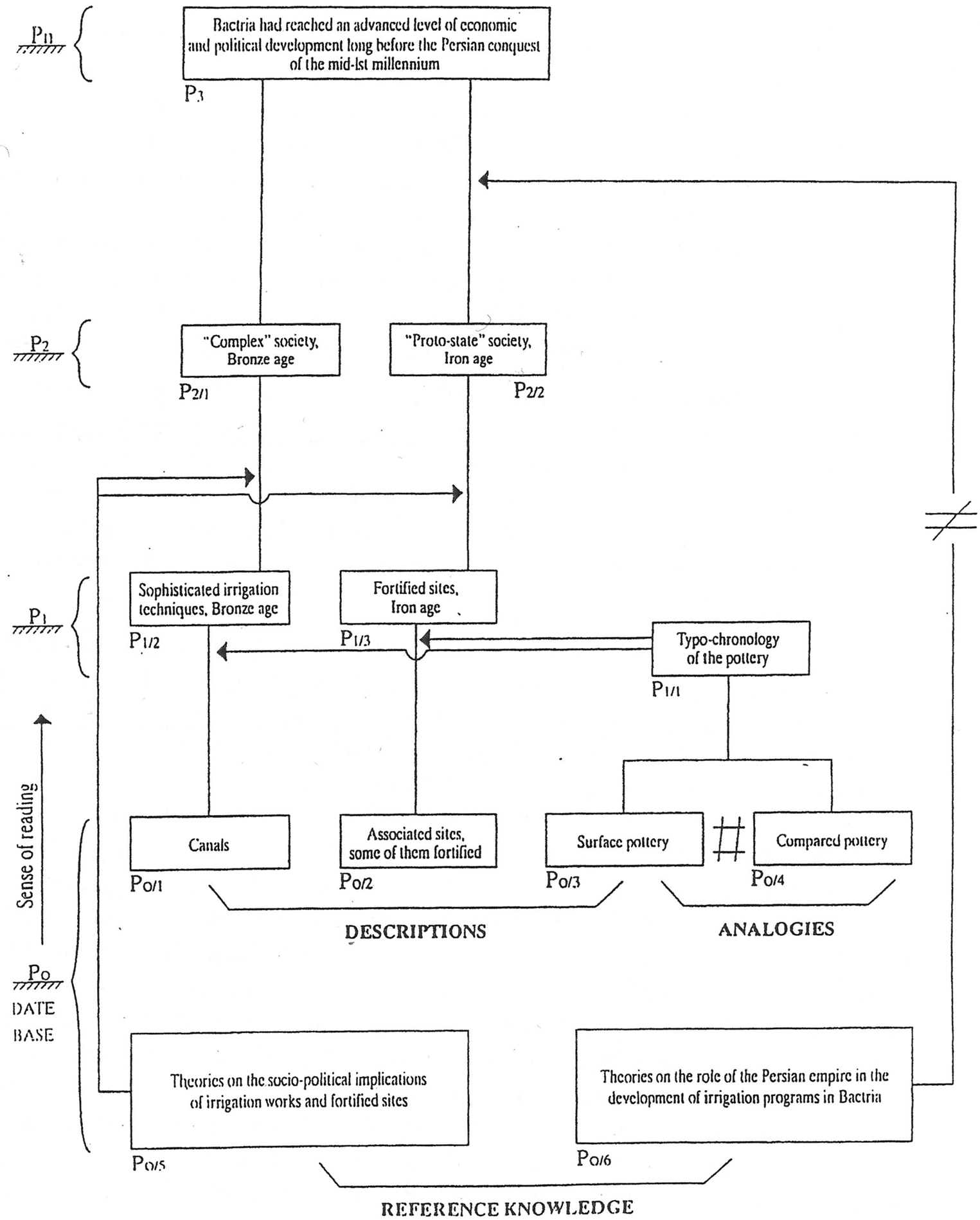
The objective is, therefore, to bridge the three main elements of an archaeological discourse: the descriptions, their meaning (or interpretation), and the arguments connecting descriptions and meaning.
The first of the three categories comprises elements that merge with the ample concept of a database (P0 in Figure 4), including descriptions but also references to knowledge or antecedent theories used to underpin the inferences found in the text and the analogies used to establish correspondences between objects based on their characteristics.
The second refers to the propositions (or conclusions) that stem from the argumentation process or the starting hypotheses to be established (Pn in Figure 4).
The last category includes the series of arguments that link the database to the conclusions, operations that Gardin identifies with rewrite formulas of the kind p→q. This means that, given a set Pn of hypotheses or conclusions and a set of propositions P0 composing the database, it is possible to proceed inductively from a subset of P0, through successive inferential passages, of the type P1→P2, to the conclusions (Pn) or in reverse order, deductively from Pn to P0. Interestingly, despite defining this method as irrespective of the method used, Gardin's method solely considers induction and deduction as forms of logical inference (see also Marlet et al., Reference Marlet, Zadora-Rio, Buard, Markhoff and Rodier2019: fig. 4).
Notably, as stated by Gardin himself, schematization tells us nothing about the nature of the arrows, being focused on the verification of the potential conversion of theories into ‘IF p→THEN q’ formulas, with the caveat that ‘the arrow in rewrite formulas covers a wide variety of relations that has never been systematically categorized in the archaeological discourse’ (Gardin, Reference Gardin and Franck2002: 277).
Here, I propose a methodology, reinterpreting Gardin's approach and implementing an IBE-based argumentation chain, that constitutes a framework for recording the complete sequence of archaeological reasoning underpinning the interpretation of a specific case study.
The starting point consists of adopting schematization, intended as a third way between the mathematical models and natural language and as a sort of hybrid genre ‘distinctive of the social science and the humanities’ (Gardin, Reference Gardin and Franck2002: 282). This does not entail abandoning narration in natural language, but instead greatly benefits the self-assessment of coherence and clarity of argumentation through a constant relation with the more condensed form of schematization. This model is then reshaped, in order to implement an IBE-based argumentation chain, with the framework identified by Amaya (Reference Amaya, Kaptein, Prakken and Verheji2009), while considerations by her and by Fogelin (Reference Fogelin2007) on the nature of the best explanation are adopted in the evaluation phase.
The proposed pipeline consists of four main stages: the collection of records from an existing archive; the formulation of hypotheses; the definition of competing accounts; and the selection of the best explanation among several plausible candidates (Figure 5).
The IBE-based model for the recording of archaeological argumentation.

In the first stage, specific records (set SR in Figure 5) informed by the relevant issue at stake are selected from an archive (set R in Figure 5) comprising photographic, textual, visual, and analytical elements. In my case study (Campanaro, in prep.), I tackle the question whether the atrium of the House of the Greek Epigrams (Regio V, Insula 1, 18) in Pompeii was roofed over or not in the last stage of its life and propose an archaeological interpretation in the form of a 3D digital reconstruction. In this instance, elements from the existing documentation (R in Figure 6) concerning the state of the house (recent and past excavation reports, photographic campaigns, reproductions from the nineteenth century, etc.) have been selected.
The IBE-pipeline applied to the case study of the House of the Greek Epigrams in Pompeii.
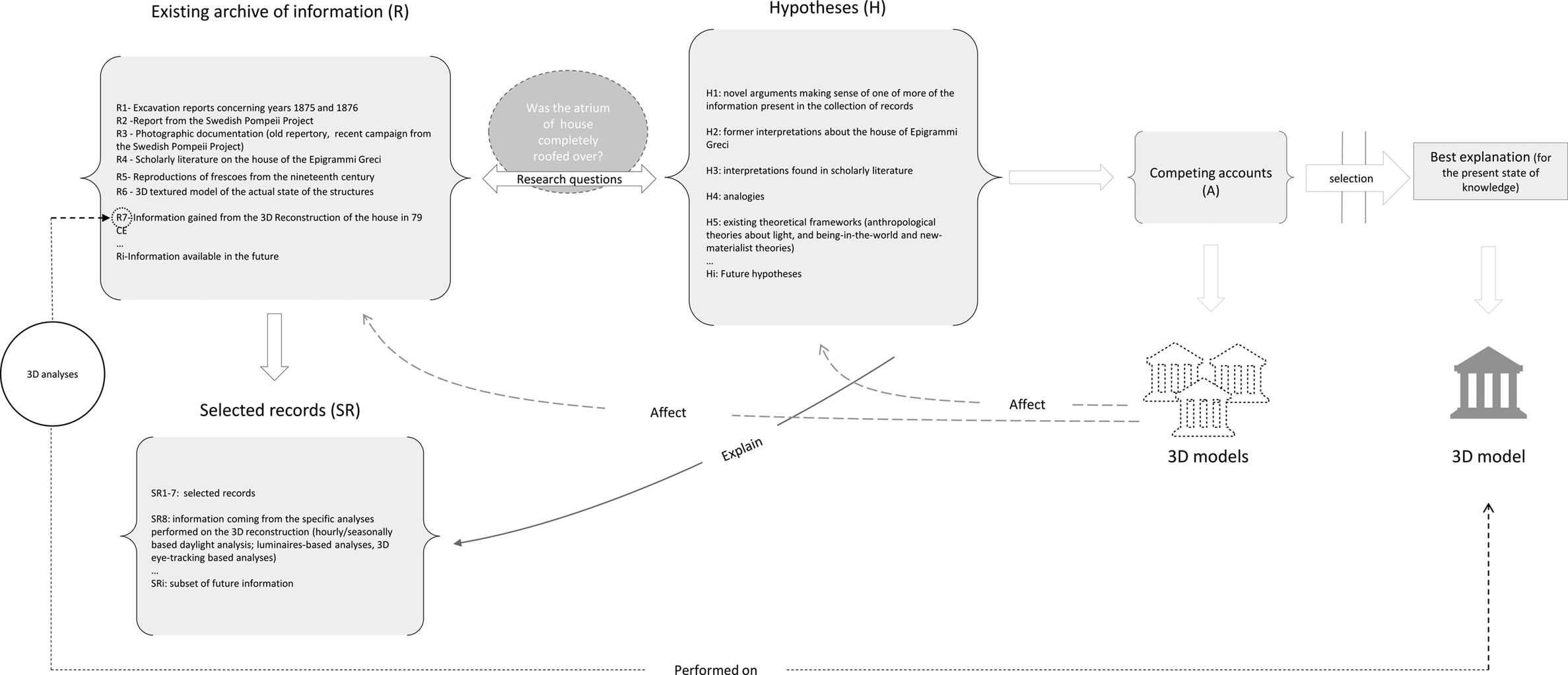
In a second stage, a series of hypotheses making sense of one or more pieces from the collection of records included in the first group is defined (set H in Figures 5 and 6). This category also includes interpretations found in past reports and theories (e.g. archaeological, anthropological, social, etc.), elements that enter Gardin's model at a database stage. The nature of the relation between one or more elements of the selected subset (SR) and the explaining hypothesis (Hi) is not of the ‘IF p→THEN q’ kind, as in Gardin, but of the ‘Hi explains {SRi}’ type, where Hi is a hypothesis making sense of one or more pieces of information. In my Pompeii study, for example, instances of prestige (see H.2.1 in Figure 7) suggest that, at the House of the Greek Epigrams, an impluvium was added at a later stage, when the house received its second style decoration, along with a compluviate roof and a coffered ceiling.
House of the Greek Epigrams in Pompeii case study. Left: the selected records (R); each record is associated with a coloured symbol. Right: the hypotheses (H) explaining one or more of the selected records (represented with their respective symbol).

The first two stages are informed by constant feedback between the record collection and the formulation of hypotheses in a sort of marshalling process (Amaya, Reference Amaya, Kaptein, Prakken and Verheji2009: 139) aimed at better organizing the information available. Importantly, within this iterative exchange between records and hypotheses, the formulation of the research questions plays a key role, in accordance with Amaya's (Reference Amaya, Kaptein, Prakken and Verheji2009: 139) and Sintonen and Kiikeri's (Reference Sintonen, Kiikeri, Wolénski, Niiniluoto and Sintonen2004: 227–33) ideas that a successful inquiry at this stage is primarily an exercise of interrogation. With respect to the Pompeii case study, a preliminary process of refinement made it possible to exclude roof styles such as Tetrastyle, Corinthian, testudinate, pent, or flat roofs, identifying the atrium tuscanicum (an inward sloping framework leaving an open space in the centre, the compluvium) as the most coherent solution among the hypotheses for a covered space.
At this point, a ‘contrast set’ of plausible competing accounts consisting of one or more subsets of the group of hypotheses (set A in Figures 5 and 6) is constructed and revised following coherence-making strategies of subtraction and addition, as explained earlier. Each account comprises one or more hypotheses, connecting interpretations and generating contrast sets among competing accounts. As the Pompeii example shows, in Figure 8, A1 and A2 represent two alternative 3D models pertaining to the accounts available: a roof structure of the atrium tuscanicum type or an open atrium with simple overhanging eaves.
House of the Greek Epigrams in Pompeii case study. Left: the hypotheses (H). Right: the competing accounts (A). Every account is associated with a colour (blue for compluviate roof and yellow for an open courtyard). In the hypotheses table (left), the relationship with the accounts is shown by cells coloured with the respective colour.

A further process of refinement takes place when the ‘virtues’ discussed earlier (generality, empirical breadth, simplicity, etc.) are used to maximize the coherence and help select the best among the accounts based on the current state of knowledge. As this pertains to the Pompeii study, the accounts were assessed against the seven virtues of Quine and Ullian (Reference Quine and Ullian1978), envisaging a roof structure of the atrium tuscanicum type as the solution best explaining the information available. The model has a certain permeability, giving specialists the possibility to introduce new elements (e.g. following new excavations or analysis, or if legacy documentation, such as old photographic records, is found) and retrace the entire chain of reasoning and possibly produce new findings resulting from a novel IBE-based process.
Conclusions
This study of IBE applied to archaeological reasoning, accompanied by a model for recording the argumentation process, reveals that this pattern of reasoning is highly relevant and answers a plea for the deployment of more solid argumentation. An IBE-based methodology is also capable of tackling issues of transparency and efficiency in the management of digital archaeological data.
Previous work shows that IBE has been a silent companion of archaeological argumentation for over a century; nevertheless, the lack of definition of specific models for the application of this pattern has led to limitations in its use. Consequently, examples of inference to the best explanation in the legal domain and of schematization of archaeological reasoning have been examined, with the aim of designing a novel IBE-based model for recording archaeological argumentation. Some findings from a case study in Pompeii illustrate how the IBE-based methodology presented here can be used in practice.
The proposed scheme has the potential to benefit the management of digital data in future, for example by including the schematization in the paradata that accompany the data to be stored. The approach described can easily be integrated within existing frameworks designed to improve transparency in the 3D reconstruction processes or efficiency in digital data management, providing us with an invaluable tool to enhance archaeological reasoning.
Acknowledgements
The author sincerely thanks the anonymous reviewers, the EJA technical editor Madeleine Hummler, and the editor Dr Catherine J. Frieman for their valuable comments and feedback. Special gratitude goes also to Prof. Henrik Gerding, Prof. Anne-Marie Leander Touati and Dr Nicolò Dell'Unto for their constructive comments.


 Open access

