

1. Introduction
Lower Carboniferous strata are well developed across the Moroccan Meseta and were folded and variably metamorphosed during the Variscan (Hercynian) orogeny. An upper Viséan transgression produced more uniform palaeogeography, with shallow-marine carbonate platforms in the southern and eastern parts of the Western Meseta (Piqué, Reference Piqué1979; Izart, Reference Izart1990) and in the north-western Meseta (Chalouan and Hollard, Reference Chalouan and Hollard1979; Neqqazi et al., Reference Neqqazi, Raji and Benfrika2014). In the Sidi-Bettache Basin, Lower Carboniferous sedimentation comprises thick detrital and marine successions that record substantial subsidence. This subsidence was particularly active during the Famennian, then progressively declined during the lower Viséan and intensified again during the upper Viséan (Piqué, Reference Piqué1979; Izart, Reference Izart1990). East of the Sidi-Bettache Basin, the Khouribga-Oulmès anticline represents a palaeogeographic high (Zaer Ridge), where Lower Carboniferous deposits are absent. On its southeastern flank (Smaala region), a Viséan succession is in tectonic contact with Ordovician-Devonian strata (Cailleux, Reference Cailleux1978). The lack of Upper Devonian-Tournaisian deposits and the occurrence of Devonian clasts in Viséan conglomerates suggest an east-to-west Viséan transgression across the Zaer Ridge (El Kamel, Reference El Kamel1987). In the Azrou-Khenifra Basin (eastern Central Morocco), Carboniferous successions display diverse facies reflecting contrasting tectonic settings (Bouabdelli, Reference Bouabdelli1994; Becker et al., Reference Becker, Aboussalam, El Hassani, Cózar, Herbig and Ernst2021). In the NW Benahmed (western Moroccan Meseta), the Oued Ayada Formation (upper Asbian to the upper Asbian-lowest Brigantian) represents a neritic, shallow-water carbonate platform setting with erosional channels that transgressed deeper-water Devonian strata that were previously uplifted by Eovariscan block faulting (Becker et al., Reference Becker, Aboussalam, El Hassani, Cózar, Herbig and Ernst2021). In the Rehamna region, the Viséan is represented by volcano-sedimentary rocks. The Skikirat series includes an olistostrome with reworked Devonian reefal limestone, interpreted as recording a basin-margin setting; late Viséan sedimentary rocks and volcanic flows are exposed at Gada Jennabia, ∼6 km SE of Mechra Ben Abbou. In the Western Meseta, the Palaeozoic Jebilet massif (north of Marrakech) comprises strata from the Cambrian to the late Viséan-Namurian age. Its eastern part is dominated by a thick detrital flysch-type succession, the Kharrouba Flysch or Kharrouba Formation (Gaillet, Reference Gaillet1981), separated from the central Jebilet by a NNW-SSE sinistral shear zone (Lagarde and Choukroune, Reference Lagarde and Choukroune1982; Essaifi et al., Reference Essaifi, Lagarde and Capdevila2001). In the central Jebilet, Carboniferous rocks are mainly represented by the Sarhlef Formation.
The Sarhlef Formation is dated as late Viséan-Namurian based on the presence of the bivalve Posidonia becheri (Hollard et al., Reference Hollard, Huvelin and Mamet1977; Moreno et al., Reference Moreno, Sáez, González, Almodóvar, Toscano, Playford and Bajddi2008) and has been interpreted as distal marine platform deposits hosting a bimodal intrusive complex. Drill cores DS170, DS125 and DF306 from the Draa Sfar area, however, indicate the presence of Upper Devonian strata within an interval spanning the upper part of the lower member to the basal part of the upper member (Lazreq et al., Reference Lazreq, Königshof, Essaifi, Bouari and Outigua2021). In the eastern Jebilet (Marrakech area), the Carboniferous Kharrouba Formation consists mainly of platform to hemipelagic deposits (carbonates, sandstones and turbidites derived from the east) (Vachard and Tahiri, Reference Vachard and Tahiri1991). The top of this Formation has been assigned to the late Viséan based on Posidonia becheri and the ammonoid Goniatites crenistria (e.g., Hollard et al., Reference Hollard, Huvelin and Mamet1977). The Sarhlef Formation presents shale (schist) dated Devonian (Frasnian-Famennian) by conodonts (Lazreq et al., Reference Lazreq, Königshof, Essaifi, Bouari and Outigua2021 and Reference Lazreq, Bamoumen, Bouari, Soulaimani and Königshof2023) transgressed by shale (schist) contacting Posidonia becheri of Upper Viséan age (Hollard et al., Reference Hollard, Huvelin and Mamet1977; Huvelin, Reference Huvelin1977). The Viséan part of the Sahrlef Fm is therefore the western equivalent of the Kharrouba Fm (Viséan).
In the present study, we have revisited and refined previous bibliographic data, with updated age determinations primarily based on foraminifera, which are of great significance for understanding the palaeogeographic evolution of the Jebilet and the Meseta. Micropalaeontological analysis of mostly limestone samples from various localities in the eastern Jebilet (Figure 1; Table 1) has, for the first time, allowed the chronological clarification of several key geological events in the region: the Viséan transgression, the base of the Kharrouba Formation, the emplacement of the eastern Jebilet nappe and the dating of these studied outcrops.
Location of the Jebilet in the Moroccan Meseta after Cózar et al., (Reference Cózar, Vachard and Somerville2023) and the eastern Jebilet (a) and simplified geological overview of the central and western part of the eastern Jebilet showing the location of studied sections, extracted from the 1:100 000 geological map of the central Jebilet by Huvelin (Reference Huvelin1972) (b). Dj: Dar Jaïdet, T: Jebel Tekzim, oo: Ouled Omar, Sb: Lamkhalif, Mr: Marabout, Mj: Koudiat El Menjel, Dt: Douar Tolba, D: Douar Fokra and Gr: El Gargabat.
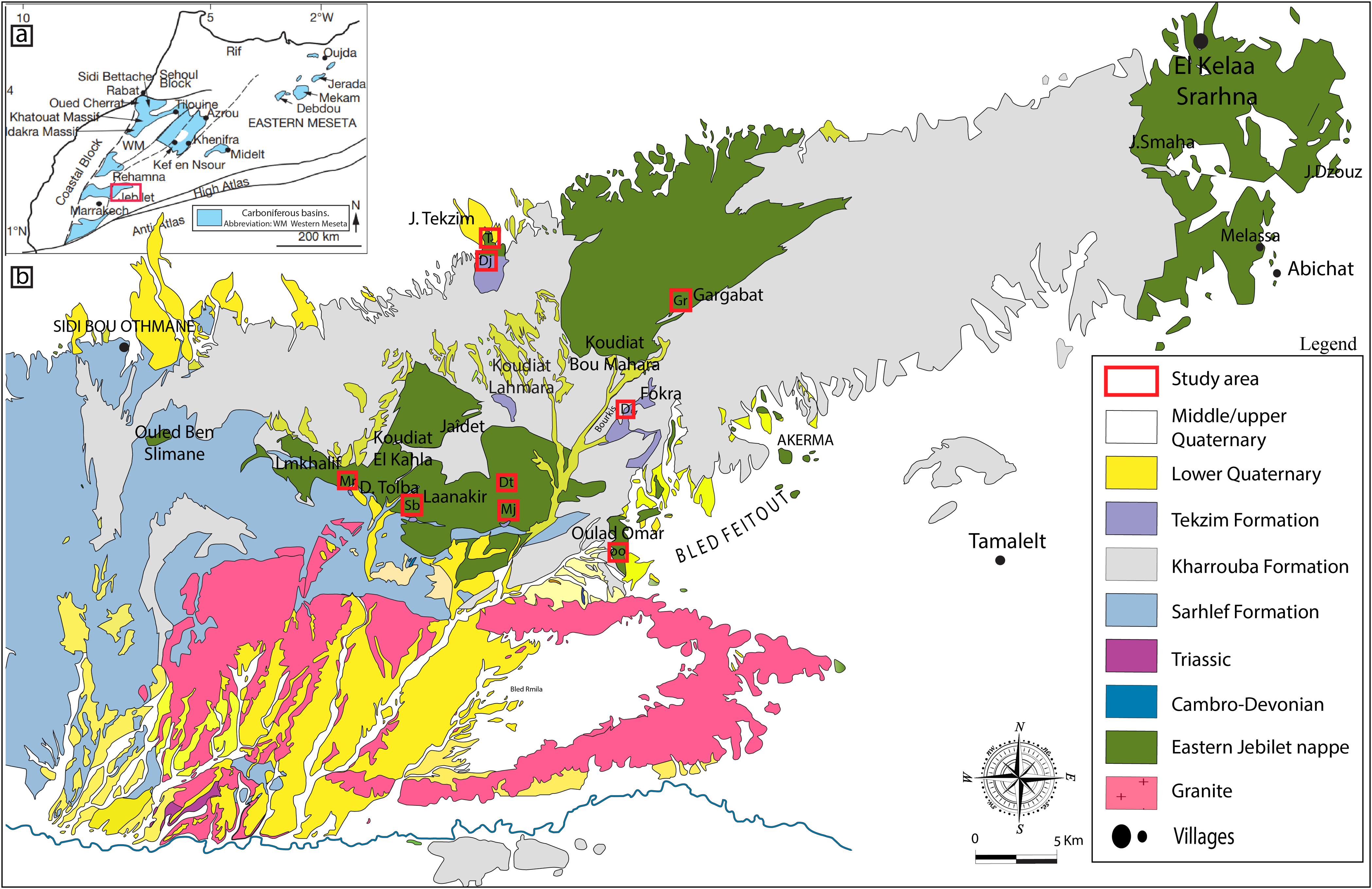
Figure 1. Long description
The map illustrates the geological formations and features of the Moroccan Meseta, with a focus on the Jebilet region. It highlights the location of various geological sections and formations, including the Kharrouba Formation and the Sarhlef Formation. Key locations such as Dar Jaiïdet, Jebel Tekzim, Ouled Omar, Lamkhalif, Marabout, Koudiat El Menjel, Douar Tolba, Douar Fokra, and El Gargabat are marked. The map uses different colors to represent various geological periods and formations, such as Middle/upper Quaternary, Lower Quaternary, Tekzim Formation, Kharrouba Formation, Sarhlef Formation, Triassic, Cambro-Devonian, Eastern Jebilet nappe, and Granite. The study areas are outlined in red, and villages are indicated with black dots. The map provides a detailed overview of the geological structure and history of the region.
Studied sections and distribution of samples and fossiliferous samples in the eastern Jebilet
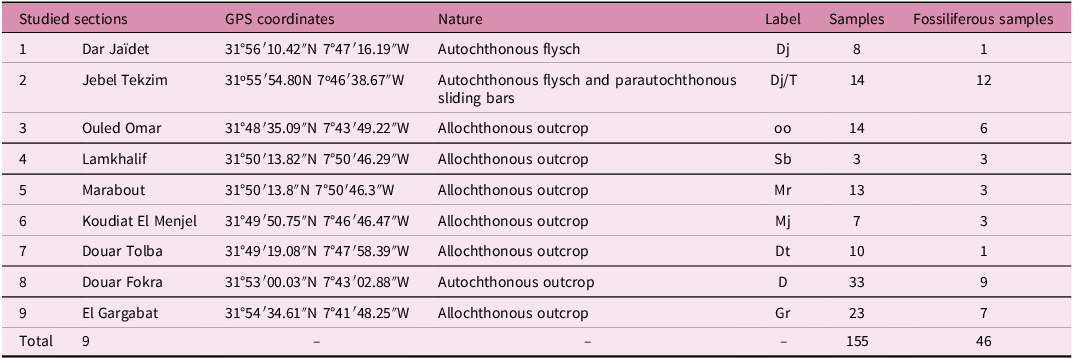
Table 1. Long description
The table presents data on nine studied sections in the eastern Jebilet, detailing their GPS coordinates, nature, label, number of samples, and fossiliferous samples. The sections include Dar Jaidet, Jebel Tekzim, Ouled Omar, Lamkhalif, Marabout, Koudiat El Menjel, Douar Tolba, Douar Fokra, and El Gargabat. The nature of these sections ranges from autochthonous flysch to allochthonous outcrops. The table lists the specific GPS coordinates for each section, the type of geological formation, and the number of samples collected, with a focus on those containing fossils. Notable trends include the high number of samples from Douar Fokra and El Gargabat, and the significant number of fossiliferous samples from Jebel Tekzim and Ouled Omar.
2. Regional and geological context
The Jebilet massif is composed of folded Palaeozoic rocks, surrounded by unconformably overlying Mesozoic and Cenozoic formations. It is traditionally divided into three tectonic zones, each characterized by distinct lithological, magmatic, tectonic and metamorphic features (Huvelin, Reference Huvelin1977): the western Jebilet, the central Jebilet and the eastern Jebilet, separated by major shear zones. The western and central Jebilet are separated by a NNE–SSW-trending shear zone known as the Western Meseta Shear Zone (Piqué et al., Reference Piqué, Jeannette and Michard1980; Le Corre and Bouloton, Reference Le Corre and Bouloton1987). The boundary between the central and eastern Jebilet corresponds to the Marrakech Shear Zone, a NNW–SSE-trending sinistral shear zone (Lagarde and Choukroune, Reference Lagarde and Choukroune1982; Essaifi et al., Reference Essaifi, Lagarde and Capdevila2001).
According to Zarhaoui (Reference Zarhaoui1981), the emplacement of Hercynian bars of Jebel Tekzim is tectonically controlled. He identified a relative autochthonous Viséan flysch basement overlain by several allochthonous structural units, including one composed of Ordovician–Silurian–Devonian material and another of upper Viséan origin. The emplacement of these bars occurred after the upper Viséan and before the Westphalian, as the nappe is metamorphosed to the west by a granite dated at 319 Ma (Tisserant, Reference Tisserant1977). Zarhaoui (Reference Zarhaoui1981) defined several superposed allochthonous units, separated by tangential, anomalous contacts and resting on a flysch basement. From bottom to top, the following units are distinguished:
-
• The basement, consisting of a thick Viséan flysch series (2400 m), whose underlying substratum is unknown. Its upper part is characterized by distal turbidites overlain in stratigraphic continuity by the argillaceous–calcareous detrital Bourkis Formation, indicative of a regressive, shallow marine environment. This flysch basement shows broad, arched folds truncated at their crests by subhorizontal contacts with overlying units.
-
• The block unit (Oulad Bou Zid Unit), regarded by Huvelin (Reference Huvelin1977) as a synsedimentary submarine slide breccia (olistostrome). However, Zarhaoui (Reference Zarhaoui1981) interpreted it as a tectonic breccia resulting from the more or less intense disruption of an already folded flysch basement under the effect of nappe displacement.
-
• The Tekzim Unit, composed of upper Viséan argillaceous–calcareous material, is only represented by the klippe of Jebel Tekzim. According to Zarhaoui (Reference Zarhaoui1981), the emplacement of this unit occurred relatively late compared to the two previous ones, and its transport likely took place from NNW to SSE.
The work of Oukemeni (Reference Oukemeni1987) on the eastern Jebilet nappe demonstrated that the upper Viséan basin underwent a progressive infilling. This began with deep marine sedimentation, followed by continental slope-type deposits, marked by sedimentary instabilities and occasional slumping of the flyschoid series. This sequence transitions upwards, in stratigraphic continuity, into the Bourkis Formation, indicative of a very shallow, reefal environment. These limestones are overlain by a recurrence of clay-rich facies. Subsequently, a block-bearing formation appears, which constitutes an olistostrome discordant over the folded Viséan substratum. Some of the blocks exhibit the same lithology as that of the Bou Marhara nappe.
Essemani (Reference Essemani1988) showed that the Viséan of the eastern Jebilet, particularly the eastern part of the Kharrouba Flysch, is composed of sandstone–pelitic deposits. The base of this succession is affected by fracture cleavage associated with NE-trending Hercynian folds. It is overlain by the eastern Jebilet nappe, and its base was dated by this author as middle–late Viséan transition.
In the eastern Jebilet, small Devonian–Carboniferous or solely Carboniferous outcrops are widely distributed. These are generally considered allochthonous, except at Dar Jaïdet and Jebel Tekzim, where there is a pseudo-concordance between the autochthonous units composed of the Kharrouba Flysch and the overlying allochthonous bars, emplaced during major phases of the Hercynian orogeny (Huvelin, Reference Huvelin1967) (Figure 1).
3. Material and methods
This study focused on stratigraphic sections previously investigated by Huvelin (Reference Huvelin1977) and Oukemeni (Reference Oukemeni1987). Additional sections (Dar Jaïdet, Jebel Tekzim, Ouled Omar, Lamkhalif, Marabout, Koudiat El Menjel, Douar Tolba, Douar Fokra and El Gargabat) were selected and sampled in search of conodonts, foraminifera and microflora. For each sample, 2–3 kg of limestone was crushed and treated with 10% diluted acetic acid. Residues were washed every 24 h and sieved using 1 mm and 60 µm meshes. All samples were processed in the sedimentology laboratory of the Faculty of Sciences Semlalia. In total, 155 samples were collected, of which 46 were fossiliferous.
Biostratigraphic dating relies primarily on foraminifera. The recovered conodonts (mainly Gnathodus, including G. texanus, G. pseudosemiglaber s.l., G. semiglaber and G. homopunctatus) have broad stratigraphic ranges from the middle/upper Tournaisian to the Serpukhovian and, therefore, provide limited temporal resolution. For this reason, Carboniferous foraminifers were analyzed from both washed residues and thin sections.
All foraminifers recorded in thin sections are usually poorly preserved. Most assemblages indicate a late Viséan age, particularly the late Asbian (Cf6γ subzone; zone 15 of Mamet in Hollard et al., Reference Hollard, Huvelin and Mamet1977), which broadly corresponds to the Gnathodus bilineatus bilineatus conodont zone. Some samples lack diagnostic markers, whereas others contain primitive Neoarchaediscus specimens that may extend into the early Brigantian. The base of Jebel Tekzim and the Douar Tolba outcrops are exceptional in yielding a mid-Viséan foraminiferal assemblage. Calcareous algae and algospongia are generally poorly preserved, but several taxa provide supplementary age constraints (Table 1).
4. Results
4.a. Dar Jaïdet and Jebel Tekzim (autochthonous flysch and parautochthonous sliding bars)
The Dar Jaïdet and Jebel Tekzim sections are located at the northern front and eastern end of the eastern Jebilet (Figure 1, Table 1), approximately 38 kilometres NNE of Marrakech and 15 kilometres east of the village of Sidi Bou Othmane. This area covers an area of 80 000 square metres and consists of about ten scattered houses at the foot of Jebel Tekzim and along the northeastern flank of Dar Jaïdet. It is characterized by pronounced relief, representing the highest elevation of the entire Jebilet range, with the Jebel Tekzim reaching 1061 metres. The Dar Jaïdet section is located about one kilometre west of Jebel Tekzim, forming a moderate hill ranging from 300 to 400 metres in altitude. This hill extends at the northern end of the eastern Jebilet, oriented east-west, with a slope that varies in places, forming kilometre-scale folds (anticlines) with a general direction of N40°, a dip of 10° to the northeast and an almost horizontal axis. These folds continue for several kilometres westward towards the vicinity of the villages of Sidi Bou Othmane and Koudiat Lhajel.
4.a.1. Geology of Dar Jaïdet and Jebel Tekzim sections
The sections of Dar Jaïdet and Jebel Tekzim belong geologically to the Kharrouba Flysch mountain massifs of the eastern Jebilet, which extend from Sidi Bou-Othmane to the western flank of Jebel Smaha (region of El-Kelâa des Sraghna). Here, there is a disconcordance between the autochthonous terrains of the eastern Jebilet and the allochthonous nappe displaced during the major Hercynian orogeny movements, according to Huvelin (Reference Huvelin1967). These sliding bars are displaced over the olistostrome and the platform facies at the top of Jebel Tekzim.
The Kharrouba Formation is composed of at least 2000 m-thick sediments such as turbidites, bioclastic limestones, shales and sandstones. The outcrop at Dar Jaïdet represents one of the thickest sections in the Kharrouba Formation, on the southeast flank, where, according to Huvelin (Reference Huvelin1977), atop about a thousand metres of flysch, there are about fifty metres of very fossiliferous green shales at certain levels, well dated by Posidonia becheri and Goniatites crenistria. In the green schist at the base of the Kharrouba Formation, Hollard et al., (Reference Hollard, Huvelin and Mamet1977) found Goniatites crenistria and Posidonia becheri at point 2 (Figure 2). These are overlain by bedded flysch, then by the olistostrome, which extensively outcrops throughout the plain at the southern foot of Jebel Tekzim. This olistostrome formation is composed of reworked flysch and notably contains blocks of bioclastic limestones of varying sizes as well as blocks of calcareous sandstones, probably from flysch, embedded in a grey schistose cement or matrix (Huvelin, Reference Huvelin1977). Some microfold structures and surfaces with differently oriented striations are observed, likely reflecting gravity-driven sliding movements during the formation of the flysch. At Jebel Tekzim, the olistostrome is overlain by shales and green sandstones and sometimes calcschists containing crinoids and corals, capped by bedded, sometimes cross-bedded, bioclastic calcareous sandstones followed by calcareous sandstones (Huvelin, Reference Huvelin1977). The bioclastic limestones (sample Dj14) are sometimes sandy and bioclastic.
Stratigraphic log of Dar Jaïdet-Jebel Tekzim (eastern Jebilet), combining the Dar Jaïdet section (samples Dj1 to Dj5), the Jebel Tekzim section (samples T2, T3, Dj6 to Dj14) and the three limestone bars of Jebel Tekzim (B1, B2 and B3); distribution of foraminifera, algae and algospongia.
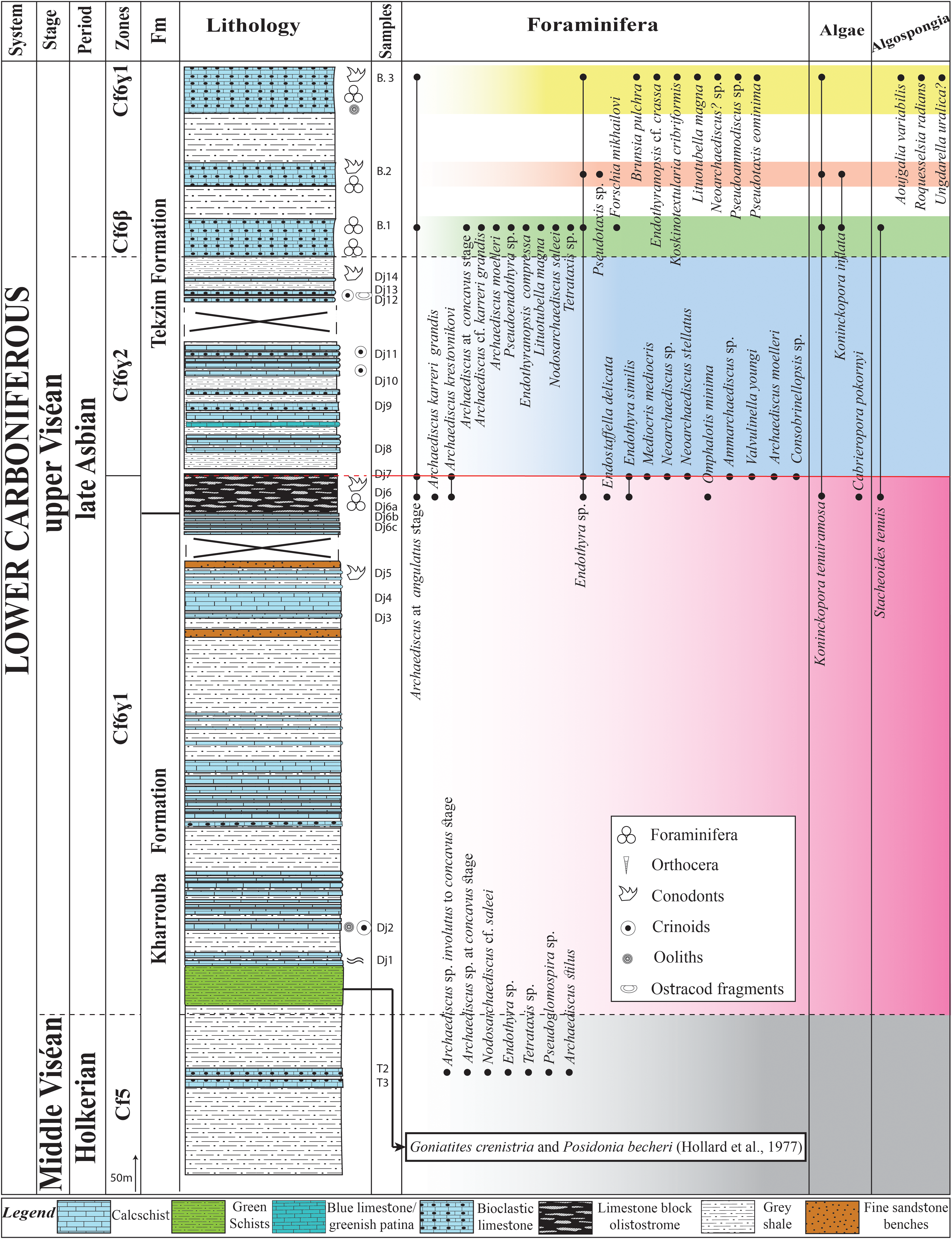
Figure 2. Long description
The table presents the stratigraphic log of Dar Jaiet-Jebel Tekzim, combining the Dar Jaiet section (samples Dj1 to Dj5), the Jebel Tekzim section (samples T2, T3, Dj6 to Dj14), and the three limestone bars of Jebel Tekzim (B1, B2, and B3). It details the distribution of foraminifera, algae, and algospongia across different formations and zones. The table includes columns for system, stage, period, zones, formation, lithology, and samples. Notable formations include the Kharrouba Formation, Tekzim Formation, and Green Formation. The lithology column uses various patterns to represent different rock types, such as calceshist, green schists, blue limestone, greenschist, bioclastic limestone, limestone block olistostrome, grey shale, fine sandstone benches, and ooliths. The foraminifera column lists various species, while the algae and algospongia columns indicate the presence of specific types. The table provides a detailed view of the geological strata and biological distribution in the region.
The outcrops with T1 and T2 samples are located in platform facies at the base of the Kharrouba Fm from the Jebel Tekzim area, and the same is true for outcrops with Dj1–Dj5 samples from Dar Jaïdet. These samples from Dar Jaïdet are probably platform facies, like Koudiat Bourkis. The outcrops Dj6–Dj14 samples and B1, B2 and B3 samples in Jebel Tekzim, corresponding to the Tekzim Fm, are allochthonous in a gliding nappe above the olistostrome (Figure 3b).
Photograph showing the olistostrome with bioclastic limestone blocks embedded in a micritic siliceous matrix on the northern slope of Jebel Tekzim (a) and schematic section north of Jebel Tekzim and Dar Jaïdet, after Andre (Reference Andre1989) (b).
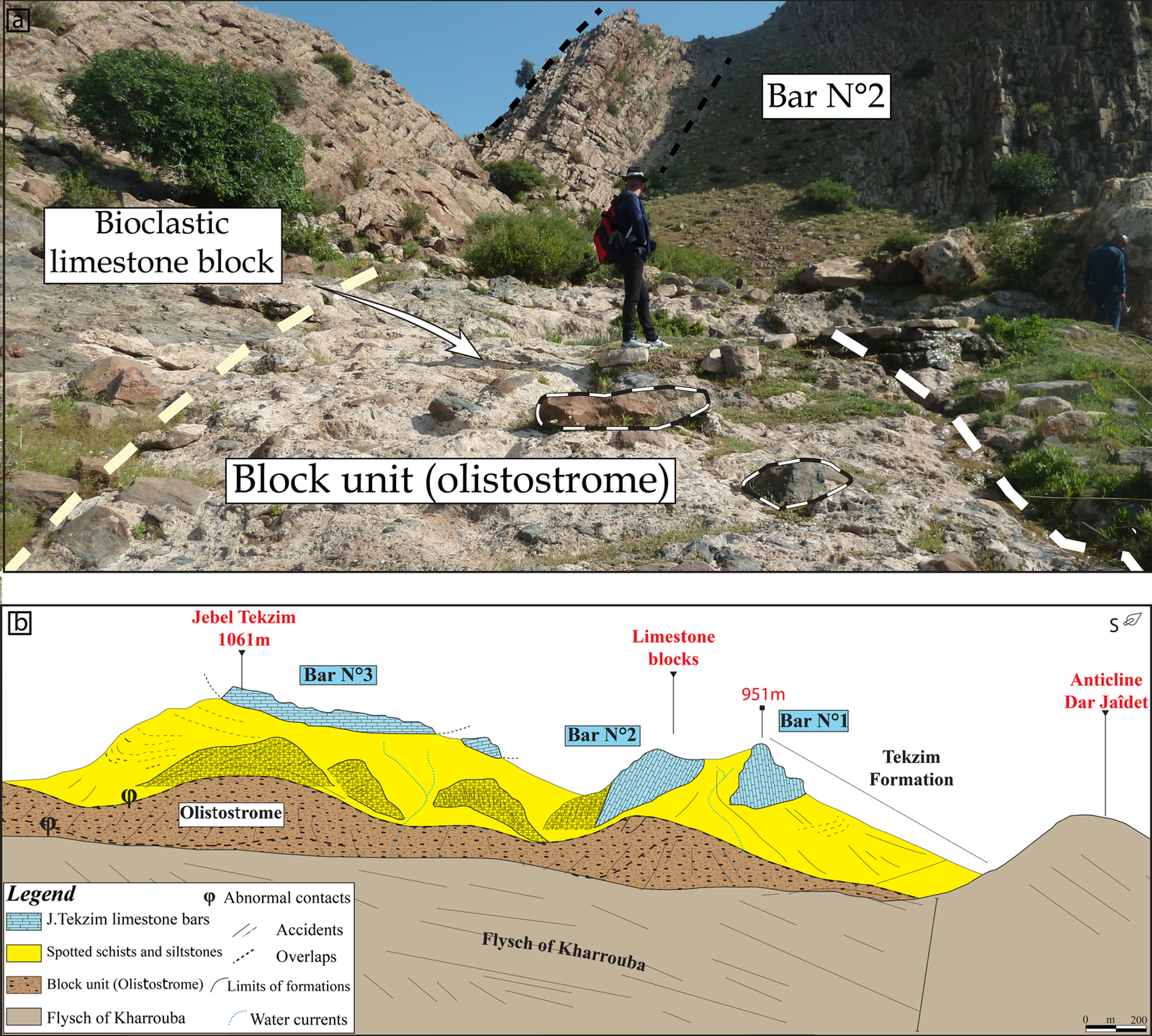
Figure 3. Long description
The photograph shows a person standing on a rocky slope with bioclastic limestone blocks embedded in a micritic siliceous matrix. The blocks are labeled as ‘Bioclastic limestone block’ and ‘Block unit (olistostrome)’. The schematic section illustrates the geological structure north of Jebel Tekzim and Dar Jai. It includes labels such as ‘Jebel Tekzim’, ‘Bar N°2’, ‘Bar N°3’, ‘Limestone blocks’, ‘Olistostrome’, ‘Spotted schists and siltstones’, ‘Flysch of Kharrouba’, and ‘Anticline Dar Jai’. The section shows the spatial arrangement of these geological features, with elevations marked in meters.
4.a.2. Description of the Dar Jaïdet section (Dj)
Our sampling route began on the northeast flank of the Dar Jaïdet anticline, just beside a water tributary below the hill, and continued up to the ridge summit towards the south. All the samples studied from this section were collected within the Flysch of the Kharrouba Formation, below the olistostrome. The stratigraphic sequence from bottom to top consists of about fifty metres of heavily weathered grey shales at the base of the hill (Figure 2). These shales cover the northern flank of the anticline and are sometimes characterized by nodules and cubic pyrite crystals. They are overlain by beds of friable calcschists. These strata are followed by reddish calcareous sandstones with thicknesses ranging from 10 to 40 centimetres. Above comes a series of yellowish, grey-fractured, bioclastic, sandy limestone beds interbedded with iron-rich, reddish calcareous sandstones. Sample Dj1 corresponds to a very fine micritic crystalline limestone, 60 cm thick, with a yellowish to light grey patina on the fracture (Figure 2). It is overlain by a sandstone-dominated alternation of sandstones and pelites, characterized by beds ranging from 20 to 50 centimetres thick and occasionally up to 90 centimetres. This alternation is followed by 4 metres of heavily weathered shales, then by bed Dj2, a finely crystalline light grey laminated limestone 50 centimetres thick, followed by 2 metres of shales. The next bed, Dj3, is a fine-grained limestone with a light grey patina, itself overlain by a metre of grey shales. Bed Dj4 consists of thin limestone lenses about 10 centimetres thick. This shale-lenticular limestone alternation (from 5 to 40 cm thick) repeats over a thickness of about 30 metres (Figure 2). Bed Dj5 is a finely crystalline limestone, 20 centimetres thick, which yielded Gnathodus pseudosemiglaber s.l. as well as Polygnathus glaber medius, Pseudopolygnathus cf. fusiformis and Palmatolepis sp. A. Dj5 is overlain by some beds of sandy limestones interbedded with shale or red sandstone beds, forming a small ridge at the summit of the well-known Dar Jaïdet hill, with a vertical dip corresponding to the hinge of the kilometre-long Dar Jaïdet anticline elongated east-west, which includes calcschist strata and some upper sandy limestone beds (Figure 2).
4.a.3. Description of the Jebel Tekzim section (T)
To the northwest and at the base of the Kharrouba Formation, within the calcshists, two fine lenticular limestone beds (about 15 cm) provide the two samples T2 and T3. Only T2 (N31°56′34.60″N, W7°47′12.81″), a highly recrystallized bioclastic limestone, yielded a few small foraminifera (Figure 2). Further above and to the southeast, a few metres from the house at the base of Jebel Tekzim, the strata outcrop continues from those of Dar Jaïdet (Dj6a, Dj6b and Dj6c) (Figure 2). About 90 metres south of the house, the olistostrome appears as fragments of large blocks of bioclastic limestone (Figure 3a), which can reach up to 2 metres in thickness within a greyish matrix (Dj6, Dj7). This flysch outcrops cover almost the entire hill of Dar Jaïdet and the base of Jebel Tekzim to the east. At the base of the outcrop, there are three metres of a sandstone-pelite sequence dominated by sandstones, characterized by sandstone beds ranging from 30 to 90 centimetres thick and alternating with calcarenites. After a 60-metre gap in observation, a few beds of calcschists and highly fractured sandstones appear (Figure 3b). The first sampled beds of the olistostrome (Dj6, Dj7), located just 100 metres from the Douar, consist of limestone containing fragments and pieces of limestone within an olistostrome cemented by sparite. This petrographic assemblage is complex, composed of siliciclastic materials and carbonate particles strongly mixed in a detrital matrix, reflecting a turbulent environment marked by slumps or slides. Dj6 and Dj7 belong to a limestone unit 5 to 6.5 metres thick, with a blue patina and grey fracture. Its general texture is an oolitic and bioclastic packstone that includes fragments of probable algal encrustations. Notably, Dj6 yielded reworked Devonian conodont specimens along with Viséan ones: Neopolygnathus communis communis, Polygnathus sp., Palmatolepis sp. A and Gnathodus pseudosemiglaber s.l., as well as foraminifers (Figure 2). Dj7 also yielded conodont taxa: Gnathodus pseudosemiglaber s.l. and Palmatolepis sp. B, and foraminifers (Figure 2). This unit is overlain by bed Dj9, one metre thick, showing a very bioclastic limestone with a sandy tendency, blue fracture and a still-yellowish patina. Towards the bars, the olistostrome (Figure 3a) thickens progressively. Above it, samples Dj10 and Dj11 are massive bioclastic limestone beds rich in crinoids, separated by a few very weathered limestone beds. These are overlain by beds Dj12 (40 cm thick) and Dj13 at the foot of Jebel Tekzim, which display a carbonate facies particularly rich in crinoids. Next comes bed Dj14, a hard limestone bed with blue patina and grey fracture, 30 centimetres thick, which yielded two conodont specimens: Gnathodus semiglaber and Gnathodus pseudosemiglaber s.l. These limestones are followed by three metres of grey shales, which separate them from the Jebel Tekzim bars. The first bar of calcareous sandstone is affected by folding and fracturing and is rich in foraminifers (Figure 2). This first bar (B.1) is overlain by 60 metres of flysch with intercalations of small calcschist beds about 20 centimetres thick and with some beds of fractured fine sandstone (Figure 3b). The second bar, more or less vertical and slightly dipping south, is about 60 metres thick and consists of very bioclastic blue limestone intercalated with highly fractured crystalline sandstone, calcarenites and bioclastic limestone lenses in places. The continuation of the succession consists of 200 metres of flysch with intercalations of some sandstone beds (10 to 30 cm thick) (Figure 2). At the summit of Jebel Tekzim, the third bar (B.3) is roughly horizontal (Figure 3b), 15 metres thick and composed of calcarenites with subcircular limestone blocks 30 to 120 cm in diameter containing ooids, bryozoans and corals. This third bar, forming the famous ridge of Jebel Tekzim at 1060 m altitude, corresponding to the bioclastic limestone lenses (h2) described by Huvelin (Reference Huvelin1977), yielded common foraminifers and algae (Figure 2).
4.a.4. Biostratigraphic results
The first sample T2 from the base of the Kharrouba Formation (Figure 2) is at least middle Viséan (Cf5) due to the first occurrence of Nodosarchaediscus and Archaediscus at the concavus stage. In the middle part of the Kharrouba Formation, beneath the olistostrome, sample Dj5 yielded reworked Upper Devonian conodonts along with probable Viséan conodonts, notably Palmatolepis sp. A and Gnathodus pseudosemiglaber s. l. Within the olistostrome, sample Dj6 provided reworked Upper Devonian conodonts and a foraminiferal assemblage of the Archaediscus karreri group, first occurring from the base of the late Viséan but most commonly from the upper Asbian upwards in Morocco (Vachard and Tahiri, Reference Vachard and Tahiri1991; Cózar et al., Reference Cózar, Vachard and Somerville2023). The presence of Stacheoides tenuis, which first appears between biozones Cf6β and Cf6γ (early to late Asbian) (Vachard and Tahiri, Reference Vachard and Tahiri1991), suggests that sample Dj6 should be assigned to the late Asbian Cf6γ1 subzone. The reworking of Devonian conodonts, although absent from the autochthonous deposits of the eastern Jebilet, suggests the existence of a Famennian platform prior to the upper Viséan transgression. Sample Dj7, from the top of the olistostrome, contains a few rare specimens of primitive Neoarchaediscus, whose range extends from the late Asbian to the base of the early Brigantian (Cf6δ = V3c) (Cózar et al., Reference Cózar, Vachard and Somerville2023). However, these forms become dominant only from the Brigantian onwards, indicating that Dj7 likely belongs to the Gnathodus bilineatus bilineatus zone, i.e., the late Asbian. Thus, based on the foraminiferal fauna, the upper part of the olistostrome is dated to the latest Asbian (Cf6γ2). In the upper part of the section, the limestone bar of Tekzim, the first limestone bed (B.1) is dated to the early Asbian (Cf6β) based on the presence of foraminifers such as Archaediscus cf. karreri grandis, Pseudoendothyra sp., Endothyranopsis compressa and Stacheoides tenuis (see complete assemblage in Figure 2). These taxa are recorded in Morocco during the early Asbian (e.g., Vachard and Tahiri, Reference Vachard and Tahiri1991), whereas no marker of the late Asbian is recorded by us. Finally, the third limestone bed is assigned to a late Asbian age (Cf6γ1), as evidenced by the presence of Endothyranopsis cf. crassa, Neoarchaediscus? sp. and Ungdarella uralica? (Figure 2), typical taxa of the assigned biozone in Morocco (Vachard and Tahiri, Reference Vachard and Tahiri1991; Cózar et al., Reference Cózar, Vachard, Somerville, Berkhli, Medina Varea, Rodríguez and Said2008, Reference Cózar, Vachard, Izart and Coronado2020a, Reference Cózar, Vachard and Somerville2023; Izart et al., Reference Izart, Vachard and Berkhli2017; Becker et al., Reference Becker, Aboussalam, El Hassani, Cózar, Herbig and Ernst2021).
4.b. Ouled Omar section (oo) (Allochthonous outcrop)
The Ouled Omar section is located in the central-eastern part of the eastern Jebilet, about 32 km northeast of Marrakech and 22 km east of the village of Sidi Bou-Othmane (Figure 1; Table 1). This section shows a series of more or less folded carbonate beds forming a moderate hill about 100 metres high oriented east-west. It represents a nappe unit overlain by an olistolith (Huvelin, Reference Huvelin1977). At the base of the section, quartzitic limestones occur in beds 10 to 30 cm thick, with surfaces ranging from bluish-grey to reddish patina, showing abrupt transitions between quartzitic sandstones or calcareous sandstones and calcareous limestones. These are the Devonian limestones of Koudiat Mbijia, belonging to the eastern Jebilet nappe. These limestones have yielded tentaculites and conodonts, indicating a probable Middle Devonian age (Huvelin, Reference Huvelin1977).
4.b.1. Description
The first bed consists of a finely crystalline grey-beige limestone (oo1), 46 cm thick, showing some sedimentary structures (Figure 4). It yielded conical forms of conodonts, Drepanodus sp. and Belodella resima. Sample oo2, located 25 metres higher across a wheat field, consists of a thick yellowish carbonate facies (1.5 m) with beige fracture surfaces, highly recrystallized with some iron oxide nodules. It is directly overlain by a dark grey centimetre-thick limestone, followed by lenticular bioclastic-rich beds interbedded with grey shales over five metres thick, from which sample oo3 was taken. Oo3 yielded the following conodont taxa: Gnathodus cuneiformis, Gnathodus pseudosemiglaber s.l., Gnathodus semiglaber, Gnathodus antetexanus, Gnathodus girtyi and Geniculatus glottoides, as well as foraminifers (Figure 4). Higher up, sample oo4 contains Palmatolepis delicatula delicatula, Gnathodus cuneiformis and Gnathodus pseudosemiglaber s.l. The whole sequence is overlain by a 1.5-metre-thick limestone layer (oo5), lenticular and highly fractured, rich in large bioclasts. Oo5 yielded Gnathodus cuneiformis, Gnathodus pseudosemiglaber s.l., Gnathodus girtyi meischneri, Gnathodus girtyi girtyi and Cavusgnathus unicornis, as well as foraminifers and algae/algospongia (Figure 4). Bed oo6 is characterized by a finely crystalline carbonate facies with blue patina and grey fracture, rich in crinoids, overlain by a crystalline crinoidal limestone with abundant detrital material and numerous foraminifers. After 1.5 metres of grey shales, oo7 shows a fine grey-to-black limestone with large crinoids and foraminifers. Oo7 yielded Palmatolepis glabra prima, Icriodus praealternatus praealternatus, Gnathodus cuneiformis, Gnathodus pseudosemiglaber s.l., Gnathodus semiglaber s.l., Gnathodus texanus, Gnathodus girtyi meischneri, Gnathodus girtyi girtyi, Geniculatus glottoides and Kladognathus complectens. After 3 metres of grey shales, beds oo8, oo9 and oo10 show thicknesses varying between 20 and 40 centimetres. They are interbedded with shales over a distance of 10 metres. Note that bed oo10 consists of a quartzitic limestone rich in foraminifers (Figure 4), with blue patina and grey fracture. One metre above, bed oo11 is characterized by a finely crystalline blue limestone, showing sedimentary structures (Figure 4). Bed oo12, located five m higher, is blue limestone which yielded Gnathodus cuneiformis, Gnathodus pseudosemiglaber s.l., Gnathodus girtyi girtyi, Hindeodella cristulus and foraminifers (Figure 4). It is followed by ten metres of non-deposition or an erosion period. The succession continues with a 15-metre-thick massive grey limestone with blue fracture where samples oo13 and oo14 were collected.
Stratigraphic log and distribution of foraminifera, algae and algospongia of the Ouled Omar section.

Figure 4. Long description
The table presents the stratigraphic log and distribution of foraminifera, algae, and algospongia in the Ouled Omar section. It includes columns for system, stage, period, zones, lithology, samples, foraminifera, algae, and algospongia. The lithology column describes different types of limestone and shale, while the foraminifera, algae, and algospongia columns list various species found at different stages. The table spans from the Middle Devonian to the upper Visan period, detailing the presence of specific species at each stage. Notable trends include the distribution of different species across various stages and the types of lithology present.
4.b.2. Biostratigraphic results
The first bed, oo1, yielded Drepanodus sp. and Belodella resima. Although the latter taxon is known from the Lower Devonian to the Famennian (Druce, Reference Druce1976), it is of Middle Devonian age here because it belongs to the Devonian limestones of Koudiat Mbijia from the Eastern Jebilet nappe, dated as Middle Devonian by Huvelin (Reference Huvelin1977). Bed oo2 belongs to a nappe unit overthrusting the Devonian limestones of Koudiat Mbijia. It is barren of conodonts but is most probably of Devonian age. The contact between this bed and those overlying it is manifested by a paraconformity. Samples oo3 to oo7 contain the foraminifers, algae and algospongia of early n-Asbian age (Cf6α-β). Regarding the algae, the presence of Stacheoides tenuis and Cabrieropora also suggests an Asbian age (Vachard and Tahiri, Reference Vachard and Tahiri1991; Cózar et al., Reference Cózar, Vachard and Somerville2023) (Figure 4). From bed oo10 upwards, the succession is assigned to the late Asbian (Cf6γ) due to the occurrence of Archaediscus karreri grandis and Ungdarella uralica (Vachard and Tahiri, Reference Vachard and Tahiri1991; Cózar et al., 2020) (Figure 4).
Reworked conodonts, mostly broken, eroded and often too incomplete for generic identification, are found in samples oo3, oo4 and oo7. These contain a mix of pelagic taxa ranging from the Famennian to the middle Tournaisian. Sample oo4 yielded Palmatolepis delicatula delicatula (Famennian, Upper Devonian). The sample oo7 yielded Icriodus praealternatus praealternatus, Palmatolepis glabra prima (Famennian, upper Devonian) and Geniculatus glottoides (upper Tournaisian to lower mid-Viséan). These reworked conodonts indicate that a pelagic platform likely existed formerly in the source region of this Ouled Omar section, from which top Frasnian to Famennian and middle Tournaisian-middle Viséan limestones were eroded and redeposited in the limestones resulting from the upper Viséan transgression.
4.c. Lamkhalif section (Sb) (allochthonous outcrop)
4.c.1. Description
The outcrop of this section is located near Sidi Bou Othmane, a few metres from Douar Lamkhalif, near the Marabout, where we collected three samples (Sb17–Sb19) (Figure 1; Table 1). Sample Sb18 contains poorer microbiota assemblages than Sb17 (Figure 5). In addition, Sb17 provided conodont specimens, such as Gnathodus pseudosemiglaber s.l., Gnathodus semiglaber and Gnathodus praebilineatus. These two beds constitute a very gritty limestone rich in bioclasts, especially crinoids. Near the track south of Douar Tolba (south of Douar Oulad Brahim), beds are cropping out (Sb19), 50 centimetres thick, with a very dark blue patina. It is a bioclastic limestone isolated within shales, poor in globular and elongated foraminifers (Figure 5). It yielded the conodont Gnathodus bilineatus bilineatus.
Stratigraphic log and distribution of foraminifera, algae and algospongia of the Lamkhalif section.
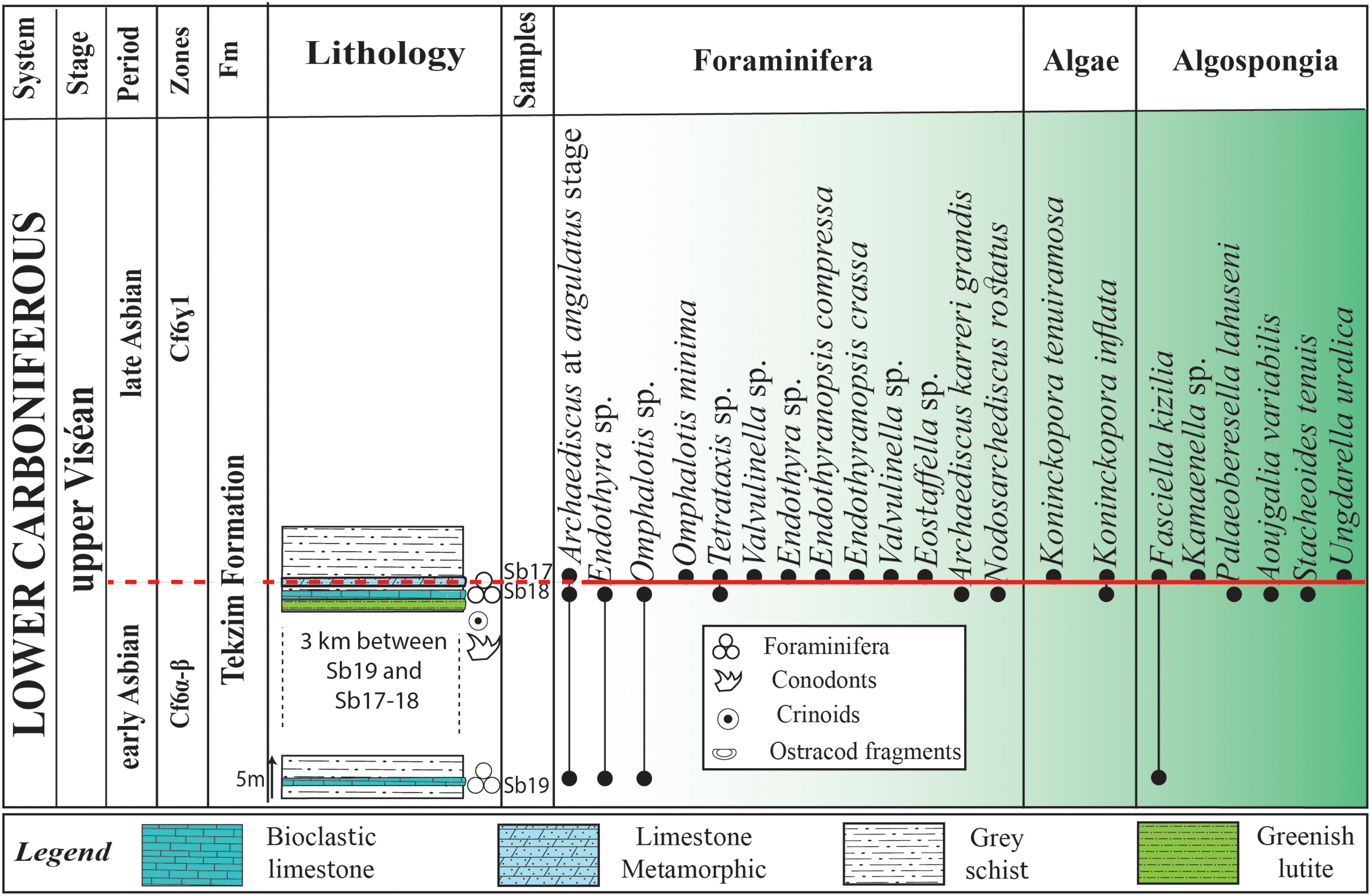
Figure 5. Long description
The table presents the stratigraphic log and distribution of foraminifera, algae, and algospongia of the Lamkhalif section. It includes columns for system, stage, period, zones, formation, lithology, samples, foraminifera, algae, and algospongia. The table has multiple rows detailing specific data points for each category. For instance, the lithology column includes bioclastic limestone, limestone, grey metamorphic, grey schist, and greenish lutite. The foraminifera column lists various species such as Archaeiscus at angulatus stage, Endothyra sp., Omphalotis minima, and Valvulinella sp. The algae column includes species like Koninckopora tenuiramosa and Fasciella kizilia. The algospongia column lists species such as Kamaenella sp. and Palaeoberesella lahuseni. The table also includes a legend explaining the symbols used for different types of microfossils. The data provides insights into the biostratigraphy and chronological constraints of the eastern Jebilet successions during the Variscan orogeny.
4.c.2. Biostratigraphic results
Sb18 and Sb19 contain markers at least of the early Asbian (Cf6α-β). Whereas Sb 17 corresponds to the upper Asbian (Cf6γ1), due to the occurrence of Archaediscus karreri grandis and Endothyranopsis crassa and Ungdarella uralica (Cózar et al., Reference Cózar, Vachard, Somerville, Berkhli, Medina Varea, Rodríguez and Said2008, 2020; Vachard and Cózar, Reference Vachard and Cózar2010) (Figure 5), the foraminiferal assemblages, algae and algospongia may include reworked specimens.
4.d. Marabout section (Mr) (allochthonous outcrop)
4.d.1. Description
The Marabout section is located at the western end of the eastern Jebilet (Figure 1; Table 1), ten kilometres east of the village of Sidi Bou Othmane, behind the Marabout (Figure 6a). Sampling began from the northwest slope, where an isolated nappe unit crops out within recent sediments, following an almost northeast direction. After crossing a few metres of grey shales, the first bed (Mr13) appears, composed of very massive, hard crinoid limestone. It is overlain by about ten metres of massive bioclastic limestones. Samples Mr11 and Mr10 correspond to a carbonate facies with a blue patina, while Mr9 and Mr8 are oolitic limestones with a light blue patina, rich in bioclasts. Sample Mr8 contains foraminifers (Figure 6b). Strata Mr7 to Mr5 form hard blue-patina limestone beds rich in bioclasts, overlain by bed Mr4, a well-preserved carbonate facies showing great richness in bioclasts and rare microbiota (Figure 6b). Above is a seven-metre-thick succession of bioclastic limestone beds. Mr3 directly followed by Mr2, showing a 1.5-metre-thick limestone containing fish scales and foraminifers (Figure 6b). The last bed, Mr1, is heavily weathered, with a grey patina and rich in crinoids.
View of the outcrop of the allochthonous unit (Marabout section) of the eastern Jebilet nappe, showing massive bioclastic limestones (a) and stratigraphic log and distribution of foraminifera, algae and algospongia of the studied Marabout section (b).
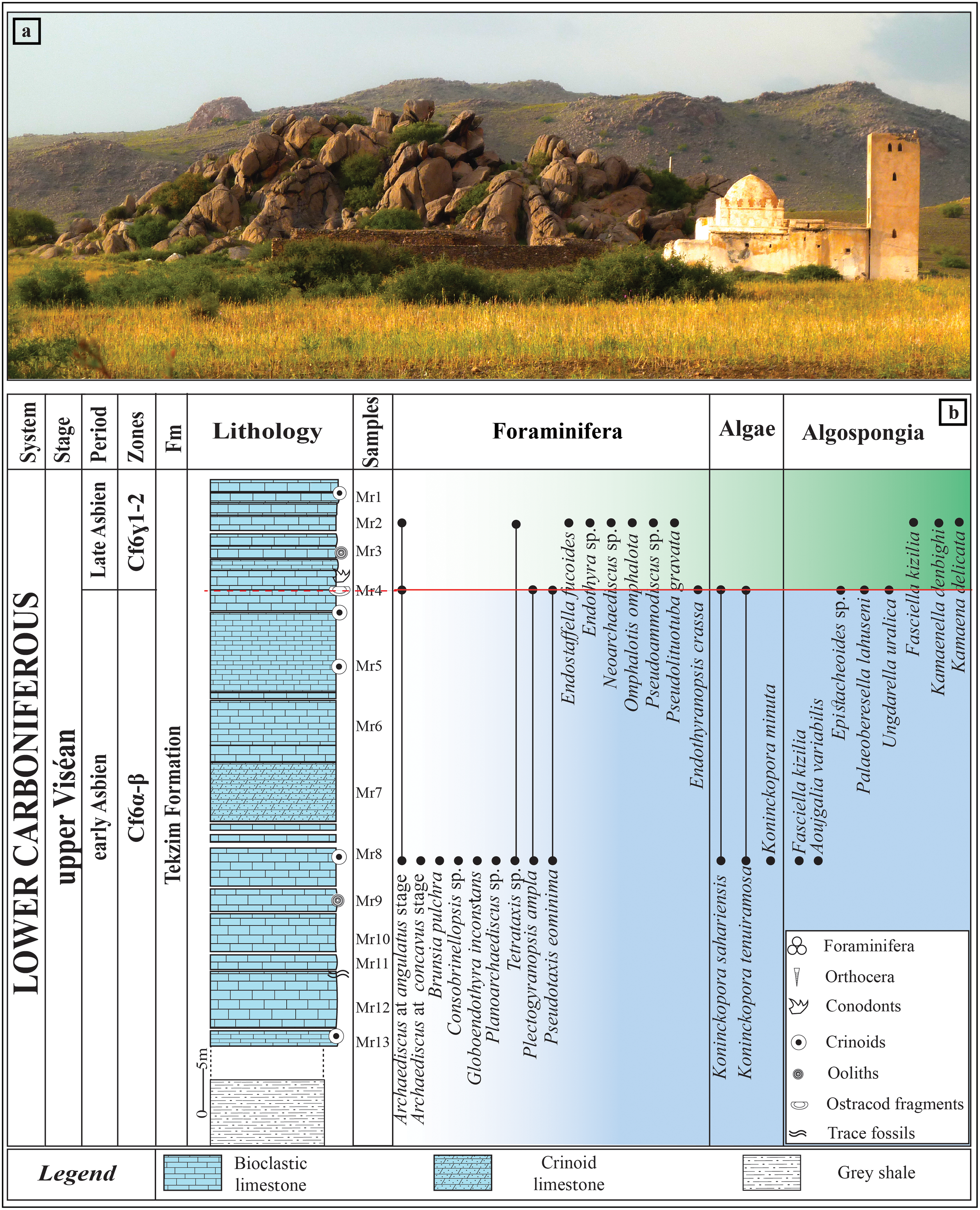
Figure 6. Long description
The image presents a view of the outcrop of the allochthonous unit of the eastern Jebilet nappe, displaying massive bioclastic limestones. The stratigraphic log in the lower part of the image details the distribution of foraminifera, algae, and algospongia in the studied Marabout section. The log includes columns for system, stage, period, zones, formation, lithology, samples, foraminifera, algae, and algospongia. The lithology column shows different types of limestone and grey shale, while the other columns list specific fossils and organisms found in each sample. The legend at the bottom explains the symbols used in the log.
4.d.2. Biostratigraphic results
From Mr13 to Mr8, the microbiota corresponds to the early Asbian (Cf6α-β) owing to the occurrence of Archaediscus at the angulatus stage, whereas the occurrence of Neoarchaediscus in Mr4 suggests that the upper part of the section corresponds to the late Asbian (Cf6γ1-2) (Figure 6b).
4.e. Koudiat El Menjel (Mj) section (allochthonous outcrop)
4.e.1. Description
The Koudiat El Menjel section is located in the middle of the eastern Jebilet, south of Douar Oulad Brahim and southeast of Douar Jaïdet (Figure 1; Table 1). It forms a series composed of a succession of centimetre-thick beds of bioclastic limestones rich in crinoids. The gritty limestone facies of Koudiat El Menjel shows a strong affinity with that of Ouled Omar to the north, in terms of richness in large crinoids. The first sample, Mj1, about 50 centimetres thick, showing a dark blue patina and grey fracture, is overlain by a very hard and finely crystalline limestone bed, Mj2 (60 cm), which is rich in crinoid ossicles and rare foraminifers and algae (Figure 7). Bed Mj3, a lenticular carbonate facies, is overlain by three metres of limestone beds (Mj4 and Mj5), which are massive and crinoidal with a dark blue patina and microbiota (Figure 7). The sequence continues with some limestone lenses (Mj5a), more or less altered, rich in crinoid ossicles and trace fossils. This set is topped by a very hard, gritty limestone bed Mj6 (50 cm), with microbiota (Figure 7).
Stratigraphic log and distribution of foraminifera, algae and algospongia of the Koudiat El Menjel section.
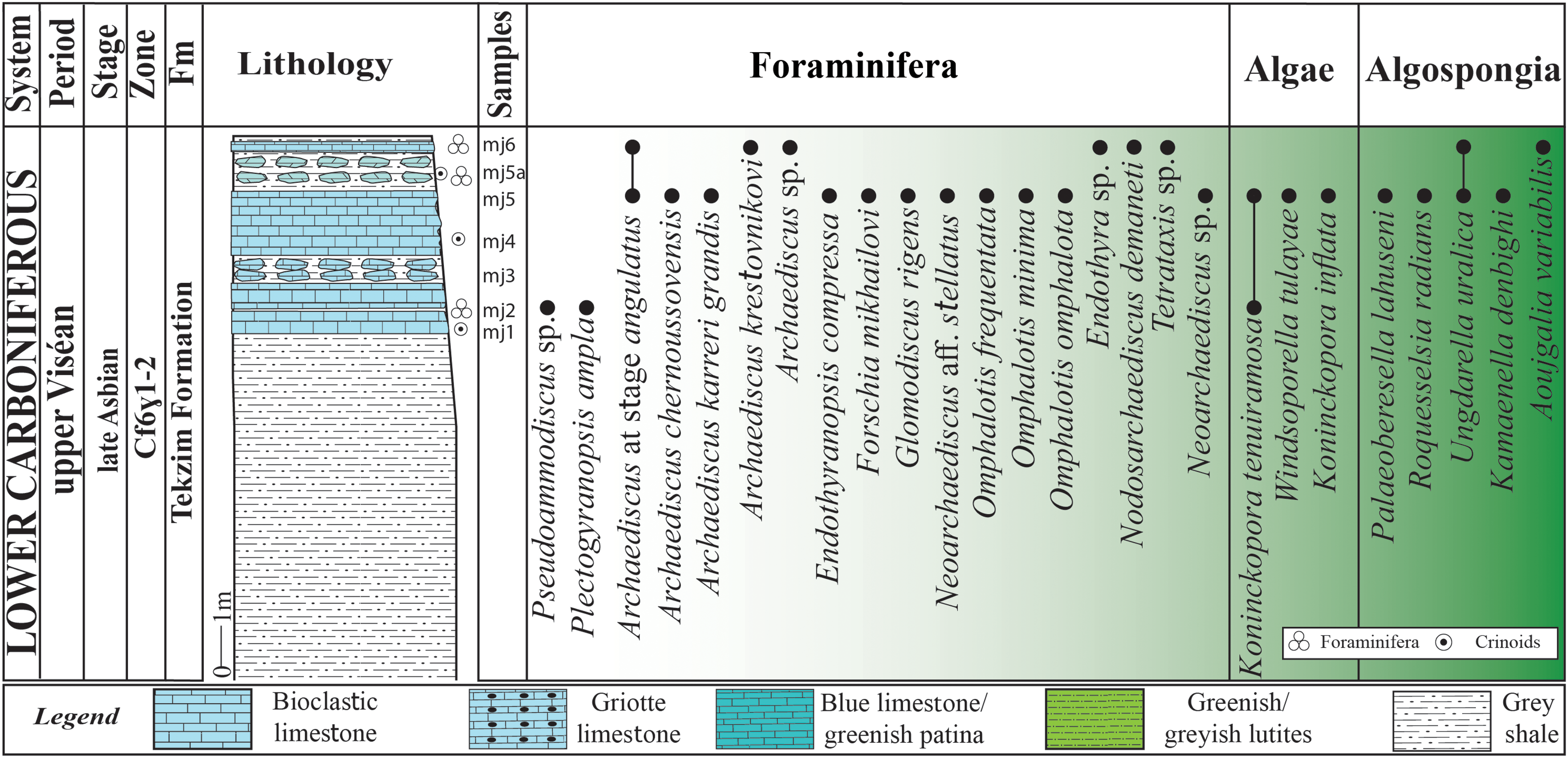
Figure 7. Long description
The table presents the lithology and distribution of foraminifera, algae, and algospongia in the Koudiat El Menjel section. It includes columns for system, period, stage, zone, formation, lithology, samples, foraminifera, algae, and algospongia. The lithology column features various types of limestone and shale, with a legend indicating bioclastic limestone, griotte limestone, blue limestone, greenish/greyish lutites, and grey shale. The foraminifera column lists different species such as Pseudoammodiscus sp., Plectogyranopsis ampla, and Archaediscus at stage angulatus. The algae column includes species like Koninkopora tenuiramosa, Windsoporella tulavae, and Konickopora inflata. The algospongia column lists species such as Palaeoberesella lahuseni, Roquesettia uralica, and Kamaenella denbighi. The table spans multiple rows and columns, providing a detailed stratigraphic log of the section.
4.e.2. Biostratigraphic results
No conodonts were recovered from the samples of the Koudiat El Menjel section. However, all the foraminifers found in the residue from washing and those identified from thin sections indicate a late Asbian age (Cf6γ1-2), including the occurrence of Neoarchaedicus and Ungdarella uralica (Figure 7).
4.f. The Douar Tolba section (Dt)
4.f.1. Description
The Douar Tolba section is located in the centre of the eastern Jebilet, about one kilometre southwest of the Douar and seven kilometres south-southwest of Douar Ouled Brahim, near a small watercourse. It is characterized by small hills ranging from 100 to 200 m in altitude, with various orientations and slopes, separated by a network of wadis and tributaries. The hill of the Douar Tolba section (Figure 1; Table 1) forms a small mound about 50 metres high, composed of a series of carbonate strata with intercalations of folded grey shales, cut by networks of faults. This section is also one of the best exposures in the eastern Jebilet, showing clearly the direct contact between the pre-Viséan (Middle Devonian) and the Viséan. The Devonian, with a thickness of 40 metres, consists of siliceous shales and sandstone beds. Its top is made up of ‘griottes’ limestones containing tentaculites. These Devonian limestones are overlain by Viséan bioclastic limestones (Figure 8a). This pre-Viséan nappe unit is identical in appearance and facies to that of the Ouled Omar section. The outcrop is formed by a hill rising to 106 metres in altitude, representing a north–south elongated nappe unit. The first bed (Dt1) is a finely arenaceous, well-preserved limestone with a dark yellow patina, with a grey fracture surface and a thickness of 50 centimetres. It is directly overlain in normal contact by a bioclastic limestone bed (Dt2), 60 cm, with a dark blue patina and grey fracture surface (Figure 8b). This unit is followed by four metres of schist strata with intercalated limestone lenses, which are in turn overlain by another bioclastic arenaceous limestone (Dt3), rich in crinoids, elongate foraminifera and other bioclastic fragments. The following interval consists of about ten metres of highly weathered grey shale containing centimetre-scale bioclastic limestone lenses rich in crinoids. Bed Dt5 shows a crinoid-bearing carbonate facies. The succession continues with nine metres of shale, overlain by a massive, very hard and well-preserved reefal limestone bed (8 m). The washed residue from Dt6 is rich in elongated foraminifera, some rare crinoids, a few ostracods and numerous reefal organisms. Beds Dt7 and Dt8, separated by 12 metres of grey shale, are fine limestones with a few crinoids, showing a bluish patina. At the top of the section, four metres of shale are capped by a massive limestone bed (Dt8) rich in crinoids and ostracods, with a few traces of algae (Figure 8c).
View of the Douar Tolba section showing the Devonian outcrops at the base, overlain by the Viséan limestones toward the top (a), detail of the normal contact between the Viséan deposits and the Devonian red nodular limestones, separated by an unconformity (b) and stratigraphic log and distribution of foraminifera of the Douar Tolba section (c).
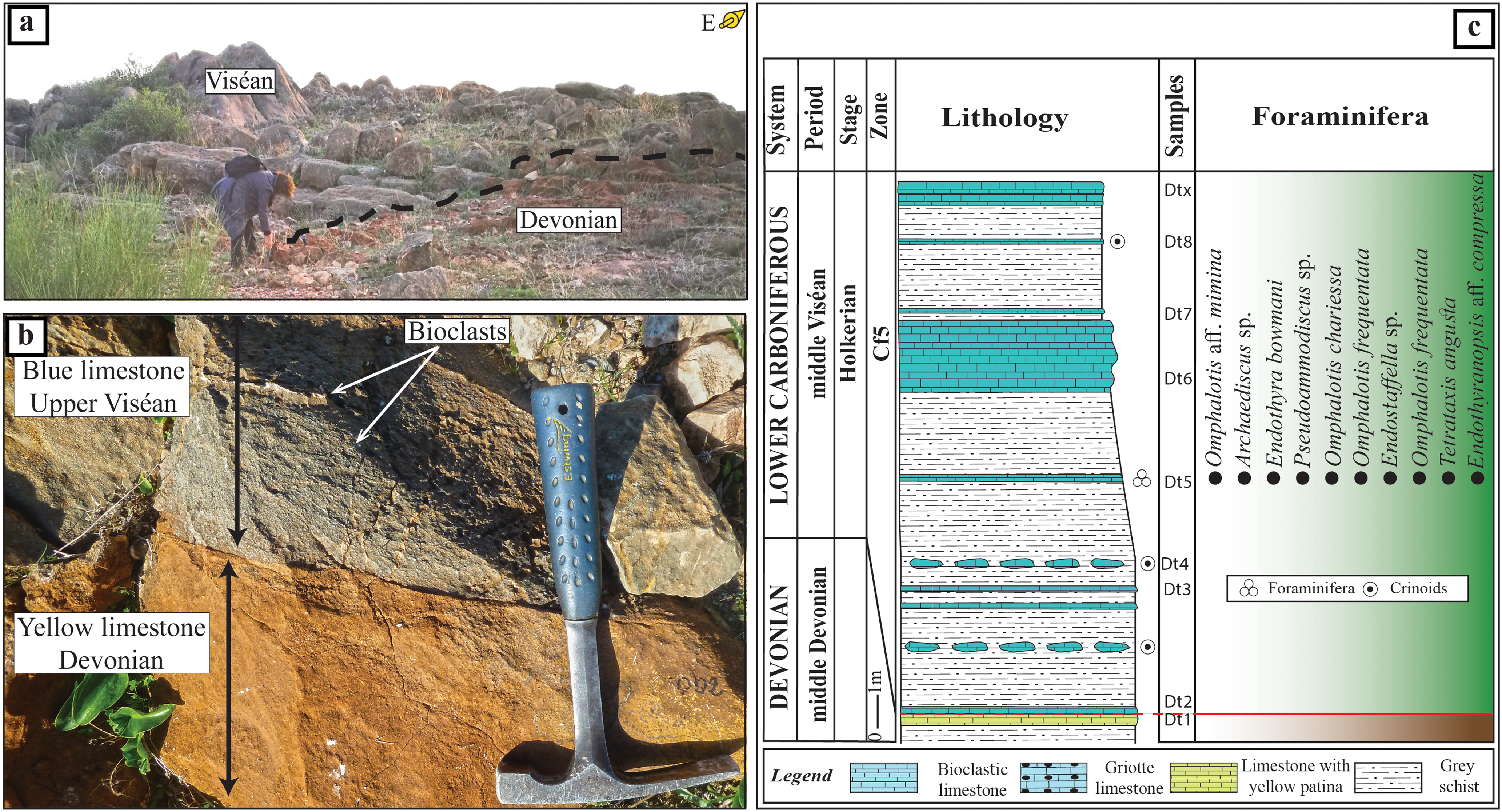
Figure 8. Long description
The image consists of three parts. Part a shows a view of the Douar Tolba section with Devonian outcrops at the base and Viséan limestones toward the top. Part b provides a detailed view of the normal contact between the Viséan deposits and the Devonian red nodular limestones, separated by an unconformity. Part c presents a stratigraphic log and the distribution of foraminifera of the Douar Tolba section. The stratigraphic log includes columns for system, period, stage, zone, lithology, samples, and foraminifera. The lithology column shows different types of limestone and grey schist. The foraminifera column lists various species of foraminifera found in the samples.
4.f.2. Biostratigraphic results
The sample taken from the Devonian was barren of conodonts. The samples Dt5 to Dt7 do not provide precise biostratigraphic information. Many of the foraminiferal specimens present in thin sections appear from the early Viséan onwards, but the first Endostaffella occurs in the mid-Viséan. Furthermore, the rare Archaediscus specimens are still in the involute stage, suggesting a rather primitive assemblage, indicative of the mid-Viséan (Figure 8c).
4.g. The Douar Fokra section (D) (autochthonous outcrop)
4.g.1. Description
The Douar Fokra outcrop corresponds to the platform facies at the top of the Kharrouba flysch close to the Koudiat Bourkis mapped by Huvelin (Reference Huvelin1977) as Sarhlef limestone. The Douar Fokra section is located near the small Douar Fokra, in the central part of the eastern Jebilet, south of Douar Lakakla, approximately 35 kilometres northeast of Marrakech and 17 kilometres east of Sidi Bou Othmane (Figure 1; Table 1). This area, along with that of Douar Ouled Ben Tounsi, has been the subject of numerous studies (Huvelin, Reference Huvelin1977; Oukemeni, Reference Oukemeni1987; Essamani, 1988). It forms a series of small hills that become more pronounced eastward, reaching elevations of 300 to 400 metres. These hills are composed of bioclastic, or ‘griotte’, limestones alternating with psammitic shales. The sampling of this section began with an isolated bed, showing a well-preserved lenticular crinoidal limestone (D1) with a thickness of 60 centimetres, brown patina and a blue fracture, which is rich in bioclasts. It is followed by several metres of grey shales, deformed, altered and folded; notably, at the level of the water stream, we crossed to reach a small segment where four sandy carbonate beds crop out. D2 is a limestone with a yellowish patina (30 cm), while D3, D4 and D5 are lenticular beds of yellowish colour with beige fractures, highly recrystallized, with thicknesses ranging from 20 to 40 centimetres within the shales. Sample D3 contains foraminifers (Figure 9). The sequence continues with a massive bed, five to ten metres thick, from which we collected samples D6 to D9, consisting of an alternation of grey crystalline limestone rich in crinoids and bioclasts. Only sample D7 contains foraminifers (Figure 9). In the middle of this massive bed lies bed D10, which is a crystalline limestone lithologically similar to the previous beds and which contains many crinoids, ostracods, some gastropods and corals. This bed is rich in foraminifers, algae and algospongia (Figure 9). The beds D11 and D12, forming a finely crystalline limestone, are overlain by seven metres of shale, within which two carbonate beds (D13 and D14) are intercalated with thicknesses of 40 and 60 centimetres, respectively, showing a beige-coloured carbonate facies with a grey fracture. D15 directly overlies these grey shales. It is a massive (5 m) bed whose base consists of finely crystalline limestone rich in foraminifers and abundant crinoids, with some ostracods and reef organisms. In the middle of this massive bed, we collected sample D16, showing a highly recrystallized facies, while at the top of the layer lies bed D17 characterized by well-preserved limestone with a beige patina and grey fractures, rich in crinoids. The whole sequence is topped by very altered grey shales, about one metre thick, overlain by a huge limestone bar (7 m). At its base, sample D18 was collected, showing a beige-to-yellow carbonate facies containing crinoids and rare foraminifers. Samples from D19 to D23, 20 to 60 centimetres thick, are characterized by massive beige limestone with grey fractures, rich in crinoids. Beds D20, D25 and D26 display a carbonate facies rich in crinoids and some foraminifera, algae and algospongia (Figure 9). The continuation of the section is located 130 metres NNE from the previous beds, crossing the Viséan flysch of the Kharrouba Formation, and is generally folded and locally deformed, showing some probable epizonal metamorphic minerals. Beds D27 and D28 correspond to limestone beds similar to the previous ones, reflecting a beige-coloured limestone with grey fractures, more or less altered. The second subsector, located 700 metres to the east, consists of four distinct samples (D30 to D33) collected at the northeast base of Koudiat Bourkis, corresponding to the h2 unit of Huvelin (Reference Huvelin1977) and dated as Viséan-Namurian, mainly composed of bioclastic limestones.
Stratigraphic log and distribution of foraminifera, algae and algospongia of the Douar Fokra section.
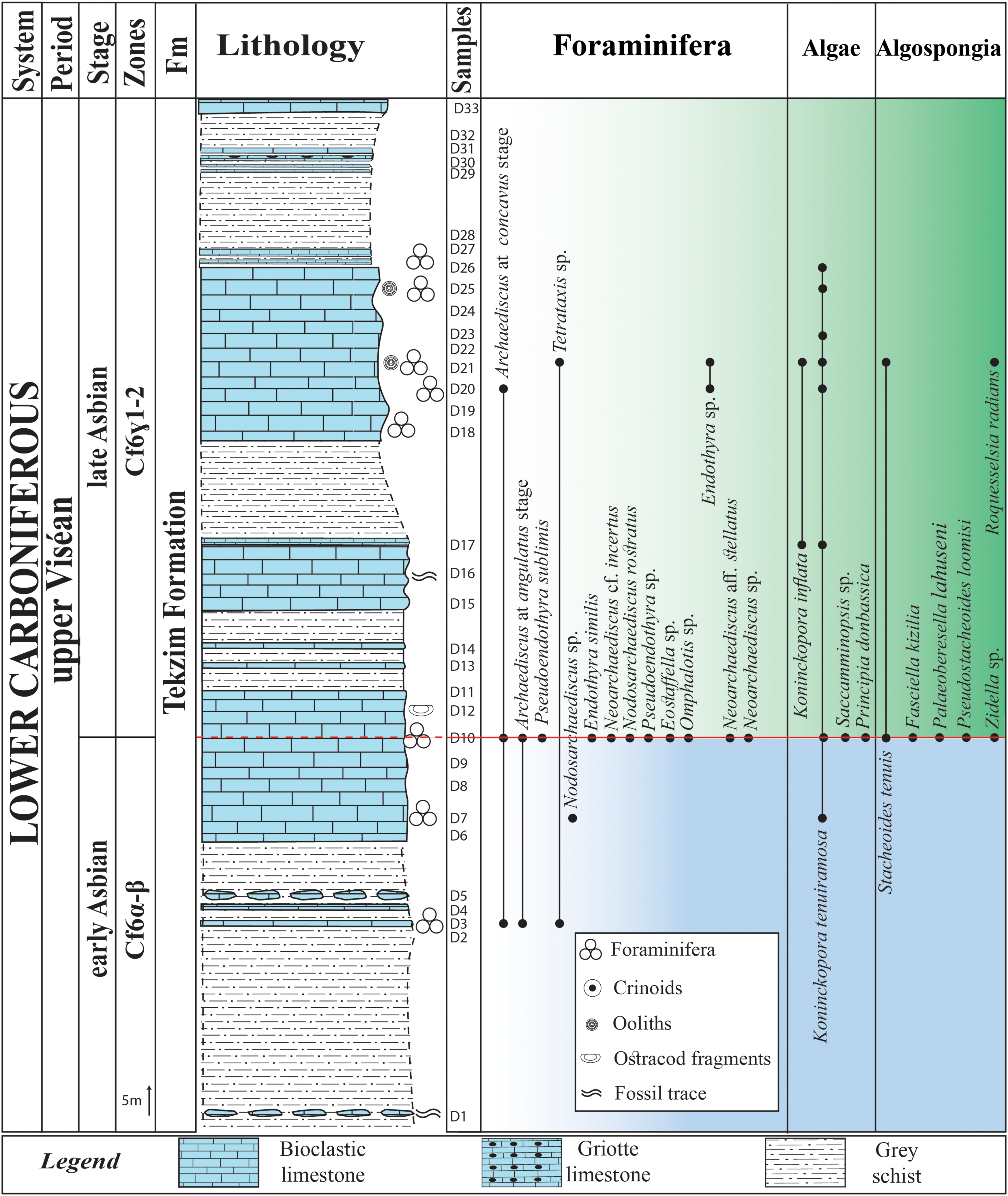
Figure 9. Long description
The table presents the stratigraphic log and distribution of foraminifera, algae, and algospongia in the Douar Fokra section. It includes columns for system, period, stage, zones, formation, lithology, samples, foraminifera, algae, and algospongia. The lithology column features bioclastic limestone, griotte limestone, and grey schist. The foraminifera column lists various species such as Archaeiscus at angulatus stage, Pseudoendothyra similis, Endothyra sp., and others. The algae column includes species like Koninckopora inflata, Saccamminopsis sp., and others. The algospongia column lists species like Fasciella kizilia, Pseudotachydiscus loomis, and others. The table spans multiple rows and columns, detailing the presence of these species across different stratigraphic levels.
4.g.2. Biostratigraphic results
The foraminifera recovered from sample D10 of the Douar Fokra section correspond to the latest Asbian age (Cf6γ1-2), mostly due to the occurrence of Neoarchaediscus, Saccamminopsis and Zidella. So, we attributed the lower part of the section to early Asbian (Cf6α-β) (Figure 9).
4.h. The El Gargabat section (Gr) (allochthonous outcrop)
4.h.1. Description
The El Gargabat section is located in the centre of the eastern Jebilet, one kilometre south of Douar Oulad Ben Tounsi and three kilometres NNE of Douar Fokra (Figure 1; Table 1). The zone is characterized by small low-altitude mounds generally ranging from 100 to 200 metres high, with varying directions and slopes formed by sandstone or sometimes schistose hills. This section is one of the best studied in the eastern Jebilet by Huvelin (Reference Huvelin1977), where the transition from the Devonian to the Viséan can be observed, showing the reworking of some Devonian limestone pebbles within the Viséan limestones (Figures 10a, b). It is mainly composed of a succession of limestone beds intercalated with greenish-black to dark grey shales. The sampling direction is from northeast to southwest, with the first sample located near the northern bank of a watercourse, where the beds are vertical. Sampling began from the top of the series with closely spaced samples taken from centimetre-thick beds of Viséan sandy limestones or, sometimes, bioclastic limestones (Huvelin, Reference Huvelin1977). The section shows a concordant transition from the pre-Viséan, generally represented by a facies of more or less altered griotte limestones rich in large orthoceras, from sample Gr23 to Gr21. These griotte limestones are in contact with Viséan bioclastic limestones corresponding to beds Gr10 to Gr1 (Figure 10a). The entire sequence belongs to the nappe of the eastern Jebilet.
Field photo showing the contact between the Devonian and the Viséan within the El Gargabat outcrop (a) and field image of the boundary between the Devonian and the Viséan, showing the reworked Devonian blocks within the Viséan limestones (b).
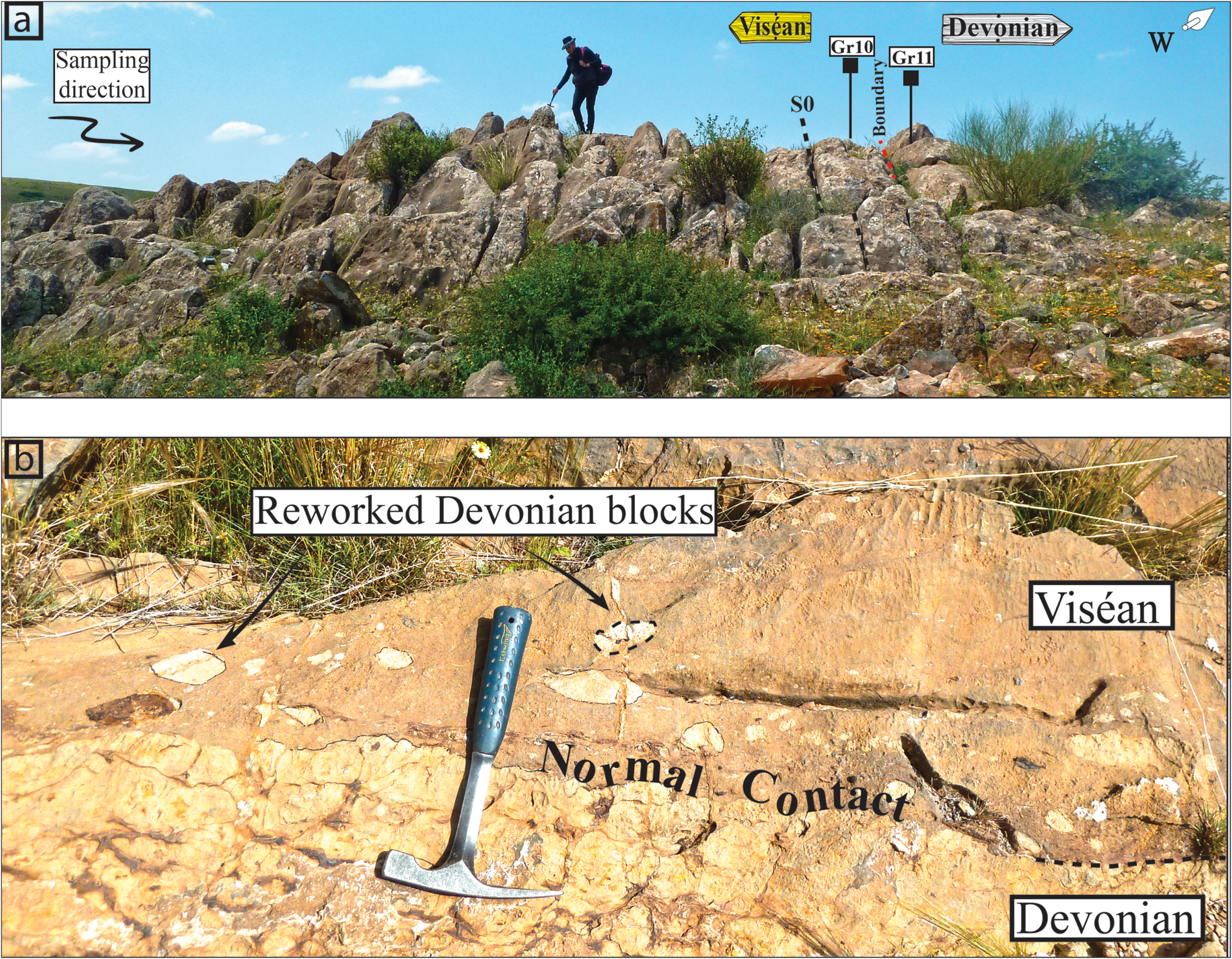
Figure 10. Long description
A person stands on a rocky outcrop, with labels indicating the geological periods Viséan and Devonian. The image includes markers for sampling direction, a boundary line, and specific points labeled Gr10 and Gr11. Below, a close-up shows reworked Devonian blocks within Viséan limestones, with a hammer for scale and labels indicating normal contact between the Devonian and Viséan layers.
At the base of the section, 15 m of Silurian graptolite shales are overlain by bed Gr23, a well-preserved limestone bed, about 50 cm thick, containing agglutinating foraminifera belonging to the genus Hyperammina. Gr23 is overlain by three thin limestone beds interbedded within grey shales, followed by a pseudonodular griotte limestone bed overlain by bed Gr22. The latter is a nodular limestone with a grey-greenish patina, rich in orthocones. This is followed by a series of griotte limestone beds (2 m), topped by Gr21, a small nodular limestone bed (10 cm) rich in tentaculitoids. After 20 cm of fine limestone and massive limestone (2 m) interspersed with grey schist comes Gr20, a finely crystalline limestone (80 cm). This is followed by two metres of griotte limestone (Gr18 and Gr19) rich in orthocones and tentaculitoids, particularly nowakiids. The next layer (Gr17) is a finely marly limestone, followed by 1.2 m of massive limestone (Gr15–16), rich in crinoids. Then a massive bed (Gr13–14), 1.5 m thick, of gritty limestone at the base, with horizontal laminations. Note that Gr14 is rich in tentaculitoides. Next comes Gr12, a greyish micritic nodular limestone (45 cm) containing the foraminifer Lagenammina sphaerica, bivalves, crinoid stems and ossicles and ostracods. Gr11 shows a grey-to-reddish pseudonodular limestone, 40 cm thick, containing orthocone shells and some goniatites and which yielded the foraminifera Saccammina sp., Tolypammina irregularis and Tolypammina sp. 2 (Figure 11). The first Viséan bed corresponds to Gr10, a limestone (50 cm) with a blue patina and rich in iron oxide. This is directly overlain by a massive (1.5 m) bed (Gr7–Gr9) of dark, gritty limestone. Note that Gr8 contains an individual of Lagenammina sphaerica, while Gr9 yielded unidentifiable Viséan foraminifera. Gr6 is a 40 cm thick, blackish, gritty limestone rich in iron, whose washed residue contains fish scales. The following bed is metric in thickness (Gr5) with a very fine dolomitic limestone facies containing pyrite crystals. Meanwhile, Gr4 shows a highly recrystallized carbonate facies (50 cm) and yields a foraminiferal assemblage, algae and algospongia. Beds Gr3 and Gr2 constitute a very marly and highly altered carbonate facies, 80 cm and 40 cm thick, respectively. They contain some fish scales. At the top of the section, Gr1 is a gritty limestone with a grey patina, 50 cm thick and rich in microbiota (Figure 11).
Stratigraphic log and distribution of foraminifera, algae and algospongia of the El Gargabat section.

Figure 11. Long description
The table presents the stratigraphic log and distribution of foraminifera, algae, and algospongia of the El Gargabat section. It includes columns for system, stage, period, zone, lithology, samples, foraminifera, algae, algospongia, and graptolites. The lithology column features various types of limestone and schist, with specific beds labeled from Gr1 to Gr23. The foraminifera column lists different species found in each bed, while the algae and algospongia columns indicate the presence of specific types. The table also includes a legend explaining the symbols used for different fossils. Notable trends include the presence of specific foraminifera species in certain beds and the interbedding of different types of limestone and schist.
4.h.2. Biostratigraphic results
Two lithostratigraphic formations (Smaha Fm and Jaidet Fm), whose ages have been determined using conodonts, ammonites and microfacies, were identified in the allochthonous Devonian of the eastern Jebilet by Becker et al., (Reference Becker, Aboussalam, El Hassani, Cózar, Herbig and Ernst2021). Based on lithological correlation, the black shales and nodular limestones at the base of the El Gargabat section correspond to the Smaha Fm, dated from the Silurian to the Lochkovian–Praguian. The griotte limestones (Gr23 to Gr18), rich in orthocones and tentaculitoids, correspond to the lower and middle members of the Jaidet Fm and are of Praguian age (Becker et al., Reference Becker, Aboussalam, El Hassani, Cózar, Herbig and Ernst2021). The overlying layers (Gr17 to Gr13) correspond to the upper member of the Jaidet Fm, dated early Emsian (Becker et al., Reference Becker, Aboussalam, El Hassani, Cózar, Herbig and Ernst2021). The griotte limestones interbedded with nodular shales (Gr11 and Gr12) containing some goniatites likely represent the upper part of the upper member of the Jaidet Fm and are assigned to the upper Emsian (Becker et al., Reference Becker, Aboussalam, El Hassani, Cózar, Herbig and Ernst2021). Due to the presence of rare specimens of primitive Neoarchaediscus, Endothyranopsis crassa and Fascifolium pantherinium (this latter taxon is rare and mostly restricted to Morocco; Vachard and Cózar, Reference Vachard and Cózar2010), the samples Gr1, Gr4 and Gr10 are assigned to the latest Asbian age (Cf6γ2) (Figure 11).
5. Discussion
5.a. Comparison with previous studies in the eastern Jebilet
-
• The Kharrouba turbidites were studied by Huvelin (Reference Huvelin1977); Graham (Reference Graham1982a); Essemani (Reference Essemani1988) and Izart (Reference Izart1990). The turbidites were dated Holkerian in Koudiat Kouchina (Essemani, Reference Essemani1988) and Asbian at the top in Koudiat Bourkis (zone 15 of Mamet, Hollard et al., Reference Hollard, Huvelin and Mamet1977, sample 14). Posidonia becheri and Goniatites crenistria were found in Dar Jaïdet (point 2; Hollard et al., Reference Hollard, Huvelin and Mamet1977). The Kharrouba platform facies are known in the Koudiat Bourkis at the top of the turbidites (Graham, Reference Graham1982a and Reference Graham1982b), Nouidar (Reference Nouidar1988) and Izart (Reference Izart1990). This facies consists of limestone and claystone and is dated Asbian (zone 15 of Mamet, samples 5 and 89). The Koudiat Lahmara is a gliding nappe overlying an olistostrome, as in Jebel Tekzim. Thick bioconstructions are not known in Jebilet as in Central Morocco (Cozar et al., Reference Cózar, Somerville, Rodríguez, Houicha, Vachard, García-Frank, Coronado, Izart and Said2023), except the 10 m-thick bioconstruction in Koudiat Lahmara (André, Reference André1986; Nouidar, Reference Nouidar1988) with Dibunophyllum, Lithostrontion, Bryozoans and Algae. It is dated upper Asbian (sample 7, zone 15 Mamet, Cf6γ, upper Asbian; Hollard et al., Reference Hollard, Huvelin and Mamet1977). In Koudiat Oulad Habid (in the South of Eastern Jebilet), Courtinat and Beauchamp (Reference Courtinat and Beauchamp1985) and Izart (Reference Izart1990) described conglomerates with grading and oblique stratification and sandstone with HCS (storm deposit) and alternation of sandstone and claystone deposited in a fan delta with wave ripples and marine ichnofacies (worm tracks, Monocraterium burrows) that were recently studied by El Khounaijri et al., (Reference El Khounaijri, Algouti, Algouti, Essemani, Hadach, Aboulfaraj, Ezzahri and Baid2024). The age of this facies (sample 16, zone 15, Hollard et al., Reference Hollard, Huvelin and Mamet1977) is Asbian.
-
• Cózar et al., (Reference Cózar, Vachard, Izart, Said, Somerville, Rodríguez, Coronado, El Houicha and Ouarhache2020b) revised the foraminifers used for the biostratigraphy of all then-known Mississippian outcrops in Morocco, previously assigned either to early Viséan (V2a or V2a/b or Cfm1) to mid-Viséan (V2b-V3a or Cfm 2-Cfm 3). This group of microfossils occurs in shallow-water limestones within dominantly siliciclastic successions. They point out that most of the previously determined early Viséan ages for outcrops are now interpreted as mid-Viséan or even late Viséan. Similarly, some outcrops initially attributed to the mid-Viséan are now considered late Viséan outcrops.
-
• Regarding sample 7 in Koudiat Lahmara in Hollard et al., (Reference Hollard, Huvelin and Mamet1977), which is interpreted as an indeterminated Zone 13 to Zone 15, the foraminiferal assemblage table actually mostly contains mid-Viséan microfossils, as well as ‘Climacammina’. The Climacammina reported in this table cannot be of that age, likely representing oblique sections of Cribrostomum or Koskinobigenerina, which suggest also a late Asbian Cf6γ zone. True Climacammina first occurs in the late Brigantian or Serpukhovian in Western Europe and Northern Africa (Cózar and Somerville, Reference Cózar and Somerville2021).
-
• The outcrops E1 and E2 of Koudiat Kouchina (Essemani, Reference Essemani1988) both have very poor assemblages. Considering the appearance of Endothyranopsis compressa in E1, it could be mid-Viséan as suggested by the author, but the taxa in E2 are only representative of the early Viséan, by the appearance of Planoarchaediscus (since the other taxa are typical of a Tournaisian age). As these outcrops are close to the Hollard et al., (Reference Hollard, Huvelin and Mamet1977) outcrops 11 (Jebel Smaha in the olistostrome in the Kharrouba area) and 13 (in Douar El Amra), as well as other outcrops with Goniatites crenistria, it is easier to assume they might contain non-representative foraminifers and should be considered late Asbian.
-
• For middle Viséan limestones: fauna Cf5 (V2b), in the lower part of the Kharrouba Flysch at Koudiat Kouchina (North Tamlalet in the Kharrouba area); Izart et al., (Reference Izart, Beauchamp, Vachard, Tourani and Essamani1997) based their dating on Essemani (Reference Essemani1988). The microfossil assemblage is insufficient to confirm a mid-Viséan age. Similarly, the allochthonous conglomerate at the base of the Tekzim Formation (lower/middle Viséan at Koudiat Lahmara) (Becker et al., Reference Becker, Aboussalam, El Hassani, Cózar, Herbig and Ernst2021) likely derived from a shallow-water carbonate platform existing formerly in the early/mid-Viséan but later destroyed by erosion and reworking.
-
• Likewise, according to Berkhli et al., (Reference Berkhli, Paicheler and Vachard1993), lower and middle Viséan carbonates are absent in the eastern Meseta, although the basal part of the succession remains undated, but the shales and limestones immediately above have been assigned to the late Viséan, suggesting a late Viséan age for this undated part.
5.b. Age of the Kharrouba Formation
The Lower Carboniferous succession of the Jebilet Mountains comprises the Kharrouba Flysch and its lateral equivalent, Sarhlef Shales (Huvelin, Reference Huvelin1977), in the eastern and central Jebilet, respectively. Contrary to the suggestion by Delchini et al., (Reference Delchini, Lahfid, Plunder and Michard2016) assigning them an age ranging from the Late Devonian to the late Viséan, previous studies (Hollard et al., Reference Hollard, Huvelin and Mamet1977; Huvelin, Reference Huvelin1977; Izart et al., Reference Izart, Beauchamp, Vachard, Tourani and Essamani1997; André, Reference André1986; Becker et al., Reference Becker, Aboussalam, El Hassani, Cózar, Herbig and Ernst2021) and a revision of the microfossils for more than forty samples from the Jebilet, including both autochthonous and allochthonous outcrops, clarified that most samples belong to the late Viséan, specifically the late Asbian (Cf6γ1), with some assigned to the top of this zone (Cf6γ2). But our palaeontological data gives new results. The age is at least middle Viséan (Cf5) for the base and late Viséan, more precisely late Asbian (Cf6γ1-2), for the middle and upper parts of the Kharrouba Formation, of which the age of its top is notably based on the presence of molluscs (Posidonia becheri and Goniatites crenistria), the latter being a zonal marker of the top of the Asbian (Riley, Reference Riley1993; Korn, Reference Korn2017). Figures 12 and 13 illustrate selected foraminifers, algae and algospongia recorded from the eastern Jebilet. In the present study, the age of at least middle Viséan to late Asbian (Cf5-Cf6γ2) has been highlighted in the autochthonous deposit of Jebel Tekzim. In the allochthonous outcrops, the middle Viséan (Cf5) and the late Viséan age, Asbian, more precisely Cf6α-Cf6γ1, Cf6α-Cf6γ2, Cf6γ1, Cf6γ2 or Cf6γ1-Cf6γ2, are recognized (Figure 14a). It should also be noted that Viséan sediment deposition, directly above Famennian limestones, has been identified (Lazreq et al., Reference Lazreq, Bamoumen, Bouari, Soulaimani and Königshof2023).
Selected foraminifers recorded in the eastern Jebilet. 1. Archaediscus at angulatus stage, sample oo3, Ouled Omar section, early Asbian. 2. Archaediscus at angulatus stage, sample oo10, Ouled Omar section, late Asbian. 3. Omphalotis minima, sample oo10, Ouled Omar section, late Asbian. 4. Archaediscus karreri grandis: note that this species shows facets and is incomplete; sample B.1, Jebel Tekzim section, early Asbian. 5. Pseudoendothyra struvii, sample oo3, Ouled Omar section, early Asbian; the specimen is recrystallized, the usual preservation for specimens of this genus. 6. Pseudoendothyra sublimis (recrystallized), sample D10, Douar Fokra section, late Asbian. 7. Neoarchediscus sp., sample Dj7, Jebel Tekzim section, late Asbian. 8. Neoarchaediscus sp., a primitive form still preserving a marked microgranular wall, sample Mj6, Koudiat El Menjel section, late Asbian. 9. Neoarchaediscus aff. stellatus, sample D10, Douar Fokra section, late Asbian. 10. Neoarchaediscus sp., a primitive form still preserving a marked microgranular wall, sample Mr2, Marabout section, late Asbian. 11. Neoarchaediscus cf. incertus, sample D10, Douar Fokra section, late Asbian. 12. Neoarchaediscus aff. parvus, sample D10, Douar Fokra section, late Asbian. 13. Endothyranopsis crassa (juvenile), sample Gr1, El Gargabat section, late Asbian.

Figure 12. Long description
The image displays a collection of foraminifer specimens from the eastern Jebilet region. Each specimen is labeled with its species and sample location. The first image shows Archaediscus at the angulatus stage from the Ouled Omar section, early Asbian. The second image also shows Archaediscus at the angulatus stage from the Ouled Omar section, late Asbian. The third image features Omphalotis minima from the Ouled Omar section, late Asbian. The fourth image displays Archaediscus karreri grandis from the Jebel Tekzim section, early Asbian, noted for its facets and incomplete form. The fifth image shows Pseudoendothyra struvii from the Ouled Omar section, early Asbian, which is recrystallized. The sixth image features Pseudoendothyra sublimis, also recrystallized, from the Douar Fokra section, late Asbian. The seventh image shows Neoarchediscus sp. from the Jebel Tekzim section, late Asbian. The eighth image displays Neoarchaediscus sp., a primitive form with a marked microgranular wall, from the Koudiat El Menjel section, late Asbian. The ninth image features Neoarchaediscus aff. stellatus from the Douar Fokra section, late Asbian. The tenth image shows another Neoarchaediscus sp., a primitive form with a marked microgranular wall, from the Marabout section, late Asbian. The eleventh image displays Neoarchaediscus cf. incertus from the Douar Fokra section, late Asbian. The twelfth image features Neoarchaediscus aff. parvus from the Douar Fokra section, late Asbian. The thirteenth image shows Endothyranopsis crassa, a juvenile specimen, from the El Gargabat section, late Asbian.
Selected algae and Algospongia from the eastern Jebilet. 1. Ungdarella uralica, sample Mr4, Marabout section, late Asbian. 2. Stacheoides tenuis, sample oo3, Ouled Omar section, early Asbian. 3. Fascifolium pantherinum, sample Gr1, El Gargabat section, late Asbian. 4. Saccamminopsis sp., sample D10, Douar Fokra section, late Asbian. 5. Windsoporella tulayae, sample Mj5, Koudiat El Menjel section, upper Asbian. 6. Aujgalia regularis, sample B.3, Jebel Tekzim section, late Asbian.
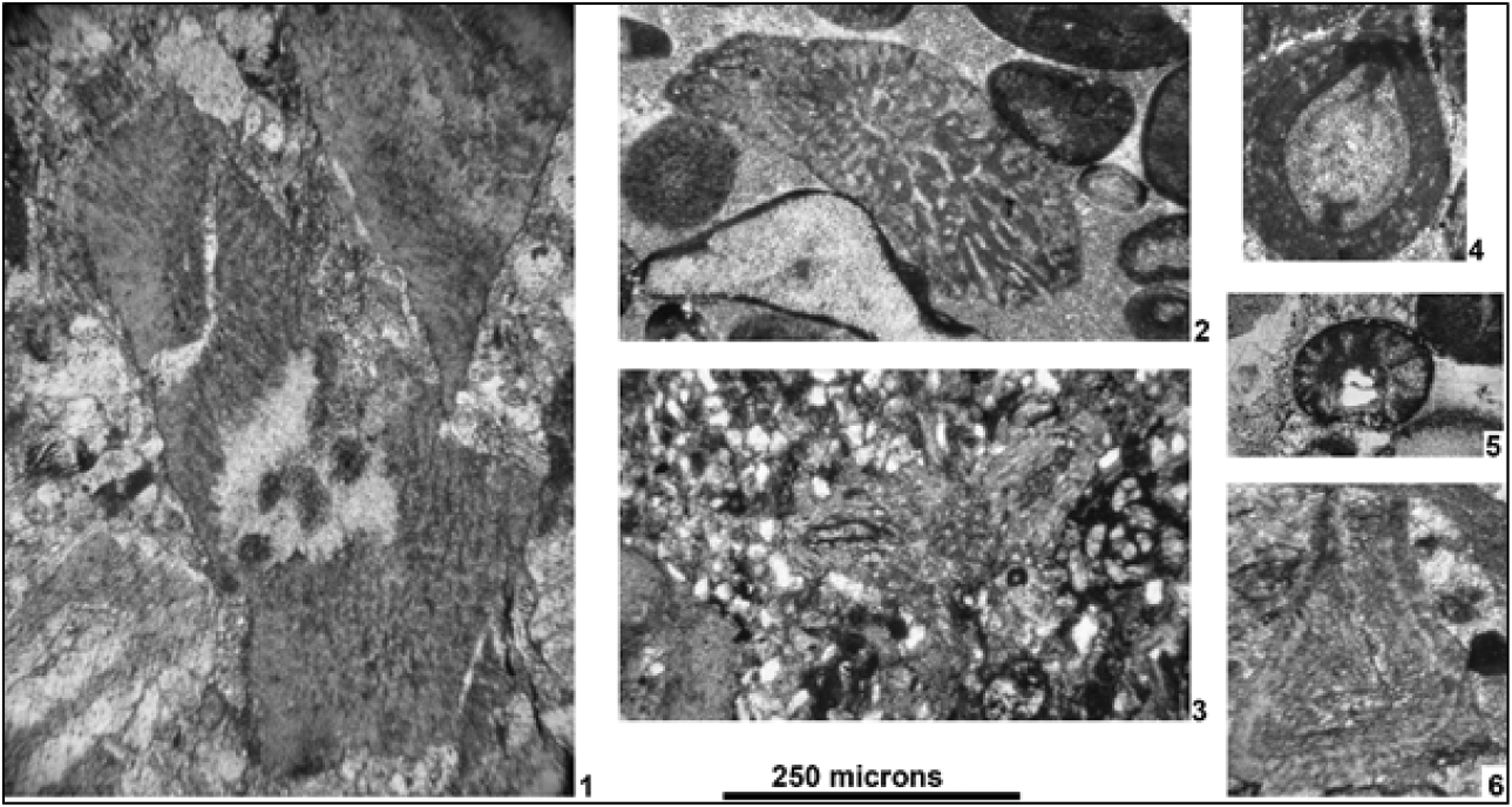
Figure 13. Long description
The image displays a collection of microscopic views of different algae and Algospongia samples from various sections in the eastern Jebilet. The samples are labeled as follows: 1. Ungdarella uralica from the Marabout section, dated to the late Asbian period. 2. Stacheoides tenuis from the Ouled Omar section, dated to the early Asbian period. 3. Fascifolium pantherinum from the El Gargabat section, dated to the late Asbian period. 4. Saccamminopsis sp. from the Douar Fokra section, dated to the late Asbian period. 5. Windsoporella tulayae from the Koudiat El Menjel section, dated to the upper Asbian period. 6. Aujgalia regularis from the Jebel Tekzim section, dated to the late Asbian period. Each sample is shown in a distinct frame, highlighting the unique structures and characteristics of each species.
Stratigraphic intervals corresponding to the outcrops studied in previous works (Hollard et al., Reference Hollard, Huvelin and Mamet1977; Essamani, 1988) and the present study, according to the stratigraphic correlation between the foraminiferal zonal schemes in Belgium and northern France (based on Conil et al., Reference Conil, Groessens, Laloux, Poty and Tourneur1991; Poty et al., Reference Poty, Devuyst and Hance2006); the British Isles includes zones defined by Conil et al. (Reference Conil, Longerstaey and Ramsbottom1980); and Russian stages and substages. Koudiat Bourkis and Koudiat Lahmara are after Hollard et al. (Reference Hollard, Huvelin and Mamet1977), and Koudiat Kouchina is after Essemani (Reference Essemani1988) (a) lithostratigraphic correlation of the Meseta and Anti-Atlas formations according to Cózar et al. (Reference Cózar, Vachard, Izart, Said, Somerville, Rodríguez, Coronado, El Houicha and Ouarhache2020b), with the addition of data from the present study. The diagonal lines indicate non-depositional zones; green areas represent lithological successions dominated by siliciclastics with some interbedded carbonates; white areas correspond to successions composed exclusively of siliciclastics (b).

Figure 14. Long description
The table compares stratigraphic intervals and lithostratigraphic correlations across the Russian platform, France-Belgium, and the British Isles, with a focus on the Jebilet region in Morocco. It features 19 rows and 12 columns, detailing various stratigraphic stages and substages, foraminiferal zones, and lithological successions. Key columns include Mamet, the Russian platform, France-Belgium, the British Isles, and allochthonous outcrops. Notable trends include the correlation of stratigraphic intervals across different regions, with specific outcrops studied in previous works highlighted. The table also indicates non-depositional zones and areas dominated by siliciclastics or carbonates.
The flysch (turbidites and platform facies at the base) corresponds to the Kharrouba Fm, which is dated Holkerain (Essamani, 1988), Asbian (Hollard et al., Reference Hollard, Huvelin and Mamet1977) and Hokerian to late Asbian in the present work. However, we designed the name Jebel tekzim Fm for the olistostrome, the platform facies and the bars from the gliding nappe in Jebel Tekzim (dated Asbian), the reef (André, Reference André1986) in Koudiat Lahmara dated Asbian (Hollard et al., Reference Hollard, Huvelin and Mamet1977), the platform facies located on the flysch in Koudiat Bourkis (dated Asbian) corresponding to the Douar Fokra outcrop and the platform facies dated Asbian in the nappe units (of the present study) of the eastern Jebielt nappe. These nappe units are the Lamkhalif and Marabout outcrops mapped by Huvelin (Reference Huvelin1977) as Sarhlef limestone and the Koudiat El Menjel outcrop mapped by Huvelin (Reference Huvelin1977) as slide breccia.
5.c. Transgression age
According to the dates obtained in this work, we deduce that the Viséan transgression in the eastern Jebilet occurred during at least the middle Viséan Cf5 to the upper Asbian Cf6γ2 and that the base of the Kharrouba Formation is at least middle Viséen in age.
Comparing our results with those from a comprehensive biostratigraphic analysis of multiple Viséan localities in Morocco, based on foraminiferal studies (Cózar et al., Reference Cózar, Vachard, Izart, Said, Somerville, Rodríguez, Coronado, El Houicha and Ouarhache2020b), the Jebilet has many similarities with the north and northwest of the Western Meseta and with the Azrou-Khenifra region (Figure 14b).
In the eastern Jebilet, the existence of a lost Famennian pelagic platform prior to the transgression is confirmed by the reworked Famennian (Upper Devonian) conodonts (Figure 15).
Reworked conodonts from autochthonous and allochthonous bioclastic limestones of the Eastern Jebilet. 1-3: Geniculatus glottoides, oo7; 4: Belodella resima, oo1; 5: Drepanodus sp., oo1; 6: Polygnathus sp., Dj7; 7: Palmatolepis delicatula delicatula, oo4; 8: Palmatolepis glabra prima, oo7; 9: Neopolygnathus c. communis – 9a: upper view, 9b: lower view, Dj6; 10: Icriodus praealternatus praealternatus, oo7; 11: Polygnathus glaber medius – 11a: upper view, 11b: lower view, Dj5; 12: Polygnathus tenellus, Dj6; 13: Palmatolepis sp. A, Dj6; 14: Palmatolepis sp. B, Dj7.

Figure 15. Long description
The image displays various reworked conodonts from autochthonous and allochthonous bioclastic limestones of the Eastern Jebilet. The conodonts are labeled with specific identifiers such as Geniculatus glottoides, Belodella resima, Drepanodus sp., Polygnathus sp., Palmatolepis delicatula delicatula, Palmatolepis glabra prima, Neopolygnathus c. communis, Icriodus praealternatus praealternatus, Polygnathus glaber medius, Polygnathus tenellus, Palmatolepis sp. A, and Palmatolepis sp. B. Each conodont is shown with detailed views, including upper and lower perspectives where applicable.
5.d. Palaeogeography
According to these new foraminiferal dates (from at least middle Viséan to upper Viséan), the Jebilet deposits, which are similar to common mid-Viséan successions in the south of Marrakech, in the Haouz region (Aboussalam et al., Reference Aboussalam, Becker, El Hassani, Eichholt and Baidder2017) and in the central High Atlas (Cózar et al., Reference Cózar, Vachard, Izart, Said, Somerville, Rodríguez, Coronado, El Houicha and Ouarhache2020b), reflect marine connections with the Palaeotethys Ocean that also extended to the Jebilet. Furthermore, during the upper Viséan, a uniform marine transgression occurred across the entire Meseta.
5.e. Dating of the emplacement of the eastern Jebilet nappe
According to our biostratigraphic results, the age of the bars at the top of Jebel Tekzim, deposited above the Kharrouba Formation, ranges from early Asbian Cf6β to the latest Asbian Cf6γ2. The age of Viséan bioclastic limestones from allochthonous units varies from mid-Viséan Cf5 to late Asbian Cf6γ2. Thus, the displacement of all these lithological units cannot be contemporaneous with the upper Viséan transgression. It occurred after Cf6γ2 and after the deposits of the Kharrouba Formation.
5.f. Provenance of the Devonian-Carboniferous units of the eastern Jebilet nappe
The allochthonous Asbian deposits of Lamkhalif (Cf6α-Cf6γ1), Koudiat El Menjel (Cf6γ1-2) and Marabout (Cf6α to Cf6γ2) are similar to the Eastern Meseta since lower and middle Viséan carbonates are absent there (Berkhli et al., Reference Berkhli, Paicheler and Vachard1993; Cózar et al., Reference Cózar, Vachard, Izart, Said, Somerville, Rodríguez, Coronado, El Houicha and Ouarhache2020b). The allochthonous outcrop of Douar Tolba (Devonian/mid-Viséan) likely derives from the Western Meseta, where shallow-water middle Viséan limestones are widely distributed (massifs of Mdakra, Khatouat, Tilouine, Bouqachmir, El Goulib, Jbel Bouechchot and the High Atlas of Marrakech and Skoura) (Cózar et al., Reference Cózar, Vachard, Izart, Said, Somerville, Rodríguez, Coronado, El Houicha and Ouarhache2020b). The Devonian-Carboniferous deposits of El Gargabat (Silurian–Upper Emsian/Cf6γ2) present a big similarity with the Submeseta-Skoura Devonian (Becker et al., Reference Becker, Aboussalam, El Hassani, Cózar, Herbig and Ernst2021). The Ouled Omar section is an exception, as it is an allochthonous outcrop (Devonian/early to late Asbian (Cf6α to Cf6γ2), where upper Viséan limestone contains reworked Famennian and upper Tournaisian to middle Viséan conodonts. This nappe slice probably comes from the Western Meseta, where upper Viséan (upper Asbian) deposits show heterogeneous reworking of microfossils from the Upper Devonian, Tournaisian and lower and/or middle Viséan, as in the Boudouda region northwest of Benahmed (Becker et al., Reference Becker, Aboussalam, El Hassani, Cózar, Herbig and Ernst2021).
6. Conclusions
A biostratigraphic study mainly based on foraminifers, algae and algospongia was carried out on nine outcrops. Age ranging from at least middle Viséan Cf5 to late Asbian Cf6γ2 could be proven in the eastern Jebilet.
-
• The Viséan transgression began at least in the middle Viséan, and the Kharrouba Formation is dated from at least middle Viséan Cf5 to the late Asbian Cf6γ2.
-
• The base of the Kharrouba Formation is at least middle Viséan. It is recognized for the first time in the eastern Jebilet, while the most part corresponds to the late Asbian Cf6γ1-2.
-
• The emplacement of the eastern Jebilet nappe occurred after Cf6γ2 and after the deposits of the Kharrouba Formation.
-
• It should be noted that in the autochthonous outcrops of Dar Jaïdet and at the base of the Kharrouba Formation and in the olistostrome at Jebel Tekzim, the reworked Famennian (Late Devonian) conodonts prove a Viséan transgression over a lost Famennian pelagic platform in the eastern Jebilet.
-
• The Late Devonian transgression was followed in the eastern Jebilet by emergence during the Tournaisian.
-
• The eastern Jebilet successions are similar to the Western Meseta, including the Sub-Meseta (Skoura region), characterized by the development of large basins during the Devonian and Lower Carboniferous. There is currently no evidence confirming the Lower Viséan.
Acknowledgements
We thank the editor and the anonymous reviewers for extremely detailed and helpful comments that greatly improved the manuscript. We would like to thank Moulay Ahmed Boumehdi, head of the Department of Geology of Cadi Ayyad University, Marrakech, for his continuous help and support. Funding was provided by Cadi Ayyad University, Faculty of Sciences Semlalia, Marrakech, Morocco.
Competing interests
The authors declare none.
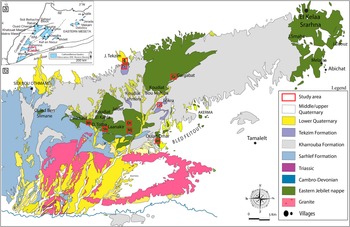
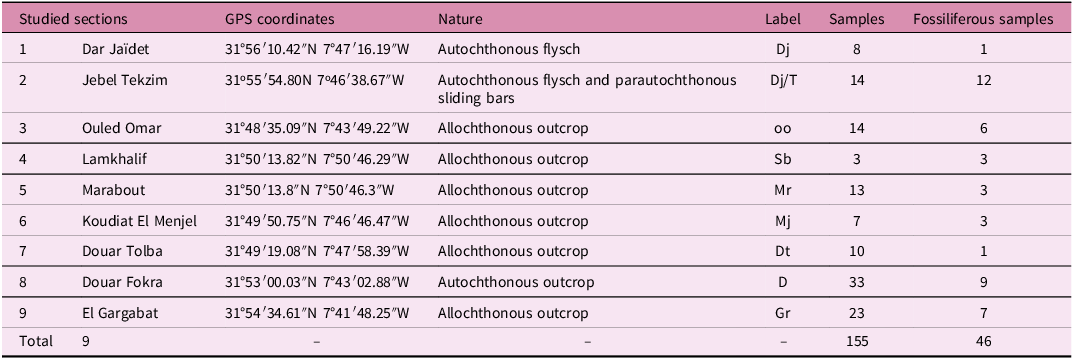
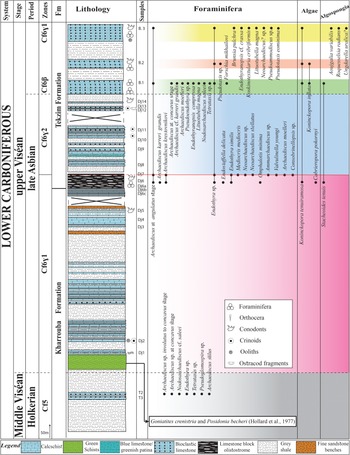
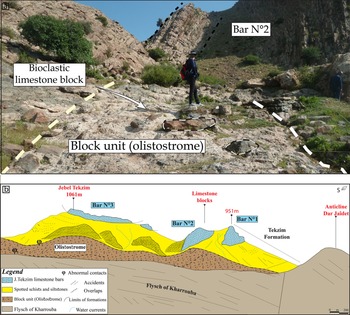
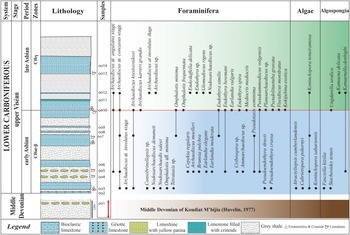
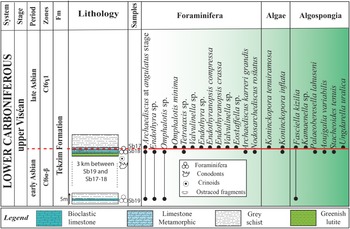
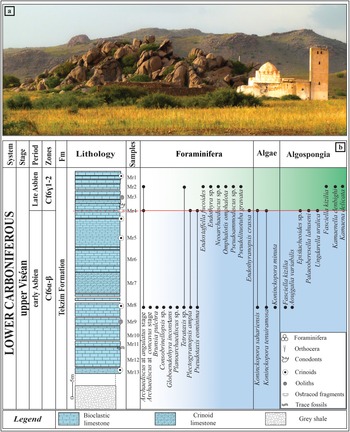

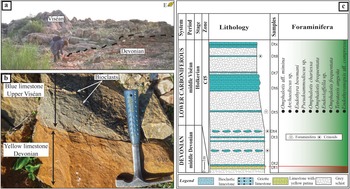
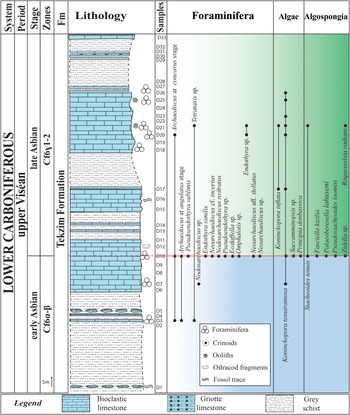
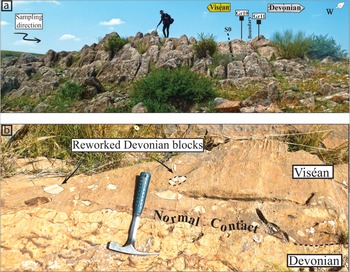
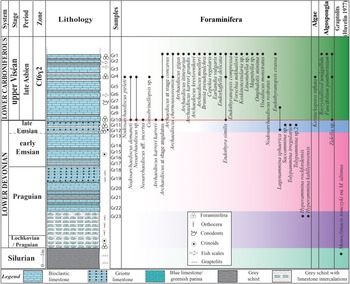
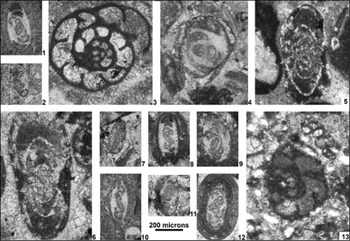

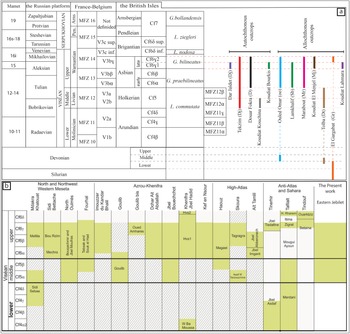
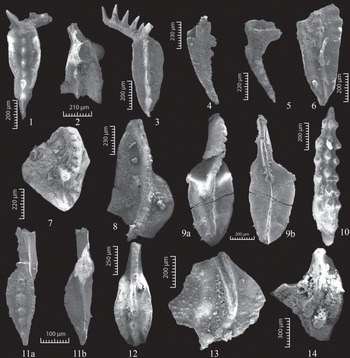

 Open access

