




“Reformers lacking the capabilities to overturn existing institutional arrangements may try to nurture new ones, in the hope that over time they will be able to assume more and more prominence.”
– Paul Pierson, Reference Pierson2011Footnote 1“Supporting prefecture-level cities to enhance their capacity to allocate resources and further strengthen the competitiveness of their urban area reflects the spirit of the central government's urbanization blueprint.”
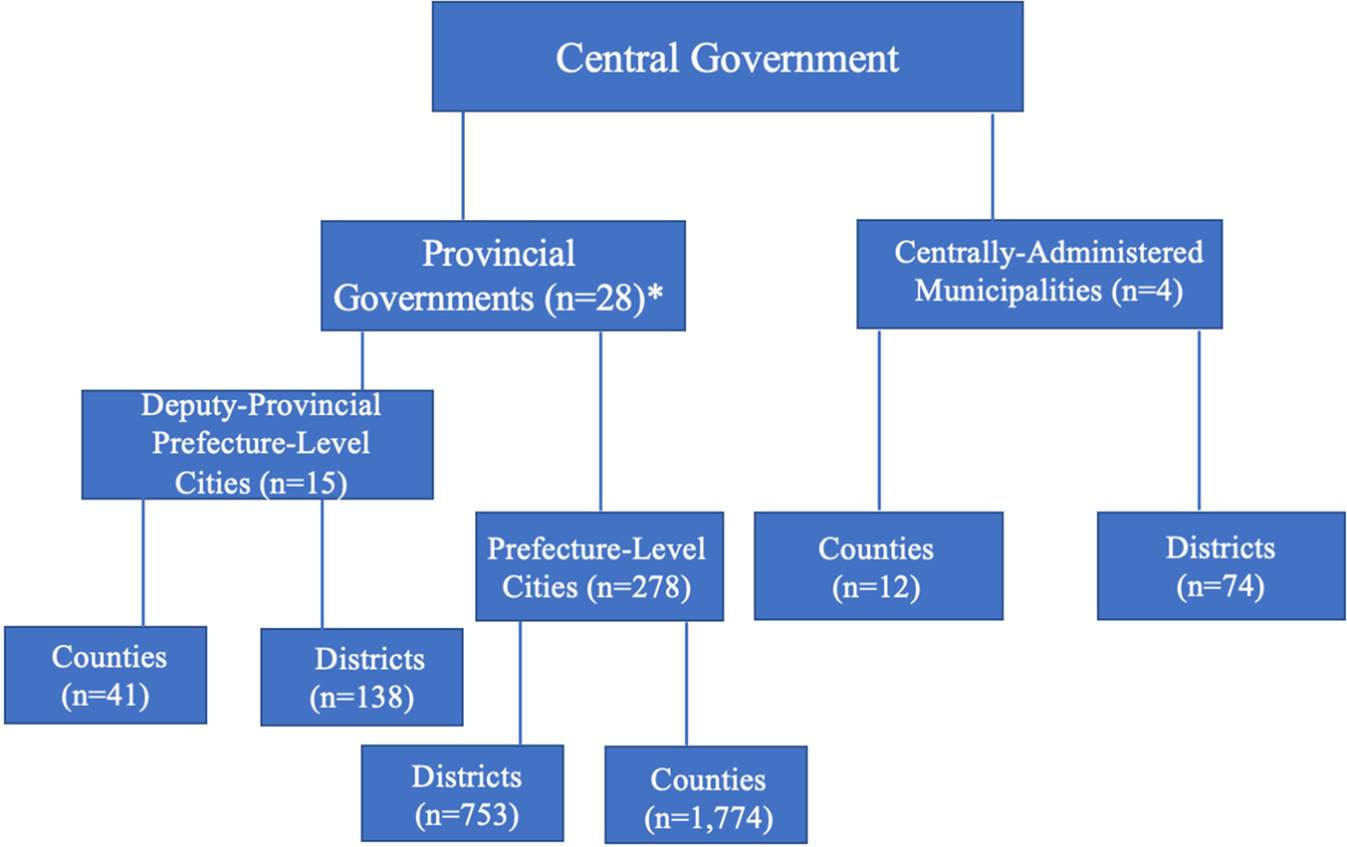
– National Development and Reform Commission, 2020Political systems typically have vertical tiers of government, with responsibility for increasingly circumscribed territorial boundaries devolving from the national to lower levels of administration. For over three decades, China's political system was similarly characterized by two organizing principles: the structure of an “explicit layer-by-layer administrative hierarchy” and “one-level-down personnel control.”Footnote 2 The vertically layered administrative apparatus was stipulated by Articles 108 and 110 in the 1982 Constitution of the People's Republic of China (PRC), which granted local administrative entities downward authority at or above the county level.Footnote 3 Two years later, the principle of appointing cadres “one level down” was enforced by the central government and appeared to be institutionalized as an administrative practice (Figure 1).Footnote 4 In 2016, however, this bureaucratic rule was compromised by two provinces when Zhejiang and Guangdong's provincial organization departments publicly announced the appointment of cadres at the county and urban district level, which are two levels below the provincial government. In effect, prefecture-level cities in these two provinces have lost appointment authority over their immediate subordinate governments. How can this deviation from the 1982 constitutional mandate be explained?Footnote 5 What are the implications of this reconfiguration of administrative authority among China's sub-national units?
One-level-down Appointment System
Source:
Drafted by authors based on Lu and Tsai Reference Lu and Tsai2019.
Notes:
* includes four autonomous regions; “n” indicates the number of this administrative entity. Administrative entities placed at the same horizontal level reflect the same administrative rank.
Based on original field interviews and city-level data, this article observes that evolutionary shifts in administrative governance have generated unintended conflicts in China's inter-governmental relations. Specifically, in the early reform era, a popular provincial strategy for boosting GDP figures took the form of enhancing the authority of economically strong counties. This entailed placing counties in a dual-reporting relationship to both prefecture-level and provincial governments. Despite the possibility that increasing the autonomy of counties might weaken prefecture-level governments, leaders of prefecture-level cities accepted this arrangement because the GDP of empowered counties was still counted in official statistics reporting the overall economic performance of prefectures.Footnote 6 As the growing autonomy of counties appreciably contributed to China's economic development during the 1990s,Footnote 7 the central government reinforced linkages between counties and provinces by recommending the “empowerment of economically strong counties” in a series of policy documents during the 2000s. Various provincial governments subsequently extended personnel control to county and urban districts, thereby reviving the pre-1984 practice of appointing cadres “two levels down.”Footnote 8
We contend that this creeping evolution in the reach of personnel appointments has yielded unintended consequences. In an era of more moderate economic growth, the central government has shifted to prioritizing multi-dimensional developmental targets,Footnote 9 and advocates coordinated investment across an entire jurisdiction. Hence, prefecture-level cities no longer prioritize the statistical contribution of empowered counties; instead, they seek the capacity to distribute fiscal resources throughout their territorial jurisdictions.Footnote 10 This new expectation for prefecture-level cities has exacerbated tensions with provincial governments: prefecture-level governments seek greater fiscal autonomy just as provincial authority has expanded. However, a complicating phenomenon is that provincial capitals rely less on the economic development of counties than non-capital cities owing to the legacy of weaker counties surrounding capitals. As a result, provinces prefer to support their capital cities over regular prefecture-level cities at a similar economic scale.
This article proceeds as follows. The first section conceptualizes vertical intergovernmental relations within the framework of evolutionary governance in China, and proposes that the progressive circumvention of reporting lines by specific levels of government has changed China's formal administrative hierarchy over the past three decades. The second part traces the emergence of “empowering economically strong counties” and why provincial governments selected this as an adaptive strategy to centralize provincial authority. The third section elaborates on the extension of the province's personnel reach down to the county/urban-district level. As shown in the fourth section, the rise of direct province–county relations has intensified fiscal conflicts between provinces and prefecture-level cities. The conclusion reflects on the implications of these dynamics given the present leadership's centralizing efforts.
China's Vertical Intergovernmental Dynamics
Evolutionary governance among state actors
Shocks such as wars, revolutions and external occupation are familiar critical junctures during which political institutions may undergo major transformations. By contrast, explaining gradual institutional change during “normal” times has inspired analysis of mechanisms endogenous to a political system. For example, James Mahoney and Kathleen Thelen observe that because institutions are based on negotiations conducted by particular political coalitions, even the most apparently stable institutions may be subject to renegotiation at the margins.Footnote 11 Over time, apparently minor or incremental adjustments may yield significant changes.
In this regard, the logic of evolutionary theories provides insights for exploring the mechanisms of endogenous institutional change. As Orion Lewis and Sven Steimo observe, “Imperfect copies of earlier compromises help to ensure imperfections in the replication of institutions, which is often a primary driver of further change.”Footnote 12 From a relational approach, Yuen Yuen Ang highlights mutual adaptation as the key distinction between “evolution” and “gradual institutional change” and advises tracing the process of institutional adaptation by identifying “two (or more) domains of significance.”Footnote 13 Ang's study maps the co-evolution between the local state and market forces in China.Footnote 14 Along similar lines, various scholars have examined co-evolutionary dynamics between China's NGOs and relevant state bureaucracies.Footnote 15
Overall, social scientists who engage with the concept of evolutionary governance in China focus on the interaction between state and non-state actors.Footnote 16 By contrast, this study demonstrates how interactions among state actors themselves may fundamentally re-define the dynamics of administrative governance. Even in an authoritarian regime with a unitary political system and one-party rule, we observe opportunistic adaptations in the evolution of vertical intergovernmental dynamics, as lower layers of government attempt to safeguard their autonomy from higher levels.
Mechanism of institutional adaptation: directed improvisation
Various studies note that China's multitiered administrative structure breeds institutional adaptation at the local level. Yongshun Cai explains that “a political system with multiple levels of authority can reduce uncertainty by granting conditional autonomy to lower-level governments.”Footnote 17 Relatedly, Xiaoxiao Shen and Kellee Tsai identify variation in the institutional adaptability of local states following the global financial crisis.Footnote 18
But why and how does institutional adaptation occur? Our study builds on Ang's concept of directed improvisation to elucidate the incentives driving institutional adaptation. Directed improvisation allows for creativity at the local level within the parameters of a particular institutional context. “A skilled director,” Ang observes, “is not the one who dictates to actors what exactly they should do, but empowers them in the creative process.”Footnote 19 Most studies of China's reform era are premised on a longstanding administrative structure of governance with an explicit “layer-by-layer administrative hierarchy” and “one-level-down personnel control.”Footnote 20 Operationally, decentralization is expected to occur based on vertical layers of administration,Footnote 21 and the relative autonomy of each administrative unit is secured by its control over the appointment of personnel in the immediate subordinates.
However, when the central government started strengthening provincial authorities in the 1980s, in a parallel process it also empowered some prefecture-level cities by designating them as “separately-planned cities” (jihua danlie shi 计划单列市).Footnote 22 These cities were granted access to negotiate economic affairs directly with the central government, bypassing their provincial authorities. Following central mandates to encourage decentralization, provincial governments started to empower “economically strong counties” (qiangxian kuoquan 强县扩权), sidestepping some prefecture-level cities.Footnote 23 Consequently, the earlier arrangement of directed improvisation within a particular level of government was destabilized by a lower layer of empowerment between their superiors and subordinates.
Our research delineates how state actors have adapted to the disruption of directed improvisation in certain localities and contends that the conventional depiction of China as possessing a symmetrical chain of power delegation is merely a snapshot of the co-evolutionary process of interaction among state actors at multiple administrative layers. Over the past three decades, some provinces have lost authority over separately-planned cities while gaining access to empowered counties. Meanwhile, some prefecture-level cities have been elevated as separately-planned cities, while ceding fiscal authority over empowered counties. On balance, this gradual reconfiguration of inter-governmental relations has eroded the capacity of certain prefecture-level units to realize urbanization goals set by the central government.
Contemporary implications of institutional adaptation
When directed improvisation is the underlying mechanism for institutional adaptation, the resulting equilibrium may be unstable. This is because actors who were incentivized at the outset of institutional distortions might change their minds, ask for more benefits or refuse to cooperate later on. Yet this process is not readily observable. As Mahoney and Thelen point out, “Gradual or piecemeal institutional changes often only register as change over a longer time frame.”Footnote 24 For example, the US budget reforms of 1974 resulted from an extended process of institutional layering, meaning the superimposition of new arrangements on top of pre-existing structures designed to serve different purposes.Footnote 25 Eric Schickler argues that institutional layering reflected battles in various periods, starting from 1890, and finds that the last dynamic emerged nearly a century later, between 1970 and 1989.Footnote 26 In another context, Dan Slater contends that the political balancing that allowed Suharto to concentrate autocratic power in Indonesia between the 1940s and 1990s eventually paved the way for regime change.Footnote 27 Over time, the coercive capacity of co-opted institutions and organizations was undermined.Footnote 28 Joy Langston similarly attributes the effects of dedazo resistance in Mexico during 1952 to 1987 to its collapse in the 1990s.Footnote 29
Such historically grounded studies have contributed to concept formation in comparative institutional analysis and can be harnessed for explaining contemporary politics. Indeed, the concept of layering is especially well suited for analysing political dynamics in China's complex bureaucratic and administrative context.Footnote 30 Although scholars often discuss central–local relations in dichotomous terms, China's administrative structure comprises five official tiers, ranging from the central government to townships.Footnote 31 Lower-ranked governments are expected to accept institutional adjustments introduced by higher-level ones, yet their compliance may be reluctant and fragile. Local governmental incentives may change, leading to vertical inter-governmental bargaining and even overt competition. As Lewis and Steinmo explain, “From an ontological standpoint, evolutionary systems are never at equilibrium.”Footnote 32 The current study demonstrates how institutional layering has gradually altered China's multitiered administrative hierarchy since the 1990s and created developmental constraints for prefecture-level cities.
Institutional Evolution in China's Early Reform Era
Privileging regions by granting dual-reporting linkages
China's reform process has been marked by a drastic downward delegation of central authority and the active promotion of local initiatives.Footnote 33 Decentralization of fiscal and administrative powers to lower levels of government constituted a defining feature of post-Mao economic development.Footnote 34 Concurrently, however, the cadre management system remained centralized, which enabled upper levels of the party-state to implement high priority policies.Footnote 35 China's political economy has been described as “regionally decentralized authoritarianism,” whereby the party-state exercises layer-by-layer personnel control, with key positions at every level of government appointed by the level immediately above it.Footnote 36 In this hierarchical arrangement, subordinate governments and their appointed officials are directly accountable to superiors at the next level up (Figure 1).Footnote 37 Building on Ang's notion of directed improvisation, such a structure allows for what we refer to as the “improvisational autonomy” of each administrative entity. When a city government exercises full authority over personnel in its jurisdiction, there is scope for local creativity and the distribution of resources to achieve developmental goals.Footnote 38
This administrative design was intended to tighten the accountability of all sub-national governments one level up; however, it also enabled higher-level governments to pillage the resources of their immediate subordinate governments. Some studies have observed distrust between prefecture-level cities and provinces, including that between Hubei and Wuhan during the 1980s.Footnote 39 Others have pointed out how prefecture-level cities sacrificed counties’ benefits, or diverted their revenues to urban areas, leaving counties fiscally strapped.Footnote 40 Despite these tensions, it was not realistic to eliminate prefecture-level units, which have existed since the 1950s, let alone provincial governments, which have been part of China's administrative hierarchy for over 2,000 years.Footnote 41 This was the context in which a new pattern that enabled certain administrative entities to directly interact with units two levels higher emerged.
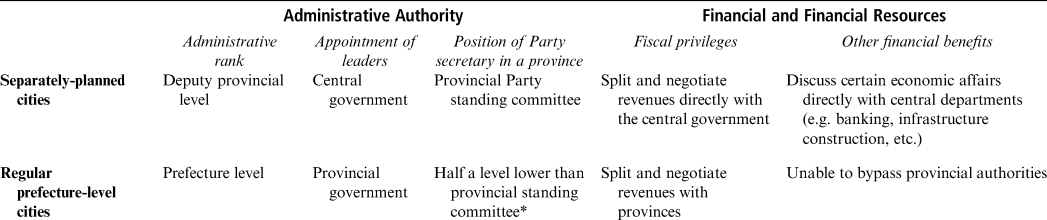
During the 1980s, the central government initiated dual-reporting relations to alleviate the exploitation of select administrative units and to promote their development.Footnote 42 As shown in Figure 2, separately-planned cities were granted direct economic linkages with the central government, bypassing their corresponding provincial governments.Footnote 43 More specifically, separately-planned cities were empowered with provincial-level authority in certain areas of economic management, and its administrative rank rose above that of regular prefecture-level cities. Building on indicators proposed by Kyle Jaros to measure the policymaking power of China's local governments, Table 1 summarizes the privileges of separately-planned cities compared with those of regular prefecture-level cities.Footnote 44
Institutional Adaptation through Layering in China's Administrative Hierarchy, 2010s
Source:
Drafted by authors based on Lu and Tsai Reference Lu and Tsai2019.
Notes:
The thicker arrow lines pointing up denote the emergence of extra administrative reporting relations; centrally-administered municipalities are excluded because they do not have dual-reporting relations; administrative entities at the same horizontal level are at the same administrative rank. * includes four autonomous regions; number of counties includes both empowered and regular counties because official statistics do not indicate the number of “empowered counties.”

Major Privileges of Separately-planned Cities
Sources:
Lu and Tsai Reference Lu and Tsai2019; Landry Reference Landry2008; interview with officials from Zhejiang DRC and Ningbo, 9 May 2018; 8 April 2019; 20 August 2019.
Notes:
*In reality, Party secretaries of very few regular prefecture-level cities are concurrently serving as provincial standing committee members, yet this arrangement is special rather than representative. See Bulman and Jaros Reference Bulman and Jaros2019.
Mimicking this strategy, during the 1990s provinces started empowering economically strong counties by authorizing them to negotiate directly with provincial governments, sidestepping their superior prefecture-level cities.Footnote 45 Taken together, the two sequential policies of creating separately-planned cities and empowering economically strong counties circumvented the original structure of level-by-level administrative authority. Moreover, both initiatives introduced similar upgrades in administrative privileges. In terms of rank, the Party secretaries of empowered counties are listed within the prefectural standing committee, thereby signalling a higher status than that of ordinary counties. Fiscally, empowered counties bypass prefecture-level cities by negotiating and splitting revenues directly with provinces. These reconfigurations of inter-governmental relations constitute institutional layering such that new institutions were added to pre-existing structures because the latter were not readily dismantled.Footnote 46 As a result, the original vertical structure of directed improvisation has been compromised. The improvisational autonomy of both provinces and prefecture-level cities has become unsettled by the addition of administrative relations between the central government and separately-planned cities, and between provincial governments and empowered counties, respectively.Footnote 47
The designation of “separately-planned cities”
Logically, the creation of dual-reporting relations would not be welcomed by governments whose authority over subordinate entities is diminished. During the 1980s, friction emerged between provincial capital cities and provinces, especially when provincial capitals were granted separately-planned city status, thereby enabling capital cities to circumvent their provincial superiors.Footnote 48 For example, rumours circulated that Wuhan would be granted separately-planned or even centrally-administered status, which would have cut its fiscal, if not administrative, ties with Hubei province. In response, Hubei province prioritized other cities and was slow to approve Wuhan's proposed infrastructure projects.Footnote 49 The rationale for this reluctance is straightforward: provincial authorities sought to rein in separately-planned cities under their jurisdiction, while separately-planned cities tried to operate more independently from provincial governments.Footnote 50
Such strains extended beyond Hubei and Wuhan. Tensions similarly arose between other separately-planned cities/provincial capitals and their provincial governments. This strain in intergovernmental relations led the State Council in 1989 to order that provinces improve their relations with provincial capitals that had been elevated to separately-planned cities.Footnote 51 Provinces then initiated various negotiations with the central government to salvage their own standing with these separately-planned cities.Footnote 52 As a result, even though Wuhan gained separately-planned city status in 1984, the city, along with seven other provincial capitals, lost this status in 1993. By 1997, five non-provincial capital cities had managed to retain their separately-planned city status because their provinces regarded them as causing fewer negative effects. The number of separately-planned cities remains unchanged to date.Footnote 53 Nonetheless, conflict continues between these cities and provinces.Footnote 54 The National Academy of Governance even recommended the removal of Ningbo's 宁波 separately planned status in order to foster smoother relations among the central, provincial and city governments.Footnote 55
With regards to establishing separately-planned cities, institutional adaptation emerged among the central government, provincial authorities and separately-planned cities. At the outset of this process, Beijing introduced the designation of separately-planned cities and other select cities to serve as economic magnets. In so doing, the centre built regional economies that leveraged their areas of comparative advantage and promoted national economic growth during the 1980s.Footnote 56 Over time, the institutional adaptation of creating separately-planned cities undermined the improvisational autonomy of provincial authorities, especially since the Central Organizational Department controls the appointment of Party secretaries and mayors in separately-planned cities.Footnote 57 Shortly thereafter, provincial anxiety that their capitals would become “centrally-administered municipalities” proliferated, resulting in several rounds of central–provincial bargaining. Provincial governments tried to retain direct control over their provincial capitals (with separately-planned status), while the central government attempted to maintain the privileged status of these provincial capitals.Footnote 58
Adaptive empowerment of counties during the 1990s and the 2000s
In a parallel logic, the empowerment of strong counties allowed these counties to build dual-reporting relationships with both prefecture-level cities and provinces (Figure 2). In this instance, provincial governments initiated institutional adaptation, whereas prefecture-level city governments tried to preserve the original administrative hierarchy. Following the objections of provinces to separately-planned cities, one might assume that prefecture-level governments would in turn oppose the empowerment of counties. This has not been the case, however. Unlike the stagnation in creating separately-planned cities since 1997, a growing number of counties have been granted direct linkages with provinces since 1992.Footnote 59 Moreover, since the practice of empowering economically strong counties commenced in Zhejiang, this pattern of bolstering the authority of economically strong counties has spread to other provinces.Footnote 60 Indeed, beginning in the 1990s, relations between prefecture-level governments and empowered counties became less contentious.Footnote 61
During the 1990s, prioritization of economic growth stimulated horizontal inter-regional competition among cadres.Footnote 62 Leaders of prefecture-level cities cared more about aggregate GDP figures, irrespective of whether growth was generated from counties or urban areas.Footnote 63 Suzhou's 苏州 developmental profile exemplifies this situation. Even though Suzhou has been noted for having a “weaker urban core compared with surrounding counties,” its overall prosperity has made it a “cradle for provincial governors” (shengzhang yaolan 省长摇篮), a reference to the fast-track promotion record of Suzhou's officials.Footnote 64 Prefecture-level city leaders accepted their diminished authority over counties because their economic performance improved the statistical indicators of prefecture-level cities.Footnote 65
Although GDP incentives could plausibly motivate provincial leaders to accept separately-planned cities, provinces worry that such cities may be further elevated and re-titled as centrally-administered municipalities.Footnote 66 Unlike the circumstance of empowering economically strong counties, where prefecture-level cities still enjoy the statistical contribution of counties, the promotion of separately-planned cities into centrally-administered municipalities eliminates their statistical contribution to provinces. As noted above, after the administrative concept of separately-planned cities was proposed in the 1980s, Hubei feared that Wuhan might become a centrally-administered municipality.Footnote 67 In 1997, fuelling provincial unease about the potential fate of separately-planned cities, the central government upgraded Chongqing from a separately-planned city to a centrally-administered municipality.
Building on “Dual-reporting Relations”: Growing Provincial Authority
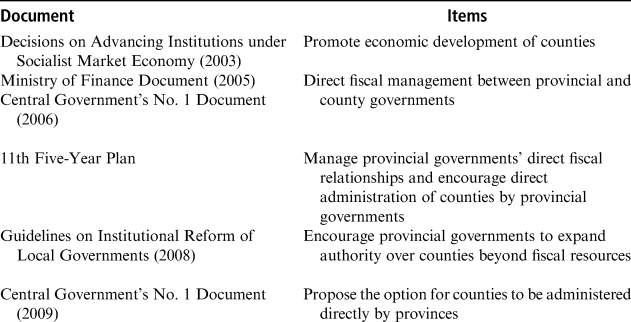
Following Zhejiang's empowerment of counties in 1992, the expansion of powers to select economically strong counties has become common practice in various provinces.Footnote 68 The nationwide adaptation of empowering economically strong counties was built upon the realization that such linkages facilitated China's economic development.Footnote 69 Intensified competition among counties and substantial decision-making power on the part of county-level governments were the chief drivers of rapid growth during the 1990s.Footnote 70 Subsequently, the policy of empowering economically strong counties appeared in various central-level official documents in the 2000s, marking a growing shift in authority over counties from prefecture-level cities to provinces (Table 2).
Central Documents that Enhanced Provincial–County Relations during the 2000s
Sources:
Fan and Wang Reference Fan and Wang2013; Shen, Xuefeng, and Wang Reference Shen and Wang2018; State Council of the PRC 2006; 2009; Lu and Tsai Reference Lu and Tsai2019; “Zhonggong zhongyang guanyu wanshan shehui zhuyi shichang jingji tizhi ruogan wenti de jueding” (Decisions by the Central Committee of the CCP on advancing institutions under a socialist market economy). CPCNews, 14 October 2003, http://cpc.people.com.cn/GB/64162/64168/64569/65411/4429165.html.
Unlike the situation for separately-planned cities, whose leaders are directly appointed by the central government, the process of empowering economically strong counties did not affect the appointment of county leaders by prefecture-level cities. However, in light of central guidelines to build provincial–county relations, exceptions in the appointment system have started to occur.Footnote 71 As the pioneer of empowering economically strong counties, Zhejiang was the first province to directly manage personnel within its counties,Footnote 72 about one decade before the central government proposed that counties be administered directly by provinces.Footnote 73
Our research reveals that the pattern of direct prefectural appointment of county/county-level city leaders is likely limited to the early reform era. Continuing expansion of the province's personnel reach is evident. In 2015, Guangdong's provincial organization department announced the appointments of Party secretaries in Shenzhen's 深圳 urban districts, indicating the provincial government's direct control over the appointment of urban district-level officials.Footnote 74 The next year, Zhejiang's organization department announced the appointment of 115 officials, including Party secretaries and mayors of counties, county-level cities, and even urban districts under prefecture-level cities.Footnote 75 A similar deepening in provincial authority over personnel has occurred in Jiangsu. In 2016, the Taizhou 泰州 prefecture-level city government was still appointing leaders in its urban districts, although recent prefectural documents reveal that Jiangsu province now controls those same positions.Footnote 76 Zhejiang, Guangdong and Jiangsu's provincial activism demonstrates their personnel control over all administrative units that are two levels below the provincial level, including urban districts.
Although counties/county-level cities and urban districts are apparently at the same administrative level, they should be distinguished from one another because empowering strong counties only builds direct linkages between counties and provinces, while urban districts are fully subordinate to prefecture-level cities according to formal administrative rules.Footnote 77 Therefore, extending personnel reach to counties makes procedural sense for provinces when there are dual-reporting relations between counties and provinces; however, provincial reach to urban districts bypasses another level of government because districts only report to prefecture-level cities.Footnote 78
All provinces maintain a document entitled, “Publicity before official appointments” (guanyuan renqian gongshi mingdan 官员任前公示名单), which indicates the personnel authority of appointed officials.Footnote 79 If the appointment of specific officials is publicized by the provincial or prefecture-level organizational department, then the provincial or prefecture-level city government exerts personnel authority over these officials. We collected public announcements of official appointments from all the counties, county-level cities and urban districts of prefecture-level cities in each province and compiled a database indicating the personnel reach of provincial governments.Footnote 80
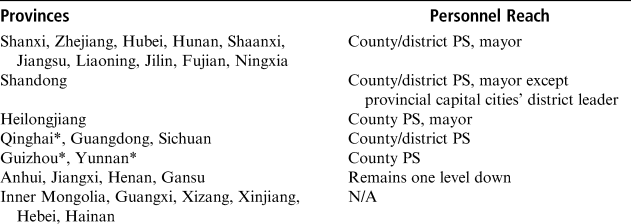
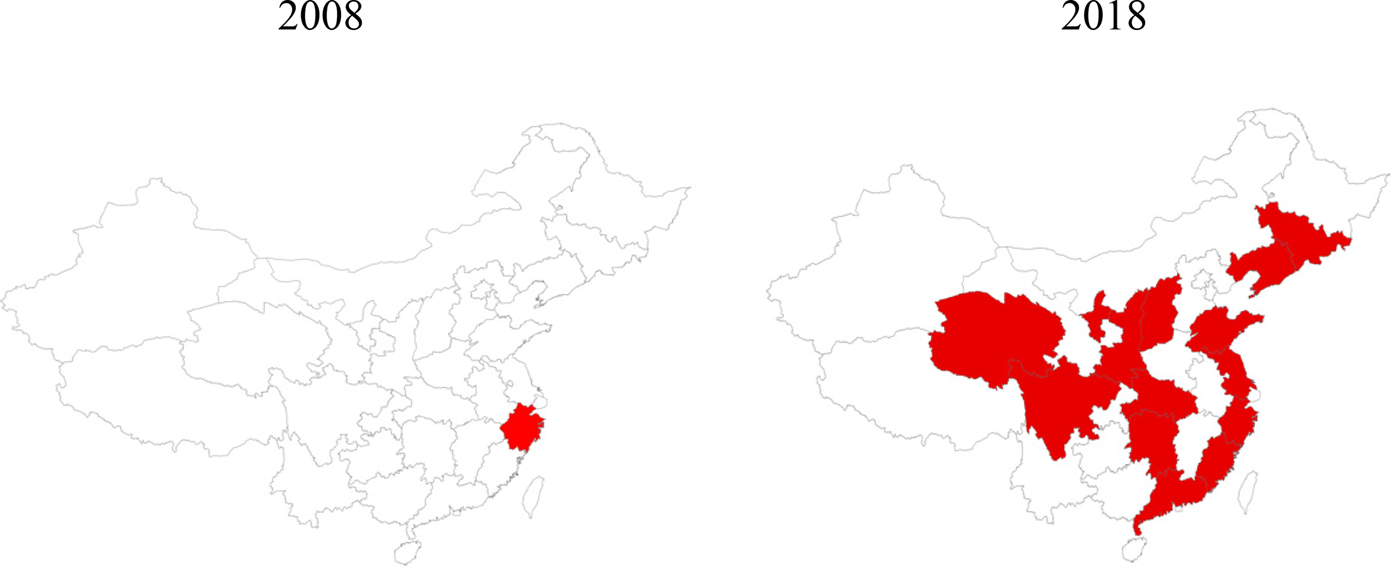
Table 3 shows major departures from the formal institutional mandate of one-level-down appointment. Although the central government still appoints provincial officials, the reach of provinces in personnel appointments varies. Only four provinces maintain the one-level-down appointment system, allowing prefectural leaders to appoint county and district leaders. Ten provinces, including Zhejiang, have taken over the authority for appointing both Party secretaries and mayors of districts. Our finding that 14 out of 27 provinces have already extended their reach to the appointment of urban district cadres demonstrates the expanding authority of provincial governments. Figure 3 maps the growth in the number of provinces appointing cadres two levels down.
Extended Personnel Reach of China's Provincial Governments
Sources:
“Publicities before the appointments of officials” from various cities and compiled by authors.
Notes:
PS=Party secretary; * in Guizhou, we were not clear about the appointment of district leaders in cities other than Guiyang; in Yunnan, information about district PS appointments is not available; in Gansu, information about the county PS and mayor is not available; information about the mayor of district/county in Qinghai is not available. We assume these officials are appointed by the city-level organization department.
Mapping of Growing Provincial Personnel Control (2008 versus 2018)
Source:
Drafted by authors based on Table 3.
Notes:
Provinces that reached the personnel appointment of urban districts are shaded. Field interviews indicate that Zhejiang was the only province exercising two-levels-down appointment as of 2008.
The Emergence of Unintended Institutional Effects
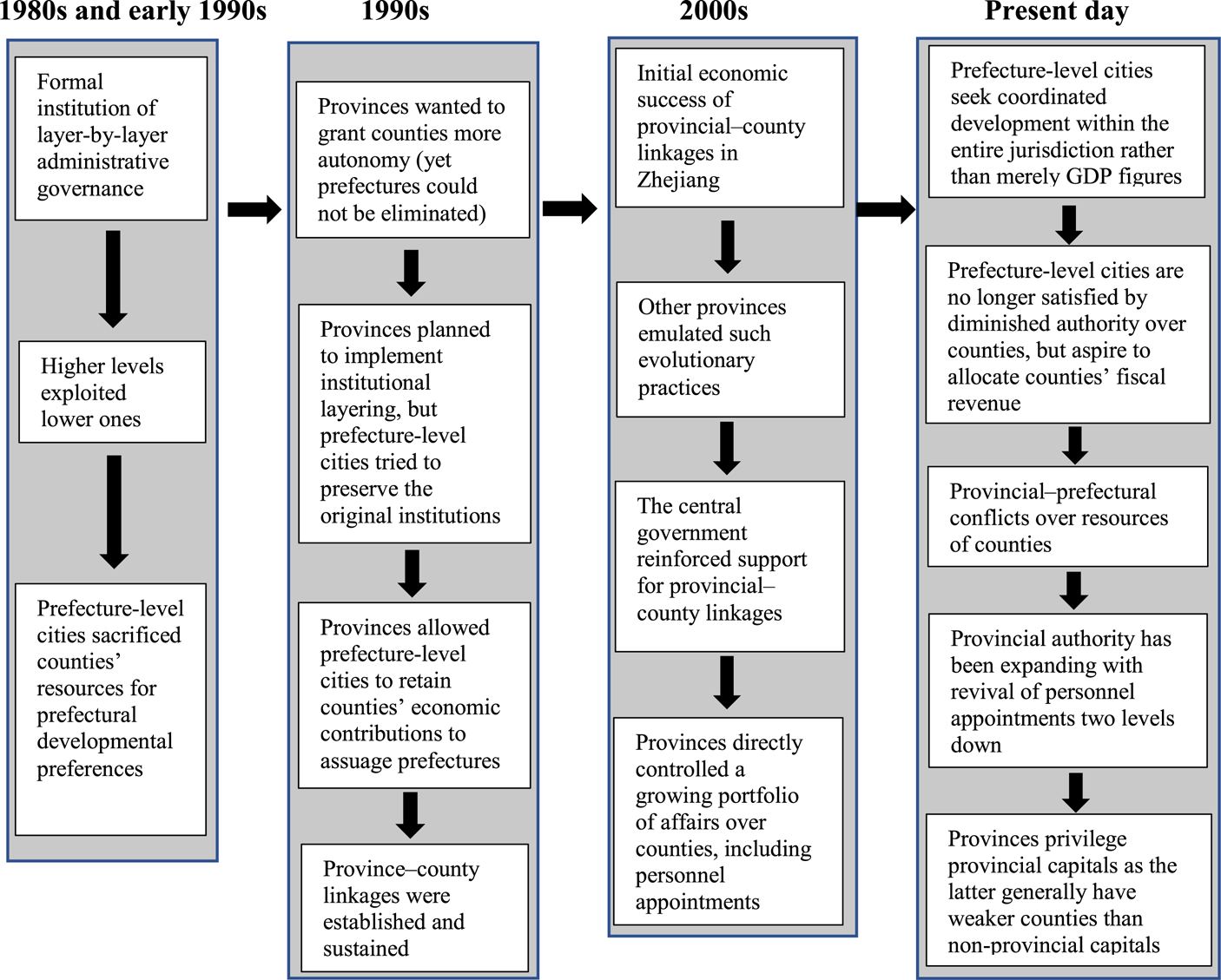
The previous two sections delineated how institutional layering and directed improvisation have incrementally changed China's multilayered administrative hierarchy (Figure 4). Ostensibly, growing provincial authority strengthens the autonomy of counties while compromising prefecture-level cities’ authority over their entire jurisdiction.Footnote 81 Given the increasing prevalence of direct provincial–county relations, since 2005 domestic scholars have deliberated about eliminating the prefecture level for better development of county-level units.Footnote 82 The erosion of prefecture-level cities’ authority is detailed in this section.
Descriptive Timeline of Institutional Adaptation among State Actors
Source:
Drafted by authors.
Why coordinating resource allocation at the prefecture level matters
Although counties were key drivers of China's economic prosperity during the 1990s,Footnote 83 prefecture-level cities have become increasingly important since the 2010s. In 2012, Premier Li Keqiang 李克强 underscored the developmental significance of prefecture-level cities for enhancing urbanization in China's future.Footnote 84 The centre's shift in urbanization metrics indicates the growing strategic position of prefecture-level cities, as seen in the 2010 “Regional plan of the Yangtze River Delta city cluster,” which highlighted regional core cities.Footnote 85 After the 19th Party Congress in 2017, the central government again called for granting prefecture-level governments more economic management authority.Footnote 86
We recognize that smaller urban centres also appear in the central government's urban strategy. To resonate with the State Council's urbanization plan (2014–2020), the National Development and Reform Commission's (NDRC hereafter) 2020 policy document expressed support for small- and medium-sized cities to play a greater role in China's new urbanization strategy. But the development of large prefecture-level cities is equally if not more critical from the centre's perspective. Indeed, the NDRC specifies “enhancing the resource allocation capacity of central prefecture-level cities” as a fundamental requirement (zongti yaoqiu 总体要求) for China's urbanization process.Footnote 87 Rather than targeting all prefecture-level cities, this is aimed at the central prefecture-level cities that, according to Beijing's intentions, were expected to manage resources throughout their entire jurisdictions but failed to do so.
To amplify the point, the NDRC's 2020 document includes nine guidelines for optimizing the spatial structure of urbanization. Only one of these nine guidelines mentions counties in China's new urbanization construction, while five specify central support for prefecture-level cities. These measures include promoting key urban clusters and urban metropolitan areas; promoting central prefecture-level cities such as provincial capitals, separately-planned cities as well as other major prefecture-level cities; supporting prefecture-level cities to better allocate resources by converting counties into urban districts, and so on.Footnote 88 This repeated focus on prefecture-level cities indicates their perceived centrality to China's urbanization strategy.
From a policy perspective, one could question the need for prefecture-level cities to coordinate resource allocation at the city level. Perhaps it would be more economically rational for prefecture-level cities to grant more autonomy to counties in the spirit of directed improvisation. However, improvisational autonomy requires that prefecture-level governments, rather than provincial authorities two layers removed, control the personnel appointment of county leaders. If county officials are still appointed provincially, then granting county-level governments more authority would exacerbate prefecture-county tensions. As we have pointed out elsewhere, maintaining administrative barriers leads prefecture-level cities to compete with their subordinate counties. Such competition impedes the urbanization of both and, by extension, the developmental goal of urban–rural integration.Footnote 89
In short, dual-reporting represents a major obstacle in China's urbanization plan because it impedes the ability of prefecture-level cities to manage resources under its territorial jurisdiction.Footnote 90 Optimizing China's administrative structure by eliminating dual-reporting relations thus constituted a key message in President Hu Jintao's 胡锦涛 report, “Deepening reform and opening up in a comprehensive manner,” presented at the 18th Party Congress in 2012.Footnote 91 This goal has remained under Xi Jinping's 习近平 leadership, as evidenced by the establishment of a leading small group devoted to deepening administrative reforms.
Given that two generations of leadership have flagged the developmental constraints and “irrationality” posed by dual-reporting, why does it persist? The challenge, ironically, lies in the centre's countervailing measures aimed at strengthening provincial authority over localities.Footnote 92 For example, in 2017 the NDRC assigned 90 per cent of the approval rights over publicly financed transportation projects to provinces.Footnote 93 Further empowerment occurred in 2020 when the central government granted provincial governments one of the most critical areas of approval authority: the power to approve transfer of agricultural land to construction use within the entire province.Footnote 94 In essence, the persistence of counties with dual-reporting to prefecture-level cities and provinces reflects an internal inconsistency between the publicly stated importance of rationalizing China's administrative system, and the central government's desire to strengthen provincial authority in a centralizing spirit. Dual-reporting cannot be eliminated by central fiat if the centre itself is simultaneously empowering provinces in other ways. The twin objectives of administrative clarity and centralization of authority to the provincial level are working at cross purposes.
The source of fiscal conflicts
As discussed, the central government's initial emphasis on aggregate GDP figures motivated prefecture-level city leaders to accept their diminishing authority over counties. By the mid-2000s, however, China's shift to adopting a “scientific outlook on development” (kexue fazhan guan 科学发展观) led to recommendations that reckless local competition over GDP figures should be complemented by additional developmental priorities. The emphasis on prioritizing multi-dimensional targets in the “new normal” era encourages coordinated investment of resources, rather than merely focusing on GDP.Footnote 95
As interjurisdictional competition among counties/districts hampers the prefecture-level cities’ capacity to provide public services,Footnote 96 they seek new growth engines to transition towards an urban economy which coordinates resources throughout their entire jurisdiction. The rationale is to reduce duplication in local services and promote implementation of development projects proposed by higher levels of government. Prefecture-level officials explained:
Based on current economic conditions, multi-dimensional development targets call for resource coordination and allocation. What differentiates first-tier cities from others is not solely their economic scale. The fundamental difference is their capacity to allocate resources, especially fiscal resources, throughout the entire jurisdiction, which is the ultimate target of prefecture-level cities.Footnote 97
It can be misleading to look at aggregate levels of fiscal revenues without distinguishing their source and whether the prefecture-level city exerts authority in mobilizing them. As an example, Suzhou's fiscal revenue (yiban yusuan shouru 一般预算收入) reached 173 billion yuan in 2016, which exceeded that of Guangzhou at 139.4 billion.Footnote 98 Yet it would not be accurate to conclude that Suzhou's prefecture-level city government is in a stronger fiscal position to execute its developmental plans. Guangzhou administers urban districts under its prefecture-level government. By contrast, Suzhou's urban districts generated only 92 billion in revenues – and nearly half of its fiscal revenue came from four strong counties that are fiscally linked with Jiangsu province rather than Suzhou.Footnote 99 Operationally, Guangzhou's prefecture-level government has access to more fiscal resources than Suzhou's prefecture-level government.Footnote 100 This is why prefecture-level cities such as Suzhou are no longer motivated solely by the statistical contribution of counties but instead seek to restore control over them. Provinces and prefecture-level cities now have competing interests over counties.Footnote 101
How provincial governments pick places
Given prefecture-level cities’ interest in allocating resources throughout their entire jurisdictions, we argue that provincial governments derive more benefits from supporting provincial capitals than regular prefecture-level cities at a similar economic scale owing to the legacy of weaker counties surrounding provincial capitals.
Indeed, provinces have been urging their provincial capitals to apply for the designation of “national-level core city” (guojia zhongxin chengshi 国家中心城市), which was introduced to denote urban areas with the greatest strategic significance in China. In 2010, the Ministry of Housing and Urban–Rural Development proposed five cities – Beijing, Shanghai, Guangzhou, Tianjin and Chongqing – as national-level core cities.Footnote 102 In 2016, Chengdu was supported by the State Council to be the sixth national-level core city.Footnote 103 Chengdu's success in raising its strategic importance has inspired competition among cities at similar levels to join the group of national-level core cities.Footnote 104 Provincial capitals are not necessarily cities with the highest political status or largest economies in a particular province, but with weaker counties, they pose less competition to provincial governments than non-capitals.
This provincial preference for promoting their capital cities is a relatively recent phenomenon. Earlier on, conflict surfaced between provincial capitals and their provinces when capitals were granted direct fiscal linkages with the central government and sidestepped provincial governments. Since 1997, the situation has stabilized such that only five non-provincial capitals have separately-planned status. The more recent lure of elevating provincial capitals into “national-level core city” status would not affect provincial access to the fiscal revenues of its capital city. The overall logic has remained consistent: provincial governments opportunistically support administrative strategies that enhance their fiscal position. The unintended consequences of growing provincial authority on a subset of prefecture-level cities can be seen in the following comparison of Hangzhou with Ningbo.
Comparing Hangzhou and Ningbo
Hangzhou and Ningbo are at the same administrative rank and the central government has named both as prefecture-level cities that should enhance their capacity to allocate resources at the city level.Footnote 105 Their main difference is that Ningbo is a non-provincial capital affected by the institutional adaptation of empowering economically strong counties. Out of China's five separately-planned cities, Ningbo relies most heavily on the economic development of its counties.Footnote 106 The following comparison shows how dual-reporting relations became problematic for Ningbo's developmental efforts.Footnote 107
During the early reform era, the central government regarded Ningbo as having better natural endowments. As a coastal city with a world-class port, in 1984 it was designated one of the 14 “coastal open cities” (yanhai kaifang chengshi 沿海开放城市). Ningbo's geographical advantage supported the rise of its export processing industry, which was concentrated in rural counties with cheaper land. The proportion of Ningbo's GDP as a percentage of Hangzhou's climbed from 68.3 per cent in 1981 to 76.5 per cent in 1984 (Figure 5). Ningbo's county economy further thrived after Deng Xiaoping's 邓小平 1992 southern tour. Ningbo's GDP reached over 80 per cent of Hangzhou's GDP in 1996 and maintained that proportion for the next 18 years. During the early 2000s, economic success earned Ningbo the reputation of being one of Zhejiang's “twin cities,” along with the provincial capital of Hangzhou. By the end of 2010, Ningbo's GDP had reached 87 per cent of Hangzhou's GDP.Footnote 108
Ningbo's GDP as a Percentage of Hangzhou's GDP, 1978–2019
Sources:
Hangzhou and Ningbo Statistical Yearbooks 2019.
Note:
The dash line represents the 80% benchmark set by Ningbo's government to measure Ningbo's relative economic performance vis-à-vis Hangzhou.
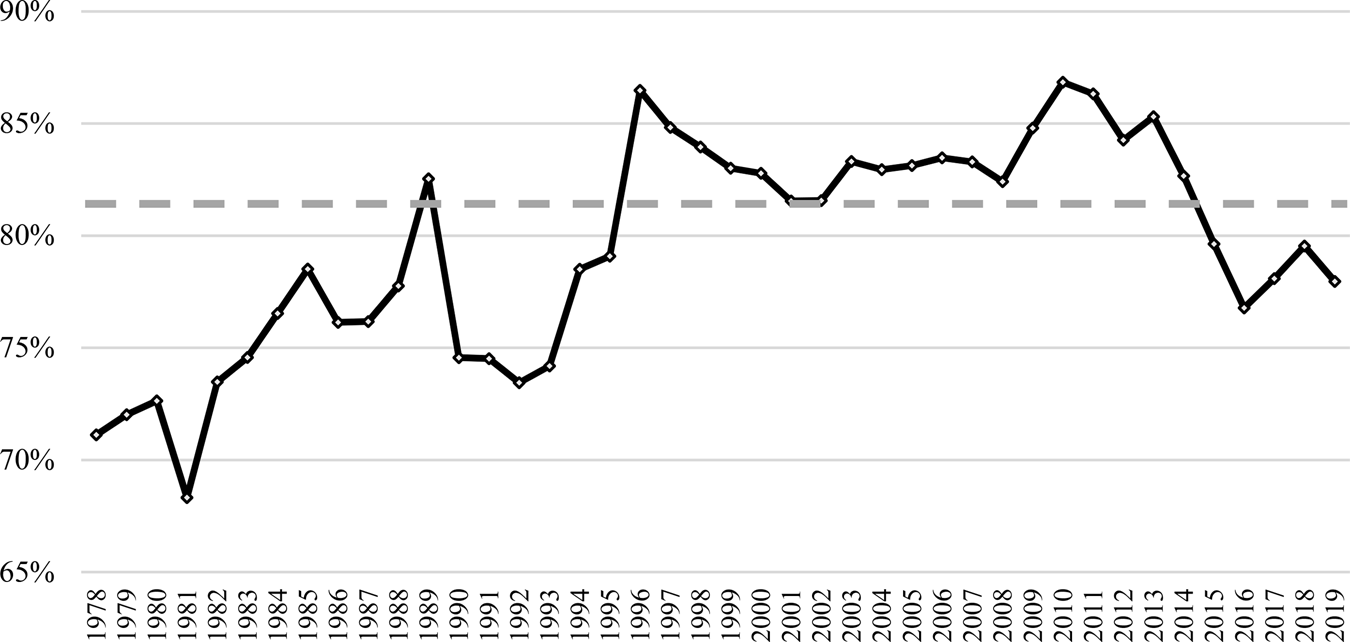
A senior provincial official in Zhejiang revealed that 80 per cent has long served as a benchmark indicator for measuring Ningbo's relative economic performance vis-à-vis Hangzhou: “If the share surpasses 80 per cent in a particular year, then Ningbo has fulfilled its growth target, and vice versa.”Footnote 109 However, by the end of 2019, Ningbo's GDP declined to 78 per cent of Hangzhou's, a sharp drop from a peak of 87 per cent in 2010.Footnote 110 Ningbo has not able to keep up with Hangzhou's growth momentum, despite its higher economic status as a separately-planned city and geographical advantage as a coastal city.
On the face of it, the expanding GDP gap between Hangzhou and Ningbo might derive from Hangzhou's economic take-off brought about by the rise of Alibaba, rather than deterioration in Ningbo's economy. Local officials disagree with this interpretation, however:
Some might attribute the expanding GDP gap between Ningbo and Hangzhou to Alibaba's remarkable success. However, it is not a zero-sum game. Hangzhou and Ningbo have distinct areas of comparative advantage. Hangzhou's development by no means comes at the expense of Ningbo's resources. Ningbo's development difficulties are institutional.Footnote 111
Specifically, as the provincial capital, Hangzhou's urban core is stronger than that of Ningbo. Provincial capital cities’ urban area has been supported by provincial institutions and enterprises, and heavy reliance on county economies typically occurs in non-provincial capital cities such as Ningbo, Wuxi 无锡, Foshan 佛山 and Suzhou. To be sure, as the site of numerous universities including Zhejiang University, Hangzhou attracts more talent than Ningbo, which has enabled the IT industry to thrive in Hangzhou. Yet Ningbo hosts a major port that supports manufacturing in counties.Footnote 112
Given the personnel arrangements and political authority granted by provincial governments, counties normally have bargaining power vis-à-vis prefecture-level city governments. Hangzhou's strong urban core clearly contributes to the prefecture-level city's ability to mobilize resources throughout its entire jurisdiction.Footnote 113 The heavy reliance of non-provincial capital cities on counties can be seen by the geographical location of China's top 50 “strongest counties.”Footnote 114 In 2020, 46 out of China's top 50 “strongest counties” were located in non-provincial capital cities.Footnote 115 The clustering of strong counties in non-provincial capitals reveals two distinct development patterns such that provincial capitals derive economic strength from their urban cores while non-provincial capitals rely on strong counties.
Table 4 shows the sharp contrast between Ningbo and Hangzhou's relative reliance on counties. Following major administrative redistricting in both cities in 2002, Hangzhou's urban area accounted for 76.7 per cent of its total GDP compared with 57.2 per cent in Ningbo. The-then economically strongest county Fuyang 富阳 accounted for only 7 per cent of Hangzhou's GDP, while Cixi 慈溪 and Yuyao 余姚 accounted for 12.4 per cent and 13.8 per cent of Ningbo's GDP, respectively. By 2017, Hangzhou managed to expand its portion of urban GDP to 92 per cent, compared with Ningbo's 63.8 per cent. Meanwhile, Ningbo's strongest counties, Cixi and Yuyao, still maintain their status, accounting for 15.6 per cent and 10.2 per cent of Ningbo's GDP. Officials from the Ningbo Statistical Bureau summarized the essence of the dilemma:
Ningbo's economic figures have benefited from empowered counties, but at the same time, strong counties constrain Ningbo prefecture-level cities’ ability to coordinate the resources throughout the entire jurisdiction. Without coordination, strong counties only contribute to Ningbo's economy from a statistical perspective.Footnote 116
GDP Share of Hangzhou and Ningbo's Subordinate Units

Sources:
Zhejiang Statistical Yearbook 2003; 2018.
The legacy of reliance on counties also limits the ability of prefecture-level cities to mobilize land revenue. Counties in Huzhou 湖州 and Ningbo, for example, remit a much smaller share of land revenue to prefecture-level governments than counties in Hangzhou.Footnote 117 This trajectory reflects how the relative bargaining power of counties vis-à-vis prefecture-level cities limits the latter's fiscal capacity. Ang argues that a hierarchical chain of personnel appointment secures the relative autonomy of each administrative unit, as a specific unit's immediate superior is always able to “direct” its resource allocation.Footnote 118 In other words, personnel control constitutes the primary source of leverage that a higher-level authority possesses over its immediate subordinate in the one-level-down system. The revival of provincial personnel reach to counties/urban districts thus significantly undermines the ability of prefecture-level cities to mobilize and redeploy the resources of territorially subordinate areas.
Comparing Ningbo and Hangzhou illustrates the logic of how the institutional adaptation of creating province–county linkages inadvertently evolved into a hindrance for further development. If the one-level-down principle were maintained, then prefecture-level cities could allocate resources in urban districts as well as counties. However, the revival of personnel appointments two levels down impedes prefecture-level city governments from exercising such authority over counties. With weaker counties, provincial capitals tend to be selected to represent the highest development level of provinces, as seen by the rapid urban expansion of provincial capitals such as Wuhan, Nanjing, Guangzhou and Hangzhou. This finding affirms the argument that China's metropolitan-oriented development has been driven in large part by provincial governments.Footnote 119
Conclusion
Privileging certain administrative units by introducing dual-reporting relations was a popular yet underexplored expression of an adaptive institution during China's early reform era. Our study identifies the circumvention of “directed improvisation” as an intermediate mechanism in this process, which reflects institutional adaptation among state actors. Following the central initiative of creating separately-planned cities in the 1980s, the province–county linkage was motivated by the GDP incentives facing prefectural leaders in the 1990s and adopted by the central government in the 2000s. This process has generated profound changes on China's intergovernmental relations, marked by the revival of personnel control two levels down. Although provincial–county linkages performed well economically during the early reform era, this structure became a developmental impediment when prefecture-level cities shifted to seeking new growth engines by coordinating resources throughout their entire jurisdictions rather than focusing merely on GDP figures. It is more challenging for prefecture-level cities to secure the compliance of counties when they report to more than one administrative level. Compared with provincial capitals that are moving towards better resource allocation, non-provincial capital cities with a legacy of stronger counties are constrained by provincial governments, even when they have achieved a similar or even higher economic scale than capitals. These conflicts are obscured if one views China's vertical administration from a static perspective.
Considerable work on China's vertical inter-governmental relations has depicted its formal administrative structures as operating in an explicit layer-by-layer manner. Yet we observe that this structure is merely a snapshot taken during part of a longer sequence of institutional evolution. Building on recent research on China's mounting provincial authority and provincial influence in forging developmental patterns of prefecture-level cities,Footnote 120 this article attributes China's inter-governmental dynamics to institutional layering and the ambiguity of implementing dual-reporting relations. In so doing, our study focuses on the continuous process of institutional development rather than those processes associated with leadership succession and retirement norms. The precise scope of dual-reporting relations in China's multitiered governing structure has yet to be specified constitutionally, as vertical administrative units compete for resources. Decades long in the making and sustained by incremental momentum, these institutional adaptations are not readily re-calibrated. In the absence of major reforms, provincial governments are likely to continue strengthening their authority,Footnote 121 and prefecture-level cities will encounter additional administrative hurdles as they seek to grow their economies.
Going forward, how the central government manages centrifugal forces under growing provincial authority merits further exploration. Andrew Mertha has observed the advent of “soft centralization,” whereby a growing number of regulatory bureaucracies are being consolidated up to the provincial level.Footnote 122 This has eroded the authority of sub-provincial governments over the economy within their jurisdictions, as provinces are becoming a centralizing node in multiple spheres of regulatory governance. Finally, it is worth reflecting on why the central government allowed provincial governments to strengthen their authority by extending their downward reach over personnel appointments. One possibility is that the centre limits provincial authority over the structure of territorial governance by retaining ultimate authority for approving administrative reorganization. The extent to which this serves the intentions of the present leadership's centralizing efforts in practice warrants additional research.
Acknowledgements
The authors gratefully acknowledge constructive feedback by John Burns, Yongshun Cai, Xi Chen, Damien Cubizol, Jean Ji Yeon Hong, Kyle Jaros, Kevin Zhengcheng Liu, Xiao Ma, Andrew Mertha, Ke Kang, Jin Wang, Jun Zhang, Qi Zhang, Xiaobo Zhang, two anonymous reviewers and participants at the Fourth Annual Meeting of the International Consortium for China Studies (ICCS) held at the Leibniz Centre for European Economic Research (ZEW) in Mannheim; the 11th International Conference on the Chinese Economy held at CERDI-IDREC, University Clermont Auvergne, France; and the Chinese Politics Mini-Conference of the 114th APSA Annual Meeting held in Boston. Research for this project was supported by a General Research Fund (#16602617) from the Hong Kong SAR Research Grants Council.
Conflicts of interest
None.
Biographical notes
Warren Wenzhi LU is a graduate student in the Division of Social Science at Hong Kong University of Science and Technology and a 2020–2024 Hong Kong PhD Fellowship Scheme Fellow.
Kellee S. TSAI is dean of humanities and social science and chair professor of social science at Hong Kong University of Science and Technology.


 Open access

