

Introduction
Since 2022 and the rediscovery of minority government in France (Bendjaballah & Sauger Reference Bendjaballah and Sauger2023), the political situation has been largely unclear. The coalition supporting the President has conducted the government as if nothing significant had happened. Its capacity to advance new policies was nonetheless limited because of the political situation but also the social unrest in the wake of the pension reform (Bendjaballah & Sauger Reference Bendjaballah and Sauger2024). The year Reference Bendjaballah and Sauger2024 started with a weak attempt to change the situation by changing the government, Prime Minister Borne being replaced by Prime Minister Attal on 9 January. This classic reshuffle aimed both at responding to unpopularity in the polls as well as maintaining a tight control of the President over the government. Attal was in charge of preparing a fresh agenda and, above all, preparing for the upcoming European elections due in June. This election proved to be a marked defeat for the presidential coalition. President Macron immediately, and very unexpectedly, called for snap legislative elections. For the first time in history, a European election triggered dramatic effects. The dissolution of the National Assembly somewhat resembled the 1997 dissolution, when President Chirac tried to take back control of the political agenda. This move already failed back then (Ysmal Reference Ysmal1998).
These 2024 snap elections were held on 30 June and 7 July after only a three-week campaign. If these elections rather amplified the on-going dynamics, with the radical right Rassemblement National (RN) still surpassing its previous records and all other opponents, no clear result came out of these elections. No block had a majority or even a sustainable minority. And none of the blocks seemed to accept cross-block governmental coalitions, despite tensions on this strategic issue both on the left and on the right. A center-right minority government was ultimately formed in September, after two months of dragging out by the President, thanks to the Olympic Games. Barnier, the new Prime Minister, however, proved to be the most short-lived Prime Minister of the Fifth Republic. By the end of the year, the snap elections, which President Macron had hoped would bring clarification, had instead led to confusion and actual gridlock.
Election report
European parliamentary elections
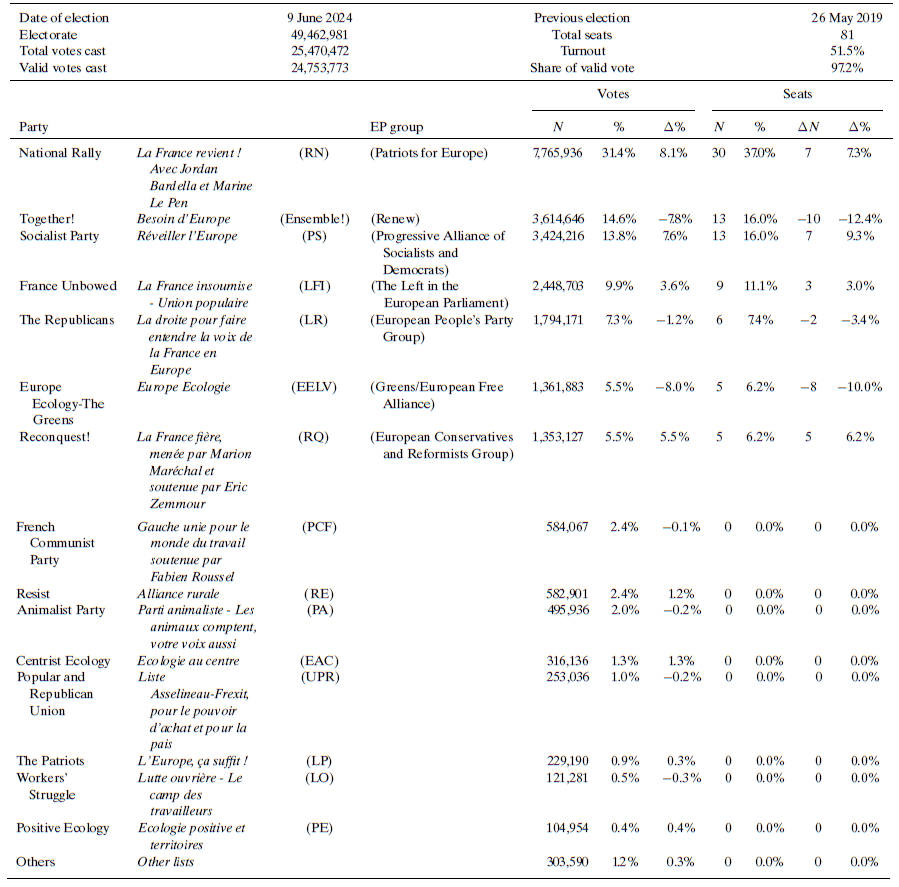
The European election was held on 9 June, with a unique national district as has been the case since 1999 (Houard-Vial & Sauger Reference Houard-Vial and Sauger2020) and a proportional electoral system. Predictably, this framework led to a highly fragmented political offer, with 38 lists running in total.
The RN performed very well, with 31.5 per cent of the votes (see Table 1). This score represents a 40-year record for any French political party in the European elections. Only Simone Veil's right-wing coalition in 1984 had done better, with 43 per cent of the votes. The RN improved on Jordan Bardella's 2019 score by almost eight points, and almost 17 per cent more than the presidential coalition's list (14.6 per cent). This result also represents a remarkable improvement, compared to the 23.1 per cent obtained by Marine Le Pen in the first round of the presidential election. This improvement cannot be fully explained by the limited weakening of the other radical right list, Éric Zemmour's Reconquest Party, which still garnered about 5.5 per cent of the vote in the European election (compared to the 7.1 per cent in the first round of the presidential election). Together, both radical right parties reached a peak of 37 per cent of the vote in the European election.

Notes:
1. Note that columns use the main party name and label of the list; the actual label of the list running in the election is used in the second column. The acronym refers to the name of the main party of the list, if it exists.
2. We use here the number of seats of 2019, after the increase in the number of seats due to Brexit.
3. Lists only above 100,000 votes (0.4 per cent) are specified in this list. Twenty-three other lists are regrouped into the other lists category.
Source: Ministère de l'intérieur website (2024).
With almost twice as many votes as President Emmanuel Macron's coalition, the RN sent 30 members to the European Parliament, which is the body's largest delegation—France being represented by 81 members of the European Parliament (MEPs). The RN benefited from a campaign focusing on its favorite issues: immigration and insecurity, following the classical dynamics of a polarized campaign dominated by the radical right.
As expected, the presidential party was the main loser in this election, reaching only 14.6 per cent of the votes. At the same time, this outcome demonstrated a degree of resilience for this still relatively new party, given President Macron's unpopularity. In contrast, the Republicans, the former main right-wing party, continued its demise, with 7.3 per cent of the vote.
The other surprise of this election was the good performance, given past results, of the Socialist Party (PS), which ran alongside the non-socialist party Place publique and under the leadership of the current MEP Raphaël Glucksmann, who had already led the joint list between PS and Place publique in the 2019 EU Elections. During the campaign, the Socialist, Green, and Communist parties trusted that a strong showing by Glucksmann would rebalance their parties’ power dynamics with the radical-left La France Insoumise (France Unbowed—LFI) party and force its leader, Jean-Luc Mélenchon, to accept the idea of a joint left-wing candidacy for the 2027 presidential election. Glucksmann emerged as a candidate due to the internal turmoil in the PS on who could run a list with good chances to take votes off Macron's traditional electorate. Glucksmann was a way to oppose President Macron's traditional tactic of setting up a duel between progressives and nationalists.
With 13.8 per cent, the PS was able to reclaim leadership within the left block, while LFI, its main contender in the block, remained just under the 10 per cent threshold. For the ecologists, the good performance of 2019 gave way to a mediocre score of 5.5 per cent, just above the threshold of 5 per cent to participate in the distribution of seats. These results contrast significantly with 2022, when 75 members from La France Insoumise and “only” 31 from the PS were elected. The balance within the leftist bloc seemed then to have shifted in two years.
Snap elections
In the evening of 9 June, hence the very day of the European election, President Macron unexpectedly called for snap elections. Article 12 of the French Constitution allows the President to end the Assemblée Nationale's term early. However, dissolving the Parliament is not usual. There were only five precedents in the Fifth Republic, for various reasons, including putting an end to President Mitterrand's cohabitation and securing a majority for President Chirac. It is indeed a risky decision, as the President might lose its parliamentary majority as a result of calling new elections. Article 12 is invoked at the discretion of the President. There are no constitutional constraints to call for dissolution, except for consultations with the Prime Minister and the chairs of both of the Parliament's chambers. It is usually motivated by political reasons, such as a government crisis or institutional deadlock.
President Macron's decision was precipitated by the severe defeat of the presidential coalition Ensemble ! in the European elections, up to the point that the mandatory consultations were very short, and it was not even clear that the Prime Minister indeed knew about it before the public announcement. Moreover, since the 2022 legislative elections, the executive branch had been forced to rule with no absolute majority in the National Assembly. For each legislative initiative, the government had to contend with both left-wing and right-wing parliamentary opposition, which constrained its capacity of action. An extreme example was the pension reform, strongly contested by the trade unions, which was passed without a formal vote in Parliament by recourse to Article 49-3 of the Constitution.
The left reunited almost instantly after President Macron announced snap elections. The very next day, an agreement was signed between LFI, the PS, the Greens, the Communist Party (PCF), and other minor left-wing parties. This new coalition was called Nouveau Front Populaire (New Popular Front, NFP), intending to recall the old Popular Front formed in the 1930s. The NFP had approximately the same perimeter as NUPES for the previous elections of 2022. The NFP agreed to a common distribution of candidates and on a common political platform. The platform notably included scrapping the 2023 French pension reform law and raising the minimum wage.
On the right, the campaign began with the controversial decision by Eric Ciotti, the President of Les Républicains (LR), to get into an alliance with the RN. After the EU elections, opinion polls showed that Marine Le Pen's party could win with a large majority of between 235 and 265 seats, a huge jump from its existing 88 but short of the 289 needed for an absolute majority.Footnote 1 The prospect of a victory for RN probably hastened Ciotti's decision. However, it provoked an internal fracture, as many prominent figures of LR disagreed with it, leading to Ciotti's exclusion from LR at the end of a meeting of the top party committee.
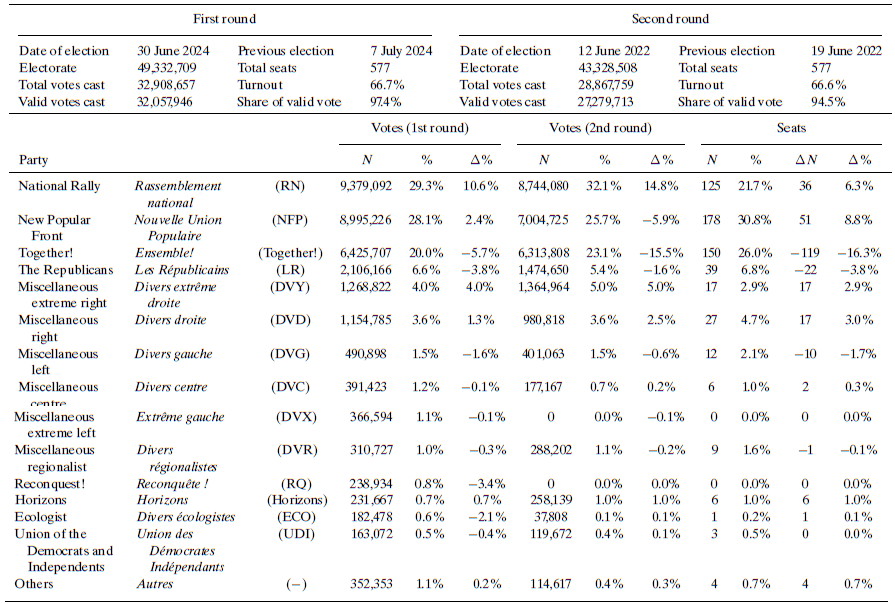
Turnout for the first round was 66.7 per cent, the highest rate for legislative elections since 1997 and a 20-percentage point increase, compared to the former poll (47.5 per cent in 2022). For sure, voters were motivated by the possibility of a change of government, as well as by the prospect of the far right coming to power. The RN (and candidates brought in by Éric Ciotti) led with 33.2 per cent of the vote (29.3 per cent for RN only), followed by the NFP with 28.1 per cent, the pro-Macron alliance Ensemble! with 20 per cent, and LR candidates with 7 per cent (see Table 2). On the basis of these results, 76 candidates were directly elected in the first round. Three hundred and six constituencies out of 577 were headed to three-way runoffs and five to four-way runoffs. One hundred and thirty-four NFP and 82 Ensemble! candidates withdrew in order to reduce the RN's chances of winning an absolute majority of seats, thus keeping alive the cordon sanitaire. In the second round, the turnout was 66.6 per cent. NFP candidates won 180 seats, the Ensemble! coalition winning 159, the RN-supported candidates 142, and LR candidates taking 39 seats.

Note: Note that most parties are in fact coalitions of parties or gathering of candidates of marginal parties.
Source: Ministère de l'intérieur website (2025) and Le Monde (June 2024).
Since no party reached the requisite 289 seats needed for a majority, the second round resulted in a Parliament with no majority. The logics of the electoral blocks, negotiated before the elections, were not to be fundamentally altered. Forming a government coalition outside of these blocks is not a usual practice, as it is seen as detrimental for the long-term electoral prospects of the parties agreeing to compromise. Therefore, France was to be ruled by a minority government once again. Contrary to 2022, no party appeared in the position to control the game. The left claimed victory without having a chance of surviving a vote of non-confidence due to the vocal opposition of the spectrum going from the center to the radical right against any government including representatives of the radical left LFI. The RN, despite being the largest group, had no chance either. The center and the right were those having lost the most from the election. Yet, it took the whole summer for the President to reinstall more or less the same governmental coalition but with an enhanced role for the smallest party (i.e., LR), which had a pivotal position in the bargaining for forming the new government.
It appeared crystal clear that the French electorate was (still) fragmented into three blocks: the left-wing NFP, the centrist Ensemble!, and the RN. In this respect, nothing really changed since 2019 (Gougou Reference Gougou2024). The 2024 legislative elections did not bring up a new political landscape, with new partisan divisions; however, at the same time, Macron may have hastened the end of his own political project with his decision to call new elections. The presidential coalition Ensemble! performed a bit better than expected, thanks to the cordon sanitaire, but former Prime Ministers Gabriel Attal and Édouard Philippe have stated publicly that France needs a new political alliance that goes beyond the “Macronist” coalition. It will not be easy for the centrist bloc to build a new political project and to agree on a candidate for 2027.
Cabinet report
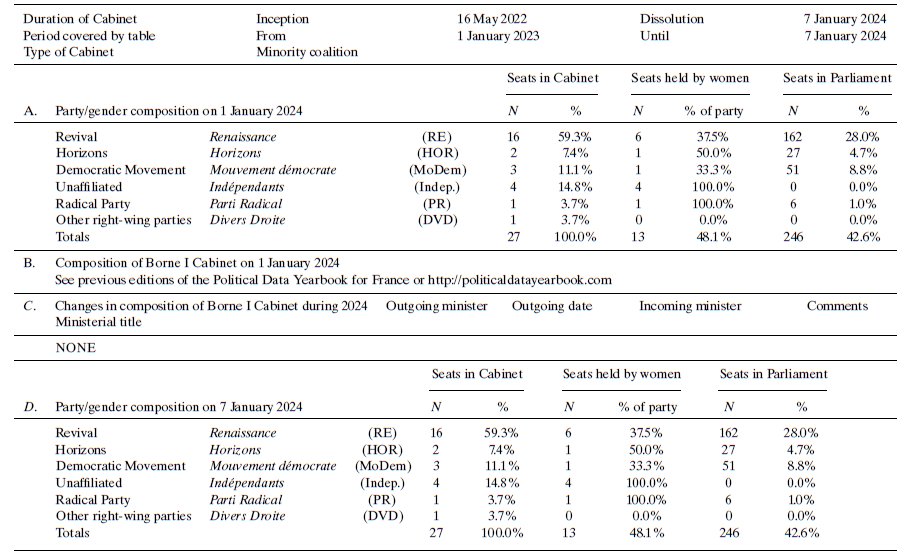
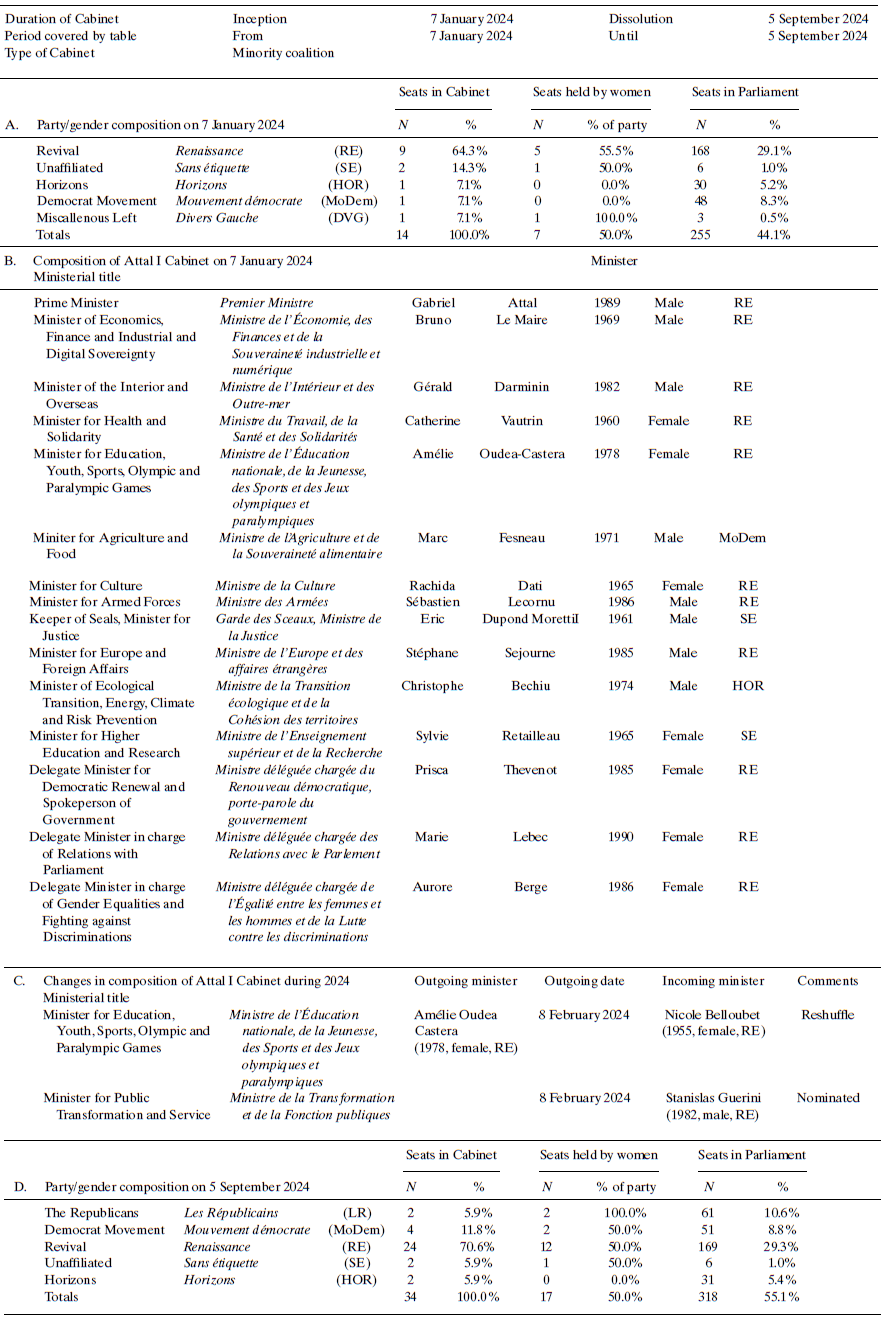
On 8 January, Prime Minister Elisabeth Borne resigned at the request of President Macron (see Table 3 below). This provoked significant discussion, as Borne explicitly stated in her letter of resignation that Macron insisted on her quitting, which is not in line with the Constitution.Footnote 2 Gabriel Attal was nominated as the new Prime Minister. Attal was the youngest Prime Minister of the Fifth Republic (34 at the start of this tenure) and a loyal follower of Macron since the start. He had been in charge of various portfolios since 2018 and was known for his energetic communication style. However, his government was short-lived. He offered his resignation on 8 July for the first time, which was not accepted by President Macron. He then offered his resignation a second time on 16 July, which was accepted on this occasion. He, however, remained as acting Prime Minister till 5 September.

Source: Site Officiel du Gouvernement (2024) (www.info.gouv.fr/composition-du-gouvernement).
The composition of Attal's government was not fundamentally different from that of Borne's (see Table 4). It was still dominated by the President's party and was a minority government. Many ministers exchanged portfolios, and a few new prominent figures joined this government. The main exception was Rachida Dati, the new Minister for Culture, a well-known figure from LR from which she distanced herself upon her appointment.

Notes:
1. The Attal Cabinet was a four-party minority government as a result of the 2022 legislative election that left the governing coalition short of an absolute majority in Parliament.
2. On 8 February 2024, 18 delegate ministers and state secretaries entered the executive. However, their position is below the full ministerial rank and they are not indicated in the table. The same considerations for delegate ministers and state secretaries apply for Tables 5 and 6.


Source: http://info.gouv.fr. (2025).
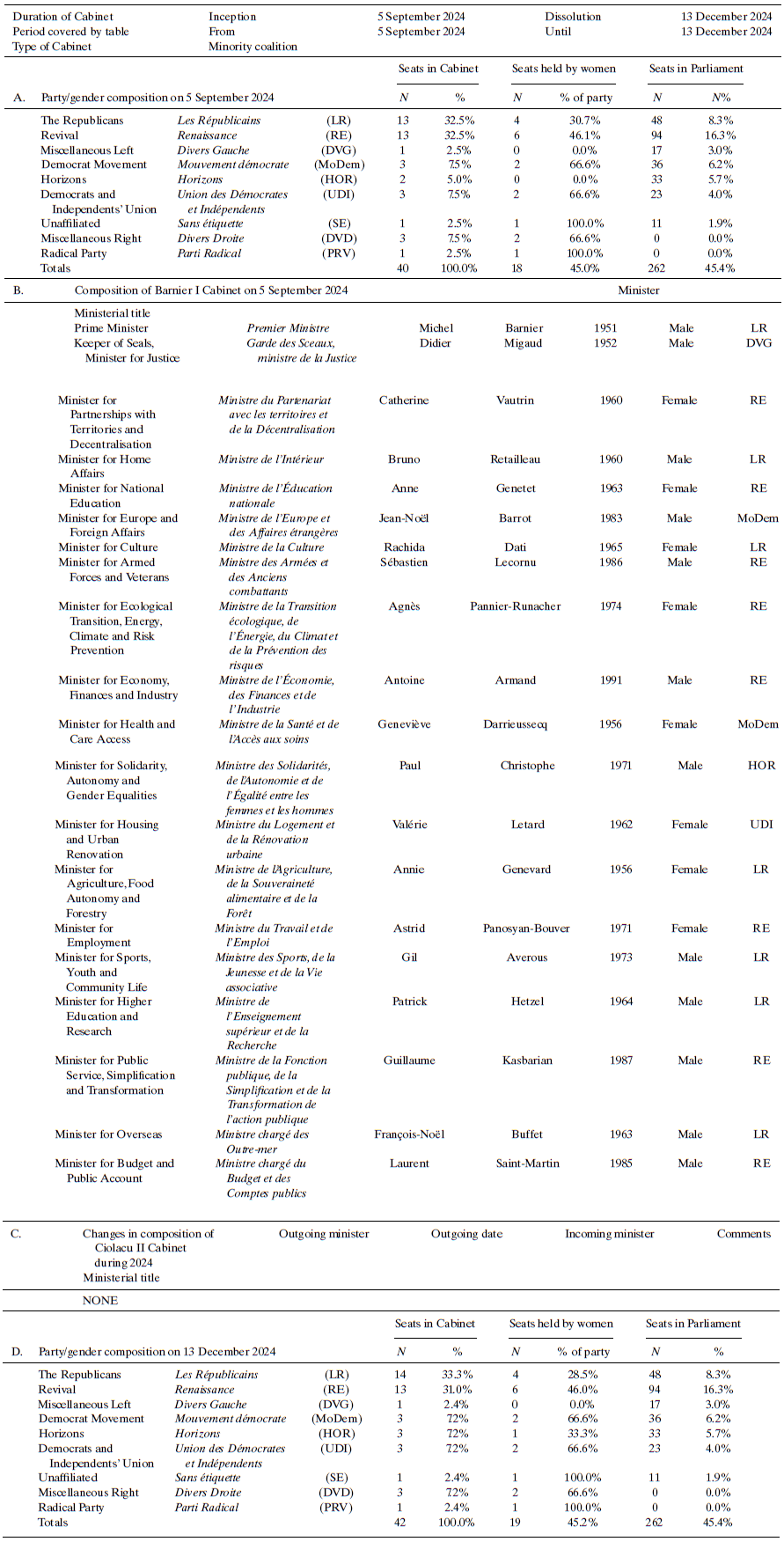
Michel Barnier, who had unsuccessfully sought the LR nomination for the 2022 presidential election, was eventually appointed as Prime Minister on 5 September, two months after the snap elections (see Table 5). It was the longest presidential delay in appointing a PM under the Fifth Republic. Long debates over the summer progressively eliminated as viable options various candidates from the left (especially the former socialist Prime Minister Bernard Cazeneuve, who appeared as the most compatible option to gain support from the centrists, and Lucie Castets, officially appointed after the election by the NFP as its common candidate for the position).
Prime Minister Barnier succeeded in forming a right-wing minority coalition Cabinet including four main parties: LR, Renaissance, Democratic Movement (MoDem), and Horizons. After long internal debates, LR agreed to officially become a member of the coalition. Michel Barnier presented his government on 19 September. However, as no parliamentary block held an absolute majority of deputies, the Barnier government faced probable motions of no confidence. Thus, Barnier made repeated overtures to the RN to try and secure its support.
Eventually, the Barnier government was censured on 4 December. This happened after he presented his government's proposal for the 2025 government budget to the National Assembly, which included a wide range of austerity measures, including €40 billion of spending cuts and €20 billion of tax increases. The issue of public deficit came at the front of the political stage mostly because, at the end of September, French borrowing costs had reached an unprecedented high. At the same time, the EU Commission criticized France for running up excessive debt and recommended to start an “excessive deficit procedure,” the first step in a process before a member state can be moved to take corrective action. Barnier had to find a solution without a political majority and without the support of the opposition on either the far left or far right. Eventually, a motion of no confidence, led by the RN and the leftist coalition, successfully ousted Barnier with 331 votes in favor. The Barnier government thus became the shortest-lived government in the history of the French Fifth Republic.
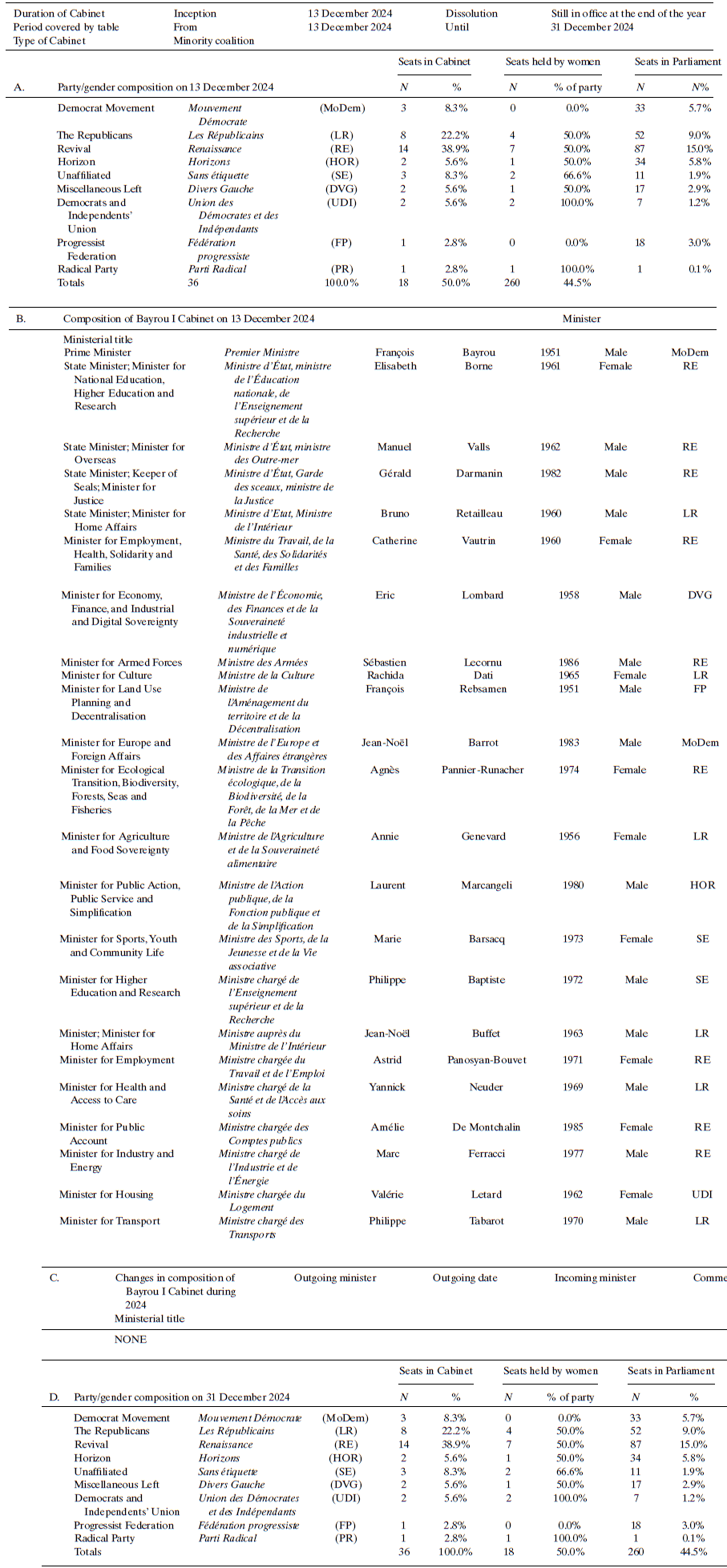
Subsequently, Emmanuel Macron appointed François Bayrou as Prime Minister on 13 December 2024. Bayrou was a long-term loyal supporter of President Macron, whom he supported in the 2017 presidential election. He was appointed Minister of State and Justice in the first Philippe Government, between May and June 2017. However, at the time, he had to resign because of presumed misappropriation of European funds. In 2024, François Bayrou was supported by the Macronist block, while being rejected by La France Insoumise. The other left-wing parties and the far right were awaiting clarity on the policies to be promoted by the Prime Minister. Bayrou is historically center-right-oriented, and his government was formed by a coalition of Renaissance, Horizons, Modem, LR, and Union of the Democrats and Independents ministers (see Table 6). It also included two former Prime Ministers (Elisabeth Borne and Manuel Valls).
All in all, this political sequence showed the pivotal role of RN. Marine Le Pen had refused to enter coalition talks of any sort (even though President Macron never actually mentioned the idea of having her in the government), but she nevertheless became kingmaker in the nominations of Michel Barnier and François Bayrou. Eventually, it became crystal clear that RN's assurance of non-censorship was a prerequisite for their nomination.
Parliament report
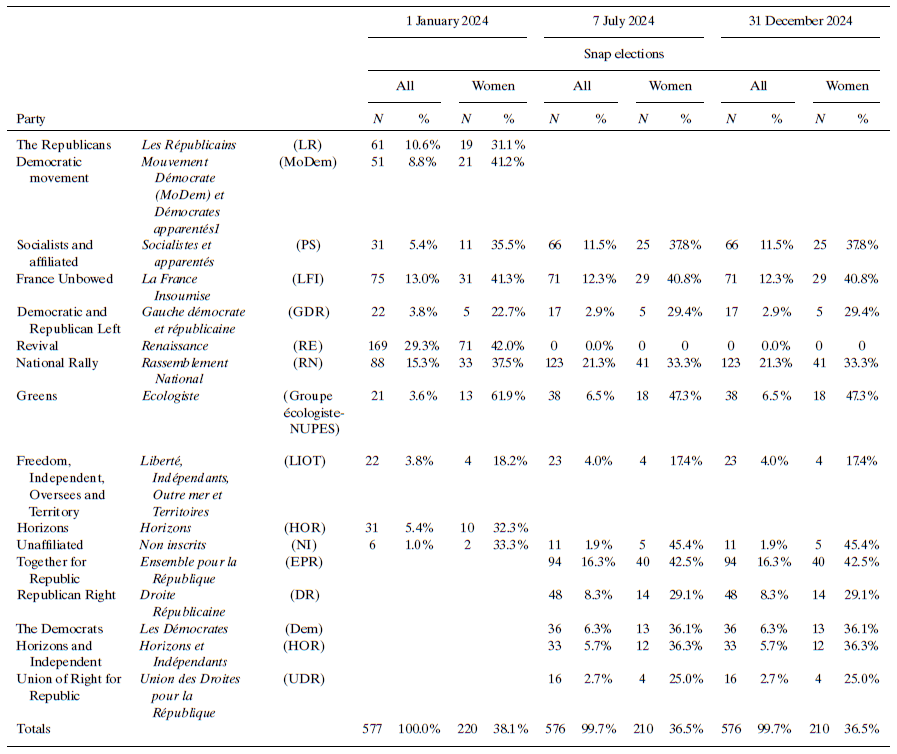
The National Assembly elected in summer 2024 was not fundamentally different from the previous one (Table 7). It was still divided into three main blocks with no absolute majority for any group. NFP candidates won 180 seats,Footnote 3 with the Ensemble! coalition winning 159, RN-supported candidates being elected to 142, and LR candidates taking 39 seats. Compared with 2022, though, the two main opposition blocs, the left-wing NFP (ex-NUPES) and the far-right RN, made significant gains in terms of seats (49 and 53 more seats, respectively).

Source: Assemblée Nationale (2025).
Geographically speaking, RN did well in rural areas and particularly in the north and east of France, in the south-east, and on the Mediterranean coast. Left-wing MPs won in urban areas, with more than 40 per cent of NFP MPs from France's 10 largest cities. NFP won 12 out of the 18 seats in the capital; the other six went to Ensemble!, which also secured a constituency in Bordeaux, Toulouse, and two in Lille. RN won just seven seats in urban areas, and all were in the south-east—three in Nice, three in Marseille, and one in Montpellier.
Regarding the new Assembly's sociological profile, there was a decrease in female representation. Only 210 out of the 577 MPs were women—36 per cent—down from 37.3 per cent in 2022. NFP had the highest number of female MPs—41.7 per cent, with Ensemble! on 38.7 per cent and both RN and LR on 32.2 per cent. Seventy-four per cent of the MPs were managers or professionals prior to their election. The average age of MPs was 49 years and two months, only six months older than the previous Assembly. The oldest deputy was 81 and the youngest 22. Both were from the RN.
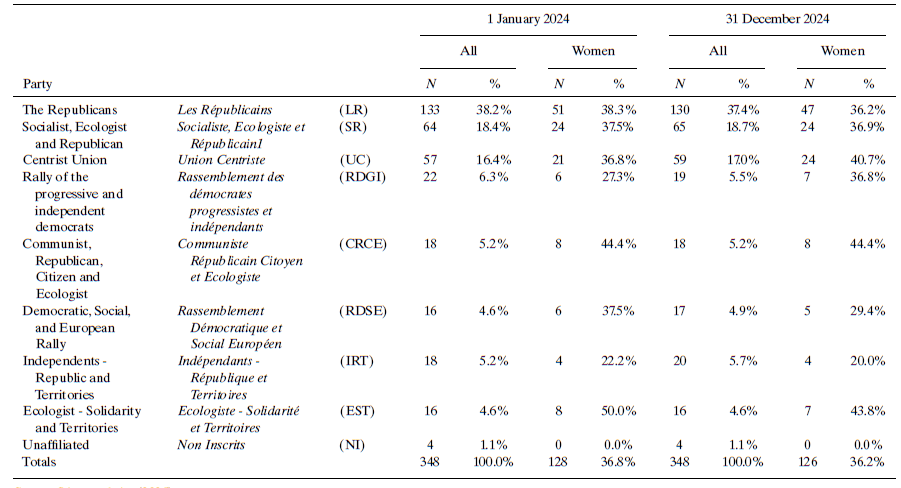
Information on the party and gender composition of the upper house of Parliament can be found in Table 8.

Source: Sénat website (2025).
Political party report
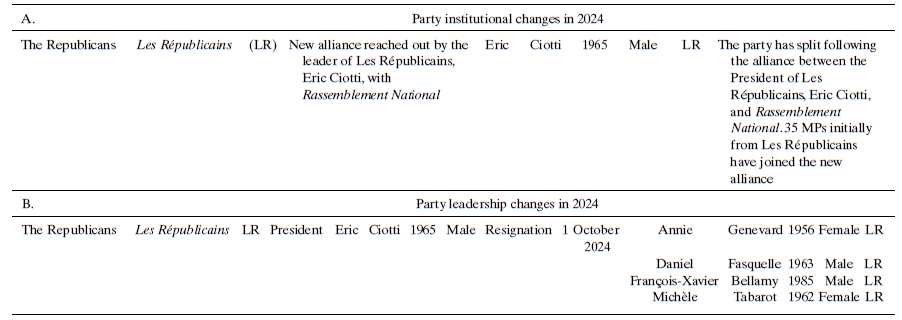
Political party developments mostly deal with internal divisions, groupings, and coalition formation (Table 9).

Among the main events was the alliance concluded by the president of LRs, Eric Ciotti, with the RN. This decision created a wave of internal realignments within the conservative party. Ciotti enrolled around 35 candidates from the LR in the new alliance with the RN. He was then ousted as leader of the conservative party LR, which was unprecedented. This was indeed the first time the right-wing party broke officially with the “front républicain.”Footnote 4 After a judicial battle, Ciotti resigned from the party on 22 September, leaving the floor to an interim collegial leadership (François Xavier Bellamy, who headed the list to the European elections, Annie Genevard, Minister for Agriculture and Food, Michèle Tabarot, MP, and Daniel Fasquelle, former MP).
There were also internal conflicts within the leftist bloc. Jean Luc Mélenchon, the leader of La France Insoumise, was deeply criticized by the other political forces of the block. Former President François Hollande, running in Corrèze's constituency, and former Prime Minister Lionel Jospin, both from Parti Socialiste, said that Jean Luc Mélenchon was not an adequate candidate for representing the alliance. In the June European elections, Raphaël Glucksmann's list (Place publique-Parti Socialiste) outpolled the LFI list. As a result, the socialists challenged the leadership that La France Insoumise gained within the left block in the 2022 legislative election and claimed themselves as the leading force on the left. In this regard, the 2024 elections sped up the recomposition on the left in view of 2027.
Many factors could explain why La France Insoumise has lost part of its electoral success. First, there were political internal quarrels. Some political figures within LFI, such as Alexis Corbière, distanced themselves from Jean Luc Mélenchon. They criticized mostly his authoritarian way of governing the party. In return, these “rebels” were not endorsed by LFI for the legislative elections. The non-investiture of these outgoing MPs immediately sparked off a crisis, revealing the weaknesses of the left-wing coalition. Besides, during the campaign for European elections, Jean-Luc Mélenchon focused much of his attention on the situation in Gaza, a strategy that did not convince many other party members. Most significantly, the balance within the left bloc shows that many voters are hesitant. If they vote for the left, who are they voting for? For Jean-Luc Mélenchon? For François Hollande, former President and “dark horse” candidate? For another, a currently unknown left-wing leader?
In this period, alliances became the main concern for political parties as a main significant source of internal fragmentation.
Institutional change report
Nothing significant is to be reported. In May, President Macron addressed the issue of France's political institutions, reiterating that introducing “a proportional component” to legislative elections would be good for democracy. Some consultations were led by the president of the Assemblée Nationale, but they ran short as snap elections were called.
Issues in national politics
Due to the absence of any clear political direction, substantial policy issues were limited in 2024.
Riots in New Caledonia
A wave of violence erupted in New Caledonia in May, during French MPs’ examination of the constitutional bill reforming the provincial electorate. The insurrection, led by the pro-independence camp in opposition to the bill, came 40 years after the start of a near-civil war in the territory. At that time, the definition of the territory's electorate was already a divisive issue between the pro- and anti-independence camps. Since then, three referendums have consistently confirmed Caledonians’ desire to remain French. However, the revision of the electorate pushed forward by Emmanuel Macron was a delicate reform, as currently, only those registered on the electoral rolls prior to the 1988 “Matignon Agreement” are currently entitled to vote. As a result, today almost one voter in five is excluded from the ballot box. The new bill aims to partially correct this inequality by expanding the electorate to include all of the territory's native population, as well as those people who have been residing in New Caledonia for at least 10 years.
An exploding public debt
The issue of public debt came to the forefront in fall 2024. French public debt escalated from €1.2 trillion in 2007, reaching an unprecedented peak of €3.3 trillion, or 113.7 per cent of gross domestic product, by the end of 2024.Footnote 5 Moreover, the total debt of the state, local authorities, and social security is projected to continue rising for at least the next five years, according to financial rating agencies.Footnote 6 Following Michel Barnier's motion of no-confidence over the 2025 budget, France was run for a few months through a “special law” regime to extend current expenditure. This somewhat contributed to an even more acute problem in the absence of measures to raise taxes or curb public spending. Such out-of-control debt puts France in an extremely delicate position both politically and economically. First, financially, the debt is becoming increasingly expensive. Interest on public debt represents the state's largest expenditure, ahead of education.
The government's lack of parliamentary majority at home significantly complicated its ability to secure political agreements over reforms to be implemented, with the RN and the left bloc rejecting any austerity measures. Thus, public debt became a political tool, fueling criticism against President Macron.
Marine Le Pen's trial
In the fall, a trial against Marine Le Pen was held. The prosecution accused her of having hired fictitious assistants when she was a member of the European Parliament (2004–2017). Allegedly, these individuals were paid by the European Parliament, but in reality worked for the RN. Furthermore, Le Pen was accused of having been at the heart of an “embezzlement system” channeling EU funds to the party between 2004 and 2016 for a total amount of around €4 million. The verdict would only be known in 2025, but the requisition indicated the possibility that Le Pen could be barred from running in any elections in the next few years.
To conclude, 2024 offered (still) intense but uncertain perspectives. President Macron called for snap elections hoping for “more political clarification.”Footnote 7 However, the results brought in even more polarization. The immediate consequence of this political turmoil was the resignation of the first post-election government following the vote of a motion of non-confidence. The subsequent Prime Minister, François Bayrou, seemed to have no choice but to find a delicate balance between trying to implement reforms, on the one hand, and keeping his position, on the other. All signs point to the absence of incentives for most parties to compromise. Gridlock, then, seems the most likely immediate outcome. The political sequence of this year underscores that the majoritarian logic of the Fifth Republic appears—for better or for worse—quite impossible to overcome.

 Open access

