




Hostname: page-component-77f85d65b8-g4pgd Total loading time: 0 Render date: 2026-03-28T07:19:02.640Z Has data issue: false hasContentIssue false

A footnote to the theory of double integrals

Published online by Cambridge University Press:  23 January 2015

Juan Pla*
Affiliation:
315 rue de Belleville, 75019 Paris, France
Get access

Extract

The probability integral theorem, which states that

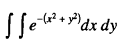
is on the record for having enticed numerous mathematicians to find alternative proofs for it, over a period of more than two centuries, till recent times (for a few recent references see [1, 2, 3, 4, 5, 6, 7, 8, 9, 10]). The most popular demonstration (attributed to the French mathematician Poisson; see [11], in references of [12]), the one found in almost all textbooks, relies on the double integral

(taken over the upper-right quarter of the Cartesian plane) obtained by squaring the probability integral. By resorting to polar coordinates and writing down the above integral as:

the value of the probability integral is obtained by taking the square root of the result on the right-hand side of this latter relation.

Information

Type
Articles
Copyright
Copyright © The Mathematical Association 2010

Access options

Get access to the full version of this content by using one of the access options below. (Log in options will check for institutional or personal access. Content may require purchase if you do not have access.)

Article purchase

Temporarily unavailable
