

Introduction
Attempts to count workers in the French colony of Côte d’Ivoire reflect not only social realities and changes in the wage economy, but also the power relationships in play. This paper considers the production of statistical data on labor from 1946 onward in the context of tensions between local actors regarding the official abolition of forced labor.Footnote 1 This historical event did not put an end to coercion—with or without contract—in French West Africa.Footnote 2 The European settlers attributed the chronic labor shortage on construction sites and plantations near the southern coast—the most fertile part of the colony—to abolition. In response, they set up in 1950 the Syndicat interprofessionnel d’acheminement de la main d’oeuvre (Interprofessional union for the transport of labor), or SIAMO, to organize the movement of workers to the Ivorian forest zone in the south.
This article presents a history of the production of statistics on workforce mobilization and labor migration in the context of Côte d’Ivoire.Footnote 3 The poor quality of the data used to account for the workforce in the colonial era has been highlighted by studies of colonial statistics.Footnote 4 Maxence Demeule, for example, has shown that the statistics produced by labor inspectors in French Equatorial Africa indicate at best the order of magnitude involved rather than providing precise information.Footnote 5 Issiaka Mandé points out that the figures given in 1950 by SIAMO on the labor requirements of farms in Lower Côte d’Ivoire were part of the manipulation of public opinion about the labor situation. As Mandé puts it, through this quantification, the European planters “present themselves as the eternal expiatory victims of any reform undertaken in the colony.”Footnote 6 What has been less studied is the way in which the agency of workers put the quantification process, in particular that undertaken by SIAMO, to the test. By focusing on this aspect, this article addresses the blind spots in the quantification undertaken by the labor inspectorate and by SIAMO. Another goal of this paper is to trace how Ivorian planters produced their own figures to demand rights and defend their economic interests.
To do so, I draw on sources in the national archives of Mali and Côte d’Ivoire, the Centre des archives diplomatiques de Nantes (CADN), and the archives of French West Africa (Afrique Occidentale Française, or AOF) in Senegal. The last-mentioned archives proved particularly useful: analysis of correspondence between governors-general in Dakar (the capital of the AOF)Footnote 7 and lieutenant governors in Côte d’Ivoire shows how the production of statistics was a key political issue in the hierarchical relationship between the two places where colonial power was exercised. I also draw on testimonies from interviews with the last workers from this period still alive, which I collected in Mali, Senegal, and Côte d’Ivoire during my doctoral research. This oral history sheds light on a form of agency deployed to circumvent the colonial recruiting system. Taking advantage of porous borders to escape the violence of French colonial practices of forced labor after 1946, populations on the move resulted in various inaccuracies in the administration’s statistical production. I also show that the tenuous documentation on which these statistics were based (e.g., train tickets, “voluntary cards,” documents of the Régie des chemins de fer Abidjan-Niger, the RAN railway company) reflects the absence of a genuine statistical project in Côte d’Ivoire at the end of the 1940s.
My article first examines the effects of the 1946 law on colonial labor mobilization policies. I then examine the way in which statistics became an issue between the colonial administration, the European planters united within SIAMO, and African members of the Syndicat agricole africain (SAA), either supporting or hindering the march toward reform of the labor regime. I conclude by pointing out the room for maneuver and forms of resistance that workers created for themselves in the face of this recruitment system and how these indirectly impacted the quantification process.
Measuring the “labor crisis” in Lower Côte d’Ivoire after the adjustments of late colonialism
Estimating desertion from plantations after the 1946 law
The opposition of European business circles to any attempt at labor reform in Côte d’Ivoire had been constant since the beginning of the twentieth century. Even in the 1940s, it remained a key element in European colonial advocacy against the abolition of coercion in the recruitment of workers. This position can only be understood in the light of another constant of French colonization: since the interwar period, forced labor had been justified as a remedy for labor shortage.
Therefore, unsurprisingly, the plan to abolish forced labor caused panic among European planters in Côte d’Ivoire. Talk of the “dangers” to the colony’s economy began to surface—a notion that was used strategically by European planters to influence the administration’s clear-cut position in favor of the abolition of forced labor. Against this background, the law of April 11, 1946, formally abolishing forced labor in the French Overseas Territories, advocated by Félix Houphouët-Boigny, an Ivorian representative in the French National Assembly, marked a turning point in the history of labor and working conditions in the French African colonies. A French inspector named Combier, who was sent to Côte d’Ivoire on a brief mission in July 1946, assessed the workforce after the abolition of forced labor. His final report concluded that the law abolishing all coerced labor did not endanger the economy of the colony.Footnote 8
The European colonists’ main argument against the abolition of forced labor was the drop in migration levels from northern regions to the coffee and cocoa plantations and logging sites in Lower Côte d’Ivoire, in the South, after 1946. Jean Rose, a European settler, openly called for the restoration of coercive measures. He was joined by Jean Dubled, president of the Côte d’Ivoire Chamber of Commerce and Agriculture, who pointed out that “voluntary work” would increase labor shortage even more.Footnote 9 Their opinion also converged with the very detailed report by Raymond Desclercs, president of the Gagnoa planters’ union, who lamented that “manpower is becoming very scarce.”Footnote 10
Despite a last attempt to repeal the law at a meeting of French settlers in Algiers from July 30 to August 24, 1946, the move toward free labor remained irreversible. A brief inspection mission dispatched in September 1946 also concluded that the law abolishing forced labor did not endanger the Ivorian economy. It should be noted that within the colonial administration, preparations for the move to wage labor had been underway at least since the French presidential decree of August 17, 1944, which created a corps of labor inspectors for the French Overseas Territories. This decree, as well as the general decree of June 10, 1946, which organized the implementation of the inspectorate in the AOF,Footnote 11 reflected the desire of the Ministry of Colonies to establish a body of civil servants that would be independent of the European planters. From now on, all companies with more than twenty employees were to be inspected at least once a year, or twice a year if they employed more than fifty workers.Footnote 12
The work of the inspectors was complicated by the low staffing levels, which were a general problem in the French Empire in Africa. Demeule has shown how inspection in Eastern African colonies has suffered from shortages in staff.Footnote 13 The situation in the AOF was not very different, with only fifteen labor inspectors working in 1946.Footnote 14 As the governor-general lamented in the same year, in Côte d’Ivoire “requests for labor inspectors have so far gone unanswered.”Footnote 15 Under these conditions, it was impossible to carry out rigorous inspections of the 60,000 or so coffee and cocoa plantations of over two hectares in size, as listed by the colony’s Department of Finance.Footnote 16 Also among the main preoccupations of the labor inspectorate in the neighboring Afrique Equatoriale Francaise (or AEF) at the end of the war were the interrelated problems of the quantity and quality of the workforce. While the labor inspectorate forced the movement of workers to agricultural and forestry concessions held by European planters (the so-called “bush companies”, entreprises de brousse) before 1946, it had to find other means than coercion to encourage this movement after the formal abolition of forced labor. This is why the statistical monitoring of the movement of workers became crucial.
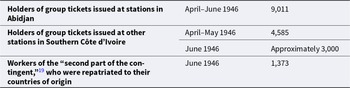
In Côte d’Ivoire, the inspectors began by assessing the rate of desertion from colonial work sites after the abolition of forced labor. As early as July 1946, Combier counted in his report all return tickets issued at train stations in the south to Middle and Upper Côte d’Ivoire (Table 1). If we include the 2,000 workers who would have returned by their own means (i.e., without return tickets provided by the administration), Combier found a total of approximately 20,000 workers who left Lower Côte d’Ivoire in the second quarter of 1946,Footnote 17 during a period of high agricultural activity.Footnote 18
Train tickets issued by the Régie Abidjan-Niger (RAN) in 1946
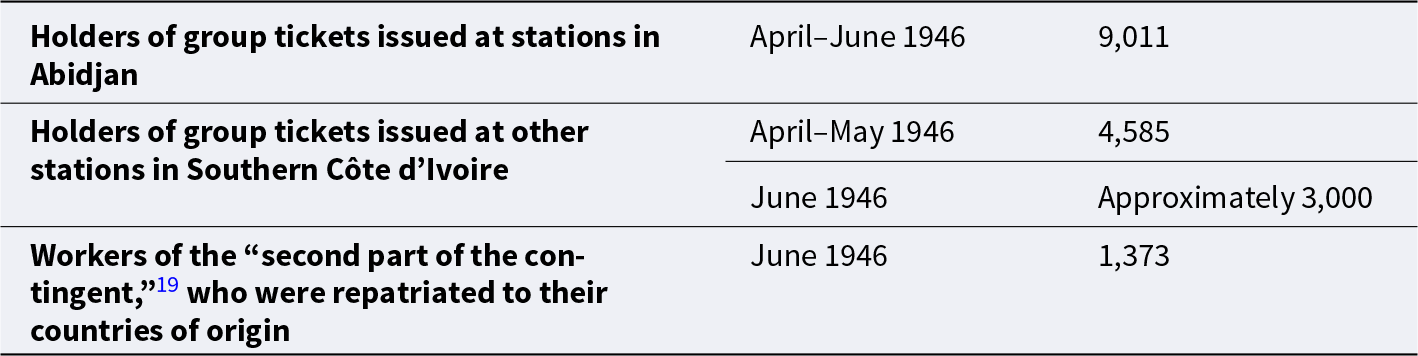
Source: Combier’s report, 13 July 1946, K450(179), ANS.
The labor inspectors took their analysis a step further with another source of data: they counted the number of “voluntary cards” (cartes de volontaires) Footnote 20 issued since 1946 by district commanders (commandants de cercle) to workers who had moved to Lower Côte d’Ivoire. Only 740 such cards were issued in May 1946 in the inland administrative districts. Surveys carried out among employer organizations were also not very precise; they estimated the number of “voluntary” workers in June 1946 at almost 2,500.Footnote 21 The Combier report concluded that there was a shortfall in Lower Côte d’Ivoire of around 17,000 workers.
Combier pointed out that the massive return of workers to their home regions in Middle and Upper Côte d’Ivoire, as well as the impossibility of immediately finding voluntary replacements in sufficient numbers, would have resulted in the near-total cessation of public services in the colony, and a brutal blow to its economy.Footnote 22 To remedy this situation, a “special card” was issued to workers leaving their home district, indicating a specific destination. This card enabled them to get a free ticket at the train station without any further formalities. This was one of the many incentives deployed by the French colonial administration after the abolition of forced labor to urge labor migration to the south. By counting the number of cards distributed in this way, the labor inspectorate was able to provide statistics on the migration of workers to agricultural concessions in Lower Côte d’Ivoire. Between 1946 and 1950, a total of 115,574 workers were transported under this system to Lower Côte d’Ivoire, both by employers and by professional recruiters, at a total cost of 43,604,078 francs.Footnote 23
Despite numerous desertions and the increasing movement of workers, some sources also indicate the persistence of forced labor. For example, a 1947 report by the head of the Bouaflé subdivision noted that workers were still being recruited under “administrative pressure” for work on roads and plantations.Footnote 24 This was prompting workers to flee across the border to the British Gold Coast (now Ghana).
Quantifying the effects of free labor on emigration to the Gold Coast
With the end of the Second World War, the colonial authorities in Côte d’Ivoire started to devote more attention to setting up a broader statistical apparatus, using more complete, more frequent, and more reliable censuses and enumerations. The growing importance of social issues led to the collection of new data on labor fluctuations, wages, and changes in the cost of living.Footnote 25 Between 1948 and 1951, however, the administration had to admit that the general availability of workers was not simply a matter of numbers, but that living and working conditions in neighboring colonies attracted workers.Footnote 26 The authorities then decided to put firm controls on the border between Côte d’Ivoire and the Gold Coast in order to stem the flight of Upper Voltan workers to the British colony.Footnote 27 By doing so, they implicitly recognized the flaws in their new system of labor allocation. As of April 16, 1941, special authorization was required to travel to the Gold Coast, but this measure was inefective due to the porous borders and the Gold Coast’s more appealing working conditions compared with those in Côte d’Ivoire.Footnote 28 Even the governor of the colony, Hubert Deschamps, admitted his powerlessness: “For the Mossi, the Gold Coast remains the normal outlet; and the frontier, whatever measures are taken to close it, is too extensive and without natural obstacles, in a wooded savannah, for it to be possible to stop men determined to cross it.”Footnote 29
Upper Voltan farm workers also crossed the border en masse, much to the chagrin of Côte d’Ivoire’s European planters. In fact, emigration to the Gold Coast had been going on for a long time. As early as 1937, the labor inspector Pierre Tap had reported that Côte d’Ivoire’s rapidly expanding coffee, cocoa, and banana plantations required 20,000 workers a year and were suffering from a labor crisis, and that 120,000 workers had emigrated to the Gold Coast.Footnote 30 The report by geographer Jean Dresch, a fervent opponent of forced labor, suggests that the movement of workers to the Gold Coast became less significant in the wake of the 1946 law.Footnote 31 The stream of emigrants, who had been attracted by the mines and plantations in the Gold Coast since at least the beginning of the twentieth century, was finally reduced.Footnote 32 While at the end of 1945 the number of workers in the plantations was estimated at 40,000 by Côte d’Ivoire governor André Latrille, it had reached around 65,000 by December 1947.Footnote 33 From then on, the flow of free labor shifted to the plantations owned by Africans in Lower Côte d’Ivoire, but very often to the detriment of European-held plantations. This led to new tensions between European and African planters over statistics in the colony.
Recruiting enough workers: A new battle over numbers
Tensions between African and European planters
Once forced labor had been abolished, a major question arose: How could workers be recruited on a voluntary basis? European planters clung to the idea that there was an inextricable link between coercion and putting Africans to work. In this, the cliché of the “lazy native” figured prominently.Footnote 34 “Africans would never work: I know the Negro,” said Jean Rose, a leading figure among European planters and an ardent defender of forced labor.Footnote 35 On the other hand, Ivorian planters who owned coffee, cocoa, and banana plantations, like the political leader Félix Houphouët-Boigny, who created the SAA (Syndicat agricole africain) in 1944, argued that the workforce was available, willing, and ready to offer their labor to the owners of agricultural concessions on free, non-coercive terms.
A few months before the abolition of forced labor, the governor-general of the AOF, Pierre Cournarie, considered the increasingly obvious reluctance of the populations of Upper Côte d’Ivoire, a less dynamic economic zone located inland, to migrate to the wealthier and more fertile Lower Côte d’Ivoire. A clear sign that the colonial administration was moving in the direction of free labor is that Cournarie issued instructions to reduce the number of forced recruits: their number was approximately 25,000 to 30,000 per year between 1942 and 1945, but was not to exceed 10,000 in 1946.Footnote 36 The refusal of the European planters’ unions to abide by this plan to gradually reduce the number of forced workers led to an initial clash with the African landowners. The European settlers, ignoring the directives from Dakar, asked that 500,000 workers still be transferred to the forest zone.Footnote 37 As a symbol of their resistance against the abolition of forced labor, European settlers occupied the governor’s park in Abidjan in November 1945. In response, the African planters organized. They supported desertion and sabotage by African workers on European plantations, as we shall see later. The administration then took on the role of arbitrator between the European and African planters.
However, we should not interpret the move of West African planters as a desire for a radical break with the colonial economic structure, as the dominant nationalist narrative in Côte d’Ivoire would have it. Indeed, Ivorian planters thrived on the economic tools that had been offered by the French administration since the 1930s. While the abolition of forced labor was undeniably part of the agenda of this economically successful indigenous elite, the creation of the SAA was also aimed at safeguarding its own interests. Despite its obvious economic contribution to the growth of the plantations, this burgeoning Ivorian agrarian bourgeoisie class remained subject to discriminatory measures based on racist arguments, which they sought to mitigate with the abolition of forced labor. For example, the maintenance bonus instituted in 1930 for the benefit of growers by Dieudonné François Reste de Rocca, governor of Côte d’Ivoire from 1930 to 1935, was granted only to plantations of at least twenty-five hectares in a single contiguous block, a criterion that automatically disqualified most Ivorian owners.Footnote 38 The administration finally proposed allocating 1,000 francs per hectare for Europeans and 500 francs for Africans. When protestors reacted to this unequal treatment, they were told that African planters did not have to pay for repatriation and vacations and that they ate yams rather than bread.Footnote 39
Statistical data subsequently became a means of arbitrating tensions between the European SIAMO union and its rival, the SAA. In support of their demands to local government for workers on their farms, the European settlers appealed to numbers. They based their claims on a study of the coffee and cocoa sectors during the Second World War, which estimated that a prototypical two-hectare farm would require one man employed year-round, and that harvesting would require an additional seasonal workforce of one man per two hectares for six months. Thus, since European plantations covered a total of around 24,000 hectares, they would require 12,000 permanent workers and 12,000 seasonal workers on a colony-wide scale.Footnote 40 Given the extent of these needs, the European settlers, through the voice of Jean Dubled, argued that the change to a regime of voluntary work would mean the end of their farms.
The SAA, which saw itself as a defender of African workers’ freedom, disagreed. It produced its own figures in an attempt to convince the authorities to grant African owners permission to hire their own workers. The arguments made by Félix Houphouët-Boigny in December 1944 at the Abidjan conference on the labor force show that quantification was not the exclusive prerogative of the privileged Whites.Footnote 41 Houphouët-Boigny summarized the conference as follows: “We discussed for two days. They stuck to their figures, we stuck to ours.” Voluntary recruitment was feasible, he argued: in the past, “the Agnis used this workforce to create and maintain their cocoa plantations. And the Ashantis of the Gold Coast hired several tens of thousands of free wage laborers from Moaga country every year for the same purpose.” He then asked: “Why can’t we, like the Ashantis, recruit free laborers from the colony’s northern populations?”Footnote 42 To achieve this, he explained, “African planters offered more attractive conditions to free wage workers. This led to the recruitment of 400 workers who freely presented themselves in Dédougou and 1,200 in Ouagadougou within just sixteen days.”Footnote 43 This plea astonished the governor of Côte d’Ivoire, André Latrille: “You were able to hire 1,600 workers in less than fifteen days?”Footnote 44 “Yes, (replied Houphouët-Boigny,) with two union members. Another 400 workers are in Bobo-Dioulasso.”Footnote 45 The governor was finally convinced that the “shared affinities” of African planters with potential workers, as well as the lure of sharecropping, would help to create a properly functioning free labor market.Footnote 46 In this case, numbers accompanied the advent of free labor and the changing balance of power between settlers and workers.Footnote 47
The railroad crisis of 1946 provides a vivid illustration of this tactical alliance between the administration and the SAA. On the railroads, the situation became critical in June 1946 because of a shortage of firewood brought on by a manpower shortage. Almost 90 percent of the firewood needed for the Abidjan-Niger railroad was supplied by European-owned companies, with the remainder coming from public works. The number of workers recruited by the authorities to supply firewood had been decreasing steadily since 1944 (Table 2). The main reason for this was that the European companies supplying wood for the steam locomotives did not accept the government proposal to reduce their workforce in light of the overall labor shortage, and continued to demand forced recruitment. In response, the government approached African entrepreneurs, organized in the SAA. In July 1946, seven logging operations were launched, employing 1,690 workers, which by September had increased to 9,869 workers; workers on the RAN similarly rose from 327 to 2,366. By the beginning of September 1946, more wood had been cut that year than in 1938 or 1945.Footnote 48 The battle for firewood had been won, thanks to the efficient recruitment network set up by the SAA.Footnote 49
Workers recruited by the administration in the timber sector in Côte d’Ivoire, 1944–1946

Source: Combier report, K450(179), ANS.
Since African owners were able to mobilize a plentiful supply of labor, they played an increasingly important role in the plantation economy. Therefore, for the European settlers, regaining their former economic dominance in the face of the rise of African planters required the availability of sufficient manpower, which they must now recruit without coercion. The creation of SIAMO in 1950, with the support of the colonial administration, was aimed at achieving this goal.
SIAMO and the production of new statistical data (1950–1960)
In 1950, Governor Laurent Péchoux decided that the colonial authorities of Côte d’Ivoire could not continue to subsidize transport for the workers employed by European companies as in the past, though he recognized that it contributed to the country’s prosperity, as well as to tax revenue. To compensate for this withdrawal, European settlers, led by Raymond Desclercs, founded SIAMO.Footnote 50 SIAMO was a private union, financed by membership fees, donations, and subsidies from the Fonds de soutien du café et du cacao (Support fund for coffee and cocoa), the Chamber of Commerce, the Fédération bananière (the banana federation), and the Syndicat forestier (the forestry union). Its bylaws specified that it operated under the control of the colonial administration and the labor inspectorate.Footnote 51
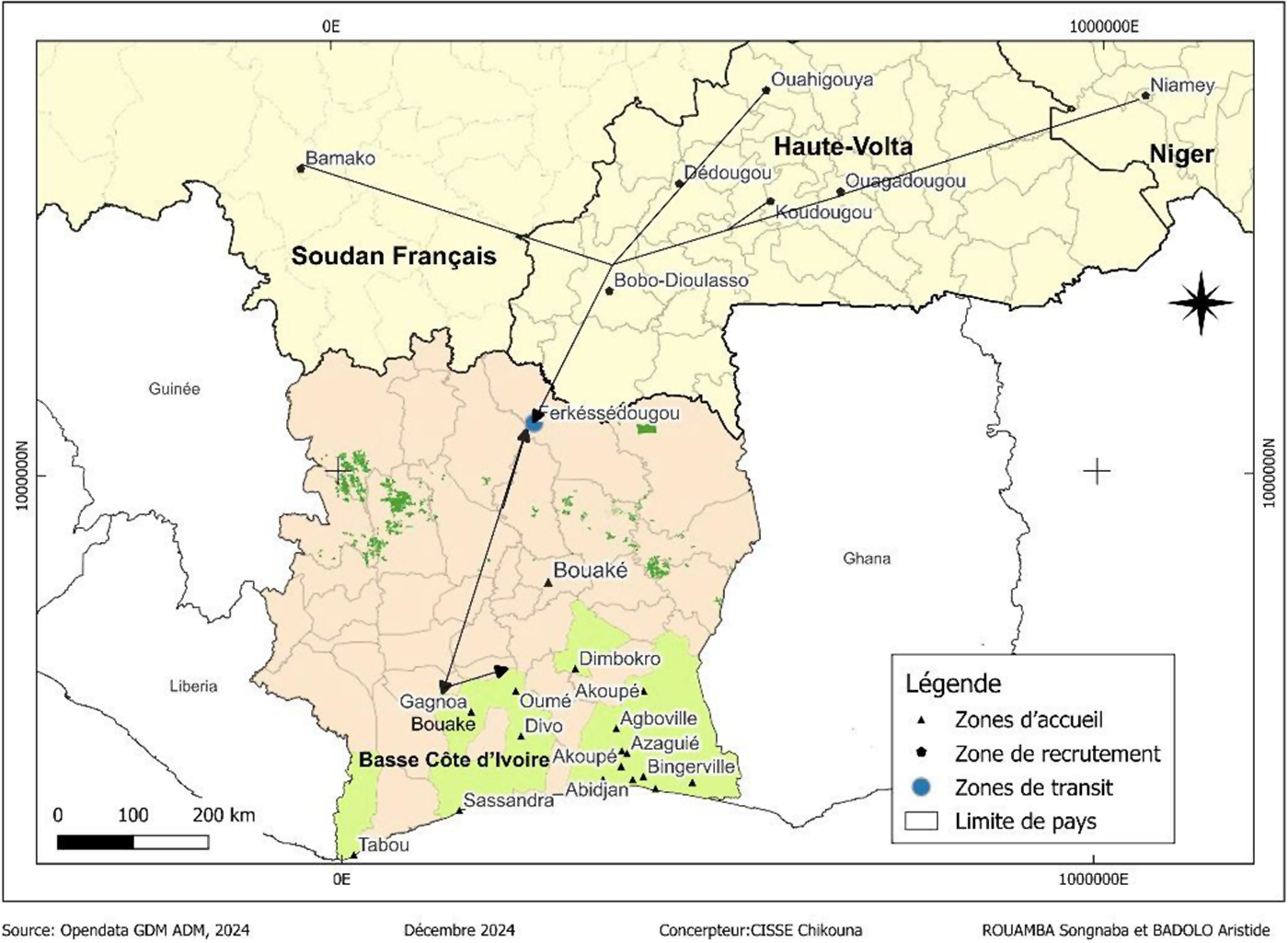
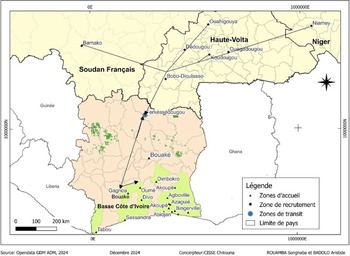
There is an abundant literature on the SIAMO,Footnote 52 which tends to focus on the reasons for its creation. Issakia Mandé has also shown that recruitment by SIAMO continued to be financed by public funds, as had previously been the case.Footnote 53 Employers first recruited the workers they needed to run their businesses, sometimes through professional recruiters. SIAMO reimbursed their expenses on a flat-rate basis of one franc per kilometer per man arriving at their destination, plus 300 francs for recruitment and food expenses. Checks on the identity and health of workers were carried out at both departure and arrival. In the 1950s, the management of the recently created recruitment, accommodation, and travel centers was added to SIAMO’s activities.Footnote 54 The first two recruitment centers were set up in 1952 at Bobo-Dioulasso and Dédougou, in the midst of the Upper Volta labor pool.Footnote 55 A third recruitment and placement center was opened in Bamako in 1953, but since results fell short of expectations, it was quickly decided to move it to Ouahigouya, in a densely populated region with a long history of emigration.Footnote 56 During the same period, other centers were established in Ouagadougou and Koudougou in Upper Volta, and in Niamey, Niger. SIAMO also opened centers in Côte d’Ivoire, notably in Ferkessédougou and Bouaké, which were on the route to the plantations further south (Fig. 1).Footnote 57
Map of SIAMO labor recruitment and routing zones (1950–1960). Map created by Chikouna Cissé and Songanaba Rouamba.
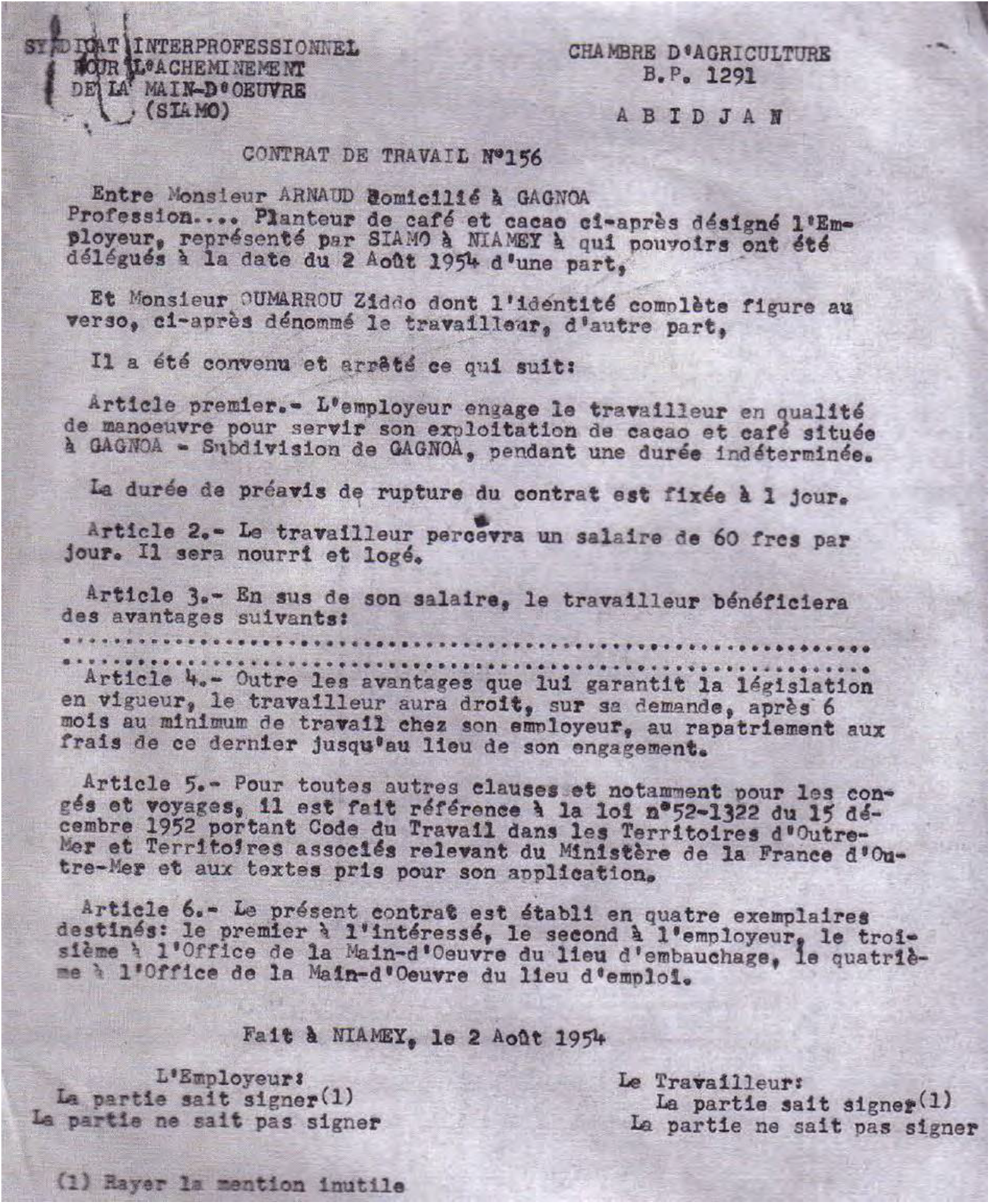
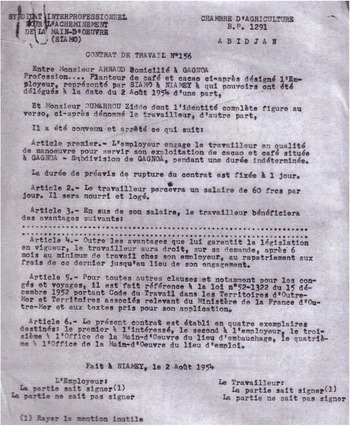
The existing literature also focuses on the number of workers sent to Lower Côte d’Ivoire. It does not criticize the quality of the SIAMO data on labor migration, but they are questionable for several reasons. First, the strategies employed by colonized workers to circumvent SIAMO systems very often distort the data, as discussed above. In addition, the union’s inability to take into account all labor pools resulted in figures that were very partial. Earlier studies give disparate and contradictory figures, reflecting the more general state of statistical production in Côte d’Ivoire. Reynald Blion and Sylvie Bredeloup, for instance, argue that during its seven years of existence, the SIAMO succeeded in attracting 230,000 Upper Voltan workers to Côte d’Ivoire.Footnote 58 André Hauser writes that SIAMO brought around 50,000 workers to Lower Côte d’Ivoire, but it is not clear whether he is giving monthly or annual figures; if the latter, this would mean a workforce of about 500,000 was brought in over ten years.Footnote 59 With few exceptions, the scholarship does not question the methods used to produce these figures, though Victor Piché and Denis Cordell point out, but without going into any further detail, that the figures produced by SIAMO represent just the tip of the iceberg, given that they take into account only workers hired officially under contract (Fig. 2).Footnote 60
Prototype SIAMO contract drawn up in 1954.
A first alternative statistical source comes from the railway company, RAN. Their lists show that some of the workforce reached plantations without going through SIAMO recruitment channels: of the 21,260 workers transported by train in 1952, only 7,699 travelled with the help of SIAMO. In addition, most of the workers recruited by SIAMO deserted once they had arrived in the south of the colony. This pattern of desertion was confirmed in 1953: of the 12,962 recruited by SIAMO, only 1,205 were still being monitored by it on their arrival in Côte d’Ivoire.Footnote 61 Having benefited from the transport provided by SIAMO, the workers were then poached by African planters.Footnote 62
Let us now take a look at other ways in which workers manifested their own agency.
The flaws of labor quantification
When statistics collide with workers’ agency
From the very beginning of colonial exploitation, the refusal of West Africans to submit to forced labor took the form of desertions from colonial work sites and ruses to circumvent control mechanisms. As was the case elsewhere in Africa, the topography and social structures of Côte d’Ivoire provided powerful tools for resisting colonial attempts to control labor, even after 1946.Footnote 63 SIAMO noted, for example, that it was very common for recruited workers not to give their real identity, or even the exact name of their village.Footnote 64 Thus, in the context of colonial domination, any attempt by the colonial administration to produce statistics ran up against the agency of colonized people.
Attitudes toward labor around the start of the Second World War echoed the opposition to conscription and taxation at the beginning of the twentieth century.Footnote 65 Indeed, ways of evading colonial taxation, such as the technique of disguise used by JulaFootnote 66 merchants in Côte d’Ivoire to avoid paying for a peddler’s licence, are recorded quite early. People could also bypass customs posts by changing their itinerary, or, on arrival at a checkpoint, where it was impossible to go unnoticed, they would entrust all their goods to a member of the caravan who had a circulation card, while the rest disguised themselves as porters.Footnote 67 Of particular note were the tricks used to avoid the head tax, as observed with certain canton and village chiefs in the administrative district of Séguéla, who made false declarations of the real numbers of their subjects.Footnote 68
The avoidance of SIAMO recruitment in the 1950s can also be seen as a continuation of avoidance strategies and fierce contestation during and after the Second World War, when workers in Upper Côte d’Ivoire were under the greatest pressure from recruiters. One strategy was simply to change one’s place of residence. Along the road from Gambaga to Novrongo, many Mossi from the Ouagadougou district, accompanied by their families, stayed temporarily with local residents, waiting for the rainy season to end so they could choose a site to build new homes.Footnote 69 After the war, this desire to escape the grip of the colonial state led to a direct and violent opposition in Côte d’Ivoire. In the districts of Sassandra, Lahou, Gagnoa, and Dimbokro, an opposition movement to the forced labor system was organized in 1944 in a region with many SAA members. In 1946, workers in the Lahou administrative districts committed serious sabotage on a European plantation.Footnote 70 The fact that sabotage and desertion were occurring at the same time blurred the boundaries between them, giving a political tone to these acts of defiance against colonial authority. At the same time, unrest among workers threatened to bankrupt several European plantations. In 1946, André Buttavand, a labor inspector on a tour in the Gagnoa district, was alarmed by the economic situation, as the harvest of an exceptionally good crop was in jeopardy due to a lack of labor.Footnote 71
After the passing of the 1946 law, workers became increasingly reluctant to work on European plantations. After the abolition of forced labor, professional recruiters were paid according to the number of men sent to Lower Côte d’Ivoire, and often used fraudulent practices; for example, to get the consent of workers, they promised higher wages than those actually on offer and gave false information about the location and nature of the jobs. The International Labour Organization (ILO) took note of these issues in a 1958 study, which emphasized that the circumstances and geographical, cultural, and administrative difficulties had hitherto prevented the compilation of satisfactory statistics in African territories.Footnote 72
The excerpted interviews that follow illustrate how the agency of workers deployed in opposition to coercive practices made it possible to circumvent the SIAMO recruiting system, rendering its statistical production unreliable. First, a Sudanese man named Boubacar Diallo, who was hired as a driver in the 1950s by a professional recruiter called Miglaury based in Bobo-Dioulasso, explained in an interview conducted in 2006:
We used to look for Mossi in Tenkodogo, Yako, Kaya, Ouahigouya, and Koudougou, and gave them to the colonists in Lower Côte d’Ivoire, more specifically those in Gagnoa. On the other hand, we refrained from telling them that they were going to Côte d’Ivoire to be handed over to the settlers in this district.Footnote 73
Gagnoa was abhorred by workers because of the arduous nature of the work there. The particularly harsh living and working conditions were strongly denounced by labor inspectors. Dr. Farges, a doctor at the Gagnoa medical center, reported on the alarming health conditions of a group of Voltaic workers on European plantations. But workers had found a way to avoid being sent to this region. Diallo continues:
When we went to look for them, we went via Bobo, then Bouaké and Toumodi. When we got there, the oldest of the laborers would redouble their vigilance. A road to the right led to Kokumbo, Oumé, and then Gagnoa. If the truck took this road rather than the one leading directly to Abidjan, these old hands, who had already made this journey, knew what it meant and threw themselves out while the truck was in motion, because the treatment that had been inflicted on them at the Gagnoa plantations was quite simply inhuman.Footnote 74
Sanga Bouraima, a migrant from Upper Volta employed on the coffee plantations of a Lebanese named Khalil Sabeh in Oumé, shows that this resistance could take a more violent turn:
As soon as the truck carrying them to the south of Côte d’Ivoire took the road leading to Gagnoa, contrary to what had been promised, the laborers attacked the driver and beat him up. Losing his balance, he lost control of the truck, which ended its run in the forest, letting its occupants escape.Footnote 75
Clearly, SIAMO also resorted to false promises and misinformation, which provoked resistance. In this way, a considerable number of workers (though the exact number is difficult to estimate) were recorded by the administration and employers, even if they never arrived at their destination. As we will see in the last section, these individual cases were far from unique and undermined the quality of the figures produced by SIAMO.
Statistical gaps and disagreements: the colonial administration versus SIAMO
The French administration itself acknowledged that it was unable to put a precise figure on migration from neighboring colonies to Lower Côte d’Ivoire before the creation of SIAMO. A 1946 report notes the presence of some migrant workers who were difficult to control and count accurately.Footnote 76 They were probably from French Sudan (now Mali) and they continued to migrate in the 1950s. Evidence for this is the high number of identity cards, which were needed to cross colonial borders,Footnote 77 issued in the French Sudanese district of Bougouni, 2,676 in 1952.Footnote 78 In the neighboring administrative district of Sikasso, Commander Roger Lafeuille pointed out that it was “difficult to quantify the scale of this exodus” to Côte d’Ivoire. In 1952, he acknowledged that “the figure of 10,000 is not too far-fetched.”Footnote 79 However, his assessment is probably even lower than the real level of migration, which affected almost every canton in southern French Sudan. For the Bougouni district alone, the annual economic report estimated the number of young men who left to work in the plantations and towns of Côte d’Ivoire at about 20,000.Footnote 80 The absence of SIAMO in this southern part of the French colony of Sudan, which was a major source of migration to Côte d’Ivoire, makes its figures all the more questionable for estimating the extent of labor migration.
This difficulty was exacerbated by disagreements over figures between the colonial administration and SIAMO. While the labor inspectorate estimated the need for manpower in Côte d’Ivoire at around 70,000 workers in its 1950 annual report, SIAMO put it at 190,000, of which 143,000 were needed in agriculture. To back up its figures, SIAMO criticized the forecasts of the labor inspectorate. In the view of European planters, the estimate of 6,438 men needed in the mining sector was too high, since, according to them, this sector hired a large number of West African gold miners working independently, who should not be counted as employees. While the labor inspectorate gave a figure of 17,485 laborers for the agriculture and livestock sector in 1950, the report by Raymond Desclercs, a founding member of SIAMO, gave a figure of 143,000 for the agricultural sector alone.Footnote 81 The significant discrepancy between the two figures can be explained by manipulation on the part of European planters, who tended to exaggerate the figures to serve their class interests. Desclercs himself acknowledged, however, that a figure at this order of magnitude cannot be considered rigorous.Footnote 82
There are other reasons to be cautious about the reliability of these figures. First, the great distance separating the northern labor pools from the southern production centers (it is 800 km from Bobo-Dioulasso to Abidjan, and over 1,200 km from Bamako or Ouagadougou), makes it extremely difficult to quantify worker migration. Another characteristic of this labor force, according to European planters, was its instability, which can be understood in terms of the agency of the workers themselves. Desclercs, therefore, saw no point in trying to fix the terms of employment by means of verbal or written contracts.Footnote 83 The important movement of workers was thus part of a wider set of factors that complicated the production of reliable statistics.
Conclusion
On January 18, 1925, Richard Brunot, the governor of Côte d’Ivoire, issued a circular putting an end to the forced recruitment of labor by his administration.Footnote 84 To demonstrate the danger of this decision for European settlers, Senator Messimy, president of the Association Colonies-Sciences, sent an alarmist letter to the governor-general of the AOF, in which he wrote: “The complaints are unanimous and the figures communicated to us show that many concession holders have been forced, for lack of manpower, to reduce their crops and leave part of their farms fallow.”Footnote 85 The stance taken by European planters, who also used statistics to argue against the abolition of forced labor in 1946, was thus a continuation of their tactical use of figures. As this article has demonstrated, however, what did change in the run-up to the Second World War and its aftermath was the ability of economically dominated groups (SAA planters and West-African workers) to strategically use the production of figures. For instance, the Syndicat agricole africain, a union of African planters, produced statistics to defend their own interests in the debate on the abolition of forced labor. With figures to back up their arguments, they demonstrated to the colonial administration that a switch to voluntary labor was feasible, and that they themselves could even supplant European planters in the recruitment of workers.
Another key point to bear in mind when interpreting statistics on the workforce is the ability of West African workers to circumvent the colonial recruiting system. They rented out their muscles to the highest bidder, and could also escape forced labor, just as others had evaded colonial enumeration in the past. At a time when French authorities were hoping to modernize colonialism with the help of statistics, presented as a more advanced method, such evasions compromised the accuracy of figures on worker recruitment. More generally, the post-1945 and 1946 period sheds light on the approximations and overestimations involved in the colonial quantification of the workforce. Statistics were also regularly used to defend class or state interests. Though this period is considered by many specialists to be when Africa entered the “statistical era,”Footnote 86 efforts to produce statistics and to modernize relations between workers and employers nevertheless came late and were inconsistent. Overall, disputes over statistics placed the issue of forced labor and its abolition at the heart of the transformation of colonial structures in the aftermath of World War II. The battle over figures, ultimately won by African planters, showed that a voluntary system for recruiting African labor was possible. The metropole, acknowledging the reversal of power relations between economic actors within the colony, finally understood the anachronistic nature of forced labor and abolished it in 1946. Thus, post-abolition discrepancies in the counting of workers reveal not only power dynamics in the plantation economy but also the complexity of the process of decolonization in French Africa.
Acknowledgements
The author would like to express his gratitude to the two anonymous reviewers for their comments aswell as to Annick Lacroix, Baptiste Mollard, Laure Piguet and Léa Renard. IA (DeepL) was carefully used totranslate the original article from French into English


 Open access

