


Introduction
The stalemate and doubt on the Cyprus issue continued in 2024. There had been a lack of a formal negotiation process since the failure of the last round of negotiations in Crans-Montana in 2017. This was the longest time since the start of the first inter-communal negotiations in 1968 without any substantial negotiations. The Turkish Cypriot community, supported by Ankara, continued to assert sovereign equality and equal status of the two sides, which many regard as a two-state solution, as a prerequisite for the resumption of a formal negotiation process. This position is very much apart from supporting a bi-zonal and bi-communal federation, which has been the parameters of the Cyprus solution jointly agreed by the two sides in the 1977 and 1979 high-level agreements by the two Cypriot leaders as the accepted international framework for a solution. Meanwhile, the Greek Cypriot leader, President Nikos Christodoulides, widely seen as a hardliner in the Cyprus question, utilized the hardening of the Turkish position on Cyprus, followed a conciliatory stance and publicly supported a bi-communal and bi-zonal solution, which is the only solution framework supported by the international community.
The appointment of María Ángela Holguín Cuéllar as the United Nations Secretary General's personal envoy on Cyprus initially spurred optimism. However, by the time her mission came to an end, no meaningful progress in the attempts to restart formal negotiations had been achieved. Nonetheless, modest confidence-building initiatives, such as the Greek Cypriot President Nikos Christodoulides’ introduction of a series of measures to support Turkish Cypriots, indicated continued efforts at practical reconciliation.
Domestically, the Greek-Cypriot-dominated Republic of Cyprus experienced substantial political and social transitions in 2024. Political campaigns exclusively at the European and local electoral levels significantly reshaped the island's political landscape, as traditional parties lost ground to emerging voices. Notably, Fidias Panayiotou, a 24-year-old YouTuber whose campaign criticized established political structures, attracted young voters and, remarkably, older demographics as well, manifesting the increasing public dissatisfaction with established parties. Simultaneously, the far-right National Popular Front (ELAM) gained political ground by securing its first-ever seat in the European Parliament, highlighting the rising populist right-wing trend within the electorate.
At the national level, President Christodoulides undertook a significant Cabinet reshuffle amid considerable controversy. Criticism emerged particularly over the lack of adequate consultation with coalition parties, as well as the diminished representation of women, counteracting previously articulated commitments to gender balance. Further internal tensions arose surrounding the controversial removal of Auditor-General Odysseas Michaelides over allegations of improper conduct, a decision perceived as politically motivated given Michaelides’ previous strong stance against corruption in the government.
In the Turkish Republic of Northern Cyprus (TRNC), 2024 was marked by probably the biggest scandal in the higher education sector of all times, where three officials of KSTBU (Cyprus Health and Social Sciences University), based in Morphou (Güzelyurt), and a senior civil servant were arrested in mid-February after the owners of the university went to the police following an internal audit that revealed embezzlement and fraud through fake student registrations and fake diplomas.
Internationally, Cyprus actively pursued an increased diplomatic global profile. A significant highlight was President Christodoulides’ official visit to Washington, D.C., marking an enhancement in Cyprus–United States relations. Additionally, Cyprus undertook active humanitarian initiatives amid regional crises, notably facilitating aid to Gaza and positioning itself diplomatically in conflicts affecting its Middle Eastern neighbors.
Election report
In the Republic of Cyprus, European elections as well as local elections took place. However, there were no major national elections or referenda.
European parliamentary elections
Given that the European elections were combined with local elections, European, national, and local issues dominated the electoral campaigns. Immigration emerged as the most significant topic, followed by economic issues such as the rising cost of living and the declining public trust in political institutions. This loss of trust was highlighted by the emergence of 24-year-old YouTuber Fidias Panayiotou, whose criticism of the effectiveness and transparency of political structures resonated with young voters and a significant number of older Cypriots.
As EU citizens and citizens of the Republic of Cyprus, 103,268 Turkish Cypriots living in the north and 835 Turkish Cypriots living in the south were registered to vote. Voting by Turkish Cypriots at these elections is only possible by traveling to the south. In total, only 5676 Turkish Cypriots cast their votes, and their turnout declined from 6.8 per cent in 2019 to 5.5 per cent in 2024. The Progressive Party of Working People (AKEL) received 4485 Turkish Cypriot votes, Volt received 621, and the Movement of Ecologists received 367.
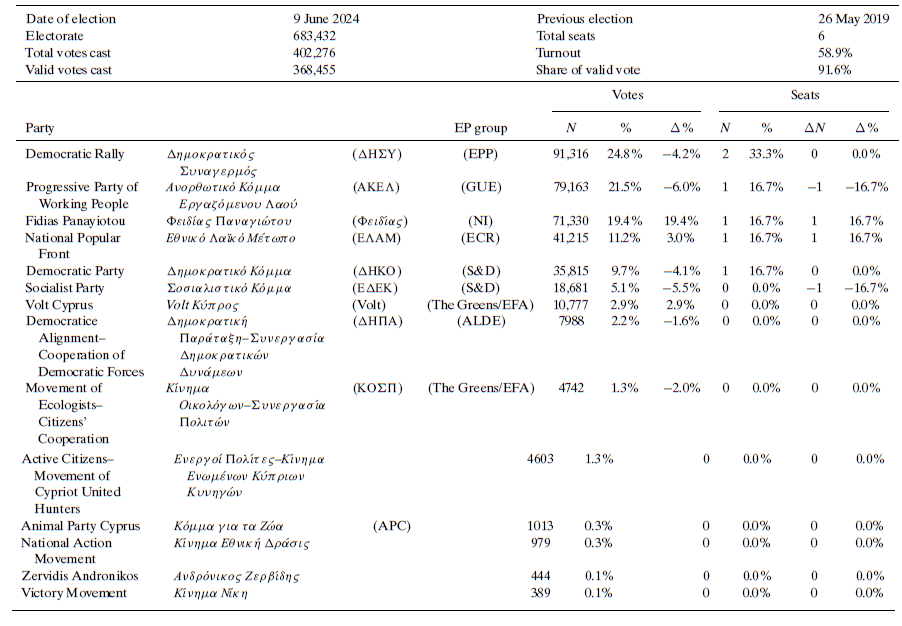
Significantly, all mainstream parliamentary parties sustained substantial electoral losses at the European Parliament election. The center-right Democratic Rally (DISY; European People's Party group) had mixed results: despite internal difficulties and losing considerable votes, it retained the top position and its two seats. The second-largest party, AKEL (European United Left–Nordic Green Left group), representing the left of the political spectrum, lost its second seat for the first time. Together, the two largest Cypriot parties lost approximately 10 per cent of their electorate. Centrist political parties—the Democratic Party (DIKO; Socialists & Democrats group), the Socialist Party (EDEK; Socialists & Democrats group), and the Democratic Alignment (DIPA; Renew group)—which support President Christodoulides, suffered even heavier losses, each losing between one-third and a half of their voters. Nevertheless, DIKO managed to retain its seat, unlike EDEK. On an individual level, the sole Turkish Cypriot MEP, Niyazi Kizilyürek, was not re-elected on AKEL's ticket, removing the first and only Turkish Cypriot voice from EU institutions.
The election of Panayiotou came as a surprise and shock for established parties and most observers. He secured 19.4 per cent of the votes, gaining one of the six Cypriot seats with the third-highest number of votes. Another notable outcome was the far-right, xenophobic ELAM (ECR) securing its first seat ever with 11.2 per cent, highlighting the growing influence of populist right-wing politics in Cyprus.
Voter turnout was notably improved, compared to 2019, reaching 58.7 per cent (an increase of 13.9 per cent). This increase stemmed largely from the heightened voter mobilization prompted by simultaneous local elections (see Table 1).

Cabinet report
The Republic of Cyprus
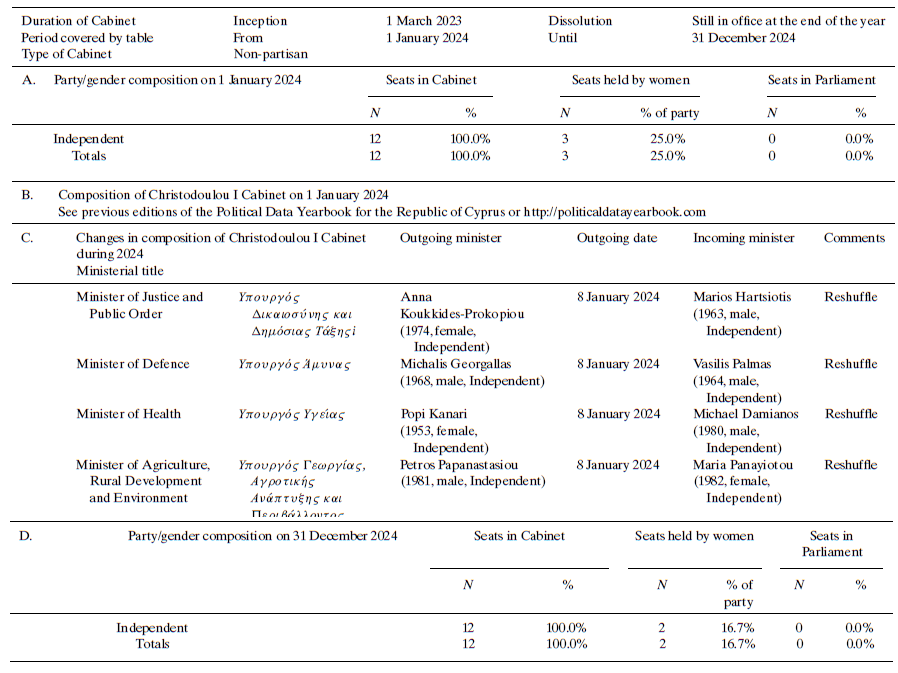
On 8 January, President Nikos Christodoulides announced a minor Cabinet reshuffle. Four ministers were replaced—Justice, Defence, Health, and Agriculture—and several new appointments were made to deputy ministerial and commissioner positions.
Justice Minister Anna Koukkides-Procopiou (Independent) was replaced by Marios Hartsiotis (Independent), Defence Minister Michalis Giorgallas (Independent) by Vasilis Palmas (Independent), Health Minister Popi Kanari (Independent) by Michael Damianos (Independent), and Agricultural Minister Petros Xenophontos (Independent) by Maria Panayiotou (Independent) (see Table 2). The changes sparked controversy as outgoing ministers reportedly learned of their dismissals through media leaks rather than formal notices. Criticism also arose due to the reshuffle's lack of consultation with political allies (such as DIPA, EDEK, DIKO) and because it reduced female representation in the Cabinet from three to two, contradicting the President's earlier pledge of gender parity.

Notes:
1. Formally, according to the Constitution, the Council of Ministers in the Republic of Cyprus is composed by 11 ministers. The president of the Republic is added here making it 12. There are in addition, the Government Spokesman and eight Deputy Ministers, who participate actively but without the right to vote.
2. The Republic of Cyprus has a Presidential system.
3. Christodoulides, while maintaining his independent status, was officially supported by three parties with seats in Parliament, DIKO, EDEK, and DIPA, which also had a say in the appointment of ministers. Some ministers have or had clearly a close affiliation and, in some cases, positions in these parties in the past. Yet, they are still listed as independent here, given the official narrative of the government. Therefore, one could argue that the government enjoys the support of 16 (DIKO: nine; EDEK: three; DIPA: four) out of 56 Greek Cypriot parliamentarians in 2024.
Source: Government Composition (2025) (www.presidency.gov.cy/cypresidency/cypresidency.nsf/dmlint_en/dmlint_en?OpenDocument).
At lower governmental levels, Philippos Hadjizacharias (Independent) became Deputy Minister of Research, Innovation, and Digital Policy following the resignation of Nikodemos Damianou (Independent) on 5 January. Marilena Rouna (Independent) replaced Andreas Mavroyiannis (Independent) as Deputy Minister of European Affairs. All newly appointed officials were sworn in on 10 January.
On 14 June, university lecturer Nicholas Ioannides (Independent) was appointed Deputy Minister for Migration and International Protection, a newly created position encompassing asylum and migration duties previously assigned to the Ministry of Interior.
The TRNC
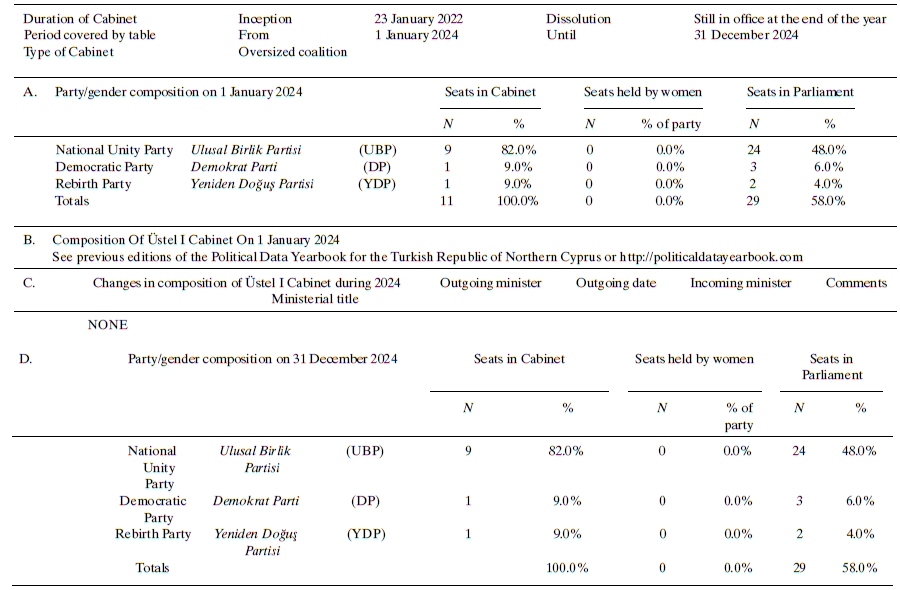
There was no major Cabinet shuffle in the TRNC in 2024 (see Table 3)

Source: KKTC Cumhuriyet Meclisi (2024) - https://cm.gov.ct.tr.
Parliament report
Republic of Cyprus
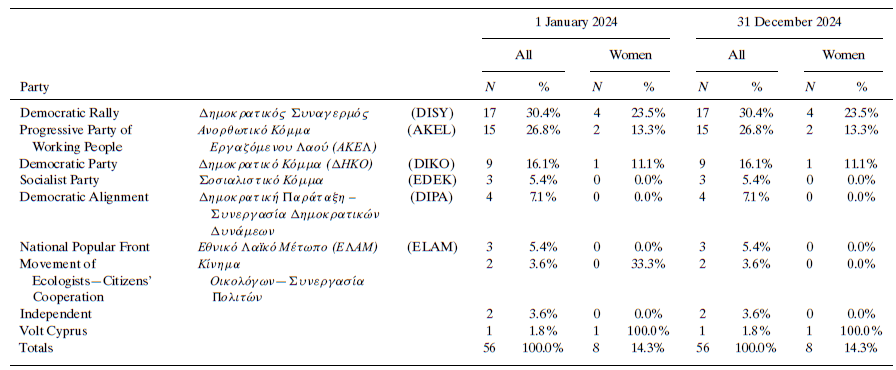
There were no parliamentary changes in the Republic of Cyprus in 2024. For the composition of the Parliament of the Republic of Cyprus in 2024, see Table 4.

Sources: www.parliament.cy/en/general-information/composition/members-of-the-house); https://en.wikipedia.org/wiki/List_of_members_of_the_parliament_of_Cyprus; information provided by the Office of the President of the Parliament to the author.
The TRNC
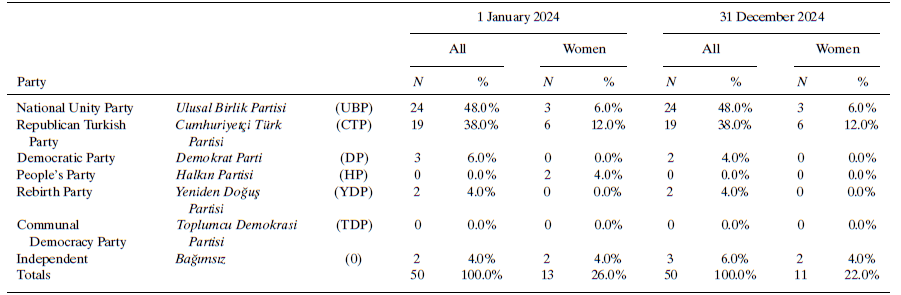
Electing the speaker of the Parliament turned into a farce. The ruling three-party coalition (National Unity Party–UBP, Democrat Party- DP and New Birth Party–YDP), which holds 29 seats in the 50-seat Parliament, failed to secure the required 26 votes in favor, even after 15 rounds of voting with three different candidates. Worse still, the ruling coalition declared Ziya Öztürkler (UBP Morphou MP and former Minister of Interior) elected, despite objections from all three parliamentary lawyers and opposition MPs. After weeks of deadlock in Parliament over the election of a new speaker, the impasse ended on 18 November with the election of Ziya Öztürkler from the National Unity Party (UBP) as Speaker of Parliament. Fazilet Özdenefe, from the main opposition Republican Turkish Party (CTP), was re-elected as Deputy Speaker.
On 27 November, Hasan Tosunoğlu, a Nicosia MP elected on the Democratic Party (DP) ticket, resigned from his party, citing dissatisfaction with its leadership and direction.
For the composition of the Parliament in the TRNC in 2024, see Table 5.

Note: MP Hasan Tosunoğlu resigned and became and independent member.
Source: KKTC Cumhuriyet Meclisi (2024).
Political party report
The Republic of Cyprus
On 12 February, Marios Pelekanos resigned as vice chairman of DISY after failing to secure the party's nomination for the European Parliament elections in June 2024. In March, Pelekanos joined the far-right party ELAM and ran on its ticket.
On 15 December, VOLT, the Cyprus branch of Volt Europe, which was established on the island in 2021, elected a new leadership. Andromachi Sophocleous and Panos Parras became new party leaders, while Lysia Demetriou and Charilaos Velaris were elected deputy leaders (see Table 6).

Note: Volt Cyprus has a double leadership.
Source: Information provided by Volt to the author.
The TRNC
Zeki Çeler became the party leader for the social democrat TDP–Communal Democracy Party, replacing Mine Atlı in February 2024.
Ünal Üstel was re-elected as the leader of the ruling coalition's senior partner, the National Unity Party (UBP), during its 23rd Ordinary Congress on 21 September. Üstel secured 6555 votes. Hasan Taçoy received 3284 votes, while Ahmet Melih Karavelioğlu garnered only 121 votes. Additionally, 176 ballots were deemed invalid. This was the first time that Üstel got elected in a multi-candidate congress (see Table 7).

Sources: Toplumsal Demokrasi Partisi Websitesi - https://tdpkibris.org (2025); Ulusal Birlik Partisi Websitesi - https://ubp.org.tr (2025).
Institutional change report
There were no major institutional changes in either part of the island of Cyprus in 2024.
Issues in national politics
Developments in the Cyprus problem
In 2024, attempts to resolve the island's division remained stalled. Efforts to restart negotiations, discontinued since 2017, were unsuccessful. On 5 January, UN Secretary-General António Guterres appointed María Ángela Holguín Cuéllar as his personal envoy to assess possibilities for resuming negotiations. Despite meetings in New York and Cyprus and consultations with guarantor powers, Greece and Turkey, positions remained unchanged. The Greek Cypriot leader Christodoulides and his Turkish Cypriot counterpart Tatar, reiterated their longstanding divergent positions, with Christodoulides advocating for a bizonal, bicommunal federation and Tatar insisting on the acceptance of sovereign equality and equal international status between two states by the Greek Cypriots as a prerequisite for the resumption of talks which no longer should focus only on a federation but also include a two state solution as an option. The latter is outside the internally agreed framework for a bicommunal, bizonal federation. By May, Holguin completed her mission without achieving the resumption of negotiations. In July, she submitted her report to the UN Secretary General concluding that both sides are far away from a compromise solution to the Cyprus problem.
On 15 October, Greek and Turkish Cypriot leaders Nikos Christodoulides and Ersin Tatar attended an informal dinner with the UNSG in New York. Despite opposite positions on the way forward, both agreed to have an informal meeting in a broader format in the near future under the auspices of the UNSG, to discuss the way forward and hold future meetings to discuss the opening of more crossing points.
The year also witnessed President Christodoulides introducing a package of 14 measures to bring Turkish Cypriots closer to the Republic. These measures included easing citizenship procedures for children of mixed marriages, expanding trade across the Green Line (the UN buffer zone that divides the island into two), improving healthcare access, and facilitating Turkish Cypriots’ participation in cultural activities within the Republic of Cyprus.
Nevertheless, tensions resurfaced due to incidents such as the construction of an anti-tank trench by Turkish Cypriot forces at the Green Line and controversial debates regarding property compensation cases linked to the Immovable Property Commission in the north. The Commission addresses property claims in the north arising from the division of the island and provides remedies such as restitution, compensation, or exchange for affected property owners.
Additionally, a major EU-backed initiative—conducting a feasibility study for a solar power plant in the buffer zone—was introduced. The project aims to foster cooperation between the two communities, indicating a possible opportunity for practical collaboration and confidence-building measures. However, the underlying political stalemate remained unchanged. On 4 March, the United Nations Peacekeeping Force in Cyprus (UNFICYP) marked its 60th anniversary. UNFICYP is the second-oldest active UN mission globally.
The Greek Cypriot authorities’ attempts to curb the construction boom in the north through legal action became a significant issue in 2024. In early June, Israeli property developer Simon Mistriel Aykut was arrested while attempting to cross from the north to the south. He remained in custody over allegations of developing and selling Greek Cypriot properties worth 43 million euros located in the north. On 7 July, a 49-year-old German citizen was arrested at Larnaca Airport, accused of involvement in buying and selling pre-1974 Greek Cypriot properties in the TRNC.
Issues in Greek Cypriot National Politics
Domestically, President Christodoulides' popularity remained low in the polls (Cleaver Reference Cleaver2024; Damaskinos Reference Damaskinos2024; Hazou Reference Hazou2024; Kallinikou Reference Kallinikou2024; Offsite 2024; Philenews 2024), and he lacked a parliamentary majority. His September dismissal of the popular Auditor-General Odysseas Michaelides further damaged his standing. On 2 October, he appointed Andreas Papaconstantinou as Michaelides's successor. The dismissal occurred after a Supreme Constitutional Court ruling declared Michaelides unfit for office due to inappropriate conduct. The decision prompted demonstrations attended by thousands of Greek Cypriots, reflecting Michaelides's popularity and reputation for combating widespread elite corruption. Many perceived his removal as politically motivated. Later in the year, Michaelides announced his decision to run as an independent candidate in the 2028 presidential elections.
Migration continued to be a major concern for the Republic of Cyprus, which for several years has hosted the highest number of refugees per capita within the EU. Irregular migration flows arrived through maritime routes as well as across the Green Line separating the Turkish Cypriot-controlled north from the Republic's territory. In 2024, Cyprus focused its migration strategy on reducing new migrations, accelerating asylum processing, upgrading infrastructure, and increasing returns—both deportation and voluntary. While the Eastern Mediterranean route was among the few where numbers rose during 2024, Cyprus did not follow that trend. Numbers have steadily decreased since their highest point in 2022, when the country recorded a peak of 21,565 asylum applications and 17,280 new arrivals. In 2024, a total of 10,941 migrants departed the country, resulting in the highest departures-to-arrivals ratio (179 per cent) among EU member states.
The main issues raised during the European election campaign are discussed in the relevant elections report section above.
Issues in Turkish Cypriot National Politics
A fake diploma and fraud scandal at a Turkish Cypriot university reignited the debate on the problems in the Turkish Cypriot higher education sector (Erden Reference Erden2024). Three officials of KSTBU (Cyprus Health and Social Sciences University), based in Morphou (Güzelyurt), and a senior civil servant were arrested in mid-February after the owners of the university went to the police following an internal audit that revealed embezzlement and fraud through fake student registrations and fake diplomas.
The head of the Turkish Cypriot registrar of cooperative companies, who, it turned out, had a fake graduate and a postgraduate diploma from the university, was charged with forgery of documents, circulation of forged documents, and eliciting funds through fraud. The registrar presented his fake diplomas to get promotions and pay rises in the civil service. He resigned from his position following the scandal.
In October 2023, the rector and a student affairs staffer of another university, Ada Kent University (City Island), were arrested for stealing tuition fees worth more than TL12m (about €363 thousand).
Later in February, Kemal Dürüst, a former minister and the president of the board of trustees of KSTBU, was also arrested for his part in the scandal. Dürüst's wife, who is the director of the Ministry of Labour, was also arrested for using a fake diploma to get a promotion.
The head of the institution that oversees higher education institutions (the Higher Education Planning, Evaluation, Accreditation, and Coordination Board), Turgay Avcı, resigned following his arrest as part of a police investigation into a fake/invalid diploma and corruption scandal that has rocked the country in recent weeks.
The law that regulates the “Immovable Property Acquisition” by foreigners was amended to address concerns regarding the increase of land and property sales to foreign nationals, particularly those which are based solely on sales contracts. Under the new law, effective as of 21 May, foreign nationals will be restricted to purchasing just one apartment or house in the TRNC, while “citizens of countries that recognise the TRNC,” that is, Turkish citizens, will be able to purchase up to three houses or apartments. Sales contracts must now be registered with the Land Registry within a six-month transition period, ensuring transparency and tax compliance. On 14 December, the Council of Ministers issued a decree amending the new property regime that came into effect in May 2024. The decree allows “foreign real or legal persons who are nationals of states that recognise the TRNC [i.e., Turkey]” to establish partnerships with TRNC citizens in the build-to-sell property sector, provided the foreign share of the partnership does not exceed 49 per cent.
Foreign Policy Developments
The visit of President Nikos Christodoulides to Washington in October 2024 marked a significant milestone in Cyprus–US relations. Invited by US President Joe Biden just days before the US presidential elections, Christodoulides met with Biden at the White House on 30 October. This meeting represented the first official invitation of a Cypriot President to the White House since 1996, when President Glafcos Clerides met with then-President Bill Clinton.
During their discussions, Christodoulides and Biden addressed a variety of strategic issues. The conversations centered primarily on the Cyprus problem, with President Biden reaffirming his support for a solution based on a bizonal, bicommunal federation with political equality, consistent with United Nations resolutions. They also discussed ways to strengthen bilateral ties, regional security challenges, and wider developments in the Middle East. Cyprus’ humanitarian contributions in the Gaza conflict, its support for Ukraine, and its efforts toward energy diversification were specifically highlighted as valuable roles played by the island nation. Christodoulides’ visit positioned Cyprus more clearly within Western diplomatic and security frameworks, continuing a policy shift initiated by his predecessor, Nicos Anastasiadis, in 2018.
Notably, reports emerged that Christodoulides presented a plan during his visit outlining Cyprus’ intent to seek NATO membership, contingent upon Turkey lifting its objections. Although discussions regarding Cyprus’ NATO membership remain in the preliminary stages, this effort clearly underscores the government's strategic shift toward deeper integration with Euro-Atlantic structures, aligning itself more closely with US and European strategic interests.
The strengthening of US–Cyprus relations had already been signaled earlier in the year by the official announcement in June of a strategic dialogue that would cover cooperation on diverse issues, including security, education, energy, and trade throughout 2024. This could also include the establishment of an American helicopter base on the island for which construction commenced in 2024.
In December, British Prime Minister Keir Starmer undertook a historic visit to Cyprus, the first by a British Prime Minister in 53 years, reaffirming strong bilateral ties between the two countries.
Energy diplomacy constituted another important aspect of Cyprus’ foreign policy. The Republic of Cyprus government continued developing closer ties with Egypt to facilitate the transfer of natural gas from Cyprus’ Exclusive Economic Zone (EEZ) for liquefaction. Significant progress was also made in hydrocarbon exploration, including discussions aimed at expediting the development of fields such as Cronos and advancing infrastructure projects such as the Great Sea Interconnector. These actions reflect Cyprus’ aspiration to establish itself as a prominent energy player in the Eastern Mediterranean. However, Turkey and the Turkish Cypriots remain opposed to energy exploitation by the Republic without prior approval from the Turkish side and participation by Turkish Cypriots in decision-making and benefit-sharing. Additionally, Turkey maintains claims to parts of the EEZ declared by the Republic of Cyprus and opposes the Great Sea Interconnector, which Ankara views as crossing areas within its own EEZ.
The conflicts in neighboring Gaza and Lebanon continued to impact Cyprus. In 2024, the Republic of Cyprus aimed to maintain a balanced diplomatic stance regarding both the Israeli–Palestinian conflict and the ongoing conflict in Gaza. In recent years, the Republic maintained very close relations with the government in Jerusalem that also extended to military and intelligence cooperation. The Republic voted repeatedly in favor of pro-Palestinian UN resolutions critical of Israel in 2024 (United Nations 2025), while carefully maintaining its good relations with the Israeli government. While initially expressing support for Israel, following the Hamas-led attacks of 7 October 2023, Cyprus emphasized its humanitarian role by launching the Amalthea initiative. This humanitarian maritime corridor from the Port of Larnaca to Gaza facilitated the delivery of over 500 tonnes of urgently needed aid to the Palestinians. However, due to technical difficulties, deliveries soon stopped for good.
At the same time, the government firmly rejected allegations (including threats from Hezbollah) that Cyprus was involved in military operations against Lebanon or Gaza. Authorities clarified that Cyprus provided neither military support nor facilities to Israel, and affirmed that any military activity was likely associated with the British sovereign bases on the island, which are beyond Nicosia's control. President Christodoulides stressed Cyprus’ intention to contribute to solutions by providing humanitarian assistance rather than becoming involved in military operations. Nonetheless, the threats from Hezbollah leader Hassan Nasrallah caused considerable alarm, given the island's historical perception of maintaining positive relations with nearly all significant regional actors, apart from Turkey.
With increasing tensions along the Lebanon–Israel border, the Republic of Cyprus also proactively designed plans for a potential humanitarian crisis. Given the elevated threats and violence involving Hezbollah, the Cypriot government activated the so-called Estia evacuation plan, making preparations to assist European Union and third-country nationals evacuating from Lebanon if required.



 Open access

