


Many jurisdictions in high-income countries maintain separate legal structures for the provision of mental healthcare based on risk on the one hand and incapacity on the other. England and Wales is now one of these jurisdictions and has the Mental Health Act 1983 and the Mental Capacity Act 2005. Both have been amended by the Mental Health Act 2007. Jurisdictions that maintain these separate frameworks need to manage the interface between them. In cases where detention in hospital is required this can cause legal difficulties, particularly for jurisdictions covered by the European Convention on Human Rights. This study addresses some of the dilemmas that can arise in the setting of admission to psychiatric hospital from the community.
The Mental Health Act establishes a framework for the provision of treatment, on an involuntary basis if necessary, to those suffering from mental disorder to the specified degree. The main criteria for its application are the presence of mental disorder and risk to the individual themselves or others (Appendix 1).
The Mental Capacity Act, on the other hand, provides a more general framework through which decisions, including those relating to medical treatment, may be taken on behalf of adults who lack decision-making capacity. The absence of capacity is the main criterion for its application. The Mental Health Act is primarily concerned with the reduction of risk both to the individual and to others, while the Mental Capacity Act is designed to enable the individual to make their own decisions as far as possible, to ensure that decisions reflect the individual's best interests and that the least restrictive intervention is used. The Mental Health Act provides for the legal detention of people in hospital for treatment, but prior to the enactment of the Mental Capacity Act non-objecting individuals who lacked capacity were often accommodated in hospital informally, outside the Mental Health Act, using common law powers. 1 This practice was held to breach the rights guaranteed by the European Convention on Human Rights in cases where the restrictions imposed on the individual amounted to a deprivation of liberty. 2 In 2007 the Mental Capacity Act was amended to include the safeguards necessary to comply with the requirements of the European Convention on Human Rights in cases where a deprivation of liberty is required in the person's own best interests. Thus either statute could apply to adults with mental disorders who lack capacity and require treatment for those disorders, even when that treatment includes the deprivation of liberty. At the point of Mental Health Act assessment, clinicians will have the dilemma of which of the two frameworks to use. 3 First, individuals lacking capacity can no longer be treated informally under the common law, the principles of the Mental Capacity Act must be applied if the Mental Health Act is not used. Second, if this treatment involves deprivation of liberty, then a choice must be made between detention under the Mental Health Act and the application of the deprivation of liberty safeguards under the amended Mental Capacity Act. 4 The factors governing this choice include the presence of objections on the part of the individual. 3,4
A different dilemma concerns people who are detained under the Mental Health Act with capacity. Although this practice is lawful, 3 there have been concerns expressed about the ethics and the potentially stigmatising consequences of allowing mental health law based on risk to ‘trump’ mental health law based on capacity and individual autonomy. Reference Szmukler and Holloway5–Reference Richardson7
In this paper we aim to describe how existing psychiatric practice mapped on to this new legal landscape, specifically:
-
(a) what are the characteristics of informal patients meeting the incapacity criterion of the Mental Capacity Act? In particular, what is the degree of ‘objecting’ to treatment and how might this bear upon Mental Health Act detention;
-
(b) what are the characteristics of individuals detained under the Mental Health Act with capacity? Does recent self-harm or violence characterise this group;
-
(c) in individuals with capacity and without capacity, what predicts detention under the Mental Health Act?
Method
Participants
We performed a cross-sectional study based in three general adult acute psychiatric wards (one female and two male) at the Maudsley Hospital, London, UK. These wards serve part of Southwark, a deprived inner-London borough with an ethnically diverse population. The local research ethics committee approved the study.
Consecutive patients, admitted between February 2006 and June 2007, were identified by regular examination of the electronic medical records and consultations with the ward nursing staff. All admissions were included other than those admitted during planned research breaks. The sole exclusions were people from other catchment areas admitted to the wards and those transferred from other in-patient facilities. All individuals who spoke English were approached for a research interview. Those who assented were provided with full details of the study and the interview was stopped if there was any subsequent change in choice or resistance. Written consent was sought and participants were offered £5 for their time. Interviews were conducted as close to the admission as possible.
Assessment of capacity
Relevant information about the participant's presenting problems, diagnosis and treatment plan was obtained from the medical record and discussion with the clinical team. The clinical researcher (G.O.) determined whether the treating team's principal treatment recommendation at that time was stabilisation on medication or admission to a place of safety (hospitalisation). If it was medication, then the capacity assessment centred on the decision to take the recommended medication or not. If it was hospitalisation, then it was the capacity to decide on whether to come into hospital or not.
The presence or absence of capacity to decide on treatment was based on the two-stage test formulated in the Mental Capacity Act. This requires: evidence of ‘an impairment of, or disturbance in, the functioning of the mind or brain’ (Section 2(1)); and evidence that this impairment or disturbance means that the person is unable to make a specific decision (Section 3(1)). We interpreted the first stage of the test using clinical psychopathological concepts and ICD–10 diagnoses. 8
The capacity judgement was facilitated by a clinical assessment (notes review and clinical interview) and the administration of the MacArthur Competence Assessment Tool for Treatment (MacCAT–T). Reference Grisso, Appelbaum and Hill-Fotouhi9 The MacCAT–T is a semi-structured interview that provides relevant information disclosures to individuals about their illness (including its risks), the nature of treatment options and their risks and benefits. The assessor evaluates capacity in terms of four abilities relating to the disclosures: understanding, appreciation, reasoning and expressing a choice. These abilities map onto the abilities regarded as relevant by the Mental Capacity Act which are understanding, retaining, using, weighing and communicating. ‘Using’ is the term the Law Commission favoured in place of the term ‘appreciation’. 10 We interpreted the terms to have equivalent meanings.
The judgement about capacity followed the approach outlined by Grisso & Appelbaum. Reference Grisso and Appelbaum11 This incorporates the ‘sliding scale’ concept whereby decisions that carry a greater risk require greater evidence of the relevant decision-making abilities. This concept is similar to the English Law notion that the graver the consequences of the decision, the commensurately greater the level of competence that is required to make it.
The content of the MacCAT–T was modified for this study. When the principal treatment decision concerned medication, participants were given a disclosure about ‘no medication’ as the alternative to the ‘recommended’ medication rather than iterate through all medication options. This was done to simplify the interview and to reflect the main choice people who are acutely ill typically face. When the principal treatment decision concerned hospitalisation, participants were given a disclosure about the option of being an in-patient or not. Each disclosure involved giving the individual simple information about the nature of the option and its risks and benefits. The form of the MacCAT–T was left unaltered by these changes. Previous studies have demonstrated excellent interrater reliability (κ>08) when the MacCAT–T is used in this way. Reference Okai, Owen, McGuire, Singh, Churchill and Hotopf12,Reference Cairns, Maddock, Buchanan, David, Hayward and Richardson13
Other variables
Details of status under the Mental Health Act were obtained from the clinical records. The Expanded Schedule for the Assessment of Insight (SAI–E) Reference Sanz, Constable, Lopez-Ibor, Kemp and David14 and the Brief Psychiatric Rating Scale (BPRS) Reference Ventura, Green, Shaner and Liberman15 were also administered. Both are clinically based, semi-structured interviews. The SAI–E comprises three main dimensions (awareness of illness, relabelling of symptoms as pathological and treatment adherence). We used the summary of adherence score (Item C of the SAI–E) as our measure of treatment refusal. This is a seven-point scale: 1 = complete rejection of treatment; 2 = partial rejection; 3 = reluctant acceptance; 4 = occasional reluctance; 5 = passive acceptance; 6 = moderate participation; 7 = active participation. We used the relabelling score because it has conceptual similarity with ‘use’ (in the Mental Capacity Act). This scale measures the extent to which symptoms that the clinical interview has highlighted as indicators of illness can be regarded as such by the patient. We separated relabelling from treatment refusal because they are conceptually distinguishable. We adjusted the total BPRS score to account for domains of psychopathology that were not assessable (e.g. hallucinations in an individual who was mute) by summing subscores and dividing the total by the number of BPRS domains that were assessable. This was done to obtain a measure of total symptoms that was not misleadingly low in participants who did not respond to questions about symptoms. Level of symptoms is sometimes used with ‘insight’ to interpret ‘nature and degree’ (in the Mental Health Act). Broad ICD–10 categories were used for the main mental disorder.
We recorded acts of self-harm and violence in the period 2 weeks prior to admission until the point of assessment using information from the medical records, nursing staff and self-report. To structure this we used the Modified Overt Aggression Scale. Reference Kay, Wolkenfeld and Murrill16
We used the MacArthur Admissions Experience Survey Reference Gardner, Hoge, Bennett, Roth, Lidz and Monahan17 to collect information relating to subjective coercion. This relates to recent admission and includes measures of participants' perceived coercion, recall of negative pressures and sense of ‘voice’ in the admission procedure.
Statistical analysis
Analyses were performed using Stata 9.2 for Windows. Conventional bivariate methods were used to compare participant groups.
Results
Details on the 350 consecutive admissions with prevalence estimates of mental incapacity are reported elsewhere. Reference Owen, Richardson, David, Szmuker, Hayward and Hotopf18 Two hundred people were interviewed by the researcher. Individuals interviewed were similar to individuals not interviewed on diagnosis, number of previous admissions, length of contact with services and global assessment of functioning. People not interviewed had significantly higher levels of treatment refusal than those interviewed with a trend to being more frequently detained (details available from the author on request).
Decision-making capacity status and status under the Mental Health Act divides participants into four broad groups: informal/capacity, informal/incapacity, detained/capacity, detained/incapacity. (Informal participants are those in respect of whom no Mental Health Act powers have been taken.) Table 1 shows participants according to these groups. In each group the types of mental disorder (ICD–10) and, where applicable, the Mental Health Act section is summarised.
Mental disorder and legal status

| Capacity | Incapacity | |
|---|---|---|
| Informal, n | 73 | 47 |
| Mental disorder, n (%) | ||
| Psychotic episode | 10 (13.7) | 11 (23.4) |
| Schizophrenia | 6 (8.2) | 11 (23.4) |
| Schizoaffective disorder | 1 (1.4) | 5 (10.6) |
| Bipolar affective disorder, manic phase | 1 (1.4) | 5 (10.6) |
| Bipolar affective disorder, depressed phase | 5 (6.9) | 1 (2.1) |
| Depression | 29 (39.7) | 11 (23.4) |
| Personality disorder | 14 (19.2) | 0 |
| Post-traumatic stress disorder | 1 (1.4) | 0 |
| Organic | 0 | 1 (2.1) |
| Other | 6 (8.2) | 2 (4.3) |
| Detained, n | 12 | 68 |
| Mental disorder, n (%) | ||
| Psychotic episode | 5 (41.7) | 18 (26.5) |
| Schizophrenia | 2 (16.7) | 20 (29.4) |
| Schizophrenia disorder | 0 | 4 (5.9) |
| Bipolar affective disorder, manic phase | 0 | 17 (25.0) |
| Bipolar affective disorder, depressed phase | 0 | 0 |
| Depression | 2 (16.7) | 4 (5.9) |
| Personality disorder | 0 | 1 (1.5) |
| Post-traumatic stress disorder | 2 (16.7) | 1 (1.5) |
| Organic | 0 | 3 (4.4) |
| Other | 1 (8.3) | |
| Mental Health Act applies, section: n (%) | ||
| S.4 | 0 | 1 (1.4) |
| 5.2 | 2 (16.7) | 19 (27.9) |
| S.2 | 9 (75.0) | 27 (39.7) |
| S.3 | 1 (8.3) | 20 (29.4) |
| Court order | 0 | 1 (1.5) |
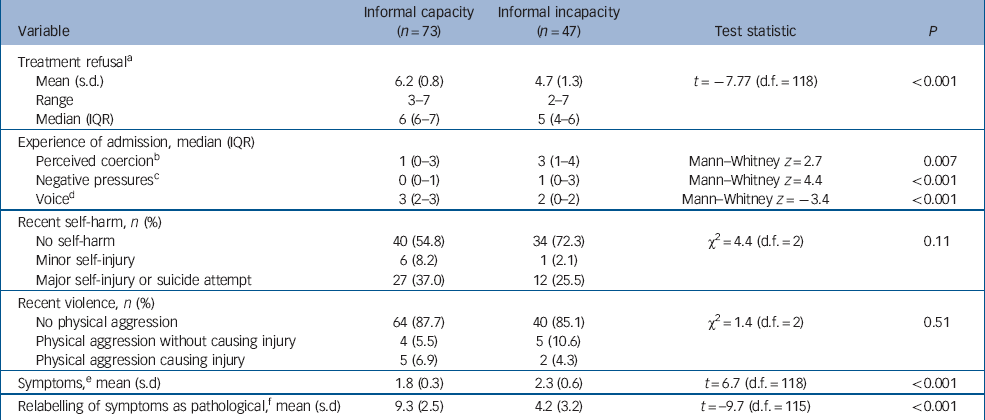
Tables 2 and 3 address informal and detained participants respectively. Explanations of the scales used are given as footnotes. Table 2 shows the differences between informal participants with and without capacity. In informal participants, levels of treatment refusal and negative experience of admission were significantly higher in the incapacity group than in the capacity group. In the incapacity group the median value of treatment refusal was 5 (passive acceptance of treatment) with the interquartile range between 4 and 6 (occasional reluctance to moderate participation). When treatment refusal was converted to a binary variable using a cut-off score of less than 5 (treatment adherence less than passive acceptance) to indicate ‘objection’ to treatment then 18 participants without capacity (38%) objected and incapacity associated with ‘objection’ to treatment (χ2 = 20.1, P<0.001). If the cut-off score was set at less than 3 (any rejection of treatment) then only three participants without capacity (6%) ‘objected’ although incapacity was still associated with ‘objection’ (χ2 = 4.78, P<0.03). Symptom levels were significantly higher and ability to relabel symptoms as pathological were lower in the individuals without capacity. Levels of recent self-harm and violence showed no significant difference.
Differences between informal participants with and without capacity
| Variable | Informal capacity (n = 73) | Informal incapacity (n = 47) | Test statistic | P |
|---|---|---|---|---|
| Treatment refusala | ||||
| Mean (s.d.) | 6.2 (0.8) | 4.7 (1.3) | t = -7.77 (d.f. = 118) | <0.001 |
| Range | 3-7 | 2-7 | ||
| Median (IQR) | 6 (6-7) | 5 (4-6) | ||
| Experience of admission, median (IQR) | ||||
| Perceived coercionb | 1 (0-3) | 3 (1-4) | Mann—Whitney z = 2.7 | 0.007 |
| Negative pressuresc | 0 (0-1) | 1 (0-3) | Mann—Whitney z = 4.4 | <0.001 |
| Voiced | 3 (2-3) | 2 (0-2) | Mann—Whitney z = -3.4 | <0.001 |
| Recent self-harm, n (%) | ||||
| No self-harm | 40 (54.8) | 34 (72.3) | χ2 = 4.4 (d.f. = 2) | 0.11 |
| Minor self-injury | 6 (8.2) | 1 (2.1) | ||
| Major self-injury or suicide attempt | 27 (37.0) | 12 (25.5) | ||
| Recent violence, n (%) | ||||
| No physical aggression | 64 (87.7) | 40 (85.1) | χ2 = 1.4 (d.f. = 2) | 0.51 |
| Physical aggression without causing injury | 4 (5.5) | 5 (10.6) | ||
| Physical aggression causing injury | 5 (6.9) | 2 (4.3) | ||
| Symptoms,e mean (s.d) | 1.8 (0.3) | 2.3 (0.6) | t = 6.7 (d.f. = 118) | <0.001 |
| Relabelling of symptoms as pathological,f mean (s.d) | 9.3 (2.5) | 4.2 (3.2) | t = -9.7 (d.f. = 115) | <0.001 |
Differences between detained participants with and without capacity

| Variable | Detained capacity (n = 12) | Detained incapacity (n = 68) | Test statistic | P |
|---|---|---|---|---|
| Treatment refusal,a mean (s.d.) | 3.5 (1.9) | 2.6 (1.4) | t = -2.0 (d.f. = 78) | 0.05 |
| Experience of admission, median (IQR) | ||||
| Perceived coercionb | 4.5 (2-5) | 3.5 (2-5) | Mann—Whitney z = -0.6 | 0.54 |
| Negative pressuresc | 2 (1-5) | 4 (1-5) | Mann—Whitney z = 1.3 | 0.19 |
| Voiced | 1 (1-2) | 1.5 (0-2) | Mann—Whitney z = 0.37 | 0.71 |
| Recent self-harm, n (%) | ||||
| No self-harm | 8 (66.7) | 63 (92.7) | Fisher's exact | 0.008 |
| Minor self-injury | 0 | 3 (4.4) | ||
| Major self-injury or suicide attempt | 4 (33.3) | 2 (2.9) | ||
| Recent violence, n (%) | ||||
| No physical aggression | 10 (83.3) | 41 (60.3) | Fisher's exact | 0.35 |
| Physical aggression without causing injury | 2 (16.7) | 19 (27.9) | ||
| Physical aggression causing injury | 0 | 8 (11.8) | ||
| Symptoms,e mean (s.d) | 1.7 (0.4) | 2.3 (0.7) | t = 3.0 (d.f. = 78) | 0.004 |
| Relabelling of symptoms as pathological,f mean (s.d) | 7.9 (3.1) | 2.5 (2.4) | t = -7.0 (d.f. = 72) | <0.001 |
Table 3 shows the differences between detained participants with and without capacity. In detained individuals, levels of treatment refusal and negative experience of admission did not differ by capacity status. Levels of symptoms were higher and ability to relabel those symptoms as pathological was significantly lower in the participants without capacity. Recent violence showed no significant difference but recent self-harm was significantly higher in those with capacity.
Tables 4 and 5 address participants with and without capacity respectively. Table 4 shows the variables which associate with detention in participants with capacity. The only variable which was associated with detention in participants with capacity was treatment refusal. Recent self-harm or violence, levels of symptoms or inability to relabel symptoms as pathological were not associated with detention. To obtain a clearer understanding of this important group of individuals, we examined in detail the case records concerning the circumstances of admission for the 12 people with capacity who were detained. They fell into three groups:
Associations of detention in participants with capacity

| Variable | Capacity informal (n = 73) | Capacity detained (n = 12) | Test statistic | P |
|---|---|---|---|---|
| Treatment refusal,a mean (s.d.) | 6.2 (0.8) | 3.5 (1.9) | t = 8.3 (d.f. = 83) | <0.001 |
| Recent self-harm, n (%) | ||||
| No self-harm | 40 (54.8) | 8 (66.7) | Fisher's exact | 0.70 |
| Minor self-injury | 6 (8.2) | 0 | ||
| Major self-injury or suicide attempt | 27 (37.0) | 4 (33.3) | ||
| Recent violence, n (%) | ||||
| No physical aggression | 64 (87.7) | 10 (83.3) | Fisher's exact | 0.32 |
| Physical aggression without causing injury | 4 (5.5) | 2 (16.7) | ||
| Physical aggression causing injury | 5 (6.9) | 0 | ||
| Total symptoms,b mean (s.d) | 1.8 (0.3) | 1.7 (0.3) | t = 0.82 (d.f. = 83) | 0.41 |
| Relabelling of symptoms as pathological,c mean (s.d) | 9.3 (2.5) | 7.9 (3.1) | t = 1.7 (d.f. = 83) | 0.09 |
Associations of detention in participants without capacity

| Variable | Incapacity informal (n = 47) | Incapacity detained (n = 68) | Test statistic | P |
|---|---|---|---|---|
| Treatment refusal,a mean (s.d.) | 4.7 (1.3) | 2.6 (1.4) | t = 8.2 (d.f. = 113) | <0.001 |
| Recent self-harm, n (%) | ||||
| No self-harm | 34 (72.3) | 63 (92.7) | Fisher's exact | 0.001 |
| Minor self-injury | 1 (2.1) | 3 (4.4) | ||
| Major self-injury or suicide attempt | 12 (25.5) | 2 (2.9) | ||
| Recent violence, n (%) | ||||
| No physical aggression | 40 (85.1) | 41 (60.3) | Fisher's exact | 0.02 |
| Physical aggression without causing injury | 5 (10.6) | 19 (27.9) | ||
| Physical aggression causing injury | 2 (4.3) | 8 (11.8) | ||
| Total symptoms,b mean (s.d) | 2.3 (0.6) | 2.3 (0.7) | t = 0.09 (d.f. = 113) | 0.93 |
| Relabelling of symptoms as pathological,c mean (s.d) | 4.2 (3.2) | 2.5 (2.4) | t = 3.2 (d.f. = 104) | 0.002 |
-
(a) five participants (three with a psychosis) probably lacked capacity at the time of admission, but then made a rapid improvement;
-
(b) five participants (two with a psychosis) presented with recent behaviour indicating a risk of future self-harm (four individuals) or of violence (one person) and it was unclear what the individual' intentions were;
-
(c) two people with a psychosis with extensive previous contact with services engineered an involuntary admission to ensure they were admitted, probably to gain respite from problems in the community.
Table 5 shows the variables that were associated with detention in individuals without capacity. Treatment refusal, recent violence and inability to relabel symptoms as pathological were all associated with detention. Total symptoms were not associated with detention. Recent self-harm was associated with informal care.
Discussion
Main findings
People admitted to psychiatric hospital from the community span all four groups created by capacity law and the Mental Health Act: capacity/informal, incapacity/informal, capacity/detained and incapacity/detained. The largest groups are capacity/informal (37%) and incapacity/detained (34%). Approximately a third fell into the legally and ethically more problematic categories of incapacity/informal and capacity/detained. Of these, the incapacity/informal group was large, comprising 24% of the sample. Most people in this group have a psychotic illness or depression as the main mental disorder, a pattern similar to that of the detained/incapacity group. With regard to the provision of treatment to this incapacity/informal group the principles of the Mental Capacity Act will now apply, thus any treatment given will have to be in the person's best interests and be the least restrictive alternative. However, if this treatment involves deprivation of liberty under article 5, European Convention on Human Rights, then a choice will have to be made between detention under the Mental Health Act and the application of the deprivation of liberty safeguards under the amended Mental Capacity Act. Thus, in relation to this significant group of individuals, clinicians will have to become familiar with the identification of deprivations of liberty and with the factors governing the choice of legislative framework, including the person's objections to treatment. In relation to the presence of ‘objection’, the data indicate that informal patients without capacity have higher levels of treatment refusal, perceived coercion and negative treatment pressures on admission and a reduced sense of ‘voice’ compared with informal patients with capacity. The majority of people in this group have levels of treatment refusal between occasional reluctance and moderate participation. If any level of treatment adherence less than ‘passive acceptance’ is taken as a marker for ‘objecting’ to treatment then incapacity associates with ‘objection’ in informal patients. Such a level of objection might amount to grounds for preferring Mental Health Act detention to deprivation of liberty under the Mental Capacity Act. This could lead to an increase in the use of the Mental Health Act in relation to previously informal patients who are deprived of their liberty. Much will depend on how ‘deprivation of liberty’ and ‘objecting’ to treatment are interpreted by clinicians and ultimately by the courts – both will become significant legal concepts yet both pose challenges of interpretation.
The capacity/detained group was small (6%). About a third probably lacked capacity at the time of admission but had recovered it by the time of interview. Most are on assessment sections of the Mental Health Act. Surprisingly, participants in this group did not feel more coerced than those without capacity who are detained. They were less symptomatic and better able to relabel their symptoms as pathological, an important aspect of insight. Reference David19 They self-harmed more but were neither more nor less violent. In some cases, previous risky behaviour in someone whose further intentions were not clear was a key factor. There have been human rights concerns about detaining individuals with capacity. 20,21 It might be expected that this group would be characterised less by psychotic illness, and more by people with personality disorders posing considerable risk of harming themselves or others. In this study over half of these individuals had psychotic illnesses as the main diagnosis, and none had personality disorder as the main diagnosis. However, the sample size for these analyses was small, making it difficult to draw firm conclusions. Further, it is possible that the existence of this group simply reflects a few inevitable ‘false negative’ errors in the capacity classification (or ‘false positive’ errors in the application of the Mental Health Act).
Which factors are associated with detention on admission to psychiatric hospital? We found that irrespective of capacity, treatment refusal rather than recent violence or self-harm was most strongly associated with detention. This suggests that it is the perceived need for treatment by the clinical team in the face of resistance from the individual that drives detention under the Mental Health Act rather than recent self-harm or violence. The only positive association of detention in participants with capacity is treatment refusal. Relabelling of symptoms did not associate with detention in this group. Although recent self-harm or violence were not associated with detention for the group as a whole, it was important for a subgroup of people where it was difficult to assess the individual's intentions in respect of a repetition of self-harm or violence. The associations of detention in people without capacity go beyond treatment refusal and include recent violence and inability to relabel symptoms. This suggests that in clinical practice the significance of recent violence depends upon capacity status and the related concept of ability to relabel symptoms as pathological. When capacity is absent, recent violence seems more likely to trigger detention than when capacity is present.
Methodological shortcomings
This is the largest study of mental capacity in a psychiatric setting yet conducted, although as the study was carried out in an urban setting in one jurisdiction it may not generalise to other psychiatric in-patient settings. Previous studies were limited by the use of convenience samples or not including an overall judgement of capacity for a clinically significant decision. Reference Sanz, Constable, Lopez-Ibor, Kemp and David14 We used a strictly consecutive sample and expanded treatment decisions to include hospitalisation if this was the significant treatment decision. Fifty-seven per cent of all admissions participated in the assessment by the researcher. This raises the issue of non-participation potentially creating a non-representative sample. Our comparisons of non-participants and participants on basic clinical and legal variables suggested that the participants were reasonably representative of the individuals admitted.
Our assessments of capacity were not carried out at the precise time of the clinical decision to admit the person to hospital. The majority were carried out within 3 days. This time lag could be a problem for missing rapidly fluctuating capacity status but we believe that this is only likely to be a major factor in the setting of emotional crises (e.g. surrounding self-harm), or drug or alcohol intoxication. The majority of individuals who were admitted had psychotic or serious affective illnesses that are unlikely to involve significant capacity fluctuation over the course of a few days.
Clinical and legal implications
Clinicians now face a more complex landscape of mental health law. They will have to navigate two legal frameworks, the Mental Health Act 1983 and the Mental Capacity Act 2005, and keep in mind the unfolding meaning of ‘deprivation of liberty’ and ‘objecting’ to treatment. This study maps existing psychiatric practice onto this more complex legal landscape to show us some of the implications. However, it was not able to resolve the question of how prevalent ‘deprivation of liberty’ is in the in-patient setting.
Although systematic study of the practice of mental health law inevitably requires attention to specific jurisdictions (in this case England and Wales) we think this study helps to illuminate relationships between mental health law and guardianship/incapacity law existing across many jurisdictions in the developed world. How these dual legal frameworks will affect psychiatric practice itself over time is yet to be seen.
Appendix
Criteria for detention in hospital under the Mental Health Act 1983 (as amended by the Mental Health Act 2007)
A person can be detained for assessment under section 2 only if both the following criteria apply:
-
(a) the person is suffering from a mental disorder of a nature or degree which warrants their detention in hospital for assessment (or for assessment followed by treatment) for at least a limited period; and
-
(b) the person ought to be so detained in the interests of their own health or safety or with a view to the protection of others.
A person can be detained for treatment under section 3 only if all the following criteria apply:
-
(a) the person is suffering from a mental disorder of a nature or degree which makes it appropriate for them to receive medical treatment in hospital;
-
(b) it is necessary for the health or safety of the person or for the protection of other persons that they should receive such treatment and it cannot be provided unless the patient is detained under this section; and
-
(c) appropriate medical treatment is available.
Department of Health. Code of Practice Mental Health Act 1983: 24. TSO (The Stationery Office), 2008.
Funding
The study was funded by the Wellcome Trust. M.H. and A.S.D. are supported by the Biomedical Research Centre for Mental Health at the Institute of Psychiatry, King's College London, and The South London and Maudsley NHS Foundation Trust.
Acknowledgements
We thank the patients and the ward staff.




eLetters
No eLetters have been published for this article.