

Introduction/background/policy context
Introduced by the UK government for working age adults in 2013, Universal Credit (UC) was designed to simplify the benefit system, improve work incentives for people on low incomes and reduce fraud and error (Department for Work and Pensions (DWP), 2018). The original expectation of UC was that up to 350,000 children and 500,000 working age adults could be moved out of poverty through changes to entitlement and increased take-up of benefit (DWP, 2010, p. 5). In August 2023, over six million people were on UC, 38 per cent of whom were in employment. This equated to over four million households, 58 per cent of which included children (DWP, 2023). UC has been criticised for causing hardship, particularly for women, single parents and people with disabilities and health conditions (Cain, Reference Cain2016; Cheetham et al., Reference Cheetham, Moffatt, Addison and Wiseman2019; Dwyer et al., Reference Dwyer, Scullion, Jones, McNeill and Stewart2019; Griffiths et al., Reference Griffiths, Wood, Bennett and Millar2020).
A recent report found the UC allowance was too low to meet basic needs, meaning that many claimants are living without essentials such as food, fuel, clothes and shoes (Bannister et al., Reference Bannister, Matejic, Porter, Sands, Schmuecker, Wenham, Bull, Ferrer and Hughes2023). Life chances of children and young people (CYP) depend heavily on the resources of their family (Rivenbark et al., Reference Rivenbark, Arseneault, Caspi, Danese, Fisher, Moffitt, Rasmussen, Russell and Odgers2020; Collins & Mead, Reference Collins and Mead2021). Low household income has been shown to adversely affect CYP’s health and educational outcomes, including their cognitive and social-behavioural development (Cooper & Stewart, Reference Cooper and Stewart2021). Compelling evidence indicates even fleeting exposure to poverty in childhood leads to higher risks of mortality in early adulthood from suicide, accidents and cancer (Rod et al., Reference Rod, Bengtsson, Budtz-Jørgensen, Clipet-Jensen, Taylor-Robinson, Andersen, Dich and Rieckmann2020). UK and international studies show that many children are concerned about family money, with the youngest age group (8–10-year-olds) worrying the most according to an International Survey of Children’s Wellbeing (Rees et al., Reference Rees, Savahl, Lee and Casas2020). Heightened stress due to poverty puts strain on families, erodes domestic relationships and mental health and may lead to negative parenting behaviours (Bywaters et al., Reference Bywaters, Skinner, Cooper, Kennedy and Malik2022).
The UK experienced the largest increase in relative child poverty in Europe between 2014 and 2018 (Children’s Society, 2020). North East (NE) England, where this study was set, saw the UK’s biggest increase in child poverty, rising by over a third from 26 per cent to 37 per cent from 2014/2015 to 2019/2020 (Stone, Reference Stone2023). In 2021, the gap between the North East region and UK child poverty average had reached a 20-year high (Butler, Reference Butler2022).
In NE England, pre-pandemic child health, a key predictor of life-long health and economic productivity, was poor and deteriorating (Bambra et al., Reference Bambra, Munford, Alexiou, Barr, Brown, Davies, Konstantinos, Mason, Pickett, Taylor, Taylor-Robinson and Wickham2020). Coronavirus disease 2019 (COVID-19) exacerbated adverse trends in poverty, education, employment and mental health for CYP in North East England (Children’s Society, 2020). Parents in the COVID Realities study reported rising heating, food and schooling expenses, leading to further precarity (Brewer & Patrick, Reference Brewer and Patrick2021). COVID-19 continues to have disproportionate effects on CYP growing up in poverty, thus magnifying the factors associated with material deprivation, such as hunger, fear, isolation and stigma (McLain, Reference McLain2022). The introduction of the temporary £20-per-week uplift to UC in April 2020 did little to absorb the extra costs parents were negotiating as part of daily life (Patrick et al., Reference Patrick, Power, Agrthwaite, Kaufman, Page and Pybus2022). It is estimated 300,000 children in the UK shifted into poverty following its removal in October 2021 (Joseph Rowntree Foundation, 2022a). This risks worsening mental health outcomes among CYP living in poverty (Newlove-Delgado et al., Reference Newlove-Delgado, Marcheselli, Williams, Mandalia, Dennes, McManus, Savic, Treloar, Croft and Ford2023).
Particular UC design features impact families experiencing poverty, including the digital-by-default claims process, monthly payments in arrears and enhanced conditionality requirements (Koch & Reeves, Reference Koch and Reeves2021). The minimum five-week wait for an initial UC payment can leave families without enough money to pay bills or provide food for their children (Loopstra et al., Reference Loopstra, Reeves and Tarasuk2019). Advance payments of UC (provided as loans and repaid through deductions) exacerbate hardship and debt amongst UC claimants (Children’s Society, 2020), affecting social relationships, and provoking stigma and shame (Cheetham et al., Reference Cheetham, Moffatt, Addison and Wiseman2019). Overall UC has been shown to increase psychological distress and decrease life satisfaction among claimants, particularly those not in paid work (Wickham et al., Reference Wickham, Bentley, Rose, Whitehead, Taylor-Robinson and Barr2022; Thornton & Iacoella, Reference Thornton and Iacoella2024).
Wider changes to benefits and social support in the UK have had a disparate impact on CYP, including the bedroom tax (Moffatt et al., Reference Moffatt, Lawson, Patterson, Holding, Dennison, Sowden and Brown2016), benefits cap (Patrick, Reference Patrick2017; Grover. Reference Grover2022) and the introduction of the two-child policy for children born after April 2017 (Alston, Reference Alston2019). The benefit freeze and sanctions against parents have unintended consequences for CYP and are thought to be driving increases in child poverty (Tucker, Reference Tucker2019). Planned changes to job-seeking requirements for parents of children as young as 12 months are predicted to have an adverse impact on single parents (JRF, 2022).
Despite concerns that UC is exacerbating inequalities and hardship, there is limited understanding of CYPs’ views about UC, or effects of the wider welfare system (Bidmead et al., Reference Bidmead, El Zerbi, Cheetham and Frost2023); research to date on UC has focused on adult claimants’ views and experiences. A rapid review of UK qualitative evidence (Bidmead et al., Reference Bidmead, El Zerbi, Cheetham and Frost2023) identified several studies which explored CYP’s views of poverty (Ridge Reference Ridge2011; Save the Children, 2014; Belfast City Council Youth Forum (BCCYF), 2017), debt (Children’s Society & Step Change, 2014), education (John et al., Reference John, Steverson, Beesley and Crisp2013), food insecurity (Knight et al., Reference Knight, O’Connell and Brannen2018) and health inequalities (Fairbrother et al., Reference Fairbrother, Crowder, Dodd-Reynolds, Egan, Er, Goyder, Griffin, Holding, Lock, Scott, Summerbell and Woodrow2022), but none on UC. Studies suggest CYP are disadvantaged in multiple intersecting ways by their experiences of poverty, discrimination and financial precarity, but their voices are rarely included in policy debates (Ridge, Reference Ridge2002; Farthing, Reference Farthing2016). It has been argued that ‘social policy has generally been slow to recognise children as individuals or social rights’ holders’ (Daly, Reference Daly2020, p. 1). Understanding CYP’s experiences, insights and views could help to optimise policy on matters that affect their lives.
This paper reports findings from a pilot study with forty CYP (aged 12–16 years) conducted by researchers from the Universities of Newcastle, Northumbria and Cumbria in partnership with Children North East, Investing in Children and the North East Child Poverty Commission. We used qualitative methods to understand CYP’s awareness and views of UC and their perceptions of its impact on families in NE England. This age range was selected for pragmatic reasons, as a separately funded study is underway with children aged 5–11 years. Our approach was informed by an understanding that CYP are experts in their own lives and hold views and ideas which are likely to be different from those of parents/carers (Clark & Statham, Reference Clark and Statham2005). With its new and distinct focus on CYP’s views of UC, this study provides space for CYP to express their ideas, complementing a National Institute for Health and Social Care Research (NIHR)-funded mixed-methods study underway on the impact of UC on mental health among working age adults in Scotland and NE England (Craig et al., Reference Craig, Barr, Baxter, Brown, Cheetham, Gibson, Katikireddi, Moffatt, Morris, Munford, Richiardi, Sutton, Taylor-Robinson, Wickham, Xiang and Bambra2022).
Data and methods
Participants
Young people aged 12–16 years (n = 40) were recruited through convenience sampling via study partners and gatekeeper organisations, including in areas of socioeconomic disadvantage. Sampling was as inclusive as possible to engage young people less likely to access their rights to participate in research and influence decision-making. We did not target CYP whose families were in receipt of UC, nor did we ask participants about their families’ financial status before or during fieldwork. Selecting CYP on the basis of benefit receipt for group-based research had the potential to cause benefit stigma, humiliation and distress. We wanted to explore CYP’s views of UC generally, irrespective of their social or financial circumstances.
Recruitment
To inform people about the study, we produced a project advert and participant information sheet (see Appendix 1). Together with assent/consent forms, these were informed by a young advisor from the NIHR Applied Research Collaboration (ARC) North East and North Cumbria Young Persons Advisory Network (YPAN) to ensure our language was accessible and age appropriate.
The advert was circulated by partners, gatekeeper organisations in community settings and a secondary school and via social media. Those interested in taking part were asked to contact the research team by telephone or email. Electronic or paper copies of the participant information sheet were provided for potential participants to provide signed consent if 16 years or signed assent and parental consent if under 16 years. Young people were given at least 48 hours to consider whether they wanted to be involved and stated their preferred choice of method including in person, phone or online (via MS teams); individual or paired interviews; or small group activities with other young people as part of a workshop in a local secondary school. They could refuse to answer specific questions from a semi-structured topic guide (Appendix 2), and/or withdraw from the study at any point, without giving a reason. On completing an interview, or group activities, participants were given a debrief sheet and a £20 high street shopping voucher as an acknowledgement. Recruitment, consent and data collection were conducted in accordance with the respective safeguarding policies of Newcastle University, Children North East (CNE) and Investing in Children (IiC). Ethics approval was granted by the Newcastle University Faculty of Medical Sciences Ethics Committee (2338/230009).
Methods
The study design was informed by young people working with IiC and ethical guidelines for research with CYP (Shaw et al., Reference Shaw, Brady and Davey2011) to ensure we did not compromise the safety or welfare of participants, or contribute to CYP’s marginalisation and discrimination (Kirk, Reference Kirk2007). Young people (YP) from IiC stressed that topics such as familial finances and poverty needed to be handled sensitively so that participants would not feel uncomfortable when taking part. We aimed to make the research process interactive and enjoyable for participants of different ages and abilities through the use of creative activities such as writing and drawing, plus a series of games which were co-designed by T.D. with young advisors, whilst maximising the robustness of the data collected (Shaw et al., Reference Shaw, Brady and Davey2011, p. 13). In addition to exploratory questions about UC and how it worked, we adapted the deprivation index developed by Main and Pople (Reference Main and Pople2011) as part of our data collection methods, asking participants what they thought was necessary for children to live normal and healthy lives. We stressed there were no right or wrong answers and emphasised participants would not be expected to disclose personal information.
Data analysis
With participant’s permission, interviews and group discussions were audio-recorded, transcribed verbatim, anonymised and managed using NVivo 12. An inductive approach to reflexive thematic analysis was adopted (Braun & Clarke, Reference Braun and Clarke2022) to show similarities and variation across participants’ views and understandings. Following familiarisation with the data, line-by-line codes for each transcript were created by C.E. with extensive annotations for wider team discussion. Coding continued until a sense of no new codes could be identified from the transcripts and visual textual data (graffiti walls and activity worksheets). For reliability and transparency, M.C., E.B. and S.M. conducted line-by-line coding on two-thirds of the transcripts for comparison with the initial coding frame developed by C.E. Following team discussions, coding frames were either extended or reduced, and then mapped and developed into main themes and subthemes, which were named and defined. Illustrative extracts for each theme and subtheme were discussed by the research team (C.E., M.C., E.B., S.M. and T.D.). Interim findings were discussed in interpretive workshops with a community youth group and YPAN to check our understanding, triangulate interpretation of themes and add rigour. Here we describe our findings.
Findings
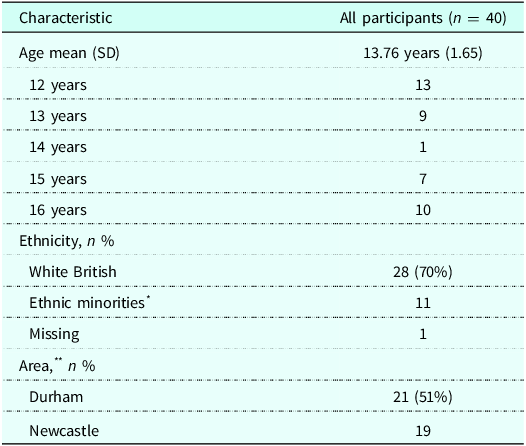
The characteristics of participants in this pilot study are detailed in Table 1. In the following sections, we discuss CYP’s understandings of UC; their views of UC conditionality, the two-child limit, UC rates for under-25s, sanctions and CYPs’ suggestions to improve UC. We report CYP’s views on what is needed for a good life and the impact of not having their needs met. Illustrative quotes are included throughout, coded to differentiate between different data collection methods (i.e. interview, focus group, workshop or online). The methods, number of participants and identifying codes are set out in Table 2.
-
1. Diverse understandings of Universal Credit
Summary of participant characteristics

* Ethnicity data have been removed as potentially identifiable.
** Based on first three characters of postcode.
Data collection method, number of participants and group identifier

Participants understood UC in different ways. Many described UC as money for ‘people who need it’ (F2F-Int) to support ‘basic’ needs, referred to as the ‘bare minimum’, namely food, water, housing (shelter, warmth and safety) and household bills (rent, electricity and gas):
I’ve heard of it. Is that like when the government gives people money, so like benefits basically?
(F2F-P-Int)
Participants believed UC claimants might include people who were unemployed, unable to work or working but on a low income, older people, single parents, those with caring responsibilities and adults and children with disabilities (including hidden or invisible disabilities such as autism or attention-deficit/hyperactivity disorder (ADHD)):
Isn’t it for non-working families? (F2F-FG1)
Is it like when you have a disabled child? (F2F-WS)
Some understood that UC was money to help people with health problems or disabilities to manage the cost-of-living crisis:
Like if your mental health is bad for example, and you can’t work for a reason, you can get like benefits to go on off the government
If you’re not well enough to work, they’ll give you some money for the cost-of-living crisis as well
(F2F-WS)
Others who took part in group discussions recognised that those in paid work might not earn enough to meet their basic needs, leaving people struggling with in-work poverty:
Even if they do work, their wages could be too small to properly support their daily lives, and so therefore the government supports them with extra money
(F2F-WS)
Asked what the term ‘Universal Credit’ meant to them, one participant wrote the following responses on a graffiti wall:
A financial benefit where people who can’t or don’t work and don’t earn a certain annual income get a certain amount of money depending on circumstances like age, marital status etc.
In this group, there was also evidence of misunderstanding, with UC associated with ‘credit to get to university’:
Universal Credit is when the environment or university will help pay for your courses if you don’t have enough money for that opportunity.
(F2F-FG2 Graffiti Wall)
There was also awareness of the rise in UC claims resulting from the adverse economic effects of COVID-19:
I know loads of people got it during Covid
Yes, because everyone being at home and not working
Because everyone was unemployed
People were losing jobs, because businesses were closing down, because they weren’t making money, because it was just closing
(F2F-FG1)
Other responses to a graffiti wall activity indicated some believed that benefits were ‘outside income or money’ which contributed to improved life chances and health, to ‘actually take care of people and stuff’, and helped to alleviate the stress caused by a lack of income.
A few participants commented that benefits were insufficient to meet the rising costs of fuel and food, meaning people resorted to food banks. Some mentioned the difficulties facing homeless people. Others drew attention to how some families could be stuck in difficult economic circumstances, describing life in poverty as ‘like a constant spiral’. Participants identified limited employment opportunities in poorly resourced areas and difficulties finding decently paid work, which resulted in high numbers of UC claimants. Access to quality educational, leisure and recreational opportunities were seen as limited in neighbourhoods affected by lack of investment and infrastructure. Participants noted foodbanks, rubbish, lack of safety and neglect of green spaces in their neighbourhoods, facets of life which they felt were not apparent in more affluent neighbourhoods.
-
1.1 UC, poverty and stigma
Many participants were aware of negative and false stereotypes around the language of benefits and poverty. Some said ‘benefits’ was used as a slur at school, in effect calling on the stigma attached to living on a low income as an insult:
I feel like it’s just like, uh, you don’t work, you’re lazy, you’re jobless, uneducated, so you’re on benefits
(Online-FG)
Other participants readily drew on such stereotypical language, invoking notions of deservingness. During conversations about UC, several mentioned potential ‘abuses’ of the system, expressed in relation to people having babies to secure benefits and to people not being ‘bothered’ to find work, which, according to one participant, had become ‘normalised’ in some families:
If their parents are on benefits, they’ll say ‘oh we’re fine we’ve got money why are we bothered, we don’t have to worry’. If you grow up in a family where like that’s normalised then I feel like you just want to do the same.
(F2F-WS)
These comments reflect persistent and highly charged political rhetoric about welfare ‘dependency’, heard in wider public debates.
-
2. Views about the rules associated with Universal Credit
-
2.1 UC claimant commitment
During group discussions with CYP, we explained that the claimant commitment is a ‘personalised’ agreement between a UC claimant and the Department for Work and Pensions (DWP), outlining what the claimant must do to find paid work. It is designed to be tailored to a person’s circumstances, such as their health or caring responsibilities, and employment status. For claimants able to work, responsibilities include attending Jobcentre appointments with a work coach, demonstrating they have made themselves available for work, spending a minimum number of hours a week looking and applying for jobs, attending job interviews and appointments and declaring any changes in circumstances.
Participants were asked to share their views on these work-related obligations. Most appreciated the value of paid employment and believed that UC claimants should be expected to look for paid work in exchange for financial support from the government:
If you don’t look for a job, it’s kind of like you’re just getting the money for free and you’re not actually putting in the effort to find a job. So, it’s just getting it for free
(F2F-P-Int)
Some people take advantage of it
(F2F-FG Graffiti Wall)
However, a majority thought that, rather than having to accept any job, work should suit a person’s interests, skills and abilities:
I think you should only have to look for work that’s suitable for you. They can’t expect you to look for something that you know you’re not going to be able to do. You’re just going to get fired or sacked. It’s going to waste your time.
(F2F-FG)
Participants commented that, although the claimant commitment was acceptable in principle, as it ‘gives you a chance to get a job’ (F2F-WS), it should also consider people’s health, personal and family circumstances. This applied also to the number of hours claimants are required to work or look for work.
Some felt the current requirements for claimants to spend looking/applying for work were fair, whilst others found them unreasonable; their suggestions on durations for job searching hours ranged from 2 to 32 hours per week. For hours spent working, many thought these should be conditional on a person’s caring responsibilities and access to childcare, as the needs of dependents would suffer otherwise:
Because some people might have kids or like they could be carers to like mams, dads, nanas, grandas, so they should be able to put in for the hours they want to work around their family life
Or similar going to the Jobcentre, you might have commitments if you’ve got kids like
Yeah you might not be able to get people to watch them
(F2FP-IV)
Participants were aware of the demands on parents and carers, particularly mothers, who were often seen as time-pressured, juggling childcare and work, with recognition of the detrimental effects on their mental health.
Transport costs were viewed as problematic for people living on UC, as claimants would be unlikely to afford public transport or a private car (plus insurance and fuel). Most, though not all, questioned how UC claimants on the standard allowance could afford to travel to the Jobcentre to attend appointments, when bus fares were so high in NE England. While participants recognised claimants responsibilities to find work, obligations to travel long distances for work were seen as having detrimental effects on family life, parents and children, particularly as most children enjoyed spending quality time with their parents:
Leaving your kids alone in the house for that amount of time isn’t very safe
I think for your mental health that wouldn’t be a good way of going about it
It would be expensive driving for two hours a day
Well a job is for the rest for your life, so you have to do something for it
(F2F-WS)
Most participants suggested that access to free public transport for claimants would alleviate some of the stress caused by not having enough money to get around.
-
2.2 Views about the two-child limit
Mixed views were apparent about the ‘two-child’ limit, which restricts UC payments to the first two children if there are subsequent children born after April 2017. The majority saw this as unfair because families needed additional financial support if there were more children in the household, as costs would be higher for essential resources such as food, fuel, clothing, shoes, school uniforms and books:
A person with five kids means more uniforms, more clothes, more shoes, so a person with two kids gets the same amount as what that person is getting, yes they still need to provide uniform and clothes but she’s still only got two kids and they’ve got five, like she needs more help. (F2F-P-Int)
One commented that it was an individual person’s choice of how many children they had, not the government’s:
It’s like your body, your choice. You should be able to have as many kids as you want
(F2F-FG2)
Contested views about the effects of the two-child limit were also apparent, as seen in this group discussion:
The more kids you have, you should get a little bit more, because you need to provide more. You need to buy more of everything.
True
But then people would just get babies on purpose
No they wouldn’t because if you think about it, if you’ve got four kids…you’ve got to have more clothes, uniforms, food. It’s going to cost more for everything. You’re going to need a bigger house
(F2F-FG2)
-
2.3 Views about lower UC rates for under-25-year-olds
Most participants thought it unfair that people aged under 25 years receive less UC as ‘everyone should get the same’ (F2F-FG2):
What is the difference? Come on, so what? So what? It should be equal
(F2F-FG2)
Another mentioned that young people under 25 years may need more money, not less: ‘I think you need more. If you’re younger, you need to get your life started’ (F2F-FG2). However, one participant agreed with the lower UC payments based on age, reasoning that it could teach younger claimants financial skills:
I think it’s better for like [younger] people, like they get lower amounts, because it helps them, like it teaches them how to manage their money, so they don’t just spend it on random stuff
(F2F-FG2)
-
2.4 Views about UC sanctions
Participants held different views about the sanctions imposed on UC claimants if they fail to meet the obligations outlined in their claimant commitment. The threat of someone’s money being stopped was largely seen as unnecessary or ‘bribery’. Most disagreed with cancelling UC payments for infringements of the claimant commitment, with one group particularly noting the effects on children in the family:
I just don’t agree with it [sanctions], say that’s the only money they’re physically getting, say they’ve got kids, they’re not able to provide for their kids, they’re not able to put food on the table, they’re not able to provide a roof, water, gas, electric, bills. They won’t be able to provide any of that, or even for school, like school uniform
(F2F-FG2)
Pathetic
I think it’s horrible
What would happen if you can’t go to the dole one day? Or if you’re ill?
(F2F-FG2)
Sanctions were also seen as counterproductive for those seeking paid work, for example: ‘Well, if they’re going to stop your money, you’re not going to be able to afford to go to the interview’ (F2F-FG2).
A minority of participants saw rules as necessary to prevent possible ‘abuses’ of the UC system, but they felt these should be fair for everyone:
There should be rules, like minimum rules, but like that aren’t stupid in a way. Fair rules
(F2F-P-Int)
One participant suggested a warning system instead of sanctions for ‘small errors’:
That’s wrong like, they should have a strike system like they do in school, or demerit or a misdemeanour…it definitely needs improvement, like from what I’ve seen, it doesn’t look stable at the minute (F2F-Int)
-
3. Suggested improvements to UC
Participants felt it was important to take account of the needs of different groups, including people without family support, and those with health issues, communication difficulties or mobility issues. It was emphasised that employers had moral and legal responsibilities to make reasonable adjustments. Some felt the government could do more to help people:
They’re [government] not doing enough to help you. They can do so much more to help people who are struggling financially and stuff like that…but they’re choosing not to
They’re keeping all the money to themselves…
They get me so angry.
I would obviously give people more money who need it. Help people out more. Make it easier to get jobs.
(F2F-FG2)
Two participants suggested that a basic minimum income should be provided, based on a proper assessment of what young people need to thrive:
A decent amount of money to be able to provide everything should be normalised
(F2F-P-Int)
Some suggested there was a need for government to do more to address the stigma surrounding UC and benefits, to reduce the embarrassment and shame surrounding UC, and prevent bullying and social exclusion.
There was broad agreement that education about UC and social security policies was important and should start at secondary school: ‘like when you’re year 7, you’re a bit more mature, understand it a bit better’ (Online FG). External speakers were considered a good option, such as someone from the job centre. Currently, school was not seen as providing essential financial planning or life skills: ‘They don’t prepare you for the life that’s coming ahead of you’ (F2F-FG2).
-
4. What is needed for a good life
Participants were asked to identify what they thought young people needed for a good life; they identified: a nutritious diet ‘because like food is just like a basic need’ (Online FG); and a safe home and neighbourhood such as ‘a good area, like there’s not as much crime … you don’t have to like constantly be worried about, like what’s going to happen’ and ‘somewhere where like you’re comfortable with, like you’re not scared’ (F2F-P-Int). They also highlighted education ‘which preps you for life after school,’ (F2F-P-Int) and access to technology and the internet to focus on school work and achieve a good standard of education. Educational achievement was seen as an essential prerequisite for young people to progress, achieve their aspirations and secure a good job in future. Participants also identified a loving family, friends, good support and personal space and time. To live a normal life participants wanted access to social and leisure opportunities ‘Like to actually go out and do stuff,’ and stable finances ‘to provide everything that a person needs’ and because ‘Money is health in a way. You need money to have health.’ (F2F-Int)
Fairness and equality were recurring themes in participants’ accounts:
Everyone should be treated the same, no matter where you’re from
(F2F-FG2)
If you’ve got money, you can live in a better area as well so that’s more like safer and umm, you can buy like this organic stuff, which is better for you…you can go to better schools if you’ve got more money and stuff
(Online FG).
Not having money was seen by participants as increasing the likelihood of mental health difficulties, stress and anxiety for parents and carers. One young person thought protecting children from these worries was good as it allowed them to focus on their education, while other participants thought older young people would realise ‘when something was not right’ and their family could not afford to pay rent, or buy food:
You can see when your parents are struggling. If they’re worrying about something, then you’re going to worry about it…we’re getting to this age now where we understand what’s going on.
(F2F-P-Int).
These participants felt it was important for parents to talk to children about their finances:
I’m sure your parents would rather that you weren’t worrying, but if you think about it, you do have a right to know. It’s your situation as much as theirs
(F2F-P-Int).
Several participants felt that not everyone was as fortunate as them, and highlighted the importance of sharing with friends who were less well off financially. Many appreciated the support and subsidised activities available from youth services in their local area. They spoke passionately about the inequalities they saw and experienced in their daily lives and their frustrations about government not addressing these. They had clear ideas about the adverse effects of poverty. In one activity, participants (n = 20) were asked what would happen to a young person if they did not have the things they needed. They said young people may become homeless (n = 7), depressed (n = 5) lonely (n = 5); that they may experience reduced opportunities in life (n = 2); poor mental health (n = 2) or turn to criminality (n = 2). Other impacts cited included doing less well in education and becoming unemployed; becoming malnourished or having unhealthy lifestyles; feeling anxious, helpless, unsafe or unwanted.
Discussion
This the first UK study we identified which investigates CYPs’ views of UC. Findings showed CYP have diverse understandings of UC (including some misconceptions) with contested views about conditionality and the two-child limit in UC. There was widespread condemnation of lower UC rates for under-25s and sanctions for families with children, and recognition of the stigma and shame associated with benefits. CYP stressed the importance of minimum standards of income and supportive tailored employment support for UC claimants, taking account of their personal, health and family circumstances.
Participants identified links between UC, poverty and poor health, social and educational outcomes. They described the complex, cumulative and interrelated effects of unemployment, precarious income, debt, poor housing, financial insecurity and food quality in similar ways to those reported by Fairbrother et al. (Reference Fairbrother, Crowder, Dodd-Reynolds, Egan, Er, Goyder, Griffin, Holding, Lock, Scott, Summerbell and Woodrow2022). CYP confirmed the importance of access to basic essentials including food, warmth, a loving family and supportive friends alongside social, leisure and educational opportunities; decent housing; and well-resourced neighbourhoods. As participants in Farthing et al.’s (Reference Farthing2016) study did, CYP saw high-quality education as a key influence on future life chances. Inequalities were noted, as a result of sustained underinvestment in their neighbourhoods. Poverty linked to social exclusion was seen to negatively affect young people’s family, health and school life.
Participants acknowledged the pressures on parents, particularly mothers, who they recognised were juggling work and childcare responsibilities. These findings echo Millar and Ridge’s (Reference Millar and Ridge2020) study with lone parents and their children, which found CYP often played a substantial role in helping their mothers with domestic work and care of younger siblings. They held back on their own needs, avoided putting financial pressure on their mothers and accepted situations that they did not like, including changes in family time and caring arrangements. Similarly, CYP in our study understood the tensions between paid work and unpaid caring responsibilities and observed links between health and wealth, recognising ‘you need money to have health’. These findings are significant given regional inequalities identified in NE England, where there are higher rates of economic inactivity due to long-term sickness, ill health or disability: 5.7 per cent in the NE, compared with the English average of 4.1 per cent (Munford et al., Reference Munford, Bambra, Davies, Pickett and Taylor-Robinson2023).
Our findings suggest CYP are aware when their parents and carers are struggling financially. It has been over 20 years since Tess Ridge’s (Reference Ridge2002) landmark study gathered CYP’s views about what it means to be poor, which showed that children may try to protect their parents from the impacts of poverty on them (Ridge, Reference Ridge2002). Findings from that study included descriptions of children being hungry and trying to hide it from parents, being anxious about lack of money in the home and not wanting to invite friends home as a result, being cut off from activities outside the home because of the costs of transport, being bullied for not being able to dress like their peers and not being able to afford school trips and outings. Our findings indicate that these profoundly social concerns remain highly relevant for CYP, raising questions about whether UC protects CYPs’ rights set out in UNCRC (1989). UC appears to do little to alleviate the risks of exclusion, stigma and isolation faced by increasing numbers of CYP living in poverty.
Participants recognised that not all CYP benefitted from the minimum standards of income and basic necessities they identified as important for living a good life. They felt the government had an important role in challenging the stigma and discrimination facing people on benefits and thought more should be done by DWP and employers to support people to find good quality jobs. Recent qualitative longitudinal analyses of claimants experiences suggest that conditionality and sanctions propel claimants into low-quality employment which is insecure and poorly paid and entails one-sided flexibility (for the employer only; Jones et al., Reference Jones, Wright and Scullion2024). Instead of punitive sanctions, some of our participants suggested efforts should be made to encourage people into paid employment which is flexible to their personal, social, economic and health-related circumstances.
Reports show the rate of UC claimants experiencing sanctions has risen rapidly since the start of the COVID-19 pandemic – with more than one in twelve (7.9 per cent equating to over 100,000 people) claimants subject to sanctions in the latest snapshot data and with claimants in the North East England 30 per cent more likely to be sanctioned than in the South West (see Parkes, Reference Parkes2023, pp. 7–8). Sanctions and deductions for loans and historical overpayments of social security have been shown to increase the risks of hardship and debt in families (Dwyer et al., Reference Dwyer, Scullion, Jones, McNeill and Stewart2019). Analysis by the North East Child Poverty Commission (NECPC, 2022) found almost 130,000 children across NE England live in households that receive less UC than their entitlement as a result of debt deductions (NECPC, 2023b).
The principles of equality, fairness and social justice were emphasised in participant’s accounts, alongside debates about deservingness, consistent with previous studies (Collins & Mead, Reference Collins and Mead2021; Thornton & Iacoella, Reference Thornton and Iacoella2024), revealing CYP as ‘reflexive moral agents’ who engage in negotiations about what is right, wrong and responsible (Such & Walker, Reference Such and Walker2005, p. 52). These findings echo strong consensus about ‘fairness’ reported in qualitative research involving public, (potential) claimants, employers and DWP staff (Rotik & Perry, Reference Rotik and Perry2011), which emphasised that sanctions should strike the right balance between toughness and fairness and protect CYP in households affected. Given the limited understanding of what sanctions mean for CYP in families receiving UC, we suggest there is a need for further exploration of the drivers underlying sanctions, reasons for regional variations and the impacts on CYP.
Policy implications
Numerous reports have comprehensively outlined short-, medium- and long-term actions to mitigate the adverse effects of welfare reform on CYP (Barnes et al., 2023). We do not reiterate these detailed recommendations here but endorse calls to invest in a fair, accessible social security system, to reduce child poverty and improve CYP’s future life chances through improved health, social, educational and work-related opportunities (NECPC, 2022; 2023a; Munford et al., Reference Munford, Bambra, Davies, Pickett and Taylor-Robinson2023).
This requires action to address the fragmented approach to spending and investment in CYP across multiple UK government departments (Jordan et al., Reference Jordan, Kane and Bibby2019). This approach makes sense given international evidence on the cost-effectiveness of investment in a social safety net and long-term benefits on adult health and economic well-being (Bailey et al., Reference Bailey, Hoynes, Rossin-Slater and Walker2020).
Robust, comprehensive equality impact assessments for all social security policies including UC will improve understanding of their effects on CYP under 18 years, informed by a review of the effectiveness of the UK Government Family Test (DWP, 2021). If CYP are viewed as meaning-makers, social actors and rights-bearing citizens, their experiences and perspectives should be valued as an essential basis for developing genuinely child-centred policies (Woodhead & Faulkner, Reference Woodhead, Faulkner, Christiansen and James2008, p. 32, cited in Christensen & James, 2008). Further research is needed to understand the cumulative effects of welfare reform from the perspectives of CYP including in households experiencing challenges, such as bereavement, redundancy, long-term health conditions and/or parental separation. Participatory research (e.g. Farthing et al., 2016) which builds CYP collective agency would help addresses the absence of CYP voices in debates about the politics of poverty.
While we do not assume that the views of CYP should be the sole determinants of social policy, CYP do have a right to a seat round the table in debates about social welfare, including UC (Children at the Table, 2023). CYP’s continuing exclusion from the policymaking process raises important questions about child agency in the context of welfare reform and rights to participation about matters that affect them (Article 12 of UNCRC 1989). These rights have been undermined by continued underinvestment in play, youth and CYP participation services which champion CYP rights – services appreciated by participants in our study. As Daly (Reference Daly2020) suggests, massive cultural and policy shifts are required to enable CYP to contribute to complex policy debates. We believe CYP have the required intellectual, social and emotional maturity to contribute, weighing up the political trade-offs, values and principles involved; articulate their concerns; and advocate appropriate actions. We hope this paper will contribute to further debates about the epistemic benefits of including CYP perspectives in research, policy and practice and welfare more widely.
Conclusion
Despite an increasing focus on CYP as competent social citizens, questions remain about their rights to agency and participation in policymaking processes. CYP lack power to have an influential role, and their voices have been largely neglected as policy actors (Collins & Mead, Reference Collins and Mead2021). Despite concerns about the detrimental effects of UC on claimants, CYP’s views of UC are not well understood (Bidmead et al., Reference Bidmead, El Zerbi, Cheetham and Frost2023). This study responds to this gap in existing literature by highlighting CYP’s views about UC, conditionality, sanctions and the two-child limit in the UK. Participants demonstrated the ability to articulate complex and diverse views and ideas. Given the rising cost of living and the decline in child mental health reported since the pandemic, urgent action is required to avoid further widening of inequalities (Wickham et al., Reference Wickham, Bentley, Rose, Whitehead, Taylor-Robinson and Barr2022; Miall et al., Reference Miall, Pearce and Moore2023) and reduce the economic insecurities driving mental distress among CYP in families living in poverty. A robust social security system including financial support at times of need is a fundamental cornerstone to ensure CYP have the best start in life and opportunities to thrive. Improving the financial security of families with children is not only a highly cost-effective investment for the future; it fulfils CYPs’ rights as social citizens. Rather than seeing young people as passive recipients of policy, we encourage researchers to consider rights-based, co-designed and creatively facilitated approaches to involving young people in future policy research.
Supplementary material
To view supplementary material for this article, please visit https://doi.org/10.1017/S0047279424000333
Acknowledgements
Thanks to the children and young people who took part in the study and staff supporting them; co-investigators and collaborators at Investing in Children, Children North East and the North East Child Poverty Commission; David Aynsley for highlighting the importance of the European Social Charter and funders, Newcastle University Policy Academy. M.C., E.B and C.E-Z are funded by the National Institute for Health and Care Research (NIHR) Applied Research Collaboration (ARC) North East and North Cumbria (NENC) (NIHR200173). The views expressed are those of the author(s) and not necessarily those of the NIHR or the Department of Health and Social Care.
Competing interests
The authors declare none.


 Open access

