

Introduction
A few years ago, three rolls of film from the excavation of two Mesolithic burial sites in the Sado Valley in south-western Portugal resurfaced. Both sites, Arapouco and Poças de S. Bento, were excavated in the 1960s and more recently in the 1980s and 2010s (Arnaud, Reference Arnaud and Bonsall1989; Larsson, Reference Larsson1996; Arias et al., Reference Arias, Diniz, Araújo, Armendariz, Teira, Borić, Antonović and Mihailović2021), and most of their human burials have been studied and published (Cunha & Umbelino, Reference Cunha and Umbelino1997; Peyroteo-Stjerna, Reference Peyroteo-Stjerna2016). The photographs of burials excavated in 1960 and 1962 were, however, missing, and the documentation was incomplete. The rediscovery of these photographs thus provided a unique opportunity to add to our knowledge of Mesolithic mortuary practices.
In this study, new interpretative resources are brought to bear on old documentation, especially the principles of archaeothanatology (Duday et al., Reference Duday, Courtaud, Crubezy, Sellier and Tillier1990; Duday, Reference Duday2009). Archaeothanatology is a taphonomically based approach to documenting and analysing human remains in archaeological contexts that relies on combining observations of the spatial distribution of the bones in the field with knowledge about how the human body decomposes after death. This approach offers not only an interpretative framework, but also a methodology for excavating and recording burials. Since the graves studied here were not recorded following an archaeothanatological protocol, we do not have all the information an archaeothanatological analysis would require; nonetheless, earlier studies that have applied archaeothanatology to older excavations have demonstrated that new and detailed information can be gained even when recording in the field was not carried out within an archaeothanatological framework (Nilsson Stutz, Reference Nilsson Stutz, Larsson, Kindgren, Knutsson, Loeffler and Åkerlund2003, Reference Nilsson Stutz, Larsson and Papmehl-Dufay2009; Peyroteo-Stjerna, Reference Peyroteo-Stjerna2016; Tõrv, Reference Tõrv2018). These studies have also shown the potential of archaeothanatology for illuminating aspects of ritual practice and the handling of the body. Furthermore, our study combines archaeothanatological analysis with insights from experimental taphonomic research, thus adding a new dimension to our understanding of Mesolithic mortuary practices. Here we present what we believe to be evidence for intentional mummification and reflect on attitudes to the body and the handling of the dead, including their transport to significant places in the landscape.
History of the Documentation
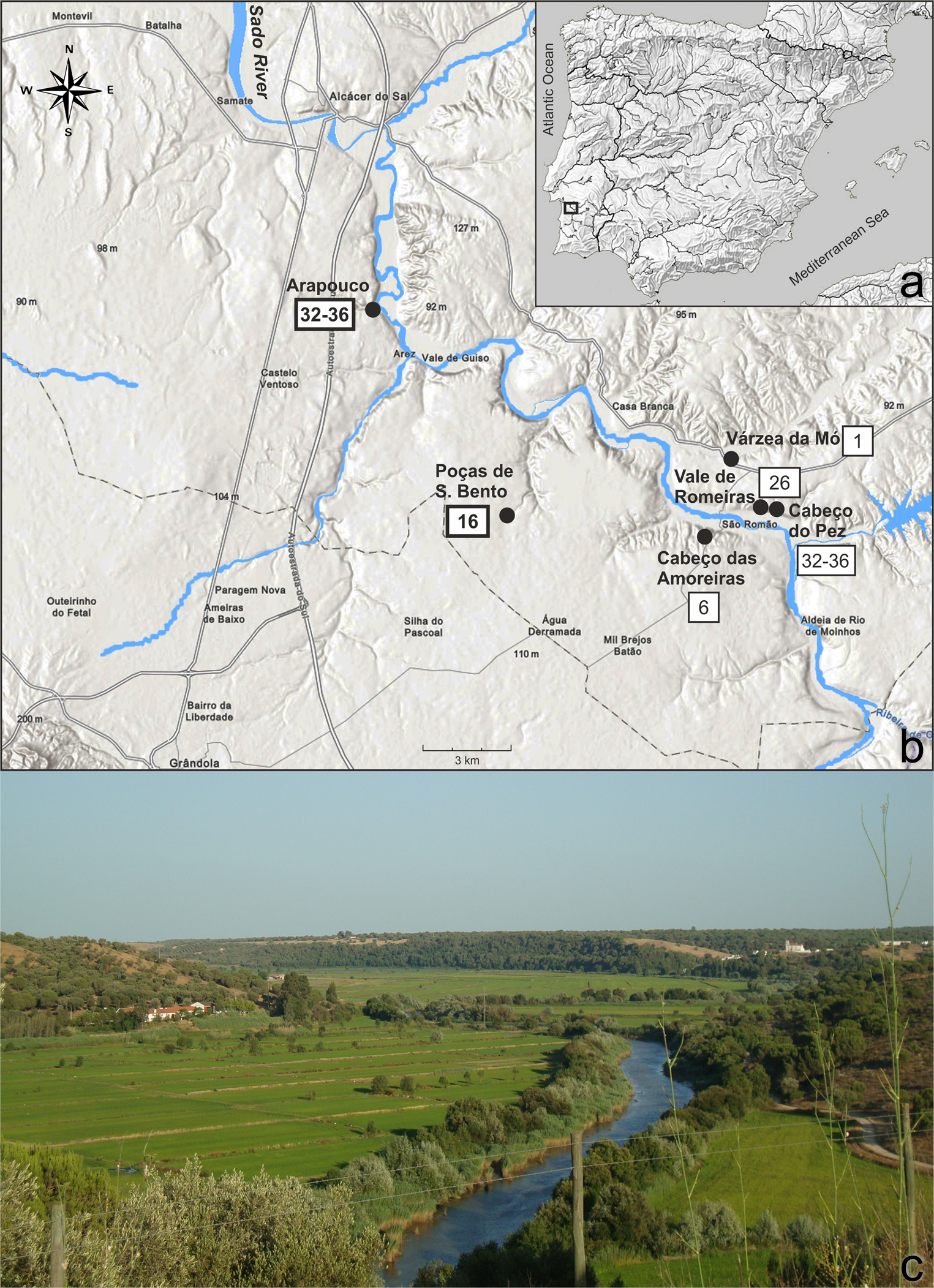
The recently rediscovered photographs document the human burials excavated in 1960 at Poças S. de Bento and in 1962 at Arapouco, two of six Late Mesolithic shell middens with human skeletal remains known in the Sado Valley (Figure 1).
a) The Iberian Peninsula and location of the shell middens of the Sado Valley, Portugal. b) Arapouco and Poças de S. Bento, with minimum number of individuals excavated in each site (Cunha & Umbelino, Reference Cunha and Umbelino1997; Diniz et al., Reference Diniz, Arias, Teira, Araújo, Cubas and Neves2014). c) View from Arapouco towards the south-east of the Sado and its alluvial plain.
The first and largest excavations in the Sado middens were carried out by the National Museum of Archaeology, Lisbon, between 1958 and 1964, recovering more than 100 skeletons dating to between 8150 and 7000 cal bp (Peyroteo-Stjerna, Reference Peyroteo-Stjerna2021). Despite multiple attempts, only two skeletons from Arapouco (1962, 2A) and S. Bento (2013, XIV) have provided reliable radiocarbon measurements, ranging between 8150 and 7900 cal bp (Cunha & Umbelino, Reference Cunha and Umbelino2001; López-Dóriga et al., Reference López-Dóriga, Diniz and Arias2016; Peyroteo-Stjerna, Reference Peyroteo-Stjerna2016, Reference Peyroteo-Stjerna2021), indicating that burial activity at the two sites was broadly contemporaneous.
Most of the archaeological material and documentation available are curated at the National Museum of Archaeology, but some photographs, site plans, and field drawings were missing from the archive (Cunha & Umbelino, Reference Cunha and Umbelino1997; Peyroteo-Stjerna, Reference Peyroteo-Stjerna2016: 227). The rolls of undeveloped photographic films were identified by one of us (Cardoso) in the personal archive of archaeologist Manuel Farinha dos Santos (1923–2001). Handwritten notes on the original film packaging indicate that the photographs are from the shell midden sites of Arapouco 1962 (one film) and Poças de S. Bento 1960 (two films). Farinha dos Santos collaborated with the National Museum and, although he did not work at these sites, part of his research was in this region (Santos et al., Reference Santos, Soares and Silva1974; Cardoso, Reference Cardoso2013).
We attributed Arapouco's photographs to the 1962 excavation season (ARA1962) by comparing the numbering of the burials, observing similarities in the concentration of shells and the preservation of the skeletal elements, and matching the spatial distribution of the burials. Arapouco was excavated in 1961 and 1962, but the site plan in the museum's archives shows only the areas excavated in 1961 and there is no information about the stratigraphy or precise location of the human burials (Peyroteo-Stjerna, Reference Peyroteo-Stjerna2016: 227). The minimum number of individuals curated at the museum is thirty-two, including six subadults and twenty-six adults (Cunha & Umbelino, Reference Cunha and Umbelino1997). The museum's archives contain photographs from both field seasons, but the only graphic record of human remains was a set of photographs from 1961 documenting fifteen individuals. The 1962 photographs in the museum's archives do not show any human remains (Peyroteo-Stjerna, Reference Peyroteo-Stjerna2016: 227). This gap has now been filled. Finally, two burials from Arapouco preserved in paraffin blocks at the museum could be identified as identical to those in the photographs. Two of the photographed graves are not numbered but are nevertheless attributed to Arapouco as they were on the same film roll and no other shell midden was being excavated in 1962.
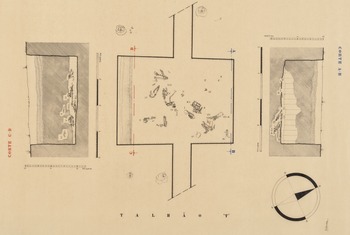
The photographs on the two other rolls of film were identified as documenting the 1960 field season at Poças de S. Bento (PSB1960). S. Bento was excavated in 1960 (Figure 2) and 1964, and further investigated in the 1980s and 2010s (Arnaud, Reference Arnaud and Bonsall1989; Larsson, Reference Larsson1996; Arias et al., Reference Arias, Diniz, Araújo, Armendariz, Teira, Borić, Antonović and Mihailović2021). The graphic documentation at the National Museum consists of two site plans showing all burials in the excavation and several individual drawings of the human remains (individuals I to XII). Previous analyses of the burials were limited by the poor quality of the photographs available in the museum's archive and the fragmentary nature of the human remains (Peyroteo-Stjerna, Reference Peyroteo-Stjerna2016: 75). We were able to confirm the provenance of the burials in the photographs as being from Poças de S. Bento 1960's excavation by comparing them with the existing documentation in the museum, and by establishing similarities in the sandy basal layer of the graves and their similar preservation.
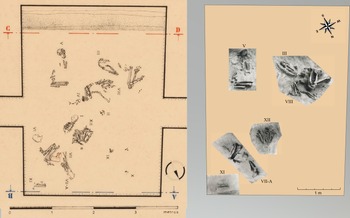
Poças de S. Bento, site plan A119 by Dario de Sousa in the archive of the National Museum of Archaeology, Lisbon. Area with the remains of twelve individuals excavated in 1960. Scale 1:20. Photograph by J. P. Ruas.

Analysis
Our analysis focused on reconstructing the distribution of the graves on the sites, and on closely examining each burial, applying an archaeothanatological approach that in selected cases was complemented with insights from experimental taphonomic research. The new set of photographs was digitized and can be found as Figures S1–S38 in the Supplementary Material.
Spatial reconstruction
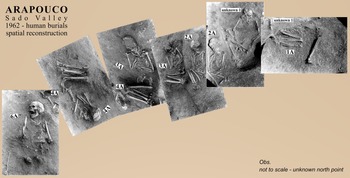
Most photographs from Arapouco show several individuals and this makes it possible to reconstruct the spatial arrangement of all individuals, except for unknown 2 and 3 (Figure 3). This is important because there are no site plans for Arapouco showing the burials in situ. As in other shell middens in the Sado Valley, the excavation photographs show that the burials were placed close to each other, with little disturbance of previous burials, suggesting knowledge of prior burials (Peyroteo-Stjerna, Reference Peyroteo-Stjerna2016: 474).
Arapouco, 1962. Reconstruction of the spatial distribution of the burials based on the new photographic documentation showing graves placed in close proximity.

For S. Bento, drawings from the museum's archives document the layout of the burials. Here we present a reconstruction based on the drawings and the new photographs (Figure 4). While the burials were closely spaced, with little disturbance of previous burials, the new photographs show that some burial spaces clearly overlap and the same space was reused. The deposition of PSB1960, III in the same space as grave VIII entailed the disturbance and partial removal of the remains of VIII to deposit individual III. This behaviour, known in archaeothanatology as reduction (Duday, Reference Duday2009: 72), was previously unclear when only the drawing was available (Figure 4, Figure S26).
Poças de S. Bento, 1960. Reconstruction of the spatial distribution of the burials based on the site plan at the National Museum of Archaeology, Lisbon, and new photographic documentation. Photograph by J. P. Ruas.

Archaeothanatological analysis
Archaeothanatological analysis was carried out on the thirteen individuals (eight from ARA1962 and five from PSB1960) documented in the recently rediscovered photographs. The analysis seeks to identify the effects of natural processes of decomposition on the deposit in order to reconstruct the effects of human practices (Duday, Reference Duday2009). Ideally, archaeothanatology relies on detailed field observations of the precise position, orientation, and dip of each bone in the field, documented in three-dimensional coordinates, but this was obviously not available here.
The photographs themselves also have limitations. In part these are related to the norms of photographic documentation at the time, which often meant that relatively few shots were taken. While most photographs show a general view of one or several individuals, providing important information about the relative position of the burials, the lack of close-up views makes it difficult to identify diagnostic skeletal elements. Most photographs were taken from oblique angles, resulting in distortion of the distances in the images and in partially obscuring some of the skeletal elements. In addition, they do not record the various stages of the excavation, which may be related to the fact that, at the time, photographs were mostly considered to be documenting scientific evidence and rarely documented investigative processes. The photographs are monochrome, sometimes with overexposure or high contrast levels resulting in dark portions in the images, making it difficult to distinguish the sediments and sometimes the position of the bones. In sum, our photographs do not always contain diagnostic elements which would allow identification of precise spatial relationships between specific bones and joints.
While not compensating for all these issues (for example we did not manipulate the photographs to rectify them), we were able to add information from existing field drawings and site plans (Poças de S. Bento) and from the analysis of the human remains preserved in two blocks of paraffin wax from Arapouco (ARA1962, 1A and 3A). In two cases (PSB1960, unknown and XI), the preservation was so poor that even a limited analysis was impossible (see Table S1). While these constraints introduce a significant uncertainty, it was still possible to obtain sufficient data to support our observations regarding the treatment of the dead and determine the burial process at the two sites as well as identify previously undocumented pre-burial practices. Further details are available in Tables S2–S4 in the Supplementary Material.
The analysis of the nature of the deposits suggests that at Arapouco and S. Bento the cadavers were placed in graves before their labile joints decomposed. In seven cases diagnostic features are poorly preserved, but the overall position of the skeletal elements strongly suggests that the bodies were deposited while still retaining their general anatomical integrity supporting the interpretation of primary burial (Table S2).
For the space of decomposition, our analysis confirms a general pattern of filled spaces at both sites (Table S2). The cadavers were covered immediately after being placed in the feature, and decomposition took place in this sediment-filled environment. In four cases, the results are unclear due to poor preservation. In most cases, the movement of the bones was limited, suggesting that the space of decomposition was filled and that the sediment could penetrate immediately. One case suggests mixed decomposition spaces (ARA1962, unknown 2).
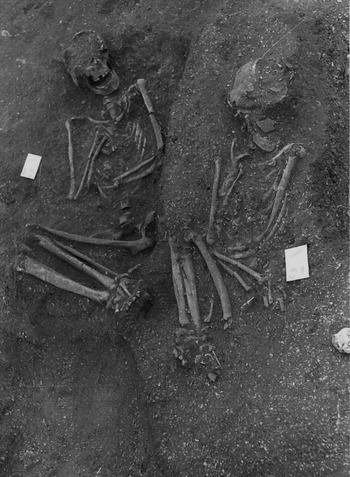
The position of the body differed between the two sites. At Arapouco, the most common initial position of the cadaver in the feature (Table S3) was on its back (n = 6) or rotated to the side (n = 2), with the lower limbs in flexion or hyperflexion, placed towards the upper body and with the feet forced towards the buttocks (Figure 5).
Arapouco 1962. Skeleton 3A is visible on the left of the photograph, lying on the right side of skeleton 2A. These burials illustrate several traits common to the Sado Valley burials during the Mesolithic.

This constricted position results in a phenomenon referred to as ‘clumping’, previously observed in the Sado burial sites (Peyroteo-Stjerna, Reference Peyroteo-Stjerna2016: 444) and interpreted as resulting from hypercontraction of the body during decomposition in situ by the progressive closure of the angles between the anatomical segments. At Arapouco, four skeletons present this pattern. At S. Bento, most cadavers were placed in the same general position with the limbs flexed in front of the body, but here three bodies were placed on the right side and one on the left. Only one of the five individuals analysed was placed on its back. In some cases, the remains show an extreme degree of flexion (ARA1962, 2A, unknown 2 and 3; PSB1960, XII) indicating that additional constraining elements, such as a tight wrapping (full wrapping or simply binding with ropes or bandages) was probably applied to the body. Except for individual XII, the S. Bento burials do not show any indications of ‘clumping’, which may be due to their position on their side rather than on their back.
The analysis of the shape of the graves (Table S4) suggests that the bodies were placed in small pits dug into the ground and that the limits of the grave constrained the arrangement of the body. The lateral pressures and wall effects observed on the skeletons indicate that, in most cases, the shape and size of the pit was sufficient to contain the body, providing lateral support and preventing the collapse of the skeletal elements during decomposition. The base of the grave tended to be irregular and sloping downwards from the upper to the lower part of the body, a shape referred to as a cuvette, common in the Portuguese Mesolithic (Peyroteo-Stjerna, Reference Peyroteo-Stjerna2016: 445). The cuvette phenomenon is especially visible in Arapouco and probably linked to the position of the body on its back with the head raised in relation to the trunk and/or the head's flexion and collapse forwards and downwards (e.g. burials 2A, 3A, 4A, 6A). The fragmented state of the material precludes detailed observations in the region of the ribs and sacrum, whose rotations during decomposition could clarify aspects of the original position of the body in the feature.
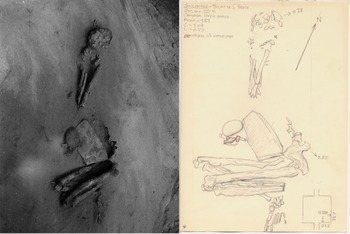
The graves are usually quite constricted, but burial PSB1960, VII-A (Figure 6) is an exception. Here the body was placed on the right side, with the upper limbs flexed in front of the body, and the lower limbs moderately flexed, indicating a primary burial in a filled space. While the left portion of the os coxae was maintained in anatomical position, suggesting significant lateral support at this level from the wall of the burial pit, the position of the right foot in extension suggests that the pit was wide enough to contain the body without exerting the pressure on the skeletal elements otherwise typical at the site. In addition, the grave contained a stone slab and a large round stone, both placed in front of the abdomen. Such objects have not been observed in any other grave in the Sado middens, which typically contain only human remains (Peyroteo-Stjerna, Reference Peyroteo-Stjerna2016). While these elements were already known from a drawing in the museum's archives, the new photographs offer more detail.
Poças de S. Bento 1960, skeleton VII-A. The new photograph shows two stone objects in the grave, never described and only previously documented on a drawing at the National Museum of Archaeology, Lisbon. The drawing seems to have been made after the round stone covering the red coloured stones had been lifted, as noted on the top left of the drawing, pedras côr avermelhada (reddish coloured stones).

In sum, the two sites suggest similar mortuary practices characterized by primary burial in contracted positions restricted by pits dug into the ground and immediately backfilled. The placement of the bodies at Arapouco, mostly on their back, differs from that at S. Bento, where the bodies are on their side. These findings align with results from the analysis of burials previously studied from Arapouco and other Mesolithic burial sites in the Sado Valley (Peyroteo-Stjerna, Reference Peyroteo-Stjerna2016: 443–47).
Evidence of mummification
While most of the burials conform to what we expect from Mesolithic burials in the Sado Valley, two stand out for the unusual position of the remains: one at Arapouco (ARA1962, unknown 3) and one at Poças de S. Bento (PSB1960, XII), suggesting complex pre-burial treatment of the body.
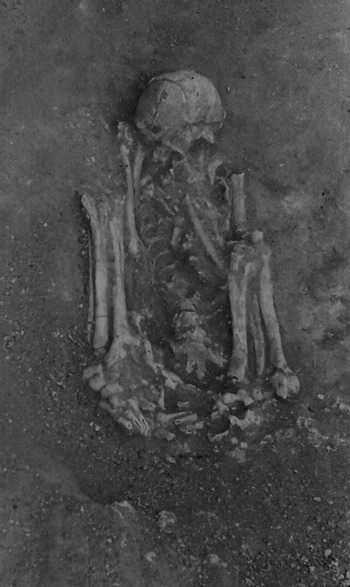
ARA1962, unknown 3, consists of the remains of an adult, lying on its back with the limbs in extreme flexion in front of the body (Figure 7). The head was rotated to the left. The right upper limb was strongly projected upwards and hyperflexed at the elbow, with the forearm lying immediately to the lateral side of the upper arm. The left upper limb was flexed at the elbow and rotated inwards, bringing the forearm diagonally across the upper portion of the thoracic cage, and the hand resting in front of the right side of the chest/right shoulder. Both upper limbs were subjected to a very strong bilateral pressure, which forced them inward towards the thoracic cage. The thoracic cage is less clear on the photograph but also appears to have had pressure from both sides. The lower limbs were hyperflexed at the hip and knee joints, bringing them up and to the sides of the thorax. They are rotated inwards, showing their lateral sides, and bringing the feet immediately below the sacrum with the toes pointing medially. While there is a degree of collapse of the bones, there is no movement outside the original volume of the cadaver, which indicates a filled space.
Arapouco 1962, skeleton unknown 3 shares the basic characteristics of all the burials at the site but was placed in a hyperflexed position which in combination with the lack of movement of the bones in the feature suggests the body was prepared and desiccated before burial.

Some of this lack of movement, especially at the feet, raises questions. This anatomical segment contains both labile (phalanges and metatarsals) and persistent (tarsals) articulations, but, even in a filled space, some of these bones, particularly those connected by labile articulations, would be expected to move during decomposition, given their position in an area so rich in soft tissue. The contracted position affecting all four limbs and the thoracic cage, and the unexpected lack of disarticulation of labile pedal phalanges, call for an explanation. An overall lateral pressure was exerted, and a general wall effect from all sides of the feature is visible in the alignment and bundling of the right upper limb and both lower limbs. This wall effect might correspond to the physical limits of the pit and could have been caused by an almost square burial pit or container. But the hyperflexion entails positioning the bones beyond the normal range of movement of a fully fleshed body and the maintenance of this position; these two aspects suggest that additional factors were at play. Decomposition of the body in situ would normally generate activity such as bloating followed by the creation of significant empty spaces within the initial volume of the body as soft tissue disappears. In filled primary burials, disarticulated bones, such as phalanges, have often moved into such empty spaces. For ARA1962, unknown 3, however, the areas of the feet (placed in front of the thighs, buttocks, and just below the abdomen) and the lower limbs show extreme flexion in combination with the surprising maintenance of labile articulations, indicating that the body was not placed in the grave as a fresh cadaver, but in a desiccated state, i.e. as a mummified corpse.
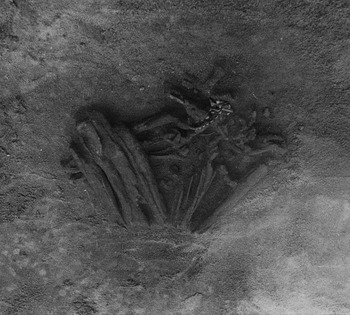
PSB1960, XII (Figure 8) is another case of hyperflexion. The position of the body in the grave appears extremely ‘flattened’, and very little sediment is present between overlying bones (see Figures S37 and S38). Given the incomplete documentation, the state of the labile joints cannot be ascertained. However, the position of the bones with extreme ‘clumping’ of the lower limbs, in combination with an overall lack of movement, resembles the pattern seen in ARA1962, unknown 3, suggesting that a similar form of preparation of the body (mummification?) before burial should be considered. An alternative hypothetical cause for the hyperflexion observed in this skeleton, i.e. (tight) wrapping of the fresh body and/or pressure from surrounding sediment, causing the intersegmental angles between the bones to close, is less likely. Indeed, the sandy sediment in which the remains were found would have rapidly penetrated voids created by the decay of the soft tissues in situ, and hence closing of the intersegmental angles would have been very limited. Moreover, wrapping materials, which may have protected the body from the influx of sediment, would have simultaneously allowed voids to form within the wrapping and movements to occur within this space as the soft tissues decomposed, leading to the disarticulation of joints. While the photographs do not show the state of articulation of some parts of the skeleton, the overall evidence suggests that PSB1960, XII may also be a case of mummification, albeit less clear.
Poças de S. Bento 1960, skeleton XII. The extreme ‘clumping’ of the lower limbs may suggest the body was prepared and desiccated prior to burial.

Mummification can affect the sequence of disarticulation, preserving the otherwise labile articulations of the hands and feet. Persistence of labile joint connections, combined with disarticulation of the persistent joint connections, has been suggested by Maureille and Sellier (Reference Maureille and Sellier1996) as an important indicator of burial in a desiccated or mummified condition, but they note that certain features associated with burial in a mummified condition, such as the maintenance of the volume of the ribcage, are dependent on the properties of the surrounding sediment.
Desiccation of the soft tissues in mummified bodies can allow for much stronger flexion, since the range of movement increases when the volume of soft tissue is smaller. Hyperflexion of skeletons placed on their back with the lower limbs, and sometimes the upper limbs, hyperflexed at the knees and the pelvis (drawn toward the abdomen) has been documented in the Caribbean and interpreted to have resulted from burying a body in a desiccated or mummified state (Hoogland et al., Reference Hoogland, Romon and Brasselet2001; Hoogland & Hofman, Reference Hoogland, Hofman, Keegan, Hofman and Rodríguez Ramos2013). In these cases, there is very little or no sediment present between the femur and tibia and fibula, or between the humerus and ulna and radius. Nonetheless, the articular connections are maintained in combination with the contracted position of the body with the lower limbs brought up in front of the body. An example in a Late Ceramic Age (dated to cal ad 1350–1450) burial at Kelbey's Ridge, Saba, in the Dutch Caribbean, is of an adult male with the remains of two children placed inside his ribcage (Hoogland & Hofman, Reference Hoogland, Hofman, Keegan, Hofman and Rodríguez Ramos2013: 460–61). Similar cases of mummification of bodies wrapped in a hammock or contained in a basket and placed near fire to cause desiccation have also been suggested for the Late Ceramic Age site of Anse à la Gourde, Guadeloupe (Hoogland & Hofman, Reference Hoogland, Hofman, Keegan, Hofman and Rodríguez Ramos2013: 457). While there are differences in mortuary practices between these contexts, the position of the lower limbs in combination with the maintenance of the labile articulations of the feet are remarkably similar.
Henri Duday (Reference Duday2009: 54) has noted that hyperflexion could result from natural decomposition processes in situ but the overall strict anatomical relation and articulation of the bones in the hyperflexed burial of ARA 1962, unknown 3 seems to indicate that there were no open spaces that formed within the original volume of the body through decomposition, reflected by the preserved articulations of labile elements, especially the phalanges. Decomposition of soft tissues with progressive infilling of surrounding sediment can be ruled out as an explanation for the movement of the forearm and leg bones in close superposition with very little sediment between them, as the initial (non-hyperflexed) position would be maintained by the infiltrating soil. If there was indeed no open space in the grave at any stage of decomposition (including space resulting from the decay of soft tissues), this contracted body position would only be possible if the remains were buried in the hyperflexed position observed.
Human decomposition experiments, conducted by one of us (Mickleburgh) at the Forensic Anthropology Research Facility at Texas State University between 2015 and 2021 on the burial of a supine flexed fresh body and a supine flexed naturally mummified body, were designed to investigate the association between hyperflexion and paradoxical disarticulation and mummification of the body. These experiments showed that in situ movement of bones due to the decomposition of soft tissue can occur in both fresh bodies with a normal volume of soft tissue around the bones and highly desiccated bodies with relatively little soft tissue around the bones.
Bone movement in these experiments was observed to be strongly associated with the soil type, and its potential to maintain open spaces in the grave for extended periods. Plant growth and the proliferation of fine roots throughout the grave also contributed to the maintenance of voids in the graves as well as to supporting small bones in a position of equilibrium. Disarticulation and movement of joints considered to be persistent, such as the ankles and the atlanto-occipital joint, was observed in both bodies. Closing of the intersegmental angles between the long bones of the lower limbs was observed in the fresh cadaver, confirming that the supine flexed body position can contribute to increased flexion. However, this movement was also associated with disarticulation at the level of the ankle (considered to be a persistent joint connection). The feet remained in supported (elevated) position in anatomical articulation, as the creation of open space by the loss of the soft tissue of the calves and thighs did not create a substantial void below the feet for them to move into.
The mummified body showed maintenance of the labile connections (with the exception of the left foot, right fibula, and mandible, which were disturbed by small animal activity), as well as bone movement mainly in the abdominal and thoracic areas, where decomposition of the dried soft tissues allowed the bones in these areas to settle downward into the grave. The left lower limb, which was flexed over the abdomen was thus able to move downwards with the left femur, coming to rest directly on the lumbar vertebrae and the femoral head disarticulating from the acetabulum. The ribcage volume was lost as the dried soft tissue decayed. The experiments demonstrate that open spaces can form, and bone movement can and will occur, in both fresh and mummified bodies upon burial, depending on the properties of the surrounding sediment and its ability to maintain secondary voids. These bone movements are associated in both cases with joint disconnection.
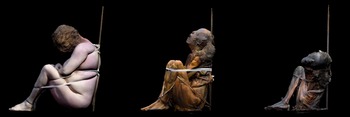
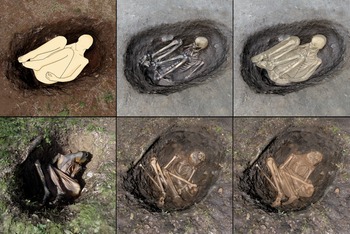
For hyperflexed positions to be present in a burial with preserved labile joint connections in unstable positions, the body must have been initially buried in this hyperflexed position. The combination of hyperflexion throughout the body with a lack of disarticulation or evidence of in situ bone movement, as observed in Arapouco 1962, unknown 3, is therefore a strong taphonomic indicator of burial in a mummified condition. The position of unknown 3 could therefore be the product of a guided natural mummification process, in which tightening of bindings around the body (trussing) over time and reduction of the soft tissue volume created the hyperflexed position and at the same time supported the maintenance of the labile joints (Figure 9). While the precise taphonomic signature depends heavily on the soil properties in the burial environment, the burial of a fully fleshed supine flexed body would leave a different taphonomic signature than the burial of a hyperflexed supine mummified body. In soil types which maintain open spaces within the grave for extended periods, substantial movement and closing of the intersegmental angles is possible in burials of fresh, fully fleshed flexed bodies. In soils that rapidly infiltrate open spaces, the natural volume of the fleshed body and non-hyperflexed bone positions would be maintained. Delayed infilling with sediment in mummified burials can also allow bone movement, although it will be restricted to the areas of the mummified body that still have substantial volume (i.e. the abdomen and thorax). Rapid infilling in mummified burials would maintain the initial hyperflexed position of the body and prevent bone movement or disarticulation (Figure 10). At both Arapouco and S. Bento, all human burials were cut into the sandy base layers of the shell middens (Peyroteo-Stjerna, Reference Peyroteo-Stjerna2016: 475). Several good examples of rapid penetration of sediment are known at Arapouco, and an hourglass effect (Duday, Reference Duday2009: 38) was often detected, indicating that fine sand could penetrate immediately and progressively fill the empty spaces created as soft tissue decayed, thus preventing the bones from collapsing.
Reduction of the soft tissue volume during guided natural mummification. Left: fully fleshed body on day 1 of the experiment placed as tightly flexed as possible using bandages to maintain body position. Centre: reduced body volume and increased flexion of the body after three weeks, due to desiccation of the soft tissues and repeated tightening of the bandages. Right: further reduced body volume after seven months, due to continued desiccation of the soft tissues. The bandages were not further tightened after three weeks.

Top row: experimental burial of a fresh body in flexed supine position, unclothed, directly in the soil. Top left: initial body position of the freshly deceased individual. Top centre: position of the skeleton upon excavation after two years and two months. Top right: relationship between the initial body position and the final position of the bones. Bottom row: experimental burial of a desiccated body after seven months of guided natural mummification and trussing during the first three weeks. Bottom left: initial body position of the mummified individual. Bottom centre: position of the skeleton upon excavation after three years and two months. Bottom right: relationship between the initial body position and the final position of the bones. See extended description in the Supplementary Material.

Discussion
The archaeothanatological analysis of photographic and written documents at Arapouco and Poças de S. Bento has revealed evidence of mortuary practices that correspond to what we already know about Mesolithic burials in Portugal, with a slight variation in the position of the body between the two sites perhaps reflecting local traditions.
More remarkably, our analysis indicates that the bodies were prepared before burial in previously unknown ways. In some cases, the flexion of the limbs is so strong that it may have required an additional supporting element, such as a wrapping, which could help explain how the cadavers were placed in tight spaces. Depending on the type of wrapping (full wrapping or simply binding with ropes or bandages), the influx of sediment could have been prevented, allowing the bones to move into more hyperflexed positions as the surrounding sediment still exerted pressure on the body. The unusual pattern presented by ARA1962, unknown 3, i.e. the combination of the position of the body and the maintenance of the labile articulations of the feet, suggests that in addition to having been wrapped, this body may have been desiccated through mummification before burial. It is unclear whether the wrapping would still have been in place at that time, or whether the body, by then transformed through mummification, would have been placed in the grave unwrapped, as suggested for PSB1960, XII.
The manipulation of the body during mummification would maintain the anatomical integrity of the skeleton and ensure a desired body position. In this case, the pre-burial treatment would allow for the body to be curated for some time and facilitate its transport (being more contracted and significantly lighter than the fresh cadaver) while ensuring that it was buried while retaining its anatomical integrity. If our interpretation is correct, a range of insights relating to the mortuary practices of Portuguese Mesolithic communities arise, including a central concern for maintaining the integrity of the body and its physical transformation from a cadaver to a curated mummy. These practices would also underscore the significance of the burial places and the importance of bringing the dead to these locations in a manner that contained and protected the body, following principles that were culturally regulated.
Current archaeological evidence (e.g. from stable isotope analysis or the study of lithic technology) suggests that several units of hunter-gatherers occupied the Sado Valley. Autonomous groups may have buried their dead in neighbouring burial grounds (Peyroteo-Stjerna, Reference Peyroteo-Stjerna2016: 467). It is generally considered that in the Sado Valley shell middens, burial was concentrated in particular areas within the sites (Larsson, Reference Larsson1996: 30), with the graves typically placed in close proximity but with little disturbance of previous burials. Our analysis, however, shows that, while specific areas within the middens were preferred for burial, at S. Bento, the same burial space may have been reused for multiple depositions. If restricted areas were used continuously for burial, even if that meant occasionally disturbing older graves, the existence of dedicated spaces for the dead becomes all the more significant. Whether these sites were permanently settled is still debated, but we suggest that at least some individuals could have been transported to the burial ground from another location after death. Moving the dead would have been a costly endeavour; mummification before transport would have made the journey easier. Yet mummification cannot only be understood in functional terms, as transforming the appearance of the cadaver would be inscribed in a cultural understanding of handling death, and perhaps even controlling it.
Ethnographic and ethnohistoric studies in communities that practise mummification show that the preparation of the body and desiccation of the soft tissues would have required the active involvement of group members tending to the body over at least a few days or weeks to several months (Beckett et al., Reference Beckett, Conlogue, Abinion, Salvador-Amores and Piombino-Mascali2017; Beckett, Reference Beckett, Shin and Bianucci2020). Our taphonomic mummification experiment confirms that a range of preparative and curative actions are required for weeks or months to ensure desiccation of the body. Halting or slowing the decomposition processes and desiccation of the soft tissues, i.e. natural mummification, occurs when the loss of water from the body (drying) is more rapid than enzyme activity. Hot and dry conditions combined with continuous air flow are favourable for such natural desiccation. Additional human actions contributing to preventing soft tissue decomposition and assisting desiccation include the construction of a platform or structure to elevate the body to allow liquids to drain; a hut or roof to protect the body from the rain; and cleaning the body and rubbing it with ointments and plant extracts to ward off insects and perhaps retard bacterial activity. Bodies are sometimes wrapped in textiles during desiccation, to help wick off fluids, and may be wrapped or kept in containers after mummification is complete. Draining of fluids and even disembowelment to stop bacterial decay can be induced by inserting sticks into the anus and other parts of the body (Beckett et al., Reference Beckett, Conlogue, Abinion, Salvador-Amores and Piombino-Mascali2017; Valentin & Sand, Reference Valentin, Sand, Leclerc and Flexner2019; Beckett, Reference Beckett, Shin and Bianucci2020; Carascal et al., Reference Carascal, Fontanilla and De Ungria2021). Keeping a fire close to the body, such as in the smoking huts constructed by the Anga in Papua New Guinea and the Ibaloi in the northern Philippines, accelerates the process of desiccation and wards off insects through heat and smoke (Beckett et al., Reference Beckett, Lohmann and Bernstein2011; Carascal et al., Reference Carascal, Fontanilla and De Ungria2021).
In temperate Mediterranean climates with long hot summers, as in southern Portugal, the earliest signs of putrefaction of a body exposed to the air can become evident just half a day after death (Pinheiro, Reference Pinheiro, Schmitt, Cunha and Pinheiro2006: 97). While these conditions can accelerate decomposition, they can also facilitate natural mummification. Wind and heat would be important agents, but the process would also require active human engagement. To produce the observed patterns, the body would have been trussed and probably placed on an elevated structure, allowing the decomposition fluids to drain away from further contact with the body. It is also possible that the transformation would have included the use of fire, which would also have needed attention. Over time, the bandages would have been tightened (trussing) to support and retain the anatomical integrity of the deceased while increasing the bilateral pressure on the body and the flexion of the limbs. In short, the process involves a complex and lasting engagement with the cadaver, an engagement that would have been visible to the community, and a significant part of its mortuary practices.
Pre-burial treatments such as desiccation through mummification have not been suggested for the Mesolithic before, but similarities with other Mesolithic burial sites exist in the Sado Valley, such as at Vale de Romeiras, where the cadavers were frequently compressed and laid in highly hyperflexed positions. Here, the extremely constrained and hyperflexed position of individual 23 is particularly striking: when excavated, the bundled skeleton occupied a small area of 49 × 32 cm, resembling a square burial position (Peyroteo-Stjerna, Reference Peyroteo-Stjerna2016: 332–34).
The fact that mummification in Mesolithic Portugal has not been proposed before may be owed to research biases and expectations. Evidence for mummification practices in prehistoric Britain, including histotaphonomic (taphonomic processes at the microstructural scale), radiocarbon, and archaeothanatological evidence, has revealed that, contrary to traditional expectations, practices of retention of the dead including mummification may have been widespread (Parker Pearson et al., Reference Parker Pearson, Chamberlain, Craig, Marshall, Mulville and Smith2005; Booth et al., Reference Booth, Chamberlain and Parker Pearson2015; Smith et al., Reference Smith, Allen, Delbarre, Booth, Cheetham and Bailey2016). In the European Mesolithic, archaeological patterns consistent with mummification, such as those seen in ARA1962, unknown 3, have so far not resulted in the same interpretation, even when extreme flexion and lack of movement of bones cannot be explained. Hence, comparative and experimental archaeothanatological studies are a valuable tool to investigate the processes of decomposition. It would be desirable to follow up our archaeothanatological observations with complementary histological analyses of the bones to assess the level of bacterial bioerosion (see Parker Pearson et al., Reference Parker Pearson, Chamberlain, Craig, Marshall, Mulville and Smith2005; Booth et al., Reference Booth, Chamberlain and Parker Pearson2015; Smith et al., Reference Smith, Allen, Delbarre, Booth, Cheetham and Bailey2016), but, because the excavation context number attributed to unknown 3 is uncertain, we cannot identify the bones in the collection. Being a single case, it is difficult to say whether it represents an exceptional or a more common practice. It would also be valuable to revisit the analysis of other potential cases such as PSB1960, XII, the possible cases suggested from Vale de Romeiras, and the Mesolithic burial F528 recently identified in Champigny, France (Garmond & Binder, Reference Garmond and Binder2020) with the same combination of archaeothanatological analysis and knowledge gained from experimental taphonomy. Future excavations using an archaeothanatological protocol and considering the possibility of mummification may also provide new robust evidence for pre-burial practices in prehistory.
Conclusion
The newly rediscovered photographs of burials at Arapouco and Poças de S. Bento and their analysis, informed by archaeothanatology and experimental taphonomy, allows us to add information on a series of burials of the Portuguese Mesolithic. These burials generally conform to the pattern characteristic of the mortuary practices known for these hunter-gatherer communities, but aspects of the treatment of the body, including its transformation and curation before burial, are new elements. New insights into the use of burial places, such as a very tight clustering of burials, and the proposed cases of mummification and subsequent interment of hyperflexed, intact bodies highlight the significance of both the body and the burial place in the wider hunter-gatherer landscape of south-western Portugal.
Acknowledgments
We thank the National Museum of Archaeology in Lisbon for research permits, access to the collections, and continuous support; José Paulo Ruas for the photographs of site plans and human remains in paraffin blocks; the Sado-Meso Research Team in 2010–2017 for access to the shell midden sites and fieldwork opportunities; Denis Bouquin for references and discussion of comparative material in Champigny, France; Aaron Stutz for the English revision and comments on the manuscript. This work was supported by the VINNOVA-funded ‘MSCA Seal of Excellence’ postdoctoral research project ‘THANATOS’ (Grant number 2019-05211). The taphonomic experiments were supported by the ERC Synergy programme (Grant number 319209), the Leiden University Fund Byvanck (Grant number 5604/30-4-2015/ Byvanck), and the 2017 Royal Netherlands Academy of Arts and Sciences (KNAW) ‘National Postdoc Prize’ awarded to Hayley Louise Mickleburgh. We also thank the Forensic Anthropology Center at Texas State, Texas State University, San Marcos, TX, for supporting the taphonomic experiments, and the body donors and their next-of-kin for their valuable gift to science.
Supplementary Material
To view supplementary material for this article, please visit https://doi.org/10.1017/eaa.2022.3.


 Open access

