





INTRODUCTION
Radiocarbon-based chronologies have become increasingly important in our understanding of early Dynastic China (Chen Reference Chen2023; Liu Reference Liu, Wu, Guo, Yuan, Ding, Fu and Pan2020; XSZ Project 2022). A major step-change in this process was the development of Bayesian modeling which allowed radiocarbon dates from specified contexts to constrain the chronologies (Bayliss Reference Bayliss2009; Bronk Ramsey Reference Bronk Ramsey, Blaauw, Kearney and Staff2019), leading to greater precision in the calibrated dates. Traditionally, Chinese archaeology has been built around stratigraphy and pottery typology, usually via the construction of a “master pottery sequence” using materials from major sites, such as early dynastic capitals (Zhang Reference Zhang1983; Yu Reference Yu1996; Lin Reference Lin and Gu2019). Whilst this has been spectacularly successful, it runs the danger of “normalizing” pottery sequences across large regions, thereby masking regional variations within such typologies. Specifically, it has the effect of projecting the typologies and associated chronologies seen in the major urban centers into smaller regional settlements. This paper investigates this phenomenon in the context of the pre-Zhou culture along the Jing River in present-day Shaanxi Province, China.
This project has focussed a large number of radiocarbon dates (n=101) on the relatively small-scale settlement of Zaolinhetan located by the Jing River in Shaanxi Province (Figure 1). Although small compared to the major contemporary sites (e.g., Zhouyuan or Xitou), it is located in the heartland of the pre-Zhou culture in the Guanzhong region, which later moved eastwards and replaced the powerful Shang dynasty in the Central Plains to become the Zhou dynasty, eventually expanding the Zhou territory from northwest China to the Yangtze River (Rawson Reference Rawson1999; Jaffe Reference Jaffe2020). A substantial volume of literature has been centered on the chronology and motivations of this process, the earliest dynastic transition recorded in bronze inscriptions and historical documents (Grundmann Reference Grundmann2019; Li Reference Li2018:28–37). The intensive radiocarbon study of the small-scale settlement Zaolinhetan reported here enables the finer chronology of this transition to be studied from the perspective of the pre-Zhou heartland. Since this is the first comprehensive radiocarbon dating project focused on the small-scale sites in this region, our sampling strategy attempts to set up a model practice that includes the whole sequence of the stratigraphy and provide suitable dating materials throughout the excavation, which should be of greater interests to archaeologists who hope for high-quality chronology in order to disentangle the development of the Zhou people and the conquest to the east.
Geographic locations of the sites mentioned in the manuscript. Adjacent sites to Zaolinhetan: 1. Nianzipo, 2. Duanjing, 3. Zaoshugounao, 4. Xitou, 5. Caijiahe, 6. Zhouyuan, 7. Andi, 8. Zhengjiapo, 9. Feng-Hao.

MATERIALS AND METHODS
Zaolinhetan is located 13 km southwest of the present-day Zaolinhetan village of Xunyi county in Shaanxi province. It is essentially a small northeast-southwest loess mound surrounded by the Sanshui river along its northern, western and southern sides. Excavation was carried out by Northwest University China in 2016. The total area of the site is approximately 80,000 m2. So far 1060 m2 have been fully excavated, including 114 trash pits/hoards, three houses, 12 trash trenches and four tombs. The largest category of recovered objects is pottery, followed by stones, bones and bronzes. The Li vessel accounts for the majority of the pottery category. Li with divided or jointed crotch have been discovered at Zaolinhetan, which are the two classical pottery forms that have been widely associated with different group identities in the literature (Liu Reference Liu2003; Zhang Reference Zhang2004; Lei Reference Lei2010). The zooarchaeological studies reveal a variety of animal species, including pigs, dogs, sheep, goats, horses, cattle and many wild ones, suggesting a mixed economy with both agriculture and pastoralist practices (Li et al. Reference Li, Chen, Liu and Dou2019). This has been complemented by an archaeobotanical study and stable isotopic analysis, demonstrating millet as staple for this region, followed by barley and soybeans (Chen et al. Reference Chen, Fu, Liu, Tang, Zhai, Zhao and Wen2019).
Sampling Strategy
The objective is to create an overarching radiocarbon-based chronology for the entire site. The first step is to summarize the complex stratigraphic sequence (Figures 2 and 3). The most complex sequence was found in the northwest part of the site, involving six layers between the two largest houses (oldest F1 and youngest F2). In order to present the complete chronological sequence, 24 sequences have been selected in the next step, all of which contain two or more layers, with each one yielding at least one well-preserved sample for radiocarbon dating. Short-lived plant seeds are the most preferential dating materials due to their relatively simple carbon reservoirs, followed by human or animal bones.
Floorplan of Zaolinhetan (the color of each strata merely indicates the relative sequence in the same archaeological group. Layers in the same color across different archaeological remains [e.g., different houses] do not necessarily suggest the same time).

The matrix of stratigraphy in Zaolinhetan (arrow indicates that the upper layer [younger] breaks through the lower layer [older]. Archaeological units in red contain both abundant pottery for typological analysis and samples that were radiocarbon dated). (Please see online version for color figures.)

Sample Pretreatment
Laboratory analyses were performed at the Oxford Radiocarbon Accelerator Unit in the Research Laboratory of Archaeology and the History of Art (RLAHA), University of Oxford. An additional 12 radiocarbon dates were obtained from Beta-laboratory during the excavation process for interlaboratory comparison. The full detailed pretreament process can be found in Brock (Reference Brock, Higham, Ditchfield and Bronk Ramsey2010). Calibration and Bayesian modeling was performed with IntCal 20 (Reimer et al. Reference Reimer, Austin and Bard2020) and OxCal (Bronk Ramsey Reference Bronk Ramsey2021, version 4.4.4). Briefly, for the category of bone samples, the routine pretreatment procedure in RLAHA (coded AF) involves a simple ABA treatment that is commonly carried out in many other radiocarbon laboratories, followed by gelatinization and ultrafiltration. Samples are sequentially treated with 0.5M hydrochloric acid (3 or 4 rinses over ∼18 hr), 0.1M sodium hydroxide (30 min), and 0.5M hydrochloric acid (1 hr) with thorough rinsing with ultrapure water between each reagent. The plant samples follow the similar sequential ABA pretreatment consisting of an initial hydrochloric acid wash (1M) for until effervescence has disappeared, then a sodium hydroxide base wash (0.2M) for 20 min and again 1M hydrochloric acid wash (80℃, coded VV).
Bayesian Modeling
The main model structure follows a mainstream Sequence-Boundary-Phase structure (Bronk Ramsey Reference Bronk Ramsey1998). The sequence of dates is determined by the excavation layer sequence (from old to young). Multiple samples are put in the same Phase if they were taken from the same excavation layer. Given that some samples are so small (e.g., plant seeds) that their positions are likely to be disturbed during deposition or excavation, we apply an Outlier model in order to identify samples that were mislocated. The model parameters are default as (student t distribution, freedom 5, uncertainty 100∼104 and t-type outlier) and each sample is set with 0.05 prior probability to be an outlier (Bronk Ramsey Reference Bronk Ramsey2009).
RESULTS AND DISCUSSION
New Chronological Phasing
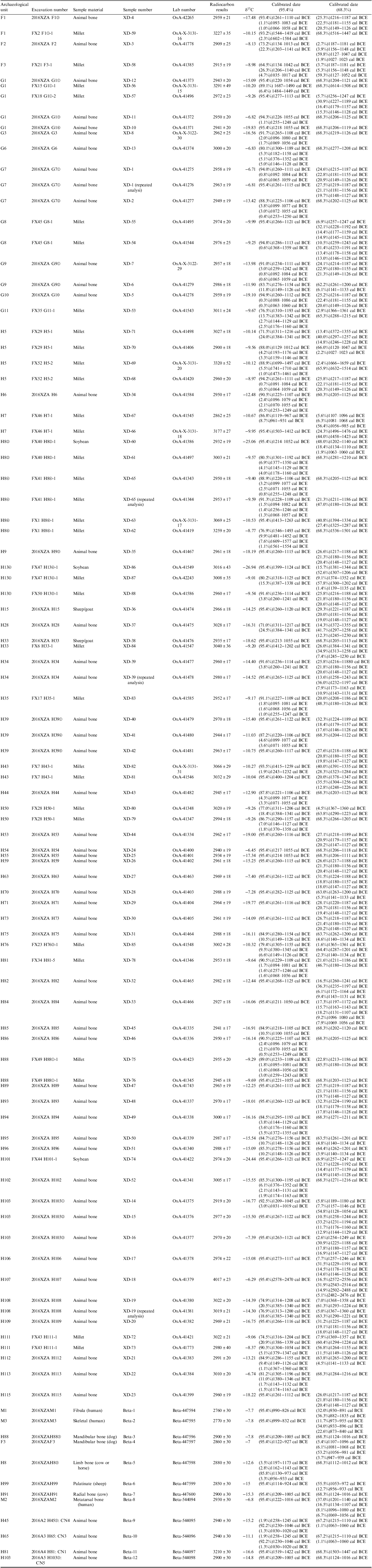
All the results can be found in Table 1. The Bayesian Outlier model was applied to reconstruction of the whole chronology. It also helps to examine the consistency between the radiocarbon results and the stratigraphic sequence. The two types of chronological information show good agreement, with only a few exceptions (Beta 15/16, XD-66/18/56) to be outlier based on their high posterior outlier probability (Bronk Ramsey Reference Bronk Ramsey2009). The samples Beta-15 and 16 appear much younger compared to their excavation layers so very likely to be later samples falling into the older layers. Opposite cases can be found in XD-66/18/56, of which the radiocarbon dates are much older compared to other samples in the same stratigraphy. The majority of the radiocarbon dates (n = 96) are well consistent with the excavation sequence. It is worth of pointing out that the radiocarbon experts were involved in the very beginning of the excavation, therefore the importance of the small plant materials and animal, together with their relative excavation sequence, was repeatedly discussed throughout excavation.
Radiocarbon results for Zaolinhetan (The excavation numbers contain information on the year and the unit/cultural layer of the excavation unit. The sample number is assigned by the excavators when selecting samples for radiocarbon dating. The lab numbers are assigned by the radiocarbon laboratories).
Methods for summarizing a large set of radiocarbon data have been extensively discussed in the literature (see reference in Bronk Ramsey Reference Bronk Ramsey2017). Whilst the Sum function, essentially to stack the dates and uncertainties together, has been widely applied to radiocarbon dates, there are a few issues with this method because of the noise due to the limited number of dated samples, noise from the calibration process, and excessive spread due to measurement uncertainty (Bronk Ramsey Reference Bronk Ramsey2017). The current study adopts the most recently developed method of the kernel density estimate (KDE). Following the widely used normal kernel and optimal bandwidth, KDE helps to overcome these issues and better visualize the relatively large number of radiocarbon data here (Bronk Ramsey Reference Bronk Ramsey2017). OxCal provides convenient tools for KDE analysis. Here the default command is employed, using the normal kernel ∼N(0,1) and the factor according to Silverman’s rule (∼U(0,1)). It is important to note that although KDE is a frequentist approach, similar to Sum, it can be built in a radiocarbon Bayesian model and take advantage of the posterior data.
As illustrated in Figure 5, the radiocarbon results illustrate a continuous occupation at Zaolinhetan since the 16th century BCE, but its major occupation appears well-correlated with a number of the key periods of the Shang dynasty (Figure 4). The earliest radiocarbon date (XD-18, animal bone) was found in H107, indicating the earliest occupation at Zaolinhetan should be dated to the late Neolithic Longshan period (ca. 2500 BCE). However, the majority of radiocarbon dates fall into the equivalent of the Shang period of the Central Plains (ca. 1500–1046 BCE). As a proxy for human activities (Chaput et al. Reference Chaput and Gajewski2016; Crema Reference Crema2022), the first peak of radiocarbon dates in the kernel density estimation corresponds well with the transition between the end of the Erlitou period (presumably the last capital of the Xia dynasty) to the rise of the early Shang dynasty, dated to around 1600–1400 BCE. This dating includes different areas of Zaolinhetan, ranging from the house F1 in northwest and trash pit H7 in south (Figure 2). The subsequent phase shows the highest intensity of human activity, which can be undoubtedly dated to 1300–1100 BCE, with over 90% of the radiocarbon dates contributing to a large peak in the kernel density distribution. Its rapid rise and fall is of great archaeological interest as they are roughly consistent with the dates of the late Shang dynasty, as exemplified by its last capital at Anyang. It is also interesting to note that with the exception of seven samples (Beta-1/2/13/17 dated to 1000–800 BC and Beta-14/18-19 to ca. 800–700 BCE, Zaolinhetan was virtually abandoned from the end of the Shang dynasty. In addition to the radiocarbon chronology, the wide dispersion of δ13C is also intriguing, which is almost certainly due to the use of C4 plant millet for human diet or animal fodder (Chen et al. Reference Chen, Fu, Liu, Tang, Zhai, Zhao and Wen2019; Liu et al. Reference Liu, Pollard, Schulting, Rawson and Liu2021).
Bayesian modeled chronology of Zaolinhetan (Sequence_Boundary_Phase models built in the Outlier Model).

Kernel density estimation of the radiocarbon age for Zaolinhetan with superimposed chronological phases of the Shang Dynasty in the Central Plains.

Comparison with Traditional Typo-Chronology
The initial brief archaeological excavation report tentatively divides Zaolinhetan into three phases based on the stratigraphy and pottery typology. The first phase is characterized by the coarsely made sand-tempered grey pottery, including Li, Yan, Pen, Guan and Zeng. The category of Li pottery was dominated by the well-known high-necked and stout-legged tripot (HNSL), which has been the center of the debate on the social identity of the pre-Zhou people for decades (see below). The excavators pointed out that the legs of the majority of NHSL are conical and solid, with their ends being flat, a special feature that allows them to be dated to the Yinxu II phase or later (Table 1), as exemplified by the Duanjing site (Lian Reference Lian1999; Lei Reference Lei2010:83–88; Zhang Reference Zhang1989: Fig. 1, Fig. 6, F3:11, H88 ④:92, H13①a:12). The second phase of Zaolinhetan is marked by a change in HNSL and the increasing proportion of Li with jointed crotch. A flat and wide strip of clay was added under the rim of HNSL for decorative purpose and their legs became more separated and conical, with their more pointed tips (Fig. 6, M4:2, H88 ②:8). Similar pottery has also been discovered in the Nianzipo culture and Caijaihe site (Hu Reference Hu2007:274–276). All of these have long been assumed to be features of the Yinxu Phase IV (Lei Reference Lei2010:147–152). Evidence for the third phase comes from exaction of H103, with more similar chance findings being discovered from the higher position of Zaolinhetan through survey (Figure 6, H103 ③:23). The major groups of pottery are grey and black, decorated by corded or diamond patterns. The legs of Li are joined in an arc shape and become smaller, which relates this period directly to the typical Mid-Western Zhou dynasty (Kings Zhao and Mu; Zhang Reference Zhang1999:99–101).
Traditional ceramic typological sequence for Zaolinhetan and other key sites.

Although the similarities in pottery typology have drawn a few major pre-Zhou and western Zhou sites into comparison with Zaolinhetan (Figure 6), the new radiocarbon data show a significantly narrower chronological span than previously thought (Dou et al. Reference Dou, Wang, Zhai, Zhao and Qian2019; Li Reference Li, Zhang, Wang, Dou, Liu, Hou, Ma, Qian and Chen2020), indicating that these changes took place either at a much faster pace or simultaneously. The issue of applying typological variation to chronological reconstruction is that it is almost impossible to estimate the associated uncertainty of the time elapsed, since pottery typology is essentially tied down to stratigraphic order therefore reflection of relative chronology. This becomes more challenging in the context of a small-scale site since the local material culture could be replaced more easily than that of the large ones. The competing hypothesis is that small sites could be less well-connected and therefore their object styles appear to be more inert and last longer.
In the case of Zaolinhetan, the abundant material remains unequivocally dated to 1300–1100 BCE highlight the fact that the typological changes observed from pottery happened in a very short period of time, implying many typical pottery styles, such as HNSL or jointed crotch Li, were in fact co-existant rather than sequential. Moreover, the Li vessel (H103③: 23), which is characterized by its flared mouth, curved rim, low and jointed crotch and pointed legs, which for decades has been assumed to be a marker of middle Western Zhou (ca. 9th century BCE), turns out to be associated with the early Yinxu periods (ca. 1200 BCE). This surprisingly early result raises new questions regarding stylistic innovation and, more importantly, to what degree is it legitimate to use pottery style to associate different groups of people and political changes (Hein 2016, 2022; Jaffe et al. Reference Jaffe, Wei and Zhao2018). It is likely that the original design of the Li vessel as such were derived from the small site of Zaolinhetan but remain absent in archaeological records until middle Western Zhou. Alternatively, this was completely lost after Zaolinhetan and reinvented during the middle Western Zhou. Whilst the link in between is still missing, the new radiocarbon chronology implies that more possible scenarios should be taken into consideration.
Social and Environmental Context of the Collapse of Zaolinhetan
How to correlate the material culture with the specific groups of people such as the pre-Zhou recorded in various textual evidence is a notoriously thorny task in Chinese archaeology. But it is particularly important for the understanding of the state formation and social identify of early dynastic China (Rawson Reference Rawson1999; Liu and Chen Reference Liu and Chen2012; Sun Reference Sun2015:501–571). A variety of textual evidence demonstrate that the Ji family was the leader of the pre-Zhou people who overthrew the Shang and established the Zhou dynasty. It was also very likely that the army which surrounded the Ji family was a combination of various groups, including their most important ally, the Jiang family. Some scholars argue that the totality of the material culture created by the Ji group should be defined as the pre-Zhou culture (Liu Reference Liu1991), whilst others tend to take a broader perspective by stating that the material culture of other groups who worked closely with the Ji people should also be considered as part of the pre-Zhou culture, such as the Jiang group (Niu Reference Niu1998). Bearing in mind the intrinsic fluidity in social identity, one should avoid a static approach which often equates one characteristic type of objects with a specific group of people. It is also likely that the composition of the pre-Zhou people was very diverse and involved many others in different time periods, therefore the term “pre-Zhou” should be considered as a big umbrella rather than a specific identity (Wang Reference Wang2018).
One of the most important clues for tracing the origin of the pre-Zhou people is from the transmitted text, which states that Gugong Danfu (the great grandfather of the King Wu who conquered the Shang capital Anyang) moved from Bin to Qi. Qi has now been identified as Zhouyuan based on various bronze inscriptions and historical texts, but the exact location of Bin remains unclear. A number of observations point to the Jing River valley as the most likely region for Bin. This has been indicated in several historical transmitted texts, of which the earliest can be traced to the Eastern Han dynasty (25–220 CE), such as the Book of Han and the Book of Later Han. Although it is questionable to what degree these records are accurate with regards to what happened one thousand years ago, several major pre-Zhou sites (e.g., Zaoshugounao, Sunjia and Duanjing) provide rich materials that could be related to the pre-Zhou culture. In particular, the most recent discovery of Xitou, which is so far the second largest Zhou site with numerous high-elite burials, adds more weight to the identification of the Jing River being the ancient Bin region.
Both Liu and Zhang (Liu Reference Liu2003:17–21; Zhang Reference Zhang2004:274–276) contend that jointed crotch Li in the Zhengjiapo archaeological type represent the Ji-group (Figure 6, Zhengjiapo Culture), whereas the Jiang group could be identified by HNSL in the Liujia culture (Figure 6, Nianzipo Culture). A completely different opinion proposed by Lei (Reference Lei2010:300–301) is that the change from HNSL to jointed crotch Li represents a chronological progression, rather than different groups of people in parallel. Therefore, both types of Li pottery should be considered as remains of the (pre-) Zhou people. The new chronology presented here demonstrates that a variety of pottery styles were contemporaneous with one another. This requires a rethinking of the traditional pottery model mentioned above. At least in the case of small-scale sites such as Zaolinhetan, different pottery types, if they could indeed represent different social groups, were actually mixed together in the same place. As a consequence, it is probably not feasible to distinguish different social groups merely based on ceramic typological variation (Jaffe et al. Reference Jaffe, Wei and Zhao2018; Liu et al. Reference Liu, Wu, Guo, Yuan, Ding, Fu and Pan2020; Chao Reference Chao2022).
Moreover, the rapid collapse of Zaolinhetan is also intriguing, which is assigned by the kernel density model to ca. 1100 BCE (Figure 5; Table 2). No evidence is indicative of any rapid environmental deterioration (e.g., flooding), plague, or warfare. The environmental records in the adjacent regions demonstrate relatively stable climate conditions from the Loess Plateau to the Jing River valley, with minor fluctuations in precipitation and temperature (Figure 7) (Zhao Reference Zhao, Chen and Zhou2010; Chen Reference Chen, Xu and Chen2015; Zhang Reference Zhang, Zhao and Zhou2021:255). The slight decrease in rainfall and colder environment appears unlikely to exert a large impact on agricultural practice, given the introduction of irrigation and local crop diversification, which therefore could mitigate the climate effect. Nevertheless, as indicated by the oracle bone records discovered at Anyang, Northern Shaanxi, which is situated on the edge of the summer monsoon and involves both agriculture and animal herding, might have been more affected, resulting in greater social pressure and migration southwards. As recorded in Bamboo Annals and Book of Poetry, it is due to invasion and harassment by the northern pastoralists (Rong and Di) that caused Gugong Danfu to move from Bin to Qi, which later became the capital of the Zhou dynasty.
Summary of key historical events and periods.

Climate variation for the triangle of Anyang, pre-Zhou and Northerners (the lower figure is the detailed version of the Zaolinhetan period in the upper one; red: branched glycerol dialkyl glycerol tetraethers [Zhang et al. Reference Zhang, Zhao and Zhou2021], green, blue lines: pollen data [Zhao et al. Reference Zhao, Chen and Zhou2010; Chen et al. Reference Chen, Xu and Chen2015], purple: carbon stable isotopic data of organic carbon [Yang et al. Reference Yang, Zhou, Zhang, Chen, Cao, Huang, Lu and Dong2023]).

In addition to the environmental factors, the other side of the coin is various social factors, which are probably more crucial to understand the abandonment of Zaolinhetan. The broadest picture was the triangular dynamics between Anyang, pre-Zhou people and northerners. Northerners here primarily refer to the people who lived north of the Central Plains and the Jing-Wei River valley, such as Lijiaya, who relied on a mixed economy of both agriculture and pastoralism. The long-term interaction between Anyang and the northern pastoralists (e.g., Lijiaya, Figure 1), was rooted in the exchange of horses, metal, agricultural products and many other items (Rawson et al. Reference Rawson, Chugunov, Grebnev and Huan2020, Reference Rawson, Huan and Taylor2021). Multiple periods of warfare between Shang and the northerners were recorded on the oracle bones (Cao Reference Cao2021; Li Reference Li2018:27–60). However, it is worth noting that very little record of pre-Zhou people can be found on oracle bones at Anyang until the period of Ji Li, the son of Gugong Danfu. Ji Li, who represented the pre-Zhou people at that time, was one vital ally of the Shang in resisting the northerners. During the Anyang Phase II, equivalent to probably the most prosperous time of Zaolinhetan (Figure 5), the Shang King Wu Ding carried out a series of successful military campaigns against the northerners, such as Gui Fang, as recorded in the oracle bones. A peaceful relationship between Shang and northerners lasted until the Anyang Phase III, when the King Wen Ding allied with Ji Li and pushed against the northerners.
The new chronology anchors a precise termination to Zaolinhetan around Yinxu III Phase (Figure 5). This immediately associates its decline to the well-known relocation from Bin to Qi led by Gugong Danfu (Table 1), followed by the rise of such pre-Zhou people as Ji Li in the oracle bone records. Although the archaeological record at Zaolinhetan is essentially limited to pottery remains, lacking any text or inscriptions itself, in the subsequent the Anyang Phase IV, its surrounding sites, however, saw a clear increasing popularity of bronzes and pottery with typical northern stylistic features along the Jing River (Figure 6). The withdraw of pre-Zhou people had left certain degree of vacuum that could be immediately occupied by others. The transformation of local material culture therefore can be also explained by the triangular interaction between the northerners, Anyang and pre-Zhou people.
CONCLUSIONS
A large number of AMS radiocarbon dates derived from well-preserved samples and sound pretreatment, together with the Bayesian modeling that respects the complex stratigraphy, has made the reconstruction of a complete and detailed chronology for Zaolinhetan possible. Its major body of occupation is dated to the 1300–1100 BCE. The rapid decline of Zaolinhetan was presumably a result of the famous event when Gugong Danfu abandoned Bin and moved to Qi. It is very likely that Gugong Danfu moved not only his immediate subordinates but also many others, especially from the surrounding small-scale sites. Not only environmental but also various social factors could contribute to this key migration in early Chinese history. The latter, of which the long-term dynamic triangle between the northern pastoralists, Anyang and the pre-Zhou people, presumably played a larger part. Of course, more radiocarbon work needs to be carried out for the other large- or small-scale sites in this region. If this holds true, then it adds further evidence that Zaolinhetan is in the core area of the ancient Bin region, and its abandonment was directly related to the movement from Bin to Qi by Gugong Danfu.
ACKNOWLEDGMENTS
This work is one of the research outputs funded by Social Science Foundation in Shaanxi China and Innovation Team of Shaanxi Universities (Comprehensive Research of Shang-Zhou Potter at Xitou, Xunyi, Shaanxi. Grant number: 2021G009; The Origin and Early Development of Civilisation on the Loess Plateau). Radiocarbon work at Oxford was supported by ERC advanced project FLAME (670010, Recipient Prof A. Mark Pollard). Dr Ruiliang Liu is also supported by ERC Synergy Project Horse Power co-funded by ERC (101071707) and UKRI (EP/X042332/1).
SUPPLEMENTARY MATERIAL
To view supplementary material for this article, please visit https://doi.org/10.1017/RDC.2023.121


 Open access

