

As of March 2024, 8 months after its release in the United States, Christopher Nolan's Oppenheimer movie grossed just shy of $1 billion (Statista Research Department, 2024). The biopic based on a Pulitzer-winning biography by Kai Bird and Martin J. Sherwin (Bird and Sherwin, Reference Bird and Sherwin2005) recounts the story of Robert Oppenheimer, the American physicist widely known as the “father of the atomic bomb.” The movie follows him before, during, and after his leadership of the Manhattan Project, the secret project to develop the United States’ first nuclear weapon. Beyond the movie's artistic and historical value, advocates in the nuclear disarmament and arms control communities hoped that the movie would spur renewed interest in their cause. In this paper, we study whether the film delivered on that promise.
The theory of narrative persuasion posits that narratives and stories are powerful tools for influencing attitudes, beliefs, and even behaviors. Unlike persuasive messages that rely merely on facts and arguments, narratives engage individuals on an emotional and experiential level, making their message more memorable and persuasive. We may consequently expect movies to be particularly well-suited to impact public opinion on respective topics. However, the evidence for the effectiveness of narrative persuasion through movies is mixed. While some studies support the idea that films can effectively influence attitudes and beliefs, others find limited or inconsistent effects.
Relying on nationally representative cross-sectional data in Italy both before and after Oppenheimer's release in the country, we estimate the causal effect of watching the movie on a range of nuclear weapons attitudes. We first show that younger respondents, men, and those with higher education, were more likely to have seen the movie. Relying on inverse probability weighting and propensity score matching (PSM), we then correct these biases in treated and untreated groups in our post-release data. Furthermore, we predict who would go on to see the movie in our pre-release data, allowing us to estimate difference-in-difference (DiD) causal estimands.
The movie seems to have fallen short of the disarmament community's expectations. We can confidently say that the movie did not shift its viewership's attitudes towards support for nuclear withdrawal of the US American nuclear weapons that are stationed in Italy, nor did it decrease support for nuclear proliferation or the use of nuclear weapons. On the other hand, we find evidence that support for nuclear arms control negotiations increased by watching the movie, although this relationship is not statistically stable across all analytical approaches. Taken together, the results indicate that if Oppenheimer had an effect, it was circumscribed – the evidence points to a qualified effect confined to support for negotiated arms control, falling short of the broader attitude change anticipated by the disarmament community but potentially meeting some of the arms control community's expectations.
Our findings speak to scholars of public opinion and international relations, international security experts and practitioners, including nuclear disarmament advocates, as well as policymakers. First, our study provides causal estimates of the impact of popular media on policy attitudes, as well as a roadmap of how to arrive at such estimates from cross-sectional data. Second, the study's results reaffirm the inconsistent track record of narrative persuasion and highlight the public's nuanced view of nuclear weapons. Consequently, these findings point advocates to the need for a nuanced approach that addresses people's security concerns directly. Overall, our study contributes to a deeper understanding of how narrative persuasion can influence public opinion on global security issues and emphasizes the importance of strategic communication in advocacy efforts.
Sparking the conversation about nuclear disarmament and arms control
Soon after Oppenheimer was released, hope that the movie could spark a renewed conversation about nuclear weapons emerged. The film's director Christopher Nolan, in his interview for The Bulletin of the Atomic Scientists (Mecklin, Reference Mecklin2023) clearly argued that “absolutely part of the intention of the film is to reiterate the unique and extraordinary danger of nuclear weapons. That's something we should all be thinking about all the time and care about very, very deeply.” Academics similarly hoped that the movie would renew public interest in nuclear weapons and disarmament, which had virtually disappeared in most Western countries since the end of the Cold War. Scott Sagan, the leading American scholar in the nuclear weapons field, expressed the hope that “the film really gets people interested in thinking through better ways of managing nuclear technology” (De Witte, Reference De Witte2023). Alex Wellerstein, a prominent historian of Project Manhattan, hoped that the movie would prompt people to think about “a world where we are not existentially threatened by nuclear warfare” (Billings et al., Reference Billings, DelViscio and Leong2023). French academic Benoît Pelopidas called the reception of Oppenheimer more important than that of any of Nolan's past or even future movies (Reference Pelopidas2023).
The arms control community and nuclear disarmament community were similarly optimistic. Arms control experts, aiming to limit nuclear arsenals to reduce risks, expressed hope that the film would encourage “new perspectives and curiosity” about nuclear threats (Arms Control Association, 2023a) and “reinvigorate public pressure on political leaders” to pursue international agreements on nuclear weaponry (Budjeryn et al., Reference Budjeryn, Bunn and George2023). Despite critiques that the movie lacked Japanese perspectives and insufficiently highlighted the destruction of the Hiroshima and Nagasaki bombings (Zhou, Reference Zhou2024), the Federation of American Scientists awarded Christopher Nolan, Oppenheimer's director, the Public Service Award for his portrait of Oppenheimer (2023) and the Arms Control Association nominated him for the Arms Control Person of the Year award (Arms Control Association, 2023b).
In a similar vein, pro-disarmament voices, generally aiming to eliminate nuclear weapons altogether, were optimistic that the movie would spark “moral examination of U.S. nuclear weapons policies” (Fox, 2023), draw examination of the “real and present danger” of nuclear weapons (Hall, Reference Hall2023), attract new people to the cause of nuclear disarmament (Schumann, Reference Schumann2023), and perhaps even (re)ignite interest in the Treaty on Prohibition of Nuclear Weapons (TPNW; Winograd, Reference Winograd2023). Mary Robinson, the Chair of The Elders and former Irish President, professed hopefully that the movie would be “a wake-up call to global leaders and citizens alike” (as quoted in Craig, Reference Craig2023). Overall, the movie was soon described as “a win for the cause of nuclear disarmament” (Schumann, Reference Schumann2023).
Narrative persuasion
Their hope was not unfounded. Films serve as prime examples of compelling persuasion through narratives (Moyer-Gusé and Dale, Reference Moyer-Gusé and Dale2017), a messaging format that presents events in sequential order, providing details about a story's characters and their actions (Druckman, Reference Druckman2022). The focus on the story's main characters increases viewers’ motivation and ability to engage with the movie's arguments through narrative involvement (Slater and Rouner, Reference Slater and Rouner2002). This logic derives from the theory of narrative persuasion, which predicts narratives as embedded in movies to be more effective at attitude change than traditional argumentation (Petty and Cacioppo, Reference Petty and Cacioppo1986).
Given narrative persuasion theory's reliance on emotional exposure to the narratives of movies’ main characters (Cohen et al., Reference Cohen, Weimann-Saks and Mazor-Tregerman2018), transportability (Green and Brock, Reference Green and Brock2000) and need for affect of viewers (Appel and Richter, Reference Appel and Richter2010) are crucial determinants for the persuasive effects of movies. Aside from emotional involvement and identification, the realism of the depicted narrative may impact persuasive effects (Cho et al., Reference Cho, Shen and Wilson2014). We may consequently expect movies to be particularly well suited to impact public opinion on respective topics.
However, despite evidence for the effectiveness of narrative persuasion (Braddock and Dillard, Reference Braddock and Dillard2016), results are often movie and audience dependent. University students primed for authoritarianism by watching 300 were more likely to support US military and reject civil action, whereas watching V for Vendetta activated antiauthoritarian sentiments (Glas and Taylor, Reference Glas and Taylor2018). Viewers of Oliver Stone's JFK were significantly less likely to vote in elections and significantly more likely to believe in conspiracy theories linked to JFK's death (Butler et al., Reference Butler, Koopman and Zimbardo1995). Viewing films critical to the US government, such as Argo or Zero Dark Thirty, was linked to negative views of the US government, regardless of any individual experiences with the government (Pautz, Reference Pautz2015). Watching Fahrenheit 9/11 spurred movie-goers to show more critical views of President Bush and the war in Iraq (Koopman et al., Reference Koopman, Butler and Palesh2006).
Other accounts of Fahrenheit 9/11 highlighted the potential pitfalls of selective exposure in estimating causal effects, even leveraging longitudinal and quasi-experimental approaches, stressing that those more critical of President Bush were more likely to see it in the first place (Jomini Stroud, Reference Jomini Stroud2007). Similarly, scholarship on the effect of documentaries argues that the effect is primarily through growing recruitment and mobilization rather than direct policy attitudes (Whiteman, Reference Whiteman2009). This highlights the threat of selection effects as one of the methodological challenges studies like the present one are often faced with. To avoid these challenges, Mulligan and Habel (Reference Mulligan and Habel2011) randomly assigned students to watch a movie on abortion, a design that allowed them to ascertain that watching the movie caused increased support for legal abortion. In a similar design, watching Wag the Dog increased belief in conspiracy theories about the US government's behavior (Mulligan and Habel, Reference Mulligan and Habel2013). The gold standard for such causal estimation is indeed through randomized controlled trials.
While movies can thus shift attitudes, often media attention surrounding prominent movies can also influence opinions. The 1983 Day After, depicting a catastrophic Soviet nuclear attack on Kansas City, was credited with shifting public views and raising awareness of nuclear risks at the height of the Cold War, despite arguments that much of the effect was a result of the media attention rather than direct viewership (Feldman and Sigelman, Reference Feldman and Sigelman1985; Schofield and Pavelchak, Reference Schofield and Pavelchak1989). Some observers nevertheless asserted that the film “changed the Cold War” after Ronald Reagan watched it at Camp David and the film made him “greatly depressed” (Craig, Reference Craig2023). Conversely, the popular series Borgen had only limited effect on viewers, partially because of the low societal debate it spurred (Boukes et al., Reference Boukes, Aalbers and Andersen2022). More nuanced were results from exposure to the series Amerika, where media attention was found to impact only select attitudes, while direct exposure shifted various attitudes in the predicted conservative direction for participants across the ideological spectrum (Lenart and McGraw, Reference Lenart and McGraw1989). On the other hand, an analysis of narratives surrounding the popular series Game of Thrones underscored that the same narratives from the series could be leveraged for diverging agenda-setting purposes (Milkoreit, Reference Milkoreit2019). In the same vein, scholars argued that the release of movies featuring US Presidents influences presidential approval, but such effects are mediated by partisanship and the state of the economy (Uscinski, Reference Uscinski2009). In a recent cross-national experimental study, exposure to Chinese state media led to more positive evaluations of the Chinese governance model (Mattingly et al., Reference Mattingly, Incerti and Ju2025). Taken together, these studies not only stress methodological concerns, but also the impact of secondary exposure, pre-exposure moderators, and elements inherent to the film, such as the relatability of characters, the emotional intensity of the narrative, and the perceived realism of the depicted events.
State of nuclear disarmament in 2023
Overall, these studies highlight the need to incorporate the contextual situation in our expectations regarding the persuasive nature of narrative media. Oppenheimer hit the cinemas at the time when nuclear tensions were at their highest point since the end of the Cold War. According to the Federation of Atomic Scientists, the nine nuclear powers possess 12,500 warheads at the time of writing (Kristensen et al., Reference Kristensen, Korda and Johns2023). While the total number of nuclear warheads has declined globally from the peak of over 70,000 in 1986; the number of deployed nuclear weapons (as opposed to those in storage or awaiting dismantlement) has been increasing for the last few years in all powers except the United States, France, and Israel (Kristensen et al., Reference Kristensen, Korda and Johns2023).
In recent years, numerous developments have increased the global perception of nuclear risks. A number of arms control treaties collapsed in recent years, prompting concerns about the “crisis of arms control” (Wisotzki and Kühn, Reference Wisotzki and Kühn2021). The most important of the collapsed nuclear arms control treaties was the Intermediate-Range Nuclear Forces Treaty, signed by Reagan and Gorbachev in 1987, which removed the whole class of intermediate-range missiles from the world and arguably paved the way to the pacification of the Cold War (Adler, Reference Adler1992). Next to the collapse of nuclear arms control, other worrying steps have taken place. After the start of its invasion of Ukraine, Russia has repeatedly rattled the nuclear saber, issuing thinly veiled threats against the supporters of Ukraine as well as Ukraine itself (Arndt et al., Reference Arndt, Horovitz and Onderco2023; Horovitz and Arndt, Reference Horovitz and Arndt2023). Combined with heightened tensions between the West and Russia, it is no wonder that the recent diplomatic conferences dedicated to nuclear weapons – the 2015 and the 2020 NPT Review Conferences (postponed to 2022 due to the COVID-19 pandemic) ended without an outcome document, which was generally accepted as an additional sign of the breakdown of global debates on nuclear disarmament.
A significant portion of the nuclear disarmament proponents placed their hope in the TPNW, which was negotiated at the United Nations in a 4-week period in 2017 and entered into force in 2021 after being ratified by 50 countries. This treaty was the result of coordination between anti-nuclear civil society and some states (Gibbons, Reference Gibbons2018), and was lauded by the anti-nuclear civil society as an important achievement (Acheson, Reference Acheson2021). Importantly, all states possessing nuclear weapons and all of their allies except for the Netherlands ignored the negotiation process and up until today none of them are a party to the treaty (Williams, Reference Williams2018; Onderco and Jiménez, Reference Onderco and Jiménez2021). This situation led some observers to argue that the treaty has limited potential for practically delivering on nuclear disarmament (Onderco, Reference Onderco2017). However, advocates argued that its primary goal is to further establish norms prohibiting nuclear weapons (Ritchie, Reference Ritchie2019; Egel, Reference Egel2022). At the time of writing, the treaty was signed by 93 countries and ratified by 70.
Yet as Oppenheimer entered cinemas, the global state of nuclear disarmament was at its worst since the end of the Cold War. Despite this, the movie would expose the mass public to a compelling narrative about the risks of nuclear weapons. The movie homes in on the moral struggles faced by Oppenheimer himself as he grapples with the destructive nature of the bombs he and his team developed. As John Holdren puts it in a Belfer Center interview (Budjeryn et al., Reference Budjeryn, Bunn and George2023): “[The film reminds us] about realities of nuclear weapons that too many have forgotten: the immense destructive power of these weapons […]; the certainty that what one nation achieves in nuclear-weapon technology will be matched by others; and the existential threat to civilization posed by the nuclear-weapon buildups.” Others disagree, highlighting that “people leave the theatre thinking how exciting a process it was, not thinking ‘God, this was a terrible weapon of mass destruction and look what's happened today’” (Turner, as quoted in Hall, Reference Hall2023).
We remain agnostic regarding which perspective is more accurate. Instead, we adopt the disarmament and arms control communities’ hopes as our guiding expectation for the film's impact: that watching Oppenheimer would lower support for nuclear proliferation and the use of nuclear weapons, while increasing support for arms control and the withdrawal of US nuclear weapons stationed in Italy.
Methodology
Case. This study is conducted in Italy, which is one of the five European countries hosting the US nuclear weapons on their territory, a practice known as “nuclear sharing” (Kristensen et al., Reference Kristensen, Korda and Johns2023). While this practice has never been officially confirmed, the United States is believed to station its nuclear weapons in Europe as a part of deterrence and assurance mechanisms (Lieber and Press, Reference Lieber and Press2020). As in other host countries, stationing nuclear weapons in Italy has been subject to intense domestic political contestation. Anti-nuclear civil society has been mobilized by Italy's continuous participation in nuclear sharing arrangements (Foradori, Reference Foradori2014). In recent years, the Italian Peace and Disarmament Network (Rete Italiana Pace e Disarmo) pushed through a national campaign “Italy, rethink!” (Italia, ripensaci!) through which there was a consistent campaign to raise public awareness for nuclear risks in Italy. The campaign's coordinator, Francesco Vignarca, published a book on nuclear disarmament, of which the release coincided with the release of Oppenheimer in Italy. Interestingly, the book's promotional cover flap features Oppenheimer's famous words apocryphally believed to be uttered after the first nuclear test, “Now I Am Become Death, the Destroyer of Worlds,” citing the Bhagavad Gita Hindu script (Vignarca, Reference Vignarca2023).
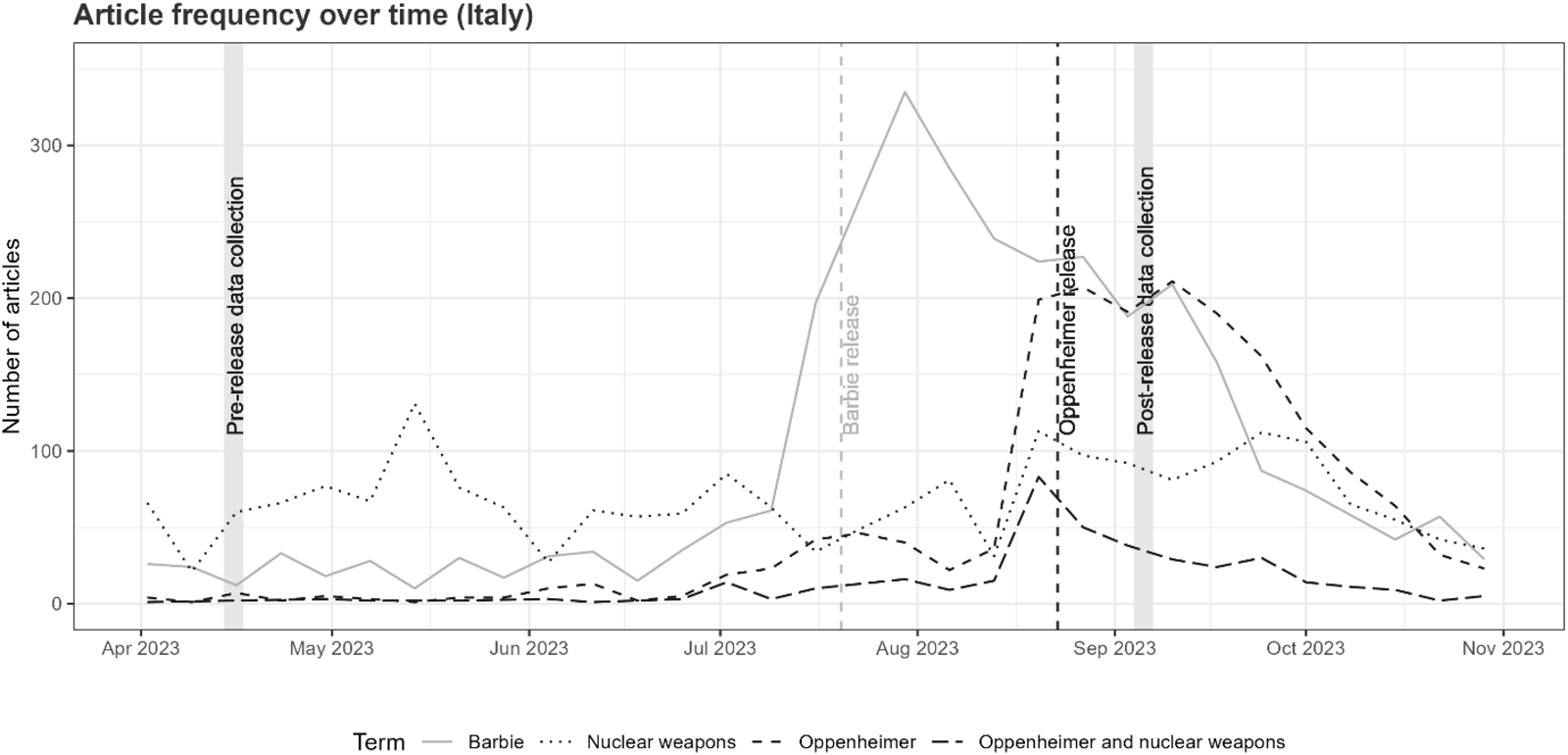
The Oppenheimer movie itself was a success in Italy. It was screened in 563 cinemas across the country, netting over $30 million in box office revenue. Over one-third of this revenue was collected by the end of the opening weekend, and two-thirds within the first 2 weeks (Box Office Mojo, n.d.). The movie received substantial media attention around its launch and several weeks after (although this attention was lower than that given to Barbie, another blockbuster released in summer 2023). Figure 1 shows the frequency of media articles in Italy over the course of our data collection, which spanned the launch of the Oppenheimer movie.
Frequency of newspaper articles in Italy as retrieved from Factiva. Four searches were performed on Italian-language media within Italy, from April to November 2023. Prevalence of articles on the Barbie movie is included for reference. Specific queries are included in the appendix.

Data. We leverage two representative survey datasets of respectively n = 1003 and n = 1095 Italians between 18 and 64 years old. Both datasets are provided by IPSOS, with the first survey fielded in April 2023, several months before the release of Oppenheimer, but well over a year after Russia's full-scale invasion of Ukraine, and the second survey fielded in September 2023 to correct four items’ translation errors. In the post-release survey, we asked respondents whether they had seen the Oppenheimer movie (n = 214), not yet seen the movie but were planning on doing so (n = 674), or whether they had not seen the movie and were not planning to (n = 207). The pre- and post-release data have 49% and 51% women, a mean age of 43 and 44 years old, and 31% and 39% higher educated respondents, respectively.
Variables. We investigate four dependent variables, representing different dimensions of nuclear disarmament and arms control. First, we ask two items about unconditional withdrawal of the nuclear weapons stationed in Italy. Second, we asked respondents about their support for arms control, both as a general necessity and as a necessity for nuclear withdrawal. Third, two survey items make up the nuclear proliferation dimension, asking about Italian development of nuclear weapons and about an increase of the number of American nuclear weapons stationed in Italy. Lastly, two items drawn from Onderco et al. (Reference Onderco, Etienne and Smetana2022) measure support for the use of nuclear weapon, asking about approval regarding both a first and a second-strike scenario. All of these items are measured on 7-point Likert scales ranging from “Strongly disagree” to “Strongly agree.” In the post-release wave, they are averaged into indices for withdrawal, arms control, proliferation, and nuclear weapons use respectively. In the pre-release wave, only the proliferation dimension remains averaged, since all other dimensions had one or two translation errors in the original items, reducing them to single items. Table 1 includes all respective items, with those with pre-release wave translation errors marked in italics.
Four dependent concepts and their operationalization. Italicized items contained translation mistakes in the pre-release wave and are excluded from the DiD models, which rely on both pre- and post-release data

Identification strategy. Given the cross-sectional nature of our two datasets, we leverage both inverse probability weighting (IPW) and PSM to estimate the causal effect of watching the Oppenheimer movie.Footnote 1 For both methods, we split the post-release data into three subsets, in which we compare respondents who indicate to have seen the movie with those who intend to see the movie, those who do not intend to see the movie, and the combination of the latter two groups. We denote this as “Yes vs Not yet,” “Yes vs No,” and “Yes vs No + Not yet.” On each subset, we run a binomial logit regression to calculate respondents’ probabilities of having seen the movie. These models’ specifications were initially informed by a LASSO technique as applied to the entire selection of plausibly exogenous variables and subsequently harmonized across subsets (see appendix). Among these exogenous variables are demographics such as age, gender, education, and region, political variables such as vote intention, left-right self-placement, and institutional trust, as well as a range of attitudinal items that are unlikely to be influenced by seeing the movie. The predicted probabilities for seeing the movie are used as inverse probability weights in the IPW approach and as matching distances in the PSM approach (Guo et al., Reference Guo, Fraser and Chen2020). The specific matching algorithm, full matching with a 0.2sd caliper (Cochran and Rubin, Reference Cochran and Rubin1973), was selected blind to the results based on matching diagnostics, ensuring standardized mean differences below 0.2. Probability plots for the IPW approach as well as balance tests and love plots for the PSM approach are included in the appendix. Subsequently, we predict if pre-wave respondents would go on to see the movie after its release, allowing us to conduct DiD analyses for the proliferation, arms control, and withdrawal dimensions (which did not suffer from the mistranslation in the pre-release survey). This approach is based on similar work attempting to estimate causal effects from suboptimal data (Karmakar et al., Reference Karmakar, Pareek, Small and Ghosh2018; Hobbs and Hopkins, Reference Hobbs and Hopkins2021). In other words, we estimate the levels of the respondents who are predicted to go on to see the movie as well as the levels of those who are predicted not to see the movie, and contrast those to the levels of the respondents who ended up seeing the movie versus those that did not. This allows us to compare the slope between the two time points for both groups.
Results
The results section is organized as follows. We first discuss the result of the model specification predicting who has seen the Oppenheimer movie, allowing discussion of the extent of selective exposure. We then proceed to use the resulting probabilities in the causal estimation of our dependent variables. first through IPW and PSM, and later through DiD analysis. Lastly, we discuss a number of robustness checks.
The Oppenheimer public
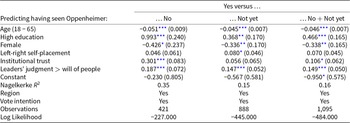
From a selection of 18 exogenous variables in our data, a LASSO model selected the most relevant predictors for three equivalently specified models predicting who had seen Oppenheimer, while forcing demographics and ideological predictors into the model. The harmonized result across data subsets yields the additional inclusion of a statements that reads “Political leaders should make decisions according to their best judgment, not the will of the people” as well as respondents’ institutional trust (average of trust in the EU and in the WTO).
On average, younger people are much more likely to have seen the movie, with those having seen the movie being 38 years old, those wanting to see the movie being 45 years old, and those not wanting to see the movie being 47 years old. This provides the first circumstantial evidence that those who have seen and those who want to see the movie are likely not drawn from the same distribution of people. We observe similar patterns with regards to education, where higher education is a significantly positive predictor in all three models as shown in Table 2. Among those who have seen the movie, 51% are highly educated, as contrasted with 39% of those wanting to see the movie and 27% of those who have no intention of seeing the movie. There seems to be a slight inclination of those with a more right-wing ideology to watch the movie, consistent with findings that those on the right are more inclined to support nuclear weapons (Onderco et al., Reference Onderco, Etienne and Smetana2022). Overall, younger, male, and higher-educated Italians were more likely to have seen the movie.
Regression results of binomial models predicting having seen the Oppenheimer movie

Note:
* P < 0.1; **P < 0.05; ***P < 0.01.
Estimating causal effects
We now rely on the probabilities generated by the above models to estimate causal effects through inverse probability weighting and PSM, two techniques that are commonly used in observational studies to address confounding bias and estimate causal effects. Inverse probability weighting assigns weights to each observation based on the probability of receiving the observed treatment, thereby balancing the distribution of covariates between treated and control groups. PSM involves matching treated and control units based on their propensity scores, which are the estimated probabilities of receiving the treatment as generated above.
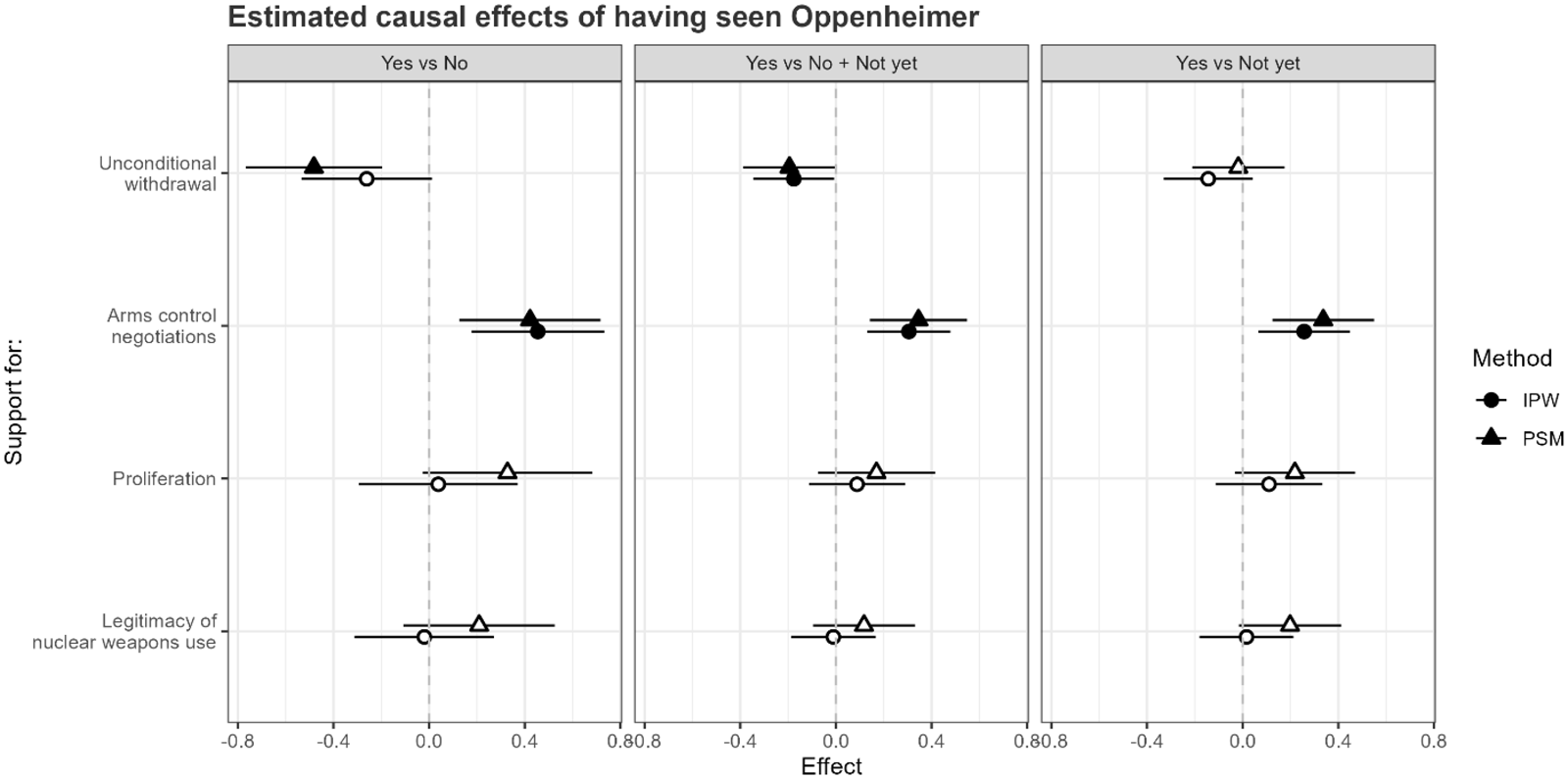
Given the relative similarity between the people who intend to see the movie and those who already have, this comparison provides the most conservative test of the effect of seeing the movie. We find significantly positive effects across both estimation methods on support for arms control, as can be seen in Figure 2. This effect persists across comparisons, comparing against those who do not intend to see the movie as well as against the combination of those who do and do not intend to. Between the three comparisons and two estimation methods, effects range between 4% and 8% increases on the 7-point scale. These patterns offer converging evidence that Oppenheimer may have raised support for arms control negotiations.
Estimated causal effects on the four dependent variables with both IPW and PSM methods. Error bars indicate 95% confidence levels.

While we find consistently negative effects on support for the unconditional withdrawal of the nuclear weapons stationed in Italy, these findings are not consistently significant. The somewhat counterintuitive combination of advocating for arms control with a simultaneous realization that the weapons have a deterrent value and should therefore not be withdrawn is nevertheless in line with most European countries’ nuclear weapons policy (Foradori, Reference Foradori2014; Smetana et al., Reference Smetana, Onderco and Etienne2021). The indices representing proliferation attitudes and nuclear weapons use preferences display inconsistent or insignificant results.
As a third approach, we predict who would go on to see the movie among respondents in the pre-release wave. This allows us to compare the change over time between those who are predicted to see the movie and those who are not. We conduct this test for all items that did not have translation mistakes in the pre-release wave.
We observe a positive effect of watching Oppenheimer on support for arms control negotiations. We observe this in the top row of Figure 3, which shows that in April 2023, in our pre-release data, both groups sit at statistically indistinguishable levels of support for arms control negotiations, regardless of the comparison. Post-release, those who have seen the movie are significantly higher in their support as compared to those who have not yet and those who do not intend to see the movie. In this DiD design, the models’ interaction term is the causal estimand, providing evidence of the movie's causal effect assuming parallel trends. It is significant in all three comparisons, although we will show in the robustness checks that while the directionality is consistent, the significance is sensitive to the classifier used.
Difference-in-difference analyses with predicted group membership in the pre-release wave. Ribbons indicate 95% confidence levels.

Mirroring the IPW and PSM analyses, the other outcomes do not show significant patterns in the DiD analyses. We do, however, note that support for proliferation is significantly higher among those who intend to see (and saw) the movie. With respect to unconditional withdrawal, both groups tend to move nearly in parallel as well.
Robustness checks
We realize that the applied techniques are sensitive to unmeasured confounding as well as potentially to researcher degrees of freedom. We urge the reader to interpret the following results with the necessary scrutiny, especially considering causal interpretation. However, we conduct a wide range of robustness checks that overall are supportive of our findings that the movie did not change views on nuclear disarmament while only increasing support for nuclear arms-control negotiations.
First, we address the large number of researcher degrees of freedom in our approach. The prediction models as used in the results section rely on harmonized models across all three data subsets as informed by a LASSO procedure. We re-run our analyses with prediction models based exclusively on demographic variables, as well as on the full range of exogenous variables. In the IPW procedure, our results remain substantively the same in nearly all cases. In the PSM procedure, on top of the prediction model specification, many specifications for the matching algorithm are available. Except for some nearest matching algorithms and mahalanobis distance specifications, our results remain substantively the same. In the DiD procedure, we classify respondents in the pre-release wave based on how likely we predict them to be to see the movie after its release. Out of seven classification approaches, we selected the one with the best overall diagnostics, while excluding the boosting classifications which appeared to overfit the model on the relatively small subset of data. We re-run the same analyses with all approaches, including the boosting classifiers. In addition, instead of classification, we simply run the interaction in the model based on the predicted probabilities, and instead of using the true outcomes in the post-release wave, we also compare with the predicted outcomes in the post-release wave (the pre-release wave outcomes are always predicted). The DiD approach appears most sensitive to the design choices we made, with 51 out of 90 arms control coefficients being significant, and the remaining 39 being insignificant. Nevertheless, in none of the 180 approaches to estimate the effect on arms control do we find a significantly negative effect.
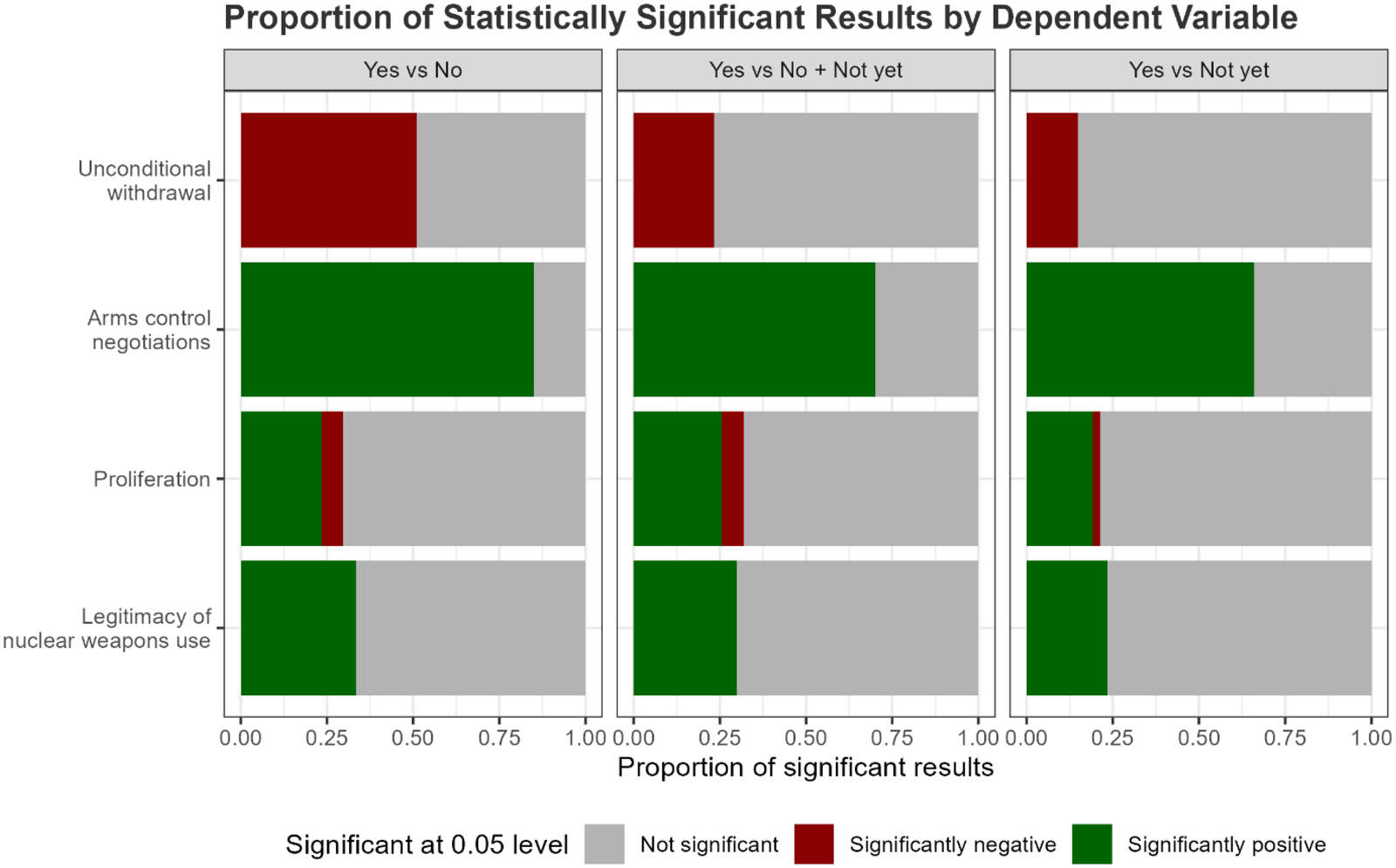
To summarize the potential effects of such researcher degrees of freedom, we include a post-hoc overview of the effect of each different approach and specification in the appendix. We summarize that overview in Figure 4 to show that most approaches yield significant effects for arms control but not for the other investigated outcomes, where most approaches produce null effects. These results are in line with the selected results reported in the previous section.
Summary of universe analysis containing all design choices and their outcomes, by dependent variable and comparison group.

Second, under the assumption that watching the movie is the treatment that leads to the potential effects, rather than exposure to media attention surrounding the movie being the treatment, we would expect there to be no significant differences between both untreated groups (those who haven't watched the movie but do intend to watch it in the future, versus those who haven't watched it and don't intend to). Instead, we find that for the arms control and proliferation outcomes, around 35% and 30% of our specifications produce significant results, respectively. This means one of two things. Either the method for this comparison is ineffective at separating the causal effect from the cross-sectional effect, or a treatment outside of watching Oppenheimer was administered to either of the two groups. The latter case is a particularly plausible explanation given extant results of secondary exposure (see e.g. Feldman and Sigelman, Reference Feldman and Sigelman1985; Schofield and Pavelchak, Reference Schofield and Pavelchak1989), which are likely moderated by interest in seeing the movie. However, both explanations cast doubt on the causal effect of watching the Oppenheimer movie in itself, but may bolster the hopes of the disarmament and arms control communities that even merely the conversation around Oppenheimer had some effect.
Third, we conduct sensitivity tests to gauge how large any unmeasured confounders would need to be to invalidate our results. In the IPW analyses, an unobserved confounder would need to explain between 2.2% and 5.9% of the residual variance in both the treatment and the outcome to render insignificant the estimated effects of watching Oppenheimer on support for arms control. In the PSM analyses, the unobserved confounder would need to explain between 3.8% and 4.4% of variance. In the DiD analyses, the unobserved confounder would need to explain between 1.3% and 3.2% of variance. These tests remind us that the presented effect on support for arms control negotiations is relatively sensitive to reasonably sized confounders, but not so sensitive that a negligible confounder would invalidate the results.
Fourth, placebo tests and parallel trends analyses are run on outcomes where we would not expect an effect of watching the movie. Between April and September 2023, more events presumably impacted attitudes in Italy than simply the release of Oppenheimer. Our DiD analyses assume that any such events would have impacted both groups at the same rate – or, in other words, that both groups show parallel trends outside of the treated period. We consider two placebo tests to ensure that any observed differences are attributable to the treatment effect rather than other external factors. First, drawing on Zaller's argument that levels of political interest determine people's potential for attitude change (Reference Zaller1992), we investigate if levels of knowledge on nuclear issues differ between the two groups. Our constructed nuclear weapons knowledge index is not significantly different between those predicted to see the movie and those not predicted to see the movie in the pre-release wave (knowledgeyes = 4.73, knowledgeno = 4.81, p = 0.4), reducing concerns about a lack of parallel trends. The comparisons between ‘yes’ and ‘not yet’ is similarly insignificant, but there is a significant difference in knowledge levels when comparing ‘yes’ with ‘no + not yet.’ Second, we should not expect to see significant estimates of having seen Oppenheimer on any of the exogenous variables that were not included in the prediction models. Indeed, out of the nine unused exogenous variables, not a single one appears to be significantly impacted by seeing the movie in this analysis. Last, the stable sample-wide attitudinal trends as shown in Figure 3 further assuage this concern somewhat.
Discussion and conclusion
The theory of narrative persuasion suggests that emotionally engaging narratives, such as those presented in movies, can significantly influence public attitudes and beliefs. Our findings contribute to the evaluation of these expectations. While we observed a significant increase in support for nuclear arms control negotiations among those who watched Oppenheimer, the effects on other dimensions of nuclear attitudes were either insignificant or inconsistent. These mixed results align with previous studies on narrative persuasion through films, which have shown variable impacts often depending on context, movie-specific attributes, or audience characteristics. In line with experts’ expectations, the movie's narrative, not uniformly in favor or opposed to nuclear weapons, may further explain these mixed results. While our study was situated in Italy, we may reasonably expect that it would be generalizable to other European countries under the US nuclear umbrella, as these countries benefit from US nuclear deterrence. While their publics have often been broadly skeptical of nuclear weapons, nuclear disarmament and arms control continues to attract broad support among the publics, and weapons are less likely to be viewed as an element of national status or pride.
In underscoring the complexities of narrative persuasion, these findings offer both encouraging insights and cautionary notes for advocates of arms control and disarmament. Despite the qualified positive impact of Oppenheimer on public support for arms control, the strategic use of compelling narratives in media is not a silver bullet for their campaigns. Our findings indicate that Oppenheimer presented nuclear weapons primarily as a dangerous but potentially useful (through their deterrent value). This explanation would be consistent with the view of the arms control community, which views nuclear weapons as risky, but not fundamentally useless (Onderco et al., Reference Onderco, Smetana and van der Meer2021). The lack of effect on preferences on nuclear proliferation and use, indirectly, aligns with such reading (as it indicates that those who viewed Oppenheimer supported gradual limitation of the risk, not its expansion). By contrast, the movie did not fulfil the expectations of the disarmers, who would probably hope that the movie would support a view that nuclear weapons are dangerous and disarmament (and abolition) are the only response. Like many films before it, Oppenheimer may not have lived up to the high expectations set by civil society advocates and experts.
Furthermore, it is important to recognize that potential effects are not uniformly distributed among the population. This highlights the difficulties in researching the policy impact of narrative persuasion. Even experimental and longitudinal designs are not always appropriately equipped to separate the effect of media ‘buzz’ as a treatment. Despite our best efforts to isolate causal effects of seeing the Oppenheimer movie, we are most likely unable to fully correct for selection effects, nor are we able to fully parse out the effects of primary versus secondary exposure.
Despite the above-mentioned methodological challenges, our paper provides but an indication that Oppenheimer did shift support for nuclear arms negotiation among the movie-goers. Overall, however, it appears unlikely that the movie fulfilled the expectations that the disarmament and arms control communities had for it. These findings highlight both the potential and limitations of narrative persuasion in shaping public attitudes. Our study underscores the need for a nuanced approach in advocacy efforts that balances the existential dangers and deterrent values associated with nuclear weapons.
Funding
Data collection for the paper was supported by the grant “Nuclear Politics in Europe” awarded to Michal Onderco by the Stanton Foundation. Open access funding provided by Erasmus University Rotterdam.
Data
The replication dataset is available at http://thedata.harvard.edu/dvn/dv/ipsr-risp.
Supplementary material
The supplementary material for this article can be found at https://doi.org/10.1017/ipo.2026.10088.
Acknowledgements
The authors contributed to the paper equally and are listed in alphabetical order. We are thankful to Mahmoud Javadi for his research assistance, to Alon Bergman, Neil Fasching, Jon Griffiths, Shanze Rauf, Dylan Small, and Alex Tolkin, as well as to participants at the University of Pennsylvania's ISCAP and CIND workshops and the ECSE conference participants for their helpful feedback.
Competing interests
The authors declare none.




 Open access

