





Introduction
Palliative care is a specialty area of practice, requiring excellent clinical and assessment skills, and highly developed communication skills. Regardless of their work-setting, nurses are likely to care for the patients, and their family, who have been told they are dying; thus, nurses need to engage in discussions regarding prognosis or medical futility.
While death is a certainty for everyone, palliative care skills are not a compulsory part of the nursing curriculum. Comparatively, cardiopulmonary resuscitation is frequently taught and skills tested annually, when it is reserved for a narrow population.
Literature and anecdotal evidence demonstrate that undergraduate nursing students are poorly prepared for palliative or end-of-life care (EoLC) and lack the skills and knowledge to confidently hold conversations with the dying and their families (Andersson et al. Reference Andersson, Salickiene and Rosengren2016; Kim et al. Reference Kim, Park and Shin2016), leading to stress, anxiety, and burnout (Kim et al. Reference Kim, Park and Shin2016). A common theme of newly graduated nurses is frustration and lack of time to attend to patients with palliative care needs (Andersson et al. Reference Andersson, Salickiene and Rosengren2016), while also attending to the general or clinical needs of other patients. Similarly, Henderson et al. (Reference Henderson, Rowe and Watson2016) suggest that despite some exposure to death and dying either in clinical practice or within the curricula, students feel ill-prepared as graduates.
Previous research found a gap in palliative care education in undergraduate nursing curriculum worldwide (Fabro et al. Reference Fabro, Schaffer and Scharton2014; Kopp and Hanson Reference Kopp and Hanson2012; Sarabia-Cobo et al. Reference Sarabia-Cobo, Alconero-Camarero and Lavín-Alconero2016). The undergraduate nursing curriculum usually focuses on preparing students for acute care practice, with palliative care often taught incidentally alongside concepts such as chronic illness management, the deteriorating patient, and medical futility, rather than as a stand-alone unit of study. Interprofessional communication and clinical handover skills are routinely taught, but challenging discussions centered around death and dying are often left to be learned in the clinical environment. This can prove challenging for undergraduates if clinical placements do not provide opportunities for them to participate or observe these skills in action.
The use of simulation can bridge the gap between clinical placement and theoretical content (Kirkpatrick et al. Reference Kirkpatrick, Cantrell and Smeltzer2017). Being immersed in a task or a setting allows the participant to practise skills and strategies for “real-world” settings. Simulation is particularly useful in communication training, as realistic conversations coupled with body language and emotions are difficult to simulate in other learning approaches (Aldridge Reference Aldridge2017). During simulation with mannequins, participants remain aware that they are “practicing” skills. Within an immersive simulation, using actors or simulated patients (SPs), the environment is designed to allow participants an experience that is experiential, interactive, and learner-centered (Aldridge Reference Aldridge2017; Jeffries et al. Reference Jeffries, Rodgers and Adamson2015). Training an SP is essential if simulation is to be distinguished from role playing. Suspending disbelief relies on the ability of the facilitator to set the scene, replicate real life, and encourage participation and learning (Hamstra et al. Reference Hamstra, Brydges and Hatala2014; Muckler Reference Muckler2017). If done well, students can believe events while being aware that it is a form of role play.
Previous research on palliative care communication with undergraduate nurses included measures of attitude in caring for the dying, demonstrating improvements in attitude and self-awareness (Ferguson and Cosby Reference Ferguson and Cosby2017; Kirkpatrick et al. Reference Kirkpatrick, Cantrell and Smeltzer2019; Lippe and Becker Reference Lippe and Becker2015). While all papers focused on communication, some also combined nursing skills in the simulation. Of these, all reported an increase in confidence with nursing tasks as well as communication skills with a patient approaching the end of their life (Fabro et al. Reference Fabro, Schaffer and Scharton2014; Ferguson and Cosby Reference Ferguson and Cosby2017; Fluharty et al. Reference Fluharty, Hayes and Milgrom2012; Hjelmfors et al. Reference Hjelmfors, Strömberg and Karlsson2016). These studies used a mix of simulation and a mannequin to impart new knowledge and skills acquisition; despite the different approaches, a perceived lack of palliative care preparedness was a common finding.
A key goal of nursing education is to prepare students for future practice, and Kirkpatrick et al. (Reference Kirkpatrick, Cantrell and Smeltzer2019) recommend the use of simulation as an alternative to clinical experience. Further research into its impact on student learning was recommended.
Methods
Aim
The aim of the research was to determine the influence of a palliative care communication simulation for undergraduate nursing students, and 4 specific questions were identified. Three questions were answered by the quantitative data collected in the research:
1. Have the participants’ attitudes toward EoLC changed as a result of the simulation?
2. Does prior experience with death, either personally or professionally, change the influence of the simulation?
3. Do the demographics of participants impact attitudes toward the care of the dying patient and their family?
Setting
The setting was a simulated environment at 2 university campuses with second-year nursing or third-year midwifery students, who attended a 2-hour workshop where the simulation was conducted. Sixteen workshops were facilitated for 480 students enrolled in the same core subject. Sampling from both campuses occurred, to access students with differing demographics; a higher international student cohort in one (A), and a dual degree (B) in the other. Eight workshops were conducted at campus A, 7 at campus B and 1 online for students who were either offshore or unable to attend due to COVID-19 restrictions. Each workshop had approximately 30 students, with 15 attending online. Two educators facilitated the simulation alongside a paid actor for the SP role. Students were informed of the research as part of the simulation and invited to participate via posters and links in online learning content. Participation was entirely voluntary and no incentives were offered to students. Prior to the workshop, students were introduced to the patient “Michelle” through online content developed by the Palliative Care Cirruculum for undergraduates [PCC4U] (2022). On entering the workshop, students were able to see the SP on a bed in a simulated hospital ward environment.
Study design
The research employed a pre- and post-study design with quantitative data collected using Frommelts Attitude Toward Care of the Dying (FATCOD-B) scale, a 30-item, 5-point Likert scale questionnaire with an accompanying set of demographic questions (Frommelt Reference Frommelt2003). The FATCOD-B tool includes both positive and negative forms of questioning to gauge attitudes of participants when thinking about caring for patients and their family during EoLC. Permission was sought from the author of the tool; while minor alterations to the accompanying demographic questions accommodated the population and scope of study, the scale was unchanged to ensure compatibility with other studies and to support reliability of the results.
The simulation was divided into 3 distinct sections within the 2-hour workshop. First, a pre-briefing and planning session allowed students to prepare for the simulation. This session summarized the expectations, including behavior and responsibilities during the simulation. Emotional safety was discussed, outlining the nature of the simulation, acknowledging that strong emotions may develop. A list of supports was provided as part of their pre-learning, and students were reminded that they may excuse themselves should the need arise. Not all students were required to communicate with the patient; however, active participation via direct observation was required for those not directly interacting with the SP.
During the simulation, 6 to 8 pairs of students were invited to take turns approaching the patient and engage in clinical therapeutic communication. Although educators facilitated the simulation, communication was guided by the SP, who had just been told of her poor prognosis and processing her own mortality. The SP used prompts to allow the students to guide discussion, such as “I wish my husband was here,” “I know I will die soon,” “How will I tell my children” and “what does palliative care mean?” Students were able to “tap out” of the simulation or the educator would pause the simulation to allow the next group of students to resume the conversation.
Next, a debriefing discussion was facilitated by educators. Questions were initially addressed to those who interacted directly with the SP, promoting discussion about how they felt and explored positive or negative experiences. Following this, active observers and the SP were invited into the discussion, with questions and comments encouraged from all.
Pre-simulation data collection occurred in the days leading up to the simulation and post-simulation data collection followed conclusion of the workshop.
Analysis
Qualtrics© was used to collect the participants’ responses. Data were downloaded to Microsoft Excel for Mac and was screened for errors. Completed questionnaires were individually checked for missing data, and participants’ pre- and post-questionnaires were matched. Those with a missing post-simulation questionnaire response or questionnaires with large amounts of missing data were removed. Once matching was accomplished, student identification numbers were removed and a unique identifier was used to protect the anonymity of participants. After data cleaning, 90 datasets remained eligible for analysis.
Coding the FATCOD-B scale required changing responses from a nominal scale to a numerical scale. Additionally, half the questions were negatively worded, and these questions were reverse-scored prior to analysis to reflect this. Finally, data were entered into SPSS© version 28 for Mac software.
Results
The aim of this research was to determine the influence of the palliative care communication simulation experienced by undergraduates, with additional questions relating to change in attitude toward EoLC. Of further interest was whether prior experience with death or the participants’ demographic characteristics influenced how participants experienced the simulation.
Descriptive statistics were used to analyze the demographic information. Pre- and post-simulation mean and change scores were calculated for each participant. These figures were used in a series of paired or independent t-tests to assist in answering the research questions. Cronbach’s alpha was calculated to determine the reliability of the survey, statistical significance was set at p < .05, and effect size using Cohen’s d was reported as either small (<.2), medium (.5–), or large effect (≥.8) (Cohen Reference Cohen1988).
Findings
Of the 480 students enrolled in the course, 311 participated in the pre-simulation survey and 215 participated in the post-simulation survey, with a response rate of 64.79% and 44%, respectively. As previously discussed, 90 participants remained eligible for data analysis. The 30-item FATCOD-B scale was assessed for internal consistency using Cronbach’s alpha coefficient scores for the pre- and post-simulation surveys. The items within the scale for each were calculated as .88 and .89 respectively, demonstrating good internal consistency of the items (Field Reference Field2015). Looking at the histogram and test of normality, Kolmogorov–Smirnov was not significant. Additionally, skewness and kurtosis were nonsignificant; therefore, the researchers were confident to move ahead with further tests. The total possible score on the FATCOD-B tool was between 30 and 150. Higher scores reflected more positive attitude toward caring for the dying (Ferri et al. Reference Ferri, Di Lorenzo and Stifani2021). No set value to determine positive attitude within the FATCOD-B tool is provided by the author; however, 65% of the total score has been previously set as an arbitrary point (Paul et al. Reference Paul, Renu and Thampi2019) to determine a positive attitude. Using this calculation, a score above 97.5 was chosen to indicate a positive attitude.
Demographic data
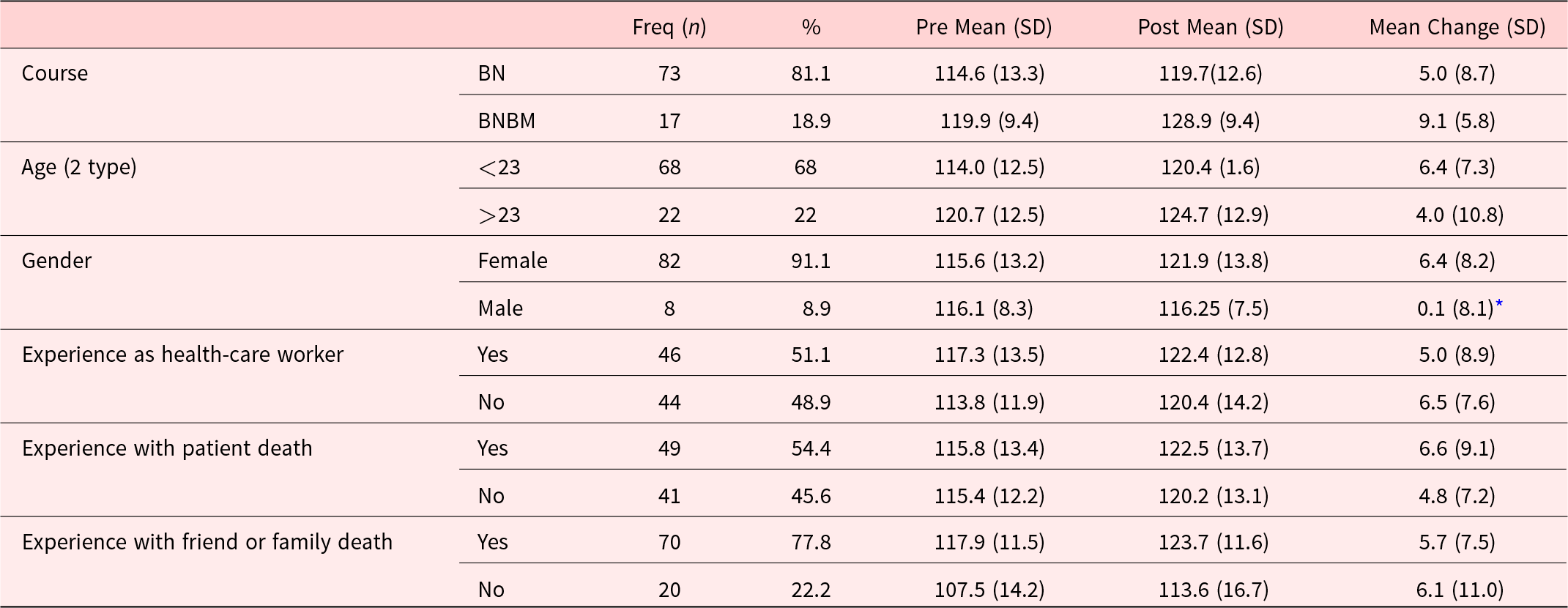
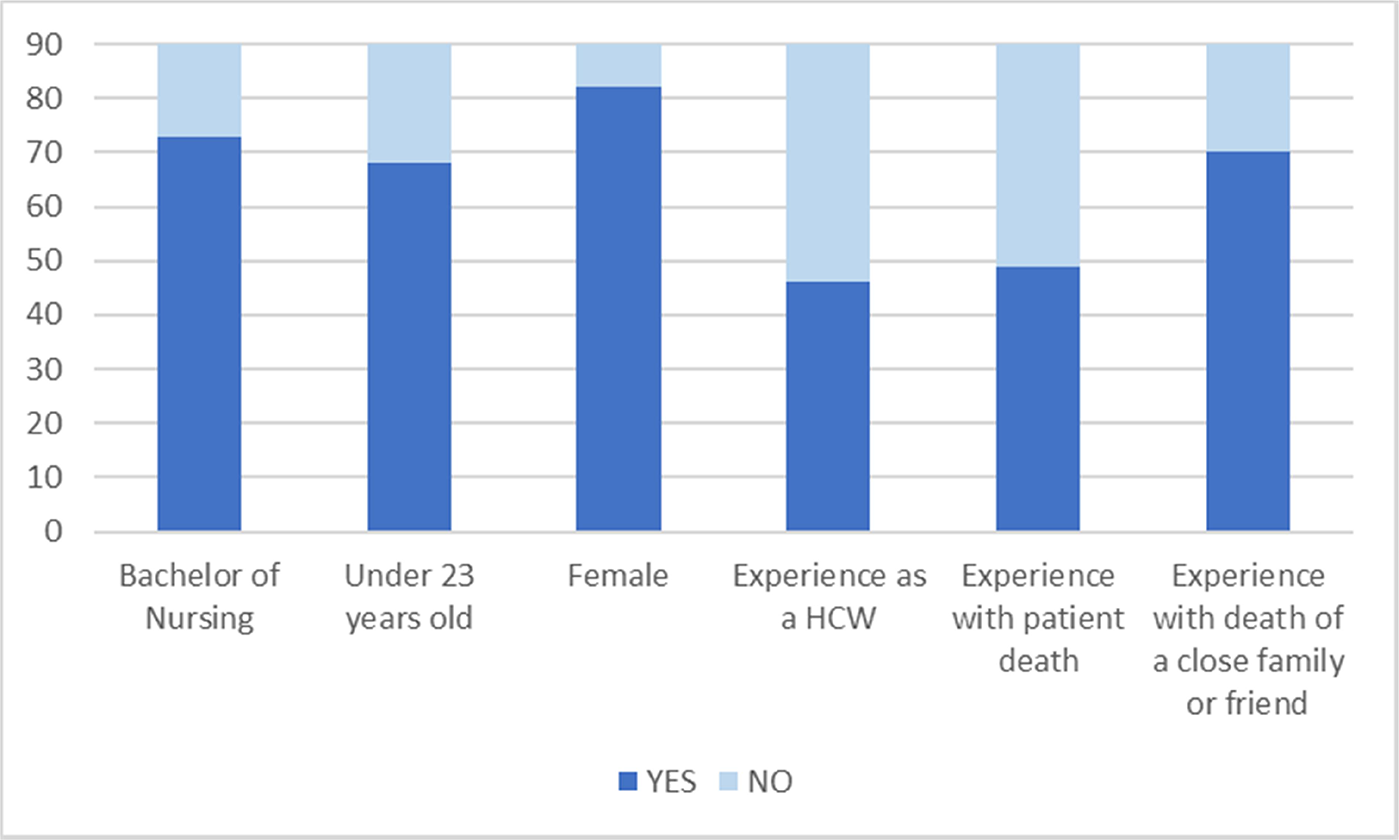
The participants’ demographic details (Table 1, Figure 1) were not equally distributed within the sample.
Demographic data (n = 90)

* Statistical significance.
Participant demographics.

Independent t-tests for each demographic category were performed, using the mean change score to determine whether a change in score pre- and post-simulation had statistical significance. In this study, a statistically significant result was found when comparing gender: females (M = 6.36 SD = 8.18) and males (M = .13 SD = 8.13; t(88) = 2.06, p = .04) with a medium effect size, (d = .77).
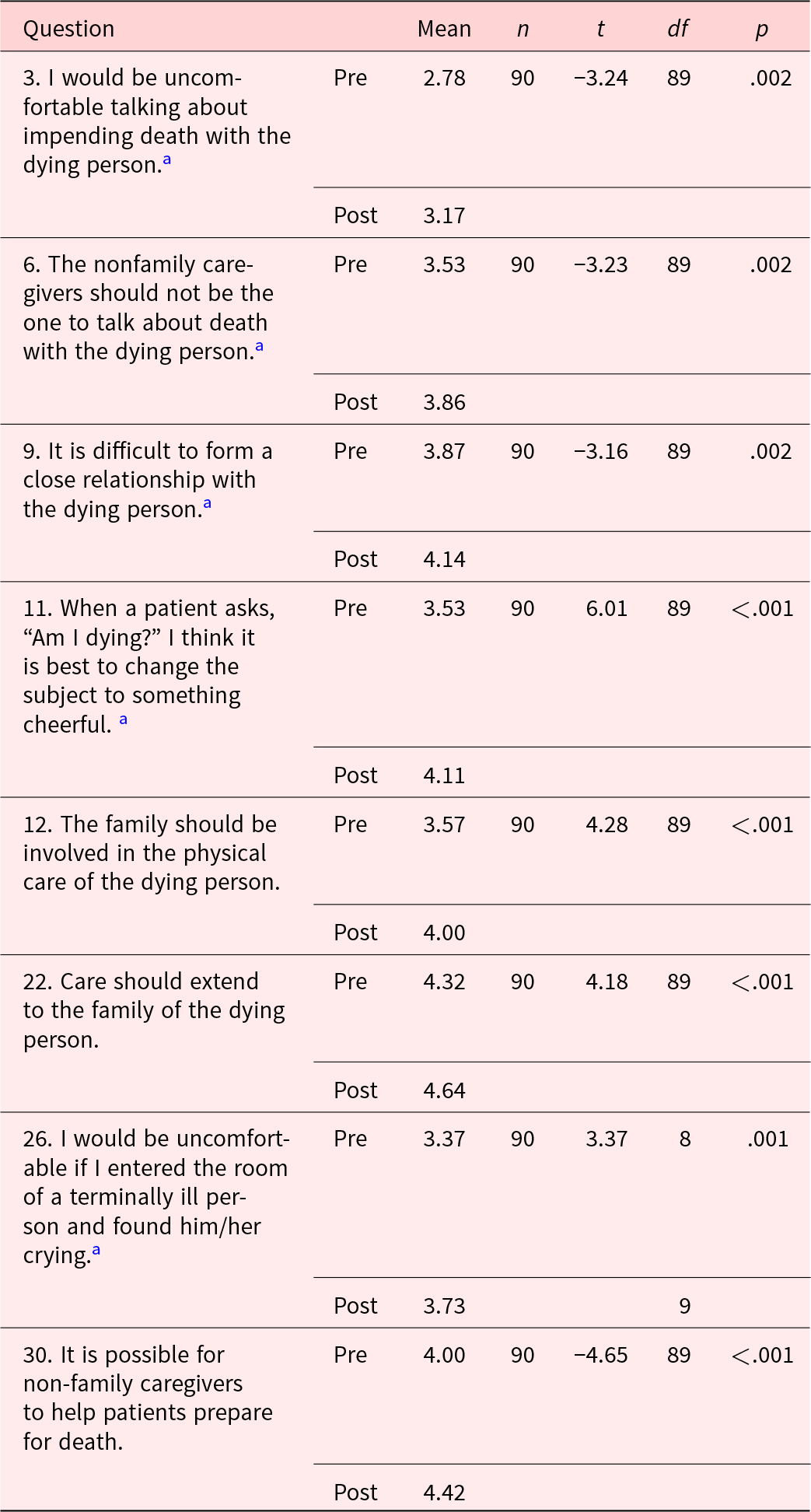
A paired t-test was also conducted to evaluate the impact of the simulation. The change between the pre- and post-simulation scores for participants was used. There was a statistically significant increase in FATCOD-B scores from pre-simulation (M = 115.64 SD = 12.80) and post-simulation scores (M = 121.45 SD = 12.44), t (89) = 6.62, p < .001 with a medium effect size noted (d = .70). The mean increase in FATCOD-B scores was 5.81, with a 95% confidence interval ranging between 4.06 and 7.55. Additional paired t-tests were performed for each of the 30 FATCOD-B questions posed to participants, to reveal the questions most statistically significant (Table 2).
Questions with a statistically significant change between pre- and posttest

a Negatively worded questions are reverse scored.
Discussion
EoLC is not reserved for the palliative care ward; rather nurses and midwives, in any health setting, will inevitably care for a patient and/or their family at the end of their life. Palliative care education is essential to prepare for practice. Results from the FATCOD-B tool indicate that regardless of demographics, the simulation had an overall positive change in attitude toward care of the dying. It was hypothesized that prior experience with death, either personally or professionally, would limit the educational intervention; however, this was not demonstrated in the mean change in FATCOD-B score. This suggested that simulation had a positive influence on participants’ attitude toward caring for the dying, regardless of previous exposure to death. It is noteworthy, however, that participants with no previous experience of death or a family member or close friend had, on average, the lowest scores both pre- and post-simulation. Participants’ demographic diversity had an effect when comparing results between genders, where statistical significance was demonstrated. The minimal change in overall male scores and negative change in several individuals suggests a need for additional research.
Observing the participant demographics, an unequal spread between genders, course enrolment and age was noted. This was expected skew in distribution as it was reflective of the student enrolment in a Bachelor of Nursing (BN) and Bachelor of Nursing and Midwifery (BNBM) (female students entering tertiary education within a year of completing secondary school) programs in Australia. In 2020, the university where the study took place, reported the nursing and midwifery enrolments were 88% female, and 71% of the students were under 25 years old (Univeristy Planning and Statistics 2020). This gender skew is observed throughout the nursing and midwifery workforce, with the Australian workforce comprising 88.5% female, 11.5% male and <0.1% not stated, intersex or indeterminate (Nursing and Midwifery Board of Australia 2021). Internationally. this is also reflected, a recent report (World Health Organization [WHO] 2020), includes data from 191 countries, and reports approximately 10% of the world nursing workforce are men, indicating the comparability of the percentages in this study
Gender was the only demographic variable which demonstrated statistical significance. Significance occurred as men had only a minor increase overall in their post-simulation scales. On further investigation of the results and data, 2 of the 8 men in the study had unchanged scores between pre- and post-simulation scores, and 3 men had negative change scores. Looking to previous research utilizing the FATCOD-B tool, several studies (Berndtsson et al. Reference Berndtsson, Karlsson and Rejnö2019; Zahran et al. Reference Zahran, Hamdan and Hamdan-Mansour2022) also showed a statistically significant change in mean scores between gender, with male participants demonstrating a lower mean change when compared to female participants; however, this was not a finding represented in all studies that used the FATCOD-B tool. The original study conducted by Frommelt (Reference Frommelt1991) into the attitudes toward care of the dying demonstrated no statistical significance between male and female participants; however, those participants were already employed registered nurses, and took part in an education program rather than a communication simulation.
Male participants in this study who showed negative or no score change between pre-and post-simulation, all had previous experience with a patient’s death. This may indicate that experience gave them a sense of preparedness or a more positive attitude toward care of the dying. On the other hand, an overconfident attitude toward the care of the dying pre-simulation may be explained by studies finding that men under-report death anxiety (Bassett Reference Bassett2015). Men may be bound by the gender stereotypes of a protector and one who can navigate emotions or challenging situations with more ease than women (Fischer and LaFrance Reference Fischer and LaFrance2015; Wu et al. Reference Wu, Oliffe and Bungay2015). Participants may have also been affected by social-desirability bias (Mills et al. Reference Mills, Wand and Fraser2018), regardless of the anonymity of the questionnaire, presenting a favorable image of themselves in the pre-simulation questionnaire. However, once confronted with the prospect of caring and communicating with a dying patient in this simulation, participants may have felt less confident, and their negative change in attitude scores reflected this. Further, the small sample of men in this study makes it difficult to determine whether there would have been such disparity between the genders if there were equal numbers of male and female participants. As already noted, disparity in gender is reflected in the nursing workforce, as well as the university cohorts in undergraduate nursing, suggesting that repeated sampling would produce similar gender disparity.
The review of literature only identified 3 palliative care or EoLC simulations using FATCOD-B as a data collection tool. Ferguson and Cosby (Reference Ferguson and Cosby2017) conducted a simulation with a high-fidelity mannequin that was programmed with an EoLC scenario and an actor playing the role of the family member. Unlike the simulation in this research, the participants were required to provide EoLC and interact with the family member. Participants in Ferguson and Cosby’s (Reference Ferguson and Cosby2017) study undertook a pre-simulation FATCOD-B survey and debriefing afterward. Unfortunately, the FATCOD-B 30-item Likert scale was modified to only 12 items, and the FATCOD-B results were not reported in the article, so comparison is unavailable. Further review of the literature was unable to uncover any studies that used FATCOD-B in a simulation that could be used to assess similarity. This new finding warrants further exploration in future studies.
Communication simulations using the FATCOD-B scale (Ferguson and Cosby Reference Ferguson and Cosby2017; Kirkpatrick et al. Reference Kirkpatrick, Cantrell and Smeltzer2019; Lippe and Becker Reference Lippe and Becker2015) do not make mention of individual participants’ scores, reporting only a single score where no pre- and post-intervention questionnaire was administered, or in reporting an overall improvement of a cohort. Although changes in individual scores are thought-provoking, they do not reflect the overall attitude of students; this may be why the findings are unreported in previous studies.
Several studies found that exposure to EoLC, either in simulation or clinical experience improves attitude toward care of the dying (Croxon et al. Reference Croxon, Deravin and Anderson2018; Fristedt et al. Reference Fristedt, Grynne and Melin-Johansson2021). This was reflected in the current study, with most participants (n = 67) having a positive increase in their scores across the 2 survey periods. It is important to acknowledge, however, participants already possessed a positive attitude toward caring for the dying, with the mean pre-simulation FATCOD-B score above 96.5 for all participants, greater than 65% of the total score achievable.
In analyzing questions, the most positive responses in the pre-simulation survey were as follows: Question 1 – “Giving care to the dying person is a worthwhile experience”; and Question 4 – “Caring for the patient’s family should continue throughout the period of grief and bereavement.” Both questions were positively worded, and participants’ responses indicated that care of the dying was considered part of their role and was viewed as a positive work activity. Leombruni et al. (Reference Leombruni, Miniotti and Bovero2013) noted similar findings with participants in their study with highest scores in Question 1. Despite reports of discomfort and feeling of poor preparation by undergraduate nursing students when caring for the dying, they view this care as worthwhile and positive (Berndtsson et al. Reference Berndtsson, Karlsson and Rejnö2019; Croxon et al. Reference Croxon, Deravin and Anderson2018; Dimoula et al. Reference Dimoula, Kotronoulas and Katsaragakis2019).
Prior to the simulation, participants were able to recognize the importance of providing family care alongside care of the patient. When the post-simulation survey was reviewed, Question 4 from the FATCOD-B again had the highest score and Question 22 “Care should extend to the family of the dying person,” further demonstrated participants’ family-centered care focus. This was also noted in a recent Indian study (Paul et al. Reference Paul, Renu and Thampi2019). Providing a patient- and family-centered approach in palliative care is essential as the family remains after a death (Keeley Reference Keeley2017) and their needs extend beyond that of the dying patient.
Interestingly the question with the largest change in mean score was Question 11, “When a patient asks, ‘Am I dying?’ I think it is best to change the subject to something cheerful.” During the simulation, the SP directly asks the participants if he/she is going to die. Participants needed to navigate discomfort when the SP asked this direct and confronting question. The change in the mean score demonstrates learning that occurred within the simulation and the debriefing, also aligning with findings from similar research (Jeffries et al. Reference Jeffries, Rodgers and Adamson2015; Rattani et al. Reference Rattani, Kurji and Khowaja2020; Tamaki et al. Reference Tamaki, Inumaru and Yokoi2019). Providing EoLC is not limited to physical care, and learning to navigate difficult discussions can be challenging for undergraduates. Kim et al. (Reference Kim, Park and Shin2016) found that undergraduates and inexperienced nurses report less anxiety and are more comfortable following death-related education interventions or clinical experience. Valen et al. (Reference Valen, Holm and Jensen2019) also found that participants in an end-of-life simulation reported simulation to be less scary than real life and the experience to be a valuable intervention in a safe learning environment.
Several other questions indicated an improvement in attitude. In particular, Question 2 “Death is not the worst thing that can happen to a person,” and Question 29 “Family members who stay close to a dying person often interfere with the professional’s job with the patient.” These negatively worded questions, although not statistically significant, clearly showed participants reevaluated feelings and attitudes surrounding these questions. This demonstrated an increased understanding of an end-of-life diagnosis and the burden of treatment, for both the person and family members. This aligns with Rattani et al. (Reference Rattani, Kurji and Khowaja2020) who suggested that post-simulation, participants were more ready to extend care to the family of the dying. Given that one of the highest educational needs is considered to be communication with the dying patient and their family, these findings are positive (Lewis et al. Reference Lewis, Reid and McLernon2016).
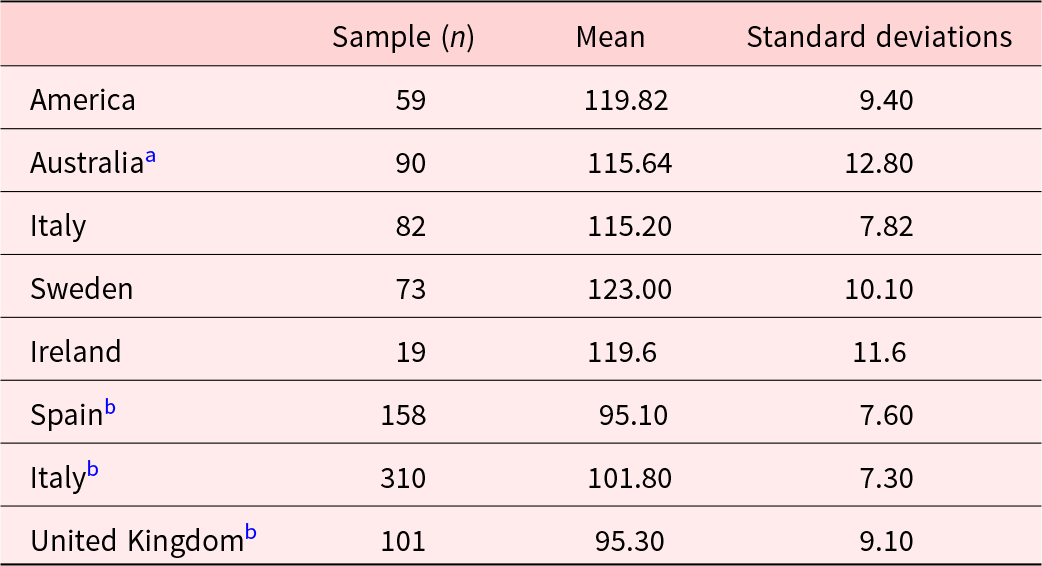
To understand how the participants’ attitudes to care of the dying scores compare internationally, the pre-simulation scores were compiled into a table format and evaluated with other studies that used the FATCOD-B scale (Table 3).
International undergraduate studies using FATCOD

a This research.
b European multicenter study.
Participants in the current research demonstrated lower pre-simulation mean scores when compared with participants in American, Swedish, and Irish studies (Berndtsson et al. Reference Berndtsson, Karlsson and Rejnö2019; Lewis et al. Reference Lewis, Reid and McLernon2016; Mallory Reference Mallory2003); however, results from an Italian pretest demonstrated similar scores (Leombruni et al. Reference Leombruni, Miniotti and Bovero2013). Pre-simulation scores are suggestive of the pre-existing knowledge, skills, and attitudes toward palliative care, and although different courses and years of undergraduate study, it was indicative of the attitudes toward the care of the dying prior to any intervention. A score over 97.5, or 65% of the total FATCOD-B score, has been previously set as an arbitrary point (Paul et al. Reference Paul, Renu and Thampi2019) for a positive attitude toward care of the dying; however, there is no set value to determine a positive attitude within the FATCOD-B tool. Rationale for comparing studies before the educational intervention is to determine whether attitudes internationally, prior to any specific palliative care education, are similar in undergraduate nursing programs.
Differences in these results may also be attributed to the number of years of previous nursing education; the curriculum delivered to participants; and the impact of beliefs associated with death or EoLC, indicating a need for international research. The extensive literature search reveals this study as the first to report a focus of communication only, in the context of palliative care; as such, comparing post-intervention scores was inappropriate as they would not be meaningful. Additionally, it is inappropriate to generalize the scores to students who are undertaking a different education delivery program. Rather, the results can be used to measure the outcome of the educational intervention within the context of this study, which could then be replicated for comparison.
By providing a safe and positive learning environment for undergraduate nursing students, the university increases the likelihood that students will possess a positive attitude toward difficult and challenging communication. This will have a supportive effect for patients and their families, not just when caring for the dying or those in palliative care, but communication in general.
Limitations
This research was limited by the number of participants in the study. While 90 participants were included in the results, this number would have been increased had more complete surveys been returned.
Participants had 2 valuable, but different, experiences within the workshop, either actively engaging with the SP or observing the simulation. This information was not collected in the questionnaire and would be useful to include in future research. Similarly, the questionnaire did not collect data as to whether the participants were international or domestic students. Given the university has many international students, it would have been valuable to compare the 2 groups to determine if international student’s results were similar to domestic students.
Finally, given the sensitive or personal nature of the information collected, the participants may also have been reluctant to share information, despite completing the questionnaire online. There is also a risk that for similar reasons, participants may not have been entirely transparent or truthful in their responses due to social desirability bias.
Conclusion
This study supports the hypothesis that a palliative care communication simulation will improve participant attitudes towards care to patients and their families during EoLC. As anticipated, the palliative care communication simulation demonstrated an overall statistically significant improvement in attitudes toward caring for the dying, consistent with previous research where educational interventions were employed and a pre- and post-intervention FATCOD-B questionnaire was utilized. It was however, impossible to make a true comparison, as no previous research used a communication-only simulation, with many combining communication with care provision or clinical skills practice. Being a male participant demonstrated a statistically significant result. They were less likely to have an improved score and at times showed a negative trend in attitude post-simulation. Participants with the most positive attitudes, however, were those over 23 years of age. Both pre- and post-simulation, this cohort of participants had the highest score, demonstrating the most positive toward the care of the dying, although their change score was not significant.
The findings support the continuation of the educational intervention. Exposure to a positive learning environment for conducting conversations about death and dying will allow students to approach clinical situations with less apprehension. As with many studies, the research has identified areas where additional information would be valuable, and further research is recommended to provide clarity or richness to these findings.
Author contributions
All authors have agreed on the final version and meet at least either of the following criteria:
1) Substantial contributions to conception and design, acquisition of data, or analysis and interpretation of data or
2) Drafting the article or revising it critically for important intellectual content.
Funding
This research received no specific grant from any funding agency, commercial or not-for-profit sectors.
Competing interests
No conflict of interest has been declared by the authors.
Ethical approval
Questions about past lived experience with death and dying, as well as the content of the core subject and the simulation had the potential to cause distress; thus, attention to students’ emotional well-being was required. Ethical approval was gained through the University Human Research Ethics Committee (project: 29995). Additionally, approval was gained from the university Nursing and Midwifery education register (project: 2021:61). This ensured research conducted within the school met requirements of educational research, as well as ensured students are protected from frequent research requests. Counseling services were also offered and links to other supportive services provided.

 Open access

